北京市第十八中学 2021-2022 学年度第二学期期中练习
初二英语
班级 _______ 姓名_______
考试须知
1.本试卷共 8 页,共七道大题,57 道小题,满分 60 分,考试时间 90 分钟。
2.在试卷和草稿纸上准确填写姓名、准考证号、考场号和座位号。
3.试题答案一律填涂或书写在答题卡上,在试卷上作答无效。
4.在答题卡上,选择题用 2B 铅笔作答,其他试题用黑色字迹签字笔作答。
5.考试结束,请将本试卷、答题卡和草稿纸一并交回。
知识运用(共 15 分)
一、单项填空(共 5 分,每小题 0.5 分)
从下面各题所给的 A、B、C、D 四个选项中,选择可以填入空白处的最佳选项。
1. You could play with the sad girl and cheer __________ up.
A. him B. her C. them D. you
【答案】B
【解析】
【详解】句意:你可以和那个伤心的女孩一起玩,让她高兴起来。him他,her她的,them他们,you你。
根据You could play with the sad girl可知此处表示让那个女孩高兴起来,代指那个女孩用代词her。故选B。
2. —When is Jay’s concert?
—It’s at three o’clock ________ the afternoon of July 18th.
.
A to B. at C. on D. in
【答案】C
【解析】
【详解】句意:——周杰伦的演唱会是什么时候?——时间是7月18日下午3点。
考查时间介词辨析。to到;at后接具体时刻;on后接具体某一天;in后接某年某月某季节。“the afternoon
of July 18th”是具体的一天,应填on,故选C。
3. —___________do you have to stay at home?
—Because I have something important to do.
A. When B. Why C. Who D. Which
【答案】B【解析】
【详解】句意:—为什么你不得不待在家?—因为我有很重要的事要做。
考查特殊疑问句。When什么时候;Why为什么;Who谁;Which哪一个。根据回答中Because可知,问
句是在询问原因,用Why引导的特殊疑问句。故选B。
4. My parents and I ________ trees last Sunday.
A. plant B. will plant C. are planting D. planted
【答案】D
【解析】
【详解】句意:我的父母和我上星期天种树。
考查一般过去时。根据“last Sunday”可知,时态是一般过去时,故选D。
5. Sorry, sir. I ________ follow you. Would you please speak slower?
A. can’t B. mustn’t C. shouldn’t D. needn’t
【答案】A
【解析】
【详解】句意:对不起,先生,我听不懂。请你说慢一点好吗?
考查情态动词。can’t不能;mustn’t禁止;shouldn’t不应该;needn’t不需要。根据“Would you please speak
slower”可知说话人不能跟上先生,听不懂了,应用can’t。故选A。
6. —Lingling, can you play football with me now?
—Sorry, I can’t. I ________ a chocolate pie.
A. made B. make C. am making D. was making
【答案】C
【解析】
【详解】句意:——玲玲,你现在能和我一起踢足球吗?——对不起,我不能。我正在做巧克力派。
考查动词时态。根据“can you play football with me now?”可知句子的时态是现在进行时,故选C。
7. Robots all the heavy and difficult jobs in the future.
.
A do B. did C. are doing D. will do
【答案】D
【解析】
【详解】句意:机器人将在未来做所有繁重和困难的工作。
考查一般将来时。do动词原形;did过去式;are doing现在进行时;will do一般将来时;根据“in the
future”可知,此处用一般将来时,故选D。
8. ——Lucy, is your uncle a teacher?——Yes,he is.He history for nearly 20 years.
A. teaches B. has taught C. is teaching D. will teach
【答案】B
【解析】
【详解】句意:——露西,你叔叔是老师吗? ——是的,他教了将近20年的历史了。考查现在完成时。
根据for nearly 20 years可知,这是一个表示一段时间的时间状语,通常用于现在完成时,而且动词应该用
延续性动词,现在完成时态结构为have/has+动词的过去分词。故选B。
【点睛】本题主要考查现在完成时。用法:表示过去发生或完成的动作对现在造成的影响或结果,还表示
过去发生动作一直持续到现在。其结构是have/has+及物动词的过去分词。此题注意短暂性动词和延续性动
词的区别。
9. Scientists ________ to send spaceships to Mars in the 1960s.
A. begin B. have begun C. began D. were beginning
【答案】C
【解析】
【详解】句意:科学家们在20世纪60年代开始向火星发射宇宙飞船。
考查动词时态。根据“in the 1960s”可知,句子是一般过去时,动词用过去式,故选C。
10. -I worked in an old people’s home last summer.
-Oh, what did they ask you_________ out with?
A. help B. to help C. helping D. helped
【答案】B
【解析】
【详解】句意:——去年夏天我在一个老年人之家工作。——哦,他们要求你帮助什么?ask sb to do sth要
求某人做某事,故用动词不定式to help,故选B。
二、根据句意和所给的首字母补全单词。(共 5 分,每小题 0.5 分)
11. What a m____! You should put away these useless things.
【答案】(m)ess
【解析】
【详解】句意:真是一团糟!你应该把这些无用的东西收起来。根据“put away these useless things.”可知东
西摆的到处都是,很乱,mess“混乱”,是名词,故填(m)ess。
12. My mother keeps healthy by eating healthy food and taking e____.
【答案】(e)xercise
【解析】【详解】句意:我妈妈通过吃健康的食物和锻炼来保持健康。根据“by eating healthy food and taking...”和
首字母提示可知,此处是指通过锻炼来保持健康。固定短语take exercise“做锻炼、运动”。故填
(e)xercise。
13. The dancer felt a bit n________ in her first performance.
【答案】nervous
【解析】
【详解】句意:舞蹈演员第一次表演时有点紧张。
根据语境及首字母可知,此处应为nervous紧张的,形容词,在句中作表语,意为“感觉紧张”。故答案
为nervous。
14. He is not at home. You can leave a m________ for him.
【答案】(m)essage
【解析】
【详解】句意:他不在家。你可以给他留个口信。固定短语leave a message“留口信”,故填(m)essage。
15. I like swimming best. It’s my f________ sport.
【答案】(f)avourite##(f)avorite
【解析】
【详解】句意:我最喜欢游泳。这是我最喜欢的运动。根据“swimming”结合单词首字母可知,此处是指
最喜欢的运动,favourite/favorite“最喜欢的”,是形容词,故填(f)avourite/(f)avorite。
16. I have many h________, like collecting stamps, taking photos and so on.
【答案】(h)obbies
【解析】
【详解】句意:我有很多爱好,比如集邮,拍照等等。 根据“like collecting stamps, taking photos and so
on”及首字母可知,此处列举自己的爱好,hobby“爱好”,many修饰可数名词的复数形式,故填
(h)obbies。
17. Two years ago, the young man was w____ and he often fell ill, but now he is very strong.
【答案】(w)eak
【解析】
【详解】句意:两年前,这个年轻人身体虚弱,经常生病,但现在他非常强壮。根据“but ”可知此处是表
示转折,现在很强壮,过去很虚弱,weak“虚弱的”,是形容词,故填(w)eak。
18. We all know that stones are hard. They are not s____ at all.【答案】(s)oft
【解析】
【详解】句意:我们都知道石头是硬的。它们一点也不软。根据“stones are hard”结合单词首字母可知石
头不软,soft“柔软的”,是形容词作表语,故填(s)oft。
19. We all know that the moon moves around the e________.
【答案】(e)arth
【解析】
【详解】句意:我们都知道月亮围绕地球转。根据常识可知,月亮围绕地球转,地球的英文是earth,定冠
词the表示特指,只有一个地球。故填(e)arth。
20. The old man didn’t want to live in London. He decided to m____ to his hometown.
【答案】(m)ove
【解析】
【详解】句意:这位老人不想住在伦敦。他决定搬到家乡去。根据“He decided to...to his hometown.”结合单
词首字母可知,此处指的是搬家,move“搬家”,是动词,空前有不定式符号to,动词用原形,故填
(m)ove。
三、完形填空(共 5 分,每小题 0.5 分)
My First Marathon(马拉松)
A month before my first marathon, one of my ankles (脚踝) was injured and this meant not running for two
weeks, leaving me only two weeks to train. Yet, I decided to go ahead.
I remember back to my 7th year in school. In my first P.E. class, the teacher asked us to run laps and then hit a
softball. I didn’t do ___21___. He later told me that I was “not athletic”.
The idea that I was “not athletic” ___22___ me for years. When I started running in my 30s, I realized
running was a battle against myself, not about competition or if I was athletic. It was all about the battle against my
own body and mind. A test of wills!
The night before my ___23___, I dreamt that I couldn’t even find the finish line. I woke up sweating (出汗)
and nervous, but ready to prove something to myself.
Shortly after crossing the start line, my shoe laces (鞋带) became untied. So I ___24___ to readjust (再调整).
Not the start I wanted!
At mile 3, I passed a sign: “GO FOR IT, RUNNERS!”
By mile 17, I became out of breath and the once injured ankle hurt badly. Despite the pain, I stayed the course
walking a bit and then ___25___ again.
By mile 21, I was starving!As I got mile 23, I could see my wife waving a sign. She is my biggest fan. She never ___26___ the alarm
clock sounding at 4 a.m. or questioned my expenses on running.
I was one of the ___27___ runners to finish. But I finished! And I got a medal. In fact, I got the same medal
as the one that the guy who came in first place had.
Determined to be myself, move forward, free of shame and worldly labels (世俗标签), I can now call myself a
“marathon ___28___”.
21. A. happily B. quietly C. excitedly D. well
22. A. moved B. troubled C. questioned D. confused
23. A. marathon B. trip C. walking D. leaving
24. A. refused B. failed C. stopped D. promised
25. A. walking B. waving C. finishing D. running
26. A. minded B. heard C. stopped D. changed
27. A. first B. final C. injured D. crossed
28. A. coach B. runner C. winner D. trainer
【答案】21. D 22. B 23. A 24. C 25. D 26. A 27. B 28. C
【解析】
【分析】文章大意:本文为一篇记叙文。讲述了自己第一次跑马拉松,凭借自己的意志力成功跑完全程的
励志故事。
【21题详解】
句意:我做得不好。
happily高兴地;quietly安静地;excitedly兴奋地;well很好地。根据下文“He later told me that I was “not
athletic”.”可知是我做得不好,设空处修饰前面的动词do,因此用副词well,故选D。
【22题详解】
句意:我“不擅长运动”的想法困扰了我很多年。
moved被移动的;troubled困惑的;questioned怀疑的;confused混乱的。根据下文“When I started running
in my 30s, I realized running was a battle against myself,…”结合“The idea that I was “not athletic” … me for
years.”可知是“不擅长运动”的想法困扰了我很多年,30多岁开始跑步时,我意识到跑步是一场与自己
的战斗……,故选B。
【23题详解】
句意:在我跑马拉松的前一天晚上,我梦见我甚至找不到终点线。
marathon马拉松赛跑;trip旅行;walking步行;leaving离开。根据上文“A month before my first
marathon,”可知是在我跑马拉松的前一天晚上,故选A。【24题详解】
句意:所以我停下来重新调整。
refused拒绝;failed失败;stopped停止;promised许诺。根据上文“my shoe laces (鞋带) became untied.”
鞋带松了,可知应是停下来调整,故选C。
【25题详解】
句意:尽管很疼,我还是坚持走了一会儿,然后再跑。
walking走;waving挥手;finishing完成;running跑。根据“I stayed the course walking a bit and then …
again.”结合语境,可知我在参加马拉松比赛,因此应是坚持走了一会儿后接着再跑,故选D。
【26题详解】
句意:她从不介意凌晨4点的闹钟响,也从不质疑我的跑步费用。
minded介意;heard听到;stopped停止;changed改变。根据上文“She is my biggest fan.”她是我的忠实粉
丝,可知应是不介意凌晨4点的闹钟响,也从不质疑我的跑步费用。故选A。
【27题详解】
句意:我是最后一名跑完全程的选手之一。
first第一;final最后;injured伤害;crossed交叉。根据下文“But I finished! And I got a medal. In fact, I got
the same medal as the one that the guy who came in first place had.”结合“I was one of the … runners to
finish.”可知我是最后一名跑完全程的选手之一,故选B。
【28题详解】
句意:我现在可以称自己为“马拉松赢家”。
coach教练;runner跑步者;winner获胜者;trainer训练员。根据上文“But I finished! And I got a medal. In
fact, I got the same medal as the one that the guy who came in first place had.”可知我最后完成了马拉松比赛,
而且还获得了一枚奖章,因此应该是现在可以称自己为“马拉松赢家”,故选C。
阅读理解(共 31 分)
四、阅读下列短文,根据短文内容,从短文后各题所给的 A、B、C、D 四个选项中,选择
最佳选项。(共 26 分,每小题 2 分)
A
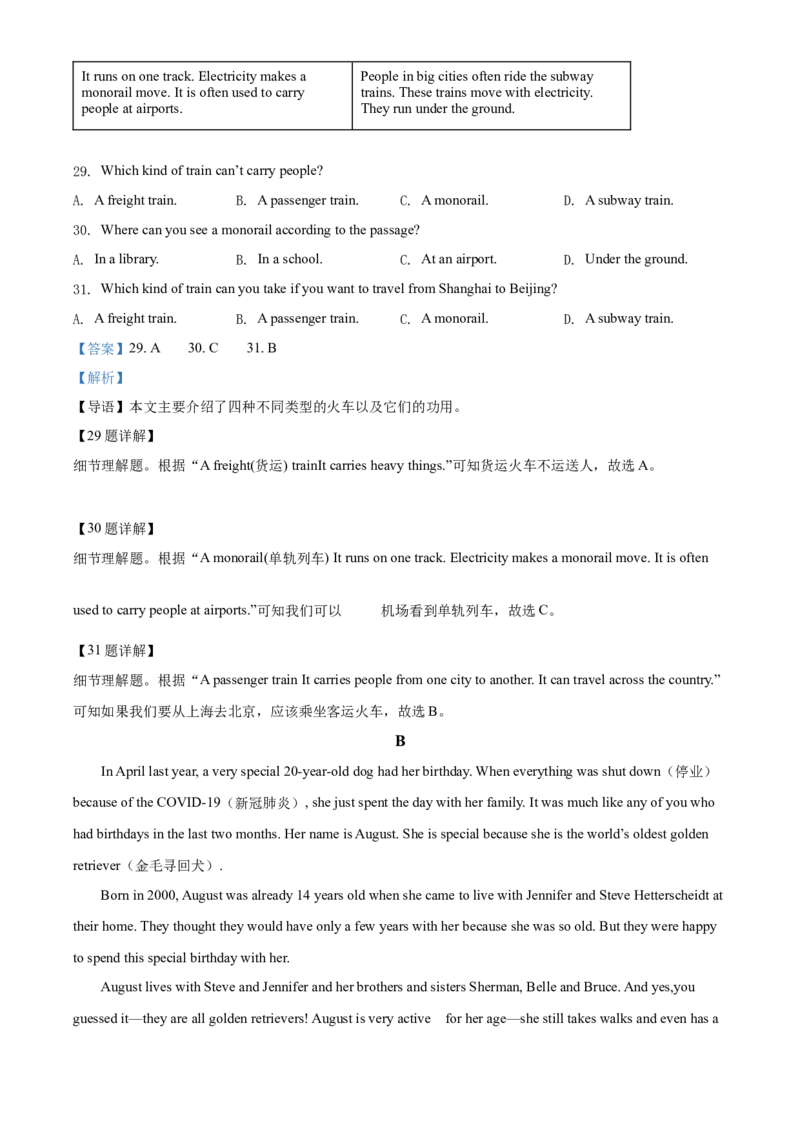
A train is a set of cars. Some trains carry people. Others carry things. Trains can move along one track(轨道)
or two. Trains can move very fast. But they can’t stop quickly. Here are some different trains.
A freight(货运) train A passenger train
It carries heavy things. A freight train often It carries people from one city to another. It
travels long distances. can travel across the country.
A monorail(单轨列车) A subway trainIt runs on one track. Electricity makes a People in big cities often ride the subway
monorail move. It is often used to carry trains. These trains move with electricity.
people at airports. They run under the ground.
29. Which kind of train can’t carry people?
A. A freight train. B. A passenger train. C. A monorail. D. A subway train.
30. Where can you see a monorail according to the passage?
A. In a library. B. In a school. C. At an airport. D. Under the ground.
31. Which kind of train can you take if you want to travel from Shanghai to Beijing?
A. A freight train. B. A passenger train. C. A monorail. D. A subway train.
【答案】29. A 30. C 31. B
【解析】
【导语】本文主要介绍了四种不同类型的火车以及它们的功用。
【29题详解】
细节理解题。根据“A freight(货运) trainIt carries heavy things.”可知货运火车不运送人,故选A。
【30题详解】
细节理解题。根据“A monorail(单轨列车) It runs on one track. Electricity makes a monorail move. It is often
在
used to carry people at airports.”可知我们可以 机场看到单轨列车,故选C。
【31题详解】
细节理解题。根据“A passenger train It carries people from one city to another. It can travel across the country.”
可知如果我们要从上海去北京,应该乘坐客运火车,故选B。
B
In April last year, a very special 20-year-old dog had her birthday. When everything was shut down(停业)
because of the COVID-19(新冠肺炎), she just spent the day with her family. It was much like any of you who
had birthdays in the last two months. Her name is August. She is special because she is the world’s oldest golden
retriever(金毛寻回犬).
Born in 2000, August was already 14 years old when she came to live with Jennifer and Steve Hetterscheidt at
their home. They thought they would have only a few years with her because she was so old. But they were happy
to spend this special birthday with her.
August lives with Steve and Jennifer and her brothers and sisters Sherman, Belle and Bruce. And yes,you
guessed it—they are all golden retrievers! August is very active for her age—she still takes walks and even has aswim from time to time!
So, how old can dogs live? Most dogs can live 10 to 15 years. For golden retrievers, they can live 12 to 15
years. It is really a wonder(奇迹)for August to live such a long life!
32. Why is August special?
A. Because she has a good family. B. Because she has a strange name.
C. Because she has a very old age. D. Because she has a kind owner.
33. When did August come to this family?
A. In 2000. B. In 2014. C. In 2001. D. In 2015.
34. What can we know about August?
A. She lives with her three children.
B. She spent her twentieth birthday in a restaurant.
C. She sometimes takes walks or has a swim.
D. She’s been with Jennifer and Steve for 20 years.
【答案】32. C 33. B 34. C
【解析】
【导语】本文主要介绍了世界上最年老的金毛寻回犬庆祝20岁生日的故事。
【32题详解】
细节理解题。根据“She is special because she is the world’s oldest golden retriever”可知,她很特别,因为她
是世界上最老的金毛寻回犬,故选C。
【33题详解】
推理判断题。根据“Born in 2000, August was already 14 years old when she came to live with Jennifer and
Steve Hetterscheidt at their home”可知,出生于2000年,来到Jennifer和Steve家是14岁,由此可推断,她
是在2014年来到这个家庭的,故选B。
【34题详解】
细节理解题。根据“she still takes walks and even has a swim from time to time”可知,她有时去散步和游泳,
故选C。
C
One day after school, I went to the teacher’s office to see my teacher, but nobody was there. As I was about to
leave, I noticed a piece of paper on the floor. I picked it up and saw the words “FINAL-TERM EXAMINATION”
at the top. I put the paper into my school bag secretly and ran out of the room.
After I came back home, I took out the paper quickly. It was the exam paper of my worst subject, History. I
felt excited. My heart beat fast. I took out my History book and started working on the answer. I had neveranswered any questions so seriously.
On the day of the History exam, I went into the exam hall confidently. When the paper was sent to me, I
dreamt of getting the highest mark in the whole grade and could not help smiling. “My History teacher always
encouraged me to work hard and get better grades, but I let him down time and time again. This time I will give
him a big surprise,” I thought.
When the teacher said we could start, I turned the paper over. To my surprise, all the questions were different.
Later I felt nervous. In the end, I almost left the paper undone. After the exam, I ran to the toilet, took out the paper
and carefully read it from the top. Oh! It was last year’s exam paper. I read all the questions but I hadn’t read the
date.
This is a lesson in which I know I have to put my feet on the ground. I regretted doing such a silly thing. After
that, I told my teacher the truth and I promised to be honest. From then on, I worked harder than ever before.
35. The writer went to the teacher’s office to ________.
A. take an exam B. see his teacher C. get his school bag D. ask some questions
36. The writer always ________ in his History exams.
A. got high marks B. did silly things C. let his teacher down D. left the paper undone
37. When did the writer know it was last year’s exam paper?
A. Before he read all the questions. B. As soon as he returned home.
C. Until he went into the teacher’s office. D. After he read the paper in the toilet.
【答案】35. B 36. C 37. D
【解析】
【导语】本文是一篇记叙文。通过一份历史试卷的故事告诫我们:人必须要诚实、脚踏实地做事。
【35题详解】
细节理解题。根据“One day after school, I went to the teacher’s office to see my teacher, but nobody was there”
可知,去老师办公室的目的是为了看老师,故选B。
【36题详解】
细节理解题。根据“My History teacher always encouraged me to work hard and get better grades, but I let him
down time and time again”可知,老师总是鼓励作者努力学习,取得高分,但是作者一次一次的让他失望,
故选C。
【37题详解】
细节理解题。根据“After the exam, I ran to the toilet, took out the paper and carefully read it from the top. Oh! It
的
was last year’s exam paper”可知,作者在卫生间看试卷后才知道那份试卷是去年 ,故选D。D 说明文 关系型(AB) A影响B
①Are you a happy person most of the time? Or do you easily get angry sometimes? Everyone has a different
temperament(脾气). It is usually believed that both genes(基因)and environment may affect(影响)
people’s temperaments in different ways. But now scientists have found that the season of birth also plays a role.
②Scientists from Budapest, Hungary, studied 400 university students. In the study, the students needed to
finish a questionnaire(问卷 ). The purpose of it was to find out which of four kinds of temperaments they most
had. From the questionnaire, scientists found that the students always answered something like “My mood often
changes for no reason” and “I love to deal with new projects, even if it is risky”. These answers were then matched
with their birthdays.
③They discovered that people born in summer easily change between sad and happy moods compared to
people born in winter. Those who always feel positive are mostly born in spring and summer.
④The study also found that those born in autumn less probably had a mood of depression which may easily
drive them to cry, while those born in winter were not easier to be angry.
⑤Scientists said that this was probably because the seasons had an influence on certain chemicals in the
.
human body And the chemicals are important to control people’s moods even in adult life.
⑥“It seems that when you are born may increase or decrease your chance of developing certain mood
disorders(紊乱), ” lead scientist Xenia Gonda told The Telegraph.
38. What probably can’t affect(关系)people’s temperaments(脾气)according to Paragraph 1?
A. Genes. B. Ages. C. Seasons. D. Environment.
39. What does the underlined word “depression” most probably mean?
A. Sadness. B. Happiness. C. Surprise. D. Excitement.
40. Which of the following sentences is NOT true from the passage?
A. People born in summer change their moods more easily.
B. The season of birth has an influence on human’s moods.
C. There were 400 middle school students taking part in the study.
D. The answers to the questionnaire were matched with their birthdays.
41. What’s the best title for this passage?
A. Seasons and Moods B. The Influence of Genes
C. Moods and Health D. The Importance of Birthplaces
【答案】38. B 39. A 40. C 41. A
【解析】
【导语】本文主要通过实验讲述人的脾气不但受人的基因和环境影响,而且人出生的季节也起作用。研究表明,夏天出生的人比冬天出生的人情绪易变。研究还发现,秋天出生的人极少有可能出现消极情绪,而
冬天出生的人不容易生气。这也许是人体内化学变化起作用的结果。
【38题详解】
细节理解题。根据短文第一段“It is usually believed that both genes(基因)and environment may affect(影
响)people’s temperaments in different ways. But now scientists have found that the season of birth also plays a
role”的描述可知,年龄不可能影响人的脾气。故选B。
【39题详解】
词义猜测题。根据下文“which may easily drive them to cry”的描述可知,这里指的是秋天出生的人极少有
可能出现消极情绪。故选A。
【40题详解】
细节理解题。根据“Scientists from Budapest, Hungary, studied 400 university students”可知,来自匈牙利布达
佩斯的科学家对400名大学生进行了研究,而不是中学生,故选C。
【41题详解】
标题归纳题。本文主要通过实验讲述了季节对人的情绪的影响。故选A。
五、阅读短文,根据短文内容回答问题。(共 10 分,每小题 2 分)
Loan words
Our class project last month was to find out more about loan words, words which are borrowed by one
language from another.
There are thousands of loan words in English, because English is influenced by a variety of different
languages, and, for that reason, it has a huge number of loanwords. It is said that 80 percent of English words come
from other languages. Some speakers prefer using foreign words and phrases in place of English ones—they think
they sound more interesting.
Two Asian languages which have a lot of loan words are Japanese and Korean. Most of the loan words in
Japanese come from Chinese and English. Chinese words, and the Chinese characters, first came into the Japanese
language more than 1,000 years ago. Chinese characters which are used in Japanese are called kanji, and many
Chinese Kanji have different meanings or pronunciations, as well as occasionally being written slightly differently.
In recent times, Japanese has also borrowed many words from Portuguese, German (especially medical
words), French and Italian (especially words about music and food). Non- Chinese loan words are written in
another alphabet, called katakana.
There are also a lot of Chinese words and characters in Korean. More recently, Korean has also taken a lot of
words from English. However, when they are used in Korean, the meanings of many words and expressions
change. For example, the English word “dessert” means something sweet that you eat at the end of a meal. InKorean, the word now means something you drink at the end of a meal—tea, coffee or a soft drink.
42. What are loan words?
_______________
43. Why does English have a huge number of loan words?
_______________
44. When did Chinese words first come into the Japanese language?
_______________
45. What does the English word “dessert” mean in Korean?
_______________
46. What are the last three paragraphs mainly about?
_______________
【答案】42. Loan words are the words which are borrowed by one language from another.
43. Because English is influenced by a variety of different languages.
44. More than 1,000 years ago.
45. It means something you drink at the end of a meal—tea, coffee or a soft drink.
46. Both Japanese and Korean have a lot of loan words.
【解析】
【导语】本文主要讲述了各种语言的外来词,几乎世界上每种重要的语言都有外来词。
【42题详解】
根据“Our class project last month was to find out more about loan words, words which are borrowed by one
language from another”可知,外来词就是一种语言从另一种语言中借来的单词,故填Loan words are the
words which are borrowed by one language from another.
【43题详解】
根据“There are thousands of loan words in English, because English is influenced by a variety of different
languages, and, for that reason, it has a huge number of loanwords”可知,英语有大量的外来词是因为英语受各
种不同语言的影响,故填Because English is influenced by a variety of different languages.
【44题详解】
根据“Chinese words, and the Chinese characters, first came into the Japanese language more than 1,000 years
ago”可知,汉语和汉字在1000多年前首次进入日语,故填More than 1,000 years ago.
【45题详解】
根据“In Korean, the word now means something you drink at the end of a meal—tea, coffee or a soft drink”可知,
在韩语中,这个词现在的意思是餐后喝的东西——茶,咖啡或软饮料,故填It means something you drink at
the end of a meal—tea, coffee or a soft drink.【46题详解】
根据“Two Asian languages which have a lot of loan words are Japanese and Korean”以及这三段的内容可知,
这几段主要介绍了两种有很多外来词的亚洲语言是日语和韩语,故填Both Japanese and Korean have a lot of
loan words.
书面表达(共 14 分)
六、完成句子。根据中文提示完成下列英文句子,每空一词。(共 4 分,每小题 0.5 分)
47. 苹果派听起来不错。
Apple pie ________ ________.
【答案】 ①. sounds ②. good##great##nice
【解析】
【详解】sound“听起来”,连系动词,后接形容词作表语;good/great/nice“好的”,陈述事实,句子用一
般现在时,主语是单数形式,动词用三单,故填sounds;good/great/nice。
48. 我哥哥在校网球队。我为他骄傲!
My brother is in the school tennis team. I am ________ ________ him!
【答案】 ①. proud ②. of
【解析】
【详解】根据中英文对照可知空处应填“为……骄傲”,固定短语be proud of“为……骄傲”,故填
proud;of。
49. 他们正在倒数天数。
They are _______________ the days.
【答案】counting down
【解析】
【详解】根据题干可知,本句是现在进行时(be doing)。固定短语count down“倒数”,count的现在分词为
counting。故填counting down。
50. 你想过其他的比赛吗?
Have you ever _______________ other kinds of competitions?
【答案】thought of
【解析】
【详解】根据中英文对照可知空处应填“想过”,固定短语think of“考虑,思考”,根据“Have”可知句子
是现在完成时,动词用过去分词,故填thought of。
51. 这个旅程花了几个月。The journey ________ several months.
【答案】took
【解析】
【详解】对比中英文可知,空处缺少“花费”的翻译。主语journey指物,且空格后接的是时间,用take
表示“花费”,描述过去发生的事情,句子用一般过去时,故填took。
52. 这很难想像。
It is _______________ imagine.
【答案】hard to
【解析】
【详解】分析句子可知考查句型It is+形容词+to do sth“做某事是……的”,hard“艰难的”,形容词。故填
hard to。
53. 教练通常和我们一起参加训练。
Our coach usually _______________ in the training with us.
【答案】takes part
【解析】
【详解】固定短语take part in“参加”;根据“usually”可知,本句是一般现在时,且主语“Our coach”是第
三人称单数,动词需用三单形式。故填takes part。
54. 该看卡通片啦。
_______________ to watch a cartoon.
【答案】It’s time
【解析】
【详解】根据中英文对照可知,此处缺少“该是做……的时候”;固定句型It’s time to do sth.“该是做某事
的时候了”。故填It’s time。
七、文段表达(10 分)
55. 根据中文和英文提示,写出意思连贯、符合逻辑、不少于60词的短文,所给提示词语仅供选用,
请不要写出你的校名和姓名。
“读万卷书,行万里路”。旅行让人开阔眼界,增长知识。在你的旅行经历中,有哪一段经 历是最
令你难忘的呢?你去了什么地方?经历了些什么?你的感受如何?请以“An unforgettable travel experience”
为题,分享你最难忘的旅行经历。
提示词语:beach, visit, take photos, enjoy, wonderful
提示问题:
Where did you go and who did you go with?What did you do there?
How do you feel?
____________________________________________________________________________________________
____________________________________________________________________________________________
____________________________________________________________________________________________
__________________________________________________________________
【答案】例文
I won’t forget the first time I traveled alone forever. Last summer vacation, I went to the summer camp in
Yunnan. At first, I was kind of afraid because it was the first time I traveled alone. But my parents encouraged me a
lot. Then I met many kids and we became good friends. We went to climb the mountain together happily and
helped each other on the way. At last, we got to the top of the mountain. We had a picnic there. We were all very
excited. I learned a lot from this experience. I know how to deal with problems when I face them.
【解析】
【详解】1.题干解读:本文是一篇话题作文。以“An unforgettable travel experience”为题,分享你最难忘的
旅行经历。
2.写作指导:本文时态以一般过去时为主。人称采用第一人称行文。写作时按照提示问题进行写作,可围
绕话题适当发挥使行文连贯,确保语句通顺,无单词语法错误。