2024-2025 学年八年级英语下学期单元语法精讲精练(人教版)
03 情态动词 could 表示请求或允许的用法
语法聚焦
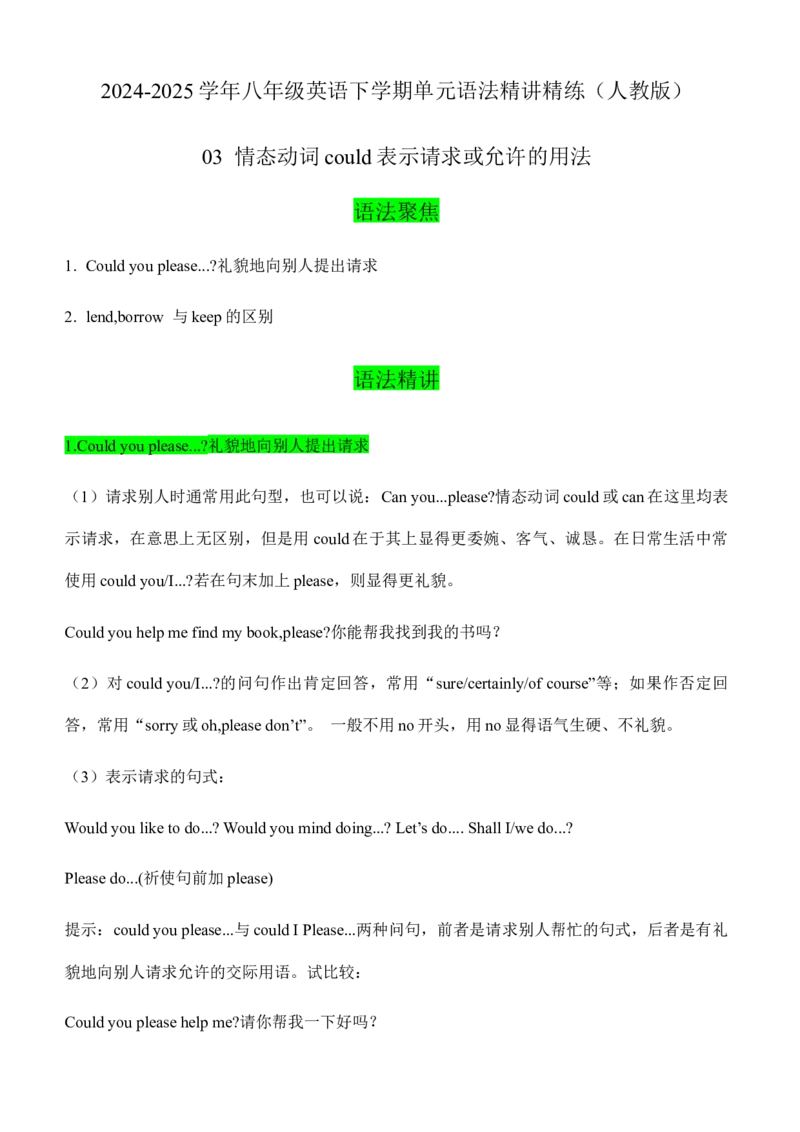
1. Could you please...?礼貌地向别人提出请求
2. lend,borrow 与keep的区别
语法精讲
1.Could you please...?礼貌地向别人提出请求
(1)请求别人时通常用此句型,也可以说:Can you...please?情态动词could或can在这里均表
示请求,在意思上无区别,但是用could在于其上显得更委婉、客气、诚恳。在日常生活中常
使用could you/I...?若在句末加上please,则显得更礼貌。
Could you help me find my book,please?你能帮我找到我的书吗?
(2)对could you/I...?的问句作出肯定回答,常用“sure/certainly/of course”等;如果作否定回
答,常用“sorry或oh,please don’t”。 一般不用no开头,用no显得语气生硬、不礼貌。
(3)表示请求的句式:
Would you like to do...? Would you mind doing...? Let’s do.... Shall I/we do...?
Please do...(祈使句前加please)
提示:could you please...与could I Please...两种问句,前者是请求别人帮忙的句式,后者是有礼
貌地向别人请求允许的交际用语。试比较:
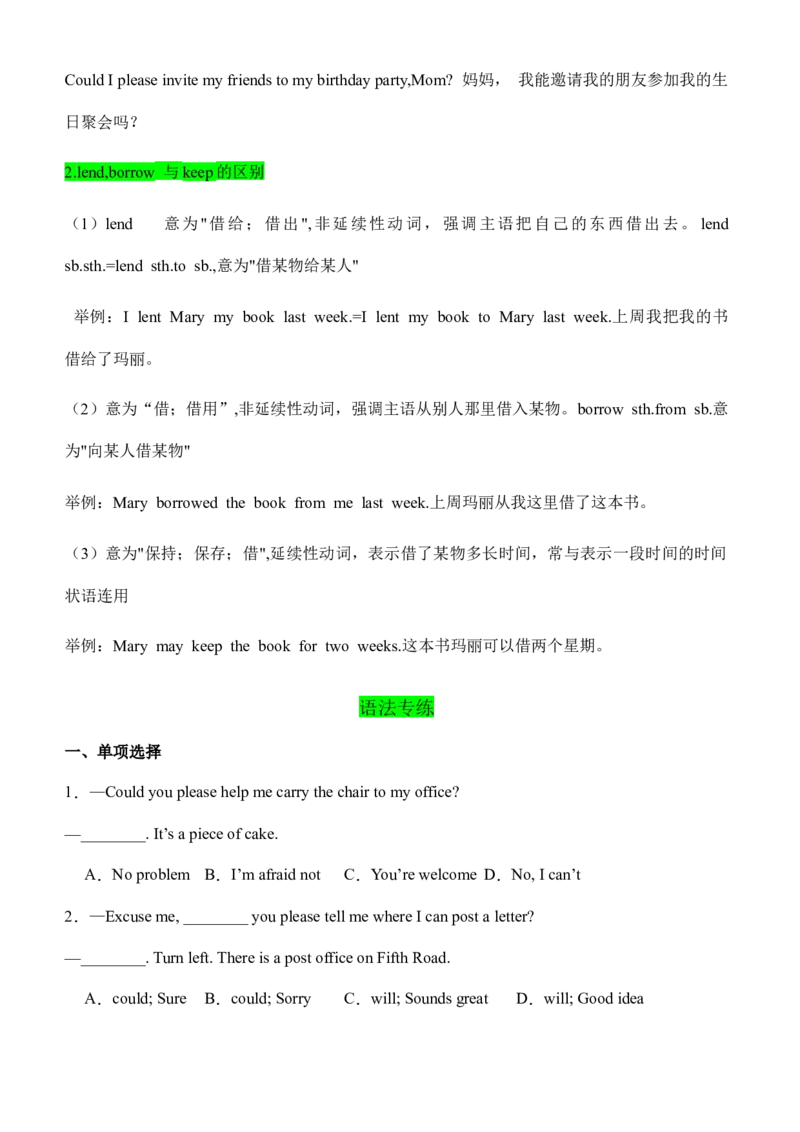
Could you please help me?请你帮我一下好吗?Could I please invite my friends to my birthday party,Mom? 妈妈, 我能邀请我的朋友参加我的生
日聚会吗?
2.lend,borrow 与keep的区别
(1)lend 意为"借给;借出",非延续性动词,强调主语把自己的东西借出去。lend
sb.sth.=lend sth.to sb.,意为"借某物给某人"
举例:I lent Mary my book last week.=I lent my book to Mary last week.上周我把我的书
借给了玛丽。
(2)意为“借;借用”,非延续性动词,强调主语从别人那里借入某物。borrow sth.from sb.意
为"向某人借某物"
举例:Mary borrowed the book from me last week.上周玛丽从我这里借了这本书。
(3)意为"保持;保存;借",延续性动词,表示借了某物多长时间,常与表示一段时间的时间
状语连用
举例:Mary may keep the book for two weeks.这本书玛丽可以借两个星期。
语法专练
一、单项选择
1.—Could you please help me carry the chair to my office?
—________. It’s a piece of cake.
A.No problem B.I’m afraid not C.You’re welcome D.No, I can’t
2.—Excuse me, ________ you please tell me where I can post a letter?
—________. Turn left. There is a post office on Fifth Road.
A.could; Sure B.could; Sorry C.will; Sounds great D.will; Good idea3.—Can you ________ me your homework?
—Sorry, you can’t ________ homework from others. Copying others’ homework is wrong.
A.borrow; lend B.keep; borrow C.lend; borrow D.keep; lend
4.—________ people talk with friends by QQ twenty years ago?
—No, but today most of us ________ do that.
A.Can; could B.Could; can C.Could; could D.Could; can’t
5.—Mike, I can’t stop playing computer games.
—For your eyes, my dear friend, I’m afraid you ________ .
A.could B.may C.would D.have to
6.—Excuse me. _______ I sit here?
—You’d better not. It’s the man’s seat.
A.Must B.Need C.Could D.Should
7.—Could you play the piano at the age of five?
—No, I ________. I started at six.
A.can’t B.shouldn’t C.needn’t D.couldn’t
8.—Could I invite my friends to the party on Saturday, Mom?
—Of course you ________. That sounds like fun.
A.may B.could C.must D.can
9.—Could you go to the new movie with me now?
—Sorry, I _____. Look, it’s time for me to watch The Reader on CCTV.
A.can’t B.can C.needn’t D.must
10.— Ruby, could you please help me do some washing?
— ________. Mom, I’ m studying for my English test.A.Go ahead B.No problem C.Sorry, I can’t D.Yes, of course
11.—Can you ________ with us on Friday night?
—Sure, I’d love to.
A.hang over B.hang out C.bring out D.take up
12.— May I speak to Tom?
— Please ________. I’ll see if he is here.
A.hang on B.hang up C.hang out D.hang over
13.The worker of the library said I could ________ the book for three days.
A.lend B.keep C.borrow D.give
14.— Can I ________ your bike?
— With pleasure. But you mustn’t ________ it to others.
A.lend; borrowB.borrow; lend C.lend; lend D.borrow; borrow
15.—________ you please help me look for my English book? I can’t find it anywhere.
—With pleasure.
A.Should B.Must
C.Might D.Could
16.You ________ ask your friends for help if you don’t know how to work out the math problem.
A.could B.would
C.must D.might
17.—Jack, could you please ________ the door? I have a cold.
—Of course.
A.to close B.closed
C.close D.closing18.My little sister ________ ride bikes at the age of four.
A.should B.could
C.had to D.need
19.—Could you ________ tomorrow? I have something to tell you.
—OK, I will.
A.come about B.come by C.come off D.come over
20.—May I borrow a dictionary ________ you?
—Sure.
A.at B.from C.to D.on
21.Could you ________ your bike to me this Sunday? My bike is broken.
A.borrow B.lend C.save D.keep
22.—Could you pass _______, please?
—Certainly. Here you are.
A.me to the book B.the book to me
C.me for the book D.the book for me
23.Could I buy ________ drinks and snacks?
A.some B.any C.something D.anything
24.-Excuse me, could you please help me do the dishes?
-__________.
A.No problem B.Yes, I do C.It’s a good idea D.Not at all
25.—Could you please help me do the dishes?
—________. I cut my finger and I’m trying not to get it wet.
A.Yes, sure B.Sorry, I can’t C.Yes, here you are26.—______ you please take the dog for work?
—OK, but I have to fold the clothes first.
A.Must B.Should C.Could D.May
27.—Could you please do the dishes?
—________. I cut my finger and I’m trying not to get it wet.
A.Yes, sure B.No problemC.Sorry, I’m afraid I can’t D.That would be fine
28.—My English is poor. Could you help me with it?
—________.
A.Thank you B.Me, too C.No problem D.See you
29.—Could you please give me a cake?
—________.
A.Yes, I could B.No, I couldn't C.Sure, here you are D.I couldn't
30.—Can I____ Robinson Crusoe? Mrs Zhao.
—Sure, it’s very interesting, but you can only ____it for two weeks.
A.borrow; lend B.lend; borrow
C.borrow; keep D.lend; keep
二、按要求完成句子。
1.—Could you please open the window? (作肯定回答)
— , .
2.Could I go to see the movies? (作否定回答)
, .
3.Pass me the new shirt. (用could改写句子)
pass the new shirt to me?4.I want to use your bike. (改为委婉语气)
your bike?
5.How about going out for lunch with Jack? (用could改写句子)
6.Could you please take the trash out? (改为同义句)
7.Could you please clean your room now? (改为否定句)
8.Could you please help me do the dishes? (作肯定回答)
9.Could I swim in the river with my friends, Mom? (作否定回答)
10.Could you pass me that English book?(作肯定回答)
, . Here you are.
11.Could I swim in the river with my friends?(作否定回答)
, . It is too dangerous.
12.Tom could make dinner by himself. (改为否定句)
Tom dinner by himself.
13.Could you lend your notebook to me?(改为同义句)
Could you your notebook?
14.Could I swim in the river with my friends, Mom? (作否定回答)
, .
15.Could I borrow the English novel?(作肯定回答).
三、翻译句子。
1.我可以和朋友出去吃晚饭吗?
2.你能把盐递给我吗?
3.你可以借给我一些钱吗?
4.晚饭后你能把垃圾拿出去吗?
5.我可以和我的朋友们出去吃晚饭吗?
go out for dinner my friends?
6.您能帮我铺床吗?
7.你星期五帮忙照看一下我的孩子好吗?
you after my child on Friday?
8.“我们可以在这里拍照吗?” “对不起,不能。”
—Could we take photos here?
—Sorry, .
9.——今晚我可以去你的派对吗?——是的,你可以。
— go to your party tonight?
— , .
10.你能去遛狗吗?take the dog for a walk?
链接中考
阅读短文,用方框中所给词的适当形式填空,使短文完整、正确。(每词限用一次)
borrow; both; provide; rubbish; hate;while; sweep; chore; neighbor; mess
Lily lives with her family in a big house. Her mom Mrs. Green is a nurse. Mrs. Green is busy.
She doesn’t have enough time to do 1 . So Lily’s dad Mr. Green helps her do them. To 2
a good environment (环境) for his family, he does lots of housework.
In the morning, 3 Mrs. Green makes breakfast, Mr. Green does other things.
Sometimes he 4 the floor. Sometimes he helps to take out the 5 . But Mr. Green
never helps to fold the clothes because he 6 to do that.
After dinner, Mr. Green often helps his son Tom tidy up his room. Tom is naughty (淘气的). He
always makes a 7 in his room. Sometimes Mr. Green takes his dog for walks. On weekdays
when Mr. Green plays chess with his 8 Mr. Hand, he 9 a book from him to tell
his children stories.
On weekends, Mrs. Green and Mr. Green often tidy up their garden together because they 10
like gardening.