文档文本内容
Unit 3 Could you please clean your room ?
Section A 2d &GF-4c 导学案
班级: 姓名:
科目: 授课教师:
1. 语言能力:掌握pass、lend 、borrow、hate、while等词汇用法;在讨论家务的情境中,
以听、说、读、看、写等方式理解并运用could礼貌地提出要求及征询许可的用法。
2. 学习能力:学生能够掌握“Could you (please) …?”用于礼貌地提出要求、表达意愿的
用法及“Could I …?”用于委婉地获取许可的用法。
学习目标
3. 思维品质:学生通过做家务的情境,初步表达对做家务的喜好,从跨文化视角去观察和
认识西方文化,培养对事物的逻辑性看法。
4. 文化意识:在家务劳动的情境下,学生能够体验父母和孩子对事物的要求和标准不同,
进一步提升家务劳动的主动性。
重点:
1.通过情景体验学习,能够掌握“Could you (please) …?”用于礼貌地提出要求、表达意愿
学习 的用法及“Could I/we …?”用于委婉地获取许可的用法。
重难点 2. 能够掌握could的常见用法(表能力,表建议,表推测)。
难点:掌握“Could you (please) …?”用于礼貌地提出要求、表达意愿的用法及“Could
I/we …?”用于委婉地获取许可的用法。
自学指导 自学检测及课堂展示
1.情态动词could
①含义:________________
②是___________的过去式,比它更委婉;
③__________(不能/能)作谓语, _________(有/没有)人称和数的变化,后加______________.
2、写出句子结构。
课前预习 (1) 委婉而有礼貌的请求他人做某事(make requests)
__________________________+v. 动词原形
(2) 礼貌地请求他人允许自己做某事(ask for permission)
__________________________+v. 动词原形
1. Review Nancy’s story.
2. Look the conversation in 2d quickly and answer the questions below.
Who are in the picture?
Where are they?
情景导入
What are they doing?
Read and role play the conversation with partner.
4. Present.How to make polite requests and ask for permission fluently ?If you want to......
go out for dinner with your friends
get something to drink after the movie
If your mom want you to......
take the dog for a walk
take out the rubbish
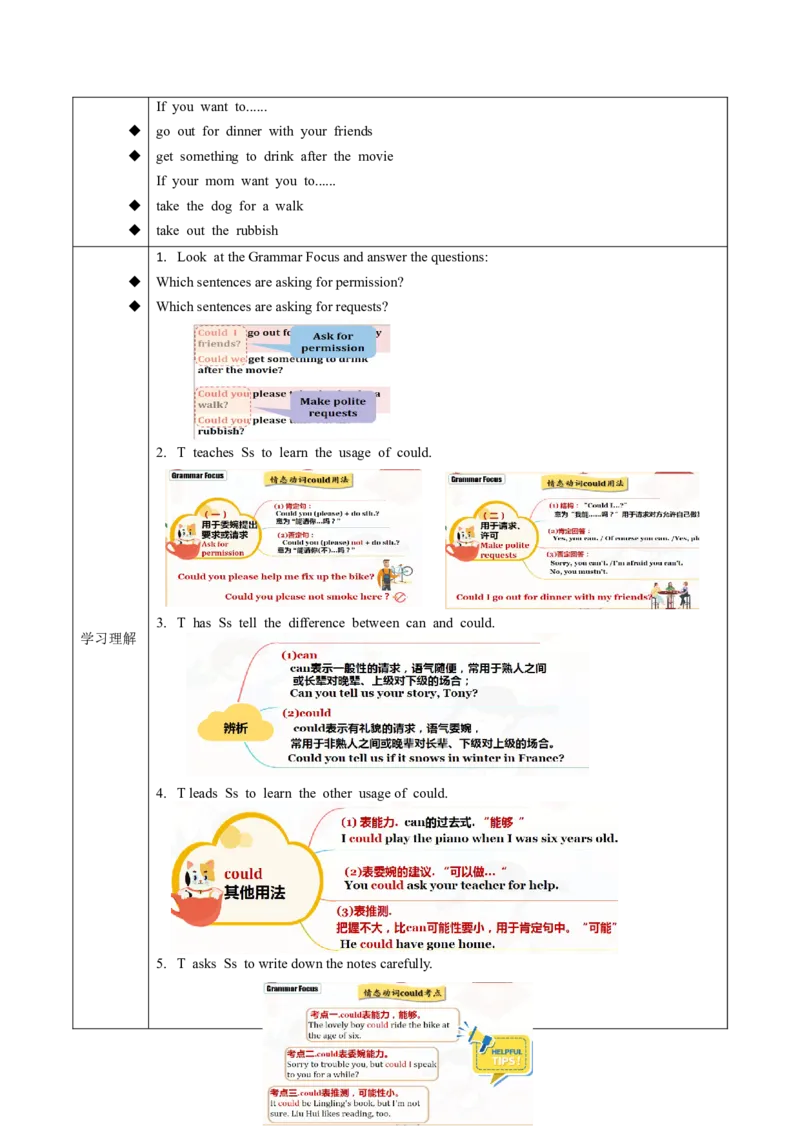
1. Look at the Grammar Focus and answer the questions:
Which sentences are asking for permission?
Which sentences are asking for requests?
2. T teaches Ss to learn the usage of could.
3. T has Ss tell the difference between can and could.
学习理解
4. T leads Ss to learn the other usage of could.
5. T asks Ss to write down the notes carefully.1. 1. Write R for requests and P for permission. Then Match each one with the correct
response.
2.
应用实践-
3. 2. Fill in the blanks in the conversation.
1. Tony and his sister cleaned the room so well that their mother was very happy. So
she decided to support them to go to a camping trip.Tony and his sister will call their
friends and discuss what they should do before the trip.
What should they do before the trip?
How do they make polite requests ?
迁移创新
2. Pair work. T asks Ss to finish the task in 4c—make a list of things your group needs to
do for a camping trip.
3. T asks Ss to make conversations about preparing for a camping trip with could.一、单项选择
1.—Could you ________ me your bike?
—Sorry, Lily has ________ it.
A.lend; borrowed B.borrow; lent C.lend; lent D.borrow; borrowed
2. — Dad, it's too hot. ____I swim in the lake with my friends?
— No, you ______. That's too dangerous!
A. Could; mustn't B. Need; couldn't
C. Must; needn't D. Should; can’t
3.—Could you please help me wash the car, Tony?
—____, I'm studying for my coming English test now.
A. That's right B. I'm sorry C. It doesn't matter D. Not at all
课堂练习
二、根据汉语意思完成句子。
①你能把你的电子词典借给我吗?
Could you _________ your e-dictionary ________ me?
②鲍勃,我能借你一些钱吗?
Bob, could I ___________ some money _________ you?
③这本书你可以借两周。
You can ______________ this book for two weeks.
④你们做作业时,请不要闲聊。
Please don’t chat ___________ you’re ___________ your homework.
1. Review the use of the modal verb “could”.
作业
2. Make conversations with the modal verb “could”.
【参考答案】
1. ①“能够, 可能”②can ③不能 ; 没有; 动词原形.
课前预习
2. (1)Could you please (2) Could I / we
一、 单项选择
AAB
课堂练习
二、根据汉语意思完成句子
1.lend to 2.borrow from 3. keep 4.while doing