2024-2025 学年八年级英语下学期单元语法精讲精练(人教版)
02 动词不定式
语法聚焦
1.动词+副词、动词+介词构成的动词短语的用法
2.动词不定式的用法
语法精讲
1. 动词+副词、动词+介词构成的动词短语的用法
(1)1. “动词+介词”构成的动词短语
“动词+at,for,from,into,of,to,with, on,about等介词”构成的短语是及物性动词短
语,后面必须有宾语,而且它的宾语不管是代词还是名词,只能放在介词的后面。常见的短语
有:look after,listen to,care for,look for,talk about,talk to,think about,shout at等。
如:
Don't shout at me. Allow me to explain. 别对我大吼大叫。让我解释嘛。
2. “动词+副词”构成的动词短语
“动词+up, on, down, away, out, off,over等副词”构成的短语有及物性的,也有不及物性的。
(1)及物性的此类动词短语后面要接宾语。若接名词作宾语,名词位于副词的前面或后面皆
可;若接代词作宾语,代词只能放在动词与副词之间。常见的短语有:put on, throw away, turn
off, turn on, put up, call up, cheer up, pick up, try on,give out,write down,clean up,wake up
等。如:
Write your name down. =Write down your name. 写下你的名字。
Tom is still sleeping.Please wake him up. 汤姆还在睡觉。请把他叫醒。
(2)不及物性的此类动词短语后面不接宾语。常见的短语有:grow up,run out,take off,look out,fall down, run away,lie down等。如:
She grew up in Boston. 她在波士顿长大。
3. “动词+副词+介词”构成的动词短语
此类短语是及物性动词短语,后面要接宾语,且只能放在介词后面。常见的短语有:come up
with,look forward to,catch up with,get along with,do well in,run out of,keep away from,
get out off等。如:
If you study hard, you will catch up with other students. 如果你努力学习,你就会赶上其他同学。
2.动词不定式的用法
动词不定式的基本形式是“不定式符号to+动词原形”,不定式符号有时也可省略,其否定形
式为“not to+动词原形”。动词不定式常可作宾语、宾语补足语以及状语。
1. 动词不定式作宾语
常接动词不定式作宾语的动词有:
want to do sth. 想要做某事
like to do sth. 喜欢做某事
try to do sth. 努力做某事
decide to do sth. 决定做某事
hope to do sth. 希望做某事
agree to do sth. 同意做某事
refuse to do sth. 拒绝做某事
offer to do sth. 主动提出做某事
would like to do sth. 想要做某事
promise to do sth. 承诺做某事
help (to) do sth. 帮助做某事
remember to do sth. 记得要做某事【注意】 find, think, make等动词后面接不定式作宾语时,常用it作形式宾语,而将真正的宾
语(动词不定式)后置。如:
You'll find it helpful to talk things over with a friend. 把情况和朋友详细聊一聊,你会觉得
大有帮助。
2. 动词不定式作宾语补足语
常接动词不定式作宾语补足语的动词有:
ask sb. to do sth. 叫某人做某事
allow sb. to do sth. 允许某人做某事
teach sb. to do sth. 教某人做某事
invite sb. to do sth. 邀请某人做某事
help sb. (to) do sth. 帮助某人做某事
tell sb. to do sth. 吩咐某人做某事
encourage sb. to do sth.鼓励某人做某事
expect sb. to do sth. 期望某人做某事
advise sb. to do sth.建议某人做某事
【注意】使役动词(如make, let等)及感官动词(如see, feel, hear, watch等)后常跟不带to的动
词不定式作宾语补足语。如:
The children made me tell the story again. 孩子们让我再讲一次那个故事。
I often see them play football on the playground. 我经常看到他们在操场踢足球。
3. 动词不定式作状语
动词不定式作状语,常用来表示目的、结果或原因。作目的状语时,可放句末也可放句首,放
句首时要用逗号隔开。如:
They take exercise every day to keep healthy. 他们为了保持健康每天运动。
语法专练一、单项选择
1.David learnt ________ when he was five.
A.swim B.swims C.swam D.to swim
2.Mount Huang is so famous that a large number of travelers wish ________ it.
A.to visit B.visit C.visited D.visiting
3.—Miss Li, can you tell me how to improve my writing skills?
—Certainly. I advise you ________ a diary in English every day.
A.to keep B.keeping C.kept D.keeps
4.You’re expected ________ silent when you’re in the library.
A.keeping B.to kept C.to keep D.to keeping
5._______ English well, we should use it as often as possible.
A.Learning B.To learn C.Learned D.Learn
6.We read the article quickly _______ its main idea.
A.getting B.to get C.got D.get
7.—I am too tired to walk on. Let’s stop ________ a rest.
—OK. We can drink some water first.
A.have B.having C.to have D.has
8.The teacher asked us ________ so much noise.
A.don’t make B.not make C.not making D.not to make
9.As a result of my laziness, I failed ________ my work in time.
A.and finished B.to finish C.and finishing D.to finishing
10.—Where did he go?
—He went to another store ________ pencils.
A.to buy B.for buying C.buy D.buying11.________ our wishes, we must try our best to work hard.
A.Realizing B.To realize C.Realized D.Having realized
12.We advised her ________ there at once.
A.should get B.gets C.to get D.to getting
13.—I have trouble ________ my English.
—Don’t worry. I’ll show you how ________ it well.
A.improving; learning B.to improve; to learn
B.C.improving; to learn D.to improve; learning
14.I hope________ the history museum with my friend this Sunday.
A.visit B.to visit
C.visited D.visiting
15.My mother usually gets up at 6 o’clock ________ the early bus in the morning.
A.catch B.caught
C.to catch D.catching
16.Lisa is very kind and she often teaches me ________ the piano.
A.to play B.playing
C.play D.played
17.We ________ get something ________ after watching the movie. I am hungry now.
A.mightn’t; to eat B.might; eating
C.couldn’t; eating D.could; to eat
18.I found it easy ________ everything we learned in class, so I tried ________ them down.
A.to forget; write B.forget; writing
C.forget; to write D.to forget; to write
19.John is funny and he usually tells jokes to make us ________.A.to laugh B.laugh
C.laughed D.laughing
20.Jenny is going to the supermarket. And she is asking her mother what _______ for today’s
dinner.
A.is buying B.buy
C.bought D.to buy
21.It’s useful for children________ their parents’ phone numbers. It can help them when they are in
trouble.
A.remembering B.remembered
C.to remember D.remember
22.Paul made a nice cage _______the little sick bird till it could fly.
A.keep B.kept C.keeping D.to keep
23.—Could you tell me how ________ to the hospital?
—Sure.Walk straight and then turn right at the first crossing.It's on your left.
A.get B.to get C.gets D.getting
24.As a volunteer, the girl wants to visit sick kids in the hospital _______them up.
A.to cheer B.cheer C.cheering D.cheered
25.________ more money for homeless people, he sold his own car.
A.Raise B.Raising C.Raised D.To raise
26.He decides ________ an English speech contest.
A.to try out on B.to try out for C.trying out for D.to try out in
27.We will have a trip tomorrow,but I don't know ________.
A.when to go B.how to go C.what to do it D.where to do it
28.----Would you like ____ a film with us tonight?
---- Sorry,I have to help my mother do housework.A.see B.to see C.seeing D.to seeing
29.Zhou Lan doesn’t have to be made ________. She always studies very hard.
A.learn B.to learn C.learning D.learned
30.We are not allowed ________ outdoors with some other children.
A.playing B.to be playing C.to play D.be playing
31.As a volunteer, the girl wants to visit sick kids in the hospital them up.
A.to cheer B.cheer C.cheering D.cheered
32.Nick thinks the best time of a new term is when the teacher ________ new books.
A.gives out B.looks out C.finds out D.helps out
33.________ a writer for her school newspaper is a dream ________ for Jenny.
A.Be; comes true B.Being; came true C.Be; coming true D.Being; come true
34.In China, people usually ________ their houses to sweep away bad luck before Spring Festival.
A.clean up B.look up C.make up D.put up
35.My brother often _________ his spare time to help me with my spoken English.
A.puts up B.gives up C.opens up D.tidies up
36.Jack likes playing basketball. He is going to ________ for the basketball team.
A.try out B.find out C.run out D.give out
37.Never ________ your dream although you meet with problems and difficulties along the way.
A.give up B.look up
C.put up D.take up
38. We have to ______ the bike ride because of the bad weather.
A.put off B.turn off
C.take off D.get off
39.Why don’t you ________ for the football team? You have nothing to lose.A.try out B.give out C.hand out D.come out
40.—I remember we will go hiking this Saturday.
—Right. But it’ll be ________ till next week because of the bad weather.
A.put out B.put off C.put away D.put on
二、用所给词的适当形式填空。
1.Mr. Black told me (bring) my photos to school.
2.The old man hopes (live) with his son.
3.The boys stopped (play) basketball and had a short rest.
4.I didn’t know what (do) at that time.
5.Helen decides (go) on vacation in Qing Dao this summer.
6.Touched by doctors and nurses in Wuhan, Li Ming wants (be) a doctor when he grows
up.
7.Henry’s uncle is planning (take) a trip to Dunhuang now.
8.My mother and I went to the airport (meet)my father yesterday.
9. (realize)his lifelong dream, the young man went to Hollywood by himself, with only
a few dollars in his pocket.
10.George thinks it is popular (wear) sunglasses in the sun.
11.Lily asked me (get) in touch with her when I arrived in Beijing.
12.Jim often takes notes in class (remember) what the teacher said.
13.John is only two years old. It’s difficult for him (learn) to write now.
14.David loves animals. He wishes (have) a lovely dog.
四、按要求完成句子。
1.That you read English in the morning is very important. (改为同义句)
It is very important you English in the morning.
2.He said he would write a letter.He said he would have a letter .
3.I don’t know when we will have the meeting. (同义句转化)
I don’t know when the meeting.
4.His brother decided that he would buy the book.
His brother decided the book.
5.“Don’t play music so loudly,” she said to me.
She told me music so loudly.
6.She hopes she will travel around the world some day.
She hopes around the world some day.
链接中考
(1)
用括号中所给动词的适当形式完成短文。
Students can’t bring mobile phones to school, but Gary often broke this rule. Gary’s parents
were really worried about him and talked to him often. They asked him 1 (work) harder and
he promised 2 (spend) more time on his schoolwork. Even so, Gary often got into trouble.
One day, his Chinese teacher saw him 3 (play) games on his phone in class again and told
him that if he broke the rule one more time, he would be punished (被惩罚).
Gary went home and lay on the bed with his eyes open. He was lost in thought. His parents sent
him to a nice school and he didn’t want to keep disappointing (使失望) them. He decided 4
(talk) to his best friend Susan about his problems because he knew it was time 5 (make)
some changes in his life. Susan agreed 6 (come) over to his home the next day after school.
After hearing about his problems, she advised Gary 7 (listen) to the teacher carefully in
class and make a weekly study plan. What was more, she would like 8 (help) him with his
homework so he could improve his grades.
Gary thanked Susan for 9 (give) him such great advice. He said he didn’t want to
keep making trouble in the future and he hoped 1 0 (become) an excellent student.(2)
用括号中所给动词的适当形式完成短文。
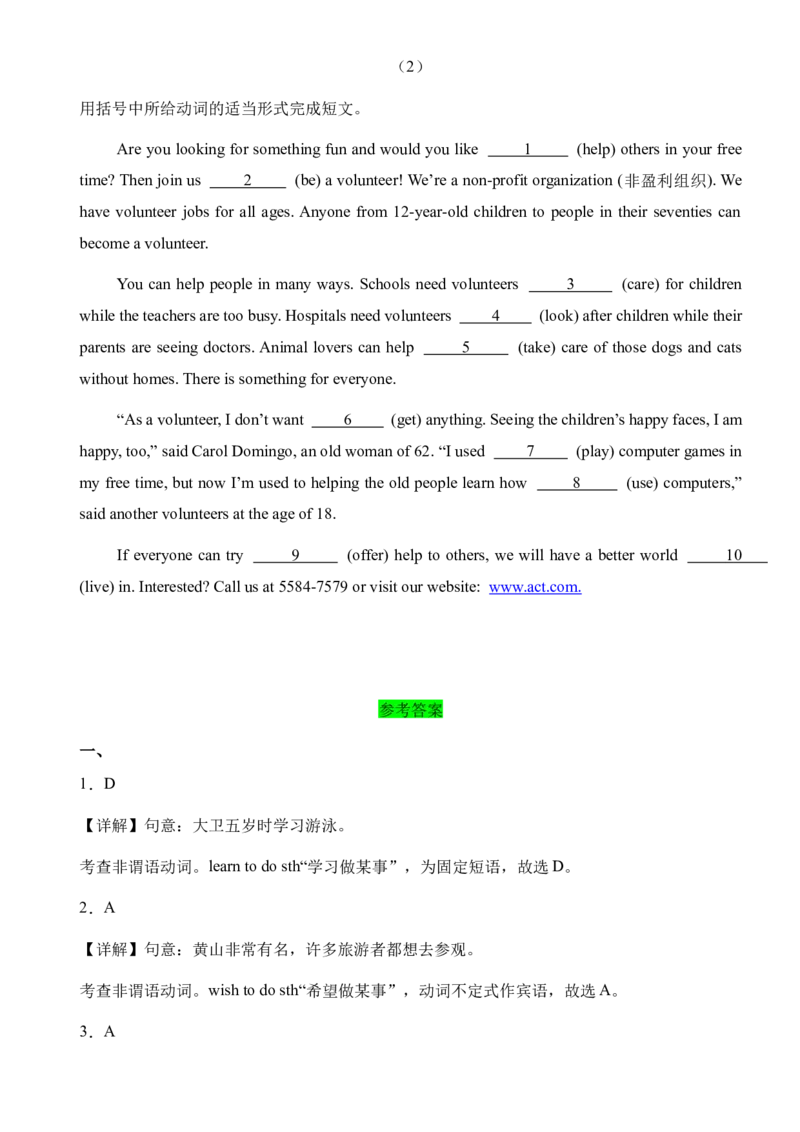
Are you looking for something fun and would you like 1 (help) others in your free
time? Then join us 2 (be) a volunteer! We’re a non-profit organization (非盈利组织). We
have volunteer jobs for all ages. Anyone from 12-year-old children to people in their seventies can
become a volunteer.
You can help people in many ways. Schools need volunteers 3 (care) for children
while the teachers are too busy. Hospitals need volunteers 4 (look) after children while their
parents are seeing doctors. Animal lovers can help 5 (take) care of those dogs and cats
without homes. There is something for everyone.
“As a volunteer, I don’t want 6 (get) anything. Seeing the children’s happy faces, I am
happy, too,” said Carol Domingo, an old woman of 62. “I used 7 (play) computer games in
my free time, but now I’m used to helping the old people learn how 8 (use) computers,”
said another volunteers at the age of 18.
If everyone can try 9 (offer) help to others, we will have a better world 1 0
(live) in. Interested? Call us at 5584-7579 or visit our website: www.act.com.
参考答案
一、
1.D
【详解】句意:大卫五岁时学习游泳。
考查非谓语动词。learn to do sth“学习做某事”,为固定短语,故选D。
2.A
【详解】句意:黄山非常有名,许多旅游者都想去参观。
考查非谓语动词。wish to do sth“希望做某事”,动词不定式作宾语,故选A。
3.A【详解】句意:——李老师,你能告诉我如何提高我的写作技巧吗?——当然。我建议你每天
用英语写日记。
考查非谓语动词。advise sb. to do sth.“建议某人做某事”,动词不定式作宾语补足语。故选
A。
4.C
【详解】句意:当你在图书馆的时候,你应该保持安静。
考查非谓语动词。be expected to do sth.“被期望做某事”。故选C。
5.B
【详解】句意:为了学好英语,我们应该尽可能多地使用它。
考查非谓语动词。根据“English well, we should use it as often as possible.”可知,此处是指为了
学好英语,表目的,空处用动词不定式作目的状语。故选B。
6.B
【详解】句意:我们迅速阅读了这篇文章以了解其大意。
考查非谓语动词。分析句子可知,“我们快速读文章”的目的是“了解其大意”,作目的状语
用动词不定式。故选B。
7.C
【详解】句意:——我太累了,走不动了。让我们停下来休息一下吧。——好的。我们可以先
喝点水。
考查非谓语动词。根据“I am too tired to walk on.”及“We can drink some water first.”可知,此
处指停下来休息一下,stop to do sth.“停下来去做某事”,固定词组。故选C。
8.D
【详解】句意:老师要求我们不要发出那么多噪音。
考查动词非谓语。ask sb to do sth“要求某人做某事”,否定形式为ask sb not to do sth。故选
D。
9.B
【详解】句意:由于懒惰,我未能及时完成工作。考查动词不定式。fail to do sth. “未能做(成)某事”,此处指的是由于懒惰,未能及时完成工
作。故选B。
10.A
【详解】句意:——他去哪儿了? ——他去另一家商店买铅笔了。
考查动词不定式的用法。根据“He went to another store...pencils.”可知,去另一家商店是为了
买铅笔,动词不定式作目的状语。故选A。
11.B
【详解】句意:为了实现愿望,我们必须努力。
考查非谓语动词。根据“... our wishes, we must try our best to work hard.”可知,努力的目的是为
了实现愿望,用不定式表目的。故选B。
12.C
【详解】句意:我们建议她马上到那里。
考查动词不定式。根据“advised her”可知,advise sb to do sth“建议某人做某事”,此空使用动
词不定式作宾语补足语。故选C。
13.C
【详解】句意:——我在提高英语水平上遇到了困难。——别担心。我会教你如何学好的。
考查动词非谓语。have trouble (in) doing sth.“做某事有困难”;how to do“如何做”。故选C。
14.B
【详解】句意:我希望这个星期天能和我的朋友一起参观历史博物馆。
考查非谓语动词。hope to do sth.希望做某事,动词不定式作宾语。故选B。
15.C
【详解】句意:我妈妈通常早上6点起床赶早班公共汽车。
考查非谓语动词。根据句意可知,6点起床的目的是赶早班车,所以用不定式来表达,故选
C。
16.A【详解】句意:Lisa很善良,她经常教我弹钢琴。
考查非谓语动词。teach sb. to do sth.“教某人做某事”,所以设空处填写不定式形式。故选A。
17.D
【详解】句意:看完电影我们可以去吃点东西。我现在饿了。
考查情态动词和非谓语动词。mightn’t不会;might可能,可以;couldn’t不可能;could可能,
可以。根据“I am hungry now.”可知,指看完电影后可能得吃点东西。结合get sth to do sth意
为“借助某物做某事”,动词不定式to eat作定语,修饰不定代词something。故选D。
18.D
【详解】句意:我发现很容易忘记我们在课堂上学到的东西,所以我试着把它们写下来。
考查非谓语。find it+adj.+to do do sth.意为“发现做某事……”,try to do sth.意为“尝试做某
事”。故选D。
19.B
【详解】句意:约翰很有趣,他经常讲笑话逗我们笑。
考查非谓语动词。make sb do sth“使某人做某事”,固定短语,所以空处用动词原形,故选
B。
20.D
【详解】句意:Jenny要去超市。她问她妈妈今天的晚餐买什么。
考查非谓语动词。分析句子结构可知,此处应用“疑问词+不定式”结构,作宾补。故选D。
21.C
【详解】句意:记住父母的电话号码对孩子们很有用。当他们遇到麻烦时,这可以帮助他们。
考查非谓语动词。本题考查句型It’s adj. for sb. to do sth.,意为“做某事对某人来说是……
的”,it作形式主语,动词不定式作真正主语。故选C。
22.D
【详解】句意:保罗做了一个漂亮的笼子养鸟,一直到它可以飞为止。make此处译为“制
作”,用动词不定式作目的状语。故选D。23.B
【详解】句意:——请你告诉我怎样到达那个医院好吗?——当然,一直往前走,然后在第一
个十字路口右转。在你的左边。短语get to…表示到达……,这里是疑问词+to do的形式。根
据题意,故选B。
24.A
【详解】句意:作为志愿者,那个女孩想看望医院生病的孩子以使他们振作起来。
考查动词不定式的用法。A.to cheer动词不定式;B.cheer动词原形; C.cheering动词的ing形
式;D.cheered动词过去式。动词不定式可以表示目的,结合句意,故选A。
25.D
【详解】句意:为了给无家可归的人筹集更多的钱,他卖掉了自己的汽车。
考查非谓语动词。空格表达的是“为了筹集”,应用不定式作目的状语,故选D。
26.B
【详解】句意:他决定去参加英语演讲比赛的选拔。
考查固定句式和短语,decide to do sth.意为“决定做某事”排除选项C; try out for意为“参
加……的选拔”,try on“试穿”,try in“尝试于”。结合语境,故选B。
27.B
【详解】句意:明天我们将去旅行,但是我不知道怎样去。A. when to go何时去;B. how to go
怎样去; C. what to do it 语法错误;D. where to do it去哪里做。前一句中有tomorrow,此处
不能是询问时间,这里是怎样去。根据题意,故选B。
28.B
【详解】句意:——你今晚想和我们一起看电影吗?——对不起,我得帮妈妈做家务。A. see
动词原形;B. to see动词不定式;C. seeing分词或动名词;D. to seeing表达错误。would like to
do sth.想做某事。故答案为B。
29.B
【详解】句意:周兰不需要被迫去学习。她总是学习很努力。
考查非谓语动词。be made to do sth表示“被要求做某事”。故选B。30.C
【详解】句意:我们不被允许和其他一些孩子在户外玩耍。
考查非谓语动词,be not allowed to do“不被允许做某事”,固定用法,故选C。
31.A
【详解】句意:作为志愿者,那个女孩想看望医院生病的孩子以使他们振作起来。
考查动词不定式的用法。A.to cheer动词不定式;B.cheer动词原形; C.cheering动词的ing形
式;D.cheered动词过去式。动词不定式可以表示目的,结合句意,故选A。
32.A
【详解】句意:尼克认为新学期最好的时间是老师发新书的时候。
考查动词短语辨析。give out分发;look out小心;find out找出;help out帮助解决困难。根据
“new books”可知,此处指“分发”书籍,故选A。
33.D
【详解】句意:珍妮想成为校报的一名作者终于梦想成真了。
考查非谓语。分析句子结构,第一空作主语,应用不定式或动名词,排除A/C选项;第二空是
短语a dream come true“梦想成真”,动作已完成,应用过去分词作定语,故选D。
34.A
【详解】句意:在中国,人们通常在春节前打扫房子,把坏运气扫走。
考查动词短语辨析。clean up打扫;look up查询;make up编造;put up张贴。根据“their
houses to sweep away bad luck before Spring Festival”及常识可知,在春节前打扫房子,把坏运
气扫走,故选A。
35.B
【详解】句意:我的哥哥经常放弃空余时间来帮助我的英语口语。
考查动词短语。puts up张贴;gives up放弃;opens up开封;tidies up收拾。根据“his spare
time to help me with my spoken English”可知此处用动词短语gives up表示“放弃空余的时间”。
故选B。
36.A【详解】句意:杰克喜欢打篮球。他打算参加篮球队的选拔。
考查动词短语辨析。try out 参加(工作的)试用,试验是否胜任某个机会;find out找出;run
out用完;give out分发。根据“Jack likes playing basketball. He is going to…for the basketball
team.”的句意并结合选项可知,此处指参加篮球队的选拔,try out for…“参加……的选拔”。
故选A。
37.A
【详解】句意:永远不要放弃你的梦想,尽管你一路上遇到了问题和困难。
考查动词短语辨析。give up放弃;look up查找;put up搭起;take up开始从事。根据空后的
“although”可知,此处句意发生了转折让步,所以空处表示永远不要放弃你的梦想。故选A。
38.A
【详解】试题分析:句意:由于糟糕的天气,我们不得不将这个骑车活动延期了。put off推迟,
延期;turn off关闭,拐弯;take off脱下,起飞;get off动身,下车。故选A。
【考点定位】考查动词短语
39.A
【详解】句意:你为什么不参加足球队的选拔呢?你没有什么可以失去的东西了。
考查动词短语辨析。try out参加选拔;give out释放;hand out分发;come out出版。根据
“Why don’t you...for the football team? You have nothing to lose.”可知,此处表示参加选拔。故
选A。
40.B
【详解】句意:——我记得这个星期六我们将去远足。——对。但由于天气不好,它将推迟到
下周。
考查动词短语。put out熄灭;put off推迟;put away放好;put on穿上。根据“till next week
because of the bad weather”可知,由于天气原因推迟了远足,故选B。
二、
1.句意:布莱克先生让我把照片带到学校。tell sb to do sth“告诉某人做某事”,是固定短语,
空处用不定式形式,故填to bring。2.句意:这位老人希望和儿子住在一起。hope to do sth“希望做某事”,空处用不定式形式,
故填to live。
3.句意:男孩们停止打篮球,休息了一会儿。根据“had a short rest”可知,此处指的是“停止
打球去休息”,stop doing sth“停止做某事”,空处用动名词形式,故填playing。
4.句意:当时我不知道该怎么办。此处是“疑问词+不定式”的结构,故填to do。
5.句意:海伦决定今年夏天去青岛度假。decide to do sth“决定做某事”,空处用不定式形式,
故填to go。
6.to be
【详解】句意:被武汉的医生和护士感动,李明想长大了成为一名医生。
表达“想做某事”用动词短语want to do,此处用动词不定式 to be表示“想成为一名医生”。
故答案为to be。
7.to take
【详解】句意:亨利的叔叔现在正计划去敦煌旅行。plan to do sth.计划做某事,plan后面要跟
动词不定式作宾语,故填to take。
8.to meet
【详解】句意:妈妈和我昨天去机场接爸爸了。此处表目的,应该用meet的动词不定式to
meet,故填to meet。
9.To realize
【详解】句意:为了实现他毕生的梦想,这个年轻人独自去了好莱坞,口袋里只带了一点钱。
此处表示目的,应该填动词不定式;realize意为“实现”,是动词,故填To realize。
10.to wear
【详解】句意:乔治认为在阳光下戴太阳镜很流行。It’s popular to do sth.“做某事很流行”。故
填to wear。
11.to get
【详解】句意:Lily让我到北京后与她联系。根据“Lily asked me... in touch with her ”可知,指
的是让我联系她,ask sb. to do sth. “让某人做某事”。故填to get。12.to remember
【详解】句意:吉姆经常在课堂上记笔记来记住老师说的话。根据“Jim often takes notes in
class... what the teacher said.”可知,记笔记是为了记住老师说的话,动词不定式作目的状语。故
填to remember。
13.to learn
【详解】句意:约翰只有两岁。对他来说,现在学习写字很困难。根据“It’s difficult for
him...to write ”可知,it’s difficult for sb. to do sth. “对某人来说做某事很困难”,动词不定式作
主语。故填to learn。
14.to have
【详解】句意:David喜欢动物。他希望有一只可爱的狗。根据“He wishes...a lovely dog”可知,
wish to do sth.“希望做某事”。故填to have。
三、
1. for to read
【详解】句意:你早上读英语是很重要的。根据“It is very important ...you...English in the
morning.”可知,此处是it作形式主语,结构为:It is + important + for sb. to do sth. “对某人来说
做某事是重要的”。故填for;to;read。
2. to write
【详解】句意:他说他会写一封信。改为同义句,需用to write作a letter的后置定语,表示
“有一封信要写”。故填to;write。
3. to have
【详解】句意:我不知道我们什么时候开会。原句是含有宾语从句的复合句,可以用 “疑问
词(when)+动词不定式(to have)”形式转换,在句中作宾语。故填to;have。
4. to buy
【详解】句意:他哥哥决定他要买这本书。此句也可表达为“他哥哥决定买这本书”,decide
to do sth.“决定做某事”,固定词组,不定式作宾语。故填to;buy。
5. not to play【详解】句意:“不要把音乐放得那么大声,”她对我说。改为同义句,即“她告诉我不要那
么大声地播放音乐”;tell sb. not to do sth.“告诉某人不要做某事”,play“播放”,动词。故填
not;to;play。
6. to travel
【详解】句意:她希望有一天她能环游世界。hope+宾语从句,同义句可以用“hope to+动词原
形”来替换,travel around the world“环游世界”。故填to;travel。
链接中考
(1)
1.to work 2.to spend 3.playing 4.to talk 5.to make 6.to come 7.
to listen 8.to help 9.giving 10.to become
【导语】本文是一篇记叙文,文章讲述了加里在好友的建议下改变自己的事迹。
1.句意:他们要求他更加努力学习,他答应在功课上花更多的时间。根据“asked him”可知,
考查ask sb to do“要求某人做某事”,因此设空处填不定式。故填to work。
2.句意:他们要求他更加努力学习,他答应在功课上花更多的时间。spend“花费”,根据
“he promised”可知,考查promise to do“答应做某事”,因此填不定式作宾语。故填to spend。
3.句意:有一天,他的语文老师看到他又在课堂上玩手机游戏,并告诉他,如果他再违反规
则,他将受到惩罚。play“玩”,根据“saw him”可知,考查see sb doing“看见某人正在做某
事”,故填playing。
4.句意:他决定和他最好的朋友苏珊谈谈他的问题,因为他知道是时候改变他的生活了。
talk“谈话”,设空处前是“decided”,decide to do“决定做某事”。故填to talk。
5.句意:他决定和他最好的朋友苏珊谈谈他的问题,因为他知道是时候改变他的生活了。
make“做”,根据“it was time”可知,考查固定句型it is time to do sth“是时候做某事”。故填
to make。
6.句意:苏珊同意第二天放学后到他家去。come over“顺便来访”,根据“agreed”可知,考
查agree to do sth“同意做某事”,故填to come。
7.句意:听到加里的问题后,她建议他在课堂上认真听老师讲课,并制定每周的学习计划。
listen“听”,根据“she advised Gary”可知,考查短语advise sb to do“建议某人做某事”。故填to listen。
8.句意:更重要的是,她愿意帮助他做作业,这样他就可以提高他的成绩。help“帮助”,根
据“she would like”可知,would like to do“愿意做某事”,故填to help。
9.句意:加里感谢苏珊给了他这么好的建议。give“给”,根据“thanked Susan for”可知,考
查thank sb for doing sth“感谢某人做某事”。故填giving。
10.句意:他说他以后不想再惹麻烦了,他希望成为一名优秀的学生。become“成为”,根据
设空处前的“hoped”可知,考查hope to do“希望做某事”。故填to become。
(2)
1.to help 2.to be 3.to care 4.to look 5.to take/take 6.to get 7.to
play 8.to use 9.to offer 10.to live
【导语】本文主要介绍了志愿工作的作用,以及一些志愿者的感受。
1.句意:你在寻找一些有趣的事情而且你想在空闲时间帮助别人吗?would like to do sth.“想
要做某事”。故填to help。
2.句意:那就加入我们成为一名志愿者吧!根据“Then join us ... a volunteer!”可知,加入我们
的目的是成为一名志愿者,用不定式表目的。故填to be。
63.句意:学校需要志愿者在老师太忙的时候照顾孩子。need sb. to do sth.“需要某人做某事”。
故填to care。
4.句意:医院需要志愿者在孩子的父母看病时照顾他们。need sb. to do sth.“需要某人做某
事”。故填to look。
5.句意:动物爱好者可以帮助照顾那些无家可归的猫狗。help (to) do sth.“帮助做某事”。故
填(to) take。
6.句意:作为一名志愿者,我不想得到任何东西。want to do sth.“想做某事”。故填to get。
7.句意:我曾经在我的空闲时间玩电脑游戏,但现在我习惯于帮助老人学习如何使用电脑。
used to do sth.“过去常常做某事”。故填to play。
8.句意:我曾经在我的空闲时间玩电脑游戏,但现在我习惯于帮助老人学习如何使用电脑。
根据“ but now I’m used to helping the old people learn how ... computers”可知,此处是“疑问词
+不定式”作动词learn的宾语。故填to use。9.句意:如果每个人都能尽力帮助别人,我们将有一个更美好的世界生活。try to do sth.“尽力
做某事”。故填to offer。
10.句意:如果每个人都能尽力帮助别人,我们将有一个更美好的世界生活。根据“we will
have a better world ... in.”可知,有一个生活的更美好的世界,用不定式作定语,修饰名词
world。故填to live。