2023-2024 学年九年级第一学期期末模拟试卷一(北京市 )
时间: 90 分钟 满分: 60分
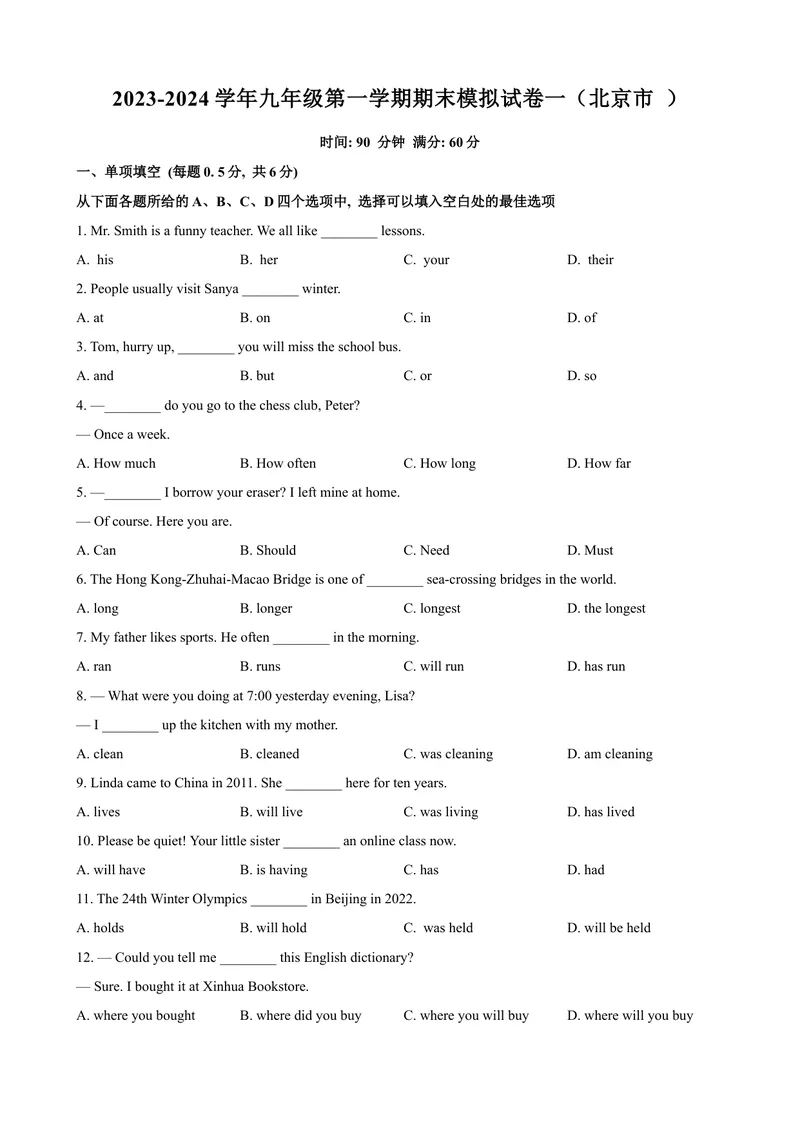
一、单项填空 (每题0. 5分, 共6分)
从下面各题所给的A、B、C、D四个选项中, 选择可以填入空白处的最佳选项
1. Mr. Smith is a funny teacher. We all like ________ lessons.
A. his B. her C. your D. their
2. People usually visit Sanya ________ winter.
A. at B. on C. in D. of
3. Tom, hurry up, ________ you will miss the school bus.
A. and B. but C. or D. so
4. —________ do you go to the chess club, Peter?
— Once a week.
A. How much B. How often C. How long D. How far
5. —________ I borrow your eraser? I left mine at home.
— Of course. Here you are.
A. Can B. Should C. Need D. Must
6. The Hong Kong-Zhuhai-Macao Bridge is one of ________ sea-crossing bridges in the world.
A. long B. longer C. longest D. the longest
7. My father likes sports. He often ________ in the morning.
A. ran B. runs C. will run D. has run
8. — What were you doing at 7:00 yesterday evening, Lisa?
— I ________ up the kitchen with my mother.
A. clean B. cleaned C. was cleaning D. am cleaning
9. Linda came to China in 2011. She ________ here for ten years.
A. lives B. will live C. was living D. has lived
10. Please be quiet! Your little sister ________ an online class now.
A. will have B. is having C. has D. had
11. The 24th Winter Olympics ________ in Beijing in 2022.
A. holds B. will hold C. was held D. will be held
12. — Could you tell me ________ this English dictionary?
— Sure. I bought it at Xinhua Bookstore.
A. where you bought B. where did you buy C. where you will buy D. where will you buy二、完形填空 (每题1分, 共8分)
阅读下面的短文,掌握其大意,然后从短文后各题所给的A、B、C、D四个选项中,选择最佳选项。
Last Dance
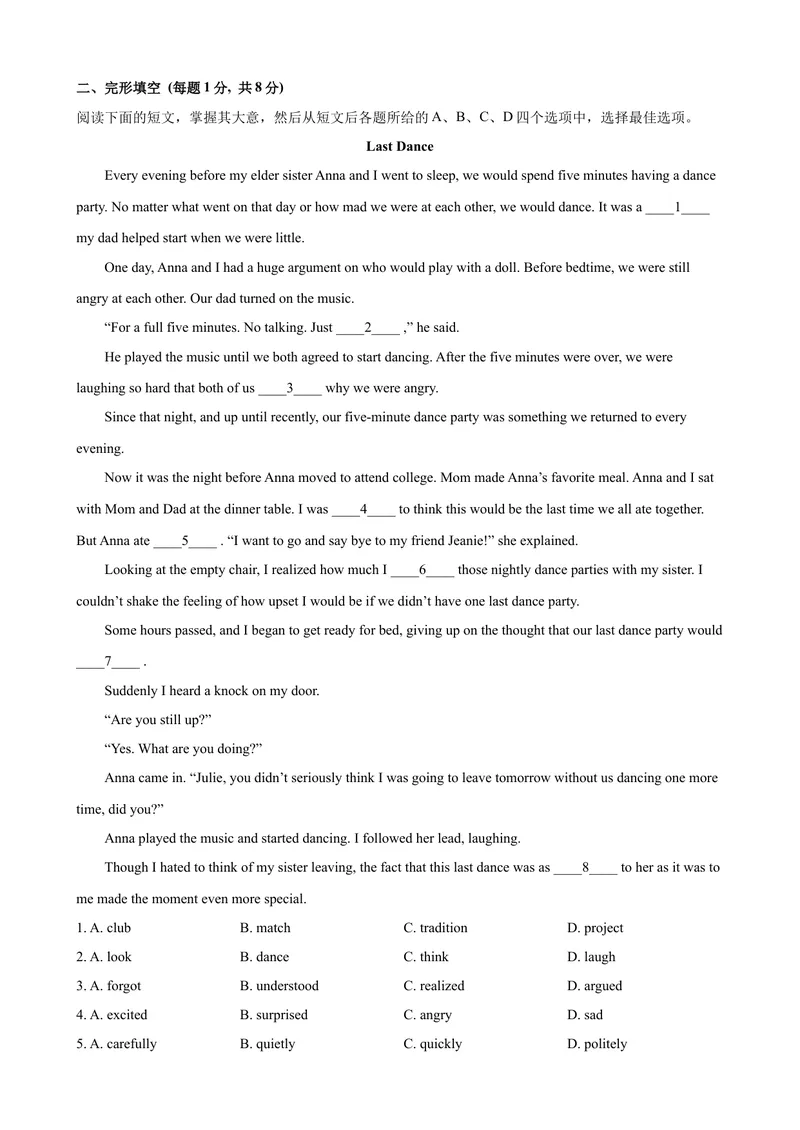
Every evening before my elder sister Anna and I went to sleep, we would spend five minutes having a dance
party. No matter what went on that day or how mad we were at each other, we would dance. It was a ____1____
my dad helped start when we were little.
One day, Anna and I had a huge argument on who would play with a doll. Before bedtime, we were still
angry at each other. Our dad turned on the music.
“For a full five minutes. No talking. Just ____2____ ,” he said.
He played the music until we both agreed to start dancing. After the five minutes were over, we were
laughing so hard that both of us ____3____ why we were angry.
Since that night, and up until recently, our five-minute dance party was something we returned to every
evening.
Now it was the night before Anna moved to attend college. Mom made Anna’s favorite meal. Anna and I sat
with Mom and Dad at the dinner table. I was ____4____ to think this would be the last time we all ate together.
But Anna ate ____5____ . “I want to go and say bye to my friend Jeanie!” she explained.
Looking at the empty chair, I realized how much I ____6____ those nightly dance parties with my sister. I
couldn’t shake the feeling of how upset I would be if we didn’t have one last dance party.
Some hours passed, and I began to get ready for bed, giving up on the thought that our last dance party would
____7____ .
Suddenly I heard a knock on my door.
“Are you still up?”
“Yes. What are you doing?”
Anna came in. “Julie, you didn’t seriously think I was going to leave tomorrow without us dancing one more
time, did you?”
Anna played the music and started dancing. I followed her lead, laughing.
Though I hated to think of my sister leaving, the fact that this last dance was as ____8____ to her as it was to
me made the moment even more special.
1. A. club B. match C. tradition D. project
2. A. look B. dance C. think D. laugh
3. A. forgot B. understood C. realized D. argued
4. A. excited B. surprised C. angry D. sad
5. A. carefully B. quietly C. quickly D. politely6. A. treasured B. supported C. minded D. hated
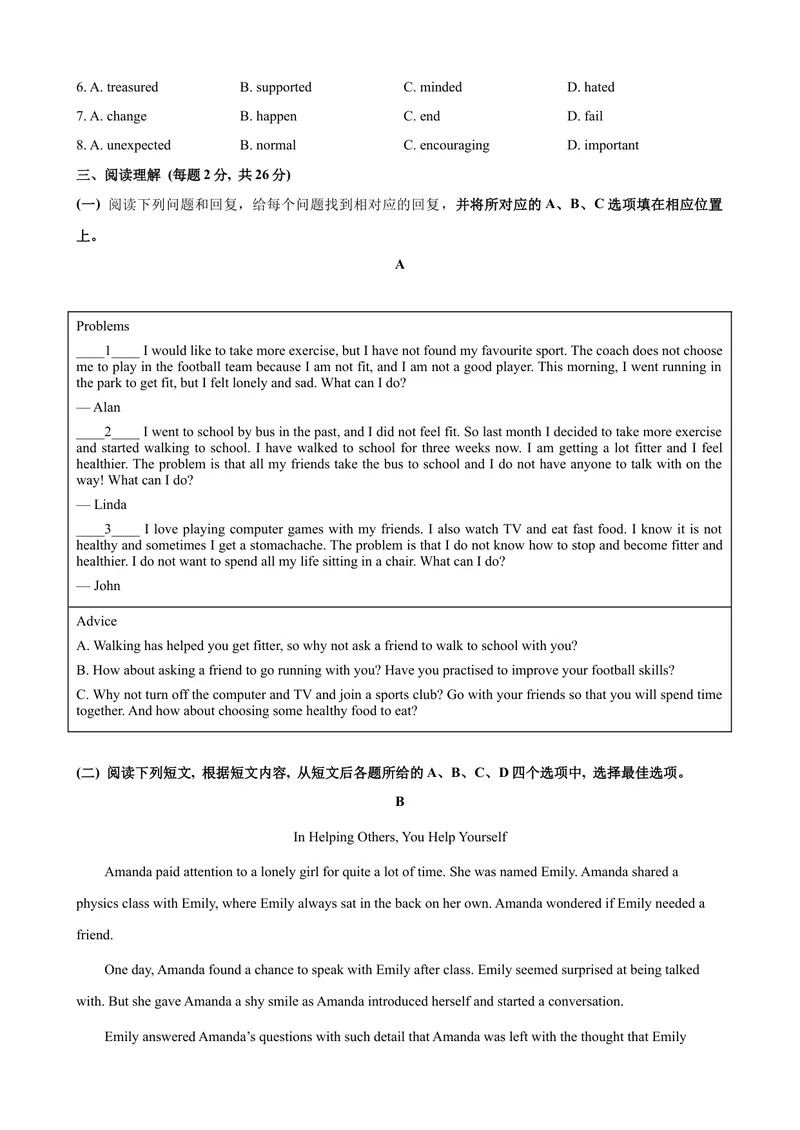
7. A. change B. happen C. end D. fail
8. A. unexpected B. normal C. encouraging D. important
三、阅读理解 (每题2分, 共26分)
(一) 阅读下列问题和回复,给每个问题找到相对应的回复,并将所对应的A、B、C选项填在相应位置
上。
A
Problems
____1____ I would like to take more exercise, but I have not found my favourite sport. The coach does not choose
me to play in the football team because I am not fit, and I am not a good player. This morning, I went running in
the park to get fit, but I felt lonely and sad. What can I do?
— Alan
____2____ I went to school by bus in the past, and I did not feel fit. So last month I decided to take more exercise
and started walking to school. I have walked to school for three weeks now. I am getting a lot fitter and I feel
healthier. The problem is that all my friends take the bus to school and I do not have anyone to talk with on the
way! What can I do?
— Linda
____3____ I love playing computer games with my friends. I also watch TV and eat fast food. I know it is not
healthy and sometimes I get a stomachache. The problem is that I do not know how to stop and become fitter and
healthier. I do not want to spend all my life sitting in a chair. What can I do?
— John
Advice
A. Walking has helped you get fitter, so why not ask a friend to walk to school with you?
B. How about asking a friend to go running with you? Have you practised to improve your football skills?
C. Why not turn off the computer and TV and join a sports club? Go with your friends so that you will spend time
together. And how about choosing some healthy food to eat?
(二) 阅读下列短文, 根据短文内容, 从短文后各题所给的A、B、C、D四个选项中, 选择最佳选项。
B
In Helping Others, You Help Yourself
Amanda paid attention to a lonely girl for quite a lot of time. She was named Emily. Amanda shared a
physics class with Emily, where Emily always sat in the back on her own. Amanda wondered if Emily needed a
friend.
One day, Amanda found a chance to speak with Emily after class. Emily seemed surprised at being talked
with. But she gave Amanda a shy smile as Amanda introduced herself and started a conversation.
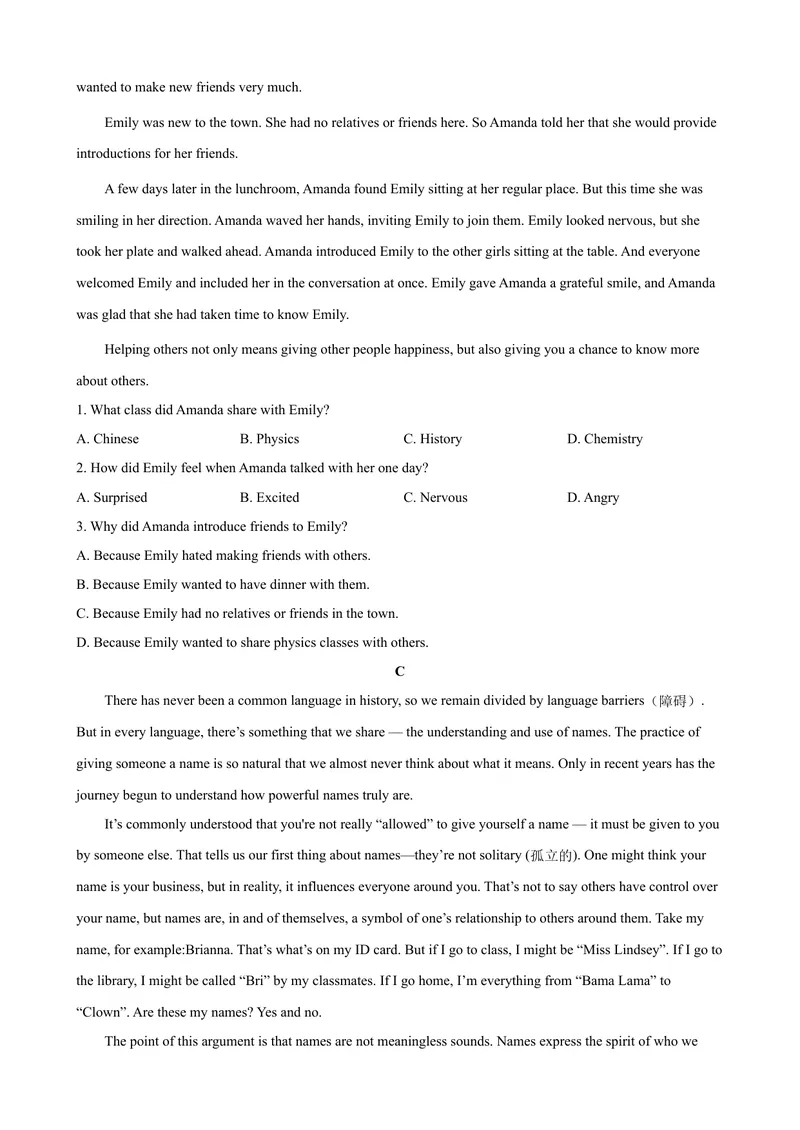
Emily answered Amanda’s questions with such detail that Amanda was left with the thought that Emilywanted to make new friends very much.
Emily was new to the town. She had no relatives or friends here. So Amanda told her that she would provide
introductions for her friends.
A few days later in the lunchroom, Amanda found Emily sitting at her regular place. But this time she was
smiling in her direction. Amanda waved her hands, inviting Emily to join them. Emily looked nervous, but she
took her plate and walked ahead. Amanda introduced Emily to the other girls sitting at the table. And everyone
welcomed Emily and included her in the conversation at once. Emily gave Amanda a grateful smile, and Amanda
was glad that she had taken time to know Emily.
Helping others not only means giving other people happiness, but also giving you a chance to know more
about others.
1. What class did Amanda share with Emily?
A. Chinese B. Physics C. History D. Chemistry
2. How did Emily feel when Amanda talked with her one day?
A. Surprised B. Excited C. Nervous D. Angry
3. Why did Amanda introduce friends to Emily?
A. Because Emily hated making friends with others.
B. Because Emily wanted to have dinner with them.
C. Because Emily had no relatives or friends in the town.
D. Because Emily wanted to share physics classes with others.
C
There has never been a common language in history, so we remain divided by language barriers(障碍).
But in every language, there’s something that we share — the understanding and use of names. The practice of
giving someone a name is so natural that we almost never think about what it means. Only in recent years has the
journey begun to understand how powerful names truly are.
It’s commonly understood that you're not really “allowed” to give yourself a name — it must be given to you
by someone else. That tells us our first thing about names—they’re not solitary (孤立的). One might think your
name is your business, but in reality, it influences everyone around you. That’s not to say others have control over
your name, but names are, in and of themselves, a symbol of one’s relationship to others around them. Take my
name, for example:Brianna. That’s what’s on my ID card. But if I go to class, I might be “Miss Lindsey”. If I go to
the library, I might be called “Bri” by my classmates. If I go home, I’m everything from “Bama Lama” to
“Clown”. Are these my names? Yes and no.
The point of this argument is that names are not meaningless sounds. Names express the spirit of who wethink we are. If you always had to answer to the nickname(绰号)“Chatterbox”, it might be funny at first, but
time would wear down the humor, and you would begin to connect yourself with the meaning of that name.
Moreover, we live in a world where impression is king. How we feel is directly influenced by others’ impressions
of us, and names are one of the most powerful ways through which we understand their impressions of us.
So, whether it’s a birth name, a chosen name, or a nickname, there’s always more to what you’re called than
is on the surface. Birth names are gifts, titles are agreements, nicknames are often inside jokes. We are composed
of thousands of stories, and names are how we express those connections to everyone.
We often hear the phrase “what’s in a name” thrown around to show how little the effect what we call
something has, but the truth is: What’s in a name? Everything.
1. What can we learn from the passage? ________
A. Names can hardly shape our character.
B. Names show who we are in others’ eyes.
C. Names on people’s ID cards aren’t actually useful.
D. Names are creative expressions chosen by oneself.
2. If a girl often answers to the nickname Walking Dictionary, she might ________.
A. begin to believe she has a large vocabulary
B. think good learning depends on great dictionaries
C. realize having a nickname improves her sense of humor
D. agree having a large vocabulary matters most in a relationship
3. Which of the following would be the best title for the passage?________
A. What is really in a name? B. How to use a name properly?
C. How to give a meaningful name? D. Why do we need a powerful name?
D
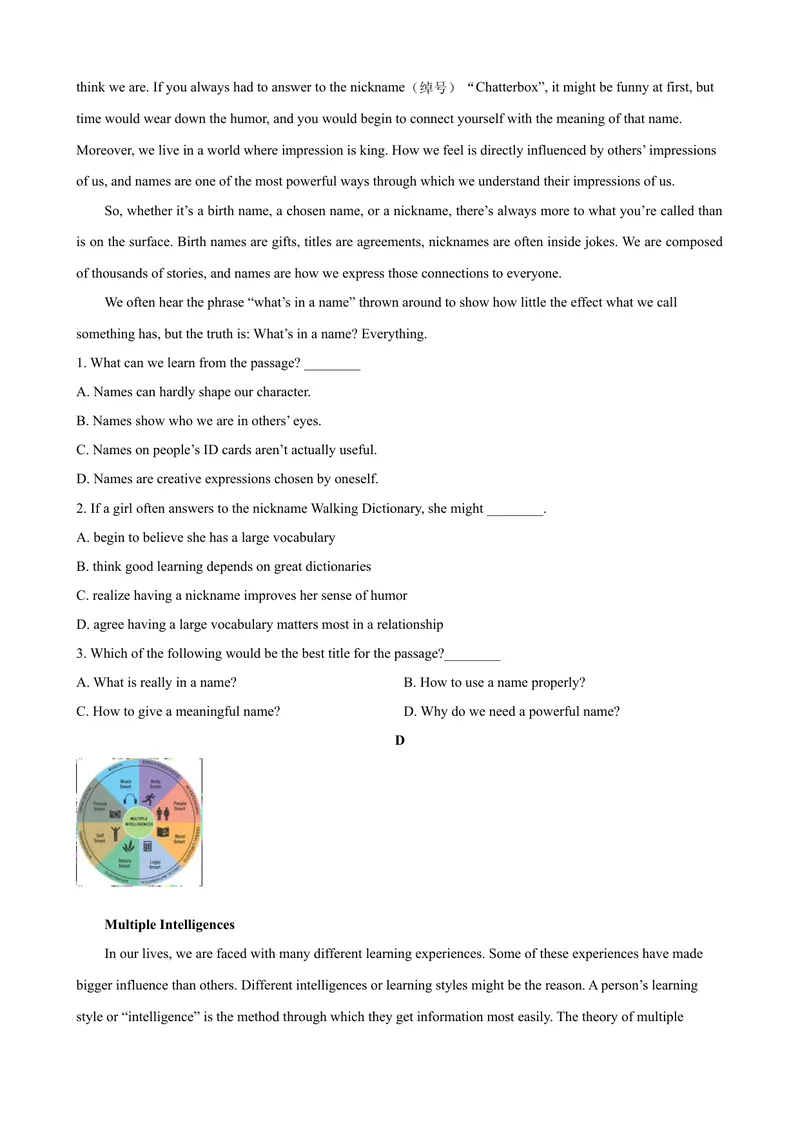
Multiple Intelligences
In our lives, we are faced with many different learning experiences. Some of these experiences have made
bigger influence than others. Different intelligences or learning styles might be the reason. A person’s learning
style or “intelligence” is the method through which they get information most easily. The theory of multipleintelligences(多元智能理论) was put forward in 1983 by Dr. Howard Gardner in his book Frames of Mind: The
Theory of Multiple Intelligences, and it suggests that people are not born with all of the intelligences they will ever
have, and traditional ideas about intelligence, measured (测量) by IQ tests, are very limited (有限的). He listed
some different intelligences to describe different abilities. These intelligences include linguistic (语言的), logical-
mathematical (逻辑数学的), visual-spatial (视觉空间的), bodily-kinesthetic (艺体的), musical and so on.
Dr. Howard Gardner notes that the linguistic and logical-mathematical are the most typed valued in school
and society. American schools and culture focus attention on these two intelligences so people who are good at
expressing or logical thinking are treated differently: they are likely to get more respect and are offered better
rewards and chances. However, Dr. Gardner says that we should place equal (平等的) attention on people who
have the other intelligences: artists, musicians, naturalists, designers, dancers, and athletes. Unluckily, many
children don’t receive much attention and encouragement for these abilities in school. Many of these kids, in fact,
end up being considered as not good enough ones because they are taught in a heavily linguistic or logical-
mathematical classroom and not in a style favored to their type of intelligence.
Education can be much more interesting and help more students to learn better if teachers are encouraged to
present lessons in all kinds of ways using music, group work, art activities, role-play, multimedia, field trips, and
so on. The good news is that in America, hundreds of schools are now using the theory of multiple intelligences to
redesign the way they educate children. By reaching more intelligences, all students will perform better and get
more important information. Understanding a student’s learning style can also help later in life and lead them into
a more satisfying career (职业) direction.
Many adults find themselves in jobs that do not make the best use of their most highly developed
intelligences. For example, the highly bodily-kinesthetic person who is stuck in a linguistic or logical office job
would be much happier in a job where they could move around, such as a sports coach. The theory of multiple
intelligences gives adults a whole new way to look at their lives, examining inner abilities that they left behind in
their childhood (such as a love for art or play); they may now have the chance to develop these through courses,
hobbies, or other programs of self-development.
1. The Theory of Multiple Intelligences suggests _________.
A. people have all of the intelligences when they are born
B. different people might have different kinds of intelligences
C. traditional IQ tests can measure people’s intelligences correctly
D. a person with a high IQ score must have all kinds of intelligences
2. According to the passage, what can we learn about American schools?
A. Students without many intelligences don’t receive much attention.B. Schools use Dr. Gardner’s theory to change students’ intelligences.
C. Schools focus attention on the two most typed valued intelligences.
D. Students will perform perfect if they are taught in the way they like.
3. What does the last paragraph mainly tell us?
A. Adults now have chances to go back to schools to check their inner abilities.
B. Dr. Gardner’s theory can help adults develop their inner abilities left behind.
C. A bodily-kinesthetic person must be offered jobs where he can move around.
D. Dr. Gardner’s theory can help adults become successful in their present jobs.
4. What is the writer’s main purpose in writing this passage?
A. To discuss the importance of multiple intelligences.
B. To compare different types of multiple intelligences.
C. To explain the ways to develop multiple intelligences.
D. To encourage the application of multiple intelligences.
第二部分
本部分共5题, 共20分。根据题目要求, 完成相应任务。
四、阅读表达 (第1-3题每题2分, 第4题4分, 共10分)
阅读短文,根据短文内容回答问题。
Internet history was made on September 19,1982, when professor Scott Fahlman at Carnegie Mellon
University, US, posted “:—)” on the school’s online bulletin board (电子布告栏) .
Guinness World Records called this smiley face the “first digital emoticon (数字表情符号)”.
In the 40 years since, emoticons, and later emojis, have become central to our conversations online. GIFs and
memes(表情包) also appeared. Now there are 3,600 emojis available for us to show our feelings, according to
CNN.
“They offer things that words aren’t saying. They said that when you say ‘okay,’ what kind of okay is that?”
Jennifer Daniel, head of the Emoji Subcommittee for the Unicode Consortium, an organization in charge of
choosing official emojis, told CNN. She said emojis are like our “body language” online. A 2017 study even found
that the use of emojis helps us get the same satisfaction from talking online that we get from communicating in
person.
Just as language develops, so do emojis. The Unicode Consortium brings out new emojis every year. And it
cares about race, gender(性别) and other aspects in emoji sets. In 2015, it released different skin tones(肤色). In
2016, different jobs were added, such as teacher and firefighter—along with female versions(版本) of these jobs.
In 2019, emojis of disabled people were added, including emojis of blind people and people in wheelchairs.
Some argue that we may depend on emojis too much. As people understand an emoji in different ways,misunderstandings often happen. The University of Valencia once studied the “thumbs—up” emoji. It found that
when we use it alone, it serves many meanings: acceptance, liking, or closing the discussion.
So what is the future of emojis? Will the emoji develop to become an international language? Or will emojis
go the way of the emoticon and fade(消失) after the next big thing comes along? It is hard to predict—even
technology and language experts are divided on the topic. What do you think?
1. What has become central to our conversations online in the 40 years since?
____________________________________________________
2. What can we know from the study in 2017?
____________________________________________________
3. Why do misunderstandings often happen when people use emojis?
____________________________________________________
4. Do you like using emojis when having conversations online? Why or why not?
____________________________________________________
五、文段表达 (10分)
从下面两个题目中任选一题, 根据所给提示, 完成一篇不少于50 词的英语文段写作。文中已给出内容不
计入总词数。所给提示词语仅供选用。请不要写出你的校名和姓名。
题一
著名哲学家弗朗西斯·培根在《论读书》一文中写到:读书足以怡情,足以博彩,足以长才。
假如你是李华,是你校读书俱乐部成员。俱乐部要举办一次“我最爱的书籍”主题演讲比赛。请你用英
文介绍一下你最喜欢的一本书,你喜欢它的原因,以及读书带给你的益处。
提示词语:wonderful, inspiring, knowledge, benefit, improve
提示问题: What’s your favorite book?
Why do you like it?
How does reading help you?
___________________________________________________________________________________________
___________________________________________________________________________________________
___________________________________________________________________________________________
___________________________________________________________________________________________
___________________________________________________________________________________________
___________________________________________________________________________________________
___________________________________________________________________________________________题二
“见贤思齐焉,见不贤而内自省也。”
在成长过程中,我们一定会受到身边榜样的影响。假如你是李华,你的笔友Mike想了解你的榜样的
相关事情与你的想法。请你用英语给他回信。说说你的榜样是谁,简述你的榜样所做的那件/些事情影响
了你,你从他/她身上学到了什么。
提示词语:hard-working, helpful, successful, admire, creative
提示问题:Who is your role model?
What did he/she do makes him/her your role model?
What have you learned from him/her?
Dear Mike,
It’s nice to hear from you.
___________________________________________________________________________________________
___________________________________________________________________________________________
___________________________________________________________________________________________
___________________________________________________________________________________________
________________________________
Look forward to hearing from you again.
Yours,
Li Hua