2023-2024 学年九年级上学期期末考试(杭州卷)
英语
(满分:120分;考试时间:100分钟,其中听力30分钟,笔试90分钟)
注意事项:
1. 本试卷共四部分,共七大题,满分120分,考试时间100分钟。
2. 请务必在答题卡上答题,在试卷上答题无效。
3. 考试结束后,请将试卷和答题卡一并交回。
第I卷
第一部分 听力 (共两节,满分30分)
第一节 (共 5小题,每小题 2 分,满分 10 分)
听下面 5 段对话,每段对话后有一个小题。从题中所给的 A、B、C 三个选项中选出最佳选项,并标在
试题的相应位置。听完每段对话后,你都有 10 秒钟的时间来回答有关小题和阅读下一小题。每段对话
仅读一遍。
一、听短对话选答案(共 5 小题,每小题 2分,满分 10 分)
1.Where does Cindy probably want to go?
A.To a bank. B.To a bookstore. C.To her school.
2.What are the chopsticks made of?
A.Wood. B.Steel. C.Bamboo.
3.How does Peter improve his spoken English now?
A.By watching movies. B.By listening to tapes. C.By reading English books.
4.What kind of movies does the man like to watch?
A.Documentaries. B.Action movies. C.Comedies.
5.Why is Simon so tired today?
A.Because he went camping with his parents yesterday.
B.Because he didn’t have enough time to have a sleep last night.
C.Because he kept hearing noises when he was sleeping last night.
二、听对话或对白选答案(共 10 小题,每小题 2分,满分 20分)
听对话,回答以下各小题。
6.When was the great invention invented?
A.In Song Dynasty. B.In Tang Dynasty. C.In Han Dynasty.
7.What was it used for?A.Testing the earthquake. B.Drinking water. C.Making tea.
8.Where does the conversation probably take place?
A.In a school. B.In a library. C.In a museum.
听对话,回答以下各小题。
9.Whose party did Mike attend?
A.Lisa’s. B.Mary’s. C.Cathy’s.
10.When did Mike arrive at the party?
A.At 8:30. B.At 9:00. C.At 9:30.
11.What kind of clothes was Mike supposed to wear to an outdoor party?
A.A suit and tie. B.A T-shirt and jeans. C.A sweater and jeans.
听独白,回答以下各小题。
12.How often do students have the laboratory class?
A.Twice a week. B.Once a week. C.Three times a week.
13.What is the most important in a laboratory class?
A.To be on time. B.To be safe. C.To be tidy.
14.Which of the following is allowed to do in the class?
A.Wearing shorts and dresses. B.Eating and drinking. C.Reporting the accidents.
15.How should students sit during COVID time?
A.Take every seat. B.Take every two seats. C.Take every three seats.
第二部分 阅读理解(共两节;满分40分)
第一节 (共15小题;每小题2分,满分30分)
阅读下列短文,从每题所给的四个选项(A、B、C、D)中选出最佳选项。
A
The Teens newspaper has a little test for young students each week. Here below is Frank’s completed test
this week.
Weekly Test Scores and Their Meanings
1. I prefer to spend my spare time b . 4—6:Your family is very important to you.
(a)with my family You enjoy being with friends but your family
comes first. You are kind and always think more of
(b)with my friends
others.
(c)on my own
7—9:You have lots of friends and like to
2. If I have a problem. I would rather a . have fun. You are close to your family but your
friends are quite important to you, too. You are
(a)talk to my parents than to my friends
easy-going and generous.
(b)talk to my friends than to my family
10—12:You probably have one or two close
试卷第2页,共3页(c)solve it on my own
3. I prefer to study c .
(a)at home with my family around
(b)with my friends
friends, but you’d rather relax with a good book
(c)on my own than go to a party. You are confident and like to do
things for yourself.
4. For my birthday, I would prefer to c .
(a)be with my family
(b)have a party with lots of friends
(c)go out with just my best friend
•You get 1 point for each(a), 2 for each(b), and
•You can e-mail us at weeklytest@teens. com
3 for each(c). and tell us whether your result has described a
REAL you.
•Go and find out what your score means on the right!
16.How many points did Frank get in the week’s test? ________
A.8. B.9. C.10. D.11.
17.From Frank’s result, we may know that ________.
A.he has many close friends and enjoys having fun with them
B.his family comes first although he loves being with friends
C.both his family and his friends are of great importance to him
D.he is a confident young student with only a few close friends
18.By taking this test, a student is supposed to find out ________.
A.how to solve teenage problems
B.how to make good friends
C.what his lifestyle is like
D.what kind of person he is
B
The rest of September was hard. I wasn’t used to getting up so early in the morning. I wasn’t used to being
given homework. And I got my first “test” at the end of the month. I never got “tests” when Mom home-schooled
me. I also didn’t like how I had no free time any more. Before, I could play whenever I wanted to, but now it felt
like I always had something to do for school.
And being at school was awful in the beginning. Every new class I had was like a new chance for kids to
“not look” at me in a strange way. My face would always surprise some kid who maybe hadn’t heard about me.
The kid would make the sound you make when you hold your breath before going underwater, a little “uh!”
sound. This happened four or five times a day for the first few weeks. In the end, everyone was going to see my
face at some time. And I knew after the first couple of days that word had got around me, because from time to
time I’d catch a kid pushing his friend to make him or her to notice me as they passed me, or talking behind theirhands as I walked by them.
I’m not saying they were doing any of these things in an unkind way, not once did any kid laugh or make
noises or do anything like that. They were just being normal silly kids. I know that. I even wanted to tell them
that. Like”It’s okay, I know I’m strange-looking, take a look, I don’t bite. “Hey, the truth is, if a Wookiee(伍基
人)started going to the school all of a sudden, I’d be interested. I’d probably look at him in a strange way! And if
I was walking with Jack or Summer, I’d probably speak to them in a low voice: Hey, there’s the Wookiee. And if
the Wookiee caught me saving that, he’d know I wasn’t trying to be unkind. I was just pointing out the fact that
he’s a Wookiee.
19.Why did the writer compare his homeschooling with the school education?
A.To explain that he preferred to stay at home.
B.To introduce two different kinds of education.
C.To show that it was hard for him to get used to the change.
D.To complain that he had no free time at school any more.
20.How did most kids feel at the sight of the writer?
A.Angry. B.Excited. C.Afraid. D.Surprised.
21.What can we infer from the last paragraph of the passage?
A.The kids in the writer’s school were unfriendly to him.
B.The writer could understand why the kids acted like that.
C.The kids were excited that the writer was like a Wookiee.
D.The writer would fight with the kids if he met them again.
22.The best title for the passage is ________.
A.My Hard Beginning at School B.My Unhappiness as a Young Kid
C.Those Silly Kids at My School D.My Experience of Being a Wookiee
C
One way you can tell if an animal is sleeping is by studying its brainwaves. When human beings or other
mammals(哺乳动物) fall asleep, the pattern of their brainwaves changes.
However, mammals have different brains than fish. Humans and other mammals have complex(复杂的)
brains. A fish’s brain is much less complex than a mammal’s brain. A fish’s brainwaves don’t change when the fish
is asleep. This means that we can’t tell if a fish is sleeping by looking at its brainwaves.
Although fish may not sleep like people, they do rest. One way to tell if a fish is resting is to watch what it is
doing. Most fish will slow down when they are resting. If you have ever had a pet fish, you might have noticed
that it will rest near the bottom of the tank for a few hours every night. When the fish rests, it makes very small
试卷第4页,共3页movements to keep itself in one place.
Another way to tell that a fish is resting is to watch how it reacts(反应) to things that happen to it. When a
fish is resting, it will react much more slowly. In 2007, a group of scientists studied the sleeping habits of zebra
fish. They gave the zebra fish mild(温和的) electric shocks when they were fully awake and while they were
resting. If you have a pet fish at home, you can try a similar experiment. Try giving your fish some food when it is
resting. It should take much longer for the fish to notice that there is food in its tank than it does when the fish is
fully awake.
23.What happens to their brainwaves when fish are resting?
A.Their brainwaves stay the same. B.Their brainwaves become less complex.
C.Their brainwaves die down. D.Their brainwaves change differently.
24.What does the underlined word “they” in Paragraph 2 refer to?
A.People. B.Mammals. C.Fish. D.Brainwaves.
25.What can we learn from the passage?
A.Fish usually eat nothing when they are resting. B.Fish will react more slowly when they are resting.
C.Fish prefer to stay at the bottom of the tank all day.D.Fish usually stop moving when they are resting.
26.What’s the best title for the passage?
A.Do Fish Sleep at Night? B.Fun Facts of Fish.
C.How to Know If a Fish is Resting? D.Sleeping Habits of Fish.
D
①We can see circles, squares and triangles (三角形) everywhere in our daily life. Have you thought about
their meanings in films? Much like colors, different shapes can show different features of characters in the scenes.
②Circles represent (代表) things that are soft and natural. The round shape reminds us of things that appear
in nature, like the sun, flowers, raindrops and so on. We can also connect circles with beautiful eyes, babies’ round
faces…All these things make us feel happy and warm. This is why so many cartoon characters’ bodies—heroes,
kids, good people—are round in shape, because circles represent goodness, happiness and friendliness.
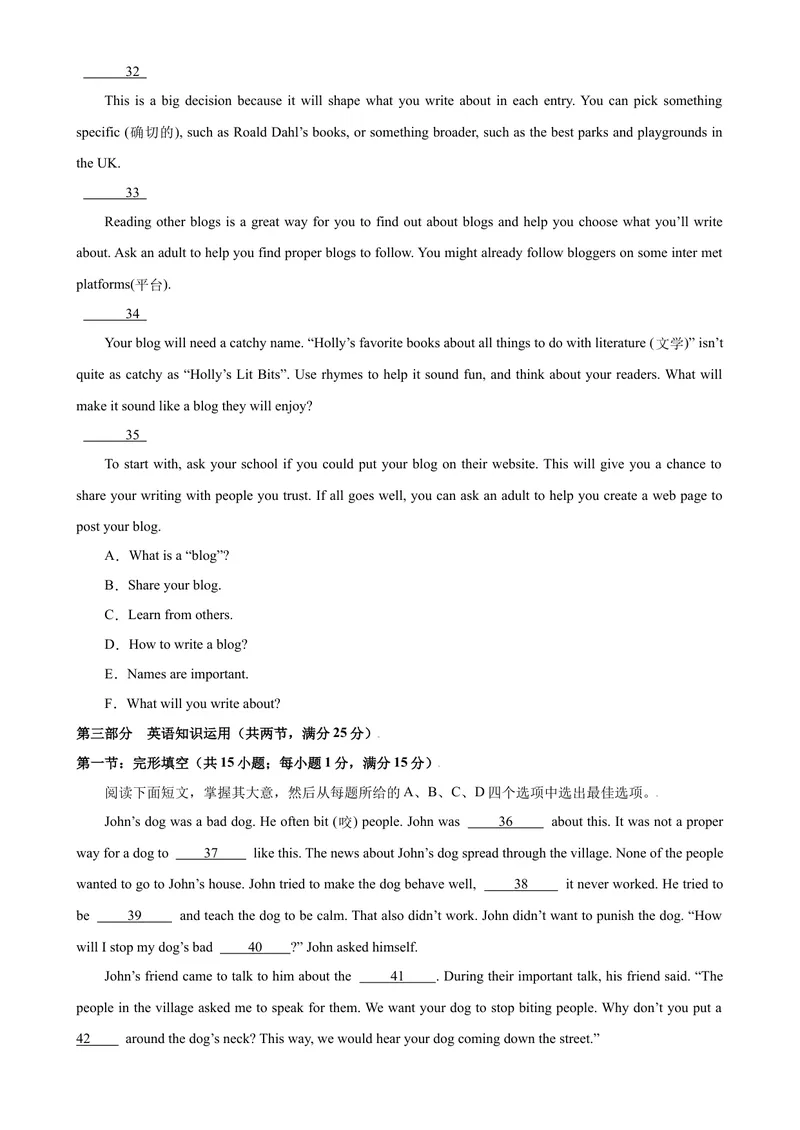
③Squares show things that are unnatural or man-made, or things that are boring or old-fashioned. In Up,
Carl, an elderly man, has a square face and wears square glasses, while Russell, an 8-year-old boy with a round
face, always wears round medals. These shapes show the characters’ personalities. Carl is stubborn (执拗的) and
lonely, while Russell is lovely and full of energy.④The angriest shape is the triangle. Every kid who draws a monster with sharp teeth draws a row of
triangles, don’t they? That’s because the shape represents fear, distrust and doubt in some way. Look at the bad
guys in cartoons—they are all drawn with plenty of points and triangles, like Shengongbao in Ne Zha. And
triangles are stable (稳固的) and don’t easily fall down. In films, this feature makes bad people difficult to deal
with.
⑤Not only in cartoons, but also in other kinds of films, different shapes are used for the same purpose. So,
next time you see a film, try to find the hidden shapes and you will know what the characters are like.
27.The writer explains the relationship between squares and personalities of cartoon characters by ________.
A.telling a story B.giving an example
C.raising a question D.showing the results of a study
28.Why is Shengongbao mentioned in Paragraph 4?
A.Because kids think he is a monster.
B.Because he has a row of sharp teeth.
C.Because he is a bad guy in the film.
D.Because he is not easy to deal with.
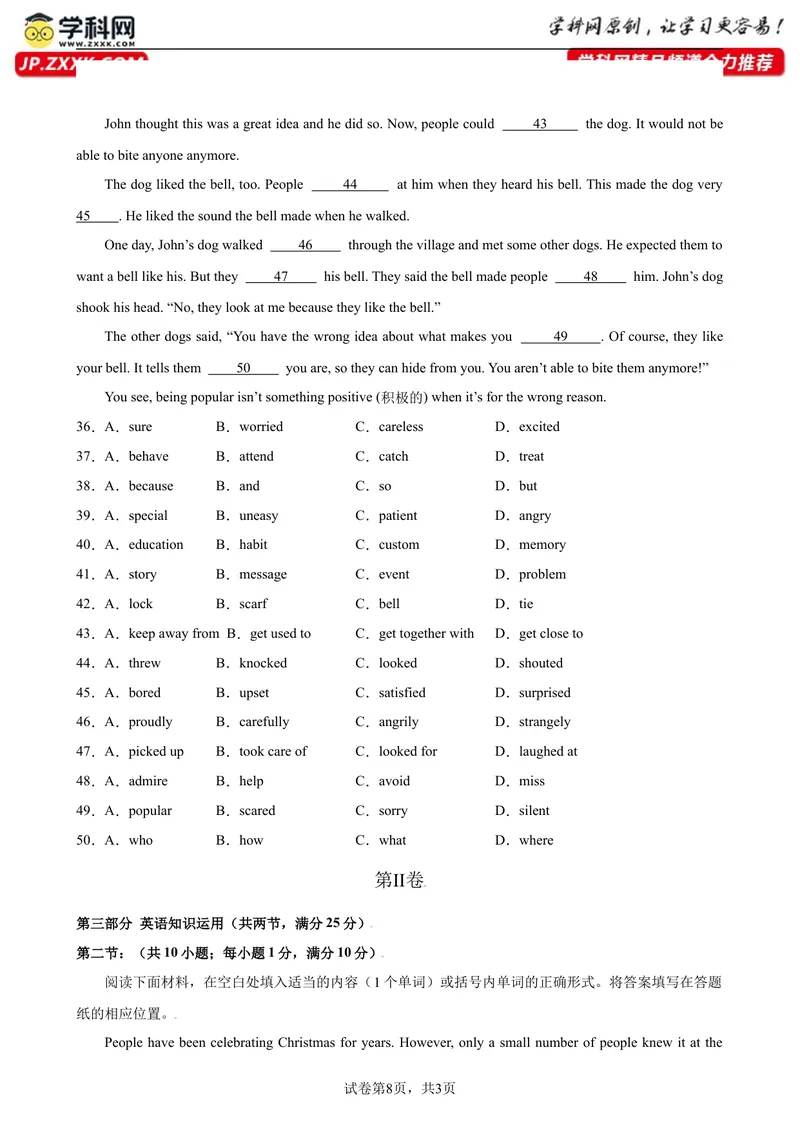
29.Which of the following is the structure of the passage?
A. B. C. D.
30.The passage mainly talks about ________.
A.why different shapes represent different things
B.what makes heroes in films have great charm
C.what different shapes represent in films
D.how to make cartoons with different colors and shapes
第二节(共5小题,每小题2分,满分10分)
下面文章中有五处需要添加标题。请从以下选项(A、B、 C、D、E和F)中选出符合意思的标题。
选项中有一项是多余选项。
Writing a blog(博客) is a great way to practice your writing and get your ideas out there for the world to
read. Many successful writers started as bloggers and you can follow in their footsteps in the future.
31
A blog is some written pieces of a blogger’s opinions on different topics. It is shared online for people to
read. It looks like diary entries, where the most recent post is at the top, with a date and a title(标题).
试卷第6页,共3页32
This is a big decision because it will shape what you write about in each entry. You can pick something
specific (确切的), such as Roald Dahl’s books, or something broader, such as the best parks and playgrounds in
the UK.
33
Reading other blogs is a great way for you to find out about blogs and help you choose what you’ll write
about. Ask an adult to help you find proper blogs to follow. You might already follow bloggers on some inter met
platforms(平台).
34
Your blog will need a catchy name. “Holly’s favorite books about all things to do with literature (文学)” isn’t
quite as catchy as “Holly’s Lit Bits”. Use rhymes to help it sound fun, and think about your readers. What will
make it sound like a blog they will enjoy?
35
To start with, ask your school if you could put your blog on their website. This will give you a chance to
share your writing with people you trust. If all goes well, you can ask an adult to help you create a web page to
post your blog.
A.What is a “blog”?
B.Share your blog.
C.Learn from others.
D.How to write a blog?
E.Names are important.
F.What will you write about?
第三部分 英语知识运用(共两节,满分25分)
第一节:完形填空(共15小题;每小题1分,满分15分)
阅读下面短文,掌握其大意,然后从每题所给的A、B、C、D四个选项中选出最佳选项。
John’s dog was a bad dog. He often bit (咬) people. John was 36 about this. It was not a proper
way for a dog to 37 like this. The news about John’s dog spread through the village. None of the people
wanted to go to John’s house. John tried to make the dog behave well, 38 it never worked. He tried to
be 39 and teach the dog to be calm. That also didn’t work. John didn’t want to punish the dog. “How
will I stop my dog’s bad 40 ?” John asked himself.
John’s friend came to talk to him about the 41 . During their important talk, his friend said. “The
people in the village asked me to speak for them. We want your dog to stop biting people. Why don’t you put a
42 around the dog’s neck? This way, we would hear your dog coming down the street.”John thought this was a great idea and he did so. Now, people could 43 the dog. It would not be
able to bite anyone anymore.
The dog liked the bell, too. People 44 at him when they heard his bell. This made the dog very
45 . He liked the sound the bell made when he walked.
One day, John’s dog walked 46 through the village and met some other dogs. He expected them to
want a bell like his. But they 47 his bell. They said the bell made people 48 him. John’s dog
shook his head. “No, they look at me because they like the bell.”
The other dogs said, “You have the wrong idea about what makes you 49 . Of course, they like
your bell. It tells them 50 you are, so they can hide from you. You aren’t able to bite them anymore!”
You see, being popular isn’t something positive (积极的) when it’s for the wrong reason.
36.A.sure B.worried C.careless D.excited
37.A.behave B.attend C.catch D.treat
38.A.because B.and C.so D.but
39.A.special B.uneasy C.patient D.angry
40.A.education B.habit C.custom D.memory
41.A.story B.message C.event D.problem
42.A.lock B.scarf C.bell D.tie
43.A.keep away from B.get used to C.get together with D.get close to
44.A.threw B.knocked C.looked D.shouted
45.A.bored B.upset C.satisfied D.surprised
46.A.proudly B.carefully C.angrily D.strangely
47.A.picked up B.took care of C.looked for D.laughed at
48.A.admire B.help C.avoid D.miss
49.A.popular B.scared C.sorry D.silent
50.A.who B.how C.what D.where
第II卷
第三部分 英语知识运用(共两节,满分25分)
第二节:(共10小题;每小题1分,满分10分)
阅读下面材料,在空白处填入适当的内容(1个单词)或括号内单词的正确形式。将答案填写在答题
纸的相应位置。
People have been celebrating Christmas for years. However, only a small number of people knew it at the
试卷第8页,共3页51 (begin) of the 19th century. Thanks to Charles Dickens and his great work—Christmas Carol,
Christmas became one of the most popular 52 (festival) around the world. At the age of 31, Charles
was a well-known writer with four children. But life wasn’t easy for him. His last novel didn’t seem 53
(sell) well. What was worse, his friends kept borrowing money 54 him and his wife was going to
give birth to their fifth baby. He wondered 55 he could afford it or not. On an October evening, he
walked along the Thames (泰晤士河), lonely and unhappy, hoping to find new ideas for his next book. The
moment he saw the 56 (terribly) living conditions of homeless people, he came up with 57
idea. Why not write a story to encourage people in need before Christmas?
58 (lucky), this book became a great success. Up to now it 59 (spread) to non-
English speaking countries. People all like his books 60 the spirit of his stories is always truth,
goodness and beauty in humans.
第四部分 写作(共两节,满分25分)
第一节:单词拼写(共10小题;每小题1分,满分10分)
根据首字母提示,正确拼写单词,并将答案填写在答题卡对应的横线上。
61.We are flying a the clouds in a plane.
62.Switzerland is the c of clocks and watches.
63.Scott’s wallet was s , so he called the police for help.
64.If you stay up late at night, you will be s the next day.
65.Jack is always careful in examinations to a making mistakes.
66.The expressions we use might depend on w we are speaking to.
67.Online shopping is very common in our d lives because of its convenience.
68.Mary’s parents took p in her because she won the first prize in the competition.
69.Good learners often c what they need to learn with something interesting.
70.When I was a tiny baby c all night, my mom sang to me and stayed by my side.
第二节:书面表达(共1小题;满分15分)
71.假定你是李平,请阅读以下邮件,接受邀请并回复。词数80左右,可适当增加细节,以使行文
连贯。
To: LiPing@mail.com
Subject: Music festival
Hi!
Do you remember we talked about going to the music festival in my town? Do you still want to go? We could
go to the festival on Friday or Saturday. Which day would you prefer? What kind of music do you like? I’ll find
out who’s playing and let you know.See you soon!
Kim
Dear Kim,
___________________________________________________________________________________________
___________________________________________________________________________________________
___________________________________________________________________________________________
___________________________________________________________________________________________
___________________________________________________________________________________________
___________________________________________________________________________________________
___________________________________________________________________________________________
___________________________________________________________________________________________
Li Ping
试卷第10页,共3页参考答案:
1.B
【原文】M: Excuse me, Cindy. What are you going to do?
W: I want to buy a magazine around here.
2.C
【原文】W: Do you think those chopsticks are made of wood?
M: No, they are made of bamboo.
3.B
【原文】W: Peter, do you improve your spoken English by watching English movies?
M: No. I used to learn by reading English books. But now, I’m learning by listening to tapes.
W: Wow, you do know how to learn well.
4.A
【原文】M: Hi, Jane. Do you like comedies?
W: I prefer action movies that can help shut off my brain and just have fun. What about you?
M: Hmm. Well, I prefer to watch documentaries that can give me something to think about.
W: I know you do.
5.C
【原文】W: Hey, Simon. Why are you so tired today?
M: I went camping with my parents yesterday. But I didn’t sleep the whole night because I kept hearing strange
noises.
W: Oh, that sounds terrible.
M: Yeah, so I want to have a good rest today.
6.C 7.A 8.C
【原文】W: Mike. Look! Over there! That looks so interesting! What is it?
M: Ah, it’s a great invention in ancient China.
W: Really? Who invented it?
M: It was invented by Zhang Heng in Han Dynasty.
W: What was it used for at that time? Was it used for drinking water?
M: No, it was used for testing earthquakes.
W: Really? But how?
M: Read this instruction, and you will know everything about it.W: Wow, it’s really amazing!
9.A 10.C 11.B
【原文】W: Hi, Mike. I heard you went to your friend Lisa’s party with Cathy yesterday. How was it?
M: Oh, Mary, it was terrible.
W: What happened?
M: Well, I was supposed to arrive at 9 o’clock but I got there half an hour late.
W: Oh, that was not very polite.
M: Yeah, and then when I met Lisa’s mom, I shook hands with her.
W: Oh, you were supposed to bow instead.
M: That’s right. And I wore a suit and tie.
W: What’s wrong with that?
M: Well, it turned out that it was an outdoor party. Everyone out was in a T-shirt and jeans.
W: I guess next time you should ask what you are supposed to wear.
12.A 13.B 14.C 15.B
【原文】
Good morning, everyone. Welcome to the class today. The laboratory is a wonderful place, but there are
some instructions that you should strictly follow. We have laboratory class twice a week. I expect you to be on
time. And as you know, safety comes first in a lab! And remember to keep things tidy. Dress properly and be
careful. You mustn’t wear shorts or dresses. You shall not eat or drink here. What’s more, any accidents must be
reported at once. You should wash your hands before and after class. Oh, don’t forget to take every two seats in
the classroom during COVID time. I hope you will enjoy the time in our laboratory. Thank you.
16.B 17.C 18.D
【导语】本文是一份Frank完成的小测试,主要测试了他属于哪种类型的人。
16.推理判断题。根据“You get 1 point for each(a), 2 for each(b), and 3 for each(c).”可知 ,选a得
1分,选b得2分,选c得3分,经计算Frank的得分是9分(2+1+3+3)。故选B。
17.细节理解题。根据7—9分的结果“You are close to your family but your friends are quite important to
you, too.” 可知,他的朋友和家人对他都很重要。故选C。
18.细节理解题。根据“You can e-mail us at weeklytest@teens. com and tell us whether your result has
答案第2页,共2页described a REAL you.” 可知,测试的目的是让学生认识到一个真实的自己。故选D。
19.C 20.D 21.B 22.A
【导语】本文讲述了作者从在家上学到了学校上学,感到日子过得很艰难,大多数孩子对作者感到好奇
和惊讶。
19.推理判断题。根据“The rest of September was hard. I wasn’t used to getting up so early in the morning. I
wasn’t used to being given homework. And I got my first ‘test’ at the end of the month.”(9月剩下的日子很难
熬。我不习惯早上起得那么早。我不习惯被布置家庭作业。我在月底有了我的第一次“测试”)以及“I
never got ‘tests’ when Mom home-schooled me. I also didn’t like how I had no free time any more. Before, I
could play whenever I wanted to, but now it felt like I always had something to do for school.”(妈妈在家教育
我的时候,我从来没有“考试”。我也不喜欢我再也没有空闲时间了。以前,我可以在任何我想玩的时
候玩,但现在我感觉我总是有事情要做在学校。)可推知作者把在家的教育和学校的教育相比是为了强
调改变生活是困难的,故选C。
20.推理判断题。根据“My face would always surprise some kid who maybe hadn’t heard about me. The kid
would make the sound you make when you hold your breath before going underwater, a little ‘uh!’ sound. This
happened four or five times a day for the first few weeks.”(我的脸总是让那些可能没听说过我的孩子感到惊
讶。这个孩子会发出像你潜水前屏住呼吸时发出的声音,一种轻微的“啊!”声音。在最初的几周里,
这种情况每天发生四五次。)可推知大多数孩子对于作者是感到惊讶和好奇的,故选D。
21.推理判断题。根据“I’m not saying they were doing any of these things in an unkind way, not once did any
kid laugh or make noises or do anything like that. They were just being normal silly kids.”(我并不是说他们做
这些事情的方式不友好,没有一个孩子大笑或发出声音或做类似的事情。他们只是普通的傻孩子)以及
“I know I’m strange-looking, take a look, I don’t bite.”(我知道我看起来很奇怪,看看,我不咬人)可推知
作者可以理解为什么孩子们会那样做。故选B。
22.最佳标题题。根据“The rest of September was hard.”以及“And being at school was awful in the
beginning.”结合全文可知,文章讲述了作者从在家上学到了学校上学,感到日子过得很艰难,大多数孩子
对作者感到好奇和惊讶。选项A“我在学校的艰难开端”符合主题,故选A。
23.A 24.C 25.B 26.C
【导语】本文告诉了我们两种判断动物是否在睡觉或休息的方法:一个是通过动物的脑电波来判断它是
否在睡觉,另一个是通过观察它对发生在它身上的事情的反应来判断它是否在休息。23.细节理解题。根据“A fish’s brainwaves don’t change when the fish is asleep.”可知,鱼睡觉时,脑电波
不会改变。故选A。
24.词句猜测题。分析“Although fish may not sleep like people, they do rest.”可知,虽然鱼可能不像人一样
睡觉,但它们会休息。 此处they指的是“鱼”,故选C。
25.细节理解题。根据“When a fish is resting, it will react much more slowly.”可知,当鱼休息时,它的反
应会慢得多。故选B。
26.最佳标题题。本文主要告诉了我们两种判断动物是否在睡觉或休息的方法,故选C。
27.B 28.C 29.A 30.C
【导语】本文介绍了我们随处可见圆形、正方形和三角形,不同的形状可以在场景中显示不同的人物特
征。
27.细节理解题。根据“In Up, Carl, an elderly man, has a square face and wears square glasses, while Russell,
an 8-year-old boy with a round face, always wears round medals.”可知作者解释卡通人物的个性与方格的关系
靠举例子。故选B。
28.细节理解题。根据“Look at the bad guys in cartoons—they are all drawn with plenty of points and
triangles, like Shengongbao in Ne Zha.”可知Shengongbao是坏人。故选C。
29.篇章结构题。第一段提出主题,不同的形状可以在场景中显示不同的人物特征;第二三四段,分别
介绍圆形、正方形和三角形与人物的联系;第五段总结。故选A。
30.主旨大意题。本文介绍了我们随处可见圆形、正方形和三角形,不同的形状可以在场景中显示不同
的人物特征。因此文章主要是谈论不同的形状代表了什么,故选C。
31.A 32.F 33.C 34.E 35.B
【导语】本文介绍了什么是博客以及如何写博客。
31.根据下文“A blog is some written pieces of a blogger's opinions on different topics. It is shared online for
people to read. It looks like diary entries, where the most recent post is at the top, with a date and a title(标题).”
结合备选选项可知,此处解释了什么是博客。因此应说什么是“博客”?故A项“什么是‘博客’?”
符合语境。故选A。
32.根据下文“This is a big decision because it will shape what you write about in each entry. You can pick
something specific (确切的), such as Roald Dahl’s books, or something broader, such as the best parks and
playgrounds in the UK.” 结合备选选项可知,说的是在博客中写什么。因此应说你会写些什么?因此F项
“你要写些什么?”符合语境。故选F。
答案第4页,共2页33.根据下文“Reading other blogs is a great way for you to find out about blogs and help you choose what
you'll write about. Ask an adult to help you find proper blogs to follow. You might already follow bloggers on
some inter met platforms(平台).” 结合备选选项可知,说的是阅读其他博客是一种很好的方法。因此应说向
他人学习。故C项“向他人学习”符合语境。故选C。
34.根据下文“Your blog will need a catchy name. ‘Holly’s favorite books about all things to do with literature
(文学)’ isn’t quite as catchy as ‘Holly’s Lit Bits’. Use rhymes to help it sound fun, and think about your readers.
What will make it sound like a blog they will enjoy?”结合备选选项可知,此处说的是你的博客需要一个朗朗
上口的名字。因此应说名字很重要。故E项“名字很重要”。符合语境。故选E。
35.根据下文“To start with, ask your school if you could put your blog on their website. This will give you a
chance to share your writing with people you trust. If all goes well, you can ask an adult to help you create a web
page to post your blog.”结合备选选项可知,说的是分享你的作品。因此应说分享你的博客。故B项“分享
你的博客”符合语境。故选B。
36.B 37.A 38.D 39.C 40.B 41.D 42.C 43.A 44.C 45.C
46.A 47.D 48.C 49.A 50.D
【导语】本文是一篇记叙文,主要介绍了约翰的狗喜欢咬人,朋友建议他给狗系上铃铛,这样可以提醒
人们避开狗,而狗却误以为人们喜欢它的铃铛。
36.句意:约翰对此很担忧。
sure肯定的;worried担忧的;careless粗心的;excited兴奋的。根据文章前两句“John’s dog was a bad
dog. He often bit (咬) people.”可知,约翰的狗经常咬人,所以约翰应该对此感到担忧,故选B。
37.句意:狗这样的行为不是合适的方式。
behave行为,表现;attend参加;catch抓住;treat对待。结合上文和“It was not a proper way for a dog
to ... like this”可知,这里是指狗咬人的行为,故选A。
38.句意:约翰努力使狗表现得好,但从来没有起过作用。
because因为;and和;so所以;but但是。根据该空前后两个分句“John tried to make the dog behave well”
与“it never worked”可知,这两个分句是转折关系,故选D。
39.句意:他努力让自己耐心并且教狗保持冷静。
special特别的;uneasy不安的;patient耐心的;angry生气的。根据题意和空格后面“and teach the dog to
be calm”可知,约翰教狗狗保持冷静,and表示前后动作要一致,所以前面是约翰要让自己有耐心,故选
C。40.句意:“我要怎样阻止狗的坏习惯?”约翰问自己。
education教育;habit习惯;custom风俗;memory记忆。根据上文语境和“How will I stop my dog’s
bad ...”可知,这里是指约翰的狗有咬人的坏习惯,而他不知道怎么阻止,故选B。
41.句意:约翰的朋友来和他谈起这个问题。
story故事;message短信;event事件;problem问题。根据语境可知,约翰的朋友和他谈论的是狗咬人的
问题,故选D。
42.句意:为什么不系一个铃铛在狗的脖子上呢?
lock锁;scarf围巾;bell铃铛;tie领带。根据第四段第一句“The dog liked the bell, too.”可知,下文有提
到狗狗喜欢这个铃铛,所以该处应该是约翰的朋友建议他系一个铃铛在狗的脖子上,故选C。
43.句意:现在,人们可以远离这只狗。
keep away from远离;get used to习惯于;get together with和……相聚;get close to靠近。根据第三段最后
一句“It would not be able to bite anyone anymore.”可知,人们听到铃铛的声音就可以远离狗,这样狗再也
不会咬人,故选A。
44.句意:人们在听到铃铛声音时看着他。
threw扔;knocked敲;looked看;shouted大喊。根据第五段最后两句John’s dog shook his head. “No, they
look at me because they like the bell.”可知,人们在听到铃铛声音时会看着狗,故选C。
45.句意:这使狗很有满足感。
bored无聊的;upset不安的;satisfied满意的;surprised惊讶的。根据第四段第二句“People ... at him
when they heard his bell.”和第四段最后一句“He liked the sound the bell made when he walked.”可知,狗狗
很喜欢他走动时,铃铛发出的声音,而且人们听到声音后也会看着他,对此狗狗很有满足感,故选C。
46.句意:有一天,约翰的狗骄傲地穿过村庄,遇到了一些其他的狗。
proudly骄傲地;carefully小心翼翼地;angrily生气地;strangely奇怪地。根据第四段最后一句“He liked
the sound the bell made when he walked.”可知,狗狗很喜欢走路时铃铛发出的声音,所以当狗带着铃铛走
在街上,他感到很骄傲,故选A。
47.句意:但他们嘲笑他的铃铛。
picked up捡起;took care of照顾;looked for寻找;laughed at嘲笑。根据倒数第二段第一句“The other
dogs said, ‘You have the wrong idea about what makes you ...’” 可知,其他的狗知道铃铛是为了提醒人们避
开约翰的狗,所以他们嘲笑他的铃铛,故选D。
48.句意:他们说铃铛是让人们避开他。
admire欣赏;help帮助;avoid避开;miss错过。根据倒数第二段第二句和第三句“Of course, they like
your bell. It tells them ... you are, so they can hide from you.”可知,铃铛是为了提醒人们约翰的狗来了,好让
答案第6页,共2页人们避开约翰的狗,故选C。
49.句意:关于什么使你受欢迎,你的想法是错误的。
popular受欢迎的;scared害怕的;sorry抱歉的;silent沉默的。根据倒数第三段的最后一句“No, they
look at me because they like the bell.”可知,约翰的狗以为人们在铃铛响的时候看着他是因为他们喜欢铃铛,
也就是他以为铃铛是他受欢迎的原因,而其他的狗告诉他,关于他受欢迎的原因他的想法是错误的,故
选A。
50.句意:它告诉他们你在哪里,这样他们就可以躲开你。
who谁;how怎样;what什么;where哪里。根据该句的后半句“so they can hide from you”可知,铃铛会
告诉人们狗在哪里,然后他们听到声音就会躲开,故选D。
51.beginning 52.festivals 53.to sell 54.from 55.whether 56.terrible 57.an
58.Luckily 59.has spread 60.because
【导语】本文讲述了查尔斯·狄更斯和他的伟大作品《圣诞颂歌》的故事。
51.句意:然而,只有少数人在19世纪初知道它。根据空前“the” 可知,此处应填名词beginning“开
始”,at the beginning of表示“在……的开始”。故填beginning。
52.句意:圣诞节成为世界上最受欢迎的节日之一。one of the +形容词最高级+名词复数,是固定用法。
故填festivals。
53.句意:他的上一部小说看似卖得并不好。seem to do sth表示“看起来……”,需填sell的不定式。故
填to sell。
54.句意:更糟糕的是,他的朋友不断地从他这里借钱。borrow from表示“向……借”,是固定搭配。
故填from。
55.句意:他疑惑自己是否能够养得起。此处用连词whether来引导宾语从句,并和句中的“or not”组成
短语“whether or not”,表示“是否”。故填whether。
56.句意:当他看到无家可归者可怕的生活条件时。terribly副词。此处应用形容词修饰living
conditions。故填terrible。
57.句意:他想出了一个主意。介词的宾语idea,表泛指,是可数名词单数且是以元音音素开头,故用不
定冠词an来修饰。故填an。
58.句意:幸运的是, 这本书取得巨大成功。根据“this book became a great success.”这本书取得巨大成
功。可知空处应填lucky的副词形式,在句中作状语,表示“幸运的是”。故填Luckily。
59.句意:直到现在,它已经传播到非英语国家了。根据句中“Up to now到现在为止”可知句子为现在完成时;主语it是第三人称单数,故助动词have用第三人称单数has,spread的过去分词是spread。故填
has spread。
60.句意:人们都喜欢他的书,因为他的故事的精神永远是人类的真善美。空前和空后是因果关系,故
用because引导原因状语从句。故填because。
61.(a)bove
【详解】句意:我们在飞机里,在云层之上飞行。根据“We are flying…the clouds”及首字母,可知,飞
机在云层之上飞行,above“在……之上”,故填(a)bove。
62.(c)apital
【详解】句意:瑞士是钟表之都。根据“Switzerland…watches and clocks”及首字母可知,瑞士是钟表之
都,the capital of“……的首都”,故填(c)apital。
63.(s)tolen
【详解】句意:Scott的钱包被偷了,所以他去警察局寻求帮助。根据“so he called the police for help”并
结合首字母可知,钱包被偷,该句为被动语态结构“be+动词过去分词”,stolen“偷”,过去分词。故填
(s)tolen。
64.(s)leepy
【详解】句意:如果你晚上熬夜,第二天就会犯困。根据“If you stay up late at night, you will be … the
next day.”及首字母可知,如果熬夜第二天会犯困,sleepy“困倦的”,形容词作表语,故填(s)leepy。
65.(a)void
【详解】句意:杰克考试时总是很细心,以免出错。根据“Jack is always careful in examinations”可知他考
试很小心,可推测是为了避免错误,avoid“避免”,此处是动词不定式表目的,所以用动词原形,故填
(a)void。
66.(w)hom
【详解】句意:我们使用的表达可能取决于我们说话的对象。根据“we are speaking to”,并结合首字母
可知应是取决于和谁说话,whom“谁”符合语境,引导宾语从句,作to的宾语,故填(w)hom。
67.(d)aily
【详解】句意:网上购物在我们的日常生活中很常见,因为它很方便。根据“Online shopping is very
common in our …lives”及首字母可知,此处指在日常生活中常见,daily“日常的”,形容词作定语,故填
(d)aily。
68.(p)ride
【详解】句意:玛丽的父母为她感到骄傲,因为她在比赛中得了一等奖。根据“because she won the first
答案第8页,共2页prize in the competition”及首字母提示可知,这里指为她感到骄傲,take pride in意为“为……感到自豪”,
故填(p)ride。
69.connect
【详解】句意:好的学习者经常把他们需要学习的东西和一些有趣的东西联系起来。空格处缺少动词作
谓语,副词often说明时态是一般现在时,主语Good learners是复数形式,所以谓语动词用原形,根据
“what they need to learn with something interesting”可知,指好的学习者经常把他们需要学习的东西和一些
有趣的东西联系起来,connect...with...“把……和……联系起来”。故填connect。
70.(c)rying
【详解】句意:当我还是个小婴儿的时候,整夜哭,我妈妈给我唱歌,陪在我身边。根据“When I was a
tiny baby...all night, my mom sang to me and stayed by my side.”可知小时候哭的时候妈妈会给我唱歌,
cry“哭”,句中有谓语动词,此处用非谓语动词,且主语和cry是主动关系,故用现在分词。故填
(c)rying。
71.例文
Dear Kim,
Thanks for the invite! I’m excited about the music festival. Let’s go there on Saturday as it works better for
me. I’m a big fan of rock and indie music, but I’m open to enjoying different genres too. Can’t wait to see which
bands are playing! Looking forward to a great time and catching up with you.
Li Ping
【详解】[总体分析]
①题材:本文是一篇应用文,是一封电子邮件;
②时态:时态主要为“一般现在时”和“一般将来时”;
③提示:邮件内容基于给定的情景和要求编写,注意根据邮件的上下文适当增加细节,保持内容的连贯
性和语气的友好。
[写作步骤]
第一步,对邮件进行回应,表达对音乐节计划的兴趣和对邀请的感谢;
第二步,确定具体的参加日期(即选择周六),并表达对音乐类型的偏好;
第三步,表达对活动的期待,并以友好的方式结束邮件。
[亮点词汇]
①be excited about对……感到兴奋
②be open to doing愿意做某事
[高分句型]Let’s go there on Saturday as it works better for me.(祈使句)
答案第10页,共2页