1
Unit 1 语法篇
__________________________________________________________________________________
__________________________________________________________________________________
1.
理解并掌握反意疑问句的用法
2.
理解并掌握一般现在时被动语态的用法
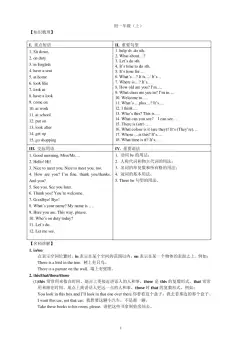
1. 反意疑问句
(1)用法反意疑问句可以表示真实的疑问,也可以表示说话者的某种倾向、强调或反问。
(2)反意疑问句由两部分组成:前一部分陈述,后一部分提问。
(3)如果前一部分用肯定形式,后一部分就用否定形式;如果前一部分用否定,后部分就用肯定
形式。即:前肯后否,前否后肯。
(4)如果陈述句的谓语是be 动词,反意疑问部分只需根据陈述句的be 动词进行肯定或否定变化;
如果是行为动词,则反意疑问部分需借助助词do, don’t, does, doesn’t 或did(didn’t),需使用哪
一个,视时态、人称而定。
(5)反意疑问句的几种特殊用法
①由动词原形引导的祈使句,其反意疑问句用“will you”。
②Let’s 开头的祈使句,反意疑问句用“shall we”; let us 开头的祈使句,则用“will you”。
③there be 句型的反意疑问句用相应的“be 动词+ there”。
④陈述部分有have to +v. (had to + v.),疑问部分常用don't +主语(didn't +主语)
⑤陈述部分用 no, nothing, nobody, never, few, seldom, hardly, rarely, little 等否定含义的词 时,疑
问部分用肯定含义。否定前缀不能视为否定词,其反意疑问句仍用否定形式。
2
⑥陈述部分主语是指示代词或不定代词everything, that, nothing, this, 疑问部分主语用it。
   陈述部分主语是不定代词everybody, anyone, somebody, nobody, no one 等,疑问部分常用复数
they,有时也用单数he。
2. 一般现在时的被动语态
  英语动词分为主动语态和被动语态。主动语态表示主语是动作的执行者,被动语态表示主语是动
作的承受者。
(1)被动语态的构成:be + done
(2)一般现在时的被动语态:am/is/are + done
 Tom(

 执
  )   cleans(

 谓动

 )   the room(

 承
  )   every day.
    (主动)
The room(

 承
  )   is cleaned(

 谓动

 )   by Tom(

 执
  )   every day.
(被动)
被动语态变换口诀:
宾变主,主变宾,前加by;动变被,看清be,结构be+p.p.
1. ---Don’t be late for school next time, ___________?      ---No, I won’t.

A. are you
       B. will you
       C. do you       D. did you
2. We have to finish the work now,____________?

A. don’t we
       B. haven’t we   C. have we
       D. do we
3. He has never been to Beijing, _____________?

A. hasn’t he       B. has he       C. doesn’t he   D. has he
4. You had some trouble finding where I live, ___________?

A. didn’t you       B. hadn’t you   C. do I
       D. don’t I
5. The girl returned you a bike yesterday evening, ________?

A. didn’t she       B. did she
       C. isn’t she
   D. is she
6. The pet dog is warm and lovely. It ________ as a daughter of my family.

A. treats           B. treated       C. is treated
   D. was treated
7. We _________ any money by our parents.

A. are given       B. give
       C. don’t give   D. aren’t given
8. The Olympic Games ________ every four years.

A. are held
       B. were held
   C. hold
       D. held
9. A lot of flowers_________ in Beijing International Flower Port every year.

A. plant            B. planted       C. are planted   D. were planted
10. ---Now computers_________ in many ways in our life.  ---Yes, they are very useful.

A. use
           B. are used
   C. used
       D. were used
3
基础演练
一、完成下列反意疑问句
1. It’s a nice day, __________?
2. The old man can hardly dress himself, _____________?
3. Linda’s just come back from America, ______________?
4. He thinks his aunt is right, ______________?
5. The students will go to the Great Wall next week, ____________?
6. Today, it is not hot, _____________?
7. Mary draws pictures every day, ______________?
8. Nothing is impossible,  _______________ ?
9. There is little milk left in the bottle,  _______________ ?
10. Let us clean the classroom by ourselves,  _______________ ?
二、用括号里所给单词的正确形式填空
1. Body language ______________(use) to communicate with each other.
2. The students _________ often _________(tell) to take care of their desks and chairs.
3. The room ______________(clean) by me every day.
4. Children under 18________________(not allow) to watch this show without their parents.
5. Vegetables, eggs and fruits ______________(sell) in this shop.
6. English _________(speak) the most widely in the world.
7. The town ___________(call) Rugao.
8. Metal _____________ (use) for making machines.
9. Tea______________(grow) in South China.
10. He _______ often________(help) by his brother.
巩固提高
根据中文提示完成句子。(每空一词)
1. 身势语到处都用。
  Body language ________ _________ everywhere.
2. 游客会犯许多错。
  Many mistakes________ _________ by travelers.
3. 这种机器是在中国制造的。
  This kind of machine_________ _________ in China.
4. 每年,两本法国故事书都会被卫斯理翻译成中文。
  Two French storybooks________ __________ into Chinese by Wesley every year.
5. 他每天早上都会查看邮件。
4
  Emails __________ __________ _______ him every morning.
6. 每年春天他们都会种树。
  Trees ________ __________ by them every _________.
7. 单词的学习必须结合其符号、意义和发音的学习。
  Words must be________ ________ __________ their symbol, meaning and pronunciation.
8. 音调在中英文用法有很大不同。
  Tone _______ ________very _________ in Chinese and English.
9. 在计算机课上,文字处理技术被教授。
  Word processing skills_______ _________ in our computer lessons.
10. 这首歌经常被女孩听。
  This song _______ often ___________ _________ by girls.
一、单项选择
1. Many students _______ chances to show themselves in class because the class size is too big.

A. don’t give       B. aren’t given     C. haven’t given    D. won’t given
2. On snowy days, a driver must drive as_______ as possible.

A. fast
           B. careful         C. wisely
        D. carefully
3. ---How do you like maths?      ---I think it’s ____________ than English.

A. difficult
       B. more difficult
 C. more difficult    D. the most difficult
4. When you __________ a difficult task, try to continue with it and finish it.

A. give
           B. gave
         C. are giving
        D. are given
5. In order to get a good grade in the exam, she ________ the result again and again.

A. checks           B. check         C. inspects
        D. inspect
6. When we heard the good news, we feel very__________.

A. exciting
       B. excited         C. excite
        D. excites
7. You seldom go to visit your grandparents, ____________?

A. aren’t you       B. are you
         C. don’t you
        D. do you
8. The first floor in Britain is the _________ floor in the USA.

A. ground
       B. first
         C. second
        D. third
9. David and Tom are good friends. They ____________ each other for ten years.

A. knew           B. know
         C. have known
    D. had known
10. Why not ________you friend for help when you are in trouble?

A. ask
           B. to ask         C. asks
            D. asking
二、完形填空
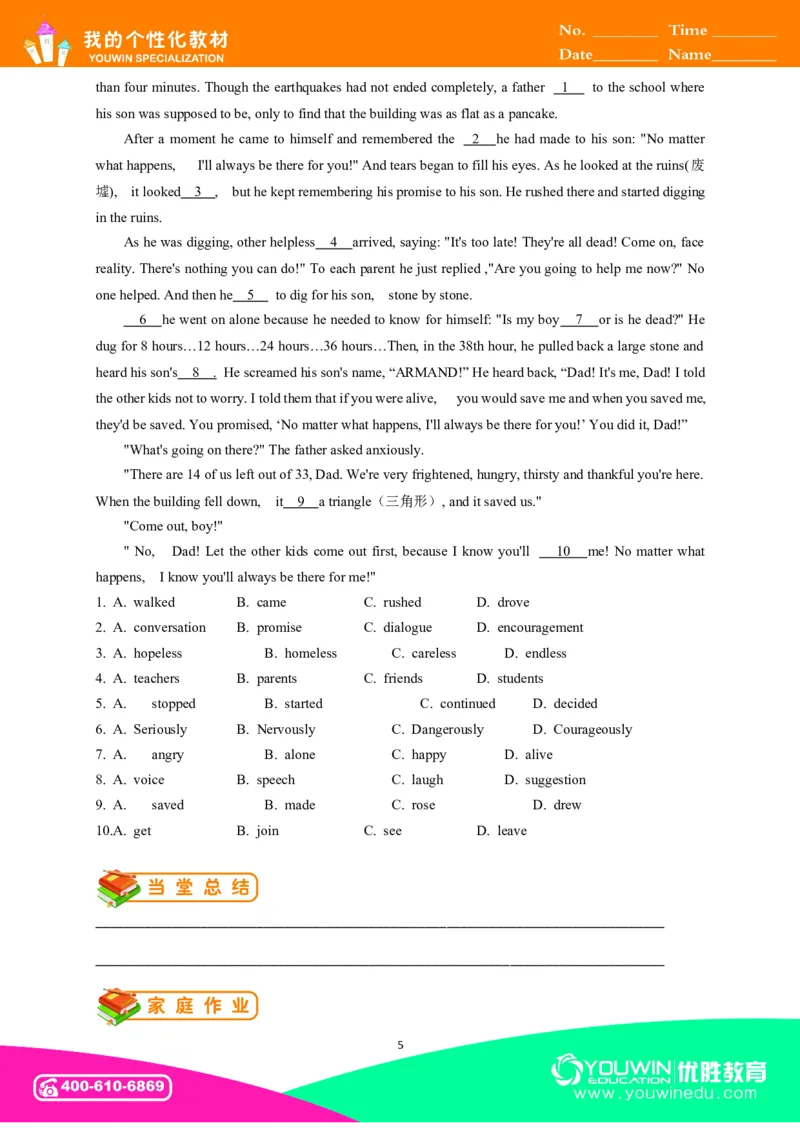
In 1989 a strong earthquake almost flattened America, and over 300,000 people were injured in less
5
than four minutes. Though the earthquakes had not ended completely, a father  1   to the school where
his son was supposed to be, only to find that the building was as flat as a pancake.
After a moment he came to himself and remembered the  2  he had made to his son: "No matter
what happens,   I'll always be there for you!" And tears began to fill his eyes. As he looked at the ruins(废
墟),  it looked  3  ,  but he kept remembering his promise to his son. He rushed there and started digging
in the ruins.
As he was digging, other helpless  4  arrived, saying: "It's too late! They're all dead! Come on, face
reality. There's nothing you can do!" To each parent he just replied ,"Are you going to help me now?" No
one helped. And then he  5   to dig for his son,  stone by stone.
  6  he went on alone because he needed to know for himself: "Is my boy  7  or is he dead?" He
dug for 8 hours…12 hours…24 hours…36 hours…Then, in the 38th hour, he pulled back a large stone and
heard his son's  8  . He screamed his son's name, “ARMAND!” He heard back, “Dad! It's me, Dad! I told
the other kids not to worry. I told them that if you were alive,   you would save me and when you saved me,
they'd be saved. You promised, ‘No matter what happens, I'll always be there for you!’ You did it, Dad!”
"What's going on there?" The father asked anxiously.
"There are 14 of us left out of 33, Dad. We're very frightened, hungry, thirsty and thankful you're here.
When the building fell down,  it  9  a triangle(三角形), and it saved us."
"Come out, boy!"
" No,  Dad! Let the other kids come out first, because I know you'll
  1  0

 me! No matter what
happens,  I know you'll always be there for me!"
1. A. walked        B. came          C. rushed
      D. drove
2. A. conversation    B. promise
      C. dialogue      D. encouragement
3. A. hopeless
        B. homeless
      C. careless      D. endless
4. A. teachers        B. parents
      C. friends
      D. students
5. A.
stopped
        B. started
          C. continued
  D. decided
6. A. Seriously
    B. Nervously
      C. Dangerously
  D. Courageously
7. A.
angry
        B. alone          C. happy
      D. alive
8. A. voice
        B. speech
          C. laugh
      D. suggestion
9. A.
saved
        B. made          C. rose
          D. drew
10.A. get            B. join
          C. see          D. leave
_________________________________________________________________________________
_________________________________________________________________________________
6
一、
单项选择
1. --- __________ do you go to see your uncle?
--- Three times a month.
A. How long               B. How many            C. How often            D. How old
2. I bought two coats yesterday. One is green, ________ is yellow.
    A. other                  B. others                 C. another              D. the other
3.--- Must we get to the airport before 6:00?
   --- No, you _________. The plane takes off at 9:00.
     A. mustn’t              B. won’t               C. can’t
    D. needn’t
4.Mr. Black was born _________ July, 1989.
     A. at
       B. in
      C. on                    D. to
5. I was tired last night, ________ I went to bed earlier.
     A. and
       B. but                     C. so
     D. or
(附:单选1-5, 2015 北师大实验中学初三英语综合练习)
二、阅读理解
A
Sitting still and keeping quiet seems like what students should do in class. However, putting your feet
on the table, using iPads, eating and drinking may also take place in school. Americans are famous for
their casual (随意的)style. I didn’t think it was a big deal until I arrived here.
I was told sitting still is what you should do in middle school. That is a traditional Chinese way to
show that we are paying attention to what the teacher is saying. Meanwhile, it doesn’t seem to matter in
the US. When I first saw a student lying on a sofa, I was shocked and thought the teacher may feel angry,
but she didn’t. She just smiled and kept talking. Then I got used to it, and enjoyed the relaxing and
comfortable position (姿势) in class. Yet it’s really easy to fall asleep if I feel too comfortable.
Also, we don’t have uniforms at school. We can wear whatever we want. And teenagers here feel
free to eat breakfast, snacks, and drink soda while teachers are talking. Teachers won’t feel upset and may
even eat with them. Once, my English teacher was secretly eating a bag of chips in her seat.
American teachers chat with students in class. It makes us feel closer to them. Although it does mean
we go off topic easily. In comparison, Chinese teachers are strict, but it helps us to focus on our task.
1. Where is the writer from?
  A. America
B. China          C. England    D. I don’t know
2. According to the passage, students should _________ in class in China.
  A. put the feet on the table
     B. use iPads
C. eat and drink something
         D. sit still and listen carefully
3. In America, when a student was seen lying on a sofa in class, the teacher will be ________.
A. shocked    B. angry         C. strict         D. unsurprised
4. Which of the following is NOT true?
  A. When American teachers talk with the students, the students will feel upset.
7
  B. I may feel asleep in class because of the relaxing position.
C. We don’t have uniforms at school in America.
D. We can eat breakfast in class in America.
B
    One day, my mother and I went shopping at a Chinese supermarket. We found that the crucian carps
(鲫鱼) in the seafood counter were very fresh, as a result we chose four crucian carps and handed them
over to the seller. As it would take some time to clean the fish and dispose of their intern al organs, we
decided to look around the other places first. When we came back to the seafood counter, I asked the seller
for my fish. He raised one, which was being cleaned, to let me have a look and tell me he was still working
on the fish. I hurriedly said, "Go ahead. Go ahead." I meant for him to go on.
    To my surprise, the seller stopped his work, looking at me with puzzled (困惑的) expression, and
asked me, "Go ahead?”“Yes," I said, "go ahead". He pointed at the fish in all seriousness, and repeated very
seriously, "Head?" Paying no more attention to him, I turned back to chat with my mother. Suddenly,
"Bang, bang, bang," was heard from the counter.
Quickly, the seller passed the four fish without heads to me. I asked loudly, "Why did you cut all the
heads off?" The seller was also very angry and said, "Didn't you tell me to go ahead again and again?"On
hearing what he said I felt funny as well as angry. It turned out that he considered "go ahead" as "cut the
head off". No wonder he asked me several times about it!
5. The writer went to ____ with her mother that day.
  A. a restaurant    B. a beach        C. a supermarketD. a park
6. The writer ____ with her mother after they bought the fish.
  A. looked around the other places
    B. cleaned the fish
C. cut all the heads of the fish off
    D. went back home
7. The seller cut all the heads off because _______.
A. the writer asked him to do so
B. he was angry with the writer
C. he wanted to cut off the heads
D. he didn’t understand what the writer said
C
Do American children still learn handwriting in school? In the age of
the keyboard, some people seem to think handwriting lessons are on the
way out. 90% of teachers say they are required to teach handwriting. But
studies have yet to answer the question of how well they are teaching it.
One of this year’s studies found that about three out of every four teachers
say they are not prepared to teach handwriting. Some teachers are teaching
handwriting by providing instruction for 10 to 15 minutes a day, and then other teachers who basically
teach it for 60 to 70 minutes a day — which really for handwriting is pretty much.
8
Many adults remember learning that way — by copying letters over and over again. Today’s thinking
is that short periods of practice are better. Many experts(专家) also think handwriting should not be taught
by itself. Instead, they say it should be used as a way to get students to express ideas. After all, that is why
we write.
Handwriting involves two skills. One is legibility, which means forming the letters so they can be
read. The other is fluency(流畅) — writing without having to think about it. Fluency continues to develop
up until high school.
But not everyone masters these skills. Teachers commonly report that about one fourth of their kids
have poor handwriting. Some people might think handwriting is not important any more because of
computers and voice recognition programs.
But Steve Graham at Vanderbilt says word processing is seldom done in primary school, especially in
the early years. American children traditionally first learn to print, and then to write in cursive, which
connects the letters. But guess what we learned from a spokeswoman for the College Board(大学委员会).
More than 75 percent of students choose to print their essay(article) on the test rather than write in cursive.
8. From Paragraph 1 we can learn           .
  A. teaching handwriting is a basic requirement in the teaching job
  B. most teachers prefer to teach handwriting
C. teachers spend little time in teaching handwriting
D. a keyboard has taken the place of the handwriting
9. Which of the following is WRONG for traditional handwriting in the USA?
A. Handwriting includes two skills
B. To write in cursive is taught first
C. The letters are repeated many times
D. The students are taught by practicing a long period
10. The underlined word “legibility” in Paragraph 3 means           .
   A. easy to read
 B. easy to write        C. unexpected      D. unreadable
11. The best title for the passage is           .
   A. How to Improve Handwriting in School
   B. Right or Wrong: the Death of Handwriting
C. Handwriting Involves Two Skills
D. Handwriting Lessons Are on the Way Out

9
课程顾问签字:                        教学主管签字: