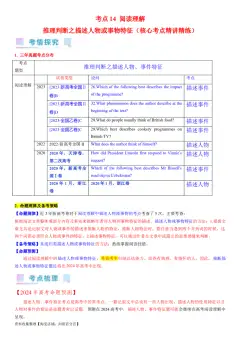
考点 8 阅读理解
推理判断之文章结构(核心考点精讲精练)
1. 命题规律及备考策略
【命题规律】近3年新高考卷对于阅读理解中没有对推断文章结构进行考查,这不意味着未来不会考查。高考备
考要充分准备未来可能考的题,不是盲目追风必考考过的试题。主要考查:
根据阅读文章整体推断文章结构。推断文章结构的方法:1.从整体出发,辨别文章结构图;2.根据文章的某一段落,
选择文章作者是怎么展开或组织段落的。
【备考策略】系统归类推断文章结构的方法;熟练掌握阅读技能。
【命题预测】
学业水平考试的是高中生的毕业考试,高考是国家选拔创新人才的考试。学考和高考分开考的目的很明确。
高考就是选拔性考试,通过高考英语试题,考查学生的推理判断能力和逻辑思维能力及品质是重要导向。
通过阅读理解中,推断文章结构考查考生的整体观,从全局看问题的能力,在新高考命题中很可能会出现。
推断文章结构的命题依据是:新课程标准中要求学生掌握:主要语篇结构特征。因此,推断文章结构的推理判断
题,有可能在2024年高考中将成为高考阅读理解的题型,应该倍加注意。
【2024年高考命题预测】
推理判断之推断文章结构考点是新课标中明确要考的考点。在当今高考的新改革时代,考查文章结构题最能
考查学生对语篇的整体把控,要求学生必须从大处着眼。预测在2024高考中,推断文章结构题有可能在高考阅读
理解中呈现。
【推理判断之文章结构考点指南】
规律方法:
文章结构主要的设题方式常有:
(1)How is the passage organized?
(2)Which of the following best shows the structure/organization of the passage?
规律方法:如何解决文章结构题?
考查组织结构的文章通常行文组织结构都比较清晰、规范,因此,具备文体、写作方式和文章组织结构方面相
关知识对于有效解答此类题目具有至关重要的作用。
1、记叙文可以采取以时间为序、以地点为序、以故事情节发展为序(开端、发展、高潮、结局)等叙事方式进行
写作。以故事情节为序又可以不按照时间的先后顺序叙述,比如,先写结局,再写其他,最后写高潮,这种叙事
手法叫做倒叙。
2、议论文总体上可以分为四类:
第一类,“提出论点——分论点一——分论点二——分论点三……——结论”;
第二类,“引入段——导出论点——分点论述——结论”;
第三类,“提出问题——分析问题——解决问题”;
第四类,“提出反面观点——批驳反面观点——提出正面观点”。3、说明文往往采取下定义、举例子、列数字、对比或比较等说明方式进行写作,而这些说明方式都是为了使文章
要说明的内容或问题更加清晰明了、真实可信,或者更具说服力。
(2023届江西省赣州市高三下学期二模)
Sleep is reparative. Because we need to repair a lot while we sleep, it’s important to get quality sleep.
Most of us function better in the daytime with routines. We also function better at night with a routine because we want
to keep pace with our natural body rhythms. Each person’s routine may be different — some people wash their face at night,
and some take a bath — just make sure it is a routine. That’s true during the week and on the weekend; consistency matters.
Have a winding down, getting ready for sleep routine, and carry that out at the same time every night. Find things that are
relaxing and help slow you down for sleep. That may be reading, listening to music, meditating, praying — anything that’s
relaxing while also being constructive or healthy.
Typically, people relax and tend to slow everything down at bedtime. As they relax, they take deeper breaths,
increasing oxygen flow, which raises their skin temperature. This is one of the key reasons why we sleep better in a cooler
environment. If your skin temperature increases and your room is already a bit warm, you will be too hot to sleep well.
The exact temperature is a personal matter. The key is that it’s more toward cool than hot. Many consider 68 degrees an
environment that’s neither so cold we shiver nor so hot we sweat. But there’s no scientific evidence for an exact, perfect
sleeping temperature.
At the end of the day, sleep is absolutely crucial for so many reasons. It helps us repair and rejuvenate so we can fight
infection, concentrate, regulate our moods, show up for ourselves and the people in our lives, and basically function as
humans. We can’t make up lost sleep, contrary to what many a night owl might think. So, it’s really high time we should do
all we can to foster the best sleep possible, starting with a cool room and relaxing bedtime routine.
1.What can be inferred from Paragraph 2?
A.A routine can be helpful in getting quality sleep.
B.It’s best to avoid screens before you go to bed.
C.Higher quality of sleep leads to better mental health.
D.Listening to music makes it difficult to stay asleep.
2.What will happen when people relax during sleep at night?
A.They’ll take more regular breaths. B.They’ll feel cooler than in the day.
C.Their skin temperature will rise. D.They will not get enough oxygen.
3.What main point does the author want to make in the last paragraph?
A.Good sleep can be made at any time. B.Sleep is important for many reasons.
C.Try to develop good sleep habits now. D.Lost sleep makes no difference to people.
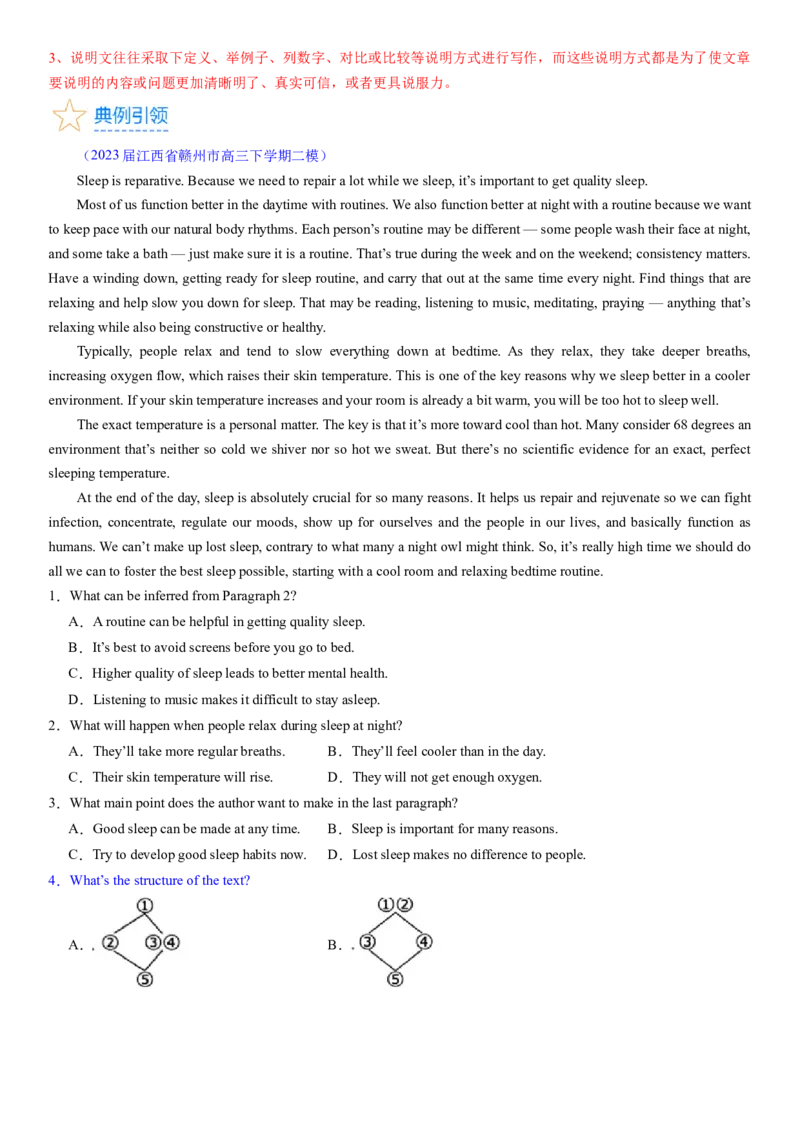
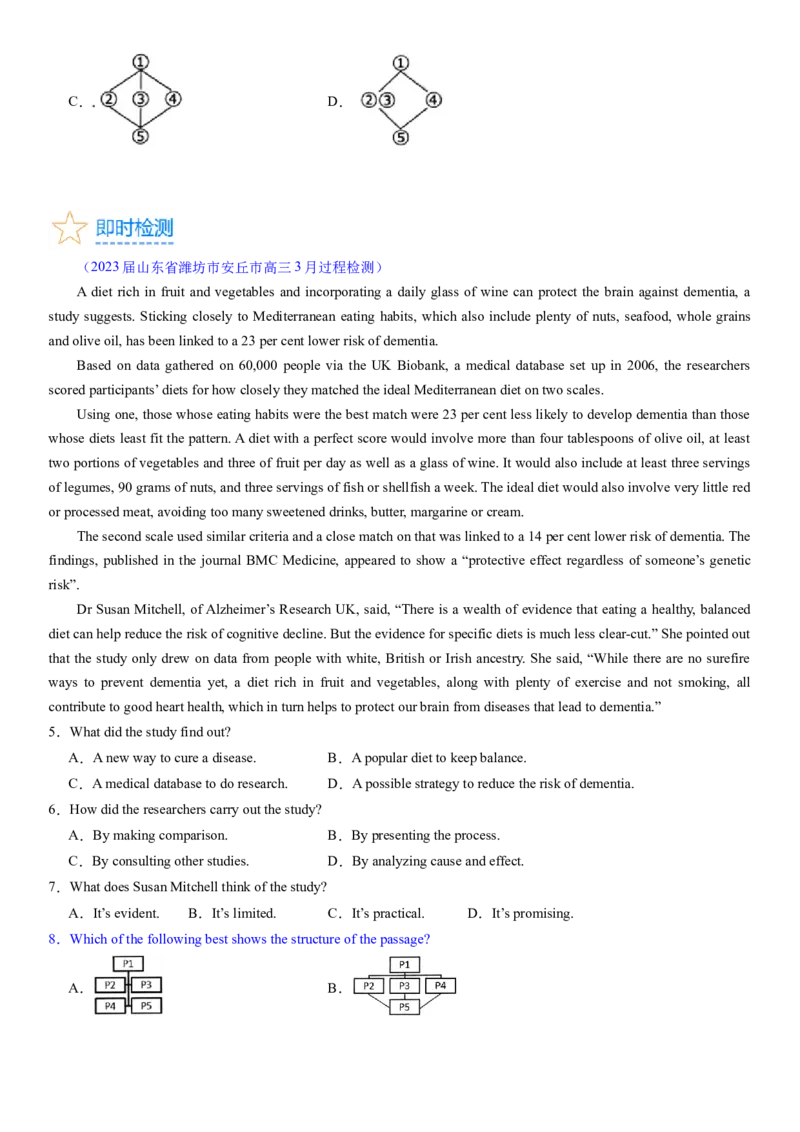
4.What’s the structure of the text?
A. B.C. D.
(2023届山东省潍坊市安丘市高三3月过程检测)
A diet rich in fruit and vegetables and incorporating a daily glass of wine can protect the brain against dementia, a
study suggests. Sticking closely to Mediterranean eating habits, which also include plenty of nuts, seafood, whole grains
and olive oil, has been linked to a 23 per cent lower risk of dementia.
Based on data gathered on 60,000 people via the UK Biobank, a medical database set up in 2006, the researchers
scored participants’ diets for how closely they matched the ideal Mediterranean diet on two scales.
Using one, those whose eating habits were the best match were 23 per cent less likely to develop dementia than those
whose diets least fit the pattern. A diet with a perfect score would involve more than four tablespoons of olive oil, at least
two portions of vegetables and three of fruit per day as well as a glass of wine. It would also include at least three servings
of legumes, 90 grams of nuts, and three servings of fish or shellfish a week. The ideal diet would also involve very little red
or processed meat, avoiding too many sweetened drinks, butter, margarine or cream.
The second scale used similar criteria and a close match on that was linked to a 14 per cent lower risk of dementia. The
findings, published in the journal BMC Medicine, appeared to show a “protective effect regardless of someone’s genetic
risk”.
Dr Susan Mitchell, of Alzheimer’s Research UK, said, “There is a wealth of evidence that eating a healthy, balanced
diet can help reduce the risk of cognitive decline. But the evidence for specific diets is much less clear-cut.” She pointed out
that the study only drew on data from people with white, British or Irish ancestry. She said, “While there are no surefire
ways to prevent dementia yet, a diet rich in fruit and vegetables, along with plenty of exercise and not smoking, all
contribute to good heart health, which in turn helps to protect our brain from diseases that lead to dementia.”
5.What did the study find out?
A.A new way to cure a disease. B.A popular diet to keep balance.
C.A medical database to do research. D.A possible strategy to reduce the risk of dementia.
6.How did the researchers carry out the study?
A.By making comparison. B.By presenting the process.
C.By consulting other studies. D.By analyzing cause and effect.
7.What does Susan Mitchell think of the study?
A.It’s evident. B.It’s limited. C.It’s practical. D.It’s promising.
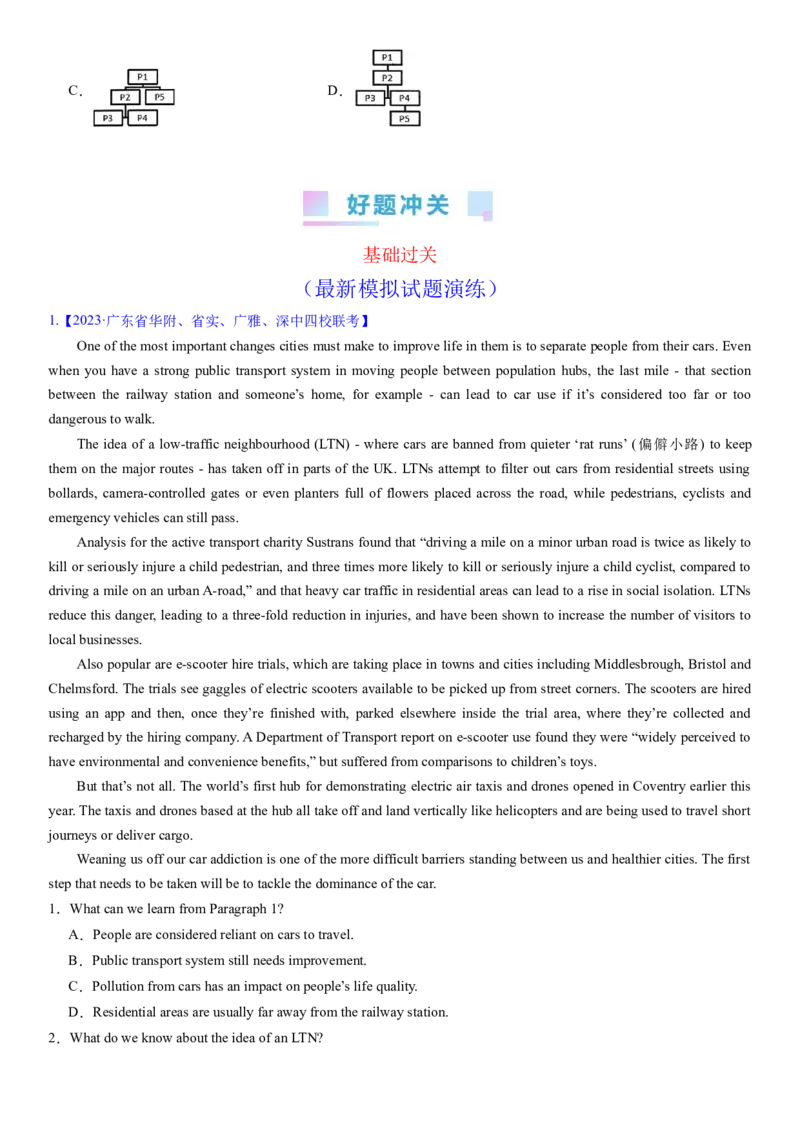
8.Which of the following best shows the structure of the passage?
A. B.C. D.
基础过关
(最新模拟试题演练)
1.【2023·广东省华附、省实、广雅、深中四校联考】
One of the most important changes cities must make to improve life in them is to separate people from their cars. Even
when you have a strong public transport system in moving people between population hubs, the last mile - that section
between the railway station and someone’s home, for example - can lead to car use if it’s considered too far or too
dangerous to walk.
The idea of a low-traffic neighbourhood (LTN) - where cars are banned from quieter ‘rat runs’ (偏僻小路) to keep
them on the major routes - has taken off in parts of the UK. LTNs attempt to filter out cars from residential streets using
bollards, camera-controlled gates or even planters full of flowers placed across the road, while pedestrians, cyclists and
emergency vehicles can still pass.
Analysis for the active transport charity Sustrans found that “driving a mile on a minor urban road is twice as likely to
kill or seriously injure a child pedestrian, and three times more likely to kill or seriously injure a child cyclist, compared to
driving a mile on an urban A-road,” and that heavy car traffic in residential areas can lead to a rise in social isolation. LTNs
reduce this danger, leading to a three-fold reduction in injuries, and have been shown to increase the number of visitors to
local businesses.
Also popular are e-scooter hire trials, which are taking place in towns and cities including Middlesbrough, Bristol and
Chelmsford. The trials see gaggles of electric scooters available to be picked up from street corners. The scooters are hired
using an app and then, once they’re finished with, parked elsewhere inside the trial area, where they’re collected and
recharged by the hiring company. A Department of Transport report on e-scooter use found they were “widely perceived to
have environmental and convenience benefits,” but suffered from comparisons to children’s toys.
But that’s not all. The world’s first hub for demonstrating electric air taxis and drones opened in Coventry earlier this
year. The taxis and drones based at the hub all take off and land vertically like helicopters and are being used to travel short
journeys or deliver cargo.
Weaning us off our car addiction is one of the more difficult barriers standing between us and healthier cities. The first
step that needs to be taken will be to tackle the dominance of the car.
1.What can we learn from Paragraph 1?
A.People are considered reliant on cars to travel.
B.Public transport system still needs improvement.
C.Pollution from cars has an impact on people’s life quality.
D.Residential areas are usually far away from the railway station.
2.What do we know about the idea of an LTN?A.It’s a way to encourage social interaction and local business.
B.It’s a series of measures to reserve the streets to walking residents.
C.It’s a system that employs high technology to keep cars on the main roads.
D.It’s a practice proved effective in keeping children safe from traffic accidents.
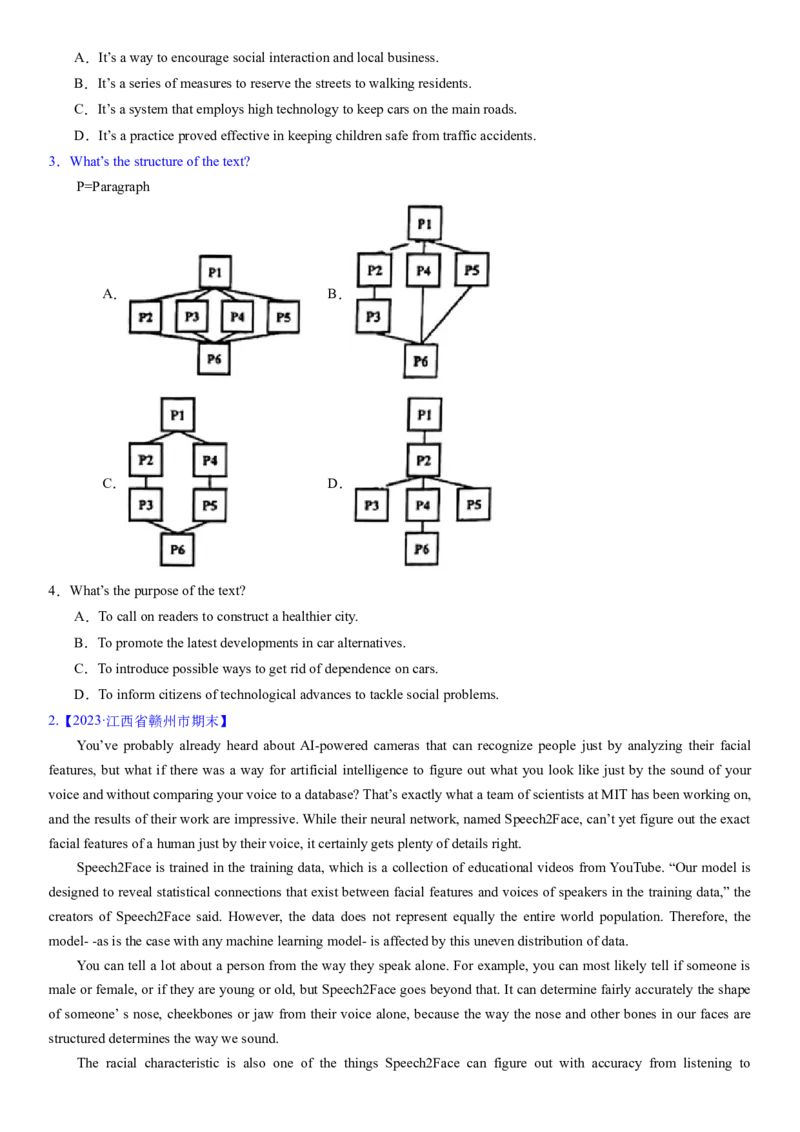
3.What’s the structure of the text?
P=Paragraph
A. B.
C. D.
4.What’s the purpose of the text?
A.To call on readers to construct a healthier city.
B.To promote the latest developments in car alternatives.
C.To introduce possible ways to get rid of dependence on cars.
D.To inform citizens of technological advances to tackle social problems.
2.【2023·江西省赣州市期末】
You’ve probably already heard about AI-powered cameras that can recognize people just by analyzing their facial
features, but what if there was a way for artificial intelligence to figure out what you look like just by the sound of your
voice and without comparing your voice to a database? That’s exactly what a team of scientists at MIT has been working on,
and the results of their work are impressive. While their neural network, named Speech2Face, can’t yet figure out the exact
facial features of a human just by their voice, it certainly gets plenty of details right.
Speech2Face is trained in the training data, which is a collection of educational videos from YouTube. “Our model is
designed to reveal statistical connections that exist between facial features and voices of speakers in the training data,” the
creators of Speech2Face said. However, the data does not represent equally the entire world population. Therefore, the
model- -as is the case with any machine learning model- is affected by this uneven distribution of data.
You can tell a lot about a person from the way they speak alone. For example, you can most likely tell if someone is
male or female, or if they are young or old, but Speech2Face goes beyond that. It can determine fairly accurately the shape
of someone’ s nose, cheekbones or jaw from their voice alone, because the way the nose and other bones in our faces are
structured determines the way we sound.
The racial characteristic is also one of the things Speech2Face can figure out with accuracy from listening tosomeone’s voice for just a few milliseconds, as people who come from the same groups tend to have similar qualities or
features. The AI takes a variety of factors into account, and it sometimes produces impressive results, but it’s still a work in
progress.
1.How does Speech2Face recognize a human’s facial features?
A.By the shape of their nose. B.By the sound of their voice.
C.By the expression on their face. D.By the results of data comparison.
2.What can we learn about Speech2Face according to the passage?
A.It can tell a person’s personality by his voice.
B.It can determine where a person comes from.
C.It can tell the size of a person by his voice.
D.It can reconstruct an image of a person’s face.
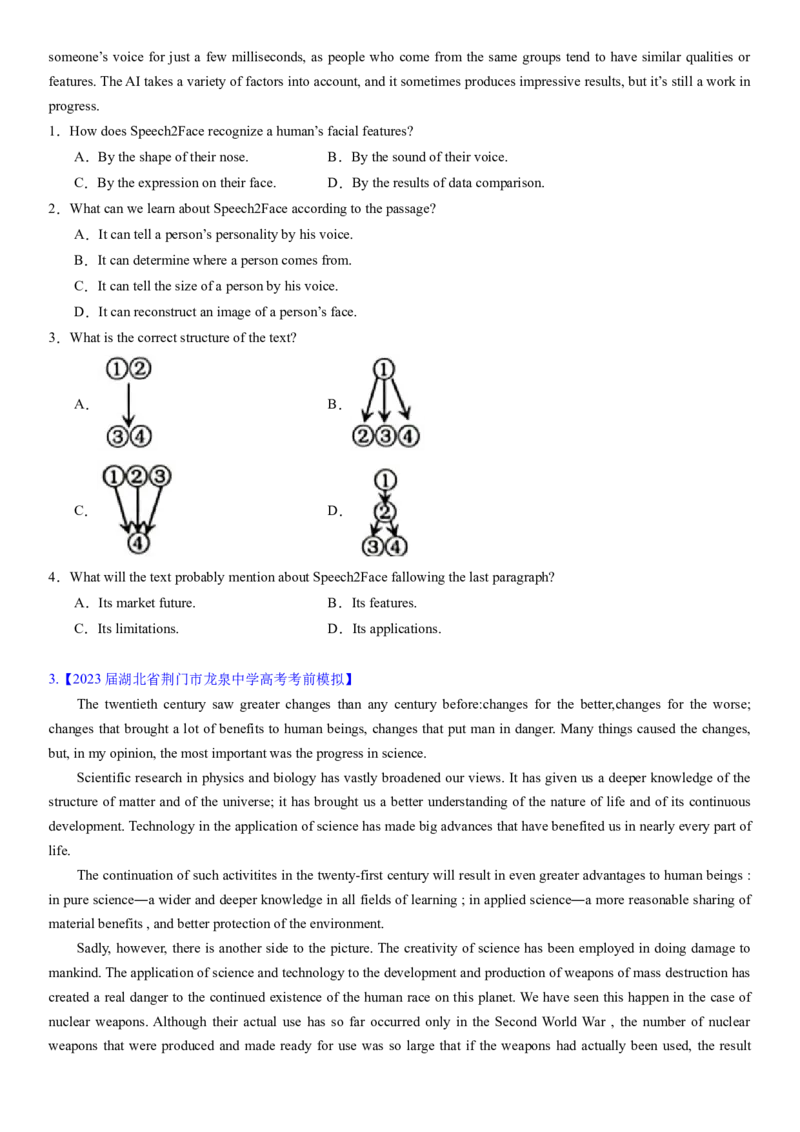
3.What is the correct structure of the text?
A. B.
C. D.
4.What will the text probably mention about Speech2Face fallowing the last paragraph?
A.Its market future. B.Its features.
C.Its limitations. D.Its applications.
3.【2023届湖北省荆门市龙泉中学高考考前模拟】
The twentieth century saw greater changes than any century before:changes for the better,changes for the worse;
changes that brought a lot of benefits to human beings, changes that put man in danger. Many things caused the changes,
but, in my opinion, the most important was the progress in science.
Scientific research in physics and biology has vastly broadened our views. It has given us a deeper knowledge of the
structure of matter and of the universe; it has brought us a better understanding of the nature of life and of its continuous
development. Technology in the application of science has made big advances that have benefited us in nearly every part of
life.
The continuation of such activitites in the twenty-first century will result in even greater advantages to human beings :
in pure science―a wider and deeper knowledge in all fields of learning ; in applied science―a more reasonable sharing of
material benefits , and better protection of the environment.
Sadly, however, there is another side to the picture. The creativity of science has been employed in doing damage to
mankind. The application of science and technology to the development and production of weapons of mass destruction has
created a real danger to the continued existence of the human race on this planet. We have seen this happen in the case of
nuclear weapons. Although their actual use has so far occurred only in the Second World War , the number of nuclear
weapons that were produced and made ready for use was so large that if the weapons had actually been used, the resultcould have been the ruin of the human race , as well as of many kinds of animals.
William Shakespeare said , “ The web of our life is of a mingled yarn(纱线), good and ill together .” The above brief
review of the application of only one part of human activities—science seems to prove what Shakespeare said . But does it
have to be so? Must the ill always go together with the good ?Are we biologically programmed for war?
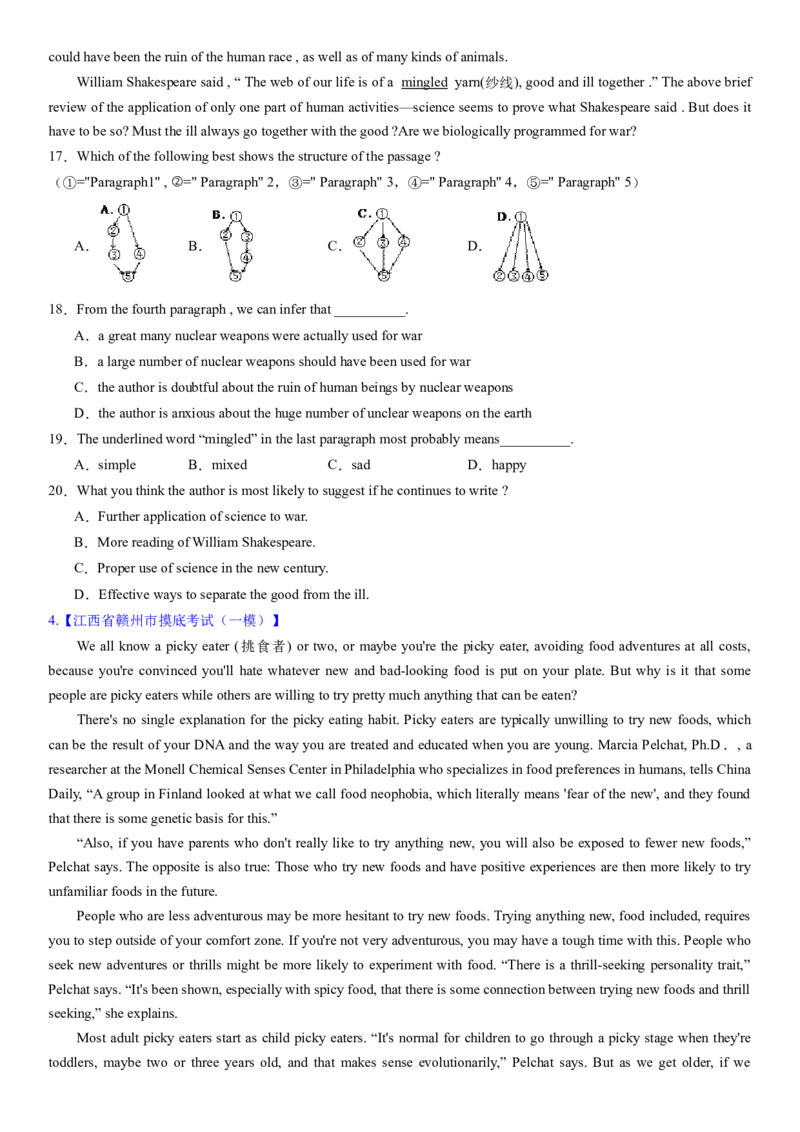
17.Which of the following best shows the structure of the passage ?
(①="Paragraph1" , ②=" Paragraph" 2,③=" Paragraph" 3,④=" Paragraph" 4,⑤=" Paragraph" 5)
A. B. C. D.
18.From the fourth paragraph , we can infer that __________.
A.a great many nuclear weapons were actually used for war
B.a large number of nuclear weapons should have been used for war
C.the author is doubtful about the ruin of human beings by nuclear weapons
D.the author is anxious about the huge number of unclear weapons on the earth
19.The underlined word “mingled” in the last paragraph most probably means__________.
A.simple B.mixed C.sad D.happy
20.What you think the author is most likely to suggest if he continues to write ?
A.Further application of science to war.
B.More reading of William Shakespeare.
C.Proper use of science in the new century.
D.Effective ways to separate the good from the ill.
4.【江西省赣州市摸底考试(一模)】
We all know a picky eater (挑食者) or two, or maybe you're the picky eater, avoiding food adventures at all costs,
because you're convinced you'll hate whatever new and bad-looking food is put on your plate. But why is it that some
people are picky eaters while others are willing to try pretty much anything that can be eaten?
There's no single explanation for the picky eating habit. Picky eaters are typically unwilling to try new foods, which
can be the result of your DNA and the way you are treated and educated when you are young. Marcia Pelchat, Ph.D., a
researcher at the Monell Chemical Senses Center in Philadelphia who specializes in food preferences in humans, tells China
Daily, “A group in Finland looked at what we call food neophobia, which literally means 'fear of the new', and they found
that there is some genetic basis for this.”
“Also, if you have parents who don't really like to try anything new, you will also be exposed to fewer new foods,”
Pelchat says. The opposite is also true: Those who try new foods and have positive experiences are then more likely to try
unfamiliar foods in the future.
People who are less adventurous may be more hesitant to try new foods. Trying anything new, food included, requires
you to step outside of your comfort zone. If you're not very adventurous, you may have a tough time with this. People who
seek new adventures or thrills might be more likely to experiment with food. “There is a thrill-seeking personality trait,”
Pelchat says. “It's been shown, especially with spicy food, that there is some connection between trying new foods and thrill
seeking,” she explains.
Most adult picky eaters start as child picky eaters. “It's normal for children to go through a picky stage when they're
toddlers, maybe two or three years old, and that makes sense evolutionarily,” Pelchat says. But as we get older, if wecontinue to avoid new foods, pickiness can persist.
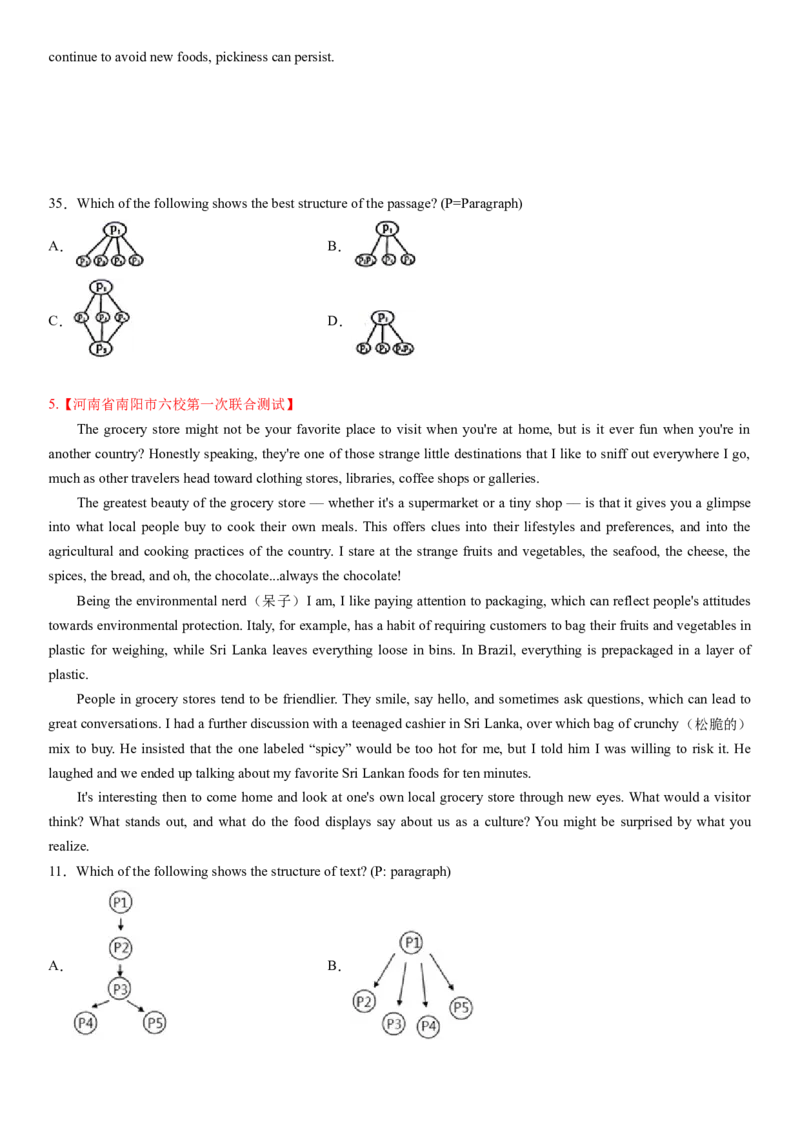
35.Which of the following shows the best structure of the passage? (P=Paragraph)
A. B.
C. D.
5.【河南省南阳市六校第一次联合测试】
The grocery store might not be your favorite place to visit when you're at home, but is it ever fun when you're in
another country? Honestly speaking, they're one of those strange little destinations that I like to sniff out everywhere I go,
much as other travelers head toward clothing stores, libraries, coffee shops or galleries.
The greatest beauty of the grocery store –– whether it's a supermarket or a tiny shop –– is that it gives you a glimpse
into what local people buy to cook their own meals. This offers clues into their lifestyles and preferences, and into the
agricultural and cooking practices of the country. I stare at the strange fruits and vegetables, the seafood, the cheese, the
spices, the bread, and oh, the chocolate...always the chocolate!
Being the environmental nerd(呆子)I am, I like paying attention to packaging, which can reflect people's attitudes
towards environmental protection. Italy, for example, has a habit of requiring customers to bag their fruits and vegetables in
plastic for weighing, while Sri Lanka leaves everything loose in bins. In Brazil, everything is prepackaged in a layer of
plastic.
People in grocery stores tend to be friendlier. They smile, say hello, and sometimes ask questions, which can lead to
great conversations. I had a further discussion with a teenaged cashier in Sri Lanka, over which bag of crunchy(松脆的)
mix to buy. He insisted that the one labeled “spicy” would be too hot for me, but I told him I was willing to risk it. He
laughed and we ended up talking about my favorite Sri Lankan foods for ten minutes.
It's interesting then to come home and look at one's own local grocery store through new eyes. What would a visitor
think? What stands out, and what do the food displays say about us as a culture? You might be surprised by what you
realize.
11.Which of the following shows the structure of text? (P: paragraph)
A. B.C. D.
6.【广东省名校2022届高三年级下学期联合测试】
Integrity is the quality of being honest and strong about what you believe to be right. The concept of integrity has
played a key role in moral philosophy throughout history and is promoted in all societies because of its importance to social
relations. Individual integrity is vital to society, one that enables people to make use of their capacity for critical reflection,
does not force people to take up particular roles and does not encourage individuals to betray each other. Besides, societies
can be favorable to the development of individual integrity.
Individual integrity can lift up the spirits of the entire society. It can shape the lives of people living in a particular
society, the lives of all fellow people and, in its broadest sense, even the destiny of a nation. By contrast, if those living in
the society are corrupt, it could have bad effects, jeopardizing the healthy morality of the society.
On the other hand, a society can be favorable to the development of individual integrity. Society expects and requires
integrity. A society consisting of people of integrity, and people who never compromise on their principles, could have a
positive mark on the personal development on its members. Being a part of such a morally lively community could serve as
a basis for absorbing traits of good character. This could be of a distinct advantage to any individuals in the society.
Nonetheless, some social structures are of the wrong sort for some individuals to pursue integrity. If that is the case, we
have to ask questions about the moral nature of society first before raising questions about individual integrity. Questions
about integrity may turn out to be about what kind of society it is, rather than about the relationship between individual
interests and characteristics of a society. The pursuit of adequate individual integrity often depends, not so much on
understanding who one is and what one believes and is committed to, but rather understanding what one’s society is and
imagining what it could be.
Under no circumstances can we underestimate the importance of human integrity in a society. People, who are honest,
trustworthy, compassionate and caring, are the factors decisive in the growth of individuals as well as the development of a
society.
12.Individual integrity has been valued in society because ______.
A.it helps develop philosophy B.it is crucial to social relations
C.it is the basis of critical thinking D.it ensures people’s particular roles
13.The underlined word “jeopardizing” in Paragraph 2 probably means “______”.
A.strengthening B.assessing
C.influencing D.destroying
14.What does the author believe according to the passage?
A.Individual integrity relies on what one has faith in.
B.The pursuit of individual integrity changes with time.
C.The nature of society is decided by economic development.
D.Social structures guide the formation of individual integrity.15.Which of the following shows the development of ideas in the passage?
CP: Central Point P: Point Sp: Sub-point C: Conclusion
A. B.
C. D.
7.(北京四中高三期中)The new social robots, including Jibo, Cozmo, Kuri and Meccano M.A.X., bear some
resemblance to assistants like Apple’s Siri, but these robots come with something more. They are designed to win us over
not with their smarts but with their personality. They are sold as companions that do more than talk to us. Time magazine
hailed (称赞) the robots that “could fundamentally reshape how we interact with machines.” But is reshaping how we
interact with machines a good thing, especially for children?
Some researchers in favor of the robots don’t see a problem with this. People have relationships with many kinds of
things. Some say robots are just another thing with which we can have relationships. To support their argument, roboticists
sometimes point to how children deal with toy dolls. Children animate (赋予…生命) dolls and turn them into imaginary
friends. Jibo, in a sense, will be one more imaginary friend, and arguably a more intelligent and fun one.
Getting attached to dolls and sociable machines is different, though. Today’s robots tell children that they have
emotions, friendships, even dreams to share. In reality, the whole goal of the robots is emotional trickery. For instance,
Cozmo the robot needs to be fed, repaired and played with. Boris Sofman, the chief executive of Anki, the company behind
Cozmo, says that the idea is to create “a deeper and deeper emotional connection ... And if you neglect him, you feel the
pain of that.” What is the point of this, exactly? What does it mean to feel the pain of neglecting something that feels no
pain at being neglected, or to feel anger at being neglected by something that doesn’t even know it is neglecting you?
This should not be our only concern. It is troubling that these robots try to empathize with children. Empathy allows us
to put ourselves in the place of others, to know what they are feeling. Robots, however, have no emotions to share, and they
cannot put themselves in our place. No matter what robotic creatures “say” or squeak, they don’t understand our emotional
lives. They present themselves as empathy machines, but they are missing the essential equipment. They have not been
born, they don’t know pain, or death, or fear. Robot thinking may be thinking, but robot feeling is never feeling, and robot
love is never love.
What is also troubling is that children take robots’ behavior to indicate feelings. When the robots interact with them,
children take this as evidence that the robots like them, and when robots don’t work when needed, children also take it
personally. Their relationships with the robots affect their self-esteem (自尊). In one study, an 8-year-old boy concluded that
the robot stopped talking to him because the robot liked his brothers better.
For so long, we dreamed of artificial intelligence offering us not only simple help but conversation and care. Now that
our dream is becoming real, it is time to deal with the emotional downside of living with robots that “feel.”
1.How are the new social robots different from Siri?A.They are intended to teach children how to talk.
B.They are designed to attract people with their smarts.
C.Their main function is to evaluate children’s personality.
D.They have a new way to communicate with human beings.
2.In Paragraph 3 Cozmo is used as an example to show that the social robots ______.
A.are deeply connected with human beings
B.are unable to build a real relationship with children
C.are so advanced that they can feel the pain of human beings
D.are not good enough to carry out the instructions of children
3.The underlined phrase “essential equipment” in Paragraph 4 refers to ______.
A.emotion B.pain
C.fear D.thinking
4.Which of the following shows the development of ideas in the passage?
I: Introduction P: Point Sp: Sub-point (次要点) C: Conclusion
A. B.
C. D.
8.(2020·北京西城·一模)The Impossible Burger is entirely free of meat. But it looks, smells, feels and—most
importantly—tastes so much like real hamburger beef. In fact, plant-based burger alternatives have set off a strong
resistance from the beef industry. The Center for Consumer Freedom, a nonprofit that advocates on behalf of the fast food
and meat industries has launched an “informational” campaign targeting plant-based meats. The campaign has included TV
and online ads, as well as print ads in newspapers. The ads seem to imply that not only is an artificial burger too processed,
but that it might be even less healthy than the average beef burger.
While it’s true that a plant-based meat alternative is processed and it’s true that eating one is not as healthy as a pile of
raw vegetables, it’s best to take the ads with a generous pinch of salt.
For instance, the additives and preservatives in plant-based meat highlighted in one ad sure sound scary. Who wants
something called titanium dioxide (二氧化钛) in their meal? But the truth is that additives such as those listed in the ads are
regularly used in all sorts of packaged foods. And if methylcellulose, a food thickener, sounds unpleasant, it’s really nothing
compared with salmonella (沙门菌) poisoning you can get from regular meat.
Also, the ad campaign misses the bigger point. Choosing an Impossible or Beyond burger isn’t just about eating
healthy. Burgers, whether they are made from processed pea protein or processed meat, will never be as healthy as organicraw vegetables.
What’s appealing is the prospect of enjoying a juicy burger without the bitter aftertaste of guilt.
Let’s face it, there are huge environmental costs to eating cows. Cattle raising is contributing to climate change, and
not just because methane (甲烷) from cows and cattle is responsible for about 14.5% of greenhouse gas. More broadly, our
global food production system releases more than a third of the world’s greenhouse gases. Yet we can’t seem to control our
meat appetite even knowing that large areas of the Amazon forest have been ruined, and continue to be cut down to make
room for more cattle to feed the growing demand for beef. Humans also know full well that many animals live short, cruel
lives in awful conditions for the purpose of becoming foods for humans to enjoy at dinner.
A plant-based meat that satisfies meat desires and delivers protein but with a smaller climate footprint is a potential
environmental game changer and the reason Impossible Foods was one of those receiving the U.N. Global Climate Action
Award in 2019. No wonder the meat industry is on guard.
1.What does the underlined sentence in Paragraph 2 most probably mean?
A.These ads deserve little consideration.
B.We should spread the message of these ads.
C.We’d better be cautious when reading these ads.
D.These ads tell people a lot about plant-based burgers.
2.What do we know about additives and preservatives in plant-based burgers?
A.They are likely to cause poisoning.
B.Their use is within the normal range.
C.Some have not been used in hamburgers.
D.They are used to ensure burgers taste good.
3.What is the author’s attitude towards plant-based burgers?
A.Supportive. B.Neutral.
C.Disapproving. D.Doubtful.
4.Which of the following shows the development of ideas in the passage?
I: Introduction P: Point Sp: Sub-point (次要点) C: Conclusion
A. B.
C. D.
9.(2021·天津市武清区杨村第一中学一模)Many parents worry that showing negative emotions in front of their
children will cause them to suffer. For example, children may end up thinking it's their fault or simply "catch" the emotion.
Indeed, this worry has a sound basis — the phenomenon of “emotional contagion"(情绪感染)is real, and one recentstudy found that parents can transfer their fear of going to the dentist, for example, to their children.
On the other hand, there is the natural idea that we should “be real" with our children, and that they will benefit from
watching a parent who struggles and eventually deals with their negative emotions like any other human being.
There are three concepts to consider when it comes to emotional display in front of children: suppression (压
抑),"uncontained" expression, and talking about emotions. Suppression of emotion is when you hide the outward signs
of an emotion. Unfortunately, it doesn't work very well — the act of suppressing your emotion actually increases your blood
pressure. Observers can pick up on your distress despite your efforts to hide it, making them feel stressed. The recent
research has also found that when parents feel negative emotions and keep them from their children, they experience lower
relationship quality and decreased responsiveness to their child's needs.
On the other hand, “uncontained" expression of anger and sadness by the parent is also not salutary for the child.
Uncontained means high intensity emotion, with no attempts to regulate or take ownership of it. Shouting, smashing
(摔)things and blaming someone else for "making you angry" are all example of this .
So, what is the middle ground? That would be talking about emotion taking ownership of them and showing your child
that you are trying to deal with them. Classic research found that six-year-old kids had better emotional understanding and
perspective-taking skills if their mothers had talked to them about their emotions at the age of three. In fact, the more the
mothers had talked, the better the outcome would be.
So next time you feel sad, angry or frustrated and your child is watching you expressing emotion, do explain what's
going on in terms they can understand.
1.The author uses the example of going to the dentist mainly to _______.
A.explain parents' common fear
B.introduce the topic of negative emotions
C.show children may catch parents' emotions
D.present the consequences of transferring negative emotions
2.If a mother suppresses ((压抑))her emotions, .
A.she will not make her kids feel stressed
B.she can hide her emotions from her kids
C.she will often shout at her kids for no reasons
D.she can't respond effectively to her kids' needs
3.What does the underlined word "salutary" in Paragraph 4 probably mean?
A.Enough. B.Beneficial.
C.Necessary. D.Reliable.
4.What is the author's intention of writing this text?
A.To encourage parents to "be real" with our children.
B.To call on parents to develop a positive attitude to life.
C.To inform parents of the consequences of negative emotions.
D.To recommend parents to talk about negative emotions with children.
5.What's the structure of the text?A. B.
C. D.
10.(湖南永州·三模)The organic food has gained a lot of [popularity as they are being considered as healthier and
tastier. A fair number of people advocate a large-scale shift to organic farming from conventional agriculture. But this
might not seem well-founded.
Since the mid-19th century, conventional industrial agriculture has become incredibly efficient on a simple land to food
basis. Conventional farming gets more and more crop per square foot of land, which can mean less wilderness needs to be
transformed to farmland.
To make farming more efficient, conventional agriculture uses a significant amount of synthetic fertilizer(合成肥
料)each year, and all that nitrogen(氮)enables much faster plant growth. However, the cost is paid in vast polluted dead
zones at the months of many of the world’s rivers, because much of the nitrogen ends up running off the soil and into the
oceans. This also makes conventional farming one of the major threats to the environment.
To weaken the environmental impact of agriculture, improve soil quality as well as produce healthier foods, some
farmers have turned to organic farming. Environmentalists have also welcomed organic food as better for the planet than the
food produced by agricultural corporations. Organic practices --- refusing artificial fertilizers and chemical pesticides –are
considered far more sustainable. Sales of organic food rose 7.7% in 2010, up to $26.7 billion—and people are making those
purchases for their moral senses as much as their tongues.
Yet a new meta-analysis in Nature does the math and comes to a hard conclusion: organic farming produces 25%
fewer crops on average than conventional agriculture.
In the Nature analysis, scientists performed an analysis of 66 studies comparing conventional and organic methods
across 34 different crop species, from fruits to grains. They found that organic farming delivered a lower output for every
crop type, though the difference varied widely. For crops like fruit trees, organic trailed(落后于)conventional agriculture
by just 5%. Yet for major grain crops and vegetables – all of which provide the world’s main calories – conventional
agriculture outperformed organics by more than 25%.
What that means is that while organic farming may be more sustainable than conventional agriculture, there are trade-
offs(此消彼长)with each. So an ideal global agriculture system may borrow the best from both systems rather than
upholding merely organic or conventional practices.
1.What’s the author’s purpose of writing the passage?
A.To compare two types of farming.
B.To criticize conventional agriculture.
C.To discuss the development of farming.
D.To argue for a realistic agriculture system.
2.What do we know about conventional farming?
A.It produces more crops with fewer fertilizers.B.It achieves efficiency at a huge cost to the environment.
C.If offers a long-term solution to global demand for food.
D.It performs far better for each crop type than organic farming.
3.What does the author most probably agree with?
A.Employing organic farming to plant rice.
B.Adopting organic practices to grow potato.
C.Using conventional methods to plant cabbage.
D.Applying conventional farming to growing apple.
4.Which of the following shows the development of ideas in this passage?
CP: Central Point P: Point Sp: Sub-point(次要点) C: Conclusion
A. B.
C. D.
11.【山西省祁县中学高三8月月考】There is always no lack of ordinary people taking action for extraordinary
change. Aghan Oscar is just among them. Thirteen years ago, Aghan. bothered by the ever-increasing quantity of plastinc
waste in this low-income suburb of Nairobi, decided to find a way to recycle it.
Nou his company. Continental Renewable Energy Co.Ltd(COREC) produces poles for use in construction, farming and
road signs. So far he's sold 96,000, and he says his potential ior growth is limited only by the considerable expense of
setting up plastic recycling plants.
Most of Aghan's customers are farmers and developers who once used wooden fence poles. Customers say they have
other benefits as well. "I have fenced my piece of land three times using wood posts, but most of the time the fence was
vandalized(故意破坏)by villagers who used the posts as firewood." said Caleb Kapten. Now plastic posts have stopped the
problem, he said.
The Kenya National Highways Authority is one of COREC s biggest customers. It approached the company after road
signs were vandalized by criminals who sold the metal poles to steel manufacturing companies. Aghan reckons (估计)that
COREC's products have saved the government millions of shillings, besides preventing road accidents. And he also points
out that COREC has been able to conserve large numbers of trees by producing plastic poles.
When Aghan started this recycling business in 2003, most of his employees were his family members due to financial
constraint(限制).Now he employs 250 young people to collect plastic waste. Fifty more youths work on the production line,
where the waste is sorted according to quality before being crushed and washed, melted and cast into different shapes. The
poles are then arranged by shape and size for sale in the yard of the recycling plant.
1. What's the biggest challenge of Aghan's future career?
A. The poor technology in recycling. B. The high cost of building factories.C. increasing piles of plastic waste. D. The limited policy support in recycling.
2. How was Caleb Kapten's problem finally solved?
A. He gave up fencing his land.
B. He guarded the land more carefully
C. He replaced the wood posts with plastic ones
D. He got some donated metal Posts.
3. What does the last paragraph suggest?
A. Great difficulty facing Aghan
B. Stricl standards of plastic poles.
C. Various ways of making plastic poles.
D. The complex process of recycling plastic waste
4. Which best shows the structure of the text?
A B.
.
C. D.
12.【江苏省南京市金陵中学期末】
As e-cigarettes become more popular, fewer people are taking up smoking traditional cigarettes. But can e-cigarettes,
an electronic nicotine delivery system, help people quit smoking altogether?
The answer is probably yes. A study led by Matthew Carpenter, a professor at the
Medical University of South Carolina found that e-smokers tend to smoke less and
have increased quit attempts.
In the pilot study, Carpenter evaluated e-cigarettes in terms of usage,
product preference, changes in smoking behaviors and nicotine exposure. Ninety
subjects were evaluated:45 were randomized to use e-cigarettes, and 45 were randomized to a control group. Everyone
was followed over a period of four months. The study was published in Cancer Epidemiology in November and is one of
the few randomized studies in the U. S. to examine the effects of e-cigarettes.
Results showed that when smokers were given e-cigarettes, uptake was strong. Many participants rated the e-
cigarettes similar to their usual product, suggesting that e-cigarettes might give smokers a suitable alternative to
combustible(燃烧的)cigarettes. E-cigarettes offer significantly less exposure to harmful toxicants and therefore are safer.
People using e-cigarettes throughout the study smoked an average of 37 percent fewer cigarettes, as compared to those in
the control group, showing a positive effect when making the switch and potentially serving as a tool to help smokers quit.
That's good news for Carpenter and his colleagues. Smoking is the leading cause of cancer and has a negative
impact on the effectiveness of cancer treatments. People who quit smoking, regardless of their ages, have substantial gains
in life expectancy(预期寿命)compared with those who continue to smoke.
Carpenter cautions that while e-cigarettes may help people smoke less or even quit, they are not for everyone. "It is
important to protect non-smokers, particularly adolescents, from starting any nicotine-containing product. "More than 1,500 varieties of e-cigarettes are now available, including different looks, high-tech power settings and
many flavors. All these make them more appealing to kids. In fact, e-cigarettes are more popular than conventional
cigarettes among youth. "All these should raise our alarm bells," he said.
E-cigarettes were only recently regulated by the Food and Drug Administration. Largely manufactured overseas, the
quality control process varies, he says. Without enough information to answer the long-term public health issues of e-
cigarettes, researchers like Carpenter are aware of the importance of further studies on the latest tobacco trends.
Combustible cigarettes have been around for many decades. E-cigarettes have not, and the science has a lot of questions left
to answer, he said.
1.Which of the following is TRUE about Professor Carpenter's experiment on e-cigarettes?
A. The test groups include conventional smokers, e-smokers and non-smokers.
B. E-cigarettes expose smokers to fewer poisonous substances.
C. Many participants don't think e-cigarettes as good as traditional ones.
D. It is one of the few studies to test the effects of smoking.
2. After reading the passage, we may infer that_______.
A. most e-cigarette smokers will finally give up smoking
B. there are more e-smokers than traditional smokes in the USA
C. many adolescents are attracted to e-cigarettes due to their low prices
D. carpenter is worried about the e-cigarettes' popularity among children
3. What can be concluded from the last paragraph?
A. E-cigarettes are faced with many problems and need more study.
B. The U. S. government should strengthen its regulation over e-cigarettes.
C. Smokers should be cautious because of e-cigarettes' low quality.
D. Researchers are concerned about e-cigarettes' harm to people's health.
4. What is the structure of the passage?___
(①to ⑦represent Paragraphs 1 to 7)
13.【2020届山东省淄博市高三下学期一模】
The production of coffee beans is a huge, profitable business, but, unfortunately, full-sun production is taking over the
industry and bringing about a lot of damage. The change in how coffee is grown from shade-grown production to full-sun
production endangers the very existence of, certain animals and birds, and even disturbs the world’s ecological balance.
On a local level, the damage of the forest required by full-sun fields affects the area’s birds and animals. The shade of the
forest trees provides a home for birds and other special(物种) that depend on the trees’ flowers and fruits. Full-sun coffeegrowers destroy this forest home. As a result, many special are quickly dying out.
On a more global level, the destruction of the rainforest for full-sun coffee fields also threatens(威胁)human life. Medical
research often makes use of the forests' plant and animal life, and the destruction of such species could prevent researchers
from finding cures for certain diseases. In addition, new coffee-growing techniques are poisoning the water locally, and
eventually the world's groundwater.
Both locally and globally, the continued spread of full-sun coffee plantations (种植园)could mean the destruction of the
rainforest ecology. The loss of shade trees is already causing a slight change in the world's climate, and studies show that
loss of oxygen-giving trees also leads to air pollution and global warming. Moreover, the new growing techniques are
contributing to acidic(酸性的) soil conditions.
It is obvious that the way much coffee is grown affects many aspects many aspects of life, from the local environment to the
global ecology. But consumers do have a choice. They can purchase shade-grown coffee whenever possible, although at a
higher cost. The future health of the planet and mankind is surely worth more than an inexpensive cup of coffee.
5. What can we learn about full-sun coffee production from Paragraph 4?
A. It limits the spread of new growing techniques.
B. It leads to air pollution and global warming.
C. It slows down the loss of shade trees.
D. It improves local soil conditions.
6. The purpose of the text is to .
A. entertain B. advertise C. instruct D. persuade
7. Where does this text probably come from ?
A. An agricultural magazine.
B. A medical journal.
C. An engineering textbook.
D. A tourist guide.
8. Which of the following shows the structure of the whole text?
A. B.C. D.
14.(重庆巴蜀中学高三阶段练习)
Getting your children to stop lying is challenging. There are many influences (TV, movies, video games and some great
books) in which lies are common. Children see parents lie to others, if only to be polite. Most parents add to that with tales
about the lives and activities of Santa Claus or the Tooth Fairy, or to allay fears. (“This will not hurt!”) Parents do this out of
love, but for some children, lying can become a problem. The most common reactions to children who lie are explaining
why it is wrong and punishment. But as ways of changing behavior, these are ineffective.
However, what counts is to praise. You could ask your child to say something that happened at school that is true. It is
not critical what that is. This is about practice. When your child complies, praise him enthusiastically. Be specific: “That
was great! You told me what happened just like I asked. Wow!” and give your child a hug or a high five. If your child says
something true in the course of her day, praise that behavior too. Aim for one or two interactions like this a day. If you
happen to “catch” your child in a lie, be matter-of-fact in your disapproval. Say something like, “That is not true and could
get you in trouble outside of the hoe; it is better to say the truth.”
Besides, you should set a good example to your kids and tell the truth explicitly. This could be about something that
happened when you were a child or something that happened during the day. It need not be dramatic. Another option is to
play a game at dinner. Each person tells one thing that was true that day. Again, give a little praise to the child who normally
lies if she plays along.
In most instances, children are unlikely to change behavior or develop the conduct you want. That does not mean
ignoring, lying or letting it go. Rather, use very mild punishment (light reprimand, short loss of privilege, a brief time-out).
More severe, harsh or enduring punishments (shouting, taking away something for a week, hitting) are not more effective in
actually changing the frequency of lying.
Try these procedures for two to three weeks and see where you are. Usually they can be dropped by then. It is unlikely
that lying will be completely removed, but with the right encouragement, it can be dramatically lessened.
9.Which punishment is relatively ineffective?
A.A brief time-out.
B.Light reprimand.
C.Short loss of privilege.
D.Taking away something for a week.
10.What can we conclude from the passage?
A.Parents can tell lies sometimes.
B.Lying will disappear thoroughly.
C.Punishment can change behaviors.D.Praising your kids a lot is beneficial.
11.Which of the following could serve as the best title?
A.Is Lying a Problem?
B.Can Kids Stop Lying?
C.What Can You Do When Kids Tell lies?
D.How Can You Punish Your Kids for Lying?
12.Which best shows the structure of the text?
A. B.
C. D.
真题感知
1.【2012·北京卷】
Wilderness
“In wilderness(荒野) is the preservation of the world.” This is a famous saying from a writer regarded as one of the
fathers of environmentalism. The frequency with which it is borrowed mirrors a heated debate on environmental protection:
whether to place wilderness at the heart of what is to be preserved.
As John Sauven of Greenpeace UK points out, there is a strong appeal in images of the wild, the untouched; more than
anything else, they speak of the nature that many people value most dearly. The urge to leave the subject of such images
untouched is strong, and the danger exploitation(开发) brings to such landscapes(景观) is real. Some of these wildernesses
also perform functions that humans need—the rainforests, for example, store carbon in vast quantities. To Mr.Sauven, these
”ecosystem services” far outweigh the gains from exploitation.
Lee Lane, a visiting fellow at the Hudson Institute, takes the opposing view. He acknowledges that wildernesses do
provide useful services, such as water conservation. But that is not, he argues, a reason to avoid all human presence, or
indeed commercial and industrial exploitation. There are ever more people on the Earth, and they reasonably and rightfully
want to have better lives, rather than merely struggle for survival. While the ways of using resources have improved, there is
still a growing need for raw materials, and some wildernesses contain them in abundance. If they can be tapped without
reducing the services those wildernesses provide, the argument goes, there is no further reason not to do so. Being
untouched is not, in itself, a characteristic worth valuing above all others.
I look forwards to seeing these views taken further, and to their being challenged by the other participants. One
challenge that suggests itself to me is that both cases need to take on the question of spiritual value a little more directly.
And there is a practical question as to whether wildernesses can be exploited without harm.
This is a topic that calls for not only free expression of feelings, but also the guidance of reason. What position wilderness
should enjoy in the preservation of the world obviously deserves much more serious thinking.
1.John Sauven holds that_____.
A.many people value nature too muchB.exploitation of wildernesses is harmful
C.wildernesses provide humans with necessities
D.the urge to develop the ecosystem services is strong
2.What is the main idea of Para. 3?
A.The exploitation is necessary for the poor people.
B.Wildernesses cannot guarantee better use of raw materials.
C.Useful services of wildernesses are not the reason for no exploitation.
D.All the characteristics concerning the exploitation should be treated equally.
3.What is the author’s attitude towards this debate?
A.Objective. B.Disapproving. C.Sceptical. D.Optimistic.
4.Which of the following shows the structure of the passage?
CP: Central Point P: Point Sp: Sub-point(次要点) : Conclusion
A. B. C. D.
2.【2023·江苏省南京外国语学校期中】
Our character, basically, is a composite of our habits. “Sow a thought, reap an action; sow an action, reap a habit; sow a
habit, reap a character; sow a character, reap a destiny,” the maxim goes.
Habits are powerful factors in our lives. Because they are consistent, often unconscious patterns, they constantly, daily,
express our character and produce our effectiveness…or ineffectiveness.
As Horace Mann, the great educator, once said, “Habits are like a cable. We weave a strand of it every day and soon it
cannot be broken.” I personally do not agree with the last part of his expression. I know they can be broken. Habits can be
learned and unlearned. But I also know it isn’t a quick fix. It involves a process and a tremendous commitment.
Those of us who watched the lunar voyage of Apollo 11 were transfixed as we saw the first men walk on the moon and
return to earth. Superlatives such as “fantastic” and “incredible” were inadequate to describe those eventful days. But to get
there, those astronauts literally had to break out of the tremendous gravity pull of the earth. More energy was spent in thefirst few minutes of lift-off, in the first few miles of travel, than was used over the next several days to travel half a million
miles.
Habits, too, have tremendous gravity pull-more than most people realize or would admit. Breaking deeply imbedded
habitual tendencies such as procrastination, impatience, criticalness, or selfishness that violate basic principles of human
effectiveness involves more than a little willpower and a few minor changes in our lives. “Lift-off” takes a tremendous
effort, but once we break out of the gravity pull, our freedom takes on a whole new dimension.
Like any natural force, the gravity pull can work with us or against us. The gravity pull of some of our habits may
currently be keeping us from going where we want to go. But it is also the gravity pull that keeps our world together, that
keeps the planets in their orbits and our universe in order. It is a powerful force, and if we use it effectively, we can use the
gravity pull of habit to create the cohesiveness and order necessary to establish effectiveness in our lives.
25.The author disagrees with Horace Mann because the latter believes ______.
A.habits are like a cable B.habits can be leaned
C.habits learning is hard D.habits cannot be broken
26.The author compares launching spacecraft and breaking old habits mainly because ______.
A.They both involve a little willpower.
B.A lot of effort is needed during both the processes.
C.They both take a tremendous effort in the beginning
D.Once done, they’ll ensure people unlimited freedom.
27.What is the structure of the text?
A. B. C. D.
28.Which of the following is a suitable title for the text?
A.The breakoff of habits B.Powerful factors in our lives
C.The lift-off of gravity pull D.Important habits in our lives
3.【天津市双菱中学2022-2023学年高三上学期期中】
In this day and age, the vast majority of quality extra-curriculum programs are launched to boost academic
performance, decrease youth crimes and other high-risk behaviors, and enable younger generations to grow into healthy,
successful adults.
Frankly speaking, the effect of quality after-school programs on academic performance is considerable. Studies show
that students who take part in such programs show better work habits, higher rates of homework completion, improved
grades, and higher scores on achievement tests. They also have fewer absences and are less likely to blame. After-school
programs also influence high-risk teen behavior. Various studies show decreased rates of crime, drug use, and teen sex
among youth who join in well-run after-school programs when compared to similar youth who do not. Finally, after-school
programs play an important role in supporting the following fields of development: physical development, mental
development and social development. Thus, one can safely say that after-school programming is an effective method to help
young people become contributing members of society.
Although there is adequate proof from both small and large assessments that after-school programs can make a positivedifference, it is important to note that not all programs are equal. First, dosage(剂量)matters —young people who attend the
most hours over the most years benefit more than members who attend less often or over a shorter period of time. Next,
after-school programs make a bigger difference for those students who need help most and have the fewest choices. Finally,
program qualities matter. After-school programs work best when they create unique opportunities for youth. They should
provide opportunities, skill building meaningful involvement, expression suggestion, service, and work. Staff characteristics
make an important difference in the quality of a program. The adults should treat youth as partners, create safe and fair
environment, encourage personalized involvement, and actively create learning opportunities. In short, although after-
school programs have promising future, how they are designed and run matters.
29.Good after-school programs might not assist students in _______ .
A.having fewer attendances B.improving academic performance
C.having high scores on tests D.decreasing high-risk teen behavior
30.A good after-school program is usually determined by _______.
a. students’ willingness and family backgrounds
b. safe and fair environments
c. workers’ characteristics
d. its special opportunities
A.a, b, c, d B.a, b, c C.a, c, d D.b, c, d
31.Which of the following structures suits the passage best?
A. B.
C. D.
4.【天津市河西区2022-2023学年高三上学期期中质量调查】
The concept of sharing goods and services with your community as a means of economic transaction is ancient. But
thanks to the Internet, the concept now has global scale at the click of a button. It’s called the sharing economy.At its most
basic, the sharing economy, also known as the collaborative or peer-to-peer economy, is about connecting individuals with
resources to others that want them. It often works through lending or borrowing but can also involve the financial
transaction of goods or services.
While the concept of sharing economy has been round for some time, the coming of apps and smartphone technology
means that it’s easier for individuals to participate in peer-to-peer sharing transactions in real time.
There are many reasons why people participate in the sharing economy, but here are some of the biggest ones:
Finding temporary accommodation while travelling can be stressful, especially if you’re looking for something on
short notice. Thanks to the sharing economy, there are a few popular services that connect people looking to rent out their
apartment or home with travelers for as little as a day or two.
Everyone who’s ever driven in a major city knows that finding parking can be a real pain.Limited parking spaces and
higher fees have contributed to tech-based services that can help you find and even reserve an available parking space.Whether you’re pressed for time or need to find somewhere to leave the car for a day or two while visiting an unfamiliar
city, parking is one more headache the sharing economy is helping alleviate.
For pet owners, leaving town on vacation can be a stressful experience. Finding a dog sitter on short notice can be a
problem, and leaving your pet at a kennel might leave you worried about their well-being when you should be relaxing.
Luckily, a little tech-inspired collaboration can offer an elegant solution. Partnering pet owners with willing hosts can give
your dog a vacation of their own, with plenty of TLC “tender loving care” and space to roam in the home of a fellow pet
lover.
Now it is true that apps empower you to exchange a variety of items.with people from all over. Whether it’s a bike,
some tools you need for project, or anything in between, collaborative economies make it easier to access the things you
need without cash.
32.How can the sharing economy help people find temporary accommodation while travelling?
A.By checking the information on short notice.
B.By giving people much useful information.
C.By offering those in need some popular services.
D.By finding people who want to rent out their home.
33.. What does the underlined word “alleviate” in Paragraph 5 mean?
A.Improve, B.Handle. C.Disappear. D.Relieve.
34.What is probably the author’s attitude towards the sharing economy?
A.Neutral. B.Positive. C.Negative. D.Indifferent.
35.What’s the structure of the passage?
A. B.
C. D.
5.【2022届四川省成都石室中学下学期三诊模拟】
Every day we are the targets of advertisers,fundraisers and politicians trying to persuade us to buy something, do
something or think a certain way. And they’re good at it. Over the years, they’ve learned a lot about what features to build
into a communication. But by concentrating so much on the message itself, they’ve missed a crucial component of the
process.
Research done in the last 15 years shows that the best persuasion is achieved through the best pre-suasion—the
practice of arranging for people to agree with a message before they even know what’s in it. Pre-suasion works by focusing
people’s attention on a selected concept, which in turn encourages them to value it more than related ones.
Long before scientists started studying the process of pre-suasion, a few notable communicators already had an
intuitive understanding of it.
For example, in 1588, thousands of British troops, who were gathered against a sea invasion by Spain at Tilbury in the
UK, were deeply concerned that their leader Queen Elizabeth I would not be up to the rigors(严酷)of battle. In addressing
the men, she removed her fears pre-suasively first acknowledging their concern by admitting a weakness, which establishedher honesty, and then following it with a strength that removed this perceived weakness “I know,” she stated firmly, “I have
the body of a weak woman. But I have the heart of a king, and a king of England, too,” It’s reported that this statement was
welcomed with long and loud cheers.
The same pre-suasive, honesty-establishing tactic was employed in the late 1950s by the advertising firm Doyle Dane
Bernbach to introduce the oddly shaped Volkswagen Beetle to a US market dominated by big, powerful, boat-like vehicles.
The “We’re ugly but...” campaign tactically admitted to limitations in appearance before trumpeting the auto’s strengths
such as economy, reliability and simplicity. Credited with cracking open the US market for small cars, the ad campaign has
been rated among the greatest of all time.
With considerable success, practitioners(从业者)of social influence have always featured persuasive prods—
enthusiastic appreciation, emotional feelings, last-chance opportunities—in their appeals. Perhaps because of that success,
they’ve mostly missed an accompanying truth. For maximum impact, it’s not only what you do; it’s also what you do just
before you do what you do.
1.What is true about pre-suasion?
A.The importance of pre-suasion has not been widely recognized.
B.All advertisers, fundraisers and politicians are good at pre-suasion.
C.Pre-suasion works by concentrating so much on the message itself.
D.Pre-suasion arrange for people to agree with an idea after knowing it
2.Why does the author mention Queen Elizabeth I?
A.To acknowledge her great power as a female emperor.
B.To analyze the scientific principles behind pre-suasion.
C.To give an example of applying pre-suasion successfully.
D.To recommend the most important techniques in pre-suasion.
3.What does the underlined word “trumpeting” mean?
A.Blowing a trumpet. B.Stating or announcing proudly.
C.Making a loud noise. D.Resembling a trumpet in shape.
4.Which of the following structure can best summarize the passage?
A.①—②—③④—⑤⑥ B.①②—③④—⑤—⑥
C.①—②—③④⑤—⑥ D.①②—③—④⑤⑥
6.【2022届湖南省长沙市第一中学高三下学期一模】
Many people drink protein shakes regularly to lose weight, build muscle or both. Others, however, question the belief
that protein shakes are better than normal, high-protein foods. So what is the truth?
Protein shakes are dietary supplements (饮食补充剂) designed to help people consume more protein than they
otherwise would. Protein shakes can be ready-made drinks. Besides, people can mix their own shakes using protein powder.
Protein powder can be made from plants or animals. Plant-based protein shakes can include soy, pea or rice protein. Animal-
based protein powder is usually made from cows’ milk. Those who want to avoid milk can also get protein powder made
from egg whites.
Studies indicate that consuming protein shakes is helpful if you want to build muscle. They can also improve your
performance and help you recover while exercising. And if you’re losing weight, protein shakes can help to make sure that
you don’t lose muscle.
Consuming protein shakes can also help you lose weight. Eating a high-protein diet helps you feel full, so it’s easier to
resist eating too much. High-protein diets can also make your body burn energy quickly. When you use more energy thanyou take in through food, you lose weight.
However, you don’t have to drink protein shakes to have a high-protein diet. Many wholefoods are rich in protein. In
fact, the people in many high-protein diet studies didn’t drink protein shakes. The studies proved the benefits of eating
protein-rich foods. Moreover, these foods contain other natural nutrients besides protein. In contrast, many protein shakes
contain sugar or artificial sweeteners, which are not healthy.
To sum up, yes, protein shakes are convenient and they work. However, they are not your only choice for eating a
high-protein diet.
5.What’s paragraph 2 mainly about?
A.What protein shakes are.
B.How protein shakes arc made.
C.Where protein shakes come from.
D.Why people drink protein shakes.
6.What can be inferred about consuming protein shakes?
A.It can burn your fat directly.
B.It is beneficial to your muscle.
C.It can take the place of eating other food.
D.It is the best choice for the people in a high-protein dict.
7.Which of the following shows the structure of the whole text?
A. B. C. D.
8.Which word best describes the author's attitude to protein shakes?
A.Skeptical. B.Objective. C.Tolerant. D.Conservative.
7.【2022届江西省赣州市高三适应性考试】
Being perfect is something many of us want and try to achieve. It makes us feel we’re correct and that our hard work
has paid off. However, as much as perfection and being perfect is not all a perfect thing.
Perfection is all about being without mistakes and criticism. Wanting or trying to be perfect can make it hard to admit a
mistake. Nevertheless, it is important to own up to mistakes and work to fix them. Not being able to take criticism and fix
mistakes is arrogance, not perfection.
Perfection is a double-edged sword. In our lives, we want perfection. Perfection holds us accountable; it’s the mistakes
and imperfection that keeps pushing us harder and further at what we do. It’s the perfect motivator. But it’s also the perfect
killer. For example, the movie “Black Swan” showcased how perfection can kill us. Working and training and stress hurt our
body, mind, and so much more that we can’t do it any more.
But perfection can also have the opposite effect. The movie “High Strung” showed that perfection doesn’t exist, but
practicing and pushing ourselves can bring us great rewards. In “Black Swan,” the main character tried to be perfect but he
also compared himself to someone else who he thought was better than him. This added more pressure and self-doubt,which can cause unhealthy ways of achieving perfection. The main character of “Black Swan” didn’t know when to stop,
whereas the main character of “High Strung” did, or at least didn’t focus so much on the comparison, and instead focused
on the competition and the ones she cared about.
Perfection is something we can’t live without and can’t live with. The only way to keep the sword from cutting us is if
we know when to stop. Some days are going to be good days and others will be bad. We have to take whatever day it is —
perfect or imperfect — and hope that’s enough.
9.What does the underlined phrase “own up to” mean in Paragraph 2?
A.Make. B.Avoid. C.Correct. D.Acknowledge.
10.What prevents the character in “Black Swan” from going further?
A.Comparison. B.Self-doubt. C.Pressure. D.Competition.
11.What does the author advise us to do while trying to be perfect?
A.Try not to make mistakes. B.Push ourselves harder.
C.Stop before going too far. D.Prove our ability to others.
12.What could be the best structure of the passage? (P=Paragraph)
A. B.
C. D.
8.【2022届江苏省苏锡常镇四市高三教学情况调研(一)】
Star Wars fans would be familiar with the good relationship between humans and droids (机器人) in the movies. In the
movie Solo: A Star Wars Story, Lando Calrissian risked his life to rescue his co-pilot, a female droid L3-37. In real life, a
humanoid robot, Sophia, has recently been granted (给予) citizenship in Saudi Arabia. Increasingly, people are ready to see
robots as resembling humans. Given this phenomenon, I believ it is necessary to consider giving robots certain rights
humans enjoy.
Experts have argued that since robots have now acquired human-like qualities, it is appropriate to consider if they
should have rights just as humans. Sophia has a human like face and utilizes artificial intelligence to respond to speech and
express emotions. For such a lifelike being that is potentially capable of expressing emotions, does it not deserve the right to
be loved and respected?
Robots should also be given legal and moral protection as harming a robot may be similar to harming humans. Since
people tend to form attachments to social robots, it becomes possible for companies to control the hardware and software to
exploit this emotional attachment. There is a danger that data that is stored in the robot could be uploaded to the cloud.
There would then possibly be situations in which the government or private sector retrieves (检索数据) the information
stored in a robotic toy or social robot. With these uncertainties, it is clear why robots should be protected, just as humans.
An even more irresistible reason to grant human rights to the robots is the protection of societal values. We should stop
a young child from kicking or tearing a toy robot apart because it resembles a real life. Giving robots certain rights willensure that societal standards are set.
Still, many have roundly argued that no matter how sophisticated (老练的) they may be, robots are still machines. It is
therefore quite ridiculous to treat them as living beings and grant them rights. However, with the advancement in
technology, it is a matter of time before robots are fully anthropomorphized (赋予人的特征), and we would have to
consider granting them rights.
In conclusion, deciding whether robots deserve human rights is by no means an easy task, but now is the time to start
the conversation on this and seriously consider the possibility.
13.Why does the author mention the two examples in the first paragraph?
A.To remind readers of the importance of robots.
B.To discuss the necessity of rescuing robots.
C.To set readers thinking about an issue about robots.
D.To describe the relationship between humans and robots.
14.What’s the main idea of Paragraph 3?
A.Robots should be legally and morally protected.
B.There is possible information risk.
C.Humans are doing harm to robots.
D.Robots should be given more emotional attachment.
15.What’s the author’s attitude towards granting robots human rights?
A.Doubtful. B.Favorable.
C.Negative. D.Uncaring.
16.What’s the structure of the passage?
(①=Para. 1 ②=Para. 2 ③=Para. 3 ④=Para. 4 ⑤=Para. 5 ⑥=Para. 6)
A.①—②③④⑤—⑥ B.①②—③④⑤—⑥
C.①—②③—④⑤⑥ D.①—②③④—⑤⑥
9.【2022·江苏省扬州市宝应中学月考】
Ashlee Thomas' struggles are just one example of Instagram's potential"toxic"effect on teen girls,as highlighted in he
congressional(国会的) testimony(证词)of Frances Haugen on Friday.
"I believe Facebook's products harm children,encourage division and weaken our democracy, said Haugen, a 37-year-
old former Facebook product manager who worked on civic integrity issues at the company.
Facebook's own internal research,cited by Haugen,showed"13.5%of teen girls on Instagram Instagram is owned by
Facebook) say the platform makes thoughts of 'Suicide and Self Injury worse"and 17% say the platform makes" Eating
Issues"such as anorexia(厌食症)worse.
Its research also claimed Facebook's platforms"make body image issues worse for l in 3 teen girls."
"The company's leadership knows how to make Facebook and Instagram safer but won't make the necessary changes
because they have put their profits before people,"Haugen said during her opening remarks."Congressional action is needed.
They wont solve this crisis without your help."
Facebook CEO Mark Zuckerberg took to the platform he built to defend the company against Haugen's allegations(指
控),saying in a 1,300-word statement that the tech giant's research on its impact on children was being misrepresented.
"We care deeply about issues like safety, well-being and mental health,"Zuckerberg wrote.
He added, "Many of the claims don't make any sense.If we wanted to ignore research, why would we create anindustry-leading research program to understand these important issues in the first place?"
In a statement, Facebook doubted the interpretation(解释) of the research and insisted th percentages are much
lower.The company has also said it welcomes regulation.
Still, those familiar with the workings of the tech world say it will take much more to save teens.
"Their business model's putting kids into these kinds of loops of engagement,"said Tristan Harris, co-founder of the
Center for Humane Technology."And that's what I’m really worried about...that there isn't some quick fix to this thing.It’s
the intrinsic((固有的)nature of the product."
17.What issue does this article mainly talk about?
A.Facebook's development problems.
B.Children's poor eating habits.
C.Facebook's possible harm on its users.
D.Instagram's business model.
18.What does the underlined word"toxic"in the first paragraph most probably mean?
A.poisonous B.Immediate
C.beneficial D.dramatic
19.What is the main conflict between Frances Haugen and Mark Zuckerberg?
A.Whether there is a Facebook internal research.
B.Whether the result of the internal research is true.
C.Whether Facebook accepts regulation.
D.Whether Facebook cares about its users.
20.What is the best structure of this passage?
A.
B.
C.D.
10.The biomedical world is flooded in data. We have a lot of genomic information from mouse to human, precious
health measurements from clinical tests, and a large amount of so-called real-world data from insurance companies and
drugstores. Using powerful computers, scientists have carefully researched it with some fine results, but it has become clear
that we can learn much more with an assist from artificial intelligence. Over the next decade deep-learning neural networks
will likely transform how we look for patterns in data and how research is conducted and applied to human health. This
special report explores the future of this new transformation.
Right now the biggest assumptions are being placed in the field of drug discovery, and for good reason. The average
cost of bringing a new drug to market nearly doubled between 2003 and 2013 to $2.6 billion, and because nine out of ten
fail in the final two periods of clinical tests, most of the money goes to waste. Every large drug company is working with at
least one AI-focused start-up to see if it can raise the return on investment.
Machine-learning algorithms (算法) can get through millions of chemical compounds, narrowing the choices for a
particular drug target. Perhaps more exciting, AI systems—free by leading theories and biases—can identify entirely new
targets by spotting tiny differences at the level of cells, genes or proteins between a healthy brain and one marked by
Parkinson’s—differences that might avoid or even puzzle a human scientist.
That same sharp-eyed ability is also being used to explain medical scans. Some systems can already discover early
signs of cancer that might be missed by a radiologist or see things that are simply beyond human capacity—such as
evaluating cardiovascular (心血管) risk from a retinal scan. The Food and Drug Administration is approving imaging
algorithms at a rapid click. Other AI applications lie a bit further down the road.
Will the inefficiencies of today’s electronic health records (EHRs) be solved by smart systems that prevent prescribing
mistakes and provide early warnings of disease? Some of the world’s biggest tech giants are working on it.
Despite fears that machines will replace humans, most experts believe artificial and human intelligence will work
cooperatively. The bigger concern is a shortage of people with both biomedical knowledge and algorithm proficiency. If this
human problem can be solved, the key to creating successful AI applications may depend on the quality and quantity of
what we provide them with. “We rely on three things,” says the CEO of one deep-learning start-up. “Data, data and more
data.”
21.Why do large drug companies work with AI-focused start-up?
A.Because it is required by the government to do so.
B.Because it helps to explore new medicine with others.
C.Because it saves costs for drug companies to explore AI.
D.Because it’s used to check if the return on investment can be increased.
22.What is the author’s attitude towards the changes that AI has brought to the field of medicine?
A.Positive. B.Negative. C.Neutral. D.Unclear.
23.What would be the best title for this passage?
A.Why New Technology Will Change Our Life
B.How Artificial Intelligence Will Analyze DataC.How Artificial Intelligence Will Replace Humans
D.How Artificial Intelligence Will Change Medicine
24.Which of the following shows the structure of the passage?
CP: Central Point P:Point Sp: Sub-point (次要点) C:Conclusion
A. B.
C. D.
11.The constant rise of global demand for protein poses a threat of meat shortage in the agricultural sector. To address
this, a few scientists use artificial meat as an alternative to traditional ones, which from the growing process to its benefits
proves it does no harm or even it does good to us.
Currently, one of the most advanced techniques to grow meat in the lab involves taking cells from an animal and
changing them to muscle cells. The cells are then cultured with nutrients and essential vitamins and can be developed to
any quantity and then shaped into hamburgers, steaks or mince, and so it is also called “cultured” meat. “Cultured meat is
not genetically engineered,” Dr. Mark Post of Maastricht University says. “It is meat grown from the same cells that
produce the meat in the cow, but this time outside the cow.” He believes that cultured meat shouldn’t be any better or worse
for you than old-school animal flesh.
This may sound like science fiction, but it is not such a strange idea and there are reasons to be excited about it. “The
environment impacts of cultured meat could be lower than those of meat produced in the conventional way,” said Hanna
Tuomisto, a researcher at Oxford University. The process would require between 7% and 45% less energy than the same
volume of conventionally produced meat such as pork, beef or lamb, and could be engineered to use only 1% of the land
and 4% of the water associated with conventional meat. Tuomisto’s research also shows that cultured meat could be part of
the solution to feeding the world’s growing population, at the same time cutting emissions and saving both energy and
water.
Aside from the above benefits, cultured meat should also provide cheap nutrition. Animal protein is an increasing part
of diets, as millions of people in rapidly emerging economies are drawn out of poverty and become able to afford more meatin their diets. The pressure this creates has been an important factor in rapidly rising grain prices, deforestation in the
Amazon basin, increasing water shortage and rising pressure to find new farmland. Growing meat artificially could
potentially take huge pressure off farmlands around the world.
Another benefit would be to help animal welfare and protect endangered species. If most of our meat was grown, there
would be no need for factory farms. Conditions for animals could be greatly improved. Elsewhere, it could also stop illegal
endangered species hunts by providing an alternative way to produce meat form these species.
Exactly how long it takes before the meat is sold in supermarkets depends on the investment in research and
development. One thing seems clear: Unless vegetarianism catches on in a very big way, the world’s demand for meat will
soon outpace our supply of cows, chickens, pigs and other edible animals. The health and environmental impacts of cultured
meat aren’t going to be hypothetical for much longer.
25.What does the underlined word “cultured” probably mean?
A.grown. B.sorted. C.connected. D.shaped.
26.Compared with traditional meat, the artificial meat______.
A.tastes much better B.contains more nutrients
C.saves more natural resources D.changes people’s habit of eating meat
27.The author tries to persuade the readers to accept his argument mainly by______.
A.comparing the results from different researches
B.explaining the advantages of the artificial meat
C.presenting the problems caused by meat shortage
D.showing the current situation of food consumption
28.Which of the following shows the structure of the passage?
I: introduction P: point SP: sub-point C: conclusion
A. B.
C. D.
12.【2022届四川省凉山州高三下学期第三次诊断】
China deployed(部署) a satellite on Oct 24 to carry out technological tests for space debris(残骸) management,according to the China Aerospace Science and Technology Corp. The spacecraft aims to demonstrate technologies to
alleviate space debris.
Since the dawn of the space age in the 1950s, humans have launched thousands of rockets and sent even more satellites
into orbit. Many are still there, and we are now facing an ever-increasing risk of space junk.
More than 27,000 pieces of orbital debris, or “space junk”, are tracked in space, according to NASA.Much more
debris is too small to be tracked but large enough to threaten human spaceflight and robotic missions. Since a piece of
debris can move faster than a speeding bullet, collisions with these tiny pieces often leave pits in many satellites, telescopes
and other objects orbiting our planet.
In 2006, for example, a tiny piece of space junk collided with the International Space Station, taking a chip out of the
heavily reinforced window, according to National Geographic.
Space junk is a huge threat to space missions that involve human life. “This is particularly important since careful
consideration needs to be made about the orbital path of space junk before spacewalk exercises are conducted,” Joon Wayn
Cheong, a satellite systems expert, told Science X, a science website.
Luckily, scientists are fully aware of the issue, and they are approaching it in different ways.
One involves using a giant net. In 2018, the UK’s Surrey Space Center used a net to catch space junk in an experiment.
It was the first successful demonstration of space cleanup technology, CNN reported. It involved targeting debris and
catching it with a net and a harpoon(鱼叉).
Another solution is to use robotic arms. Clear Space 1, the European Space Agency’s mission to remove space junk
from orbit, is expected to launch in 2025, which will adopt robotic arms to capture the debris, BBC Science Focus
Magazine reported. The mission plans to locate, capture and throw debris into the atmosphere, where it will burn up in the
intense pressure and friction(摩擦) of re-entry into the Earth’s atmosphere.
36.What does the underlined word “alleviate” in paragraph1 mean?
A.Track. B.Increase. C.Reduce. D.Destroy.
37.What can be inferred about space junk according to the passage?
A.A great many satellites orbiting the Earth don’t work efficiently.
B.About 27,000 satellites are working on the orbit of the Earth.
C.Many satellites have been damaged by speeding bullets.
D.Spacewalk exercises can be a huge threat to space junk.
38.Which of the following shows the structure of the passage? (P= paragraph)
A. B. C. D.
39.What would be the best title for the text?
A.Achievement in aerospace B.Risks of space junk
C.Solutions to solving debris D.Space debris cleanup