理 论 精 讲 - 教 学 设 计 2
▹ 讲师:慕伊
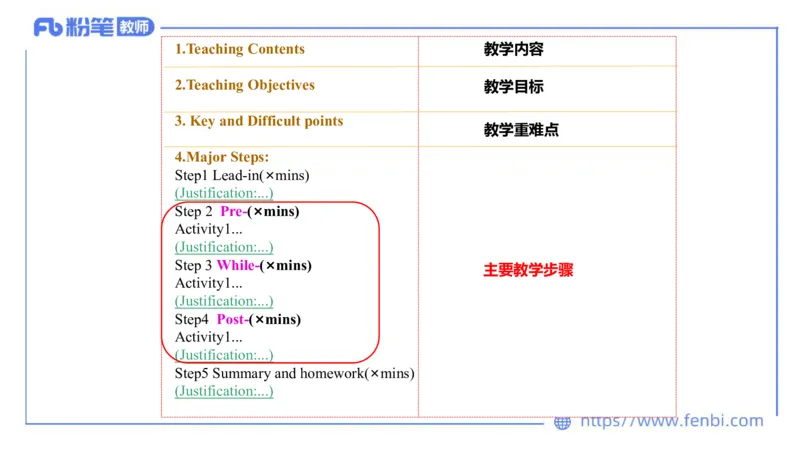
更多干货关注 粉笔教师教育 粉笔教师1.Teaching Contents 教学内容
2.Teaching Objectives 教学目标
3. Key and Difficult points
教学重难点
4.Major Steps:
Step1 Lead-in(×mins)
(Justification:...)
Step 2 Pre-(×mins)
Activity1...
(Justification:...)
Step 3 While-(×mins)
主要教学步骤
Activity1...
(Justification:...)
Step4 Post-(×mins)
Activity1...
(Justification:...)
Step5 Summary and homework(×mins)
(Justification:...)阅 读 课 、 听 说 课Listening / Reading — PWP
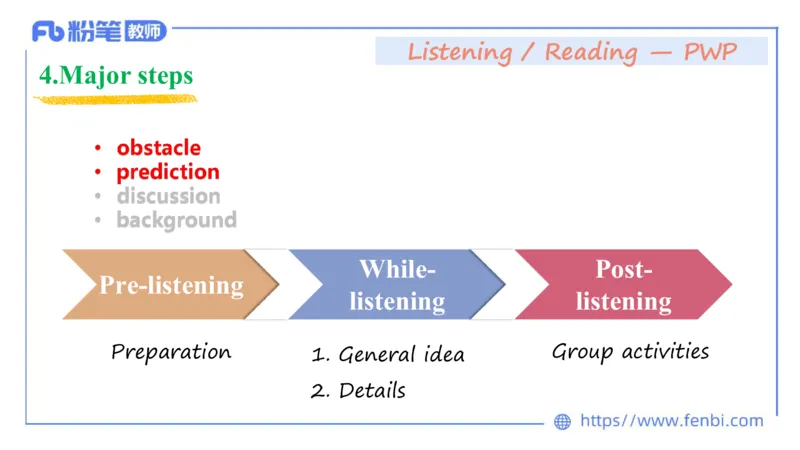
4.Major steps
While- Post-
Pre-listening
listening listening
Preparation Group activities
1. General idea
2. Details听前模板
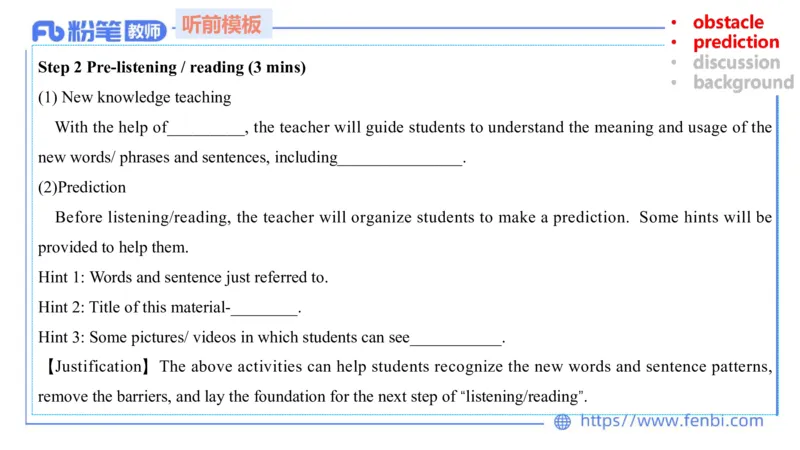
Step 2 Pre-listening / reading (3 mins)
(1) New knowledge teaching
With the help of_________, the teacher will guide students to understand the meaning and usage of the
new words/ phrases and sentences, including_______________.
(2)Prediction
Before listening/reading, the teacher will organize students to make a prediction. Some hints will be
provided to help them.
Hint 1: Words and sentence just referred to.
Hint 2: Title of this material-________.
Hint 3: Some pictures/ videos in which students can see___________.
【Justification】The above activities can help students recognize the new words and sentence patterns,
remove the barriers, and lay the foundation for the next step of “listening/reading”.小练习
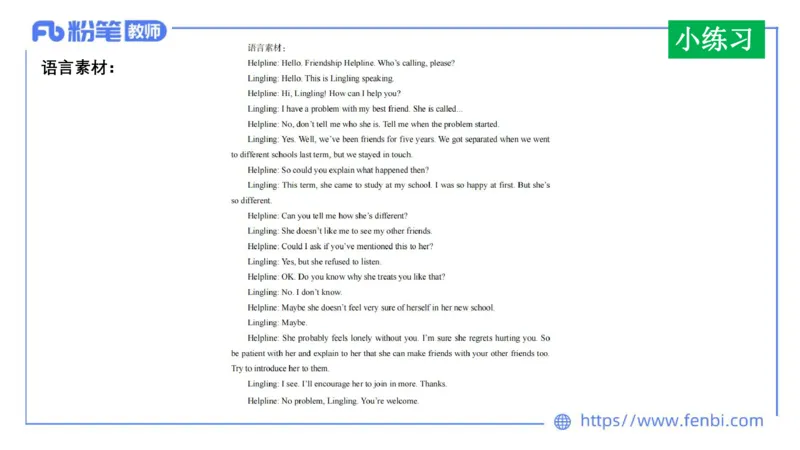
语言素材:小练习
【参考答案】
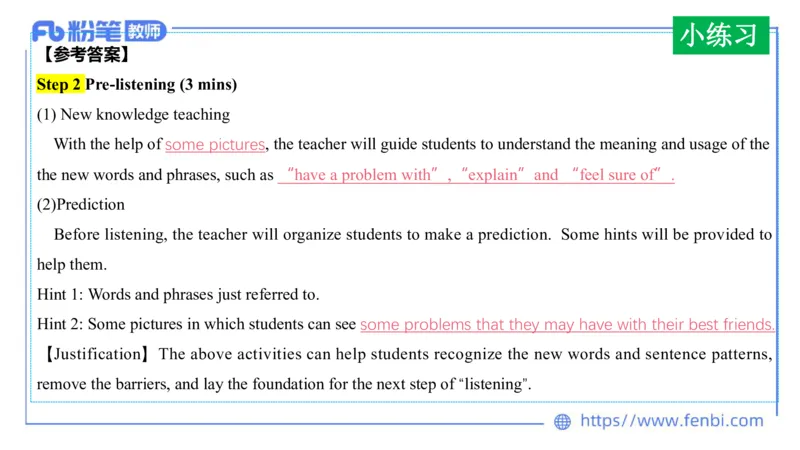
Step 2 Pre-listening (3 mins)
(1) New knowledge teaching
With the help of some pictures, the teacher will guide students to understand the meaning and usage of the
the new words and phrases, such as “have a problem with”,“explain”and “feel sure of”.
(2)Prediction
Before listening, the teacher will organize students to make a prediction. Some hints will be provided to
help them.
Hint 1: Words and phrases just referred to.
Hint 2: Some pictures in which students can see some problems that they may have with their best friends.
【Justification】The above activities can help students recognize the new words and sentence patterns,
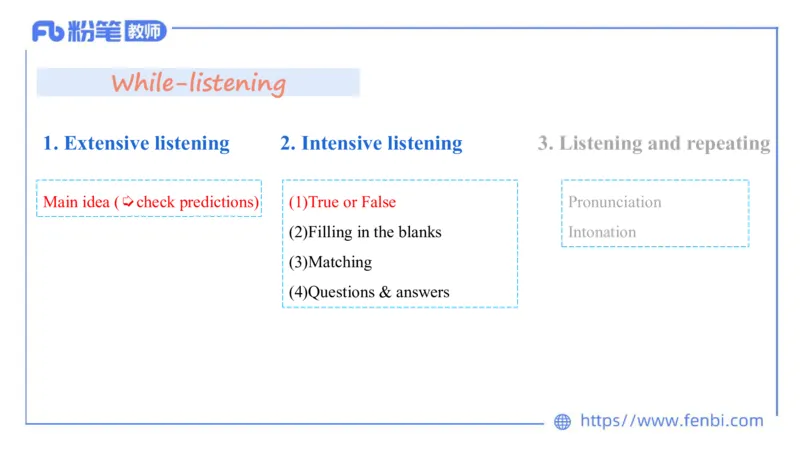
remove the barriers, and lay the foundation for the next step of “listening”.While-listening
1. Extensive listening 2. Intensive listening 3. Listening and repeating
➭
Main idea ( check predictions) (1)True or False Pronunciation
(2)Filling in the blanks Intonation
(3)Matching
(4)Questions & answersWhile-reading
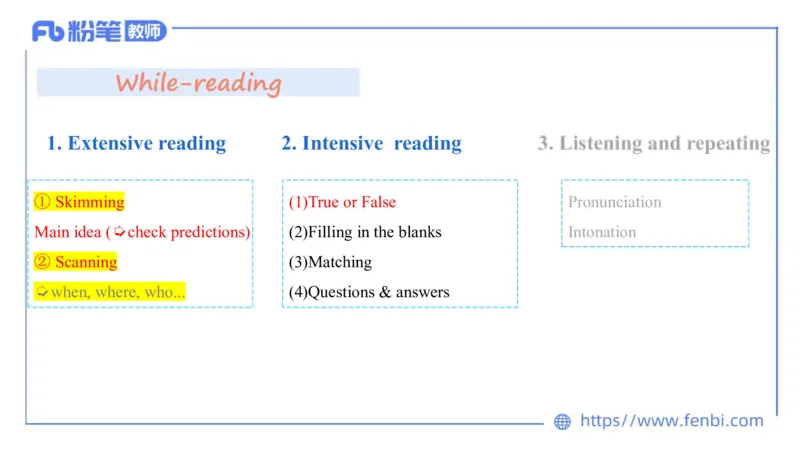
1. Extensive reading 2. Intensive reading 3. Listening and repeating
①
Skimming (1)True or False Pronunciation
➭
Main idea ( check predictions) (2)Filling in the blanks Intonation
②
Scanning (3)Matching
➭
when, where, who... (4)Questions & answers听中/读中模板
Step 3 While-listening/reading (11 mins)
(1)Extensive listening/reading
Students will listen to the passage/conversation for the first time to check their predictions and
conclude/summarize the main idea of the passage/conversation.
(2)Intensive listening/reading
Students should listen to/read the passage/conversation for the second time and do the following tasks:
①True or False ②Form-filling
________________(T/F).
________________(T/F).
________________(T/F).听中/读中模板
(3) Listening and repeating
可写可不写
Students will listen to the passage/conversation for the third time and read after it. They should pay
attention to the pronunciation and intonation.
【Justification】 In the process of completing the listening/reading tasks at different levels, students can
not only understand the content and certain details of the passage/conversation, but also improve their
listening/reading skills.小练习
语言素材:小练习
【参考答案】
Step 3 While-listening (11 mins)
(1)Extensive listening
Students will listen to conversation for the first time to check their predictions and summarize the main
idea of the conversation.
(2)Intensive listening
Students should listen to the conversation for the second time and do the following task:
True or False
①Lingling’s friend doesn’t feel very sure of herself in her new school. (T/F)
②Lingling won’t be patient with her friend and explain to her that she can’t make friends
with Lingling’s other friends too. (T/F)
③Helpline needs to know Lingling’s friend’s name. (T/F)小练习
【参考答案】
(3)Listening and repeating
Students will listen to the dialogue for the third time and read after the tape. They should pay attention to
the pronunciation and intonation.
【Justification】In the process of completing the listening tasks at different levels, students can not only
understand the content and certain details of the dialogue, but also improve their listening skills.任选其一
Post-listening / reading
Discuss this question Act out this dialogue
in groups of four. with partners.
Discussion 02 Role play 04
Survey Debate
01 03
Make a survey in 5 Which idea do you agree?
minutes with group
mates.听后模板
Step 4 Post-listening / reading (4 mins)
Group discussion/Doing a survey
Students will work in groups to discuss the following question/ do a survey about__________ by using
the key words/ phrases and sentences. Several minutes will be given. When time's up, several students will
be invited to share their answers/results. Then the teacher will comment on students' performances.
【Justification】Group activities will provide students with the opportunity to apply what they have learned
to the situation, improve their comprehensive language skills, and boost their confidence in learning English
/strengthen their sense of teamwork.Listening Reading
Pre-listening Pre-reading
Obstacle Obstacle
Prediction Prediction
While-listening While-reading
Extensive listening
Extensive/Global/Fast reading
Intensive listening
Intensive/Detailed/Careful reading
Listen and repeat
Read after the audio
Post-listening Post-reading
Do a survey Do a survey
Group discussion Group discussion写作课(读写课)W riting—PWP
Pre- While- Post-
writing writing writing
1. Learning about the material 1. Editing
Drafting
2.Conceiving writing material 2. Displaying
3. Structure learning 3. Evaluating
4. Outlining语言素材:
( )
1 Read the short essay and discuss
We can learn all we need on the Internet
I agree with this idea, especially on the subject of learning English. In my class, there are 45
students, and our English lessons last for 50 minutes. That means that we each have one minute of
our teacher's time! Our English teacher is excellent, but she can't help everyone in the class in 50
minutes.
It would be much better if we spend the time working on a computer. There are 45 computers in
our school, so we could do that if we work independently, we can learn much more.And we can learn
about the subjects that we are interested in.
( )
2 Write a paragraph giving the opposite view.• what to write
• how to write
Pre-writing (8 mins)
(1) Learning about the material
The teacher will guide students to read the material to summarize the topic of it. Then students will
answer some questions about the material/find the supporting ideas of the material.
① ? / ① .
② ? / ② .
③ ? / ③ .• what to write
• how to write
(2) Conceiving writing material
Students will work in groups of four to talk about ________ and write down some ideas.
Representatives from each group will share their discussion results, including some useful phrases,
sentences and so on.• what to write
• how to write
(3) Structure learning
The teacher will guide students to summarize the basic structure of _______, and remind them that they
should pay attention to the topic sentences, transitional words and logical relations.
(4) Outlining
Students will write an outline based on above activities
【Justification】Through the above activities, students will be prepared to write their own compositions.
They will know what to write and how to write it.语言素材:
( )
1 Read the short essay and discuss
We can learn all we need on the Internet
I agree with this idea, especially on the subject of learning English. In my class, there are 45
students, and our English lessons last for 50 minutes. That means that we each have one minute of
our teacher's time! Our English teacher is excellent, but she can't help everyone in the class in 50
minutes.
It would be much better if we spend the time working on a computer. There are 45 computers in
our school, so we could do that if we work independently, we can learn much more.And we can learn
about the subjects that we are interested in.
( )
2 Write a paragraph giving the opposite view.Pre-writing (8 mins)
(1) Learning about the material
The teacher will guide students to read the material to summarize the topic of it. Then students
will find the supporting ideas of the material.
① adequate study time.
② more options of choosing subject.
③ limited study time in traditional class.
(2) Conceiving writing material
Students will work in groups of four to talk about why we can’t learn all we need on the Internet
and write down some ideas. Representatives from each group will share their discussion results,
including some useful phrases, sentences and so on.(3) Structure learning
The teacher will guide students to summarize the basic structure of argumentation, and remind them that
they should pay attention to the topic sentences, transitional words and logical relations.
(4) Outlining
Students will write an outline based on above activities
【Justification】Through the above activities, students will be prepared to write their own compositions.
They will know what to write and how to write it.WRITING
1.Think of someone famous that you admire a lot, for example, an artist, a musician or
writer.
2.Write two or three paragraphs about his or her life. Below are some suggestions to help
you.
3.Write about:
Where he/she was born and where he/she lived as a child.
His/her family.
How he/she become famous.
His/her songs/ music/painting/novels/poems...
To show he/she has been in.
Your opinion of his/her work. Explain why you like him/her.
What you think will happen to him/her.
Whether he/she will continue to be successful.• what to write
• how to write
Pre-writing(8mins)
1. Brainstorming
Let students do a brainstorming. The topic is _________. Students will be given several minutes to work
in groups to talk about it and write down some ideas. After that, representatives from each group will share
their results, including some useful phrases, sentences and so on. Each answer will get a positive feedback.
2. Structure learning
The teacher will guide students to analyse and summarize the basic structure of _______. Students should
also pay attention to the topic sentences, transitional words, logical relations and so on.
3. Outlining
Students will write an outline based on above activities.
【Justification】Through the above activities, students will be prepared to write their own compositions.
They will know what to write and how to write it.• Drafting
写中模板
Step 3 While-writing (7 mins)
Drafting
Students will write their own compositions, and the teacher will walk around to offer help and remind
students to pay attention to the spelling, grammar, punctuation and so on.
【Justification】Through the above activities, students will finish their writing and their writing ability will
be improved.• Editing
写后模板 • Displaying and evaluating
Step 4 Post-writing (5 mins)
(1) Editing
① Self-editing
The teacher will give students a short time to go through their compositions to correct the mistakes in
spelling and grammar.
② Peer-editing
Students will exchange their compositions with each other and correct the mistakes in spelling and
grammar. They can also make suggestions about polishing their writings.
(2) Displaying and evaluating
The teacher will invite some students to share their compositions with the whole class and guide other
students to evaluate these compositions, and then the teacher will make a conclusion.
【Justification】Through these activities, students will regulate their language and work out better ideas or
expressions, and they will improve their writing skills. Besides, they will be more willing to share their ideas
in public and learn from each other.口 语 课Speaking—PWP
Pre- While- Post-
speaking speaking speaking
1. Listen to/Read the material 1. Display
1. Read after the tape
2. Learn expressions 2. Evaluation
2. Group work说前模板
Pre-speaking (8 mins)
(1) Listening to the conversation/Reading the passage
Students will listen to the conversation/read the passage to get the main idea, and then answer
some questions/fill in the table.
_____________?
_____________? 或者
_____________?
(2) Learning expressions
The teacher will explain the meaning and usage of the new words and sentences about the situation,
including _________and invite students to do some exercises about the new knowledge.
(Justification: With those activities, students will be familiar with the situation, and accumulate many
expressions which can be used in this situation, making good preparations for the speaking activities.)While-speaking
Group work
Reading after the tape (discussion/making a new dialogue/ survey)说中模板
While-speaking (7 mins)
(1) Reading after the tape
The teacher will play the tape and lead students to read after it. Students should pay attention to the
pronunciation and intonation. Then they can act out the dialogue.
(2) Group work
Ask students to work in groups of four and have a discussion/make up a conversation about . They
should try to use the words and sentence structures they have learned today.
【Justification】Students will have a deeper understanding of the topic and usage of the new knowledge,
and they can also have more opportunities to express themselves.Post-speaking
Displaying Evaluating说后模板
Post-speaking (5 mins)
Displaying and evaluating:
The teacher will invite some students to share their dialogue with the whole class and guide other students
to evaluate the performance, and then the teacher will make a conclusion.
【Justification】Through these activities, students will regulate their language and work out better ideas or
expressions, and they will improve their speaking skills. Besides, they will be more willing to share their
ideas in public and learn from each other.Writing Speaking
Pre-writing
While-speaking
1. Learning about the material
1. Listen to/Read the material
2.Conceiving writing material
2. Learn expressions
3. Structure learning
4. Outlining
While-writing While-speaking
Drafting
1.Reading after the tape
2.Group work
Post-writing Post-speaking
1.Displaying
1. Editing
2.Evaluating
2. Displaying
3. Evaluating