文档文本内容
理 论 精 讲 - 教 学 设 计 1
▹ 讲师:慕伊
更多干货关注 粉笔教师教育 粉笔教师第三部分
教学设计P179
第一章
教学设计概述一、教学设计的概念
了解即可
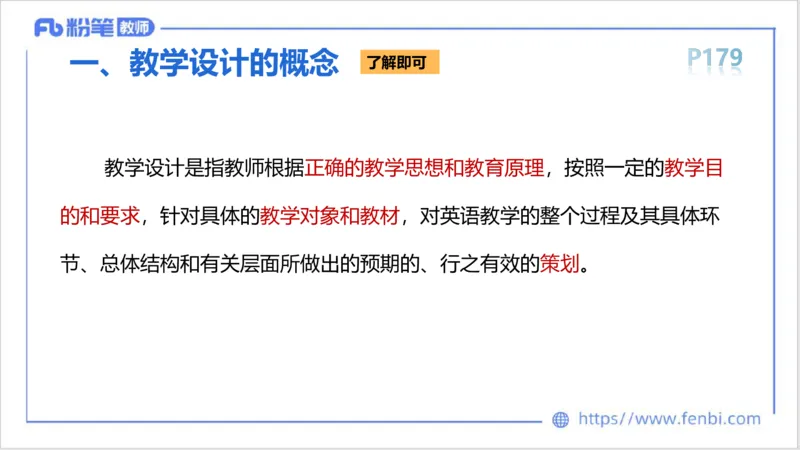
教学设计是指教师根据正确的教学思想和教育原理,按照一定的教学目
的和要求,针对具体的教学对象和教材,对英语教学的整个过程及其具体环
节、总体结构和有关层面所做出的预期的、行之有效的策划。二、教学设计的原则
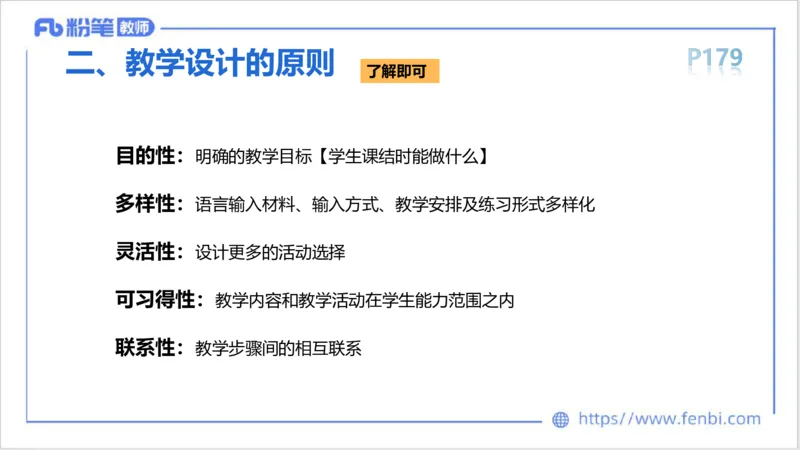
了解即可
目的性:明确的教学目标【学生课结时能做什么】
多样性:语言输入材料、输入方式、教学安排及练习形式多样化
灵活性:设计更多的活动选择
可习得性:教学内容和教学活动在学生能力范围之内
联系性:教学步骤间的相互联系P181
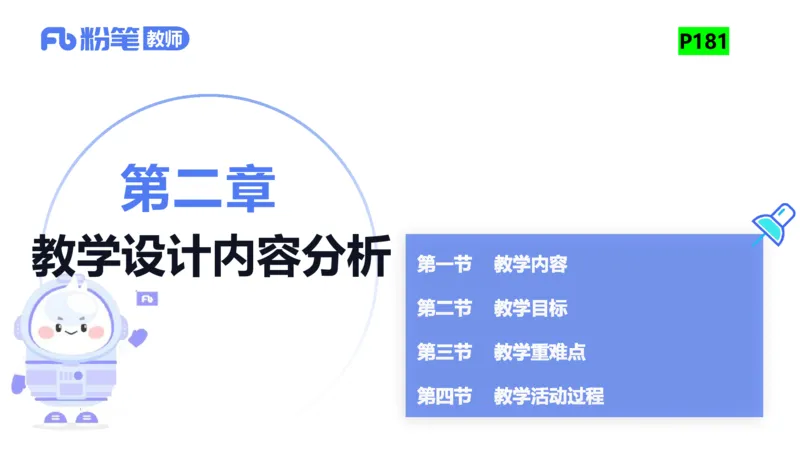
第二章
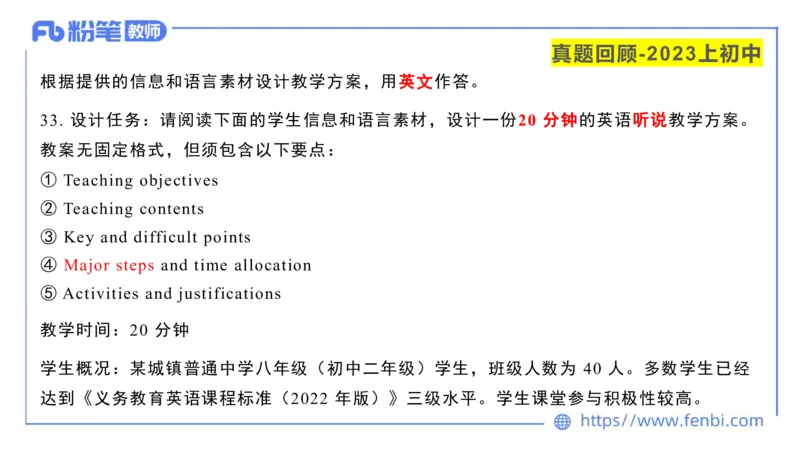
教学设计内容分析一、考 情 梳 理真题回顾-2023上初中
根据提供的信息和语言素材设计教学方案,用英文作答。
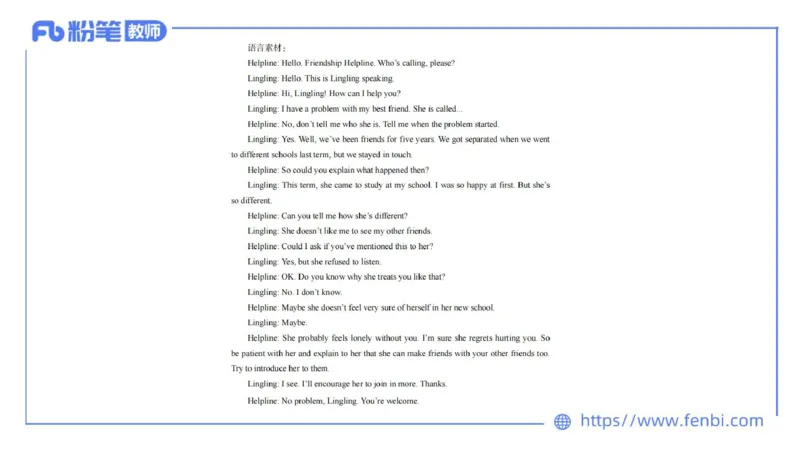
设计任务:请阅读下面的学生信息和语言素材,设计一份 分钟的英语听说教学方案。
33. 20
教案无固定格式,但须包含以下要点:
①
Teaching objectives
②
Teaching contents
③
Key and difficult points
④
Major steps and time allocation
⑤
Activities and justifications
教学时间: 分钟
20
学生概况:某城镇普通中学八年级(初中二年级)学生,班级人数为 人。多数学生已经
40
达到《义务教育英语课程标准( 年版)》三级水平。学生课堂参与积极性较高。
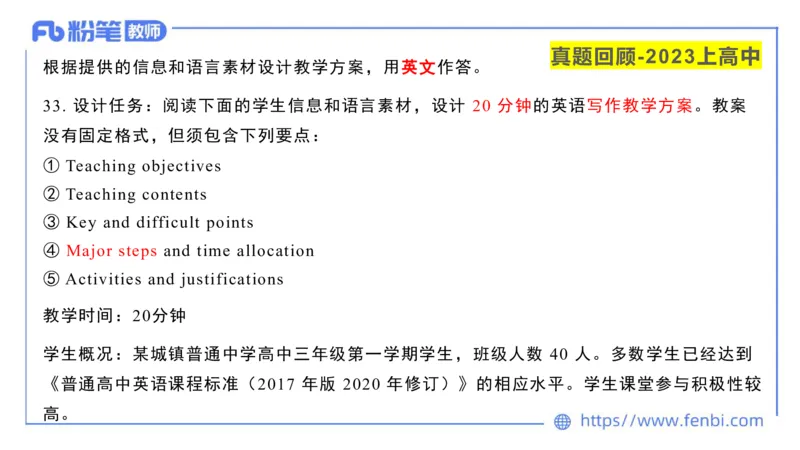
2022真题回顾-2023上高中
根据提供的信息和语言素材设计教学方案,用英文作答。
设计任务:阅读下面的学生信息和语言素材,设计 分钟的英语写作教学方案。教案
33. 20
没有固定格式,但须包含下列要点:
①
Teaching objectives
②
Teaching contents
③
Key and difficult points
④
Major steps and time allocation
⑤
Activities and justifications
教学时间: 分钟
20
学生概况:某城镇普通中学高中三年级第一学期学生,班级人数 人。多数学生已经达到
40
《普通高中英语课程标准( 年版 年修订)》的相应水平。学生课堂参与积极性较
2017 2020
高。一:呈现形式
二:课型要求
文章、对话或写作话题
初中:听说课、阅读课、口语课、语法课
高中:写作课、阅读课、口语课、听力课
三:书写要求 四:内容要求
全英文 教学内容
教学目标
教学重难点
主要教学环节和时间分配
教学活动及设计意图年份 23上 22下 22上 21下 21上 20下 19下 19上 18下 18上
课型 听说 -- 阅读 听说 语法 阅读 口语 阅读 口语 听说
初中
时间 20 -- 15 20 20 20 20 20 20 15
课型 写作 听力 阅读 口语 读写 写作 阅读 阅读 写作 阅读
高中
时间 20 20 15 20 20 20 20 20 20 20二、设计详解1.Teaching Contents 教学内容
2.Teaching Objectives 教学目标
3. Key and Difficult points
教学重难点
4.Major Steps:
Step1 Lead-in(×mins)
(Justification:...)
Step 2 Pre-(×mins)
Activity1...
(Justification:...)
Step 3 While-(×mins)
主要教学步骤
Activity1...
(Justification:...)
Step4 Post-(×mins)
Activity1...
(Justification:...)
Step5 Summary and homework(×mins)
(Justification:...)通用部分1.Teaching Contents
【教案模板】
呈现要素:课型+主题
方式一:
This is a reading lesson. It talks about...
方式二:
The given reading material introduces/shows...小练习
I. Teaching contents
方式一:This is a __________ lesson. It talks about __________.
方式一:The given __________ material introduces/shows __________.小练习
【参考答案】
I. Teaching contents
方式一:This a listening lesson. It talks about how to get on well with one’s best friends and how
to handle the barriers in daily life to keep a good friendship.
方式二:The given listening material introduces/shows how to get on well with one’s best friends
and how to handle the barriers in daily life to keep a good friendship.2. Teaching Objectives
三维教学目标和四维教学目标
语言能力目标
知识目标
文化意识目标
技能目标
思维品质目标
情感目标
学习能力目标
老版课标 新版课标语言能力:语音、词汇、句型、语法、语篇;
听说读看写
文化意识:中外文化理解、鉴赏;正确的价值观、
必备品格的形成与发展
思维品质:理解、分析、比较、推断、批判、评
价、创造
学习能力:学习策略;乐学与善学、合作与探究2.Teaching Objectives-Language competence
【听说课、阅读课】
1. Students can know/understand/grasp/remember the new words and
expressions/sentence patterns, such as ____________.
2. Through listening/reading, students will understand the main idea of the
listening/reading materials/ passage and be able to use the target language to talk about
______.2.Teaching Objectives-Language competence
【写作课】
1. Students can know the main idea of the passage and the structure/form of the
writing.
2. Students can write a passage with a certain topic ______.
【口语课】
Students will know/understand some new expressions, such as ______ and talk
about ______ correctly and fluently.2.Teaching Objectives-Language competence
【词汇课】
1. Students will understand/remember/recite/know/grasp the meaning of the new words,
such as _______, and new sentences _________.
2. Students can use the new words to talk about ________ correctly.
【语音课】
Students will know/grasp the pronunciation of the letter(s) _________ and use it to
communicate with others correctly.2.Teaching Objectives-Language competence
【语法课】
1. Students can understand/remember/know/grasp/get the meaning and usage of the new
grammar _________.
2. Students can use this grammar to talk about __________ correctly/read the material
more easily and quickly.2.Teaching Objectives-Cultural awareness
(1) Students can be interested in learning and exploring Chinese and foreign culture.
(2) Students can compare Chinese and foreign culture and identify with Chinese
culture.
(3) Students can respect cultural diversity and differences.2.Teaching Objectives-Cultural awareness
(4) Students can have a sense of national identity, cultural confidence, correct
values and positive emotional attitude.【推荐】
(5) Students can have good qualities of self-confidence and self-improvement.
【推荐】2.Teaching Objectives-Thinking quality
(1) Students can sort out and summarize the information in the
passage/material.【推荐】
(2) Students can analyze and infer the logical relationship of the passage/material.
(3) Students can use English to think independently and creatively.【推荐】2.Teaching Objectives-Thinking quality
(4) Students can correctly understand and judge the thematic meaning and
viewpoint of the passage/material.
(5) Students can infer the author’s attitude and view from the passage/material.2.Teaching Objectives-Learning ability
(1) Students can increase their interest in learning English.
(2) Students will be willing to take part in the class activities and cooperate with
other group members.【推荐】2.Teaching Objectives-Learning ability
(3) Students will be more confident and willing to share their own ideas with
others in public.【推荐】
(4) Students can make clear learning objectives and plans and arrange learning tasks
reasonably.
(5) Students can actively use English to communicate and be not afraid of
difficulties.【推荐】版本
1
Teaching objectives
(1) Language competence
Students can learn to use some important words and expressions in the conversation, such as __________
Through listening, students can understand the main idea of the dialogue and be able to use the target language
to talk about _______________
(2) Cultural awareness
Students can have good character of self-confidence and self-improvement.
(3) Thinking quality
Students can sort out and summarize information in the material.
(4) Learning ability
Students will be willing to take part in the class activities and cooperate with other group members.版本
2
Teaching objectives
(1)Students can learn to use some important words and expressions in the conversation, such as
__________
(2)Through listening, students can understand the main idea of the dialogue and be able to
use the target language to talk about _______________
(3) Students can have good character of self-confidence and self-improvement.
(4) Students can sort out and summarize information in the material.
(5)Students will be willing to take part in the class activities and cooperate with other group members.小练习
语言素材:小练习
Teaching objectives
(1) Students can understand the new words and phrases, such as “have a problem with”
“explain” “feel sure of”.
(2)Through listening, students can understand the main idea of the dialogue and be able to
use the target language to talk about some problems with one’s best friends.
(3)Students can have good character of self-confidence and self-improvement.
(4) Students can sort out and summarize information in the material.
(5) Students will be willing to take part in the class activities and cooperate with other group members.3. Key and Difficult points
Key point(s)
(1) The teacher will help students to know the meaning and usage of the new
words/phrases and sentence patterns.
(2) The teacher will help students to understand the content of this lesson through
listening.3. Key and Difficult points
Difficult point(s)
(1) The teacher will help students to talk about/describe the new topic correctly
and fluently.
(2) The teacher will help students to improve their confidence in speaking English.1.Teaching Contents 教学内容
2.Teaching Objectives 教学目标
3. Key and Difficult points
教学重难点
4.Major Steps:
Step1 Lead-in(×mins)
(Justification:...)
Step 2 Pre-(×mins)
Activity1...
主要教学步骤
(Justification:...)
Step 3 While-(×mins)
Activity1...
(Justification:...)
Step4 Post-(×mins)
Activity1...
(Justification:...)
Step5 Summary and homework(×mins)
(Justification:...)4.Major Steps
45 minsP190
了解即可
简洁来说:多样/启发/针/有趣Lead-in Step 1 Lead-in (5 mins)
After greeting students, the teacher will show a picture/
Review Situational
photo/ video of_______ and ask one question: “_________”.
Then the teacher will invite some volunteers to share their
Language
answers. After that, the teacher will give corresponding
comments on students’ answers and show the topic/ task of this
Course
Media
lesson.
Homework
【Justification】The picture/photo/video is vivid and
Rhythm
interesting, which can arouse students' interest to the teaching
activity. Meanwhile, it can also introduce the topic today
naturally)小练习
语言素材:小练习
【参考答案】
Step 1 Lead-in (5 mins)
After greeting students, the teacher will show a picture/ photo/ video of __________ and ask one
question: “________________________________”. Then the teacher will invite some volunteers to share their
answers. After that, the teacher will give corresponding comments on students’ answers and show the
topic/ task of this lesson.
【Justification】The picture/photo/video is vivid and interesting, which can arouse students' interest to
the teaching activity. Meanwhile, it can also introduce the topic today naturally.Summary and Homework (5 mins)
P194
1. Summary:
The teacher can ask students to act as assistants to conclude what they have learned from this class, and
then make a summary together.
2. Homework:
① Listen to / Read the new words/phrases/sentences they’ve learned today./Retell the passage/
conversation.
②Talk about ___with partners/friends./Find more information about __and share it with partners/friends.
(Justification: Summary can help students develop good habits and deepen the impression of the new
knowledge they have learned. Homework can help students apply what they have learned to practical use.)小练习
语言素材:小练习
【参考答案】
Step 5 Summary and Homework (5 mins)
1. Summary:
The teacher can ask students to act as assistants to conclude what they have learned from this class, and
then make a summary together.
2. Homework:
①Practice the dialogue after class.
②Find more information about ______and share it with partners/friends.
【Justification】 Summary can help students develop good habits and deepen the impression
of the new knowledge they have learned. Homework can help students apply what they have
learned to practical use.).1.Teaching Contents 教学内容
2.Teaching Objectives 教学目标
3. Key and Difficult points
教学重难点
4.Major Steps:
Step1 Lead-in(×mins)
(Justification:...)
Step 2 Pre-(×mins)
Activity1...
(Justification:...)
Step 3 While-(×mins)
主要教学步骤
Activity1...
(Justification:...)
Step4 Post-(×mins)
Activity1...
(Justification:...)
Step5 Summary and homework(×mins)
(Justification:...)