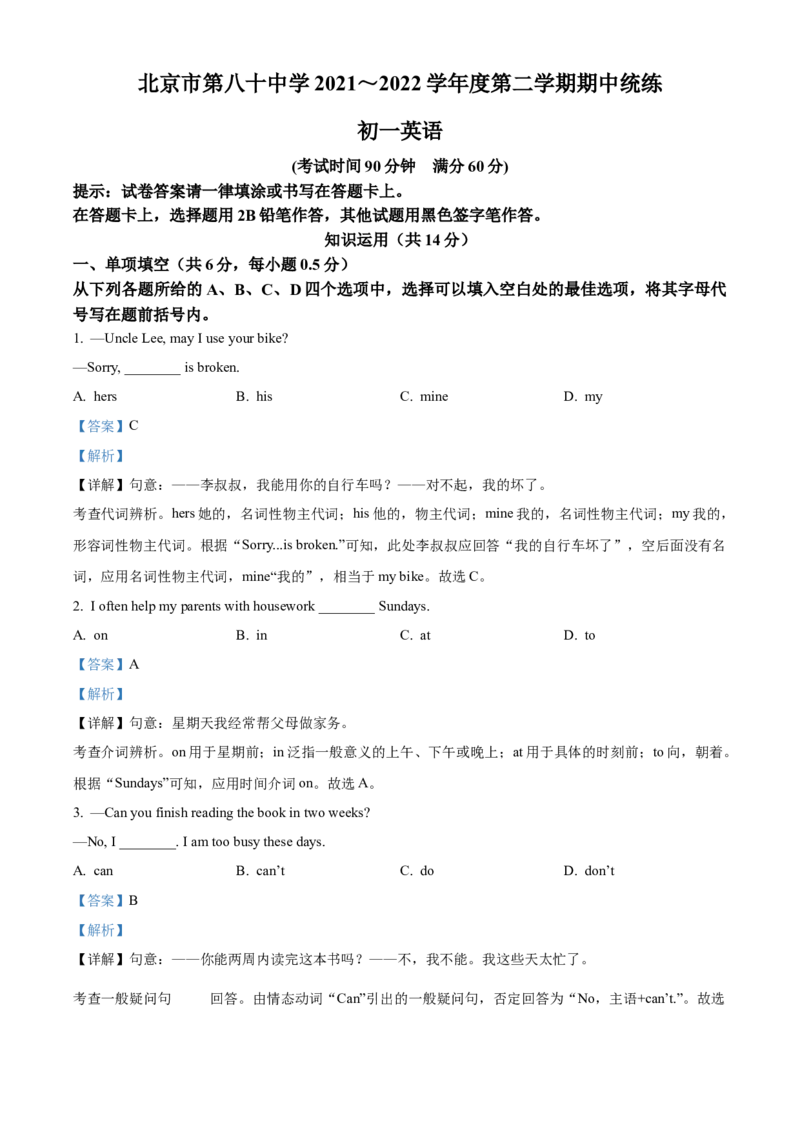
北京市第八十中学 2021~2022 学年度第二学期期中统练
初一英语
(考试时间90分钟 满分60分)
提示:试卷答案请一律填涂或书写在答题卡上。
在答题卡上,选择题用2B铅笔作答,其他试题用黑色签字笔作答。
知识运用(共14分)
一、单项填空(共6分,每小题0.5分)
从下列各题所给的A、B、C、D四个选项中,选择可以填入空白处的最佳选项,将其字母代
号写在题前括号内。
1. —Uncle Lee, may I use your bike?
—Sorry, ________ is broken.
A. hers B. his C. mine D. my
【答案】C
【解析】
【详解】句意:——李叔叔,我能用你的自行车吗?——对不起,我的坏了。
考查代词辨析。hers她的,名词性物主代词;his他的,物主代词;mine我的,名词性物主代词;my我的,
形容词性物主代词。根据“Sorry...is broken.”可知,此处李叔叔应回答“我的自行车坏了”,空后面没有名
词,应用名词性物主代词,mine“我的”,相当于my bike。故选C。
2. I often help my parents with housework ________ Sundays.
A. on B. in C. at D. to
【答案】A
【解析】
【详解】句意:星期天我经常帮父母做家务。
考查介词辨析。on用于星期前;in泛指一般意义的上午、下午或晚上;at用于具体的时刻前;to向,朝着。
根据“Sundays”可知,应用时间介词on。故选A。
3. —Can you finish reading the book in two weeks?
—No, I ________. I am too busy these days.
A. can B. can’t C. do D. don’t
【答案】B
【解析】
【详解】句意:——你能两周内读完这本书吗?——不,我不能。我这些天太忙了。
的
考查一般疑问句 回答。由情态动词“Can”引出的一般疑问句,否定回答为“No,主语+can’t.”。故选B。
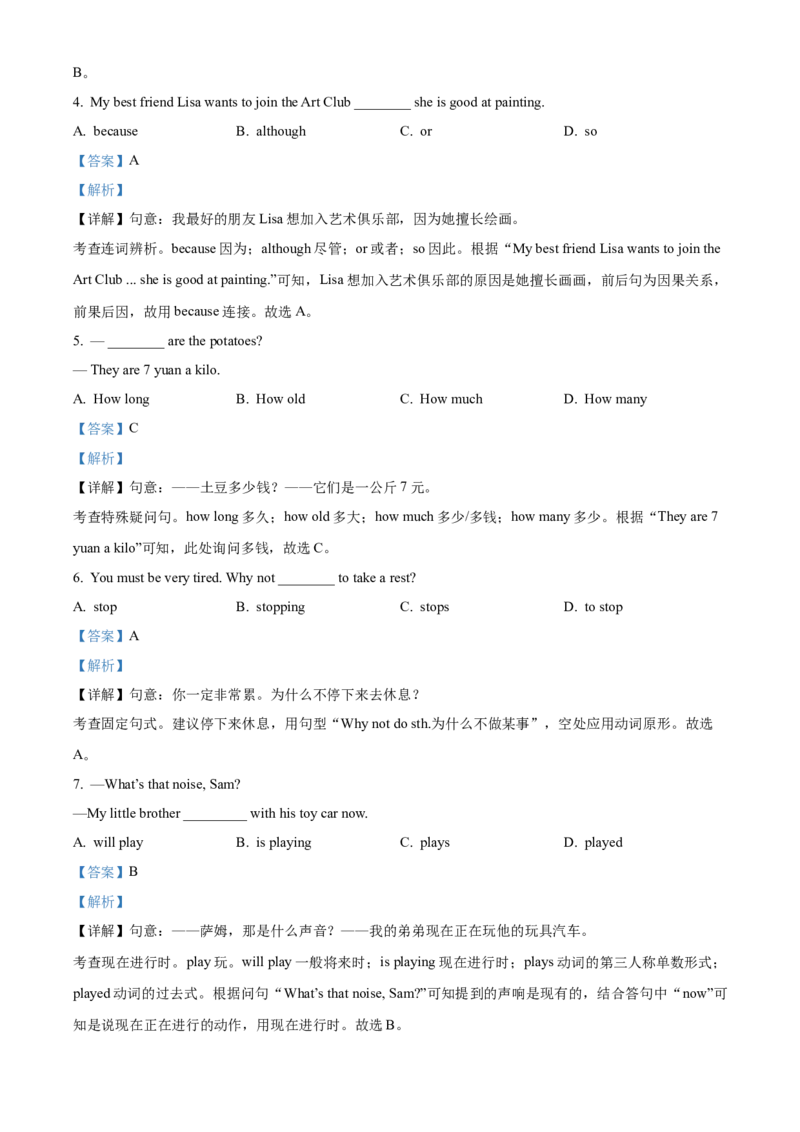
4. My best friend Lisa wants to join the Art Club ________ she is good at painting.
A. because B. although C. or D. so
【答案】A
【解析】
【详解】句意:我最好的朋友Lisa想加入艺术俱乐部,因为她擅长绘画。
考查连词辨析。because因为;although尽管;or或者;so因此。根据“My best friend Lisa wants to join the
Art Club ... she is good at painting.”可知,Lisa想加入艺术俱乐部的原因是她擅长画画,前后句为因果关系,
前果后因,故用because连接。故选A。
5. — ________ are the potatoes?
— They are 7 yuan a kilo.
A. How long B. How old C. How much D. How many
【答案】C
【解析】
【详解】句意:——土豆多少钱?——它们是一公斤7元。
考查特殊疑问句。how long多久;how old多大;how much多少/多钱;how many多少。根据“They are 7
yuan a kilo”可知,此处询问多钱,故选C。
6. You must be very tired. Why not ________ to take a rest?
A. stop B. stopping C. stops D. to stop
【答案】A
【解析】
【详解】句意:你一定非常累。为什么不停下来去休息?
考查固定句式。建议停下来休息,用句型“Why not do sth.为什么不做某事”,空处应用动词原形。故选
A。
7. —What’s that noise, Sam?
—My little brother _________ with his toy car now.
A. will play B. is playing C. plays D. played
【答案】B
【解析】
【详解】句意:——萨姆,那是什么声音?——我的弟弟现在正在玩他的玩具汽车。
考查现在进行时。play玩。will play一般将来时;is playing现在进行时;plays动词的第三人称单数形式;
played动词的过去式。根据问句“What’s that noise, Sam?”可知提到的声响是现有的,结合答句中“now”可
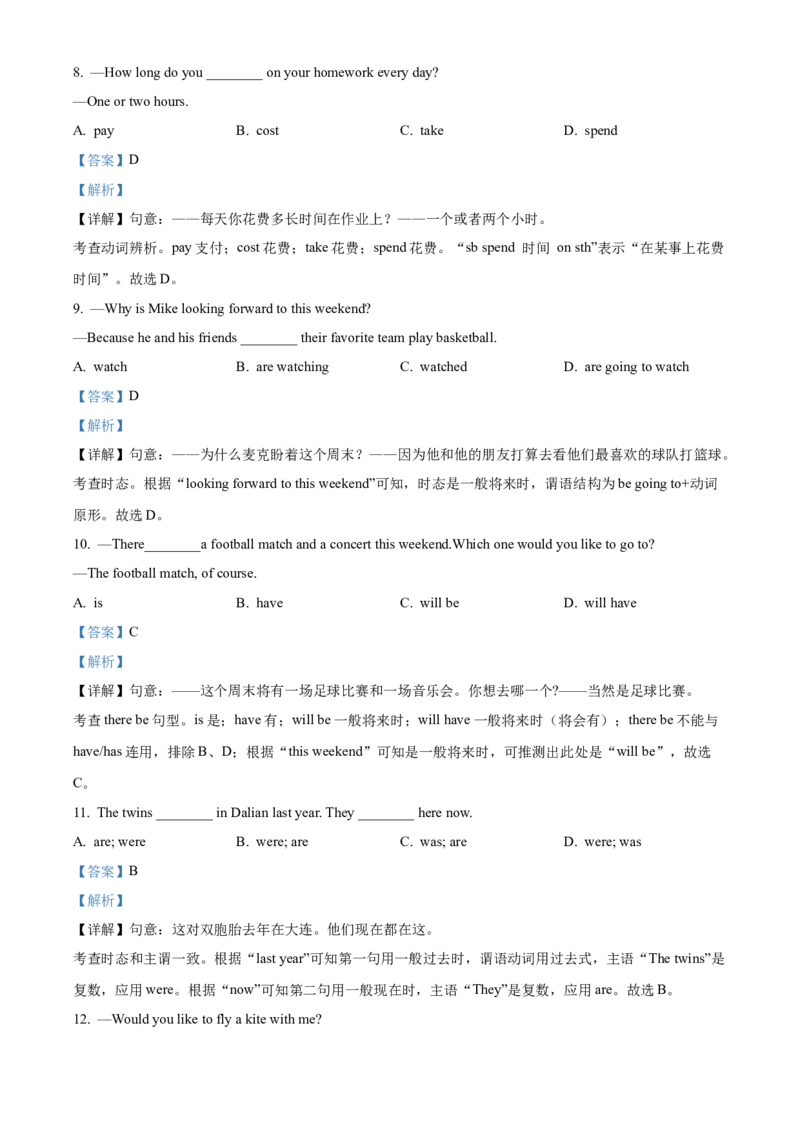
知是说现在正在进行的动作,用现在进行时。故选B。8. —How long do you ________ on your homework every day?
—One or two hours.
A. pay B. cost C. take D. spend
【答案】D
【解析】
【详解】句意:——每天你花费多长时间在作业上?——一个或者两个小时。
考查动词辨析。pay支付;cost花费;take花费;spend花费。“sb spend 时间 on sth”表示“在某事上花费
时间”。故选D。
9. —Why is Mike looking forward to this weekend?
—Because he and his friends ________ their favorite team play basketball.
A. watch B. are watching C. watched D. are going to watch
【答案】D
【解析】
【详解】句意:——为什么麦克盼着这个周末?——因为他和他的朋友打算去看他们最喜欢的球队打篮球。
考查时态。根据“looking forward to this weekend”可知,时态是一般将来时,谓语结构为be going to+动词
原形。故选D。
10. —There________a football match and a concert this weekend.Which one would you like to go to?
—The football match, of course.
A. is B. have C. will be D. will have
【答案】C
【解析】
【详解】句意:——这个周末将有一场足球比赛和一场音乐会。你想去哪一个?——当然是足球比赛。
考查there be句型。is是;have有;will be一般将来时;will have一般将来时(将会有);there be不能与
have/has连用,排除B、D;根据“this weekend”可知是一般将来时,可推测出此处是“will be”,故选
C。
11. The twins ________ in Dalian last year. They ________ here now.
A. are; were B. were; are C. was; are D. were; was
【答案】B
【解析】
【详解】句意:这对双胞胎去年在大连。他们现在都在这。
考查时态和主谓一致。根据“last year”可知第一句用一般过去时,谓语动词用过去式,主语“The twins”是
复数,应用were。根据“now”可知第二句用一般现在时,主语“They”是复数,应用are。故选B。
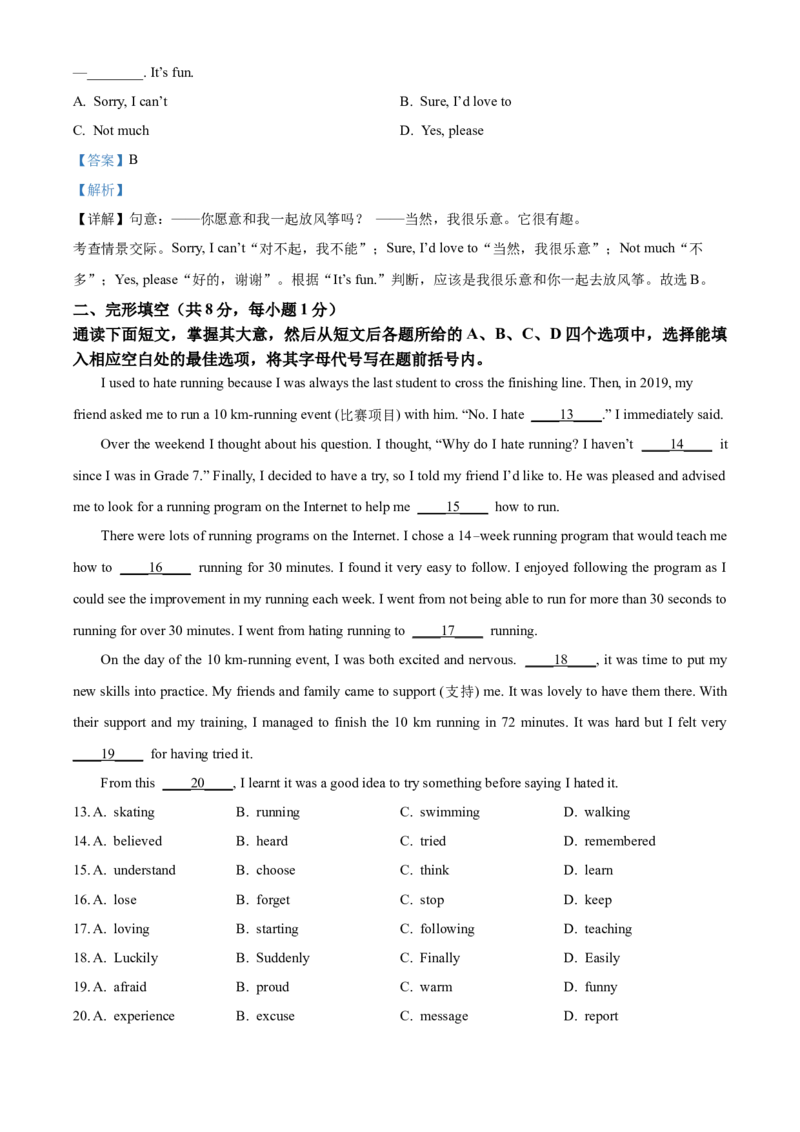
12. —Would you like to fly a kite with me?—________. It’s fun.
A. Sorry, I can’t B. Sure, I’d love to
C. Not much D. Yes, please
【答案】B
【解析】
【详解】句意:——你愿意和我一起放风筝吗? ——当然,我很乐意。它很有趣。
考查情景交际。Sorry, I can’t“对不起,我不能”;Sure, I’d love to“当然,我很乐意”;Not much“不
多”;Yes, please“好的,谢谢”。根据“It’s fun.”判断,应该是我很乐意和你一起去放风筝。故选B。
二、完形填空(共8分,每小题1分)
通读下面短文,掌握其大意,然后从短文后各题所给的A、B、C、D四个选项中,选择能填
入相应空白处的最佳选项,将其字母代号写在题前括号内。
I used to hate running because I was always the last student to cross the finishing line. Then, in 2019, my
friend asked me to run a 10 km-running event (比赛项目) with him. “No. I hate ____13____.” I immediately said.
Over the weekend I thought about his question. I thought, “Why do I hate running? I haven’t ____14____ it
since I was in Grade 7.” Finally, I decided to have a try, so I told my friend I’d like to. He was pleased and advised
me to look for a running program on the Internet to help me ____15____ how to run.
There were lots of running programs on the Internet. I chose a 14-week running program that would teach me
how to ____16____ running for 30 minutes. I found it very easy to follow. I enjoyed following the program as I
could see the improvement in my running each week. I went from not being able to run for more than 30 seconds to
running for over 30 minutes. I went from hating running to ____17____ running.
On the day of the 10 km-running event, I was both excited and nervous. ____18____, it was time to put my
new skills into practice. My friends and family came to support (支持) me. It was lovely to have them there. With
their support and my training, I managed to finish the 10 km running in 72 minutes. It was hard but I felt very
____19____ for having tried it.
From this ____20____, I learnt it was a good idea to try something before saying I hated it.
13. A. skating B. running C. swimming D. walking
14. A. believed B. heard C. tried D. remembered
15. A. understand B. choose C. think D. learn
16. A. lose B. forget C. stop D. keep
17. A. loving B. starting C. following D. teaching
18. A. Luckily B. Suddenly C. Finally D. Easily
19. A. afraid B. proud C. warm D. funny
20. A. experience B. excuse C. message D. report【答案】13. B 14. C 15. D 16. D 17. A 18. C 19. B 20. A
【解析】
【导语】本文主要讲述了作者从讨厌跑步,到喜欢跑步的过程,从而告诉我们没有尝试就不知道自己是否
真正喜欢。
【13题详解】
句意:“不,我讨厌跑步。”我立刻说。
skating滑冰;running跑步;swimming游泳;walking走路。根据上文“I used to hate running”,可知是讨厌
跑步。故选B。
【14题详解】
句意:我上七年级以后就没试过了。
believed相信;heard听说;tried尝试;remembered记得。根据上文“Why do I hate running?”可知应是从七
年级开始就没尝试过跑步了。故选C。
【15题详解】
句意:他很高兴,并建议我在网上找一个跑步教程来帮助我学习如何跑步。
understand明白、理解;choose选择;think想、认为;learn学习。根据“He was pleased and advised me to
look for a running program on the Internet to help me … how to run.”可知跑步教程应是来帮助作者学习如何跑
步的。故选D。
【16题详解】
句意:我选择了一个14周的跑步教程,它将教会我如何坚持跑30分钟。
lose失去、失败;forget忘记;stop停止;keep持续、保持。根据“I chose a 14-week running program that
would teach me how to … running for 30 minutes.”可知,应是这个教程将教会作者怎么坚持跑30分钟,keep
doing sth“持续做某事”,固定搭配。故选D。
【17题详解】
句意:我从讨厌跑步变成了喜欢跑步。
loving喜欢、热爱;starting开始;following跟随;teaching教。根据上文的描述“I found it very easy to
follow. I enjoyed following the program as I could see the improvement in my running each week. I went from not
being able to run for more than 30 seconds to running for over 30 minutes.” 可知,作者在跑步上取得了很大的
效果,所以应是有讨厌变为了喜欢。故选A。
【18题详解】
句意:最后,是时候把我 的新技能付诸实践了。
Luckily幸运地;Suddenly突然地;Finally最终;Easily容易地。根据“it was time to put my new skills into
practice.”可知,所有的训练都是为了最后的10公里赛跑,finally符合语境。故选C。【19题详解】
句意:这是很难的,但我为尝试过它而感到非常自豪。
afraid害怕的;proud骄傲的、自豪的;warm温暖的;funny滑稽的。根据“It was hard but I felt very … for
having tried it.”由转折词but可知前后句之间表达的是转折关系,虽然很难,但完成之后作者感到很自豪。
故选B。
【20题详解】
句意:从这次经历中,我明白了在说不喜欢某件事之前先尝试一下是个好主意。
experience经历、经验;excuse借口;message消息;report报告。根据“I learnt it was a good idea to try
something before saying I hated it.”可知这是作者从自身的经历中得出的感悟。故选A。
阅读理解(共36分)
三、阅读理解(共26分,每小题2分)
阅读下面A、B、C、D四篇短文,根据短文内容,从短文后各题所给的 A、B、C、D四个选
项中,选择最佳选项,将其字母代号写在题前括号内。
A
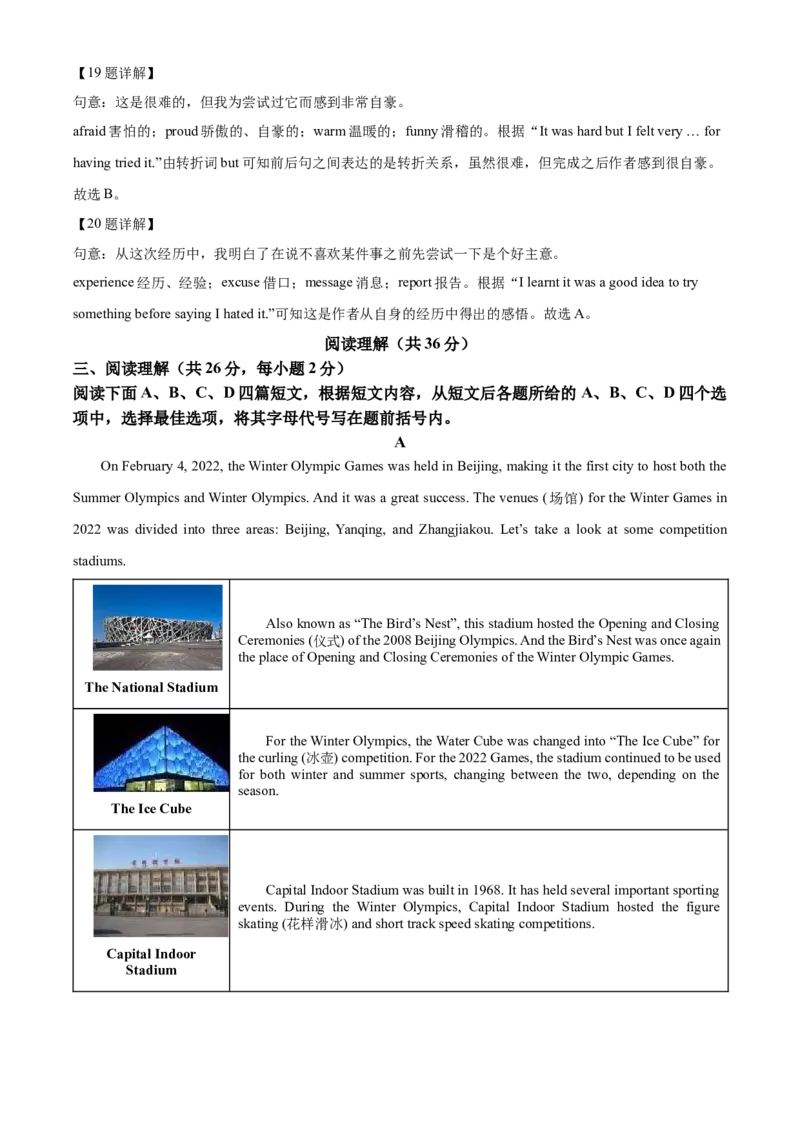
On February 4, 2022, the Winter Olympic Games was held in Beijing, making it the first city to host both the
Summer Olympics and Winter Olympics. And it was a great success. The venues (场馆) for the Winter Games in
2022 was divided into three areas: Beijing, Yanqing, and Zhangjiakou. Let’s take a look at some competition
stadiums.
Also known as “The Bird’s Nest”, this stadium hosted the Opening and Closing
Ceremonies (仪式) of the 2008 Beijing Olympics. And the Bird’s Nest was once again
the place of Opening and Closing Ceremonies of the Winter Olympic Games.
The National Stadium
For the Winter Olympics, the Water Cube was changed into “The Ice Cube” for
the curling (冰壶) competition. For the 2022 Games, the stadium continued to be used
for both winter and summer sports, changing between the two, depending on the
season.
The Ice Cube
Capital Indoor Stadium was built in 1968. It has held several important sporting
events. During the Winter Olympics, Capital Indoor Stadium hosted the figure
skating (花样滑冰) and short track speed skating competitions.
Capital Indoor
StadiumWukesong Sports Center is very large. It can hold 18,000 people. It served as the
main indoor stadium for ice hockey at the 2022 Winter Games together with the
National Indoor Stadium.
Wukesong Sports
Center
21. Where did we see the Opening and Closing Ceremonies of the Winter Olympic Games?
A. The Ice Cube. B. Capital Indoor Stadium.
C. The National Stadium. D. Wukesong Sports Center.
22. When was the Capital Indoor Stadium built?
A. In 1968. B. In 2008. C. In 2018. D. In 2022.
23. What competition did you see in Wukesong Sports Center?
A. Curling. B. Skating. C. Figure Skating D. Ice hockey.
【答案】21. C 22. A 23. D
【解析】
【导语】本文主要介绍了北京冬奥会的场馆。
【21题详解】
细节理解题。根据“And the Bird’s Nest was once again the place of Opening and Closing Ceremonies of the
Winter Olympic Games.”可知,在国家体育馆可以看到冬奥会的开幕式和闭幕式。故选C。
【22题详解】
细节理解题。根据“Capital Indoor Stadium was built in 1968.”可知,首都体育馆于1968年建成的。故选
A。
【23题详解】
细节理解题。根据“It served as the main indoor stadium for ice hockey at the 2022 Winter Games together with
the National Indoor Stadium.”可知,在五棵松体育馆能看到冰球比赛。故选D。
B
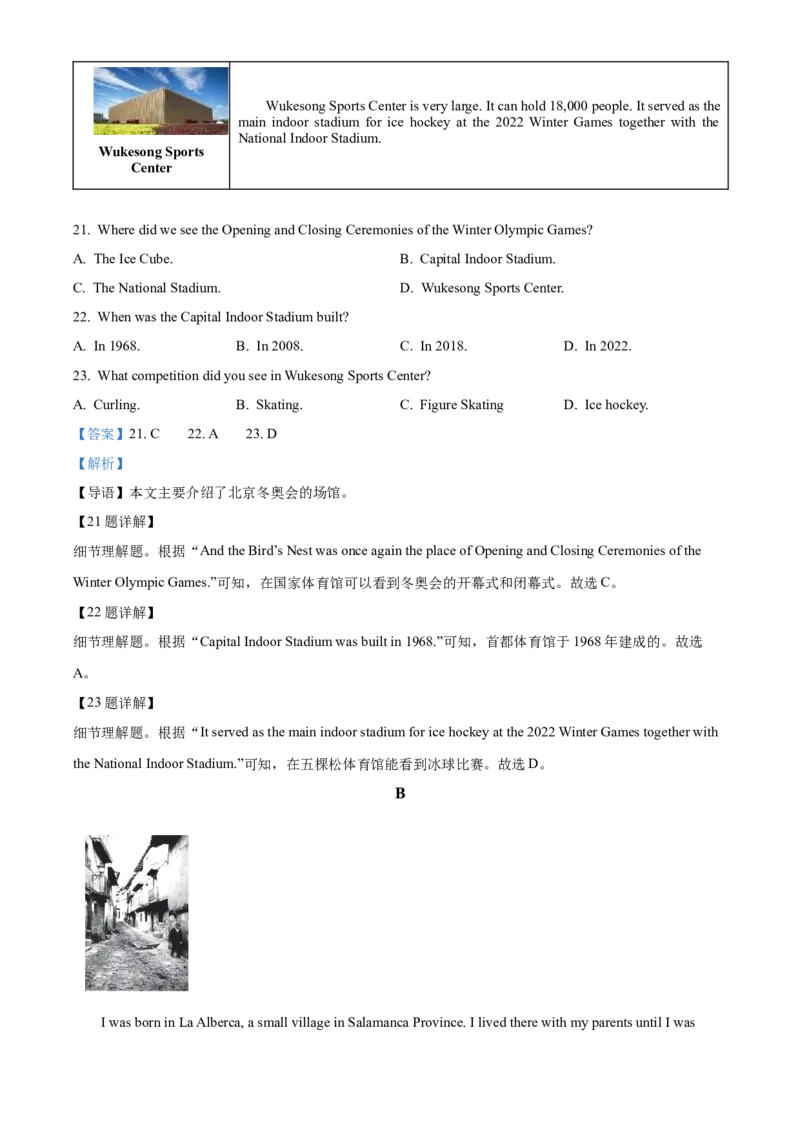
I was born in La Alberca, a small village in Salamanca Province. I lived there with my parents until I wasfourteen years old. I remember playing after school with my friends, who were my neighbors. We usually played in
the main square, and it was the place where everybody met. After playing for about two hours, my sister and I
always went home.
My sister is two years older than me and she always took care of me. We were very close friends and today we
are still very close. When we arrived home, we had to do our homework, and after dinner we went to bed.
I liked our house which was in the main square. It had four floors, and my family always lived on the third
floor. Even though the house was very big, my sister and I shared the same room. I loved to be with my sister in our
room because we could talk about things and share our “secrets” there.
I especially (尤其) remember the summer when my aunt, who is from Asturias, came to visit us.
She had two daughters, and they were the same age as my sister. The four of us spent most of our time
together playing in the main square. In the daytime, when it was hot, we went to the swimming pool. Other days,
we took a tour to the small villages near La Alberca.
I have good memories ( 回 忆 ) of my childhood and the nice times I shared with my friends in the village,
La Alberca.
24. How long did the writer live in La Alberca?
A. For 14 years. B. For 12 years. C. For 4 years. D. For 2 years.
25. Why did the writer and her sister share the same room?
A. Their house was very small. B. Her sister had to take care of her.
C. They enjoyed being together. D. The writer was afraid to be alone.
26. What did the girls do when their aunt visited them?
A. They helped do housework. B. They shared good memories.
C. They went swimming on clear days. D. They visited the villages near La Alberca.
27. Which of the following is true?
A. The writer’s family lived on the ground floor.
B. The writer played about two hours after school.
C. The writer was the same age as her aunt’s daughters.
D. The writer’s house was in the main square in Asturias.
【答案】24. A 25. C 26. D 27. B
【解析】
【分析】本文是一篇记叙文。文章描述了作者小时候住的地方,并且也分享了与姐姐、姑姑家的孩子在一
起玩耍的快乐时光。
【24题详解】细节理解题。根据首段“ I lived there with my parents until I was fourteen years old. ”可知,作者住在此处14
年。故选A。
【25题详解】
细节理解题。根据第三段“ I loved to be with my sister in our room because we could talk about things and
share our “secrets” there.”可知,姐妹俩在一起可以毫无顾忌地畅聊,所以很享受在一起的时间。故选C。
【26题详解】
细节理解题。根据第五段“ Other days, we took a tour to the small villages near La Alberca.”可知,她们一起
去参观了La Alberca附近的小村庄。故选D。
【27题详解】
推理判断题。根据首段“After playing for about two hours,”可知,放学后大约玩2小时。故选B。
C
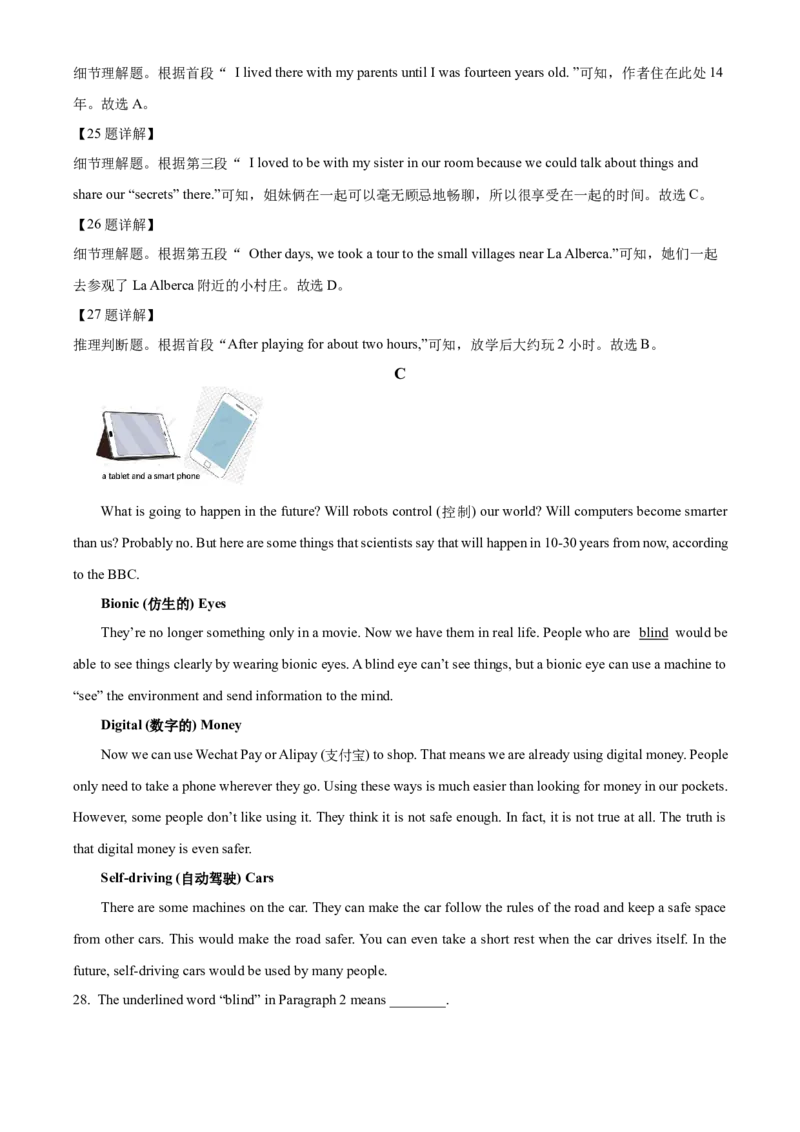
What is going to happen in the future? Will robots control (控制) our world? Will computers become smarter
than us? Probably no. But here are some things that scientists say that will happen in 10-30 years from now, according
to the BBC.
Bionic (仿生的) Eyes
They’re no longer something only in a movie. Now we have them in real life. People who are blind would be
able to see things clearly by wearing bionic eyes. A blind eye can’t see things, but a bionic eye can use a machine to
“see” the environment and send information to the mind.
Digital (数字的) Money
Now we can use Wechat Pay or Alipay (支付宝) to shop. That means we are already using digital money. People
only need to take a phone wherever they go. Using these ways is much easier than looking for money in our pockets.
However, some people don’t like using it. They think it is not safe enough. In fact, it is not true at all. The truth is
that digital money is even safer.
Self-driving (自动驾驶) Cars
There are some machines on the car. They can make the car follow the rules of the road and keep a safe space
from other cars. This would make the road safer. You can even take a short rest when the car drives itself. In the
future, self-driving cars would be used by many people.
28. The underlined word “blind” in Paragraph 2 means ________.A. 盲的 B. 积极的 C. 聪明的 D. 肥胖的
29. Which of the following is TRUE?
A. Bionic eyes can only appear in a film.
B. We can have a short rest when using self-driving cars.
.
C Self-driving cars don’t have to follow the traffic rules.
D. Everybody in the world likes using digital money.
30. What is the passage mainly about?
A. Some new things in the future. B. How to help the blind people see.
C. Self-driving cars in the future. D. The importance of phones.
【答案】28. A 29. B 30. A
【解析】
【导语】本文主要介绍了未来的一些新事物,比如仿生眼睛,数字货币和自动驾驶汽车。
【28题详解】
词句猜测题。根据“A blind eye can’t see things, but a bionic eye ...”可知,盲人的眼睛看不见东西;因此
“blind”表示“盲的”。故选A。
【29题详解】
细节理解题。根据“You can even take a short rest when the car drives itself. ”可知,当汽车自动驾驶时,你甚
至可以休息一会儿。故选B。
【30题详解】
主旨大意题。根据“But here are some things that scientists say that will happen in 10-30 years from now,
according to the BBC.”及全文可知,本文主要介绍了未来的一些新事物,故选A。
D
Have you ever been angry with your parents about putting away the iPad or turning off a video game? Most
families are having these fights. In 2018, Brigham Young University and Deseret News did their American Family
Survey(调查). It showed that the Number One worry for parents about teenagers was too much technology(科技).
If you’re in school now, you may not remember a time before there were smartphones and tablets everywhere.
The iPhone came out in 2007 and the iPad a few years later, in 2010. But screen(屏幕) time is nothing new. When
your parents were growing up, they watched as much television as you do now, or even more. They probablyplayed video games, too.
Mobile devices(设备) are different, though, because they can come with us everywhere we go: to the dinner
table, to restaurants into the car, into the bedroom when we’re going to sleep. They are always trying to make us
pick them up or keep using them. That’s part of what makes smartphones smart! But it also means that they always
stop us from having family time. And unlike with TV, which people often watch as a family, everyone—including
parents—is now distracted(分心) by his or her own little machine.
Studies show that too much screen time can cause problems. More than two hours a day of screen time raises
your risk of being overweight. Too much screen time at night stops you from getting healthy sleep. Children who
grow up with the most screen time (several hours a day) can have a hard time doing well in school. And many
families fight about screen time, which is no fun for anyone.
The solution is to talk about screen time. Make an agreement with your family about where, when, and how
you are going to use computers and other devices. No more than an hour day is suggested for children during the
school week. Parents, too, should put down their phones.
When you do use a device, remember to enjoy it with your family, perhaps by playing games or watching a
movie. The American Academy of Pediatrics says it’s the best way for children to grow up healthy in our digital
world.
31. According to the survey, what do teenagers’ parents worry most?
A. Teenagers do badly at school.
B. Teenagers have fights with classmates.
C. Teenagers have risks of being overweight.
D. Teenagers spend too much time in front of screens.
32. The writer compares mobile devices with televisions to explain ________.
A. why parents prefer watching TV
B. why mobile devices lead to less family time
C. why smartphones are smarter than televisions
D. why mobile devices can cause health problems
33. What is the writer’s purpose in writing the passage?
A. To give parents advice on using smartphones.
B. To introduce the development of new technology.
C. To tell children how to use mobile devices in a right way.
D. To ask children to spend less time playing computer games.
【答案】31. D 32. B 33. C【解析】
【分析】本文主要介绍了当今的社会现象,那就是青少年太依赖智能手机,本文着重介绍了这对青少年的
危害,并提出建议如何减少屏幕时间。
【31题详解】
细节理解题。根据“It showed that the Number One worry for parents about teenagers was too much technology”
可知,家长担心青少年花太多时间在屏幕前,故选D。
【
32题详解】
细节理解题。根据“And unlike with TV, which people often watch as a family, everyone—including parents—is
now distracted(分心) by his or her own little machine”可知,租着拿电视和移动设备相比较,是为了说明移动
设备导致家人在一起的时间少了,故选B。
【33题详解】
推理判断题。本文通过描述当今青少年太依赖智能手机的这个社会现象,并介绍了它对青少年的危害,来
告诉孩子们要正确地使用移动设备,故选C。
四、阅读与表达(共10分,每小题2分)
The Rules of British Roads
British roads are some of the safest in the world. A study in 2018 compared more than 30 countries and found
that 3.8 out of 100,000 died in traffic accidents in the UK.
This number was lower than any other country. So, what did British drivers do to achieve this? What are they
doing differently? Here are some pieces of advice for drivers who are planning a trip to the UK.
◆People in Britain drive on the left side of the road. In fact, a long time ago people drove on the left in most
countries, but now only a few countries have this. Don't forget that this also means you must drive the other way
around roundabouts (环岛).
◆British people feel that waiting should be fair for everybody. If you are in a line of traffic, then don't try to
push past the cars in front of yours. This is called "jumping the line". You must wait for your turn; or people may
get angry with you.
◆You must stop at the traffic lights when they are red. In many countries, it is OK to go past the red lights if
you are turning a corner or if there isn't any other traffic around. In the UK you could have a lot of trouble if you do
this.
◆If another driver flashes (闪烁) his car's lights at you, he is probably trying to tell you that he will wait for
you to go first. British people don't like to use their car horn (喇叭) much because they think people who do so are
rude.◆If you get in an accident, don't try to pay the police. The police in the UK never take money, and if you try to
offer them some, you could end your holiday visiting British prison(监狱).
34. How many pieces of advice are mentioned in the passage?
____________________
35. Which side do British people drive on?
____________________
36. If a driver jump the line, how will other drivers feel?
____________________
37. Why don't British people like to use their car horn much?
____________________
38. What's the main idea of the last paragraph?
____________________
【答案】34. Five.
35. On the left side of the road.
36. They will get angry with the driver/him/her.
37. Because they think people who do so are rude.
38. If you get in an accident, don't try to pay the police.
【解析】
【分析】本文介绍了英国的交通规则。
【34题详解】
People in Britain drive on the left side of the road“英国人在马路的左边开车”,British people feel that waiting
should be fair for everybody“英国人感觉等待对每个人都是公平的”,You must stop at the traffic lights when
they are red“当交通灯是红色时,你必须停下来”,If another driver flashes his car's lights at you, he is
probably trying to tell you that he will wait for you to go first“如果另一个司机向你闪车灯,他可能想要告诉
你他要等你先走”,If you get in an accident, don't try to pay the police“如果你遇到了交通事故,不要试图付
钱给警察”,由此可知,本文一共提到了5条建议。故答案为:Five.
【35题详解】
根据People in Britain drive on the left side of the road,可知,英国人在马路的左边开车。故答案为:On the
left side of the road.
【36题详解】
根据You must wait for your turn; or people may get angry with you“你必须按顺序排队,否则人们会生你的
气”,可知,如果一个司机插队,其他的司机会生这个司机的气。故答案为:They will get angry with thedriver/him/her.
【37题详解】
根据British people don't like to use their car horn (喇叭) much because they think people who do so are rude,可
知,英国人不喜欢用他们的车喇叭,因为他们认为用这个的人很粗鲁。故答案为:Because they think
people who do so are rude.
【38题详解】
根据If you get in an accident, don't try to pay the police,可知,最后一段主要讲述的是,如果你遇上了交通
事故,不要试图付钱给警察。故答案为:If you get in an accident, don't try to pay the police.
书面表达(共10分)
五、文段表达 (共10分)
39. 根据中文和英文提示,完成一篇不少于50词的文段写作。文中已给出内容不计入总词数。所给提示词
语仅供选用。请不要写出你的校名和姓名。
端午假期 Dragon Boat Festival 就要到了。你的英国笔友 Tony 对中国传统文化很感兴趣,想了解一下
你的端午假期安排,请你给他写一封信,介绍一下你的端午活动计划。
提示词语:Chaoyang Park, fly a kite, have a picnic, visit grandparents, eat Zongzi, watch dragon boat races
提示问题:
● Where are you going?
● Who are you going with?
● What are you going to do there?
Dear Tony,
I’m so glad to talk about my plan for the Dragon Boat Festival.
____________________________________________________________________________________________
____________________________________________________________________________________________
____________________________________________________________________________________________
____________________________________________________________________________________________
_________
I’m looking forward to your letter.
Yours,
Li Hua
【答案】例文:
Dear Tony,
I’m so glad to talk about my plan for the Dragon Boat Festival. It is one of the Chinese traditional festivals which
has about two thousand years of history. The festival is celebrated to honor the great poet Qu Yuan. On that day,people often get together with their family to eat Zongzi and other delicious food. I also have a 3-day holiday during
the festival. So I’m going to visit Beijing with my parents. We will climb the Great Wall and visit the Forbidden City.
We’ll also try Beijing Roast Duck. Then I will visit my grandparents. We will fly a kite and watch dragon boat races.
How interesting the Dragon Boat Festival is and I like it very much.
I’m looking forward to your letter.
Yours,
Li Hua
【解析】
【详解】[总体分析]
①题材:本文是一篇记叙文,为书信作文;
②时态:时态为“一般现在时和一般将来时”;
③提示:根据所给提示完成写作,不能遗漏信息,以第一人称为主。
[写作步骤]
第一步,介绍端午节的起源和习俗;
第二步,介绍自己端午节的计划。
[亮点词汇]
①one of ……之一
②on TV在电视上
[高分句型]
①It is one of the Chinese traditional festivals which has about two thousand years of history. (which引导定语从
句)
②How interesting the Dragon Boat Festival is and I like it very much. (how引导感叹句)
40. 题目②
假如你是红星中学七年级李华,新学期伊始,你们班竞选(run for)班长,很多同学跃跃欲试,你也想参
加竞选。请根据下面的提示及要求写一篇英文发言稿参与竞选。
提示词语: helper(助手), support(支持), try one’s best to do…
提示问题: ● What are your advantages?
● What are your hobbies?
● Why would you like to be the class monitor?
● How can you be a good class monitor?
,
Dear teachers and classmates
My name is Li Hua. I’m glad to stand here running for the class monitor.
________________________________________________________________________________________________________________________________________________________________________________________
____________________________________________________________________________________________
____________________________________________________________________________________________
____________________________________________________________________________________________
______
【答案】例文:
Dear teachers and classmates,
My name is Li Hua. I’m glad to stand here running for the class monitor.
I’m a friendly boy and I get on well with everyone in our class. I’m also a good helper to teachers and I study
hard and do well in all subjects. I’m kind and I’m always ready to help others. I usually offer to help others. When I
am free, I like doing sports and playing the piano. I’m a member of our Dance Club. I want to do something for our
class, so I hope you can support me. To be a good monitor, I will try my best to help you with your study and life.
Please choose me! Thanks a lot!
【解析】
【详解】[总体分析]
①题材:本文是一篇应用文;
②时态:时态为“一般现在时和一般将来时”;
③提示:根据所给提示完成写作,不能遗漏信息,以第一人称为主。
[写作步骤]
第一步,介绍自己的名字,引出自己想竞选班长;
第二步,介绍自己的优点、爱好、竞选班长的原因以及如何做。
[亮点词汇]
①get on well with sb与某人相处融洽
②do well in擅长
③play the piano弹钢琴
④try one’s best to do sth.尽某人最大努力做某事
⑤help sb with sth.在某方面帮助某人
[高分句型]
①I want to do something for our class, so I hope you can support me. (so连接的并列句)
②When I am free, I like doing sports and playing the piano. (When引导时间状语从句)