Unit 5 Farm s an d u s
题目:
教学内容: Part A What farm animals do you know?
Let’s talk, Ask and answer
教学目标:
1.能够听懂、会说、认读、会写句式:What animals do you have on the farm? I
have a lot of animals. How many cows so you have? I have 20. (学习理解)
2. 能够听懂、会说、会写单词:cow、horse、sheep、pig、chicken (学习理
解)
3. 能够理解并能正确认读课文对话,发音准确,语调自然。 (应用实践)
4. 能够在真实的语境中运用本课的句型来交流农场上有哪些动物、动物的数量
是多少。 (迁移创新)
教学重难点:
1.重点:
能够听懂、会说、认读句式:What animals do you have on the farm? I have a lot
of animals. How many cows so you have? I have 20.
能够理解并能正确认读课文对话,发音准确,语调自然。
2. 难点:
能够在真实的语境中运用本课的句型来交流在农场上看到的动物。
多媒体课件
课时安排 第一课时 教学准备
教学设计 复备
Step 1 Warm up
1.Listen and chant.
播放单元页的chant, 学生齐唱韵句。引入主题:farm animals
Step 2 Lead in
1. 展示一些动物的图片,请学生想一想,哪些动物我们只能
在动物园里看到,哪些动物我们能在农场上看到。
Teacher: Look at these animals. Where can you see them?
Teacher: What animals can you see in the zoo? What animals
can you see on the farm?Step 3 Presentation
1. 展示教材中的图片,先谈论图片,再播放课文内容视频。
学生认真倾听对话内容,回答问题。
Teacher:Look!Where is Mike?What animals can he see
there?
Teacher: Now watch the video to find the answer.
2. 讨论对话内容,展示重点词汇及重点句式。
Teacher: Mike is on a farm. He can see many animals.
What animals does the farmer have on the farm?
Ss: Cows, horses, sheep, pigs and chickens.
Teacher: Can Mike see some cows on the farm?
Ss: Yes, he can.
Teacher: How many cows does the farmer have?
Ss: He has 20.
Teacher: What can the cows give us?
Ss: They can give us milk.
3. 讲解句型:What animals do you have on the farm?
重点讲解单词:sheep(单复数同形)
Step 4 Practice
1. 播放课文内容,学生跟读,注意发音、语调。
Teacher:Now read the dialogue with the tape. Please read it
carefully and loudly. Pay attention to the pronunciation.
2. 自由读对话内容,分角色表演课文。
Teacher:Read the dialogue freely. Then I will ask you to act it
out. Let’s find the best group.
3.Think and say.
两人操练对话:—What animals do you have on the farm?
—I have...
—How many...do you have?
—I have...
Step 5 Summary学习、齐唱韵句,总结本课主要内容。
板书设计
Unit 5 Farms and us
Part A What farm animals do you know?
Let’s talk, Ask and answer
—What animals do you have on the farm? —I have...
—How many...do you have? —I have...
课堂作业新设计
一、 连词成句。
1. farm, animals, you, What, have, do, the, on ?
2. have, many, pigs, How, you, do ?
3. of, chickens, a, I, have, lot .
4. things, us, Farm, many, give, animals .
教学反思Unit 5 Farm s an d u s
题目:
教学内容: Part A What farm animals do you know?
Let’s learn, Read and guess
教学目标:
1. 能够听懂、会说、认读、会写单词 cows、horses、sheep、pigs、chickens
(学习理解)
2. 能够听懂、会说、认读句式:There are+动物名词的复数形式... (学习理
解)
3. 能够理解并能正确认读动物单词,并用简单的句子形容动物的特点。 (应
用实践)
4. 能够在真实的语境中运用本课的句型来描述动物。 (迁移创新)
教学重难点:
1.重点:
能够听懂、会说、认读、会写农场动物单词的复数形式
能够根据对动物特征的描述猜测出动物的名称。
2. 难点:
能够在真实的语境中运用本课的句型来描述动物。
多媒体课件
课时安排 第二课时 教学准备
教学设计 复备
Step 1 Warm up
1. Sing a song:On the farm. 播放单元页歌曲,学生跟唱。
Step 2 Lead in
1.出示课本主图,请学生看看图片中都有什么?
Teacher: Look at this picture. What animals can you see on
the farm?
2.联系生活,对话引起学生兴趣。
Step 3 Presentation
1. 展示教材中的图片,播放课文内容,学生认真倾听,回答问题。
Teacher: Sarah is on a farm. What can she see?
Teacher: Now listen to the tape to find the answer.
2. 讨论对话内容,展示重点词汇及重点句式。
Teacher: There are many animals on the farm.(展示羊的图
片)What are these?讲解They’re sheep. What about those black
and white ones? (展示奶牛的图片) Say with me, cows.
What are those? Are they also cows?( 展示马的图片) No.
They’re horses. Look. They can give use eggs. What are they?
( 展 示 鸡 的 照 片 ) They’re chickens. Look at those animals.
They’re very fat.(展示一个轮船的图片)They are pigs. Read
after me, pigs.
Teacher: We can say: There are sheep, cows, horses,
chickens and pigs on the farm.
Step 4 Practice
1. 播放课文内容,学生跟读,注意发音、语调。
Teacher :Now read the words with the tape. Please read it
carefully and loudly. Pay attention to the pronunciation.
2. 游戏:Read and guess. 读一读,猜一猜,“我”是谁。
Teacher: Now, let’s play a game: What am I?
I like to run fast. I am fun to ride. What am I? →horse
I can make milk. I am black and white. What am I? →cow
I can lay eggs. I am a bird, but I don’t fly well. What am I?
→chicken
I like the mud. I have a big nose and small eyes. What am I?
→pig
My coat can keep you warm. I am woolly and white. What am
I? →sheep
Step 5 Summary
学习、齐唱韵句,总结本课主要内容。
板书设计
Unit 5 Farms and us
Part A What farm animals do you know?Let’s learn, Read and guess
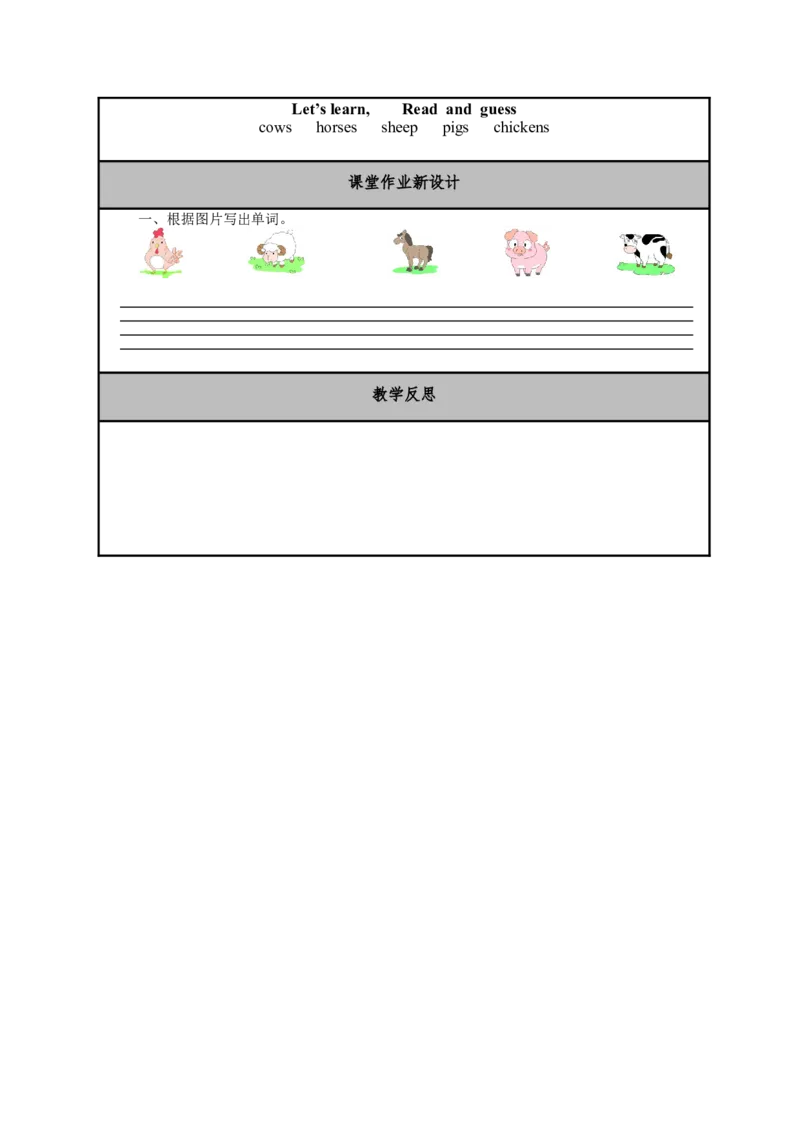
cows horses sheep pigs chickens
课堂作业新设计
一、根据图片写出单词。
教学反思Unit 5 Farm s an d u s
题目:
教学内容: Part A What farm animals do you know?
Let’s spell
教学目标:
1. 掌握air在单词中的发音规则。 (学习理解)
2. 能够根据air的发音规则拼写单词。 (应用实践)
3. 培养学生对语音知识的学习兴趣。 (迁移创新)
教学重难点:
重点:掌握air在单词中的发音规则。
难点:自主拼读和书写符合规律的单词,阅读含有air单词的句子及小短文。
多媒体课件
课时安排 第三课时 教学准备
教学设计 复备
Step 1 Warm-up & Revision
Let’s chant
ar, ar, /ɑː/, /ɑː/, /ɑː/. Farm, arm, and card.
er, er, /ə/, /ə/, /ə/. Brother, sister, father and mother.
or, or, /ɔ:/, /ɔ:/, /ɔ:/. Fork, short and a horse.
or, or, /ɜː/, /ɜː/, /ɜː/. Work, word, and the world.
ir, ir, /ɜː/, /ɜː/, /ɜː/. Bird, girl, skirt and shirt.
ur, ur, /ɜː/, /ɜː/, /ɜː/. Turn, hurt and a nurse.
Revision
(1)课件动画出示不同单词,学生大声说出看到的单词,复
习含有字母组合ar, er, or, ir, ur的单词的发音。
(2)Let’s read.
教师利用课件呈现单词chair的图片,让学生根据已学的单词
感知字母组合air的发音规律。
Step 2 Presentation & Practice
1. 归纳总结air在单词中的发音规律。
(1)教师出示Let’s spell部分的图片,让学生尝试描述在图片
中看到的场景和图片内容。如:The boy is on a farm He wears
a pair of black trousers. There is a small chair in the picture.
等。
(2)启发同学们感知pair和chair的发音。2. Practice. 学生两人一组,使用单词pair和chair进行造句。
3. Let’s chant.
(1)播放Listen, repeat and chant歌谣朗读部分的录音,学生
仔细听,并找出带有air字母组合的单词。
(2)教师出示Listen, repeat and chant的文本内容,学生跟着
录音朗读。
(3)Read and chant.
学生先朗读chant部分,随后跟唱,最后在只有伴奏下唱歌
谣。
4. Read, listen and number.
教师播放录音,学生听音给所听到的单词排序。
Step 3 Consolidation&Extension
1. Look, listen and write.
教师出示Look, listen and write部分的图片并播放录音,学生
根据所听内容写单词补全句子。
2.游戏:I Say You Spell
教师随机说出单词(如fair,pair,hair等),学生拼读并写在
纸上,邀请一名学生上台来写出答案,其他同学判断是否正确。
Step 4 Summary&Homework
1. Summary.
air /eə/: fair hair chair air ...
2. Homework.
(1)熟读本课时单词,体会发音规律。
(2)完成本课时配套练习。
板书设计
Unit 5 Farms and us
Part A What farm animals do you know?
Let’s spell
air /eə/: fair hair chair air课堂作业新设计
一、判断句中画线部分的发音是(√)否(×)相同。
( )1. Tom has fair hair.
( )2.The girl sits on a chair.
( )3. The air is clean, and I hear birds singing.
( )4. Look at that farmer. He buys a pair of shoes.
教学反思Unit 5 Farm s an d u s
题目:
教学内容: Part B What can we learn on a farm?
Let’s talk, Play a guessing game
教学目标:
1. 能够听懂、会说、认读 、会写句式:What are these/those? They’re
tomatoes/... (学习理解)
2. 能够听懂、会说单词:tomato, bee (学习理解)
3. 能够在真实或模拟的情景中正确使用句型What are these/those? They’re... 来
询问和回答近处/远处的多个事物是什么。 (应用实践)
4.能够理解并能正确认读课文对话,发音准确,语调自然。 (应用实践)
5.能够在真实的语境中运用本课的句型来询问和回答某些事物是什么,并简单描
述事物的颜色、形状等特征。 (迁移创新)
教学重难点:
1.重点:
能够听懂、会说、认读句式What are these/those? They’re...
能够理解并能正确认读课文对话,发音准确,语调自然。
2. 难点:
能够在真实的语境中运用本课的句型来询问和回答某些事物是什么,并简单描述事
物的颜色、形状等特征。
多媒体课件
课时安排 第四课时 教学准备
教学设计 复备
Step 1 Warm up
1. 农场小游戏。在教室一角布置一个小型农场,放置一些农
场动物和水果模型。让学生们说出这些模型的英语单词并将这些
模型分别放置在农场中的牧场区和果园区。
Step 2 Lead in
1. 将同学们的视线聚焦到农场中的蔬菜区,蔬菜区里有蔬
菜模型:红色的西红柿和黄色的西红柿,让同学们一起学习这种
蔬菜tomato。
2. 将同学们的视线再聚焦到农场中的牧场区,远处是一些
小动物,它们很忙碌,在采花蜜,让同学们一起学习这种动物
bee。
3. 讲解tomato的复数变化形式:词尾加-es。Step 3 Presentation
1. 教师指着微型农场中的一些事物,并进行询问,引导学生
来回答。
Teacher: —What are these? —They’re tomatoes. (板书句
子)
—What are those? —They’re bees.
2.播放教材对话录音,学生认真倾听,寻找答案。
Teacher:Mike is on the farm. Try to answer, what can he
see on the farm?
Teacher: Now, who can answer my question? Yes, he can see
some tomatoes and bee boxes.
Step 4 Practice
1.播放课文录音。学生跟读课文。
Teacher: Boys and girls, let’s read the dialogue after the tape.
Please listen carefully, and read carefully.
2. 自由读课文,针对对话内容进行交流。
3. 分角色朗读课文。
Teacher: Let’s read the dialogue in roles. Who wants to be Mike?
Who wants to be the farmer? Let’s find the best pair.
4. 两人小组活动,从微型农场中选择一些动物或农作物模
型,进行对话练习。
Teacher:Let’s do a pair work. Please ask and answer in pairs.
You can use the sentences structures on the blackboard.
Teacher:Which pair wants to show your dialogues?
5. Play a guessing game.
(1)老师在不同位置展示一些水果的切片或剪影图片,一位
同学根据物品的远近询问“What are these?”或“What are
those?”,其他同学举手抢答。
(2)三位同学一起通过动作或叫声模仿某种动物,老师询问
“What are these?”或“What are those?”,其他同学举手抢
答。
Step 5 Summary
TPR 活动,What are these/those? 学生回答教师的问题,同
时模仿动物的叫声或动作、描述事物(水果或蔬菜)的颜色或形
状。板书设计
Unit 5 Farms and us
Part B What can we learn on a farm?
Let’s talk, Play a guessing game
—What are these? —They’re tomatoes.
课堂作业新设计
一、仿照例子,根据图片说一说。
例:What are those?They’re horses. They’re tall and strong.
1. 2.
教学反思Unit 5 Farm s an d u s
题目:
教学内容: Part B What can we learn on a farm?
Let’s learn, Listen and do
教学目标:
1. 能够听懂、会说、认读、会写以下单词的复数形式:tomatoes、carrots、
potatoes (学习理解)
2. 能够在真实或虚拟的情景中用句型They’re...描述蔬菜的特征。 (应用实
践)
3. 能够描述自己喜欢的蔬菜以及蔬菜的形状等特征。 (迁移创新)
教学重难点:
1.重点:
能够听懂、会说、认读、会写单词:tomatoes、carrots、potatoes。
能够听懂、会说、认读单词:mouse(复数形式mice)
2. 难点:
能够说明自己喜欢的蔬菜并描述蔬菜的颜色、形状的特征。
多媒体课件
课时安排 第五课时 教学准备
教学设计 复备
Step 1 Warm up
1. 农场大冒险”游戏,在教室地面贴上不同农场元素的图片,
如“tomato”“cow”等,让学生听指令跳到相应的图片上并说出单词的
复数形式。
Step 2 Lead in
1. 教师描述几种蔬菜的特征,学生选出对应的蔬菜单词卡片。
如教师说“They’re red and round. We can make ketchup with
them.”学生回答“tomatoes”(板书单词)。然后引出新单词
“potatoes”和“carrots”。
Teacher: Look at these vegetables. They’re big and round.
They’re brown. We can make chips with them. What are they?
They’re potatoes. Read after me, potatoes.(板书单词)
Teacher: Look at these vegetables. They’re long and thin.
They’re orange. They’re good for us. What are they? They’re
carrots. Read after me, carrots.(板书单词)
2. 讲解单词tomato和potato变复数形式的规律Step 3 Presentation
1. 播放课文录音,回答问题。
Teacher:What animal does Mike see? Let’s listen to the tape
and find.
2. 播放课文录音,学生跟读。
Teacher:Listen to the tape again. Read with it this time.
3. 展示一张各种蔬菜的图片,请学生尝试描述其他的蔬菜。
Teacher: Look at the picture. What do you see? You can ask your
partner some questions and describe the things you see. For example:
What are these/those? They’re big and red.
Step 4 Practice
1. 以游戏操练单词。
(1)单词归归类。
教师列出下列单词,让学生们归类。
tomatoes carrots mice cucumbers
potatoes green peas green beans bees
Long vegetables: Round vegetables: Small animals:
2. Listen and chant. 播放韵文录音,学生边听边说。
Step 5 Summary
学习并自编、诵读韵句,结束课程。
板书设计
Unit 5 Farms and us
Part B What can we learn on a farm?
Let’s learn, Listen and do
tomatoes potatoes carrots
课堂作业新设计
一、看图,写出图片中的蔬菜单词的复数形式。1. 2. 3.
教学反思Unit 5 Farm s an d u s
题目:
教学内容: Part B Read and write
Part C Project: Make a “farm-to-table” flow chart, Reading time
教学目标:
1.学生能在图片的帮助下读懂文本,理解核心句型。并能够按照正确的意群朗读语
篇,学生在看、听、说的活动中了解农场上出产的各种农场品。 (学习理解)
2.学生能够利用核心句型询问和回答农场上的事物,描述农场上的事物。学生在教师
的帮助下,朗读故事。 (应用实践)
3.了解农场上的动植物能够给我们提供哪些农产品,能描述食物的来源并说明食物从
农场到餐桌的过程。 (迁移创新)
教学重难点:
学生能在图片的帮助下读懂文本,理解核心句型。并能够按照正确的意群朗读语
篇,学生在看、听、说的活动中了解农场上出产的各种农场品。
学生能够利用核心句型询问和回答农场上的事物,描述农场上的事物。学生在教
师的帮助下,朗读故事。
多媒体课件
课时安排 第六课时 教学准备
教学设计 复备
Step 1 Warm up
1. 课前热身 。Look and say. 展示真实的农作物或农场动物
的图片,让学生们两人一组进行问答。
2. 展示Mr Wang的农场图片,学生写出农场上的各种动物和
蔬菜。
Step 2 Presentation & Practice
Read and write
1. Read and circle.
Teacher: Mr Wang has a big farm. What animals and
vegetables can you see on the farm? Please read and circle.
出示教材中的文本内容和图片,学生阅读后圈出相应的蔬菜和
动物单词。
2.Look, draw and write.
(1)教师引导学生仔细观察该部分的图片,找出图中出现的动物和蔬菜。然后根据例句,写出合适的句子描述图片。教师提
醒学生注意指示代词these和those的使用以及名词的复数形式。
师生一起核对答案。
(2)假设一个场景,学校将要建设校园农场,请同学们各自
选择一种自己想在校园农场中养殖的动物和种植的蔬菜,画出它
们,并写出句子描述它们的名称和特征。例如:These are
carrots. They’re long. Those are cows. They’re black and white.
C Project
1.通过课本图片,回顾本单元学过的农场动植物名称。听录音,
完成第一题。
2.思考并讨论图片中食物的来源,将图片与单词连线。观察图
片,完成第二题。
3. 写单词完成“农场到餐桌”流程图,完成第三题。
4. 与同桌分享你制作的流程图并描述我们能从农场上获得哪些农
产品。
Step 3 Consolidation&Extension
Reading time
1. 出示该部分的图片。教师介绍故事背景:We have to eat
something every day. They give us some energy to have fun and
to study. But what can give us energy?
2.教师让学生认真观察图片,找出能为我们提供能量的事
物。
3. 看一看图中这些提供能量的事物来自什么地方?引出它们
中的许多来自农场。并介绍各种各样的农场。
4.Read and say.教师播放该部分的音频,学生跟读。
Step 4 Summary&Homework
1. Summary.
(1)复习本单元所学的词汇。
(2)复习如何询问和回答近处或远处的复数事物是什么。
2.Homework.
(1)制作单词卡片。在卡片上写单词及相应的汉语意思。家
长任意抽选卡片,家长报汉语意思,学生说出单词。
(2)完成本课时配套练习。
板书设计Unit 5 Farms and us
Part B Start to read
Part C Project: Make a “farm-to-table” flow chart, Reading time
We need farms.
A lot of our food is from farms.
课堂作业新设计
一、选出下列各组中不同类的一项。
( )1. A. carrot B. cow C. chicken
( )2. A. can B. box C. mice
( )3. A. horse B. potato C. cucumber
( )4. A. bee B. pig C. tomato
( )5. A. green beans B. green peas C. bee boxes
教学反思