文档文本内容
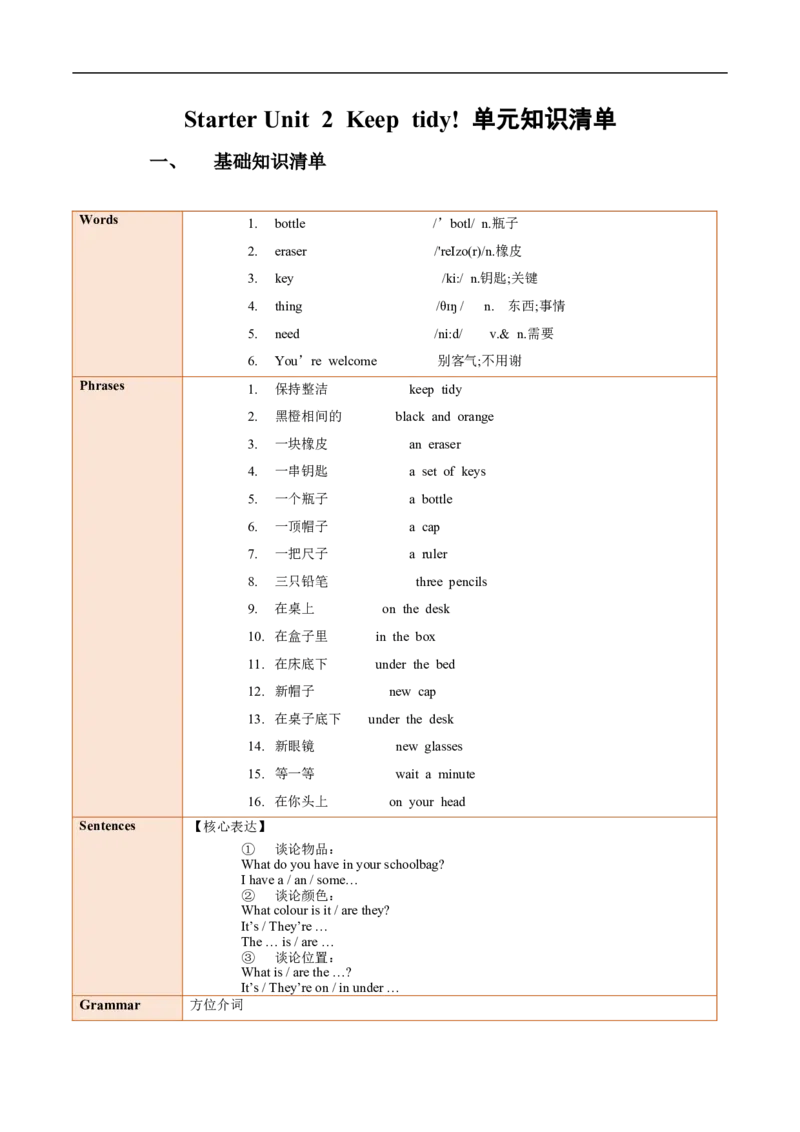
Starter Unit 2 Keep tidy! 单元知识清单
一、 基础知识清单
Words 1. bottle /’botl/ n.瓶子
2. eraser /'reIzo(r)/n.橡皮
3. key /ki:/ n.钥匙;关键
4. thing /θɪŋ / n. 东西;事情
5. need /ni:d/ v.& n.需要
6. You’re welcome 别客气;不用谢
Phrases 1. 保持整洁 keep tidy
2. 黑橙相间的 black and orange
3. 一块橡皮 an eraser
4. 一串钥匙 a set of keys
5. 一个瓶子 a bottle
6. 一顶帽子 a cap
7. 一把尺子 a ruler
8. 三只铅笔 three pencils
9. 在桌上 on the desk
10. 在盒子里 in the box
11. 在床底下 under the bed
12. 新帽子 new cap
13. 在桌子底下 under the desk
14. 新眼镜 new glasses
15. 等一等 wait a minute
16. 在你头上 on your head
Sentences 【核心表达】
① 谈论物品:
What do you have in your schoolbag?
I have a / an / some…
② 谈论颜色:
What colour is it / are they?
It’s / They’re …
The … is / are …
③ 谈论位置:
What is / are the …?
It’s / They’re on / in under …
Grammar 方位介词Writing 描述房间
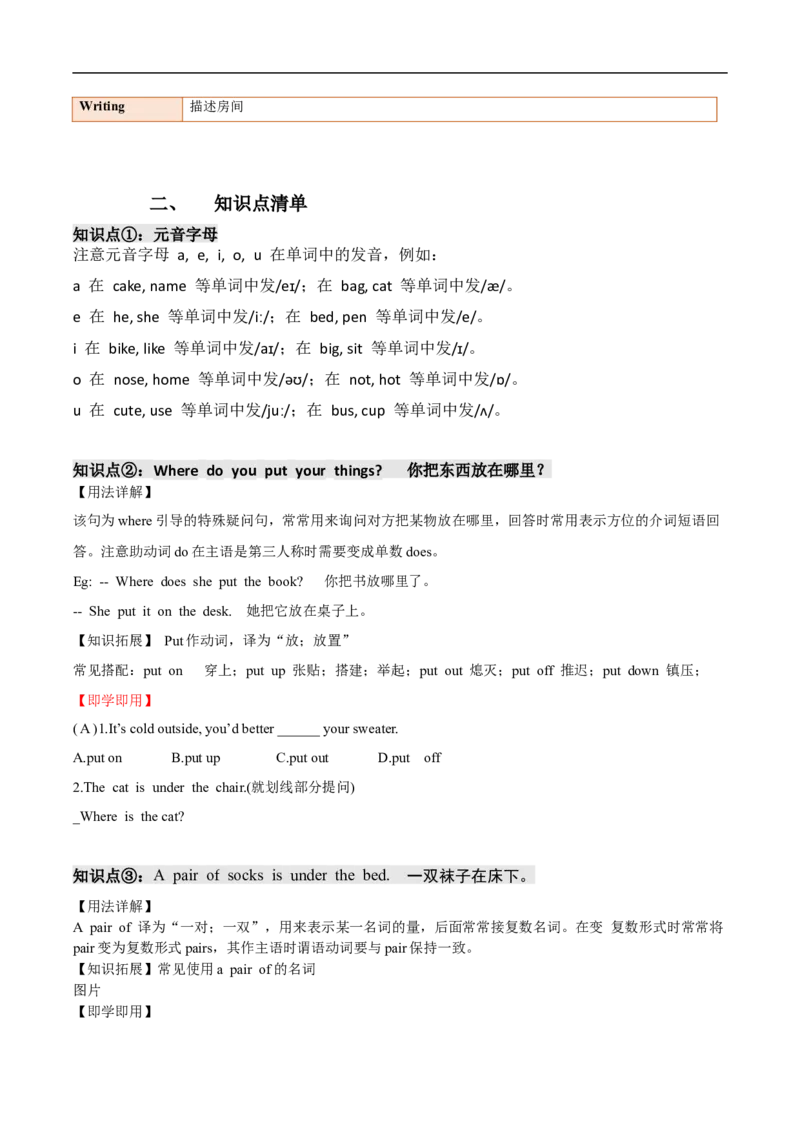
二、 知识点清单
知识点①:元音字母
注意元音字母 a, e, i, o, u 在单词中的发音,例如:
a 在 cake, name 等单词中发/eɪ/;在 bag, cat 等单词中发/æ/。
e 在 he, she 等单词中发/iː/;在 bed, pen 等单词中发/e/。
i 在 bike, like 等单词中发/aɪ/;在 big, sit 等单词中发/ɪ/。
o 在 nose, home 等单词中发/əʊ/;在 not, hot 等单词中发/ɒ/。
u 在 cute, use 等单词中发/juː/;在 bus, cup 等单词中发/ʌ/。
知识点②:Where do you put your things? 你把东西放在哪里?
【用法详解】
该句为where引导的特殊疑问句,常常用来询问对方把某物放在哪里,回答时常用表示方位的介词短语回
答。注意助动词do在主语是第三人称时需要变成单数does。
Eg: -- Where does she put the book? 你把书放哪里了。
-- She put it on the desk. 她把它放在桌子上。
【知识拓展】 Put作动词,译为“放;放置”
常见搭配:put on 穿上;put up 张贴;搭建;举起;put out 熄灭;put off 推迟;put down 镇压;
【即学即用】
( A )1.It’s cold outside, you’d better ______ your sweater.
A.put on B.put up C.put out D.put off
2.The cat is under the chair.(就划线部分提问)
_Where is the cat?
知识点③:A pair of socks is under the bed. 一双袜子在床下。
【用法详解】
A pair of 译为“一对;一双”,用来表示某一名词的量,后面常常接复数名词。在变 复数形式时常常将
pair变为复数形式pairs,其作主语时谓语动词要与pair保持一致。
【知识拓展】常见使用a pair of的名词
图片
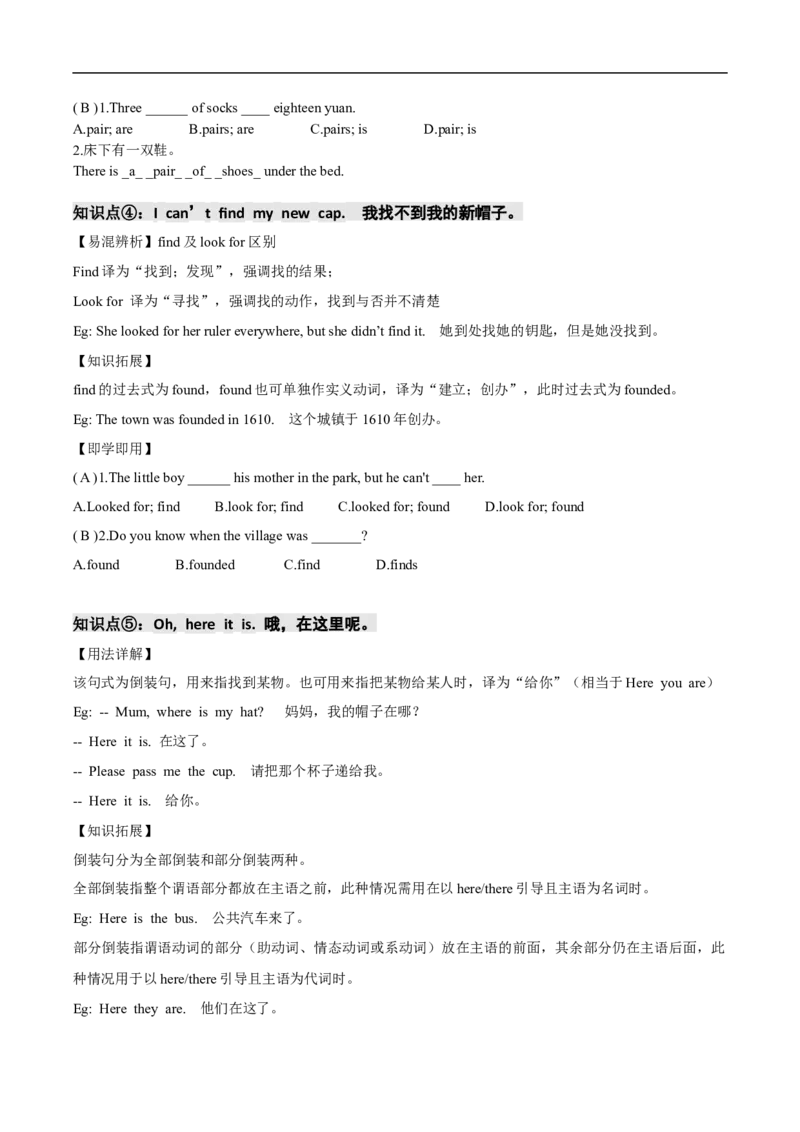
【即学即用】( B )1.Three ______ of socks ____ eighteen yuan.
A.pair; are B.pairs; are C.pairs; is D.pair; is
2.床下有一双鞋。
There is _a_ _pair_ _of_ _shoes_ under the bed.
知识点④:I can’t find my new cap. 我找不到我的新帽子。
【易混辨析】find及look for区别
Find译为“找到;发现”,强调找的结果;
Look for 译为“寻找”,强调找的动作,找到与否并不清楚
Eg: She looked for her ruler everywhere, but she didn’t find it. 她到处找她的钥匙,但是她没找到。
【知识拓展】
find的过去式为found,found也可单独作实义动词,译为“建立;创办”,此时过去式为founded。
Eg: The town was founded in 1610. 这个城镇于1610年创办。
【即学即用】
( A )1.The little boy ______ his mother in the park, but he can't ____ her.
A.Looked for; find B.look for; find C.looked for; found D.look for; found
( B )2.Do you know when the village was _______?
A.found B.founded C.find D.finds
知识点⑤:Oh, here it is. 哦,在这里呢。
【用法详解】
该句式为倒装句,用来指找到某物。也可用来指把某物给某人时,译为“给你”(相当于Here you are)
Eg: -- Mum, where is my hat? 妈妈,我的帽子在哪?
-- Here it is. 在这了。
-- Please pass me the cup. 请把那个杯子递给我。
-- Here it is. 给你。
【知识拓展】
倒装句分为全部倒装和部分倒装两种。
全部倒装指整个谓语部分都放在主语之前,此种情况需用在以here/there引导且主语为名词时。
Eg: Here is the bus. 公共汽车来了。
部分倒装指谓语动词的部分(助动词、情态动词或系动词)放在主语的前面,其余部分仍在主语后面,此
种情况用于以here/there引导且主语为代词时。
Eg: Here they are. 他们在这了。【即学即用】
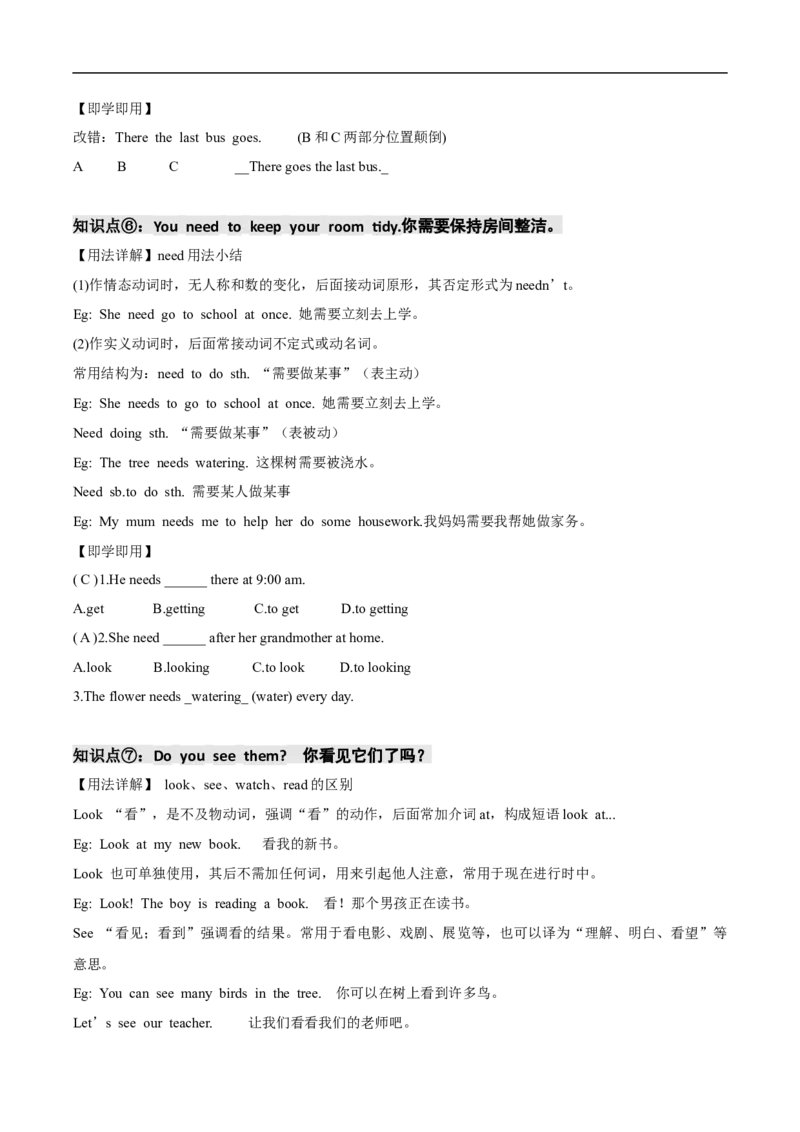
改错:There the last bus goes. (B和C两部分位置颠倒)
A B C __There goes the last bus._
知识点⑥:You need to keep your room tidy.你需要保持房间整洁。
【用法详解】need用法小结
(1)作情态动词时,无人称和数的变化,后面接动词原形,其否定形式为needn’t。
Eg: She need go to school at once. 她需要立刻去上学。
(2)作实义动词时,后面常接动词不定式或动名词。
常用结构为:need to do sth. “需要做某事”(表主动)
Eg: She needs to go to school at once. 她需要立刻去上学。
Need doing sth. “需要做某事”(表被动)
Eg: The tree needs watering. 这棵树需要被浇水。
Need sb.to do sth. 需要某人做某事
Eg: My mum needs me to help her do some housework.我妈妈需要我帮她做家务。
【即学即用】
( C )1.He needs ______ there at 9:00 am.
A.get B.getting C.to get D.to getting
( A )2.She need ______ after her grandmother at home.
A.look B.looking C.to look D.to looking
3.The flower needs _watering_ (water) every day.
知识点⑦:Do you see them? 你看见它们了吗?
【用法详解】 look、see、watch、read的区别
Look “看”,是不及物动词,强调“看”的动作,后面常加介词at,构成短语look at...
Eg: Look at my new book. 看我的新书。
Look 也可单独使用,其后不需加任何词,用来引起他人注意,常用于现在进行时中。
Eg: Look! The boy is reading a book. 看!那个男孩正在读书。
See “看见;看到”强调看的结果。常用于看电影、戏剧、展览等,也可以译为“理解、明白、看望”等
意思。
Eg: You can see many birds in the tree. 你可以在树上看到许多鸟。
Let’s see our teacher. 让我们看看我们的老师吧。Watch “观看、注视”多用指感兴趣的观看某物,如电视、比赛等
Eg: I like watching football matches. 我喜欢看足球比赛。
Read “阅读”,主要用于看书、报纸、杂志等和纸张有关的带有文字的东西
Eg: The girl likes reading books very much. 这个女孩非常喜欢读书。
【即学即用】
( C )1.My father likes _____ a newspaper every evening.
A.watching B.seeing C.reading D.looking
( A )2._____! There is a boy climbing the tree.
A.Look B.Watch C.See D.Read
知识点⑧:You’re welcome.不客气!
【用法详解】
“You’re welcome”常用于礼貌地回答别人的感谢。
其同义句为:Not at all.= Don’t mention it.= That’s all right.= It’s my pleasure.= No problem.
Eg: -- Thank you for helping me. 谢谢你帮我。
-- You’re welcome. 不客气。
【知识拓展】
Welcome (动词) “欢迎”;(名词) “欢迎”
常用搭配:welcome (back) to ... “欢迎(回)到...”
give sb.a warm welcome 热烈欢迎某人
Eg: Welcome to Beijing. 欢迎来到北京。
The hotel gives everyone a warm welcome.这个旅馆热烈欢迎每个人。
【即学即用】
( D )1.-- Thank you very much.
-- _______
A.Sorry. B.OK. C.It doesn’t matter. D.You’re welcome.
2.老舍茶馆热烈欢迎大家。
Laoshe Teahouse _gives_ _everyone_ _a_ _warm_ _welcome_.
三、 语法清单
知识点①:方位介词
方位介词用于描述事物存在的方向和位置。(1) 常用方位介词:
at:表示在某处,通常用于较小的地方或具体的点。
in:表示在某物内部或范围之内。
on:表示在某物上面,与表面接触。
under:表示在某物垂直的正下方。
behind:表示在某物的后面。
over:表示在某物的正上方,不接触表面。
near:表示在某物的附近。
above:表示在某物之上,不一定垂直。
below:表示在某物之下。
(2) 用法示例:
in:The book is in the bag.(书在包里。)
on:The cat is on the table.(猫在桌子上。)
under:The ball is under the chair.(球在椅子下。)
behind:There is a tree behind the house.(房子后面有一棵树。)
over:The plane flew over the city.(飞机飞过城市。)
(3) 辨析:
on 和 over 都表示“在……之上”,但 on 强调与表面接触,over 则不接触。
in 和 on 在表示位置时,in 表示在某个空间内部,on 表示在某个物体表面。
under 和 below 都表示“在……之下”,但 under 强调垂直关系,below 则更宽泛。
(4) 特殊用法:
方位介词还可以用于表示范围、方向、时间等。例如:in 可以表示时间(in the morning),
to 可以表示方向(go to school)。四、 写作指导
可以引导学生了解如何保持不同场所的整洁,如教室(classroom)、图书馆(library)等,
以及在这些场所应该遵守的规则。同时,可以通过一些小游戏或互动活动,让学生练习使用
方位介词来描述物品的位置,增强他们对知识点的理解和掌握。
写作范文:
My Room
I'm very happy to introduce my room to you. It's a place full of comfort and warmth.
As you enter my room, the first thing you'll notice is my big and cozy bed. It's placed against the wall in
the center of the room. The soft quilt and pillows on it make it extremely inviting, and I spend a lot of
good sleeping time here every day.
Next to the bed is my study desk. It's neatly arranged with my books, notebooks, and a lamp. I do my
homework and study here every evening. There is also a comfortable chair in front of the desk for me
to sit on.
On the other side of the room, there is a big bookcase. It's filled with all kinds of books, from storybooks
to textbooks. I love reading, and these books are my precious treasures.
The walls of my room are painted in light blue, which gives me a sense of calm and relaxation. There
are also some beautiful pictures and posters hanging on the walls to make the room more lively.
In one corner of the room, there is a small closet where I keep my clothes and other personal items. It
helps me keep my things organized.
Overall, my room is my own little world where I can relax, study, and have fun. I really love it.