1
第5 讲:Unit 3 词汇篇
__________________________________________________________________________________
__________________________________________________________________________________
熟练掌握第三单元重点短语和句型
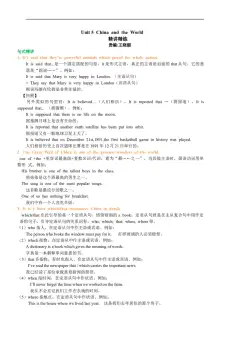
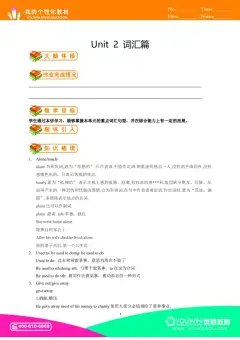
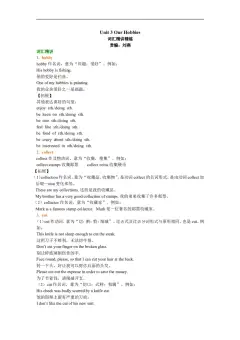
短语归纳
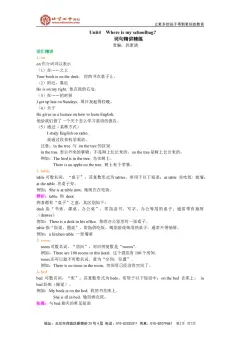
1. choose to do sth. 选择做某事  We choose to join the English club.
2. tell sb. About sth. 告诉某人关于某事  Please tell me about your vacation plan.
3. one of the + 形容词最高级 + 可数名词的复数形式,最……的……之一
  She is one of the most famous singers in China.
4. in the world 在世界上
5. play table tennis 打乒乓球
6. stopping doing sth. 停止正在做的事
  stop to do sth. 停下去做另外一件事
7. attend university abroad 出国留学
  attend a meeting 参加一次会议
8. Whatever she does, she never gives up. 无论她做什么,她从不放弃。
  whatever = no matter what 无论什么 Take whatever you want. 你想要什么就拿什么
  give up doing sth. = stop doing sth. 放弃做某事  You should give up smoking at once.
9. have a strong will 有坚强的意志
10. as well as  不但……而且;还    She can speak English as well as Japanese.
   as well as  同……一样好(同级比较的结构)   He plays the piano as well as you.
11. She is simply the best.   她确实是最好的。
12. die for 为……而死   He died for the country .
13. take care of = look after 照顾;护理
2
 take good care of … = look after …well  好好照顾
14. the + 形容词,表示某一类人,表示复数意义,若用作主语,谓语动词用复数形式。
   the rich 富人   the poor 穷人    the sick 病人   the old 老人   the young 年轻人
 the weak 弱者  the strong 强者   the blind 失明的人      the wounded 伤员
 The rich get richer and the poor get poorer. 富者愈富,贫者愈贫。
15. so that 以便; 为的是 (从句中出现情态动词,so that 引导的是目的状语从句)
  He got up early so that he could catch the early bus.
  He got up early so that he caught the early bus.
(从句中用的是行为动词的过去时,so that 引导的是结果状语从句)
16. invent v. 发明  invention n. 发明物   inventor n. 发明家
   Can you tell me who invented the telephone?
   He wants to be an inventor when he grows up.
   What do you think is the most important inventions?
17. at that time 那时候,在那时
18. on one’s own = by oneself = alone 独自;单独
   The girl can finish the work on her own / by herself.
19. It’s useful for sb. to do sth. 做某事对某人有用  It’s useful for you to know the rules.
  be useful to sb. 对某人有用   This book is useful to young people.
  be useful for (doing) sth. 某事/某物有用 Dictionaries are useful for learning English.
20. without doing sth. 没有做某事(做伴随状语)  without sth. 没有某物
   He went to school without eating breakfast.
   We went out without any money.
21. manage to do sth. 设法做成某事  He managed to avoid an accident.  避免
22. operate v. 做手术  n. operation 手术
   operate on +sb./某部位  The doctor is operating on a boy / his leg.
   do an operation on sb. 给某人做手术  The doctor is doing an operation on a girl.
23. continue doing sth. 继续做原来的事  continue to do sth. 继续做另一件事
   He continued reading Lesson Ten.   They continued talking after the meal.
   After reading Lesson Nine, he continued to read Lesson Ten.
24. in the end = at last = finally 最后;终于  In the end he finished the work on time.
25. die of 因……而死(内因)后跟hunger, cold, illness, a fever 等名词。
   The man died of his illness.
   die from 由于…而死(外因)后跟wound, accident, over work, carelessness 等名词。
   The soldier died from his wound.
26. make +宾语 +宾语补足语(名词/形容词)
   We made him our monitor. 我们选他当我们的班长。
   The presents made us excited.
27. take off (飞机等)起飞;脱下(衣服等)
3
   The plane took off at nine.    He took off his wet shoes. 他脱下了浸湿的鞋子。
28. around the world = all over the world 世界各地,全世界
29. in need of 需要 need n. The doctor told me I was in need of a good doctor.
30. be proud of 为……感到自豪  They are proud of their brave soldiers.
31. set off/ out =start off/ out  出发;动身
   set off for… 动身/出发去…  They set off for home then.
32. get away  离开,逃离  I hope to get away early in the morning.
33. learn from 向......学习   learn sth. from sb. 向某人学习某事
   Let’s learn from Lei Feng.    I am learning English from Tom.
34. on one’s way home 在某人回家的路上   I bought a book on my way home.
35. save one’s life 挽救某人的生命  The doctor tried his best to save the boy’s life.
36.once again 再一次
重点句型
1.one of +the+形容词最高级+可数名词复数   最.....的......之一
2.tell sb. about sth.告诉某人关于某事      3.start doing sth.开始做做某事
4.begin to do sth.开始做某事              5.stop doing sth.停止做某事
6.on one's own 独自一人                 7.manage to do sth.设法完成某事
8.both...and...    .......和......两者都        9.want to do sth.想做某事
10.make sb/sth. +形容词  使某人/某物......
11.try to do sth.努力干某事               12.wait for sb. to do sth.等待某人做某事
重点词汇用法:
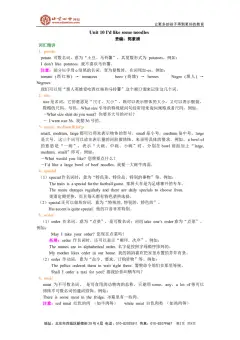
1.attend, join, join in , take part in 的区别

attend
意为“上(学);出席,参加”正式用语,通常用于指“上”学或
“参加”会议、典礼、婚礼葬礼等。
join
多指“加入”某组织、团体,成为其中的一员,其后常接表示组织的
集体名词,如the club, the Party 等。
join in
多指“参加”小规模的活动,如游戏、球赛等;join sb. in doing sth.意
为“和某人一起做某事”。
take part in
主要指“参加”会议或群众性活动等,着重说明句子主语参加该项活
动并在活动中发挥作用。
2.as well as 和as well 的区别
 as well as 意为“并且,还”常用来连接两个并列成分。连接两个并列主语时,遵循“就前原则”。
 As well 意为“也,还有”相当于too.
3.Whatever 连词,意为“不管怎样”,引导让步状语从句,相当于no matter what.
类似的词还有:whichever= no matter which    无论哪个
              whoever=___________       ___________
whenever=________         __________
wherever=__________       __________
4
however=________          ________
4.  will  n. 意志;决心 aux.(表示将来)将;会
 辨析:fall asleep, be asleep,  go to sleep,与sleepy
5.victory n.获胜;胜利 反义词:defeat n.击败,战败
6..sick 与ill
sick
Sick 既可以作表语又可以作定语,如表示“病人”可以说a sick man
或the sick. sick 有“恶心的;厌倦的”之意
ill
ill 表示生病的,有病的这一意思是,一般用作表语,不能作定语。
ill 作定语修饰名词是“坏的,邪恶的”之意
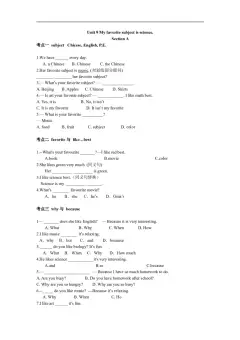
1. My aunt is a teacher ____ a writer.
 A. as soon as    B. as well as
C. as long as
D. as far as  7
2. Ask me again tomorrow, I’ll have to give it some_____.
A. thought
B. advice
C. opinion
D. mind
3. We are sure that the little girl can do the housework   .  版权所有
A. by her own
B. of her own
C. with her own
D. on her own
4. —Smoking is bad for your health.
—You’re right. I decide to   .
A. give it up
B. find it out
C. give it in
5. —Every year, many African children   hunger.
—What bad news! I think we should do something to help them.
A. die in
B. die by
C. die of
D. die for
解析
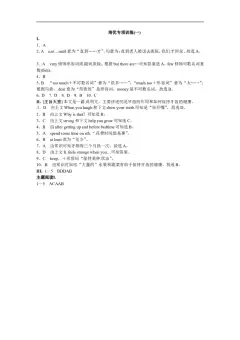
1.选B。考查as well as 也,和。应选B。
2.选B。考查advice,建议,不可数名词。故选B。
3.选D。考查固定搭配。on one’s own 介词短语, 意为“独自一人; 独立地”。
4.选A。考查短语辨析。句意: ——吸烟对你的健康有害。——对, 我决定戒掉它。give up 放弃;
find out 查明; give in 让步。故选A。
5.选C。考查短语辨析。die in 在……中死去; die by 死于……(溺水、上吊等); die of 主要指由于疾
病、冻饿等原因的死亡; die for 为……而死。故选C。
基础演练
5
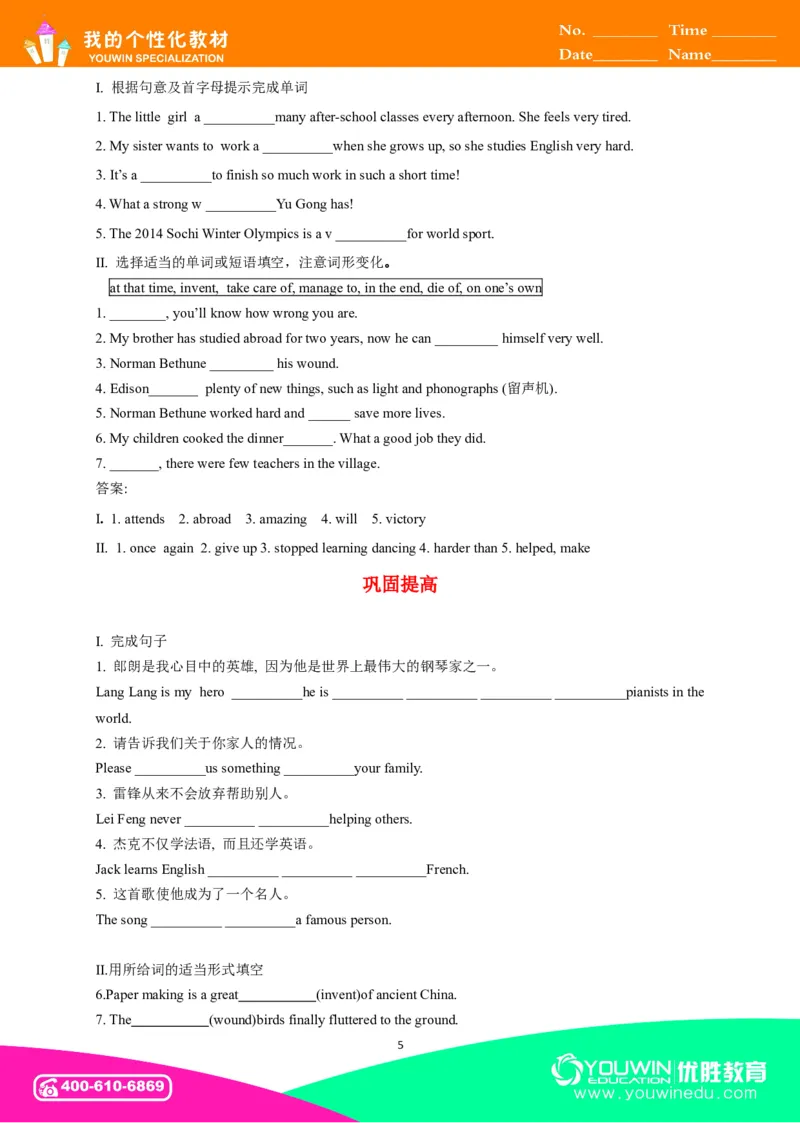
Ⅰ. 根据句意及首字母提示完成单词
1. The little girl a __________many after-school classes every afternoon. She feels very tired.
2. My sister wants to work a __________when she grows up, so she studies English very hard.
3. It’s a __________to finish so much work in such a short time!
4. What a strong w __________Yu Gong has!
5. The 2014 Sochi Winter Olympics is a v __________for world sport.
II. 选择适当的单词或短语填空,注意词形变化。
at that time, invent, take care of, manage to, in the end, die of, on one’s own
1. ________, you’ll know how wrong you are.
2. My brother has studied abroad for two years, now he can _________ himself very well.
3. Norman Bethune _________ his wound.
4. Edison_______ plenty of new things, such as light and phonographs (留声机).
5. Norman Bethune worked hard and ______ save more lives.5
6. My children cooked the dinner_______. What a good job they did.
7. _______, there were few teachers in the village.
答案:
Ⅰ. 1. attends 2. abroad 3. amazing 4. will  5. victory【 :21·世纪·教育·网】
II. 1. once again 2. give up 3. stopped learning dancing 4. harder than 5. helped, make
巩固提高
I. 完成句子
1. 郎朗是我心目中的英雄, 因为他是世界上最伟大的钢琴家之一。
Lang Lang is my hero __________he is __________ __________ __________ __________pianists in the
world.
2. 请告诉我们关于你家人的情况。
Please __________us something __________your family.
3. 雷锋从来不会放弃帮助别人。
Lei Feng never __________ __________helping others. 【 : 】
4. 杰克不仅学法语, 而且还学英语。
Jack learns English __________ __________ __________French.
5. 这首歌使他成为了一个名人。
The song __________ __________a famous person.

II.用所给词的适当形式填空
6.Paper making is a great           (invent)of ancient China.
7. The           (wound)birds finally fluttered to the ground.
6
8. The doctor is saving the          (die)man.
9. Elephants are           (use)for the farmers in Thailand.
10. When Tom was young, his parents were so busy that they always left him alone by          (he).
III.同义句转换
1. We can’t go to a picnic because of the heavy rain.
We can’t go to a picnic __________it’s raining heavily.
2. I started learning English at the age of ten.
I started learning English __________ __________ __________ten years old.
3. Wang Li will go to a university in Beijing.
Wang Li will __________university in Beijing.
4. No matter what he thinks, we shouldn’t forget him.
 __________he thinks, we shouldn’t forget him.
5. The child is not only healthy but also lively.
The child is healthy __________ __________ __________lively.
答案 :
I1.because; one of the greatest 2. tell; about  3. gave up 4. as well as 5. made him
II.invention, wounded, dying, useful, himself
III.because 2. when I was 3. attend 4. Whatever  5. as well as
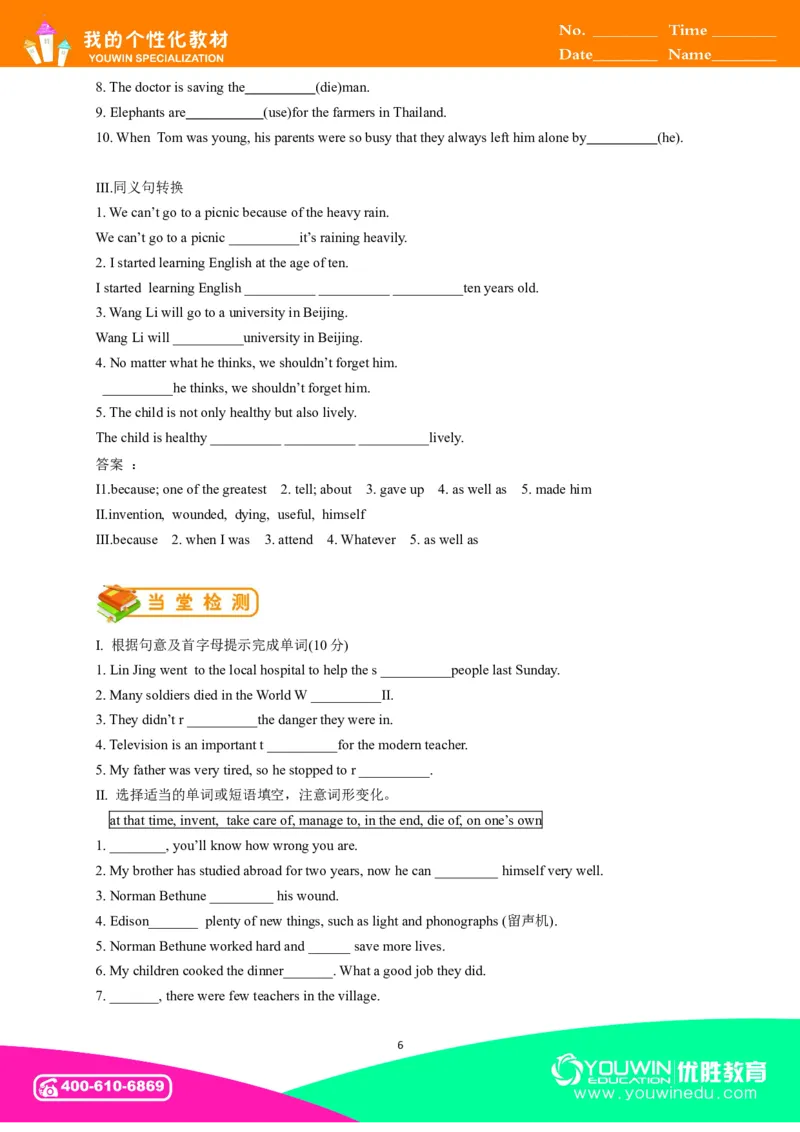
Ⅰ. 根据句意及首字母提示完成单词(10 分)
1. Lin Jing went to the local hospital to help the s __________people last Sunday.
2. Many soldiers died in the World W __________Ⅱ.
3. They didn’t r __________the danger they were in.
4. Television is an important t __________for the modern teacher.
5. My father was very tired, so he stopped to r __________.
II. 选择适当的单词或短语填空,注意词形变化。
at that time, invent, take care of, manage to, in the end, die of, on one’s own
1. ________, you’ll know how wrong you are.
2. My brother has studied abroad for two years, now he can _________ himself very well.
3. Norman Bethune _________ his wound.
4. Edison_______ plenty of new things, such as light and phonographs (留声机).
5. Norman Bethune worked hard and ______ save more lives.5
6. My children cooked the dinner_______. What a good job they did.
7. _______, there were few teachers in the village.
7
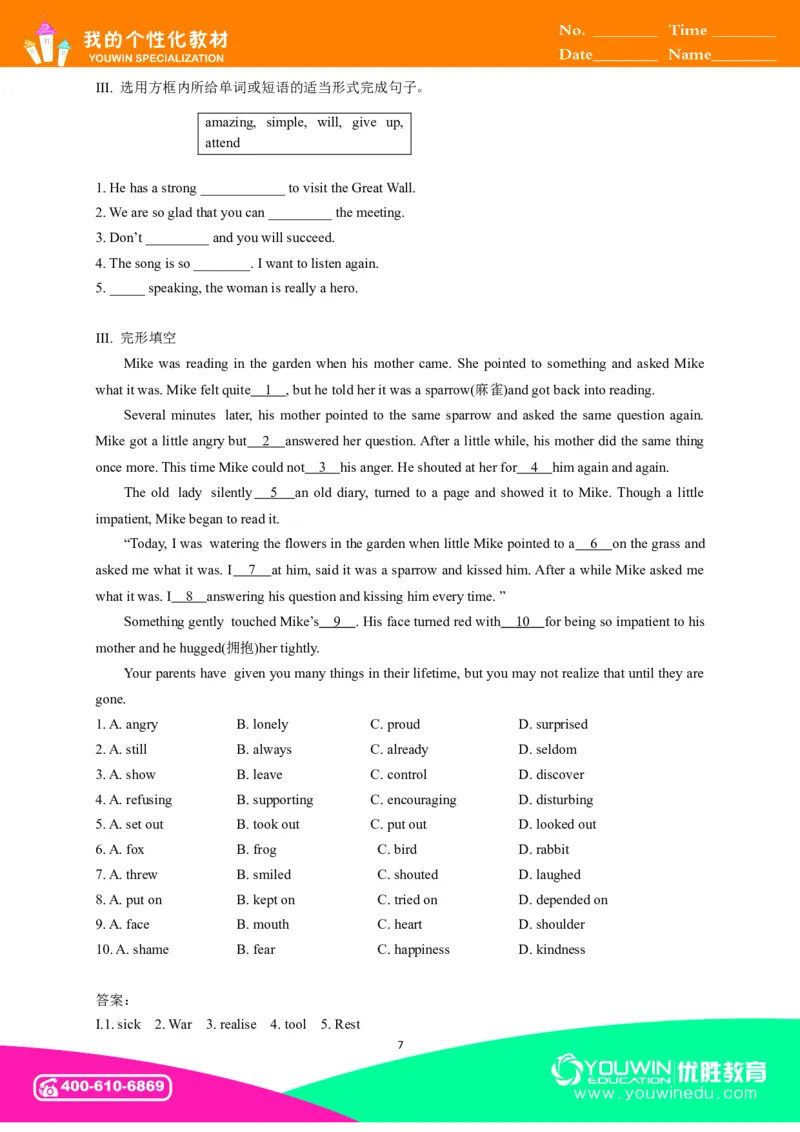
III. 选用方框内所给单词或短语的适当形式完成句子。
1. He has a strong ____________ to visit the Great Wall.21
2. We are so glad that you can _________ the meeting.9
3. Don’t _________ and you will succeed.
4. The song is so ________. I want to listen again. 【     :21  0】
5. _____ speaking, the woman is really a hero.
III. 完形填空
Mike was reading in the garden when his mother came. She pointed to something and asked Mike
what it was. Mike felt quite
  1
  , but he told her it was a sparrow(麻雀)and got back into reading.
Several minutes later, his mother pointed to the same sparrow and asked the same question again.
Mike got a little angry but
  2
  answered her question. After a little while, his mother did the same thing
once more. This time Mike could not
  3
  his anger. He shouted at her for
  4
  him again and again.
The old lady silently
  5
  an old diary, turned to a page and showed it to Mike. Though a little
impatient, Mike began to read it.
“Today, I was watering the flowers in the garden when little Mike pointed to a
  6
  on the grass and
asked me what it was. I
  7
  at him, said it was a sparrow and kissed him. After a while Mike asked me
what it was. I
  8
  answering his question and kissing him every time. ”
Something gently touched Mike’s
  9
  . His face turned red with
  10

  for being so impatient to his
mother and he hugged(拥抱)her tightly.
Your parents have given you many things in their lifetime, but you may not realize that until they are
gone.
1. A. angry
B. lonely
   C. proud
       D. surprised
2. A. still
B. always
   C. already
D. seldom
3. A. show
B. leave
   C. control
    D. discover
4. A. refusing
B. supporting
   C. encouraging       D. disturbing
5. A. set out
B. took out
   C. put out
   D. looked out
6. A. fox
B. frog
C. bird
D. rabbit
7. A. threw

B. smiled
C. shouted
D. laughed
8. A. put on
B. kept on
C. tried on
D. depended on
9. A. face
B. mouth
C. heart
D. shoulder
10. A. shame
B. fear
C. happiness
D. kindness
答案:
I.1. sick 2. War 3. realise 4. tool 5. Rest
amazing, simple, will, give up,
attend
8
II. 1. In the end 2. take care of 3. died of 4. invented 5. managed to 6. on their own 7. At that time
III. 1. will 2. attend 3. give up 4. amazing 5. Simply
IV.DACDB CBBCA
_________________________________________________________________________________
_________________________________________________________________________________
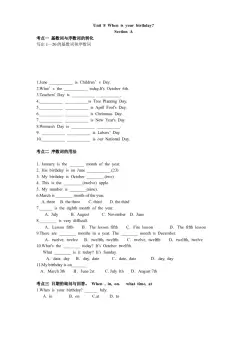
I.单项选择
1. The dinner didn't start ______ all the friends arrived. (2014 外研九年级上期中)
 A. when                 B. while                    C. until                 D. whether
2. We will have ____ drinking water if we don’t protect the environment.   (2014 外研九年级上期中)
A. fewer and fewer        B. little and little
C. more and more         D. less and less
3. --____ terrible the Japan Earthquake(地震) was! 2014 外研九年级上期中)
  --That’s true. ____ people lost their lives in it.
A. How, Two thousands  B. How, Thousands of       C. What, Two thousand   D. What, Thousands of
4. Can you tell me_________? (2014 外研九年级上期中)
A.where does she live      B.where did she live      C.where she lives            D.where she living
5. ----Don’t depend on others.You have to do it by yourself.
  ----OK.I will manage________it on my own. 2014 外研九年级上期中)
A.do                    B.to do

    C.does
 D.doing
6. _______ he is ill, _______ he didn’t go to school.
A. Because; so
 B. Because;             C. Although; /         D. Although; but
7. I want to listen to _____ music.
A. a
 B. an
C. a pair of
 D. piece
8. Sally is really good ______ the violin.
A. in
 B. at
C. on
 D. with
9. We’re so hungry. Let’s stop _________ some cakes
A. eat
 B. eating
C.eats
 D. to eat
10.The teacher asked ________.
A. what wrong with Sally
B. what wrong was with Sally
C. what was wrong  with Sally
D. what is wrong with Sally
II. 任务型阅读
  The famous scientist and thinker, Charles Darwin, was born on February     12, 1809. His family lived
not far from the River Severn, England. Charles’ father was a well-known doctor and the son of a still
greater doctor and scientist. Charles’ father hoped that his son would also become a doctor.
As a boy Charles liked to go for walks in the fields and forests. He watched nature and compared what
9
he saw with everything he had read in science books. He also liked collecting very much. He collected
many things: eggs, stones, and leaves. His father did not like this, as Charles was not studying very well at
school. ①为了成为一名医生

 ,   十六岁时达尔文就被送到爱丁堡大学

 (Edinburgh University)

 学习。

 But
he was interested in the history of nature.
Then he studied at Cambridge University until 1831.
Some time later, he heard that the ship Beagle was going on a trip to South America and wanted a
scientist. His professor advised him to go. He said the trip would be just for Darwin. So when the ship left
England in December 1831, Darwin was on it. The research lasted almost five years. The Beagle studied
the waters in the sea near South America. It also visited New Zealand, Australia and islands in the Pacific.
Darwin saw many new plants and animals. He collected all kinds of plants, which he sent home from the
places he visited. When he returned home, Darwin was warmly greeted by his families and many friends. In
1842, Darwin went to live in Kent, where he continued his studies of the changes in nature. ②Darwin
understood that plants and animals are not always the same, and that they really change.
By 1859, Darwin had finished his famous book The Origin of Species. It made a great hit in the
world of science. ③He was opposed(

 反对

 )by the church and even by some scientists.

 But later, more and
more scientists agreed with him. Darwin continued his studies in science until he died in 1882.
1. Why didn’t Charles become a doctor?
_________________________________________________________________
2. When did Charles start the research with the Beagle?
_________________________________________________________________
3. 请将①处画线句子翻译成英语。
_________________________________________________________________
_________________________________________________________________
_________________________________________________________________
4. 请将②处画线句子翻译成汉语。
_________________________________________________________________
5. 请改写③处画线句子, 使其意思与原句一致(每空一词)。
The church and even some scientists                                  him.
IV.阅读理解
A
October is getting closer and it also means that the year of 2015 is coming to an end. “Hooray! It’s a
holiday!” While you are thinking of putting textbooks aside and playing video games, let’s take a look at
what children in other continents usually do during their holidays.
Children in America don’t have much homework to do. They keep themselves busy by playing camp
games. A parent says, “My daughter Shirley usually attends different camps. We don’t ask her to spend
plenty of time on maths problems or spelling tests.”
Children in Australia take part in activities on over twenty different themes ( 主题). They learn
painting, dancing, singing, history, culture and so on. Parents can accompany their kids to enjoy the
10
learning process and to build a closer relationship with them.
These are what African kids do: build a boat, have a camel race, make a drum and make a rag (碎布)
football. Don’t you think it is interesting that kids in other places have no idea how to make a drum, but
kids in Africa do?
Plan your holiday well and try what you want to try. Make a good plan and you will have a lot of fun.
(   )1. Where does Shirley come from?
A. Asia.
B. America.
C. Australia.
D. Africa.
(   )2. What does the underlined word “accompany” mean in Chinese?
A. 提醒
B. 监视         C. 陪伴
D. 排斥
(   3. According to the passage, only kids in Africa know how to ______.
A. play camp games
B. do spelling tests C. build a boat D. make a drum
(   )4. Which of the following is TRUE?
A. The passage was written before October.     B. Kids in America are good at maths.
C. Kids in Australia spend much time on homework.
D. Kids in Africa don’t play football.
(   )5. What is the purpose of this passage?
A. To advise kids to make holiday plans.     B. To introduce some good holiday camps.
C. To encourage kids to make friends with parents.
D. To show the importance of doing homework during holidays.
B
“Whoosh!” The ball flew into the net and the game was finally over. This game had gone into
overtime (加时赛) twice. Until the last goal was scored, no one had any idea which team would win.
Dave felt so bad because his team had lost. He liked playing soccer, but he liked winning even more.
Now the two teams should have a picnic together. Dave did not want to eat lunch with the other team. The
other team would probably brag (显摆) by talking about how they won the game.
Dave went to the locker room (更衣室) to change out of his soccer clothes. There the coach talked to
the team about what they had done well. They also talked about how they could improve. Then everybody
walked outside towards the picnic table.
One of the players from the other team was standing near the picnic table. He handed Dave a paper
plate. “Hi, I’m Miguel,” he said.
“Hi,” Dave replied, looking down at the ground.
“You played great,” Miguel said. “I didn’t think we were going to win.”
Dave was surprised. Miguel was not bragging at all.
“Thanks,” Dave said to Miguel. “You played great, too.”
Dave felt happy. Dave promised himself that the next time his team won a game, he would not brag to
the other team. It was wonderful to win, but it was even more important to be a good winner.
(   )1.What happened first in the story?
    A. Dave met Miguel.
B. The boys ate lunch together.
    C. Dave went to the locker room.
D. The soccer game ended.
11
(   )2.Which sentence best describes Dave?
    A. He didn’t like to lose.
B. He got angry a lot.
C. He got tired easily.
D. He was not friendly to others.
(   )3.What happened in the locker room?
    A. Dave and Miguel talked.
B. Dave and his team ate lunch.
    C. The coach talked to the team.
D. Dave put on his soccer clothes.
(   )4.What was Dave’s problem?
    A. He was too tired to eat.
B. He didn’t want to eat with the winning team.
    C. He didn’t like Miguel.
D. He didn’t play soccer as well as his teammates.
(   )5. Based on the story, what would probably happen in the future?
    A. Miguel would brag the next time his team won.
    B. Dave would not brag the next time his team won.
    C. Dave’s team would win the next soccer game.
    D. Miguel’s team would not play against Dave’s team again.
C
Kitesurfing as a water sport began in the 1980s, but didn’t get popular until the end of last century. It is
also known as kiteboarding, and in some European countries as flysurfing. Kitesurfing works through wind
power (动力) by using a large kite to pull a rider on the water at high speed.
At first, kitesurfing was a difficult and dangerous sport. Now it is becoming easier and safer because of
the safer kite design. For an able and strong person, kitesurfing can be a very fun, exciting sport, just like
skating on the water with a feeling of flying. It has become more and more popular.
Compared with other water sports, kitesurfing is easier to learn. A beginner can understand how to
operate the kite with 5-10 hours of training. And anybody aged from 13 to 65 can learn. It is not expensive
to get the equipment (装备) for kitesurfing, which costs $1,000 to $2,500. Training lessons range from
$200 to $500 for two or three hours. With the development of its equipment progress (进步), kitesurfing
is becoming even safer. After some training, you can enjoy its excitement and challenging feeling.
With the rising popularity of kitesurfing, most major seaside cities have kitesurfing clubs. In China,
Xiamen is the only place that has the kitesurfing club, which provides professional kitesurfing training and
equipments.
(   )1.Kitesurfing has a history of about     years.
  A. 30
B. 50        C. 100
D. 130
(   )2.     is mentioned in the passage as the power of kitesurfing.
  A. Water
B. Wind     C. The sun
D. The kite
(   )3.The underlined word “range” in the third paragraph means “  ” in   Chinese.
  A. 在……范围内变动
B. 按……顺序排列
C. 向……方向延伸
D. 根据……归类
(   )4.The most important reason for the popularity of kitesurfing is that    .
A. its price is getting lower and lower
B. more and more people are enjoying its excitement
12
C. its equipment progress makes it easier and safer
D. all people can learn and take part in it
(   )5.The main idea of this passage is about    .
  A. how to operate kitesurfing
B. the progress of kitesurfing equipment

C. the history of kitesurfing in China
D. the development of kitesurfing
D
During a winter storm in 1919, one dog managed to save the lives of the people on the ship Ethie.
Today, people still tell the story of the dog.
In December 1919, Ethie was travelling along the coast of northern Canada. Without warning, the ship
ran into a bad storm. Because of high winds and heavy snow, the captain could not tell where he was going.
Sailing too close to the shore (岸), the ship could not move because of some rocks. Ethie was in danger.
The captain decided to save the people on his ship. He thought it was too dangerous to try to reach the
shore by lifeboat, so he sent up flares (闪光信号) to call for help. People saw the flares and rushed to the
beach. The crew (船员) tried to throw a rope (绳子) to them, but there seemed to be no way to get a rope
to the shore.
In the early 1900s ships often carried a large kind of dog called a Newfoundland. Newfoundlands are
excellent swimmers. During sea journeys, Newfoundlands would bring back things that had fallen off the
ship or even save people from the sea.
The Newfoundland on Ethie was named Tang. The captain decided that Tang offered their best hope
of survival (幸存). He gave the dog a long rope. Holding the rope between his teeth, Tang jumped into the
turbulent water. He fought his way through high waves and strong winds. Finally he reached the beach.
The people on the shore took the rope. The rope became the ship’s lifeline.
Because of Tang, all the people on Ethie landed on the beach safely. He was given a special medal for
being a hero. Tang wore the medal for the rest of his life.
(   )1.What happened to the ship Ethie at the beginning of the story?
A. It ran into a bad storm.
B. It couldn’t reach the shore.
C. There was a hole in it.
D. It was found at the bottom of the sea.
(   )2.Ethie could not move near the shore because of    .
A. the high waves
   B. the heavy snow
C. some rocks in the sea
   D. the strong winds
(   )3. Which order is RIGHT according to the story?
 The dog reached the beach.
①
 The captain gave Tang a rope.
②
 Tang was given a special medal.
③
 The captain sent up flares.
④
A. ①③②④
B. ④②①③
C. ①②④③
D. ②④①③
13
(   )4.The word “turbulent” means    .
A. rough
B. smooth
C. safe
D. amazing
(   )5. Which of the following can be the best title of the passage?
A. A storm in 1919
   B. The rope to save people
C. A medal for a dog
D. The hero on the ship
V 书面表达
  根据提示, 写一篇英语短文介绍一下你心目中的英雄——贝多芬。不少于70 个词。
  贝多芬, 著名作曲家(composer), 生于1770 年德国波恩(Bonn), 1792 年搬到奥地利(Austria)的维
也纳(Vienna), 向约瑟夫·海顿学习作曲, 很快他就能自己谱曲。但是他成功后便失聪了, 但他仍旧坚
持谱曲。
  1827 年, 在维也纳去世。


答案:
I.1-5 CDBCB 6-10. BCBDC
II.1. Because he was interested in the history of nature.
  2. (He started it)in December, 1831. /In 1831.
  3. At the age of sixteen/ When he was sixteen(years old), Darwin was sent to Edinburgh University(to
study)in order to /so as to/ to become a doctor(so that/ in order that he could become a doctor). (时间状语
与目的状语的位置不唯一)
  4. 达尔文认为植物和动物不是一成不变的, 实际上它们是变化的。
  5. were against/ disagreed with
III.BCDAA
DACBB ABACD  ACBAD
IV.. 书面表达(20 分)
  【参考范文】
  I like the famous composer Beethoven very much. Beethoven was born in Bonn, Germany, in 1770.
In 1792, he moved to Vienna, Austria to study with Austrian composer Joseph Haydn. Soon Beethoven
could play music that he wrote himself. But just as he was becoming successful, he started to lose his
hearing. But he kept writing msausic. The music he wrote became even better. In 1827, he died in Vienna. I
was deeply moved by Beethoven himself and his music.
14
课程顾问签字:                        教学主管签字: