1
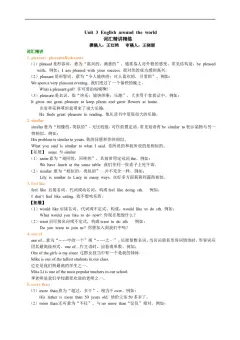
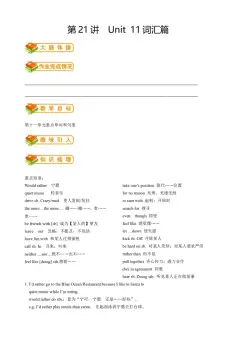
Unit 3 词汇篇
__________________________________________________________________________________
__________________________________________________________________________________
1. 理解并灵活运用重点单词、词组
2. 理解、掌握并灵活运用重点句型
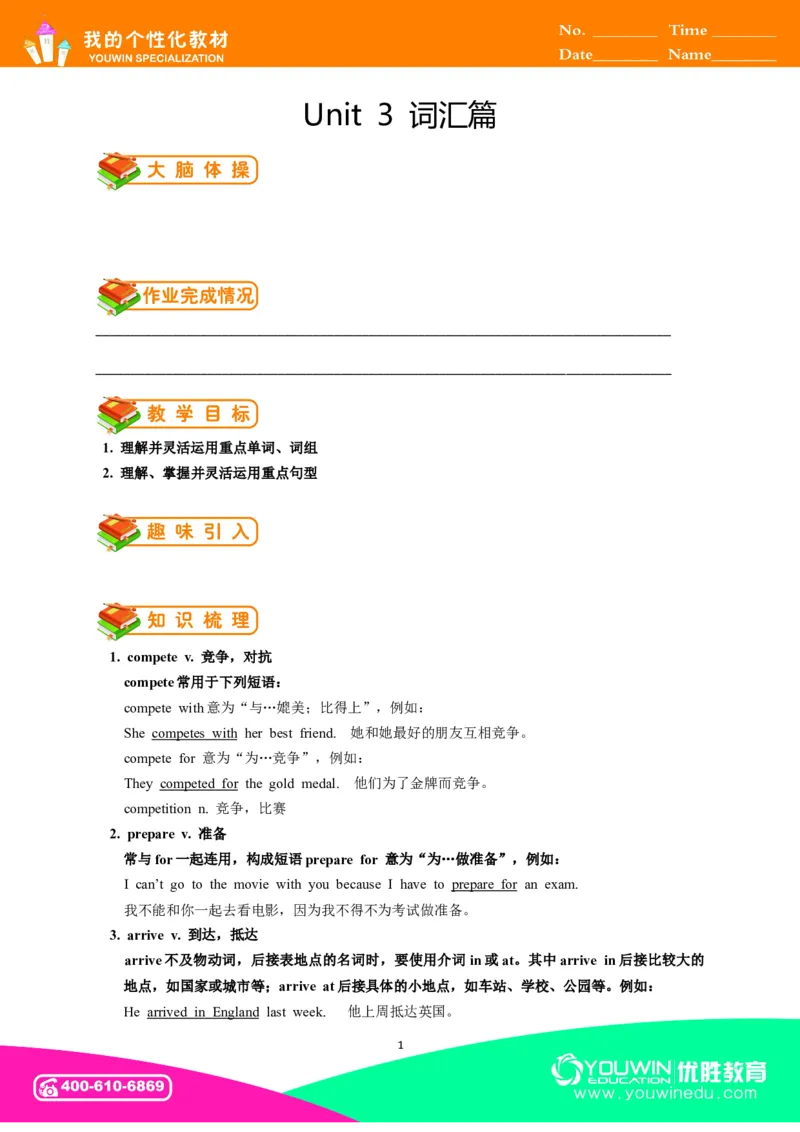
1. compete v. 竞争,对抗
  compete 常用于下列短语:
  compete with 意为“与…媲美;比得上”,例如:
  She competes

   with

  her best friend.  她和她最好的朋友互相竞争。
compete for 意为“为…竞争”,例如:
They competed

   for
   the gold medal.  他们为了金牌而竞争。
competition n. 竞争,比赛
2. prepare v. 准备
  常与for 一起连用,构成短语prepare for 意为“为…做准备”,例如:
  I can’t go to the movie with you because I have to prepare

   for
   an exam.
  我不能和你一起去看电影,因为我不得不为考试做准备。
3. arrive v. 到达,抵达
    arrive 不及物动词,后接表地点的名词时,要使用介词in 或at。其中arrive in 后接比较大的
地点,如国家或城市等;arrive at 后接具体的小地点,如车站、学校、公园等。例如:
    He arrived

   in    England

  last week.   他上周抵达英国。
2
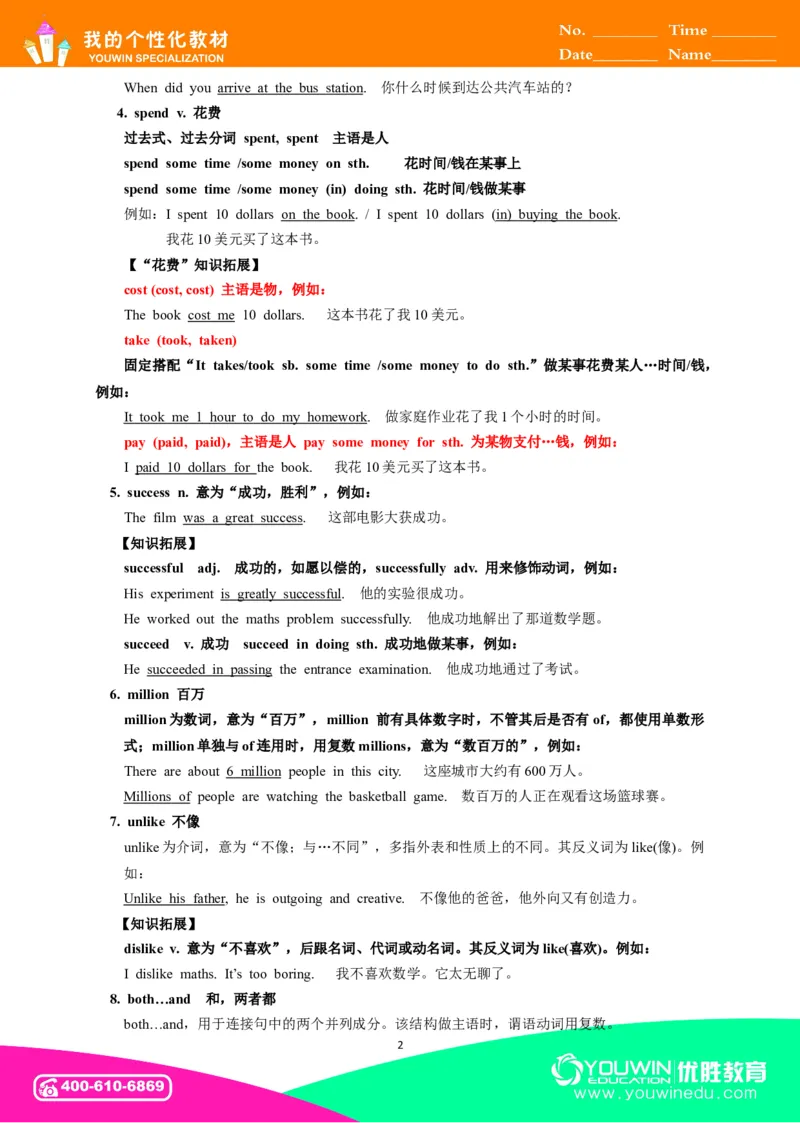
    When did you arrive

   at    the
    bus

   station

 .  你什么时候到达公共汽车站的?
4. spend v. 花费
过去式、过去分词 spent, spent  主语是人
spend some time /some money on sth.     花时间/钱在某事上
spend some time /some money (in) doing sth. 花时间/钱做某事
例如:I spent 10 dollars on
    the
    book

 . / I spent 10 dollars (in)
    buying

   the
    book

 .
      我花10 美元买了这本书。
【“花费”知识拓展】
cost (cost, cost) 主语是物,例如:
The book cost

   me
   10 dollars.   这本书花了我10 美元。
take (took, taken)
固定搭配“It takes/took sb. some time /some money to do sth.”做某事花费某人…时间/钱,
例如:
I t   took

   me
    1    hour

   to    do
    my
    homework

 .  做家庭作业花了我1 个小时的时间。
pay (paid, paid),主语是人 pay some money for sth. 为某物支付…钱,例如:
I paid

   10
    dollars

   for
    the book.   我花10 美元买了这本书。
5. success n. 意为“成功,胜利”,例如:
  The film was

   a    great

   success

 .   这部电影大获成功。
【知识拓展】
  successful  adj.  成功的,如愿以偿的,successfully adv. 用来修饰动词,例如:
  His experiment is    greatly

   successful

 .  他的实验很成功。
  He worked out the maths problem successfully.  他成功地解出了那道数学题。
  succeed  v. 成功  succeed in doing sth. 成功地做某事,例如:
  He succeeded

   in    passing

  the entrance examination.  他成功地通过了考试。
6. million 百万
  million 为数词,意为“百万”,million 前有具体数字时,不管其后是否有of,都使用单数形
式;million 单独与of 连用时,用复数millions,意为“数百万的”,例如:
  There are about 6    million

  people in this city.   这座城市大约有600 万人。
  Millions

   of
   people are watching the basketball game.  数百万的人正在观看这场篮球赛。
7. unlike 不像
  unlike 为介词,意为“不像;与…不同”,多指外表和性质上的不同。其反义词为like(像)。例
如:
  Unlike

   his
    father

 , he is outgoing and creative.  不像他的爸爸,他外向又有创造力。
 【知识拓展】
  dislike v. 意为“不喜欢”,后跟名词、代词或动名词。其反义词为like(喜欢)。例如:
  I dislike maths. It’s too boring.   我不喜欢数学。它太无聊了。
8. both…and  和,两者都
  both…and,用于连接句中的两个并列成分。该结构做主语时,谓语动词用复数。
3
 【知识拓展】
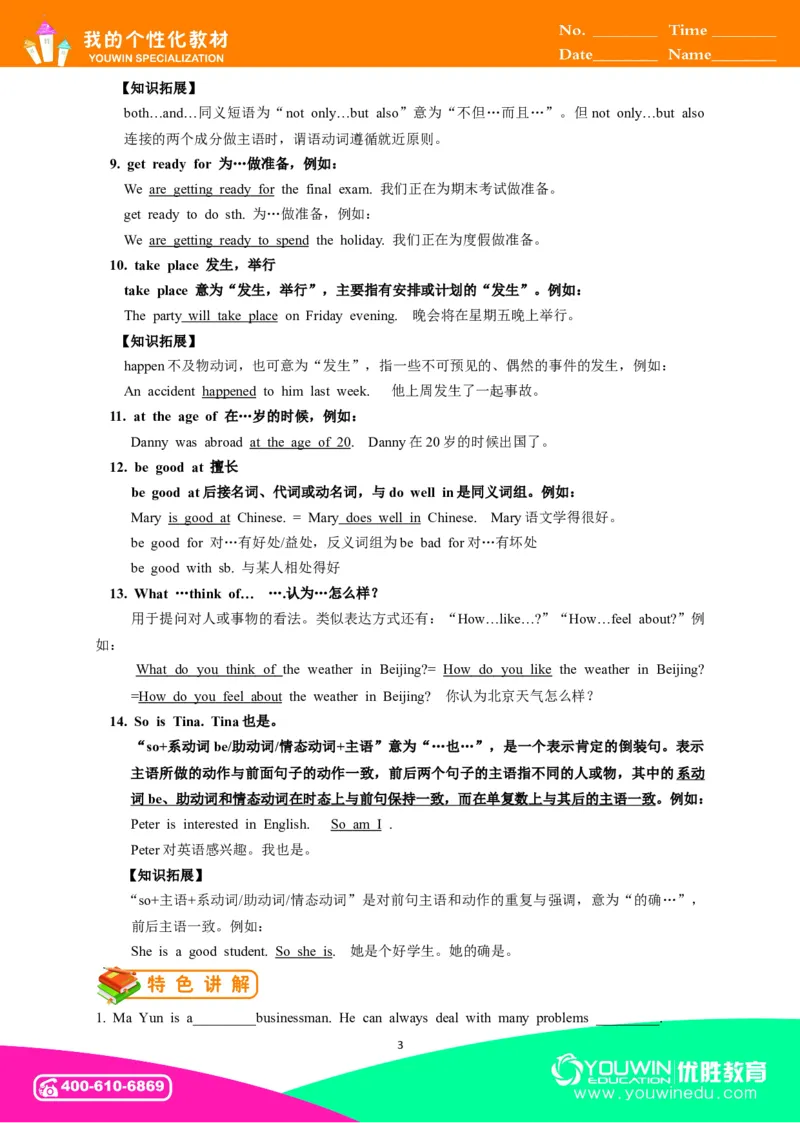
both…and…同义短语为“not only…but also”意为“不但…而且…”。但not only…but also
连接的两个成分做主语时,谓语动词遵循就近原则。
9. get ready for 为…做准备,例如:
    We are
    getting

   ready

   for
   the final exam. 我们正在为期末考试做准备。
    get ready to do sth. 为…做准备,例如:
    We are
    getting

   ready

   to    spend

  the holiday. 我们正在为度假做准备。
10. take place 发生,举行
  take place 意为“发生,举行”,主要指有安排或计划的“发生”。例如:
  The party will
   take
   place

  on Friday evening.  晚会将在星期五晚上举行。
【知识拓展】
 happen 不及物动词,也可意为“发生”,指一些不可预见的、偶然的事件的发生,例如:
 An accident happened to him last week.   他上周发生了一起事故。
11. at the age of 在…岁的时候,例如:
Danny was abroad at    the
    age

   of
    20
  .  Danny 在20 岁的时候出国了。
12. be good at 擅长
   be good at 后接名词、代词或动名词,与do well in 是同义词组。例如:
   Mary is    good

   at   Chinese. = Mary does

  well
   in   Chinese.  Mary 语文学得很好。
   be good for 对…有好处/益处,反义词组为be bad for 对…有坏处
   be good with sb. 与某人相处得好
13. What …think of…  ….认为…怎么样?
     用于提问对人或事物的看法。类似表达方式还有:“How…like…?”“How…feel about?”例
如:
     W
  hat
    do
    you

   think

   of
    the weather in Beijing?= How

   do
    you

   like

  the weather in Beijing?
=How

   do
    you

   feel

   about

  the weather in Beijing?  你认为北京天气怎么样?
  14. So is Tina. Tina 也是。
     “so+系动词be/助动词/情态动词+主语”意为“…也…”,是一个表示肯定的倒装句。表示
主语所做的动作与前面句子的动作一致,前后两个句子的主语指不同的人或物,其中的系动
词
  be
  、助动词和情态动词在时态上与前句保持一致,而在单复数上与其后的主语一致

 。例如:
     Peter is interested in English.   S  o    am
    I  .
     Peter 对英语感兴趣。我也是。
    【知识拓展】
   “so+主语+系动词/助动词/情态动词”是对前句主语和动作的重复与强调,意为“的确…”,
前后主语一致。例如:
 She is a good student. S  o    she

   is  .  她是个好学生。她的确是。
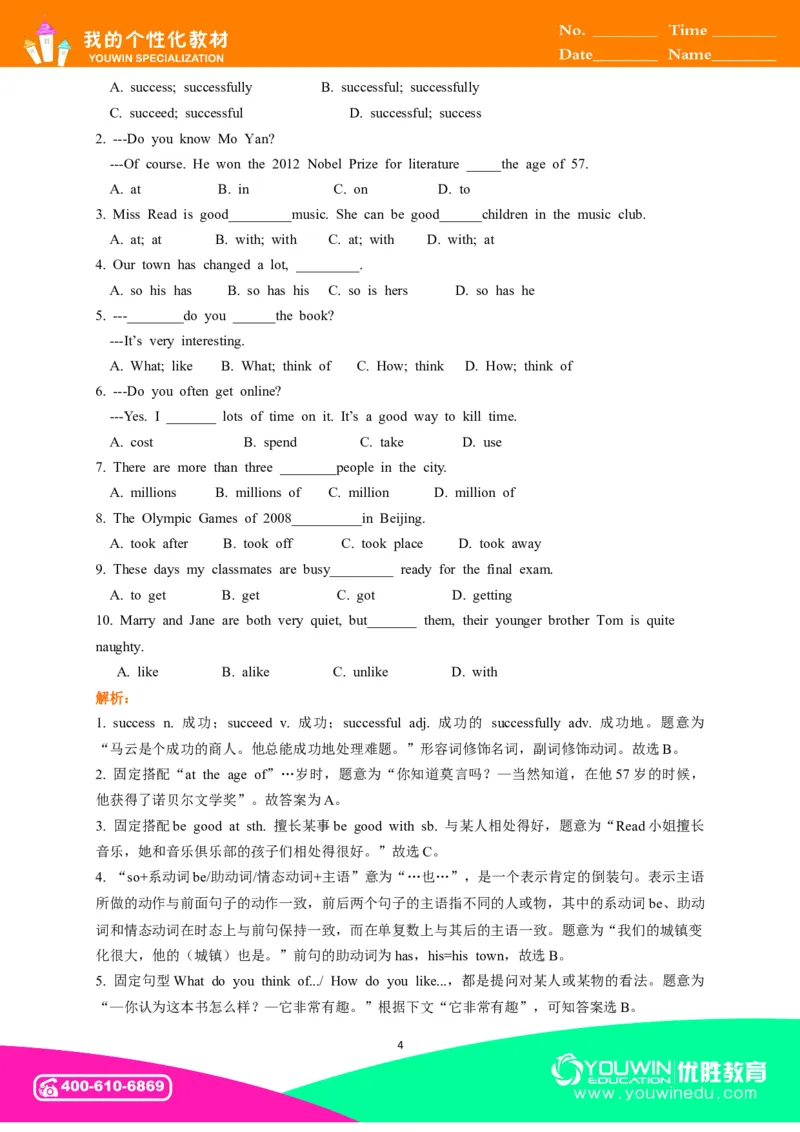
1. Ma Yun is a_________businessman. He can always deal with many problems _________.
4
  A. success; successfully
        B. successful; successfully
C. succeed; successful
            D. successful; success
2. ---Do you know Mo Yan?
---Of course. He won the 2012 Nobel Prize for literature _____the age of 57.
  A. at           B. in            C. on          D. to
3. Miss Read is good_________music. She can be good______children in the music club.
  A. at; at
     B. with; with   C. at; with
   D. with; at
4. Our town has changed a lot, _________.
  A. so his has     B. so has his  C. so is hers
   D. so has he
5. ---________do you ______the book?
---It’s very interesting.
  A. What; like    B. What; think of
 C. How; think   D. How; think of
6. ---Do you often get online?
---Yes. I _______ lots of time on it. It’s a good way to kill time.
  A. cost
         B. spend         C. take        D. use
7. There are more than three ________people in the city.
  A. millions     B. millions of
 C. million
    D. million of
8. The Olympic Games of 2008__________in Beijing.
  A. took after     B. took off       C. took place     D. took away
9. These days my classmates are busy_________ ready for the final exam.
  A. to get        B. get           C. got           D. getting
10. Marry and Jane are both very quiet, but_______ them, their younger brother Tom is quite
naughty.
   A. like         B. alike         C. unlike         D. with
解析:
1. success n. 成功;succeed v. 成功;successful adj. 成功的 successfully adv. 成功地。题意为
“马云是个成功的商人。他总能成功地处理难题。”形容词修饰名词,副词修饰动词。故选B。
2. 固定搭配“at the age of”…岁时,题意为“你知道莫言吗?—当然知道,在他57 岁的时候,
他获得了诺贝尔文学奖”。故答案为A。
3. 固定搭配be good at sth. 擅长某事be good with sb. 与某人相处得好,题意为“Read 小姐擅长
音乐,她和音乐俱乐部的孩子们相处得很好。”故选C。
4. “so+系动词be/助动词/情态动词+主语”意为“…也…”,是一个表示肯定的倒装句。表示主语
所做的动作与前面句子的动作一致,前后两个句子的主语指不同的人或物,其中的系动词be、助动
词和情态动词在时态上与前句保持一致,而在单复数上与其后的主语一致。题意为“我们的城镇变
化很大,他的(城镇)也是。”前句的助动词为has,his=his town,故选B。
5. 固定句型What do you think of.../ How do you like...,都是提问对某人或某物的看法。题意为
“—你认为这本书怎么样?—它非常有趣。”根据下文“它非常有趣”,可知答案选B。
5
6. 固定用法sb. spend some money/time on sth.某人在某事/物花费金钱/时间,题意为“—你经常
上网吗?—是的,我花费很多时间在这上面,上网是消磨时间的好方式”。故选B。
7. 由于空白处前面有数词three,故此处应用million 的单数形式。题意为“这个城市有超过三百万
的人口。”故选C。
8. take after 与...相像;take off 脱掉,起飞;take place 发生,举行;take away 带走,拿走。根据
题意 “2008 年的奥运会在北京举行”,故选C。
9. be busy doing sth. 忙着做某事,get ready for 为...做准备。题意为“这些天我的同学们正忙着
准备期末考试。”故选D。
10. like 喜欢,像;alike 相似的,相同的;unlike 不像;with 和,用。根据题意“Mary 和Jane 都非
常安静,但是不像他们,他们的弟弟Tom 相当淘气。”故选C。
答案:
1-5BACBB    6-10 BCCDC
基础演练
一、短语互译
1. 稍微_______________      2. 开玩笑________________     3. 打破记录_________________
4. 多于_______________      5. 发生事故______________     6. 跳高项目_________________
7. 上周_______________      8. 两年后________________     9. 学校运动节_______________
10. 最好的跳跃者_______________________
11. 在…的末尾_________________________
12. prepare for sth._______________________
13. be well-known for____________________
二、根据句意及汉语提示填写单词或词组
1. John won the first prize in the 400m_____________ (赛跑).
2. Yesterday I bought a___________(唱片) of Deng Ziqi.
3. ---How often are the O___________Games held?  ---Every four years.
4. I’m sure Jack can win the c__________this term.
5. My grandpa is too __________(虚弱的) to look after himself. He needs help.
6. I’m going to Tian’anmen Square to watch the raising of the n______flag.
7. The little boy is very __________(勇敢的).
8. What_______(大小)bowl of porridge would you like, small or large?
9. Every year the world’s top tennis players come to Shanghai to c________against each other.
10. Many of the students in our class are from the_____________(北部).
巩固提高
6
根据中文提示完成句子。(每空一词)
1. 我们村附近有一条20 米宽的河。
  There is a________ _______ near our village.
2. Jack 是我们学校最高的学生。
  Jack is________ ________ ________ in our school.
3. Anna 在比赛中赢得了金牌。
  Anna ________ _________ ________ ________in the competition.
4. —多久之后你将搬到北京去?         —三个月以后。
  --- _______ _______will you move to ?   ---______ _______ _______.
5. 他的父亲和母亲都是医生。
  _______ his father________ mother_______ doctors.
6. 我的同学们正在为晚会做准备。
  My classmates_______ _______ _______ the evening party.
7. 请你要求孩子们不要玩蛇好吗?
  Would you please______ the children________ ______ ______with snakes?
8. 北京是中国的首都。
  Beijing is________ ________ ________ China.
9. 2016 年奥运会将在里约热内卢举行。
  The 2016 Olympic Games_______ ______ _______ in Rio de Janeiro.
10. 这位老人为慈善机构筹集了数百万美元。
  The old man raised ______ _______ _______ for charity.
答案
基础演练
一、短语互译
1. a bit                2. joke around            3. break the record
4. more than           5. have an accident         6. high jump event
7. last week            8. in two years            9. Schools Sports Day
10. the best jumper      11. at the end of
12. 为某事做准备      13. 因…而闻名于世
二、根据句意及汉语提示填写单词或词组
1.race         2. record        3. Olympic       4. competition      5. weak
6. national     7. brave         8. size           9.compete         10. north
巩固提高
1. 20—metre-wide river
2. the tallest student
3. won the gold medal
4. How soon; In three months
5. Both; and
7
6. are preparing for
7. ask; not to play
8. the capital of
9. will take place
10. millions of dollars
一、单项选择
1. ---What is the ________of the sign on the bottle?  ---It_______“Keeps away from the
children”.
  A. means; meaning                   B. meaningful; meaning

C. meaning; means
                D. means; mean
2. Over the river there is ______ bridge.
  A. a 110-meter-long
                B. a 110-meters-long

C. an 110-meter-long                 D. an 110-meters-long
3. We are too small to compete _______a company like that.
  A. for           B. with
        C. in
             D. on
4. The group of the soldiers arrived______ a small town_______a rainy morning.
  A. to; on          B. at; in
        C. at; on         D. in; in
5. ---I hear______your grandpa______your grandma like watching Beijing Opera.
  ---Right, just as many old people do in our city
  A. both; and
       B. either; or        C. neither; nor     D. not only; but also
6. --- Mum, I have great trouble with my maths.   ---Never_______and you will learn it well.
  A. give out       B. give away
 C. give up
     D. give off
7. Sally and I are in________.
  A. class two
       B. Class Two     C. Two Class
     D. two class
8. ---It is often said, “All roads _________Rome.”
---Yes. I’m sure if you work hard, you will be_______.
  A. lead to; successful                  B. lead to; successfully
C. leading to; success
                 D. leading to; successful
9. Justin Bieber has many good songs. They are______with young people.
  A. modern       B. beautiful        C. easy         D. popular
10. It will _________ you much time to finish the hard work.
  A. spend          B. take            C. use         D. need
二、完形填空
“Never give up!” It is my law(法则) of life. It has brought me
  1
  . I learned the law
from my father’s
  2
  story.
8
My father was
  3
  in a poor village in the north of Jiangsu, China. When he was a young
boy, he went to school in the morning, then
  4
  in the fields till sunset. And then he did his
homework
  5    midnight. Life was hard, because they have no
  6
  !
At the age of 14, my father heard of the United States of America. It was the land of gold,
the land where
  7
  people can become rich.
“
  8
  don’t I go to America?” he thought to himself, full of hope.
So, my father came to America. “I had thought it was easy to
  9
  money in America,”
he told me. “But when I arrived here, I realized it was not true. They did not like to hire(雇佣)
me because I spoke
  10
    English. Later, I worked in a small restaurant, cleaning up tables,
  11

dishes and sweeping the floor. Life was
  12

  for the first few years. I worked from 10 a.m. to
11 p.m.. I wanted to go to school to learn English, but it was impossible. I couldn’t
  13

  the
schooling(学费).”
My father
  14

  working hard, and reached his goal.
“Alan,” he often says to me. “If you want something, you have to work for it and never
give up. Things do not come
  15

  in life.” That is what I learned from my father.
1. A. disaster       B. loss           C. success
        D. pity
2. A.
life            B. fashion       C. danger        D. history
3. A.
famous
       B. lucky
       C. rich
        D. born
4. A.
taught
       B. worked       C. studied        D. slept
5. A.
until           B. towards
       C. for
        D. during
6. A. experience
   B. energy       C. time
        D. money
7. A. kind           B. poor       C. strong        D. lazy
8. A.What
       B. How
       C. Why
        D. When
9. A. discover
       B. make
       C. collect        D. spend
10. A. little
       B. good
       C. much
        D. excellent
11. A. giving         B. running
   C. washing
    D. receiving
12. A. comfortable
   B. cheerful
       C. nice
        D. hard
13. A.borrow       B. need
       C. afford        D. pay
14. A.kept
       B. finished
       C. minded        D. stopped
15. A. really       B. easily       C. quietly        D. slowly
答案
一、单项选择  1-5 CABCA   6-10 CBADB
二、完形填空  1-5 CADBD   6-10 DBCBA    11-15 CDCAB
_________________________________________________________________________________
9
_________________________________________________________________________________
 一、单项选择
1. The policeman asked the children________in the street.
   A. not to play        B. to not play
      C. don’t play
   D. playing
 2. The text is very hard for you. There are__________new words in it.
   A. a few            B. a little
          C. few           D. little
 3. The maths exam was quite easy. I think _______could pass it.
   A. someone           B. anyone          C. nobody
       D. everything
4. ---How clever a girl she is!       --- _________.
A. So is she           B. So she is         C. So was she      D. So she was
 5. Thank you for_______me the news. I’m glad to hear that.
   A. tell
                B. to tell           C. told
        D. telling
6.The weak cat______strange, it _____ a ghost.
     A. sounds ,sounds                             B. sounds like ,sounds like
C. sounds like ,sounds                        D. sounds ,sounds like
7.The teacher often tells us_____much time_____TV.
     A. not to spend ,watch                         B. to not spend ,watching
     C. not to spend ,watching                     D. don’t spend  ,watch
8. The fridge is making _____noise. I I dont know what___with it.
A. too much ,is wrong                         B. too much ,wrong is
C. much too ,is wrong                         D. much too ,wrong is
9. ______school is much larger than ______. Really?
A. Our, your              B. Our, yours         C. Ours, yours        D. We ,you
10. I don’t like the colour of the T-shirt. Would you show me _____one?
A. other                  B. the other            C. another            D. others
 (附:6-10,2013-2014 海淀八年级上期中英语模拟试卷)
二、用括号内所给词的正确形式填空
11. It’s time ________(have) breakfast now.
12. Mary is good at______________ (run).
13. He made a few ___________(mistake) in the exam.
14. To keep healthy, I decide____________(exercise) half an hour every day.
15. Do you want ____________(watch) the news?
三、根据汉语提示完成英语句子
16. Janek 为这次旅行准备了好几个月。
Janek_____ _______ the trip for several months.
10
17. 这个人是多么的勇敢啊!
________ _______the man is!
18. 他怎样能够到达公园?
How_______ he_______ _______the park?
19. 他给了生活最好的回答。
He gave _______ _______ ________of his life.
20. 他小时候出过车祸,失去了左腿。
He_______ ________accident when he was young and______his left leg.
四、完形填空
All over the world people enjoy sports. Sports help people to keep  21   , happy and to live  22  .
People play different games in winter and summer.  23  is good for swimming. And in winter people
often go skating. Some sports are very  24  and people everywhere like them. For example, football is
very popular. In China, most people, men,   25  boys and girls, like to watch football games. They often
talk about them.  26  and jumping began long, long ago. But basketball and volleyball are rather   27  .
People began to play them not long ago. And people are  28  new sports or games all the time. Water
skiing is one of   29  . People   30  different countries may not be able to understand each other, but
after a game they often become friends.
21.A. health           B. busy          C. healthy        D. lazy
22.A. long            B. longer         C. happy         D. happily
23.A. Winter          B. Summer       C. Autumn        D. Spring
24.A. boring          B. difficult        C. expensive      D. interesting
25.A. woman         B. women         C. old           D. young
26.A. Run            B. Runs          C. Running       D. To run
27.A. new            B. interesting      C. popular       D. old
28.A. start            B. play           C. playing       D. starting
29.A. oldest           B. newest        C. the oldest      D. the newest
30.A. in              B. of            C. from          D. a
五、阅读理解
A
Every four years, the greatest athletes from all over the world get together in one city to take part in
the world sports meeting-the Olympic Games. The holy flame (圣火) is carried from one place to the next.
In 2008, the holy flame was carried to Beijing, the capital of China.
When Beijing was chosen as the host city to hold the Olympic Games in 2008, all the Chinese people
were very happy, excited and proud. They showed their excitement in different ways when they heard the
news. Some people cheered, jumped and shouted.
In Beijing we built a new Olympic village with hotels for athletes and stadiums for matches.
“One World, One Dream” is our slogan for the 29th Olympics. It expresses the wishes of 1.3 billion
11
Chinese people for a peaceful and better world tomorrow.
31. The Olympic Games is held every _____ years.
A. five        B. two            C. three           D. four
32. Beijing hosted the 29th Olympics in _____.
   A. 2007      B. 2008        C. 2012          D. 2010
33. ______ was built for the 29th Olympics in Beijing.
   A. Hotels     B. Stadiums    C. Olympic village  D. Villages
34. When Chinese people heard the news that Beijing would hold the 29th Olympics, they _______.
A. cheered       B. excited      C. shouted          D. all the above
35. The slogan for the 29th Olympics is _______.
A. “Good, better, best”          B. “Faster, higher, stronger”
C. “One World, One Dream”     D. “World, Dream”
B
On 22nd January, 2007, Dave Cornthwaite from the UK became the first person to skateboard across
Australia. He made a new world record, by skating a total of 5,823 kilometers. Jack Smith, the previous (前
任的) champion, had skated a total of 4,830 kilometers across the US in 2003. Dave’s journey started in
Perth and ended in Brisbane traveling about 60 kilometers a day. It took him five months and 13 pairs
of shoes. He had great physical pain and he got really sore feet.
If Dave hadn’t believed in making his dreams come true, none of this would have happened. Dave left
his job two weeks after he had bought a skateboard and decided to go on a journey. He wanted this journey
to be about something more than him, so he created an association that would raise money for charities. “If
people follow my journey and donations, then I’m doing many people a lot of good,” said Dave. This
journey had plenty of challenges. He traveled across the Australian desert ( 沙漠) where temperatures
reached 48℃ in the day and 0℃ at night. He had a serious accident in Adelaide when he jumped on a
piece of metal that cut through his foot.
Dave helped raise more than £50,000 for children’s charities, wrote a book and encouraged others
to  follow in his footsteps. I wish we had more people like him leading the way!
36. Where is Dave from?
A. The US.         B. Australia.         C. The UK         D. France
37. What can we get from the passage?
   A. Dave skated a total of 4,830 kilometers across Australia.
   B. Dave spent 5 months skating from Perth to Brisbane.
C. Dave was the first person to skateboard across the US.
   D. Dave traveled at the speed of 600 kilometers a week.
 38. What is the main idea of the second paragraph?
    A. Dave got hurt during his journey.
    B. Everyone can help others if he wishes.
12
    C. The environment of Australia is terrible.
    D. Dave challenged himself to achieve his dreams.
 39. Where may the passage come from?
A. An art book.     B. A story book.   C. A science book.    D. A medicine book
答案
一、单项选择
1-5 AABBD   6-10 DCABC
二、用括号内所给词的正确形式填空
11. to have   12. running    13. mistakes   14.to exercise    15. to watch
三、根据汉语提示完成英语句子
16. prepared for
17. How brave
18. can; get to
19. the best answer
20. had an; lost
四、完形填空
21-25 CBBDB     26-30 CACDC
五、阅读理解
31-35 DBCDC     36-39 CBDB

课程顾问签字:                        教学主管签字: