2026 年高考第一次模拟考试(上海卷)
英语
(考试时间:120 分钟  试卷满分:140 分)
注意事项:
1.答卷前,考生务必将自己的姓名、考生号等填写在答题卡和试卷指定位置上。
2.回答选择题时,选出每小题答案后,用铅笔把答题卡对应题目的答案标号涂黑。如需改动,用橡
皮擦干净后,再选涂其他答案标号。回答非选择题时,将答案写在答题卡上。写在本试卷上无效。
3.考试结束后,将本试卷和答题卡一并交回。
I.Listening Comprehension (第1-10 题, 每题1 分;第11-20 题,每题1.5 分;共25 分)
Section A
Directions: In Section A, you will hear ten short conversations between two speakers. At the end of each
conversation, a question will be asked about what was said. The conversations and the questions will be spoken
only once. After you hear a conversation and the question about it, read the four possible answers on your paper,
and decide which one is the best answer to the question you have heard.
1.
A.David.
B.James.
C.Peter.
D.John.
2.
A.Have a meeting.
B.Travel to Beijing.
C.Dine with Mr. Kim.
D.Discuss their program.
3.
A.Husband and wife.
B.Father and daughter.
C.Manager and secretary.
D.Salesman and customer.
4.
A.To write a program.
B.To listen to a radio program.
C.To read a book about radio.
D.To talk about a radio program.
5.
A.The woman will go to the airport by taxi.
B.The woman is asking the man for help.
C.The woman really likes taking buses.
D.The woman's car has broken down.
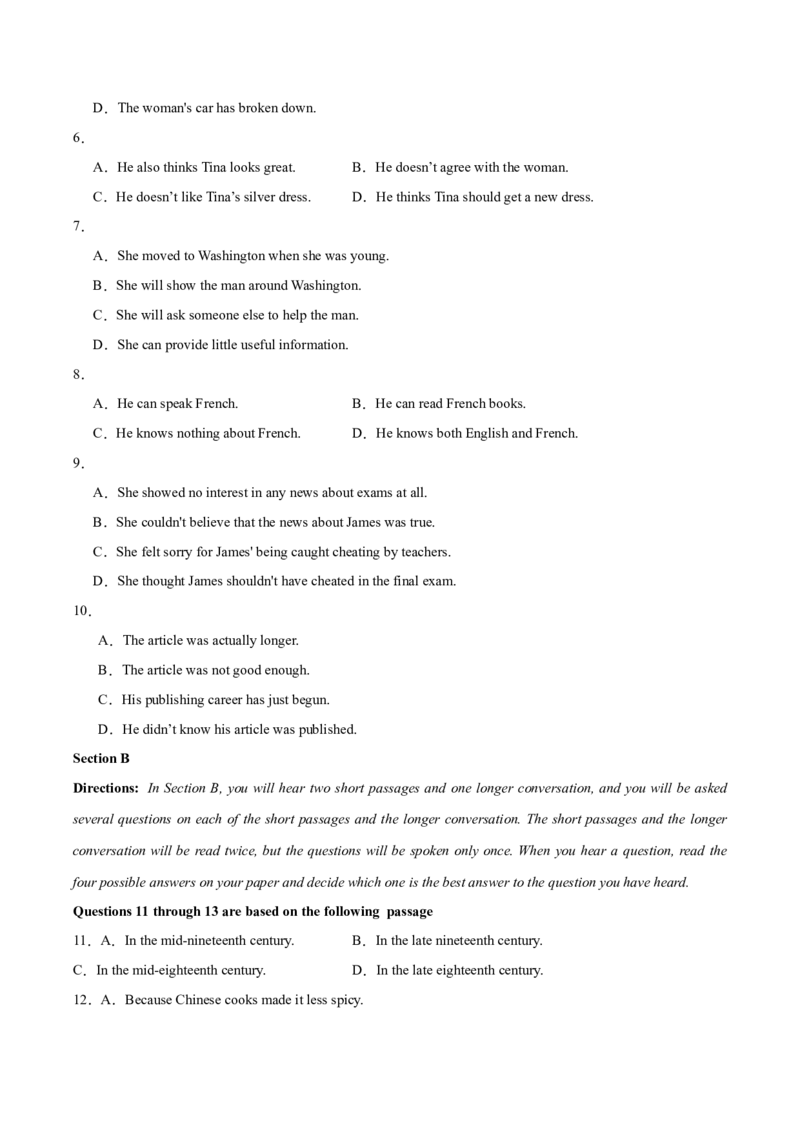
6.
A.He also thinks Tina looks great.
B.He doesn’t agree with the woman.
C.He doesn’t like Tina’s silver dress.
D.He thinks Tina should get a new dress.
7.
A.She moved to Washington when she was young.
B.She will show the man around Washington.
C.She will ask someone else to help the man.
D.She can provide little useful information.
8.
A.He can speak French.
B.He can read French books.
C.He knows nothing about French.
D.He knows both English and French.
9.
A.She showed no interest in any news about exams at all.
B.She couldn't believe that the news about James was true.
C.She felt sorry for James' being caught cheating by teachers.
D.She thought James shouldn't have cheated in the final exam.
10.
A.The article was actually longer.
B.The article was not good enough.
C.His publishing career has just begun.
D.He didn’t know his article was published.
Section B
Directions: In Section B, you will hear two short passages and one longer conversation, and you will be asked
several questions on each of the short passages and the longer conversation. The short passages and the longer
conversation will be read twice, but the questions will be spoken only once. When you hear a question, read the
four possible answers on your paper and decide which one is the best answer to the question you have heard.
Questions 11 through 13 are based on the following passage
11.A.In the mid-nineteenth century.
B.In the late nineteenth century.
C.In the mid-eighteenth century.
D.In the late eighteenth century.
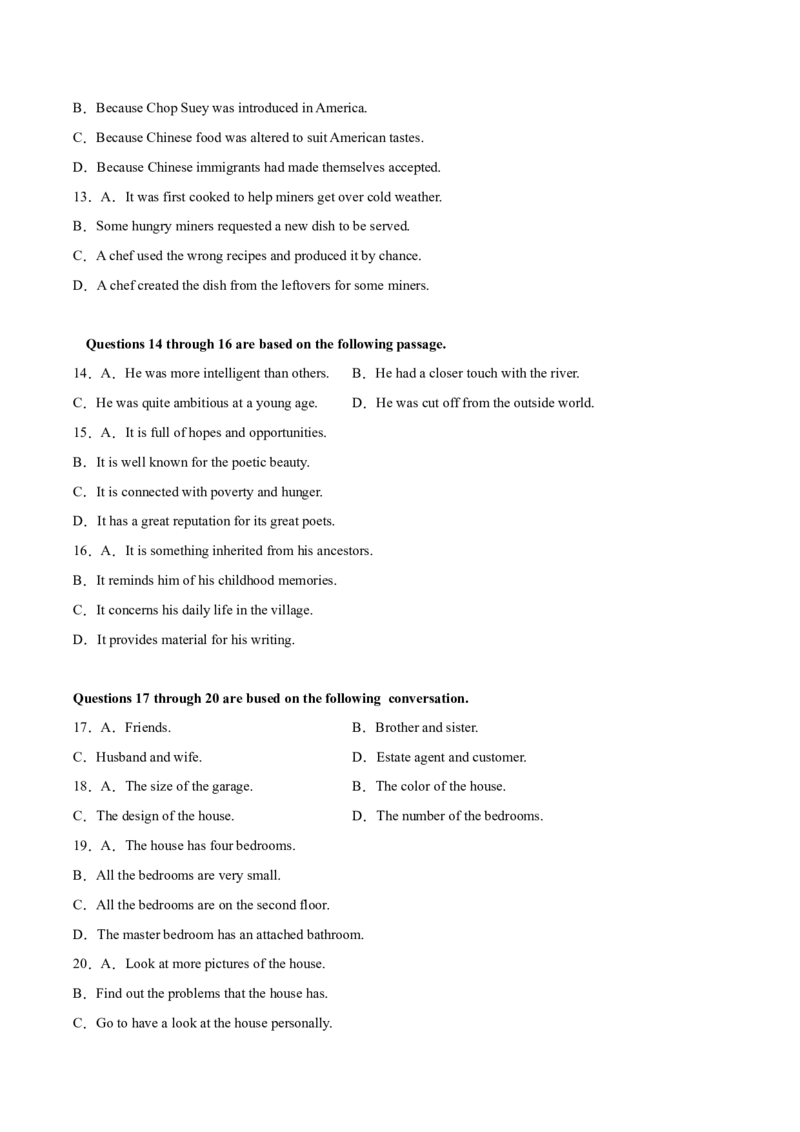
12.A.Because Chinese cooks made it less spicy.
B.Because Chop Suey was introduced in America.
C.Because Chinese food was altered to suit American tastes.
D.Because Chinese immigrants had made themselves accepted.
13.A.It was first cooked to help miners get over cold weather.
B.Some hungry miners requested a new dish to be served.
C.A chef used the wrong recipes and produced it by chance.
D.A chef created the dish from the leftovers for some miners.
Questions 14 through 16 are based on the following passage.
14.A.He was more intelligent than others.
B.He had a closer touch with the river.
C.He was quite ambitious at a young age.
D.He was cut off from the outside world.
15.A.It is full of hopes and opportunities.
B.It is well known for the poetic beauty.
C.It is connected with poverty and hunger.
D.It has a great reputation for its great poets.
16.A.It is something inherited from his ancestors.
B.It reminds him of his childhood memories.
C.It concerns his daily life in the village.
D.It provides material for his writing.
Questions 17 through 20 are bused on the following conversation.
17.A.Friends.
B.Brother and sister.
C.Husband and wife.
D.Estate agent and customer.
18.A.The size of the garage.
B.The color of the house.
C.The design of the house.
D.The number of the bedrooms.
19.A.The house has four bedrooms.
B.All the bedrooms are very small.
C.All the bedrooms are on the second floor.
D.The master bedroom has an attached bathroom.
20.A.Look at more pictures of the house.
B.Find out the problems that the house has.
C.Go to have a look at the house personally.
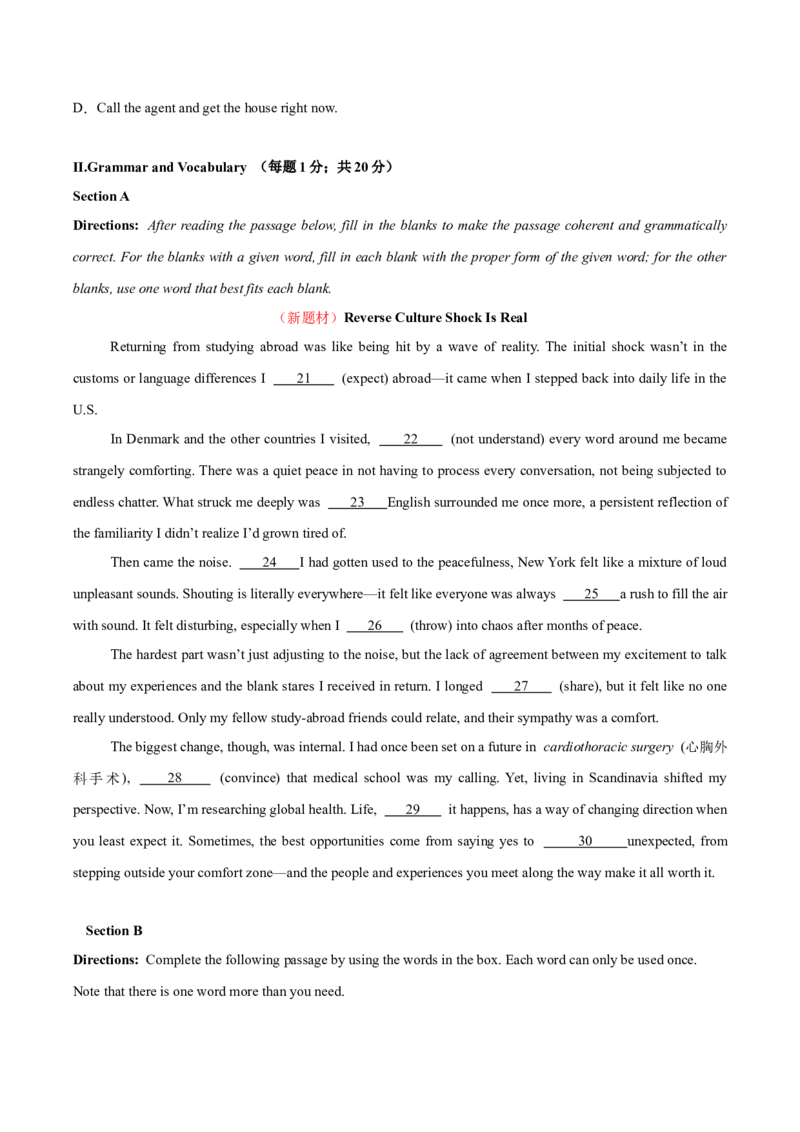
D.Call the agent and get the house right now.
II.Grammar and Vocabulary (每题1 分;共20 分)
Section A
Directions: After reading the passage below, fill in the blanks to make the passage coherent and grammatically
correct. For the blanks with a given word, fill in each blank with the proper form of the given word; for the other
blanks, use one word that best fits each blank.
(新题材)Reverse Culture Shock Is Real
Returning from studying abroad was like being hit by a wave of reality. The initial shock wasn’t in the
customs or language differences I    21    (expect) abroad—it came when I stepped back into daily life in the
U.S.
In Denmark and the other countries I visited,    22    (not understand) every word around me became
strangely comforting. There was a quiet peace in not having to process every conversation, not being subjected to
endless chatter. What struck me deeply was    23   English surrounded me once more, a persistent reflection of
the familiarity I didn’t realize I’d grown tired of.
Then came the noise.    24   I had gotten used to the peacefulness, New York felt like a mixture of loud
unpleasant sounds. Shouting is literally everywhere—it felt like everyone was always    25   a rush to fill the air
with sound. It felt disturbing, especially when I    26    (throw) into chaos after months of peace.
The hardest part wasn’t just adjusting to the noise, but the lack of agreement between my excitement to talk
about my experiences and the blank stares I received in return. I longed    27    (share), but it felt like no one
really understood. Only my fellow study-abroad friends could relate, and their sympathy was a comfort.
The biggest change, though, was internal. I had once been set on a future in cardiothoracic surgery (心胸外
科手术),    28    (convince) that medical school was my calling. Yet, living in Scandinavia shifted my
perspective. Now, I’m researching global health. Life,    29    it happens, has a way of changing direction when
you least expect it. Sometimes, the best opportunities come from saying yes to     30    unexpected, from
stepping outside your comfort zone—and the people and experiences you meet along the way make it all worth it.
Section B
Directions: Complete the following passage by using the words in the box. Each word can only be used once.
Note that there is one word more than you need.
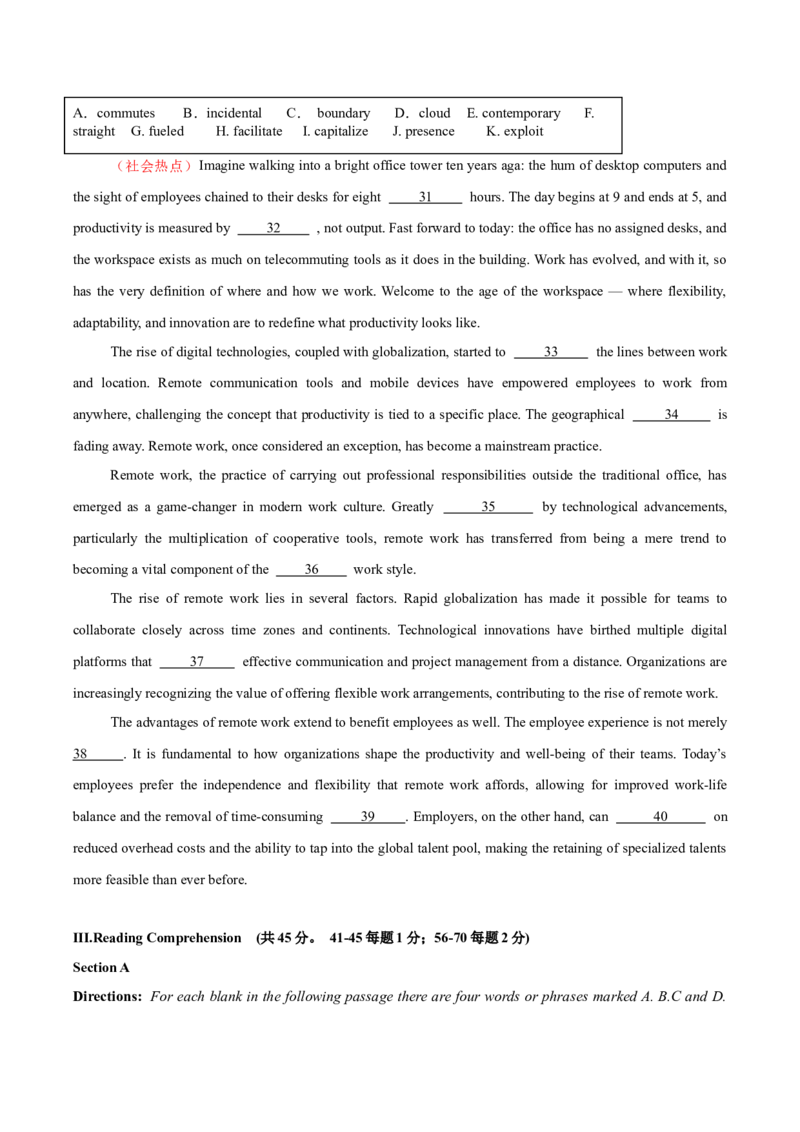
A.commutes       B.incidental      C. boundary      D.cloud    E. contemporary      F.
straight    G. fueled        H. facilitate     I. capitalize      J. presence        K. exploit
(社会热点)Imagine walking into a bright office tower ten years aga: the hum of desktop computers and
the sight of employees chained to their desks for eight     31     hours. The day begins at 9 and ends at 5, and
productivity is measured by     32     , not output. Fast forward to today: the office has no assigned desks, and
the workspace exists as much on telecommuting tools as it does in the building. Work has evolved, and with it, so
has the very definition of where and how we work. Welcome to the age of the workspace — where flexibility,
adaptability, and innovation are to redefine what productivity looks like.
The rise of digital technologies, coupled with globalization, started to     33     the lines between work
and location. Remote communication tools and mobile devices have empowered employees to work from
anywhere, challenging the concept that productivity is tied to a specific place. The geographical     34     is
fading away. Remote work, once considered an exception, has become a mainstream practice.
Remote work, the practice of carrying out professional responsibilities outside the traditional office, has
emerged as a game-changer in modern work culture. Greatly     35     by technological advancements,
particularly the multiplication of cooperative tools, remote work has transferred from being a mere trend to
becoming a vital component of the     36     work style.
The rise of remote work lies in several factors. Rapid globalization has made it possible for teams to
collaborate closely across time zones and continents. Technological innovations have birthed multiple digital
platforms that     37     effective communication and project management from a distance. Organizations are
increasingly recognizing the value of offering flexible work arrangements, contributing to the rise of remote work.
The advantages of remote work extend to benefit employees as well. The employee experience is not merely
38    . It is fundamental to how organizations shape the productivity and well-being of their teams. Today’s
employees prefer the independence and flexibility that remote work affords, allowing for improved work-life
balance and the removal of time-consuming     39    . Employers, on the other hand, can      40      on
reduced overhead costs and the ability to tap into the global talent pool, making the retaining of specialized talents
more feasible than ever before.
III.Reading Comprehension  (共45 分。 41-45 每题1 分;56-70 每题2 分)
Section A
Directions: For each blank in the following passage there are four words or phrases marked A. B.C and D.
Fill in each blank with the word or phrase that best fits the context
Are noise-cancelling headphones damaging our hearing skills?
Noise-cancelling headphones have become a popular choice for many, offering a way to block out
background noise and letting us enjoy music at lower volumes.    41   , some experts are worried that using
these headphones too much might make it harder for our brains to process sounds properly.
Renee Almeida, an audiologist (听力学家), has noticed a small increase in adults coming to her clinic with
42    issues. They might fail to    43    where a sound is coming from, or struggle to follow a conversation on
the train, in a bar or at a restaurant. The condition, known as auditory processing disorder (APD), is often
diagnosed in children, so the rise in adults with similar issues struck Almeida as    44   . Almeida suspects that
the widespread use of noise-cancelling headphones could be a    45   .
She explains that our brains are used to dealing with thousands of different sounds at the same time and
deciding which ones are worth paying attention to.    46   , when a dog barks outside, the brain quickly
identifies the sound and dismisses it as unimportant. However, noise-cancelling headphones    47    the brain to
a single source of sound, such as music or a podcast, potentially weakening its ability to process     48

sounds.
Almeida also notes that the overuse of noise-cancelling headphones could harm the developmental process
by which children learn to    49    sounds. For adults, it could make their brains lazy, just as muscles    50
without exercise. In both cases, people could struggle to distinguish speech from background noise.
Despite these    51   , there is currently no scientific evidence proving that noise-cancelling headphones
cause APD .Nor is there sufficient data showing a rise in the condition. But Almeida believes the question
deserves attention.
Prof. Dani Tomlin from the University of Melbourne    52    that people who use noise-cancelling
headphones for long periods may find listening harder when they take them off. But she says “the    53
should not be overlooked”, for helping individuals to listen to music and movies on planes and trains. “Instead of
suggesting    54    noise-cancelling headphones, we need more comprehensive research studies,” she adds.
For now, Almeida recommends    55    like bone conduction headphones. She also encourages people to
actively engage in listening exercises to maintain their auditory processing skills.
41.A.Instead
B.Moreover
C.Otherwise
D.However
42.A.learning
B.socializing
C.hearing
D.reading
43.A.indicate
B.locate
C.recall
D.sustain
44.A.common
B.raw
C.odd
D.predictable
45.A.primary stage B.contributing factor C.direct consequence D.temporary solution
46.A.For example
B.In conclusion
C.As a result
D.On the contrary
47.A.expand
B.reserve
C.limit
D.detect
48.A.multiple
B.external
C.unfamiliar
D.inviting
49.A.clear away
B.attend to
C.tune out
D.trace back
50.A.strengthen
B.tighten
C.weaken
D.stimulate
51.A.concerns
B.efforts
C.threats
D.trends
52.A.protests
B.suspects
C.acknowledges
D.opposes
53.A.risks
B.benefits
C.requests
D.costs
54.A.monitoring
B.tolerating
C.purchasing
D.abandoning
55.A.alternatives
B.restrictions
C.opponents
D.perspectives
Section B
Directions: Read the following three passages. Each passage is followed by several questions or unfinished
statements. For each of them there are four choices marked A, B, C and D. Choose the one that fits best according
to the information given in the passage you have just read.
A
When you’re driving around the same block, keeping searching, because there’s nowhere to park your car,
any suggestion that America devotes too much space to parking might seem foolish. But consider this: in a typical
year, the country builds more three-car garages than one-bedroom apartments. Even the crowded cities reserve lots
of street space to store private vehicles. And local laws across the country require house and apartment builders to
provide off-street parking, whether residents need it. Step back to assess the result: it’s obvious that more square
footage is devoted to parking each car than to housing each person.
That Americans like driving is hardly news, but all the above talking isn’t finding fault with cars. The
complaint is about parking — or, more to the point, about everything we have given up for it. Over the years, cities
and towns have torn down grand old structures to make way for it. All those 9-foot-by-18-foot rectangles of
asphalt (柏油路) haven’t only damaged the environment or these once-valued architectural styles, but also upset
the crucial social goal of housing affordability. This misplaced priority has put the country in a bind. For decades,
even as rents rocketed and climate change worsened, the prevalence (盛行) of parking spaces discouraged anyone
from noticing their social impact. But the parking space has been eating up our living space for sure, with or
without our knowledge.
Here an optimist may give the excuse that some of the country’s largest cities have no choice but to
renegotiate the relationship among people, cars, and parking spaces. However, parking space’s conquering the city
in the 20th century was already so complete that, in the 21st, people need to recognize that the rules have to change,
and that the constant promotion of parking spaces is already weakening cities and crowding out other needs. Some
of the most consequential social problems are the ones hiding in plain sight, but parking isn’t even hiding. It’s just
everywhere — for us to take seriously.
56.In which section can we most probably read this passage?
A.Travel.
B.Features.
C.Front page.
D.Public welfare.
57.The underlined phrase in paragraph 2 is closest in meaning to _______.
A.lead the country to trouble
B.discourage residents from buying cars
C.annoy the local residents
D.weaken the country’s overall strength
58.What can we imply about parking space’s role in the 20th century cities?
A.It failed to meet the growing parking demands.
B.It completely dominated urban planning priorities.
C.It was a necessary renegotiation by the city government.
D.It unexpectedly brought about problems to people’s daily life.
59.What can be concluded from the passage?
A.America should continue expanding parking though it is harmful.
B.Cities in the 21st century should absolutely stop building more garages.
C.Excessive parking space is damaging the society so it should be limited.
D.Housing and other problems are not as urgent as insufficient parking space.
Sign up today and you could win the journey of a lifetime, all expenses paid! Luxury
without limits awaits.
Imagine yourself:
Experiencing a VIP Broadway premiere
( 百老汇VIP 首映礼) in New York, with
luxurious accommodations at The Grand
Aurora Hotel.
Jetting off to Rome for an exclusive
opera performance from the Palazzo Verdi
Suite by Stellar Rewards ( 星级奖励) , or
even backstage with the stars!
But there’s more! Become a new member, and countless advantages are waiting for you.
Welcome drink
Enjoy a free signature
cocktail at the hotel during
your stay. Check directly
with the hotel to discover
their selection of handcrafted
drinks.
Priority

reception
Upon arrival, enjoy priority
access to our dedicated
Stellar Rewards reception
desk for Azure members.
Late check-out
If you desire a later
departure, extend your stay in
your room on the day of your
check-out. This benefit is
upon request and subject to
availability.
To access this offer, become a member of Stellar Rewards or sign in to your existing
account and register for the promotion. The activation code will be pre-filled automatically.
Ensure your Stellar Rewards loyalty number is added to your company booking tool profile
before booking. If your code isn’t working, double-check it is identical. When writing the code,
please pay close attention to capitalization. Using the wrong case will result in errors. Besides,
the code is for one-time use. If your points haven’t appeared after seven days, please contact
customer service.
60.What should Emma, as an Azure member, do first to enjoy her early check-in?
A.Appreciate a premiere exclusive opera performance.
B.Order a welcome signature cocktail at the reception bar.
C.Ask politely for early access in the regular check-in line.
D.Go directly to the dedicated Stellar Rewards reception desk.
61.What should Emma do if her activation code isn’t working?
A.Immediately contact the customer service.
B.Capitalize all the letters of the activation code.
C.Check that the code is entered in an accurate way.
D.Add the loyalty number to the booking tool profile.
62.What is the main purpose of this passage?
A.To criticize the high costs of luxury travel experiences.
B.To persuade readers to register for a membership promotion.
C.To provide tips on how to win free Broadway premiere tickets.
D.To explain the history of Stellar Rewards and its achievements.
C
(社会热点)On farms all over the country, even the most traditional ones, thought is being given to the
possibilities of AI. For the moment, artificial intelligence isn’t making much of an impact on the daily lives of most
British farmers. But the way AI can transform agriculture in the near future is very much a reality in universities
and research labs. My eyes were opened to the possibilities on a visit to a lab where cows were being automatically
monitored in an innovative ‘smart’ dairy. AI was learning to recognize each individual cow and log its behavior. It
then analyzed the data to warn of any signs of illness.
Meanwhile, in my home county, work is underway to ensure that the upcoming generation of farmers isn’t
left behind. In a few weeks’ time, newly arrived students at the Royal Agricultural University (RAU) will start their
course in Agricultural Technology, at the heart of which is AI’s role in making farming more effective, productive
and adaptive in a world of changing weather patterns. This would have sounded like science fiction in the 1950s,
but now, 70 years on, I’m encouraged that tomorrow’s farmers are being armed with the know-how to succeed in
the new digital age.
Naturally, there are concerns about what all this might mean for the countless number of people who depend
on farming for their livelihood. Soft fruit and seasonal veg are extremely tender and need an army of pickers and
packers who may find themselves replaced at some point by the sort of standard precision-robots that have been
trialled on a strawberry farm.
In recent years many places have struggled to employ and keep seasonal workers, so rather than create
unemployment, AI might just provide the answer to a worrying labour gap. It’s worth saying that this technology
will need a whole new set of workers to produce the hardware, input new data and then install, maintain, repair and
replace systems and kit. So don’t despair but do consider upskilling.
Since the Industrial Revolution, every generation of farmers has had to deal with the technological changes
of the day and they have successfully adapted to survive. Who knows! AI may well turn out to be just the latest in a
long line of challenges to be embraced by adaptable and spirited farmers. And anything that saves me the worry of
checking the weather forecast day and night during harvest season must be a good thing.
63.What did the author discover during his visit to the lab?
A.AI has made automation a reality in the dairy industry.
B.AI has helped most British farmers to closely monitor cows.
C.AI is being developed to improve cow health through behavior analysis.
D.AI is primarily being used to transform universities and labs across Britain.
64.What is the focus of the course in Agricultural Technology at the RAU?
A.The role of traditional methods in enhancing crop productivity.
B.The development of AI in agricultural practices in the UK.
C.The ways climate change affects global food security.
D.The impact of AI on boosting farming efficiency and productivity.
65.What can be inferred about the introduction of AI in agriculture from the third and the fourth paragraphs?
A.It will lead to widespread unemployment.
B.It will eliminate the need for human labor completely.
C.It may help address the labor shortage issue.
D.It doesn’t affect the nature of seasonal workers.
66.What is the author’s attitude towards the use of AI in agriculture?
A.Suspicious.
B.Optimistic.
C.Neutral.
D.Concerned.
Section C
Directions: Complete the following passage by using the sentences in the box Each sentence can only be used
once. Note that there are two sentences more than you need.
Fresh Thinking about Fresh Air
In 1842, Edwin Chadwick, a British social reformer, published his landmark Report on the Sanitary (卫生
的) Condition of the Labouring Population. By highlighting the link between poor public health conditions and
poor health, Chadwick’s report revealed social and geographic health inequalities. His findings inspired British
cities to organize clean water supplies and centralized waste treatment systems, which significantly reduced
infectious diseases.     67
Schools serve as a good example of this issue. A study of 100 American classrooms proved that 87 had
airflow rates below healthy standards. In Europe, researchers found that 66% of classrooms in countries such as
Denmark and France failed to meet acceptable indoor air quality standards. This is alarming, as poor air quality in
schools contributes to conditions like asthma (哮喘), which affects nearly one in 13 American children. Outdoor
air pollution, which often enters buildings, can further harm brain development, academic performance and even
increase cancer risks.     68     Most people spend more than 90% of their time indoors, where spaces with
poor air flow have been linked to headaches, burnout, asthma and other health issues. Poor air flow has been
blamed for decreased workplace productivity and higher absenteeism.
Despite its importance, indoor air quality has received little government attention.     69     Installing
carbon dioxide sensors could inform occupants when to open windows or upgrade air systems. National indoor air
quality standards, enforced through air flow certificates similar to food safety ratings, would help ensure safer
environments.
The cost of better air circulation is modest. Upgrading air circulation in all American schools to meet
minimum standards would cost less than 0.1% of annual public education spending.     70     As Chadwick’s
reforms established clean water as a public expectation, the recent health disaster should inspire policymakers to
make clean air an essential standard for all buildings.
A.Air circulation is the forgotten part for improved public health.
B.But achieving clean, healthful air in buildings is feasible.
C.Investments in clean indoor air yield significant returns, boosting academic performance and enhancing
workplace productivity.
D.The government’s recent plan prioritizes school air flow, setting an example for other countries to follow.
E.The problem, however, is not limited to schools.
F.Today, another public health priority is emerging: improving indoor air quality.
IV.Summary Writing   (共10 分)
Directions: Read the following passage. Summarize the main idea and the main point( s)of the passage in no more
than 60 words. Use your own words as far as possible.
Are Big Cities Overrated?
Judged by their revealed preferences, people love cities. Metropolises such as London and New York are
overcrowded, with house prices to match. Across the world, 25% of people live in cities of over a million, up from
just 15% six decades ago.
Economists tend to think this is a great development. Cities, they argue, benefit from “agglomeration”, the
consequence of so many people living in close quarters. For one thing, government and businesses can run more
efficiently: scale helps everything from public transport to the hiring of staff. For another, finding the next big idea
is easier when like-minded people crowd together. Although London makes up 15% of Britain’s population, it
accounts for 22% of its economic output.
But have economists overestimated the benefits of big cities? That is what a new working paper by Matthew
Turner and David Weil, both of Brown University, suggests. Their analysis applies existing estimates of the impact
of agglomeration on economic efficiency and the pace of invention to a model of the American economy. This
allows the researchers to answer a question: how different would America look if, from 1900 to 2010, no urban area
had grown to a population of more than 1 million people?
According to their calculations, the answer is “not all that much”. Growth would have been slower, but only
a bit: the researchers estimate that America’s total output would have been 8% lower in 2010 than it was in reality.
As Mr. Weil puts it: “Without big cities, we would still have modern life as we know it.”
There is plenty about city life that is unpleasant. In September, for instance, Eric Adams, New York’s mayor,
organized a “National Urban Rat Summit”, as part of his “war on rats”. It’s evident that big cities don’t just offer
growth; they come with their own sets of drawbacks and challenges as well.
____________________________________________________________________________________________
____________________________________________________________________________________________
____________________________________________________________________________________________
____________________________________________________________________________________________
_______________________________________________
V.Translation (共15 分。第1 小题和第2 小题,每题3 分;第3 题4 分;第4 题5 分。)
Directions:Translate the following sentences into English, using the words given in the brackets
72.夕阳染红了半边天空,真是赏心悦目。(engage)(汉译英)

73.豆腐营养丰富且容易消化,老少咸宜。(perfect) (汉译英)

74.池塘边石柱上的精美雕刻体现了人与自然和谐共生的理念。(belief)(汉译英)

75.邻居阿婆原本觉得美图软件这类新潮玩意儿用起来会很麻烦,但跟着侄女没学几次就能自如地给照片
改色调了。(as)(汉译英)

VI.Guided Writing  (共25 分)
76.Directions: Write an English composition in 120-150 words according to the instructions given below in
Chinese.
假设你是明启中学高三学生李明。你想报考某外地大学,因为该校有你心仪的专业,且该专业在全国排名
领先,但遭到了父母的反对。写一封信给你的父母,争取他们的支持(信中请不要出现真实的校名和人
名)。内容须包括:
1)你的意愿;
2)你的理由。
____________________________________________________________________________________________
____________________________________________________________________________________________
____________________________________________________________________________________________
____________________________________________________________________________________________
______________________________________________________________________________________