第 28 讲 阅读理解说明文(核心考点精讲精练)
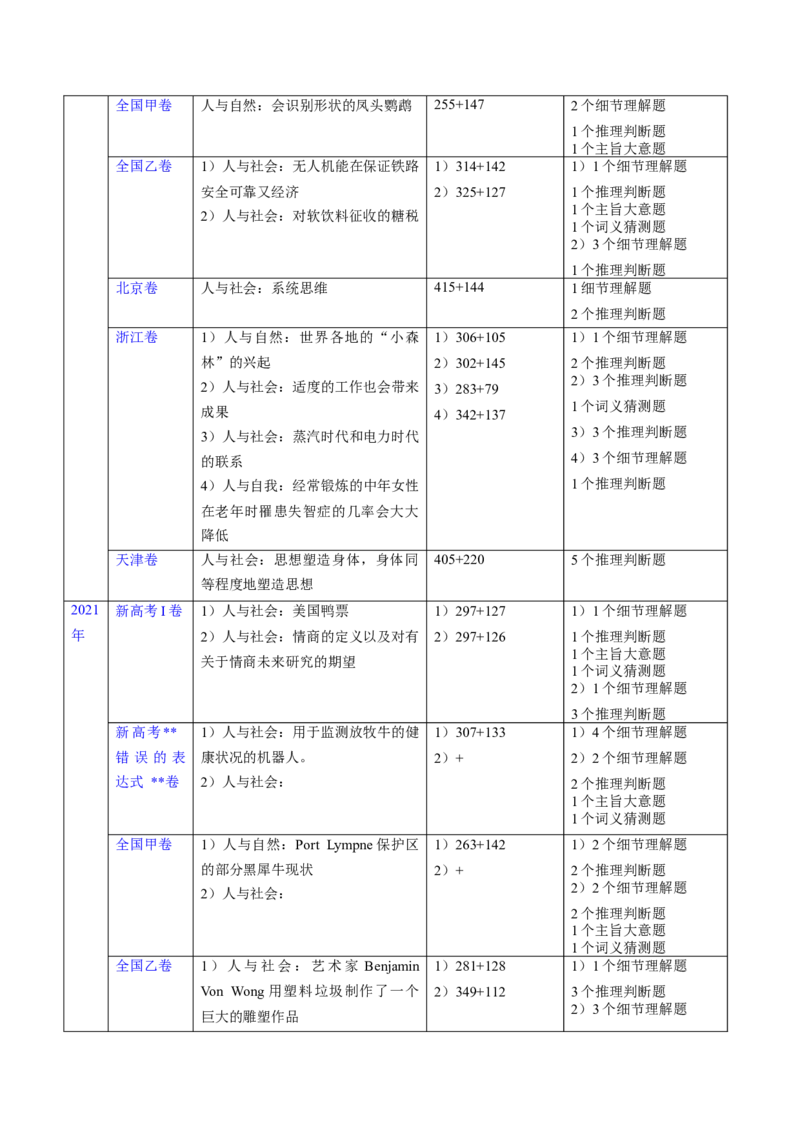
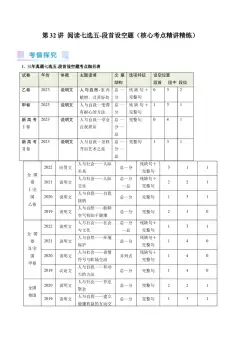
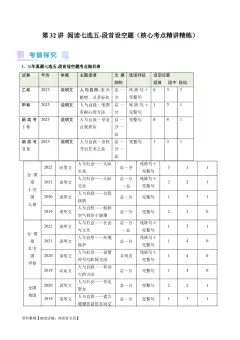
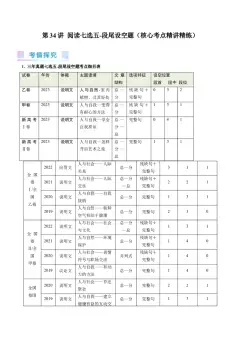
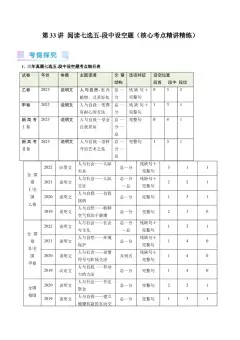
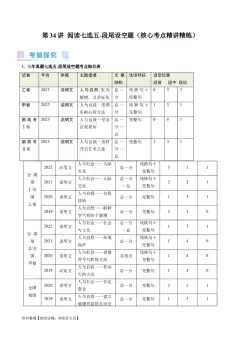
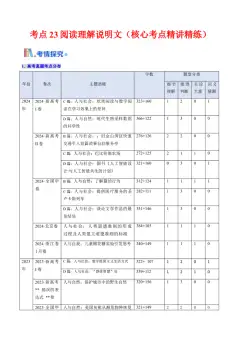
1. 三年真题说明文考点细目表
时间 卷次 主题语境 字数 题型分类
2023 新高考I卷 1)人与社会:数字极简主义生活方 1)322+ 107 1)1个细节理解题
年 式 2)339+112 2个推理判断题
1个词义猜测题
2)人与社会:“群体智慧”效应
2)1个细节理解题
2个推理判断题
1个主旨大意题
新高考** 人与自然:保护城市中的野生自然 320+156 1个细节理解题
错 误 的 表 3个推理判断题
达式 **卷
全国甲卷 人与自然:美国灰熊从濒危物种恢 321+149 2个细节理解题
复到2000多头 2个推理判断题
全国乙卷 人与社会:英国烹饪节目的影响 295+103 2个细节理解题
2个推理判断题
北京卷 1)人与社会:短期主义 1)365+102 1)3个推理判断题
2)人与社会:ALife是否也在不断 2)429+129 2)2个推理判断题
地进化的 1个主旨大意题
1个词义猜测题
浙江卷 人与社会:新型的太阳能农场 317+149 2个细节理解题
1个推理判断题
1个主旨大意题
天津卷
2022 新高考I卷 1)人与自然:在家庭中过零浪费的 1)346+130 1)2个推理判断题
年 生活方式 2)299+131 1个主旨大意题
1个词义猜测题
2)人与社会:改善老年人的健康状 3)339+153
2)3个推理判断题
况的项目
1个词义猜测题
3)人与社会:饮食的改变导致了现
3)2个细节理解题
在在世界上一半的语言中发现了新
1个推理判断题
的语音
1个主旨大意题
新高考** 人与社会:Textalyzer(短信监控 289+128 1个细节理解题
错 误 的 表 器)的技术来监控司机在开车的时 1个推理判断题
1个主旨大意题
达式 **卷 候是否使用了手机
1个词义猜测题全国甲卷 人与自然:会识别形状的凤头鹦鹉 255+147 2个细节理解题
1个推理判断题
1个主旨大意题
全国乙卷 1)人与社会:无人机能在保证铁路 1)314+142 1)1个细节理解题
安全可靠又经济 2)325+127 1个推理判断题
1个主旨大意题
2)人与社会:对软饮料征收的糖税
1个词义猜测题
2)3个细节理解题
1个推理判断题
北京卷 人与社会:系统思维 415+144 1细节理解题
2个推理判断题
浙江卷 1)人与自然:世界各地的“小森 1)306+105 1)1个细节理解题
林”的兴起 2)302+145 2个推理判断题
2)3个推理判断题
2)人与社会:适度的工作也会带来 3)283+79
1个词义猜测题
成果 4)342+137
3)人与社会:蒸汽时代和电力时代
3)3个推理判断题
的联系 4)3个细节理解题
4)人与自我:经常锻炼的中年女性 1个推理判断题
在老年时罹患失智症的几率会大大
降低
天津卷 人与社会:思想塑造身体,身体同 405+220 5个推理判断题
等程度地塑造思想
2021 新高考I卷 1)人与社会:美国鸭票 1)297+127 1)1个细节理解题
年 2)人与社会:情商的定义以及对有 2)297+126 1个推理判断题
1个主旨大意题
关于情商未来研究的期望
1个词义猜测题
2)1个细节理解题
3个推理判断题
新高考** 1)人与社会:用于监测放牧牛的健 1)307+133 1)4个细节理解题
错 误 的 表 康状况的机器人。 2)+ 2)2个细节理解题
达式 **卷 2)人与社会: 2个推理判断题
1个主旨大意题
1个词义猜测题
全国甲卷 1)人与自然:Port Lympne保护区 1)263+142 1)2个细节理解题
的部分黑犀牛现状 2)+ 2个推理判断题
2)2个细节理解题
2)人与社会:
2个推理判断题
1个主旨大意题
1个词义猜测题
全国乙卷 1)人与社会:艺术家 Benjamin 1)281+128 1)1个细节理解题
Von Wong用塑料垃圾制作了一个 2)349+112 3个推理判断题
2)3个细节理解题
巨大的雕塑作品2)人与社会:开放性办公室以及有 1个推理判断题
关多少分贝的噪音最有利于人们的
创造性思维的研究
北京卷 人 与 社 会 : 全 球 崩 塌 ( global 354+81 2个推理判断题
collapse)的概念 1个词义猜测题
浙江卷 1 1)人与社会:人们时间的紧缺和陪 1)315+108 1)2个细节理解题
月卷 伴的重要性 2)344+158 1个推理判断题
2)1个细节理解题
2)人与自然:黑猩猩用来交流的手
1个推理判断题
势含义
1个主旨大意题
1个词义猜测题
浙江卷 6 人与社会:狗能够识别人类的面部 1)334+107 1)2个细节理解题
月卷 表情的原因 1个主旨大意题
天 津 卷 1)人与社会:数字人类 1)414+173 1)3个细节理解题
( 第 一 2)人与社会:催眠技术的使用 2)369+235 2个推理判断题
2)4个细节理解题
次)
1个推理判断题
天 津 卷 人与社会:艺术对人类的重要意义 384+211 4个细节理解题
( 第 二 1个推理判断题
次)
2. 命题规律及备考策略
【命题规律】
近三年说明文阅读理解主要考查以下题型:
一、细节理解题
顾名思义,事实细节题即对文章的某个事实或细节而设置的试题,事实细节题的命题方法很多,如可
能是对某个细节用同义结构转换后进行考查,也可能是将文章中的几个细节放在一起要求考生判断是非
(选出正确的一项或选出错误的一项)或对几个细节进行排序等。解答这类试题时,一个常用的方法就是
运用定位法,即根据题干或选项中的线索词从原文中找到相关的句子,与选项进行比校从而确定答案(此
时要特别注意一些常见的同义装换或简单换算)。
二、推理判断题
推理判断题考查考生透过文章表面文字信息推测文章隐含意思,进行逻辑推理,对文章的细节、作者
的态度、意图作出正确推理判断的能力。分析今年高考题可知,推断题呈不断上升的趋势,且由过去简单
的对号入座直接答题转向通过语句的同义或反义词及长难句来考查考生对语言的理解能力,难度比之前有
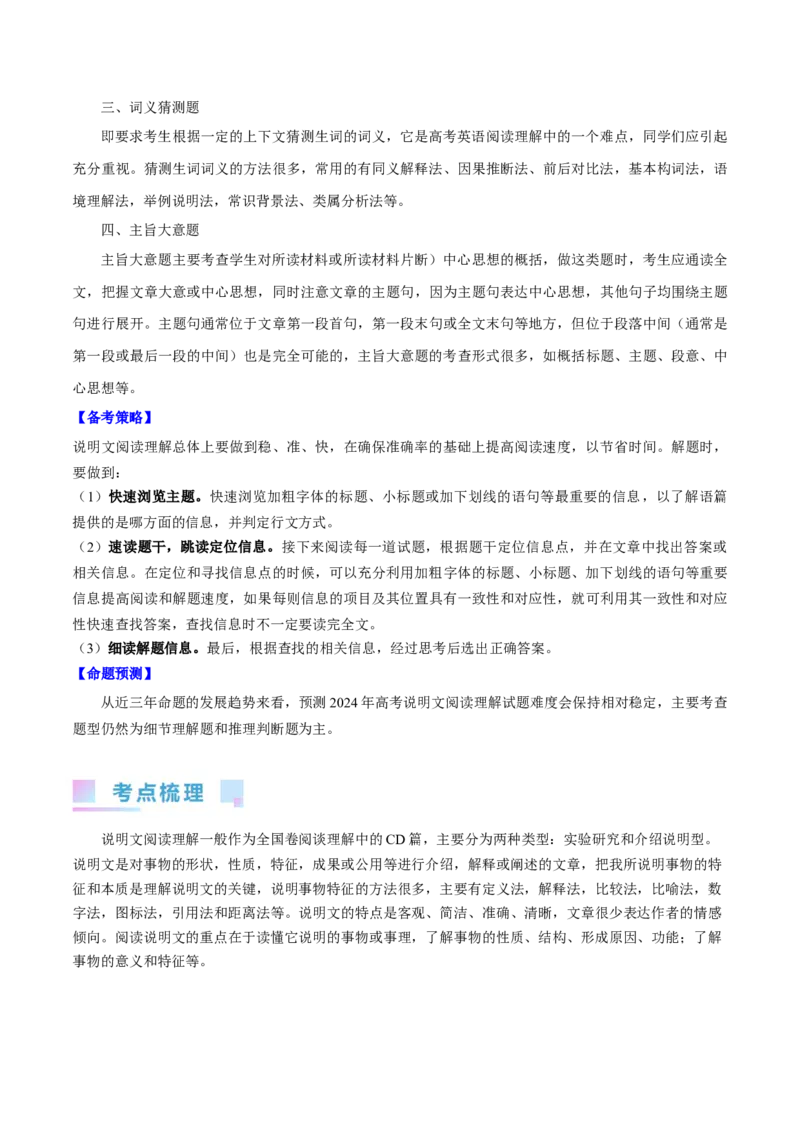
所增加。三、词义猜测题
即要求考生根据一定的上下文猜测生词的词义,它是高考英语阅读理解中的一个难点,同学们应引起
充分重视。猜测生词词义的方法很多,常用的有同义解释法、因果推断法、前后对比法,基本构词法,语
境理解法,举例说明法,常识背景法、类属分析法等。
四、主旨大意题
主旨大意题主要考查学生对所读材料或所读材料片断)中心思想的概括,做这类题时,考生应通读全
文,把握文章大意或中心思想,同时注意文章的主题句,因为主题句表达中心思想,其他句子均围绕主题
句进行展开。主题句通常位于文章第一段首句,第一段末句或全文末句等地方,但位于段落中间(通常是
第一段或最后一段的中间)也是完全可能的,主旨大意题的考查形式很多,如概括标题、主题、段意、中
心思想等。
【备考策略】
说明文阅读理解总体上要做到稳、准、快,在确保准确率的基础上提高阅读速度,以节省时间。解题时,
要做到:
(1)快速浏览主题。快速浏览加粗字体的标题、小标题或加下划线的语句等最重要的信息,以了解语篇
提供的是哪方面的信息,并判定行文方式。
(2)速读题干,跳读定位信息。接下来阅读每一道试题,根据题干定位信息点,并在文章中找出答案或
相关信息。在定位和寻找信息点的时候,可以充分利用加粗字体的标题、小标题、加下划线的语句等重要
信息提高阅读和解题速度,如果每则信息的项目及其位置具有一致性和对应性,就可利用其一致性和对应
性快速查找答案,查找信息时不一定要读完全文。
(3)细读解题信息。最后,根据查找的相关信息,经过思考后选出正确答案。
【命题预测】
从近三年命题的发展趋势来看,预测2024年高考说明文阅读理解试题难度会保持相对稳定,主要考查
题型仍然为细节理解题和推理判断题为主。
说明文阅读理解一般作为全国卷阅谈理解中的CD篇,主要分为两种类型:实验研究和介绍说明型。
说明文是对事物的形状,性质,特征,成果或公用等进行介绍,解释或阐述的文章,把我所说明事物的特
征和本质是理解说明文的关键,说明事物特征的方法很多,主要有定义法,解释法,比较法,比喻法,数
字法,图标法,引用法和距离法等。说明文的特点是客观、简洁、准确、清晰,文章很少表达作者的情感
倾向。阅读说明文的重点在于读懂它说明的事物或事理,了解事物的性质、结构、形成原因、功能;了解
事物的意义和特征等。推理判断题
[常见设问形式]
1.隐含推断题
·It can be inferred from the text that ________.
·The writer/author indicates/suggests/implies that ________.
2.观点态度题
·The author's attitude towards...can be best described as________.
·The tone of this passage is best described as________.
3.写作意图题
·The main purpose of this text is________.
·What's the author's purpose in writing this article?
4.文章出处题
·In which part of a newspaper can you most probably read the text?
·Where does the text most probably come from?
5. 文章走势预测
推理判断题中的正确选项是依据文章的事实或论据推断出的符合逻辑的结论或观点,正确选项一般具
有以下特征:
1.“立足原文,只推一步”,即根据原文内容,一步即可推得。
2.选项中一般不可以出现绝对概念,如only、never、all、absolutely等;正确答案的表述一般有一点
模糊,会用一些相对能够留下一些余地的词汇,如 often、usually、sometimes、some、may、might、can、
could、possibly、probably等。
1.主观臆断:没有基于原文进行推断,而是根据常识推断。
2.过度推断:有时作者只是客观地叙述事实,并未做评论,而一些选项却主观地进行推断。如提到
一样东西贵,并不意味着就买不起。
3.错误推断:某些细节看似在原文中出现过,但与原文不符,或断章取义,或因果倒置等。
4.细节代替推断:只是原文简单的叙述,而非推断出来的结论。
考点一 推理判断题
一、隐含推理题
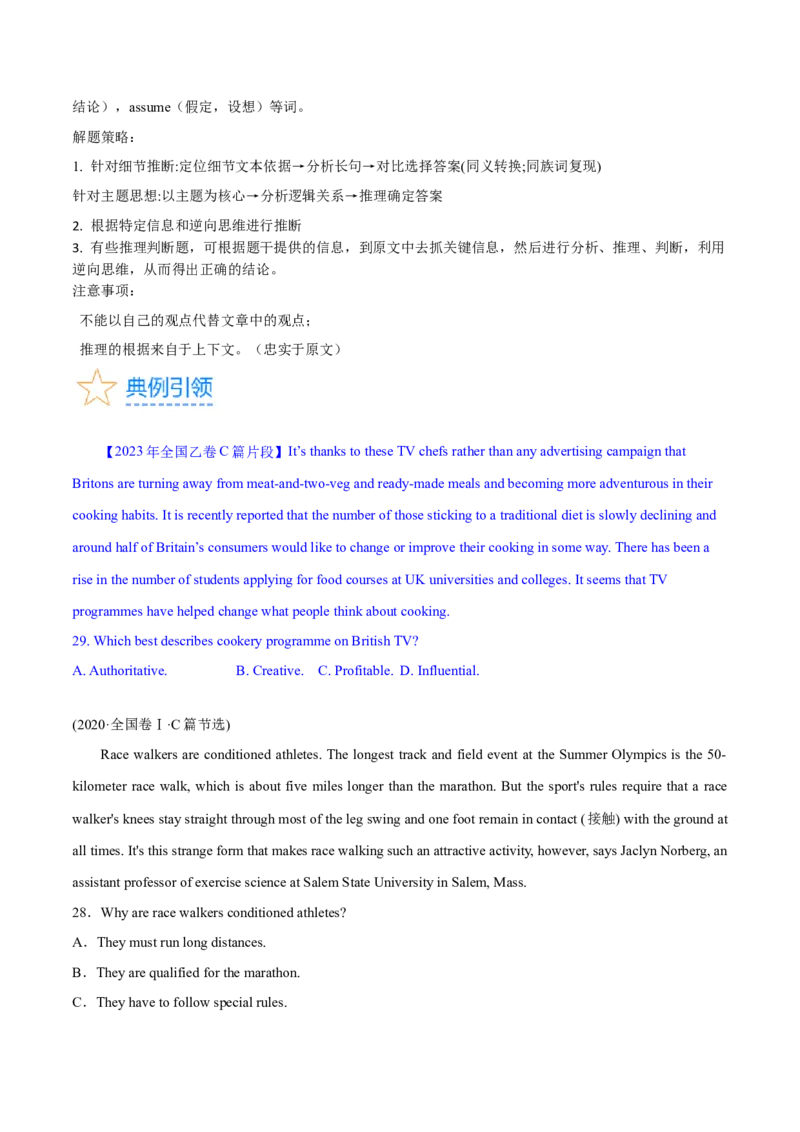
题干中常出现infer(推断),indicate(象征,暗示),imply(暗示),suggest(暗示),conclude(作出结论),assume(假定,设想)等词。
解题策略:
1. 针对细节推断:定位细节文本依据→分析长句→对比选择答案(同义转换;同族词复现)
针对主题思想:以主题为核心→分析逻辑关系→推理确定答案
2. 根据特定信息和逆向思维进行推断
3. 有些推理判断题,可根据题干提供的信息,到原文中去抓关键信息,然后进行分析、推理、判断,利用
逆向思维,从而得出正确的结论。
注意事项:
不能以自己的观点代替文章中的观点;
推理的根据来自于上下文。(忠实于原文)
【2023年全国乙卷C篇片段】It’s thanks to these TV chefs rather than any advertising campaign that
Britons are turning away from meat-and-two-veg and ready-made meals and becoming more adventurous in their
cooking habits. It is recently reported that the number of those sticking to a traditional diet is slowly declining and
around half of Britain’s consumers would like to change or improve their cooking in some way. There has been a
rise in the number of students applying for food courses at UK universities and colleges. It seems that TV
programmes have helped change what people think about cooking.
29. Which best describes cookery programme on British TV?
A. Authoritative. B. Creative. C. Profitable. D. Influential.
(2020·全国卷Ⅰ·C篇节选)
Race walkers are conditioned athletes. The longest track and field event at the Summer Olympics is the 50-
kilometer race walk, which is about five miles longer than the marathon. But the sport's rules require that a race
walker's knees stay straight through most of the leg swing and one foot remain in contact (接触) with the ground at
all times. It's this strange form that makes race walking such an attractive activity, however, says Jaclyn Norberg, an
assistant professor of exercise science at Salem State University in Salem, Mass.
28.Why are race walkers conditioned athletes?
A.They must run long distances.
B.They are qualified for the marathon.
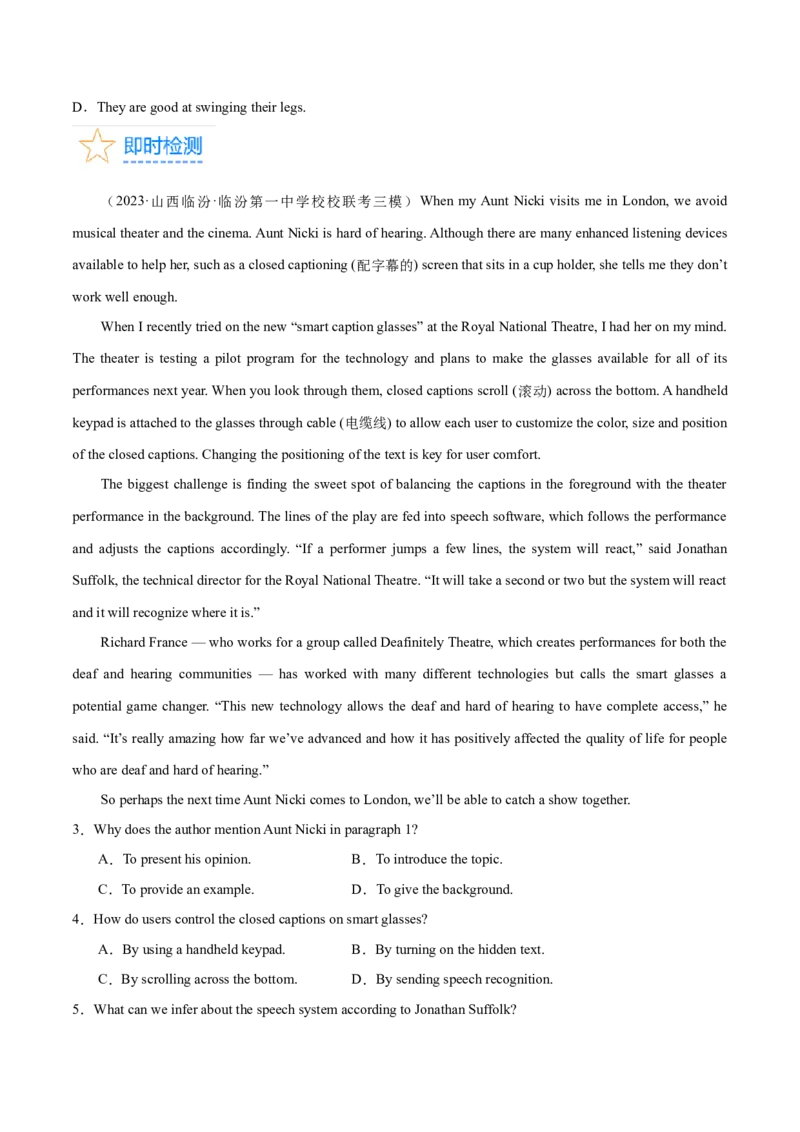
C.They have to follow special rules.D.They are good at swinging their legs.
(2023·山西临汾·临汾第一中学校校联考三模)When my Aunt Nicki visits me in London, we avoid
musical theater and the cinema. Aunt Nicki is hard of hearing. Although there are many enhanced listening devices
available to help her, such as a closed captioning (配字幕的) screen that sits in a cup holder, she tells me they don’t
work well enough.
When I recently tried on the new “smart caption glasses” at the Royal National Theatre, I had her on my mind.
The theater is testing a pilot program for the technology and plans to make the glasses available for all of its
performances next year. When you look through them, closed captions scroll (滚动) across the bottom. A handheld
keypad is attached to the glasses through cable (电缆线) to allow each user to customize the color, size and position
of the closed captions. Changing the positioning of the text is key for user comfort.
The biggest challenge is finding the sweet spot of balancing the captions in the foreground with the theater
performance in the background. The lines of the play are fed into speech software, which follows the performance
and adjusts the captions accordingly. “If a performer jumps a few lines, the system will react,” said Jonathan
Suffolk, the technical director for the Royal National Theatre. “It will take a second or two but the system will react
and it will recognize where it is.”
Richard France — who works for a group called Deafinitely Theatre, which creates performances for both the
deaf and hearing communities — has worked with many different technologies but calls the smart glasses a
potential game changer. “This new technology allows the deaf and hard of hearing to have complete access,” he
said. “It’s really amazing how far we’ve advanced and how it has positively affected the quality of life for people
who are deaf and hard of hearing.”
So perhaps the next time Aunt Nicki comes to London, we’ll be able to catch a show together.
3.Why does the author mention Aunt Nicki in paragraph 1?
A.To present his opinion. B.To introduce the topic.
C.To provide an example. D.To give the background.
4.How do users control the closed captions on smart glasses?
A.By using a handheld keypad. B.By turning on the hidden text.
C.By scrolling across the bottom. D.By sending speech recognition.
5.What can we infer about the speech system according to Jonathan Suffolk?A.It fails to find the balance point. B.It sometimes misses a few lines.
C.It responds to performers quickly. D.It refuses to change captions on the screen.
二、 推断写作意图/写作手法
常见设问方式:
What is the main purpose of the author writing the text?
The writer of the story wants to tell us that________
The fact... is mentioned by the author to show______
The author writes the last paragraph in order to_____
解题技巧:
1. 关注设问的信息位置:
1)开头提出问题——To attract readers’ attention;To introduce the topic;
2)开头举例,用谚语或者名人名言——To draw the readers’ attention to the top;
3)结尾设问——To attract readers to pay for a trip to some attraction; To call on…; To sell a product
or service;
4)文中引语、事例、研究的数据和研究——To argue against…; To support one’s own idea; To make it
more persuasive (更有说服力的)
2. 关注逻辑关系和篇章结构(TEEC 模式)Topic→explanation→example→conclusion 主题+举例子解释或
者证明——To stress/confirm/support sth
常见的说明方法:
1、列数字(list figures): 具体而准确地说明该事物的特点。使说明更有说服力。
2、举例子(give examples): 具体真切地说明了事物的等等特点。
3、引资料(quote): 能使说明的内容更具体、更充实。用引用的方法说明事物的特征,增强说服力。如引用
古诗文、谚语、俗话。引用说明在文章开头,还起到引出说明对象的作用。
4、分类别(by category): 条理清楚地说明了事物的特点,对事物的特征/事理分门别类加以说明,使说明更
有条理性。使说明的内容眉目清楚,避免重复交叉的现象。
5、打比方(make an analogy) : 打比方就是修辞方法中的比喻。生动形象地说明该事物的 xx特点,增强了
文章的趣味性。
6、下定义(draw a definition/ make analysis): 用简明科学的语言对说明的对象/科学事理加以揭示,从而更
科学、更本质、更概括地揭示事物的特征/事理。
7、作比较(make a contrast/comparision): 突出强调了被说明对象的特点(地位、影响等)。
【2023年全国甲卷C片段】Weiner starts each chapter with a scene on a train ride between cities and then
frames each philosopher’s work in the context (背景) of one thing they can help us do better. The end result is a
read in which we learn to wonder like Socrates, see like Thoreau, listen like Schopenhauer, and have no regrets likeNietzsche. This, more than a book about understanding philosophy, is a book abour learning to use philosophy to
improve a life.
29. Why does the author list great philosophers in paragraph 4?
A. To compare Weiner with them.
B. To give examples of great works.
C. To praise their writing skills.
D. To help readers understand Weiner’s book.
(2023·江苏南京·南京市第一中学校考三模)Comfort food makes a person feel good. Food high in sugar
or fat tends to improve mood by stimulating the brain’s reward system. So it makes sense that many of us may turn
to food for comfort in times of stress. There’s some fascinating research that examines food as a source of
comfort.However, the most interesting thing about this research may be that foods are far less comforting than we
tend to believe they are.
Traci Mann, a professor of psychology, and colleagues conducted a series of study with college students. The
researchers examined how much comfort foods actually improve mood. They provided students with one of the
three foods that they had indicated were their top, personal comfort foods. After producing a negative mood by
having them watch movie clips designed to increase their sadness, anger and anxiety, the researchers offered the
students their comfort food.
They had to assess(评估) how they felt before and after they were supposedly comforted by ice cream, pizza
or whatever they had indicated they typically ate to feel better. All of the students completed the study on two
separate occasions: once when they were able to eat their comfort food and once when they were able to eat another
food they liked, but they wouldn’t call a comfort food. The researchers found that comfort food did improve
students’ moods—but only by a little bit and not more than the other food they liked.
In another study, comfort food was compared to no food at all, and students’ moods seemed to improve even
when they didn’t eat anything—most likely just due to the passage of time.
The take-home message from the studies? While the comfort food may make the person feel better for the time
being, it does little to address emotional problems. Of course, everyone can indulge (纵情)in a comfort food from
time to time, but overall, aim for these instances to be the exception rather than the rule.7.What does the author intend to do in the last paragraph?
A.To explain a rule. B.To introduce a concept.
C.To present a fact. D.To make a suggestion.
三、推断作者观点态度
常见设问方式:
The attitude of the author towards something is .
The writer of the passage seems to think that .
What's the author's opinion on ...?
What do we know about ... in the passage?
What does the author think about ...?
(1)注意作者或文中人物的措辞:①分析字里行间所隐含的意思,切忌用自己观点代替作者或文中人物的观
点;②留意相关氛围的语言及表达情感态度或观点的词句,这些常流露于修饰语之中;③结合英语国家的
文化传统或风俗习惯等背景知识进行合理推断。
(2)牢记观点态度的常见词语:
附注:英语阅读理解中表示作者态度的高频词汇
观点态度 例词
positive (积极的)、supportive (支持的)、optimistic (乐观的)、concerned 关心的
支持肯定
humorous(幽默的)、enthusiastic(热情的)、pleasant (愉快的);subjective 主观的
neutral (中立的)、objective(客观的)、not mentioned(未提及的)、unconcerned 不
中立 关心的、uninterested(不感兴趣的)、indifferent(漠不关心的);conservative 保守
的
negative(否定的)、suspicious/skeptical(怀疑的)、disgusted(憎恶的)
否定反对 critical(批评的)、disappointed(失望的)、disapproving(不赞成的)、puzzled/
confused 困惑的、pessimistic 悲观的
,
【2023年新高考全国Ⅰ卷D片段】In a follow-up study with 100 university students the researchers tried
to get a better sense of what the group members actually did in their discussion. Did they tend to go with those most
confident about their estimates? Did they follow those least willing to change their minds? This happened some of
the time, but it wasn’t the dominant response. Most frequently, the groups reported that they “shared arguments and
reasoned together.” Somehow, these arguments and reasoning resulted in a global reduction in error. Although the
studies led by Navajas have limitations and many questions remain the potential implications for group discussionand decision-making are enormous.
35. What is the author’s attitude toward Navajas’ studies?
A. Unclear. B. Dismissive. C. Doubtful.D. Approving.
1.(2023·河南开封·统考三模)Facing the growing digital economy and new positions incubated (孵化) in
the sector such as deliverymen and live-streaming hosts, young people, especially those born after 2000, are
expressing a stronger willingness for flexible work relations with companies, and also wish to become “digital
workers” with flexible work locations and schedules.
A report from Peking University’s National School of Development released on Wednesday said that nearly 66
percent of surveyed employees born after 2000 prefer to work from home. The number is higher than surveyed
people born after 1970, with about 54. 4 percent of them preferring the new way.
“The Internet can do anything for me. I check emails from my clients and submit my proposals through
WeChat, then we discuss plans via teleconference. I love working from home actually,” said Mi Lu, a 28-year-old
new media operator in Beijing. “It’s a much more convenient and cooler thing. We work everywhere, perhaps in a
cafe, or on a bullet train or even on the table of a restaurant.”
Hu Jiayin, an associate professor in Peking University’s National School of Development, concluded that their
survey shows that young people desire freedom in their jobs, but also wish for stability in their careers because of
uncertainties brought by the fast-changing digital economy.
“But the development of the digital economy also brings great uncertainties and a sense of insecurity to the
working population, so we’ve found some interesting things during our surveys that over 30 percent of job seekers
we’ve surveyed wish to have a stable job at state-owned companies,” she added.
Li Qiang, vice-president of Zhaopin, said that the greatest risk to those seeking flexible work is whether the
company pays the salary fully and on time. “It’s necessary for job seekers to set up a long-term development plan,
rather than be shortsighted.” He added that companies may bear risks that flexible employees can’t deliver high-
quality work in a limited time period, which requires the companies to establish a sound work delivery standard to
help evaluate employee performance.
1.What is the author’s attitude to the topic of the text?
A.Favorable. B.Objective. C.Ambiguous. D.Disapproving.
2.(2023·福建厦门·统考三模)About 5,300 years ago, people from the grasslands of modern-day Russiaand Ukraine expanded rapidly across Eurasia. Within a few centuries these “Yamnaya” left a lasting genetic mark
on populations from central Europe to the Caspian Sea. Today, archaeologists call them “eastern cowboys” for their
livestock herding (畜牧) and highly mobile lifestyle.
But one part of the classic cowboy picture was missing: horseback riding. Although cattle bones and solid
carriages have been found in Yamnaya sites, horse bones are hard to find, and most archaeologists assumed people
did not start to ride horses until at least 1,000 years later.
In a new study published in Science Advances, researchers say they’ve found the earliest evidence of
horseback riding not in the bones of ancient horses, but in their Yamnaya riders. “Everyone has focused on horse
remains to get an idea of early horse riding,” says co-author and University of Helsinki archaeologist Volker Heyd.
“Our approach was to look at humans.”
The researchers looked at more than 150 bones unearthed in Romania, Hungary, and Bulgaria — the western
frontier of Yamnaya expansion. The Yamnaya were well-fed, healthy, and tall; the chemical composition of their
bones showed protein rich diets consistent with herding cattle and sheep. But the bones showed signs of distinctive
wear and tear. They also showed thick spots on the leg bone consistent with lots of time spent on the horse back.
Healed injuries matched the kinds of damage a kicking horse might cause, or what sports medicine doctors today
see in riders thrown from their horses.
“In terms of trying to identify people riding horses, I think they’ve done the best job possible
bioarchaeologically,” says bioarchaeologist Jane Buikstra. “That doesn’t mean it’s perfect, or convincing,
ultimately.”
More samples — including horse bones with signs of riding, such as bit marks or back bone damage from the
weight of a rider — would help make the case, says CU bioarchaeologist Lauren Hosek. What the group has found
“is really interesting”, she says. “But there’s a lot more work to be done when the risks of drawing the final
conclusion are as high as the earliest horse riding.”
4.What is Lauren Hosek’s attitude to the research findings?
A.Objective. B.Favorable.
C.Disapproving. D.Unclear.
四、 推理文章出处/来源
常见设问方式:
This passage would be most likely to be found in____The passage is probably taken out of _____________
Where does this text probably come from?
Which section of a magazine is this passage probably taken from?
判断文章出处的题目应从文章的体裁和内容着手。一般来说,报纸上的新闻前面会出现日期、地点或通讯
社名称等;广告类文章因其格式特殊,容易辨认;产品说明类文章如器皿、设备的使用说明会有产品名称
或操作方式,而药品的服用说明会告知服用时间、次数、药量等;来自网络的文章一般比较新颖,时效性
强。
常见选项:
A biology textbook(生物教科书)/A magazine /A research paper(研究论文) /A travel brochure(旅游手册)/A
news report(新闻报告)/A booklet(小册子)/A website/a blog(博客;网络日志)/ A guide book/An
advertisement 等.
1.【2023年全国乙卷D篇】
【para1】If you want to tell the history of the whole world, a history that does not privilege one part of
humanity, you cannot do it through texts alone, because only some of the world has ever had texts, while most of
the world, for most of the time, has not. Writing is one of humanity’s later achievements, and until fairly recently
even many literate (有文字的) societies recorded their concerns not only in writing but in things.
【para2】Ideally a history would bring together texts and objects, and some chapters of this book are able to
do just that, but in many cases we simply can’t. ...
...【para3】When we consider contact (联系) between literate and non-literate societies such as these, all our
first-hand accounts are necessarily twisted, only one half of a dialogue. If we are to find the other half of that
conversation, we have to read not just the texts, but the objects.
15. Which of the following books is the text most likely selected from?
A. How Maps Tell Stories of the World B. A Short History of Australia
C. A History of the World in 100 Objects D. How Art Works Tell Stories
(2023·新疆·校联考二模)Getting a package delivered is easy, but sending it back is not. Repacking,
printing labels and shipping it back up to the seller is an increasingly familiar experience for online shoppers. InAmerica 21% of online orders, worth some $ 218, were returned in 2021, according to the National Retail
Federation, up from 18% in 2020. For clothing and shoes it can reach around 40%. It is a headache for retailers.
The problem has its roots in the birth of e-commerce. To compete with bricks-and-mortar sellers and make
consumers comfortable with ordering online, e-commerce firms offered free returns. Consumers came to expect it.
The scale of returns has been amplified by the covid-induced boom. In America online-shopping now makes up
15% of retail sales by value, up from 10% at the start of 2019.
Returns could grow as nervous consumers cut spending. In May, Boohoo, a British online fashion firm,
forecast lower profits for the year, in part because of a higher return rate. In June, Asos, a rival, did the same.
Overstocking, as retailers miscalculate changing demand, adds to the problem. Steve Rop of goTRG, a startup
which helps retailers sort returns, notes an uptick in returns of discounted goods as consumers realise they don’t
want them.
Each step of the process is costly. Retailers have to pay for goods to be picked up or posted. Processing returns
is labour-intensive, explains Zac Rogers who worked as a return s manager at Amazon and is now at Colorado State
University. The outbound system is highly automated and streamlined; a return must be opened and someone has to
decide what to do with it. “A worker in an Amazon warehouse can pick 30 items in a minute, but a return can take
ten minutes to process,” says Mr Rogers. Once processed, only 5% of returned goods can be resold immediately by
retailers. Most go to liquidators at knock-down prices or are thrown away. Retailers typically recoup about a third
on a $ 50 item, says Optoro, a firm that helps with returns.
Startups are getting in on the action. Using artificial intelligence to help retailers decide what to do with the
returned goods, taking into account factors such as price trends in second-hand markets, is the brainchild of
goTRG. Happy Returns, another startup bought last year by PayPal, a fin-tech firm, helps with logistics. It has
5,000 drop-off points for return s across America, mostly in chain stores. The returns are aggregated and sent back
to retailers all at once, saving up to 40% of postage costs, says David Sobie, the firm’s boss. Some are
experimenting with virtual reality (VR). Over half of items are returned because they are the wrong size. In June
Walmart said it will buy Mamma, an augmented-reality (AR) startup that lets shoppers virtually try on glasses.
Walmart also offers ways to try on clothes and arrange furniture in rooms using AR. Amazon recently launched a
VR feature that lets users try on shoes. Retailers will now try virtually anything to cut down on returns.
1.Where could you read this passage?
A.An economic magazine. B.A science fiction.
C.An official report. D.An academic research.五、文章走势预测
常见的设问方式:
1. What will be discussed further in the coming paragraph?
2.What may the researchers do next according to the last paragraph?
3.What would the author most probably discuss next?
4.Where does the article go next?
5.What would the following paragraph talk about?
1. [2023·全国乙卷] What comes into your mind when you think of British food? Probably fish and chips, or a
Sunday dinner of meat and two vegetables. But is British food really so uninteresting? Even though Britain has a
reputation for less-than-impressive cuisine, it is producing more top class chefs who appear frequently on our
television screens and whose recipe books frequently top the best seller lists.
Its thanks to these TV chefs rather than any advertising campaign that Britons are turning away from meat-
and-two-veg and ready-made meals and becoming more adventurous in their cooking habits. It is recently reported
that the number of those sticking to a traditional diet is slowly declining and around half of Britains consumers
would like to change or improve their cooking in some way. There has been a rise in the number of students
applying for food courses at UK universities and colleges. It seems that TV programmes have helped change what
people think about cooking.
According to a new study from market analysts, 1 in 5 Britons say that watching cookery programmes on TV
has encouraged them to try different food. Almost one third say they now use a wider variety of ingredients(配料)
than they used to, and just under 1 in 4 say they now buy better quality ingredients than before. One in four adults
say that TV chefs have made them much more confident about expanding their cookery knowledge and skills, and
young people are also getting more interested in cooking. The UKs obsession(痴迷) with food is reflected
through television scheduling. Cookery shows and documentaries about food are broadcast more often than before.
With an increasing number of male chefs on TV, its no longer “uncool” for boys to like cooking.
31.What might the author continue talking about?
A.The art of cooking in other countries.
B.Male chefs on TV programmes.
C.Table manners in the UK.D.Studies of big eaters.
【2023届山西省长治市部分学校高三下学期三模联合考试】
One of the things that we expect from the ocean is is deep blue color that reflects the sky. Scientists at UC San
Diego Institution of Oceanography along with scientists at the University of Washington have been experimenting
with dyeing (染) the ocean at San Diego beach pink. What could they possibly be up to?
This is being done for a study that examines how freshwater outflows are combining with the ocean surf zone.
The experiment is called Plumes in Nearshore Conditions (PiNC).“I’m excited because this research hasn’t been
done before and it’s a unique experiment,” said Sarah Giddings, a coastal oceanographer leading the study. “The
aim is to understand how freshwater interacts with waves, since it is usually warmer than ocean water and more
buoyant (有浮力的).”
The freshwater is dyed pink so that the team can easily keep track of it when freshwater is added to the
seawater. The dye is environmentally friendly and is then spotted as it makes progress in the water. It is tracked by
sensors on poles that are located along the sand as well as by drones (无人机). There’s also a jet ski with a
fluorometer that tracks the light that is given out from the pink dye. The sensors outside of the surf zone record the
height of the waves, ocean currents and temperature. There are three planned dye releases as of now, and
researchers are hoping that this pink dye experiment will help them record more about how pollutants travel in the
ocean water through these additions of freshwater.
Giddings explained: “We’re bringing together different people with different expertise, such that I think it’s
going to have some great results and impacts. We’ll combine results from this experiment with an older field study
and computer models that will allow us to make progress on understanding how the dyed freshwater spread.”
31.What will researchers probably do next?
A.Build more scientific computer models.
B.Experiment with dyes of different colors.
C.Make a further research into the results.
D.Discuss the results with different experts.
考点二 词句猜测题[常见设问形式]
1.词义类:①The underlined word/phrase...probably means/can be replaced by ________.②Which of the
following is the closest in meaning to the underlined word/phrase...?
2.指代类:① What does the underlined word “this/that/it/they...” refer to? ② The underlined part
“this/that/it/they...” refers to ________.
3.句意类:①The underlined sentence in the...paragraph probably means ________.②What can we infer
from the underlined sentence in Paragraph...?
1.含义和字面意义没有任何关系。
2.上下文逻辑通顺。
3.与原句意思最接近。
1.与所考词汇形似。
2.如果考的是熟词,含有常规词义的往往是错误选项。
3.句子解释中含有过多原句中的词和短语的选项。
一、语境分析猜词义
1.【2023 年全国甲卷·B 片段】Terri Bolton is a dab hand when it comes to DIY (do-it-yourself). Skilled at
putting up shelves and piecing together furniture, she never pays someone else to do a job she can do herself.
24. Which is closest in meaning to “a dab hand” in paragraph 1?
A. An artist. B. A winner. C. A specialist.D. A pioneer.
2.【2022年全国甲卷· B片段】As Ginni Bazlinton reached Antarctica, she found herself greeted by a group of
little Gentoo penguins(企鹅) longing to say hello. These gentle, lovely gatekeepers welcomed her and kick-started
what was to be a trip Ginni would never forget.
Ever since her childhood, Ginni, now 71, has had a deep love for travel. Throughout her career(职业) as a
professional dancer, she toured in the UK, but always longed to explore further When she retired from dancing and
her sons eventually flew the nest, she decided it was time to take the plunge.
28. Which of the following best explains “take the plunge” underlined in paragraph 2?
A. Try challenging things. B. Take a degree.
C. Bring back lost memories. D. Stick to a promise.(2021·四川凉山·统考二模)For decades, Mars, known as the Red Planet, has been an attraction for
scientists. Despite the current amount of carbon dioxide in its atmosphere and the incompetence of the planet to
support Earthly life forms, research has suggested that the planet was once able to host ecosystems.
Since the beginning of the 1960s, over 40 Mars exploration missions have been carried out. On July 23, China
launched Tianwen 1, a Mars probe named after a poem titled The Quest for Heavenly Truth by ancient Chinese poet
Qu Yuan (about 340-278 BC). The mission marked China’s first step in planetary exploration of the solar system.
It will take Tianwen 1 six to seven months to reach the Red Planet. The probe is expected to land on Mars
around February 2021. Yet the landing process might not be easy. NASA scientists once referred to a Mars landing
as “the seven minutes of terror”. During those suspenseful 420 seconds, the Tianwen 1 has to slow down from 4.8
kilometers per second to zero and land on the Red Planet autonomously.
1.What does the word “incompetence” underlined in paragraph 1 refer to?
A.Isolation. B.Hospitality. C.Unpopularity. D.Inability.
二、就近原则定指代
【2023年全国乙卷·D片段】 In addition to the problem of miscomprehension from both sides, there are
victories accidentally or deliberately twisted, especially when only the victors know how to write. Those who are
on the losing side often have only their things to tell their stories. The Caribbean Taino, the Australian Aboriginals,
the African people of Benin and the Incas, all of whom appear in this book, can speak to us now of their past
achievements most powerfully through the objects they made: a history told through things gives them back a
voice. When we consider contact (联系) between literate and non-literate societies such as these, all our first-hand
accounts are necessarily twisted, only one half of a dialogue. If we are to find the other half of that conversation,
we have to read not just the texts, but the objects.
34. What does the underlined word “conversation” in paragraph 3 refer to?
A. Problem. B. History. C. Voice. D. Society.
三、 语境吻合判句意【2023 年新高考全国Ⅰ卷·C 片段】The goal of this book is to make the case for digital minimalism,
including a detailed exploration of what it asks and why it works, and then to teach you how to adopt this
philosophy if you decide it’s right for you.
To do so, I divided the book into two parts. In part one, I describe the philosophical foundations of digital
minimalism, starting with an examination of the forces that are making so many people’s digital lives increasingly
intolerable, before moving on to a detailed discussion of the digital minimalism philosophy.
Part one concludes by introducing my suggested method for adopting this philosophy: the digital declutter.
This process requires you to step away from optional online activities for thirty days. At the end of the thirty days,
you will then add back a small number of carefully chosen online activities that you believe will provide massive
benefits to the things you value.
29. What does the underlined word “declutter” in paragraph 3 mean?
A. Clear-up. B. Add-on. C. Check-in. D. Take-over.
(2023·甘肃·统考三模)More American businesses are starting to use artificial intelligence(AI)tools to come
up with new ideas and to deal with customers.
Mattel is known for making children’s toys. The company recently used an AI image generator called DALL-
E to come up with ideas for new Hot Wheels toy cars. The used vehicle seller CarMax is using ChatGPT to gather
thousands of customer comments. The social media service Snapchat has added a chatbot to its messaging service.
And Instacart, a delivery service, now uses ChatGPT to answer food questions.
Even the Coca-Cola company plans to use AI to help create new marketing content. It has not said exactly how
it plans to use the technology. But the move shows that businesses are under pressure to use the tools that many of
their employees and customers are already trying on their own. “We must embrace the risks,” Coca-Cola CEO
James Quincey said in a video announcing a partnership with OpenAI—maker of both DALL-E and ChatGPT.
Some experts warn that businesses should carefully consider possible harms to customers, society, and their own
companies before choosing to use AI tools in the workplace.
Claire Leibowicz is with The Partnership on AI, a nonprofit group. The group recently releasedrecommendations for companies producing AI-generated images, audio and other media. “I want people to think
deeply before deploying this technology,” Leibowicz said. “They should play around...but we should also think,
what purpose are these tools serving in the first place?”
While text generators like ChatGPT can make the process of writing emails and marketing documents faster
and easier, they also appear to present misinformation as fact. And image generators like DALL-E are trained in
copying widely available digital art and photography. This has raised copyright concerns from the creators of those
works.
“It is safer to use AI tools as a ‘thought partner’ but still people as the creator of final products,”said Anna
Gressel, who is with the law firm Debevoise & Plimpton.
1.What does the underlined word “deploying” in Paragraph 4 mean?
A.Using effectively. B.Promoting successfully.
C.Questioning publicly. D.Presenting confidently.
过关检测
(2023·云南·云南师大附中校考模拟预测)Lately, it’s felt like technological change has entered an
incredible speed. Companies like OpenAI and Google have unveiled new Artificial Intelligence systems with
incredible capabilities, making what once seemed like science fiction an everyday reality. It’s an era that is raising
big, existential questions for us all, about everything from the future of human existence to the future of human
work.
“Things are changing so fast,” says Erik Brynjolfsson, a leading, technology-focused economist based at
Stanford University. As he notes, this new wave of technological change looks like it could be pretty different.
Unlike before, experienced and skilled workers benefited mostly from AI technology. In this new wave, it’s the less
experienced and less skilled workers who benefit the most. “And that might be helpful in terms of closing some of
the inequality that previous technologies actually promoted,” Brynjolfsson says. So one benefit of intelligence
machines is—maybe —they will improve the know-how and smarts of low performers, thereby reducing
inequality.
But it’s also possible that Al could lower the profit of the experienced, smart, or knowledgeable ones. AI could
reduce inequality by bringing the bottom up, and it could also reduce inequality by bringing the top and middledown.
Of course, as Erik put, it’s also possible that Al could end up increasing inequality even more. For one, it could
make the Big AI companies, which own these powerful new systems, wildly rich. It could also empower business
owners to replace more and more workers with intelligent machines. And it could kill jobs for all but the best of the
best in various industries, who keep their jobs because maybe they’re superstars or because maybe they have
seniority.
The effects of AI, of course, are still very much being studied-and these systems are evolving fast — so this is
just an assumption. This machine intelligence could upend much of the previous thinking on which kinds of jobs
will be affected by automation.
1.What do the underlined words “the know-how and smarts” mean in paragraph 2?
A.Experience and intelligence. B.Skills and potential.
C.Abilities and experience. D.Outlook and talents.
2.Who will gain more in this new AI era?
A.The senior with high rank. B.The new with little experience.
C.The learned with great credit. D.The poor with practical skills.
3.Which statement will Erik probably agree with?
A.The fast development of AI will promote the division of inequality.
B.The best of all walks of life will survive the competition against AI systems.
C.Giant Al companies will be the winner in the future world of new AI systems.
D.Lower rank workers with little knowledge are bound to be abandoned by employers.
4.Which of the following is the best title for the text?
A.The Fast Growth of the World B.The Influence of the Inequality
C.The Impact of the AI System D.The Future of the AI Generation
(2023·陕西宝鸡·统考二模)A new study released in the journal Plant and Cell Physiology suggests that ethanol
—or alcohol —can help plants survive in times of drought, even for as long as two weeks without water.
To come up with their finding, the researchers grew wheat and rice plants, regularly watering them, and then
added ethanol to the soil in one group of plants over three days. They then kept both groups deprived of(中断)
water for two weeks and found that drunk plants grew better than untreated ones. Around 75% of the drunk wheat
and rice plants survived after rewatering, while less than 5% of the untreated plants did.
The study also looked at how ethanol protected a plant. Using arabidopsis, a small plant commonly used in
experiments, the researchers discovered that when ethanol-treated specimens (样品) were deprived of water, tinyopenings on the leaves’ surface closed up to preserve water and heat.
The team studied arabidopsis’ gene (基因) expression and found that the ethanol-treated plants started
behaving if they were experiencing drought, even before they were actually deprived of water. This gene expression
gave the plants an advantage in preparing for a drought.
The researchers said, “The finding is not just useful for the world’s gardens, but also for farms growing vital
crops like rice and wheat. Drought-resistant crops could help achieve sustainable food security, which is an issue
affecting many parts of the world right now.” They added that ethanol was a useful and simple way to increase food
production all over the world in times of drought. “The application of ethanol to plants would be a potent
agricultural method to enhance drought resistance in various plants,” said Motoaki Seki, the study’s lead author.
But, he warned that the ethanol needed to be used reasonably as higher concentration of ethanol prevented plants
growing. Seki added, “We will soon begin testing ethanol on plants in real fields. ”
5.What did the researchers find in their study?
A.Plants produce ethanol in times of drought. B.Drunk plants could live longer without water.
C.There is no need to water house plants every day. D.It requires more water to grow wheat in the field.
6.What do the researchers expect of the finding?
A.It will cut the cost of food production. B.It will bring about the change of diet.
C.It will help maintain global food security.D.It will generate increases in food price.
7.What does the underlined word “potent” in the last paragraph mean?
A.Difficult. B.Effective. C.Similar. D.Primary.
8.What does Seki want to stress about ethanol in the text?
A.It would fit all kinds of plants. B.It has been applied to real fields.
C.It should be used in proper amount. D.It enables wheat plants to grow fast.
(2023·贵州遵义·统考三模)Joseph Dituri hasn’t seen the sun for days. And he won’t see it again for
months. Since March 1, the bio-medical engineer has been underwater, with the goal of spending 100 days there—
for science.
The underwater living, if successful, will also break the current world record for time spent living underwater,
which was set by two Tennessee biologists in 2014 when they stayed beneath the surface for 73 days.
Dituri, who uses the nickname Dr. Deep Sea, is living in Jules’ Undersea Lodge (小屋) in Key Largo, Florida
—the same underwater spot where the previous record was set. The 100-square-foot hotel, which sits 30 feet below
the surface, is his intended home until June 9, where he’ll be carrying out research and giving virtual lectures forhis students at the University of South Florida.
As part of this research, Dituri is researching the effects of living in a high-pressure environment for an
extended period. To keep water from entering the lodge, air must constantly be pumped into the space, which
creates a pressure about 1.6 times that of Earth’s surface.
“The human body has never been underwater that long, so I will be monitored closely,” Dituri says in a press
release. “This study will examine every way this journey affects my body.” Before taking the dive, Dituri had
psychosocial, psychological and medical tests. He will continue to have testing during and after his 100 days at the
lodge. He’s also taking doses of Vitamin D and keeping regular psychological appointments.
Beyond research, the project is also a chance to promote ocean protection and encourage young scientists.
“The oceans are in a bit of trouble―the coral reefs are under attack, and the fishing industry is collapsing,” Thane
Milhoan, habitat operations manager for Jules’ Undersea Lodge, says in a video. “We wanted to make use of the
attention that the 100-day mission would demand to inspire the youth, more so than anybody, to get involved and
start taking action.”
9.What is the reason for Joseph Dituri’s living underwater?
A.To enjoy a unique hotel. B.To do scientific research.
C.To break the world record. D.To promote an undersea lodge.
10.How do the researchers keep water out of the lodge?
A.By pumping air into the lodge. B.By increasing the water pressure.
C.By changing the underwater spot. D.By extending the surface of the hotel.
11.Why is Dituri always taking tests?
A.To keep a positive mood. B.To adapt to the environment.
C.To see the effects of the study on him. D.To examine the change of the surroundings.
12.What does the underlined word “collapsing” in the last paragraph mean?
A.Breaking down. B.Coming out.
C.Operating well. D.Growing fast.
(2023·湖南长沙·湖南师大附中校考一模)When you think about it, food is an important part of our lives.
Family gatherings center around food and the celebration of major life events and milestones involves food in one
way or another. The same holds true for us here on the Space Station. Food is important and ends up usually being a
topic of discussion for almost every crew.
The food that we have here on ISS has to meet many different requirements. What about variety? How do youmeet all of the peculiarities of the people that you come across, especially when they are from different cultures?
What about the logistics(物流)of getting the right food here at the right time? So there are a couple of different
questions you have to consider when you talk about food and long-duration space flight.
On the U.S. side we have gone to a standard menu, meaning that every 16 days you start over with the same
menu. To compensate the crews, we are allowed to pick one“preference”container which consists of our pick of
anything on the U. S. menu list. This allows us some variety in our menu, with the choices up to us. One of the
desirable options for any crew is to make sure that enough tortillas(墨西哥玉米粉薄饼) get on board. You can do
so much with a tortilla; it becomes the vehicle with which to eat almost anything.
Our food also comes packaged in many ways. But no matter what the form of the food though, you still have
the same problem eating it- - you do not want it flying away from you and making a mess when you open it up. In
this case a little bit of extra water is extremely helpful. It keeps the food kind of sticking together and to the
package and to your spoon. Small things do escape from time to time, but we really try hard to minimize the
random flying food problem. That is enough for now! Next time I will write about how to cook in space.
13.Where is the text most probably taken from?
A.A food magazine. B.An astronaut’s journal.
C.A sci-fi handbook. D.A space history website.
14.What does the underlined word “peculiarities“ mean in paragraph 2?
A.Ambitious targets. B.Similar requests.
C.Unusual habits. D.Harsh conditions.
15.What is the author’ s purpose in mentioning tortillas?
A.To illustrate the preference container. B.To give an example of standard menu.
C.To advocate tortillas to the readers. D.To show the variety of food options.
16.What can be inferred about eating in space?
A.Food packaging is optional. B.Sufficient water helps transport food.
C.Flying food problem is unavoidable. D.Eating in space is easier than most imagine.
(2023·湖南长沙·湖南师大附中校考一模)During the past several years, fake news has been a frequent
topic of real news, with articles considering the role of social media in spreading fake news. Something less well-
known, though, is that fake news has also become a topic of scientific investigation.
In a paper published in March in the journal Science, David Lazer, Matthew Baum and 14 co-authors consider
what we do and don’t know about the science of fake news. They define fake news as “made-up information thatimitates news in form but not in process or intention”.
The paper makes a persuasive case that the investigation of fake news is timely and important. One
conservative (保守的) estimate is that in the month before the 2016 election, the average American was exposed to
somewhere between one and three articles from a known publisher of fake news. Another alarming result is that
when it comes to political topics, tweets containing false information spread more rapidly and broadly on Twitter
than those containing reliable information.
Researchers mentioned in the paper that in the face of fake news and its spreading by social and other forms of
media, “A new system of safeguards is needed.” But what kinds of safeguards can individual news consumers put
into place? The simplistic answer is “be more reflective”. Don’ t believe everything you read, but consider the
possibility that it’s false. We need to foster standards of discussion in which it’s OK to challenge what others say
without the conversation immediately turning into abuse. The most effective lab meetings are like that: If someone
disagrees with the presenter, they say so in a polite way. And by doing so, they might be saving the presenter from
embarrassment in a more public forum. A community that encourages individuals to point out when statements are
false or unclear benefits everybody by helping detect the truth.
In the long run, the truth will win out. Our preferred society encourages the truth to win out before great
damage is done.
17.What can we infer from the third paragraph?
A.The investigation proved fake news is persuasive.
B.The spread of fake news has become an alarming issue.
C.The use of social media might help fake news to spread.
D.Fake news on political topics received more attention.
18.What safeguard is suggested to individuals according to the passage?
A.Reflecting on what you read. B.Neglecting the false information.
C.Challenging what others say. D.Helping others detect the truth.
19.What is the author’s attitude to the future of news?
A.Skeptical. B.Unclear. C.Indifferent. D.Optimistic.
20.Which of the following can be the best title for the passage?
A.Do Not Believe in Everything B.The Truth Will Finally Win Out
C.The Truth About Fake News D.The Spreading of Fake News
(2023·重庆·重庆一中校考三模)If you’ve ever emerged from the shower or returned from your walk witha clever idea or a solution to a problem you had been struggling with, it may not be a surprise. Rather than
constantly concentrating on a problem, research from the last 15 years suggests that people may be more likely to
have creative breakthroughs when they’re doing a habitual task that doesn’t require much thought.
“People always get surprised when they realize they get interesting, novel ideas at unexpected times,” says
Kalina Christoff, a scientist at the University of British Columbia in Vancouver, “because our culture tells us that
we should do it through hard work.”
Now researchers begin to understand why these clever thoughts occur during more passive activities and
what’s happening in the brain. They have found that the key is a series of brain activities—within what’s called the
default mode (DM) network—that occur while an individual is resting or performing habitual tasks that don’t
require much attention.
“Simply put, it is a state that your brain returns to when you’re relaxed,” explains Christoff. “By contrast,
when you’re working on a demanding task, the brain’s executive control (EC) systems keep your thinking focused,
analytical, and logical.”
Researchers find that the DM network is also involved in the early stages of idea generation, drawing from
past experiences and knowledge about the world. When your mind wanders, you’re allowing thoughts to playfully
cross your mind, which helps you combine information and ideas in new ways and something clicks.
“A cautionary note: While the DM network plays a key role in the creative process, it is the EC systems that
help you to evaluate and apply the creative ideas effectively to your problems in the real world,” Christoff says. “So
it’s unwise to place blind faith in the discovery that creative ideas can be generated in the shower or during any
other kinds of mind wandering. Instead, you have to do the work to set the groundwork for creative ideas to emerge
in the first place.”
21.What is the most unlikely function of the EC systems?
A.To start your thinking process. B.To help you analyze.
C.To let you get novel ideas D.To keep you focused.
22.What do the underlined words “something clicks” in paragraph 5 probably mean?
A.A clever idea occurs. B.Something drops down.
C.A memory disappears. D.A funny thought happens.
23.What is Kalina Christoff’s attitude to the culture of hard work?
A.Disapproving. B.Positive. C.Doubtful. D.Unconcerned.
24.Which statement might the author agree with?A.Practice makes perfect.
B.Where there is a will, there is a way.
C.Everything comes to him who waits.
D.All work and no break makes Jack a dull boy.
(2023·湖北·开滦第二中学校考模拟预测)Whales are threatened by a variety of human activities off the
West Coast of the United States, including fishing, ship traffic, and pollution. They have bad effects on whale
populations, but are rarely addressed by current whale-protection policies in California, according to a study from
the University of California, Davis.
The study, published for open access this week in the journal Marine Policy, examines the main causes of
death for nine whale species in the California Current Ecosystem, which stretches from British Columbia, Canada
to Baja California, Mexico. The whales considered in the study include gray, blue, fin, minke, North Pacific right,
and killer whales.
“We find that it is people that deem fishing causes whale death,” said co-leading author Eliza Oldach. “But a
number of human activities have made the modern ocean a really tough environment for whales to survive. We’re
excited about efforts that look broadly to rebuild healthy oceans.”
The report found that main contributors to whale death are currently, targeted with relevant policy responses:
noise, water quality and marine (海洋的) rubbish. But three other threats-nutritional stress, disease and predation
(捕食) -need to also be considered to provide a more whole approach toward managing whale deaths.
“Gray whales migrate (迁徙) over 5,000 miles between their breeding grounds at either end of the California
Current,” said co-leading author Helen Killeen. “Throughout their journey, they must pass through a large number
of human activities, fighting with changes to their environment caused by climate change.”
The study comes as the California Ocean Protection Council (COPC) aims to develop a plan for achieving
zero death for whales in the California Current Ecosystem this year. Achieving such a goal requires understanding
the key drivers of whale deaths and opportunities for policy change, the report said.
25.Which activity will lead to whales’ death?
A.Going fishing with your friends in a river. B.Playing with your friends beside the sea.
C.Going sailing with your family on weekends. D.Throwing rubbish in the sea as you are playing.
26.What’s meaning of the underlined word “deem” in Paragraph 3?
A.Catch. B.Complain. C.Think. D.Describe.
27.What can we learn from Helen’s words?A.Gray whales are fond of travelling. B.Gray whales’ migration is full of danger.
C.Human being is the only killer of whales. D.Whales’ death is mainly caused by climate.
28.What should COPC do prevent whales’ death?
A.Get rid of the present policy. B.Plant more trees along the sea.
C.Know what actually leads to it. D.Find a right place for them to live.
(2023·湖南郴州·校联考模拟预测)When the Great Backyard Bird Count (GBBC) began last Friday, Steve
and Janet Kistler of Hart County, Kentucky, joined in. They’ve done so every year since the now-global tradition
began 25 years ago.
For Moira Dalibor, who teaches math at a school, this was the first count. She led a group of students and
parents to an arboretum (植物园) for an exercise in data-gathering. They were among hundreds of thousands of
people around the world counting and recording over four days. Last year, about 385,000 people from 192
countries took part in the GBBC.
This global data goes into the eBird database used by scientists for research on bird populations, which have
declined sharply overall in past decades. It’s part of a rise in “citizen science” projects in which volunteers collect
data about the natural world for use by researchers.
Many bird-watchers use eBird year-round, and it has collected huge amounts of data — often between 1
million and 2 million bird checklists a month from around the world in the past couple of years, says Becca
Rodomsky-Bish, the project’s leader at the Cornell Lab of Ornithology, in Ithaca, New York. “Observing birds is a
good way to connect with the natural world. Birds are everywhere. You don’t have to leave your house. They will
come. And they’re charismatic because they’re fun and interesting to watch.”
This is how it works: Participants watch birds, whether that means looking out of the window for 15 minutes
or taking a longer trip to a nature area. Organizers recommend the Merlin bird ID app to distinguish birds by size,
shape, song or other characteristics. Many participants also carry field guides and binoculars (双筒望远镜) along
with their phones. They then enter the findings into the eBird app. Those numbers help researchers track the ups
and downs of various species, which then help determine the direction of conservation efforts.
Dalibor prepared her classes with information about local species and practiced with the Merlin app. The kids
recorded bird sightings with pencils and drawing boards, and parent volunteers entered those numbers on phones.
29.Why did Dalibor lead her students to an arboretum?
A.To do exercise for health. B.To observe different plants.
C.To practice their math skills. D.To collect information about birds.30.What does the underlined word “charismatic” in paragraph 4 probably mean?
A.Attractive. B.Beautiful. C.Rare. D.Shy.
31.What can people use the Merlin bird ID app to do?
A.To record their findings. B.To identify different birds.
C.To help determine the birds’ habitat. D.To track the ups and downs of various species.
32.What’s the best title of the text?
A.Great Backyard Bird Count: a strange activity
B.Watching birds contributes to students’ education
C.Moira Dalibor: a pioneer and responsible teacher
D.Great Backyard Bird Count shows power of citizen science
(2023·福建泉州·泉州五中校考一模)Every 40 days a language dies. This “catastrophic” loss is being
intensified by the climate crisis, according to linguists. If nothing is done, conservative estimates suggest half of all
the 7000 languages currently spoken will be extinct by the end of the century.
Speakers of minority languages have experienced a long history of persecution (迫 害), with the result that by
the 1920s half of all indigenous (土著的) languages in Australia, the US, South Africa and Argentina were extinct.
The climate crisis is now considered the “final nail in the coffin” for many indigenous languages and the
knowledge they represent.
“Languages are already endangered,” says Anastasia Richl, director of the Strathy language unit at Queen’s
University in Kingston, Ontario. Huge factors are globalization and migration, as communities move to regions
where their language is not spoken or valued, according to Richl. “It seems particularly cruel, ” she says, “ that
most of the world’s languages are in parts of the world that are growing unpleasant to people. ” Vanuatu, a South
Pacific island nation measuring 12, 189 km2, has 110 languages, the highest density (密度) of languages on the
planet. It is also one of the countries most at risk of sea level rise. “Many small language communities are on
islands and coastlines easily subject to hurricanes and sea level rise,” she says. Others live on lands where rising
temperature threatens traditional farming and fishing practices, leading to migration.
In response to the crisis, the UN launched the International Decade of Indigenous Languages in 2022.
Promoting and conserving languages of indigenous communities is “ not only important for them, but for all
humanity, ” said Csaba Korosi, the UN general assembly president, urging countries to allow access to education in
indigenous languages.
33.What does the underlined phrase “final nail in the coffin” in paragraph 2 mean?A.The last straw.
B.The last challenge.
C.The last possibility.
D.The last opportunity.
34.Why is Vanuatu mentioned in paragraph 3?
A.To explain the main reason for language density.
B.To show the common features of endangered languages.
C.To stress the impact of geographical position on migration.
D.To illustrate the situation of minority language communities.
35.What does the International Decade of Indigenous Languages aim to do?
A.Support migrants to access local education.
B.Discourage people from massive migration.
C.Improve the living conditions of minority groups.
D.Preserve the languages of indigenous communities.
36.Which of the following is the best title for the text?
A.Faced with Disasters: Communities Have to Leave
B.Lost for Words: Climate Crisis Brings Threat of Catastrophe
C.Upset at Extinction: UN Urges International Cooperation
D.Involved in Action: Experts Seek Solutions to Climate Crisis
(2023·重庆·西南大学附中校考三模)How do you create lots of affordable housing with limited materials,
labor, and other resources? One group of researchers at the University of Maine has come up with a solution: hook
up a 3D printer.
The United States faces rising rents and housing shortages, but Maine has its own unique challenges: The state
needs another estimated 20,000 homes to meet the current demand for low-income housing. It also has the oldest
average population in the nation, with a median age of 44.7, an issue that exacerbates the state’s labor shortage.
BioHome3D, the prototype (样品房), was the first 3D-printed home made entirely of organic, renewable
materials. It is 600 square feet in total, with a modern roof and a wide front porch. The interior contains an open-
concept kitchen, living, and dining area with wooden walls and tall windows. The single bedroom doubles as an
office, and a bathroom completes the space.
The materials used to manufacture the 3D-printed home also help address another issue in Maine: the shutting
of several paper factories that once processed byproducts from local sawmills (锯木厂).Dagher said, “We asked ourselves, could we print a home with that material?” The answer, thus far, has been
yes. The prototype, which was shown on Nov. 21 at the University of Maine’s Orono campus, is now undergoing
tests to see how the building fares during Maine’s harsh winters.
Though Dagher’s lab is not the first to 3D print a house, they are the first to use a 3D printer to create the
entirety of the structure, as well as the first to use reusable materials. “There’s a lot of potential, not only to solve a
crisis in Maine, but to assist in a solution to the housing crisis nationally as well,” he said.
37.What does the underlined word “exacerbates” in paragraph 2 mean?
A.Suffers. B.Solves. C.Worsens. D.Eases.
38.What can be learnt about BioHome3D?
A.It is the first 3D-printed house. B.It is environmentally friendly.
C.It is poorly equipped. D.It is mass-produced.
39.Which aspect of the 3D-printed home does paragraph 4 mainly talk about?
A.Its structure. B.Its construction.
C.Its application. D.Its contribution.
40.Which would be the best title for the text?
A.3D-printed Houses — Kill Two Birds With One Stone
B.3D-printed Houses — No Sweet Is Without Sweat
C.3D-printed Houses — Well Begun Is Half Done
D.3D-printed Houses — Easier Said Than Done
(2023·重庆·重庆市育才中学校考三模)Video has become an increasingly popular educational tool. As a
storytelling medium, video is in many ways superior to text or lecture-based instruction, but it is not without
disadvantages. It can be difficult to search or find already seen content for review. And note-taking is especially
laborious (费力的).
Hari Subramonyam, a research professor in the Stanford Graduate School of Education, and two workmates,
have used computer vision and natural language processing tools to develop VideoSticker a note-taking application
specifically for video-based learning.
VideoSticker combines video, transcripts (文本), and a powerful visual and textual note-taking application.
Better yet using AI, VideoSticker can automatically identify and trim (修剪) objects out of the video and place them
in the note-taking area. VideoSticker then deals with the transcripts using tools like those behind popular voice
recognition and chatbots to pull key text into the note-taking area, combining it with the relevant imagery.It all adds up to a big head start on manual (手工的) note-taking and allows students to focus on the important
content to improve comprehension and recall.
To evaluate the effectiveness of the VideoSticker approach, the researchers conducted a test with 10
undergraduate students. Each completed a 75-to-90-minute note-taking session. They then reported their
experiences. All participants noted VideoSticker’s flexibility in note-taking. “Trimming the objects and controlling
them in the video viewing panel is cool,” notes one participant.
“Overall, I think VideoSticker is a great example of AI making a good combination with the learning context
to balance manual note-taking with the experience of learning that is so important to real comprehension”,
Subramonyam says. “As video becomes more commonplace in the classroom, as it is sure to in coming years, a tool
like this will be very much needed. Going forward, my team plans to partner with educators to evaluate
VideoSticker in real-world learning contexts and make the tool commercially available.”
41.What is paragraph 3 mainly about?
A.What VideoSticker is about.
B.Where VideoSticker can be applied.
C.Why VideoSticker was developed.
D.How VideoSticker works.
42.What was the participants’ attitude to VideoSticker?
A.Unclear. B.Doubtful. C.Disapproving. D.Favorable.
43.What will Subramonyam’s team do next?
A.Create more learning tools.
B.Put VideoSticker on the market.
C.Improve real-world learning contexts.
D.Allow AI to change manual note-taking.
44.Which is the most suitable title for the text?
A.Video-based learning gains popularity due to VideoSticker.
B.Note-taking applications begin to attract more AI developers.
C.VideoSticker helps students take notes from video lessons.
D.Educators consider VideoSticker as an essential teaching tool.
(2022·河南开封·河南省杞县高中校联考模拟预测)The festive sound officially opened the fishing season
in Aberdeenshire, Scotland, on February 1, 2022. Conservationists took this opportunity to celebrate tree planting
along the River Dee, a campaign that aims to cool the waters and increase the number of spawning salmon (产卵的鲑鱼).
The River Dee, which empties into the Atlantic from Scotland’s southwestern coast, is one of Scotland’s most
popular fishing rivers. Unfortunately, due to climate change, the water temperature has been rising causing stress to
spawning salmon.
The warmer water has resulted in a decline in salmon, with catches falling by a dramatic 80 percent since
1957. Scientists soon discovered that the water temperature in Scottish rivers was too high for the wild Atlantic
salmon which prefers cold water.
“These rivers are the nursery grounds for young fish and it’s the young fish that will be affected by summer
temperatures — their feeding and growth rates are affected.” Lorraine Hawkins from the Dee District Salmon
Fishery Buard said.
It was tine to take action. Back in 2013, to plant 1 million young trees along the river was proposed. These
trees will offer cooling shade to the fish and increase wildlife biodiversity from the leaf fall that attracts insects. A
forest can also offer protection from flooding.
Since this project began,the River Dee Board and Trust, along with fisheries, has planted 250,000 trees,
reaching one quarter of its goal. The company and its partners are planting various species of trees and are well on
their way to reaching one million trees by 2025. The Scottish government is also carrying out an environmental
protection plan for salmon.
These cool and shaded river waters promise to be a welcome shelter for spawning salmon. And once the
number of salmon has increased, anglers (垂钓者) will come and cast their rods (鱼竿) into refreshingly cool
waters. And as they get their Scottish catches, there just may be a celebratory sound!
45.What is the root cause of the decline in salmon?
A.Tree cutting. B.Festive noise.
C.Illegal fishing. D.Climate change.
46.How can tree planting benefit salmon?
A.Tress can drive insects away. B.Tree shade can attract feeders.
C.Trees can offer cooling shade. D.Fallen leaves can serve as food.
47.What is paragraph 6 mainly about?
A.Efforts to protect salmon. B.Specific tree planting goals.
C.Ways to plant various trees. D.Achievements of the festival.
48.What is the author’s attitude towards the future of the project?A.Hopeful. B.Skeptical. C.Uncaring. D.Worried.
(2023·重庆·重庆南开中学校考三模)According to Dr. John Swaddle, a professor at the Institute for
Integrative Conservation at William & Mary, hundreds of millions of birds die every year from window
collisions(碰撞).
However, if you put decals(贴花纸) or colorful stickers outside of your windows, the birds are more likely to
see the barrier and therefore avoid it. Remember: never inside your window; always outside of your window.
“Double-glazed(双层的) windows reflect a lot of light, especially when you view them from a slight angle, as
a flying bird would do,” Swaddle told Salon. He is the corresponding author of a recent study which tries to figure
out how this basic reality of physics impacts on a bird’s experience as it flies near a standard window. For their
experiment, researchers had birds perform repeated and controlled flight trials near windows with film(薄膜)
products, BirdShades film and Haverkamp film, respectively.
“In our collision avoidance trials, BirdShades increased window avoidance by 47% and the Haverkamp
increased avoidance by 39%. But neither product was effective when the films were applied to the internal surface
of windows,” the authors concluded.
When breaking down the problem of avoiding window collisions from a bird’s point of view, Swaddle
explained, “The light and reflected imagery from the external surface of the glass is sufficient to obscure a film or
decal that is stuck to the inner surface from being seen clearly.”
If you want to protect birds from easily avoidable deaths without buying window film products, there are other
solutions. Swaddle recommended “pleasing fritted glass that could be used in new construction and which is also
bird-friendly”. Besides, he notes that screens can be helpful as well, not only by limiting reflectiveness but by
providing birds with a cushion if they make impact. It is also possible to use everyday household objects to signal
to birds that there are barriers — netting, bits of string, colorful stickers, and paint. These can all be used to this
effect.
49.Which of the following can work to reduce bird window collisions?
A.Choosing double-glazed windows.
B.Avoiding opening windows at night.
C.Covering the inner windows with decals.
D.Sticking decals to the outer side of windows.
50.What did the researchers want to find in the experiment?A.The bird-friendly film products and glass.
B.The efficient measures of collision avoidance.
C.The bird behaviors when hitting the bright window.
D.The link between light reflection and bird window collisions.
51.What does the underlined word “obscure” in Paragraph 5 probably mean?
A.Protect. B.Use. C.Shade. D.Find.
52.What is mainly talked about in the last paragraph?
A.Solutions to reducing the window cost.
B.Other ways to avoid bird collisions.
C.Bird-friendly objects to attract birds.
D.Environmentally friendly glass products.
(2023·贵州遵义·统考三模)A great many studies have been conducted to distinguish between babies
learning their first language and children or adults learning a second language.
A baby’s brain comes into the world prepared to learn any human language they hear spoken around them. The
brain gets the same stimulation(刺激)from exposure to any language, although it adapts to certain features of the
language such as specific sounds. Learning a language is natural for all babies, like learning to walk.
In fact, babies can even acquire two or more languages together, if they hear them regularly. The languages
can be similar, like Portuguese and Spanish, or very different, like English and Chinese. Their bilingual(双语
的)brains already understand something about the ways that languages can be different.
But scientists found that changes exist if people already speak a language and are learning a second one. A
language that is very different to the one they already know is going to seem harder than the one that’s quite similar
to their first language.
For example, if your first language is English, Spanish words like león for “lion” or sal for “salt” are going to
be easier to learn than, say, Chinese shīzi and yán, or Turkish aslan and tuz. To make English words plural(复数),
you usually add-s or-es, and the same is true in Spanish, so “lions” is leones. But in Turkish “lions” is aslanlar, and
in Chinese there’s no difference between “lion” and “lions” at all. It’s mainly the difference from your first
language that can make another language “easier” or “harder”, not the language itself.
Scientists used to think that there was a cutoff point, at around the age of 12 or 13, after which it was
impossible to learn a new language completely. We now know that young people can learn another language
throughout their teen years. After that, it does become harder — but not impossible — to reach high levels offluency in a new language.
53.Why can babies acquire different languages according to the text?
A.They receive more stimulation. B.They can make specific sounds.
C.They have well-developed brains. D.They are natural language learners.
54.What is the purpose of giving examples in Paragraph 5?
A.To arouse interest. B.To make predictions.
C.To show the diversity. D.To explain the finding.
55.What can we infer from the last paragraph?
A.Adults can learn a new language easily.
B.Teenagers can not reach high levels of fluency.
C.Languages should be learned at a younger age.
D.The cutoff point makes no difference in language study.
56.What is the text mainly about?
A.Benefits of acquiring languages. B.Learning difficulties in language.
C.Age influence on language learning. D.Differences between children and adults.
(2023·湖南益阳·校联考模拟预测)The surface of Mars is etched (蚀刻) with ancient river valleys and lake
basins. Some re searchers think that liquid water once flowed on the Red Planet. Today, Mars is too cold for much,
if any, liquid water to exist, And 3.8 billion years ago, when the flowing water formed, the sun was fainter than it is
today, making it even harder to imagine a warm Martian climate. That’s why many researchers think Mars may
have gone in and out of deep freezes.
Some researchers have suggested that early Mars only melt when large asteroid (小行星) impacts or volcanic
eruptions temporarily warmed the planet. But Kasting, a geologist at Pennsylvania State University thinks warm
windows from such dramatic events would have been too brief to carve the vast valleys that exist on Mars. Now,
Kasting and his colleagues have come up with an alternative explanation: They think Mars may have experienced a
series of climate cycles caused by changes in the strength of the greenhouse effect.
The idea goes like this: When Mars was cold and frozen volcanoes continued to erupt the greenhouse gases
carbon dioxide and hydrogen into the atmosphere. There, the gas blanket trapped heat and warmed the planet up
until liquid water began to flow, forming Mars rivers and lakes. However, warm temperatures and abundant water
would also have sped up certain chemical reactions that consumed carbon dioxide, mitigating the greenhouse effect
and cooling the planet back down again. Then the cycle would repeat.Kasting shared his theory with other astronomers at the December meeting of the American Geophysical
Union in San Francisco, and in the journal Earth and Planetary Science Letters. So far, Kasting’s team has only
shown that such an explanation is possible. But the researchers say field trips could help test the idea by looking for
evidence of multiple warm events, and their duration.
57.What made researchers believe that liquid water once existed on Mars?
A.The color of the planet,
B.The natural climate of Mars
C.The temperatures of the sun.
D.The geological features of Mars;
58.What is Kasting’s theory based on?
A.Large asteroids had no impact on Mars.
B.Volcanic eruptions were very frequent on Mars
C.Vast valleys couldn’t be formed in a short period of time.
D.Carbon dioxide and hydrogen were abundant in the atmosphere;
59.What does the underlined word “mitigating” in paragraph 3 mean?
A.Imitating. B.Reducing.
C.Predicting. D.Enhancing.;
60.Which of the following might confirm Kasting’s theory?
A.The future Mars missions.
B.The publication of the journal.
C.The design of the climate model.
D.The cooperation with astronomers.
真题演练
2023年
Passage 1
【2023年新高考全国Ⅰ卷】The goal of this book is to make the case for digital minimalism, including a
detailed exploration of what it asks and why it works, and then to teach you how to adopt this philosophy if you
decide it’s right for you.To do so, I divided the book into two parts. In part one, I describe the philosophical foundations of digital
minimalism, starting with an examination of the forces that are making so many people’s digital lives increasingly
intolerable, before moving on to a detailed discussion of the digital minimalism philosophy.
Part one concludes by introducing my suggested method for adopting this philosophy: the digital declutter.
This process requires you to step away from optional online activities for thirty days. At the end of the thirty days,
you will then add back a small number of carefully chosen online activities that you believe will provide massive
benefits to the things you value.
In the final chapter of part one, I’ll guide you through carrying out your own digital declutter. In doing so, I’ll
draw on an experiment I ran in 2018 in which over 1,600 people agreed to perform a digital declutter. You’ll hear
these participants’ stories and learn what strategies worked well for them, and what traps they encountered that you
should avoid.
The second part of this book takes a closer look at some ideas that will help you cultivate (培养) a sustainable
digital minimalism lifestyle. In these chapters, I examine issues such as the importance of solitude (独处) and the
necessity of cultivating high-quality leisure to replace the time most now spend on mindless device use. Each
chapter concludes with a collection of practices, which are designed to help you act on the big ideas of the chapter.
You can view these practices as a toolbox meant to aid your efforts to build a minimalist lifestyle that words for
your particular circumstances.
8. What is the book aimed at?
A. Teaching critical thinking skills. B. Advocating a simple digital lifestyle.
C. Solving philosophical problems. D. Promoting the use of a digital device.
9. What does the underlined word “declutter” in paragraph 3 mean?
A. Clear-up. B. Add-on. C. Check-in. D. Take-over.
10. What is presented in the final chapter of part one?
A. Theoretical models. B. Statistical methods.
C. Practical examples. D. Historical analyses.
11. What does the author suggest readers do with the practices offered in part two?
A. Use them as needed. B. Recommend them to friends.
C. Evaluate their effects. D. Identify the ideas behind them.
Passage 2
【2023年新高考全国Ⅰ卷】On March 7, 1907, the English statistician Francis Galton published a paperwhich illustrated what has come to be known as the “wisdom of crowds” effect. The experiment of estimation he
conducted showed that in some cases, the average of a large number of independent estimates could be quite
accurate.
This effect capitalizes on the fact that when people make errors, those errors aren’t always the same. Some
people will tend to overestimate, and some to underestimate. When enough of these errors are averaged together,
they cancel each other out, resulting in a more accurate estimate. If people are similar and tend to make the same
errors, then their errors won’t cancel each other out. In more technical terms, the wisdom of crowds requires that
people’s estimates be independent. If for whatever reasons, people’s errors become correlated or dependent, the
accuracy of the estimate will go down.
But a new study led by Joaquin Navajas offered an interesting twist (转折) on this classic phenomenon. The
key finding of the study was that when crowds were further divided into smaller groups that were allowed to have a
discussion, the averages from these groups were more accurate than those from an equal number of independent
individuals. For instance, the average obtained from the estimates of four discussion groups of five was
significantly more accurate than the average obtained from 20 independent individuals.
,
In a follow-up study with 100 university students the researchers tried to get a better sense of what the group
members actually did in their discussion. Did they tend to go with those most confident about their estimates? Did
they follow those least willing to change their minds? This happened some of the time, but it wasn’t the dominant
response. Most frequently, the groups reported that they “shared arguments and reasoned together.” Somehow,
these arguments and reasoning resulted in a global reduction in error. Although the studies led by Navajas have
limitations and many questions remain the potential implications for group discussion and decision-making are
enormous.
12. What is paragraph 2 of the text mainly about?
A. The methods of estimation. B. The underlying logic of the effect.
C. The causes of people’s errors. D. The design of Galton’s experiment.
13. Navajas’ study found that the average accuracy could increase even if ________.
A. the crowds were relatively small B. there were occasional underestimates
C. individuals did not communicate D. estimates were not fully independent
14. What did the follow-up study focus on?
A. The size of the groups. B. The dominant members.
C. The discussion process. D. The individual estimates.15. What is the author’s attitude toward Navajas’ studies?
A. Unclear. B. Dismissive. C. Doubtful. D. Approving.
Passage 4
【2023年新高考全国Ⅱ卷】As cities balloon with growth, access to nature for people living in urban areas
is becoming harder to find. If you’re lucky, there might be a pocket park near where you live, but it’s unusual to
find places in a city that are relatively wild.
Past research has found health and wellness benefits of nature for humans, but a new study shows that
wildness in urban areas is extremely important for human well-being.
The research team focused on a large urban park. They surveyed several hundred park-goers, asking them to
submit a written summary online of a meaningful interaction they had with nature in the park. The researchers then
examined these submissions, coding (编码) experiences into different categories. For example, one participant’s
experience of “We sat and listened to the waves at the beach for a while” was assigned the categories “sitting at
beach” and “listening to waves.”
Across the 320 submissions, a pattern of categories the researchers call a “nature language” began to emerge.
After the coding of all submissions, half a dozen categories were noted most often as important to visitors. These
include encountering wildlife, walking along the edge of water, and following an established trail.
Naming each nature experience creates a usable language, which helps people recognize and take part in the
activities that are most satisfying and meaningful to them. For example, the experience of walking along the edge
of water might be satisfying for a young professional on a weekend hike in the park. Back downtown during a
workday, they can enjoy a more domestic form of this interaction by walking along a fountain on their lunch break.
“We’re trying to generate a language that helps bring the human-nature interactions back into our daily lives.
And for that to happen, we also need to protect nature so that we can interact with it,” said Peter Kahn, a senior
author of the study.
12. What phenomenon does the author describe at the beginning of the text?
A. Pocket parks are now popular. B. Wild nature is hard to find in cities.
C. Many cities are overpopulated. D. People enjoy living close to nature.
13. Why did the researchers code participant submissions into categories?
A. To compare different types of park-goers. B. To explain why the park attracts tourists.
C. To analyze the main features of the park. D. To find patterns in the visitors’ summaries.
14. What can we learn from the example given in paragraph 5?A. Walking is the best way to gain access to nature.
B. Young people are too busy to interact with nature.
C. The same nature experience takes different forms.
D. The nature language enhances work performance.
15. What should be done before we can interact with nature according to Kahn?
A. Language study. B. Environmental conservation.
C. Public education. D. Intercultural communication.
Passage 5
【2023年全国乙卷】What comes into your mind when you think of British food? Probably fish and chips, or
a Sunday dinner of meat and two vegetables. But is British food really so uninteresting? Even though Britain has a
reputation for less-than-impressive cuisine, it is producing more top class chefs who appear frequently on our
television screens and whose recipe books frequently top the best seller lists.
It’s thanks to these TV chefs rather than any advertising campaign that Britons are turning away from meat-
and-two-veg and ready-made meals and becoming more adventurous in their cooking habits. It is recently reported
that the number of those sticking to a traditional diet is slowly declining and around half of Britain’s consumers
would like to change or improve their cooking in some way. There has been a rise in the number of students
applying for food courses at UK universities and colleges. It seems that TV programmes have helped change what
people think about cooking.
According to a new study from market analysts, 1 in 5 Britons say that watching cookery programmes on TV
has encouraged them to try different food. Almost one third say they now use a wider variety of ingredients (配料)
than they used to, and just under 1 in 4 say they now buy better quality ingredients than before. One in four adults
say that TV chefs have made them much more confident about expanding their cookery knowledge and skills, and
young people are also getting more interested in cooking. The UK’s obsession (痴迷) with food is reflected through
television scheduling. Cookery shows and documentaries about food are broadcast more often than before. With an
increasing number of male chefs on TV, it’s no longer “uncool” for boys to like cooking.
8. What do people usually think of British food?
A. It is simple and plain. B. It is rich in nutrition.
C. It lacks authentic tastes. D. It deserves a high reputation.
9. Which best describes cookery programme on British TV?
A. Authoritative. B. Creative. C. Profitable. D. Influential.10. Which is the percentage of the people using more diverse ingredients now?
A. 20%. B. 24%. C. 25%. D. 33%.
11. What might the author continue talking about?
A. The art of cooking in other countries. B. Male chefs on TV programmes.
C. Table manners in the UK. D. Studies of big eaters.
Passage 6
【2023年全国甲卷】Grizzly bears, which may grow to about 2.5 m long and weigh over 400 kg, occupy a
conflicted corner of the American psyche — we revere (敬畏) them even as they give us frightening dreams. Ask
the tourists from around the world that flood into Yellowstone National Park what they most hope to see, and their
answer is often the same: a grizzly bear.
“Grizzly bears are re-occupying large areas of their former range,” says bear biologist Chris Servheen. As
grizzly bears expand their range into places where they haven’t been seen in a century or more, they’re increasingly
being sighted by humans.
The western half of the U.S. was full of grizzlies when Europeans came, with a rough number of 50,000 or
more living alongside Native Americans. By the early 1970s, after centuries of cruel and continuous hunting by
settlers, 600 to 800 grizzlies remained on a mere 2 percent of their former range in the Northern Rockies. In 1975,
grizzlies were listed under the Endangered Species Act.
Today, there are about 2,000 or more grizzly bears in the U.S. Their recovery has been so successful that the
U.S. Fish and Wildlife Service has twice attempted to de-list grizzlies, which would loosen legal protections and
allow them to be hunted. Both efforts were overturned due to lawsuits from conservation groups. For now, grizzlies
remain listed.
Obviously, if precautions (预防) aren’t taken, grizzlies can become troublesome, sometimes killing farm
animals or walking through yards in search of food. If people remove food and attractants from their yards and
campsites, grizzlies will typically pass by without trouble. Putting electric fencing around chicken houses and other
farm animal quarters is also highly effective at getting grizzlies away. “Our hope is to have a clean, attractant-free
place where bears can pass through without learning bad habits,” says James Jonkel, longtime biologist who
manages bears in and around Missoula.
32. How do Americans look at grizzlies?
A. They cause mixed feelings in people.
B. They should be kept in national parks.C. They are of high scientific value.
D. They are a symbol of American culture.
33. What has helped the increase of the grizzly population?
.
A The European settlers’ behavior.
B. The expansion of bears’ range.
C. The protection by law since 1975.
D. The support of Native Americans.
34. What has stopped the U. S. Fish and Wildlife Service from de-listing grizzlies?
A. The opposition of conservation groups.
B. The successful comeback of grizzlies.
C. The voice of the biologists.
D. The local farmers’ advocates.
35. What can be inferred from the last paragraph?
A. Food should be provided for grizzlies.
B. People can live in harmony with grizzlies.
C. A special path should be built for grizzlies.
D. Technology can be introduced to protect grizzlies.
Passage 7
【2023年北京卷】In recent years, researchers from diverse fields have agreed that short-termism is now a
significant problem in industrialised societies. The inability to engage with longer-term causes and consequences
leads to some of the world’s most serious problems: climate change, biodiversity collapse, and more. The historian
Francis Cole argues that the West has entered a period where “only the present exists, a present characterised at
once by the cruelty of the instant and by the boredom of an unending now”.
It has been proved that people have a bias (偏向) towards the present, focusing on loud attractions in the
moment at the expense of the health, well-being and financial stability of their future selves or community. In
business, this bias surfaces as short-sighted decisions. And on slow-burning problems like climate change, it
translates into the unwillingness to make small sacrifices (牺牲) today that could make a major difference
tomorrow. Instead, all that matters is next quarter’s profit, or satisfying some other near-term desires.
These biased perspectives cannot be blamed on one single cause. It is fair to say, though, that our
psychological biases play a major role. People’s hesitancy to delay satisfaction is the most obvious example, but
there are others.One of them is about how the most accessible information in the present affects decisions about thefuture. For instance, you might hear someone say: “It’s cold this winter, so I needn’t worry about global
warming.”Another is that loud and urgent matters are given too much importance, making people ignore longer-
term trends that arguably matter more. This is when a pop star draws far more attention than, say, gradual
biodiversity decline.
As a psychologist once joked, if aliens (外星人) wanted to weaken humanity, they wouldn’t send ships; they
would invent climate change. Indeed, when it comes to environmental transformations, we can develop a form of
collective “poor memory”, and each new generation can believe the state of affairs they encounter is nothing out of
the ordinary. Older people today, for example, can remember a time with insect-covered car windscreens after long
drives. Children, on the other hand, have no idea that insect population has dropped dramatically.
28. The author quotes Francis Cole mainly to ________.
A. draw a comparison
B. introduce a topic
C. evaluate a statement
D. highlight a problem
29. What can be inferred from the last paragraph?
A. Climate change has been forgotten.
B. Lessons of history are highly valued.
C. The human mind is bad at noting slow change.
D. Humans are unwilling to admit their shortcomings.
30. What does the author intend to tell us?
A. Far-sighted thinking matters to humans.
B. Humans tend to make long-term sacrifices.
C. Current policies facilitate future decision-making.
D. Bias towards the present helps reduce near-term desires.
Passage 8
,
【2023年北京卷】What is life? Like most great questions this one is easy to ask but difficult to answer.
The reason is simple: we know of just one type of life and it’s challenging to do science with a sample size of one.
The field of artificial life-called ALife for short — is the systematic attempt to spell out life’s fundamental
principles. Many of these practitioners, so-called ALifers, think that somehow making life is the surest way to
really understand what life is.
So far no one has convincingly made artificial life. This track record makes ALife a ripe target for criticism,such as declarations of the field’s doubtful scientific value. Alan Smith, a complexity scientist, is tired of such
complaints. Asking about “the point” of ALife might be, well, missing the point entirely, he says. “The existence of
a living system is not about the use of anything.” Alan says. “Some people ask me, ‘So what’s the worth of artificial
life?’ Do you ever think, ‘What is the worth of your grandmother?’”
As much as many ALifers hate emphasizing their research’s applications, the attempts to create artificial life
could have practical payoffs. Artificial intelligence may be considered ALife’s cousin in that researchers in both
fields are enamored by a concept called open-ended evolution (演化). This is the capacity for a system to create
essentially endless complexity, to be a sort of “novelty generator”. The only system known to exhibit this is Earth’s
biosphere. If the field of ALife manages to reproduce life’s endless “creativity” in some virtual model, those same
principles could give rise to truly inventive machines.
Compared with the developments of Al, advances in ALife are harder to recognize. One reason is that ALife is
a field in which the central concept — life itself — is undefined. The lack of agreement among ALifers doesn’t
help either. The result is a diverse line of projects that each advance along their unique paths. For better or worse,
ALife mirrors the very subject it studies. Its muddled (混乱的) progression is a striking parallel (平行线) to the
evolutionary struggles that have shaped Earth biosphere.
Undefined and uncontrolled, ALife drives its followers to repurpose old ideas and generated novelty. It may
be, of course, that these characteristics aren’t in any way surprising or singular. They may apply universally to all
acts of evolution. Ultimately ALife may be nothing special. But even this dismissal suggests something:perhaps,
just like life itself throughout the universe, the rise of ALife will prove unavoidable.
31. Regarding Alan Smith’s defence of ALife, the author is .
A. supportive B. puzzled C. unconcerned D. doubtful
32. What does the word “enamored” underlined in Paragraph 3 most probably mean?
A. Shocked. B. Protected. C. Attracted. D. Challenged.
33. What can we learn from this passage?
A. ALife holds the key to human future. B. ALife and AI share a common feature.
C. AI mirrors the developments of ALife. D. AI speeds up the process of human evolution.
34. Which would be the best title for the passage?
A. Life Is Undefined. Can AI Be a Way Out?
B. Life Evolves. Can AI Help ALife Evolve, Too?
C. Life Is Undefined. Can ALife Be Defined One Day?D. Life Evolves. Can Attempts to Create ALife Evolve, Too?
【2023年浙江卷1月】A machine can now not only beat you at chess, it can also outperform you in debate.
Last week, in a public debate in San Francisco, a software program called Project Debater beat its human
opponents, including Noa Ovadia, Israel’s former national debating champion.
Brilliant though it is, Project Debater has some weaknesses. It takes sentences from its library of documents
and prebuilt arguments and strings them together. This can lead to the kinds of errors no human would make. Such
wrinkles will no doubt be ironed out, yet they also point to a fundamental problem. As Kristian Hammond,
professor of electrical engineering and computer science at Northwestern University, put it: “There’s never a stage
at which the system knows what it’s talking about.”
What Hammond is referring to is the question of meaning, and meaning is central to what distinguishes the
least intelligent of humans from the most intelligent of machines. A computer works with symbols. Its program
specifies a set of rules to transform one string of symbols into another. But it does not specify what those symbols
mean. Indeed, to a computer, meaning is irrelevant. Humans, in thinking, talking, reading and writing, also work
with symbols. But for humans, meaning is everything. When we communicate, we communicate meaning. What
matters is not just the outside of a string of symbols, but the inside too, not just how they are arranged but what they
mean.
Meaning emerges through a process of social interaction, not of computation, interaction that shapes the
content of the symbols in our heads. The rules that assign meaning lie not just inside our heads, but also outside, in
society, in social memory, social conventions and social relations. It is this that distinguishes humans from
machines. And that’s why, however astonishing Project Debater may seem, the tradition that began with Socrates
and Confucius will not end with artificial intelligence.
28. Why does the author mention Noa Ovadia in the first paragraph?
A. To explain the use of a software program.
B. To show the cleverness of Project Debater.
C. To introduce the designer of Project Debater.
D. To emphasize the fairness of the competition.
29. What does the underlined word “wrinkles” in paragraph 2 refer to?
A. Arguments. B. Doubts. C. Errors. D. Differences.
30. What is Project Debater unable to do according to Hammond?
A. Create rules. B. Comprehend meaning.C. Talk fluently. D. Identify difficult words.
31. What can we learn from the last paragraph?
A. Social interaction is key to understanding symbols.
B. The human brain has potential yet to be developed.
C. Ancient philosophers set good examples for debaters.
D. Artificial intelligence ensures humans a bright future.
D
【2023 年浙江卷 1 月】According to the Solar Energy Industry Association, the number of solar panels
installed(安装)has grown rapidly in the past decade, and it has to grow even faster to meet climate goals. But all of
that growth will take up a lot of space, and though more and more people accept the concept of solar energy, few
like large solar panels to be installed near them.
Solar developers want to put up panels as quickly and cheaply as possible, so they haven’t given much thought
to what they put under them. Often, they’ll end up filling the area with small stones and using chemicals to control
weeds. The result is that many communities, especially in farming regions, see solar farms as destroyers of the soil.
“Solar projects need to be good neighbors,” says Jordan Macknick, the head of the Innovative Site Preparation
and Impact Reductions on the Environment(InSPIRE)project. “They need to be protectors of the land and
contribute to the agricultural economy.” InSPIRE is investigating practical approaches to “low-impact” solar
development, which focuses on establishing and operating solar farms in a way that is kinder to the land. One of the
easiest low-impact solar strategies is providing habitat for pollinators(传粉昆虫).
Habitat loss, pesticide use, and climate change have caused dramatic declines in pollinator populations over
the past couple of decades, which has damaged the U.S. agricultural economy. Over 28 states have passed laws
related to pollinator habitat protection and pesticide use. Conservation organizations put out pollinator-friendliness
guidelines for home gardens, businesses, schools, cities—and now there are guidelines for solar farms.
Over the past few years, many solar farm developers have transformed the space under their solar panels into a
shelter for various kinds of pollinators, resulting in soil improvement and carbon reduction. “These pollinator-
friendly solar farms can have a valuable impact on everything that’s going on in the landscape,” says Macknick.
32. What do solar developers often ignore?
A. The decline in the demand for solar energy.
B. The negative impact of installing solar panels.
C. The rising labor cost of building solar farms.D. The most recent advances in solar technology.
33. What does InSPIRE aim to do?
A. Improve the productivity of local farms.
B. Invent new methods for controlling weeds.
C. Make solar projects environmentally friendly.
D. Promote the use of solar energy in rural areas.
34. What is the purpose of the laws mentioned in paragraph 4?
A. To conserve pollinators. B. To restrict solar development.
C. To diversify the economy. D. To ensure the supply of energy.
35. Which of the following is the best title for the text?
A. Pollinators: To Leave or to Stay B. Solar Energy: Hope for the Future
C. InSPIRE: A Leader in Agriculture D. Solar Farms: A New Development
2022年阅读理解说明文
Passage 1
【2022年新高考全国Ⅰ 卷】Like most of us, I try to be mindful of food that goes to waste. The arugula (芝
麻菜)was to make a nice green salad, rounding out a roast chicken dinner. But I ended up working late. Then
friends called with a dinner invitation. I stuck the chicken in the freezer. But as days passed, the arugula went bad.
Even worse, I had unthinkingly bought way too much; I could have made six salads with what I threw out.
In a world where nearly 800 million people a year go hungry, “food waste goes against the moral grain,” as
Elizabeth Royte writes in this month’s cover story. It’s jaw-dropping how much perfectly good food is thrown away
— from “ugly” (but quite eatable) vegetables rejected by grocers to large amounts of uneaten dishes thrown into
restaurant garbage cans.
Producing food that no one eats wastes the water, fuel, and other resources used to grow it. That makes food
waste an environmental problem. In fact, Royte writes, “if food waste were a country, it would be the third largest
producer of greenhouse gases in the world.”
If that’s hard to understand, let’s keep it as simple as the arugula at the back of my refrigerator. Mike Curtin
sees my arugula story all the time — but for him, it's more like 12 bones of donated strawberries nearing their last
days. Curtin is CEO of DC Central Kitchen in Washington, D.C., which recovers food and turns it into healthy
meals. Last year it recovered more than 807,500 pounds of food by taking donations and collecting blemished (有
瑕疵的) produce that otherwise would have rotted in fields. And the strawberries? Volunteers will wash, cut, andfreeze or dry them for use in meals down the road.
,
Such methods seem obvious yet so often we just don’t think. “Everyone can play a part in reducing waste,
whether by not purchasing more food than necessary in your weekly shopping or by asking restaurants to not
include the side dish you won’t eat,” Curtin says.
4. What does the author want to show by telling the arugula story?
A. We pay little attention to food waste. B. We waste food unintentionally at times.
C. We waste more vegetables than meat. D. We have good reasons for wasting food.
5. What is a consequence of food waste according to the test?
A. Moral decline. B. Environmental harm.
C. Energy shortage. D. Worldwide starvation.
6. What does Curtin’s company do?
A. It produces kitchen equipment. B. It turns rotten arugula into clean fuel.
C. It helps local farmers grow fruits. D. It makes meals out of unwanted food.
7. What does Curtin suggest people do?
A. Buy only what is needed. B. Reduce food consumption.
.
C Go shopping once a week. D. Eat in restaurants less often.
Passage 2
【2022年新高考全国Ⅰ 卷】The elderly residents (居民) in care homes in London are being given hens to
look after to stop them feeling lonely.
The project was dreamed up by a local charity (慈善组织) to reduce loneliness and improve elderly people’s
wellbeing, It is also being used to help patients suffering dementia, a serious illness of the mind. Staff in care homes
have reported a reduction in the use of medicine where hens are in use.
Among those taking part in the project is 80-year-old Ruth Xavier. She said: “I used to keep hens when I was
younger and had to prepare their breakfast each morning before I went to school. ”
“I like the project a lot. I am down there in my wheelchair in the morning letting the hens out and down there
again at night to see they’ve gone to bed.”
“It’s good to have a different focus. People have been bringing their children in to see the hens and residents
come and sit outside to watch them. I’m enjoying the creative activities, and it feels great to have done something
useful.”
There are now 700 elderly people looking after hens in 20 care homes in the North East, and the charity has
been given financial support to roll it out countrywide.Wendy Wilson, extra care manager at 60 Penfold Street, one of the first to embark on the project, said:
“Residents really welcome the idea of the project and the creative sessions. We are looking forward to the benefits
and fun the project can bring to people here.”
Lynn Lewis, director of Notting Hill Pathways, said: “We are happy to be taking part in the project. It will
really help connect our residents through a shared interest and creative activities.”
8. What is the purpose of the project?
A. To ensure harmony in care homes. B. To provide part-time jobs for the aged.
C. To raise money for medical research. D. To promote the elderly people’s welfare.
9. How has the project affected Ruth Xavier?
A. She has learned new life skills. B. She has gained a sense of achievement.
C. She has recovered her memory. D. She has developed a strong personality.
10. What do the underlined words “embark on” mean in paragraph 7?
A. Improve. B. Oppose. C. Begin. D. Evaluate.
11. What can we learn about the project from the last two paragraphs?
A. It is well received. B. It needs to be more creative.
C. It is highly profitable. D. It takes ages to see the results.
Passage 3
【2022年新高考全国Ⅰ 卷】Human speech contains more than 2,000 different sounds, from the common
“m” and “a” to the rare clicks of some southern African languages. But why are certain sounds more common than
others? A ground-breaking, five-year study shows that diet-related changes in human bite led to new speech sounds
that are now found in half the world’s languages.
More than 30 years ago, the scholar Charles Hockett noted that speech sounds called labiodentals, such as “f”
and “v”, were more common in the languages of societies that ate softer foods. Now a team of researchers led by
Damián Blasi at the University of Zurich, Switzerland, has found how and why this trend arose.
They discovered that the upper and lower front teeth of ancient human adults were aligned (对齐), making it
hard to produce labiodentals, which are formed by touching the lower lip to the upper teeth. Later, our jaws
changed to an overbite structure (结构), making it easier to produce such sounds.
The team showed that this change in bite was connected with the development of agriculture in the Neolithic
period. Food became easier to chew at this point. The jawbone didn’t have to do as much work and so didn’t grow
to be so large.Analyses of a language database also confirmed that there was a global change in the sound of world
languages after the Neolithic age, with the use of “f” and “v” increasing remarkably during the last few thousand
years. These sounds are still not found in the languages of many hunter-gatherer people today.
This research overturns the popular view that all human speech sounds were present when human beings
evolved around 300,000 years ago. ”The set of speech sounds we use has not necessarily remained stable since the
appearance of human beings, but rather the huge variety of speech sounds that we find today is the product of a
complex interplay of things like biological change and cultural evolution,“ said Steven Moran, a member of the
research team.
12. Which aspect of the human speech sound does Damián Blasi’s research focus on?
A. Its variety. B. Its distribution. C. Its quantity. D. Its development.
13. Why was it difficult for ancient human adults to produce labiodentals?
A. They had fewer upper teeth than lower teeth.
B. They could not open and close their lips easily.
C. Their jaws were not conveniently structured.
.
D Their lower front teeth were not large enough.
14. What is paragraph 5 mainly about?
A. Supporting evidence for the research results.
B. Potential application of the research findings.
C. A further explanation of the research methods.
D. A reasonable doubt about the research process.
15. What does Steven Moran say about the set of human speech sounds?
A. It is key to effective communication. B. It contributes much to cultural diversity.
C. It is a complex and dynamic system. D. It drives the evolution of human beings.
Passage 4
【2022年新高考全国Ⅱ卷】Over the last seven years, most states have banned texting by drivers, and public
service campaigns have tried a wide range of methods to persuade people to put down their phones when they are
behind the wheel.
Yet the problem, by just about any measure, appears to be getting worse. Americans are still texting while
driving, as well as using social networks and taking photos. Road accidents, which had fallen for years, are now
rising sharply.
That is partly because people are driving more, but Mark Rosekind, the chief of the National Highway TrafficSafety Administration, said distracted(分心)driving was "only increasing, unfortunately. "
"Big change requires big ideas. " he said in a speech last month, referring broadly to the need to improve road
safety. So to try to change a distinctly modern behavior, lawmakers and public health experts are reaching back to
an old approach: They want to treat distracted driving like drunk driving.
An idea from lawmakers in New York is to give police officers a new device called the Textalyzer. It would
work like this: An officer arriving at the scene of a crash could ask for the phones of the drivers and use the
Textalyzer to check in the operating system for recent activity. The technology could determine whether a driver
had just texted, emailed or done anything else that is not allowed under New York's hands-free driving laws.
"We need something on the books that can change people's behavior,” said Félix W. Ortiz, who pushed for
the state's 2001 ban on hand-held devices by drivers. If the Textalyzer bill becomes law, he said, "people are going
to be more afraid to put their hands on the cell phone. "
8. Which of the following best describes the ban on drivers' texting in the US?
A. Ineffective. B. Unnecessary.
C. Inconsistent. D. Unfair.
9. What can the Textalyzer help a police officer find out?
A. Where a driver came from. B. Whether a driver used their phone.
C. How fast a driver was going. D. When a driver arrived at the scene.
10. What does the underlined word "something" in the last paragraph refer to?
A. Advice. B. Data. C. Tests. D. Laws.
11. What is a suitable title for the text?
A. To Drive or Not to Drive? Think Before You Start
B. Texting and Driving? Watch Out for the Textalyzer
C. New York Banning Hand-Held Devices by Drivers.
D. The Next Generation Cell Phone: The Textalyzer-
Passage 5
【2022年全国乙卷】Can a small group of drones(无人机)guarantee the safety and reliability of railways
and, at the same time, help railway operators save billions of euros each year? That is the very likely future of
applying today’s “eyes in the sky” technology to making sure that the millions of kilometres of rail tracks and
infrastructure(基础设施)worldwide are safe for trains on a 24/7 basis.
Drones are already being used to examine high-tension electrical lines. They could do precisely the same thing
to inspect railway lines and other vital aspects of rail infrastructure such as the correct position of railway tracksand switching points. The more regularly they can be inspected, the more railway safety, reliability and on-time
performance will be improved. Costs would be cut and operations would be more efficient(高效)across the board.
That includes huge savings in maintenance costs and better protection of railway personnel safety. It is
calculated that European railways alone spend approximately 20 billion euros a year on maintenance, including
sending maintenance staff, often at night, to inspect and repair the rail infrastructure. That can be dangerous work
that could be avoided with drones assisting the crews’ efforts.
By using the latest technologies, drones could also start providing higher-value services for railways, detecting
faults in the rail or switches, before they can cause any safety problems. To perform these tasks, drones for rail
don’t need to be flying overhead. Engineers are now working on a new concept: the rail drones of the future. They
will be moving on the track ahead of the train, and programmed to run autonomously. Very small drones with
advanced sensors and AI and travelling ahead of the train could guide it like a co-pilot. With their ability to see
ahead, they could signal any problem, so that fast-moving trains would be able to react in time.
8. What makes the application of drones to rail lines possible?
A. The use of drones in checking on power lines. B. Drones’ ability to work at high altitudes.
C. The reduction of cost in designing drones. D. Drones’ reliable performance in remote areas.
9. What does “maintenance” underlined in paragraph 3 refer to?
A. Personnel safety. B. Assistance from drones.
C. Inspection and repair. D. Construction of infrastructure.
10. What function is expected of the rail drones?
.
A To provide early warning. B. To make trains run automatically.
C. To earn profits for the crews. D. To accelerate transportation.
11. Which is the most suitable title for the text?
A. What Faults Can Be Detected with Drones
B. How Production of Drones Can Be Expanded
C. What Difficulty Drone Development Will Face
.
D How Drones Will Change the Future of Railways
Passage 6
【2022年全国乙卷】The Government's sugar tax on soft drinks has brought in half as much money as
Ministers first predicted it would generate, the first official data on the policy has shown.
First announced in April, 2016, the tax which applies to soft drinks containing more than 5g of sugar per100ml, was introduced to help reduce childhood obesity(肥胖). It is believed that today's children and teenagers
are consuming three times the recommended level of sugar, putting them at a higher risk of the disease.
Initially the sugar tax was expected to make £520m a year for the Treasury. However, data of the first six
months showed it would make less than half this amount. At present it is expected to generate £240m for the year
ending in April 2019, which will go to school sports.
It comes after more than half of soft drinks sold in shops have had their sugar levels cut by manufacturers(制
造商)so they can avoid paying the tax. Drinks now contain 45 million fewer kilos of sugar as a result of
manufacturers' efforts to avoid the charge, according to Treasury figures. Since April drinks companies have been
forced to pay between 18p and 24p for every litre of sugary drink they produce or import, depending on the sugar
content.
However, some high sugar brands, like Classic Coca Cola, have accepted the sugar tax and are refusing to
change for fear of upsetting consumers. Fruit juices, milk-based drinks and most alcoholic drinks are free of the tax,
as are small companies manufacturing fewer than 1m litres per year.
Today's figures, according to one government official, show the positive influence the sugar tax is having by
raising millions of pounds for sports facilities(设施)and healthier eating in schools. Helping the next generation
to have a healthy and active childhood is of great importance, and the industry is playing its part.
12. Why was the sugar tax introduced?
A. To collect money for schools. B. To improve the quality of drinks.
C. To protect children’s health. D. To encourage research in education.
13. How did some drinks companies respond to the sugar tax?
A. They turned to overseas markets. B. They raised the prices of their products.
C. They cut down on their production. D. They reduced their products’ sugar content.
14. From which of the following is the sugar tax collected?
A. Most alcoholic drinks. B. Milk-based drinks. C. Fruit juices. D. Classic Coke.
15. What can be inferred about the adoption of the sugar tax policy?
A. It is a short-sighted decision. B. It is a success story.
C. It benefits manufacturers. D. It upsets customers.
Passage 7
【2022年全国乙卷】Can a small group of drones(无人机)guarantee the safety and reliability of railways
and, at the same time, help railway operators save billions of euros each year? That is the very likely future ofapplying today’s “eyes in the sky” technology to making sure that the millions of kilometres of rail tracks and
infrastructure(基础设施)worldwide are safe for trains on a 24/7 basis.
Drones are already being used to examine high-tension electrical lines. They could do precisely the same thing
to inspect railway lines and other vital aspects of rail infrastructure such as the correct position of railway tracks
and switching points. The more regularly they can be inspected, the more railway safety, reliability and on-time
performance will be improved. Costs would be cut and operations would be more efficient(高效)across the board.
That includes huge savings in maintenance costs and better protection of railway personnel safety. It is
calculated that European railways alone spend approximately 20 billion euros a year on maintenance, including
sending maintenance staff, often at night, to inspect and repair the rail infrastructure. That can be dangerous work
that could be avoided with drones assisting the crews’ efforts.
By using the latest technologies, drones could also start providing higher-value services for railways, detecting
faults in the rail or switches, before they can cause any safety problems. To perform these tasks, drones for rail
don’t need to be flying overhead. Engineers are now working on a new concept: the rail drones of the future. They
will be moving on the track ahead of the train, and programmed to run autonomously. Very small drones with
advanced sensors and AI and travelling ahead of the train could guide it like a co-pilot. With their ability to see
ahead, they could signal any problem, so that fast-moving trains would be able to react in time.
8. What makes the application of drones to rail lines possible?
A. The use of drones in checking on power lines. B. Drones’ ability to work at high altitudes.
C. The reduction of cost in designing drones. D. Drones’ reliable performance in remote areas.
9. What does “maintenance” underlined in paragraph 3 refer to?
A. Personnel safety. B. Assistance from drones.
C. Inspection and repair. D. Construction of infrastructure.
10. What function is expected of the rail drones?
.
A To provide early warning. B. To make trains run automatically.
C. To earn profits for the crews. D. To accelerate transportation.
11. Which is the most suitable title for the text?
A. What Faults Can Be Detected with Drones
B. How Production of Drones Can Be Expanded
C. What Difficulty Drone Development Will Face
.
D How Drones Will Change the Future of RailwaysPassage 9
【2022年全国甲卷】Goffin’s cockatoos, a kind of small parrot native to Australasia, have been shown to
have similar shape-recognition abilities to a human two-year-old. Though not known to use tools in the wild, the
birds have proved skilful at tool use while kept in the cage. In a recent experiment, cockatoos were presented with a
box with a nut inside it. The clear front of the box had a “keyhole” in a geometric shape, and the birds were given
five differently shaped “keys” to choose from. Inserting the correct “key” would let out the nut.
In humans, babies can put a round shape in a round hole from around one year of age, but it will be another
year before they are able to do the same with less symmetrical (对称的) shapes. This ability to recognize that a
shape will need to be turned in a specific direction before it will fit is called an “allocentric frame of reference”. In
the experiment, Goffin’s cockatoos were able to select the right tool for the job, in most cases, by visual recognition
alone. Where trial-and-error was used, the cockatoos did better than monkeys in similar tests. This indicates that
Goffin’s cockatoos do indeed possess an allocentric frame of reference when moving objects in space, similar to
two-year-old babies.
The next step, according to the researchers, is to try and work out whether the cockatoos rely entirely on visual
clues (线索), or also use a sense of touch in making their shape selections.
4. How did the cockatoos get the nut from the box in the experiment?
A. By following instructions. B. By using a tool.
C. By turning the box around. D. By removing the lid.
5. Which task can human one-year-olds most likely complete according to the text?
A. Using a key to unlock a door. B. Telling parrots from other birds.
C. Putting a ball into a round hole. D. Grouping toys of different shapes.
6. What does the follow-up test aim to find out about the cockatoos?
A. How far they are able to see. B. How they track moving objects.
C. Whether they are smarter than monkeys. D. Whether they use a sense of touch in the test.
7. Which can be a suitable title for the text?
A. Cockatoos: Quick Error Checkers B. Cockatoos: Independent Learners
C. Cockatoos: Clever Signal-Readers D. Cockatoos: Skilful Shape-Sorters
Passage 11
【2022年北京卷】“What would the world be if there were no hunger?” It’s a question that Professor Crystal
would ask her students. They found it hard to answer, she wrote later, because imagining something that isn’t partof real life—and learning how to make it real—is a rare skill. It is taught to artists and engineers, but much less
often to scientists. Crystal set out to change that, and helped to create a global movement. The result—an approach
known as systems thinking—is now seen as essential in meeting global challenges.
Systems thinking is crucial to achieving targets such as zero hunger and better nutrition because it requires
considering the way in which food is produced, processed, delivered and consumed, and looking at how those
things intersect (交叉 ) with human health, the environment, economics and society. According to systems
thinking, changing the food system—or any other network—requires three things to happen. First, researchers need
to identify all the players in that system; second, they must work out how they relate to each other; and third, they
need to understand and quantify the impact of those relationships on each other and on those outside the system.
Take nutrition. In the latest UN report on global food security, the number of undernourished (营养不良
)people in the world has been rising, despite great advances in nutrition science. Tracking of 150 biochemicals in
food has been important in revealing the relationships between calories, sugar, fat and the occurrence of common
diseases. But using machine learning and artificial intelligence, some scientists propose that human diets consist of
at least 26,000 biochemicals—and that the vast majority are not known.This shows that we have some way to travel
before achieving the first objective of systems t hinking - which,in this example, is to identify more constituent
parts of the nutrition system.
A systems approach to creating change is also built on the assumption that everyone in the system has equal
power. But as some researchers find, the food system is not an equal one. A good way to redress (修正 ) such
power imbalance is for more universities to do what Crystal did and teach students how to think using a systems
approach.
More researchers, policymakers and representatives from the food industry must learn to look beyond their
direct lines of responsibility and adopt a systems approach. Crystal knew that visions alone don’t produce results,
but concluded that “we’ll never produce results that we can’t envision”.
28. The author uses the question underlined in Paragraph 1 to ________.
A. illustrate an argument B. highlight an opinion
C. introduce the topic D. predict the ending
29. What can be inferred about the field of nutrition?
A. The first objective of systems thinking hasn’t been achieved.
B. The relationships among players have been clarified.
C. Machine learning can solve the nutrition problem.D. The impact of nutrition cannot be quantified.
30. As for systems thinking, which would the author agree with?
A. It may be used to justify power imbalance.
B. It can be applied to tackle challenges.
C. It helps to prove why hunger exists.
D. It goes beyond human imagination.
Passage 12
【2022 年浙江卷 6 月】All around the world, there are small changes taking place. At the side of roads,
behind school playgrounds and on all kinds of unloved pieces of land across towns and cities, tiny forests barely the
size of tennis courts are appearing, making a great place for both wildlife and local people who may not normally
have easy access to nature. This is the Tiny Forest movement, which aims to prove that the best things in life really
do come in small packages.
Tiny forests were first pioneered as a concept in the 1970s by Dr Miyawaki, a Japanese botanist. As he went
on to share his concept with others, the idea soon took off in India and other countries before eventually reaching
Europe, where it became popular in places like France, Belgium and the Netherlands.
So how does it work? Louise Hartley, who is leading the Tiny Forest project in the UK, explains that the
process begins by identifying areas in which a tiny forest could have the biggest influence. “We focus on urban
areas where access to nature is often not that easy”, says Hartley. “We see it as a chance to try to break the growing
disconnect between people and nature.”
In a Tiny Forest, there must be a minimum of 600 trees, and the trees are planted much closer together and
without chemicals or fertilisers (肥料). There are usually around 30 different kinds of all-native tree species (物种).
This variety, coupled with the fact that tiny forests grow up to ten times faster than standard forests, means they
attract a rich abundance of wildlife. It’s also thought that these places could help reduce the risk of flooding,
remove carbon from the atmosphere and fight climate change, as well as improving the mental health of those
living locally.
4. What do we know about the Tiny Forest movement?
A. It has achieved notable success. B. It is led by number of schools.
C. It began in Europe in the 1970s. D. It will spread to the countryside.
5. What is the purpose of the project led by Hartley in the UK?
A. To promote eco-tourism. B. To improve forestry research.C. To popularise gardening. D. To get people close to nature.
6. What is special about the trees in a Tiny Forest?
A. They are small in size. B. They are thickly planted.
C. They are foreign species. D. They are heavily fertilised.
Passage 13
【2022 年浙江卷 6 月】Many people believe that working to the maximum is the secret to success, but
research has found that moderation(适度) also gets results on the job.
In a study led by Ellen Langer of Harvard University, researchers asked people to translate sentences into a
new a made-up language. Subjects who practiced the language moderately beforehand made fewer errors than those
who practiced extensively or not at all. High levels of knowledge can make people too attached to traditional ways
of viewing problems across fields the arts, sciences, and politics. High conscientiousness is related to lower job
performance, especially in simple jobs where it doesn’t pay to be a perfectionist.
How long we stay on the clock and how we spend that time are under careful examination in many
workplaces. The young banker who eats lunch at his desk is probably seen as a go-getter, while his colleagues who
chat over a relaxed conference-room meal get dirty looks from the corner office. “People from cultures that value
relationships more than ours does are shocked by the thought of eating alone in front of a computer”, says Art
Markman, a professor of psychology at the University of Texas, Austin. Social interaction has been shown to lift
mood(情绪) and get people thinking in new directions and in ways that could help improve any post-lunch effort.
Markman also promotes off-task time. “Part of being a good thinker is experiencing things that are seemingly
unrelated to what you are working on at the moment but give you fresh ideas about your work,” he says. “Also,
there is a lot of research showing that a positive mood leads to higher levels of productivity and creativity. So, when
people do things to increase their life satisfaction, they also make themselves more effective at work.”
7. What does Ellen Langer’s study show?
A. It is worthwhile to be a perfectionist B. Translation makes people knowledgeable.
C. Simpler jobs require greater caution. D. Moderate effort produces the best result.
8. The underlined word “go-getter” in paragraph 3 refers to someone Who_______.
A. is good at handling pressure B. works hard to become successful
C. a has a natural talent for his job. D. gets on well with his co-workers
9. What can be inferred from the last paragraph?
A. A good thinker is able to inspire other people.
B. Experience unrelated to your job is useless.C. A cheerful mood helps make a creative mind.
D. Focusing on what you do raises productivity.
10. What does the text seem to advocate?
A. Middle-of-the-road work habits. B. Balance between work and family.
C. Long-standing cultural traditions. D. Harmony in the work environment.
Passage 14
【2022 年浙江卷 1 月】 The United States rose to global power on the strength of its technology, and the
lifeblood that technology has long been electricity. By providing long-distance communication and energy,
electricity created the modem world. Yet properly understood, the age of electricity is merely the second stage in
the age of steam, which began a century earlier.
"It is curious that no one has put together a history of both the steam and electric revolutions.*' writes Maury
Klein in his book The Power Makers, Steam, Electricity, and the Men Invented Modem America. Klein, a noted
historian of technology, spins a narrative so lively that at times it reads like a novel.
The story begins in the last years of the 18th century in Scotland, where Watt perfected "the machine that
changed the world*'. Klein writes, "America did not invent the steam engine, but once they grasped its passwords
they put it to more uses than anyone else."
Meanwhile, over the course of 19th century, electricity went from mere curiosity to a basic necessity. Morse
invented a code for sending messages over an electromagnetic circuit. Bell then gave the telegraph a voice. Edison
perfected an incandescent bulls that brought electric light into the American home.
Most importantly, Edison realized that success depended on mass electrification, which he showed in New
York City. With help from Tesla, Westinghouse's firm developed a system using alternating current, which soon
became the major forms of power delivery.
To frame his story, Klein creates the character of Ned, a fictional witness to the progress brought about by the
steams and electric revolutions in America during one man's lifetime. It's a technique that helps turn a long
narrative into an interesting one.
4. What is Klein's understanding of the age of electricity?
A. It is closely linked to the steam age.
B. It began earlier than proper thought.
C. It is a little-studied period of history.
D. It will come to an end sooner or later.
5. What can be inferred about Ned?A. He was born in New York City. B. He wrote many increasing stories,
C. He created an electricity company. D. He lived mainly in the 19th century.
6. What is the text?
A. A biography. B. A book review. C. A short story. D. A science report.
Passage 15
【2022年浙江卷1月】 The benefits of regular exercise are well documented but there ?s a new bonus to
add to the ever-growing list. New researchers found that middle-aged women who were physically fit could be
nearly 90 percent less likely to develop dementia in later life, and as they did, it came on a decade later than less
sporty women.
Lead researcher Dr. Helena Horder, of the University of Gothenburg in Sweden, said : "These findings are
exciting because ifs possible that improving people's cardiovascular ('ll、血管 )fitness in middle age could
delay or even prevent them from developing dementia. ”
For the study, 191 women with an average age of 50 took a bicycle exercise test until they were exhausted to
measure their peak (最大值的) cardiovascular capacity. The average peak workload was measured at 103
watts.
A total of 40 women met the criteria for a high fitness level, or 120 watts or higher. A total of 92 women were
in the medium fitness category; and 59 women were in the low fitness category, defined as a peak workload of 80
watts or less, or having their exercise tests stopped because of high blood pressure, chest pain or other
cardiovascular problems.
These women were then tested for dementia six times over the following four decades. During that time, 44 of
the women developed dementia. Five percent of the highly fit women developed dementia, compared to 25 percent
of the women with medium fitness and 32 percent of the women with low fitness.
"However, this study does not show cause and effect between cardiovascular fitness and dementia, it only
shows an association. More research is needed to see if improved fitness could have a positive effect on the risk of
dementia and also to look at when during a lifetime a high fitness level is most important. " She also admitted that a
relatively small number of women were studied, all of whom were form Sweden, so the results might not be
applicable to other groups.
7. What is on the ever-growing list mentioned in the first paragraph?
A. Positive effects of doing exercises.
B. Exercises suitable for the middle-aged.C. Experimental studies on diseases.
D. Advantages of sporty woman over man
8. Why did the researchers ask the woman to do bicycle exercise?
A. To predict their maximum heart rate.
B. To assess their cardiovascular capacity
C. To change their habits of working out
D. To detect their potential health problems
9. What do we know about Dr Horder's study?
A. It aimed to find a cure for dementia.
B. Data collection was a lengthy process.
C. Some participants withdrew from it.
D. The results were far from satisfactory.
10. Which of the following is the best title for the text?
A. More Women Are Exercising to Prevent Dementia
B. Middle-Aged Women Need to Do More Exercise
C. Fit Women Are Less Likely to Develop Dementia
D. Biking Improves Women*s Cardiovascular Fitness
Passage 16
【2022 年浙江卷 6 月】All around the world, there are small changes taking place. At the side of roads,
behind school playgrounds and on all kinds of unloved pieces of land across towns and cities, tiny forests barely the
size of tennis courts are appearing, making a great place for both wildlife and local people who may not normally
have easy access to nature. This is the Tiny Forest movement, which aims to prove that the best things in life really
do come in small packages.
Tiny forests were first pioneered as a concept in the 1970s by Dr Miyawaki, a Japanese botanist. As he went
on to share his concept with others, the idea soon took off in India and other countries before eventually reaching
Europe, where it became popular in places like France, Belgium and the Netherlands.
So how does it work? Louise Hartley, who is leading the Tiny Forest project in the UK, explains that the
process begins by identifying areas in which a tiny forest could have the biggest influence. “We focus on urban
areas where access to nature is often not that easy”, says Hartley. “We see it as a chance to try to break the growing
disconnect between people and nature.”
In a Tiny Forest, there must be a minimum of 600 trees, and the trees are planted much closer together andwithout chemicals or fertilisers (肥料). There are usually around 30 different kinds of all-native tree species (物种).
This variety, coupled with the fact that tiny forests grow up to ten times faster than standard forests, means they
attract a rich abundance of wildlife. It’s also thought that these places could help reduce the risk of flooding,
remove carbon from the atmosphere and fight climate change, as well as improving the mental health of those
living locally.
4. What do we know about the Tiny Forest movement?
A. It has achieved notable success. B. It is led by number of schools.
C. It began in Europe in the 1970s. D. It will spread to the countryside.
5. What is the purpose of the project led by Hartley in the UK?
A. To promote eco-tourism. B. To improve forestry research.
C. To popularise gardening. D. To get people close to nature.
6. What is special about the trees in a Tiny Forest?
A. They are small in size. B. They are thickly planted.
C. They are foreign species. D. They are heavily fertilised.
Passage 18
【2022年天津卷第二次】Is it true that our brain alone is responsible fo human cognition(认知)? What about
our body? Is it possible for thought and behavior to originate from somewhere other than our brain? Psychologists
who study Embodied Cognition(EC) ask similar questions. The EC theory suggests our body is also responsible for
thinking or problem-solving. More precisely, the mind shapes the body and the body shapes the mind in equal
measure.
If you think about it for a moment, it makes total sense. When you smell something good or hear amusing
sounds, certain emotions are awakened. Think about how newborns use their senses to understand the world around
them. They don’t have emotions so much as needs—they don’t feel sad, they’re just hungry and need food. Even
unborn babies can feel their mothers’ heartbeats and this has a calming effect. In the real world,they cry when
they’re cold and then get hugged. That way, they start to as-sociate being warm with being loved.
Understandably, theorists have been arguing for years and still disagree on whether the brain is the nerve
centre that operates the rest of the body. Older Western philosophers and mainstream language researchers believe
this is fact, while EC theorises that the brain and body are working together as an organic supercomputer,
processing everything and forming your reactions.
Further studies have backed up the mind-body interaction. In one ex-periment, test subjects(实验对象) wereasked to judge people after being handed a hot or a cold drink. They all made warm evaluations when their
fingertips perceived warmth rather than coolness. And it works the other way too; in another study, subjects’
fingertip temperatures were measured after being“included” in or “rejected” from a group task. Those who were
included felt physically warmer.
For further proof, we can look at the metaphors(比喻说法) that we use without even thinking. A kind and
sympathetic person is frequently referred to as one with a soft heart and someone who is very strong and calm in
difficult situations is often described as solid as a rock. And this kind of metaphorical use is common across
languages.
Now that you have the knowledge of mind-body interaction, why not use it? If you’re having a bad day,a
warm cup of tea will give you a flash of pleasure. If you know you’re physically cold, warm up before making any
interpersonal decisions.
46. According to the author, the significance of the EC theory lies in ________.
A. facilitating our understanding of the origin of psychology
B. revealing the major role of the mind in human cognition
C. offering a clearer picture of the shape of human brain
D. bringing us closer to the truth in human cognition
47. Where does the new borns’ understanding of their surroundings start from?
A. Their personal looks.
B. Their mental needs.
C. Their inner emotions.
D. Their physical feelings.
48. The experiments mentioned in Paragraph 4 further prove________.
A. environment impacts how we judge others
B. how body temperature is related to health
C. the mind and the body influence each other
D. how humans interact with their surroundings
49. What does the author intend to prove by citing the metaphors in Paragraph 5?
A. Human speech is alive with metaphors.
B. Human senses have effects on thinking.
C. Human language is shaped by visual images.
D. Human emotions are often compared to natural materials.50. What is the author’s purpose in writing the last paragraph?
A. To share with the reader ways to release their emotions.
B. To guide the reader onto the path to career success.
C. To encourage the reader to put EC into practice.
D. To deepen the reader’s understanding of EC.
2021年阅读理解说明文
Passage1
【2021年新高考全国Ⅰ 卷】When the explorers first set foot upon the continent of North America, the
skies and lands were alive with an astonishing variety of wildlife. Native Americans had taken care of these
precious natural resources wisely. Unfortunately, it took the explorers and the settlers who followed only a few
decades to decimate a large part of these resources. Millions of waterfowl ( 水 禽 ) were killed at the hands of
market hunters and a handful of overly ambitious sportsmen. Millions of acres of wetlands were dried to feed and
house the ever-increasing populations, greatly reducing waterfowl habitat.
In 1934, with the passage of the Migratory Bird Hunting Stamp Act (Act), an increasingly concerned nation
took firm action to stop the destruction of migratory ( 迁徙的) waterfowl and the wetlands so vital to their
survival. Under this Act, all waterfowl hunters 16 years of age and over must annually purchase and carry a Federal
Duck Stamp. The very first Federal Duck Stamp was designed by J.N. “Ding” Darling, a political cartoonist from
Des Moines, lowa, who at that time was appointed by President Franklin Roosevelt as Director of the Bureau of
Biological Survey. Hunters willingly pay the stamp price to ensure the survival of our natural resources.
About 98 cents of every duck stamp dollar goes directly into the Migratory Bird Conservation Fund to
purchase wetlands and wildlife habitat for inclusion into the National Wildlife Refuge System — a fact that ensures
,
this land will be protected and available for all generations to come. Since 1934 better than half a billion dollars
has gone into that Fund to purchase more than 5 million acres of habitat. Little wonder the Federal Duck Stamp
Program has been called one of the most successful conservation programs ever initiated.
28. What was a cause of the waterfowl population decline in North America?
A. Loss of wetlands. B. Popularity of water sports.
C. Pollution of rivers. D. Arrival of other wild animals.
29. What does the underlined word “decimate” mean in the first paragraph?
A. Acquire. B. Export.
C. Destroy. D. Distribute.30. What is a direct result of the Act passed in 1934?
A. The stamp price has gone down. B. The migratory birds have flown away.
C. The hunters have stopped hunting. D. The government has collected money.
31. Which of the following is a suitable title for the text?
A. The Federal Duck Stamp Story B. The National Wildlife Refuge System
C. The Benefits of Saving Waterfowl D. The History of Migratory Bird Hunting
Passage2
D
【2021年新高考全国Ⅰ 卷】 Popularization has in some cases changed the original meaning of emotional
(情感的) intellingence. Many people now misunderstand emotional intelligence as almost everything desirable in a
person's makeup that cannot be measured by an IQ test, such as character, motivation, confidence, mental stability,
optimism and “people skills.” Research has shown that emotional skills may contribute to some of these qualities,
but most of them move far beyond skill-based emotional intelligence.
We prefer to describe emotional intelligence as a specific set of skills that can be used for either good or bad
purposes. The ability to accurately understand how others are feeling may be used by a doctor to find how best to
help her patients, while a cheater might use it to control potential victims. Being emotionally intelligent does not
necessarily make one a moral person.
Although popular beliefs regarding emotional intelligence run far ahead of what research can reasonably
support, the overall effects of the publicity have been more beneficial than harmful. The most positive aspect of this
popularization is a new and much needed emphasis (重视) on emotion by employers, educators and others
interested in promoting social well-being. The popularization of emotional intelligence has helped both the public
and researchers re-evaluate the functionality of emotions and how they serve people adaptively in everyday life.
Although the continuing popular appeal of emotional intelligence is desirable, we hope that such attention will
excite a greater interest in the scientific and scholarly study of emotion. It is our hope that in coming decades,
advances in science will offer new perspectives (视角) from which to study how people manage their lives.
Emotional intelligence, with its focus on both head and heart, may serve to point us in the right direction.
32. What is a common misunderstanding of emotional intelligence?
A. It can be measured by an IQ test. B. It helps to exercise a person’s mind.
C. It includes a set of emotional skills. D. It refers to a person’s positive qualities.
33. Why does the author mention “doctor” and “cheater” in paragraph 2?A. To explain a rule. B. To clarify a concept.
C. To present a fact. D. To make a prediction.
34. What is the author’s attitude to the popularization of emotional intelligence?
A. Favorable. B. Intolerant.
C. Doubtful. D. Unclear.
35. What does the last paragraph mainly talk about concerning emotional intelligence?
A. Its appeal to the public. B. Expectations for future studies.
C. Its practical application. D. Scientists with new perspectives.
Passage3
【2021年新高考全国Ⅱ 卷】An Australian professor is developing a robot to monitor the health of grazing
cattle, a development that could bring big changes to a profession that's relied largely on a low-tech approach for
decades but is facing a labor shortage.
Salah Sukkarieh, a professor at the University of Sydney, sees robots as necessary given how cattlemen are
aging. He is building a four-wheeled robot that will run on solar and electric power. It will use cameras and sensors
to monitor the animals. A computer system will analyze the video to determine whether a cow is sick. Radio tags
(标签) on the animals will measure temperature changes. The quality of grassland will be tracked by monitoring
the shape, color and texture (质地) of grass. That way, cattlemen will know whether they need to move their
cattle to another field for nutrition purposes.
Machines have largely taken over planting, watering and harvesting crops such as com and wheat, but the
monitoring of cattle has gone through fewer changes.
For Texas cattleman Pete Bonds, it's increasingly difficult to find workers interested in watching cattle. But
Bonds doesn't believe a robot is right for the job. Years of experience in the industry - and failed attempts to use
technology - have convinced him that the best way to check cattle is with a man on a horse. Bonds, who bought his
first cattle almost 50 years ago, still has each of his cowboys inspect 300 or 400 cattle daily and look for signs that
an animal is getting sick.
Other cattlemen see more promise in robots. Michael Kelsey Paris, vice president of the Oklahoma
Cattlemen's Association, said a robot could be extremely useful given rising concerns about cattle theft. Cattle tend
to be kept in remote places and their value has risen, making them appealing targets.
12. What is a problem with the cattle-raising industry?A. Soil pollution. B. Lack of workers.
C. Aging machines. D. Low profitability.
13. What will Sukkarieh's robot be able to do?
A. Monitor the quality of grass. B. Cure the diseased cattle.
C. Move cattle to another field. D. Predict weather changes.
14. Why does Pete Bonds still hire cowboys to watch cattle?
A. He wants to help them earn a living. B. He thinks men can do the job better.
C. He is inexperienced in using robots. D. He enjoys the traditional way of life.
15. How may robots help with cattle watching according to Michael Kelsey?
A. Increase the value of cattle. B. Bring down the cost of labor.
C. Make the job more appealing. D. Keep cattle from being stolen.
Passage4
【2021年全国甲卷】Port Lympne Reserve, which runs a breeding (繁育) programme, has welcomed the
arrival of a rare black rhino calf (犀牛幼崽). When the tiny creature arrived on January 31, she became the 40th
black rhino to be born at the reserve. And officials at Port Lympne were delighted with the new arrival, especially
as black rhinos are known for being difficult to breed in captivity (圈养).
Paul Beer, head of rhino section at Port Lympne, said: “Obviously we're all absolutely delighted to welcome
another calf to our black rhino family. She's healthy, strong and already eager to play and explore. Her mother,
Solio, is a first-time mum and she is doing a fantastic job. It's still a little too cold for them to go out into the open,
but as soon as the weather warms up, I have no doubt that the little one will be out and about exploring and playing
every day.”
The adorable female calf is the second black rhino born this year at the reserve, but it is too early to tell if the
calves will make good candidates to be returned to protected areas of the wild. The first rhino to be born at Port
Lympne arrived on January 5 to first-time mother Kisima and weighed about 32kg. His mother, grandmother and
great grandmother were all born at the reserve and still live there.
According to the World Wildlife Fund, the global black rhino population has dropped as low as 5500, giving
the rhinos a “critically endangered” status.
4. Which of the following best describes the breeding programme?
A. Costly. B. Controversial. C. Ambitious. D. Successful.
5. What does Paul Beer say about the new-born rhino?
A. She loves staying with her mother. B. She dislikes outdoor activities.C. She is in good condition D. She is sensitive to heat.
6. What similar experience do Solio and Kisima have?
A. They had their first born in January. B. They enjoyed exploring new places
C. They lived with their grandmothers. D. They were brought to the reserve young
7. What can be inferred about Porn Lympne Reserve?
A. The rhino section will be open to the public.
B. It aims to control the number of the animals.
C. It will continue to work with the World Wildlife Fund.
D. Some of its rhinos may be sent to the protected wild areas.
Passage5
【2021年全国乙卷】You’ve heard that plastic is polluting the oceans — between 4.8 and 12.7 million tonnes
enter ocean ecosystems every year. But does one plastic straw or cup really make a difference? Artist Benjamin Von
Wong wants you to know that it does. He builds massive sculptures out of plastic garbage, forcing viewers to re-
examine their relationship to single-use plastic products.
At the beginning of the year, the artist built a piece called “Strawpocalypse,” a pair of 10-foot-tall plastic
waves, frozen mid-crash. Made of 168,000 plastic straws collected from several volunteer beach cleanups, the
sculpture made its first appearance at the Estella Place shopping center in Ho Chi Minh City, Vietnam.
Just 9% of global plastic waste is recycled. Plastic straws are by no means the biggest source(来源)of
plastic pollution, but they’ve recently come under fire because most people don’t need them to drink with and,
because of their small size and weight, they cannot be recycled. Every straw that’s part of Von Wong’s artwork
likely came from a drink that someone used for only a few minutes. Once the drink is gone, the straw will take
centuries to disappear.
In a piece from 2018, Von Wong wanted to illustrate(说明) a specific statistic: Every 60 seconds, a
truckload’s worth of plastic enters the ocean. For this work, titled “Truckload of Plastic,” Von Wong and a group of
volunteers collected more than 10,000 pieces of plastic, which were then tied together to look like they’d been
dumped(倾倒) from a truck all at once.
Von Wong hopes that his work will also help pressure big companies to reduce their plastic footprint.
28. What are Von Wong’s artworks intended for?
A. Beautifying the city he lives in. B. Introducing eco-friendly products.
C. Drawing public attention to plastic waste. D. Reducing garbage on the beach.
29. Why does the author discuss plastic straws in paragraph 3?A. To show the difficulty of their recycling.
B. To explain why they are useful.
C. To voice his views on modern art.
D. To find a substitute for them.
30. What effect would “Truckload of Plastic” have on viewers?
A. Calming. B. Disturbing.
C. Refreshing. D. Challenging.
.
31 Which of the following can be the best title for the text?
A. Artists’ Opinions on Plastic Safety
B. Media Interest in Contemporary Art
C. Responsibility Demanded of Big Companies
D. Ocean Plastics Transformed into Sculptures
Passage6
【2021年全国乙卷】During an interview for one of my books, my interviewer said something I still think
about often. Annoyed by the level of distraction(干扰)in his open office, he said, “That’s why I have a
membership at the coworking space across the street — so I can focus”. His comment struck me as strange. After
all, coworking spaces also typically use an open office layout(布局). But I recently came across a study that
shows why his approach works.
The researchers examined various levels of noise on participants as they completed tests of creative thinking.
They were randomly divided into four groups and exposed to various noise levels in the background, from total
silence to 50 decibels(分贝), 70 decibels, and 85 decibels. The differences between most of the groups were
statistically insignificant; however, the participants in the 70 decibels group — those exposed to a level of noise
similar to background chatter in a coffee shop — significantly outperformed the other groups. Since the effects
were small, this may suggest that our creative thinking does not differ that much in response to total silence and 85
decibels of background noise.
But since the results at 70 decibels were significant, the study also suggests that the right level of background
noise — not too loud and not total silence — may actually improve one’s creative thinking ability. The right level
of background noise may interrupt our normal patterns of thinking just enough to allow our imaginations to wander,
without making it impossible to focus. This kind of “distracted focus” appears to be the best state for working on
creative tasks.So why do so many of us hate our open offices? The problem may be that, in our offices, we can’t stop
ourselves from getting drawn into others’ conversations while we’re trying to focus. Indeed, the researchers found
that face-to-face interactions and conversations affect the creative process, and yet a coworking space or a coffee
shop provides a certain level of noise while also providing freedom from interruptions.
32. Why does the interviewer prefer a coworking space?
A. It helps him concentrate. B. It blocks out background noise.
C. It has a pleasant atmosphere. D. It encourages face-to-face interactions.
33. Which level of background noise may promote creative thinking ability?
A. Total silence. B. 50 decibels C. 70 decibels. D. 8 5 decibels.
34. What makes an open office unwelcome to many people?
A. Personal privacy unprotected. B. Limited working space.
C. Restrictions on group discussion. D. Constant interruptions.
35. What can we infer about the author from the text?
A. He’s a news reporter.
B. He’s an office manager.
C. He’s a professional designer.
D. He’s a published writer.
Passage7
【2021年北京卷】Hundreds of scientists, writers and academics sounded a warning to humanity in an open
letter published last December: Policymakers and the rest of us must engage openly with the risk of global collapse.
Researchers in many areas have projected the widespread collapse as “a credible scenario(情景) this century”.
A survey of scientists found that extreme weather events, food insecurity, and freshwater shortages might
create global collapse. Of course, if you are a non-human species, collapse is well underway.
The call for public engagement with the unthinkable is especially germane in this moment of still-
uncontrolled pandemic and economic crises in the world's most technologically advanced nations. Not very long
ago, it was also unthinkable that a virus would shut down nations and that safety nets would be proven so
disastrously lacking in flexibility.
The international scholars’ warning letter doesn't say exactly what collapse will look like or when it might
happen. Collapseology, the study of collapse, is more concerned with identifying trends and with them the dangers
of everyday civilization. Among the signatories(签署者) of the warning was Bob Johnson, the originator of the
“ecological footprint” concept, which measures the total amount of environmental input needed to maintain a givenlifestyle. With the current footprint of humanity, “it seems that global collapse is certain to happen in some form,
possibly within a decade, certainly within this century,” Johnson said in an email.
“Only if we discuss the consequences of our biophysical limits,” the December warning letter says, “can we
have the hope to reduce their speed, severity and harm”. And yet messengers of the coming disturbance are likely to
be ignored. We all want to hope things will turn out fine. As a poet wrote,
Man is a victim of dope(麻醉品)
In the incurable form of hope.
The hundreds of scholars who signed the letter are intent(执着) on quieting hope that ignores preparedness.
“Let's look directly into the issue of collapse,” they say, “and deal with the terrible possibilities of what we see there
to make the best of a troubling future.”
28. What does the underlined word “germane” in Paragraph 3 probably mean?
A. Scientific. B. Credible.
C. Original. D. Relevant.
29. As for the public awareness of global collapse, the author is________.
A. worried B. puzzled
C. surprised D. scared
30. What can we learn from this passage?
A. The signatories may change the biophysical limits.
B. The author agrees with the message of the poem.
C. The issue of collapse is being prioritized.
D. The global collapse is well underway.
Passage8
【2021年浙江卷6月】If you ever get the impression that your dog can "tell" whether you look content or
annoyed, you may be onto something. Dogs may indeed be able to distinguish between happy and angry human
faces, according to a new study
Researchers trained a group of 11 dogs to distinguish between images(图像)of the same person making either
a happy or an angry face. During the training stage, each dog was shown only the upper half or the lower half of the
person's face. The researchers then tested the dogs' ability to distinguish between human facial expressions by
showing them the other half of the person's face on images totally different from the ones used in training. The
researchers found that the dogs were able to pick the angry or happy face by touching a picture of it with their nosesmore often than one would expect by random chance.
The study showed the animals had figured out how to apply what they learned about human faces during
training to new faces in the testing stage. "We can rule out that the dogs simply distinguish between the pictures
based on a simple cue, such as the sight of teeth," said study author Corsin Muller. "Instead, our results suggest that
the successful dogs realized that a smiling mouth means the same thing as smiling eyes, and the same rule applies
to an angry mouth having the same meaning as angry eyes."
"With our study, we think we can now confidently conclude that at least some dogs can distinguish human
facial expressions," Muller told Live Science.
At this point, it is not clear why dogs seem to be equipped with the ability to recognize different facial
expressions in humans. "To us, the most likely explanation appears to be that the basis lies in their living with
humans, which gives them a lot of exposure to human facial expressions," and this exposure has provided them
with many chances to learn to distinguish between them, Muller said.
8. The new study focused on whether dogs can_________.
A. distinguish shapes B. make sense of human faces
C. feel happy or angry D. communicate with each other
9. What can we learn about the study from paragraph 2?
A. Researchers tested the dogs in random order.
B. Diverse methods were adopted during training.
C. Pictures used in the two stages were different
D. The dogs were photographed before the lest.
10. What is the last paragraph mainly about?
A. A suggestion for future studies. B. A possible reason for the study findings.
C. A major limitation of the study D. An explanation of the research method.
Passage9
【2021年浙江卷1月】 At the start of the 20th century, an American engineer named John Elfreth Watkins
made predictions about life today. His predictions about slowing population growth, mobile phones and increasing
height were close to the mark. But he was wrong in one prediction: that everybody would walk 10 miles a day.
Today, in Australia, most children on average fall 2, 000 steps short of the physical activity they need to avoid
being overweight. In the early 1970s, 40 per cent of children walked to school, while in 2010, it was as low as 15
per cent.
The decline is not because we have all become lazy. Families are pressed for time, many with both parentsworking to pay for their house, often working hours not of their choosing, living in car-dependent neighborhoods
with limited public transport.
The other side of the coin is equally a deprivation: for health and well-being, as well as lost opportunities(机
会)for children to get to know their local surroundings. And for parents there are lost opportunities to walk and
talk with their young scholar about their day.
Most parents will have eagerly asked their child about their day, only to meet with a “good”, quickly followed
by "I'm hungry". This is also my experience as a mother. But somewhere over the daily walk more about my son's
day comes out. I hear him making sense of friendship and its limits. This is the unexpected and rare parental
opportunity to hear more.
Many primary schools support walking school-bus routes(路线), with days of regular, parent-
accompanied walks. Doing just one of these a few times a week is better than nothing. It can be tough to begin and
takes a little planning-running shoes by the front door, lunches made the night before, umbrellas on rainy days and
hats on hot ones-but it's certainly worth trying.
4.Why does the author mention Watkins' predictions in the first paragraph?
A.To make comparisons. B.To introduce the topic.
C.To support her argument. D.To provide examples.
5.What has caused the decrease in Australian children's physical activity?
A.Plain laziness. B.Health problems.
C.Lack of time. D.Security concerns.
6.Why does the author find walking with her son worthwhile?
A.She can get relaxed after work. B.She can keep physically fit.
C.She can help with her son's study. D.She can know her son better.
Passage10
【2021年浙江卷1月】 Researchers say they have translated the meaning of gestures that wild chimpanzees
(黑猩猩) use to communicate. They say wild chimps communicate 19 specific messages to one another with a
"vocabulary" of 66 gestures. The scientists discovered this by following and filming groups of chimps in Uganda,
and examining more than 5,000 incidents of these meaningful exchanges.
Dr Catherine Hobaiter, who led the research, said that this was the only form of intentional communication to
be recorded in the animal kingdom. Only humans and chimps, she said, had a system of communication where they
deliberately sent a message to another group member."That's what's so amazing about chimp gestures," she said. "They're the only thing that looks like human
language in that respect. ”
Although previous research has shown that apes and monkeys can understand complex information from
another animal's call, the animals do not appear to use their voices intentionally to communicate messages. This
was a significant difference between calls and gestures, Dr Hobaiter said.
Chimps will check to see if they have the attention of the animal with which they wish to communicate. In one
case, a mother presents her foot to her crying baby, signaling:" Climb on me. " The youngster immediately jumps
on to its mothers back and they travel off together. "The big message from this study is that there is another species
(物种) out there. that is meaningful in its communication, so that's not unique to humans," said Dr Hobaiter.
Dr Susanne Shultz, an evolutionary biologist from the University of Manchester, said the study was
praiseworthy in seeking to enrich our knowledge of the evolution of human language. But, she added, the results
were "a little disappointing".
"The vagueness of the gesture meanings suggests either that the chimps have little to communicate, or we are
still missing a lot of the information contained in their gestures and actions," she said. "Moreover, the meanings
seem to not go beyond what other animal convey with non-verbal communication. So, it seems the gulf remains. "
7.What do chimps and humans have in common according to Dr Hobaiter?
A.Memorizing specific words. B.Understanding complex information.
C.Using voices to communicate. D.Communicating messages on purpose.
8.What did Dr Shultz think of the study?
A.It was well designed but poorly conducted.
B.It was a good try but the findings were limited.
C.It was inspiring but the evidence was unreliable.
D.It was a failure but the methods deserved praise.
9.What does the underlined word "gulf" in the last paragraph mean?
A.Difference. B.Conflict. C.Balance. D.Connection.
10.Which of the following is the best title for the text?
A.Chimpanzee behaviour study achieved a breakthrough
B.Chimpanzees developed specific communication skills
C.Chimpanzees: the smartest species in the animal kingdom
D.Chimpanzee language: communication gestures translatedPassage11
【2021年天津卷第二次】In the fictional worlds of film and TV, artificial intelligence (Al) has been
described as so advanced that it is indistinguishable from humans. But what if we're actually getting closer to a
world where Al is capable of thinking and feeling?
Tech company UneeQ is heading for its "digital humans", which appear life like on the screen not only in
terms of language, but also because of facial movements: raised eyebrows, a smile, even a nod. They look close to a
human, but not quite.
What lies beneath UneeQ9 s digital humans? Their 3D faces are modeled on actual human features. Speech
recognition enables them to understand what a person is saying, and natural language processing is used to work
out a response. Meanwhile, another Al company, Soul Machines, is taking a more biological approach, with a
"digital brain", that imitates aspects of the human brain to adjust the emotions "fblt" and "expressed" by its "digital
people".
Shiwali Mohan, an Al scientist at the Palo Research Center, is skeptical of these digital beings. "They're
humanlike in their looks and the way they sound, but that in itself is not being human," she says. "Human qualities
also involve how you think, how you approach problems, and how you break them down; and that takes a lot of
algorithmic (算 法)design. Designing for human-level intelligence is a different attempt than designing images
that behave like humans." She then continues, “If something looks like a human, we have high expectations of
them, but they might behave differently in ways that humans just instinctively (直觉地)know how other humans
react.
Yet the demand is there, with UneeQ seeing high adoption of its digital employees across the financial, health
care, and commercial sectors (行业). "Unless these sectors make their business models much more efficient
digitally, they might be left behind," says Chetan Dube, UneeQ9s CEO.
Some other companies are taking their digital beings a step further, enabling organizations and individuals to
create digital humans themselves using free-access platforms they provide. "The biggest motivation for such
platforms is to popularize Al," Dube says.
Mohan is cautious about this approach, yet she supports the purpose behind these digital beings and is
optimistic about where they are headed. "As we develop more advanced Al technology, we would then have to use
new ways of communicating with that technology,she says. "'Hopefully, all of that is designed to support humans in
their goals."
46. According to Para. 2, in what respect(s) do UneeQ9s "digital humans" resemble human beings?A. In the way they move around.
B. In the way they act and react.
C. In observation and analysis.
D. In speech and facial expressions.
47. Soul Machines’digital brain is a technological breakthrough because it .
A. leams to make proper emotional responses
B. tends to imitate human beings' tone vividly
C. recognizes the speech sounds it receives
D. processes the natural language it hears
48. In Mohan's opinion, what human quality is lacking in digital beings?
A. Calculating brain.
.
B Language skills.
C. Instinctive judgements.
D. Problem-solving ability.
49. What makes many sectors employ digital humans?
A. The fear of falling behind in efficiency.
B. The urgency to promote e-commerce.
C. The wish to spread digital technology.
D. The need to upgrade the health care system.
50. What does Mohan think of the future of digital beings?
A. It's well planned.
B. It is promising.
C. It is uncertain.
D. It's quite hopeless.
Passage12
D
【2021年天津卷第二次】Art is everywhere. Any public space has been carefully designed by an artistic
mind to be both functional and beautiful. Why, then, is art still so widely considered to be "the easy subject" at
school, insignificant to wider society, a waste of time and effort?
Art can connect culture with commercial products in a way that not many other things can; art generates
money and holds significant emotional and cultural value within communities. When people attend a concert, theyare paying for music, sure, maybe even hotel rooms, meals, and transport, but they also gain an incredible
experience, a unique atmosphere and a memory that will go through the rest of their lives. People don't just want
material things anymore, they want to experience life一the arts are a perfect crossover (交迭)between culture
and commerce.
Furthermore, the arts can bring communities together, reducing loneliness and making people feel safer. Social
bonds are created among individuals when they share their arts experiences through reflection and discussion, and
their expression of common values through artworks in honour of events significant to a nation's experience.
The arts clearly have a pretty positive impact on physical and psychological health. It is found that people who
frequent cultural places or participate in artistic events are more likely to gain good health compared to those who
do not; more engagement with the arts is linked to a higher level of people's wellbeing. The Royal Society of Public
Health discovered that music and art, when used in hospitals, help to improve the conditions of patients by reducing
stress, anxiety and blood pressure.
Children who are involved with the arts make greater achievements in their education: those engaged with
drama have greater literary ability while others taking part in musical practice exhibit greater skills in math and
languages. Kids with preference fbr the arts have a greater chance of finding employment in the future.
Participating in the arts is essential fbr child development; encouraging children to express themselves in
constructive ways could help to form healthy emotional responses in later life.
Vital to human life, art is celebrated and used by nations across the world for various purposes. Life without
art would be boring and dead still, fbr art is a part of what makes us human.
51. Art products differ from most other commercial products because .
A. most people purchase them for collection
B. they are more expensive and less accessible
C. they have both commercial and cultural values
D. their prices may climb up as time passes
52. By sharing their arts experiences, community members can .
A. keep the community safe from illnesses
B. develop a stronger tie between them
C. learn to appreciate their own works of art
D. offer honourable solutions to their problems
53. What can we learn about people who are involved in artistic activities?A. They enjoy better living conditions.
B. They like to compare themselves with others.
C. They are particularly good at both music and art.
D. They tend to be healthier physically and mentally.
54. How does kids' engagement with the arts benefit them?
A. It promotes their academic performance and emotional growth.
B. It gives them more confidence in exhibiting their learning skills.
C. It inspires their creativity in designing their future career.
D. It helps to make responsible people out of them.
55. What is the best title for this passage?
A. How Art Cures Our Hearts
B. Art: A Blessing to Humankind
C. How Art Benefits Communities
D. Art: A Bridge Between Cultures
Passage13
【2021年天津卷第一次】 A trial project by the Montreal Children's Hospital suggested that the use of
medical hypnosis(催眠)can reduce pain and anxiety in patients. The project also resulted in a reduction in the
amount of medicines used to perform medical-imaging imaging(医学影像) procedures.
“During the examination children don't move. It works perfectly. It's amazing,“ said Johanne L'Ecuyer, a
medical-imaging technologist at the hospital.
The project was inspired by a French team from Rouen University Hospital Centre where examinations are
done under hypnosis instead of general anesthesia(麻醉).
A French medical-imaging technologist-also a hypnotist — was invited to train a few members in the medical-
imaging department of the children's hospital. In all, 80 examinations were conducted for the project between
January and September, 2019, focusing on the imaging procedures that would cause anxiety.
Hypnosis is not a state of sleep: It is rather a modified(改变的)state of consciousness. The technologist will
guide the patient to this modified state—an imaginary world that will disassociate itself more and more from the
procedure that follows.
“The technologist must build up a story with the patient," Ms. L'Ecuyer said. "The patient is left with the
power to choose what he wants to talk about. Do you play sports? Do you like going to the beach? We establish a
subject that we will discuss throughout the procedure."Everything that happens next during the procedure must be related to this story — an injection (注射)
becomes the bite of an insect; the heat on the skin becomes the sensation of the sun and a machine that rings
becomes a police car passing nearby.
“The important thing is that the technologist associates what is happening outside the patient's body with what
the patient sees in his head," Ms. L'Ecuyer said. "It requires creativity on the part of the technologist, imagination, a
lot of patience and kindness."
The procedure appealed to the staff a lot when it was introduced in January. It spread like wildfire that
someone from France was here to train the technologists," Ms. L'Ecuyer said. She added that she had a line of
staff at her door wanting to take the training.
45.One of the results produced by the trial project is ________ .
A.a better understanding of children
B.less use of certain medicines
C.new medical-imaging technology
D.an improved reputation of the hospital
46.The French technologist came to the children's hospital to ________.
A.assist in treating a patient
B.carry out hypnosis training
C.start up a new department
D.learn about the procedure
47.According to Paragraph 5, hypnosis works by ________.
A.creating a perfect world for patients
B.forcing patients into a state of deep sleep
C.putting patients into an unconscious state
D.leading patients' consciousness away from reality
48.What can we learn about the story used in the procedure?
A.It should keep pace with the procedure.
B.It reflects the patient's creativity.
C.It is selected by the technologist.
D.It tells what doctors are doing to the patient.
49.The procedure was received among the staff with ________.
A.uncertaintyB.enthusiasm
C.worry
D.criticism
50.What is the passage mainly about?
A.An easy way to communicate with patients.
B.The standard method of conducting hypnosis.
C.An introduction of medical-imaging technology.
D.The use of hypnosis in medical-imaging procedures.
2020年阅读理解说明文
Passage1
【2020年新课标Ⅰ】 Returning to a book you’ve read many times can feel like drinks with an old friend.
There’s a welcome familiarity - but also sometimes a slight suspicion that time has changed you both, and thus the
relationship. But books don’t change, people do. And that’s what makes the act of rereading so rich and
transformative.
The beauty of rereading lies in the idea that our bond with the work is based on our present mental register. It’s
true, the older I get, the more I feel time has wings. But with reading, it’s all about the present. It’s about the now
and what one contributes to the now, because reading is a give and take between author and reader. Each has to pull
their own weight.
There are three books I reread annually .The first, which I take to reading every spring is Emest
Hemningway’s A Moveable Feast. Published in 1964, it’s his classic memoir of 1920s Paris. The language is
almost intoxicating (令人陶醉的),an aging writer looking back on an ambitious yet simpler time. Another is
Annie Dillard’s Holy the Firm, her poetic 1975 ramble (随笔) about everything and nothing. The third book is
Julio Cortazar’s Save Twilight: Selected Poems, because poetry. And because Cortazar.
While I tend to buy a lot of books, these three were given to me as gifs, which might add to the meaning I
attach to them. But I imagine that, while money is indeed wonderful and necessary, rereading an author’s work is
the highest currency a reader can pay them. The best books are the ones that open further as time passes. But
remember, it’s you that has to grow and read and reread in order to better understand your friends.
24. Why does the author like rereading?
A. It evaluates the writer-reader relationship.B. It’s a window to a whole new world.
C. It’s a substitute for drinking with a friend.
D. It extends the understanding of oneself.
25. What do we know about the book A Moveable Feast?
A. It’s a brief account of a trip.
B. It’s about Hemingway’s life as a young man.
C. It’s a record of a historic event.
D. It’s about Hemingway’s friends in Paris.
26. What does the underlined word "currency" in paragraph 4 refer to?
A. Debt
B. Reward.
C. Allowance.
D. Face value.
27. What can we infer about the author from the text?
A. He loves poetry.
B. He’s an editor.
C. He’s very ambitious.
D. He teaches reading.
Passage2
【2020年新课标Ⅰ】Race walking shares many fitness benefits with running, research shows, while most
likely contributing to fewer injuries. It does, however, have its own problem.
Race walkers are conditioned athletes. The longest track and field event at the Summer Olympics is the 50-
kilometer race walk, which is about five miles longer than the marathon. But the sport’s rules require that a race
walker’s knees stay straight through most of the leg swing and one foot remain in contact (接触) with the ground at
all times. It’s this strange form that makes race walking such an attractive activity, however, says Jaclyn Norberg,
an assistant professor of exercise science at Salem State University in Salem, Mass.
Like running, race walking is physically demanding, she says, According to most calculations, race walkers
moving at a pace of six miles per hour would burn about 800 calories(卡路里) per hour, which is approximately
twice as many as they would burn walking, although fewer than running, which would probably burn about 1,000
or more calories per hour.
However, race walking does not pound the body as much as running does, Dr. Norberg says. According to herresearch, runners hit the ground with as much as four times their body weight per step, while race walkers, who do
not leave the ground, create only about 1.4 times their body weight with each step.
As a result, she says, some of the injuries associated with running, such as runner’s knee, are uncommon
among race walkers. But the sport’s strange form does place considerable stress on the ankles and hips, so people
with a history of such injuries might want to be cautious in adopting the sport. In fact, anyone wishing to try race
walking should probably first consult a coach or experienced racer to learn proper technique, she says. It takes
some practice.
28. Why are race walkers conditioned athletes?
A. They must run long distances.
B. They are qualified for the marathon.
C. They have to follow special rules.
D. They are good at swinging their legs.
29. What advantage does race walking have over running?
A. It’s more popular at the Olympics.
B. It’s less challenging physically.
C. It’s more effective in body building.
D. It’s less likely to cause knee injuries.
30. What is Dr. Norberg’s suggestion for someone trying race walking?
A. Getting experts’ opinions.
B. Having a medical checkup.
C. Hiring an experienced coach.
D. Doing regular exercises.
31. Which word best describes the author’s attitude to race walking?
A. Skeptical. B. Objective.
C. Tolerant. D. Conservative.
Passage3
D
【2020 年新课标Ⅰ】 The connection between people and plants has long been the subject of scientific
research. Recent studies have found positive effects. A study conducted in Youngstown,Ohio,for example,
discovered that greener areas of the city experienced less crime. In another,employees were shown to be 15%
more productive when their workplaces were decorated with houseplants.The engineers at the Massachusetts Institute of Technology(MIT)have taken it a step further changing the
actual composition of plants in order to get them to perform diverse,even unusual functions. These include plants
that have sensors printed onto their leaves to show when they’re short of water and a plant that can detect harmful
chemicals in groundwater. "We’re thinking about how we can engineer plants to replace functions of the things
that we use every day,"explained Michael Strano, a professor of chemical engineering at MIT.
One of his latest projects has been to make plants glow(发光)in experiments using some common vegetables.
Strano’s team found that they could create a faint light for three-and-a-half hours. The light,about one-thousandth
of the amount needed to read by,is just a start. The technology, Strano said, could one day be used to light the
rooms or even to turn trees into self-powered street lamps.
In the future,the team hopes to develop a version of the technology that can be sprayed onto plant leaves in a
one-off treatment that would last the plant’s lifetime. The engineers are also trying to develop an on and off"
switch"where the glow would fade when exposed to daylight.
Lighting accounts for about 7% of the total electricity consumed in the US. Since lighting is often far removed
from the power source(电源)-such as the distance from a power plant to street lamps on a remote highway-a lot of
energy is lost during transmission(传输).Glowing plants could reduce this distance and therefore help save energy.
32. What is the first paragraph mainly about?
A. A new study of different plants.
B. A big fall in crime rates.
C. Employees from various workplaces.
D. Benefits from green plants.
33. What is the function of the sensors printed on plant leaves by MIT engineer?
A. To detect plants’ lack of water
B. To change compositions of plants
C. To make the life of plants longer.
D. To test chemicals in plants.
34. What can we expect of the glowing plants in the future?
A. They will speed up energy production.
B. They may transmit electricity to the home.
C. They might help reduce energy consumption.
D. They could take the place of power plants.
35. Which of the following can be the best title for the text?A. Can we grow more glowing plants?
B. How do we live with glowing plants?
C. Could glowing plants replace lamps?
D. How are glowing plants made pollution-free?
Passage4
【2020年新课标Ⅱ】 Some parents will buy any high-tech toy if they think it will help their child, but
researchers said puzzles help children with math-related skills.
Psychologist Susan Levine, an expert on mathematics development in young children the University of
Chicago, found children who play with puzzles between ages 2 and 4 later develop better spatial skills. Puzzle play
was found to be a significant predictor of cognition(认知) after controlling for differences in parents’ income,
education and the amount of parent talk, Levine said.
The researchers analyzed video recordings of 53 child-parent pairs during everyday activities at home and
found children who play with puzzles between 26 and 46 months of age have better spatial skills when assessed at
54 months of age.
“The children who played with puzzles performed better than those who did not, on tasks that assessed their
ability to rotate(旋转)and translate shapes,” Levine said in a statement.
The parents were asked to interact with their children as they normally would, and about half of children in the
study played with puzzles at one time. Higher-income parents tended to have children play with puzzles more
frequently, and both boys and girls who played with puzzles had better spatial skills. However, boys tended to play
with more complex puzzles than girls, and the parents of boys provided more spatial language and were more
active during puzzle play than parents of girls.
The findings were published in the journal Developmental Science.
24. In which aspect do children benefit from puzzle play?
A. Building confidence. B. Developing spatial skills.
C. Learning self-control. D. Gaining high-tech knowledge.
25. What did Levine take into consideration when designing her experiment?
A. Parents’ age. B. Children’s imagination.
C. Parents’ education. D. Child-parent relationship.
26. How do boy differ from girls in puzzle play?
A. They play with puzzles more often.
B. They tend to talk less during the game.C. They prefer to use more spatial language.
D. They are likely to play with tougher puzzles.
27. What is the text mainly about?
A. A mathematical method. B. A scientific study.
C. A woman psychologist D. A teaching program.
Passage5
【2020年新课标Ⅱ】When you were trying to figure out what to buy for the environmentalist on your
holiday list, fur probably didn’t cross your mind. But some ecologists and fashion (时装)enthusiasts are trying to
bring back the market for fur made from nutria(海狸鼠).
Unusual fashion shows in New Orleans and Brooklyn have(showcased)nutria fur made into clothes in different
styles. “It sounds crazy to talk about guilt-free fur-unless you understand that the nutria are destroying vast
wetlands every year”, says Cree McCree, project director of Righteous Fur.
Scientists in Louisiana were so concerned that they decided to pay hunters $5 a tail. Some of the fur ends up in
the fashion shows like the one in Brooklyn last month.
Nutria were brought there from Argentina by fur farmers and let go into the wild. “The ecosystem down there
can’t handle this non-native species(物种).It’s destroying the environment. It’s them or us.” says Michael Massimi,
an expert in this field.
The fur trade kept nutria check for decades,but when the market for nutria collapsed in the late 1980s,the
cat-sized animals multiplied like crazy.
Biologist Edmond Mouton runs the nutria control program for Louisiana. He says it’s not easy to convince
people that nutria fur is green, but he has no doubt about it. Hunters bring in more than 300,000 nutria tails a year,
so part of Mouton’s job these days is trying to promote fur.
Then there’s Righteous Fur and its unusual fashion. Model Paige Morgan says,”To give people a guilt-free
option that they can wear without someone throwing paint on them-1 think that’s going to be a massive thing, at
least here in New York.” Designer Jennifer Anderson admits it took her a while to come around to the opinion that
using nutria fur for her creations is morally acceptable. She trying to come up with a lable to attach to nutria
fashions to show it is eco-friendly.
28. What is the purpose of the fashion shows in New Orleans and Brooklyn?
A. To promote guilt-free fur.
B. To expand the fashion market.C. To introduce a new brand.
D. To celebrate a winter holiday.
29. Why are scientists concerned about nutria?
A. Nutria damage the ecosystem seriously.
B. Nutria are an endangered species.
C. Nutria hurt local cat-sized animals.
D. Nutria are illegally hunted.
30. What does the underlined word “collapsed” in paragraph 5 probably mean?
A. Boomed. B. Became mature. C. Remained stable. D. Crashed.
31. What can we infer abouf wearing fur in New York according to Morgan?
A. It’s formal. B. It’s risky. C. It’s harmful. D. It’s traditional.
Passage6
【2020年新课标Ⅲ】We are the products of evolution, and not just evolution that occurred billions of years
ago. As scientists look deeper into our genes (基因), they are finding examples of human evolution in just the past
few thousand years. People in Ethiopian highlands have adapted to living at high altitudes. Cattle -raising people in
East Africa and northern Europe have gained a mutation (突变) that helps them digest milk as adults.
On Thursday in an article published in Cell, a team of researchers reported a new kind of adaptation - not to
air or to food, but to the ocean. A group of sea-dwelling people in Southeast Asia have evolved into better divers.
The Bajau, as these people are known, number in the hundreds of thousands in Indonesia, Malaysia and the
Philippines. They have traditionally lived on houseboats; in recent times, they’ve also built houses on stilts (支柱)
in coastal waters. “They are simply a stranger to the land,” said Redney C. Jubilado, a University of Hawaii
researcher who studies the Bajau.
Dr. Jubilado first met the Bajau while growing up on Samal Island in the Philippines. They made a living as
divers, spearfishing or harvesting shellfish. “We were so amazed that they could stay underwater much longer than
us local islanders,” Dr. Jubilado said. “I could see them actually walking under the sea.”
In2015, Melissa Ilardo, then a graduate student in genetics at the University of Copenhagen, heard about the
Bajau. She wondered if centuries of diving could have led to the evolution of physical characteristics that made the
task easier for them. “it seemed like the perfect chance for natural selection to act on a population,” said Dr. Ilardo.
She also said there were likely a number of other genes that help the Bajau dive.
32. What does the author want to tell us by the examples in paragraph 1?
A. Environmental adaptation of cattle raisers. B. New knowledge of human evolution.C. Recent findings of human origin. D. Significance of food selection.
33. Where do the Bajau build their houses?
A. In valleys. B. Near rivers. C. On the beach. D. Off the coast.
34. Why was the young Jubilado astonished at the Bajau?
A. They could walk on stilts all day. B. They had a superb way of fishing.
C. They could stay long underwater. D. They lived on both land and water.
35. What can be a suitable title for the text?
A. Bodies Remodeled for a Life at Sea B. Highlanders’ Survival Skills
C. Basic Methods of Genetic Research D. The World’s Best Divers
Passage7
【2020年新高考全国Ⅰ 卷(山东卷)】According to a recent study in the Journal of Consumer Research,
both the size and consumption habits of our eating companions can influence our food intake. And contrary to
existing research that says you should avoid eating with heavier people who order large portions(份), it's the
beanpoles with big appetites you really need to avoid.
To test the effect of social influence on eating habits, the researchers conducted two experiments. In the first,
95 undergraduate women were individually invited into a lab to ostensibly(表面上)participate in a study about
movie viewership. Before the film began, each woman was asked to help herself to a snack. An actor hired by the
researchers grabbed her food first. In her natural state, the actor weighed 105 pounds. But in half the cases she wore
a specially designed fat suit which increased her weight to 180 pounds.
Both the fat and thin versions of the actor took a large amount of food. The participants followed suit, taking
more food than they normally would have. However, they took significantly more when the actor was thin.
For the second test, in one case the thin actor took two pieces of candy from the snack bowls. In the other case,
she took 30 pieces. The results were similar to the first test: the participants followed suit but took significantly
more candy when the thin actor took 30 pieces.
The tests show that the social environment is extremely influential when we're making decisions. If this fellow
participant is going to eat more, so will I. Call it the “I’ll have what she's having” effect. However, we'll adjust the
influence. If an overweight person is having a large portion, I'll hold back a bit because I see the results of his
eating habits. But if a thin person eats a lot, I'll follow suit. If he can eat much and keep slim, why can't I?
12. What is the recent study mainly about?
A. Food safety. B. Movie viewership.C. Consumer demand. D. Eating behavior.
13. What does the underlined word “beanpoles” in paragraph 1 refer to?
A. Big eaters. B. Overweight persons.
C. Picky eaters. D. Tall thin persons.
14. Why did the researchers hire the actor?
A. To see how she would affect the participants.
B. To test if the participants could recognize her.
C. To find out what she would do in the two tests.
D. To study why she could keep her weight down.
15. On what basis do we “adjust the influence” according to the last paragraph?
A. How hungry we are. B. How slim we want to be.
C. How we perceive others. D. How we feel about the food.
Passage8
【2020年新高考全国Ⅱ 卷(海南卷)】Rainforests are home to a rich variety of medicinal plants, food,
birds and animals. Can you believe that a single bush(灌木丛)in the Amazon may have more species of ants
than the whole of Britain! About 480 varieties of trees may be found in just one hectare of rainforest.
Rainforests are the lungs of the planet-storing vast quantities of carbon dioxide and producing a significant
amount of the world's oxygen. Rainforests have their own perfect system for ensuring their own survival; the tall
trees make a canopy(树冠层)of branches and leaves which protect themselves, smaller plants, and the forest
animals from heavy rain, intense dry heat from the sun and strong winds.
Amazingly, the trees grow in such a way that their leaves and branches, although close together, never actually
touch those of another tree. Scientists think this is the plants' way to prevent the spread of any tree diseases and
make life more difficult for leaf-eating insects like caterpillars. To survive in the forest, animals must climb, jump
or fly across the gaps. The ground floor of the forest is not all tangled leaves and bushes, like in films, but is
actually fairly clear. It is where dead leaves turn into food for the trees and other forest life.
They are not called rainforests for nothing! Rainforests can generate 75%of their own rain. At least 80 inches
of rain a year is normal-and in some areas there may be as much as 430 inches of rain annually. This is real rain-
your umbrella may protect you in a shower, but it won't keep you dry if there is a full rainstorm. In just two hours,
streams can rise ten to twenty feet. The humidity(湿气)of large rainforests contributes to the formation of
rainclouds that may travel to other countries in need of rain.
12. What can we learn about rainforests from the first paragraph?A. They produce oxygen. B. They cover a vast area.
C. They are well managed. D. They are rich in wildlife.
13. Which of the following contributes most to the survival of rainforests?
A. Heavy rains B. Big trees.
C. Small plants. D. Forest animals.
14. Why do the leaves and branches of different trees avoid touching each other?
A. For more sunlight. B. For more growing space.
C. For self-protection. D. For the detection of insects.
15. What can be a suitable title for the text?
A. Life-Giving Rainforests B. The Law of the Jungle
C. Animals in the Amazon D. Weather in Rainforests
Passage9
【2020年北京卷】Baggy has become the first dog in the UK—and potentially the world—to join the fight
against air pollution by recording pollutant levels near the ground.
Baggy wears a pollution monitor on her collar so she can take data measurements close to the ground. Her
monitor has shown that air pollution levels are higher closer to ground level, which has helped highlight concerns
that babies and young kids may be at higher risk of developing lung problems.
Conventional air pollution monitors are normally fixed on lampposts at about nine feet in the air. However,
since Baggy stands at about the same height as a child in a pushchair(婴儿车), she frequently records pollution
levels which are much higher than the data gathered by the Environment A gency.
The doggy data research was the idea of Baggy's 13-year-old owner Tom Hunt and his dad Matt. The English
youngster noticed that pollution levels are around two-thirds higher close to the ground than they are in the air at
the height where they are recorded by the agency. Tom has since reported the shocking findings to the government
in an attempt to emphasise that babies are at higher risk of developing asthma(哮喘).
Matt Hunt said he was "very proud" of his son because “when the boy gets an idea, he keeps his head down
and gets on with it, and he really does want to do some good and stop young kids from getting asthma."“Tom built up a passion for environmental protection at a very early age," Matt added. “He became very
interested in gadgets(小装置). About one year ago, he got this new piece of tech which is like a test tube. One
Sunday afternoon, we went out to do some monitoring, and he said, why don't we put it on Baggy's collar and let
her monitor the pollution?'So we did it."
Tom said, "Most of the time, Baggy is just like any other dog. But for the rest of the time she is a super dog,
and we are all really proud of her."
34. With a monitor on her collar, Baggy can ____________.
A. take pollutant readings B. record pollutant levels
C. process collected data D. reduce air pollution
35. What can we learn from the Baggy data?
A. High places are free of air pollution.
B. Higher pushchairs are more risky for kids.
C. Conventional monitors are more reliable.
D. Air is more polluted closer to the ground.
36. What is Tom's purpose of doing the research?
A. To warn of a health risk. B. To find out pollution sources.
C. To test his new monitor. D. To prove Baggy's abilities.
37. According to the passage, which word can best describe Tom Hunt?
A. Modest. B. Generous. C. Creative. D. Outgoing.
Passage10
【2020年浙江卷1月】Milwaukee, Wisconsin, is road testing a new way to keep winter roads ice-free – by
spreading on them cheese brine, the salty liquid used to make soft cheese, like mozzarella.
Wisconsin, also called "America's Dairyland," is famous for its cheese. The state produced 2.8 billion pounds
of cheese last year! a result, there was a lot of leftover cheese brine. Disposing of(处置)the brine can be expensive.
So what should cheese makers do with the waste?
Normally, towns use rock salt to de-ice streets. The salt lowers waters' freezing point, causing ice to melt(融
化). But using cheese brine could help both cheese producers and cities save money, while keeping roads safe.
Cheese brine has salt in it, which, like the rock salt, helps lower water's freezing point.
In addition to saving money, cheese brine could also be a more environment-friendly option. Many people
suspect that all the rock salt used every winter is harming the environment.
Rock salt is made of sodium chloride, the sane con-pound (化合物)in ordinary table salt. Sounds harmless,right? But while you probably add only a small amount of salt to your food, road crews spread about 20 million
tons of salt on U.S. Roads every year!
The chemical washes off roads and goes into the ground. There it can pollute drinking water, harm plants. and
eat away soil. By spreading cheese brine on streets before adding a layer of rock salt, Milwaukee may be able to cut
its rock salt use by 30 percent.
Cheese brine has a downside too – a shell similar to that of bad milk. "I don't really mind it," Emil Norby told
Modern Farmer magazine. He works for one of Wisconsin's county highway commissions and came up with the
idea of using cheese brine. "Our roads smell like Wisconsin!" he said.
24. Why can cheese brine help keep winter roads ice-free?
A. It is soft. B. It contains salt. C. It is warm. D. It has milk in it.
25. What is a benefit of using cheese urine on roads?
A. Improving air quality. B. Increasing sales of rock salt.
C. Reducing water pollution. D. Saving the cheese industry.
26. Milwaukee's new way to de-ice streets may be an example of_______________.
A. barking up the wrong tree B. putting the cart before the horse
C. robbing Peter to pay Paul D. killing two birds with one stone
Passage11
C
【2020年浙江卷1月】Today's world is not an easy adjustment for young adults. Key skill set for success is
persistence (毅力), a characteristic that researchers say is heavily influenced by fathers. Researchers from Brigham
Young University discovered that fathers are in a unique position to help their adolescent children learn persistence.
BYU professors Laura Padilla-Walker and Randal Day arrived at these findings after following 325 American
families over several years. And over time,the persistence gained through fathers led to higher achievement in
school.
"There are relatively few studies that stress the unique role of fathers,"Padilla-Walker said. "This research
also helps to prove that characteristics such as persistence-which can be taught-are key to a child's life success.”
Researchers determined that dads need to practice an "authoritative" parenting style. Authoritative parenting is
not authoritarian:rigid,demanding or controlling. Rather,an authoritative parenting style includes some of the
following characteristics:children feel warmth and love from their father;responsibility and the reasons behind
rules are stressed children are given an appropriate level of autonomy(自主权).In the study,about 52 percent of the dads exhibited above-average levels of authoritative parenting. A key
finding is that over time,children raised by an authoritative father were significantly more likely to develop
persistence,which leads to better outcomes in school.
This particular study examined 11 to 14-year-olds living in two-parent homes. Yet the researchers suggest that
single parents still may play a role in teaching the benefits of persistence,which is an avenue of future research.
27. What is special about the BYU professors' study?
A. It centered on fathers' role in parenting.
B. It was based on a number of large families.
C. It analyzed different kinds of parenting styles.
D. It aimed to improve kids' achievement in school.
28. What would an authoritative father do when raising his children?
A. Ignore their demands. B. Make decisions for them.
C. Control their behaviors. D. Explain the rules to them.
29. Which group can be a focus of future studies according to the researchers?
A. Single parents.
B. Children aged from 11 to 14.
C. Authoritarian fathers.
D. Mothers in two-parent homes.
30. Which of the following is the best title for the text?
A. Three Characteristics of Authoritative Fathers.
B. Key Skills for Young Adults to Succeed in Future.
C. Children Tend to Learn Determination from Father.
D. Family Relationship Influences School Performance.
Passage12
【2020年江苏卷】 Sometimes it’s hard to let go. For many British people, that can apply to institutions and
objects that represent their country’s past-age-old castles, splendid homes… and red phone boxes.
Beaten first by the march of technology and lately by the terrible weather in junkyards (废品场), the phone
boxes representative of an age are now making something of a comeback. Adapted in imaginative ways, many have
reappeared on city streets and village greens housing tiny cafes, cellphone repair shops or even defibrillator
machines (除颤器).
The original iron boxes with the round roofs first appeared in 1926. They were designed by Giles GilbertScott, the architect of the Battersea Power Station in London. After becoming an important part of many British
streets, the phone boxes began disappearing in the 1980s, with the rise of the mobile phone sending most of them
away to the junkyards.
About that time, Tony Inglis’ engineering and transport company got the job to remove phone boxes from the
streets and sell them out. But Inglis ended up buying hundreds of them himself, with the idea of repairing and
selling them. He said that he had heard the calls to preserve the boxes and had seen how some of them were listed
as historic buildings.
As Inglis and, later other businessmen, got to work, repurposed phone boxes began reappearing in cities and
villages as people found new uses for them. Today, they are once again a familiar sight, playing roles that are often
just as important for the community as their original purpose.
In rural areas, where ambulances can take a relatively long time to arrive, the phone boxes have taken on a
lifesaving role. Local organizations can adopt them for l pound, and install defibrillators to help in emergencies.
Others also looked at the phone boxes and saw business opportunities. LoveFone, a company that advocates
repairing cellphones rather than abandoning them, opened a mini workshop in a London phone box in 2016.
The tiny shops made economic sense, according to Robert Kerr, a founder of LoveFone. He said that one of
the boxes generated around $13,500 in revenue a month and cost only about $400 to rent.
Inglis said phone boxes called to mind an age when things were built to last. I “like what they are to people,
and I enjoy bringing things back,” he said.
58. The phone boxes are making a comeback ______.
A. to form a beautiful sight of the city
B. to improve telecommunications services
C. to remind people of a historical period
D. to meet the requirement of green economy
59. Why did the phone boxes begin to go out of service in the 1980s?
A. They were not well-designed. B. They provided bad services.
C. They had too short a history. D. They lost to new technologies.
60. The phone boxes are becoming popular mainly because of ______.
A. their new appearance and lower prices B. the push of the local organizations
C. their changed roles and functions D. the big funding of the businessmen
Passage13
C【2020年江苏卷】 For those who can stomach it, working out before breakfast may be more beneficial for
health than eating first, according to a study of meal timing and physical activity.
Athletes and scientists have long known that meal timing affects performance. However, far less has been
known about how meal timing and exercise might affect general health.
To find out, British scientists conducted a study. They first found 10 overweight and inactive but otherwise
healthy young men, whose lifestyles are, for better and worse, representative of those of most of us. They tested the
men’s fitness and resting metabolic (新陈代谢的) rates and took samples (样品) of their blood and fat tissue.
Then, on two separate morning visits to the scientists’ lab, each man walked for an hour at an average speed
that, in theory should allow his body to rely mainly on fat for fuel. Before one of these workouts, the men skipped
breakfast, meaning that they exercised on a completely empty stomach after a long overnight fast (禁食). On the
other occasion, they ate a rich morning meal about two hours before they started walking.
Just before and an hour after each workout, the scientists took additional samples of the men’s blood and fat
tissue.
Then they compared the samples. There were considerable differences. Most obviously, the men displayed
lower blood sugar levels at the start of their workouts when they had skipped breakfast than when they had eaten.
As a result, they burned more fat during walks on an empty stomach than when they had eaten first. On the other
hand, they burned slightly more calories (卡路里), on average, during the workout after breakfast than after fasting.
But it was the effects deep within the fat cells that may have been the most significant, the researchers found.
Multiple genes behaved differently, depending on whether someone had eaten or not before walking. Many of these
genes produce proteins (蛋白质) that can improve blood sugar regulation and insulin (胰岛素) levels throughout
the body and so are associated with improved metabolic health. These genes were much more active when the men
had fasted before exercise than when they had breakfasted.
The implication of these results is that to gain the greatest health benefits from exercise, it may be wise to skip
eating first.
61. The underlined expression “stomach it” in Paragraph 1 most probably means “______”.
A. digest the meal easily B. manage without breakfast
C. decide wisely what to eat D. eat whatever is offered
62. Why were the 10 people chosen for the experiment?
A. Their lifestyles were typical of ordinary people.
B. Their lack of exercise led to overweight.C. They could walk at an average speed.
D. They had slow metabolic rates.
63. What happened to those who ate breakfast before exercise?
A. They successfully lost weight. B. They consumed a bit more calories.
C. They burned more fat on average. D. They displayed higher insulin levels.
64. What could be learned from the research?
A. A workout after breakfast improves gene performances.
B. Too much workout often slows metabolic rates.
C. Lifestyle is not as important as morning exercise.
D. Physical exercise before breakfast is better for health.
2019年阅读理解说明文
Passage1
【2019年全国卷 Ⅰ】As data and identity theft becomes more and more common, the market is growing for
biometric(生物测量)technologies—like fingerprint scans—to keep others out of private e-spaces. At present, these
technologies are still expensive, though.
Researchers from Georgia Tech say that they have come up with a low-cost device(装置)that gets around this
problem: a smart keyboard. This smart keyboard precisely measures the cadence(节奏)with which one types and
the pressure fingers apply to each key. The keyboard could offer a strong layer of security by analyzing things like
the force of a user's typing and the time between key presses. These patterns are unique to each person. Thus, the
keyboard can determine people's identities, and by extension, whether they should be given access to the computer
it's connected to—regardless of whether someone gets the password right.
It also doesn't require a new type of technology that people aren't already familiar with. Everybody uses a
keyboard and everybody types differently.
In a study describing the technology, the researchers had 100 volunteers type the word “touch”four times
using the smart keyboard. Data collected from the device could be used to recognize different participants based on
how they typed, with very low error rates. The researchers say that the keyboard should be pretty straightforward to
commercialize and is mostly made of inexpensive, plastic-like parts. The team hopes to make it to market in the
near future.
28. Why do the researchers develop the smart keyboard?
A. To reduce pressure on keys. B. To improve accuracy in typingC. To replace the password system. D. To cut the cost of e-space protection.
29. What makes the invention of the smart keyboard possible?
A. Computers are much easier to operate.
B. Fingerprint scanning techniques develop fast.
C. Typing patterns vary from person to person.
D. Data security measures are guaranteed.
30. What do the researchers expect of the smart keyboard?all 1o soisgitieoco oll.
A. It'll be environment-friendly. B. It'll reach consumers soon.
C. It'll be made of plastics. D. It'll help speed up typing.
31. Where is this text most likely from?
A. A diary. B. A guidebook C. A novel. D. A magazine.
Passage 2
【2019年全国卷 Ⅰ】During the rosy years of elementary school(小学), I enjoyed sharing my dolls and jokes,
which allowed me to keep my high social status. I was the queen of the playground. Then came my tweens and
teens, and mean girls and cool kids. They rose in the ranks not by being friendly but by smoking cigarettes,
breaking rules and playing jokes on others, among whom I soon found myself.
Popularity is a well-explored subject in social psychology. Mitch Prinstein, a professor of clinical psychology
sorts the popular into two categories: the likable and the status seekers. The likables’ plays-well-with-others
qualities strengthen schoolyard friendships, jump-start interpersonal skills and, when tapped early, are employed
ever after in life and work. Then there’s the kind of popularity that appears in adolescence: status born of power and
even dishonorable behavior.
Enviable as the cool kids may have seemed, Dr. Prinstein’s studies show unpleasant consequences. Those who
were highest in status in high school, as well as those least liked in elementary school, are “most likely to
engage(从事)in dangerous and risky behavior.”
In one study, Dr. Prinstein examined the two types of popularity in 235 adolescents, scoring the least liked, the
most liked and the highest in status based on student surveys(调查研究). “We found that the least well-liked teens
had become more aggressive over time toward their classmates. But so had those who were high in status. It clearly
showed that while likability can lead to healthy adjustment, high status has just the opposite effect on us."
Dr. Prinstein has also found that the qualities that made the neighbors want you on a play date-sharing,
kindness, openness — carry over to later years and make you better able to relate and connect with others.In analyzing his and other research,Dr. Prinstein came to another conclusion: Not only is likability related to
positive life outcomes, but it is also responsible for those outcomes, too. "Being liked creates opportunities for
learning and for new kinds of life experiences that help somebody gain an advantage, ” he said.
32. What sort of girl was the author in her early years of elementary school?
A. Unkind. B. Lonely. C. Generous. D. Cool.
33. What is the second paragraph mainly about?
A. The classification of the popular.
B. The characteristics of adolescents.
C. The importance of interpersonal skills.
.
D. The causes of dishonorable behavior
34. What did Dr. Prinstein’s study find about the most liked kids?
A. They appeared to be aggressive.
B. They tended to be more adaptable.
C. They enjoyed the highest status.
D. They performed well academically.
35. What is the best title for the text?
A. Be Nice-You Won’t Finish Last
B. The Higher the Status, the Beer
C. Be the Best-You Can Make It
D. More Self-Control, Less Aggressiveness
Passage 3
【2019年全国卷Ⅱ】Marian Bechtel sits at West Palm Beach’s Bar Louie counter by herself, quietly reading
her e-book as she waits for her salad. What is she reading? None of your business! Lunch is Bechtel’s “me” time.
And like more Americans, she’s not alone.
A new report found 46 percent of meals are eaten alone in America. More than half(53 percent)have breakfast
alone and nearly half(46 percent)have lunch by themselves. Only at dinnertime are we eating together anymore,
74 percent,according to statistics from the report.
“I prefer to go out and be out. Alone,but together,you know?”Bechtel said,looking up from her book.
Bechtel,who works in downtown West Palm Beach,has lunch with coworkers sometimes,but like many of
us,too often works through lunch at her desk. A lunchtime escape allows her to keep a boss from tapping her on
the shoulder. She returns to work feeling energized. “Today,I just wanted some time to myself,”she said.Just two seats over,Andrew Mazoleny,a local videographer,is finishing his lunch at the bar. He likes that
he can sit and check his phone in peace or chat up the barkeeper with whom he's on a first-name basis if he wants to
have a little interaction(交流). “I reflect on how my day's gone and think about the rest of the week,” he said. “It's a
chance for self-reflection, You return to work recharged and with a plan.”
That freedom to choose is one reason more people like to eat alone. There was a time when people may have
felt awkward about asking for a table for one,but those days are over. Now,we have our smartphones to keep us
company at the table. “It doesn't feel as alone as it may have before al the advances in technology,” said Laurie
Demerit, whose company provided the statistics for the report.
28. What are the statistics in paragraph 2 about?
.
A. Food variety B. Eating habits.
C. Table manners. D. Restaurant service.
29. Why does Bechtel prefer to go out for lunch?
A. To meet with her coworkers.
B. To catch up with her work.
C. To have some time on her own.
D. To collect data for her report.
30. What do we know about Mazoleny?
A. He makes videos for the bar.
B. He’s fond of the food at the bar.
C. He interviews customers at the bar.
D. He’s familiar with the barkeeper.
31. What is the text mainly about?
A. The trend of having meals alone.
B. The importance of self-reflection.
C. The stress from working overtime.
D. The advantage of wireless technology.
Passage 4
【2019年全国卷Ⅱ】Bacteria are an annoying problem for astronauts. The microorganisms(微生物) from our
bodies grow uncontrollably on surfaces of the International Space Station, so astronauts spend hours cleaning them
up each week. How is NASA overcoming this very tiny big problem? It’s turning to a bunch of high school kids.
But not just any kids. It depending on NASA HUNCH high school class, like the one science teachers Gene Gordonand Donna Himmelberg lead at Fairport High School in Fairport, New York.
HUNCH is designed to connect high school classrooms with NASA engineers. For the past two years,
Gordon’s students have been studying ways to kill bacteria in zero gravity, and they think they’re close to a
solution(解决方案). “We don’t give the students any breaks. They have to do it just like NASA engineers,” says
Florence Gold, a project manager.
“There are no tests,” Gordon says. “There is no graded homework. There almost are no grades, other
than‘Are you working towards your goal?’ Basically, it’s ‘I’ve got to produce this product and then, at the
end of year, present it to NASA.’ Engineers come and really do an in-person review, and…it’s not a very nice
thing at time. It’s a hard business review of your product.”
Gordon says the HUNCH program has an impact(影响) on college admissions and practical life skills. “These
kids are so absorbed in their studies that I just sit back. I don’t teach.” And that annoying bacteria? Gordon says his
students are emailing daily with NASA engineers about the problem, readying a workable solution to test in space.
32. What do we know about the bacteria in the International Space Station?
A. They are hard to get rid of. B. They lead to air pollution.
C. They appear different forms. D. They damage the instruments.
33. What is the purpose of the HUNCH program?
A. To strengthen teacher-student relationships. B. To sharpen students’ communication skills.
C. To allow students to experience zero gravity. D. To link space technology with school education
34. What do the NASA engineers do for the students in the program?
A. Check their product. B. Guide project designs
C. Adjust work schedules. D. Grade their homework.
35. What is the best title for the text?
A. NASA: The Home of Astronauts.
B. Space: The Final Homework Frontier.
C. Nature: An Outdoor Classroom.
D. HUNCH:A College Admission Reform.
Passage 5
【2019 年全国卷 III】For Western designers, China and its rich culture have long been an inspiration for
Western creative.
"It's no secret that China has always been a source(来源)of inspiration for designers," says Amanda Hill, chief
creative officer at A+E Networks, a global media company and home to some of the biggest fashion(时尚)shows.Earlier this year, the China Through A Looking Glass exhibition in New York exhibited 140 pieces of China-
inspired fashionable clothing alongside Chinese works of art, with the aim of exploring the influence of Chinese
aesthetics(美学)on Western fashion and how China has fueled the fashionable imagination for centuries. The
exhibition had record attendance, showing that there is huge interest in Chinese influences.
"China is impossible to overlook," says Hill. "Chinese models are the faces of beauty and fashion campaigns
that sell dreams to women all over the world, which means Chinese women are not just consumers of fashion —
they are central to its movement. "Of course, only are today's top Western designers being influenced by China-
some of the best designers of contemporary fashion are themselves Chinese." Vera Wang, Alexander Wang, Jason
Wu are taking on Galiano, Albaz, Marc Jacobs-and beating them hands down in design and sales," adds Hil.
For Hill, it is impossible not to talk about China as the leading player when discussing fashion. "The most
famous designers are Chinese, so are the models, and so are the consumers," she says. "China is no longer just
another market; in many senses it has become the market. If you talk about fashion today, you are talking about
China-its influences, its direction, its breathtaking clothes, and how young designers and models are finally
acknowledging that in many ways."
24. What can we learn about the exhibition in New York?
A. It promoted the sales of artworks. B. It attracted a large number of visitors.
C. It showed ancient Chinese clothes. D. It aimed to introduce Chinese models.
25. What does Hill say about Chinese women?
A. They are setting the fashion. B. They start many fashion campaigns.
C. They admire super models. D. They do business all over the world.
26. What do the underlined words "taking on" in paragraph 4 mean?
A. learning from B. looking down on C. working with D. competing against
27. What can be a suitable title for the text?
A. Young Models Selling Dreams to the World
B. A Chinese Art Exhibition Held in New York
C. Differences Between Eastern and Western Aesthetics
D. Chinese Culture Fueling International Fashion Trends
Passage 6
,
【2019年全国卷III】Before the 1830s most newspapers were sold through annual subscriptions in America,
usually $8 to $10 a year. Today $8 or $10 seems a small amount of money, but at that time these amounts were
forbidding to most citizens. Accordingly, newspapers were read almost only by rich people in politics or the trades.In addition, most newspapers had little in them that would appeal to a mass audience. They were dull and visually
forbidding. But the revolution that was taking place in the 1830s would change all that.
The trend, then, was toward the "penny paper"-a term referring to papers made widely available to the public.
It meant any inexpensive newspaper; perhaps more importantly it meant newspapers that could be bought in single
copies on the street.
This development did not take place overnight. It had been possible(but not easy)to buy single copies of
newspapers before 1830,but this usually meant the reader had to go down to the printer's office to purchase a copy.
Street sales were almost unknown. However, within a few years, street sales of newspapers would be commonplace
in eastern cities. At first the price of single copies was seldom a penny-usually two or three cents was charged-and
some of the older well-known papers charged five or six cents. But the phrase "penny paper " caught the public's
fancy, and soon there would be papers that did indeed sell for only a penny.
This new trend of newspapers for "the man on the street" did not begin well. Some of the early ventures(企
业)were immediate failures. Publishers already in business, people who were owners of successful papers, had little
desire to change the tradition. It took a few youthful and daring businessmen to get the ball rolling.
28. Which of the following best describes newspapers in America before the 1830s?
A. Academic. B. Unattractive. C. Inexpensive. D. Confidential.
29. What did street sales mean to newspapers?
A. They would be priced higher. B. They would disappear from cities.
C. They could have more readers. D. They could regain public trust.
30. Who were the newspapers of the new trend targeted at?
A. Local politicians. B. Common people.
C. Young publishers. D. Rich businessmen.
31. What can we say about the birth of the penny paper?
A. It was a difficult process. B. It was a temporary success.
C. It was a robbery of the poor. D. It was a disaster for printers.
Passage 7
【2019年全国卷III】Monkeys seem to have a way with numbers.
A team of researchers trained three Rhesus monkeys to associate 26 clearly different symbols consisting of
numbers and selective letters with 0-25 drops of water or juice as a reward. The researchers then tested how the
monkeys combined—or added—the symbols to get the reward.
Here's how Harvard Medical School scientist Margaret Livingstone, who led the team, described theexperiment: In their cages the monkeys were provided with touch screens. On one part of the screen, a symbol
would appear, and on the other side two symbols inside a circle were shown. For example, the number 7 would
flash on one side of the screen and the other end would have 9 and 8. If the monkeys touched the left side of the
screen they would be rewarded with seven drops of water or juice; if they went for the circle, they would be
rewarded with the sum of the numbers—17 in this example.
After running hundreds of tests, the researchers noted that the monkeys would go for the higher values more
than half the time, indicating that they were performing a calculation, not just memorizing the value of each
combination.
When the team examined the results of the experiment more closely, they noticed that the monkeys tended to
underestimate(低估)a sum compared with a single symbol when the two were close in value—sometimes choosing,
for example, a 13 over the sum of 8 and 6. The underestimation was systematic: When adding two numbers, the
monkeys always paid attention to the larger of the two, and then added only a fraction(小部分)of the smaller
number to it.
"This indicates that there is a certain way quantity is represented in their brains, "Dr. Livingstone says. “But
in this experiment what they're doing is paying more attention to the big number than the little one.”
32. What did the researchers do to the monkeys before testing them?
A. They fed them. B. They named them.
C. They trained them. D. They measured them.
33. How did the monkeys get their reward in the experiment?
A. By drawing a circle. B. By touching a screen.
C. By watching videos. D. By mixing two drinks.
34. What did Livingstone's team find about the monkeys?
A. They could perform basic addition. B. They could understand simple words.
C. They could memorize numbers easily. D. They could hold their attention for long.
35. In which section of a newspaper may this text appear?
A. Entertainment. B. Health. C. Education. D. Science.
Passage 8
【2019年浙江卷6月】California has lost half its big trees since the 1930s, according to a study to be
published Tuesday and climate change seems to be a major factor(因素).
The number of trees larger than two feet across has declined by 50 percent on more than 46, 000 square miles
of California forests, the new study finds. No area was spared or unaffected, from the foggy northern coast to theSierra Nevada Mountains to the San Gabriels above Los Angeles. In the Sierra high country, the number of big
trees has fallen by more than 55 percent; in parts of southern California the decline was nearly 75 percent.
Many factors contributed to the decline, said Patrick Mclntyre, an ecologist who was the lead author of the
study. Woodcutters targeted big trees. Housing development pushed into the woods. Aggressive wildfire control has
left California forests crowded with small trees that compete with big trees for resources(资源).
But in comparing a study of California forests done in the 1920s and 1930s with another one between 2001
and 2010, Mclntyre and his colleagues documented a widespread death of big trees that was evident even in
wildlands protected from woodcutting or development.
The loss of big trees was greatest in areas where trees had suffered the greatest water shortage. The researchers
figured out water stress with a computer model that calculated how much water trees were getting in comparison
with how much they needed, taking into account such things as rainfall, air temperature, dampness of soil, and the
timing of snowmelt(融雪).
Since the 1930s, Mclntyre said, the biggest factors driving up water stress in the state have been rising
temperatures, which cause trees to lose more water to the air, and earlier snowmelt, which reduces the water supply
available to trees during the dry season.
27. What is the second paragraph mainly about?
A. The seriousness of big-tree loss in California.
B. The increasing variety of California big trees.
C. The distribution of big trees in California forests.
D. The influence of farming on big trees in California.
28. Which of the following is well-intentioned but may be bad for big trees?
A. Ecological studies of forests.
B. Banning woodcutting.
C. Limiting housing development.
D. Fire control measures.
29. What is a major cause of the water shortage according to Mclntyre?
A. Inadequate snowmelt. B. A longer dry season.
C. A warmer climate. D. Dampness of the air.
30. What can be a suitable title for the text?
A. California's Forests: Where Have All the Big Trees Gone?
B. Cutting of Big Trees to Be Prohibited in California SoonC. Why Are the Big Trees Important to California Forests?
D. Patrick Mclntyre: Grow More Big Trees in California
Passage 9
【2019年北京卷】The problem of robocalls has gotten so bad that many people now refuse to pick up calls
from numbers they don't know. By next year,half of the calls we receive will be scams(欺诈).We are finally
waking up to the severity of the problem by supporting and developing a group of tools,apps and approaches
intended to prevent scammers from getting through. Unfortunately,it's too little,too late. By the time these
“solutions"(解决方案)become widely available,scammers will have moved onto cleverer means. In the near
future,it's not just going to be the number you see on your screen that will be in doubt. Soon you will also
question whether the voice you're hearing is actually real.
That's because there are a number of powerful voice manipulation ( 处理 ) and automation technologies that
are about to become widely available for anyone to use .At this year's I/O Conference ,a company showed a new
voice technology able to produce such a convincing human –sounding voice that it was able to speak to a
receptionist and book a reservation without detection.
These developments are likely to make our current problems with robocalls much worse. The reason that
robocalls are a headache has less to do with amount than precision A decade of data breaches(数据侵入)of personal
information has led to a situation where scammers can easily learn your mother 's name ,and far more. Armed
with this knowledge. they're able to carry out individually targeted campaigns to cheat people. This means. for
example,that a scammer could call you from what looks to be a familiar number and talk to you using a voice that
sounds exactly like your bank teller 's,ricking you into "confirming " your address,mother's name,and card
number. Scammers follow money,so companies will be the worst hit. A lot of business is still done over the
phone,and much of it is based on trust and existing relationships. Voice manipulation technologies may weaken
that gradually.
We need to deal with the insecure nature of our telecom networks. Phone carriers and consumers need to work
together to find ways of determining and communicating what is real. That might mean either developing a uniform
way to mark videos and images, showing when and who they were made by. or abandoning phone calls altogether
and moving towards data-based communications—using apps like Face Time or WhatsApp, which can be tied to
your identity.
Credibility is hard to earn but easy to lose, and the problem is only going to harder from here on out.
38. How does the author feel about the solutions to problem of robecalls?A. Panicked. B. Confused. C. Embarrassed. D. Disappointed.
39. taking advantage of the new technologies,scammer can______.
A. aim at victims precisely B. damage databases easily
C. start campaigns rapidly D. spread information widely
40. What does the passage imply?
A. Honesty is the best policy.
B. Technologies can be double-edited.
C. There are more solutions than problems.
D. Credibility holds the key to development.
41. Which of the following would be the best title for the passage?
A. Where the Problem of Robocalls Is Rooted
B. Who Is to Blame for the Problem of Roboealls
C. Why Robocalls Are About to Get More Dangerous
D. How Robocalls Are Affecting the World of Technology
Passage 10
【2019年北京卷】By the end of the century,if not sooner,the world's oceans will be bluer and greener
thanks to a warming climate,according to a new study.
At the heart of the phenomenon lie tiny marine microorganisms(海洋微生物)called phytoplankton. Because of
the way light reflects off the organisms,these phytoplankton create colourful patterns at the ocean surface. Ocean
colour varies from green to blue,depending on the type and concentration of phytoplankton. Climate change will
fuel the growth of phytoplankton in some areas,while reducing it in other spots,leading to changes in the ocean's
appearance.
Phytoplankton live at the ocean surface,where they pull carbon dioxide(二氧化碳)into the ocean while
giving off oxygen. When these organisms die,they bury carbon in the deep ocean,an important process that
helps to regulate the global climate. But phytoplankton are vulnerable to the ocean's warming trend. Warming
changes key characteristics of the ocean and can affect phytoplankton growth,since they need not only sunlight
and carbon dioxide to grow,but also nutrients.
Stephanie Dutkiewicz,a scientist in MIT's Center for Global Change Science,built a climate model that
projects changes to the oceans throughout the century. In a world that warms up by 3℃,it found that multiple
changes to the colour of the oceans would occur. The model projects that currently blue areas with little
phytoplankton could become even bluer. But in some waters,such as those of the Arctic,a warming will makeconditions riper for phytoplankton,and these areas will turn greener. “Not only are the quantities of phytoplankton
in the ocean changing. ”she said,“but the type of phytoplankton is changing. ”
42. What are the first two paragraphs mainly about?
A. The various patterns at the ocean surface.
B. The cause of the changes in ocean colour.
C. The way light reflects off marine organisms.
D. The efforts to fuel the growth of phytoplankton.
43. What does the underlined word“vulnerable”in Paragraph 3 probably mean?
A. Sensitive. B. Beneficial C. Significant D. Unnoticeable
44. What can we learn from the passage?
A. Phytoplankton play a declining role in the marine ecosystem.
B. Dutkiewicz's model aims to project phytoplankton changes
C. Phytoplankton have been used to control global climate
D. Oceans with more phytoplankton may appear greener.
45. What is the main purpose of the passage?
A. To assess the consequences of ocean colour changes
B. To analyse the composition of the ocean food chain
C. To explain the effects of climate change on oceans
D. To introduce a new method to study phytoplankton
Passage 11
【2019年江苏卷】In the 1960s,while studying the volcanic history of Yellowstone National Park,Bob
Christiansen became puzzled about something that,oddly,had not troubled anyone before:he couldn't find the
park's volcano. It had been known for a long time that Yellowstone was volcanic in nature — that's what
accounted for all its hot springs and other steamy features. But Christiansen couldn't find the Yellowstone volcano
anywhere.
Most of us,when we talk about volcanoes,think of the classic cone(圆锥体)shapes of a Fuji or
Kilimanjaro,which are created when erupting magma(岩浆)piles up. These can form remarkably quickly. In
1943,a Mexican farmer was surprised to see smoke rising from a small part of his land. In one week he was the
confused owner of a cone five hundred feet high. Within two years it had topped out at almost fourteen hundred
feet and was more than half a mile across. Altogether there are some ten thousand of these volcanoes on Earth,allbut a few hundred of them extinct. There is,however,a second les known type of volcano that doesn't involve
mountain building. These are volcanoes so explosive that they burst open in a single big crack,leaving behind a
vast hole,the caldera. Yellowstone obviously was of this second type,but Christiansen couldn't find the caldera
anywhere.
Just at this time NASA decided to test some new high-altitude cameras by taking photographs of Yellowstone.
A thoughtful official passed on some of the copies to the park authorities on the assumption that they might make a
nice blow-up for one of the visitors' centers. As soon as Christiansen saw the photos,he realized why he had failed
to spot the caldera; almost the whole park-2.2 million acres—was caldera. The explosion had left a hole more than
forty miles across—much too huge to be seen from anywhere at ground level. At some time in the past Yellowstone
must have blown up with a violence far beyond the scale of anything known to humans.
58. What puzzled Christiansen when he was studying Yellowstone?
A. Its complicated geographical features.
B. Its ever-lasting influence on tourism.
C. The mysterious history of the park.
D. The exact location of the volcano.
59. What does the second-paragraph mainly talk about?
A. The shapes of volcanoes.
B. The impacts of volcanoes.
C. The activities of volcanoes.
D. The heights of volcanoes.
60. What does the underlined word "blow-up" in the last paragraph most probably mean?
A. Hot-air balloon. B. Digital camera.
C. Big photograph. D. Bird's view.
Passage 12
【2018年浙江卷11月】The most welcome sight on a cold, wet winter night in London is the familiar shape
of a London taxi cab approaching with its yellow “for hire” sign shining brightly. That shows it is ready to pick you
up. Travelling by taxi in London is not just a way of going from one place to another. It is an experience to be
enjoyed and remembered.
The main reason for this is the drivers, who are called "cabbies." Many of them are true Cockneys. This means
they were born in the heart of London and speak their own special dialect(方言) of English. All of them know
every street and famous building in the city, and all of them love to talk. A simple twenty-minute Journey acrosstown can become very interesting. You may have a discussion about the government and its leaders or a friendly
talk about the driver’s Aunty Nellie! One thing is for sure, it will never be boring. Cabbies know all the latest news
about film stars, the Royal Family, government leaders, and popular singers or actors and actresses.
They also know the best places to eat, shop and relax. And they can take you straight to any large hotel,
department store, theatre or museum. They know the shortest way possible without even looking at a map, because
everyone who wants to become a taxi driver must pass a very difficult examination in order to get a license to drive
a taxi. The exam is called “The Knowledge.” It is a written test, and in it drivers are asked the shortest way from
one place to another. They must take into account the time of day—in rush hour, a longer route(路线) may be
quicker—and describe the best way. Moreover they must never forget the one-way streets!
21.From what can we tell that someone is a Cockney?
A.Their interest. B.Their manners. C.Their speech. D.Their appearance.
22.What does the author suggest by mentioning "Aunty Nellie" in paragraph 2?
A.Passengers are full of curiosity.
B.Cabbies’ topics are wide-ranging.
C.Aunty Nellie is popular in London.
D.Londoners are friendly to each other.
23.What is the purpose of "The Knowledge"?
A.To qualify one to drive a taxi. B.To assess one’s driving skills.
C.To test drivers’ ability to write. D.To check taxi drivers memory.
Passage 13
【2018年浙江卷11月】This month millions of American kids can forget about classroom bells and set off
for grandparents’ homes, sleep-away camps and life guard stands. But summer vacation hasn’t always been a birth
right of U.S. school children. Before the Civil War, schools operated on one of two calendars(日历), neither of
which included a summer vacation. Rural(农村的) schooling was divided into summer and winter terms, leaving
kids free to help with the farm work in the spring planting and fall harvest seasons. Urban students, meanwhile,
regularly had as many as 48 weeks of study a year, with one break per quarter.
In the 1840s, however, educational reformers like Horace Mann moved to combine the two calendars out of
concern that rural schooling was not enough and that overusing of young minds could lead to nervous disorders.
Summer appeared as the obvious time for a break:it offered a rest for teachers, fit in the farming calendar and
reduced doctors’ concern that packing students into hot classrooms would promote the spread of disease.But people’s opinion about the modern U.S. school year, which averages 180 days, is still divided. Some
experts say its pleasant but lazy summer break, which took hold in the early 20th century, is one of the reasons
math skills and graduation rates of U.S. high schoolers ranked well below average in two international education
reports published in 2007. Others insist that with children under increasing pressure to devote their downtime to
internships(实习) or study, there’s still room for an institution that protects the lazy days of childhood.
24.What did the rural school calendar before the Civil War allow children to do?
A.Enjoy a summer vacation.
B.Take a break each quarter.
C.Have 48 weeks of study a year.
D.Assist their parents with farm work.
25.What did the educational reformers do in the 1840s?
A.They introduced summer vacation.
B.They shortened rural school terms.
C.They promoted the study of farming.
D.They advocated higher pay for teachers.
26.Why are some people unhappy about the modern U.S. school year?
A.It pushes the teachers too hard. B.It reduces the quality of education.
C.It ignores science instruction. D.It includes no time for internships.
Passage 14
【2019年天津卷】How does an ecosystem(生态系统)work?What makes the populations of different
species the way they are?Why are there so many flies and so few wolves?To find an answer,scientists have
built mathematical models of food webs,noting who eats whom and how much each one eats.
With such models,scientists have found out some key principles operating in food webs. Most food webs,
for instance,consist of many weak links rather than a few strong ones. When a predator(掠食动物)always eats
huge numbers of a single prey(猎物),the two species are strongly linked;when a predator lives on various
species,they are weakly linked. Food webs may be dominated by many weak links because that arrangement is
more stable over the long term. If a predator can eat several species,it can survive the extinction(灭绝)of one
of them. And if a predator can move on to another species that is easier to find when a prey species becomes rare,
the switch allows the original prey to recover. The weak links may thus keep species from driving one another to
extinction.Mathematical models have also revealed that food webs may be unstable,where small changes of top
predators can lead to big effects throughout entire ecosystems. In the 1960s,scientists proposed that predators at
the top of a food web had a surprising amount of control over the size of populations of other species---including
species they did not directly attack.
And unplanned human activities have proved the idea of top-down control by top predators to be true. In the
ocean,we fished for top predators such as cod on an industrial scale,while on land,we killed off large predators
such as wolves. These actions have greatly affected the ecological balance.
Scientists have built an early-warning system based on mathematical models. Ideally,the system would tell
us when to adapt human activities that are pushing an ecosystem toward a breakdown or would even allow us to
pull an ecosystem back from the borderline. Prevention is key,scientists says because once ecosystems pass their
tipping point(临界点),it is remarkably difficult for them to return.
46. What have scientists discovered with the help of mathematical models of food webs?
A. The living habits of species in food webs.
B. The rules governing food webs of the ecosystems.
C. The approaches to studying the species in the ecosystems.
D. The differences between weak and strong links in food webs.
47. A strong link is found between two species when a predator______
A. has a wide food choice
B. can easily find new prey
C. sticks to one prey species
D. can quickly move to another place
48. What will happen if the populations of top predators in a food web greatly decline?
A. The prey species they directly attack will die out.
B. The species they indirectly attack will turn into top predators.
C. The living environment of other species will remain unchanged.
D. The populations of other species will experience unexpected changes.
49. What conclusion can be drawn from the examples in Paragraph 4?
A. Uncontrolled human activities greatly upset ecosystems.
B. Rapid economic development threatens animal habitats.
C. Species of commercial value dominate other species.
D. Industrial activities help keep food webs stable.50. How does an early-warning system help us maintain the ecological balance?
A. By getting illegal practices under control.
B. By stopping us from killing large predators.
C. By bringing the broken-down ecosystems back to normal.
D. By signaling the urgent need for taking preventive action.