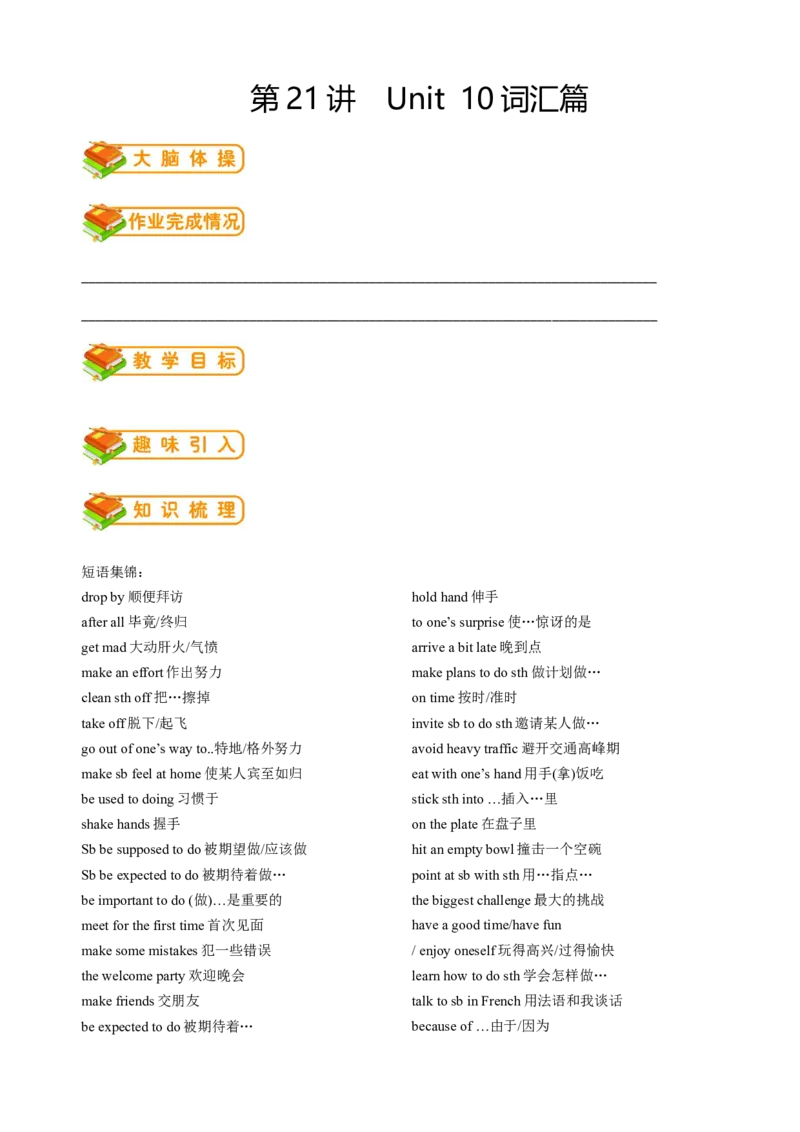
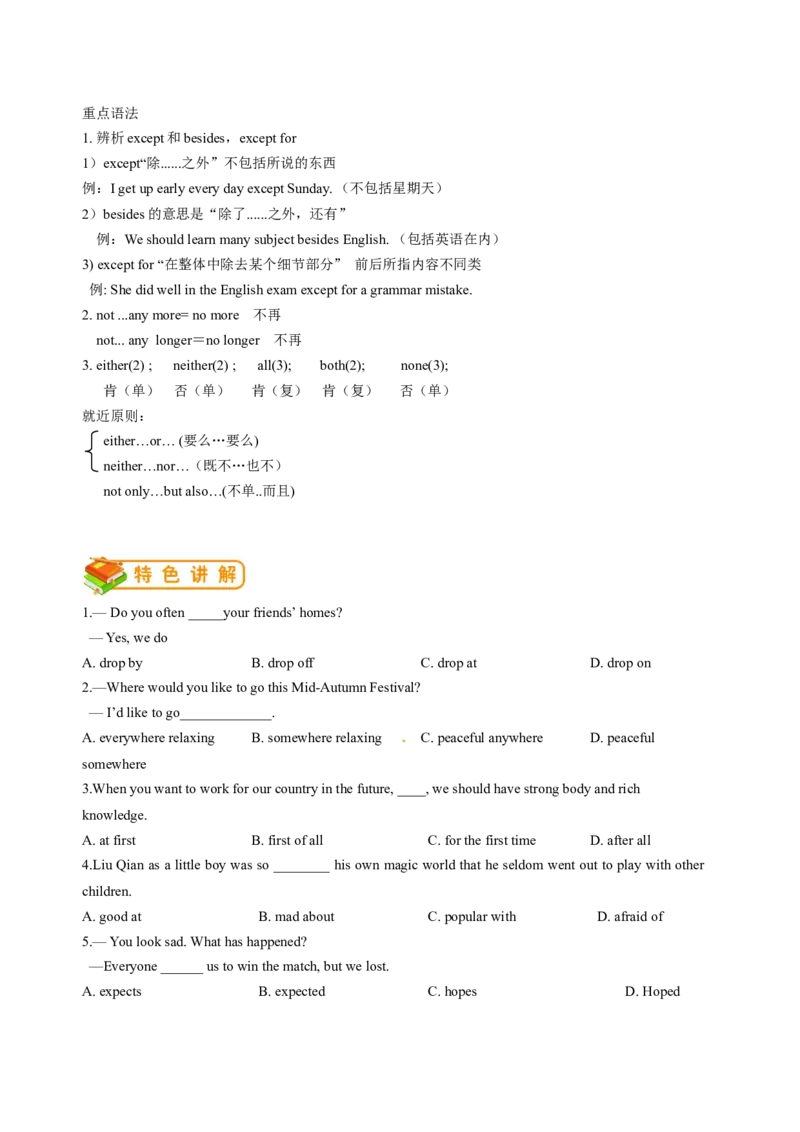
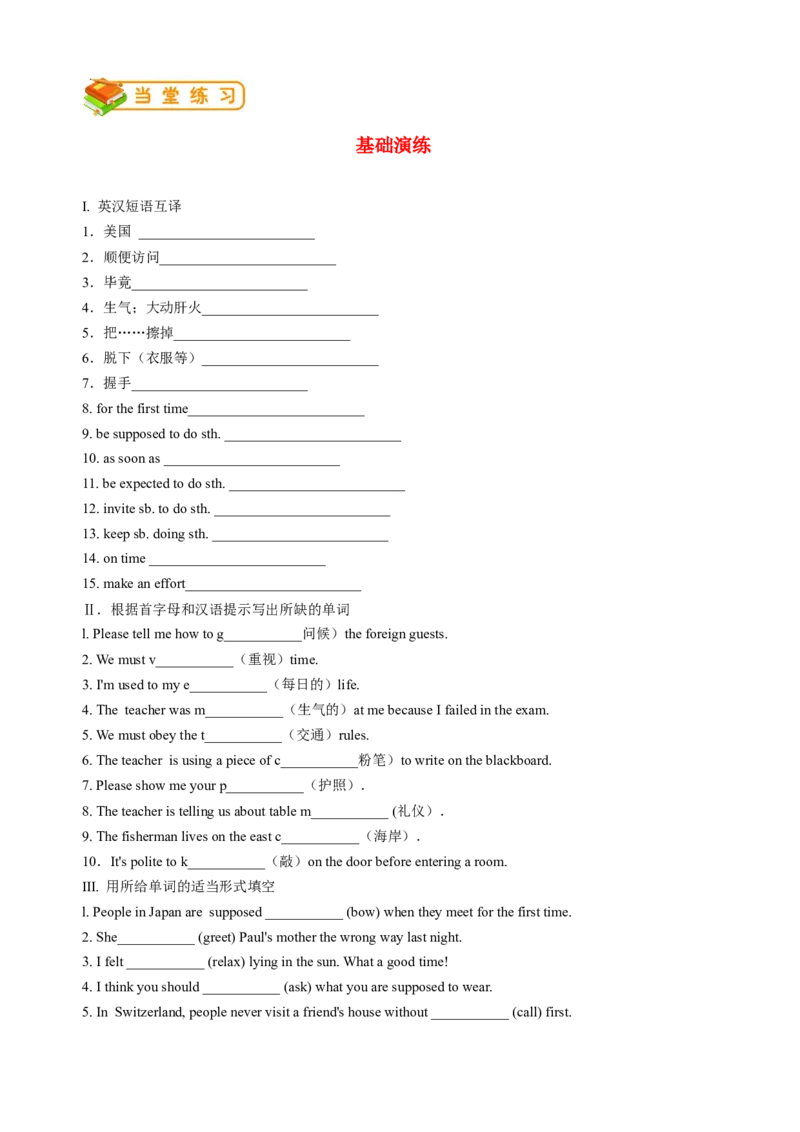
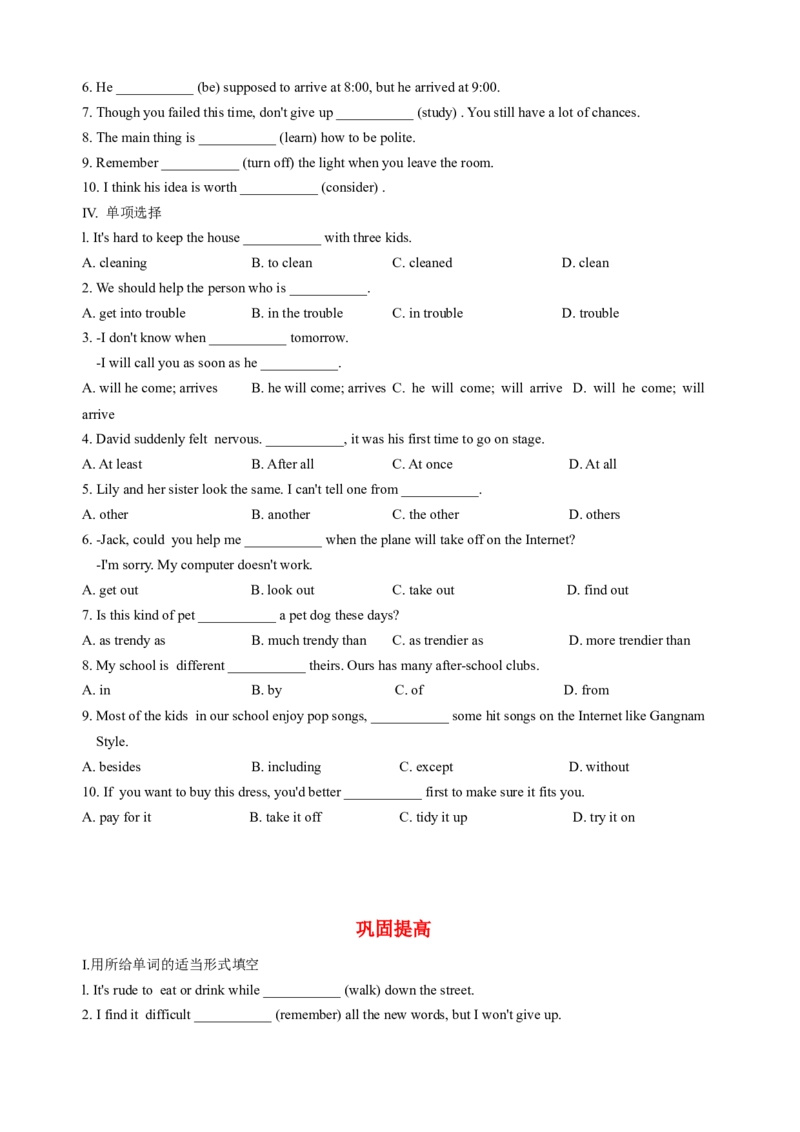
第 21 讲 Unit 10 词汇篇
__________________________________________________________________________________
__________________________________________________________________________________
短语集锦:
drop by顺便拜访 hold hand伸手
after all毕竟/终归 to one’s surprise使…惊讶的是
get mad大动肝火/气愤 arrive a bit late晚到点
make an effort作出努力 make plans to do sth做计划做…
clean sth off把…擦掉 on time按时/准时
take off脱下/起飞 invite sb to do sth邀请某人做…
go out of one’s way to..特地/格外努力 avoid heavy traffic避开交通高峰期
make sb feel at home使某人宾至如归 eat with one’s hand用手(拿)饭吃
be used to doing习惯于 stick sth into …插入…里
shake hands握手 on the plate在盘子里
Sb be supposed to do被期望做/应该做 hit an empty bowl撞击一个空碗
Sb be expected to do被期待着做… point at sb with sth用…指点…
be important to do (做)…是重要的 the biggest challenge最大的挑战
meet for the first time首次见面 have a good time/have fun
make some mistakes犯一些错误 / enjoy oneself玩得高兴/过得愉快
the welcome party欢迎晚会 learn how to do sth学会怎样做…
make friends交朋友 talk to sb in French用法语和我谈话
be expected to do被期待着… because of …由于/因为be different from与…不同
pretty strange相当奇怪
cut up sth切开
make sb adj使得某人…
show up显而易见/ 到场重点语法
1. 辨析except和besides,except for
1)except“除......之外”不包括所说的东西
例:I get up early every day except Sunday. (不包括星期天)
2)besides的意思是“除了......之外,还有”
例:We should learn many subject besides English. (包括英语在内)
3) except for “在整体中除去某个细节部分” 前后所指内容不同类
例: She did well in the English exam except for a grammar mistake.
2. not ...any more= no more 不再
not... any longer=no longer 不再
3. either(2) ; neither(2) ; all(3); both(2); none(3);
肯(单) 否(单) 肯(复) 肯(复) 否(单)
就近原则:
either…or… (要么…要么)
neither…nor…(既不…也不)
not only…but also…(不单..而且)
1.— Do you often _____your friends’ homes?
— Yes, we do
A. drop by B. drop off C. drop at D. drop on
2.—Where would you like to go this Mid-Autumn Festival?
— I’d like to go_____________.
A. everywhere relaxing B. somewhere relaxing C. peaceful anywhere D. peaceful
somewhere
3.When you want to work for our country in the future, ____, we should have strong body and rich
knowledge.
A. at first B. first of all C. for the first time D. after all
4.Liu Qian as a little boy was so ________ his own magic world that he seldom went out to play with other
children.
A. good at B. mad about C. popular with D. afraid of
5.— You look sad. What has happened?
—Everyone ______ us to win the match, but we lost.
A. expects B. expected C. hopes D. Hoped基础演练
I. 英汉短语互译
1.美国 _________________________
2.顺便访问_________________________
3.毕竟_________________________
4.生气;大动肝火_________________________
5.把……擦掉_________________________
6.脱下(衣服等)_________________________
7.握手_________________________
8. for the first time_________________________
9. be supposed to do sth. _________________________4
10. as soon as _________________________
11. be expected to do sth. _________________________21 5
12. invite sb. to do sth. _________________________2
13. keep sb. doing sth. _________________________
14. on time _________________________
15. make an effort_________________________
Ⅱ.根据首字母和汉语提示写出所缺的单词
l. Please tell me how to g___________问候)the foreign guests.3
2. We must v___________(重视)time.
3. I'm used to my e___________(每日的)life.
4. The teacher was m___________(生气的)at me because I failed in the exam.【 :21 】
5. We must obey the t___________(交通)rules.
6. The teacher is using a piece of c___________粉笔)to write on the blackboard.21
7. Please show me your p___________(护照).
8. The teacher is telling us about table m___________ (礼仪).
9. The fisherman lives on the east c___________(海岸).
10.It's polite to k___________(敲)on the door before entering a room.
Ⅲ. 用所给单词的适当形式填空
l. People in Japan are supposed ___________ (bow) when they meet for the first time.【 :21 】
2. She___________ (greet) Paul's mother the wrong way last night.
3. I felt ___________ (relax) lying in the sun. What a good time!
4. I think you should ___________ (ask) what you are supposed to wear.
5. In Switzerland, people never visit a friend's house without ___________ (call) first.6. He ___________ (be) supposed to arrive at 8:00, but he arrived at 9:00.
7. Though you failed this time, don't give up ___________ (study) . You still have a lot of chances.
8. The main thing is ___________ (learn) how to be polite.
9. Remember ___________ (turn off) the light when you leave the room.
10. I think his idea is worth ___________ (consider) .
IV. 单项选择
l. It's hard to keep the house ___________ with three kids.
A. cleaning B. to clean C. cleaned D. clean
4
2. We should help the person who is ___________.
A. get into trouble B. in the trouble C. in trouble D. trouble
8
3. -I don't know when ___________ tomorrow.
-I will call you as soon as he ___________.
A. will he come; arrives B. he will come; arrives C. he will come; will arrive D. will he come; will
arrive
4. David suddenly felt nervous. ___________, it was his first time to go on stage.
【 :0】
A. At least B. After all C. At once D. At all
5. Lily and her sister look the same. I can't tell one from ___________.
A. other B. another C. the other D. others
1
6. -Jack, could you help me ___________ when the plane will take off on the Internet?
-I'm sorry. My computer doesn't work.
A. get out B. look out C. take out D. find out
7. Is this kind of pet ___________ a pet dog these days?
A. as trendy as B. much trendy than C. as trendier as D. more trendier than
8. My school is different ___________ theirs. Ours has many after-school clubs.
A. in B. by C. of D. from
9. Most of the kids in our school enjoy pop songs, ___________ some hit songs on the Internet like Gangnam
Style.
21· * 5
A. besides B. including C. except D. without
3
10. If you want to buy this dress, you'd better ___________ first to make sure it fits you.
A. pay for it B. take it off C. tidy it up D. try it on
巩固提高
I.用所给单词的适当形式填空
l. It's rude to eat or drink while ___________ (walk) down the street.21 5
2. I find it difficult ___________ (remember) all the new words, but I won't give up.21 53. He used to ___________ (get) up early but now he doesn't.4
4. Isn't it strange that the cat is used to ___________ (lie) beside the dog peacefully? 6
5. People in Japan and people in America behave ___________(different) at the dinner table.
6. I was a bit nervous before I arrived here, but there was no reason ___________ (be).【 :21
7. I'm very comfortable ___________ (speak) English now.1
8. Thanks for ___________ (invite) me to your birthday party.21 5
9.They go out of their way to make me ___________ (feel) at home.【 :21· · ·5】
10. You won't believe how quickly my English ___________ (improve) .
11.Are you comfortable ___________ (live) in Beijing?
12. Mr. Black has been in China for three years and now he is used to ___________ (eat) Chinese food.
13.It's rude ___________ (say) you're full at the table in this country.
II. 根据汉语意思和所给的提示词翻译句子
1.除了最后一个问题,所有的问题都是容易的。(are,except)
_______________________________________________________6
2.你已经习惯早起了吗?(get)
_______________________________________________________
3.他指着地图,告诉我他的故乡在哪里。(pointed, told)
_______________________________________________________
4.这家宾馆使我觉得宾至如归。(made)
_______________________________________________________
5.我一到巴黎,就会给你写信。(as soon as,arrive)
_______________________________________________________
III.句型转换
l. You are supposed to eat with your hands.(对画线部分提问)【 :21 】
___________ are you supposed ___________ ________?
2. They arrived at school late because the traffic was heavy.(改为同义句)21
They were ________ ___________ school ___________ ___________ the heavy traffic.
3. Having a healthy lifestyle is very important.(改为同义句)21 5
___________ very important ___________ ___________ a healthy lifestyle.
4.We expected them to win the race.(用they改为被动句)
They ___________ ___________ ___________ win the race.
IV.单项选择
1.Don’t point anyone your chopsticks. It’s not polite
.A. at; by B. at; with C. to; by D. out; with
2.—Do you often your friends’ homes on your way home?
—Yes, we do.
A. drop by B. visit to C. come at D. come over at
3.Jane her way to be nice to her new classmate.A. got out of B. went out of C. got out D. went out
4.I in London now, but it was hard at the beginning.
A. used to driving B. am used to drive C. am used to driving D. used to drive
5.—Would you like some cakes? —No, thanks. I am .
A. empty B. strange C. hungry D. full
6.Don’t let the kid run so fast. He is so young, .
A. all after B. after all C. even though D. as a result
7.People are to when they meet for the first time.
A. suppose; shake hand B. supposed; shake hands
C. supposed; shake hand D. suppose; shook hands
8.I found difficult to remember everything, though I’m still young.
A. that B. this C. it D. what
9.He at the last party. He felt sorry for it.
A. makes some mistakes B. make a mistake
C. made few mistakes D. made many mistakes
10.--Is it easy for people from different countries to greet each other?
—I don’t think so. Because different countries have different .
A. clothes B. food C. ways D. customs
11.You can how different the table manners here are from ours.
A. imagine B. meet C. look D. hear
12.John Beijing the day before yesterday.
A. arrived at B. arrived C. reached to D. arrived in
13.In Switzerland, people visit a friend’s house.
A. make plans B. make plan to C. make plans to D. make a plan
14.It’s too hot. Do you mind the window?
A. my closing B. my opening C. open D. close
15.---Tom, it’s to talk loudly in the library. ---Sorry, I won’t.
A. common B. polite C. impolite D. unusual
I.单项选择
1. If you want to read English quickly, you must learn ___________ English words by heart as you can.
A. as much B. so much C. as many D. so many
【 :21 】
2. The children will climb the hill if it ___________ tomorrow.
6
A. won't rain B. didn't rain C. isn't raining D. doesn't rain
【 :0】
3. Don't worry. We'll try to make ___________ at home.A. her to feel B. her feel C. herself to feel D. herself feel
4. ___________ impolite ___________ at anyone with your chopsticks.
A. That's; to point B. That's; to pointing C. It's; to point D. It's; to pointing
5. They went out of their way ___________ that big problem.
A. to solve B. solve C. solving D. to solving
6. The peaceful music in the CD made the students ___________ relaxed.
A. feel B. feels C. felt D. to feel
7. -Could you give me some ___________ on how to learn English ___________?
-Sure. Practice makes perfect.
A. advice; good B. suggestions; good C. advice; well D. suggestion; well
8. -All the workers went home yesterday ___________ Mr. White. Why?
-Because he was on duty.
A. except B. Besides C. except for D. beside
9. You are supposed to smoking, ___________ you will get ill.
A. go on; so B. give up; or C. stop; so
10. You should ___________ here at 7:00 this morning. But you arrived at 8:00.You were late.
A. have arrived B. arrived C. arrive D. had arrived
3
ll. -Thanks ___________ joining the Talk Show!
-You're welcome.
A. by B. on C. of D. for
12. Don't eat the noodles___________ your hands. Here you are. The chopsticks.
8
A. about B. for C. of D. with
13. I ask you to sit down ___________ table, not to sit down ___________ the table.
A. at; in B. at; at C. on; to D. in; in
14. Please don't point ___________ anyone ___________ chopsticks.
A. to; on B. in; at C. at; with D. with; for
II.完型填空
A
Where I’ m from, we’re pretty 1_______ about time. We don’t like to rush around, so we don’t mind if
people are a little late 2.__________. If you tell a friend you’re going to their house for dinner, it’s OK if you
arrive a bit late. We like to 3_______our time slowly. We 4_______the time we spend 5______ our family
and friends in our everyday’s lives . We often just 6_______ our friends’ home if we have time. We don’t
usually have to make plans 7_________our friends. When we see each other, it’s polite for boys to shake
hands and for girls to kiss each other on the side of the face. We often just walk around the town center,
8______ as many of our friends as we can.
1. A. relax B. relaxed C. relaxing D. relaxes
2. A. sometimes B. sometime C. some time D. some times
3. A. enjoy B. spend C. take D. cost4. A. spend B. value C. treasure D. take
5. A. with B. on C. in D. for
6. A. drop by B. drop in C. drop at D. drop
7. A. meeting B. to meet C. met D. meet
8. A. see B. to see C. seeing D. saw
B
Chinese eating habits are different from those in Western countries. In the West,everyone has their
own plate of food. But in China the dishes are 9 on the table and everyone shares. If you are being treated
by a Chinese host,there must be a lot of food prepared for you. Chinese are very 1 0 of their culture and
will do their best to show their hospitality(好客).
And sometimes the Chinese hosts use their chopsticks to put food in your bowl or plate. This is a sign of
politeness. The proper thing to do would be to eat the whatever-it-is and say how 1 1 it is. If you feel
uncomfortable with this,you can just say “thanks” and leave the food there. Don’t 12 your
chopsticks upright into the rice bowl. Instead,lay them on your dish. The reason for this is that when
somebody 1 3 ,the shrine (圣殿) to him has a bowl of sand or rice with two chopsticks which are
stuck upright in it. It is impolite to set the teapot down where the spout (壶嘴) is facing 1 4
somebody. The spout should always be directed to where nobody is sitting,usually just outward from the
table.
Don’t hit your bowl with your chopsticks. Beggars hit their bowls,so this is not polite. Also,when the
food is coming too 1 5 in a restaurant,people will tap their bowls. If you are in someone’s home,it
is like offending the cook.
9. A. made B. cooked C. eaten D. placed
10. A. afraid B. tired C. proud D. certain
11. A. delicious B. beautiful C. terrible D. comfortable
12. A. Fall B. throw C. knock D. stick
13. A. comes B. goes C. dies D. lives
14. A. against B. towards C. over D. above
15. A. often B. early C. slow D. Fast
_________________________________________________________________________________
_________________________________________________________________________________
I.单项选择
1.—You look sad. What has happened?(-15江苏单元测试)
—Everyone us to win the match, but we lost.
[来源:Z§xx§k.Com]
A. expects B. expected C. hopes D. hoped
2. —Is your friend Michael still in Australia?(-15江苏单元测试)
—I don’t know.
I have information about him because we haven’t seen each other for years.
A. a little; a few B. little; a few C. a few; a little D. few; a little3. —What do you usually do in the morning?—I often practice English.(-15江苏单元测试)
A. speak B. to speak C. speaking D. spoken
4. We often drop our friends’ homes after school. (-15江苏单元测试)
A. for B. with C. by D. of
5. It’s very hot here. Why not your coat?(-15江苏单元测试)
A. put on B. try on C. take off D. turn off
6. Listening to the music always makes me
A. relaxed; relaxing B. relaxed; relaxed C. relaxing; relaxing D. relaxing; relaxed
7. Animals are our close friends. We are supposed them.
A. to protect B. protecting C. protect D. protected
8. —All the workers went home yesterday Mr. White. Why?
—Because he was on duty.
A. except B. besides C. except for D. beside
9. As we know,it’s not polite to keep others for a long time.
A. wait B. waited C. to wait D. waiting
10. Thank you for me .
A. invite B. inviting C. invited D. Invites
11. the teacher, I’ve made great progress.
A. Thank you B. Thanks for C. Thanks to D. Thanks you
12. Students should learn how problems.
A. solve B. solving C. can solve D. to solve
13. —Why are you so excited?
—Peter invited me on a trip to Yuntai Mountain.
A. to go B. go C. going D. went
14. I find difficult to work with her.
A. her B. me C. that D. it
15. The Greens used to live in London and now they in Beijing.
A. used to live B. are used to live C. are used to living D. are used for living
II.阅读理解
A
If you’re invited to your British or American friend’s home for a meal at home,you should learn some
table manners about their countries.
Their dinner parties usually start between 7 and 8 p. m. and end at about 11 p. m. Ask your hosts what
time you should arrive. It’s polite to bring flowers,chocolates or a bottle of wine as a gift.
Usually the evening starts with drinks and snacks(小吃). If you want to be more polite,say how
much you like the room,or the pictures on the wall. But remember—it’s not polite to ask how much things
cost.
In many families,the husband sits at one side of the table and the wife sits at the other end. They eat
with their guests. You’ll probably start the meal with soup or something small,then you’ll have meat or fish
with vegetables,and then dessert(甜点心),followed by coffee. It’s polite to finish everything on your
plate and to take more if you want it.
Did you enjoy the evening?Call your hosts the next day,or write them a short “thank you” letter.
British and American people like to say “thank you,thank you” all the time!
1.It’s impolite .A. to ask about the price of a certain thing
B. to say “thank you” to hosts
C. to take something with you when you are invited to dinner
D. to eat up everything on your plate
2.When you are invited to a dinner party,you’d better .
A. ask what time you should arrive
B. take your wife with you
C. drink as more as possible
D. eat more snacks as you can
3.You’ll probably start the meal with .
A. meat B. coffee C. dessert D. soup
4. The meal ends with usually.
A. soup B. coffee C. meat or fish D. dessert
5. Which of the following is true?
A. The hosts like the people who sit closer to them.
B. The hosts like the people who ask them time,price,age,etc.
C. The husband and the wife usually sit together.
D. You can call your host the next day or write a letter of thanks after that.
B
At present, more and more people are crazy about travelling. Why do people travel? “To see more of
the world, ” many people would say. But travelling abroad now means much more than that for the growing
number of Chinese tourists. Of course it offers us good opportunities to meet people from other countries,
learn about their culture and customs.
According to the United Nations World Tourism Organization (UNWTO), more than 1 billion people
travelled to another country in 2012. In 2012, Chinese people travelled abroad 30 percent more than in 2011.
The prosperity (繁荣) of the tourism industry can also bring both our country and foreign countries great
economic benefits (经济利益). Chinese people usually join large tourist groups and visit several countries in
one trip.
Chinese people don’t just travel for sightseeing. The China International Travel Service Company said
that all their tour trips sold out a month before Christmas Day. Stores offered discounts (打折) during that
time, so shopping in Europe and the United States is popular among Chinese travellers.
In December, China is going through a very cold winter. So many people like to go to some countries in
Southeast Asia because the weather there is quite pleasant.
The improvement of living standards means more Chinese can travel abroad. But many of them don’t
have a sense of public manners. A report by Living Social website in March 2012 even listed Chinese as the
world’s second worst tourists.
If you want to change that bad name, remember to avoid the following: littering, spitting, snatching bus
seats, line-jumping, taking off shoes in public, talking loudly and smoking in non-smoking areas. Besides, we
should learn some necessary manners of foreign countries.
1.Chinese people travel abroad not to .
A. go shopping B. see more of the world
C. go sightseeing D. make money
2.According to the United Nations World Tourism Organization, .
A. 30% of the people who travelled abroad are Chinese
B. the number of people who travelled abroad rose by 30%
C. more than 1 billion people travelled abroad in 2012D. more than 1 billion Chinese people travelled abroad in 2012
3.Which of the following is NOT true about Chinese people?
A. Chinese people like joining large tourist groups.
B. Many Chinese like to go to Southeast Asia in winter for sightseeing.
C. More and more Chinese people can travel abroad now.
D. According to the report, Chinese are the second worst tourists in the world.
4.As a good tourist, you should .
A. litter and spit here and there B. jump the line and take off the shoes in public
C. have a sense of public manners D. speak loudly and smoke as you like
5.What’s the best title of the passage?
A. Travelling B. Travelling abroad
C. Chinese tourists D. Chinese people like travelling
C
Giving gifts is a kind of knowledge, is also one kind of strategy(策略). In the western countries, you
should be careful of giving gifts. Never give a gift in a job interview or at a business meeting. Gifts are
usually given during special holidays, or as a “ thank you” for special invitations. When arriving at a special
party, you may give your gift to the host once the introductions are made. Here are a few rules:
Be modest(适度) with your gift. Do not buy gifts that are too expensive, such as a Swiss watch, a gold
ring or a gold necklace. A special food from your country, a bottle of wine, candy, or flowers are the best if
you do not know the host very well, but be sure that your gift will not need much attention. You can usually
say something like “ I hope you will like it.” when you offer your gift.
Be careful of giving wine. A bottle of wine is usually all right if you know your host drinks wine, but
hard alcohol(酒精) such as whisky(威士忌) should only be given as a gift when you know the host well and
are certain that they would like such a gift. Flowers are good, but remember: roses are for special love. You
have to be careful.
A small cultural gift from your country is usually very good. Make sure that your gift is packed(包装)
nicely. A nice card with it will be better.
1.According to the passage, people usually don’t give gifts ________.
A .on Christmas Day B. on someone’s birthday
C. in a job interview or at a business meeting D.on NewYear’s Day
2. The passage mentions _______ rules about giving gifts.
A. three B. four C. five D. six[来源:学科网ZXXK]
3. Which gift is the most proper among the following four kinds?
A. A bottle of whisky. B. Special food from your country.
C. Roses. D. A Swiss watch.
4.Which of the following is TRUE according to the passage?
A. It is not necessary to pack the gift nicely.
B. Your gift should draw everyone’s attention.
C. Hard alcohol is a good gift to most of the people.
D.You can give your gift to the host once the introductions are made.
5. The best title for the passage is _______.
A.The Rules of Gifts Giving B. How to Buy Gifts
C. Table Manners D.Cultural Differences
III.任务型完形填空
根据短文内容,从方框内选择合适的单词并用其适当形式填空,使短文完整、连贯。(有两项多
余)mad, just, instead, kiss, basic, impolite,
visitor, shut, mistake, effort, avoid, mean
You don’t need to speak French to understand the Parisians (people living in Paris). You (1)
need to know how to make gestures (手势). A new guide has come out by French tourism (旅游业) officials.
It is to help foreign (2) understand the Parisians with a list of common gestures like “(3)
up” and “Wait a minute”. These gestures are easy and vivid (生动的). “If you use them in Paris, people will
start to (4) you for a native,” says the online guide at www.cestsoparis.com.
Some of the city’s (5 ) native people in Paris have been a headache for the tourism authorities (旅
游当局) for a long time. They have made an (6) to ask the Parisians to be friendlier to foreigners.
At the same time, they have decided to show visitors some (7) gestures by the Parisians at
www.cestsoparis.com. Visitors can learn and get help from there.
The website includes the common gestures such as “Bof” and “Camembert”. “Bof” (8) “I don’t
know” or “I disagree”, and “Camembert” is to tell someone to stop talking.
And it also includes a note, which warns visitors to (9) using the gestures too freely. “Wrong
gestures may make others go (10) easily,” says the online guide.
IV.任务型阅读理解
With the development of society, we communicate more and more with western people.①customs,
important, it’s, know, some, western, for, us, to.
When you meet and greet people, the simplest thing to say is “Good morning”, “Good afternoon”②o__
“Good evening”. This kind of greeting is given to one whom you only know a little, or to anyone you are
passing quickly. “How are you?” is usually③ (use) when you are not in such a hurry .You reply should be
“Fine, thank you”. “Hello” is the commonest from of greeting between good friends.
[来源:学§科§网]
When introducing two people, the general rule is: Introduce other people to the person you wish to
respect.Old people and women are respected in the west as in China. A man alwaysstands up for an
introduction, but sometimes it’s all right for an elderly man to remain seated when a young man is
introuduced to him..
④When you receive an invitation, you should answer it at once. If you cannot give an answer at that
time, you may say, “May I let you know this evening?” or something similar.
任务一:1.将①处划线部分的单词组成正确的句子。
任务二:2.根据②处首字母提示,补全所缺单词,使句意完整。
[来源:Z。xx。k.Com]
任务三:3.用③处所给单词的正确形式填空。
任务四:4.将④处英文翻译成中文。
任务五:5.What does the passage mainly tell us about?
V.用所给单词的正确当形式填空。
1. You are ______ (suppose) to shake hands when you meet a Chinese friend.
2. Keep your eyes ______ (close) when you are doing eye exercises.
3. A knife is _____ (use) for _______ (cut) things.
4. Trees can keep water from _______ (run) away.
5. Do you remember______ (clean) the room after supper?21cnjy.com
6. Is it worth_______(spend)much time to learn about the customs?
7. Though you failed this time, don’t give up ______ (study).You still have a lot of chances.
8. It is very important ________ (spend) time with family and friends.9. Don’t forget ________ (turn off) the light when you leave the room.
10. People are pretty _______ (relax) about time in Colombia.
[来源:学科网]
V.根据汉语提示完成句子。
1.这辆汽车太旧了,不值得修。
This car is too old to be _____ ______
2. 从繁忙的学习中放松自己是很重要的。
It’s very important ourselves from our busy studies.
3. 游客应该尊重当地的风俗传统。
Tourists are __________ __________ respect the local customs and traditions.
4.我现在已经习惯了北京的生活。I am used_____ _______ in Beijing.
5. 我们老师不厌其烦地给我讲这道题。
Our teacher got out of her/his way____ ______ this problem for us.
VI.书面表达
假如你是刘阳,你的笔友David发来e-mail,说他下星期来中国,现在向你询问中国的餐桌
礼仪,请你给他回一封e-mail,告诉他有关中国餐桌礼仪的情况。
提示:1. 不要用筷子敲碗;
2. 不要将手伸到对面夹菜;
3. 等大家都到齐了才开始吃饭;
4. 为主人的长寿、健康、成功祝福。
要求:80~100词。
参考词汇:guest客人, elder长辈, tap敲打, longevity长寿。
课程顾问签字: 教学主管签字:www.3abeike.com
(按住Ctrl键点击该链接即可)