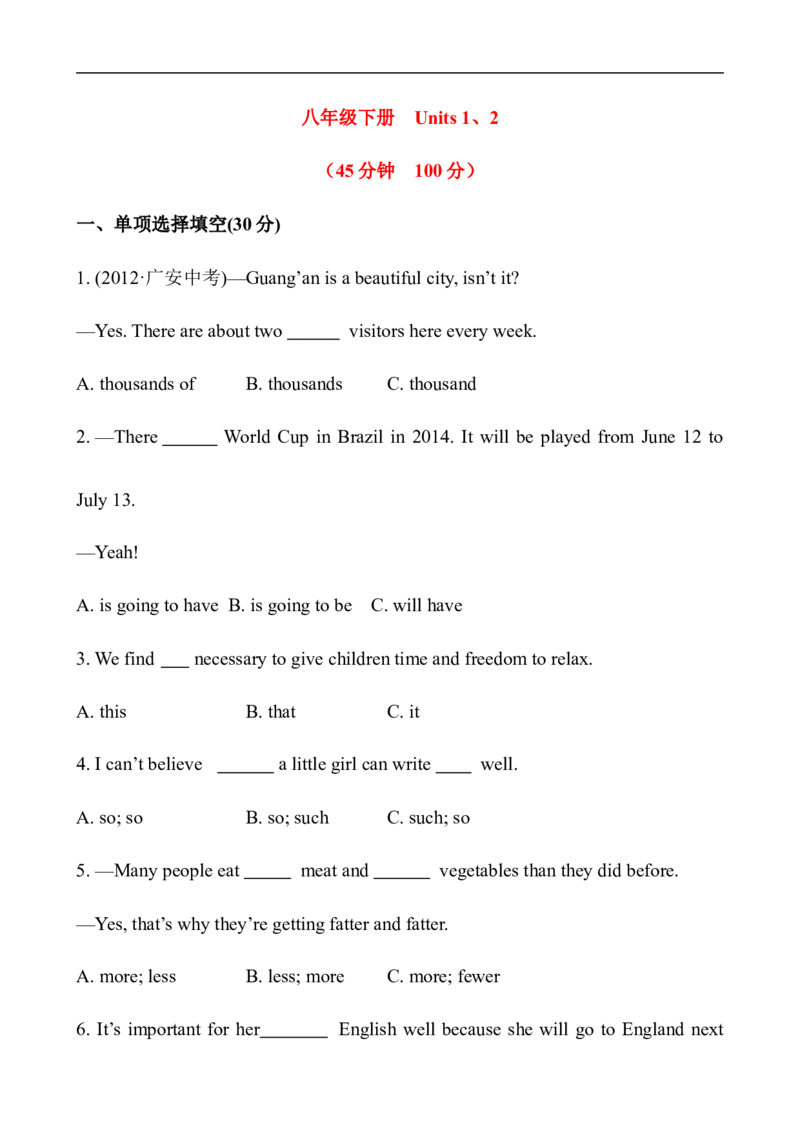
八年级下册  Units 1、2
(45 分钟  100 分)
一、单项选择填空(30 分)
1. (2012·广安中考)—Guang’an is a beautiful city, isn’t it?
—Yes. There are about two

    visitors here every week.
A. thousands of
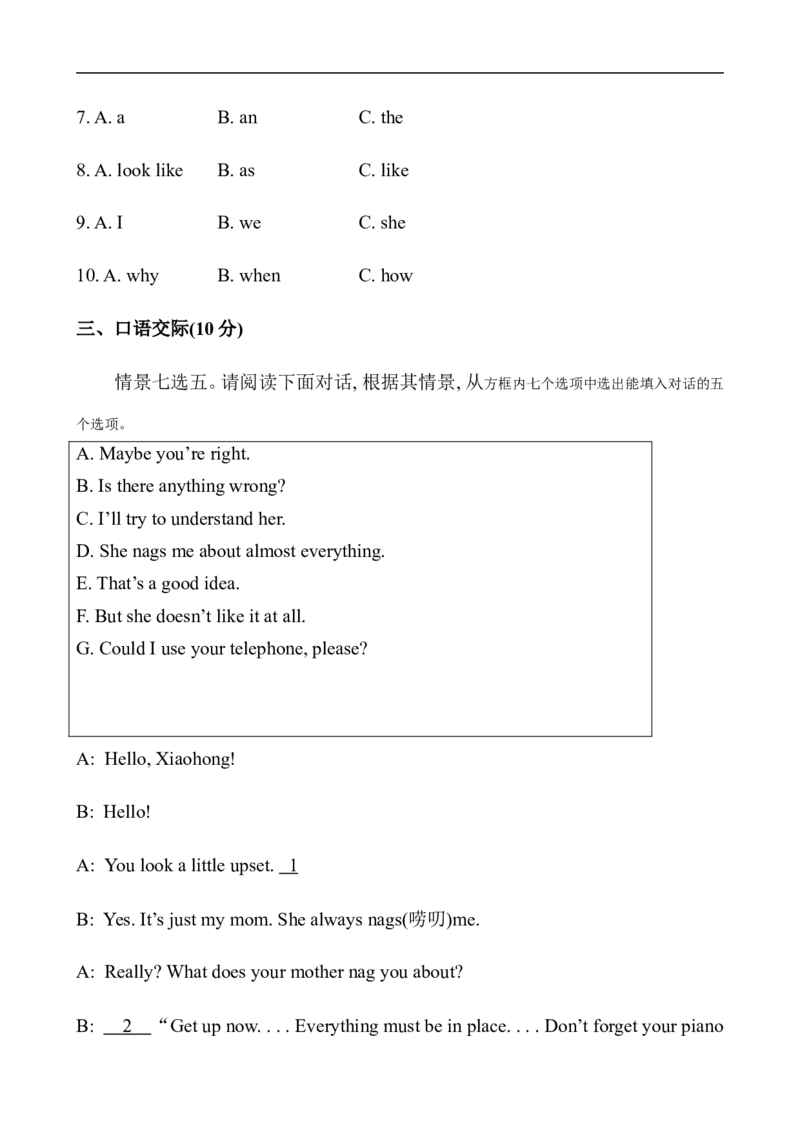
B. thousands
C. thousand
2. —There


  World Cup in Brazil in 2014. It will be played from June 12 to
July 13.
—Yeah!
A. is going to have  B. is going to be  C. will have
3. We find

  necessary to give children time and freedom to relax.
A. this
B. that
C. it
4. I can’t believe


  a little girl can write

  well.
A. so; so
B. so; such
C. such; so
5. —Many people eat       meat and        vegetables than they did before.
—Yes, that’s why they’re getting fatter and fatter.
A. more; less
B. less; more
C. more; fewer
6. It’s important for her       English well because she will go to England next
year.
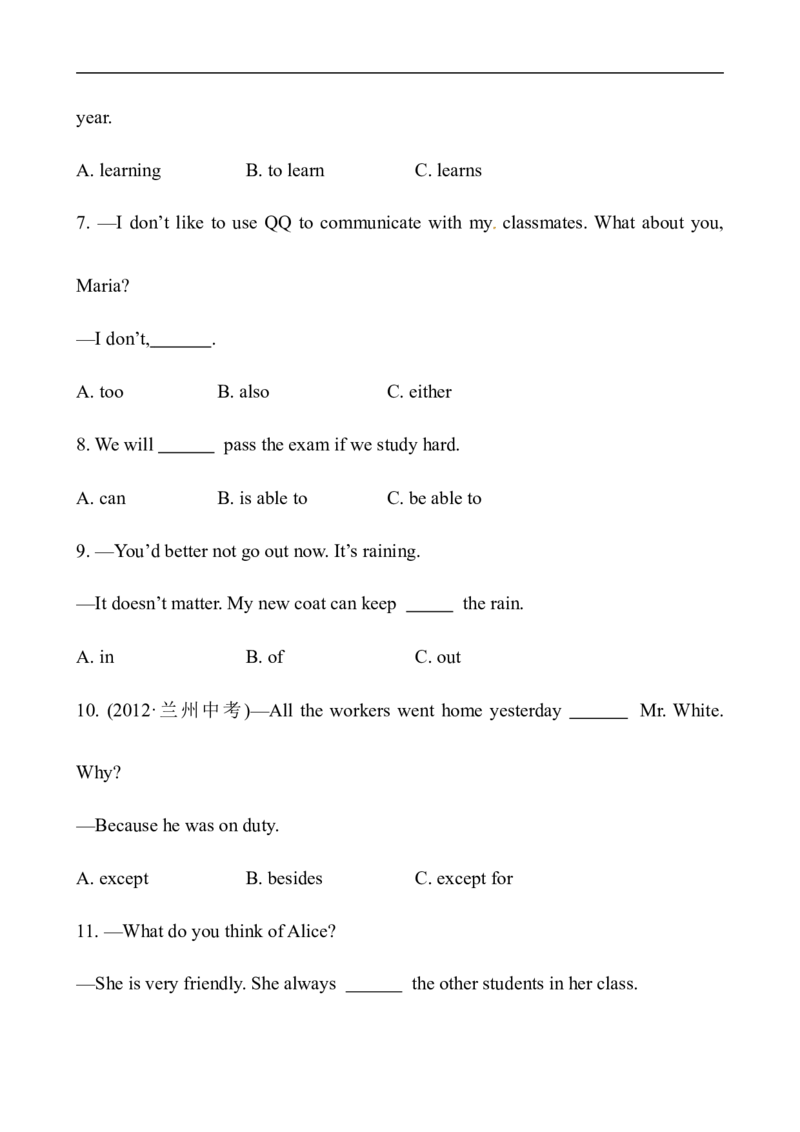
A. learning
B. to learn
C. learns
7. —I don’t like to use QQ to communicate with my classmates. What about you,
Maria?
—I don’t,

 .
A. too
B. also
C. either
8. We will        pass the exam if we study hard.
A. can
B. is able to
C. be able to
9. —You’d better not go out now. It’s raining.
—It doesn’t matter. My new coat can keep       the rain.
A. in
B. of
C. out
10. (2012·兰州中考)—All the workers went home yesterday       Mr. White.
Why?
—Because he was on duty.
A. except
B. besides
C. except for
11. —What do you think of Alice?
—She is very friendly. She always        the other students in her class.
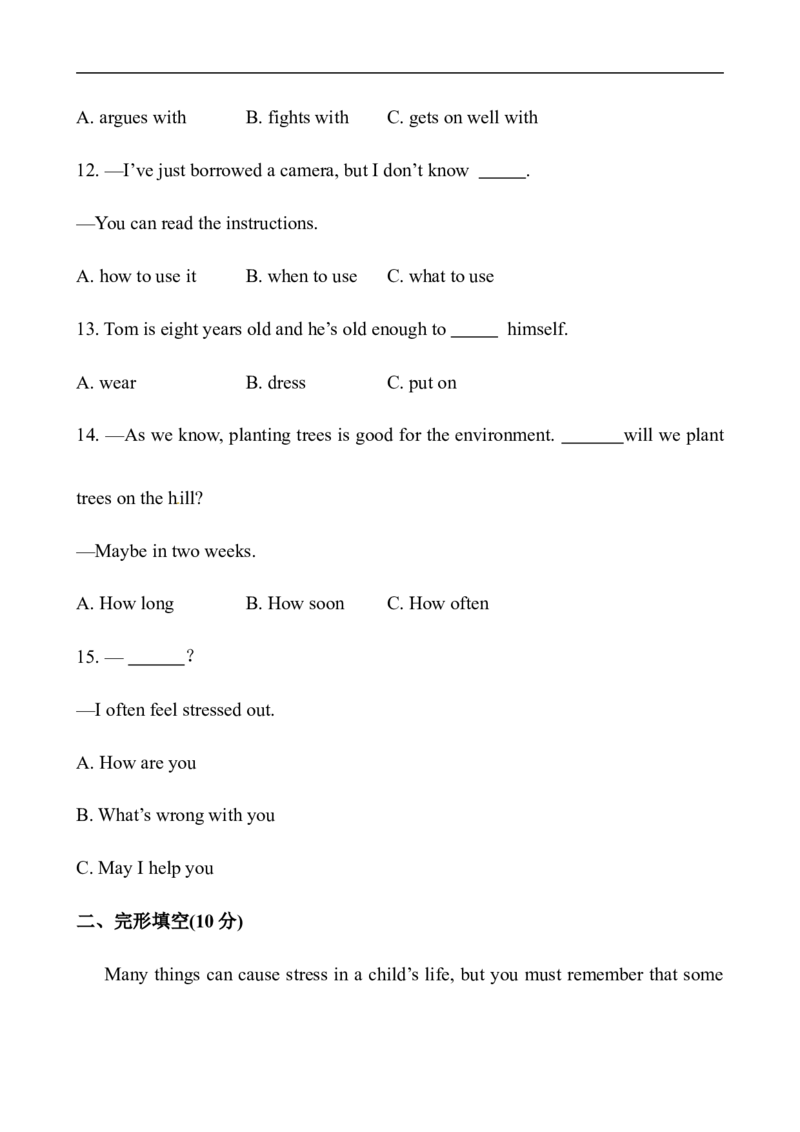
A. argues with
B. fights with
C. gets on well with
12. —I’ve just borrowed a camera, but I don’t know      .
—You can read the instructions.
A. how to use it
B. when to use
C. what to use
13. Tom is eight years old and he’s old enough to       himself.
A. wear
B. dress
C. put on
14. —As we know, planting trees is good for the environment.       will we plant
trees on the hill?
—Maybe in two weeks.
A. How long
B. How soon
C. How often
15. —       ?
—I often feel stressed out.
A. How are you
B. What’s wrong with you
C. May I help you
二、完形填空(10 分)
Many things can cause stress in a child’s life, but you must remember that some
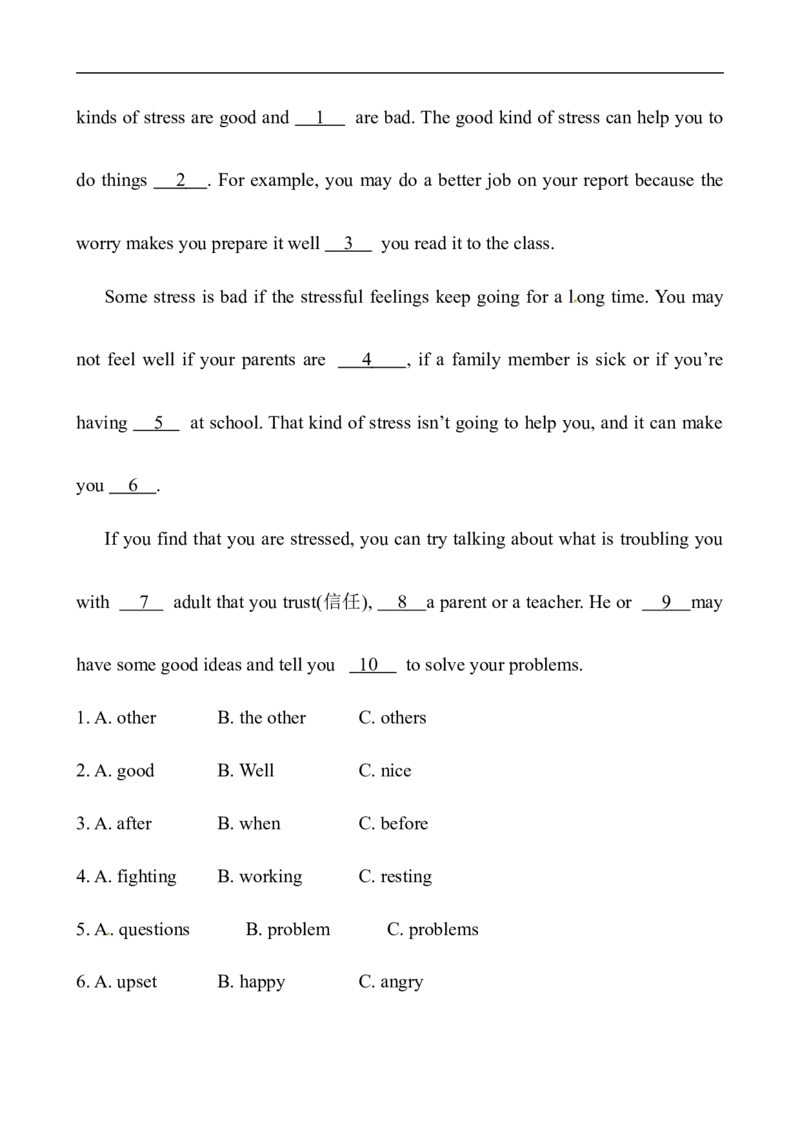
kinds of stress are good and
  1
   are bad. The good kind of stress can help you to
do things   2
  . For example, you may do a better job on your report because the
worry makes you prepare it well
  3
   you read it to the class.
Some stress is bad if the stressful feelings keep going for a long time. You may
not feel well if your parents are
  4

 , if a family member is sick or if you’re
having
  5
    at school. That kind of stress isn’t going to help you, and it can make
you
  6
  .

If you find that you are stressed, you can try talking about what is troubling you
with   7     adult that you trust(信任),
  8
  a parent or a teacher. He or   9
  may
have some good ideas and tell you   10

   to solve your problems.
1. A. other
B. the other
C. others
2. A. good
B. Well
C. nice
3. A. after
B. when
C. before
4. A. fighting
B. working
C. resting
5. A. questions
B. problem
C. problems
6. A. upset
B. happy
C. angry
7. A. a
B. an
C. the
8. A. look like
B. as
C. like
9. A. I
B. we
C. she
10. A. why
B. when
C. how
三、口语交际(10 分)
    情景七选五。请阅读下面对话, 根据其情景, 从方框内七个选项中选出能填入对话的五
个选项。
A. Maybe you’re right.
B. Is there anything wrong?
C. I’ll try to understand her.
D. She nags me about almost everything.
E. That’s a good idea.
F. But she doesn’t like it at all.
G. Could I use your telephone, please?
A: Hello, Xiaohong!
B: Hello!
A: You look a little upset.  1
B: Yes. It’s just my mom. She always nags(唠叨)me.
A: Really? What does your mother nag you about?
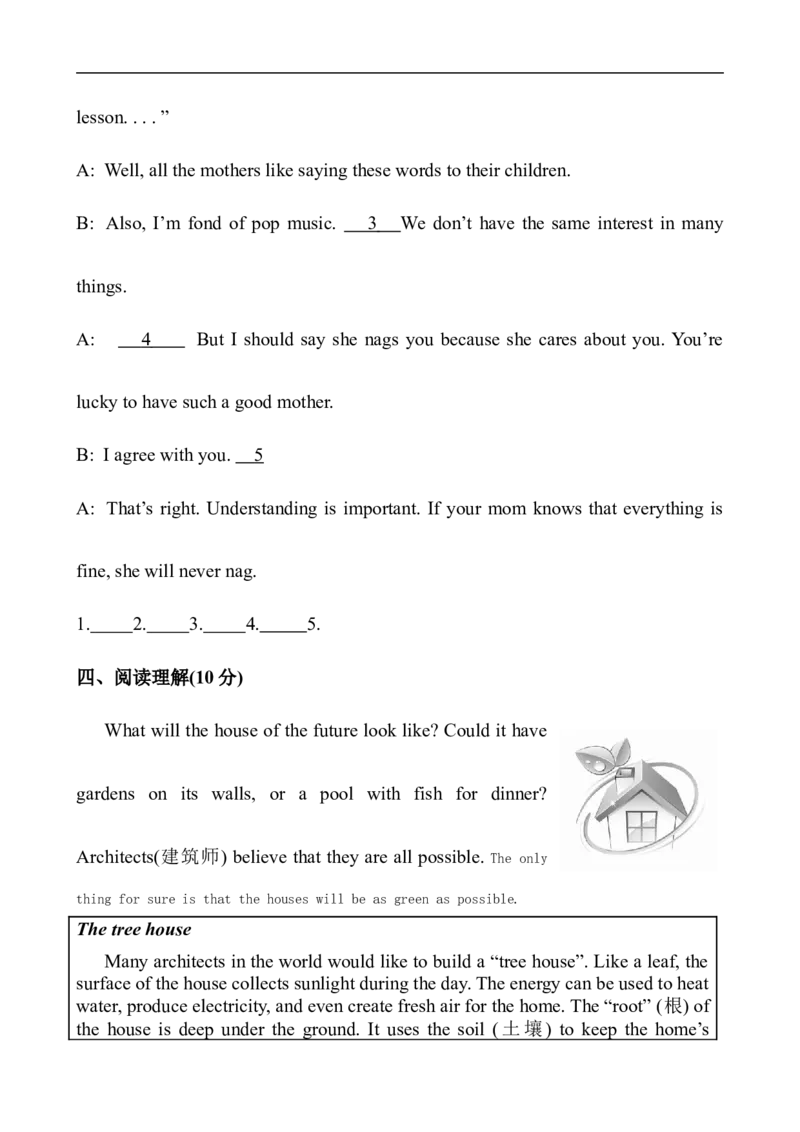
B:
  2
  “Get up now. . . . Everything must be in place. . . . Don’t forget your piano
lesson. . . . ”
A: Well, all the mothers like saying these words to their children.
B: Also, I’m fond of pop music.
  3
  We don’t have the same interest in many
things.
A:
  4

  But I should say she nags you because she cares about you. You’re
lucky to have such a good mother.
B: I agree with you.
  5
A: That’s right. Understanding is important. If your mom knows that everything is
fine, she will never nag.
1.

 2.

 3.

 4.     5.
四、阅读理解(10 分)
What will the house of the future look like? Could it have
gardens on its walls, or a pool with fish for dinner?
Architects(建筑师) believe that they are all possible. The only
thing for sure is that the houses will be as green as possible.
The tree house
Many architects in the world would like to build a “tree house”. Like a leaf, the
surface of the house collects sunlight during the day. The energy can be used to heat
water, produce electricity, and even create fresh air for the home. The “root” (根) of
the house is deep under the ground. It uses the soil ( 土壤) to keep the home’s
temperature.
The Lizard house
Like a lizard ( 蜥蜴), changing color with the weather is the most important
design of a lizard house. When it’s in the bright sun, the cover of the house will turn
dark to protect it from strong heat. During dark days, it turns white and takes in as
much light and heat as possible to produce energy.
Meals at home
This design is perhaps as much about the future of food production as
architecture (建筑风格). It has gardens on the outside wall of the house. People can
plant tomatoes, carrots and green tea in them. So every day in the morning, you just
need to walk outside and collect your meals.
1. The “root” (根) of the house uses the soil (土壤) to      .
A. keep the home’s temperature
B. produce electricity
C. protect it from the cold wind
2. We can heat water, produce electricity or create fresh air for the home

  .
A. with the root of a leaf
B. with the energy from sunlight
C. with the soil under the ground
3. What will happen to the cover of the lizard house when it’s in the bright sun?
A. It will take in light.
B. It will produce energy.
C. It will turn dark.
4. The passage seems to tell us that meals at home in the future will       .
A. be more delicious
B. need more cooks
C. be greener
5. What is the best title (标题) of the passage?
A. Green houses of the future
B. The greener, the better
C. How to build green houses
五、任务型阅读(10 分)
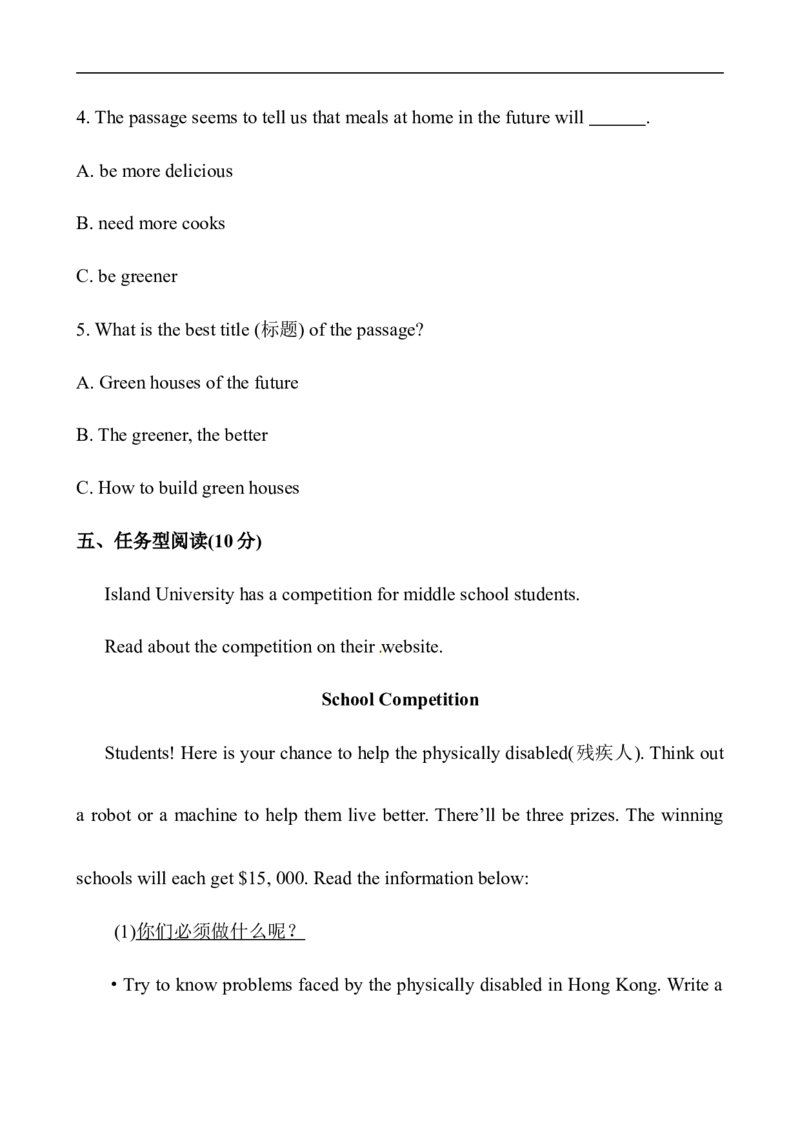
Island University has a competition for middle school students.
Read about the competition on their website.
School Competition
Students! Here is your chance to help the physically disabled(残疾人). Think out
a robot or a machine to help them live better. There’ll be three prizes. The winning
schools will each get $15, 000. Read the information below:
    (1)你们必须做什么呢?
·Try to know problems faced by the physically disabled in Hong Kong. Write a
200-word article on the difficulties these people have to suffer each day.
·Try to know modern inventions that help the physically disabled. Then think
out a robot or a machine that will improve the lives of the physically disabled. Draw
your invention. (2)You can make as many drawings as you like to show your
invention. You can even make a small model of your invention.
·Write a short description of your invention.
Who can join?
All middle school students in Hong Kong.
So, come on! Join the competition, and get the chance!
1. Where can you find the information?

2. Why is the school competition held?

3. What prize will each winning school get?

4. 将短文中画线句子(1)翻译成英语。

5. 将短文中画线句子(2)翻译成汉语。

六、词汇部分(5 分)
用括号内所给单词的正确形式填空
1. How      (color) the flowers in the garden are!
2. Are there any tall       (build)near your house?
3. I       (invite) to my friend’s party last Sunday.
4. —Do you believe the speaker’s prediction?
—No, I think he’s       (kid).
5. My parents don’t want me to do any housework. They just do it all by ______
(they).
七、句子改错(10 分)
下列各句中均有一处错误, 请写出并改正
1. Will there be fewer pollution in the future?
                                          —— ——
2. Tom doesn’t like playing lonely.              —— ——
3. Hollywood is one of the biggest movie company in the world.
                                          —— ——
4. It’s easy for the boy work out the math problem. —— ——
5. Predict the future can be difficult.             —— ——
八、书面表达(15 分)
    我们学校举办以“家乡的变化”为主题的英语征文活动, 请你根据下表提
示, 以“The Changes in My Hometown”为题, 用英语写一篇80 词左右的短文。
The Changes in My Hometown
____________________________________________________________________________
____________________________________________________________________________
___________________________________________________
答案解析
一、1.【解析】选C。由题意知, 此处意为“两千名游客two thousand visitors”, 表示
具体数目不用thousands。
2.【解析】选B。there be 句型的将来时态为“there will be”或“there is/are going to
be”, is/are 的区别在于后跟的名词单复数形式。
3.【解析】选C。考查it 作形式宾语的用法。find + it + adj. +to do sth. 结构中, it 代
替后面的不定式(短语)作形式宾语。故选C。
4.【解析】选C。第一空后接名词短语a little girl, 用such 修饰;第二空后是副词
well, 用so 修饰。
5.【解析】选C。根据句中than 可知此处应该用比较级。根据答语:是的, 那就是他
们变得越来越胖的原因。可知前一句:很多人比以前吃的肉多, 吃的蔬菜少了。
fewer 修饰可数名词, 故选C 项。
6.【解析】选B。固定句式It’s + adj. +(for sb. )to do sth. 。
7.【解析】选C。either 用于否定句句末, 表示“也”。
8.【解析】选C。be able to 可以用于将来时, can 不能与will 连用。
9.【解析】选C。keep out 不让……进入。
10.【解析】选A。由题意知, Mr. White 没有回家, 此处意为“除……之外”, 用
except。
11.【解析】选C。由“She is very friendly. ”可知她在班上能和其他同学融洽相处。
get on well with sb. 和某人融洽相处。
12.【解析】选A。由上句句意“我刚借了一个照相机, 但我不知道怎么用。”可知
是关于方式的, 要用how。
13.【解析】选B。wear 表示穿的状态, put on 表示穿的动作, dress 后接sb. 作宾语,
表示“给某人穿衣服”。
14.【解析】选B。提问“in+时间段”用how soon 表示“再过多久(才能)”, 用将来
时态。
15.【解析】选B。由答语“我常常感到紧张”。可知是询问“你怎么了?”。
What’s wrong with you? 意为“你怎么了?”, 故选B。
二、1.【解析】选C。由句中的“some”可知其后面应用others 与其呼应。some. . .
others. . . 意为“一些……另一些……”。故选C。
2.【解析】选B。由上下文语境知这种压力有助于你把事情做好。do. . .
well“把……做好”, well 是副词, 作状语, 修饰说明动作。
3.【解析】选C。由语境知此处意为“在向全班同学阅读之前”, before“在……之
前”, 故选C。
4.【解析】选A。由句中的“may not feel well”可知只有A 项fighting“争吵”符合
语境。
5.【解析】选C。由语境知此处意为“如果你在学校遇到问题”, problem“问题”,
指需要解决的问题, 是可数名词, 其复数形式为problems。have problems“遇到问
题”。故选C。
6.【解析】选A。由第二段第一句及语境知此处意为“这种压力会使你心烦”。
upset“心烦的, 沮丧的”。
7.【解析】选B。表示“泛指”, 且adult 以元音音素开头, 故其前用an。
8.【解析】选C。此处表示列举, 故用like。like 作介词时, 意为“像……”。
9.【解析】选C。由前面的he 可知其后应用she 与之对应。
10.【解析】选C。此处意为“如何解决你的问题”。how“如何;怎样”。故选C。
三、答案:1~5. BDFAC
四、1.【解析】选A。由表格的第一栏的最后两句可知房屋扎根于地下, 用土壤来
保温。
2.【解析】选B。由表格的第一栏的第二、三句可知房屋的表面可以收集阳光产生
能量。
3.【解析】选C。 由表格第二栏的第二句
When it’s in the bright sun, the cover of the house will turn dark to protect it from
strong heat.可知当在强光下, 它会变暗。
4.【解析】选C。由表格第三栏的大意可知, 未来的房子都有花园, 人们可以自己种
菜吃。
5.【解析】选A。 根据文章大意可知, 未来的房子是绿色环保的, 故选A 项。
五、答案:1. On the website.
2. To help the physically disabled(live better).
3. $15, 000.
4. What do you have to do?
5. 你可以画尽可能多的画来展示你的发明。
六、答案:1. colorful
2. buildings
3. was invited
4. kidding        5. themselves
七、答案:1. fewer; less
2. lonely; alone
3. company; companies
4. work; to work
5. Predict; Predicting
八、【参考范文】
The Changes in My Hometown
 My hometown used to be a very small city. People lived a hard life. They lived in
the small and old houses. The traffic was not convenient, so few visitors came here.
 In the last few years, great changes have taken place in my hometown. The
environment has become more beautiful. The mountains have turned greener. The
rivers and the sky have become cleaner. New houses have been built, and they are
large and bright. Many people have their own cars. Every year, thousands of tourists
from all over the world come to visit my hometown.
 I’m sure my hometown will become better and better in the future.