试题 第1 页(共10 页)                                                                                            试题 第2 页(共10 页)
………………○………………内………………○………………装………………○………………订………………○……………… 线………………○………………
………………○………………外………………○………………装………………○………………订………………○……………… 线………………○………………
…             学校:______________姓名:_____________班级:_______________考号:______________________


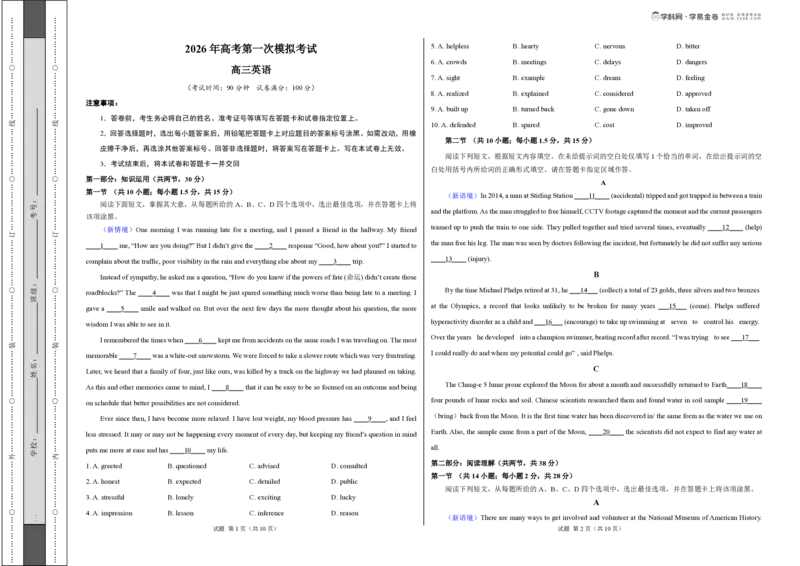
2026 年高考第一次模拟考试
高三英语
(考试时间:90 分钟  试卷满分:100 分)
注意事项:
1.答卷前,考生务必将自己的姓名、准考证号等填写在答题卡和试卷指定位置上。
2.回答选择题时,选出每小题答案后,用铅笔把答题卡上对应题目的答案标号涂黑。如需改动,用橡
皮擦干净后,再选涂其他答案标号。回答非选择题时,将答案写在答题卡上。写在本试卷上无效。
3.考试结束后,将本试卷和答题卡一并交回
第一部分:知识运用(共两节,30 分)
第一节 (共10 小题;每小题1.5 分,共15 分)
阅读下面短文,掌握其大意,从每题所给的A、B、C、D 四个选项中,选出最佳选项,并在答题卡上将
该项涂黑。
(新情境)One morning I was running late for a meeting, and I passed a friend in the hallway. My friend
____1____ me, “How are you doing?” But I didn’t give the ____2____ response “Good, how about you?” I started to
complain about the traffic, poor visibility in the rain and everything else about my ____3____ trip.
Instead of sympathy, he asked me a question, “How do you know if the powers of fate (命运) didn’t create those
roadblocks?” The ____4____ was that I might be just spared something much worse than being late to a meeting. I
gave a ____5____ smile and walked on. But over the next few days the more thought about his question, the more
wisdom I was able to see in it.
I remembered the times when ____6____ kept me from accidents on the same roads I was traveling on. The most
memorable ____7____ was a white-out snowstorm. We were forced to take a slower route which was very frustrating.
Later, we heard that a family of four, just like ours, was killed by a truck on the highway we had planned on taking.
As this and other memories came to mind, I ____8____ that it can be easy to be so focused on an outcome and being
on schedule that better possibilities are not considered.
Ever since then, I have become more relaxed. I have lost weight, my blood pressure has ____9____, and I feel
less stressed. It may or may not be happening every moment of every day, but keeping my friend’s question in mind
puts me more at ease and has ____10____ my life.
1. A. greeted
B. questioned
C. advised
D. consulted
2. A. honest
B. expected
C. detailed
D. public
3. A. stressful
B. lonely
C. exciting
D. lucky
4. A. impression
B. lesson
C. inference
D. reason
5. A. helpless
B. hearty
C. nervous
D. bitter
6. A. crowds
B. meetings
C. delays
D. dangers
7. A. sight
B. example
C. dream
D. feeling
8. A. realized
B. explained
C. considered
D. approved
9. A. built up
B. turned back
C. gone down
D. taken off
10. A. defended
B. spared
C. cost
D. improved
第二节 (共10 小题;每小题1.5 分,共15 分)
阅读下列短文,根据短文内容填空。在未给提示词的空白处仅填写1 个恰当的单词,在给出提示词的空
白处用括号内所给词的正确形式填空。请在答题卡指定区域作答。
A
(新语境)In 2014, a man at Stirling Station ____11____ (accidental) tripped and got trapped in between a train
and the platform. As the man struggled to free himself, CCTV footage captured the moment and the current passengers
teamed up to push the train to one side. They pulled together and tried several times, eventually ____12____ (help)
the man free his leg. The man was seen by doctors following the incident, but fortunately he did not suffer any serious
____13____ (injury).
B
By the time Michael Phelps retired at 31, he ___14___ (collect) a total of 23 golds, three silvers and two bronzes
at the Olympics, a record that looks unlikely to be broken for many years ___15___ (come). Phelps suffered
hyperactivity disorder as a child and ___16___ (encourage) to take up swimming at  seven  to  control his  energy.
Over the years  he developed  into a champion swimmer, beating record after record. “I was trying  to see ___17___
I could really do and where my potential could go” , said Phelps.
C
The Chang-e 5 lunar prone explored the Moon for about a month and successfully returned to Earth____18____
four pounds of lunar rocks and soil. Chinese scientists researched them and found water in soil sample ____19____
(bring)back from the Moon. It is the first time water has been discovered in/ the same form as the water we use on
Earth. Also, the sample came from a part of the Moon, ____20____ the scientists did not expect to find any water at
all.
第二部分:阅读理解(共两节,共38 分)
第一节 (共14 小题;每小题2 分,共28 分)
阅读下列短文,从每题所给的A、B、C、D 四个选项中,选出最佳选项,并在答题卡上将该项涂黑。
A
(新语境)There are many ways to get involved and volunteer at the National Museum of American History.
{#{QQABLQCUogioQIAAARhCEwVwCgCYkBAAACgOxAAYMAIBQBFABAA=}#}

试题 第3 页(共10 页)                                                                                       试题 第4 页(共10 页)

………………○………………内………………○………………装………………○………………订………………○……………… 线………………○………………
             此
卷
只
装
订
不
密
封

………………○………………外………………○………………装………………○………………订………………○……………… 线………………○………………

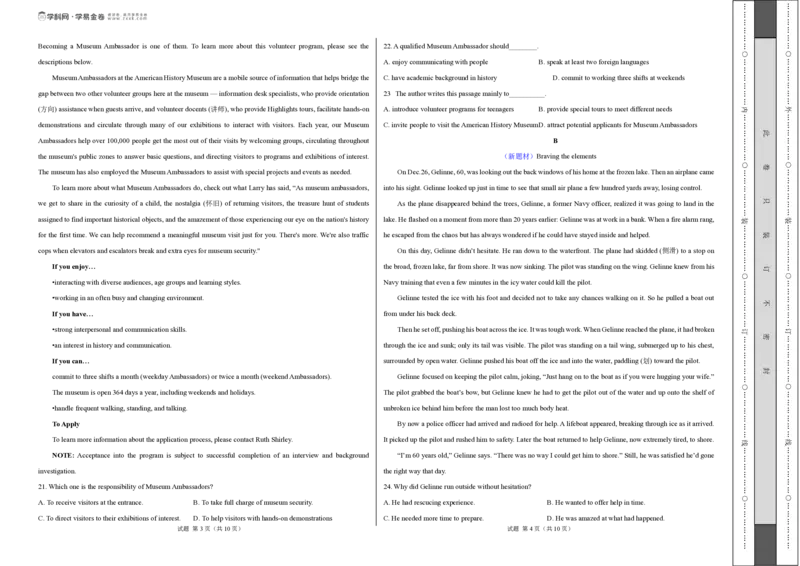
Becoming a Museum Ambassador is one of them. To learn more about this volunteer program, please see the
descriptions below.
Museum Ambassadors at the American History Museum are a mobile source of information that helps bridge the
gap between two other volunteer groups here at the museum — information desk specialists, who provide orientation
(方向) assistance when guests arrive, and volunteer docents (讲师), who provide Highlights tours, facilitate hands-on
demonstrations and circulate through many of our exhibitions to interact with visitors. Each year, our Museum
Ambassadors help over 100,000 people get the most out of their visits by welcoming groups, circulating throughout
the museum's public zones to answer basic questions, and directing visitors to programs and exhibitions of interest.
The museum has also employed the Museum Ambassadors to assist with special projects and events as needed.
To learn more about what Museum Ambassadors do, check out what Larry has said, “As museum ambassadors,
we get to share in the curiosity of a child, the nostalgia (怀旧) of returning visitors, the treasure hunt of students
assigned to find important historical objects, and the amazement of those experiencing our eye on the nation's history
for the first time. We can help recommend a meaningful museum visit just for you. There's more. We're also traffic
cops when elevators and escalators break and extra eyes for museum security."
If you enjoy…
•interacting with diverse audiences, age groups and learning styles.
•working in an often busy and changing environment.
If you have…
•strong interpersonal and communication skills.
•an interest in history and communication.
If you can…
commit to three shifts a month (weekday Ambassadors) or twice a month (weekend Ambassadors).
The museum is open 364 days a year, including weekends and holidays.
•handle frequent walking, standing, and talking.
To Apply
To learn more information about the application process, please contact Ruth Shirley.
NOTE: Acceptance into the program is subject to successful completion of an interview and background
investigation.
21. Which one is the responsibility of Museum Ambassadors?
A. To receive visitors at the entrance.


B. To take full charge of museum security.
C. To direct visitors to their exhibitions of interest.
D. To help visitors with hands-on demonstrations
22. A qualified Museum Ambassador should________.
A. enjoy communicating with people


B. speak at least two foreign languages
C. have academic background in history


D. commit to working three shifts at weekends
23 The author writes this passage mainly to__________.
A. introduce volunteer programs for teenagers

B. provide special tours to meet different needs
C. invite people to visit the American History Museum D. attract potential applicants for Museum Ambassadors
B
(新题材)Braving the elements
On Dec.26, Gelinne, 60, was looking out the back windows of his home at the frozen lake. Then an airplane came
into his sight. Gelinne looked up just in time to see that small air plane a few hundred yards away, losing control.
As the plane disappeared behind the trees, Gelinne, a former Navy officer, realized it was going to land in the
lake. He flashed on a moment from more than 20 years earlier: Gelinne was at work in a bank. When a fire alarm rang,
he escaped from the chaos but has always wondered if he could have stayed inside and helped.
On this day, Gelinne didn’t hesitate. He ran down to the waterfront. The plane had skidded (侧滑) to a stop on
the broad, frozen lake, far from shore. It was now sinking. The pilot was standing on the wing. Gelinne knew from his
Navy training that even a few minutes in the icy water could kill the pilot.
Gelinne tested the ice with his foot and decided not to take any chances walking on it. So he pulled a boat out
from under his back deck.
Then he set off, pushing his boat across the ice. It was tough work. When Gelinne reached the plane, it had broken
through the ice and sunk; only its tail was visible. The pilot was standing on a tail wing, submerged up to his chest,
surrounded by open water. Gelinne pushed his boat off the ice and into the water, paddling (划) toward the pilot.
Gelinne focused on keeping the pilot calm, joking, “Just hang on to the boat as if you were hugging your wife.”
The pilot grabbed the boat’s bow, but Gelinne knew he had to get the pilot out of the water and up onto the shelf of
unbroken ice behind him before the man lost too much body heat.
By now a police officer had arrived and radioed for help. A lifeboat appeared, breaking through ice as it arrived.
It picked up the pilot and rushed him to safety. Later the boat returned to help Gelinne, now extremely tired, to shore.
“I’m 60 years old,” Gelinne says. “There was no way I could get him to shore.” Still, he was satisfied he’d gone
the right way that day.
24. Why did Gelinne run outside without hesitation?
A. He had rescucing experience.
B. He wanted to offer help in time.
C. He needed more time to prepare.
D. He was amazed at what had happened.
{#{QQABLQCUogioQIAAARhCEwVwCgCYkBAAACgOxAAYMAIBQBFABAA=}#}

试题 第5 页(共10 页)                                                                                            试题 第6 页(共10 页)
………………○………………内………………○………………装………………○………………订………………○……………… 线………………○………………
………………○………………外………………○………………装………………○………………订………………○……………… 线………………○………………
…             学校:______________姓名:_____________班级:_______________考号:______________________


25. How did Gelinne help the pilot?
A. He made a call to the police.
B. He got the pilot out of the water.
C. He asked the pilot to grasp the bow.
D. He picked up the pilot onto the shore.
26. What Gelinne did in the rescue proved him to be ____________.
A. brave
B. generous
C. curious
D. strict
27. What can Gelinne probably learn from the rescue?
A. Think twice before action.


B. One good turn deserves another.
C. It’s never too late to make things right.


D. One should always be ready to seize chances.
C
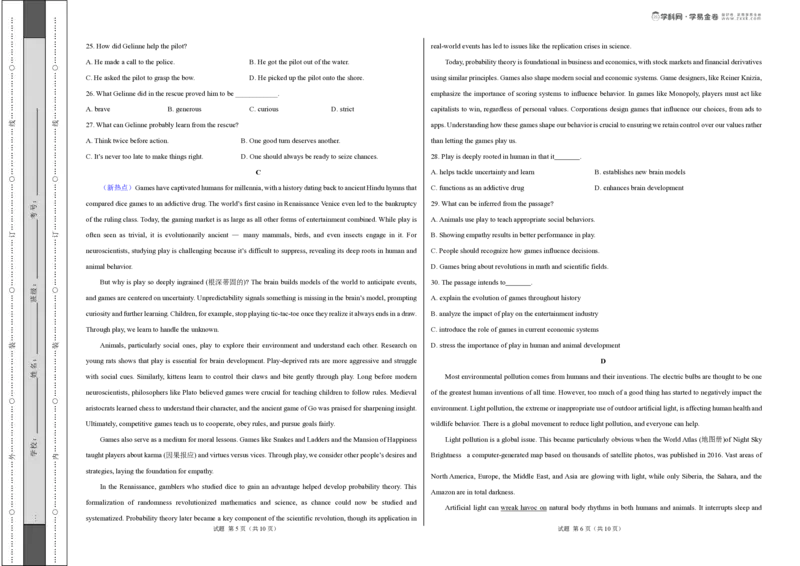
(新热点)Games have captivated humans for millennia, with a history dating back to ancient Hindu hymns that
compared dice games to an addictive drug. The world’s first casino in Renaissance Venice even led to the bankruptcy
of the ruling class. Today, the gaming market is as large as all other forms of entertainment combined. While play is
often seen as trivial, it is evolutionarily ancient — many mammals, birds, and even insects engage in it. For
neuroscientists, studying play is challenging because it’s difficult to suppress, revealing its deep roots in human and
animal behavior.
But why is play so deeply ingrained (根深蒂固的)? The brain builds models of the world to anticipate events,
and games are centered on uncertainty. Unpredictability signals something is missing in the brain’s model, prompting
curiosity and further learning. Children, for example, stop playing tic-tac-toe once they realize it always ends in a draw.
Through play, we learn to handle the unknown.
Animals, particularly social ones, play to explore their environment and understand each other. Research on
young rats shows that play is essential for brain development. Play-deprived rats are more aggressive and struggle
with social cues. Similarly, kittens learn to control their claws and bite gently through play. Long before modern
neuroscientists, philosophers like Plato believed games were crucial for teaching children to follow rules. Medieval
aristocrats learned chess to understand their character, and the ancient game of Go was praised for sharpening insight.
Ultimately, competitive games teach us to cooperate, obey rules, and pursue goals fairly.
Games also serve as a medium for moral lessons. Games like Snakes and Ladders and the Mansion of Happiness
taught players about karma (因果报应) and virtues versus vices. Through play, we consider other people’s desires and
strategies, laying the foundation for empathy.
In the Renaissance, gamblers who studied dice to gain an advantage helped develop probability theory. This
formalization of randomness revolutionized mathematics and science, as chance could now be studied and
systematized. Probability theory later became a key component of the scientific revolution, though its application in
real-world events has led to issues like the replication crises in science.
Today, probability theory is foundational in business and economics, with stock markets and financial derivatives
using similar principles. Games also shape modern social and economic systems. Game designers, like Reiner Knizia,
emphasize the importance of scoring systems to influence behavior. In games like Monopoly, players must act like
capitalists to win, regardless of personal values. Corporations design games that influence our choices, from ads to
apps. Understanding how these games shape our behavior is crucial to ensuring we retain control over our values rather
than letting the games play us.
28. Play is deeply rooted in human in that it         .
A. helps tackle uncertainty and learn
B. establishes new brain models
C. functions as an addictive drug
D. enhances brain development
29. What can be inferred from the passage?
A. Animals use play to teach appropriate social behaviors.
B. Showing empathy results in better performance in play.
C. People should recognize how games influence decisions.
D. Games bring about revolutions in math and scientific fields.
30. The passage intends to         .
A. explain the evolution of games throughout history
B. analyze the impact of play on the entertainment industry
C. introduce the role of games in current economic systems
D. stress the importance of play in human and animal development
D
Most environmental pollution comes from humans and their inventions. The electric bulbs are thought to be one
of the greatest human inventions of all time. However, too much of a good thing has started to negatively impact the
environment. Light pollution, the extreme or inappropriate use of outdoor artificial light, is affecting human health and
wildlife behavior. There is a global movement to reduce light pollution, and everyone can help.
Light pollution is a global issue. This became particularly obvious when the World Atlas (地图册)of Night Sky
Brightness a computer-generated map based on thousands of satellite photos, was published in 2016. Vast areas of
North America, Europe, the Middle East, and Asia are glowing with light, while only Siberia, the Sahara, and the
Amazon are in total darkness.
Artificial light can wreak havoc on natural body rhythms in both humans and animals. It interrupts sleep and
{#{QQABLQCUogioQIAAARhCEwVwCgCYkBAAACgOxAAYMAIBQBFABAA=}#}

试题 第7 页(共10 页)                                                                                       试题 第8 页(共10 页)

………………○………………内………………○………………装………………○………………订………………○……………… 线………………○………………
             此
卷
只
装
订
不
密
封

………………○………………外………………○………………装………………○………………订………………○……………… 线………………○………………

confuses the circadian rhythm(生理节奏)一the internal, twenty-four-hour clock that guides day and night activities
and affects physiological processes in nearly all living organisms. One of these processes is the production of the
hormone melatonin(褪黑素), which is released when it is dark and is prevented when there is light. An increased
amount of light at night lowers melatonin production, which results in lack of sleep, headaches, stress, anxiety, and
other health problems. Blue light, in particular, has been shown to reduce levels of melatonin in humans. It is found in
cell phones and other computer devices, as well as in light-emitting diodes (LEDs), the kinds of bulbs that have become
popular at home and in industrial and city lighting due to their low cost and energy efficiency.
Studies show that light pollution is also impacting animal behaviors, such as migration (迁徙)patterns and habitat
formation. Because of light pollution, sea turtles guided by moonlight during migration get confused, lose their way,
and often die. Large numbers of insects, a primary food source for birds and other animals, are drawn to artificial light
and are instantly killed upon contact with light sources. Even animals living under the deep sea may be affected by
underwater artificial lighting. One study looked at how animals in sea responded to brightly lit panels put under water
off the coast of Wales. Fewer filter feeding animals(滤食性动物), such as the sea squirt(海鞘), made their homes near
the lighted panels. This could mean that the artificial light is altering ocean ecosystems.
The good news is that light pollution, unlike many other forms of pollution, is reversible(可逆的)and each one
of us can make a difference! Now, many people are taking action to reduce light pollution and bring back the natural
night sky. Individuals are urged to use outdoor lighting only when and where it is needed, to make sure outdoor lights
are properly shielded (遮挡)and direct light down instead of up into the sky, and to close window blinds, shades, and
curtains at night to keep light inside.
31. What does the underlined phrase “wreak havoc on” in Para. 3 probably mean?
A. Greatly improve.     B. Well maintain.
C. Strictly manage.
 D. Seriously damage.
32. According to the passage, which would the author agree with?
A. Light pollution was first studied as a global issue in 2016.
B. Deep-sea environment can help animals avoid light pollution.
C. Artificial light affects the sense of direction and habits of animals.
D. LEDs can be used more because of low cost and energy efficiency.
33 What is the author’s attitude towards the control of light pollution?
A. Unconcerned.      B. Positive.
C. Neutral.
        D. Negative.
34. What is the main purpose of the passage?
A. To call on people to reduce light pollution.

B. To discuss fors and againsts of artificial light.
C. To give suggestions to protect environment.

D. To show development prospect of artificial light.
第二节 (共5 小题;每小题2 分,共10 分)
根据短文内容,从短文后的七个选项中选出能填入空白处的最佳选项,并在答题卡上将该项涂黑。选项
中有两项为多余选项。
Hesitation as intuition (直觉)
(新语境)You’ve thought about it. You’ve made your decision and then.….you hesitate. Your mouse hovers
over the “purchase now” button, you’ve written the text but can’t quite bring yourself to press “send”. You hesitate.
____35____
Our culture values doing. We’re constantly urged to “go for it.” But what if hesitation is not a sign of weakness
but rather a valuable signal? ____36____ But we don’t always make it a practice to listen to our bodies. When we do
pay attention, we have access to a lot of nonrational information including our intuition. If you notice yourself
hesitating, it might mean a part of you isn’t quite sure. Hesitation can be the body’s way of alerting us to overlooked
details or concealed information that could be crucial to our choice.
Since hesitation can carry such significance, it becomes essential to understand the nature of the signals our bodies
send. Although distinguishing between intuition and fear or anxiety is not easy, when we cultivate the habit of self-
awareness and understand our fears, we can begin to decipher (辨认) the messages behind our hesitation. Moreover,
our rational minds have their limitations. ____37____ Therefore, by integrating our emotions and physical sensations
into the decision-making process, we access a more comprehensive understanding.
To make more informed decisions, we can employ specific strategies. One way that we can help ourselves with
a specific decision is to notice when there’s hesitation and, if you have the time, wait. ____38____ Another interesting
way to look at making a decision is to walk up to the door of it. Take action as if you had already made the decision.
And before it’s too late, notice how it feels to walk that path. That may give you more information than thinking ever
could.
____39____ By integrating both rational and intuitive elements, we can handle the complex choices with greater
confidence and clarity.
A. It’s easy to miss intuitive signals when we are moving from thinking minds.
B. They work within fixed frameworks that might not match the complex reality.
C. While our minds are undoubtedly powerful, our bodies also hold a wealth of wisdom.
D. In nature, the key to effective decision-making lies in seeing hesitation as a help.
E. Check back in with the decision you thought you made and see if anything differs.
F. Hesitation means your intuition is trying to speak to you from deep inner place.
G. This hesitation is common yet often overlooked in our decision-making process.
{#{QQABLQCUogioQIAAARhCEwVwCgCYkBAAACgOxAAYMAIBQBFABAA=}#}

试题 第9 页(共10 页)                                                                                            试题 第10 页(共10 页)
………………○………………内………………○………………装………………○………………订………………○……………… 线………………○………………
………………○………………外………………○………………装………………○………………订………………○……………… 线………………○………………
…             学校:______________姓名:_____________班级:_______________考号:______________________


第三部分 书面表达(共两节,32 分)
第一节(共4 小题;第40、41 题各2 分,第42 题3 分,第43 题5 分,共12 分)
阅读下面短文,根据题目要求用英文回答问题。请在答题卡指定区域作答。
(新题材)Building relationships and working successfully with different cultural backgrounds can seem like a
major challenge. But you can enjoy the rewards, while keeping dissatisfaction to a minimum. The key to making them
work is cultural competence. Essentially, cultural competence is defined as the ability to understand and interact
effectively with people from different cultures.
Cultural competence is critical for everyone in today’s modern world. Living and working in a culturally diverse
environment sometimes comes with differences of opinion and tension. People with strong cultural competence can
resolve these issues creatively, even if a solution seems impossible at first. What’s more, thinking and caring about
others with different experiences can bring out a sense of understanding. This helps to build trust between each other.
Cultural competence can be improved through training, education, and experience. Here are some simple tips to
help you improve your cultural competence.
Assess yourself
The starting point is to understand your own cultural values and world view. Assess the current level of cultural
competence in yourself and identify the knowledge, skills and resources that you want to acquire. This can give you
an idea of your strengths and weaknesses in the area so that you can improve yourself in future.
Practice good manners
No matter whom you are dealing with, make sure that you are respecting others’ backgrounds, boundaries and
customs. Pay close attention to your communication and make sure that you’re speaking to others in a kind and polite
way.
Ask questions
When you don’t understand something or want to know why someone has behaved in a certain way, simply ask.
Asking questions stops you making unnecessary assumptions, and shows the questions you did not understand to them.
Keep in mind that developing cultural competence is not a one-shot enterprise. It takes time and practice. Whether
you are in a classroom or on campus, cultural competence plays an important role in your daily environment.
Recognizing and dealing with cultural differences will create a happier setting for everyone.
40. What is cultural competence according to the passage?
____________________________________________________________________________________________
41. Why is cultural competence important for people in intercultural environment?
____________________________________________________________________________________________
42. Please decide which part is false in the following statement, then underline it and explain why.
>To improve our cultural competence, we should not only understand our strengths and weaknesses in this area,
but also ask questions when we don’t understand others’ behaviors, even if we may speak in an impolite way.
____________________________________________________________________________________________
43. Apart from the tips mentioned in the passage, what other way(s) can you think of to develop your cultural
competence? (In about 40 words)
____________________________________________________________________________________________
第二节(20 分)
(新话题)假设你是红星中学高三学生李华,你校上个月举办了九十周年校庆活动。英国交换生Jim 听
闻后,对此活动非常感兴趣,请你给Jim 发邮件,内容包括:
1. 校庆活动介绍;2. 你的感受。
注意:1. 词数100 左右;2. 开头和结尾已给出,不计入总词数。
Dear Jim,
____________________________________________________________________________________________
Yours,
Li Hua
(请务必将作文写在答题卡指定区域内)

{#{QQABLQCUogioQIAAARhCEwVwCgCYkBAAACgOxAAYMAIBQBFABAA=}#}