2026 届山东省济
南市高三年级英语
开学摸底考试
1.What probably is the girl's favorite food?
A. Chips.
B. Salad.
C. Toast.
2.What is the man supposed to do on Saturday?
A. Take a course.
B. Rest at home.
C. Go over his lessons.
3.How much should the woman pay in total?
A.$31.5.

B.$35.
C.$38.5.
4.Where is the new owner of the house from?
A. Arizona.
B. California.
C. New York.
5.Why did the man's wife disagree with his plan?
A. To be closer to her parents.
B. To maintain a high salary.
C. To live in a big house.
听第6 段材料,回答第6、7 题。
6.How much might the electricity bill for August be?
A.$100.
B.$250.
C.$350.
7.What does the woman request from the man?
A. His phone number.

B. His email address.
C. His home address.
听第7 段材料,回答第8 至10 题。
8.What classes does Seven Island Sports Center mainly offer?
A. Swimming.
B. Yoga.
C. Dancing.
9.How many days per week can an Under Super member use the facilities?
A. Four.
B. Six.
C. Seven.
10.Which membership does the man decide on?
A. Under Super.
B. Middle Class.
C. Low Class.
听第8 段材料,回答第11 至13 题。
11.Why is the woman heading to Madrid?
A. To travel.
B. To attend a conference.
C. To take up a new post.
12.What does the woman probably need to do before leaving?
A. Pack her baggage.
B. Apply for a visa.
C. Book the flight.
13.What does the man offer to do for the woman?
A. Pick her up at the airport. B. Take her to the airport.
C. Help with her work.
听第9 段材料,回答第14 至17 题。
14.What did the girl do last this morning?
A. She wrote her paper.
B. She wrote a diary.
C. She surfed the Internet.
15.Who invented the umbrella according to the girl?
A.A German.
B. An American.
C.A Chinese.
16.When did the British first use umbrellas?
A. In the 20th century.
B. In about 450 BCE.
C. In the 18th century.
17.What does the man probably do?
A.A student.

B.A teacher.
C.A historian.
听第10 段材料,回答第18 至20 题。
18.What kind of event is The World of Ants?
A.A lecture.

B.A movie.
C.A demonstration.
19.Where will the film be shown?
A. In the Insect House.
B. In Theatre.
C. In the Exhibition Room.
20.At what time will Tasha begin her display?
A.11:00 am.
B.2:30 pm.
C.3:45 pm.
Freshwater is vital for all life on our planet. Yet, in many places around the globe, our management of
freshwater resources is becoming unsustainable. Understanding the interconnectedness and complexity of
local and regional freshwater issues is critical to living sustainably on Earth. That's why the National
Geographic Society and the Nature Conservancy have  joined forces to develop a program centered around a
unique remote externship (校外实习)program for young adults worldwide.
The Experience
Throughout the externship, you will learn about freshwater conservation careers from weekly webinars
( 研讨会) featuring the National Geographic Society and the Nature Conservancy experts, your own
research, and informational interviews conducted with local conservation organizations.
During this externship, you will also:
·Gain knowledge of freshwater conservation issues and strategies through resources and case studies
provided by the two partner organizations:
·Engage with local leaders, conservationists, and community members to grasp freshwater-related
challenges and their impacts on the community.
·Apply primary and secondary research methods to investigate existing conservation initiatives and
identify local freshwater issues.
·Conduct landscape and gap analyses to uncover conservation gaps and propose actionable solutions.
·Develop written and visual storytelling skills to effectively communicate key issues and community-
based action strategies.
Qualifications
We are seeking young people aged 18-25 from around the globe interested in learning about introductory
conservation approaches. No prior work experience or coursework in conservation or environmental topics is
required. The program values diversity in beliefs, cultures, and backgrounds,
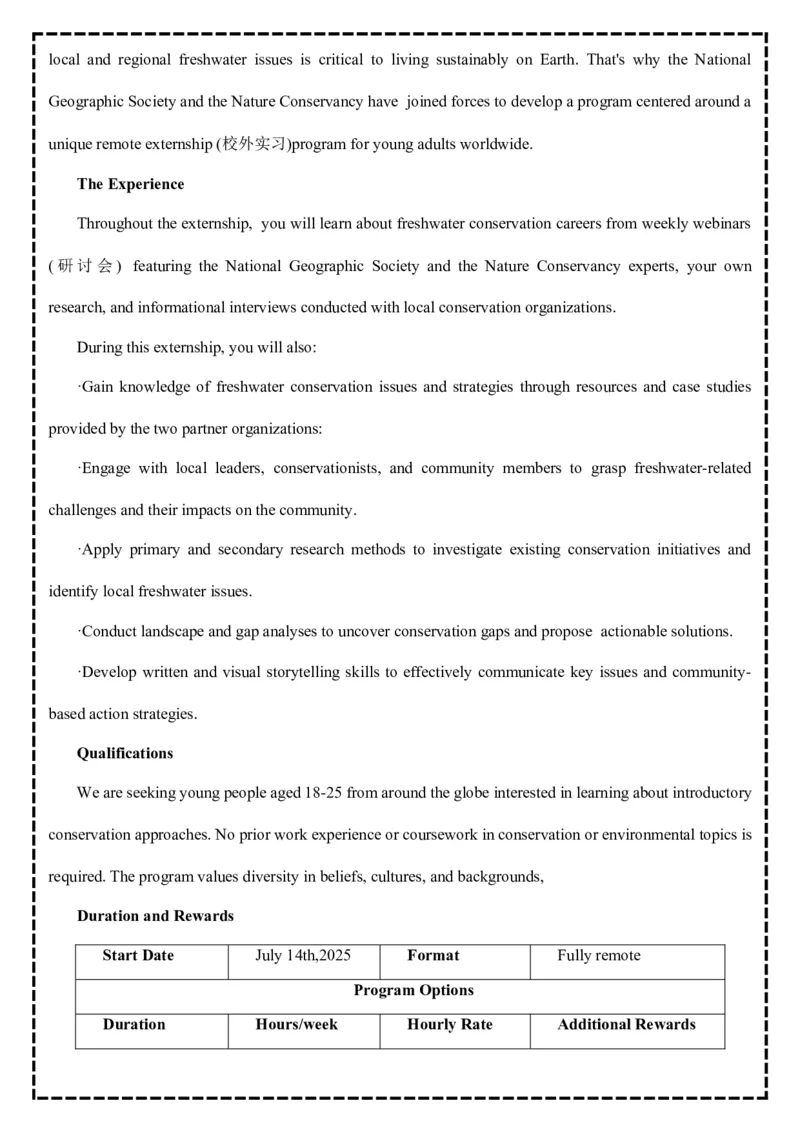
Duration and Rewards
Start Date
July 14th,2025
Format
Fully remote
Program Options
Duration
Hours/week
Hourly Rate
Additional Rewards
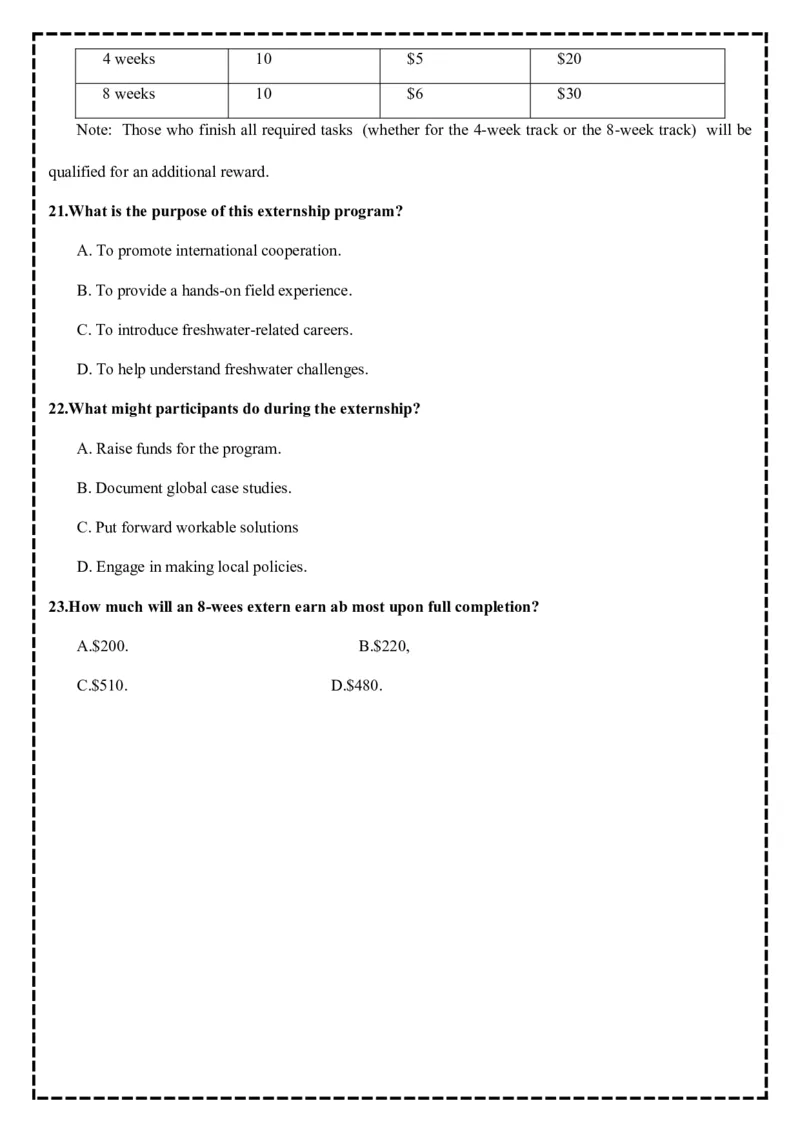
4 weeks
10
$5
$20
8 weeks
10
$6
$30
Note: Those who finish all required tasks (whether for the 4-week track or the 8-week track) will be
qualified for an additional reward.
21.What is the purpose of this externship program?
A. To promote international cooperation.
B. To provide a hands-on field experience.
C. To introduce freshwater-related careers.
D. To help understand freshwater challenges.
22.What might participants do during the externship?
A. Raise funds for the program.
B. Document global case studies.
C. Put forward workable solutions
D. Engage in making local policies.
23.How much will an 8-wees extern earn ab most upon full completion?
A.$200.
B.$220,
C.$510.
D.$480.
One quiet afternoon in France in her studio, wood crafting (木工技艺) artist Hua Yong found herself
watching water boil. Without thinking, she reached for her phone and refreshed the screen. At that very
moment, she realized how much modern life is consumed by speed. “We are completely swept up by the fast
pace of life,” she said. “It's becoming harder to find time to unwind among the everyday chaos of life.”
Hua Yong, the 2024 receiver of the Hand of Wisdom prize, a Sino-French crafts exchange program,
spent two months in Paris last year, a rare stretch of uninterrupted time that allowed her to reflect on the act
of creation. She began experimenting with simple geometric ( 几 何 的 forms, repeating them to create
visual effects that seemed to go beyond
time and space. "I thought about how to create something new
from nothing, and used the highest standards of traditional Chinese craftsmanship to bring these ideas to life,”
she said.
"Wood crafting requires the investment of time," she noted. Her exhibition Changing the World in Silence
at Yishu 8,an art platform in Beijing, marked the highlight of a year's reflection. Running through mid-June,
the show featured 25.pieces,11 of which were created after her Paris residency. Among the works was a
vortex-like( 漩 涡 状 的 )table, which drew the viewer's mind into a different dimension. “We hope all the
crafts here quietly accompany the viewers, bringing a brief mental escape and a moment of relaxation,
"described Hua.
“The changes in her work's form between movement and stillness are projections of conceptual unrest,”
said Su Dan, the artistic director of Hand of Wisdom, observing Hua's shift since her return. “She has long
engaged with Chinese traditional materials and been constantly thinking. Works created in such a state of
reflection become models of design philosophy: They are short-lived, yet everlasting.”
24.Why did Hua Yong reach for her phone in Paragraph 1?
A. She felt like taking a photo.
B. She tried to have a rest among chaos.
C. She intended to make a call.
D. She had formed the habitual behavior.
25.What change did Hua Yong make after her Paris residency?
A. She integrated Sino-French wood crafts.
B. She applied geometric shapes creatively.
C. She shifted to rare and simple materials.
D. She adopted digital techniques flexibly.
26.What do we know about the works in Changing the World in Silence?
A. They relied hardly on handwork.
B. They mirrored the rush of modern life.
C. They featured mental relaxation,
D. They were well-appreciated by viewers.
27.What does Su Dan imply about Hua Yong?
A. She underwent life unrest in Paris.
B. She deserted wood craft traditions.
C. Her works turn out the best models.
D. Her works project a consistent idea.
Beneath the Pacific lies the Clarion-Clipperton Zone (CCZ), where tens of billions of polymetallic
nodules (多金属结核) are packed with cobalt(钻). Seabed-mining companies promote them as “a battery
in a rock” and“ the easiest way to solve climate change.” They claim that those nodules can provide metals
for 4.8 billion electric vehicles.
Yet this promise threatens a biological treasure, Marine (海洋的) biologists reveal the CCZ shelters over
5,000 unique species in the darkness. The extensive mining of cobalt may lead to the loss of biodiversity. A
company claimed to have found a solution to minimize the damage to the ecology and has already trialed a
25-ton collector robot designed to harvest these nodules. However, a 2023 study shows it can cause permanent
destruction in the area.
Commercial mining is not yet permitted in international waters. The International Seabed
Authority(ISA)is still determining how, and under what conditions, mining should be allowed. After 28 years
of debate, its 168 member states still lack formal agreement. While companies advocate using nodule-
collecting robots,437 scientists from 44 countries demand an immediate stop. ISA studies confirm that just
10%mining of the CCZ may wipe out 50%of its species.
Nor is it certain that cobalt mining will even be all that important in car-battery technology. Many battery
companies are trying to recycle cobalt from spent batteries. In March, several major European carmakers
jointly stated that they would not buy any metals produced from deep-sea mining before the environmental
risks are“ completely understood”. Meanwhile, several Chinese electric vehicle producers have already made
the. switch, recycling up to 95%of metals from used batteries. “Why rush to mine the ocean for metals
becoming outdated?” said battery expert Gavin Harper.
On June 8,21 marine scientists from 8 universities finished a six-week research in the CCZ and packed
up seafloor samples to take back to their labs for further analysis. “An assessment of the mining's impact will
take years of research,” says Andrew from Edinburgh. “I'm trying to get the best environmental data. And
then it's up to society to make the decision to go ahead.”
28.Why are the nodules called “a battery in a rock”?
A. They contain valuable metals.
B. They have recharging qualities.
C. They own battery-like structure.
D. They generate renewable power.
29.What can be inferred about the ISA?
A. It prioritizes economic interests.
B. It is guarded about seabed mining.
C. It opposes commercial operations.
D. It requires more technical support.
30.What does the author want to illustrate in Paragraph 4?
A. Deep-sea mining meets demands.
B. Carmakers reuse battery materials.
C. Battery recycling needs promoting.
D. Sea-bed mining for cobalt can wait.
31.What can be a suitable title for the text?
A. Marine Mining,a Green Solution
B. Cobalt, the Future of Batteries
C. Ocean Metals,an Ocean Risk?
D. CCZ, the Treasure Unknown?
Have you ever felt so stressed that you just sort of froze? Your body goes still, you can't feel much but,
at the same time, your senses are working overtime. You know you must act soon; but it's as if something is
stopping you. This “freezing”, or tonic immobility in academic terms, is an adaptive defense response to
stress or danger.
When we freeze, our heart rate drops and our blood pressure changes. Our pupils might become wider.
A flood of hormones (荷尔蒙) spread quickly, readying us for action. It can all happen within seconds.
While fight-or-flight seems logical for survival, freezing appears counterproductive --- potentially too
much to handle, making us incapable of acting or making a decision. But is that really all that's going on? Not
according to Prof Karin Roelofs, a neuroscientist who studies freezing at Radboud University. “Many
people think that freezing is a kind of shutdown of the system,” she says. “What we actually find is that in
threatening situations, freezing actually helps gain more information, prepare actions, and improve
perception and decision making.” Freezing acts like an emergency flow state: watchful, not petrified.
Importantly, this response can be trained. Roelofs highlights two groups controlling freezing: living
statues, street performers maintaining extreme stillness and snipers (狙击手) requiring absolute stillness
while making decisions. Lab research confirms this. A virtual reality shooting game showed players with
stronger freezing responses performed better and decided faster. Freezing doesn't slow responses. “Brain
noise reduces. Perception increases. You make better decisions faster,” Roelofs clarifies.
But let's say you're not a sniper, or don't spend your weekends as a living statue. What if you're about to
take an exam or lead a big business meeting? Those situations involving social pressure, may not be life or
death, but still can cause freezing. The key is to use this response through training, particularly focused
breathing: maintain slow, rhythmic exhalation (有节奏的呼气).Instead of feeling out of control, you can
master it and—sniper or not—take your best shot.
32.What happens in “freezing” according to the text?
A. Awareness is lost.
B. The heart pounds.
C. Senses are sharper.
D. The breath quickens.
33.What does the underlined word “petrified” in Paragraph 3 probably mean?
A. Confused.
B. Panicked.
C. Distressed.

D. Occupied.
34. Why are living statues and snipers mentioned in Paragraph 4?
A. To contrast response types.
B. To illustrate freezing causes.
C. To support response training.
D. To criticize stressful professions.
35.How should students manage exam freezing according to the text?
A. Seek professional help,
B. Apply trained breathing.
C. Hold breath to stay still,
D. Make last-minute revisions.
When I first started traveling, my dad asked me what I was running away from. Another time, a friend
told me to stop running away from my problems and to start living life. I’m not sure why.     36
     We are running
away from responsibilities, challenges, and ultimately, maturity itself. People think we are all just Peter Pans
refusing to be “adults”. And to all those people, I say: you are right.
   3

 7        I’m running away from office life, commutes (通勤), weekend duties, and the strict path
society has laid out as “normal”. I’m running away because I want to experience every culture, see every
mountain, eat different food, attend crazy festivals, meet new people, and enjoy different holidays around the
world. I want to construct a life that makes me happy.
In our society, the accepted path is long and narrow: you go to college, get a job, get married, buy a
house, have two or three children, raise them, and then retire. Only then, after you've put in your time,
can you enjoy the fruits of your labor.
  38
       And any deviation (偏差) is considered abnormal
and strange.
For me, those who travel the world aren't running away from life.
  39

   They are exploring the
world and living on their own terms. They have a degree of freedom a lot of people will never
experience. They get to be the captains of their-own ships.
People may tell you they envy what you do, and say they wish they could travel like you. But they
never do. Few people have the courage to take the risk. But life is what you make it out to be. Life is yours
to create.
  4 0   So I'm not running away. I am just going after my own life. And I never plan to look
back.
A. Traveling is something everyone should do.
B. Responsible people don't just travel forever.
C. On the contrary, they are running toward true living.
D. If you really want something, you have to go after it.
E.  I’m running away from people's fixed idea of the “real” world.
F. But there is this perception that travelers must be escaping something.
G. Society boxes you in and restricts your movements to their expectations.
Marcus was the type of person who never raised his hand, rarely made eye contact, and left the
room the second the bell rang. Naturally, I assumed he was
  4 1
   or even rude since I was always
sure that I had a good
  4 2
   on people.
But everything began to change the day we were
  4 3
   up for a group project. When the teacher
announced our
  4 4 _   together, he looked over and gave me a small
  4 5
   . No smile, no greeting,
just that.  I
  4 6
   my eyes, with no expectation to cowork well with him. To my
  4 7
   , Marcus
came to our first meeting prepared: he had notes, questions and even
  4 8
   for how we could divide the
work fairly. I couldn't help asking, “Are you always this
  4 9
   ?” He shrugged (耸肩) and said,
“Only when I care.” At that moment, I realized words weren't
  5 0
   he often used, but when he did,
they
  5 1
   .
Over the next two weeks, we worked side by side. He wasn't the person I thought he was. He
didn't avoid people; he just didn't know how to
  5 2     . He didn't look down on others; he was just
shy. The day we presented our project, he spoke
  5 3     and with surprising humor. After class, when
our teacher praised us, I turned to Marcus and said, “I’m glad we got paired up.” He looked down,
smiled slightly and replied, “Me too.”
That day I realized how easy it is to misunderstand someone when you don't
  5 4
   to look deeper.
Since then, I've tried to listen more closely,
  5 5
    more slowly, and give people the space to show me
who they are.
41. A. decent
B. tolerant
C. distant
D. selfish
42. A. impact
B. read
C. hold
D. impression
43. A. paired
B. locked
C. tied
D. fed
44. A. addresses
B. names
C.jobs
D. wishes
45. A. gift
B. book
C. shake
D. nod
46. A rolled
B. lowered
C. widened
D. opened
47. A. excitement
B. surprise
C. relief
D. regret
48. A. contributions
B. opportunities
C. suggestions
D. possessions
49. A. talented
B .impressed
C. determined
D. organized
50. A. chains
B. toys
C. tools
D. weapons
51. A. replied
B. emerged
C. declined
D. mattered
52. A. show off
B. reach out
C. carry on
D. give in
53. A. angrily
B. rapidly
C. delicately
D. confidently
54. A. forget
B. fail
C. bother
D. hesitate
55. A. judge
B. behave
C. explain
D. investigate
As trains thunder across the tracks like lightning, few people pause to think of the silent sentinels (守
卫者)

 5  6

 (safeguard) Xinjiang Uygur Autonomous Region's 9,525.68 kilometers of
railway, much of which cuts through the barren (贫瘠的 )Gobi Desert.
These devoted railway workers, who

 5  7

 (brave) face sandstorms and intense heat,
carry on day and night. They light lamps against the wind and inspect every inch of the rail carefully
5  8

 (ensure)safe and smooth journeys.

 5 9

   once relied on ropes and muscle has
develop a into a mechanized maintenance force now — sweat and steel work together constructing a modern
Silk Road across the wildernesss

 60


  its reach extending beyond regional boundaries.
Since the founding of the People's Republic of China, Xinjiang's railways

 61

(progress)  rapidly under the strong and targeted

 62


  (guide) national railway development
strategies. By late 2024, the region's operating length had doubled, growing from 4,914.2 kilometers in 2012
to 9,525.68 kilometers —

 63


 93.84 percent increase.
Xinjiang now has the world's first desert railway loop (环线) around the Tarim Basin and a northern
loop encircling the Junggar Basin, both of

 64


  have become vital lifelines for promoting
65


  (strong) ethnic unity, faster regional development, and broader connectivity under the Belt and
Road Initiative.
下周是你校的“志愿者周”,请以“An Experience of Volunteering”为题写一篇短文,向校英文
报投稿,内容包括:
(1)你的一次志愿者服务经历;
(2)你的感受和倡议。
注意:
(1)写作词数应为80 个左右;
(2)请按如下格式在答题卡的相应位置作答。
An Experience of Volunteering

Fourteen-year-old Nathan ran a small stand selling colorful phone cases at the annual community
Summer Carnival (嘉年华). While younger kids crowded around other attractions, he focused on his modest
business. His real ambition, however, lay beyond this: he dreamed of owning a 3D printer. With it, he could
design and create unique pnone cases himself, transforming his small summer job into a proper online
business.
One afternoon, a 10-year-old girl named Michele stopped by and bought one phone case for her mom.
As they talked, Nathan shared his dream of having a 3D printer. “With that printer, I can print anything in
any form," Nathan said. “Anything in any form?” Michele's eyes lit up with sudden excitement. “Once
you get it, could you please make a leg for my pet duck Tim? Because he was missing one,” Michele said
hopefully. “That's a cool project,”  Nathan replied. He thought for a minute. “I'll make him one, but it
won't be ready now. I have to save up some of the money myself to buy the 3D printer.” “How lucky Tim
is! You are so kind!” Michele said happily, unable to contain her excitement.
Before leaving, Michele exchanged phone numbers with Nathan. They discovered that they lived in the
same neighborhood, which meant Nathan could easily get close to the duck and measure the size of its leg in
person to ensure that a suitable prosthetic ( 假 体 的 ) leg could be made. He promised to reach out as soon
as he could afford a printer.
That evening, Nathan told his family about Michele and his promise. His parents praised his kindness
and initiative. They agreed to offer some financial support to buy the printer but also emphasized the
importance of his own effort. “We're proud you're earning this yourself, Nathan,” his father said. “Saving
your share shows real commitment.” Nathan nodded firmly, feeling more determined than ever.
Nathan worked very hard for the 3D printer.
However, creating the leg model was not easy.