专题09语法选择易错题强化练20篇
(期末真题精选)(广东专用)
学 :___________ ___________ ___________ ___________
校 姓名: 班级: 考号:
一、语法选择
(一)
请通读下面短文,掌握其大意,根据语法和上下文连贯的要求,从每小题 3 个选项中选出一个最佳的答案,并
将答案填写在题前的括号内。
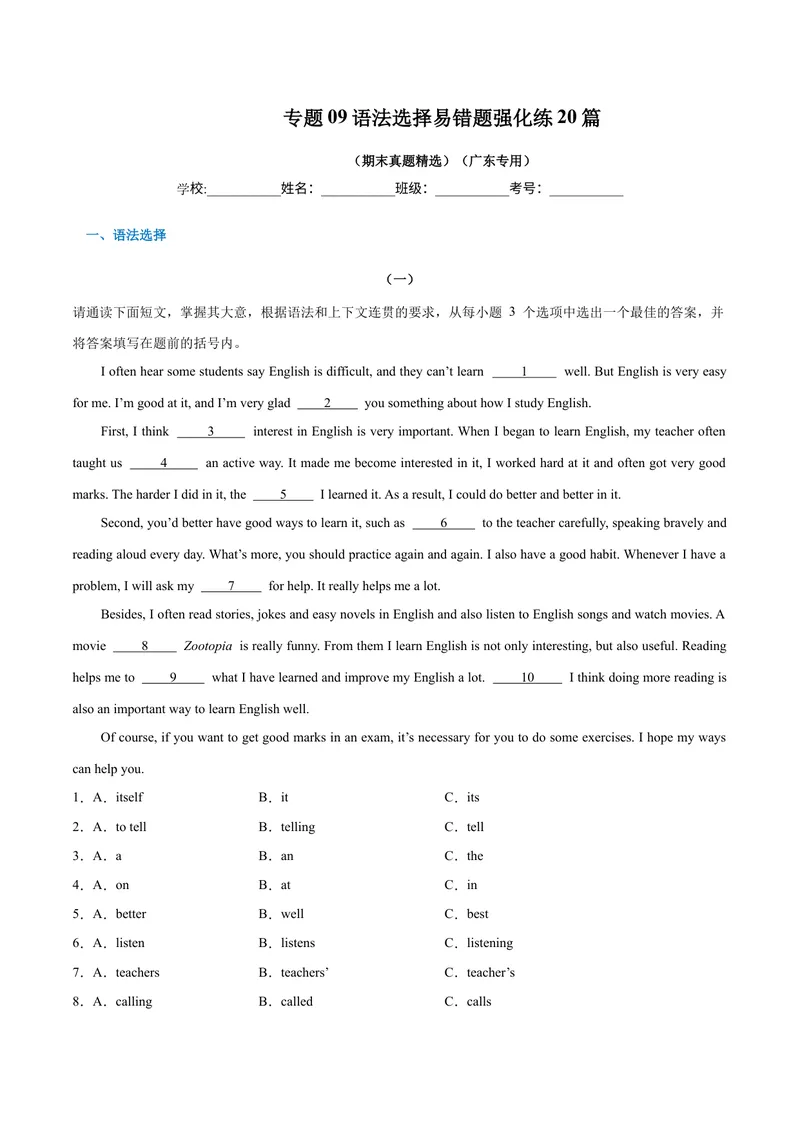
I often hear some students say English is difficult, and they can’t learn 1 well. But English is very easy
for me. I’m good at it, and I’m very glad 2 you something about how I study English.
First, I think 3 interest in English is very important. When I began to learn English, my teacher often
taught us 4 an active way. It made me become interested in it, I worked hard at it and often got very good
marks. The harder I did in it, the 5 I learned it. As a result, I could do better and better in it.
Second, you’d better have good ways to learn it, such as 6 to the teacher carefully, speaking bravely and
reading aloud every day. What’s more, you should practice again and again. I also have a good habit. Whenever I have a
problem, I will ask my 7 for help. It really helps me a lot.
Besides, I often read stories, jokes and easy novels in English and also listen to English songs and watch movies. A
movie 8 Zootopia is really funny. From them I learn English is not only interesting, but also useful. Reading
helps me to 9 what I have learned and improve my English a lot. 10 I think doing more reading is
also an important way to learn English well.
Of course, if you want to get good marks in an exam, it’s necessary for you to do some exercises. I hope my ways
can help you.
1.A.itself B.it C.its
2.A.to tell B.telling C.tell
3.A.a B.an C.the
4.A.on B.at C.in
5.A.better B.well C.best
6.A.listen B.listens C.listening
7.A.teachers B.teachers’ C.teacher’s
8.A.calling B.called C.calls9.A.review B.reviewed C.reviews
10.A.But B.So C.While
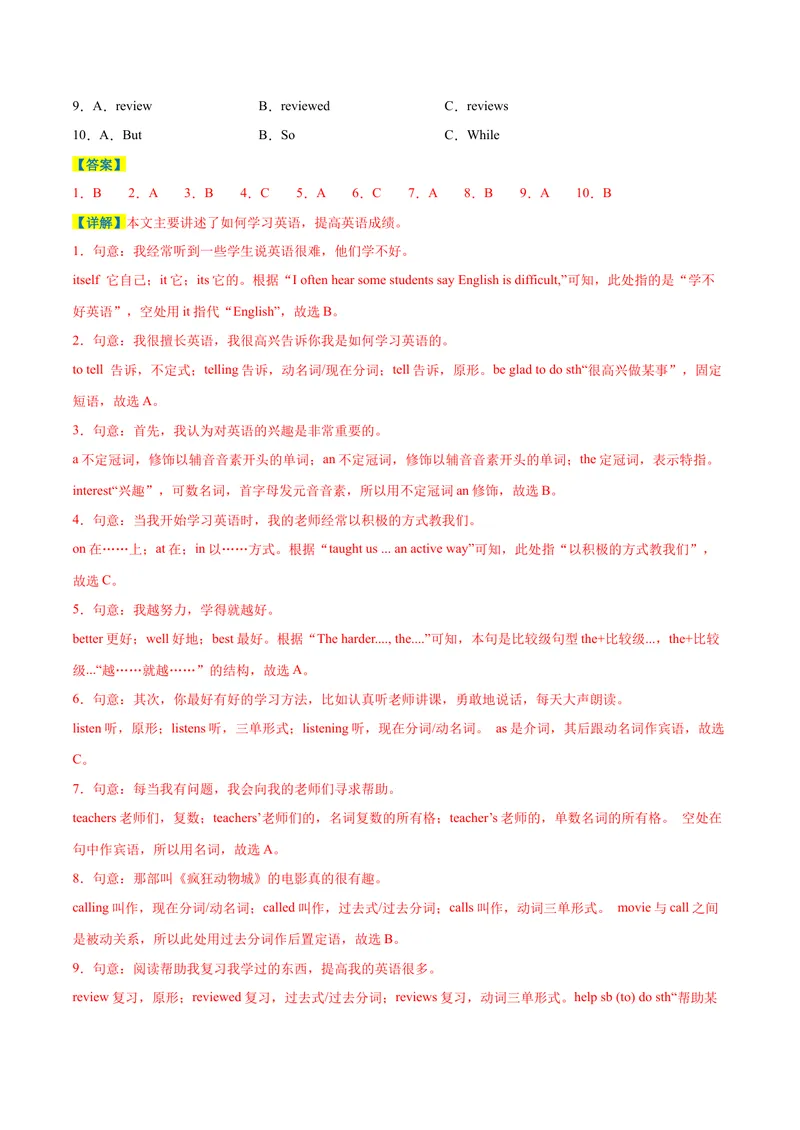
【答案】
1.B 2.A 3.B 4.C 5.A 6.C 7.A 8.B 9.A 10.B
【详解】本文主要讲述了如何学习英语,提高英语成绩。
1.句意:我经常听到一些学生说英语很难,他们学不好。
itself 它自己;it它;its它的。根据“I often hear some students say English is difficult,”可知,此处指的是“学不
好英语”,空处用it指代“English”,故选B。
2.句意:我很擅长英语,我很高兴告诉你我是如何学习英语的。
to tell 告诉,不定式;telling告诉,动名词/现在分词;tell告诉,原形。be glad to do sth“很高兴做某事”,固定
短语,故选A。
3.句意:首先,我认为对英语的兴趣是非常重要的。
a不定冠词,修饰以辅音音素开头的单词;an不定冠词,修饰以辅音音素开头的单词;the定冠词,表示特指。
interest“兴趣”,可数名词,首字母发元音音素,所以用不定冠词an修饰,故选B。
4.句意:当我开始学习英语时,我的老师经常以积极的方式教我们。
on在……上;at在;in以……方式。根据“taught us ... an active way”可知,此处指“以积极的方式教我们”,
故选C。
5.句意:我越努力,学得就越好。
better更好;well好地;best最好。根据“The harder...., the....”可知,本句是比较级句型the+比较级...,the+比较
级...“越……就越……”的结构,故选A。
6.句意:其次,你最好有好的学习方法,比如认真听老师讲课,勇敢地说话,每天大声朗读。
listen听,原形;listens听,三单形式;listening听,现在分词/动名词。 as是介词,其后跟动名词作宾语,故选
C。
7.句意:每当我有问题,我会向我的老师们寻求帮助。
teachers老师们,复数;teachers’老师们的,名词复数的所有格;teacher’s老师的,单数名词的所有格。 空处在
句中作宾语,所以用名词,故选A。
8.句意:那部叫《疯狂动物城》的电影真的很有趣。
calling叫作,现在分词/动名词;called叫作,过去式/过去分词;calls叫作,动词三单形式。 movie与call之间
是被动关系,所以此处用过去分词作后置定语,故选B。
9.句意:阅读帮助我复习我学过的东西,提高我的英语很多。
review复习,原形;reviewed复习,过去式/过去分词;reviews复习,动词三单形式。help sb (to) do sth“帮助某人做某事”,所以空处用原形,故选A。
10.句意:所以我认为多读书也是学好英语的一个重要方法。
But但是;So所以;While同时。空前讲了阅读的好处,能帮助提高英语,空后讲“觉得多读书也是学好英语的
一个好方法”,前后在句意上是因果关系,所以用so连接,故选B。
(二)
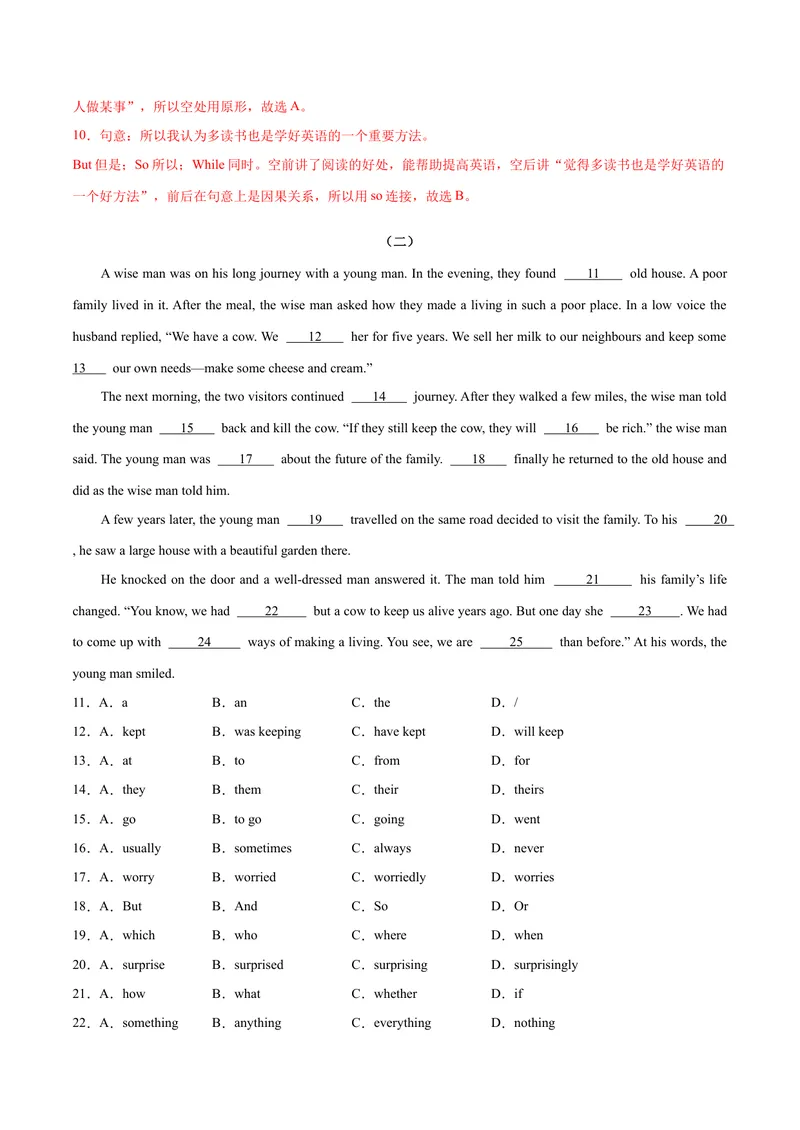
A wise man was on his long journey with a young man. In the evening, they found 11 old house. A poor
family lived in it. After the meal, the wise man asked how they made a living in such a poor place. In a low voice the
husband replied, “We have a cow. We 12 her for five years. We sell her milk to our neighbours and keep some
13 our own needs—make some cheese and cream.”
The next morning, the two visitors continued 14 journey. After they walked a few miles, the wise man told
the young man 15 back and kill the cow. “If they still keep the cow, they will 16 be rich.” the wise man
said. The young man was 17 about the future of the family. 18 finally he returned to the old house and
did as the wise man told him.
A few years later, the young man 19 travelled on the same road decided to visit the family. To his 20
, he saw a large house with a beautiful garden there.
He knocked on the door and a well-dressed man answered it. The man told him 21 his family’s life
changed. “You know, we had 22 but a cow to keep us alive years ago. But one day she 23 . We had
to come up with 24 ways of making a living. You see, we are 25 than before.” At his words, the
young man smiled.
11.A.a B.an C.the D./
12.A.kept B.was keeping C.have kept D.will keep
13.A.at B.to C.from D.for
14.A.they B.them C.their D.theirs
15.A.go B.to go C.going D.went
16.A.usually B.sometimes C.always D.never
17.A.worry B.worried C.worriedly D.worries
18.A.But B.And C.So D.Or
19.A.which B.who C.where D.when
20.A.surprise B.surprised C.surprising D.surprisingly
21.A.how B.what C.whether D.if
22.A.something B.anything C.everything D.nothing23.A.kills B.killed C.was killed D.has killed
24.A.another B.others C.other D.the other
25.A.good B.much better C.much more better D.the best
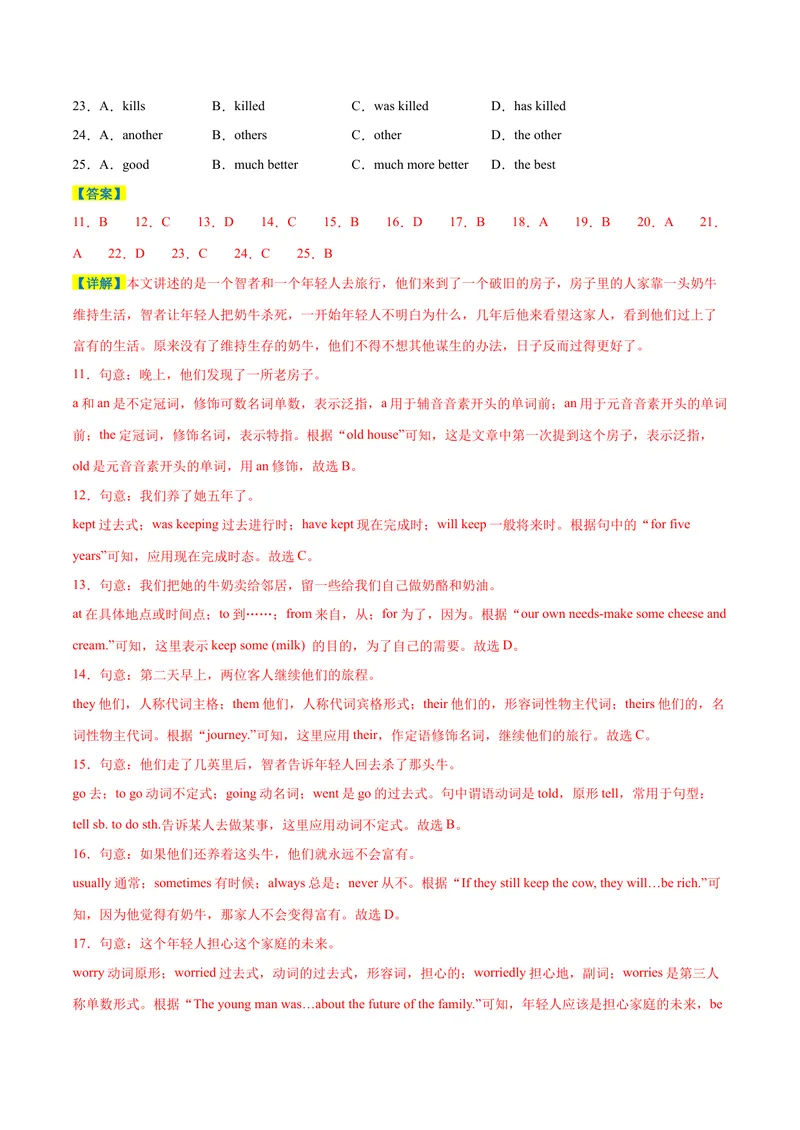
【答案】
11.B 12.C 13.D 14.C 15.B 16.D 17.B 18.A 19.B 20.A 21.
A 22.D 23.C 24.C 25.B
【详解】本文讲述的是一个智者和一个年轻人去旅行,他们来到了一个破旧的房子,房子里的人家靠一头奶牛
维持生活,智者让年轻人把奶牛杀死,一开始年轻人不明白为什么,几年后他来看望这家人,看到他们过上了
富有的生活。原来没有了维持生存的奶牛,他们不得不想其他谋生的办法,日子反而过得更好了。
11.句意:晚上,他们发现了一所老房子。
a和an是不定冠词,修饰可数名词单数,表示泛指,a用于辅音音素开头的单词前;an用于元音音素开头的单词
前;the定冠词,修饰名词,表示特指。根据“old house”可知,这是文章中第一次提到这个房子,表示泛指,
old是元音音素开头的单词,用an修饰,故选B。
12.句意:我们养了她五年了。
kept过去式;was keeping过去进行时;have kept现在完成时;will keep一般将来时。根据句中的“for five
years”可知,应用现在完成时态。故选C。
13.句意:我们把她的牛奶卖给邻居,留一些给我们自己做奶酪和奶油。
at在具体地点或时间点;to到……;from来自,从;for为了,因为。根据“our own needs-make some cheese and
cream.”可知,这里表示keep some (milk) 的目的,为了自己的需要。故选D。
14.句意:第二天早上,两位客人继续他们的旅程。
they他们,人称代词主格;them他们,人称代词宾格形式;their他们的,形容词性物主代词;theirs他们的,名
词性物主代词。根据“journey.”可知,这里应用their,作定语修饰名词,继续他们的旅行。故选C。
15.句意:他们走了几英里后,智者告诉年轻人回去杀了那头牛。
go去;to go动词不定式;going动名词;went是go的过去式。句中谓语动词是told,原形tell,常用于句型:
tell sb. to do sth.告诉某人去做某事,这里应用动词不定式。故选B。
16.句意:如果他们还养着这头牛,他们就永远不会富有。
usually通常;sometimes有时候;always总是;never从不。根据“If they still keep the cow, they will…be rich.”可
知,因为他觉得有奶牛,那家人不会变得富有。故选D。
17.句意:这个年轻人担心这个家庭的未来。
worry动词原形;worried过去式,动词的过去式,形容词,担心的;worriedly担心地,副词;worries是第三人
称单数形式。根据“The young man was…about the future of the family.”可知,年轻人应该是担心家庭的未来,beworried about担心。故选B。
18.句意:但最后他还是回到了老房子里,照智者的话做了。
But但是,表示转折;And和,而且,表示并列;So 因此,所以;Or 或者,否则。根据“finally he returned to
the old house and did as the wise man told him.”可知,前后是转折的关系。故选A。
19.句意:几年后,走在同一条路上的年轻人决定去看望这家人。
which关系代词,引导定语从句,先行词是物;who引导定语从句,先行词是人;where在哪里,是关系副词;
when关系副词,指时间。根据句子结构可知,这是一个定语从句,修饰名词the young man,从句中缺少主语,
故用关系代词who。故选B。
20.句意:令他惊讶的是,他看到那里有一座带美丽花园的大房子。
surprise吃惊,惊奇,名词;surprised吃惊的,形容词,修饰人;surprising令人吃惊的;surprisingly令人吃惊地,
副词。这里考查短语:to one’s surprise令某人吃惊的是,短语中需要用名词。故选A。
21.句意:这名男子告诉他,他的家庭生活发生了怎样的变化。
how怎样;what什么;whether是否;if是否,如果。根据“his family’s life changed.”可知,这个男人讲述他家
的生活是怎样改变的,故用how引导宾语从句。故选A。
22.句意:你知道,几年前我们只有一头牛来维持生命。
something某事;anything任何事;everything每件事;nothing没什么事。根据“but a cow to keep us alive years
ago.”可知,这一家人仅仅依靠这头奶牛来维持生活,所以这里表示“什么都没有”,nothing but...固定句型,
“除了……什么都没有”。故选D。
23.句意:但有一天她被杀了。
kills第三人称单数;killed过去式;was killed被动语态;has killed现在完成时。根据“But one day she”应该是有
一天她被杀了,当主语是动词的承受着,所以用被动。故选C。
24.句意:我们不得不想出其他谋生方法。
another另一个;others其他;other另外;the other另一个。根据“ways of making a living.”可知,这里是我们不
得不想出其他谋生方法。故选C。
25.句意:你看,我们比以前好多了。
good原形;much better比较级;much more better错误;the best最高级。句中有than表比较,much修饰比较级。
故选B。
(三)
阅读下面短文,按照句子结构的语法性和上下文连贯的要求,从各题所给的A、B、C和D项中选出最佳选
项,并在答题卡上将该项涂黑。
How time flies! We just finished our film-making program. During the 26 program, 50 students from differentcities 27 into groups to create our own films.
Summer 28 the story of Annie and Dawn. Born blind, Dawn and Annie both share the same dream 29
great pianists. To realize their dreams, they 30 face many difficulties and never give up. Through this movie, we
want to show the audience that friendship is important even when you are busy running after your dreams.
31 quite challenging for me to play the role of Dawn in the movie, because I needed to act like a blind person
without closing my eyes. After practicing over and over again at night, I finally got good at 32 !
33 the movie took us time and hard work. Most of us didn't have a rest 34 we finished our work every
midnight. Once, our director got his knees on the ground to show us 35 . The actress also tried hard. She 36
fall to the ground about 20 times to get the perfect shot. Just 37 how hard the ground was! It’s very touching,
isn’t it?
Our movie was shown at a cinema in Shenyang 38 a sunny morning. Our team took the Best Movie Award.
We felt so 39 that we almost cried. My experience during this summer is a valuable memory 40 I will
never forget. We never shot a movie before, but with our strong mind and great effort, we made it.
26.A.7 days B.7-days’ C.7-day D.7th-day
27.A.are dividing B.were divided C.were dividing D.are divided
28.A.tell B.tells C.told D.is telling
29.A.to become B.became C.become D.becoming
30.A.bravery B.brave C.braver D.bravely
31.A.It was B.It’s C.That was D.That’s
32.A.them B.they C.it D.its
33.A.Make B.Makes C.Made D.Making
34.A.since B.as C.until D.if
35.A.what could we do B.how we could do C.what to do it D.how to do it
36.A.had to B.ought to C.had better D.might
37.A.imagine B.to imagine C.imagined D.imagining
38.A.in B.on C.at D.for
39.A.excited B.excitedly C.exciting D.excitingly
40.A.when B.that C.who D.what
【答案】
26.C 27.B 28.B 29.A 30.D 31.A 32.C 33.D 34.C 35.D
36.A 37.A 38.B 39.A 40.B【详解】本文主要介绍作者拍电影的心路历程及成功后的喜悦。
26.句意:在七天的节目期间,来自不同国家的50个学生被分成不同的组来制作我们自己的电影。
7 days七天;7-days’错误写法;7-day7天的;7th-day错误写法。空后为名词,所以用形容词修饰。故选C。
27.句意:在七天的节目期间,来自不同国家的50个学生被分成不同的组来制作我们自己的电影。
are dividing正在分;were divided被分成,一般过去时的被动;were dividing正在分,过去进行时;are divided
被分成,一般现在时被动;根据语境,说的是之前那个项目中,学生们被分成了小组,是被动,由于是当时的
情况,应是一般过去时的被动语态。故选B。
28.句意:Summer讲述Annie和Dawn的故事。
tell动词原形;tells动词三单;told动词过去式;is telling现在进行时。此处是讲电影内容,下文描述故事用的
是一般现在时,故此处也用一般现在时,且主语是Summer,为第三人称单数。故选B。
29.句意:天生失明,Dawn和Annie两个分享成为伟大钢琴家的梦想。
to become不定式结构;became过去式;become动词原形;becoming动名词。分析句子可知,两人共同的梦想
是成为钢琴家,句子已含谓语,故此处应考虑非谓语动词,不定式结构作后置定语。故选A。
30.句意:为了实现他们的梦想,他们勇敢面对许多困难并绝不放弃。
bravery名词;brave形容词;braver比较级;bravely副词。横线上缺的词是修饰动词face,应是副词bravely。故
选D。
31.句意:在电影中扮演Dawn对我来说相当的有挑战。
It was它是,一般过去时;It’s它是,一般现在时;That was那是,一般过去时;That’s那是,一般现在时。根据
句型“it is 形容词 for sb. to do”可知it作形式主语,由于此句描述过去,所以是一般过去时态。所以是it was。
故选A。
32.句意:我最终做好了这件事。
them他们,宾格;they他们,主格;it它;its它的。分析句子可知,此处代指为了演好这个角色,在不闭眼的
情况下表现得像个盲人这件事,我反复练习的这件事,应用单数。故选C。
33.句意:拍电影花费我们时间和艰苦的工作。
Make动词原形;Makes动词三单;Made动词过去式;Making动名词。分析句子可知,横线上作主语,动名词
作主语。故选D。
34.句意:直到午夜我们完成我们的工作,我们大多数才休息。
since自从;as随着,因为;until直到,和否定句连用可构成not...until,意为“直到……才”;if如果。结合语
境可知,此处指直到完成工作才休息。故选C。
35.句意:从前,我们的导演跪在地上向我们展示我们如何做。
what could we do我们能做什么,问句; how we could do错误写法;what to do it错误写法;how to do it如何做。分析句子可知,此处缺少宾语。从句应用陈述语序,A错误。故选D。
36.句意:她不得不掉到地面上大约20次得到完美的镜头。
had to不得不;ought to应该;had better最好;might可能。根据语境可知,此处表示为了拍出好镜头不得不摔
倒20次。故选A。
37.句意:只是想想地面有多硬!
imagine动词原形;to imagine不定式结构;imagined动词过去式;imagining动名词。分析句子结构可知,该句
为祈使句,应用动词原形开头。故选A。
38.句意:在一个阳光明媚的早上我们的电影在沈阳的电影院上映。
in时间介词加季节,年份,月份等;on接具体某天的上下午晚上;at接钟点时间;for加段时间。空后为“a
sunny morning”阳光明媚的早上,所以是on。故选B。
39.句意:我感到如此兴奋以至于我们几乎哭了。
excited感到兴奋;excitedly感到兴奋,副词;exciting令人兴奋的;excitingly令人兴奋地。空前是系动词felt,
所以应接形容词,且主语为we,应是感到兴奋。故选A。
40.句意:这个夏天的经历是我绝不会忘记的宝贵记忆。
when当……时;that引导定语从句,先行词可以是人或物;who引导定语从句,先行词是人;what什么。分析
句子可知,空处引导定语从句修饰先行词a valuable memory,且先行词在从句中作宾语。故选B。
(四)
Have you heard of the Chinese idiom “taoli mantianxia”?
“Taoli” refers to peach and plum trees. Peach and plum trees 41 as a metaphor (比喻) for a number of
students. One of 42 things that can happen to a teacher is to see his or her students grow up to be productive
members of society.
You 43 wonder: why are students compared to these two types of trees?
It actually 44 from an ancient story about Zizhi, an official 45 lived in the state of Wei during the
Spring and Autumn Period (BC 770—BC 476). Zizhi, an educator, was a wise person. But the king didn’t like him at the
time. Zizhi had to leave his state 46 he was not well liked by the emperor. Zizhi opened a private school and
started to teach students to make a 47 .
After 48 the school. Zizhi chose his students based on neither their wealth 49 social status(地位).
He often gave his students useful advice. He often pointed at a peach and a plum tree in his garden and said, “You should
become 50 useful person and work hard to benefit society, just like when the peach and plum trees bloom and
yield fruit.”Keeping teacher’s words in 51 minds, many of Zizhi’s students went on to different places around the
country and achieved great things along the way. They planted many peach and plum trees to show their gratitude and
respect 52 their teacher.
Later, 53 Zizhi traveled around the country, he saw his students and the trees they had planted. He was
54 moved. “My students are like peach and plum trees. They are everywhere, and they 55 great results,”
he said.
41.A.use B.are using C.are used D.used
42.A.good B.best C.the best D.the better
43.A.may B.shall C.need D.have to
44.A.came B.comes C.is coming D.has come
45.A./ B.whom C.who D.whose
46.A.but B.because C.though D.or
47.A.lives B.living C.live D.leave
48.A.open B.opened C.to open D.opening
49.A.nor B.or C.and D.but
50.A./ B.the C.an D.a
51.A.they B.their C.theirs D.themselves
52.A.at B.in C.for D.with
53.A.when B.where C.if D.though
54.A.deep B.deeper C.deeply D.deepest
55.A.achieves B.achieved C.have achieved D.had achieved
【答案】
41.C 42.C 43.A 44.B 45.C 46.B 47.B 48.D 49.A 50.D 51.
B 52.C 53.A 54.C 55.C
【详解】本文主要介绍了中国谚语“桃李满天下”的由来。
41.句意:桃李树被用来比喻一些学生。
use使用,动词原形;are using现在进行时;are used一般现在时的被动语态;used过去分词。主语Peach and
plum trees和谓语use之间是被动关系,用被动语态。故选C。
42.句意:对老师来说,最好的事情之一就是看到他或她的学生成长为富有成效的社会成员。
good好的,原级;best最好的;the best定冠词加最高级;the better更好的。根据“One of...things that can happen
to a teacher...”可知是最好的事情之一,用最高级,且最高级前加定冠词the。故选C。
43.句意:你可能会想:为什么把学生比作这两种类型的树?may可能;shall将要;need需要;have to不得不。根据“You...wonder”可知是可能会好奇。故选A。
44.句意:它实际上来源于一个关于子质的古老故事,子质是春秋时期(公元前770年—公元前476年)生活
在魏国的一名官员。
came来,过去式;comes动词单三;is coming现在进行时;has come现在完成时。根据“from an ancient
story...”可知此处表示客观情况,句子用一般现在时,主语是It,谓语动词用单三。故选B。
45.句意:它实际上来源于一个关于子质的古老故事,子质是春秋时期(公元前770年—公元前476年)生活
在魏国的一名官员。
/不填;whom引导定语从句,先行词是人,关系词在从句中作宾语;who引导定语从句,先行词是人,关系词
在从句中作主语和宾语;whose引导定语从句,先行词是人或物,关系词在从句中作定语。句子是定语从句,先
行词是an official,关系词在从句中作主语,用who引导定语从句。故选C。
46.句意:子质因为不受皇帝喜欢,不得不离开他的国家。
but但是;because因为;though虽然;or或者。前后是因果关系,前果后因,用because引导原因状语从句。故
选B。
47.句意:子质开办了一所私立学校,开始教学生谋生。
lives居住,动词单三;living动名词;live动词原形;leave离开。make a living“谋生”。故选B。
48.句意:开办学校之后,子质选择学生,既不考虑他们的财富,也不考虑他们社会地位。
open打开,动词原形;opened过去式;to open动词不定式;opening动名词。介词after后加动名词。故选D。
49.句意:开办学校之后,子质选择学生,既不考虑他们的财富,也不考虑他们社会地位。
nor也不;or或者;and和;but但是。neither...nor“既不……也不”。故选A。
50.句意:你应该成为一个有用的人。
/零冠词;the定冠词;an不定冠词,修饰以元音音素开头的单词;a不定冠词,修饰以辅音音素开头的单词。此
处泛指“一个有用的人”,useful以辅音音素开头,用不定冠词a。故选D。
51.句意:把老师的话记在心里,子质的许多学生去了全国各地,一路上取得了伟大的成就。
they他们,主格;their他们的,形容词性物主代词;theirs他们的,名词性物主代词;themselves他们自己,反
身代词。修饰名词minds用形容词。故选B。
52.句意:他们种了许多桃李树来表达对老师的感激和尊敬。
at在;in在里面;for为了;with和。根据“show their gratitude and respect...their teacher”可知是对老师的感激和
尊敬,用介词for。故选C。
53.句意:后来,当子质周游全国时,他看到了他的学生和他们种的树。
when当;where哪里;if如果;though虽然。根据“Zizhi traveled around the country”可知是当他周游列国时。故
选A。54.句意:他深受感动。
deep深的,形容词原级;deeper比较级;deeply副词;deepest最高级。修饰形容词moved用副词。故选C。
55.句意:他们无处不在,取得了巨大的成绩。
achieves实现,动词单三;achieved动词过去式;have achieved现在完成时;had achieved过去完成时。根据
“They are everywhere, and they...great results”可知此处表示过去的动作对现在的影响,用现在完成时。故选C。
(五)
What do you think of your parents? I am always very pleased 56 them. 57 I have grown up, I
act like a small child sometimes. This feeling lets me 58 free and relaxed. In my opinion, things seem 59
in the world of adults’ than those of children’s.
One day, I went to buy some Christmas cards for my friends. After I went in, the shop-keeper showed me 60
I could choose the cards. I met a young mother and her baby there.
There 61 a lot of toys on the shelf. It was 62 high that the little girl was not able to pick up a
toy. The young mother tried 63 by the shelf closely, but it was still too difficult for the little girl. Then the
young mother stopped. She picked up a toy for her child and made her 64 .
The big smile 65 was on the face of the little girl made me think of my childhood. When I was a small
child, my parents came along whenever I needed them. Almost every problem 66 for me. I almost got lost in
that happy memory. Suddenly, the young mother’s words brought me back to 67 .
“Dear, one day, when you become 68 adult, I hope you can manage your own life, ” she said to the little
girl.
The words woke 69 up. I was no longer a small child. I should learn to be independent and face problems
70 by myself. And my parents would certainly be proud of me.
56.A.at B.with C.for D.to
57.A.Whether B.If C.Although D.When
58.A.feel B.to feel C.feeling D.felt
59.A.much difficult B.more difficult C.most difficult D.the most difficult
60.A.when B.what C.who D.where
61.A.are B.were C.is D.was
62.A.so B.too C.very D.such
63.A.pass B.passed C.passes D.to pass
64.A.happy B.happily C.happiness D.happiest
65.A.what B.who C.why D.which66.A.was solving B.were solving C.was solved D.were solved
67.A.reality B.real C.really D.realize
68.A.a B.an C.the D./
69.A.I B.my C.mine D.me
70.A.brave B.braver C.bravely D.bravery
【答案】
56.B 57.C 58.A 59.B 60.D 61.B 62.A 63.D 64.A 65.D
66.C 67.A 68.B 69.D 70.C
【详解】本文主要讲述了作者在买书的过程中无意听见一位母亲对孩子说的话,意识到自己应该独立了。
56.句意:我对他们总是很满意。
at在;with和;for为了;to到。be pleased with“对……满意”,故选B。
57.句意:虽然我已经长大了,但我有时表现得像个小孩子。
Whether是否;If 如果;Although尽管;When当……时。根据“I act like a small child sometimes”可知,尽管我
已经长大,有时我会像小孩子一样,故选C。
58.句意:这种感觉让我感到自由和放松。
feel动词原形;to feel动词不定式;feeling动名词;felt过去式。let sb do sth“让某人做某事”,故选A。
59.句意:在我看来,成年人的世界似乎比孩子的世界更困难。
much difficult错误格式;more difficult更困难;most difficult最困难;the most difficult最困难,有the。根据
“than”可知,需要比较级,故选B。
60.句意:我进去后,店主告诉我在哪里可以挑选卡片。
when什么时候;what什么;who谁;where哪里。根据“...I could choose the cards.”可知,店员向我展示在哪里
挑选卡片,故选D。
61.句意:架子上有很多玩具。
are一般现在式,主语是复数;were过去式,主语是复数;is主语是单数,三单形式;was过去式,主语是单数。
根据“a lot of toys on the shelf”可知,句子时态是一般过去时,主语是复数,故选B。
62.句意:它是如此之高,小女孩无法拿起一个玩具。
so如此,后接形容词或副词;too太;very非常;such如此,后接名词。根据“that the little girl was not able to
pick up a toy”可知,so...that...“如此……以至于”,故选A。
63.句意:年轻的母亲试图从架子旁边靠近,但对小女孩来说还是太困难了。
pass通过;passed动词过去式;passes三单形式;to pass动词不定式。try to do sth“尝试做某事”,故选D。
64.句意:她给她的孩子挑选了一个玩具,使她很高兴。
happy高兴,形容词;happily高兴地,副词;happiness高兴,名词;happiest最高兴的,最高级。根据“Shepicked up a toy for her child”可知,让她很开心,故选A。
65.句意:小女孩脸上的灿烂笑容使我想起了我的童年。
what什么;who谁;why为什么;which哪个。根据“The big smile ”可知,先行词是物,which符合句意,故选
D。
66.句意:几乎所有问题都为我解决了。
was solving过去进行时;were solving过去进行时;was solved被动形式,主语是单数;were solved被动形式,
主语是复数。根据“problem”可知,与solve的关系是被动,主语是单数,故选C。
67.句意:突然,年轻母亲的话把我带回了现实。
reality现实,名词;real真正的;really真地,副词;realize意识到,动词。根据“brought me back to”可知,需
要名词作to的宾语,故选A。
68.句意:“亲爱的,有一天,当你长大成人的时候,我希望你能管理自己的生活,”她对小女孩说。
a用于辅音音素前;an用于元音音素前;the定冠词; /零冠词。根据“adult”可知,需要不定冠词表示泛指,
adult是元音音素,an符合句意,故选B。
69.句意:这句话唤醒了我。
I我,主格;my我的,形容词性物主代词;mine我的,名词性物主代词;me我,宾格。根据“woke”可知,动
词后需要宾格,故选D。
70.句意:我应该学会独立,勇敢地面对问题。
brave勇敢的,形容词;braver更勇敢,比较级;bravely勇敢地,副词;bravery勇敢,名词。根据“face
problems”可知,副词修饰动词,故选C。
(六)
My mother moved to Guangzhou one month ago. Since my mother moved to live with us in Guangzhou, she 71
much heavier than before. As time went by, her health got even 72 . So I had to take her to see a doctor. My
mother 73 to lose weight by doing exercise every day. She had no choice but to follow 74 the doctor
said. In order not to make her feel lonely, I decided to exercise with her every morning.
On 75 first morning, she got up very early and ran with me in our neighborhood. At first, I ran 76
slowly that she could follow me. After we ran together for 77 minutes, I told her the proper ways of exercise and
the importance of eating healthy food. She looked at me and listened to me 78 . It made me remember that she
told me everything very patiently when I was a kid. On the following morning, I praised her for keeping 79 with
me.
80 after two weeks, she wanted to give up running because she thought the two-week exercise didn’twork at all. To encourage her, I taught her how to use the facilities(设施) for exercise in the gym 81 is not
far away. She felt 82 and began to exercise again.
83 my help, she made great progress. It took her one month 84 a good habit of daily
exercise. “Thank you, my dear daughter. Exercise brings health and happiness to me. I will never worry about 85
health.”
Her words touched my heart deeply. I felt joyful to make a big difference to my mother’s life.
71.A.was B.is C.will be D.has been
72.A.bad B.worse C.worst D.the worst
73.A.told B.tell C.was told D.was telling
74.A.what B.that C.which D.how
75.A.a B.an C./ D.the
76.A.very B.such C.quite D.so
77.A.few B.a few C.little D.a little
78.A.carefully B.careful C.more careful D.more carefully
79.A.to run B.run C.running D.ran
80.A.But B.Or C.And D.So
81.A.who B.which C.when D.whose
82.A.happiness B.happily C.happy D.happier
83.A.With B.On C.To D.In
84.A.develop B.developing C.to develop D.developed
85.A.me B.my C.I D.mine
【答案】
71.D 72.B 73.C 74.A 75.D 76.D 77.B 78.A 79.C 80.A
81.B 82.C 83.A 84.C 85.B
【详解】本文是一篇记叙文。文章主要介绍了作者的妈妈在作者的鼓励下努力地健身,身体变得越来越健康。
71.句意:自从我妈妈搬到广州和我们一起住,她比以前重了很多。
was一般过去时;is一般现在时;will be一般将来时;has been现在完成时。由“Since my mother moved to live
with us in Guangzhou”可知,since引导的时间状语从句,从句是一般过去时,主句用现在完成时,故选D。
72.句意:随着时间的流逝,她的健康状况越来越差。
bad原级;worse比较级;worst最高级;the worst定冠词the+最高级。even后加比较级,故选B。
73.句意:我妈妈被告知要通过每天锻炼来减肥。
told一般过去时,主动语态;tell一般现在时,主动语态;was told一般过去时,被动语态;was telling过去进行时。主语my mother与动词tell之间是被动关系,且时态是一般过去时,故选C。
74.句意:她别无选择,只能照医生说的去做。
what什么;that不译;which哪一个;how如何。此处是宾语从句引导词,said缺少宾语,且根据“follow ... the
doctor said”可知,此处是“按照医生说的”,故选A。
75.句意:第一天早上,她起得很早,和我一起跑到我们家附近。
a不定冠词;an不定冠词;/零冠词;the定冠词。序数词first前有定冠词the,故选D。
76.句意:起初,我跑得很慢,她能跟上我。
very非常;such如此;quite相当;so如此。此处是“so+副词+that从句”。表示“如此……以至于……”,故
选D。
77.句意:我们一起跑了几分钟后,我告诉她正确的运动方式和吃健康食物的重要性。
few很少、几乎没有,修饰复数,表示否定;a few少许、几个,修饰复数,表示肯定;little很少、几乎没有,
修饰不可数名词,表示否定;a little一些,修饰不可数名词,表示肯定。此处修饰复数minutes,且根据“ran
together for ... minutes”可知,此处是“跑了几分钟”,故选B。
78.句意:她看着我,认真地听我说。
carefully副词;careful形容词;more careful形容词比较级;more carefully副词比较级。副词修饰动词listened to
me,故选A。
79.句意:第二天早上,我称赞她一直陪我跑步。
to run不定式;run原形;running动名词;ran过去式。keep doing sth“一直做某事”,故选C。
80.句意:但两周后,她想放弃跑步,因为她认为两周的锻炼根本不起作用。
But但是;Or或者;And而且;So所以。根据“after two weeks, she wanted to give up running”可知,她想放弃跑
步,与前文“keeping ... with me”形成转折,故选A。
81.句意:为了鼓励她,我教她如何使用不远处健身房的设施进行锻炼。
who指人;which指物;when指地点;whose指人的或物的。此处是定语从句关系代词,指代the gym,指代物
用which,故选B。
82.句意:她感到很高兴,又开始锻炼了。
happiness名词;happily副词;happy形容词;happier形容词比较级。feel是系动词,后接形容词作表语,故选
C。
83.句意:在我的帮助下,她取得了很大的进步。
With和;On在……上;To到;In在……里。with one’s help“在某人帮助之下”,固定搭配,故选A。
84.句意:她花了一个月的时间才养成每天锻炼的好习惯。
develop动词原形;developing动名词;to develop不定式;developed过去式。It takes sb some time to do sth“花费某人时间做某事”,it是形式主语,用不定式作真正主语,故选C。
85.句意:我永远不会担心我的健康。
me宾格;my形容词性物主代词;I主格;mine名词性物主代词。用形容词性物主代词修饰名词health,故选
B。
(七)
My partner and I wanted to spread some pleasure, so we decided to give gifts to the people of a local nursing home.
I posted our plan 86 the Internet. My aunt and two of my friends sent me some money to buy gifts. And a lady
87 works at a store sent me a huge box of chocolates, biscuits and sweets. Another lady gave us a lot of cellophane
to wrap (包) the gifts so that they 88 pretty. My partner and I spent a full day 89 them. They looked
great!
As we didn’t have a car, we had difficulty taking these gifts to the nursing home. 90 , a young man named
James offered to drive us. So on December 22nd, we went to the nursing home with 74 gifts.
As soon as we arrived there, the nursing manager gave us 91 warm welcome and began taking us around
to everyone’s room. I saw the smiles, surprise and happiness on 92 faces. I was so happy to be there as I 93
so much pleasure. We wished them a happy Christmas and gave each of them a small gift.
It was a wonderful experience. I highly suggest that people do something like this 94 it will bring you so
much satisfaction and happiness. Now I am planning 95 visit.
86.A.on B.in C.at
87.A.who B.whom C.which
88.A.look B.will look C.would look
89.A.to wrap B.wrapping C.wrapped
90.A.Luck B.Lucky C.Luckily
91.A.a B.an C.the
92.A.them B.they C.their
93.A.give B.is given C.was given
94.A.so B.because C.so that
95.A.another B.other C.the other
【答案】
86.A 87.A 88.C 89.B 90.C 91.A 92.C 93.C 94.B 95.A
【详解】本文是一篇记叙文,主要讲的是作者和作者的伙伴一起为养老院的老人们送礼物的经历。
86.句意:我在网上公布了我们的计划。on在上面;in在里面;at在某地。on the Internet“在网上”,是固定搭配。故选A。
87.句意:一位在商店工作的女士送给我一大盒巧克力、饼干和糖果。
who用于先行词是人,在从句中作主语或宾语的情况;whom用于先行词是人,在从句中作宾语的情况;which
用于先行词是物,在从句中作主语或宾语的情况。lady指人,且在从句中作主语,故选A。
88.句意:另一位女士给了我们很多玻璃纸来包装礼物,这样它们看起来会很漂亮。
look动词原形;will look一般将来时;would look过去将来时。根据句子可知,给了玻璃纸来包装礼物,这样礼
物就很漂亮,“看起来漂亮”是发生在“包装”后,应用一般将来时,结合句中的gave可知,应用过去将来时,
故选C。
89.句意:我和我的搭档花了一整天的时间来包装它们。
to wrap动词原形;wrapping动名词;wrapped动词过去式。spend time doing“花时间做”,故选B。
90.句意:幸运的是,一个名叫詹姆斯的年轻人主动提出开车送我们。
Luck运气,名词;Lucky幸运的,形容词;Luckily幸运地,副词。此处修饰整个句子,应用一般将来时,故选
C。
91.句意:我们一到那里,护理经理就热情地欢迎我们,并开始带我们参观每个人的房间。
a用于辅音音素前;an用于元音音素前;the表特指。give sb a warm welcome表示“热烈欢迎某人”,故选A。
92.句意:我看到了他们脸上的微笑、惊喜和幸福。
them他们,宾格;they他们,主格;their他们的。空后是名词,应用形容词性物主代词,故选C。
93.句意:我很高兴能在那里,因为我得到了这么多的快乐。
give动词原形;is given一般现在时的被动语态;was given一般过去时的被动语态。“我”和“给”之间是被动
关系,句子是一般过去时,应用一般过去时的被动语态,故选C。
94.句意:我强烈建议人们做这样的事情,因为它会给你带来很多满足和快乐。
so所以;because因为;so that以便。根据“I highly suggest that people do something like this...it will bring you so
much satisfaction and happiness.”可知,因为它会给你带来很多满足和快乐,所以建议人们做这样的事情,故选
B。
95.句意:现在我正计划再去一次。
another另一个,泛指;other其他的;the other两者中的另一个。根据“Now I am planning...visit.”可知,泛指另
一次的旅行,故选A。
(八)
阅读下面短文,按照句子结构的语法性和上下文连贯的要求,从1~15各题所给的A、B、C 和D项中选出
最佳选项。
Andy was throwing an empty box when a woman and her daughter ran over.“You smell 96 !” Andy said to the woman.
The woman said, “I just want you 97 me the box. It’s how my daughter and I survive.” “ 98 it’s just
rubbish,”said Andy.
“One person’s rubbish is 99 person’s treasure,” the woman said, reaching out her hand,“ 100 I have
it?”
“ 101 you want it, just take it out of the rubbish bin by 102 ,” Andy replied impolitely. Then he
threw the box and walked towards his mother’s car. The woman didn’t say 103 and took the box.
Andy told his mother about the dirty woman. His mother said 104 a soft voice,“Andy, not everyone has
good luck. Your father 105 us when you were two years old. We lived 106 hard life. I couldn’t find a job,
so we had to live on the streets. One day, I met a lady and she advised me 107 money by recycling boxes. I
followed her suggestion and our life changed after that.”
Hearing this, Andy got out of the car and rushed to the lady. “I am sorry for 108 I did. You’re right.” Then
his mother came over and was surprised to find the woman was just the lady 109 helped them out of trouble a
few years ago. She said to the woman with joy, “You did so much for us. It’s my turn 110 you. I would like you
and your daughter to come and stay with us.” The girl and her mother were moved to tears.
There are always some people who give us unexpected warmth. So wherever we are, be kind to people around us.
96.A.terrible B.more terrible C.most terrible D.terribly
97.A.give B.gave C.to give D.giving
98.A.Though B.But C.Because D.So
99.A.other B.others C.the other D.another
100.A.Must B.Can C.Need D.Should
101.A.Whether B.Unless C.Before D.If
102.A.you B.your C.yourself D.yours
103.A.something B.anything C.everything D.nothing
104.A.in B.on C.at D.for
105.A.was leaving B.leaves C.left D.will leave
106.A.a B.an C.the D./
107.A.make B.making C.to make D.made
108.A.why B.what C.where D.when
109.A.whom B.whose C.what D.who
110.A.help B.to help C.helped D.helping【答案】
96.A 97.C 98.B 99.D 100.B 101.D 102.C 103.B 104.A 105.C
106.A 107.C 108.B 109.D 110.B
【详解】本文是一篇记叙文。Andy起初嫌弃一位捡垃圾的女士,母亲温柔地教育了她,并告诉他这个女士曾经
帮助过自己,这次该轮到我们帮助她了。
96.句意:你闻起来很难闻!
terrible糟糕的;more terrible更糟糕的;most terrible最糟糕的;terribly非常。根据后文“Andy told his mother
about the dirty woman. ”可知,女士靠捡垃圾生活,身上很脏,味道不好闻,作表用形容词。故选A。
97.句意:我只想让你把盒子给我。
give给,动词原形;gave一般过去式;to give动词不定式;giving动名词。根据“I just want you...me the box”可
知,是想让你给我盒子,want sb. to do sth.“想让某人做某事”。故选C。
98.句意:但这只是垃圾。
Though虽然;But但是;Because因为;So因此。根据“It’s how my daughter and I survive.” “...it’s just rubbish,”可
知,女士和她女儿靠捡垃圾生存,但Andy认为这只是垃圾,句子前后是转折关系,连词用but。故选B。
99.句意:一个人的垃圾是另一个人的宝藏。
other其余的,后面接可数名词复数; others其他的(人或物),代词;the other两者中的另一个;another另一
个,后面接可数名词单数。根据“One person’s rubbish is...person’s treasure”可知,指的是另一个人的。故选D。
100.句意:女人伸出手说:“我能得到它吗?”
Must必须;Can能;Need需要;Should应该。根据“...I have it?”可知,指的是能否拿到这个盒子。故选B。
101.句意:“如果你想要,就从垃圾桶里自己拿”。Andy不礼貌地回答。
Whether是否;Unless如果不;Before在……之前;If如果。根据“...you want it, just take it out of the rubbish”可
知,指的是如果你想要,if引导条件状语从句。故选D。
102.句意:“如果你想要,就从垃圾桶里自己拿”。Andy不礼貌地回答。
you你;your你的;yourself你自己;yours你的。根据“just take it out of the rubbish bin by..., Andy replied
impolitely”可知,Andy无礼地让女士她自己拿箱子。故选C。
103.句意:女士什么也没说,接过盒子。
something某些事情,用于肯定句;anything任何事情,用于否定句;everything所有事情;nothing没有什么。
根据“didn’t say...”可知,没有说话,是否定句,用anything。故选B。
104.句意:他妈妈轻声说。
in用;on在……上面;at在;for为了。根据“His mother said...a soft voice”可知,是用温柔的声音说道。故选
A。105.句意:你父亲在你两岁时离开了我们。
was leaving离开,过去进行时; leaves一般现在时单三形式;left一般过去时;will leave一般将来时。根据
“when you were two years old”可知,爸爸是过去离开我们的,用一般过去时。故选C。
106.句意:我们过着艰苦的生活。
a一个,不定冠词表泛指,后面接辅音音素开头的单词;an一个,不定冠词表泛指,后面接元音音素开头的单
词;the这个,那个。根据“We lived...hard life.”可知,是过着一段艰难的生活,hard以辅音音素开头,用不定冠
词a表泛指。故选A。
107.句意:有一天,我遇到了一位女士,她建议我通过回收盒子来赚钱。
make money赚钱;making money动名词形式;to make money动词不定式;made money一般过去式。根据“she
advised me...money”可知,是建议我赚钱,advise sb. to do sth.“建议某人做某事”。故选C。
108.句意:我为我的所作所为感到抱歉。你是对的。
why为什么;what什么;where在哪里;when什么时候。根据“‘If you want it, just take it out of the rubbish bin
by yourself, Andy replied impolitely;I am sorry for...I did”可知,Andy在为自己之前所做的无礼行为道歉,what作
did的宾语。故选B。
109.句意:然后他的母亲走了过来,惊讶地发现这个女人就是几年前帮助他们摆脱困境的那位女士。
whom谁,用作宾格;whose谁的;what什么;who谁,用作定语从句指人的关系代词。根据“the woman was
just the lady...helped them”可知,是曾经帮助过他们的女士,关系代词who作主语。故选D。
110.句意:该轮到我帮你了。
help帮助;to help动词不定式;helped一般过去式;helping动名词。根据“It’s my turn...you”可知,指的是轮到
我帮你了,it’s sb’s turn to do sth. “轮到某人做某事”。故选B。
(九)
One day, 100 people were attending a speech. The speaker was making a speech about happiness. However, after a
few hours, people began to lose their attention. The speaker thought of 111 idea. He stopped his speech and asked
all of the people to take part in a group activity.
He gave each person a balloon in the room. Each person 112 to write his or her name on the balloon with a
black marker(记号笔). Then, all of the balloons were collected and moved to 113 room.
The 100 people were then let into the room and told to find the balloon 114 their own name. Everyone was
115 searching for their own balloon. People were bumping into and tripping(绊倒)over each other.
But after about five minutes of searching, no one could find their own balloon.
After seeing this, the speaker asked each person 116 a balloon and try to find the person whose name waswritten on it. Everyone started asking each other for their name. In just a few minutes, everyone had his or her own
balloon.
“Can you see what 117 ?” the speaker said. “The balloons are like the happiness we look for in our own
lives. Everyone is busy looking for their own happiness, not caring 118 happens to others. But sometimes 119
way to find happiness is to help others. Help them find happiness 120 you can find your own.”
111.A.the B.an C.a D./
112.A.asks B.asked C.is asked D.was asked
113.A.other B.another C.others D.the other
114.A.with B.in C.on D.at
115.A.crazy B.crazily C.slow D.slowly
116.A.collect B.collected C.collecting D.to collect
117.A.happens B.happened C.is happening D.had happened
118.A.what B.who C.when D.that
119.A.good B.better C.best D.the best
120.A.but B.though C.and D.or
【答案】
111.B 112.D 113.B 114.A 115.B 116.D 117.B 118.A 119.D
120.C
【详解】本文是一篇记叙文。讲述了在一场演讲中,听众按要求搜寻写有自己名字的气球而不得,最后改为寻
找写在气球上的人,这样每个人都有了自己的气球的故事。通过找气球游戏,说明帮助别人找到幸福,你就能
找到自己的幸福的道理。
111.句意:演讲者想出了一个主意。
the那、这、这些、那些(定冠词);an一个(不定冠词);a一个(不定冠词);/不填。根据语境可知是想出
一个主意。空后是“idea”,以元音音素开头,应用an。故选B。
112.句意:每个人都被要求用黑色记号笔在气球上写下自己的名字。
asks要求(第三人称单数);asked要求(过去式);is asked被要求(一般现在时的被动语态);was asked被
要求(一般过去时的被动语态)。根据主语“Each person”是动作的承受者,所以此处应用被动语态,根据语境
可知,应用一般过去时态,所以应用was asked。故选D。
113.句意:然后,所有的气球都被收集起来,转移到另一个房间。
other别的、其他的(后跟可数名词复数);another另一个(不确定中的另一个);others 别人,别的事物)
(后面不跟名词);the other另一个(两个中的另一个)。空后的“room”是单数,根据语境,没有说有几个房间,也就是不确定的另一个房间,应用another。故选B。
114.句意:随后,这100人被允许进入房间,并被告知要找到写有自己名字的气球。
with带有;in在……里;on在……上;at在。根据空前的“the balloon”和空后的“their own name. ”可知,这里
指带有自己名字的气球。应用with带有。故选A。
115.句意:每个人都在疯狂地寻找自己的气球。
crazy疯狂的;crazily疯狂地;slow缓慢的;slowly缓慢地。根据语境可知,每个人应该是在疯狂地找气球,此
处应用副词修饰动词,所以应用crazily修饰“searching”。故选B。
116.句意:演讲者看到后,让每个人收集一个气球,试着找到上面写着名字的人。
collect收集(动词原形);collected收集(过去式);collecting收集(现在分词);to collect收集(不定式)。
根据前面的“asked”可知,此处考查ask sb to do sth“让某人做某事”。故选D。
117.句意:你能看到发生了什么吗?
happens发生(第三人称单数);happened发生(过去式);is happening正在发生(进行时态);had happened
已经发生(过去完成时)。这是一个含有宾语从句的复合句,发生的事,应用过去的某种时态,又根据“Can
you see”可知,应用一般过去时,不能用过去完成时。故选B。
118.句意:每个人都在忙于寻找自己的幸福,而不在乎别人发生了什么。
what什么;who谁;when什么时候;that那个。根据语境可知,此处是宾语从句 ,缺主语,根据空后的
“happens to others.”可知,应用sth happen to sb “某人发生了什么”,所以引导词应用“what”。故选A。
119.句意:但有时找到幸福的最好方法是帮助别人。
good好的(原级);better更好的(比较级);best最好的(最高级);the best最好的(最高级)。根据空后
的“way to find happiness is to help others.” 可知,此处应是考查the best way to do sth.“做某事的最好的方法”。
形容词最高级前应有定冠词the。故选D。
120.句意:帮助他们找到幸福,你就能找到自己的幸福。
But但是(表转折);though虽然(表转折);and和(表并列,肯定句);or或者(表并列,否定句)。根据
空前的“Help them find happiness”和“you can find your own.”可知,这两个句子是并列关系,肯定句。故选C。
(十)
在每小题的四个选项中,选出可以填入空白处的最佳答案。
Many homes have cameras to protect them from danger. The cameras can tell the owners if someone has entered.
But the cameras do not know 121 the person is a family member, a friend, a postman or a criminal (犯罪).
But a new camera made by a French company can recognize (辨别出) faces. It can tell parents at work that 122
children have returned from school, or that the mail has been sent to their home. It can also tell them if a stranger hasentered their home. 123 family members enter a home, the smart camera “recognizes” them and sends
information to the owner’s phone. The owner can choose to see the video then or later. But if an unknown person enters
the home, the camera 124 a warning sound to the owner’s phone.
This is what happened recently to a smart home camera owner named Damien. He lives in Paris.
“On a Friday I 125 a big monthly meeting at work when my phone moved. At first I 126
myself ‘Oh, it must be a wrong warn,’ but my phone was telling me there was a face 127 the camera did not
recognize. Something was happening in my house!
“I saw a person I did not know with his shoes on, which 128 in my apartment (公寓). I watched it on the
video. I felt quite 129 . I hurried back home as fast as possible and called the police on the way. Thanks to the
smart camera, the criminal 130 soon.” said Damien.
121.A.whether B.that C.what D.which
122.A.they B.them C.theirs D.their
123.A.While B.When C.During D.As
124.A.sending B.is sending C.will send D.send
125.A.was having B.had C.am having D.will have
126.A.tell B.was telling C.told D.have told
127.A.who B.which C.whom D.whose
128.A.is not allowingB.not allows C.not allow D.is not allowed
129.A.surprised B.surprise C.surprising D.surprises
130.A.caught B.is caught C.was caught D.being caught
【答案】
121.A 122.D 123.B 124.C 125.A 126.C 127.B 128.D 129.A
130.C
【详解】本文主要介绍了法国新近的一种新型的智能摄像机,有能够识别人脸的功能,把这种智能摄相机安装
在家里,能够帮助主人防止意外的发生。
121.句意:但是摄像机不知道这个人是家庭成员、朋友、邮递员还是罪犯。
whether是否;that那个;what什么;which哪个。根据“But the cameras do not know…the person is a family
member, a friend, a postman or a criminal ”可知,此处指的是不知道是否是家庭成员、朋友、邮递员还是罪犯。故
选A。
122.句意:它可以告诉上班的父母,他们的孩子已经从学校回来了,或者邮件已经送到他们家了。
they他们,主格;them他们,宾格;theirs他们的,名词性物主代词;their他们的,形容词性物主代词。根据“t can tell parents at work that…children have returned from school”可知,此处指的是“他们的孩子”,用形容词
性物主代词their。故选D。
123.句意:当家庭成员进入住宅时,智能摄像头会“识别”他们,并将信息发送到主人的手机上。
While当……时候,常用于进行时;When当……时候,常用于一般时态;During在……期间;As随着。根据
“…family members enter a home, the smart camera…”可知,此处指的是“当家庭成员进入住宅的时候”,时态为
一般现在时,因此此处用连词when引导时间状语从句。故选B。
124.句意:但如果有陌生人进入家中,摄像头会向主人的手机发出警告声。
sending送,动名词;is sending送,正在进行时;will send送,一般将来时;send送,动词原形。根据“But if
an unknown person enters the home, the camera…a warning sound to the owner’s phone.”可知,此处遵循主将从现原
则,主句是一般将来时,因此此处用will send。故选C。
125.句意:一个周五,我正在开一个大型的月度工作会议,这时我的手机动了。
was having有,过去进行时;had有,动词过去式;am having有,现在进行时;will have有,一般将来时。根据
“On a Friday I…a big monthly meeting at work when my phone moved. ”可知,此处表示过去的某一时间段发生的
动作和状态,因此用过去进行时。故选A。
126.句意:起初,我告诉自己:“哦,这一定是一个错误的警告”,但我的手机告诉我,有一张脸是摄像头无
法识别的。
tell告诉,动词原形;was telling告诉,过去进行时;told告诉,过去式;have told告诉,现在完成时。根据语境
可知,此处是过去发生的动作,因此用一般过去时,用told。故选C。
127.句意:起初,我告诉自己:“哦,这一定是一个错误的警告”,但我的手机告诉我,有一张脸是摄像头无
法识别的。
who谁;which哪个;whom谁;whose谁的。根据“but my phone was telling me there was a face…the camera did
not recognize.”可知,句子是定语从句,先行词是“face”,从句中缺宾语,因此此处关系词用which。故选B。
128.句意:我看到一个我不认识的人穿着鞋子,这在我的公寓里是不允许的。
is not allowing不允许,正在进行时;not allows表达错误;not allow不允许,动词原形;is not allowed不被允许,
被动。根据“I saw a person I did not know with his shoes on, which…in my apartment”可知,此处指的是“不被允
许”,用被动语态,时态用一般现在时,表示习惯性发生的动作,一般现在时的被动语态其谓语动词构成为is
not allowed。故选D。
129.句意:我感到非常惊讶。
surprised惊讶的,指人;surprise惊讶,名词;surprising惊讶的,指物;surprises惊讶,名词复数。根据“I felt
quite…”可知,此处修饰人,形容词作表语,因此用surprised。故选A。
130.句意:多亏了智能摄像机,罪犯很快就被抓住了。caught抓,过去式;is caught被抓住,一般现在时的被动语态;was caught被抓住,一般过去时的被动语态;
being caught被抓住,进行时。根据“the criminal…soon”可知,主语与谓语动词之间是被动关系,因此此处用被
动语态,事情发生在过去,因此此处用一般过去时的被动语态,其形式为“was caught”。故选C。
(十一)
There is a special rule for German schools. The police will make reports on students 131 don’t have
permission(许可)to miss school. Like many places, students can’t miss classes without permission from the school in
Germany.
But during busy travel times, some parents often take 132 children out of school early to go on vacation,
and they can save a lot of money on planes and hotels by 133 at a different time from others.
Last weekend was the beginning of 134 important holiday period in Germany. The police checked and
made sure that students weren’t leaving on vacation before they 135 to.
The police at three German airports(机场) looked 136 families with school-aged children. When they
found them, they pulled(推)the families out of lines to talk with them. They wanted to find out 137 the
parents had permission for the children to be out of school. If the children didn’t have permission, the police would
138 the families to their schools and to the government.
However, these families had two weeks to show that it was OK for their children 139 school. If they
couldn’t, they might have to pay as 140 as £1, 000 as a fine(罚款), or received some other punishment.
131.A.whose B.what C.who
132.A.they B.them C.their
133.A.go B.going C.to go
134.A.the B.a C.an
135.A.allowed B.are allowed C.were allowed
136.A.like B.for C.after
137.A.whether B.although C.since
138.A.report B.reports C.reported
139.A.miss B.missing C.to miss
140.A.much B.more C.most
【答案】
131.C 132.C 133.B 134.C 135.C 136.B 137.A 138.A 139.C
140.A
【详解】本文是一篇说明文。主要介绍了德国学校的特殊规定和警方如何检查和惩罚未经允许缺课的学生。131.句意:警方将对未经学校允许缺课的学生进行报告。
whose谁的,引导定语从句,表示所属关系;what什么,引导名词性从句,用于表示疑问或引导说明;who谁,
引导定语从句。该句中关系代词who引导定语从句修饰students,表示“那些没有得到允许缺席学校的学生”。
故填C。
132. 句意:但在繁忙的旅游季节,一些家长经常提前让他们的孩子早退去度假。
they他们,主格代词;them他们,宾格代词;their他们的,形容词性物主代词。该句指的是父母让他们的孩子
早退,所以应该用形容词性物主代词their。故选C。
133.句意:他们可以通过在不同的时间旅行来节省很多机票和酒店费用。
go去,动词原形;going去,go的现在分词形式;to go不定式。根据空前的介词“by”可知,此处需要填动词go
的动名词going。 故选B。
134.句意:上周末是德国一个重要节日假期的开始。
the定冠词,特指;a不定冠词,表示“一个”或“一种”,用于辅音音素开头的单数可数名词前;an不定冠词,
用来表示“一个”或“一种”,用于元音音素开头的单数可数名词前。根据空后的“important holiday period”可
知,holiday period是一个单数可数名词短语,它表示一段节日假期,而important是以元音音素开头的单词。故
选C。
135.句意:警察进行检查并确保学生在被允许之前不会离开度假。
allowed允许,过去式;are allowed被允许,一般现在时的被动语态;were allowed被允许,一般过去时的被动语
态。根据上下文可知,时态用的是一般过去时,且句子的主语student和动词allow之间是被动关系,所以应该
用一般过去时被动语态were allowed。故选C
136.句意:在德国的三个机场,警察寻找有学龄儿童的家庭。
like像,介词;for为了,表示目的,介词;after在……之后,介词。look for寻找;look like看起来像;look
after照顾。根据语境可知,警察是在寻找有学龄儿童的家庭。故选B。
137.句意:他们想弄清楚父母是否有让孩子缺课的许可。
whether是否;although虽然;since因为、既然、自从。whether在此句中引导一个宾语从句,表示一种选择或
询问,用来表明他们想要弄清楚的事情是关于孩子是否有离校的许可。故选A。
138.句意:如果孩子没有得到允许,警察会向他们所在的学校和政府报告这些家庭。
report报告、报道,动词原形;reports报告、报道,report 的复数形式;reported报告、报道,过去式。根据空
前的“would”可知,情态动词后加应动词原形。故选A。
139.句意:然而,这些家庭有两个星期的时间来证明让他们孩子缺课是可以的。
miss错过,动词原形;missing错过,miss 的现在分词形式;to miss不定式。此句有一个常用的表达方式“it is
OK for sb to do sth”,意为“对某人做某事是可以的”;it was OK for their children to miss school,意为“他们的孩子不去学校是可以的”。故选C。
140.句意:如果他们无法做到,他们可能需要支付高达1000英镑的罚款,或接受其他惩罚。
much 非常、很多;more更多;most最多。根据“as…as”可知,空处应该使用形容词或副词的原级形式,as
much as,表示程度或数量上的相等或一样多。故选A。
(十二)
Usually I wouldn’t cross the park at this time of night, but walking around the park would take more time. And it
was raining so hard that I couldn’t even see clearly 141 was before me. So I entered the park. And that was
142 first stupid thing I did tonight.
Soon after I walked into the park, I saw a man under a tree up ahead, my heart fell. The stories I’d heard about the
park were all coming into my head at this moment. Anyone 143 a clear mind would just turn back. But me?
No. I did 144 stupid thing, I decided 145 past him.
Just when I was passing the man, he 146 his head and gave me the strangest smile. I got scared and
started running, “Hey!” The man shouted from behind. “Wait!” He was running after me!
I ran like crazy. I had hoped the trees would keep some rain off. And they did, but they also made the park look even
147 I couldn’t see what 148 ahead of me, then I ran into something. It was the man!
“ 149 me!” I cried.
“What? I was trying to give back your bag! You dropped it.” The man gave me my bag.
Now, I felt saying that to the man was the stupidest thing 150 I did tonight.
141.A.how B.what C.when D.whether
142.A.a B.an C.the D./
143.A.with B.in C.of D.by
144.A.other B.the other C.another D.others
145.A.hurry B.hurrying C.hurried D.to hurry
146.A.raises B.raised C.is raising D.was raised
147.A.dark B.darker C.darkest D.the darkest
148.A.is B.are C.was D.were
149.A.No kill B.Not kill C.Don’t killing D.Don’t kill
150.A.which B.who C.whose D.that
【答案】
141.B 142.C 143.A 144.C 145.D 146.B 147.B 148.C 149.D
150.D【详解】本文是记叙文,文章讲述了作者在一个下雨的夜晚在公园遇到了一个人,以为像别人一样遇到了坏人
而惊慌失措,最后才知道他是给自己还包的人。
141.句意:雨下得很大,我甚至看不清面前是什么。
how如何;what什么;when何时;whether是否。此处是宾语从句,引导词在从句中作主语,故选B。
142.句意:这是我今晚做的第一件蠢事。
a泛指一个,用于辅音音素开头前;an泛指一个,用于元音音素开头前;the定冠词表特指;/零冠词。序数词
first前要加the,故选C。
143.句意:任何头脑清醒的人都会回头。
with和;in在里面;of……的;by通过。根据“Anyone..a clear mind would just turn back.”可知,此处表伴随,表
示“有头脑清醒的人”,故选A。
144.句意:我又做了一件蠢事,我决定赶紧从他身边过去。
other其他的;the other两者中的另一个;another三者及以上的另一个;others其他人/物。根据“I did...stupid
thing”可知,此处修饰可数名词单数thing,是三者及以上的另一个,故选C。
145.句意:我又做了一件蠢事,我决定赶紧从他身边过去。
hurry动词原形;hurrying动名词/现在分词;hurried动词过去式;to hurry动词不定式。decide to do sth“决定做某
事”,故选D。
146.句意:就在我经过那个人的时候,他抬起头,给了我一个最奇怪的微笑。
raise动词三单;raised动词过去式;is raising现在进行时;was raised一般过去时的被动语态。此处在句中作谓
语,时态是一般过去时,主语是动作的发出者,故选B。
147.句意:它们做到了,但它们也让公园看起来更暗了我看不见前面的东西,然后我撞到了什么东西。
dark形容词原级;darker形容词比较级;darkest形容词最高级;the darkest定冠词the+形容词最高级。even修饰
比较级,表示“更暗”,故选B。
148.句意:它们做到了,但它们也让公园看起来更暗了我看不见前面的东西,然后我撞到了什么东西。
is一般现在时,主语是第三人称单数;are一般现在时,主语是第二人称或复数;was一般过去时,主语是第三
人称单数;were一般过去时,主语是第二人称或复数。本句时态是一般过去时,主语是“what”,表单数,故选
C。
149.句意:别杀我!
No kill没有杀害;Not kill不会致命;Don’t killing表述错误;Don’t kill别杀。此处是祈使句,故选D。
150.句意:我觉得对他说这话是我今晚做的最愚蠢的事。
which指物,作主语或宾语;who指人,作主语或宾语;whose指人或指物,作定语;that指人或指物,作主语
或宾语。此处是定语从句,引导词在从句中作宾语,先行词有最高级修饰,只能用that引导。故选D。(十三)
阅读下面短文,掌握其大意,按照句子结构的语法和上下文连贯的要求,从每题所给的四个选项中选出一
个最佳答案,并将答题卡上对应题目所选的选项涂黑。
At the end of my first year of high school, I realized I needed to find a summer job. I was tired of asking my parents
for money. I 151 to go to the shopping center or movies with friends without asking for $20 from my parents. I
imagined having a job at a store or at a summer camp where 152 could play games with children. 153
the result was disappointing. The only job I could find was cleaning up tables at 154 local restaurant.
The first day was terribly busy. I got up very 155 . I was running around, racing to get a table ready for the
waiting customers. I’ll never forget 156 tired I felt that day, but I’ll also never forget sitting down for lunch
with my workmates for the first time. People 157 my age or ten years older than me all sat together and talked
about their days. All of a sudden, I was a part of that, and when I 158 by the customers, I felt so good.
I 159 at the restaurant for almost one year. I’ve learned to be happy about getting up so early, because I
know there are going to be a few good moments every day there.
From starting there as a shy student, I’ve been able to grow into a person 160 can go up and greet anyone,
at work or anywhere else. I’m also not as sensitive (敏感的) as I used to be. The little job has given me so much, and I
can’t wait to go back and continue to grow from my experience.
151.A.want B.wants C.wanted D.wanting
152.A.I B.me C.my D.myself
153.A.And B.Or C.But D.So
154.A.a B.an C.the D./
155.A.early B.earlier C.earliest D.the earliest
156.A.what B.what a C.what an D.how
157.A.to B.at C.in D.on
158.A.praised B.praise C.is praised D.was praised
159.A.worked B.was working C.have worked D.will work
160.A.which B.who C.what D.where
【答案】
151.C 152.A 153.C 154.A 155.A 156.D 157.B 158.D 159.C
160.B
【详解】本文是一篇记叙文。主要讲述了作者找了一份在一家饭店清洁桌子的工作,从刚开始的不情愿到最后
很享受这份工作,这些经历让作者成长过程中也发生了很大的变化。151.句意:我想和朋友一起去购物中心或看电影,而不用向父母索要20美元。
want想要,动词原形;wants动词单三;wanted动词过去式;wanting动名词。根据“I realized...”可知句子用一
般过去时,动词用过去式。故选C。
152.句意:我想象着在商店或夏令营找到一份工作,在那里我可以和孩子们一起玩游戏。
I我,主格;me我,宾格;my我的,形容词性物主代词;myself我自己,反身代词。此处作主语,用代词主格
I。故选A。
153.句意:但结果令人失望。
and和;or或者;but但是;so所以。此处和前句是转折关系,用but连接。故选C。
154.句意:我唯一能找到的工作就是在当地一家餐馆收拾桌子。
a不定冠词,修饰以辅音音素开头的单词;an不定冠词,修饰以元音音素开头的单词;the定冠词;/零冠词。此
处泛指“一家餐馆”,local以辅音音素开头,用不定冠词a。故选A。
155.句意:我起得很早。
early早,原级;earlier比较级;earliest最高级;the earliest定冠词加最高级。very修饰原级。故选A。
156.句意:我永远不会忘记那天我有多累,但我也永远不会忘记第一次和同事们坐下来吃午饭。
what引导感叹句,修饰可数名词复数或不可数名词;what a引导感叹句,修饰可数名词单数,且后面的词以辅
音音素开头;what an引导感叹句,修饰可数名词单数,且后面的词以元音音素开头;how引导感叹句,修饰形
容词或副词。此处修饰形容词tired用how。故选D。
157.句意:和我同龄或比我大十岁的人都坐在一起谈论他们的日子。
to到;at在;in在里面;on在上面。at my age“在我这个年纪”。故选B。
158.句意:当我受到客户的赞扬时,我感觉很好。
praised表扬,动词过去式;praise动词原形;is praised一般现在时的被动语态;was praised一般过去时的被动语
态。主语I和谓语praise之间是被动关系,且文章时态为一般过去时,故此处用一般过去时的被动语态。故选
D。
159.句意:我在这家餐馆工作快一年了。
worked工作,动词过去式;was working过去进行时;have worked现在完成时;will work一般将来时。根据
“for almost one year”可知句子用现在完成时have/has done。故选C。
160.句意:从一个害羞的学生开始,我已经成长为一个可以在工作或其他任何地方上前问候任何人的人。
which引导定语从句,先行词是物,在从句中作主语或宾语;who引导定语从句,先行词是人,在从句中作主语
或宾语;what不引导定语从句;where引导定语从句,先行词是地点,在从句中作地点状语。先行词是person,
关系词在从句中作主语,用who引导定语从句。故选B。
(十四)When I was twelve years old, my family lived next to a forest. Every evening, mockingbirds(知更鸟) would come
and rest in the trees and sing. I enjoyed 161 singing so much that I decided to catch a young bird. In this way, I
could hear it sing for me every day.
I finally managed 162 one and put it in a cage. At first, the bird was very frightened, so it fluttered(扑腾)
in its new home all the time. Several days later, it was used 163 in this new home.
The next day, the little bird’s mother flew to the cage with 164 food. The baby bird looked very happy
and ate everything that the mother brought to it. I was so happy to see this, for the mother knew how to take care of her
baby 165 than me.
But the next morning, I found it died. I was terribly 166 and cried at once. I didn’t know what happened.
Arthur Wayne, my father’s friend, was a famous ornithologist(鸟类学家). She 167 my father at that time.
168 she knew the whole thing, she explained to me, “If a mother mockingbird finds her baby 169 in a
cage, she will bring it poisonous(有毒的) berries. She thinks it’s better for her baby to die than to lose freedom.”
Since then I 170 any living animal in a cage. All living things have a right to live free.
161.A.a B.an C.the D./
162.A.get B.to get C.gets D.getting
163.A.live B.to live C.living D.to living
164.A.few B.little C.any D.some
165.A.good B.well C.better D.best
166.A.surprise B.surprised C.surprising D.surprisingly
167.A.visits B.have visited C.is visiting D.was visiting
168.A.If B.When C.Because D.Although
169.A.keep B.keeps C.is keeping D.is kept
170.A.haven’t caughtB.won’t catch C.don’t catch D.didn’t catch
【答案】
161.C 162.B 163.D 164.D 165.C 166.B 167.D 168.B 169.D
170.A
【详解】本文讲述了作者抓了一只小知更鸟,关在笼子里。一只鸟妈妈来给小鸟喂食。后来,这只小鸟死了。
原来,这只鸟妈妈认为她的孩子死了总比失去自由好。自那时起,作者再也不抓任何活着的动物,关进笼子里。
161.句意:我非常喜欢这歌声,所以我决定抓一只小鸟。
a一个,修饰辅音音素开头的单数名词;an一个,修饰元音音素开头的单数名词;the那个,表示特指;/是零冠
词。根据“Every evening, mockingbirds(知更鸟) would come and rest in the trees and sing.”可知,此处指的是前文提到的鸟唱的歌声,应用定冠词表示特指,故选C。
162.句意:我终于设法弄到了一只,把它关在笼子里。
get得到,动词原形;to get动词不定式;gets动词三单形式;getting现在分词/动名词。manage to do sth“设法成
功做某事”,故选B。
163.句意:几天后,它习惯了在这个新家的生活。
lives生活,三单式;to live动词不定式;living现在分词/动名词;to living介词to+动名词。根据“Several days
later, it was used.. in this new home”可知,此处指习惯了新生活,be used to doing sth“习惯做某事”,故选D。
164.句意:第二天,小鸟的妈妈带着一些食物飞到笼子里。
few几乎没有,修饰可数名词复数;little几乎没有,修饰不可数名词;any任何,常用在否定句或疑问句中;
some一些,常用在肯定句中。本句是肯定句,且根据“The baby bird looked very happy”可知,应是鸟妈妈带回
了一些食物,故选D。
165.句意:我很高兴看到这一点,因为母亲比我更知道如何照顾她的孩子。
good好的,形容词;well好,副词;better更好;best最好。根据“than”可知,此处用比较级,故选C。
166.句意:我大吃一惊,立刻哭了起来。
surprise使惊讶,动词原形;surprised惊讶的,修饰人;surprising令人惊讶的,修饰物;surprisingly惊人地。
was后跟形容词作表语,主语是I,所以用surprised,故选B。
167.句意:那时她正在拜访我父亲。
visits一般现在时;have visited现在完成时;is visiting现在进行时;was visiting过去进行时。根据“at that time”
可知,讲述过去某个时刻正在发生的动作,所以用过去进行时,故选D。
168.句意:当她知道整件事后,她向我解释了。
If如果;When当……时候;Because因为;Although尽管。根据“she knew the whole thing, she explained to me”
可知,她给我解释原因,应是她知道了这件事的时候,故选B。
169.句意:如果一只知更鸟妈妈发现她的孩子被饲养在笼子里,她会给它带来有毒的浆果。
keep饲养,原形;keeps动词三单形式;is keeping现在进行时;is kept一般现在时的被动语态。主语her baby与
keep之间是被动关系,指被养在笼子里,所以用被动语态,故选D。
170.句意:从那以后,我再也没有在笼子里抓过任何活着的动物。
haven’t caught没有抓住,现在完成时;won’t catch不会抓住,一般将来时;don’t catch没有抓住,一般现在时;
didn’t catch没有抓住,一般过去时。根据时间状语“Since then”可知,句子用现在完成时,故选A。
(十五)
In China, safety education is becoming more and more important. Stampedes (蜂拥), earthquakes and fires are the
main accidents at school. Students need to learn about how to keep 171 safe at school.Stampedes often happen in crowded 172 . When the people begin to push you, you should stand there and
hold something. If you fall down, you should protect your head 173 your hands.
Earthquakes always happen suddenly. If you are inside a building, you can hide under a table or a chair, because it
will protect you from 174 by the falling things. If you are outside a building, you should find 175
open place and stay away from buildings and trees.
176 there’s a fire, leave the classroom as soon as possible. While 177 the classroom, you’d
better put something wet over your mouth and nose. In this way, you won’t take in the smoke. In fact, many people die in
a fire just 178 the smoke. The smoke is full of CO and that makes it difficult for people 179 . So
2
you should make yourself close to the floor and try to go out quickly. Then you will be 180 and you can
breathe the fresh air.
171.A.them B.their C.themselves
172.A.place B.places C.place’s
173.A.by B.with C.from
174.A.hurting B.be hurt C.being hurt
175.A.a B.an C.the
176.A.When B.Though C.However
177.A.leave B.leaving C.is leaving
178.A.because B.because for C.because of
179.A.to breathe B.to breathing C.breathing
180.A.safe B.safely C.safety
【答案】
171.C 172.B 173.B 174.C 175.B 176.A 177.B 178.C 179.A
180.A
【详解】本文介绍了在学校里最容易发生的三种事故:踩踏、地震和火灾,并介绍了应对措施。
171.句意:学生们需要学习如何在学校保护自己的安全。
them他们;their他们的;themselves他们自己。当宾语与主语为同一人称时,宾语用反身代词,故选C。
172.句意:踩踏事件常发生在人多的地方。
place地方,单数名词;places地方,复数名词;place’s地方的。根据“in crowded”可知,此处指在拥挤的地方,
此空应填复数名词,故选B。
173.句意:如果你摔倒了,你应该用手保护你的头。
by通过;with用;from从。根据“protect your head… your hands”可知,用手保护头部,故选B。174.句意:如果你在建筑物里,你可以躲在桌子或椅子下面,因为它会保护你不被掉落的东西伤害。
hurting动名词;be hurt被动语态;being hurt被动语态。from是介词,后接动名词,根据“by the falling things”
可知,此处指保护你不被掉落的东西伤害,是被动关系,故选C。
175.句意:如果你在建筑物外面,你应该找一个开放的地方,远离建筑物和树木。
a一个,用于辅音音素开头;an一个,用于元音音素开头;the这个/那个。此处表示泛指,且open是以元音音
素开头的,故选B。
176.句意:当发生火灾时,尽快离开教室。
When当……时;Though尽管;However然而。根据“ there’s a fire, leave the classroom as soon as possible.”可知,
当火灾发生时,要尽快离开教室,故选A。
177.句意:离开教室时,你最好用湿的东西捂住你的嘴和鼻子。
leave动词原形;leaving动名词或现在分词;is leaving现在进行时结构。while引导的时间状语从句,当从句的
主语和主句的主语保持一致时,从句省略主语和be动词,所以此空应填现在分词,故选B。
178.句意:事实上,许多人死于火灾只是因为烟雾。
because因为,引导原因状语从句;because for无此搭配;because of因为,后接名词或名词性短语。空格后the
smoke是名词,所以应填介词短语because of,故选C。
179.句意:烟雾中充满了二氧化碳,这使得人们难以呼吸。
to breathe动词不定式;to breathing介词to+动名词;breathing动名词。固定句式:It is+形容词+to do sth表示
“做某事是……的”,动词不定式作主语,故选A。
180.句意:然后你就安全了,你可以呼吸新鲜空气。
safe安全的;safely安全地;safety安全。be后接形容词作表语,故选A。
(十六)
Do you know about Zhongshan University? It is one of the 181 universities in China. Many students want
to go there for further study. In order to know more about this university, our school organized the students in Grade Nine
182 it last month.
We went to Zhongshan University by bus at 8:00 in the morning. A teacher 183 developed training
courses in Zhongshan University met us at the school gate. We 184 to the library by him first. Some teachers
and students were doing some reading there. 185 made any noise. How quiet it was! Then he guided us to the
teaching building. It was big and beautiful. When we went to 186 floor, a chemistry teacher was showing
experiments in one of the classrooms. All the students watched and listened to him 187 , and took many notes
on the book. It was 188 wonderful that all of us lost ourselves in it. At about four o’clock in the afternoon, wehad to say goodbye to the teachers and went home.
In the evening, we wrote down what we saw and heard in Zhongshan University. I 189 up my mind to
study harder since then. I 190 become a student of Zhongshan University. I think I will make it if I study hard.
181.A.good B.better C.best D.worst
182.A.visit B.to visit C.visiting D.to visiting
183.A.who B.which C.where D.how
184.A.took B.take C.are taken D.were taken
185.A.Somebody B.Nobody C.Anybody D.Everybody
186.A.nine B.ninth C.the nine D.the ninth
187.A.careful B.careless C.carefully D.carelessly
188.A.so B.such C.very D.too
189.A.have made B.made C.will make D.am making
190.A.should B.can’t C.must D.have to
【答案】
181.C 182.B 183.A 184.D 185.B 186.D 187.C 188.A 189.A
190.C
【详解】本文主要讲述了作者去参观中国最好的大学之一——中山大学的所见所闻所感。
181.句意:它是中国最好的大学之一。
good好的;better更好;best最好;worst更差。one of the+最高级+复数名词,表示“最……之一”,根据
“Many students want to go there for further study”可知,许多学生去那里深造,说明它是最好的大学之一,故选
C。
182.句意:为了更多地了解这所大学,我们学校上个月组织了九年级的学生参观。
visit动词原形;to visit动词不定式;visiting动名词;to visiting介词to+动名词。organize sb to do sth“组织某人做
某事”,此空应填动词不定式,故选B。
183.句意:一位在中山大学开发培训课程的老师在校门口迎接我们。
who谁;which哪一个;where哪里;how怎样。分析句子结构可知,此处是定语从句,先行词teacher是指人,
在从句中作主语,用who引导定语从句,故选A。
184.句意:我们先被他带到图书馆。
took动词过去式;take动词原形;are taken一般现在时被动语态;were taken一般过去时被动语态。根据by him
可知,此处用被动语态,描述过去发生的事情,用一般过去时的被动语态,故选D。
185.句意:没有人制造任何噪音。
Somebody某人;Nobody没有人;Anybody任何人;Everybody每个人。根据“How quiet it was”可知,非常安静,没有人制造噪音,故选B。
186.句意:当我们上到九楼的时候,一位化学老师正在一间教室里做实验。
nine九,基数词;ninth第九,序数词;the nine九,基数词;the ninth第九,序数词。根据“When we went to …
floor”可知,此处用序数词表示顺序,序数词前要加the,故选D。
187.句意:所有的学生都看着,仔细听他讲的内容。
careful细心的,形容词;careless粗心的,形容词;carefully细心地,副词;carelessly粗心地,副词。此空修饰
动词listened,应填副词,根据“took many notes on the book”可知,认真地听讲并做笔记,故选C。
188.句意:它如此的棒,以至于我们沉浸其中。
so如此;such如此;very非常;too也。根据“wonderful that all of us lost ourselves in it”可知,修饰形容词用
so…that引导结果状语从句,故选A。
189.句意:从那时起,我下定决心要更加努力学习。
have made现在完成时;made动词过去式;will make一般将来时;am making现在进行时。根据“since then”可
知,此处用现在完成时have/has done的结构,故选A。
190.句意:我必须成为中山大学的一名学生。
should应该;can’t不能;must必须;have to不得不。根据“I think I will make it if I study hard”可知,下定决心
必须成为这所大学的一名学生,表示主观的意识,应填must,故选C。
(十七)
Some time ago, an old businessman had a large store in Boston. He wanted a boy to work for him, and he put up
191 advertisement in the newspaper. The next morning, many boys came to the old man’s office to 192
the job.
The businessman pointed to a nail on the door 193 his office, took out a walking stick and said,
“Everyone has three chances. If anyone can hit the nail on the head with this stick more than once, I 194 him
the job.” The boys thought it was very easy. They all tried, but 195 could make it. So the old man said, “I’m
sorry I can’t take any of you.” And they left.
He kept the advertisement in the papers, and the next morning many more boys came, and among them he saw a
thin boy who had been there the day before. The boy hit the nail 196 for three times. The old man felt excited
and asked how he 197 that. “I also failed yesterday,” said the boy, “but I thought if I kept 198 I
could do it. So I went home and practiced hitting a nail with a stick 199 I could do it, and I got up very early
this morning, and tried again.”
The old man said, “You are the boy for me.” So the job 200 to him by the old man. Whatever the boy hadto do, he tried to do his best. It was not very long before he became the best clerk in the store.
191.A.a B.an C.the D./
192.A.care for B.pay for C.ask for D.look for
193.A.of B.in C.at D.to
194.A.give B.will give C.would give D.gave
195.A.anybody B.nobody C.somebody D.everybody
196.A.successfully B.successful C.success D.succeeded
197.A.does B.do C.has done D.did
198.A.to try B.tried C.try D.trying
199.A.until B.since C.when D.after
200.A.is given B.was given C.gave D.give
【答案】
191.B 192.C 193.A 194.B 195.B 196.A 197.D 198.D 199.A
200.B
【详解】本文是一篇记叙文,讲述了一个商人想招聘员工,他的面试题是让应聘者们用拐杖击中门上的钉子至
少两次,每人有三次机会,许多人都办不到。一个男孩失败后回家认真练习,最后做到了并获得了这份工作。
191.句意:他想要一个男孩为他工作,于是他在报纸上登了一则广告。
a不定冠词,常用在辅音音素开头的单词前;an不定冠词,常用在元音音素开头的单词前;the定冠词;/不填。
根据“he put up...advertisement”可知,是登一则广告,advertisement是元音音素开头的单词,所以填an。故选
B。
192.句意:第二天早上,许多男孩来到老人的办公室请求这份工作。
care for在意;pay for为……付钱;ask for请求;look for寻找。根据“many boys came to the old man’s office
to...the job.”可知应聘者们是来请求获得这份工作的。故选C。
193.句意:这位商人指着他办公室门上的一颗钉子,拿出一根手杖,说道。
of……的;in在……里;at在;to到。根据“a nail on the door...his office”可知,这里是所属关系,表示“办公室
的门上”。故选A。
194.句意:谁要是能用这根棍子多次击中钉子,我就给他这份工作。
give给;will give一般将来时;would give过去将来时;gave一般过去时。本句是if引导的条件状语从句,遵循
“主将从现”原则。故选B。
195.句意:他们都试了,但没人能成功。
anybody任何人;nobody没人;somebody某人;everybody每个人。根据“but”可知此处表示转折,前文说大家都试了,可知此处是说没人成功。故选B。
196.句意:男孩成功地敲了三次钉子。
successfully成功地,副词;successful成功的,形容词;success成功,名词;succeeded成功,动词。此处用副
词修饰其前动词“hit”。故选A。
197.句意:老人感到很兴奋,问他是怎么做到的。
does做,动词三单形式;do动词原形;has done现在完成时;did一般过去时。根据“asked”可知,本句是一般
过去时,所以这里填动词did。故选D。
198.句意:但是我想如果我继续努力,我可以做到。
to try尝试,不定式;tried过去式;try动词原形;trying动名词。此处是固定词组,keep doing sth“坚持做某事”。
故选D。
199.句意:所以我回家练习用棍子敲钉子,直到我能做到为止,今天早上我起得很早,又试了一次。
until直到;since自从;when当……时;after在……之后。此处用until引导时间状语从句,意为“直到”。故
选A。
200.句意:所以老人给他这个工作。
is given给,一般现在时的被动语态;was given一般过去时的被动语态;gave过去式;give动词原形。此处the
job与动词give是被动关系,时态是一般过去时,所以这里是一般过去时的被动语态。故选B。
(十八)
One morning, a young bear came out of the forest and walked into one of the classrooms in a village school. The
teacher and the children were scared and tried 201 out of his way.
“Don’t be afraid of me,” said the bear. “I won’t hurt 202 . I just want to learn here.”
“But this is 203 school for humans, not animals.” said Mrs Green.
“Mrs Green, please let the bear come to school. He 204 cause any trouble,” said the children.
“You must understand, children,” replied Mrs. Green, “people follow rules. Bears are wild animals, and wild
animals do not follow rules.”
The bear quickly replied, “I can learn to follow rules. Remember, bears are good listeners.”
The teacher thought for a while. “Well,” she said, “I’ll let you stay 205 just one day. But remember, you
must follow our rules.”
“No problem,” said the bear. “If all the animals followed rules. we wouldn’t fight so much.”
“Right,” said Mrs Green. “That’s 206 we have rules. Rules help us get along.”
After saying that, the bear hurried to the back of the classroom but suddenly 207 and shouted, “But what
if I have a question to ask?”Mrs. Green replied, “You must put up your hand 208 I speak to you. Then you 209 to ask
questions.”
The bear quickly put up his hand.
“Do you already have a question?” the teacher asked.
“Yes,” replied the bear. “If I follow rules today, 210 I come back to school tomorrow?”
All the children laughed, and so did Mrs Green.
201.A.got B.get C.to get D.getting
202.A.anyone B.someone C.no one D.everyone
203.A.an B.the C./ D.a
204.A.will B.doesn’t C.isn’t D.won’t
205.A.in B.at C.for D.on
206.A.when B.where C.why D.how
207.A.stop B.stopped C.stops D.stopping
208.A.unless B.until C.while D.after
209.A.are allowed B.allowed C.allows D.allowing
210.A.need B.should C.must D.can
【答案】
201.C 202.A 203.D 204.D 205.C 206.C 207.B 208.B 209.A
210.D
【详解】本文主要讲述了一只小熊想到教室里上课,开始老师和孩子们都害怕它,但是它承诺遵守规则之后,
老师答应它可以待在教室里。
201.句意:老师和孩子们都很害怕,都想让开。
got过去式;get动词原形;to get动词不定式;getting动名词或现在分词。get out of one’s way“让开”。故选C。
202.句意:我不会伤害任何人。
anyone任何人;someone某人;no one没人;everyone每天。根据“I just want to learn here.”可知不想伤害任何人,
否定句中用anyone。故选A。
203.句意:但这是人类的学校,不是动物的。
an不定冠词表泛指,后接以元音音素开头的单词;the定冠词表特指;/零冠词;a不定冠词表泛指,后接以辅音
音素开头的单词。此处泛指一所学校,school以辅音音素开头,其前用不定冠词a。故选D。
204.句意:他不会惹麻烦的。
will将会;doesn’t不;isn’t不是;won’t不会。根据“Mrs Green, please let the bear come to school. He ... cause any
trouble”可知对未发生的事情进行保证,不会惹麻烦,用won’t。故选D。205.句意:我让你只待一天。
in后接年月季节等;at后接具体时刻等;for后接一段时间;on后接具体某一天等。“just one day”可知这是一段
时间,前用for。故选C。
206.句意:这就是为什么我们有规则。
when什么时候;where在哪里;why为什么;how如何。根据“Rules help us get along.”可知此处讲有规则的原
因,用why引导表语从句。故选C。
207.句意:说完,熊急忙跑到教室后面,但突然停了下来,喊道:“但是如果我有问题要问呢?”
stop动词原形;stopped过去式或过去分词;stops动词第三人称单数形式;stopping动名词或现在分词。根据
“After saying that, the bear hurried to the back of the classroom but suddenly ... and shouted”可知but后句意出现转折,
突然停下来。故选B。
208.句意:你必须举手,等我跟你说话。
unless除非;until直到……为止;while当……时候;after在……之后。根据“You must put up your hand ... I
speak to you.”可知直到老师说话为止,小熊都要举着手,用until引导时间状语从句。故选B。
209.句意:然后你可以问问题。
are allowed一把现在时的被动语态;allowed一般过去时;allows一般现在时;allowing动名词或现在分词。主语
you与动词allow之间是动宾关系,此处是直接引语,用一般现在时的被动语态。故选A。
210.句意:如果我今天遵守规定,明天我能来学校吗?
need需要;should应该;must必须;can能。根据“If I follow rules today, ... I come back to school tomorrow?”可知
问明天能来学校吗,用can。故选D。
(十九)
Claire Williams is 15. She is from Wales. Her friends always play volleyball and go to the cinema. They like 211
and dancing. But Claire doesn’t. She has 212 unusual hobby — beekeeping (养蜂). She’s got four beehives
(蜂箱). She isn’t sure, but she thinks she’s raised about 40,000 bees.
In the spring, this is a special Sunday for Claire. Claire gets up 213 than other times. She has breakfast
with her parents. She puts on her special clothes 214 can protect her and goes out into the garden. She 215
the bees with sugar and water. She sometimes takes photos of the bees, too.
Claire’s friends Hannah and Kate come round. They don’t go near the hives. “We 216 watch Claire with
the bees,” They say. “But we’re a bit afraid of them!” Claire talks to her friends for a while. Then Hanna and Kate say
goodbye, and Claire goes back to the bees.
It’s lunchtime. Claire likes telling 217 family about bees. “They fly 80,000 kilometers to make one kilo ofhoney!” She says, “And they visit about three million flowers!”
In the afternoon, Claire stays in her room. She loves reading something 218 bees on the Internet or in
books.
In the summer, a lot of honey 219 by Claire’s bees. She takes the honey to a small shop and sells it. She
doesn’t spend the money, 220 she wants to buy more beehives! She can have more money in the future.
211.A.sing B.sang C.to sing D.singing
212.A.a B.the C.an D./
213.A.early B.earlier C.earliest D.the earliest
214.A.that B.what C.whose D.how
215.A.feed B.feeding C.have fed D.feeds
216.A.should B.can C.may D.must
217.A.she B.hers C.herself D.her
218.A.about B.of C.into D.for
219.A.produced B.produces C.is produced D.was produced
220.A.until B.though C.if D.because
【答案】
211.D 212.C 213.B 214.A 215.D 216.B 217.D 218.A 219.C
220.D
【详解】本文是一篇记叙文。主要讲述了15岁的克莱尔·威廉姆斯有一个不寻常的爱好——养蜂,并详细描述了
她的养蜂活动。
211.句意:他们喜欢唱歌和跳舞。
sing动词原形;sang动词过去式;to sing动词不定式;singing动名词或现在分词。and连接并列宾语,根据
dancing可知此处用动名词singing。故选D。
212.句意:她有一个不寻常的爱好——养蜂。
a不定冠词表泛指,后接以辅音音素开头的单词;the定冠词表特指;an不定冠词表泛指,后接以元音音素开头
的单词;/零冠词。此处泛指“一个不寻常的爱好”,unusual以元音音素开头,其前用不定冠词an。故选C。
213.句意:克莱尔比其他时候起得早。
early早,原级;earlier更早,比较级;earliest最早,最高级;the earliest最早,定冠词+最高级。根据“than”可
知用副词比较级修饰动词。故选B。
214.句意:她穿上能保护自己的特殊衣服,走到花园里。
that引导定语从句,先行词指物;what什么;whose谁的,先行词为名词,在从句中作定语;how如何。根据
“her special clothes ... can protect her”可知此处是定语从句,先行词her special clothes指物,且在从句中作主语,用that引导定语从句。故选A。
215.句意:她用糖和水喂蜜蜂。
feed动词原形;feeding动名词或现在分词;have fed现在完成时;feeds动词第三人称单数。根据上下文可知用
一般现在时,主语“She”后接动词第三人称单数形式。故选D。
216.句意:“我们可以看克莱尔和蜜蜂在一起,”她们说。
should应该;can可以;may可能;must必须。根据“They don’t go near the hives.”可知朋友们不靠近蜂箱,可以
观看克莱尔和蜜蜂在一起。故选B。
217.句意:克莱尔喜欢给家人讲蜜蜂的事。
she她,人称代词主格;hers她的,名词性物主代词;herself她自己,反身代词;her她(的),人称代词宾格
或形容词性物主代词。根据“family”可知用形容词性物主代词修饰名词。故选D。
218.句意:她喜欢在网上或书上读一些关于蜜蜂的东西。
about关于;of……的;into进入……里面;for为了。根据上文可知爱好是养蜂,结合“She loves reading
something ... bees on the Internet or in books.”可知是喜欢读一些关于蜜蜂的东西。故选A。
219.句意:在夏天,克莱尔的蜜蜂会产出很多蜂蜜。
produced一般过去时;produces一般现在时;is produced一般现在时的被动语态;was produced一般过去时的被
动语态。主语“a lot of honey”与动词produce之间是动宾关系,结合上下文可知用一般现在时的被动语态。故选
C。
220.句意:她没有花这笔钱,因为她想买更多的蜂箱!
until直到……为止;though尽管;if如果;because因为。句子前果后因,用because引导原因状语从句。故选
D。
(二十)
Dads have Father’s Day. Moms have Mother’s Day. Kids have 221 Day. Do our grandparents have a special
holiday?
The Double Ninth Festival is a day for elderly people in China. It falls 222 the ninth day of the ninth month
of the lunar calendar(阴历). As the Chinese word for nine has the same sound as the word for long, people take the
Double Ninth Festival 223 their wishes of long life for elderly people. There are many traditions for this
festival.Families get together and climb mountains for luck and in the hope that elderly people will live much 224
. They also drink chrysanthemum(菊花)wine and wear plants called zhuyu to celebrate it. Both chrysanthemum and
zhuyu are regarded as plants 225 can clean houses and treat diseases.
Respecting elderly people is shown not only on this special day but also in daily life. For example, when an olderperson enters a room, everyone 226 stand up.When several guests are at the table, the host is supposed to
introduce them from the oldest to the youngest. When a younger person is giving something to an older person, two
hands 227 . On a crowded subway or bus, younger people will show their respect by 228 their seats to
elderly people.
So far, respecting elderly people 229 a traditional virtue(美德). That’s because the Chinese know
elderly people have 230 and experience that young people can learn from, so Chinese people are proud of getting
old. Besides, to respect the elderly people is to respect ourselves tomorrow.
221.A.Child B.Child’s C.Children D.Children’s
222.A.on B.in C.at D.of
223.A.show B.shows C.to show D.showing
224.A.longer B.the longer C.longest D.the longest
225.A.who B.why C.what D.which
226.A.can B.can’t C.should D.shouldn’t
227.A.need B.are needed C.are needing D.are being needed
228.A.offer B.offers C.offered D.offering
229.A.is B.will be C.was D.has been
230.A.know B.knowledge C.knowledgeable D.knowledgeably
【答案】
221.D 222.A 223.C 224.A 225.D 226.C 227.B 228.D 229.D
230.B
【详解】本文介绍了中国的重阳节,并强调了中国人尊重老年人的传统美德。
221.句意:孩子们有儿童节。
Child孩子,名词单数;Child’s孩子的,名词单数所有格;Children孩子们,名词复数;Children’s孩子们的,名
词复数所有格。根据前文“Dads have Father’s Day. Moms have Mother’s Day.”可知,孩子们也有自己的节日,故
用复数所有格形式。故选D。
222.句意:它是在农历九月初九。
on在,接具体哪一天;in在,接年、月、季节等;at在,接具体时间点;of在……的。根据“the ninth day of
the ninth month of the lunar calendar”可知,农历九月初九是具体的一天,应用on。故选A。
223.句意:人们用重阳节来表达他们对老年人长寿的愿望。
show展示,显示,动词原形;shows动词第三人称单数;to show动词不定式;showing动名词。take sth. to do
sth.表示“用某物做某事”。故选C。224.句意:家人聚在一起爬山以求好运,并希望老年人能活得更久。
longer更长的,形容词比较级;the longer定冠词+比较级;longest最长的,形容词最高级;the longest定冠词+最
高级。空前有副词much,修饰形容词比较级形式。故选A。
225.句意:菊花和茱萸都被认为是可以清洁房屋和治疗疾病的植物。
who谁,指人,定语从句种作主语/宾语;why为什么,定语从句中作原因状语;what什么,不引导定语从句;
which哪一个,指物,定语从句中作主语/宾语。根据先行词plants可知,此处指物,且作主语。故选D。
226.句意:例如,当一位老人进入房间时,每个人都要站起来。
can能够;can’t不能;should应该;shouldn’t不应该。根据“Respecting elderly people ...”可知,应是为了表示尊
敬,老人进房间,其他人都应该站起来。故选C。
227.句意:当年轻人给老年人东西时,需要两只手。
need需要;are needed被需要,一般现在时的被动语态;are needing正需要,现在进行时;are being needed正被
需要,现在进行时的被动语态。根据is可知,时态为一般现在时,主语和谓语动词之间是被动关系。故选B。
228.句意:在拥挤的地铁或公共汽车上,年轻人会通过向老年人让座来表达他们的尊重。
offer提供,动词原形;offers动词第三人称单数;offered动词过去式;offering动名词。根据by可知,介词后需
要接动名词形式。故选D。
229.句意:迄今为止,尊重老年人已经是一种传统美德。
is是,一般现在时;will be将会是,一般将来时;was一般过去时;has been已经是,现在完成时。根据“So
far”可知,时态为现在完成时。故选D。
230.句意:那是因为中国人知道老年人有年轻人可以学习的知识和经验。
know知道,动词;knowledge知识,名词;knowledgeable博学的,形容词;knowledgeably知识渊博地,副词。
动词have后接名词,且根据experience“经验”可知,此处和experience保持一致,应用名词形式。故选B。