文档文本内容
Unit 5 What are the shirts made of?
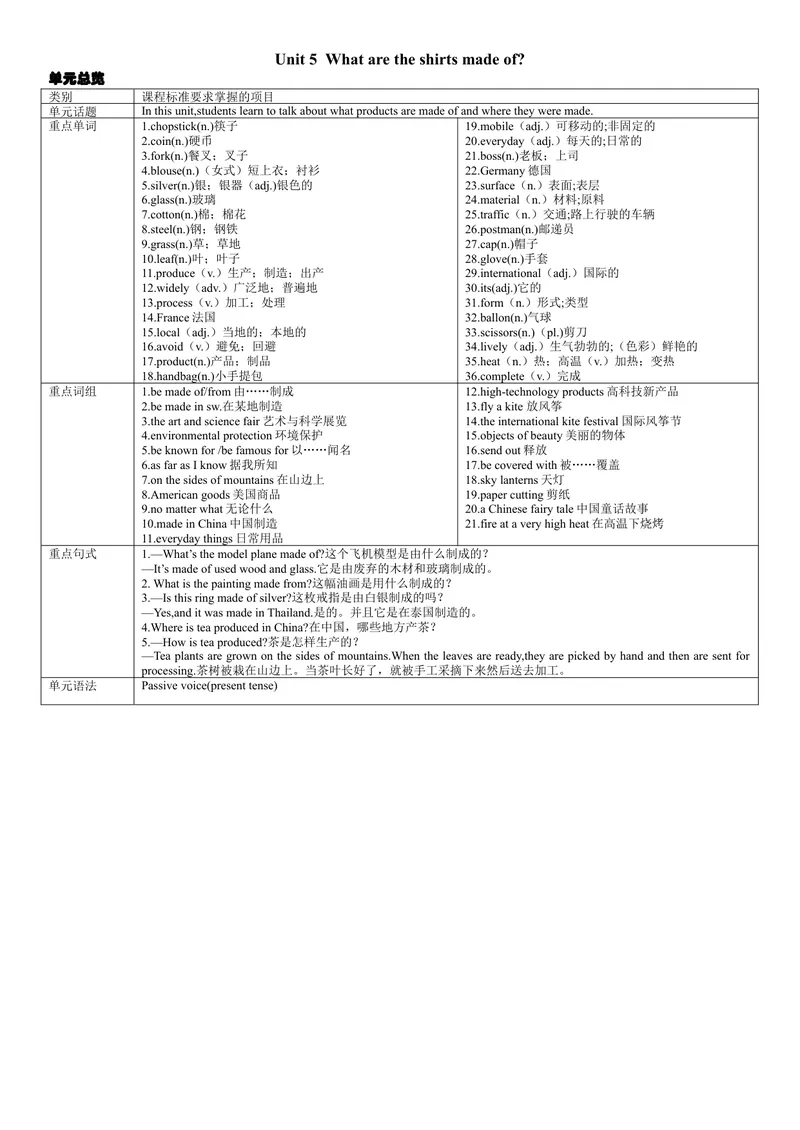
单元总览
类别 课程标准要求掌握的项目
单元话题 In this unit,students learn to talk about what products are made of and where they were made.
重点单词 1.chopstick(n.)筷子 19.mobile(adj.)可移动的;非固定的
2.coin(n.)硬币 20.everyday(adj.)每天的;日常的
3.fork(n.)餐叉;叉子 21.boss(n.)老板;上司
4.blouse(n.)(女式)短上衣;衬衫 22.Germany德国
5.silver(n.)银;银器(adj.)银色的 23.surface(n.)表面;表层
6.glass(n.)玻璃 24.material(n.)材料;原料
7.cotton(n.)棉;棉花 25.traffic(n.)交通;路上行驶的车辆
8.steel(n.)钢;钢铁 26.postman(n.)邮递员
9.grass(n.)草;草地 27.cap(n.)帽子
10.leaf(n.)叶;叶子 28.glove(n.)手套
11.produce(v.)生产;制造;出产 29.international(adj.)国际的
12.widely(adv.)广泛地;普遍地 30.its(adj.)它的
13.process(v.)加工;处理 31.form(n.)形式;类型
14.France法国 32.ballon(n.)气球
15.local(adj.)当地的;本地的 33.scissors(n.)(pl.)剪刀
16.avoid(v.)避免;回避 34.lively(adj.)生气勃勃的;(色彩)鲜艳的
17.product(n.)产品;制品 35.heat(n.)热;高温(v.)加热;变热
18.handbag(n.)小手提包 36.complete(v.)完成
重点词组 1.be made of/from由……制成 12.high-technology products高科技新产品
2.be made in sw.在某地制造 13.fly a kite 放风筝
3.the art and science fair艺术与科学展览 14.the international kite festival国际风筝节
4.environmental protection环境保护 15.objects of beauty美丽的物体
5.be known for /be famous for以……闻名 16.send out释放
6.as far as I know据我所知 17.be covered with被……覆盖
7.on the sides of mountains在山边上 18.sky lanterns天灯
8.American goods美国商品 19.paper cutting剪纸
9.no matter what无论什么 20.a Chinese fairy tale中国童话故事
10.made in China中国制造 21.fire at a very high heat在高温下烧烤
11.everyday things日常用品
重点句式 1.—What’s the model plane made of?这个飞机模型是由什么制成的?
—It’s made of used wood and glass.它是由废弃的木材和玻璃制成的。
2. What is the painting made from?这幅油画是用什么制成的?
3.—Is this ring made of silver?这枚戒指是由白银制成的吗?
—Yes,and it was made in Thailand.是的。并且它是在泰国制造的。
4.Where is tea produced in China?在中国,哪些地方产茶?
5.—How is tea produced?茶是怎样生产的?
—Tea plants are grown on the sides of mountains.When the leaves are ready,they are picked by hand and then are sent for
processing.茶树被栽在山边上。当茶叶长好了,就被手工采摘下来然后送去加工。
单元语法 Passive voice(present tense)电子导学案
第一课时Section A(1a~2d)
知识目标 1.要求学生翻开课本P33页,快速阅读1a表格部分的内容。
类别 课时要点 把物品和可能构成他们的材料匹配起来。(1分钟)
重点单词 1.produce(v.)生产;制造
2.要求学生听第一遍录音,并完成课本上1b的听力任务。(1
2.widely(adv.)广泛地;普遍地
3.process(v.)加工;处理 分钟)
重点词组 1.be made of/from 由……制成 3.要求学生听第二遍录音,并逐句进行跟读。(2分钟)
2.be made in sw.在某地制造
4.要求学生先练习1a中的对话,再模仿1c的对话,用1b表
3.the art and science fair 艺术与科学展览
4.environmental protection 环境保护 格中的信息进行对话练习。并邀请2-3对同学当堂进行演示。(3
5.grass and leaves 草地与树叶 分钟)
6.be known for /be famous for 以……闻名
7.as far as I know 据我所知
5.小结训练。要求学生在规定的时间内完成一个小练习。并
8.on the sides of mountains 在山边上 请若干学生给出自己的答案。有错误的话及时纠正。(2分钟)
重点句式 1.What is the model plane made of? 用括号内所给动词的正确形式填空。
这个飞机模型是用什么制成的? 1)The apples are sent (send) to the factory for processing.
2.What is the painting made from? 2)We are all ready but Tom hasn’t packed (pack) his clothes yet.
这幅油画是用什么制成的? 3)The windows of the room are cleaned (clean)every day.
3.—Is this ring made of silver? 4)The best cotton is produced (produce) in Xing Jiang in China.
这枚戒指是由白银制成的吗? 5)The song isn’t liked (not like) by most of us.
—Yes,and it was made in Thailand.
环节说明:通过学习1a,使学生对被动结构有所了解;通过
是的。并且它是在泰国制造的。
4.Where is tea produced in China? 1b,锻炼学生的听力及抓取关键信息的能力;通过1c的训练锻炼
在中国,哪些地方产茶?
学生的口头表达能力,同时巩固对一般现在时被动结构的认识。
课堂环节
Step 3完成教材2a-2d的任务
§自主学习方案
【操作案例】
学生想一想,说一说,写一写。
1.要求学生翻开课本P34,要求学生听第一遍录音,完成2a,
Teacher: Do you know what your everyday things are made of?
2b的听力任务。(1分钟)
Where are they made?(2分钟)
2.要求学生听第二遍录音,并逐句进行跟读。(2分钟)
【新词自查】
3.听力内容巩固训练。要求学生根据所听到的内容完成下列
根据句意及汉语提示完成句子。
各句。完成后要求若干学生给出自己的答案。以巩固对听力内容
1.Alice is getting used to eating with chopsticks(筷子)in China.
的了解。(4分钟)
2.If you want to play the game,you have to put a coin(硬币)into this A:What did you see at the art and science fair?
machine. B:I saw a model plane.
A:What is it made of?
3.The sign says:“Don’t walk on the grass(草地)”.
B:It’s made of steel.
4.In our hometown, many villagers still produce clothes with cotton A:Where was it made?
B:It is made in Beijing.
(棉花).
4.大声朗读听力材料。(1分钟)
5.English is widely(广泛地) used for business in the modern world.
5.放下听力材料,要求学生模仿听力内容,利用2a,2b的信
§课堂导学方案
息分角色练习对话。然后邀请2-3对同学当堂演示。看哪一对的表
Step 1 情景导入
现最佳。(5分钟)
参考案例
6.播放2d的对话录音,让学生跟读,模仿并理解大意。然后
Teacher: Please take out your things on your desk.We use them
让学生分角色朗读并表演2d的对话。(5分钟)
every day,do you really know them?
7.对话内容巩固训练。要求学生根据2d的对话内容完成下列
Questions:
各句。完成后要求若干学生给出自己的答案,以巩固对对话内容
Teacher: Can you tell me what these things made of?And where
的了解。(4分钟)
were they made?
1)Chinese is famous for tea both in the past and now.
Students:___________________________________ 2)As far as I know,tea plants are grown on the sides of mountains.
①The books are made of paper. 3)When the leaves are ready,they are picked by hand and then are
sent for processing.
②The paper is made from trees.
4)The tea is packed and sent to many different countries and places
…(4分钟) around China.
5)People say that tea is good for both health and business!
环节说明: 通过谈论学生的日常用品,激发学生的表达欲望,
环节说明:将听、说、读、写的任务结合起来不仅锻炼了学生
使学生体验到了掌握知识的个人意义。
的语言综合运用能力,还巩固了学生对目标语言的学习、识记和
Step 2完成教材1a-1c的任务
运用。
【操作案例】
§当堂评价方案(详见当堂训练部分)