06 动词时态和语态
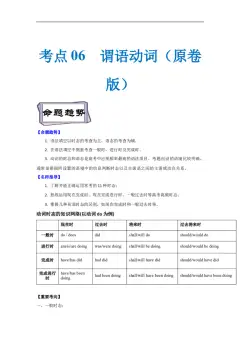
I.动词的时态
1. 常用常考的动词时态和用法:(以do为例)
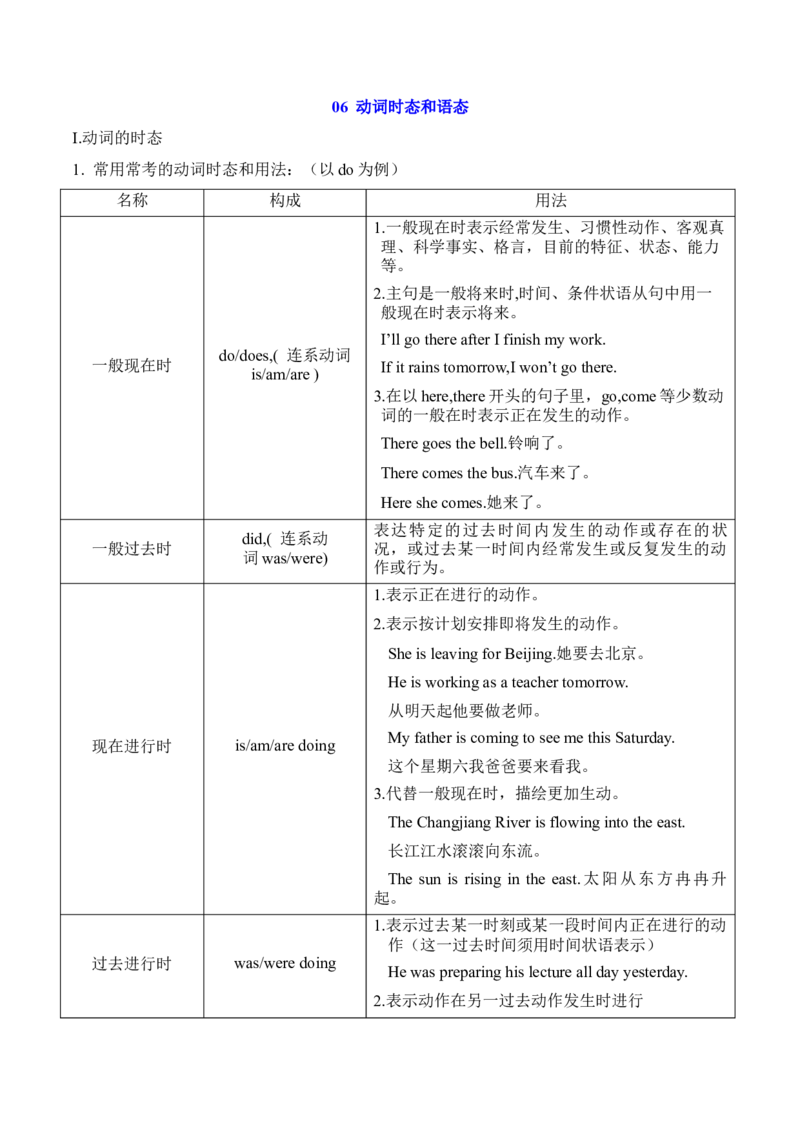
名称 构成 用法
1.一般现在时表示经常发生、习惯性动作、客观真
理、科学事实、格言,目前的特征、状态、能力
等。
2.主句是一般将来时,时间、条件状语从句中用一
般现在时表示将来。
I’ll go there after I finish my work.
do/does,( 连系动词
一般现在时 If it rains tomorrow,I won’t go there.
is/am/are )
3.在以here,there开头的句子里,go,come等少数动
词的一般在时表示正在发生的动作。
There goes the bell.铃响了。
There comes the bus.汽车来了。
Here she comes.她来了。
表达特定的过去时间内发生的动作或存在的状
did,( 连系动
一般过去时 况,或过去某一时间内经常发生或反复发生的动
词was/were)
作或行为。
1.表示正在进行的动作。
2.表示按计划安排即将发生的动作。
She is leaving for Beijing.她要去北京。
He is working as a teacher tomorrow.
从明天起他要做老师。
My father is coming to see me this Saturday.
现在进行时 is/am/are doing
这个星期六我爸爸要来看我。
3.代替一般现在时,描绘更加生动。
The Changjiang River is flowing into the east.
长江江水滚滚向东流。
The sun is rising in the east.太阳从东方冉冉升
起。
1.表示过去某一时刻或某一段时间内正在进行的动
作(这一过去时间须用时间状语表示)
过去进行时 was/were doing
He was preparing his lecture all day yesterday.
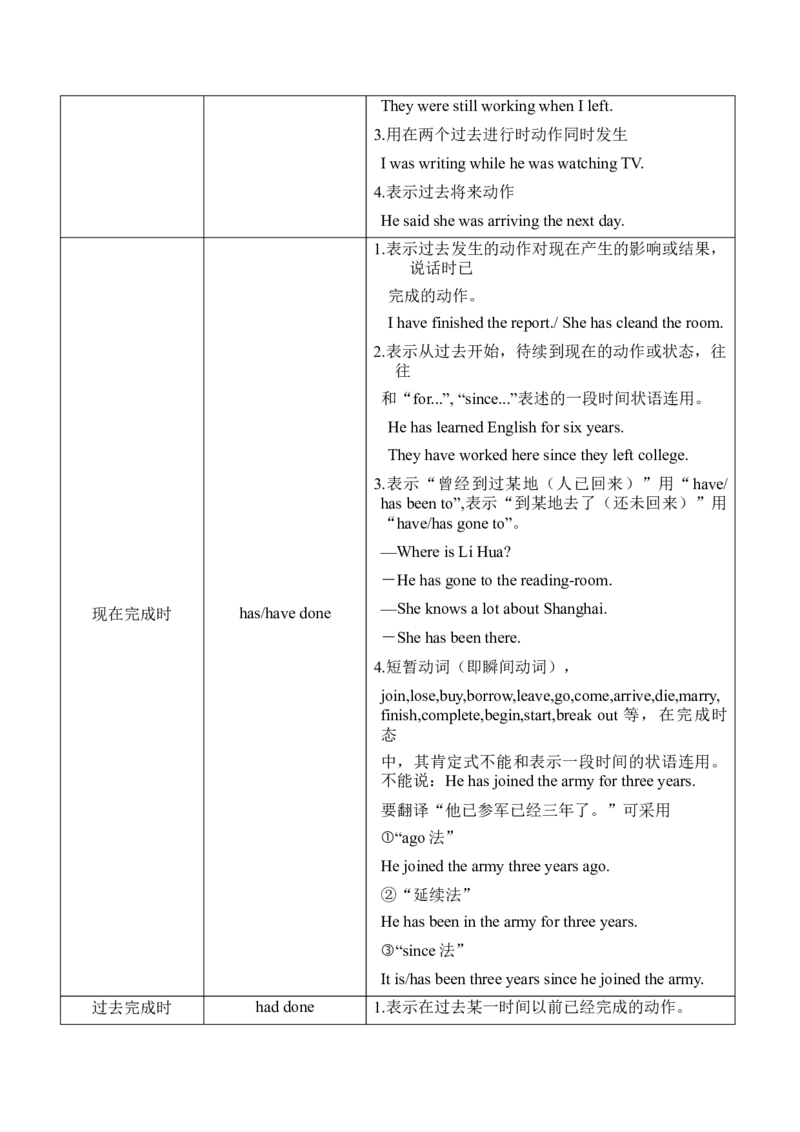
2.表示动作在另一过去动作发生时进行They were still working when I left.
3.用在两个过去进行时动作同时发生
I was writing while he was watching TV.
4.表示过去将来动作
He said she was arriving the next day.
1.表示过去发生的动作对现在产生的影响或结果,
说话时已
完成的动作。
I have finished the report./ She has cleand the room.
2.表示从过去开始,待续到现在的动作或状态,往
往
和“for...”, “since...”表述的一段时间状语连用。
He has learned English for six years.
They have worked here since they left college.
3.表示“曾经到过某地(人已回来)”用“have/
has been to”,表示“到某地去了(还未回来)”用
“have/has gone to”。
—Where is Li Hua?
-He has gone to the reading-room.
—She knows a lot about Shanghai.
现在完成时 has/have done
-She has been there.
4.短暂动词(即瞬间动词),
join,lose,buy,borrow,leave,go,come,arrive,die,marry,
finish,complete,begin,start,break out 等,在完成时
态
中,其肯定式不能和表示一段时间的状语连用。
不能说:He has joined the army for three years.
要翻译“他已参军已经三年了。”可采用
①“ago法”
He joined the army three years ago.
②“延续法”
He has been in the army for three years.
③“since法”
It is/has been three years since he joined the army.
过去完成时 had done 1.表示在过去某一时间以前已经完成的动作。He had shut the door before the dog came up.
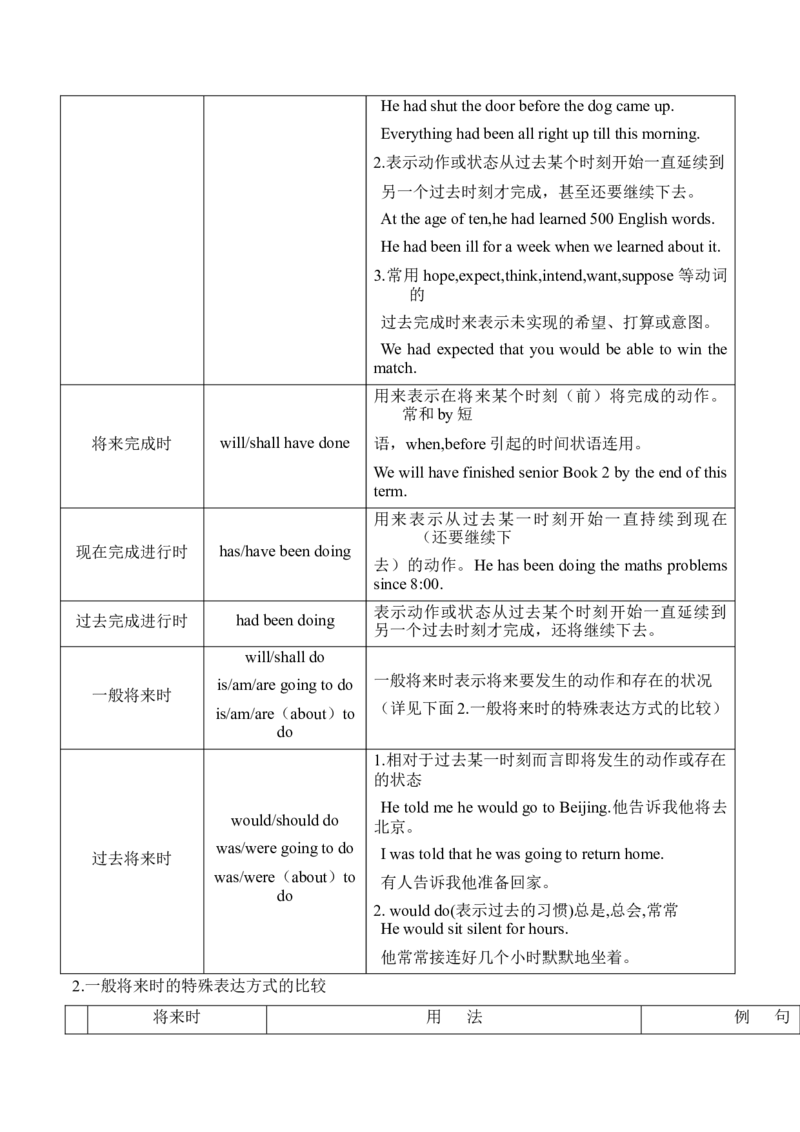
Everything had been all right up till this morning.
2.表示动作或状态从过去某个时刻开始一直延续到
另一个过去时刻才完成,甚至还要继续下去。
At the age of ten,he had learned 500 English words.
He had been ill for a week when we learned about it.
3.常用 hope,expect,think,intend,want,suppose 等动词
的
过去完成时来表示未实现的希望、打算或意图。
We had expected that you would be able to win the
match.
用来表示在将来某个时刻(前)将完成的动作。
常和by短
将来完成时 will/shall have done 语,when,before引起的时间状语连用。
We will have finished senior Book 2 by the end of this
term.
用来表示从过去某一时刻开始一直持续到现在
(还要继续下
现在完成进行时 has/have been doing
去)的动作。He has been doing the maths problems
since 8:00.
表示动作或状态从过去某个时刻开始一直延续到
过去完成进行时 had been doing
另一个过去时刻才完成,还将继续下去。
will/shall do
一般将来时表示将来要发生的动作和存在的状况
is/am/are going to do
一般将来时
is/am/are(about)to
(详见下面2.一般将来时的特殊表达方式的比较)
do
1.相对于过去某一时刻而言即将发生的动作或存在
的状态
He told me he would go to Beijing.他告诉我他将去
would/should do
北京。
was/were going to do
过去将来时 I was told that he was going to return home.
was/were(about)to
有人告诉我他准备回家。
do
2. would do(表示过去的习惯)总是,总会,常常
He would sit silent for hours.
他常常接连好几个小时默默地坐着。
2.一般将来时的特殊表达方式的比较
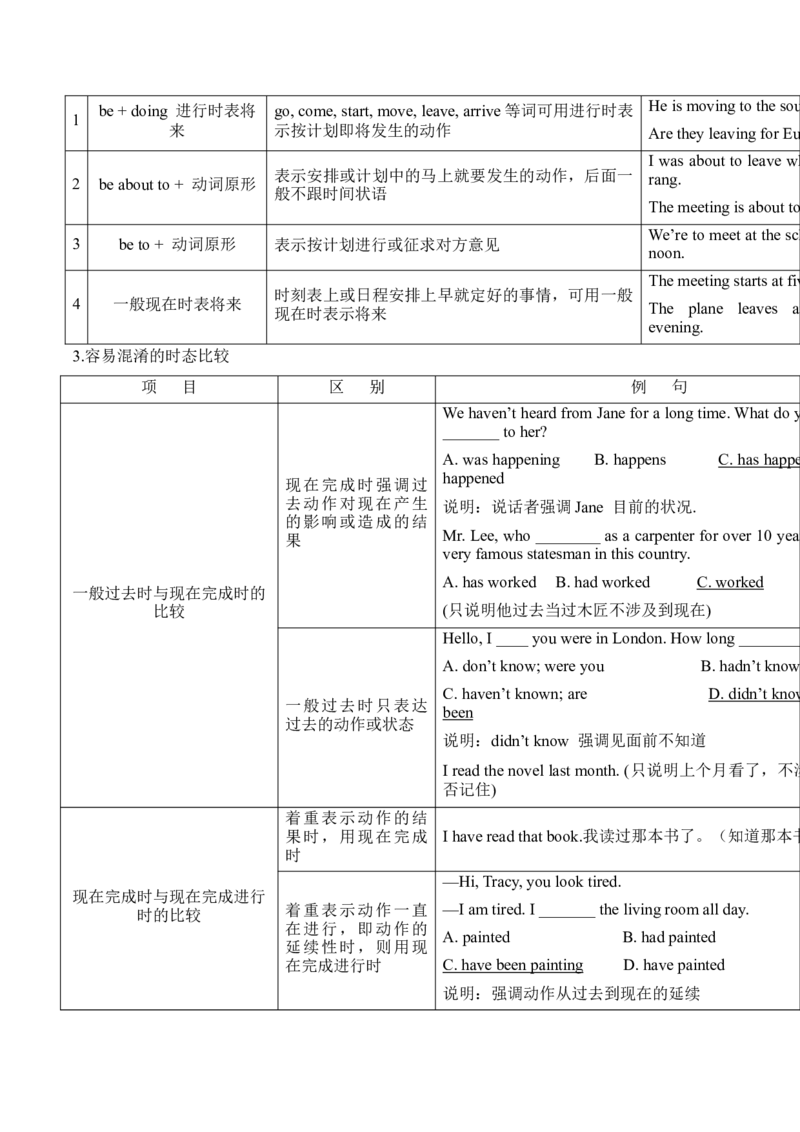
将来时 用 法 例 句be + doing 进行时表将 go, come, start, move, leave, arrive等词可用进行时表 He is moving to the south.
1
来 示按计划即将发生的动作
Are they leaving for Europe?
I was about to leave when the bell
表示安排或计划中的马上就要发生的动作,后面一
2 be about to + 动词原形 rang.
般不跟时间状语
The meeting is about to close.
We’re to meet at the school gate at
3 be to + 动词原形 表示按计划进行或征求对方意见
noon.
The meeting starts at five o’clock.
时刻表上或日程安排上早就定好的事情,可用一般
4 一般现在时表将来
The plane leaves at ten this
现在时表示将来
evening.
3.容易混淆的时态比较
项 目 区 别 例 句
We haven’t heard from Jane for a long time. What do you suppose
_______ to her?
A. was happening B. happens C. has happened
happened
现在完成时强调过
去动作对现在产生 说明:说话者强调Jane 目前的状况.
的影响或造成的结
Mr. Lee, who ________ as a carpenter for over 10 years, is now a
果
very famous statesman in this country.
A. has worked B. had worked C. worked
一般过去时与现在完成时的
比较 (只说明他过去当过木匠不涉及到现在)
Hello, I ____ you were in London. How long _________ here?
A. don’t know; were you B. hadn’t known; are you
C. haven’t known; are D. didn’t know; have you
一般过去时只表达
been
过去的动作或状态
说明:didn’t know 强调见面前不知道
I read the novel last month. (只说明上个月看了,不涉及现在是
否记住)
着重表示动作的结
果时,用现在完成 I have read that book.我读过那本书了。(知道那本书的内容)
时
—Hi, Tracy, you look tired.
现在完成时与现在完成进行
着重表示动作一直 —I am tired. I _______ the living room all day.
时的比较
在进行,即动作的
A. painted B. had painted
延续性时,则用现
在完成进行时 C. have been painting D. have painted
说明:强调动作从过去到现在的延续I don’t really work here. I ____ until the new secretary _______.
A. just help out; comes B. have just helped out; will
现在进行时表示现 come
在某个时候或某段
C. am just helping out; comes D. will just help out; has
时间正在进行的动
come
作
说明:指目前一段时间正在发生的动作, until 引导的是时间状
现在进行时与过去进行时的 语从句,动词需用一般现在时。
比较
— Hey, look where you are going!
— Oh, I’m terribly sorry. _______.
过去进行时表示某
A. I’m not noticing. B. I wasn’t noticing.
个时候或某段时间
正在进行的动作 C. I haven’t noticed. D. I don’t notice.
说明:对话的后者显然是在解释刚才不小心冒犯对方时正在
做的事情.
Tom________ into the house when no one ___________.
A. slipped; was noticing B. had slipped; noticed
C. slipped; had noticed D. was slipping; noticed
一般过去时与过去进行时的 一般过去时只表达
比较 过去的动作或状态 说明:slip和notice 为同时发生的动作,因此B、C
项,slipped 指过去有结果的动作(他溜进去了),
one was noticing 指他溜进去的一刹那发生的情况(没有人注
意)。
.He ______ a book about China last year, but I don’t know if he
______ it.
过去进行时表示某
A.wrote; has finished B. was writing; has finished
个时候或某段时间
C. was writing; had finished D. wrote; will finish
正在进行的动作
说明:正确选项为 B. 从 I don’t know if he has finished it.
断,他去年一直在写。
II. 动词的被动语态
常用被动 常用被动语
构 成 构 成
语态 态
1 一般现在
am/is/are done 6 过去进行时 was/were being done
时
2 一般过去
was/were done 7 现在完成时 have/has been done
时
3 一般将来
shall/will be done 8 过去完成时 had been done
时
4 过去将来
should/would be done 9 将来完成时 will/would have been done
时
5 现在进行 am/is/are being done 1 含有情态动 can/must/may be done时 0 词的
被动语态的否定式是在第一个助动词或情态动词后加 not,短语动词的被动态不可漏掉其
中介副词。固定结构be going to,
used to,have to, had better变为被动态时,只需将其后的动词变为被动态。
Trees should not be planted in summer. The boy was made fun of by his
classmates.
Newspapers used to be sent here by the little girl.
汉语有一类句子不出现主语,在英语中一般可用被动结构表示:
It is believed that… It is generally considered that… It is said
that…
It is well known that… It must be pointed out that… It is supposed
注
that…
It is reported that… It must be admitted that… It is hoped
意 that…
被动语态的句型
事 1.常见句式是:主语(受动者)+be+过去分词+(by+施动者):He was scolded by the
English teacher.
2.主语+get+过去分词+其它成分:The boy got drowned last summer./ She got fired
项
because of her faults.
使用这种结构不能带有“by+施动者”
3.带有双宾语(直接宾语和间接宾语)的主动句变为动句,其主语可以是直接宾语,也
可以是间接宾语。
She lent me a bike.被动:①I was lent a bike(by her). ②A bike was lent to me(by her).
4.情态动词+be+过去分词:This problem must be worked out in half an hour.
5.双重被动式:主语+被动式谓语+不定式的被动式+其它成分
These magazines are not allowed to be taken out of the reading-room.
The murderer was ordered to be shot.下面主动形式常表示被动意义
1. 不 及 物 动 词 与 状 语 连 用 , 用 以 表 示 主 语 的 品 质 和 状 态 。 常 见 动 词 是 :
cut,sell,read,write,fill,cook,lock,wash等。
This knife cuts well.这把刀好切。 These books sell well.这些书好卖。
The pen writes smoothly.这支笔写起来流畅。 Meat won’t keep long in such hot weather.
肉在这样热的天气里放不长久。
The cloth washes well.这种布好洗。
2.一些连系动词的主动式+形容词。常见动look,smell,taste,sound,feel,prove,turn out等。
The apples taste good. The flower smells wonderful.
The news proved/turned out true. Cotton feels soft.
不可变为被动语态的几种情况
1.I teach myself French.不可变为Myself is taught French.因为反身代词不可作主语。
2.We help each other/one another.不可变为 Each other/One another is helped by us.因为相互
代词不可作主语。
3.He lost heart.不可变为Heart was lost by him.
因为象lose heart,make a face,keep silence,lose in thought这类动宾结构的固定短语只能用
于主动式,不能用被动式。
4.She took part in the sports meet.不能变为The sports meet was taken part in by her.
因为象take part in,belong to ,own,have,hate,fail,contain等表状态动词没有被动语态。
含有短语动词在被动语态中介词不能丢
Much attention must be paid to your handwriting.
特别注意以下句子的结构:Every minute must be made full use of to study Englsih.
下面词或短语没有被动态:
leave, enter, reach, become, benefit, cost, equal, contain, last, lack, fit, fail, have, appear,
happen, occur, belong to, take place, break out, come about, agree with, keep up with, consist of,
have on, lose heart等等
注意:
1.一些固定句式的形态:
英语中有一些句式的时态常常很固定,如果题干中出现这种句式,考生应注意根据规则选用
适当的时态。例如:
(1)It is the first/second/... time that sb. have/has done...
(2)It was the first/second/... time that sb. had done...
(3)sb.was/were doing sth. when... did...
(4)It's high time that sb. did/should do...(5)Hardly/Scarcely had sb.done sth. when sb.did...
(6)No sooner had sb. done sth. than...did...
2.
(1)在时间、条件、让步状语从句中,若主句为一般现在时或一般将来时,则从句用一般现
在时代替一般将来时;若主句为一般过去时,则从句也应用相应的过去时态。
(2)正确判定主句谓语动词及从句谓语动词所表示的动作发生的时间,并认真体会命题者所
给出的语境。
(3)解答宾语从句与主句时态呼应问题时,考生应熟知以下规则:如果主句是现在时态或将
来时态,则从句可根据语境使用任何时态;如果主句为过去时态,则从句需要用适当的过去
的某种时态(表示客观真理时使用一般现在时)。
As a little girl, I___________ (wish)to be a zookeeper when I grew up.
【解析】句意为:还是一个小女孩时,我就希望长大后当一名动物园饲养员。根据时间状语
从句 when I grew up 可知,此处描述作者小时候的愿望,故应用一般过去时。故填wished。
巩固练习:
单句填空:
1. During the Han Dynasty, written records referred________ the cultivation of green tea.
2. Barbecue is popular in China, but Zibo’s barbecue differs_________ three ways---it’s made on a
stove, and is served with a flatbread(小饼)and dressings(蘸料).
3. But participating________too many extracurricular activities does deprive the children of their
playtime.
4. He studied hard before the exam, and it paid________. He got an A.
5. The guqin ________(favor)by the literati(文人学士)in ancient China.
6. The intense tectonic movements millions of years ago_______(gift)Mount Wuyi a magnificent
Danxia landform, which differs from the Danxia landform in northwest China.
7. So far, seven of the twelve bronze head statues of zodiac animals, including the horse-head
statue,________(come)back to China.
8. Jane can’t attend the meeting at 3 o’clock this afternoon because she________(teach)a class at
that time.
9. By the time we got home, Mark_________(cook)us a wonderful dinner.
10.At present, the water system, streets, folk houses and even interior arrangements of thevillage__________ (preserve)as the primitive conditions of the ancient village.
11.The fossil, named “Baby Yingliang”, was found in southeast China and ________(belong) to a
feathered dinosaur.
12.Although the species is still endangered, the conservation efforts _______(think) to be working.
13.Early Chinese poetry _________(influence) by The Book of Songs, and the Chinese poet and
statesman Qu Yuan.
14.A few years later, I am back in Virginia where I __________(grow) up.
15. He saw how the china clay_________ (combine)with another substance, mica, which would turn
it into porcelain.
16.Although Dai paper ____________(carry) the culture and belief of the Dai people, the crafting of
it is faced with great challenges.
17.The police arrested the man who __________(break) into a jewelry shop.
18. It was said that the flight to New York ___________(cancel) due to the foggy weather.
19.A German shepherd__________ (rescue) from his previous shelter, where he was going to be put
down after a biting incident.
20.When you find the thing that you want to commit to, you __________(become) fearless to follow
your dream.
21.It is the first time that the Dunhuang Academy (hold) such a big exhibition in Beijing.
22.I was sitting in my room and my cat Smartie was on my lap when the roof of my room (blow)
away.
23.People can also visit the Yunnan Stone Forest,which (know) as “the first wonder of the world”
since the Ming Dynasty.
24.Planting many trees(be) very good for our environment.
25.Neither the twins nor their father (be)addicted to online games at present.
26.A survey shows that 80% of the middle-aged in this city___________(be)in favor of the
proposal for the health care reform.
语法填空A组
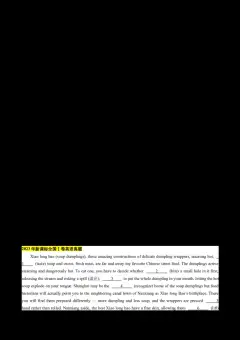
The 2023 Pulitzer Prize(普利策奖) 1_________ (compete)for books is now open, and
2________(include)a new category for a distinguished memoir(回忆录)or autobiography by an
American author.The Pulitzer Prizes for books are awarded 3_________writers of
fiction,U.S.history,biography,memoir or autobiography, poetry and general non-fiction.
4__________ (previous),memoirs and autobiographies 5__________ (judge) in the Biography
category.Many have been finalists in the category 6_________ have won the prize.
“Memoirs and autobiographies are flourishing,”said Marjorie Miller, Administrator of the
Prizes.“The members of the Pulitzer Prize Board 7_______have been considering them alongside
biographies and othernon-fiction for years felt it was time for each genre(体裁)8_________
(have) its own prize category.”
The new Pulitzer Prize category will be for a distinguished and factual memoir or autobiography
by an American author.
First awarded in 1917, Biography is one of the 9__________(origin) Pulitzer Prie categories.It
will now be awarded for a distinguished and appropriately documented biography by an American
author.
This year, the criteria for entry in all categories remain the same: To be eligible, 10______
(book)must be first published in the United States during 2022,and authors in all categories except
U.S.History must be American citizens.
语法填空B组
“Early to bed and early to rise, makes a person healthy, wealthy and wise.”
The words of Benjamin Franklin have been backed by science. It has been proved that morning
people are persistent and 1._________(product).Rising early also 2______ (relieve) stress and
tension because it gives you the time to work out before you get distracted(分神).This is
3________ morning people tend to be healthier and happier. Recent research 4_______ (find) that
late sleepers generally consume approximately 248 more 5________(calorie) than those who rise
early.
Researchers have also said that early morning is the best time 6_______(study).This will help
you stay ahead in the class and keep your grades up.
More rest equals more energy, plain and simple.If you get into the routine of rising early and
going to bed early,you are more likely to have a 7__________ (good)sleeping pattern which leads to
being more energetic throughout the day, 8__________(help) you accomplish your tasks in a faster
and more creative manner.Getting up early has many benefits for both your body 9 _________your mind. The hardest part
is convincing yourself to do it, and then getting into a routine of getting up early every morning.
If you don't develop 10 ________habit of waking up before the rest of the world, you won't be
able to change the world.