特殊句式和情景交际(讲义)
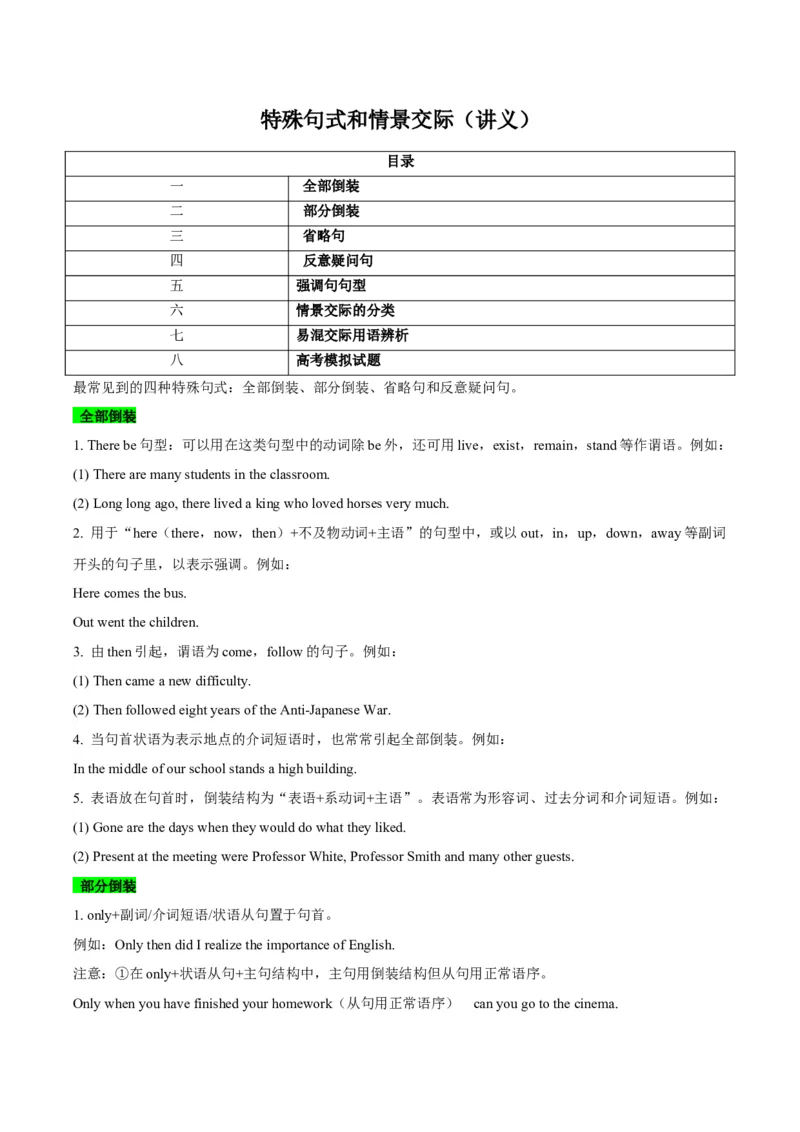
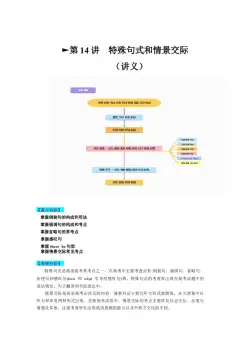
目录
一 全部倒装
二 部分倒装
三 省略句
四 反意疑问句
五 强调句句型
六 情景交际的分类
七 易混交际用语辨析
八 高考模拟试题
最常见到的四种特殊句式:全部倒装、部分倒装、省略句和反意疑问句。
全部倒装
1. There be句型:可以用在这类句型中的动词除be外,还可用live,exist,remain,stand等作谓语。例如:
(1) There are many students in the classroom.
(2) Long long ago, there lived a king who loved horses very much.
2. 用于“here(there,now,then)+不及物动词+主语”的句型中,或以out,in,up,down,away等副词
开头的句子里,以表示强调。例如:
Here comes the bus.
Out went the children.
3. 由then引起,谓语为come,follow的句子。例如:
(1) Then came a new difficulty.
(2) Then followed eight years of the Anti-Japanese War.
4. 当句首状语为表示地点的介词短语时,也常常引起全部倒装。例如:
In the middle of our school stands a high building.
5. 表语放在句首时,倒装结构为“表语+系动词+主语”。表语常为形容词、过去分词和介词短语。例如:
(1) Gone are the days when they would do what they liked.
(2) Present at the meeting were Professor White, Professor Smith and many other guests.
部分倒装
1. only+副词/介词短语/状语从句置于句首。
例如:Only then did I realize the importance of English.
注意:①在only+状语从句+主句结构中,主句用倒装结构但从句用正常语序。
Only when you have finished your homework(从句用正常语序) can you go to the cinema.②only修饰主语,不倒装。Only Tom knows how to deal with the tough situation.
2. 否定词(短语)开头的句子:
表示否定意义的副词never,nor,neither;xk;w
表示半否定意义的副词hardly,few,seldom,little;
含有no和not的词组by no means(绝不),in no time(很快),at no time(在任何时候都不),not until, not only
… but also...,no sooner...than
(1) Never shall I believe you again.
(2) Little did he know who the woman was.
(3) Not until I began to work did I realize how much time I had wasted.
3. 以so开头,用“so+助动词/情态动词/系动词+主语”表明前面叙述的肯定情况也适合于另一个人或物,
译作“也,同样,也如此”。表示前面叙述的否定情况也适合于另一个人或物,用“neither/nor+助动词/情
态动词/系动词+主语”。译作“也不是,也没有”。例如:
The boy left home, and so did his sister a week later.
-I don’t think I can walk any further.
—Neither can I. Let’s stop for a rest.
注意:当so表示对前句内容的肯定、附和或进一步强调前面所说的情况,译作“的确,正是”时,用正常
语序。例如:
— Tom works hard.
— So he does and so do you.
4. 如果虚拟条件句的谓语含有were,should,had,可以把if省略,而将这三个词放于条件句主语前构成
倒装。
例如:
If there should be a flood, what would we do?
Should there be a flood, what would we do?
5. 频度副词及短语often,always,now and then,many a time,every other day等放在句首时,有时也倒装。
例如:Many a time has he come to comfort me.
6. 某些表示祝愿的句子也用倒装语序。 例如:May you succeed!
省略句
1. 如果复合句中的时间、条件、原因状语从句用了主语+be+分词结构,且主、从句主语一致时,可省略从
句的连接词、主语和be动词,只保留分词和其他成分。例如:
Lost in thought, he almost ran into the car in front of him. (Lost in thought为As he was lost in thought的省略)2. 如复合句中从句的句尾和主句相重复的话,从句的句尾可省略。例如:
(1) Li Lei will play football if Mike will (play football).
(2) Mary is going to sweep the floor because Alice won’t (sweep the floor).
3. 在回答问句及其他形式的答语中,如有和上文重复的不定式时,在答语中只保留其不定式符号to,而把
动词和其他部分省略。例如:
— I’ll be away on a business trip. Would you mind looking after my cat?
— Not at all. I’d be happy to. (I’d be happy to后省略了look after your cat)
4. 在英语中,有一些特殊的省略结构,如:What/How about...? Why not do...?等实际上已形成了习惯用法。
例如:
— I usually go there by train.
— Why not try going by boat for a change?
反意疑问句
反意疑问句是指当提问的人对前面所叙述的事实不敢肯定,而需要向对方加以证实时所提出的问句。
其结构为:前一部分是一个陈述句,后一部分是一个简单问句。完成后一部分简单问句时,要根据前面陈
述句的动词时态和人称来选择适当的助动词进行提问,前后两部分的人称和动词时态要保持一致。如果前
一部分用肯定式,后一部分一般用否定式;反之,前一部分为否定式,后一部分要用肯定式。
1、反意疑问句的一般情况
(1) 当陈述部分的主语是everyone,everybody,someone,no one,nobody,somebody等时,其附加部分的
主语强调全部可用they,强调个体也可用he。例如:
Somebody phoned while I was out, didn’t he?
Everyone knows what money means, doesn’t he/don’t they?
(2) 当陈述部分的主语是指示代词this,that或these,those时,附加问句中的主语分别用it和they。
例如:This is important, isn’t it?
These are your friends Tom and Jack, aren’t they?
(3) 当陈述部分的主语是everything,anything,nothing等时,附加问句中的主语用it。
例如:Everything seems all right now, doesn’t it?
(4) 陈述部分带有否定词或半否定词,如:never,hardly,scarcely,seldom,no,none, no one,rarely,
nowhere,nothing,nobody,few,little等,附加问句一般用肯定式。
例如:She seldom goes to the cinema, does she?
2、常见句型的反意疑问句
(1) 当陈述部分是there be句型时,其后的附加问句也用there。There will be a special exhibition on tomorrow, won’t there?
(2) 祈使句后面的反意疑问句问题:
①祈使句是否定形式,附加疑问部分只能用will you。
Don’t forget the meeting, will you?xk,w
②祈使句是肯定形式,附加疑问部分用肯定、否定均可。
Give me some cigarettes, will you/ won’t you?
3、复合句的反意疑问句
当陈述部分是“I’m sure,I’m afraid,I don’t think (suppose,expect,imagine,believe等)+宾语从句”结构
时,附加问句应与从句主语和谓语动词保持对应关系,但要注意陈述部
分的否定转移现象。
例如:
I’m sure that he is late for school, isn’t he?
I don’t think she cares, does she?
4、关于情态动词的反意疑问句
(1) 陈述部分中有have/had to,附加疑问句部分通常用do的相应形式代替。例如:
You have to get up early tomorrow to catch the first bus, don’t you?
(2) 陈述部分中是mustn’t表示“禁止”时,附加疑问句部分用must;陈述部分中的must表示“一定、想
必”等推测意义时,附加疑问句部分则是根据陈述部分的谓语动词或其助动词来定。
例如:
You mustn’t walk on the grass, must you?
You must be very thirsty, aren’t you? (对想在情况的推测)
It must have snowed last night, didn’t it? (对过去情况的推测)
(3) 陈述部分是I wish,表示询问或征求意见,附加疑问部分用may I。
例如:
I wish to see you again, may I?
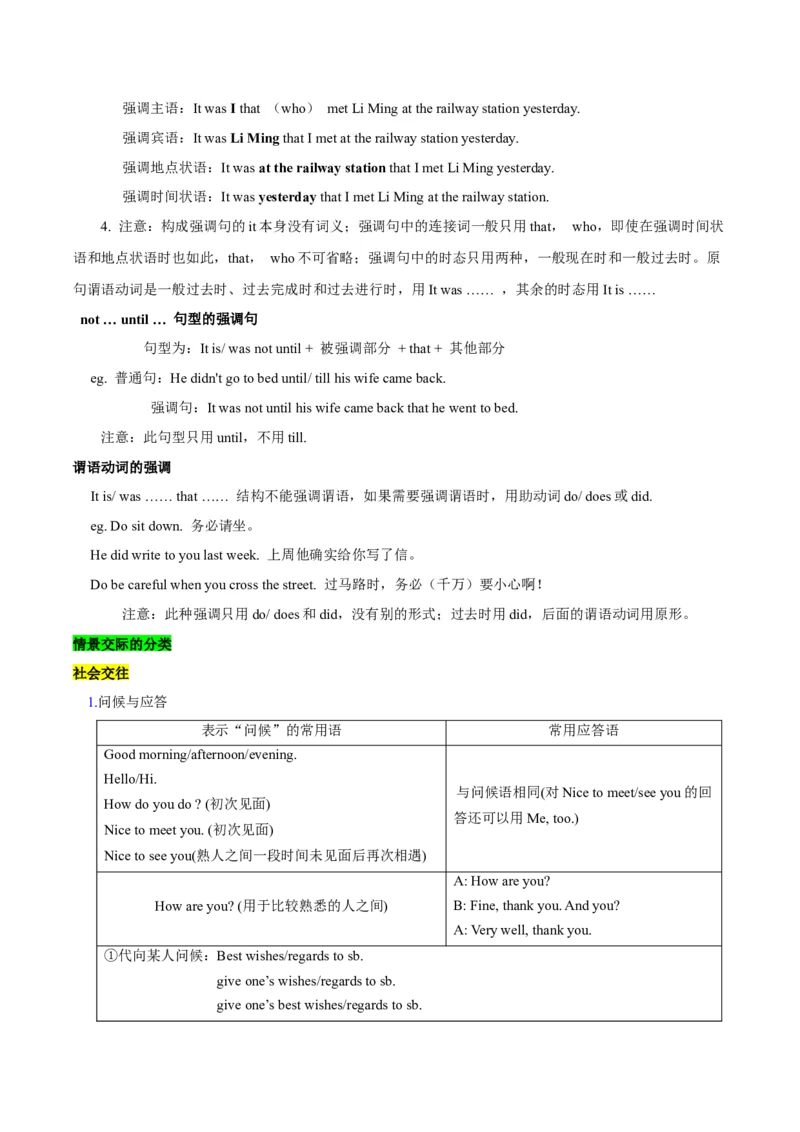
强调句句型
1. 陈述句的强调句型:It is/ was + 被强调部分(通常是主语、宾语或状语)+ that/ who(当强调主语且
主语指人)+ 其他部分。
eg. It was yesterday that he met Li Ping. 他撞见李萍是在昨天。
2. 一般疑问句的强调句型:同上,只是把is/ was提到it前面。
eg. Was it yesterday that he met Li Ping?
3. 强调句例句:针对I met Li Ming at the railway station yesterday.句子进行强调。强调主语:It was I that (who) met Li Ming at the railway station yesterday.
强调宾语:It was Li Ming that I met at the railway station yesterday.
强调地点状语:It was at the railway station that I met Li Ming yesterday.
强调时间状语:It was yesterday that I met Li Ming at the railway station.
4. 注意:构成强调句的it本身没有词义;强调句中的连接词一般只用that, who,即使在强调时间状
语和地点状语时也如此,that, who不可省略;强调句中的时态只用两种,一般现在时和一般过去时。原
句谓语动词是一般过去时、过去完成时和过去进行时,用It was …… ,其余的时态用It is ……
not … until … 句型的强调句
句型为:It is/ was not until + 被强调部分 + that + 其他部分
eg. 普通句:He didn't go to bed until/ till his wife came back.
强调句:It was not until his wife came back that he went to bed.
注意:此句型只用until,不用till.
谓语动词的强调
It is/ was …… that …… 结构不能强调谓语,如果需要强调谓语时,用助动词do/ does或did.
eg. Do sit down. 务必请坐。
He did write to you last week. 上周他确实给你写了信。
Do be careful when you cross the street. 过马路时,务必(千万)要小心啊!
注意:此种强调只用do/ does和did,没有别的形式;过去时用did,后面的谓语动词用原形。
情景交际的分类
社会交往
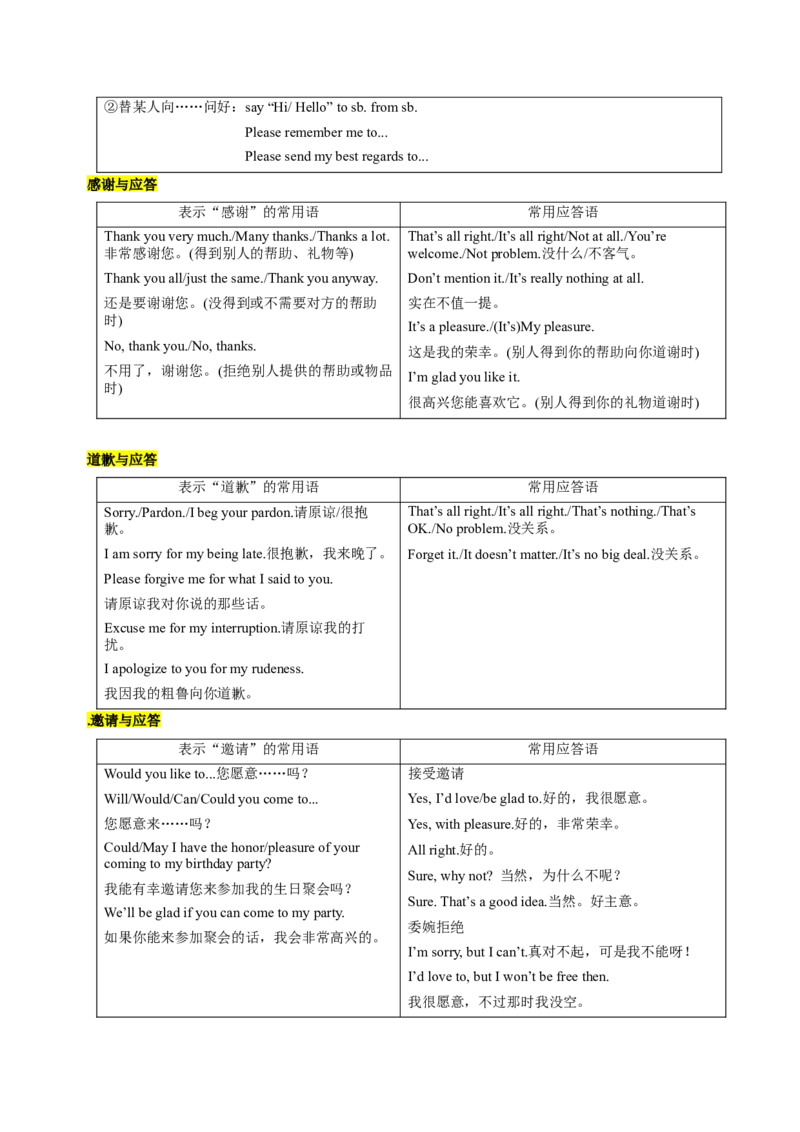
1.问候与应答
表示“问候”的常用语 常用应答语
Good morning/afternoon/evening.
Hello/Hi.
与问候语相同(对Nice to meet/see you的回
How do you do ? (初次见面)
答还可以用Me, too.)
Nice to meet you. (初次见面)
Nice to see you(熟人之间一段时间未见面后再次相遇)
A: How are you?
How are you? (用于比较熟悉的人之间) B: Fine, thank you. And you?
A: Very well, thank you.
①代向某人问候:Best wishes/regards to sb.
give one’s wishes/regards to sb.
give one’s best wishes/regards to sb.②替某人向……问好:say “Hi/ Hello” to sb. from sb.
Please remember me to...
Please send my best regards to...
感谢与应答
表示“感谢”的常用语 常用应答语
Thank you very much./Many thanks./Thanks a lot. That’s all right./It’s all right/Not at all./You’re
非常感谢您。(得到别人的帮助、礼物等) welcome./Not problem.没什么/不客气。
Thank you all/just the same./Thank you anyway. Don’t mention it./It’s really nothing at all.
还是要谢谢您。(没得到或不需要对方的帮助 实在不值一提。
时)
It’s a pleasure./(It’s)My pleasure.
No, thank you./No, thanks.
这是我的荣幸。(别人得到你的帮助向你道谢时)
不用了,谢谢您。(拒绝别人提供的帮助或物品
I’m glad you like it.
时)
很高兴您能喜欢它。(别人得到你的礼物道谢时)
道歉与应答
表示“道歉”的常用语 常用应答语
Sorry./Pardon./I beg your pardon.请原谅/很抱 That’s all right./It’s all right./That’s nothing./That’s
歉。 OK./No problem.没关系。
I am sorry for my being late.很抱歉,我来晚了。 Forget it./It doesn’t matter./It’s no big deal.没关系。
Please forgive me for what I said to you.
请原谅我对你说的那些话。
Excuse me for my interruption.请原谅我的打
扰。
I apologize to you for my rudeness.
我因我的粗鲁向你道歉。
.邀请与应答
表示“邀请”的常用语 常用应答语
Would you like to...您愿意……吗? 接受邀请
Will/Would/Can/Could you come to... Yes, I’d love/be glad to.好的,我很愿意。
您愿意来……吗? Yes, with pleasure.好的,非常荣幸。
Could/May I have the honor/pleasure of your All right.好的。
coming to my birthday party?
Sure, why not? 当然,为什么不呢?
我能有幸邀请您来参加我的生日聚会吗?
Sure. That’s a good idea.当然。好主意。
We’ll be glad if you can come to my party.
委婉拒绝
如果你能来参加聚会的话,我会非常高兴的。
I’m sorry, but I can’t.真对不起,可是我不能呀!
I’d love to, but I won’t be free then.
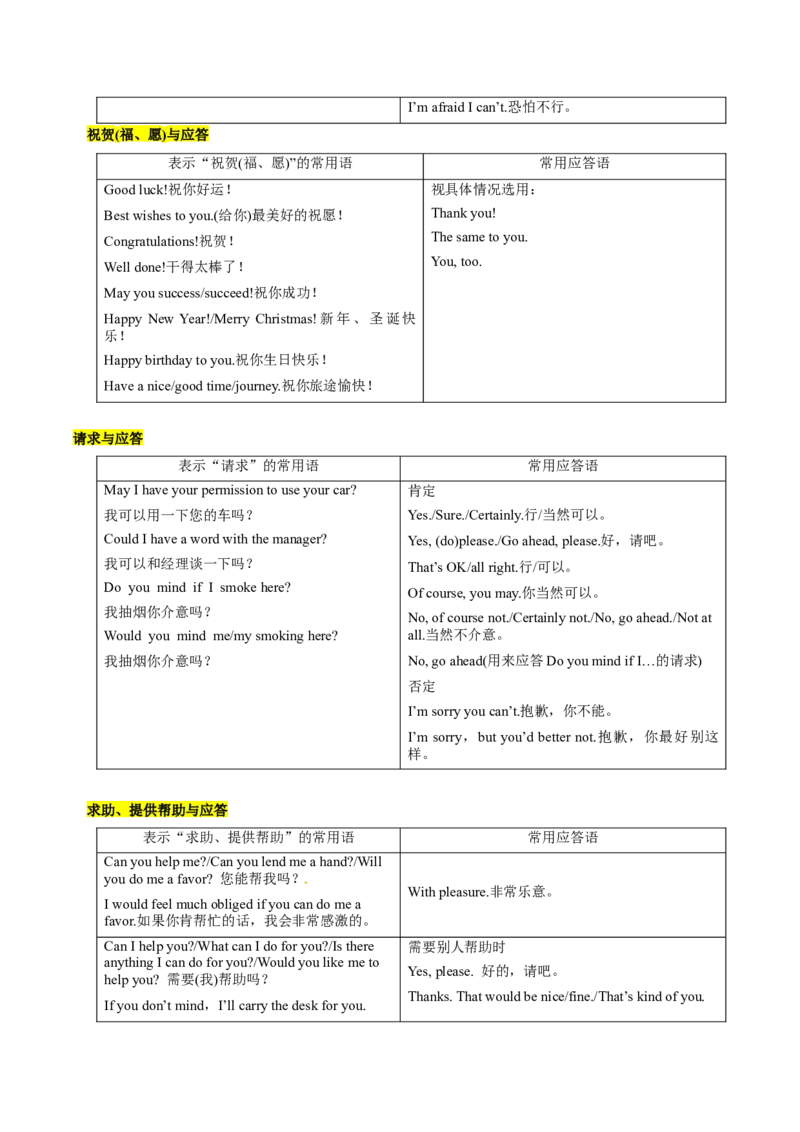
我很愿意,不过那时我没空。I’m afraid I can’t.恐怕不行。
祝贺(福、愿)与应答
表示“祝贺(福、愿)”的常用语 常用应答语
Good luck!祝你好运! 视具体情况选用:
Best wishes to you.(给你)最美好的祝愿! Thank you!
Congratulations!祝贺! The same to you.
You, too.
Well done!干得太棒了!
May you success/succeed!祝你成功!
Happy New Year!/Merry Christmas!新年、圣诞快
乐!
Happy birthday to you.祝你生日快乐!
Have a nice/good time/journey.祝你旅途愉快!
请求与应答
表示“请求”的常用语 常用应答语
May I have your permission to use your car? 肯定
我可以用一下您的车吗? Yes./Sure./Certainly.行/当然可以。
Could I have a word with the manager? Yes, (do)please./Go ahead, please.好,请吧。
我可以和经理谈一下吗? That’s OK/all right.行/可以。
Do you mind if I smoke here?
Of course, you may.你当然可以。
我抽烟你介意吗?
No, of course not./Certainly not./No, go ahead./Not at
Would you mind me/my smoking here? all.当然不介意。
我抽烟你介意吗? No, go ahead(用来应答Do you mind if I…的请求)
否定
I’m sorry you can’t.抱歉,你不能。
I’m sorry,but you’d better not.抱歉,你最好别这
样。
求助、提供帮助与应答
表示“求助、提供帮助”的常用语 常用应答语
Can you help me?/Can you lend me a hand?/Will
you do me a favor? 您能帮我吗?
With pleasure.非常乐意。
I would feel much obliged if you can do me a
favor.如果你肯帮忙的话,我会非常感激的。
Can I help you?/What can I do for you?/Is there 需要别人帮助时
anything I can do for you?/Would you like me to
Yes, please. 好的,请吧。
help you? 需要(我)帮助吗?
Thanks. That would be nice/fine./That’s kind of you.
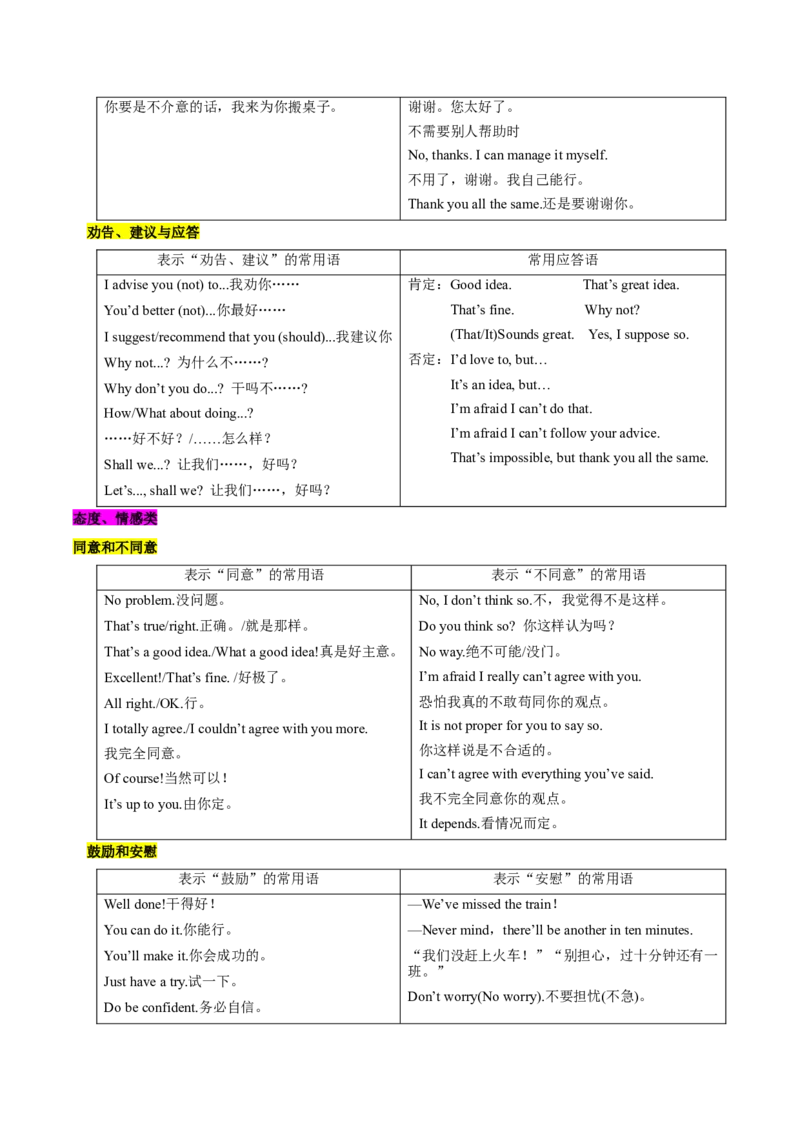
If you don’t mind,I’ll carry the desk for you.你要是不介意的话,我来为你搬桌子。 谢谢。您太好了。
不需要别人帮助时
No, thanks. I can manage it myself.
不用了,谢谢。我自己能行。
Thank you all the same.还是要谢谢你。
劝告、建议与应答
表示“劝告、建议”的常用语 常用应答语
I advise you (not) to...我劝你…… 肯定:Good idea. That’s great idea.
You’d better (not)...你最好…… That’s fine. Why not?
I suggest/recommend that you (should)...我建议你 (That/It)Sounds great. Yes, I suppose so.
Why not...? 为什么不……? 否定:I’d love to, but…
Why don’t you do...? 干吗不……? It’s an idea, but…
I’m afraid I can’t do that.
How/What about doing...?
I’m afraid I can’t follow your advice.
……好不好?/……怎么样?
That’s impossible, but thank you all the same.
Shall we...? 让我们……,好吗?
Let’s..., shall we? 让我们……,好吗?
态度、情感类
同意和不同意
表示“同意”的常用语 表示“不同意”的常用语
No problem.没问题。 No, I don’t think so.不,我觉得不是这样。
That’s true/right.正确。/就是那样。 Do you think so? 你这样认为吗?
That’s a good idea./What a good idea!真是好主意。 No way.绝不可能/没门。
Excellent!/That’s fine. /好极了。 I’m afraid I really can’t agree with you.
All right./OK.行。 恐怕我真的不敢苟同你的观点。
I totally agree./I couldn’t agree with you more. It is not proper for you to say so.
我完全同意。 你这样说是不合适的。
Of course!当然可以! I can’t agree with everything you’ve said.
我不完全同意你的观点。
It’s up to you.由你定。
It depends.看情况而定。
鼓励和安慰
表示“鼓励”的常用语 表示“安慰”的常用语
Well done!干得好! —We’ve missed the train!
You can do it.你能行。 —Never mind,there’ll be another in ten minutes.
You’ll make it.你会成功的。 “我们没赶上火车!”“别担心,过十分钟还有一
班。”
Just have a try.试一下。
Don’t worry(No worry).不要担忧(不急)。
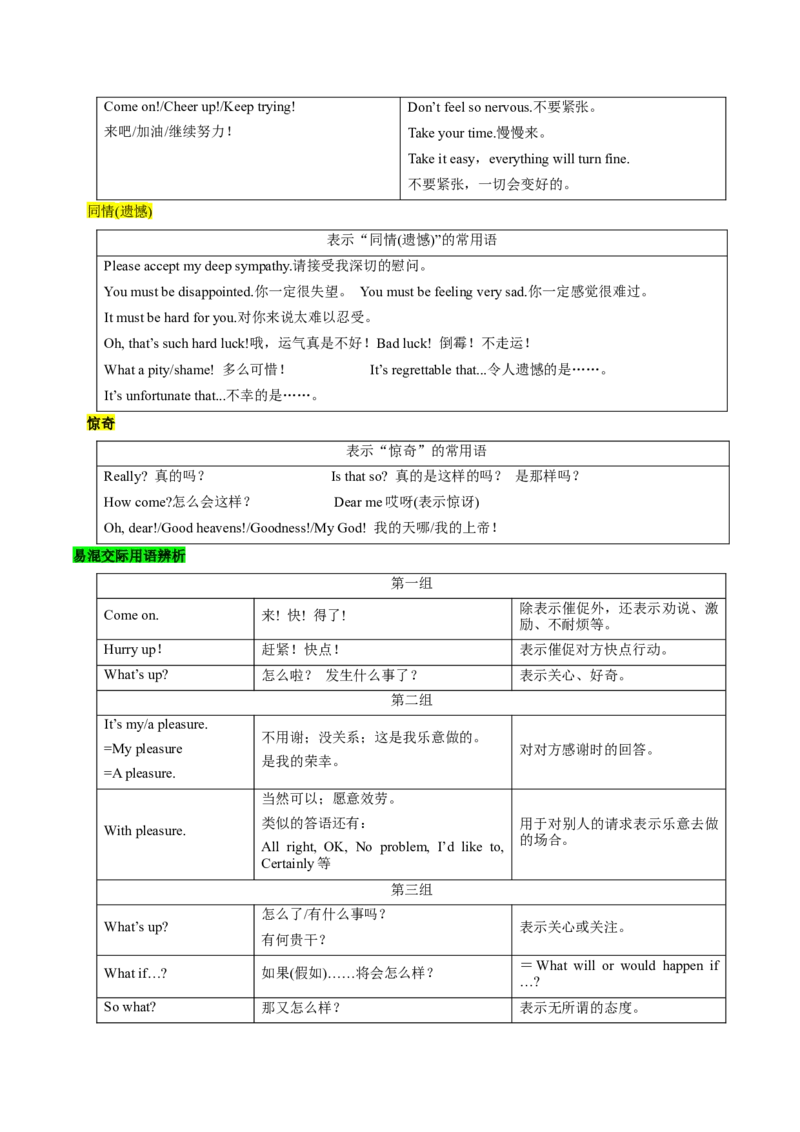
Do be confident.务必自信。Come on!/Cheer up!/Keep trying! Don’t feel so nervous.不要紧张。
来吧/加油/继续努力! Take your time.慢慢来。
Take it easy,everything will turn fine.
不要紧张,一切会变好的。
同情(遗憾)
表示“同情(遗憾)”的常用语
Please accept my deep sympathy.请接受我深切的慰问。
You must be disappointed.你一定很失望。 You must be feeling very sad.你一定感觉很难过。
It must be hard for you.对你来说太难以忍受。
Oh, that’s such hard luck!哦,运气真是不好!Bad luck! 倒霉!不走运!
What a pity/shame! 多么可惜! It’s regrettable that...令人遗憾的是……。
It’s unfortunate that...不幸的是……。
惊奇
表示“惊奇”的常用语
Really? 真的吗? Is that so? 真的是这样的吗? 是那样吗?
How come?怎么会这样? Dear me哎呀(表示惊讶)
Oh, dear!/Good heavens!/Goodness!/My God! 我的天哪/我的上帝!
易混交际用语辨析
第一组
除表示催促外,还表示劝说、激
Come on. 来! 快! 得了!
励、不耐烦等。
Hurry up! 赶紧!快点! 表示催促对方快点行动。
What’s up? 怎么啦? 发生什么事了? 表示关心、好奇。
第二组
It’s my/a pleasure.
不用谢;没关系;这是我乐意做的。
=My pleasure 对对方感谢时的回答。
是我的荣幸。
=A pleasure.
当然可以;愿意效劳。
类似的答语还有: 用于对别人的请求表示乐意去做
With pleasure.
的场合。
All right, OK, No problem, I’d like to,
Certainly等
第三组
怎么了/有什么事吗?
What’s up? 表示关心或关注。
有何贵干?
=What will or would happen if
What if…? 如果(假如)……将会怎么样?
…?
So what? 那又怎么样? 表示无所谓的态度。怎么回事? 通常用在你觉得奇怪而问问什么
的时候。当你不愿意回答别人的
怎么搞的?
How come? 某个问题时也可说How come?意
为什么? 思是“Why do you ask that? It’s
怎么会这样? none of your business.”
How so 为什么(会是这样呢)? 为什么(这么说)? 表示惊异、纳闷、不理解等。
第四组
用于赞同对方的意见、建议或邀
All right. 好;行;可以。
请。
①不用谢;别客气; ①对别人致谢的回答。=That’s
OK./Not at all.?/You are
welcome;
②没关系;不介意;
② 对 别 人 致 歉 时 的 答 语 =It
That’s all right.
doesn’t matter/Never mind;
③可以,没有问题。
③在海关、哨卡等场所,检验人
员对出入人员的证件和包裹检查
后,发现无可疑情况时常用。
用于表示对某事物的肯定,即同
That is right. 正确;对。 意对方的观点或意见。在口语
中,可直接用right作答。
第五组
慢点;放松些;沉住气;别紧张;慢慢 表示安慰对方“不要过度紧
Take it easy.
来。 张”。
表示允许对方“慢慢做,不用着
Take your time. 别着急;慢慢来。
急”。
第六组
That’s something. 太好了;太棒了。 向他人表示祝贺。
相当于(Not)Exactly“正是(并非)
That’s (not)the case. 情况就是(不是)这样的。
如此”的意思。
第七组
Got it. 明白啦。 对别人的提醒或吩咐的应答。
表示某人事业获得成功。
Made it. 成功。成功做成……。
表示某人做成某事。
较为陌生的交际用语
交际用语 表达意义
I couldn’t agree less. 我绝对/完全不同意。与“I couldn’t agree more”意义相反。
Mind your own business. 这不用你管! 你少管闲事! 这关你什么事?
①表示帮不上忙:我也没办法/这不是我的错。
I can’t help it.
②表示控制不住某种情感或思想等:我控制不住/我忍不住/我没法
不……。
没有办法或帮不上忙:无可挽回/这是无法避免的/实在没办法/只好这
It can’t be helped.
样。①用来回答感谢或类似于感谢的句子:没什么/不用谢/这不算什么。
It’s /was nothing. ②用来回答称赞:不行/不好/不算什么/不好意思。
③用来回答道歉:没什么/没关系。
Same here. 我也一样/这里也一样。
It’s a real bargain. 真便宜。便宜货。划得来的交易。
It’s a deal. 成交。一言为定。
It’s no big deal. 没什么大不了的。没什么大不了的事。
谚语和俗语
More haste, less speed.欲速则不达。 A watched pot never boils心急吃不了热豆腐。
Constant dripping wears away the stone.滴水穿石。 Time lost cannot be recalled.光阴一去不复返。
Lost time is never found again.时不再来。 Time and tide wait for no man.岁月不待人。
It’s never too late to mend.改过迁善从不嫌晚(亡羊补牢,未为迟也)。
An hour in the morning is worth two in the evening.一日之计在于晨。
A roaring lion kills no game.空谈不如行动。 To stand still is to move back.逆水行舟,不进则退。
An idle youth, a needy age.少壮不努力,老大徒伤悲。 Every minute counts.分秒必争。
A good beginning makes a good ending.善始才有善终。 Birds of a feather flock together.物以类聚,人以群分。
Two heads are better than one.三个臭皮匠顶个诸葛亮。 A rising tide lifts all boats.水涨众船高。
Many hands make light work.众人搭柴火焰高。 Great minds think alike.英雄所见略同。
An old pan is the one that makes good food.姜还是老的辣。
Cheerful company shortens the miles旅有好旅伴,不觉行程远。
Lookers-on see most of the game.旁观者清。
A bad workman always blames his tools.拙匠总怪工具差。
The best fish are/swim near the bottom.好鱼居水底(有价值的东西不能轻易得到)。
All work and no play makes Jack a dull boy.只工作/学习不玩耍,聪明孩子也变傻。
You may take a horse to the water, but you cannot make him drink.
领马河边易,逼马饮水难(不要逼人做不愿做的事)。
All that dogs bark at are not thieves./All are not thieves that dogs bark at.狗吠者未必是贼(勿以貌取人)。
It is a good horse that never stumbles, and a good wife that never grumbles.良马会失蹄,贤妻有牢骚。
Those who live in glass houses should not throw stones.家居玻璃房,切忌乱扔石(自己有弱点,勿揭他人短)。
Nothing brave, nothing have.不入虎穴,焉得虎子。
Where there is life, there is hope.有生命就有希望(留得青山在,不怕没柴烧)。
A fall into the pit, a gain in your wit.吃一堑,长一智。An eye for an eye, a tooth for a tooth.以眼还眼,以牙还牙。
Once bitten, twice shy.一朝被蛇咬,十年怕井绳(一次上当,下次小心)。
Out of sight, out of mind.眼不见,心不烦。
As the tree, so the fruit.种瓜得瓜,种豆得豆。
He that corrects not small faults will not control great ones.小错不纠,大错难控。
Where there’s smoke, there’s fire.无风不起浪。
If at first you don’t succeed, try, try, try again.再接再厉,终会成功。
Don’t trouble trouble until trouble troubles you.不要自找麻烦。
East or west, home is the best.金窝银窝不如自家草窝。
A bird in the hand is worth two in the bush.双鸟在林不如一鸟在手。
One false step will make a great difference.失之毫厘,谬之千里。
You cannot have your cake and eat it too.鱼与熊掌,不可得兼。
A little pot is soon hot量小易怒。 Forgive and forget既往不咎。
The world is your oyster.你可随心所欲了。 It really costs me an arm and a leg。真太贵了。
It really gets on my nerves心神不宁。 It beats my brains out绞尽脑汁。
It pulls my legs开玩笑,愚弄我。 be the apple of their eye掌上明珠
have their feet of clay有弱点 be in the red有债务,赤字
be green with envy羡慕嫉妒 kill the fatted calf设宴欢迎/款待
have egg on your face丢脸 wash your hands off撒手不管
get down off your high horse别摆架子,省省吧。 a Jekyll and Hyde existence过双重人格的生活
give sb. a cold shoulder对某人很不屑(没有好脸色),让某人吃闭门羹
a wet blanket扫兴的人或物 a green finger新手
a black sheep害群之马 a fat cat有钱有势的人
a bad apple坏人 a hard/tough nut难对付的人
an early bird早起的鸟儿(比喻勤劳的人) a lucky dog幸运儿
a piece of cake小菜一碟,易事一件 child’s play小儿科、轻而易举
as easy as pie小事一桩 a cup of tea小意思
a hard nut to crack很棘手的事情 a David and Goliath battle强弱悬殊,以弱战强
a catch-22 situation用来形容任何自相矛盾、不合逻辑的规定或条件所造成的无法摆脱的困境、难以逾越的
障碍,表示人们处于左右为难的境地,或者是一件事陷入了死循环,或者跌进逻辑陷阱
等等。a Pandora’s box“潘多拉的盒子”被用来比喻造成灾害的根源
高考模拟试题
一、单项选择
1.(2024·山东·三模)It was ________ 11th December ________ Xu Chengcheng got the first prize in National
English Speech Competition.
A.in; when B.in; that C.on; when D.on; that
2.(2024·山东·三模)There ______ an English Evening next Tuesday.
A.was B.will be C.will have D.is going to have
3.(2024·山东·三模)I______ come here yesterday. I just stood here.
A.do B.does C.did D.done
4.(2024·山东泰安·一模)— ________ into the night sky spelling the message “One World One Family”. We
were very excited about it.
— Yeah. As a Chinese we were proud of it.
A.Up went the fireworks B.Went up the fireworks
C.Up did the fireworks go D.Up the fireworks went
5.(23-24·上海·三模)________ in the future to bridge the gender gap and diversity in the scientific field?
A.Do you suggest what we can do B.What do you suggest that we should do
C.Do you suggest what can we do D.What do you suggest we do
6.(2024·甘肃兰州·三模)It was at 3 in the morning ________ the earthquake happened. Hundreds were killed,
with a lot ________ in the ruins.
A.that; buried B.when; buried
C.that; burying D.when; burying
7.(23-24·上海二模)The local government announced that only when the fire was under control ________ to
return to their homes.
A.the residents would be allowed B.had the residents been allowed
C.would the residents be allowed D.the residents had been allowed
8.(2024·上海·二模)________ in the past, at the moment it is a favorite choice for wedding gown.
A.Unpopular as has white been B.As unpopular white has been
C.As white has been unpopular D.Unpopular as white has been
9.(2024山东一模)________ about wild plants that they decided to make a trip to Madagascar for further
research.A.So anxious were the couple B.So curious were the couple
C.Such eager the couple were D.The couple were such curious
10.(2024·广东·三模)________that it was already the fourth time that he _________abroad.
A.So lucky was he; traveled B.So lucky he was; traveled
C.So lucky was he; had traveled D.So lucky he was; had traveled
11.(2024·天津二模)—How’s the project going?
—_________. All we have to do is finish the last bit of work.
A.Easy come easy go B.Far from it C.It just depends D.So far so good
12.(2024·天津河北·二模)— Did Bob keep working on that math problem even after we left?
— ______. He stayed back and managed to solve it late into the night.
A.You’re kidding B.That’s it C.That’s all right D.Go ahead
13.(2024·天津南开·二模)—Tony, you’ve been accepted into our club.
—_________ That’s great.
A.Good idea! B.Congratulations! C.Have I? D.Pardon?
14.(2024·天津南开·二模)—Why are you always late?
—_________? I’ve never delayed work.
A.So what B.Why not C.What for D.Why me
15.(2024·天津·二模)—Did you have a wonderful time in Hainan last week?
—______. It was extremely hot and the food there didn’t suit me.
A.That’s right B.I couldn’t agree more C.Not really D.Very good
16.(2024·天津和平·二模)— Is your baby any better now?
—_______. She just ate too much and brought up all the things she ate.
A.Nothing seriousB.Nothing special. C.Nothing else D.Nothing better
17.(2024·天津和平·二模)—Should we go hiking in the mountains this weekend?
—The weather forecast doesn’t look good. _______ and plan an indoor activity instead.
A.Better play it safe B.It’s better than nothing
C.I can’t agree more D.Take it easy
18.(2024·天津河东·二模)—I’m wondering if Linda will agree to our plan.
—________
A.I’m afraid so. B.Leave me alone.
C.It doesn’t hurt to ask. D.Sure, it is!
19.(2024·天津河东·二模)—Dad, will you help me through the work please?—________
A.Come on! B.You have my word.
C.You must be kidding. D.Cheer up!
20.(2024·天津·二模)— I’ll never understand physics. It’s so complicated!
— __________. With effort and patience, you can definitely master it!
A.Never say never B.Hard to say C.No wonderD.Never mind
21.(2024·天津·二模)—I heard John spent all his savings on that fancy car!
— __________. That’s not like him at all.
A.You can’t be serious! B.Congratulations to him!
C.I’m happy for him. D.That’s a good investment.
22.(2024·天津·一模)— Are you going to have your essay published?
—______ It’s too good an opportunity to miss.
A.No problem! B.You bet. C.What for? D.Why bother?
23.(2024·天津·一模)— Skipping breakfast is a good way to lose weight.
—______. Actually it has the opposite effect.
A.I can’t agree more B.That’s not the case
C.That’s it D.I’m glad to know that
24.(2024·山东济南·二模)— Would you please go out for a walk with me?
— ______, but I’m too busy at that moment.
A.That’s right B.Of course not C.I’d like to D.With pleasure
25.(2024·天津·二模)—Do you know who designed the mascots of the 19th Asian Games in Hangzhou?
—______. Zhang Wen, a teacher of China Academy of Art.
A.You got me there B.Hold your horses
C.You bet D.You have a point there
26.(2024·天津河西·三模)—I’m afraid I can’t pass the English exam.
— ______. It can’t be as difficult as you expected.
A.Not to worry B.Take your time
C.That’s right D.I have no idea
27.(2024·天津·二模)—Do you think you will be able to finish your term paper by this weekend?
—_______. I am occupied with experiments these days.
A.Not a little B.No wonder C.Not a chance D.Not to mention it
28.(2024·天津南开·一模)—Why don’t we go to a movie?—________
A.I’m game. B.What’s up? C.What a relief! D.I really envy you.
29.(2024·天津红桥·一模)—Are you content with your present job?
-—______. I prefer one with flexible hours.
A.That all depends B.It’s a pity C.Not in the least D.You can bet on
that
30.(2024·山东泰安·一模)—I’ll enter the speech competition tomorrow.
—________.
A.Good luck B.With pleasure C.Congratulations D.Good idea
31.(2024·山东泰安·一模)—How is everything with you?
—________.
A.Well, pretty good B.How do you do
C.No, I don’t think so D.And you
32.(2024·天津·一模)—What happened? Your boss seems to ______.
—Didn’t you know his secretary leaked the secret report to the press?
A.be over the moon B.laugh his head off
C.be all ears D.let off steam
33.(2024·天津·一模)—I couldn’t think too highly of the Spirng Gala, where many advanced and popular
elements are adopted to present the splendid stage effect.
“— ______. I had to stay in hospital the whole night due to a car accident and missed it.
A.Good luck B.I mean it
C.Just my luck D.By all means
34.(23-24高二下·天津·阶段练习)— William didn’t show up at the get-together last night.
—________? He’s always taking an active part in such activities.
A.Why not B.What for C.How come D.So what
35.(2024·天津河东·一模)-How do you find this film. John?
- ______.
A.I find it at the cinema B.By chance
C.Oh, very interesting D.No wonder
二、翻译
36.(23-24高三上·上海宝山·三模)在填写高考志愿时,如果你的意见和父母的意见相左时,你会怎样妥
善处理?(agree)37.(2024·上海长宁·一模)只有坚持理想和信念,并做好失败的准备,一切看起来不可能战胜的困难终
将迎刃而解。(Only)
38.(2024·上海一模·)我们唯有充分利用时间、斗志昂扬, 才能开创美好未来。(Only)
39.(2024·上海·三模)这位忧心忡忡的母亲直到成功为她一周没吃过蔬菜的儿子在送餐应用上抢到了2
公斤 卷心菜,才感到如释重负。(Not until …) (汉译英)
40.(2024·上海嘉定·二模)我刚才一不小心点了“提交申请”,还有可能撤回吗?(there be)