【灿烂六月 · 高考金8 卷】
备战2026 年高考英语模拟卷(上海卷05)
(笔试部分:115 分)
II.
Grammar and Vocabulary   (每题1 分;共20 分)
Section A
Directions: After reading the passage below, fill in the blanks to make the passage coherent and
grammatically correct. For the blanks with a given word, fill in each blank with the proper form of
the given word; for the other blanks, use one word that best fits each blank.
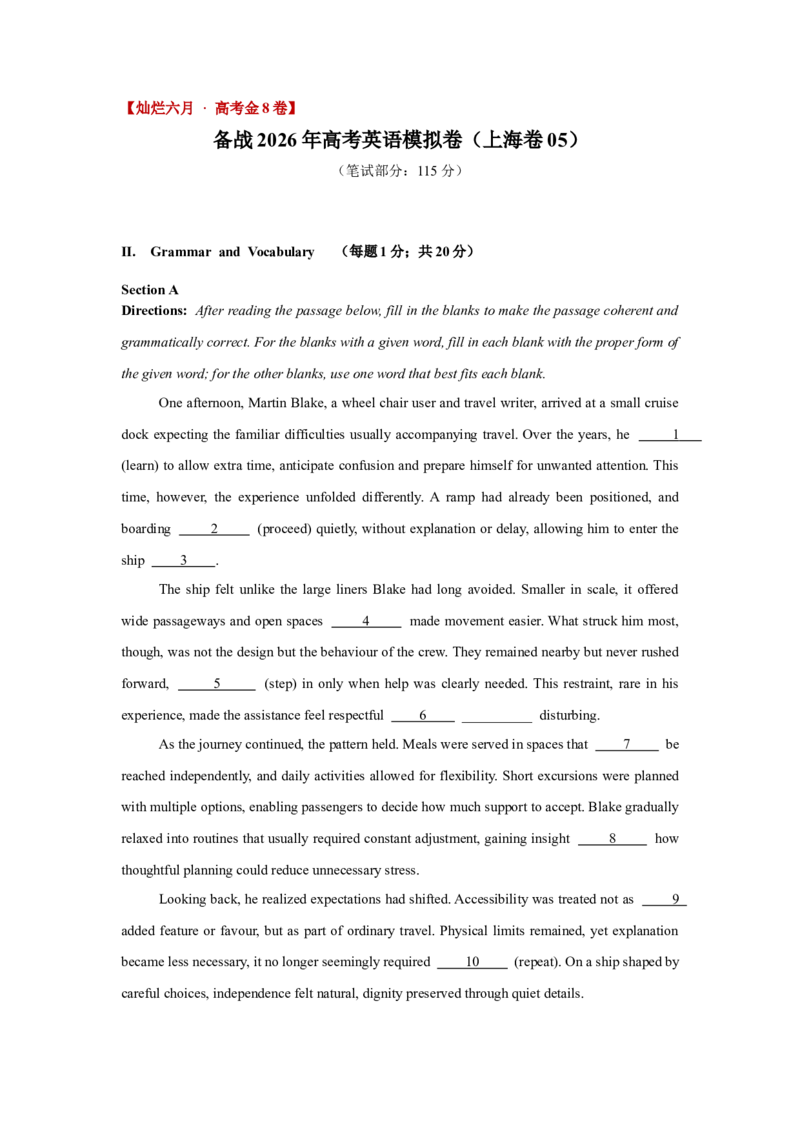
One afternoon, Martin Blake, a wheel chair user and travel writer, arrived at a small cruise
dock expecting the familiar difficulties usually accompanying travel. Over the years, he     1

(learn) to allow extra time, anticipate confusion and prepare himself for unwanted attention. This
time, however, the experience unfolded differently. A ramp had already been positioned, and
boarding     2     (proceed) quietly, without explanation or delay, allowing him to enter the
ship     3    .
The ship felt unlike the large liners Blake had long avoided. Smaller in scale, it offered
wide passageways and open spaces     4     made movement easier. What struck him most,
though, was not the design but the behaviour of the crew. They remained nearby but never rushed
forward,     5     (step) in only when help was clearly needed. This restraint, rare in his
experience, made the assistance feel respectful     6     __________ disturbing.
As the journey continued, the pattern held. Meals were served in spaces that     7     be
reached independently, and daily activities allowed for flexibility. Short excursions were planned
with multiple options, enabling passengers to decide how much support to accept. Blake gradually
relaxed into routines that usually required constant adjustment, gaining insight     8     how
thoughtful planning could reduce unnecessary stress.
Looking back, he realized expectations had shifted. Accessibility was treated not as     9
added feature or favour, but as part of ordinary travel. Physical limits remained, yet explanation
became less necessary, it no longer seemingly required     10     (repeat). On a ship shaped by
careful choices, independence felt natural, dignity preserved through quiet details.
Section B
Directions: Fill in each blank with a proper word chosen from the box. Each word can be used
only once. Note that there is one word more than you need.
A.persisted  B.recognized  C. contradicting  D.unquestionably  E. practical
F. deliberately  G. equipment  H. limit  I. underlying  J. medium  K. captured
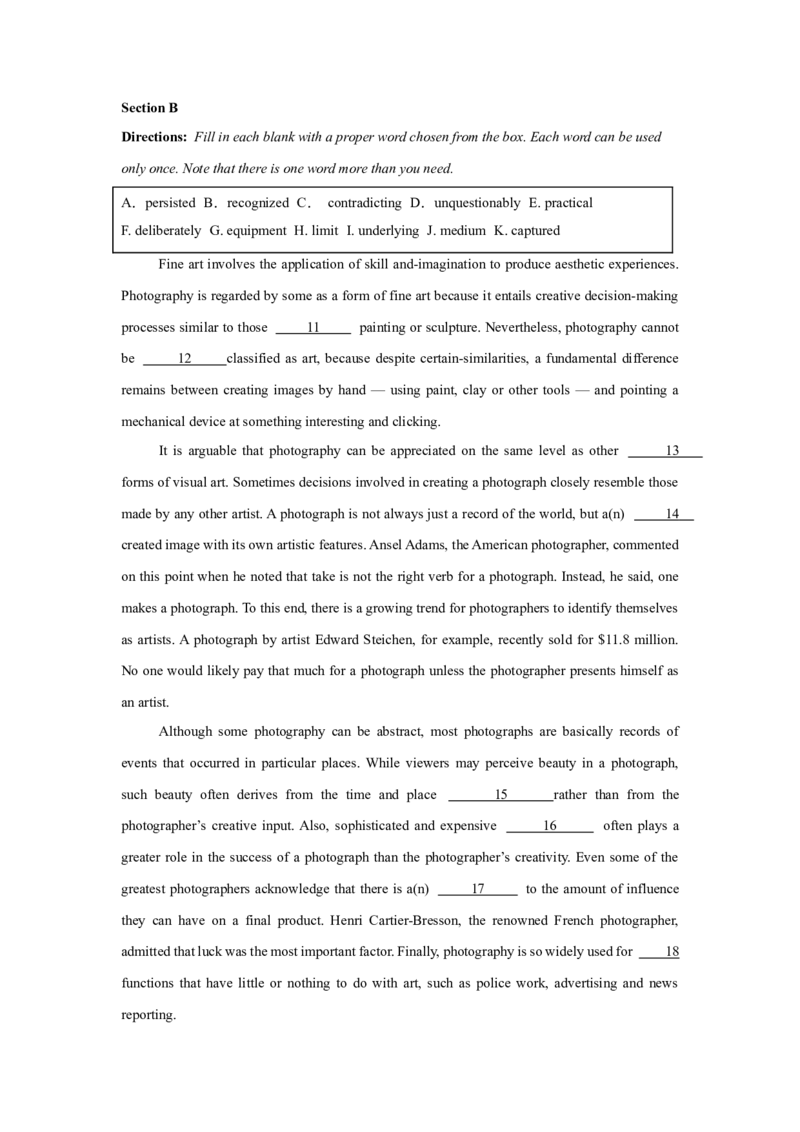
Fine art involves the application of skill and-imagination to produce aesthetic experiences.
Photography is regarded by some as a form of fine art because it entails creative decision-making
processes similar to those     11     painting or sculpture. Nevertheless, photography cannot
be     12    classified as art, because despite certain-similarities, a fundamental difference
remains between creating images by hand — using paint, clay or other tools — and pointing a
mechanical device at something interesting and clicking.
It is arguable that photography can be appreciated on the same level as other     13

forms of visual art. Sometimes decisions involved in creating a photograph closely resemble those
made by any other artist. A photograph is not always just a record of the world, but a(n)     14
created image with its own artistic features. Ansel Adams, the American photographer, commented
on this point when he noted that take is not the right verb for a photograph. Instead, he said, one
makes a photograph. To this end, there is a growing trend for photographers to identify themselves
as artists. A photograph by artist Edward Steichen, for example, recently sold for $11.8 million.
No one would likely pay that much for a photograph unless the photographer presents himself as
an artist.
Although some photography can be abstract, most photographs are basically records of
events that occurred in particular places. While viewers may perceive beauty in a photograph,
such beauty often derives from the time and place     15    rather than from the
photographer’s creative input. Also, sophisticated and expensive     16     often plays a
greater role in the success of a photograph than the photographer’s creativity. Even some of the
greatest photographers acknowledge that there is a(n)     17     to the amount of influence
they can have on a final product. Henri Cartier-Bresson, the renowned French photographer,
admitted that luck was the most important factor. Finally, photography is so widely used for     18
functions that have little or nothing to do with art, such as police work, advertising and news
reporting.
The debate over whether photography qualifies as art has     19    since its earliest
practitioners presented their work. A photographer may make the same aesthetic choices as a fine
artist: subject matter, lighting, colour or even a message. However, cameras can also be purely
functional tools, capturing visual records and presenting information. All in all, photography is
a(n)      20      that can be used to make art, but that does not mean that all photography is
art.
III.
Reading Comprehension    (41 – 55 题,每题1 分;56 – 70 题,每题2
分;共45 分)
Section A
Directions: For each blank in the following passage there are four words or phrases marked
A, B, C and D. Fill in each blank with the word or phrase that best fits the context.
How Douyin Is Reshaping Music Consumption
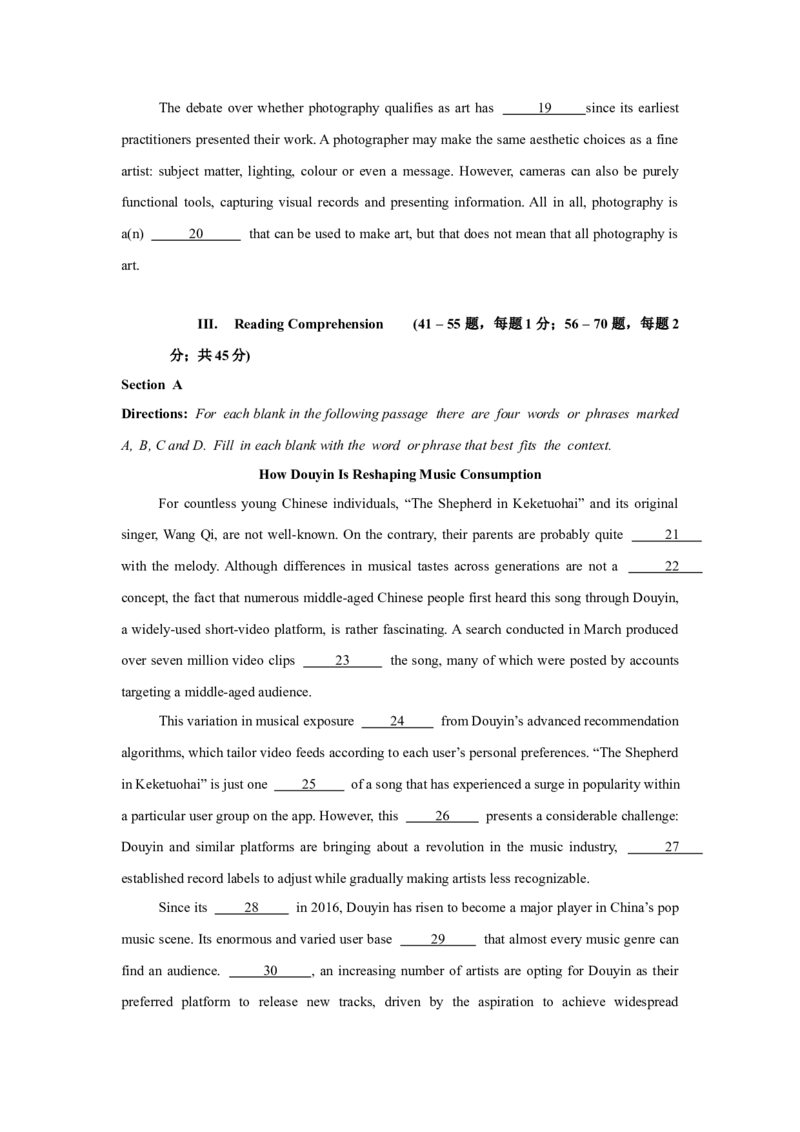
For countless young Chinese individuals, “The Shepherd in Keketuohai” and its original
singer, Wang Qi, are not well-known. On the contrary, their parents are probably quite     21

with the melody. Although differences in musical tastes across generations are not a     22

concept, the fact that numerous middle-aged Chinese people first heard this song through Douyin,
a widely-used short-video platform, is rather fascinating. A search conducted in March produced
over seven million video clips     23     the song, many of which were posted by accounts
targeting a middle-aged audience.
This variation in musical exposure     24     from Douyin’s advanced recommendation
algorithms, which tailor video feeds according to each user’s personal preferences. “The Shepherd
in Keketuohai” is just one     25     of a song that has experienced a surge in popularity within
a particular user group on the app. However, this     26     presents a considerable challenge:
Douyin and similar platforms are bringing about a revolution in the music industry,     27

established record labels to adjust while gradually making artists less recognizable.
Since its     28     in 2016, Douyin has risen to become a major player in China’s pop
music scene. Its enormous and varied user base     29     that almost every music genre can
find an audience.     30    , an increasing number of artists are opting for Douyin as their
preferred platform to release new tracks, driven by the aspiration to achieve widespread
popularity. Dance challenges, where users imitate choreographed (事先安排的) dances to short
song excerpts, have become     31     widespread.
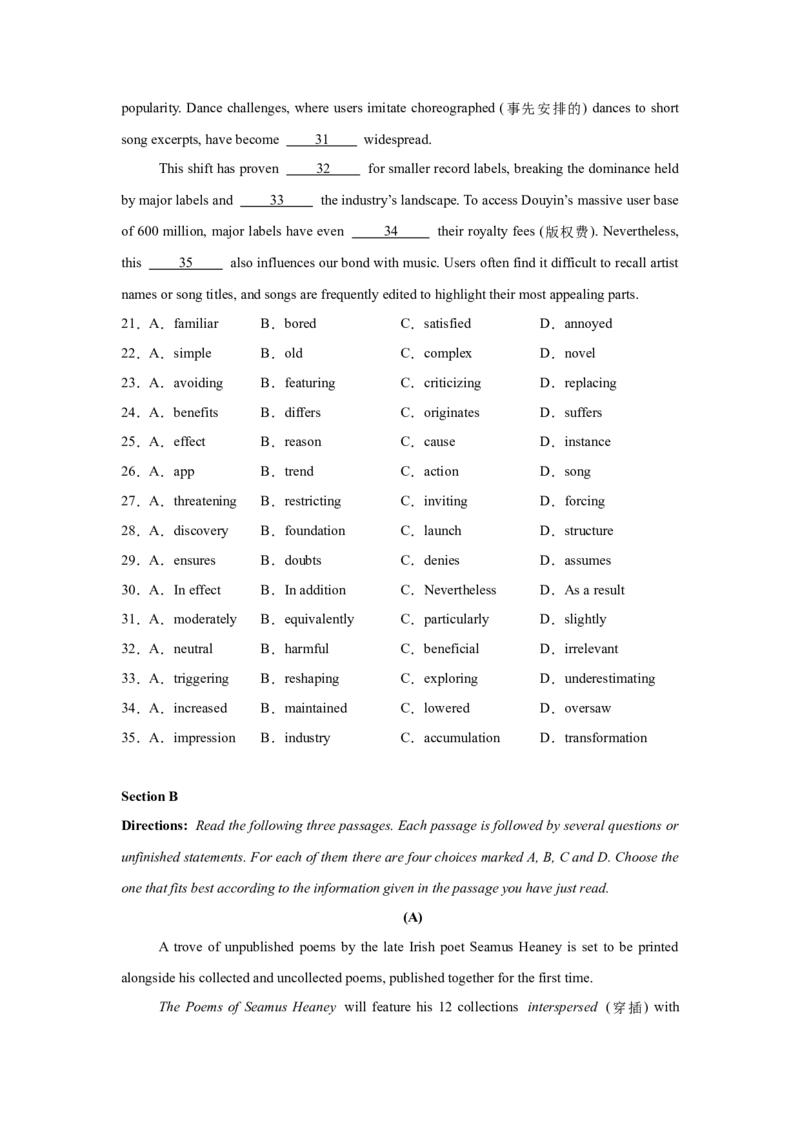
This shift has proven     32     for smaller record labels, breaking the dominance held
by major labels and     33     the industry’s landscape. To access Douyin’s massive user base
of 600 million, major labels have even     34     their royalty fees (版权费). Nevertheless,
this     35     also influences our bond with music. Users often find it difficult to recall artist
names or song titles, and songs are frequently edited to highlight their most appealing parts.
21.A.familiar
B.bored
C.satisfied
D.annoyed
22.A.simple
B.old
C.complex
D.novel
23.A.avoiding
B.featuring
C.criticizing
D.replacing
24.A.benefits
B.differs
C.originates
D.suffers
25.A.effect
B.reason
C.cause
D.instance
26.A.app
B.trend
C.action
D.song
27.A.threatening
B.restricting
C.inviting
D.forcing
28.A.discovery
B.foundation
C.launch
D.structure
29.A.ensures
B.doubts
C.denies
D.assumes
30.A.In effect
B.In addition
C.Nevertheless
D.As a result
31.A.moderately
B.equivalently
C.particularly
D.slightly
32.A.neutral
B.harmful
C.beneficial
D.irrelevant
33.A.triggering
B.reshaping
C.exploring
D.underestimating
34.A.increased
B.maintained
C.lowered
D.oversaw
35.A.impression
B.industry
C.accumulation
D.transformation
Section B
Directions: Read the following three passages. Each passage is followed by several questions or
unfinished statements. For each of them there are four choices marked A, B, C and D. Choose the
one that fits best according to the information given in the passage you have just read.
(A)
A trove of unpublished poems by the late Irish poet Seamus Heaney is set to be printed
alongside his collected and uncollected poems, published together for the first time.
The Poems of Seamus Heaney will feature his 12 collections interspersed (穿插) with
poems published in magazines, journals and newspapers, plus 25 poems selected from Heaney’s
large number of unpublished works. Many of the unpublished poems are housed in the National
Library of Ireland (NLI) , where the poet bequeathed (遗赠) his literary papers before his death
in 2013.
Whether or not they should be published was an “absolutely core question”, said Matthew
Hollis, a poet and a long-term editor of Heaney, who worked with the poet’s family and fellow
editors Rosie Lavan and Bernard O’Donoghue over the last decade to put together the collection.
“If an author chose not to publish a poem, does anyone else have the right to do so?”
However, given that Heaney had passed the poems to the NLI, “we didn’t get a sense that
he wished them to remain private”, said Hollis. Some of the poems they looked at had not reached
a state of completion that “perhaps Seamus himself would have been satisfied” with, which is why
he may have set them aside. The chosen unpublished poems are included in the appendix, so as to
separate them from the works published in Heaney’s lifetime. The book also features a
commentary by the editors, which “situates” the poems.
Reading his 12 collections together, there is a “clear sense of moving between subjects and
periods”, said Hollis. The first four have a “common project in the ground and in the bog
metaphor”, which he used to write about Ireland’s history and the Troubles; there is then a “middle
period” focused on domestic life and fatherhood; and finally a later period in which he “seems to
face out and addresses worldly subjects”, including 9/11 and the 7/7 bombings.
Putting together the collection, Hollis was struck by “quite how hardworking Seamus
Heaney was”. When writers reach a reputation so “internationally profound”, there can be “an
assumption that somehow it’s easy for them, or that they simply have a supreme gift that the rest
of us don’t have.” But Heaney’s many drafts make clear “how many avenues he would turn up and
then turn back having not reached the right place”, said Hollis. He had a busy life as a lecturer and
father, and “quite a number” of drafts are time-stamped “three o’clock in the morning”. Some
poems would take years to arrive in their final form. “Even knowledgeable readers may be
surprised at the depth and the vigour with which Seamus would work in order to bring the latent
poem to the surface.”
36.What can we learn about the unpublished poems in The Poems of Seamus Heaney?
A.They were first made public by Heaney’s family.
B.They were separately placed in the appendix.
C.They were compiled by Matthew Hollis alone.
D.They were published against the author’s will.
37.Why did some of Heaney’s poems remain incomplete or set aside?
A.They were meant to separate from his other works.
B.Heaney was too occupied to revise and perfect them.
C.They possibly did not meet Heaney’s own criteria.
D.Heaney had intended to donate them to the NLI.
38.Which of the following statements is TRUE about Seamus Heaney?
A.He was a passionate and insightful poet. B.He wrote to show his supreme talent.
C.He created poems fast on various themes.
D .He worked day and night for his
family.
39.What does the underlined quote in the last paragraph imply?
A.Heaney struck a great balance between lecturing and fatherhood.
B.Heaney went to many places and wrote poems on the spot.
C.Heaney spent a great amount of time polishing his works.
D.Heaney had to switch many themes to find inspiration.
 (B)
COOL INVENTIONSBETTER ‘LEATHER’
These shoes are ‘grown’ by bacteria!
Leather is a material that’s made
from the skin of animals. It’s used to
create lots of products. From shoes to
handbags to furniture. But the chemicals
typically used to preserve the animal
skins are bad for the environment. The
chemicals pollute the water and air
nearby, and they can make the leather
workers sick. Plus, livestock farmers cut
down trees in forests so the cows used for
leather and meat have room to graze.
But in the future, you might slip on a more
sustainable pair of shoes. National Geographic
Explorer Theanoe Schiros is experimenting with
bacteria and living things — to “grow” shoes with
a similar texture to real leather! The shoes are zero
waste, chemical free, fully decomposable and still
super strong. Discover how these cool kicks come
to life.
3
Then the microbes
2
1
Schiros and her team
spin the sugar into
threads of cellulose
(纤维素) to create
protective shells
around themselves
to keep from drying
out. (Cellulose is
the same stuff that
trees are made of!)
The team places the
microbes in a vessel like
this beaker, along with
food waste like fruit pulp.
The microbes eat the sugar
in the food.
start with bacteria cells
that are too small to see
without a microscope.
Seventy of these rod-
shaped ( 杆状的)
microbes would fit
across the width of a
human hair!
4
A lot of microbes
+ a lot of sugar
=a

mass

of
cellulose!
5
Next the team cleans the
mass and treats it with a
sunflower

seed-based
recipe to make the material
soft and strong — similar
to traditional leather. Then
it’s dried flat.
6
Want it to be colored? A
natural dye made of
indigo will work. For
black, use the bark ( 树
枝) from the acacia tree
followed by a dip in
iron-filled water (The
iron comes from old
carpentry nails!)
Around a hundred billion pieces of
clothing are made each year. Of that
clothing, about 90 percent eventually gets
thrown away.
HOW CAN YOU HELP?
Don’t toss out damaged shoes! Instead,
take them to a shoe mender to be fixed.
You’ve outgrown them? Host a clothing
exchange with friends.
7Each piece of cellulose
can be specially grown
into the shape of the
part of the shoe it will
become. The pieces are
then sewn together.
These shoes grew in
just 30 days, and
they’ll last for years!
40.The bacteria-grown shoes have been developed to ________.
 produce shoes of better quality
①

 improve visual design
②
 protect the health of leather workers
③

 reduce environmental pollution
④
A.①③
B.②④
C.③④
D.①④
41.Which of the following statements is true about the procedure of growing leather?
A.The raw materials include microbes about the width of a human hair.
B.The microbes can be transformed into a mass of cellulose after consuming sugar.
C.With a special treatment, the material can possess a texture similar to genuine leather.
D.The material can be dyed black after a dip in natural dye made from indigo.
42.Who is this article most likely intended for?
A.Chemistry majors.
B.Materials science experts.
C.Shoe manufacturers.
D.General science readers.
 (C)
A theme at this year’s World Economic Forum (WEF) meeting in Switzerland was the
perceived need to “speed up breakthroughs in research and technology.” Some of this framing was
motivated by the climate emergency, some by the opportunities and challenges presented by
generative artificial intelligence. Yet in various conversations, it seemed to be taken for granted
that to address the world’s problems, scientific research needs to move faster. The WEF mindset is
similar to the Silicon Valley dictate — to move fast and break things. But what if the thing being
broken is science? Or public trust?
In recent years we’ve seen important papers, written by outstanding scientists and published
in celebrated journals, retracted because of questionable data or methods, hence a question: Are
scholars at supercompetitive places such as Harvard and Stanford rushing to publish rather than
taking the time to do their work right?
It’s impossible to answer this question scientifically because there’s no scientific definition
of what constitutes “rushing.” But there’s little doubt that we live in a culture where academics at
leading universities are under tremendous pressure to produce results — and a lot of them —
quickly.
The problem is not unique to the U. S. In Europe, formal research assessments — which are
used to allocate (分配) future funding — have for years judged academic departments largely on
the quantity of their output. A recent reform urging an emphasis on quality over quantity allowed
that the existing system had created “counterincentives.”
Good science takes time. More than 50 years passed between the 1543 publication of
Copernicus’s On the Revolutions of the Heavenly Spheres. And it took just about half a century
for geologists and geophysicists to accept geophysicist Alfred Wegener’s idea of continental drift.
There’s plenty of evidence that scientists and other scholars are pushing results out far
faster than they used to. Consider the sheer volume of academic papers being published these
days. One recent study put the number at more than seven million a year, compared with fewer
than a million as recently as 1980. Some of this growth is driven by more scientists and more co-
authorship of papers, but the numbers also suggest that the research world has prioritized quantity
over quality. Researchers may need to slow down if we are to produce knowledge worthy of trust.
43.WEF meeting in Switzerland advocated that ________.
A.WEF and Silicon Valley reach an agreement to move fast
B.public trust in science is not supposed to be easily broken
C.researchers need to achieve breakthroughs more rapidly
D.climate emergency and AI push scientific research hard
44.Which of the following examples fails to prove that good science takes time?
A.High-profile scholars’ tremendous output.
B.Publication of Copernicus’s theory.
C.Retraction of important papers.
D.Acceptance of the idea of continental drift.
45.The underlined word “counterincentives” in para. 5 probably means ________.
A.measures to increase quantities of output B.contradictory motives for future funding
C.rewards for leading universities’ researchD.discouragements of high quality papers
46.Which of the following is best title of the passage?
A.WEF Coincides with Silicon Valley
B.Trouble in the Fast Lane
C.Choice between Quantity and Quality
D.Collapse of Public Trust
Section C
Directions: Read the following passages. Fill in each blank with a proper sentence given in
the box. Each sentence can be used only once. Note that there are two more sentences than
you need.
The Symbiotic (共生的) City: Rethinking Future Urban Living
The unprecedented scale and speed of 21st-century urbanization have placed immense
pressure on global ecosystems and social structures, worsening issues such as resource shortage,
environmental pollution, and systemic inequality. In response, the city of the future cannot be
satisfied with small upgrades or superficial technological fixes. It must undergo a fundamental
redefinition of its form and function.     47    This concept, termed the Symbiotic City,
represents a shift beyond conventional sustainability ways of thinking, envisioning an urban
environment where human and natural systems are not merely balanced, but actively enhance one
another through continuous interaction and mutual adaptation.
Central to this vision is a systematic restructuring of urban infrastructure, changing it from
a resource-intensive burden into a force that renews. Buildings, for instance, should be reimagined
not as static (静止的) energy sinks but as dynamic connections between man-made and natural
environments.     48     Water systems, too, must change from simple “use and throw away”
models to circular water systems. This includes the integrated management of rainwater
collection, recycled water for non-drinking uses, and getting nutrients back from wastewater to
support city farming-effectively closing resource loops at the neighborhood and city scale.
Yet technological and infrastructural innovation alone is insufficient. This material
transformation must be accompanied by a parallel shift in socio-economic models and governance
structures. The digital layer of the “smart city,” often criticized for reinforcing corporate control or
government monitoring, could instead be used to foster openness, civic participation, and shared
resource governance.     49     Such open access to real-time data on how a city uses
resources would let communities work together to manage spread-out energy systems, improve
shared transport networks, and check on local environmental health-strengthening social capital
while reducing ecological footprints.
Nevertheless, the transition toward symbiotic urbanism faces profound obstacles. The scale
of investment required is monumental, and existing institutional frameworks often lack the
interdisciplinary coordination and long-term vision needed to implement such integrated planning.
50     Truly strong and regenerative cities will emerge not only from new technologies or
policies, but from a deeper evolution in collective values — a shift from seeking dominion over
nature to recognizing that we are part of biospheric systems and must shoulder the responsibility
toward future generations.
A.For example, building surfaces could grow water plants to capture carbon and produce food.
B.Real-time data from sensors would then empower citizens to manage resources.
C.It must become an ecological system, achieving symbiosis with nature.
D.However, achieving this requires a profound shift in our values and mindset.
E.For instance, self-driving cars could make private vehicle ownership unnecessary.
F.Therefore, the primary goal should be maximizing the efficiency of existing urban facilities.
IV. Summary Writing   (10 分)
Directions: Read the following passage. Summarize the main idea and the main point(s) of the
passage in no more than 60 words. Use your own words as far as possible.
Should you blame yourself for your bad habits?
What is AI’s Role in Art Creation?
As artificial intelligence advances across creative fields, a question emerges: Do people
want AI to become an artist or simply a tool for artistic creation? Evidence suggests that while the
public is increasingly familiar with AI systems, they would prefer to see AI supporting human
creativity rather than replacing it.
A key reason lies in the human dimension of art. When people picture their favorite works,
say, Van Gogh’s The Starry Night, what they value is not merely technical delivery but the
emotional depth tied to human experience. In a recent survey, over 60 percent said they would
value their favorite artwork less if told it was AI-produced. Their responses highlight a shared
belief: People seek the imaginative struggles and personal histories behind creative works, a
quality machines cannot genuinely copy.
Concerns about originality and copyright strengthen this resistance. Respondents criticized
AI outputs as unoriginal, seeing them as mere reflections of models trained on vast quantities of
human-created materials. The possibility of unauthorized data use and unclear artistic ownership
fuels distrust. These worries reveal why people hesitate to view AI-generated materials-especially
films-as real art: It lacks clear authorship and true creative intention.
Yet attitudes shift when AI assists rather than replaces human artists. Forty-two percent of
participants regarded users of AI as artists who provided clear creative direction — a sign of
openness to human-AI collaboration. This perspective points to a real obstacle in today’s creative
world: Many individuals with ideas lack the resources or skills to realize them. In such cases, AI
can serve as an enabling tool, lowering costs and expanding access to creative expression.
Ultimately, people value art as a human-centered means of connection. While AI can
broaden artistic possibilities, it’s best used as a tool that supports and enriches human vision.
_______________________________________________________________________________
_______________________________________________________________________________
_______________________________________________________________________________
_______________________________________________________________________________
_______________________________________________________________________________
_________________________________________________________________
V. Translation  (第1-2 句,每句3 分;第3 句,4 分;第4 句5 分;共15 分)
Directions: Translate the following sentences into English, using the words given in the brackets.
52.这块布料轻薄又速干,最适合做运动装。(cloth)

53.你口口声声说自己要管住嘴,可为什么又点了一份炸鸡? (how come)

54.这款笔记本电脑兼顾便携与长续航,深受商务人士青睐。(favour)


55.这座公园设施陈旧,疏于管理,荒草丛生,经改造后,却让人眼前一亮。(whose)


VI. Guided Writing  (25 分)
56.假设你是明启中学的学生李宁,你正在一所英国高中游学,该校拟举办一个中英文化
交流活动,名叫Cultural Workshop,介绍并现场演示中国美食、手工艺品或书法。你对这
个活动很感兴趣,请你向组织者写一封申请信,信的内容包括:
(1)你想演示的项目及演示流程;
(2)你申请的理由。
_______________________________________________________________________________
_______________________________________________________________________________
_______________________________________________________________________________
_______________________________________________________________________________
_______________________________________________________________________________
_______________________________________________________________________________
______________________________________________________________________________