文档文本内容
粉笔教师教育
粉笔教师
主讲老师
李婉君
2 0 2 5 年全国教师资格
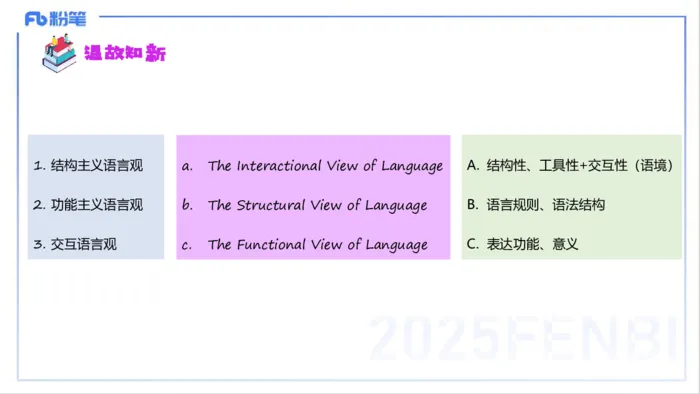
温故知新
1. 结构主义语言观
2. 功能主义语言观
3. 交互语言观
a.
The Interactional View of Language
b.
The Structural View of Language
c.
The Functional View of Language
A. 结构性、工具性+交互性(语境)
B. 语言规则、语法结构
C. 表达功能、意义
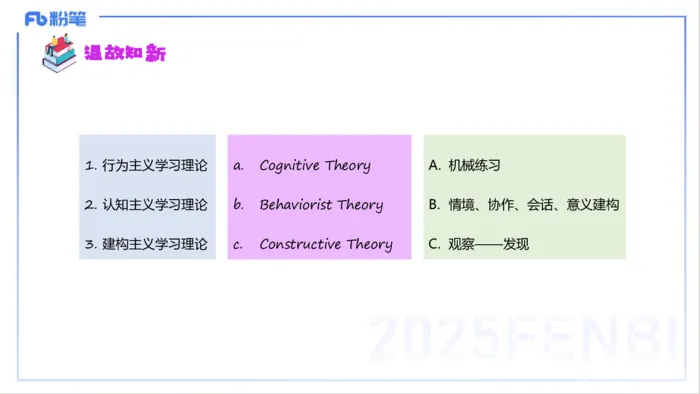
温故知新
1. 行为主义学习理论
2. 认知主义学习理论
3. 建构主义学习理论
a.
Cognitive Theory
b.
Behaviorist Theory
c.
Constructive Theory
A. 机械练习
B. 情境、协作、会话、意义建构
C. 观察——发现
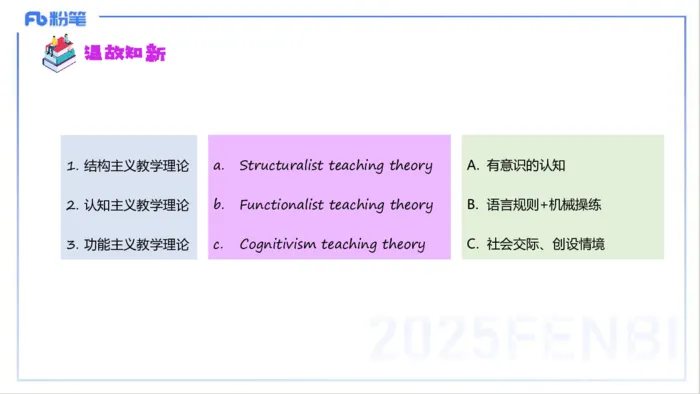
温故知新
1. 结构主义教学理论
2. 认知主义教学理论
3. 功能主义教学理论
a.
Structuralist teaching theory
b.
Functionalist teaching theory
c.
Cognitivism teaching theory
A. 有意识的认知
B. 语言规则+机械操练
C. 社会交际、创设情境
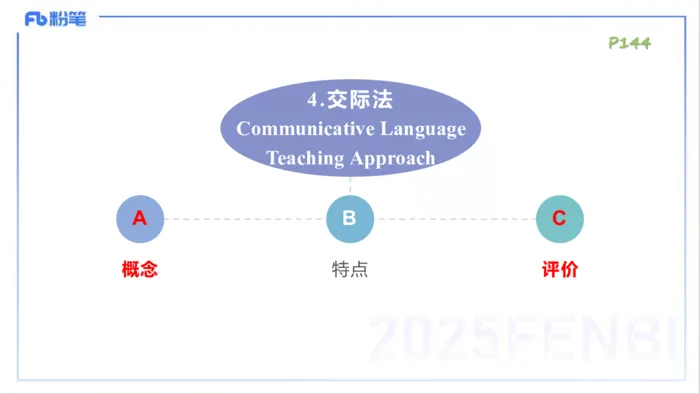
概念
A
C
B
特点
评价
4.交际法
Communicative Language
Teaching Approach
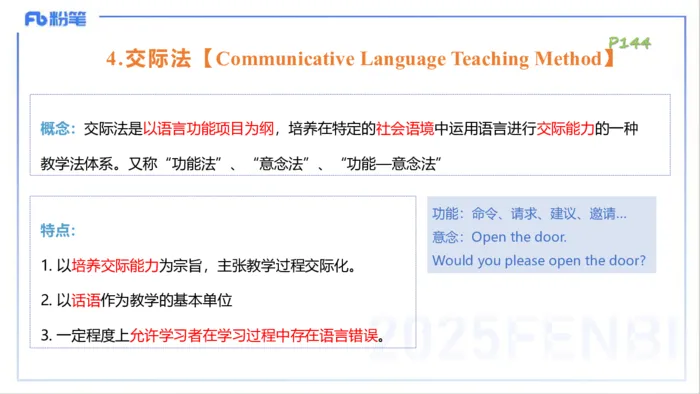
概念:交际法是以语言功能项目为纲,培养在特定的社会语境中运用语言进行交际能力的一种
教学法体系。又称“功能法”、“意念法”、“功能—意念法”
4.交际法【Communicative Language Teaching Method】
特点:
1. 以培养交际能力为宗旨,主张教学过程交际化。
2. 以话语作为教学的基本单位
3. 一定程度上允许学习者在学习过程中存在语言错误。
功能:命令、请求、建议、邀请…
意念:Open the door.
Would you please open the door?
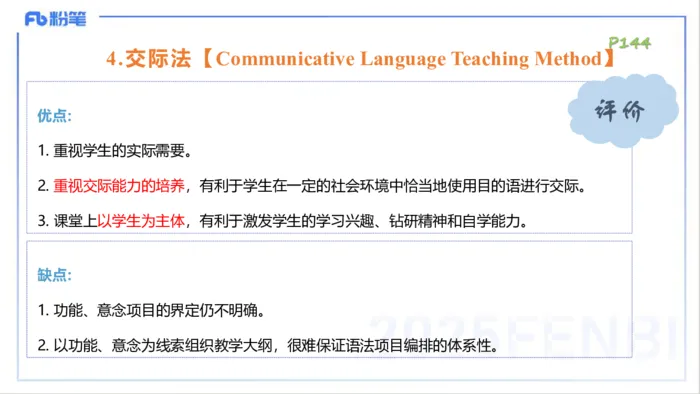
优点:
1. 重视学生的实际需要。
2. 重视交际能力的培养,有利于学生在一定的社会环境中恰当地使用目的语进行交际。
3. 课堂上以学生为主体,有利于激发学生的学习兴趣、钻研精神和自学能力。
评价
4.交际法【Communicative Language Teaching Method】
缺点:
1. 功能、意念项目的界定仍不明确。
2. 以功能、意念为线索组织教学大纲,很难保证语法项目编排的体系性。
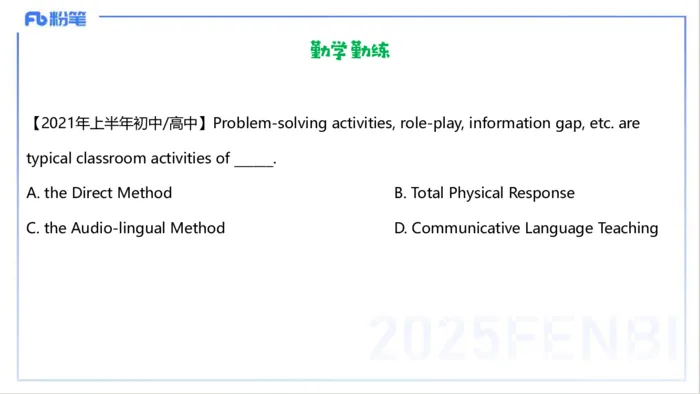
【2021年上半年初中/高中】Problem-solving activities, role-play, information gap, etc. are
typical classroom activities of ______.
A. the Direct Method
B. Total Physical Response
C. the Audio-lingual Method
D. Communicative Language Teaching
勤学勤练
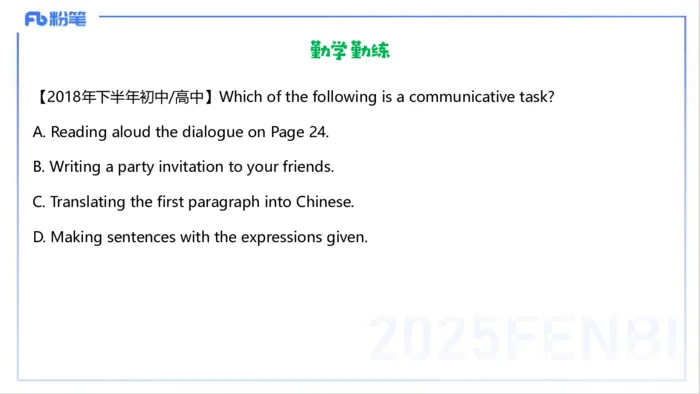
【2018年下半年初中/高中】Which of the following is a communicative task?
A. Reading aloud the dialogue on Page 24.
B. Writing a party invitation to your friends.
C. Translating the first paragraph into Chinese.
D. Making sentences with the expressions given.
勤学勤练
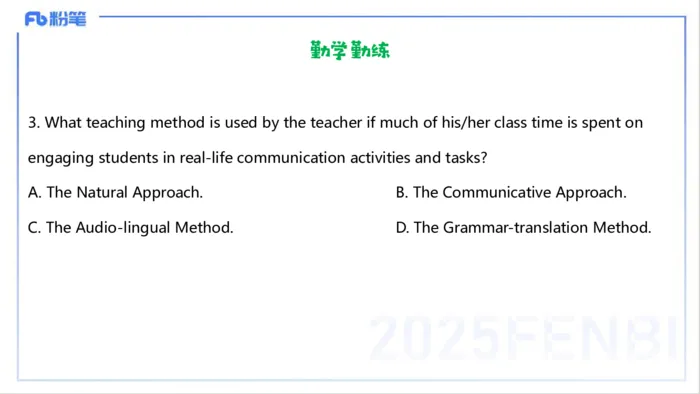
3. What teaching method is used by the teacher if much of his/her class time is spent on
engaging students in real-life communication activities and tasks?
A. The Natural Approach.
B. The Communicative Approach.
C. The Audio-lingual Method.
D. The Grammar-translation Method.
勤学勤练
概念
A
D
B
C
特点
教师作用
评价
5.情境教学法
The Situational Language
Teaching Method
概念:通过设计一些有意义的场景,为语言学习和操练提供实例,从而达到教学目的的教学法。
教学过程:听力练习—齐声模仿—个别模仿—单独操练—引进新句型
—How much is this T-shirt?
—It’s seven dollars.
5.情境教学法【Situational Language Teaching Method】
了解即可
特点:
1. 重视以句型为主的语法结构。
2. 重视口语教学。
3. 课堂教学语言要使用目的语。
4. 新的语言知识通过情境引入,并在情境中进行操练。
5. 语法教学循序渐进,先易后难。
6. 先词汇、语法,再阅读、写作。
5.情境教学法【Situational Language Teaching Method】
教师作用:
•
示范作用:演示目标结构所使用的语境并提供例句让学生模仿。
•
协调指挥:通过提问、命令和其他提示方式让学生正确回答问题。
•
监督作用:留意学生的语法和结构错误。
5.情境教学法【Situational Language Teaching Method】
5.情境教学法【Situational Language Teaching Method】
优点:
1. 直观性、趣味性、生动性
2. 避免枯燥
3. 针对性强,时效性强
缺点:
1. 学生被动接受语言材料的输入;
2. 过于重视语言形式,忽视交际能力的培养;
3. 过分强调目的语结构的机械训练和语音的准确性;
4. 不能最大限度地满足学生语言交际的实际需要。
评价
【知识拓展】
1. 创设情境的手段
(1)利用教学材料进行情境教学。
(2)借助现代化媒体进行情境教学。
(3)创设各种有趣的活动进行情境教学。
(4)充分利用直观教学手段进行情境教学。
(5)利用课外生活进行情境教学。
2. 创设情境需注意的问题
(1)情境创设要真实、开放、贴近生活。
(2)情境创设要符合学生的认识结构水平。
(3)问题的提出要兼顾学生的个体差异。
(4)教师不应过多地指责学生在语言中出现的错误。
概念
A
C
B
特点
评价
6.全身反应法
TPR-Total Physical
Response Approach
概念:以“听—做动作”为主要教学形式开展教学活动,用身体活动学习语言的一种教学方法。
If you are happy, clap your hands!
Clap, clap, clap!
If you are happy, wink your eyes!
Wink, wink, wink!
6.全身反应法【Total Physical Response Approach】
特点:
1. 注重听的技能,教师不强迫学生发言。
2. 理解先于输出。
3. 以“听—做动作”为主要教学形式开展教学活动,学生通过用身体对教师指令的动作进行反
应来提高自己的理解力。
了解即可
优点:
1. 吸引学生的注意力,课堂气氛活泼。
2. 不强迫学生说话,降低学习过程中的压力。
缺点:
1. 不适用于抽象单词和句子的讲解。
2. 不能很好地应用在初中和高中课堂教学。
3. 课堂组织和管理存在困难。
评价
6.全身反应法【Total-Physical Response Approach】
【2022年上半年初中】When teaching such words as “left” and “right”, a teacher asks
his/her students  to touch their left arms and then touch their right eyes. What does this
kind of activity  exemplify?
A. Direct Method.
B. Indirect Method.
C. Grammar Translation Method.
D. Total Physical Response.
勤学勤练
2. A teaching method in which the teacher designs the content into a series of instruction
language items and then asks the students to physically respond to the items is called ______.
A. The Direct Method
B. The Grammar-translation Method
C. The Audio-lingual Method
D. Total-Physical Response Approach
勤学勤练
概念
A
D
B
C
特点
原则
评价
7.任务型教学法
The Task-based Language
Teaching Method
概念:强调“做中学”,以任务组织教学,学生在任务的履行过程中,以参与、体验、互动、
交流、合作的学习方式,充分发挥学习者自身的认知能力,调动他们已有的目的语资源,在实
践中感知、认识、应用目的语。
任务类型:拼图任务(Jigsaw task)、信息沟任务(Information Gap task)、解决问题任
务(Problem-solving task)、决策任务(Decision-making task)和交流意见任务
(Opinion exchange task)
•
教学过程:Pre-task—While-task—Post-task
7.任务型教学法【The Task-based Language Teaching Method】
了解即可
特点:
1. 任务贯穿教学全过程。
2. 任务的焦点是解决某一交际问题,并与生活实际紧密联系。(功能function)
3. 注重任务的完成,即交际问题的解决。
4. 注重真实生活情景任务。
7.任务型教学法【The Task-based Language Teaching Method】
7.任务型教学法【The Task-based Language Teaching Method】
原则:
1. 真实性原则:任务应尽量贴近真实生活。
2. 形式 / 功能原则:让学生充分感受语言形式和功能的关系。
3. 连贯性原则:任务相互关联的,在内容上相互衔接。
4. 可操作性原则:避免环节过多、程序过于复杂的任务。
5. 实用性原则:任务要尽可能达到预期的教学目的。
6. 趣味性原则:激发学生的学习动机,使他们主动参与学习。
优点:
1. 完成多种多样的任务活动,有助于激发学生的学习兴趣。
2. 将知识和技能结合起来,有助于培养学生综合的语言运用能力。
3. 促进学生积极参与语言交流活动,有利于发挥学生的主体性作用。
4. 在任务型教学中每个学生都有自己的任务要完成,可以更好地面向全体学生进行教学。
5. 活动内容涉及面广,信息量大,有助于拓宽学生的知识面。
评价
7.任务型教学法【The Task-based Language Teaching Method】
缺点:
1. 难易程度不同的语言结构不利于学生掌握。
2. 不强调随时纠正错误,不利于培养学生使用语言的精确性。
趣用全面体
了解即可
【2024上初中/高中】In task-based language teaching, textbook units are compiled primarily
around ______.
A. skills
B. grammar
C. functions
D. topics
【2019下初中/高中】Activities such as problem solving, decision making and opinion
exchanging aretypical practices in ______.
A. audio-lingual method
B. grammar-translation method
C. situational language teaching method
D. task-based language teaching method
【2018上初中/高中】Which of the following activities is NOT typical of the Task-Based Language
Teaching method?
A. Problem-solving activities.
B. Opinion exchange activities.
C. Information-gap activities.
D. Pattern practice activities.
“用母语进行翻译”
“直接接触外语环境”
“句型反复操练”
“交际、功能”
“情境+句型操练”
“用肢体语言教英语”
任务、“在做中学”
1. Which of the following teaching methods uses real-life situations and authentic materials
to promote language learning?
A. The Grammar-translation Method.
B. The Direct Method.
C. The Communicative Approach.
D. The Audio-lingual Method.
2. The situational approach is a grammar-based language teaching method, which focuses
on ________.
A. grammar and vocabularies
B. oral language and sentence patterns
C. speaking and listening
D. pronunciation and speaking
巩固提升
【2022上·初中·教学情境分析题】
32. 下面片段选自初中英语课堂教学实录。
Create a context by pointing to a boy or a girl in the class and say, “He/She is a boy/ girl. He comes
from England. He/She is a student. He/She has a sister, and he/she is a student, too. They are in the same
school, but in different grades.”
Write down the sentences on the blackboard. Underline the new words (come from, student, sister, different)
and explain their Chinese meaning.
Ask the class to read the conversation again and sentences together after the teacher.
Ask the students to work in pairs. Replace “England” with names of other places, and  replace
“sister” with “brother”.
(2)分析该教师采用的教学方法。(6 分)
【参考答案】
(2)该教师采用了情境教学法和语法翻译法/听说法。
该教师通过指着班里的一个男生或女生来创造教学情境,并以此引出 “He/She is a boy/ girl.”
“He comes from England.” 等新句型,让学生在情境中理解新知识的含义,掌握新知识的用法,
体现了情境教学法。
该教师讲解新句型和新单词的中文释义,让学生理解新知识的含义,体现了语法翻译法。
该教师让学生们对本节课句子及对话进行句型操练,并变换单词达到熟练掌握的程度,体现了听说法。
第二章
语言知识教学
【单选、简答、情境分析】
教学内容
A
C
B
教学原则
练习方法
1.语音教学
【单选、情境分析】
教学内容:
• 语音层次:音标、读音规则(phoneme)
• 语流层次:句子重音stress、节奏rhythm、意群和停顿sense-group and
pausing、连读liaison、失去爆破loss of plosion和语调 intonation等。
1.语音教学
【单选】
教学原则:
1.
准确性原则:语音教学的首要原则;从发音方式,发音部位入手,保证准确发音。
2.
长期发展原则:语音教学不只是入门阶段的教学任务,而且是贯穿中小学各个阶段的教学任务。
3.
综合性原则:将音素、音标、单词、句子及语义、语用等各个层面结合起来。
4.
针对性原则:使用适当的教学方法来解决学生的发音问题。
5.
趣味性原则:游戏、比赛、英语说唱、英语童谣、英语绕口令及 TPR 活动等。
6.
交际性原则: 在语音教学中应将语音置于特定的交际语境之中。
7.
真实性原则:融入有意义、有情景的语音练习中,让学生大量接触真实的、自然的语料和语境。
8.
多样性原则:使用多样化语言教学手段,提供不同形式的教学材料,让学生接触不同口音。
1.语音教学
【情境分析】
练习方法:(一)发音练习
1. 认知练习(培养学生辨认和区分不同语音的能力)
•
使用最小对立对分析音差:will—well, ship—sheep
•
找相同或不同(师读单词,生辩异同):cat, hat
•
排列顺序:big, beg, bag
2. 产出练习(培养学生能发出清晰、可理解的语音的能力)
•
听并重复
•
填空并读出:[ei]: Children love to           games.
•
使用图片
•
绕口令:A big black bug bit a big black bear and made the big black bear bleed blood.
(二) 重音和语调练习
•
使用手势、使用声音、使用黑板:
1.语音教学
【简答、情境分析】
【2023下初中/高中】Which of the following is least appropriate in teaching English pronunciation to
beginners?
A. Asking students to discriminate significant sound features.
B. Asking students to read words aloud with correct pronunciation.
C. Requiring students to produce intelligible and acceptable sounds.
D. Teaching students the technical terms of phonetics and phonology.
【2021下初中/高中】When teaching pronunciation, a teacher should include phonemes, stress,
intonation  and ________ in the syllabus.
A. consonant
B. vowel
C. rhythm
D. speech
1. In English phonetic teaching, the term “minimal pair” is mainly used to ________.
A. teach students to distinguish between similar sounds
B. help students understand intonation patterns
C. improve students’ fluency in speaking
D. enhance students’ listening comprehension speed
2. English teacher Alice stopped Tom’s reading and asked him to follow her and repeat
the word “eat” again and again. What can we conclude from the description above?
A. The teacher concerns the principle of accuracy.
B. The teacher should stop student’s reading to correct their pronunciations.
C. Tom’s pronunciation is poor.
D. Every pronunciation is important in English.
巩固提升
【2017 年下·初中·教学情境分析题】
根据题目要求完成下列任务,用中文作答。
下面是一位初中英语教师在语音教学中使用的练习。
根据上面所提供的信息,从下面四个方面作答:
(3)该教学片段体现了哪两个语音教学原则?(8 分)
(4)列出能恰当体现语音教学原则的其他三种方法(9 分)
Teacher’s instruction:
Look at the words on the blackboard.
Tick the word you hear in each sentence
I read.
Teacher reads:
1. I don’t like these sports.
2. These pots are very dirty.
3. Look at that white cord on the water.
4. Mr. Smith was short.
Students tick the words they hear:
 A
   B
1. spots
sports
2. pots
ports
3. cod
cord
4. shot
short
(3)该教学片段所体现的语音教学原则:
① 综合性原则。语音教学不是孤立的发音教学,教师应该将音素、音标、单词、句子及语义、
语用等各个层面结合起来,把语音教学融入有意义、有情景的语言练习中。该教学片段中,教
师把语音和单词、句子结合起来,体现了综合性教学原则。
② 针对性原则。针对性原则指语音训练的重点应该放在有标记的语音特征上。教师要针对学
生的困难进行有针对性的指导。在该教学片段中,主要训练 [ɔː] 和 [ɒ] 这一对长短音的区别,
体现了针对性的教学原则。
【参考答案】
(4)能恰当体现语音教学原则的其他三种方法如下。
① 找出一组词中读音不相同的词。教师连续读几个词,有一个词的发音与其他词不同,请学
生挑出发音不同的那个。该练习适用于音素教学和练习,体现了语音教学的针对性原则,例如,
bit,bit,bit,pit(最后一个不同)。
② 绕口令。绕口令可以调节气氛,可以练习熟练程度,可以使学生在理解语句和语篇意义的
基础上及轻松愉快的气氛中感受英语语音的节奏美,体现了语音教学的趣味性。
③ 补充完整。教师读出一串单词,这些单词中只有一个单词的辅音或者元音不同,学生需要
通过老师的读音将单词补充完整,例如,hate,gate,fate,date。该练习适合音素的练习,体
现了语音教学的综合性原则。
【参考答案】