文档文本内容
粉笔教师教育
粉笔教师
主讲老师
李婉君
2 0 2 5 年全国教师资格
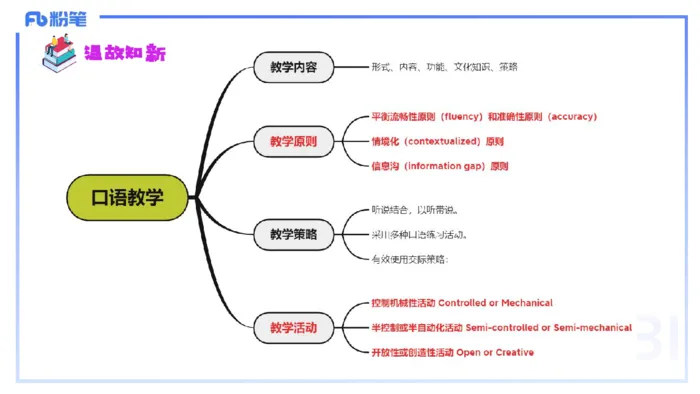
温故知新
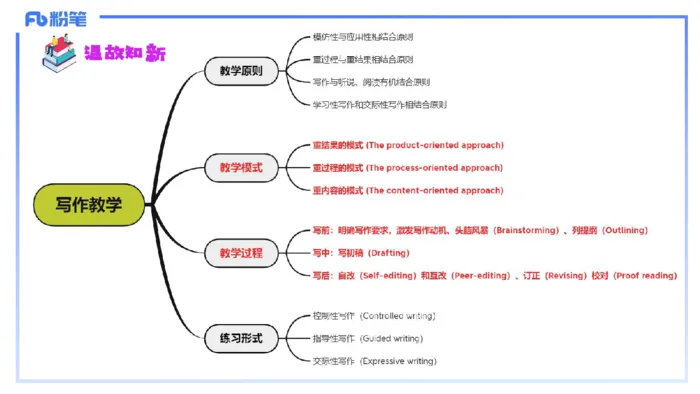
温故知新
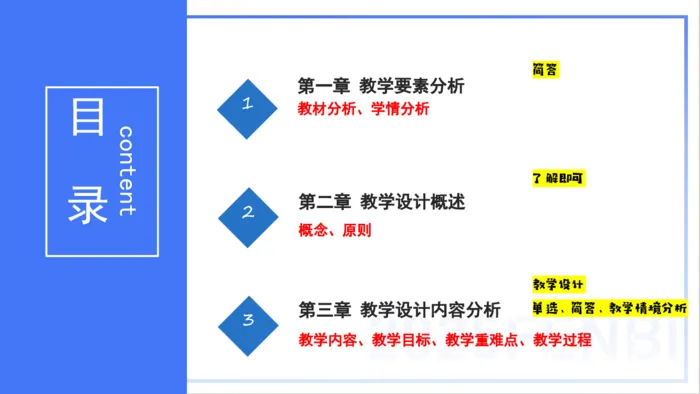
目

录
content
第一章 教学要素分析
教材分析、学情分析
1
第二章 教学设计概述
概念、原则
2
第三章 教学设计内容分析
教学内容、教学目标、教学重难点、教学过程
3
简答
了解即可
教学设计
单选、简答、教学情境分析
第一章
教学要素分析
【简答】
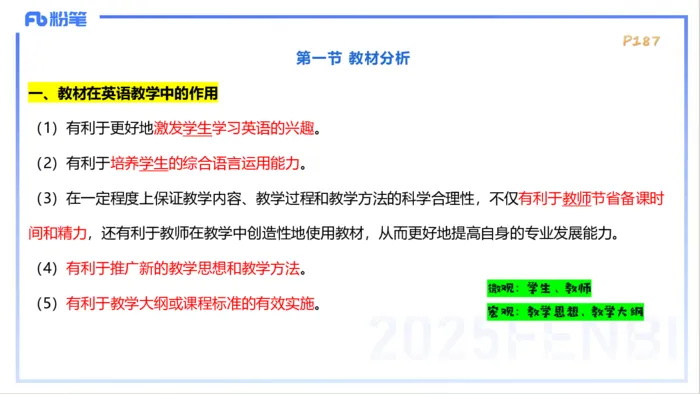
第一节 教材分析
一、教材在英语教学中的作用
(1)有利于更好地激发学生学习英语的兴趣。
(2)有利于培养学生的综合语言运用能力。
(3)在一定程度上保证教学内容、教学过程和教学方法的科学合理性,不仅有利于教师节省备课时
间和精力,还有利于教师在教学中创造性地使用教材,从而更好地提高自身的专业发展能力。
(4)有利于推广新的教学思想和教学方法。
(5)有利于教学大纲或课程标准的有效实施。
微观:学生、教师
宏观:教学思想、教学大纲
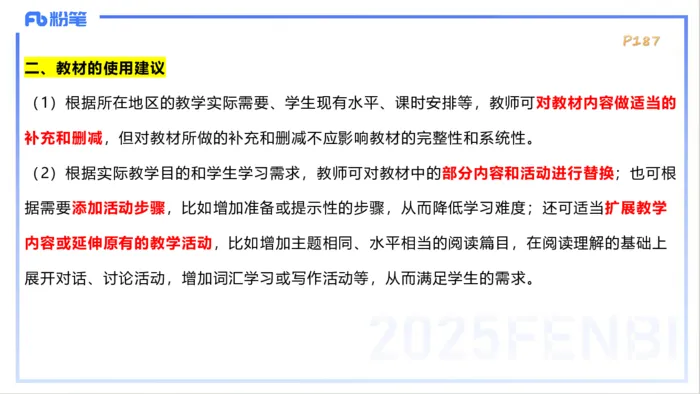
二、教材的使用建议
(1)根据所在地区的教学实际需要、学生现有水平、课时安排等,教师可对教材内容做适当的
补充和删减,但对教材所做的补充和删减不应影响教材的完整性和系统性。
(2)根据实际教学目的和学生学习需求,教师可对教材中的部分内容和活动进行替换;也可根
据需要添加活动步骤,比如增加准备或提示性的步骤,从而降低学习难度;还可适当扩展教学
内容或延伸原有的教学活动,比如增加主题相同、水平相当的阅读篇目,在阅读理解的基础上
展开对话、讨论活动,增加词汇学习或写作活动等,从而满足学生的需求。
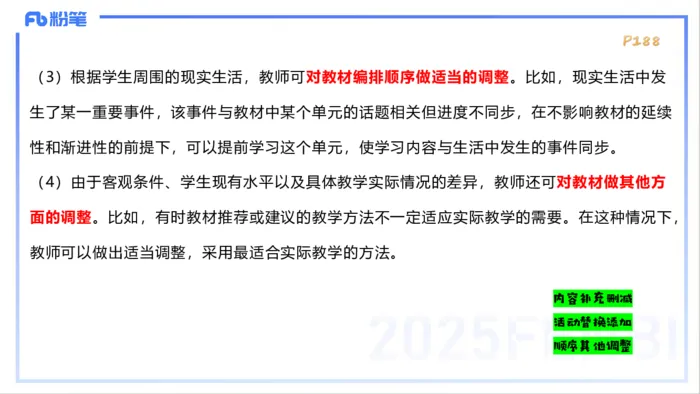
(3)根据学生周围的现实生活,教师可对教材编排顺序做适当的调整。比如,现实生活中发
生了某一重要事件,该事件与教材中某个单元的话题相关但进度不同步,在不影响教材的延续
性和渐进性的前提下,可以提前学习这个单元,使学习内容与生活中发生的事件同步。
(4)由于客观条件、学生现有水平以及具体教学实际情况的差异,教师还可对教材做其他方
面的调整。比如,有时教材推荐或建议的教学方法不一定适应实际教学的需要。在这种情况下,
教师可以做出适当调整,采用最适合实际教学的方法。
内容补充删减
活动替换添加
顺序其他调整
第二节 学情分析
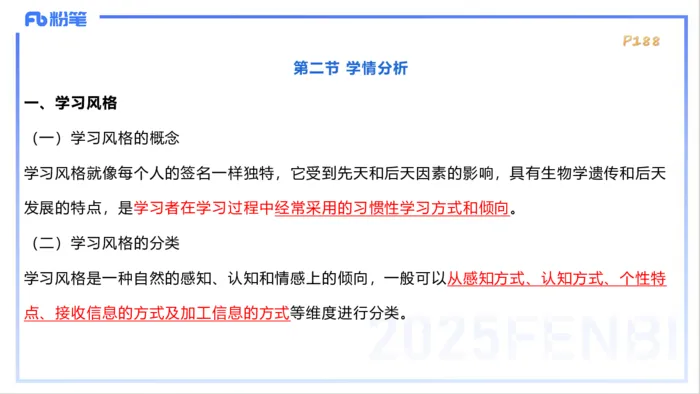
一、学习风格
(一)学习风格的概念
学习风格就像每个人的签名一样独特,它受到先天和后天因素的影响,具有生物学遗传和后天
发展的特点,是学习者在学习过程中经常采用的习惯性学习方式和倾向。
(二)学习风格的分类
学习风格是一种自然的感知、认知和情感上的倾向,一般可以从感知方式、认知方式、个性特
点、接收信息的方式及加工信息的方式等维度进行分类。
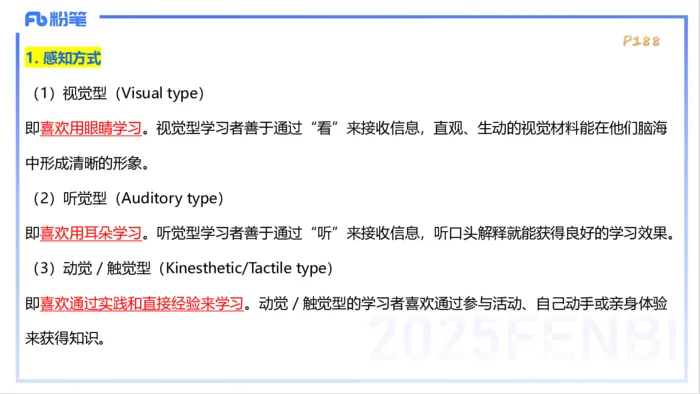
1. 感知方式
(1)视觉型(Visual type)
即喜欢用眼睛学习。视觉型学习者善于通过“看”来接收信息,直观、生动的视觉材料能在他们脑海
中形成清晰的形象。
(2)听觉型(Auditory type)
即喜欢用耳朵学习。听觉型学习者善于通过“听”来接收信息,听口头解释就能获得良好的学习效果。
(3)动觉 / 触觉型(Kinesthetic/Tactile type)
即喜欢通过实践和直接经验来学习。动觉 / 触觉型的学习者喜欢通过参与活动、自己动手或亲身体验
来获得知识。
2. 认知方式
(1)场依赖型与场独立型(Field-dependent type & Field-independent type)
往往依靠外部提供的有关信息,倾向于从整体上认知事物,他们易受外界因素的干
扰,不善于独立分析问题。
往往依靠自己内部具有的知识框架,倾向于自己独立分析问题,他们不易受外界因
素干扰,能洞察出超越事物本身的事物间的相互关系,能够很容易地把重要细节从复杂的背景中区
分出来,善于借助视觉和直觉线索。
2. 认知方式
(2)思考型与冲动型(Reflective type & Impulsive type)
一般能够约束自己的行为,能够抗拒外界诱惑。他们在碰到问题时倾向于深思熟虑,
用充足的时间考虑、审视问题,权衡各种问题解决的方法,然后从中选择一个满足多种条件的最佳
方案,因而较少犯错误。他们在学习过程中的思维方式以反省为特征,逻辑性强,有较强的批判性,
乐于在合作的情境中学习。
则倾向于很快地检验假设,根据问题的部分信息或未对问题做透彻的分析就仓促地凭
借自己的直觉推测答案,他们反应速度较快,但容易出现错误。冲动型学习者在学习过程中的思维
方式以冲动为特征,直觉性强,乐于在竞争的情境中学习。
2. 认知方式
(3)整体型与细节型(Global type & Particular type)
学习时喜欢抓住重点或者大意,全面看待问题,思维的深刻性、准确性较低,直觉性、
模糊性较高。他们即使遇到不认识的词汇或不懂的概念,也能很好地与别人进行交流。他们能从几
个角度对问题进行预测和观察,并将其与其他问题联系起来考虑。
关注具体的规则和细节,善于记住具体的信息,而且擅长逻辑分析和对比,善于以精
细的逻辑形式理解各种信息,经常把宽泛的概念分解成若干小的单位来学习,擅长发现事物之间的
差异。在语言学习中,细节型学习者关注语法规则,对新的词组和单词比较敏感。
tolerance of ambiguity【模糊容忍度】
2. 认知方式
(4)左脑型与右脑型(Left-brain type & Right-brain type)
•
左脑型学习者喜欢用“放大镜”来学习,喜欢关注细节,有很强的逻辑性和分析能力,擅长学习
数学。
•
右脑型学习者善于用“广角镜头”来学习,喜欢抓大意,相信直觉,有很强的灵活性,喜欢音乐
和艺术。
3. 个性特点
(1)外向型(Extrovert type)
外向型学习者关注外部世界,他们开朗、热情,喜欢与人交流,兴趣广泛,给别人以较好的印象。在
课堂上,他们愿意参与游戏、对话、小组讨论、角色扮演等交际性活动。
(2)内向型(Introvert type)
内向型学习者一般关注内部世界,能够集中注意力,喜欢独处,不愿意与人多接触,兴趣不多,但对
个人喜欢的领域却很精通,沉默寡言,不善于表达自己的思想。在课堂上,他们喜欢独立思考,喜欢
自己独立完成任务,或者与比较熟悉的同学做两人的学习活动。
4. 接收信息的方式(学习方式)
(1)封闭型(Closure-oriented type)
封闭型学习者善于决策和行动,他们善于制订计划并在规定的期限内完成任务,希望掌控并且尽快完
成学习任务。他们学习刻苦,有决心,不易受挫折,能够认真地对待所有的学习任务,能够在规定的
时间内完成任务,而且会提前为学习任务做准备。
(2)开放型(Open-oriented type)
开放型学习者善于收集信息,不急于下结论,通常会在广泛地获取信息和经验的基础上才下结论。他
们喜欢灵活、顺其自然的学习方式,喜欢放松地享受学习过程,把学习当成娱乐,能从学习中获得乐
趣。
5. 加工信息的方式
(1)随机直觉型(Random-intuitive type)
随机直觉型学习者面向未来,爱推测可能性,善于发现事物的主要规律,常以随机的方式处理事情,
喜欢抽象思考。比如,要求随机直觉型学习者给出 5 个例子,他们往往会给出 4 个或 6 个,他们不喜
欢循规蹈矩的程序化的授课方式。
(2)具体程序型(Concrete-sequential type)
具体程序型学习者面向现在,他们只关心眼前的任务,喜欢按部就班的学习活动,善于使用各种记忆
策略,学习上讲究先后步骤,会严格遵照指令办事,往往将教师的话当成真理,刨根问底。比如,要
求具体程序型学习者给出 5 个例子,他们往往会严格遵照指令给出 5 个。课堂上,具体程序型学习者
喜欢分解式的课堂任务,一次完成一个步骤,而且希望能够在每个步骤中及时得到反馈。
1. 视觉型
2. 听觉型
3. 动觉型
4. 场依赖型
5. 场独立型
6. 思考型
7. 冲动型
8. 整体型
9. 细节型
10. 外向型
11. 内向型
A. Introvert type
B. Global type
C. Reflective type
D. Field-independent type
E. Impulsive type
F. Kinesthetic/Tactile type
G. Particular type
H. Visual type
I. Auditory type
J. Extrovert type
K. Field-dependent type
A. 碰到问题时倾向于深思熟虑,权衡各种问题解决的方法
B. 不易受外界因素干扰,倾向于自己独立分析问题
C. 喜欢抓住重点或者大意,全面看待问题
D. 凭借直觉推测答案,反应速度较快,但容易出现错误
E. 善于通过“看”来接收信息
F. 关注具体的规则和细节,善于记住具体的信息
G. 易受外界因素的干扰,不善于独立分析问题
H. 愿意参与课堂交际性活动
I. 善于通过“听”来接收信息
J. 喜欢独处,不愿意与人多接触,喜欢自己独立完成任务
K. 喜欢通过参与活动、自己动手或亲身体验来获得知识
第二节 学情分析
二、学习需要
(一)学习需要的概念
学习需要是指学生目前的学习状况与所期望达到的学习状况之间的差距。“目前的学习状况”是指学生已经具备的能
力素质。“所期望达到的学习状况”是指学生应当具备的能力素质,包括社会、学校和家庭对学生的期望以及学生对
自己的期望。“差距”就是学生在能力素质方面的不足,就是教学中实际存在和要解决的问题,这正是经过教育或培
训可以解决的学习需要。
(二)分析学习需要的目的
学习需要分析是指通过系统化的调查研究,发现教学中存在的问题,通过分析问题产生的原因确定问题的性质,论证
解决该问题的必要性和可行性。其有以下四个目的:一是发现学生学习中存在的问题;二是分析产生问题的主要原因,
确定教学设计时解决问题的方法和途径;三是分析现有的教学资源,论证解决问题的可能性;四是分析问题的重要性。
了解即可
1. Which of the following learning styles is characterized by students who prefer to learn
through hands-on experiences and physical activities?
A. Visual learning style
B. Auditory learning style
C. Kinesthetic learning style
D. Reading and writing learning style
【巩固提升】
2. Which of the following is an important principle in the use of English textbooks?
A. Using textbooks as the only teaching resource.
B. Adapting textbooks to suit the local teaching context.
C. Following the textbook strictly without any modification.
D. Ignoring the supplementary materials provided with the textbook.
【巩固提升】
第二章
教学设计概述
第二章 教学设计概述
•
教学设计概念:指教师根据正确的教学思想和教育原理,按照一定的教学目的和要求,针对具体的教学
对象和教材,对英语教学的整个过程及其具体环节、总体结构和有关层面所做出的预期的、行之有效的
策划。
•
教学设计的原则:
一、目的性(Aim):一堂课要有明确的教学目标
二、多样性 (Variety):输入材料、输入方式、教学安排及练习形式的多样化
三、灵活性 (Flexibility):设计额外的教学活动或设计更多的活动选择
四、可习得性 (Learnability):难度要在学生的学习能力范围之内
五、联系性 (Linkage):每一个教学步骤都是相互联系的
了解即可
第三章
教学设计内容分析
年份
25上
24下
24上
23下
23上
22下
22上
21下
21上
高中
课型
写作
阅读
诗歌
写作
写作
听力
阅读
口语
写作
时间
20
40
40
20
20
20
15
15
20
年份
25上
24下
24上
23下
23上
22下
22上
21下
21上
初中
课型
阅读
听说
写作
听说
听说
阅读
阅读
听说
语法
时间
20
20
40
20
20
20
15
15
20
规律解读:1. 以技能型课型为主;2. 初中重听说、阅读;高中重写作、阅读;3. 20分钟居多
根据提供的信息和语言素材设计教学方案,用英文作答。
33. 设计任务:阅读下面的学生信息和语言素材,设计一节英语写作课教学方案。
教案没有固定格式,但须含下列要点:
① Teaching objectives
② Teaching contents
③ Key and difficult points
④ Major steps and time allocation
⑤ Activities and justifications
教学时间:40 分钟
学生概况:某城镇普通中学九年级(初中三年级)学生,班级人数为 40 人。多数学生已经达到《义
务教育英语课程标准(2022 年版)》三级水平。学生课堂参与积极性一般。
真题回顾-2024上初中
语言素材:
Subject: Can you help?
From: Fran
Dear Knowledgeable,
My best friend, Mei, has a problem. There is a really important English speech contest for our
whole city next month. Our classmates want her to represent the class in the school contest. Everyone
is sure she will win. It’s probably true. Mei is very clever and can speak English really well. In fact, she
always comes top in the school exams. The problem is that she’s very shy. She doesn’t want to let
her friends down, but she’s terrified of speaking in front of other people. She’s my best friend, so
she can tell me that she’s shy. But she can’t tell everyone that. I don’t think they would believe her.
I can’t think of any good advice to give her, but you always come up with good solutions to
people’s problems. What do you think I should tell Mei? What do you think I should tell the rest of
the students?
Fran
根据提供的信息和语言素材设计教学方案,用英文作答。
33. 设计任务:请阅读下面的学生信息和语言素材,设计一节英语诗歌欣赏课的教学方案。教案没有
固定格式,但须包含下列要点:
① Teaching objectives
② Teaching contents
③ Key and difficult points
④ Major steps and time allocation
⑤ Activities and justifications
教学时间:40 分钟
学生概况:某城镇普通中学高中三年级学生,班级人数 40 人。多数学生已经达到《普通高中英语课
程标准(2017 年版 2020 年修订)》的相应学业质量水平。学生课堂参与积极性较高。
真题回顾-2024上高中
语言素材:
① Teaching objectives
② Teaching contents
③ Key and difficult points
④ Major steps and time allocation
⑤ Activities and justifications
I. Teaching contents
II. Teaching objectives
(1) Language competence
(2) Cultural awareness
(3) Thinking quality
(4) Learning ability
III. Key and difficult points
Key point(s)
Difficult point(s)
IV. Major steps
Step 1 Lead-in (×mins)
Step 2 Pre-/Presentation (×mins)
Step 3 While-/Practice (×mins)
Step 4 Post-/Production (×mins)
Step 5 Summary and homework (×mins)
答题模板—通用部分
(一)教学内容
Teaching contents
I. Teaching contents
• 呈现要素:课型+主题
【模板一】This is a reading lesson. It talks about ________.
【模板二】The given listening material introduces / shows ________.
任选其一
语言素材:(阅读课)
Zheng He and His Seven Voyages
  Zheng He was one of China’s most famous explorers. Towards the end of the fourteenth century,
his fleet sailed to countries very far away.
Zheng He had over 300 ships, some of which were over 150 meters long and could carry up to 1000
people. In addition to the supplies for the long journeys, the ships carried gold, silver, silk, china and
other treasures to give as gifts to the rulers of the neighboring countries. Some of the ships even had
earth on board so that the sailors could grow their own crops for food.
On Zheng He’s first voyage, he set sail across the Indian Ocean. His fleet traveled for many days far
away from land. One day, they were hit by a storm. All the sailors thought the fleet was going to sink.
Then a strange light appeared at the top of the ships’ masts, and after that, the storm passed. The
strange light that appeared on the masts was probably electricity from the thunderstorm. Many sailors
today see such lightning on the masts of their ships during a storm. But the sailors in Zheng He’s fleet
believed it was a sign of protection from the gods. From then on, they were happy to follow Zheng He
wherever he led them.
Zheng He completed seven famous voyages between 1405 and 1433. He visited many countries in
Asia and Africa. Zheng He also brought back many gifts from the countries he visited, such as medicines,
pearls and strange animals. The most famous of these gifts were a giraffe and a zebra.
【参考答案】
1.Teaching contents
版本一:This is a reading lesson. It talks about Zheng He and his seven voyages.
版本二:The given reading material introduces Zheng He and his seven voyages.
(二)教学目标
Teaching objectives
教学目标的确定,源于课程标准的要求。《义务教育英语课程标准(2022 年版)》
以及《普通高中英语课程标准(2017 版)》将学科核心素养的发展目标设定为四个
方面,即语言能力(Language competence)、文化意识(Cultural awareness)、
思维品质(Thinking quality)、学习能力(Learning ability)。
一、确立教学目标的依据
语言能力:【知识】语音、词汇、句型、语法、语篇、语用
                 【技能】听说读看写
文化意识:【广义】中外文化理解、鉴赏;
                 【狭义】正确的价值观、必备品格的形成与发展
思维品质:理解、分析、比较、推断、批判、评价、创造
学习能力:学习策略;
                 乐学与善学、合作与探究
任选其一或其二
二、设计教学目标的原则
01
02
03
04
全面性原则
学生主体性原则
可测性原则
层次性原则
【教学情境分析/简答】
●3.教学目标的四要素
例:Students will express their own opinions about wildlife protection through group
discussion correctly and fluently.
A
Audience
行为主体
B
Behavior
行为动词
C
Condition
行为条件
D
Degree
表现程度
三、教学目标的四要素
【听说课、阅读课、口语课】
1. Students can know/understand/grasp/remember the new words and phrases, such as
________ and the new sentence patterns, such as ____________.
2. Through listening/reading, students will understand the main idea of the listening/ reading/
speaking material/ passage and be able to use the target language to talk about ______.
【写作课】
1. Students can know the main idea of the passage and the structure/form of the writing.
2. Students can write a passage with a certain topic ______.
1. Language competence
【词汇课】1. Students will understand/remember/recite/know/grasp the meaning of the new
words, such as _______, and new sentences _________.
2. Students can use the new words to talk about ________ correctly.
【语音课】Students will know/grasp the pronunciation of the letter(s) _________ and use it to
communicate with others correctly.
【语法课】1. Students can understand/remember/know/grasp/get the meaning and usage of
the new grammar ________.
2. Students can use this grammar to talk about _________ correctly/read the material more
easily and quickly.
(1) Students can be interested in learning and exploring Chinese and foreign culture.
(2) Students can compare Chinese and foreign culture and identify with Chinese culture.
(3) Students can respect cultural diversity and differences.
(4) Students can have a sense of national identity, cultural confidence, correct values and positive
emotional attitude.
(5) Students can have good character of self-confidence and self-improvement.
2. Cultural awareness
3. Thinking quality
(1) Students can sort out and summarize the information in the passage/material.
(2) Students can analyze and infer the logical relationship of the passage/material.
(3) Students can use English to think independently and creatively.
(4) Students can correctly understand and judge the thematic meaning and viewpoint of the
passage/material.
(5) Students can infer the author’s attitude and view from the passage/material.
(1) Students can increase their interest in learning English.
(2) Students will be willing to take part in the class activities and cooperate with other group members.
(3) Students will be more confident and willing to share their own ideas with others in public.
(4) Students can make clear learning objectives and plans and arrange learning tasks reasonably.
(5) Students can actively use English to communicate and not be afraid of difficulties.
4. Learning ability
Teaching objectives:
(1) Students can understand the new words and phrases, such as ______ and the new sentence
patterns, such as ____________.
(2) Students will understand the main idea of the material and be able to use the target
language to talk about ______.
(3) Students can have correct values and positive emotional attitude.
(4) Students can sort out and summarize the information in the material.
(5) Students will be willing to take part in the class activities and cooperate with others.
1. 首字母大小写保持一致
2. 不用写小标题,只写序号
3. 教学目标5条即可
【参考答案】
Teaching objectives
(1) Students can grasp the key words fleet, voyage, supply, sink and get the main idea of the text.
(2) Students can learn how to get information from a passage through fast reading like
skimming and scanning.
(3) Students can have good character of self-confidence and self-improvement.
(4) Students can sort out and summarize information in the passage.
(5) Students will be willing to take part in the classroom activities and cooperate with other
group members.