2011年考研英语(一)真题逐词逐句精讲
…第一段”
❶ Ancient Greek philosopher Aristotle viewed laughter as "a bodily exercise precious to health.'古希腊哲学家亚里士
多德认为,笑是“一种有益健康的身体运动”。
Ancient Greek philosopher Aristotle viewed laughter (主+谓+宾+宾补)
句子主干 •介词短语作laughter的补足语[
as "a bodily exercise precious to h*ealth/
❷ But despite some claims to the contrary, laughing probably has little influence on physical fitness.但是,笑很可能对
身体健康影响甚微,尽管有些观点与之相反。
—级修饰 But despite some claims to the contrary,
]介词短语作句子主干的让步状语
句子主干 laughing probably has Httle influence on physical fitness.(主+谓+宾)
3司汇〉主样:to the contrary相反,相反地 influence*[ -mfluans] n.影响;作用;控制力
❸ Laughter does produce short-term changes in the function of the heart and its blood vessels, boosting heart rate and
oxygen consumption.笑的确会引起心脏和心血管功能的短期变化,提高心率和耗氧量、
句子主干 Laughter does produce short-terrrrchanges in the function (主+谓+宾)
介词短语作后置定语,修饰the function |
of the heart and its blood vessels,
-级修饰 现在分词短语作句子主干的伴随状语
boosting heart rate and oxygen consumption.
.妻&生裕:句子主干中的助动词does表示强调,可译为“的确” o
「商无洼裕:vessel ☆[,vesl] n.血管;导管;大船;容器 b*oost [burst] vt.提高;使兴旺n.激励
❹ But because hard laughter is difficult to sustain, a good laugh is unlikely to have measurable benefits the way, say,
walking or jogging does.但是,由于大笑很难持续,所以它不可能像散步或慢跑那样具有显著的益处。
_级修饰 because hard laughter is difficult to sustain,
I because引导的原因状语从句,作句子主干的原因状语
句子主干 But...a good laugh is unlikely to have measurable benefits (主+谓+宾)
the way引导的方式状语从句作句子主干的方式状语
—级修饰 the way, say, walking or jogging does.
;词汇生祢:measurable [,me3gbl] a.显著的;可测量的 jogging [ d3Dgir)] n.慢跑;慢跑锻炼
77.••第二段•••
O In fact, instead of straining muscles to build them, as exercise does, laughter apparently accomplishes the opposite.
事实上,笑不像运动那样可以通过使肌肉紧张来塑造肌肉,它显然起到了相反的作用。
—级修饰 instead of straining muscles to build them, as exercise does,
l介词短语作句子主干的状语
句子主干 In fact,...laughter apparently accomplishes th^opposite.(主+谓+宾)
:词汇注释:s*train [strein]讥使紧张;扭伤;竭力 o*pposite [ opazit]几反面;对立面
❷ Studies dating back to the 1930s indicate that laughter relaxes muscles, decreasing muscle tone for up to 45 minutes
after the laugh dies down.自20世纪30年代起的种种研究表明,笑可以使肌肉放松,在笑声逐渐平息后,肌张力
会降低长达45分钟。
句子主干 Studies...indicate些旦gyg些竺jg]竺竺如弦些,(主+谓+宾从)
[现在分词短语作后置定语,修饰Studies
dating back to the 1930s
一级修饰 现在分词短语作宾语从句的伴随状语
decreasing muscle tone for up to 45 minutes
[ after引导的时间状语从句
二级修饰 after the laugh dies down.
[诃5匚注努 date back to自……至今;追溯到;始于 i*ndicate [ ^ndikeit] vt.表明;显示;象征;暗示
t*one [tsun] n.张力;语气 die down逐渐平息;逐渐变弱
®•••第三段•••«
❶ Such bodily reaction might conceivably help moderate the effects of psychological stress.可以想象,这种身体反应
可能有助于缓和心理压力带来的影响。
句子主干 Such bodily reaction might conceivably help moderate^ttweffects (主+谓+宾)
介词短语作后置定语,修饰the effects [
—级修饰 of psychological stress.
词汇注释:reaction [rr&kjn]几.反应;回应;抗拒 conceivably [kan-siivabli]配.可以想象地
m* oderate [ •modareit] 0.缓和;减轻;主持 psychological [ isaikyhx^i虹]a•心理的;心理学的
❷ Anyway, the act of laughing probably does produce other types of physical feedback that improve an individual's
emotional state.总之,笑这一行为可能的确会引发改善个人情绪状态的其他类型的身体反馈。
句子主干 Anyway, the act of laughing probably does produce otherjyges^£gly^sicaljeedback
that引导的定语从句,修饰physical feedback:
_级修饰 that improve an individual^ emotional state,
u
:零成洼释 本句句子主干的结构为“主语+谓语+宾语” O
词汇注释 f*eedback [ -fiidbsek]几 反馈;反应 i*ndividual [ |indi,vid3u°l]几 个人;个体
78❸ According to one classical theory of emotion, our feelings are partially rooted in physical reactions.根据一种经典的
情绪理论,我们的情绪部分源于身体反应。
—级修饰 According to one classical theory of emotion,
___________ [插入语
句子主干 our feelings are partially rooted in physical reactions.(主+系+表)
、通汇注释1 be rooted in sth.根源在于……;由……产生;扎根于
❹ It was argued at the end of the 19th century that humans do not cry because they are sad but that they become sad when
the tears begin to flow. 19世纪末还有人认为,人们不是因为悲伤而哭泣,而是当眼泪开始流淌时才变得悲伤。
It was argued at the end of the 19th century (主+谓)
[it为形式主语,that引导的主语从句作真正的主语
句子主干 that humans do not cry
I but连接并列的主语从句
but that they become sad
because引导的原因状语从句
because they are sad
-级修饰 when引导的时间状语从句
when the tears begin to flow.
….第四段…
O Although sadness also precedes tears, evidence suggests that emotions can flow from muscular responses. 尽管悲伤也
会先于眼泪产生,但有证据表明,情绪可以源于肌肉反应。
_级修饰 Although sadness also precedes tears,
[ Although引导的让步状语从句,作句子主干的让步状语
句子主干 evidence suggests that^motions^anjlow (主+谓+宾从)
介词短语作宾语从句的状语[
_级修饰 from muscular responses.
:词汇注释:p*recede [pn siid] m先于;在....之前发生 m*uscular [ *mAskjah (r) ] a.肌肉的;强壮的
❷ In an experiment published in 1988, social psychologist Fritz Strack of the University of Wiirzburg in Germany asked
volunteers to hold a pen either with their teeth—thereby creating an artificial smile—or with their lips, which would
produce a disappointed expression.在1988年公布的一项实验中,德国维尔茨堡大学的社会心理学家弗里茨•斯特
拉克要求志愿者用牙齿咬住钢笔一从而做出假笑的表情——或者用嘴唇夹住钢笔,从而做出失望的表情。
—级修饰 In an experiment published in 1988,
I
介词短语作句子主干的状语
句子主干 social psychologist Fritz Strack...asked volunteers to hold a pen (主+谓+宾+宾补)
介词短语作后置定语,[修饰social psychologist Fritz Strack
of the University of Wiirzburg in Germany
一级修饰 either...。健接并列的介词短语作方式状语,修饰hold
either with their teeth—thereby creating an artificial smile—or with their lips,
which引导的非限定性定语从句,补充说明to hold a pen with their lips [
二级修饰 which would produce a disappointed expression.
:词汇生释 a*rtificial [ taitrfijl] a.假装的;人造的 e*xpression [ ik-sprejn] n.表情;表露;表达方式
79© Those forced to exercise their smiling muscles reacted more enthusiastically to funny cartoons than did those whose
mouths were contracted in a frown, suggesting that expressions may influence emotions rather than just the other way
around.那些被迫锻炼笑肌的人对滑稽漫画的反应比那些皱眉绷嘴的人更为热烈,这表明表情也可以影响情
绪,而不仅仅是情绪影响表情。
—级修饰 forced to exercise their smiling muscles
___________ ]过去分词短语作后置定语,修饰Those
句子主干 Those...reacted more enthusiastically to funny c<irtoons (主+谓)
| than引导的比较状语从句,作句子主干的比较状语’
than did those
现在分词短语作句子主干的伴随状语
一级修饰 suggesting that expressions may influence emotions
rather than连接的并列成分,肯定前者,否定后者
rather than just the other way around.
whose引导的定语从句,修饰those
二级修饰 whose mouths were contracted in a frown,
要点洼释:than引导的比较状语从句使用了倒装语序,正常语序是than those...dido在现在分词短语sugges
ting... , that 引导的宾语从句,作suggesting的宾语。
:田汇注将:enthusiastically [ m(eju:zijaestikli] ad.热烈地 c*ontract [ kan traekt] v.(使)收缩
f*rown [fraun] n. /vi.皱眉;蹙额 the other way around 相反的情况
❹ Similarly, the physical act of laughter could improve mood.同样,笑这一身体行为可以改善情绪o
句子主干 Similarly, the physical act of laughter could improve mood.(主+谓+宾)
Part A
• • • . . .
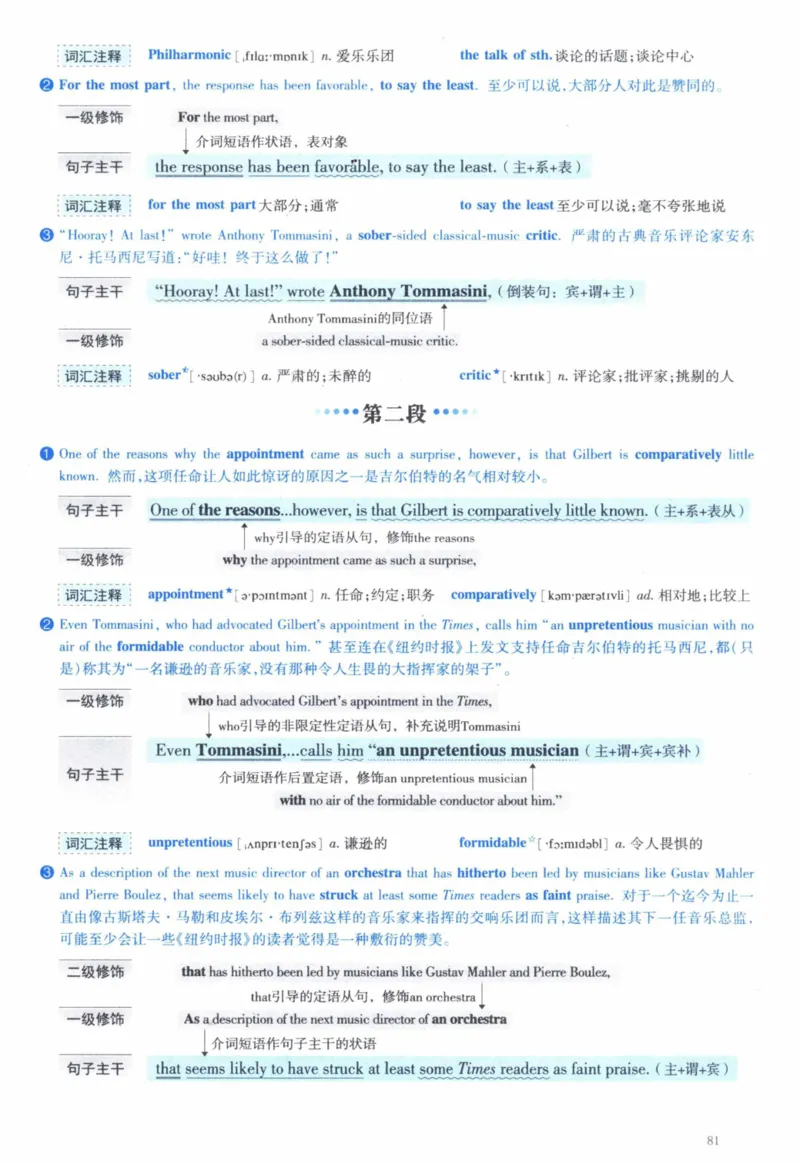
O The decision of the New York Philharmonic to hire Alan Gilbert as its next music director has been the talk of the
classieal-nmsic world ever since the sudden announcement of his appointment in 2009.纽约爱乐乐团决定聘请艾伦•吉
尔伯特担任其下一任音乐总监,这项任命自2009年突然宣布之日起,就一直是古典音乐界热议的活题。
—级修饰 to hire Alan Gilbert as its next music director
]动词不定式短语作后置定语,修饰The decision
句子主干 The decision of the New York Philharmonic ...has been thetajk (主+系 +表)
" 介词短语作后置卒语,修饰the talk [
of the classical-music world
一级修饰 介词短语作句子主干的时间状语
ever since the sudden announcement of his appointment in 2009.
80i词汇注释;Philharmonic [ ,fila: momk] n.爱乐乐团 the talk of sth.谈论的话题;谈论中心
❷ For the most part, the response has been favorable, to say the least.至少可以说,大部分人对此是赞同的。
—级修饰 For the most part,
[介词短语作状语,表对象
句子主干 the response has been favorable, to say the least.(主+系+表)
:词汇注释:for the most part大部分;通常 to say the least至少可以说;毫不夸张地说
❸"Hooray! At last!" wrote Anthony Tommasini, a sober-sided classical-music critic.严肃的古典音乐评论家安东
尼•托马西尼写道:“好哇!终于这么做了!”
句子主干 夷22史ll&J戚岌2 wrote Anthony Tommasini,(倒装句:宾+谓+主)
Anthony Tommasini 的同位语[
—级修饰 a sober-sided classical-music critic.
「词无注释]s*ober : .S3ob3(r)] a.严肃的;未醉的 critic*[ -kritik] n.评论家;批评家;挑剔的人
..第二段••••
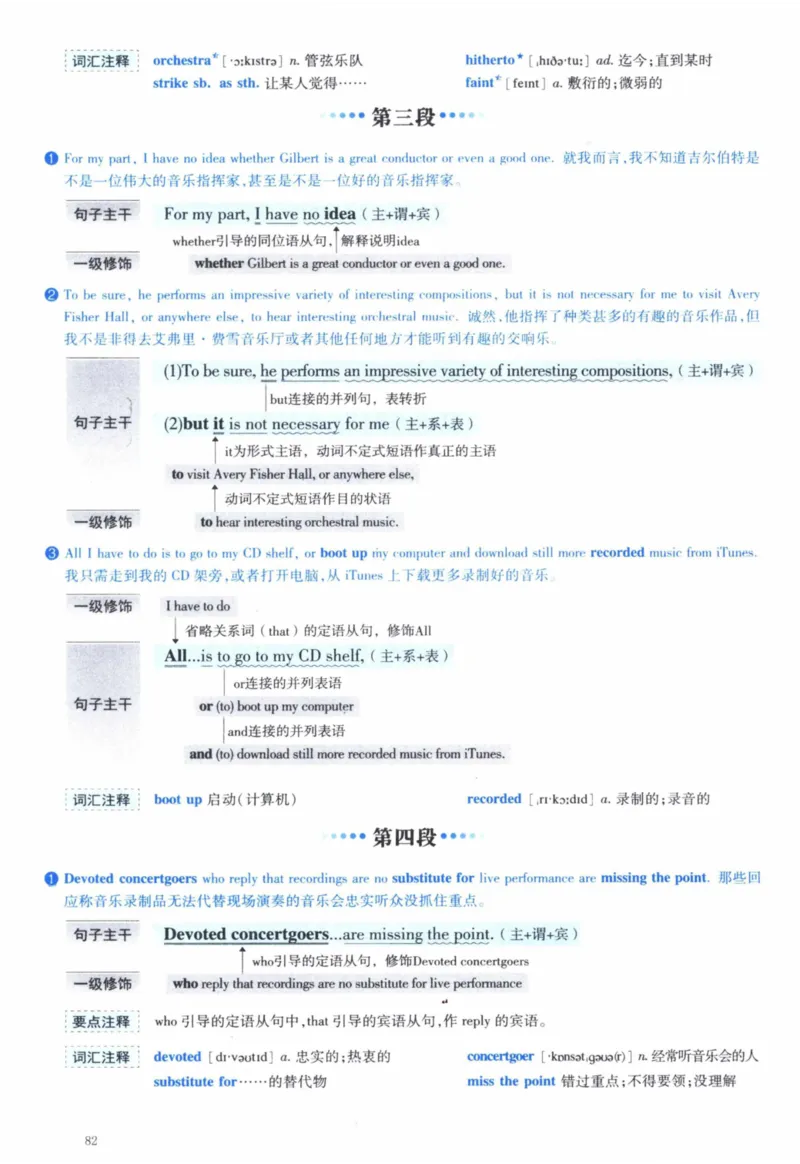
O One of the reasons why the appointment came as such a surprise, however, is that Gilbert is comparatively little
known.然而,这项任命让人如此惊讶的原因之一是吉尔伯特的名气相对较小。
句子主干 One of the reasons...however, is也咳G些冬虫迎迎四盛如也应四史.(主+系+表从)
[why引导的定语从句,修饰the reasons
—级修饰 why the appointment came as such a surprise,
3司汇注释:appointment * [ 9 p0mtm3nt ]几任命;约定;职务 comparatively [ kam paerativli]庭.相对地;比较上
❷ Even Tommasini, who had advocated Gilbert's appointment in the Times, calls him “ an unpretentious musician with no
air of the formidable conductor about him. ”甚至连在《纽约时报》上发文支持任命吉尔伯特的托马西尼,都(只
是)称其为“一名谦逊的音乐家,没有那种令人生畏的大指挥家的架子”。
_级修饰 who had advocated Gilbert's appointment in the Times,
[ who引导的非限定性定语从句,补充说明Tommasini
Even Tommasini,...calls him "an unpretentious musician (主+谓+宾+宾补)
句子主干 介词短语作后置定语,修饰an unpretentious musician
with no air of the formidable conductor about him."
3司汇注释! unpretentious [ |Anpn tenfas] a.谦逊的 formidable[ fo:midgbl] a.令人畏惧的
© As a description of the next music director of an orchestra that has hitherto been led by musicians hke Gustav Mahler
and Pierre Boulez, that seems likely to have struck at least some Times readers as faint praise.对于一■个迄今为止一-
直由像古斯塔夫•马勒和皮埃尔-布列兹这样的音乐家来指挥的交响乐团而言,这样描述其下一任音乐总监,
可能至少会让一些《纽约时报》的读者觉得是一种敷衍的赞美。
二级修饰 that has hitherto been led by musicians like Gustav Mahler and Pierre Boulez,
that引导的定语从句,修饰an orchestra [
—级修饰 As a description of the next music director of an orchestra
[介词短语作句子主干的状语
句子主干 that seems likely to have struck at least some^Yme^readers as faint praise,(主+谓+宾)
81"司汇注释:orchestra[ oikistra] n.管弦乐队 h*itherto [thida tu:] ad.迄今;直到某时
strike sb. as sth.让某人觉得.... faint[feint] a.敷衍的;微弱的
,•・•第三段.…
❶ For my part, I have no idea whether Gilbert is a great conductor or even a good one.就我而言,我不知道吉尔伯特是
不是一位伟大的音乐指挥家,甚至是不是一位好的音乐指挥家C
句子主干 For my part, I have nojdea (主+谓+宾)
J
whether引导的同位语从句 解释说明idea
—级修饰 whether Gilbert is a great conductor or even a good one.
❷ To be sure, he performs an impressive variety of interesting compositions, but it is not necessary for me to visit Avery
Fisher Hall, or anywhere else, to hear interesting orchestral music.诚然,他指挥『种类甚多的有趣的音乐作品,但
我不是非得去艾弗里•费雪音乐厅或者其他任何地方才能听到有趣的交响乐。
(l)To be sure, he performs (主+谓+宾)
I
but连接的并列句,表转折
句子主干 (2)but it is^not necessary for me (主+系+表)
[it为形式主语,动词不定式短语作真正的主语
to visit Avery Fisher Hall, or anywhere else,
I
动词不定式短语作目的状语
—级修饰 to hear interesting orchestral music.
❸ All I have to do is to go to my CD shelf, or boot up my computer and download still more recorded music from iTunes.
我只需走到我的CD架旁,或者打开电脑,从iTunes上下载更多录制好的音乐、
—级修饰 I have to do
]省略关系词(that )的定语从句,修饰All
AH...is to^oJojnjNCD^helf,(主+系+表)
I
。施接的并列表语
句子主干 or (to) boot up my computer
| and连接的并列表语
and (to) download still more recorded music from iTunes.
词汇注释 boot up启动(计算机) recorded [ jri koidid] a.录制的;录音的
・.・第四段...
❶ Devoted concertgoers who reply that recordings are no substitute for live performance are missing the point.丹K些回
应称音乐录制品无法代替现场演奏的音乐会忠实听众没抓住重点。
句子主干 Devoted concertgoers...are missing the^oint.(主+谓+宾)
| who引导的定语从句,修饰Devoted concertgoers
—级修饰 who reply that recordings are no substitute for live performance
u
;寒点注释 Who引导的定语从句中,that引导的宾语从句,作reply的宾语。
词汇注释 devoted [drvautid] a.忠实的;热衷的 concert^)er [,kDnsMgg,)]兀经常听音乐会的人
substitute for.......的替代物 miss the point错过重点;不得要领;没理解
82❷ For the time, attention, and money of the art-loving public, classical instrumentalists must compete not only with
opera houses, dance troupes, theater companies, and museums, but also with the recorded performances of the great
classical musicians of the 20th century.为了赢得广大艺术爱好者的时间、关注以及金钱,古典音乐演奏家们不仅
必须要和歌剧院、舞蹈团、剧团及博物馆竞争,还要和20世纪伟大的古典音乐家们的演奏录制品竞争。
一级修饰 For the time, attention, and money of the art-loving public,
!介词短语作句子主干的百的状语
句子主干 classical instrumentalists must compete (主+谓)
I
介词短语作句子主干的状语,表对象
not only with opera houses, dance troupes, theater companies, and museums,
—级修饰 I not only...but also连接并列的介词短语
but also with the recorded performances
[介词短语作后置定语,修饰the recorded performances
二级修饰 of the great classical musicians of the 20th century.
词汇注释:instrumentalist [ iinstro-mentalist]几.乐器演奏者 troupe [tru:p]几表演团;班子
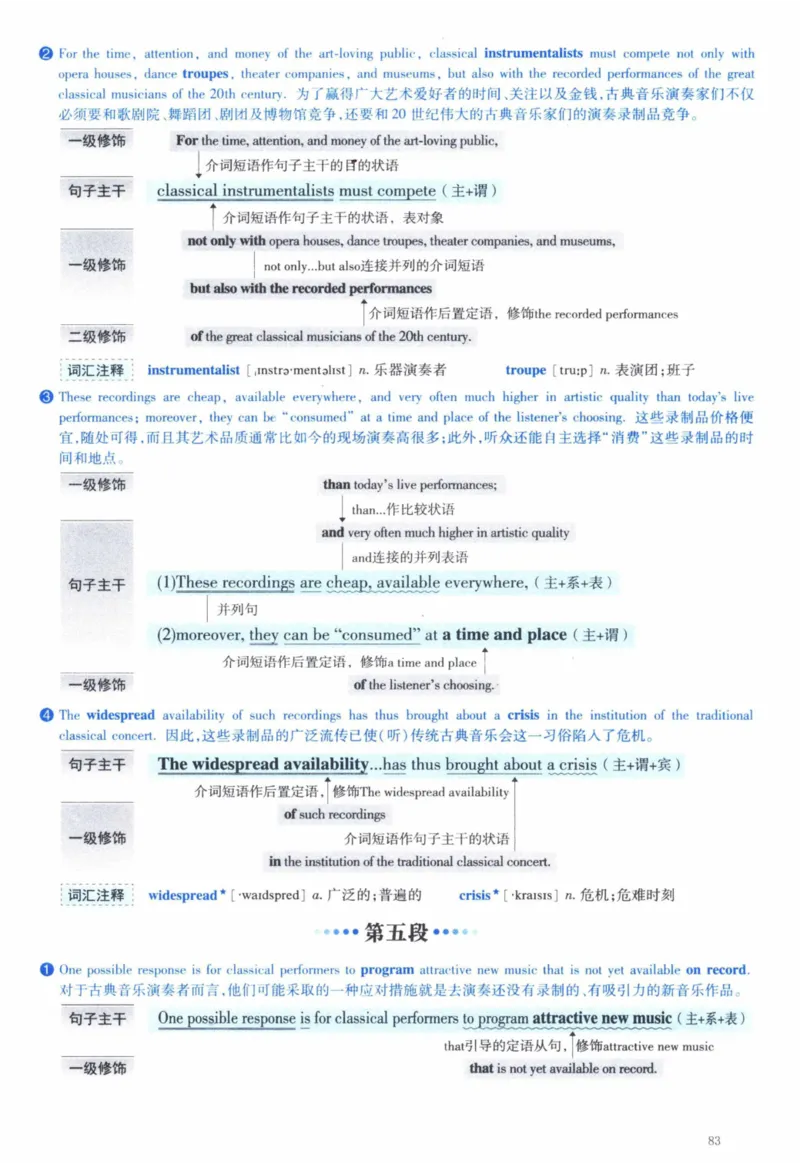
❸ These recordings are cheap, available everywhere, and very often much higher in artistic quality than today's live
performances; moreover, they can be **consumedn at a time and place of the listener's choosing. 这些录制品价格便
宜,随处可得,而且其艺术品质通常比如今的现场演奏高很多;此外,听众还能自主选择“消费”这些录制品的时
间和地点。
一级修饰 than today's live performances;
]than...作比较状语
and very often much higher in artistic quality
| and连接的并列表语
句子主干 (l)These recordings are cheag^available everywhere,(主+系+表)
I
并列句
(2)moreover, they can be "consumed" at a time and place (主+谓)
介词短语作后置定语,修饰a time and place |
一级修饰 of the listener's choosing.
❹ The widespread availability of such recordings has thus brought about a crisis in the institution of the traditional
classical concert.因此,这些录制品的广泛流传已使(听)传统古典音乐会这一习俗陷入了危机。
句子主干 The widespread availability...has thus brought about acrisis (主+谓+宾)
介词短语作后置定语,[修饰The widespread availability
of such recordings
—级修饰 介词短语作句子主干的状语
in the institution of the traditional classical concert.
"词I汇注释 widespread * [ -waidspred] a.广泛的;普遍的 crisis ★ [ *kraisis] n.危机;危难时刻
…第五段•…
O One possible response is for classical performers to program attractive new music that is not yet available on record.
对于古典音乐演奏者而言,他们可能采取的一种应对措施就是去演奏还没有录制的、有吸引力的新音乐作品。
句子主干 One possible response is for classical performers四卫缨驰迎理匹ygg竺典色£ (主+系+表)
that引导的定语从句,:修饰attractive new music
_级修饰 that is not yet available on record.
83要点注释 句子主干中,介词for引出动词不定式短语to program...的逻辑主语classical performers o
:商汇注释'program [ -praugraem] vt.编写程序(文中引申为“演奏”)on record记载下来的;公开发表的
❷ Gilbert's own interest in new music has been widely noted: Alex Ross, a classical-music critic, has described him as a
man who is capable of turning the Philharmonic into "a markedly different, more vibrant organization. ” 吉尔彳白特本
人对新音乐的兴趣已广为人知:古典音乐评论家亚历克斯•罗斯曾将他描述为一个能够将爱乐乐团变成“一个
完全不同且更有活力的乐团”的人。
句子主干 Gilbert's own interest in new music has been widely noted:(主+谓)
]补充说明句子主干
一级修饰 Alex Ross, a classical-music critic, has described him as a man
who引导的定语从句,修饰a man j
二级修饰 who is capable of turning the Philharmonic
[介词短语作状语
三级修饰 into "a markedly difierent, more vibrant organization."
词汇注释markedly [ maikidli] ad.明显地;显著地 vibrant [ -vaibrant] a.充满生机的;响亮的
❸But what will be the nature of that difference?但是那种不同的本质是什么呢?
句子主干 But what will be the nature (特殊疑问句:特殊疑问词+系+主)
J
介词短语作后置定语 修饰the nature
—级修饰 of that difference?
❹ Merely expanding the orchestra's repertoire will not be enough.仅仅增加乐团演出的曲目是不够的。
句子主干 Merely expanding the orchestra's repertoire will not be enough.(主+系+表)
词汇注释 e*xpand [ i*k spaend] v.增加;扩大;拓展 r*epertoire [ Tep9twa:(r)]几曲目;全部才能
❺ If Gilbert and the Philharmonic are to succeed, they must first change the relationship between America's oldest orchestra
and the new audience it hopes to attract.如果吉尔伯特和纽约爱乐乐团想获得成功,他们必须首先改变美国最
古老的交响乐团与其希望吸引的新听众之间的关系。
—级修饰 If Gilbert and the Philharmonic are to succeed,
I If引导的条件状语从句,作句子主干的条件状语
句子主干 they must first change thejelationship (主+谓+宾)
介词短语作后置定语,,修饰the relationship
—级修饰 between America、oldest orchestra and the new audience
省略关系词(who/that)的定语从句,修饰the new audience]
二级修饰 it hopes to attract.
词汇注释 a*udience [ 0:di3ns] n.听众;观众;读者;会见 a*ttract [a traekt] vt.吸引;使喜爱;招引
Text 2
»• • •爵有_ • ••毒
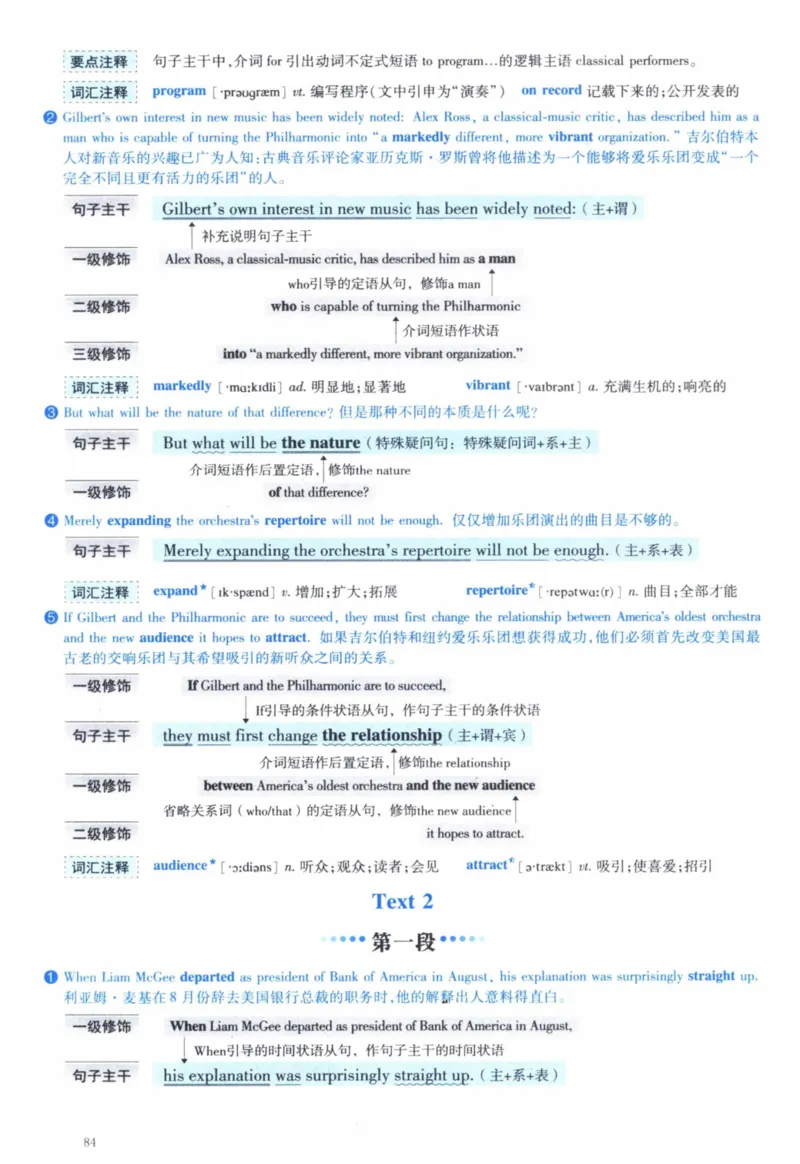
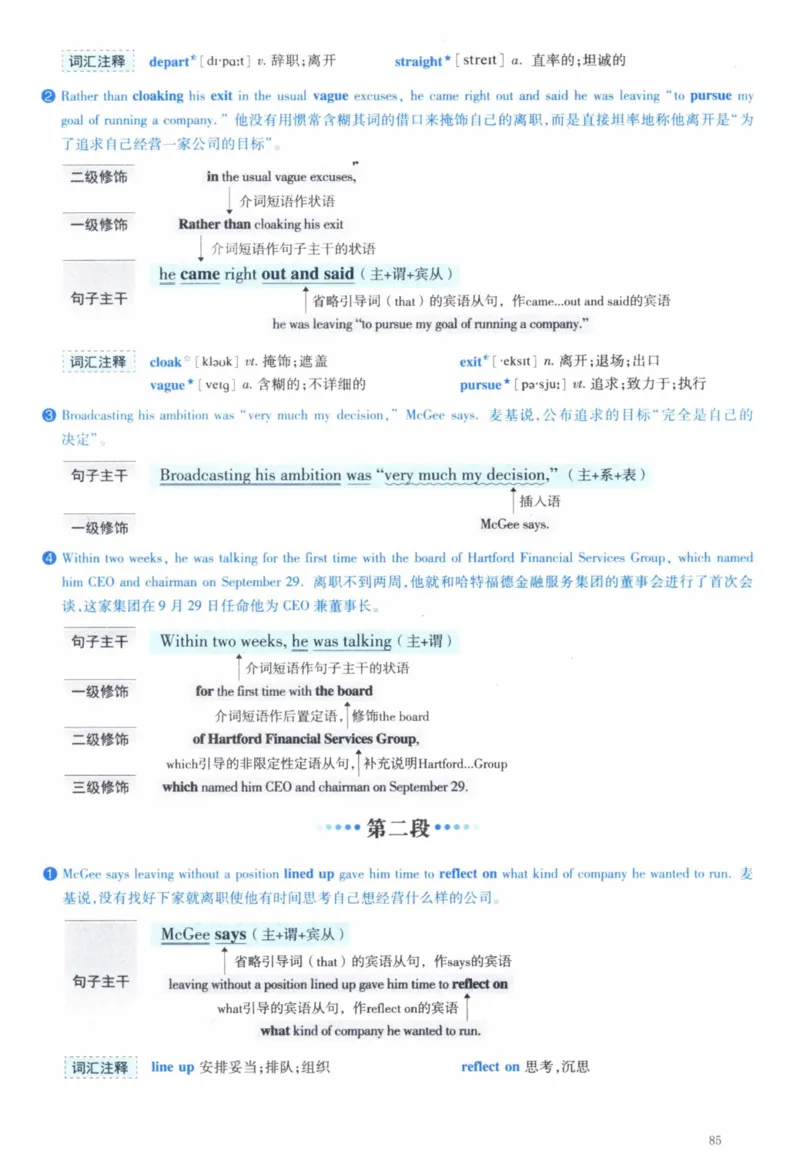
❶ When Liam McGee departed as president of Bank of America in August, his explanation was suq)risingly straight up.
利亚姆•麦基在8月份辞去美国银行总裁的职务时,他的解释出人意料得直白。
—级修饰 When Liam McGee departed as president of Bank of America in August,
I
When引导的时间状语从句,作句子主干的时间状语
句子主干 his explanation was surprisingly straightjiip.(主+系+表)
84词汇注释 depart1 [drpait]亿辞职;离开 s*traight [Streit] a.直率的;坦诚的
❷ Rather than cloaking his exit in the usual vague excuses, he came right out and said he was leaving "to pursue my
goal of running a company. ”他没有用惯常含糊其词的借口来掩饰自己的离职,而是直接坦率地称他离开是“为
了追求自己经营一家公司的目标”。
_______
二级修饰 in the usual vague excuses,
____ l
介词短语作状语
_级修饰 Rather than cloaking his exit
I
介词短语作句子主干的状语
he came right out and said (主+谓+宾从)
句子主干 [省略引导词(that)的宾语从句,作came...out and said的宾语
he was leaving "to pursue my goal of running a company."
词汇注释 cloak * [ klauk ] 掩饰;遮盖 e*xit [ 'eksit ]几.离开;退场;出口
vague * [veig] a.含糊的;不详细的 p*ursue [pssju:] vl.追求;致力于;执行
❸ Broadcasting his ambition was "very much my decision,n McGee says.麦基说,公布追求的目标“完全是自己的
决定”。
句子主干 Broadcasting his ambition was “性ej业虫Jjj四也(主+系+表)
___________ ]插入语
一级修饰 McGee says.
❹ Within two weeks, he was talking for the first time with the board of Hartford Financial Services Group, which named
him CEO and chairman on September 29.离职不到两周,他就和哈特福德金融服务集团的董事会进行了首次会
谈,这家集团在9月29日任命他为CEO兼董事长。
句子主干 Within two weeks, he was talking (主+谓)
___________ [介词短语作句子主干的状语
—级修饰 for the first time with the board
___________ 介词短语作后置定语,[修饰the board
二级修饰 of Hartford Financial Services Group,
which引导的非限定性定语从句J补充说明Hartford...Group
三级修饰 which named him CEO and chairman on September 29.
・・••第二段・・・・
❶ McGee says leaving without a position lined up gave him time to reflect on what kind of company he wanted to run. 麦
基说,没有找好下家就离职使他有时间思考自己想经营什么样的公司。
McGee says (主+谓+宾从)
[省略引导词(that)的宾语从句,作says的宾语
句子主千 leaving without a position lined up gave him time to reflect on
what引导的宾语从句,作reflect on的宾语]
what kind of company he wanted to run.
「词定生释 line up安排妥当;排队;组织 reflect on思考,沉思
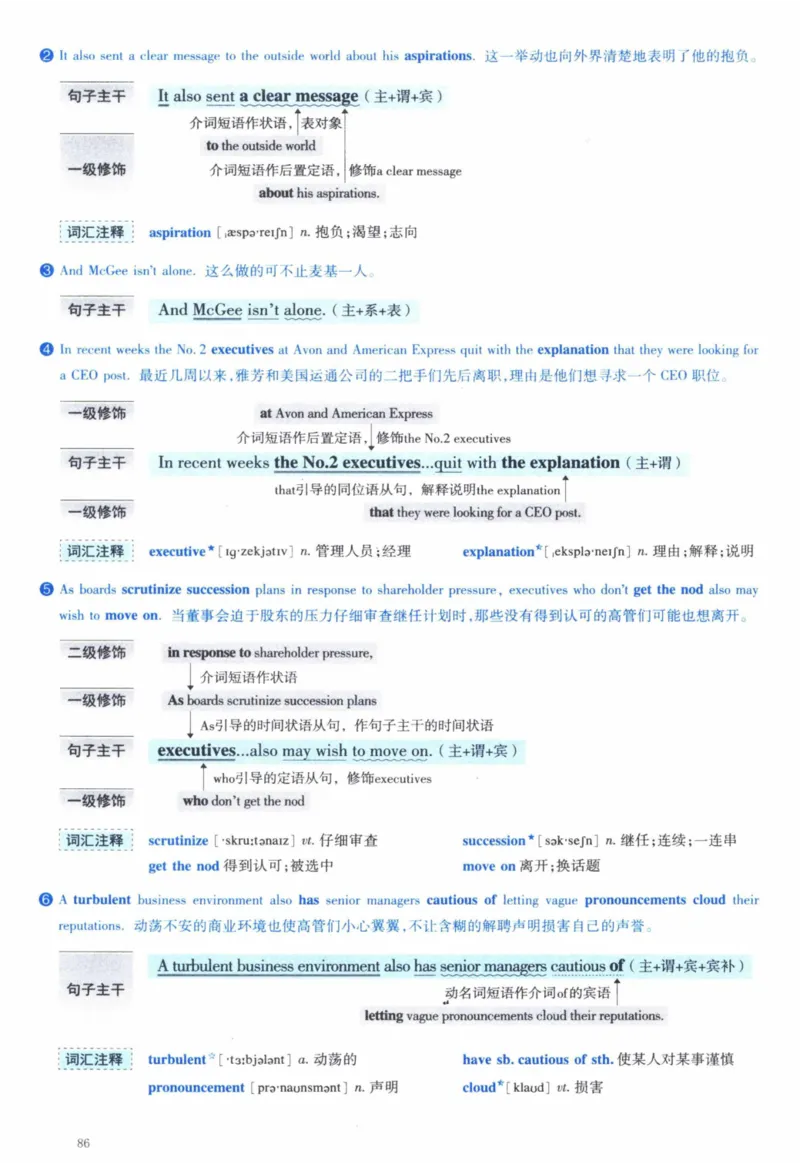
85❷ It also sent a clear message to the outside world about his aspirations.这一举动也向外界清楚地表明 了他的抱负。
句子主干 It also sent aclearmessage (主+谓+宾)
介词短语作状语,[表对象j
to the outside world
—级修饰 介词短语作后置定语,修饰a clear message
about his aspirations.
:词汇注释aspiration [ laespa reijn] n.抱负;渴望;志向
❸And McGee isn't alone.这么做的可不止麦基一人。
句子主干 And McGee isn't alone.(主+系+表)
❹ In recent weeks the No. 2 executives at Avon and American Express quit with the explanation that they were looking for
a CEO post.最近几周以来,雅芳和美国运通公司的二把手们先后离职,理由是他们想寻求一个CEO职位。
—级修饰 at Avon and American Express
介词短语作后置定语,]修饰the No.2 executives
句子主干 In recent weeks the No.2 executives...quit with the explanation (主+谓)
that引导的同位语从句,解释说明the explanation |
—级修饰 that they were looking for a CEO post.
[词汇注释:e*xecutive [ ig zekjativ]几.管理人员;经理 e*xplanation [ lekspla neijn]几.理由;解释;说明
❺ As boards scrutinize succession plans in response to shareholder pressure, executives who don't get the nod also may
wish to move on.当董事会迫于股东的压力仔细审查继任计划时,那些没有得到认可的高管们可能也想离开。
二级修饰 in response to shareholder pressure,
[介词短语作状语
—级修饰 As boards scrutinize succession plans
I As引导的时间状语从句,作句子主干的时间状语
句子主干 executives...also may wish tojnoy^on.(主+谓+宾)
[who引导的定语从句,修饰executives
_级修饰 who don't get the nod
;词汇注释« scrutinize [ skruitanaiz]仇.仔细审查 s*uccession [ s*sejn] 几继任;连续;一连串
get the nod得到认可;被选中 move on离开;换话题
❻ A turbulent business environment also has senior managers cautious of letting vague pronouncements cloud their
reputations,动荡不安的商业环境也使高管们小心翼翼,不让含糊的解聘声明损害自己的声誉。
A turbulent business environment also has seniorjnmia^re cautious of (主+谓+宾+宾补)
句子主干 裂名词短语作介词of的宾语]
letting vague pronouncements cloud their reputations.
词汇注释:turbulent [ t3:bjglant] q.动荡的 have sb. cautious of sth.使某人对某事谨慎
pronouncement [ pra-naunsmant]几.声明 c*loud [klaud] vt.损害
86…第三段・・・
O As the first signs of recovery begin to take hold, deputy chiefs may be more willing to make the jump without a net.
随着经济最初复苏迹象的逐渐稳定,副总们可能更愿意在没有找到新工作的情况下离职。
一级修饰 As the first signs of recovery begin to take hold,
] As引导的时间状语从句,作句子主干的时间状语
句子主干 deputy chiefs may be more willing to make thejumg without a net.(主+谓+宾)
词汇注释:r*ecovery [rrkAvari] n.复苏;痊愈;收回 take hold确立(文中引申为“稳定”)
d*eputy [-depjuti] n.副职;代理;议员 n*et [ net] n.网(文中引申为“新工作”)
❷ In the third quarter, CEO turnover was down 23% from a year ago as nervous boards stuck with the leaders they
had, according to Liberum Research.根据利伯伦研究公司的调查,由于焦虑的董事会紧紧地抓住现有领导不
放,在第三季度,CEO的人事变动率和一年前相比下降了 23%。
一级修饰 as nervous boards stuck with the leaders they had,
__________ j as引导的原因状语从句,作句子主干的原因状语
句子主干 In the third quarter, CEO turnover was down 23% from a year ago (主+系+表)
___________ [插入语
—级修饰 according to Liberum Research.
词汇注释 q*uarter [ 'kwoitaCr)]几.季度;一刻钟 t*urnover [ ,t3:n9uva(r) ] m人事变更率;成交量
stick with紧跟,紧随;坚持(做....) according to根据;依照;据(.... 所说)
❸ As the economy picks up, opportunities will abound for aspiring leaders.随着经济的复苏,对有抱负的领导们来说,
机会将大量存在。
一级修饰 As the economy picks 叩,
[ As引导的时间状语从句,作句子主干的时间状语
句子主干 opportunities wil! abound for aspiring leaders.(主+谓)
词汇注释 pick up好转;重新开始;继续;收拾 abound^ [a baund] vi.大量存在,有许多
•••第四段•••
❶ The decision to quit a senior position to look for a better one is unconventional.放弃高管职位去寻求一个更好的职
位,这样的决定并不符合常规。
句子主干 The decision...is unconventional.(主+系+表)
J动词不定式短语作后置定语,修WThe decision
一级修饰 to quit a senior position to look for a better one
i可汇洼粹:q*uit [ kwit ]。.放弃;离开 unconventional [ iAnkgn-ven Jani] a.不合常规的
❷ For years executives and headhunters have adhered to the rule that the most attractive CEO candidates are the ones
who must be poached.多年来,高管和猎头都坚持一个原则:最有吸引力的CEO人选是那些必须被挖来的人。
句子主干 For years executives and headhunters have adhered to th£ru|e (主+谓+宾)
that引导的同位语从句,解释说明the rule,
_级修饰 that the most attractive CEO candidates are the ones
who引导的定语从句,修饰the ones |
二级修饰 who must be poached.
87i可汇注释 headhunter [ •hedhAnts(r) ] n.猎头 adhere to 坚持,遵守,遵循
c*andidate [ kaendidgt] n.候选人;应试者 poach [poutJ] v.挖走(人员等);盗用
❸ Says Korn/Ferry senior partner Dennis Carey: "I can't think of a single search Fve done where a board has not instructed
me to look at sitting CEOs first. ”光辉国际猎头公司的资深合伙人丹尼斯•凯里说:“我所做的每一次招聘,董事
会都会让我首先从在任的CEO中寻找人选。”
Says Korn/Feiry senior partner Dennis Carey:(倒装句:谓+主+宾)
句子主干 ,直接弓I语作Says的宾语
"1 can't think of a single search Fve done
where引导的定语从句,:修饰a single search
二级修饰
where a board has not instructed me to look at sitting CEOs first."
:罢,京注释 直接引语中,省略关系词(which/that)的定语从句I've done,修饰a single searcho
…第五段…
❶ Those who jumped without a job haven't always landed in top positions quickly.那些没有找好下家就离职的人并不
总是很快就能谋得高位。
句子主干 Those...haven't always landed in top positions quickly.(主+谓)
[who引导的定语从句,修饰Those
—级修饰 who jumped without a job
:词汇注释 land^flasnd] vi.降落;着陆 p*osition [ pa zijn] n.职位;位置;立场
❷ Ellen Marram quit as chief of Tropicana a decade ago, saying she wanted to be a CEO. 10 年前,艾伦•马拉姆辞去纯
果乐公司高管之职时,她说自己想成为一名CE0o
句子主干 Ellen Marram quit as chief of Tropicana a decade ago,(主+谓)
现在分词短语作句子主干的伴随状语]
—级修饰 saying she wanted to be a CEO.
❸ It was a year before she became head of a tiny Internet-based commodities exchange.—年后,她才成为一家小型互
联网商品交易所的领导。
句子主干 It was ajear (主+系 +表)
[ before引导的时间状语从句,作句子主干的时间状语
_级修饰 before she became head
介词短语作后置定语,[修饰head
二级修饰 of a tiny Internet-based commodities exchange.
词汇注释 c*ommodity [ ka modati]几商品;有用的东西 e*xchange [ iks-tfemds]几.交易所;交换;交流
❹ Robert Willumstad left Citigroup in 2005 with ambitions to be a CEO. 2005 年,罗伯特•维伦斯坦德怀揣着成为
CEO的雄心离开了花旗集团。
句子主干 Robert Willumstad left Citigroup in 2005 (主+谓+宾)
I介词短语作句子主干的伴随状语 “
—级修饰 with ambitions to be a CEO.
词汇注释 a*mbition [sem bifn] n.雄心;梦想;抱负
88❺ He finally took that post at a major financial institution three years later.三年后,他终于在一家大型金融机构谋得
该职位。
句子主干 He finally took thaLpost...three years later.(主+谓 +宾)
]介词短语作句子主干的地点状语
—级修饰 at a major financial institution
:词汇注释 f*inancial [fai naenjl] a.金融的;财政的 institution★[』nsti,tju:Jn]几机构;制度;建立
…第六段…
❶ Many recruiters say the old disgrace is fading for top performers,很多招聘专员表示,对于高层人士而言,过去那
种离职的不光彩正在慢慢消失。
Many recruiters say (主+谓+宾从)
句子主干 [省略引导词(that)的宾语从句,作say的宾语
the old disgrace is fading for top performers.
[词汇注释 recruiter [rrkru:ta(r) ] n. 人员 disgrace^ [ dis greis]几不光彩;羞耻;丢脸的事
fade-" [feid] vi.逐渐消失;衰退 performer [pa-fo:ma(r) ] n.表现....的人;表演者
❷The financial crisis has made it more acceptable to be between jobs or to leave a bad one.金融危机使得暂时待业在
家或者辞去糟糕的工作变得更容易接受。
邛ejiqancial crisis has made it more acceptable (主+谓+宾+宾补)
句子主干 it为形式宾语Jor连接并列的动词不定式短语作真正的宾语
to be between jobs or to leave a bad one.
词汇注释 acceptable [ak septabl] a.可接受的;认同的 between jobs暂时失业中;暂时赋闲在家中
❸"The traditional rule was ifs safer to stay where you are, but that's been fundamentally inverted,M says one headhunter.
一位猎头说道:“按照传统规则,待在原来的职位会更保险,但是这一规则已经被彻底颠覆了。
_级修饰 where you are,
where引导的地点状语从句]
it's safer to stay
[省略引导词(that)的表语从句
4<The traditional rule was...
句子主干 I but连接的并列句,表转折
but that's been fundamentally inverted,"
,直接引语作says的宾语
says one headhunter.(倒装句:宾+谓+主)
;要点遂释:表语从句中,让为形式主语,动词不定式短语to stay...are作真正的主语。
:词汇注释 fundamentally [ ^Anda-mentali] ad.完全地 i*]nvert nrv3:t] vt.(使)颠倒,倒转,倒置
❹“The people who've been hurt the worst are those who've stayed too long. ” 受害最深的人恰恰是那些在一个职位待
太久的人。”
_级修饰 who've been hurt the worst
]who引导的定语从句,修饰The people
句子主干 "The people...are those (主+系+表)
who引导的定语从句,[修饰those
—级修饰 who've stayed too long.”
89Text 3
…第一段…
❶ The rough guide to marketing success used to be that you got what you paid for,过去营销成功的大致标准是一分钱
一分货。
The rough guide to marketing success used to be...(主+系+表从)
句子主干 that引导的表语从句|
that you got what you paid for.
要点洼释]在表语从句中,what引导的宾语从句,作got的宾语。
诃无注释;r*[rough Af] a.大致的;粗糙的;粗野的 marketing [ ma:kitirj] n.营销;促销;销售活动
❷No longer.如今已时过境迁。
句亍讲解!本句是一个省略句,与❶句在句意上构成转折关系,其补充完整为It is no longer that you got what
you paid foro It 指代❶句的"The rough guide to marketing successo
❸ While traditional "paid" media—such as television commercials and print advertisements—still play a major role,
companies today can exploit many alternative forms of media.虽然传统的"付费”媒体-如电视广告和平面广
告一一仍然发挥着主要作用,但企业如今还可以利用许多其他形式的媒体。
二级修饰 一uch as television commercials and print advertisements——
,举例说明traditional "paid" media
—级修饰 While traditional "paid" media...still playa major role,
i While引导的让步状语从句,作句子主干的让步状语
-------------- +
句子主干 companies today can exploit (主+谓+宾)
词汇注释 commercial * [ kamaifl ]几广告Q.商业的 e*xploit [ ik-spbit]况.利用;剥削;发挥
alternative*[o :l t3:n9tiv] a.其他的;可供替代的 media [ Tniidia] n.媒体
❹ Consumers passionate about a product may create44 earnedM media by willingly promoting it to friends, and a company
may leverage 44 ownedM media by sending e-mail alerts about products and sales to customers registered with its Web
site.痴迷于某种产品的消费者可能会乐意将之推荐给朋友,从而创造出“赢得(口碑)”媒体;企业可以利用“自
有”媒体,向其网站的注册用户发送有关产品和促销信息的提示邮件。
by willingly promoting it to friends,
一级修饰 介词短语作
(1)句的方式状语
passionate about a product
[形容词短语作后置定语,修饰Consumers^
(1) Constimers...may create (主+谓+宾)
句子主干 | and连接的并列句
(2) and a company may leverage ^owned^jnedia (主+谓+宾)
[介词短语作(2 )句的方式状语
一级修饰 by sending e-mail alerts
[ [介词短语作后置定语,修饰e-mail alerts
about products and sales
二级修饰 |介词短语作状语,表对象
to customers registered with its Web site.
90词汇注释:passionate [ paejgnat] a.狂热的;情意绵绵的 leverage [ liivands] vt.利用;举债经营
a*lert [a l3:t] n.(电子设备的)提示信号;警报 register*[ Ted3ist9(r) ] v.注册;登记
❺ The way consumers now approach the process of making purchase decisions means that marketing's impact stems from
a broad range of factors beyond conventional paid media.如今,消费者对于做出购买决定这一过程的处理方式意
味着市场营销的影响力来自传统付费媒体之外的众多因素。
一级修饰 consumers now approach the process of making purchase decisions
j省略(in which )或关系词(that)的定语从句,修饰The way
The way...means (主+谓+宾从)
句子主干 [that引导的宾语从句,作means的宾语
that marketing's impact stems from a broad range of factors
介词短语作后置定语,修饰factors |
—级修饰 beyond conventional paid media.
词汇注释 approach * [ a praotJ] vt.处理;接近;建议;对付 impact * [ -impaskt ] n.影响;作用;冲击
stem from sth.来自;是....的结果;起源于 b*[brrooad :d] a.广泛的;宽广的
…第二段…
❶ Paid and owned media are controlled by marketers promoting their own products.付费媒体和自有媒体由推销其产品
的市场营销商掌控。
句子主干 Paid and owned madia are controlled by marketers (主+谓)
___________ 现在分词短语作后置定语,修饰marketers [
—级修饰 promoting their own products.
❷ For earned media, such marketers act as the initiator for usere' responses.对于赢得(口碑)媒体而言,这些营销商
充当触发用户反应的发起人。
句子主干 such marketers act as空爻西冬业£^也变臭丈£^£££^.(主+谓+宾)
[介词短语作状语
—级修饰 For earned media,
词汇注释:initiator [ i-mjieita(r)]几.发起人 response*[rrspons] 几.反应;答复
❸ But in some cases, one marketers owned media become another marketer's paid media—for instance, when an e-commerce
retailer sells ad space on its Web site.但在某些情况下,一个营销商的自有媒体会成为另一个营销商的付费媒
体,例如,当某电子商务零售商在其网站上出售广告位时。
二级修 1布 一for instance, when an e-commerce retailer sells ad space on its Web site.
I举例说明some cases
—级修饰 in some cases,
l
介词短语作句子主干的状语
句子主干 But...one marketer's owned media become兰史坦旦窒虫斐矣卫迦(主+系+表)
词汇注释:e-commerce [ -iikomais]几.电子商务 retailer [ Ti:teila(r) ] n.零售商;零售店
❹ We define such sold media as owned media whose traffic is so strong that other organizations place their content or
e-commerce engines within that environment.我们将这种售出的媒体定义为自有媒体,该媒体的访问量如此巨大,
以至于其他机构将其内容或电子商务引擎投放在此环境中。
91句子主干 We define sucl^soldjnedia as owned media (主+谓+宾+宾补)
whose引导的定语从句,:修饰owned media
_级修饰 whose tiaffic is so strong
[ so...that引导的结果状语从句
二级修饰 that other organizations place their content or e-commerce engines
I
介词短语作状语
三级修饰 within that environment.
词汇注释 t*raffic [ traefik]几信息流量;通信量;交通 e*ngine [ -endsm]儿引擎;发动机;机车
❺ This trend, which we believe is still in its infancy, effectively began with retailers and travel providers such as airlines
and hotels and will no doubt go further.我们认为这种趋势目前仍处于初始阶段,它实际上始于零售商和像航空
箜堕嬖样的旅行服务供应商,且其无疑将走得更远。
such as airlines and hotels
—级修饰 such as...举例说明travel providers
which we believe is still in its infancy,
[which引导的非限定性定语从句,补充说明This trend 、
This trend,.. .effectively began with retailers and travel providers (主胃)
句子主干 | and连接的并列谓语
and will no doubt go further.
词汇注释:in its infancy处于初创阶段 provider [pro,vaid°(r) ] n.供应者;供养人
© Johnson & Johnson, for example, has created BabyCenter, a stand-alone media property that promotes complementary
and even competitive products.例如,强生公司创建了“宝宝中心”,这是一家独立的媒体资产,推广具有互补性甚
至竞争性的产品。
句子主干 Johnson & Johnson, for example, has created BabyCenter,(主+谓+宾)
BabyCenter的同位语[
—级穆饰
a stand-alone media property
that引导的定语从句,[修饰media property
二级修饰 that promotes complementary and even competitive products.
词汇注释 p*roperty [ propati] n.财产;特性 complementary [ ikomplrmentri] a.互补的;补充的
❼ Besides generating income, the presence of other marketers makes the site seem objective, gives companies opportunities
to learn valuable information about the appeal of other companies' marketing, and may help expand user traffic for all
companies concerned.其他营销商的存在不仅带来了收入,还令网站看起来公正客观,让企业有机会了解其他企
坐竺箜策略的宝贵信息,还可能有助于扩大所有相关企业的用户访问量。
—级修饰 Besides generating income,
[介词短语作句子主干的状语
the presence of other marketers makes the^ite seem objective,(主+谓+宾+宾补)
|并列谓宾
句子主干 gives companies opportunities to learn valuable information
and连接的并列谓宾
and may help expand user traffic for all companies concerned.
介词短语作后置定语,修饰valuable information
一级修饰 about the appeal of other companies5 marketing,
"司汇注释 generate * [ -d3engreit ] vt.产生;引起 a*ppeal n.吸引力;感染力;申诉;呼吁
92…第三段…
❶ The same dramatic technological changes that have provided marketers with more ( and more diverse) communications
choices have also increased the risk that passionate consumers will voice their opinions in quicker, more visible, and
much more damaging ways.同样是这些重大的技术变革,在为营销商提供更多(且更多样化)的沟通渠道的同时,
也加大了风险——狂热的消费者将以更迅速、重直观、更具破坏力的方式来表达他们的意见。
that have provided marketers with more (and more diverse) communications choices
that引导的定语从句,]修饰technological changes
句子主干 The same dramatic technological changes...have also increased th^risk (主+谓+宾)
that引导的同位语从句,解释说明the risk |
—级修饰 that passionate consumers will voice their opinions
介词短语作方式状语[
二级修饰 in quicker, more visible, and much more damaging ways.
或C注释 voice*[v3is] vt.表达;吐露 n.声音 v*isible [ wizghl] a.明显的;可见的
❷ Such hijacked media are the opposite of earned media: an asset or campaign becomes hostage to consumers, other
stakeholders, or activists who make negative allegations about a brand or product.这些劫持媒体为赢得(口碑)媒
体的对立面:一项资产或活动变成了对某一品牌或产品发表负面评论的消费者、其他利益相关者或激进分子的
劫持物C
句子主干 Such hijacked media are the opposite of earned rnedia:(主+系+表)
[解释说明句子主干
—级修饰 an asset or campaign becomes hostage to consumers, other stakeholders, or activists
who引导的定语从句,修饰consumers, other stakeholders, or activists }
二级修饰 who make negative allegations about a brand or product.
商W生祢:h*ijack [ haid3sk] vt.劫持;操纵 h*ostage [ hostid3] n.人质
stakeholder [,steikh如do(r) ] n.利益相关者;股东 allegation [ iaeb geifn] n.说法;指控
❸ Members of social networks, for instance, are learning that they can hijack media to apply pressure on the businesses
that originally created them.例如,社交网络用户正意识到,他们可以劫持媒体,对最初创建这些媒体的企业施加
压力。
Members of social networks, for instance, are learning (主+谓+宾从)
句子主干 that引导的宾语从句,作are learning的宾语|
that they can hijack media to apply pressure on the businesses
that引导的定语从句,修饰the businesses |
—级修饰 that originally created them.
:词汇生释:apply pressure on sth.对……施加压力 originally [ 9 rid3gn91i] ad.起初;原来
•••第四段•••"
。If that happens, passionate consumers would try to persuade others to boycott products, putting the reputation of the
target company at risk.如果发生上述情况,狂热的消费者会努力劝说他人共同抵制产品,从而危及目标企业的
声誉。
93—级修饰 If that happens,
] If引导的条件状语从句,作句子主干的条件状语
句子主干 passionate consumers would try to persu^e others to boy con products,(主+谓+宾)
I现在分词短语作句子主干的结果状语
—级修饰 putting the reputation of the target company at risk.
:要点注释 在句子主干的宾语中,others作persuade的宾语,动词不定式短语to boycott products作others的补
足语。
:词汇注释 p*ersuade [ps sweid] vt.劝说;说服;使相信 b*oycott [ -boikot] vt. /n.联合抵制
r*eputation [ irepju teijn]几.声誉;名誉 t*arget [-taigit] n.目标;指标;对象;靶子
❷ In such a case, the company's response may not be sufficiently quick or thoughtful, and the learning curve has been
steep.在这种情况下,企业回应得越快、考虑得越周全越好,这一过程会很艰难。
—级修饰 In such a case,
___________ ]插入语
(1) the company's response may not be sufficiently (主+系+表)
句子主干 | and连接的并列句
(2) and the learning curve has been steeg.(主+系+表)
:词汇注释 c*urve [k3:v] n.曲线;曲面;曲线球 s*teep [ sti:pj a.大起大落的;急剧的;不合理的
❸ Toyota Motor, for example, alleviated some of the damage from its recall crisis earlier this year with a relatively quick
and wel 1 -orchestrated social-media response campaign, which included efforts to engage with consumers directly on
sites such as Twitter and the social-news site Digg.例如,在今年早些时候发生的召回危机中,丰田汽车公司用相对
迅速、精心策划的社交媒体回应活动减轻了部分损害,具体做法包括在诸如Twitter和Digg(社会新闻网站)等网
站上直接与客户进行交流。
句子主干 Toyota Motor, for example, alleviated没匹我£色戏空鸟哭(主+谓+宾)
介词短语作后置定语,!修饰the damage
from its recall crisis earlier this year
一级修饰 介词短语作句子主干的方式状语
with a relatively quick and well-orchestrated social-media response campaign,
which引导的非限定性定语从句,补充说明social-media response campaign :
二级修饰 which included efforts to engage with consumers directly on sites
such as.. .举例说明sites:
三级修饰 such as Twitter and the social-news site Digg.
;词汇注释'alleviate^ [a liivieit] vt.减轻;缓和;缓解 relatively [ *relativli] ad.相对地;相当地
orchestrate [ ozkistreit ] vt.精心策划;密谋 engage with与....建立密切关系;同....交战
94Text 4
•••第一段•••
❶ It's no surprise that Jennifer Seniors insightful, provocative magazine cover story, "I Love My Children, I Hate My
Life," is arousing much chatter—nothing gets people talking like the suggestion that child rearing is anything less
than a completely fulfilling, life-enriching experience.詹妮弗•西尼尔见解深刻、颇具煽动性的杂志封面故事《我
爱我的孩子,我讨厌我的生活》引起了人们的热议,这并不意外一抚养孩子绝非一项完全让人充满成就感、丰
富生活的体验,没有什么比这一观点更能引发人们的讨论了。
—级修饰 "I L°ve My Children, I Hate My Life,”
]Jennifer Senior's insightful, provocative magazine cover story的同位语
that Jennifer Senior's insightful, provocative magazine cover story,...is arousing much chatter
句子主干 j It为形式主语,that引导的主语从句作真正的主语
I('s no^surpnse (主+系+表)
i
插入语,补充说明句子主干
—级修饰 ―nothing gets people talking like the suggestion
that引导的同位语从句,[解释说明the suggestion
二级修饰 that child rearing is anything less than a completely fulfilling, life-enriching experience.
3可汇注释 « insightful [ 'insaitful] a.有深刻见解的 provocative [ pra-vokativ] q.煽动性的;挑衅的
arouse * [ a rauz] vt.引起;唤醒 rearing [ Tisrirj ] n.抚养;培养;饲养
anything less than 绝非 fulfilling [ful filig] a.有成就感的
❷ Rather than concluding that children make parents either happy or miserable, Senior suggests we need to redefine
happiness: instead of thinking of it as something that can be measured by moment-to-moment joy, we should consider
being happy as a past-tense condition.西尼尔没有下定论说孩子会让父母幸福还是痛苦,而是提议我们需要重新
定义幸福:不应认为幸福是可以用即时的快乐来衡量的东西,而应将感到幸福视为一种过去时的状态。
一级修饰 Rather than concluding that children make parents either happy or miserable,
]介词短语作句子主干的状语
句子主干 Senior suggests wejjged^ojredefineJiappiness:(主+谓+宾从)
1
解释说明
instead of thinking of it as something...we should consider being happy
介词短语作being happy的补足语:
—级修饰
as a past-tense condition.
that引导的定语从句,修饰something
二级修饰 that can be measured by moment-to-moment joy,
要点注释:介词短语 Rather than...中,that 引导的宾语从句 children make parents either happy or miserable 作
concluding 的宾语。
词汇注释:miserable^ [ mizrgbl] a.痛苦的;乖戾的 c*ondition [kon dijn] n.状态;状况;环境
95❸ Even though the day-to-day experience of raising kids can be soul-crushingly hard, Senior writes that "the very things
that in the moment dampen our moods can later be sources of intense gratification and delight.''尽管日复一* 日抚养
孩子的艰难经历可能使心灵备受煎熬,但是西尼尔写道,“正是此刻这些让人心绪沉重的事情,日后会成为我们
巨大满足和欢乐的源泉。”
—级修饰 Even though the day-to-day experience of raising kids can be soul-crushingly hard,
| Even though引导的让步状语从句,作句子主干的让步状语
Senior writes (主+谓+宾从)
句子主干 [that引导的宾语从句,作writes的宾语
that4the very things...can later be sources of intense gratification and delight."
:that引导的定语从句,修饰the very things
—级修饰 that in the moment dampen our moods
:司汇注薜:crushingly [ kiAjirjli] ad.非常(不好)地 dampen [ -daempanj vt.使沮丧;减弱(感情)
i*ntense [m tens] a.很大的;激烈的 gratification [ ,grastifi keijn] n.满足;快感
« • • •爵黄 一"• • • «
❶ The magazine cover showing an attractive mother holding a cute baby is hardly the only Madonna-and-child image on
newsstands this week.该杂志封面上一位漂亮的妈妈抱着一个可爱的婴儿,这并不是本周报摊上仅有的“圣母
与圣婴”的形象。
句子主干 The magazine co ver...is hardly瓯赠垃JU?也SS竺迎也芒坦史159糜(主+系+表)
|现在分词短语作后置定语,修饰The magazine cover
showing an attractive mother holding a cute baby
—级修饰 介词短语作后置定语,修饰Madonna-and-child image
on newsstands this week.
商定注薜:c*over [ -kAV9(r)]几封面;遮盖物v.遮盖 newsstand [ nju:zstaend] n.报摊;售报亭
❷ There are also stories about newly adoptive—and newly single—mom Sandra Bullock, as well as the usual u Jennifer
Aniston is pregnant^ news.还有关于最近刚收养了孩子(并刚成为单身)的妈妈桑德拉•布洛克的报道,以及
“詹妮弗•安妮斯顿怀孕了”这种常见新闻。
as well as the usual "Jennifer Aniston is pregnant" news.
句子主干 | as well as连接的并列主语
There are also stories (There be句型:There + are +主)
[介词短语作后置定语,修饰stories
_级修饰 about newly adoptive~~and newly single一mom Sandra Bullock,
词汇注释:adoptive [g dnptiv] a.收养的;有收养关系的p*regnant [ pregnant] a.怀孕的;妊娠的
❸ Practically every week features at least one celebrity mom, or mom-to-be, smiling on the newsstands.几乎每周都会
有对至少一位明星妈妈或准妈妈的特别报道,她们在各报摊杂志上笑迎读者。
句子主干 Practically every week features at least 竺更臾1收虫四EJ519I5迦虫?,(主+谓+宾)
补充说明 one.. .mom-to-be
—级修饰 smiling on the newsstands.
商定生窿:Mature * [ .fi:tj9(r) ] vt.特写;特载 celebrity * [ sodebrati] n.明星;名誉
96♦ ...第三段•••*
O In a society that so persistently celebrates procreation, is it any wonder that admitting you regret having children is
equivalent to admitting you support kitten-killing?在一个如此执着于颂扬生育的社会,承认后悔生孩子就等于承
认赞同虐杀小猫,这又有什么奇怪的呢? ”
一级修饰 that so persistently celebrates procreation,
]that引导的定语从句,修饰a society
In a society...is k anyjyonder (一般疑问句:系+主+表)
it为形式主语jthat引导的主语从句作真正的主语
句子主干 that admitting...is equivalent t6 admitting you support kitten-killing?
[省略引导词(that)的宾语从句,作admitting的宾语
you regret having children
词汇注释 persistently [ pg-sistgntli] ad.坚定地;一直 celebrate 会[selibreit ] vt.颂扬;赞美
procreation [ .praokrreijn]儿生育;繁衍;生殖 e*quivalent [rkwivglgnt] a.相等的;相同的
❷ It doesn't seem quite fair, then, to compare the regrets of parents to the regrets of the childless.如此看来,将为人父
母者的后悔与膝下无子者的遗憾拿来比较,这似乎很不公平。
It doesn't seem quite fair, then,(主+系+表)
句子主干 [It为形式主语,动词不定式短语作真正的主语
to compare the regrets of parents to the regrets of the childless.
词汇注释 f*[afeiar(r)] a.公平的;合理的;白皙的 compare * [ kgm pe9(r) ] vt.比较;将....比作
❸ Unhappy parents rarely are provoked to wonder if they shouldn't have had kids, but unhappy childless folks are
bothered with the message that children are the single most important thing in the world: obviously their misery must be
a direct result of the gaping baby-size holes in their lives.不幸福的父母很少会被诱发思考自己是否本不该要孩
子,但不幸福的无子女者会被这样的言论所困扰:抚养孩子是世上唯一最重要的事情;显然,他们的痛苦一定是
生活中没有孩子这种缺憾直接造成的。
一级修饰 to wonder if they shouldn't have had kids,
[动词不定式短语作Unhappy parents的补足语
(1) Unhappy parents rarely are provoked (主+谓)
句子主干 but连接的并列句,表转折
(2) but unhappy childless folks are bothered with the message (主+谓)
that引导的同位语从句,解释说明the message |
一级修饰 that children are the single most important thing in the world:
[补充说明
二级修饰 obviously their misery must be a direct result of the gaping baby-size holes in their lives.
词汇注释: provoke * [ pra vguk ] vt.激起;引发;挑衅 f*[ofwlkk] n.人们
b*[other boda(r)] vt.困扰;使烦恼 gaping [ -geipig ] a.豁开的;敞开的
97….第四段•…
O Of course, the image of parenthood that celebrity magazines like Us Weekly and People present is hugely unrealistic,
especially when the parents are single mothers like Bullock.当然,像《我们周刊》《人物》这样的名人杂志中呈现的
父母形象非常不现实,特别当母亲是像布洛克这样的单身妈妈时更是如此。
—级修饰 Of course,
___________ [插入语
句子主干 the image of parenthood...is hugely unrealistic,(主+系+表)
[that引导的定语从句,修饰the image of parenthood
that celebrity magazines like Us Weekly and People present
一级修饰 when引导的条件状语从句,作句子主干的条件状语
especially when the parents are single mothers like Bullock.
词汇注释 parenthood [ pearanthud]儿父母身份 unrealistic [ tAnrig listik] q.不切实际的
❷ According to several studies concluding that parents are less happy than childless couples, single parents are the least
happy of all.多项研究得出的结论表明,为人父母者不如无子女的夫妇幸福,而单亲父母在所有人中最不幸福。
二级修饰 concluding that parents are less happy than childless couples,
现在分词短语作后置定语,j修饰several studies
—级修饰 According to several studies
i插入语,补充说明句子主干
句子主干 single parents are th^leastjiagp^ofall.(主+系 +表)
:要点注释 现在分词短语concluding that...中,that引导的宾语从句,作concluding的宾语。
© No shock there, considering how much work it is to raise a kid without a partner to lean on ; yet to hear Sandra and
Britney tell it, raising a kid on their "own" ( read: with round-the-clock help) is a piece of cake.这并没有什么可
震惊的,想想看,没有伴侣可以依靠,独自抚养孩子需要付出多少。然而,你听听桑德拉和布兰妮怎么说:“独
自”抚养孩子(注:全天有人帮忙)简直是小菜一碟。
to raise a kid without a partner to lean on;
一级修饰 it为形式主语,,动词不定式短语作真正的主语
considering how much work it is
[现在分词短语作(1)句的状语
⑴世迪)N^shock there,(主+系+表)
句子主干 | yet连接的并列句,表转折
(2)yet.・. raising a kid on their 6'own”...is a^pieceofcake.(主+系+表)
[动词不定式短语作(2 )句的状语“
to hear Sandra and Britney tell it,
—级修饰 插入语,补充说明raising..."own"
(read: with round-the-clock help)
要点洼释 (1)中No shock表达“不足为奇”之意。how引景的宾语从句,作considering的宾语,其中it是宾
语从句的形式主语,is是系动词,how much work作表语。
词汇注释 lean on依靠;依赖;对.... 施加压力 round-the-clock[ traund da klok] a.全天的;持续一整天的
98….第五段.…
O It's hard to imagine that many people are dumb enough to want children just because Reese and Angelina make it look
so glamorous: most adults understand that a baby is not a haircut.很难想象,许多人会愚蠢到仅因为瑞茜和安吉丽
娜让养孩子看起来令人向往就想要孩子一多数成年人都懂得:养孩子不像理发那样简单。
It's hard to imagine (主+斜表)
句子主干 | that引导的宾语从句,作imagine的宾语
that many people are dumb enough to want children
[because引导的原因状语从句
just because Reese and Angelina make it look so glamorous:
补充说明句子主干
—级修饰 most adults understand
[that引导的宾语从句,作understand的宾语
that a baby is not a haircut.
要点注释:句子主干中,It为形式主语,is是系动词,表语是hard,动词不定式短语to imagine...作真正的
主语。
[词汇注释,d*umb [dAm] a.愚蠢的;哑的;不肯开口的 glamorous [ -glaemaros] a.特别富有魅力的
❷ But it's interesting to wonder if the images we see every week of stress-free, happiness-enhancing parenthood aren't in
some small, subconscious way contributing to our own dissatisfactions with the actual experience, in the same way that
a small part of us hoped getting M the Rachel" might make us look just a little bit like Jennifer Aniston,但细想一下这
一点也很有意思:我们每周看到的毫无压力、幸福感提升的为人父母的形象,难道不会以某种细微的、潜意识的
方式加剧我们对养育孩子的现实情况的不满吗?这就好像我们中有少部分人曾希望剪个“瑞秋”(美国电视剧
《老友记》中的单身妈妈)发型,这样可能会让我们看上去有一点像詹妮弗•安妮斯顿(瑞秋的扮演者)。
But ifs interesting to wonder (主*表+系 )
句子主干 [if引导的宾语从句,作wonder的宾语
if the images...aren't...contributing to our own dissatisfactions...in the same way
省略关系词(which/that)的定语从句, 修饰the images
we see every week
介词短语作后置定语,修饰the images
of stress-free, happiness-enhancing parenthood
介词短语作后置定语,修饰dissatisfactions
with the actual experience,
一级修饰 介词短语作方式状语
in some small, subconscious way
that引导的定语从句,修饰the same way
that a small part of us hoped
省略引导词(that)的宾语从句,作hoped的宾语[
getting "the Rachel" might make us look just a little bit like Jennifer Aniston.
要点注释1句子主干中,让为形式主语,is是系动词,表语是interesting,动词不定式短语to wonder...作真正的
主语。
词汇注释:e*nhance [m hams]成 提高;增强;增进 subconscious [ (SAb-konJas] a.潜意识的;下意识的
99螂・••第一^段•••«
O The subtle and intelligent little book The Marketplace of Ideas: Reform and Resistance in the American University should
be read by every student thinking of applying to take a doctoral degree.每位正在考虑申请博士学位的学生都应该
读一读这本构思巧妙且充满智慧的小书一《观念的市场:美国大学的改革与阻力》。
—■级修饰 The subtle and intelligent little book
! The Marketplace of Ideas... University 的同位语
句子主干 The Marketplace of Ideas…University should be read (主+谓)
介词by引出动作的发出者[
—级修饰 by every student
现在分词短语作后置定语,修饰every student |
二级修饰 thinking of applying to take a doctoral degree.
:词汇生释 s*[ubtle sAtl] a.巧妙的;不明显的 reform*[nfo :m] n. /vt.改革;改良
resistance *[n-zist9ns] n.阻力;抵抗;反对 doctoral [ doktarsl] a.博士的;博士学位的
@ They may then decide to go elsewhere.读完之后,他们可能会决定另谋出路c
句子主干 They may then decide to^^elsewhere.(主+谓+宾)
❸ For something curious has been happening in American universities, and Louis Menand, a professor of English at
Harvard University, captured it skillfully.因为美国的大学一直在发生一些奇怪的事,而这被哈佛大学英语教授
路易斯•梅南德巧妙地捕捉到了。
(1) For something curious has been happening in American universities,(主+谓)
| and连接的并列句
句子主干
(2) and Louis Menand,...captured it skillfully.(主+谓+宾)
I Louis Menand的同位语
一级修饰 a professor of English at Harvard University,
词汇注释 capture*[ ,kaeptJMr) ] vt.捕捉;赢得 skillfully [ skilfali] ad.巧妙地,精巧地
..第二段
❶ His concern is mainly with the humanities: literature, languages, philosophy and so on.他主要关注人文学科:文学、
语言、哲学等C
句子主干 His concern is mainly匝也姓些J型理些奥55:(主+系+表)
:解释说明the humanities
—级修饰 literature, languages, philosophy and so on.
100❷ These are disciplines that are going out of style: 22% of American college graduates now major in business compared
with only 2% in history and 4% in English.这些学科即将过时:如今「22%的美国大学毕业生主修商学,与之相
比,只有2%主修历史,4%主修英语。
句子主干 These are disciplines (主+系+表)
T that引导的定语从句,修饰disciplines
一级修饰 that are going out of style:
[补充说明
二级修饰 22% of American college graduates now major in business
j过去分词短语作比较状语
三级修饰 compared with only 2% in history and 4% in English.
:Wia释;discipline*[ •disaphn] n.学科;纪律;训练方法 out of style过时,不再流行;不时髦的
❸ However, many leading American universities want their undergraduates to have a grounding in the basic canon of ideas
that every educated person should possess.然而,很多美国一流大学都希望他们的本科生接受所有受教育者都应
掌握的基本思想准则方面的基础训练。’
However, many leading American universities want flidrundei^raduato (主+谓+宾+宾补)
句子主干 动词不定式短语作their undergraduates的补足语|
to have a grounding
介词短语作后置定语,修饰a grounding |
—级修饰 in the basic canon of ideas
that引导的定语从句,j修饰the basic canon of ideas
二级修饰 that every educated person should possess.
词汇注释 grounding [ graondirj] n.基础训练;基础教学 canon [,kaen”] n.准则;标准;原则
❹ But most fii it difficult to agree on what a general e*shd*ouucaldtion look like.但大多数学校难以就何为"通识教
育”达成一
But most (universities) find it difficult (主+谓+宾+宾补)
句子主干 [it为形式宾语,动词不定式短语作真正的宾语
to agree on what a "general education" should look like.
:要点注释;动词不定式短语to agree on...中,what引导的宾语从句作agree on的宾语。
:词汇连释:agree on对....达成一致意见 general*[ -dsenral] a.普通的;一般的;大体的
❺ At Harvard, Mr. Menand notes,u the great books are read because they have been read"—they form a sort of social
glue.梅南德先生指出:在哈佛,“阅读名著是因为名著曾被读过”——这些著作形成了一种社会黏合剂。
At Harvard, Mr. Menand notes,(主+谓+宾)
句子主干 直接引语作notes的宾语[
"the great books are read
| because引导的原因状语从句
because they have been read"
一级修饰 I补充说明直接引语
——they fbmi a sort of social glue.
;[:a释:a sort of-种;某种;近似于某物 g*[gluiue :] n.胶水(文中引申为“黏合剂”)
101«•••第三段•••*
O One reason why it is hard to design and teach such courses is that they cut across the insistence by top American
universities that liberal-arts education and professional education should be kept separate, taught in different schools.
设计和讲授这类课程很难,其中一个原因是:它们与美国顶尖大学所坚持的“人文教育和专业教育应当分离,并
在不同的学院教授”这一原则相抵触。
—级修饰 why it is hard to design and teach such courses
]why引导的定语从句,修饰One reason
One reason...is...(主+系+表从)
句子主干 [that引导的表语从句
that they cut across the insistence by top American universities
that引导的同位语从句,[解释说明the insistence
that liberal-arts education and professional education should be kq)t separate,
I
—级修饰 并列谓语
(should be) taught in diflerent schools.
:词汇注释'、'cut across与....相抵触;影响 insistence [m^istgns] n.坚持;坚决要求;固执
liberal * [ -libargl] a.人文的;开明的 separate * [ -seprat] a.分开的;单独的;不同的
❷Many students experience both varieties.许多学生经历过这两种类型的教育。
句子主干 Many students experience bothjvarieties.(主+谓+宾)
❸ Although more than half of Harvard undergraduates end up in law, medicine or business, future doctors and lawyers
must study a non-specialist liberal-arts degree before embarking on a professional qualification.虽然超过半数的哈
佛本科生最终学习了法律、医学或商学专业,但未来的医生和律师必须学习一门非专业的人文学科的学位课
程,才能开始进行获取专业资格的学习。
—级修饰 Although more than half of Harvard undergraduates end up in law, medicine or business,
{Although引导的让步状语从句,作句子主干的让步状语
句子主干 future doctors and lawyers must study (主+谓+宾)
介词短语作句子主干的时间状语]
—级修饰 before embarking on a professional qualification.
词汇建释:u*ndergraduate [ ^nds-graedsuat] n.本科生 end up最后处于;最终成为
embark on开始;着手;从事 q*ualification [ ^wnlifrkeifn] n.资格;学历;合格
•・..第四段
❶ Besides professionalising the professions by this separation, top American universities have professionalised the professor.
美国顶尖大学通过这种分离的方法不仅使学科更加专业化,而且也实现了教授的专业化。
—级修饰 Besides professionalising the professions by this separation,
]介词短语作句子主于的状语
句子主干 top American universities have professionalised die^professor.(主+谓+宾)
❷ The growth in public money for academic research has speeded the process: federal research grants rose fourfold
between 1960 and 1990, but faculty teaching hours fell by half as research took its toll.用于学术研究的公共资金的
102增长,加快了这一专业化过程:1960年到1990年间,联邦科研津贴增加了三倍,但教师授课时长却因为研究工
作的影响而减半。
—级修饰 in public money for academic research
[介词短语作后置定语,修饰The growth
句子主干 The growth...has speeded th^^rocess:(主+谓+宾)
[补充说明句子主干
federal research grants rose fourfold between 1960 and 1990,
一级修饰 I but连接的并列句,表转折
but faculty teaching hours fell by half
[ as引导的原因状语从句
二级修饰 as research took its toll.
词汇注释 a*cademic [ taeka demik] a.学术的;学院的 f*ederal [ fedoral] q.联邦政府的;联邦制的
g*rant [gramt] n.津贴;补助金 fourfold [ •foifould] ad.四倍地 a.四倍的
f*aculty [ -faeklti]几.全体教师;天赋 take its toll产生恶果;造成重大损失
❸ Professionalism has turned the acquisition of a doctoral degree into a prerequisite for a successful academic career: as
late as 1969 a third of American professors did not possess one.专业化已使获取博士学位成为学术生涯成功的先
决条件:直到1969年,美国还有三分之一的教授尚未获得博士学位。
—级修饰 of a doctoral degree
介词短语作后置定语,[修饰the acquisition
句子主干 Professionalism has turned tfieacguisition... into a prerequisite (主+谓+宾+宾补)
介词短语作后置定语,修饰a prerequisite |
fbr a successful academic career
-级修饰 补充说明句子主干
as late as 1969 a third of American professors did not possess one.
:词汇注释:professionalism [ prs fej'gnalizam]".专业化 a*cquisition [ jaekwi zi/n]几.获得;收购
prerequisite [ iprirrekwgzit] n.先决条件;前提 p*ossess [pa zes]沉.获取;拥有
❹ But the key idea behind professionalisation, argues Mr. Menand, is that " the knowledge and skills needed for a particular
specialisation are transmissible but not transferable. ”但是,梅南德先生认为,专业化背后的核心思想是“一个特
定专业所需的知识和技能可以传递,但不可转让。”
—级修饰 argues Mr. Menand,
I
插入语
But the key idea behind professionalisation,...is...(主+系+表从)
句子主干 that引导的表语从句[
that4the knowledge and skills...are transmissible but not transferable."
|过去分词短语作后置定语,修饰the knowledge and skills
—级修饰 needed for a particular specialisation
'、、词汇注释;transmissible [traensEisobl] a.可传送的;可遗传的 transferable [traens fairabl] a.可转让的
103❺ So disciplines acquire a monopoly not just over the production of knowledge, but also over the production of the
producers of knowledge.因此各个学科获得的不仅仅是对知识生产的垄断,还有对知识生产者的培养的垄断。
句子主干 So disciplines acquire amonopojj (主+谓+宾)
介词短语作后置定语,[修饰a monopoly
not just over the production of knowledge,
一级修饰 not just...but also连接并列的介词短语
but also over the production of the producers of knowledge.
:词汇注释:a*cquire [9 kwaio(r)] vt.获得;得到;购得 m*onopoly [ma nnpali] n.垄断;独占;专利品
*•••第五段••••
❶ No disciplines have seized on professionalism with as much enthusiasm as the humanities.没有哪个学科像人文学科
一样热切地关注专业化。
句子主干 No disciplines have seized on professionalism (主+谓+宾)
|介词短语作方式状语,修饰have seized on
—级修饰 with as much enthusiasm as the humanities.
,词汇注释 seize on/upon sth.突然大为关注 e*nthusiasm [ i*enjuiziaezam] n.热情;热爱
❷ You can, Mr. Menand points out, become a lawyer in three years and a medical doctor in four.梅南德先生指出,你可
以在三年之内成为一名律师,四年之内成为一名医生。
句子主干 You can,...become ajawyer in three years and^ajnedical^doctor in four.(主+系+表)
___________ [插入语
—级修饰 Mr. Menand points out,
❸ But the regular time it takes to get a doctoral degree in the humanities is nine years.但通常需要花费九年时间才能取
得人文学科的博士学位。
句子主干 But the regular time...is nine^ears.(主+系+表)
,省略关系词(which/that)的定语从句,修饰the regular time
—"级修饰 it takes to get a doctoral degree in the humanities
要点注释 定语从句中,it为形式主语,谓语是takes,省略的关系词(which/that)代替先行词the regular time
作宾语;动词不定式短语to get a doctoral degree...作真正的主语。介词短语in the humanities作后
置定语,修饰 a doctoral degreeo
❹ Not surprisingly, up to half of all doctoral students in English drop out before getting their degrees.因此,多达一半的
攻读英语专业博士学位的学生在没有拿到学位之前就退学也就不足为奇了。
句子主干 Not surprisingly, up to half of all doctoral students in English drop out (主胃)
I介词短语作句子主干的时间状语
_级修饰 before getting their degrees.
司无您释;drop out退学;退出;脱离 d*egree [drgri:] n.学位;程度;度数
"•••第六段
O Equally unsurprisingly, only about half end up with professorships for which they entered graduate school. 同样不足为
奇的是,为了教授头衔进入研究生院的学生中,只有大约一半的人最终获得了教授职称。
句子主干 Equally unsurprisingly, only about half (of students) end up with professorships (主+谓)
which引导的定语从句,修饰professorships]
—级修饰 for which they entered graduate school.
104❷There are simply too few posts.教授的职位实在太少T
句子主干 There are simply too few posts. ( There be句型:There + are + 主)
:通汇注释;p*[post 9ost]几职位;岗位;邮政;邮寄
❸ This is partly because universities continue to produce ever more PhDs.部分原因是大学在继续培养更多的博士。
句子主干 This is partly史竺堕爻坚i理?也£头丝!匝业£12卫1辿变恐££5221£_3?5?・(主+系+表从)
❹ But fewer students want to study humanities subjects: English departments awarded more bachelor's degrees in
1970—71 than由ey did 20 years later.但是,想要学习人文学科的学生却越来越少了 : 1970 — 1971年间英语系授
予的学士学位比20年之后授予的还要多。
句子主干 But fewer students want匝业业些亟竺目虫j些坦:(主+谓+宾)
[解释说明句子主干
—级修饰 English departments awarded more bachelor's degrees in 1970—71
[ than引导的比较状语从句
二级修饰 than they did 20 years later.
:词汇生释\ a*ward [a wo:d] vt.授予;奖励;判给 bachelor^ degree学士学位
❺Fewer students require fewer teachers.学生少了,对教师的需求也减少了。
句子主干 Fewer students require fewerjeachers.(主+谓+宾)
❻ So, at the end of a decade of thesis-writing, many humanities students leave the profession to do something for which
they have not been trained.因此,在长达十年的论文写作之后,许多人文学科的学生放弃了自己的专业,转而从
事他们没有受过专业训练的职业。
—级修饰 at the end of a decade of thesis-writing,
[介词短语作句子主干的时间状语
句子主干 So,...many humanities students leave the^rofession to do something (主+谓+宾)
which引导的定语从句,修饰something [
—级修饰 for which they have not been trained.
「疏E生释;t*hesis [.oi:sis] n.论文;论题 t*rain [trem]讥.训练;培训;教育
•••第七段•••
❶ The key to reforming higher education, concludes Mr. Menand, is to alter the way in which “the producers of knowledge
are produced. ”梅南德先生总结道,高等教育改革的关键是改变“培养知识生产者”的方式。
—级修饰 concludes Mr. Menand,
___________ [插入语
句子主干 The key...is to^lterflwway (主+系+表)
|介词短语作后置定语J修饰The key
to reforming higher education,
—级修饰 which引导的定语从句,修饰the way
in which "the producers of knowledge are produced."
"有无注释 conclude^[kan kluzd] vt.总结;推断;终止 a*lter [ .0:lt3(r) ] v.(使)改变;更改;修改
105❷ Otherwise, academics will continue to think dangerously alike, increasingly detached from the societies which they
study, investigate and criticise.否则,大学教师的思维将会日益趋同,这是非常危险的,他们会越来越脱离他们
所研究、调查和批判的社会。
句子主干 Otherwise, academics will continue (主+谓+宾)
过去分词短语作句子主干的状语|
—级修饰 increasingly detached from the societies
which引导的定语从句,修饰the societies?
二级修饰 which they study, investigate and criticise.
词汇注释! detach from(使)脱离;摆脱 i*nvestigate [ m-vestigeit] v.调查;侦查;研究
❸“Academic inquiry, at least in some fields, may need to become less exclusionary and more holistic.""至少在某些
领域,学术研究可能需要少一些排外性,多一些整体性。”
句子主干 “Academic inquiry,•••may need 四坦(主+谓+宾)
1
插入语,补充说明句子主干
一级修饰 at least in some fields,
词汇注释:exclusionary [ ik sklu:39nri] a.排斥的;排除在外的 holistic [hau kstik] a.整体的;全面的
❹Yet quite how that happens, Mr. Menand does not say.然而,梅南德先生并未说明如何做到这一点。
句子主干 Yet quite how that happens,(主+谓)
|插入语
—级修饰 Mr. Menand does not say.
Part C
O With its theme that "Mind is the master weaver,M creating our inner character and outer circumstances, the book
As a Man Thinketh by James Allen is an in-depth exploration of the central idea of self-help writing. 思维意识是编织
大师”,它创造了我们的内在性格和外部环境,围绕这一主题,詹姆斯•艾伦《做你想做的人》一书深入地探索了
自助类书籍的核心思想。
二级修饰 that “Mind is the master weaver,"
!侦引导的同位语从句,解释说明“s theme
一级修饰 With its theme...creating our inner character and outer circumstances,
I
With独立主格结构作句子主干的伴随状语
句子主干 the book 4s a Mqd Thifiketh by James Allen is an^in-deptl^exploration (主+系+表)
介词短语作后置定语,修饰an in-depth exploration |
一级修饰 of the central idea of self-help writing.
词汇注释 m* aster [ -maistaCr) ] n.大师 vt.精通 weaver [,wi:V9(r) ] n.编织工;织布工
…•第二段•…
O Allen's contribution was to take an assumption we all share—that because we are not robots we 由erefore control our
thoughts—and reveal its erroneous nature.艾伦的贡献在于,他抓住了“我们并非机器人,因此能掌控自己的思
想”这一公认的假设,并揭示了其谬误所在。
106二级修饰 because we are not robots
__________ [ because引导的原因状语从句
_级修饰 一-that...we therefore control our thoughts—
that引导的同位语从句,解释说明an assumption]
Allen's contribution was to^ake^n^ssimigHon we all share (主+系 +表)
句子主干 | and连接并列的动词不定式短语,作表语
and (to) reveal its erroneous nature.
要点注释 '、'句子主干中,we all share为省略关系词(which/that)的定语从句,修饰an assumption o
词汇注释 c*ontribution [ iknntn bjuijn]几贡献;捐款 a*ssumption [ a sAmp/n]几假设;假定
r*eveal [nvi:l]讽 揭示;显示;透露 erroneous * [ iraonias ] a.谬误的
❷ Because most of us believe that mind is separate from matter, we think that thoughts can be hidden and made
powerless; this allows us to think one way and act another.因为我们大多数人相信,意识是独立于物质存在的,所
以我们认为思想可以被隐藏起来,并丧失效力;这就使得我们的想法和行动不一致。
—级彳廖饰 Because most of us believe that mind is separate from matter,
! Because引导的原因状语从句,作⑴句的原因状语
(1) we think that thoughts can be hidden and made powerless;(主+谓+宾从)
I
句子主干 并列句
(2) 虫B allows us to think one way and act another.(主+谓+宾+宾补)
要点注释;原因状语从句中,that引导的宾语从句,作believe的宾语。
词汇注释 be separate from与....分开 a*[llow 3 lau] vt.允许;承认;听凭
❸ However, Allen believed that the unconscious mind generates as much action as the conscious mind, and while we may
be able to sustain the illusion of control through the conscious mind alone, in reality we are continually faced with a
question: wWhy cannot I make myself do this or achieve that?”然而,艾伦认为潜意识和显意识产生的作用一样大。
尽管我们或许可以仅仅通过显意识来维持这种能够控制自己思想的错觉,但现实中我们却总是面临这样一个
问题:“为什么我不能让自己做这件事或完成那件事呢?”
as the conscious mind (generates),
—级修饰 as引导的比较状语从句,作宾语从句的比较状语
However,
[插入语 、,
(1) Allen believed (主+谓+宾从)
| and连接的并列句
句子主干
(2) and...in reality we are continually faced with aj(uestioil:(主+谓+宾)
| while引导的让步状语从句,作(2)句的让步状语 -
while we may be able to sustain the illusion of control
—级修饰 解释说明a question
"Why cannot I make myself do this or achieve that?"
介词短语作方式状语
二级修饰 through the conscious mind alone,
「词汇注释 s*ustain [ S3 stem]仇.维持;使保持;支撑 i*llusion [rluisn]几错觉;幻想
107第三段
O Since desire and will are damaged by the presence of thoughts that do not accord with desire, Allen concluded: "We do
not attract what we want, but what we are. ”由于与愿望不符的思想的出现会摧毁:我们的愿望和意志,所以艾伦总
结说:“我们不会吸引我们想要的事物,而会吸引我们本质所在的事物。”
二级修饰 that do not accord with desire,
that引导的定语从句,修饰thoughts j
—级修饰 Since desire and will are damaged by the presence of thoughts
[ Since引导的原因状语从句,作句子主干的原因状语
句子主干 Allen concluded: 25里虫JJSLSllSSLW垣或蒙经上坦!史坦(主+谓+宾)
:要点注释1直接引语中,主语是We,谓语是do not attract,but连接并列的宾语从句what we want和what we
are 作 do not attract 的宾语。
:词汇注释:d*esire [drzaia(r) ] n.愿望;渴望 accord with与......致;合乎
❷ Achievement happens because you as a person embody the external achievement; you don't "get" success but become it.
成功的到来是因为,作为一个人,你自身就是外在成功的体现;你不是“获得”成功,而是成为成功。
—级修t布 because you as a person embody the external achievement;
| because引导的原因状语从句,作(1)句的原因状语
⑴Achievement happens (主+谓)
I
并列句
句子主干 (2)you don^t uget^ success (圭+谓+宾)
I
but连接的并列谓语
but become it.
:词汇注释 e*mbody [ im bodi] vt.体现;包含;代表 e*xternal [ ik st3:nl] a.外在的;对外的
❸There is no gap between mind and matter.意识与物质之间没有鸿沟。
句子主干 There is no gap ( There be句型:There + is + 主)
|介词短语作后置定语,修饰gap
_级修饰 between mind and matter.
•••第四段•••
O Part of the fame of Allen's book is its contention that 44 Circumstances do not make a person, they reveal him."艾伦
这本书名声大噪的部分原因在于书中的论点,即“环境不能造就一个人,但能反映一个人。”
句子主干 Part of the fame of Allen's book is its^ontention (主+系+表)
that引导的同位语从句,解释说明its contention?
that "Circumstances do not make a person,
—级修饰 |并列句
they reveal him."
:词汇注释:f*ame r [feim]几.名声;名气;声誉 ^contention [kanlenfn] n.论点;观点;争吵
❷ This seems a justification for neglect of those in need, and a rationalization of exploitation, of the superiority of those
at the top and the inferiority of those at the bottom.这似乎是在为忽视贫困人群的行为做辩护,为剥削、为社会
上层人群的优越及社会底层人群的卑微找理由。
108—级修饰 fbr neglect of those in need,
]介词短语作后置定语,修饰a justification
句子主干 This seems ajustification...an^a rationalization (主+系+表)
并列的介词短语作后置定语,修饰a rationalization]
一级修饰 of exploitation, of the superiority...and the inferiority
介词短语作后置定语,修饰the superiority]
of those at the top
二级修饰 介词短语作后置定语,修饰the inferiority
of those at the bottom.
通汇汪释]in need在困难时;在危难之中 rationalization [ (raejnalarzeijn] n.合理化
inferiority [ mifiari orgti]几.低等;劣等 at the bottom在底层,在底部
…第五段…
O This, however, would be a knee-jerk reaction to a subtle argument.然而,这种观点不过是对一个微妙观点的本能反应。
句子主干 This, however, would be lection (主+系+表)
介词短语作后置定语,修饰a knee-jerk reaction]
—级修饰 to a subtle argument.
田汇注群:knee-jerk [ ni: d33:k] a.本能地做出的 a*rgument [ -aigjumant]几论点;争论;辩论
❷ Each set of circumstances, however bad, offers a unique opportunity for growth.每一种环境,不管多么糟糕,都为人
的成长提供了独特的机遇。
_级修饰 however bad,
__________ j插入语
句子主干 Each set of circumstances,...offers ajmigue^opportunity for growth.(主+谓+宾)
❸ If circumstances always determined the life and prospects of people, then humanity would never have progressed.
如果环境总是决定人们的人生和前途,那么人类就永远不会进步。
一级修饰 K circumstances always determined the life and prospects of people,
___________ I If引导的条件状语从句,作句子主干的条件状语
句子主干 then humanity would never have progressed.(主+谓)
词汇注释:prospect *[ prospekt]几前途;前景 p*rogress [ pro'gres] vi.进步;前进;推移
❹ In fact, circumstances seem to be designed to bring out the best in us, and if we feel that we have been M wrongedM
then we are unlikely to begin a conscious effort to escape from our situation.事实上,环境似乎旨在激发我们自身的
最大潜能,如果我们觉得自己遭受了“不公”,那么就不太可能有意识地去努力摆脱自己的处境。
—级修饰 to bring out the best in us,
[动词不定式短语作(1)句的目的状语
(1) In fact, circumstances seem to be designed (主+谓)
句子主干 | and连接的并列句
(2) and...then we are unlikely to begin auconscious^^ort (主+谓+宾)
[if引导的条件状语从句,作(2)句的条件状语 "
if we feel that we have been "wronged"
—级修饰 动词不定式短语作后置定语,修饰a conscious effort
to escape from our situation.
109:要点注释 if引导的条件状语从句中,that we have been “wronged”为that引导的宾语从句,作feel的宾语。
:词汇注释 bring out激发;使表现出 c*onscious [ -konjas] a.有意识的;有知觉的
❺ Nevertheless, as any biographer knows, a person's early life and its conditions are often the greatest gift to an individual.
不过,正如任何一位传记作家所知道的那样,一个人的早期生活和当时的生活环境往往是他得到的最珍贵的
礼物。
to an individual.
-级修饰 介词短语作后置定语,修饰the greatest gift
as any biographer knows,
| as引导的非限定性定语从句,补充说明句子主干
句子主干 Nevertheless,.... person's early life and its conditions are often tihe^reat^t^ft (主+系+表)
词汇注释 biographer [barografg(r)]几传记作家 c*ondition [ kan difn]儿环境;状况;条件
*•••第六段••••
❶ The sobering aspect of Allerfs book is that we have no one else to blame for our present condition except ourselves.
艾伦这本书发人深省之处在于:对于自身现状,我们不能责怪他人,只能归咎于自己C
The sobering aspect of Allen's book is...(主+系+表从)
句子主干 that引导的表语从句
that we have no one else to blame for our present condition except ourselves.
词汇注释 sobering [sub冲j] a.发人深省的;使人冷静的 b*lame [bleim]仇.责怪;把....归咎于;指责
@ The upside is the possibilities contained in knowing that everything is up to us ; where before we were experts in the
array of limitations, now we become authorities of what is possible,其积极的一面在于:既然知道了万事都取决于
我们自己,那么就存在无限可能;以前,我们是谙熟各种局限的专家,而现在,我们成为掌控一切可能的权威。
—级修饰 contained in knowing that everything is up to us;
过去分词短语作后置定语,[修饰the possibilities
(1) The upside is tiie^ossibilities (主+系+表)
句子主干 |并列句
(2) now we become authorities of what is possible.(主+系+表)
| where引导的状语从句,作(2 )句的状语
—级修饰 where before we were experts in the array of limitations,
要点注释 过去分词短语contained in...us中,that everything is up to us为that引导的宾语从句,作knowing的
宾语。(2)句中,what引导的宾语从句,作介词。f的宾语。
[词汇注释upside [ Apsaid] n.好的一* 面;正面 be up to sb.由某人决定
array * [a-rei] n.大量;大堆;数组 authority * [orenrati] n.权威;官方;职权
110