备战2024年高考英语模拟卷03(上海卷)
(考试时间:120分钟 试卷满分:140分)
注意事项:
1.答卷前,考生务必将自己的姓名、考生号等填写在答题卡和试卷指定位置上。
2.回答选择题时,选出每小题答案后,用铅笔把答题卡对应题目的答案标号涂黑。如需改动,用
橡皮擦干净后,再选涂其他答案标号。回答非选择题时,将答案写在答题卡上。写在本试卷上无效。
3.考试结束后,将本试卷和答题卡一并交回。
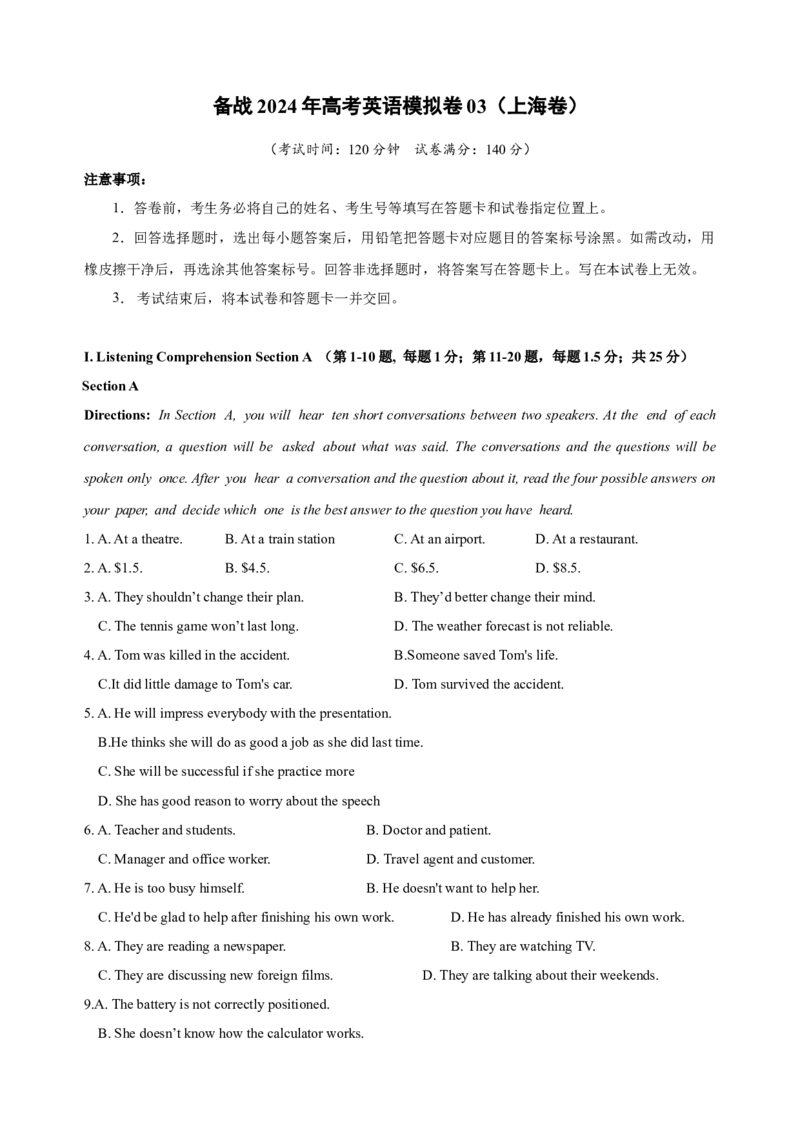
I. Listening Comprehension Section A (第1-10题, 每题1分;第11-20题,每题1.5分;共25分)
Section A
Directions: In Section A, you will hear ten short conversations between two speakers. At the end of each
conversation, a question will be asked about what was said. The conversations and the questions will be
spoken only once. After you hear a conversation and the question about it, read the four possible answers on
your paper, and decide which one is the best answer to the question you have heard.
1. A. At a theatre. B. At a train station C. At an airport. D. At a restaurant.
2. A. $1.5. B. $4.5. C. $6.5. D. $8.5.
3. A. They shouldn’t change their plan. B. They’d better change their mind.
C. The tennis game won’t last long. D. The weather forecast is not reliable.
4. A. Tom was killed in the accident. B.Someone saved Tom's life.
C.It did little damage to Tom's car. D. Tom survived the accident.
5. A. He will impress everybody with the presentation.
B.He thinks she will do as good a job as she did last time.
C. She will be successful if she practice more
D. She has good reason to worry about the speech
6. A. Teacher and students. B. Doctor and patient.
C. Manager and office worker. D. Travel agent and customer.
7. A. He is too busy himself. B. He doesn't want to help her.
C. He'd be glad to help after finishing his own work. D. He has already finished his own work.
8. A. They are reading a newspaper. B. They are watching TV.
C. They are discussing new foreign films. D. They are talking about their weekends.
9.A. The battery is not correctly positioned.
B. She doesn’t know how the calculator works.C. The calculator needs a new battery.
D. The man should enter the number in a different way.
10. A. The advertised jobs are in French and Spanish
B. The notice appeared in French and Spanish newspapers
C.She would like to teach the man French and Spanish
D. French and Spanish are necessary for the job.
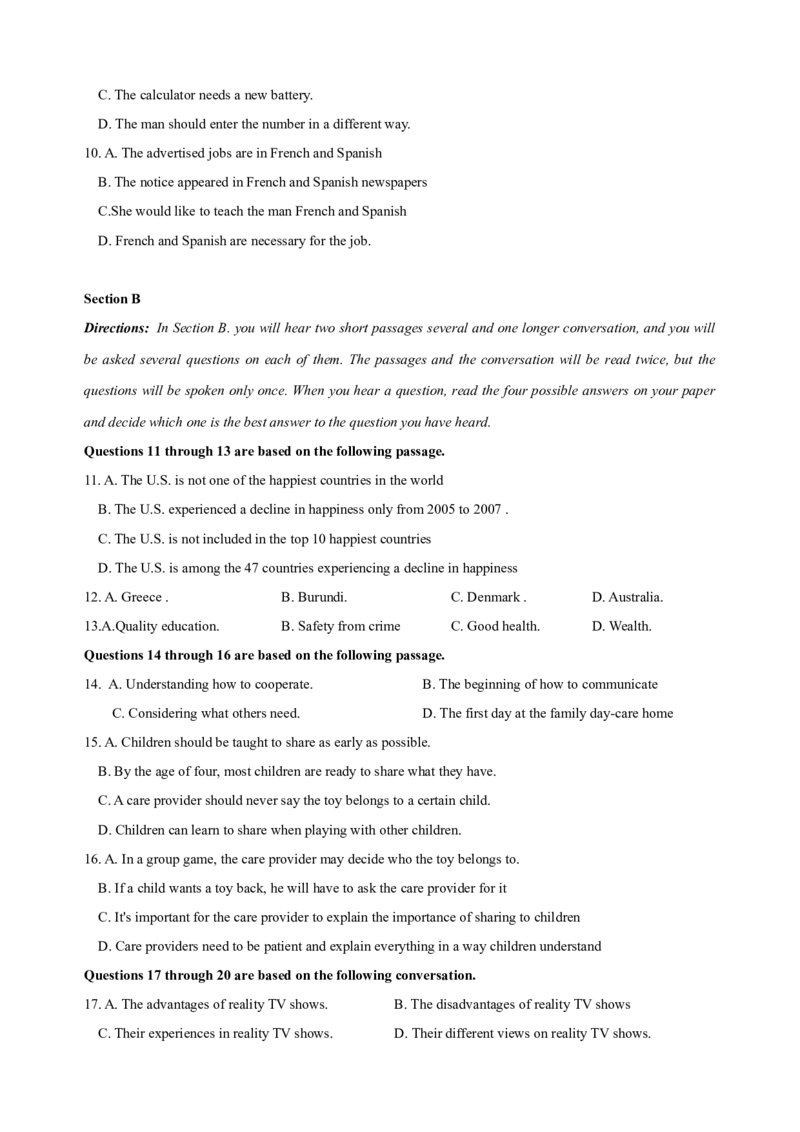
Section B
Directions: In Section B. you will hear two short passages several and one longer conversation, and you will
be asked several questions on each of them. The passages and the conversation will be read twice, but the
questions will be spoken only once. When you hear a question, read the four possible answers on your paper
and decide which one is the best answer to the question you have heard.
Questions 11 through 13 are based on the following passage.
11. A. The U.S. is not one of the happiest countries in the world
B. The U.S. experienced a decline in happiness only from 2005 to 2007 .
C. The U.S. is not included in the top 10 happiest countries
D. The U.S. is among the 47 countries experiencing a decline in happiness
12. A. Greece . B. Burundi. C. Denmark . D. Australia.
13.A.Quality education. B. Safety from crime C. Good health. D. Wealth.
Questions 14 through 16 are based on the following passage.
14. A. Understanding how to cooperate. B. The beginning of how to communicate
C. Considering what others need. D. The first day at the family day-care home
15. A. Children should be taught to share as early as possible.
B. By the age of four, most children are ready to share what they have.
C. A care provider should never say the toy belongs to a certain child.
D. Children can learn to share when playing with other children.
16. A. In a group game, the care provider may decide who the toy belongs to.
B. If a child wants a toy back, he will have to ask the care provider for it
C. It's important for the care provider to explain the importance of sharing to children
D. Care providers need to be patient and explain everything in a way children understand
Questions 17 through 20 are based on the following conversation.
17. A. The advantages of reality TV shows. B. The disadvantages of reality TV shows
C. Their experiences in reality TV shows. D. Their different views on reality TV shows.18. A. Ordinary people. B. Famous people.
C. Stupid people. D. Popular people.
19. A. Most of the situations are not real. B. Some of them are too touching.
C. They are full of tension and drama. D. She will never get into such situations.
20. A. They are amusing but sometimes harmful.
B. They are a form of “gossip entertainment”
C. They can entertain and sometimes educate people.
D. They can make people know more about nature.
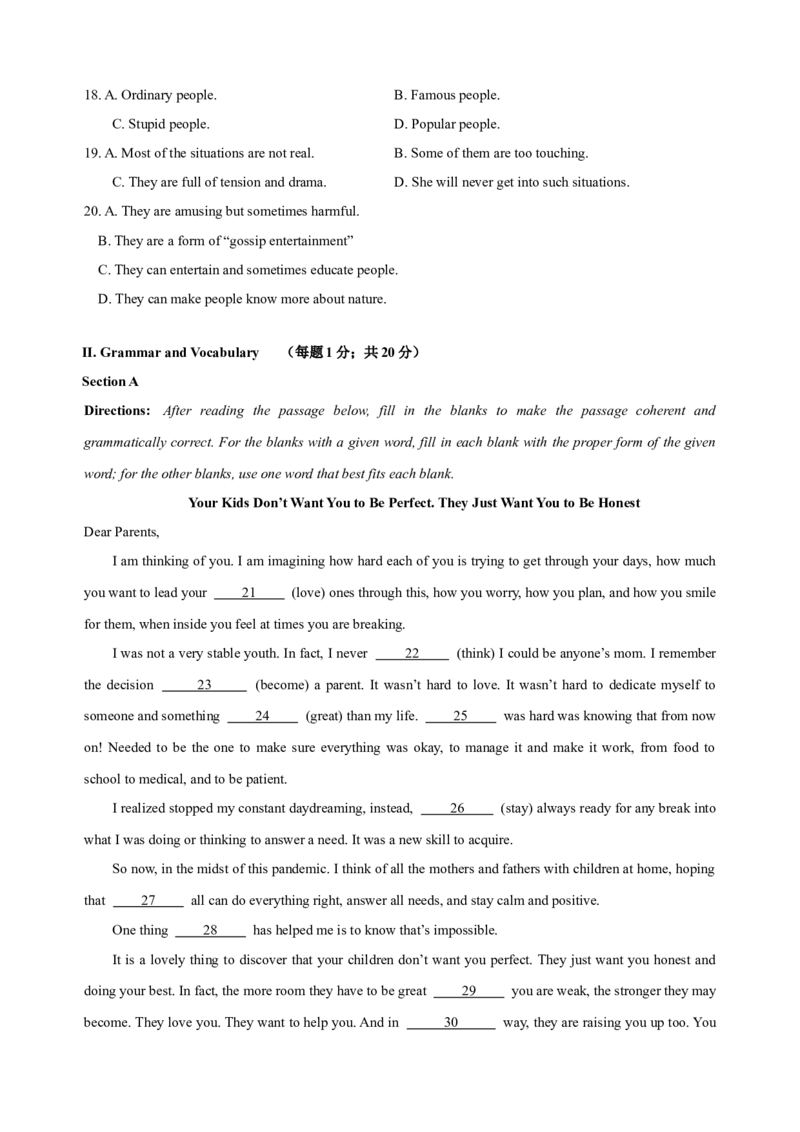
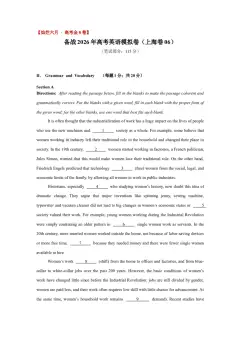
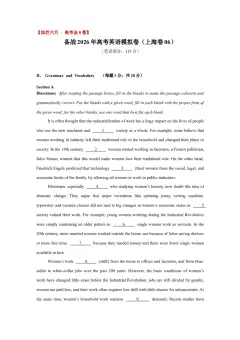
II. Grammar and Vocabulary (每题1分;共20分)
Section A
Directions: After reading the passage below, fill in the blanks to make the passage coherent and
grammatically correct. For the blanks with a given word, fill in each blank with the proper form of the given
word; for the other blanks, use one word that best fits each blank.
Your Kids Don’t Want You to Be Perfect. They Just Want You to Be Honest
Dear Parents,
I am thinking of you. I am imagining how hard each of you is trying to get through your days, how much
you want to lead your 21 (love) ones through this, how you worry, how you plan, and how you smile
for them, when inside you feel at times you are breaking.
I was not a very stable youth. In fact, I never 22 (think) I could be anyone’s mom. I remember
the decision 23 (become) a parent. It wasn’t hard to love. It wasn’t hard to dedicate myself to
someone and something 24 (great) than my life. 25 was hard was knowing that from now
on! Needed to be the one to make sure everything was okay, to manage it and make it work, from food to
school to medical, and to be patient.
I realized stopped my constant daydreaming, instead, 26 (stay) always ready for any break into
what I was doing or thinking to answer a need. It was a new skill to acquire.
So now, in the midst of this pandemic. I think of all the mothers and fathers with children at home, hoping
that 27 all can do everything right, answer all needs, and stay calm and positive.
One thing 28 has helped me is to know that’s impossible.
It is a lovely thing to discover that your children don’t want you perfect. They just want you honest and
doing your best. In fact, the more room they have to be great 29 you are weak, the stronger they may
become. They love you. They want to help you. And in 30 way, they are raising you up too. Yougrow together.
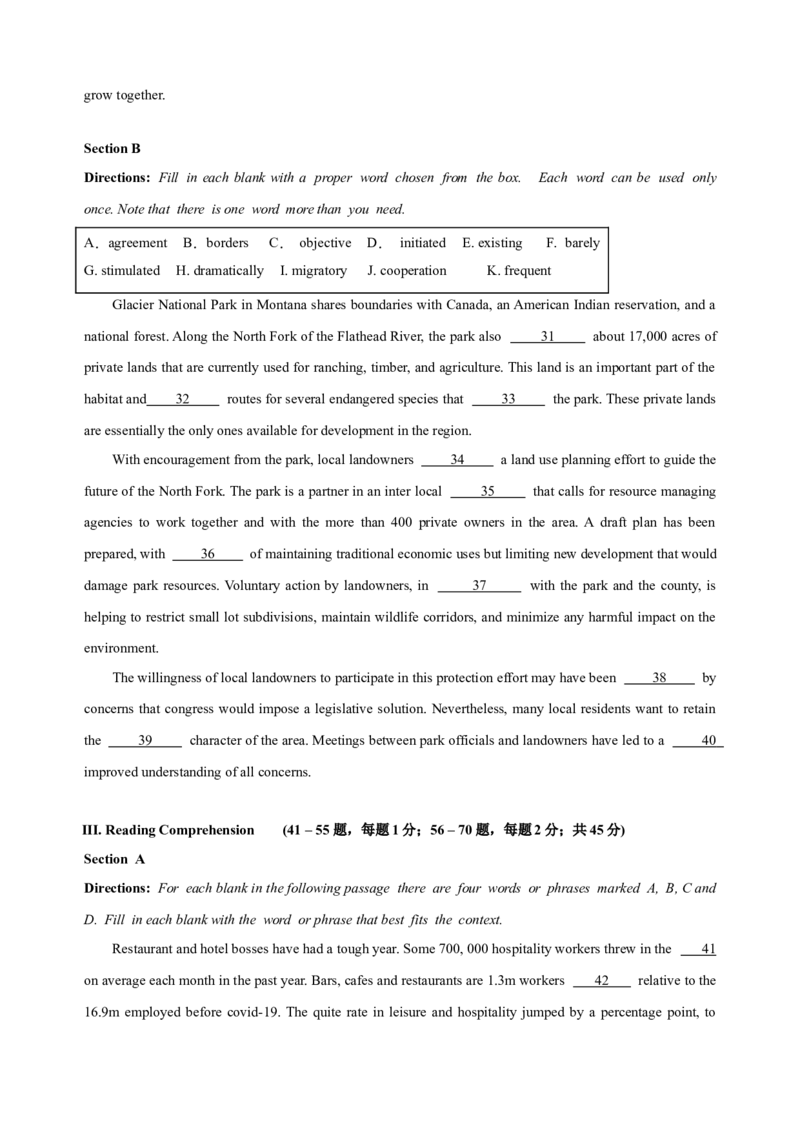
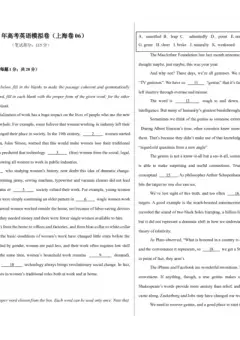
Section B
Directions: Fill in each blank with a proper word chosen from the box. Each word can be used only
once. Note that there is one word more than you need.
A.agreement B.borders C. objective D. initiated E. existing F. barely
G. stimulated H. dramatically I. migratory J. cooperation K. frequent
Glacier National Park in Montana shares boundaries with Canada, an American Indian reservation, and a
national forest. Along the North Fork of the Flathead River, the park also 31 about 17,000 acres of
private lands that are currently used for ranching, timber, and agriculture. This land is an important part of the
habitat and 32 routes for several endangered species that 33 the park. These private lands
are essentially the only ones available for development in the region.
With encouragement from the park, local landowners 34 a land use planning effort to guide the
future of the North Fork. The park is a partner in an inter local 35 that calls for resource managing
agencies to work together and with the more than 400 private owners in the area. A draft plan has been
prepared, with 36 of maintaining traditional economic uses but limiting new development that would
damage park resources. Voluntary action by landowners, in 37 with the park and the county, is
helping to restrict small lot subdivisions, maintain wildlife corridors, and minimize any harmful impact on the
environment.
The willingness of local landowners to participate in this protection effort may have been 38 by
concerns that congress would impose a legislative solution. Nevertheless, many local residents want to retain
the 39 character of the area. Meetings between park officials and landowners have led to a 40
improved understanding of all concerns.
III. Reading Comprehension (41 – 55题,每题1分;56 – 70题,每题2分;共45分)
Section A
Directions: For each blank in the following passage there are four words or phrases marked A, B, C and
D. Fill in each blank with the word or phrase that best fits the context.
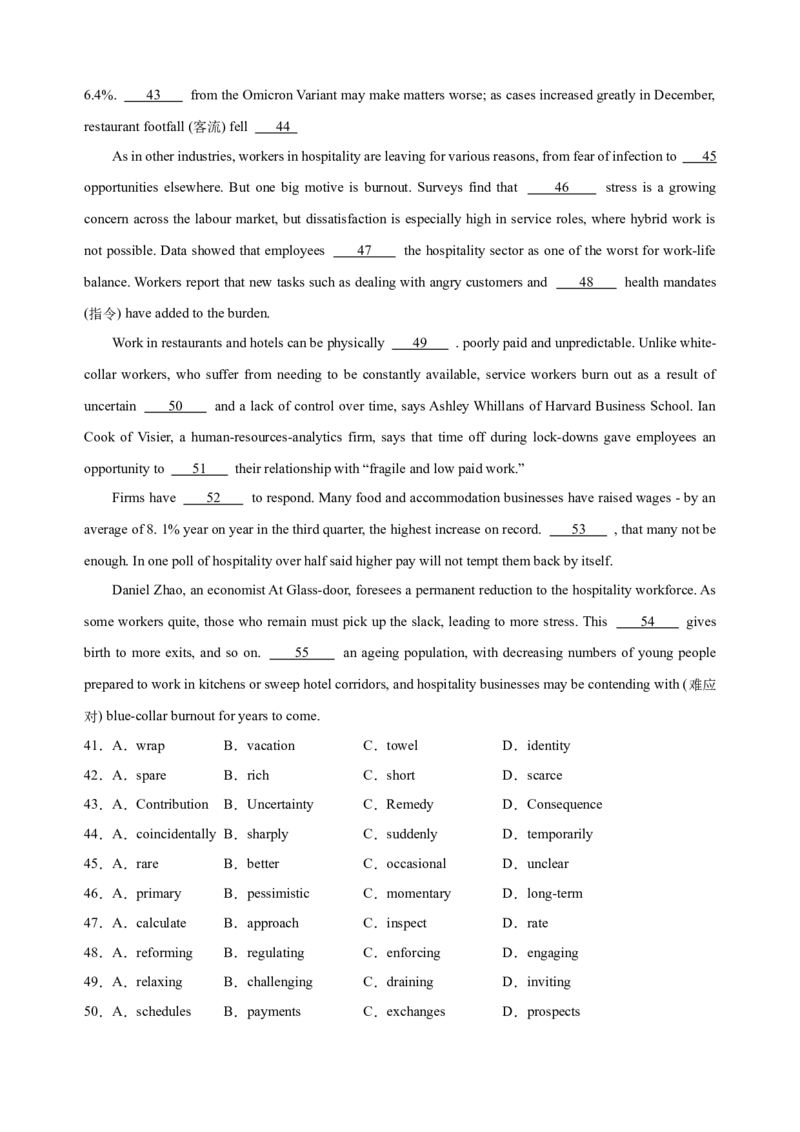
Restaurant and hotel bosses have had a tough year. Some 700, 000 hospitality workers threw in the 41
on average each month in the past year. Bars, cafes and restaurants are 1.3m workers 42 relative to the
16.9m employed before covid-19. The quite rate in leisure and hospitality jumped by a percentage point, to6.4%. 43 from the Omicron Variant may make matters worse; as cases increased greatly in December,
restaurant footfall (客流) fell 44
As in other industries, workers in hospitality are leaving for various reasons, from fear of infection to 45
opportunities elsewhere. But one big motive is burnout. Surveys find that 46 stress is a growing
concern across the labour market, but dissatisfaction is especially high in service roles, where hybrid work is
not possible. Data showed that employees 47 the hospitality sector as one of the worst for work-life
balance. Workers report that new tasks such as dealing with angry customers and 48 health mandates
(指令) have added to the burden.
Work in restaurants and hotels can be physically 49 . poorly paid and unpredictable. Unlike white-
collar workers, who suffer from needing to be constantly available, service workers burn out as a result of
uncertain 50 and a lack of control over time, says Ashley Whillans of Harvard Business School. Ian
Cook of Visier, a human-resources-analytics firm, says that time off during lock-downs gave employees an
opportunity to 51 their relationship with “fragile and low paid work.”
Firms have 52 to respond. Many food and accommodation businesses have raised wages - by an
average of 8. 1% year on year in the third quarter, the highest increase on record. 53 , that many not be
enough. In one poll of hospitality over half said higher pay will not tempt them back by itself.
Daniel Zhao, an economist At Glass-door, foresees a permanent reduction to the hospitality workforce. As
some workers quite, those who remain must pick up the slack, leading to more stress. This 54 gives
birth to more exits, and so on. 55 an ageing population, with decreasing numbers of young people
prepared to work in kitchens or sweep hotel corridors, and hospitality businesses may be contending with (难应
对) blue-collar burnout for years to come.
41.A.wrap B.vacation C.towel D.identity
42.A.spare B.rich C.short D.scarce
43.A.Contribution B.Uncertainty C.Remedy D.Consequence
44.A.coincidentally B.sharply C.suddenly D.temporarily
45.A.rare B.better C.occasional D.unclear
46.A.primary B.pessimistic C.momentary D.long-term
47.A.calculate B.approach C.inspect D.rate
48.A.reforming B.regulating C.enforcing D.engaging
49.A.relaxing B.challenging C.draining D.inviting
50.A.schedules B.payments C.exchanges D.prospects51.A.inquire into B.reflect on C.account for D.answer for
52.A.rushed B.failed C.hesitated D.expected
53.A.Hence B.Moreover C.Similarly D.Nonetheless
54.A.in return B.in a row C.in turn D.in advance
55.A.Exclude B.Follow C.Concern D.Add
Section B
Directions: Read the following three passages. Each passage is followed by several questions or unfinished
statements. For each of them there are four choices marked A, B, C and D. Choose the one that fits best
according to the information given in the passage you have just read.
(A)
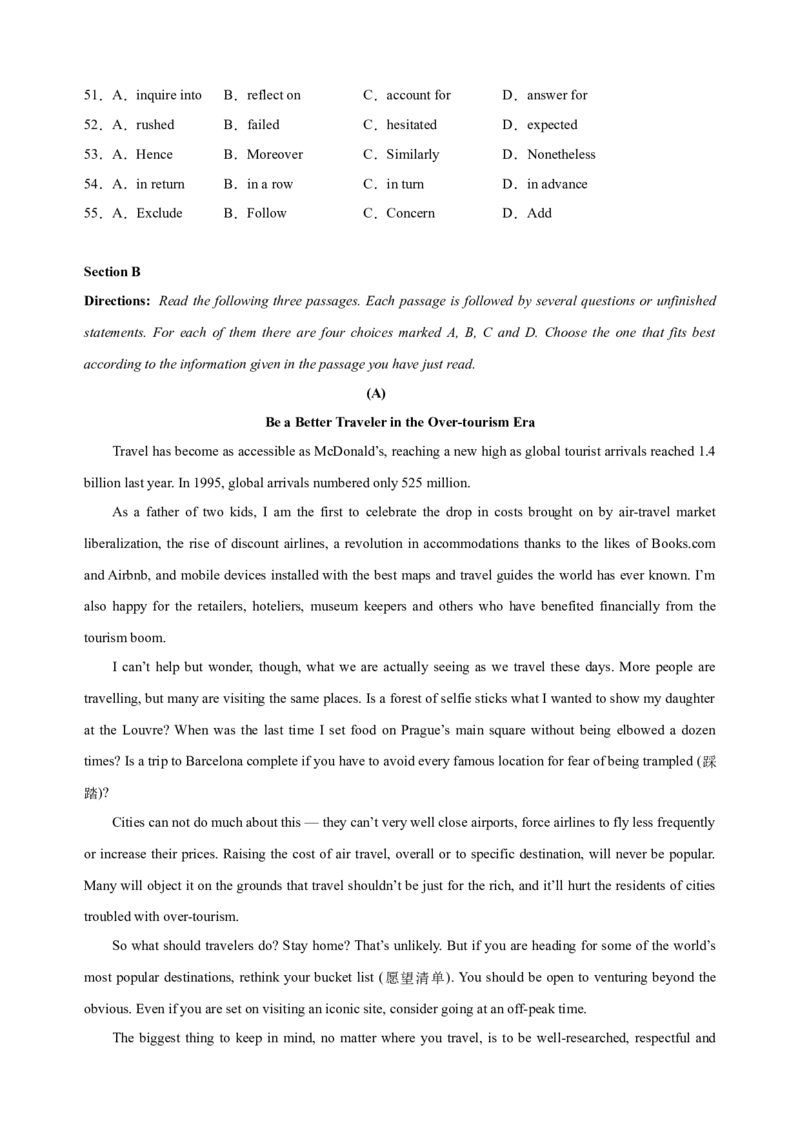
Be a Better Traveler in the Over-tourism Era
Travel has become as accessible as McDonald’s, reaching a new high as global tourist arrivals reached 1.4
billion last year. In 1995, global arrivals numbered only 525 million.
As a father of two kids, I am the first to celebrate the drop in costs brought on by air-travel market
liberalization, the rise of discount airlines, a revolution in accommodations thanks to the likes of Books.com
and Airbnb, and mobile devices installed with the best maps and travel guides the world has ever known. I’m
also happy for the retailers, hoteliers, museum keepers and others who have benefited financially from the
tourism boom.
I can’t help but wonder, though, what we are actually seeing as we travel these days. More people are
travelling, but many are visiting the same places. Is a forest of selfie sticks what I wanted to show my daughter
at the Louvre? When was the last time I set food on Prague’s main square without being elbowed a dozen
times? Is a trip to Barcelona complete if you have to avoid every famous location for fear of being trampled (踩
踏)?
Cities can not do much about this — they can’t very well close airports, force airlines to fly less frequently
or increase their prices. Raising the cost of air travel, overall or to specific destination, will never be popular.
Many will object it on the grounds that travel shouldn’t be just for the rich, and it’ll hurt the residents of cities
troubled with over-tourism.
So what should travelers do? Stay home? That’s unlikely. But if you are heading for some of the world’s
most popular destinations, rethink your bucket list (愿望清单). You should be open to venturing beyond the
obvious. Even if you are set on visiting an iconic site, consider going at an off-peak time.
The biggest thing to keep in mind, no matter where you travel, is to be well-researched, respectful andgenuinely curious about the destination. Don’t fall victim to what people call “selfie culture” and “bucket list
culture”. Treat the destination as you would do to your own home - not as a “hidden gem” that you throw
money at to get certain experience you feel entitled to.
56.Which of the following is NOT the cause of the drop in travelling costs according to the author?
A.The rise of discount airlines.
B.The freedom to choose transport
C.The popularization of mobile devices.
D.The appearances of Booking.com and Airbnb.
57.According to the passage, why might some people oppose raising the cost of air travel?
A.It would result in a decrease in airport security.
B.It would lead to fewer people travelling overall.
C.It would hurt the residents of tourism-dependent cities.
D.It would encourage a “bucket list culture.”
58.What does the author mean by saying “Cities can not do much about this”?
A.Facing the trouble of over-tourism, cities lack feasilbe measure.
B.Those cities as famous tourist destinations are not only for the rich.
C.Cities with over-tourism can’t deal with protests among travelers.
D.Cities with over-tourism can stop people making trips there.
59.What should people do to be a better traveler in the over-tourism era?
A.Set on a journey at an on-peak time. B.Avoid visiting an iconic site
C.Raise the cost of air travel. D.Be willing to explore new sites.
(B)
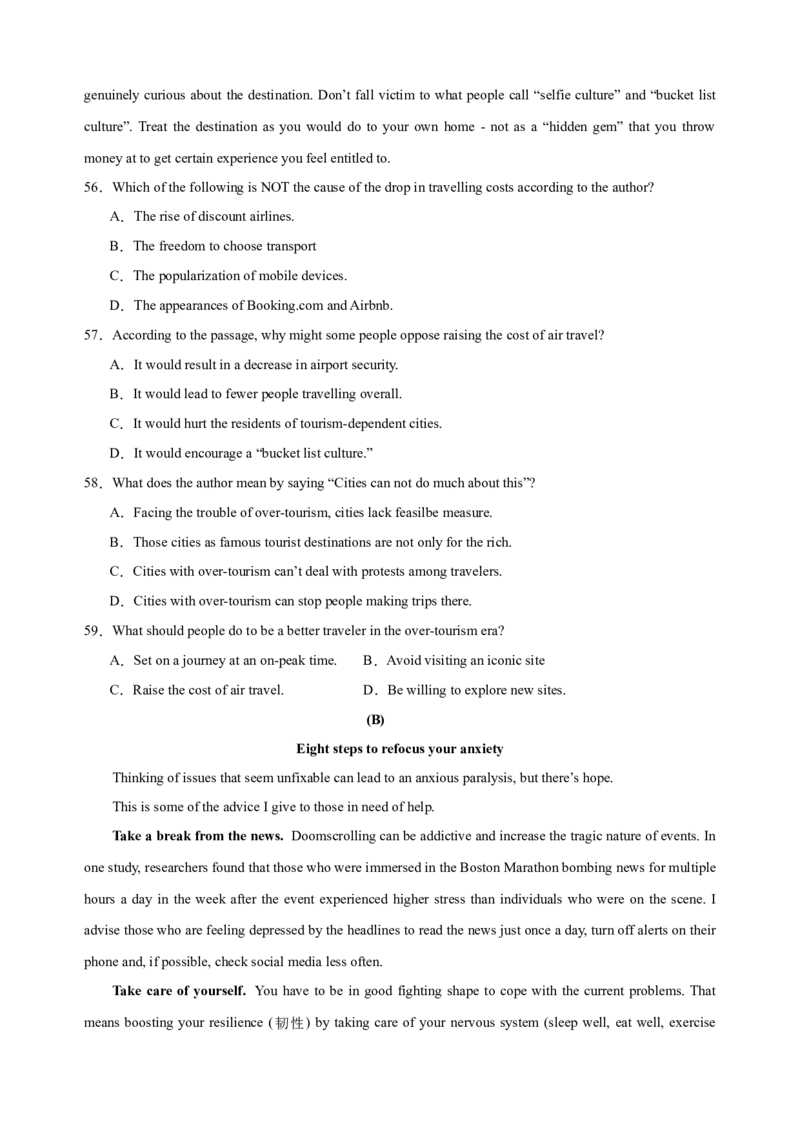
Eight steps to refocus your anxiety
Thinking of issues that seem unfixable can lead to an anxious paralysis, but there’s hope.
This is some of the advice I give to those in need of help.
Take a break from the news. Doomscrolling can be addictive and increase the tragic nature of events. In
one study, researchers found that those who were immersed in the Boston Marathon bombing news for multiple
hours a day in the week after the event experienced higher stress than individuals who were on the scene. I
advise those who are feeling depressed by the headlines to read the news just once a day, turn off alerts on their
phone and, if possible, check social media less often.
Take care of yourself. You have to be in good fighting shape to cope with the current problems. That
means boosting your resilience (韧性) by taking care of your nervous system (sleep well, eat well, exercisewisely) and engaging in positive activities.
Focus on the present. Get in the habit of putting yourself in the here and now. Worrying about the future
is not helpful.
Try a breathing exercise. Taking a few deep breaths — for instance, breathing in into the count of five
and breathing out to the count of five — will help calm your sympathetic nervous system (the fight or flight
response) and lower your anxiety. At the very least, breathing gives you something to do when your feel your
heart rate pounding quickly.
Think about your victories. Remind yourself of what’s working well in your own life — whether it’s
your job, friendships, or the array of houseplants you cultivated during the pandemic.
Be your own therapist. Ask yourself, what do I specifically feel hopeless about and why? Being able to
put into words what’s getting you down can help you feel less flooded by emotions and better able to process
the information rationally(理性地).
Take action. Worrying doesn’t help one’s mental health, but taking action does. Look around your
community. Maybe your local playground would benefit from a basketball court, or your church could sponsor
a refugee family. When people engage in local issues, they have a renewed sense of optimism.
Join forces with a friend. Pick a cause. There are hundreds of nonprofits dedicated to addressing some of
the most biggest challenges on the planet. Donate money to an inspiring organization or volunteer.
60.What’s the purpose of writing this passage?
A.To encourage people to help those in need.
B.To help those in need of help relieve anxiety.
C.To urge people to take action to help themselves.
D.To cheer readers up and boost a feeling of optimism.
61.What does the underlined part of the sentence mean?
A.“stopping moving and staying where you are”
B.“focusing on the present moment”
C.“placing yourself in a favorable environment”
D.“forgetting about the losses and gains”
62.Which of the following statements is in line with the author’s advice?
A.Only check social media once a day.
B.Involve oneself in activities that boost one’s nervous system.
C.Think of the past victories.
D.Engage in local issues and make contributions.(C)
Antibiotics, which can destroy or prevent the growth of bacteria and cure infections, are vital to modern
medicine. Their ability to kill bacteria without harming the patient has saved billions of lives and made surgical
procedures much safer. But after decades of overuse, their powers are fading. Some bacteria have evolved
resistance, creating a growing army of superbugs, against which there is little effective treatment. Antimicrobial
(抗菌的) resistance, expected to kill 10 million people a year by 2050 up from around 1 million in 2019, has
been seen as a crisis by many.
It would be unwise to rely on new antibiotics to solve the problem. The rate at which resistance emerges is
increasing. Some new drugs last only two years before bacteria develop resistance. When new antibiotics do
arrive, doctors often store them, using them only reluctantly and for short periods when faced with the most
persistent infections. That limits sales, making new antibiotics an unappealing idea for most drug firms.
Governments have been trying to fix the problem by channeling cash into research in drug firms. That has
produced only limited improvements. But there is a phenomenon worth a look. Microbiologists have known for
decades that disease-causing bacteria can suffer from illnesses of their own. They are supersensitive to attacks
by phages, specialized viruses that infect bacteria and often kill them. Phages are considered a promising
alternative to antibiotics.
Using one disease-causing virus to fight bacteria has several advantages. Like antibiotics, phages only
tend to choose particular targets, leaving human cells alone as they infect and destroy bacterial ones. Unlike
antibiotics, phages can evolve just as readily as bacteria can, meaning that even if bacteria do develop
resistance, phages may be able to evolve around them in turn.
That, at least, is the theory. The trouble with phages is that comparatively little is known about them. After
the discovery of penicillin, the first antibiotic, in 1928, they were largely ignored in the West. Given the
severity of the antibiotic-resistance problem, it would be a good idea to find out more about them.
The first step is to run more clinical trials. Interest from Western firms is growing. But it is being held
back by the fact that phages are an even less appealing investment than antibiotics. Since they are natural living
things, there may be trouble patenting them, making it hard to recover any investment.
Governments can help fun d basic research into phage treatment and clarify the law around exactly what is
and is not patentable. In time they can set up phage banks so as to make production cheaper. And they can
spread awareness of the risks of overusing antibiotics, and the potential benefits of phages.
63.We can learn from paragraphs 1 and 2 that .
A.doctors tend to use new antibiotics when the patients ask for themB.antimicrobial resistance is developing more rapidly than predicted
C.new antibiotics fail to attract drug firms due to limited use of them
D.previous antibiotics are effective in solving modern health problems
64.What is phages’ advantage over antibiotics?
A.They can increase human cells when fighting bacteria.
B.They are not particular about which cells to infect and kill.
C.They can evolve accordingly when bacteria develop resistance.
D.They are too sensitive to be infected by disease-causing bacteria.
65.According to the passage, the obstacle to phage treatment is that .
A.there is little chance of patenting phages in the future
B.governments provide financial support for other research
C.the emergence of superbugs holds back drug firms’ interest
D.over-dependence on antibiotics distracts attention from phages
66.What is the main idea of the passage?
A.Governments fail to stop the use of antibiotics.
B.Phages could help prevent an antibiotics crisis.
C.Development of antibiotics is limited by phages.
D.Antimicrobial resistance calls for new antibiotics.
Section C
Directions: Read the following passages. Fill in each blank with a proper sentence given in the box. Each
sentence can be used only once. Note that there are two more sentences than you need.
How Well Do Films Predict Our teach Future?
Everyone judged the possibility of a movie through a different perspective. If you're a doctor, you may
think: “That character would not have survived that fall.” If you're a scientist: “that's not how black holes
work.” And if you're me, it's more like: “What a stupid concept of future personal technology!”
It makes me crazy when ski-fi moviemakers dream up stuff with no basis in science. Human teleporters?
Sorry, Star Trek. A bed that detects and cures cancer in seconds? No, Elysium.
67 Star Trek's self-opening doors are now a standard feature of grocery store entranced, and the
driver less cars from Total Recall (and many other moves) are already on American roads.
Lately it's clear that Hollywood's production designers have been putting serious thought into the teach
we'll someday carry. 68 He talks to her through a single ear bud, through which he gets a surprisingamount done: processing e-mail, browsing news stories, sending messages. When an image is essential to the
communication, he flips open his phone, where the picture appears.
This solution makes a lot of sense—more than, for example, Goggle Glass, a now discontinued head band
that placed a mini screen above your eyebrow. Social mistakes, not technical ones, hastened its devise: Glass's
camera frightened others and made you look like a disgusting being. 69
In a recent movie called What Happened to Monday, humans live in a dystopian future where, to control
overpopulation, it's illegal to have more than one child. The characters wear wrist bands containing tiny
projectors. They shine perfectly crisp, color images onto their palms, which the characters tap as though they
are touch screens. 70 We won't see this in the real world, though. Even if a pick projector, battery and
process or could be shrunk and squeezed into a thin band, challenge remain. How would the projector attain
sharp focus on an irregular, moving palm? How would it project enough light on sunny days? How would it
work on very light or very dark skin?
Well, I suppose I should let that part go. They're just moves, right? They're not a depiction of the future—
at least not yet.
A.You can see why people went mad over the concept: imagine having all the power of a
smart phone without actually needing a smart phone.
B.However, the futuristic technologies some moves depict have accidentally given rise to
the possible and practical inventions in the real world.
C.Since the Her ear piece has brought about many disc re et and comfortable benefits, it is
more sensible than goggle Glass.
D.Her, for example, is about a man who falls in love with his Sir i-like voice assistant.
E.On the other hand, some moves depict futuristic technologies that are so possible and
practical that people invent them in the real world.
F.The Her ear piece delivers many of the same benefits, though discreetly and comfortable.
IV. Summary Writing (10分)
Directions: Read the following passage. Summarize the main idea and the main point(s) of the passage in no
more than 60 words. Use your own words as far as possible.
What Causes Déja Vu?
It’s a frightening feeling: You walk into a place you know you’ve never been before but are overwhelmed
by a sense of familiarity-a memory you can’t quite reach. Has this all happened before? Most people experience
‘this sensation, known as déjà vu, at some point in their lives. It’s a hard feeling to study, though, because it
tends to arise spontaneously and be shaken off easily.
Déjà vu means “already seen” in French, a term possibly coined by French philosopher Émile Boirac. In a2009 study, Cognitive psychologist Anne Cleary of Colorado State University and her colleagues found that
viewing these sneakily similar scenes was more likely to cause feelings of déjà vu than viewing dissimilar
scenes-suggesting that perhaps there is some environmental trigger for the brain to call out, “Hey, I recognize
that!” even when it’s never seen the scene before.
While Cleary’s research shows that a slight familiarity can result in déjà vu, Akira Robert O’Connor, a
cognitive psychologist at the University of St. Andrews says, in spontaneous déjà vu cases, it’s quite possible
that the familiarity feeling is random. Supporting this random-misfire hypothesis is the fact that young people
actually experience more déjà vu than older people. Younger brains are a little more excitable, more likely to
fire more quickly rather than holding back, O’Connor says.
Older people may also be less adept (擅长的)fact-checkers when false feelings of familiarity arise, says
Chris Moulin, a cognitive neuropsychologist at the Grenoble Alpes University. Older adults still recognize such
false familiarity. “It’s not perhaps that older adults are not generating false familiarity, ” Moulin says. “It’s just
that they don’t have, anymore, that certainty that what they’re experiencing is false. ”
This is a normal part of aging, not the conflation (合并)of déjà vu with reality that people with dementia
(老年痴呆症)may experience. So enjoy the feeling of having felt it all before while it lasts, Generation Z.
71._______________________________________________________________________________________
_________________________________________________________________________________________
_________________________________________________________________________________________
_________________________________________________________________________________________
_________________________________________________________________________________________
_________________________________________________________________________________________
____________________
V. Translation (第1-2句,每句3分;第3句,4分;第4句5分;共15分)
Directions: Translate the following sentences into English, using the words given in the brackets.
72.你大老远跑去超市买方便面有意义吗? (sense)
73.书展的门票只能提前一天在网上购买。(available)
74.在新闻发布会上,发言人明确表示他发表的评论媒体不得断章取义,以免造成误解。(it)
75.这部春节档电影明星云集,情节曲折,制作精良,实现了票房与口碑的双丰收。(release)
VI. Guided Writing (25分)
Directions: Write an English composition in 120-150 words according to the instructions given below inChinese.
假设你是明启中学高三学生李明,你校英语报计划腾出一个版面专门刊登学生摄影作品,计划第一期
的主题从“My winter vacation”、“People around me”及“The best scene on campus”中选择一个,现向全
校同学征求意见。写一封邮件给英语报 读者来信专栏,内容须包括:
1)你推荐的专栏主题;
2)你的理由。
_________________________________________________________________________________________
_________________________________________________________________________________________
_________________________________________________________________________________________
_________________________________________________________________________________________
_________________________________________________________________________________________