【灿烂六月 · 高考金8 卷】
备战2026 年高考英语模拟卷(上海卷06)
(笔试部分:115 分)
II.
Grammar and Vocabulary   (每题1 分;共20 分)
Section A
Directions: After reading the passage below, fill in the blanks to make the passage coherent and
grammatically correct. For the blanks with a given word, fill in each blank with the proper form of
the given word; for the other blanks, use one word that best fits each blank.
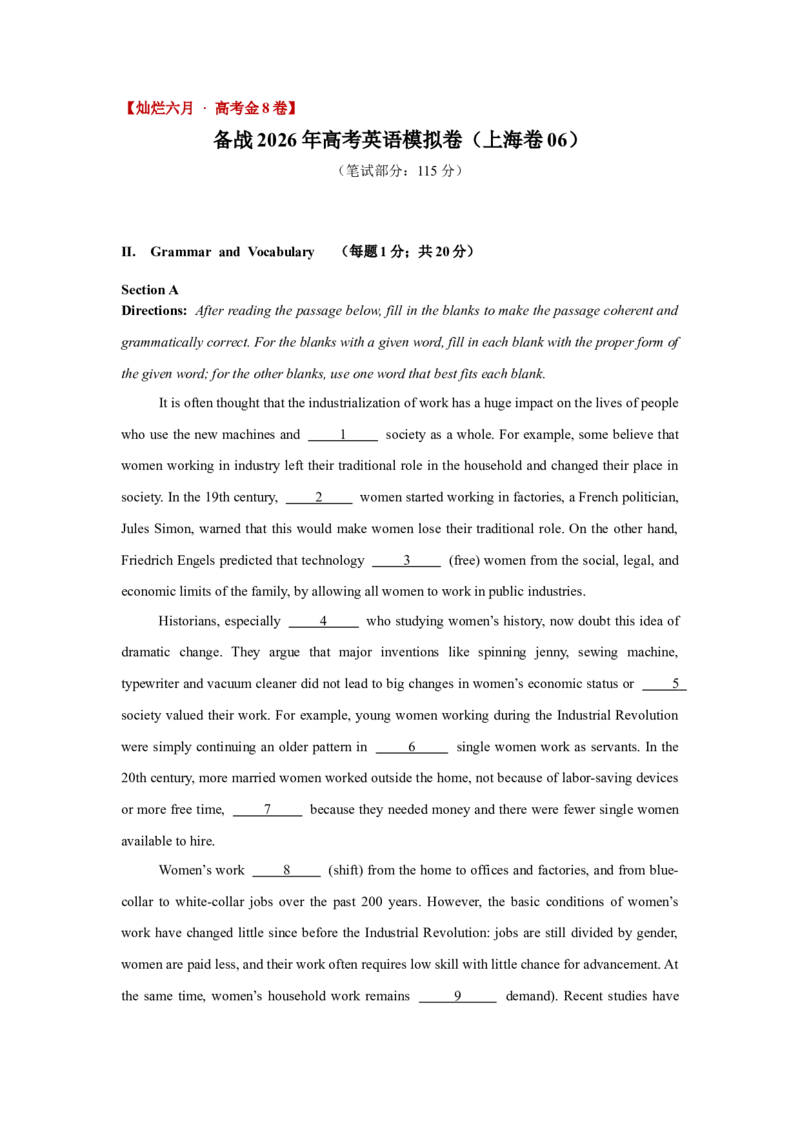
It is often thought that the industrialization of work has a huge impact on the lives of people
who use the new machines and     1     society as a whole. For example, some believe that
women working in industry left their traditional role in the household and changed their place in
society. In the 19th century,     2     women started working in factories, a French politician,
Jules Simon, warned that this would make women lose their traditional role. On the other hand,
Friedrich Engels predicted that technology     3     (free) women from the social, legal, and
economic limits of the family, by allowing all women to work in public industries.
Historians, especially     4     who studying women’s history, now doubt this idea of
dramatic change. They argue that major inventions like spinning jenny, sewing machine,
typewriter and vacuum cleaner did not lead to big changes in women’s economic status or     5
society valued their work. For example, young women working during the Industrial Revolution
were simply continuing an older pattern in     6     single women work as servants. In the
20th century, more married women worked outside the home, not because of labor-saving devices
or more free time,     7     because they needed money and there were fewer single women
available to hire.
Women’s work     8     (shift) from the home to offices and factories, and from blue-
collar to white-collar jobs over the past 200 years. However, the basic conditions of women’s
work have changed little since before the Industrial Revolution: jobs are still divided by gender,
women are paid less, and their work often requires low skill with little chance for advancement. At
the same time, women’s household work remains     9     demand). Recent studies have
challenged the idea     10     technology always brings revolutionary social change. In fact,
industrialization may have slowed changes in women’s traditional roles both at work and at home.
Section B
Directions: Fill in each blank with a proper word chosen from the box. Each word can be used
only once. Note that there is one word more than you need.
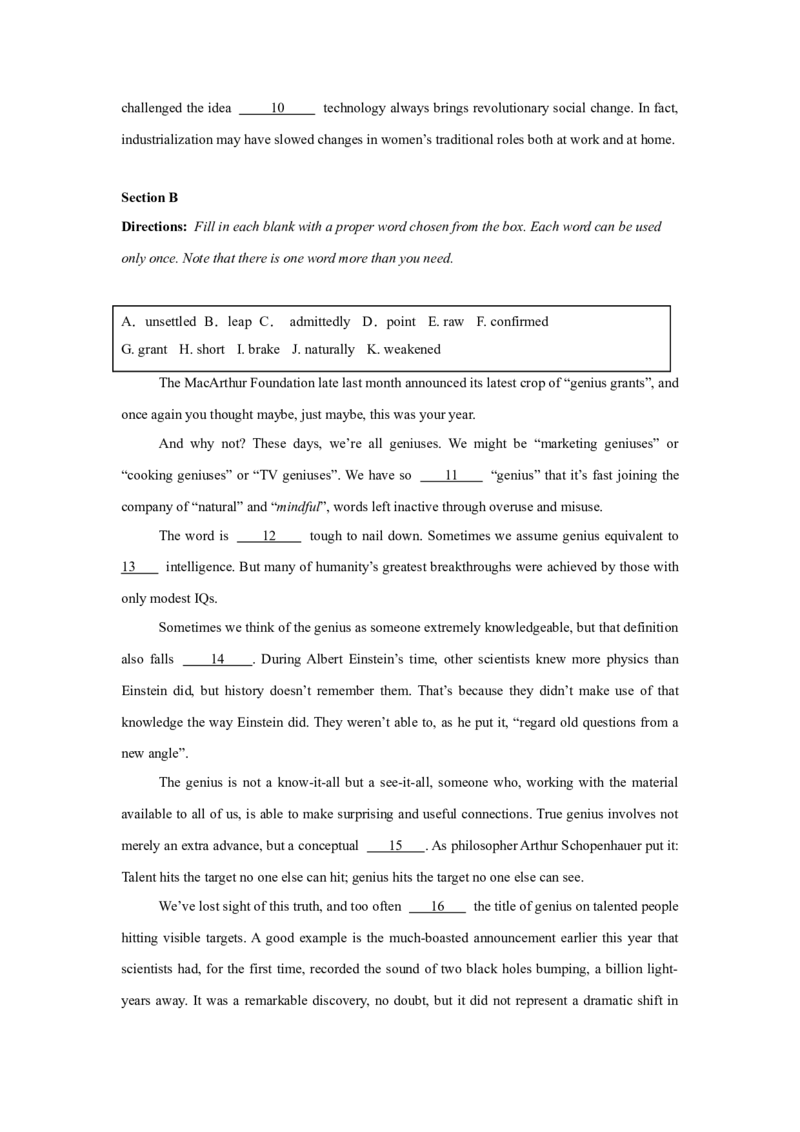
A.unsettled  B.leap  C. admittedly   D.point   E. raw   F. confirmed
G. grant   H. short   I. brake   J. naturally   K. weakened
The MacArthur Foundation late last month announced its latest crop of “genius grants”, and
once again you thought maybe, just maybe, this was your year.
And why not? These days, we’re all geniuses. We might be “marketing geniuses” or
“cooking geniuses” or “TV geniuses”. We have so    11    “genius” that it’s fast joining the
company of “natural” and “mindful”, words left inactive through overuse and misuse.
The word is    12    tough to nail down. Sometimes we assume genius equivalent to
13    intelligence. But many of humanity’s greatest breakthroughs were achieved by those with
only modest IQs.
Sometimes we think of the genius as someone extremely knowledgeable, but that definition
also falls    14   . During Albert Einstein’s time, other scientists knew more physics than
Einstein did, but history doesn’t remember them. That’s because they didn’t make use of that
knowledge the way Einstein did. They weren’t able to, as he put it, “regard old questions from a
new angle”.
The genius is not a know-it-all but a see-it-all, someone who, working with the material
available to all of us, is able to make surprising and useful connections. True genius involves not
merely an extra advance, but a conceptual    15   . As philosopher Arthur Schopenhauer put it:
Talent hits the target no one else can hit; genius hits the target no one else can see.
We’ve lost sight of this truth, and too often    16    the title of genius on talented people
hitting visible targets. A good example is the much-boasted announcement earlier this year that
scientists had, for the first time, recorded the sound of two black holes bumping, a billion light-
years away. It was a remarkable discovery, no doubt, but it did not represent a dramatic shift in
how we understand the universe. It merely    17    Einstein’s general theory of relativity.
As Plato observed, “What is honored in a country is cultivated there.” What do we honor?
Digital technology, and the convenience it represents, so    18    we get a Steve Jobs or a Mark
Zuckerberg as our “geniuses”, which, in point of fact, they aren’t.
The iPhone and Facebook are wonderful inventions. In many ways, they make our lives a
bit easier, a bit more convenient. If anything, though, a true genius makes our lives more difficult,
more    19   . William Shakespeare’s words provide more anxiety than relief, and the world
felt a bit more secure before Charles Darwin came along. Zuckerberg and Jobs may have changed
our world, but they haven’t yet changed our worldview.
We need to recover genius, and a good place to start is by pressing the     20     on
Genius Flooding.
III.
Reading Comprehension    (41 – 55 题,每题1 分;56 – 70 题,每题2
分;共45 分)
Section A
Directions: For each blank in the following passage there are four words or phrases marked
A, B, C and D. Fill in each blank with the word or phrase that best fits the context.
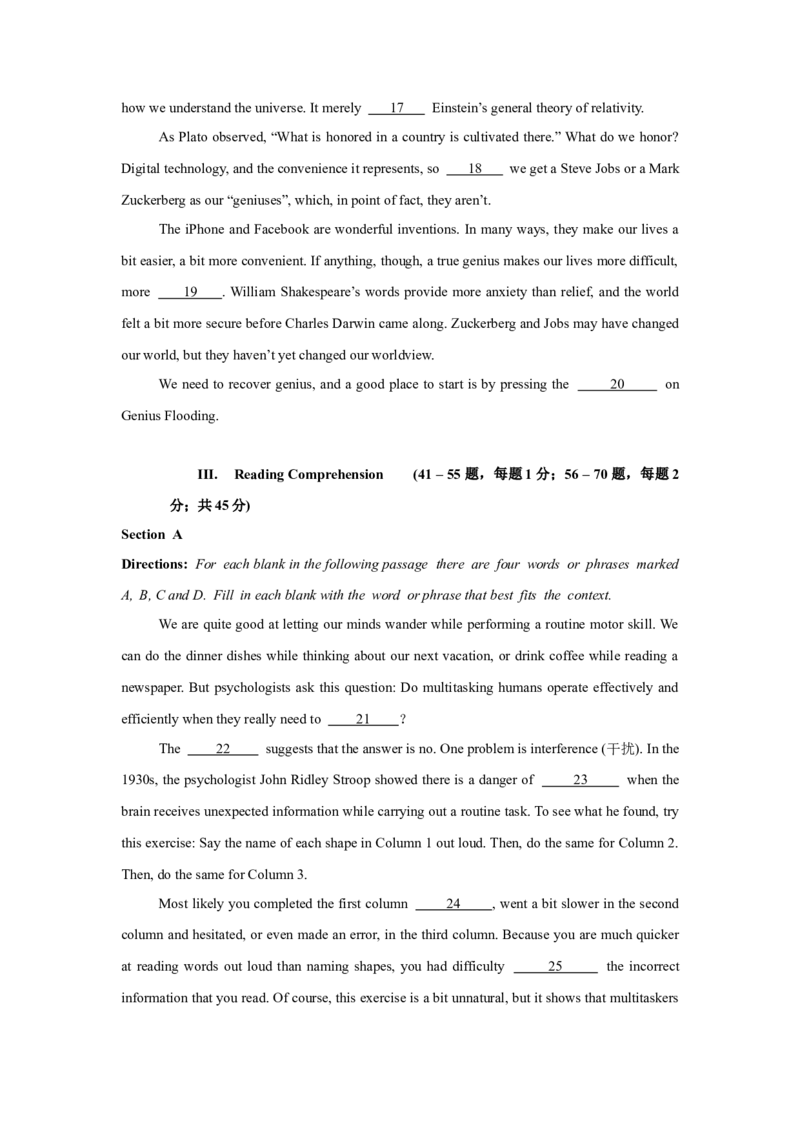
We are quite good at letting our minds wander while performing a routine motor skill. We
can do the dinner dishes while thinking about our next vacation, or drink coffee while reading a
newspaper. But psychologists ask this question: Do multitasking humans operate effectively and
efficiently when they really need to     21    ?
The     22     suggests that the answer is no. One problem is interference (干扰). In the
1930s, the psychologist John Ridley Stroop showed there is a danger of     23     when the
brain receives unexpected information while carrying out a routine task. To see what he found, try
this exercise: Say the name of each shape in Column 1 out loud. Then, do the same for Column 2.
Then, do the same for Column 3.
Most likely you completed the first column     24    , went a bit slower in the second
column and hesitated, or even made an error, in the third column. Because you are much quicker
at reading words out loud than naming shapes, you had difficulty     25     the incorrect
information that you read. Of course, this exercise is a bit unnatural, but it shows that multitaskers
are very likely to make mistakes and hesitate if they get interference from the     26     set of
stimuli while switching between tasks.
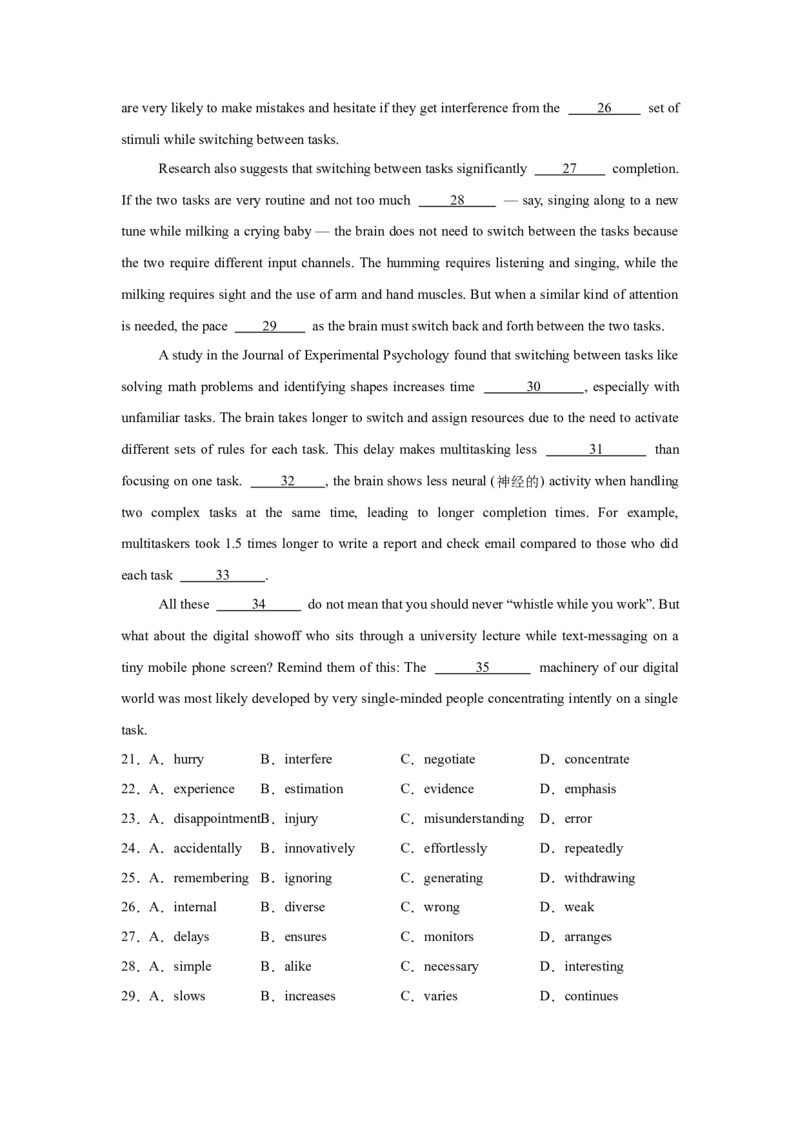
Research also suggests that switching between tasks significantly     27     completion.
If the two tasks are very routine and not too much     28     — say, singing along to a new
tune while milking a crying baby — the brain does not need to switch between the tasks because
the two require different input channels. The humming requires listening and singing, while the
milking requires sight and the use of arm and hand muscles. But when a similar kind of attention
is needed, the pace     29     as the brain must switch back and forth between the two tasks.
A study in the Journal of Experimental Psychology found that switching between tasks like
solving math problems and identifying shapes increases time      30     , especially with
unfamiliar tasks. The brain takes longer to switch and assign resources due to the need to activate
different sets of rules for each task. This delay makes multitasking less      31      than
focusing on one task.      32    , the brain shows less neural (神经的) activity when handling
two complex tasks at the same time, leading to longer completion times. For example,
multitaskers took 1.5 times longer to write a report and check email compared to those who did
each task      33     .
All these      34      do not mean that you should never “whistle while you work”. But
what about the digital showoff who sits through a university lecture while text-messaging on a
tiny mobile phone screen? Remind them of this: The      35      machinery of our digital
world was most likely developed by very single-minded people concentrating intently on a single
task.
21.A.hurry
B.interfere
C.negotiate
D.concentrate
22.A.experience
B.estimation
C.evidence
D.emphasis
23.A.disappointmentB.injury
C.misunderstanding
D.error
24.A.accidentally
B.innovatively
C.effortlessly
D.repeatedly
25.A.remembering
B.ignoring
C.generating
D.withdrawing
26.A.internal
B.diverse
C.wrong
D.weak
27.A.delays
B.ensures
C.monitors
D.arranges
28.A.simple
B.alike
C.necessary
D.interesting
29.A.slows
B.increases
C.varies
D.continues
30.A.saved
B.lost
C.tracked
D.found
31.A.popular
B.complex
C.efficient
D.challenging
32.A.Fortunately
B.Additionally
C.Ultimately
D.Alternatively
33.A.separately
B.regularly
C.vigorously
D.originally
34.A.requirements
B.tasks
C.concerns
D.negatives
35.A.multitasking
B.mechanical
C.specialized
D.packaging
Section B
Directions: Read the following three passages. Each passage is followed by several questions or
unfinished statements. For each of them there are four choices marked A, B, C and D. Choose the
one that fits best according to the information given in the passage you have just read.
(A)
My adventure with pottery began unexpectedly online. I saw a video of a person making a
late-night snack, but what truly caught my eye was the plate — a beautifully simple, cream-
colored piece with a unique bubbled shape. I had never seen anything like it and immediately
wanted one, I imagined all the meals I could present on it and how lovely they would look.
However, it was quite expensive. I couldn’t justify the purchase, so a bold idea struck me:
Why not make it myself? I admitted this was a little unreasonable. My only experience with clay
was from a brief encounter in elementary school. Yet, driven by the desire for that unique plate
and then a wish to learn something new, I signed up for a pottery class last April.
I entered the first class confidently, but reality soon hit. In the beginning, handling clay —
which seemed so simple — was much harder for me, a rather carefree girl, than I had anticipated.
My posture was wrong; I failed to center the clay on the wheel; I even couldn’t control its speed
properly. Once, I spun the wheel too fast and made my piece flying across the room. I felt
embarrassed and thought about quitting right then.
However, I was not the one to give up easily. I continued attending class. By the third
session, a shift occurred. I concentrated on steadying my elbows, gently applying pressure to the
clay, and slowly pulling up the walls to form a bowl. The quiet rhythmic sound of the spinning
wheel had a calming effect. To my surprise, by the end of that class, I had created my first real
piece — a small, imperfect, yet completely handmade bowl.
That semester taught me more than pottery; it taught me perseverance, and how to find
beauty in imperfection. I left with several bowls and a vase. The bubble-shaped plate remained my
goal in my next round of classes. This journey reminded me that true value lies not in a perfect
product, but in the rewarding process of creating something with my own hands.
36.What was the author’s initial intention of making a piece of pottery?
A.To learn a new skill.
B.To join a pottery class.
C.To have a special plate.
D.To decorate a perfect room.
37.Why did the author almost give up pottery making?
A.She found it too tiring.
B.She was rather careless.
C.She lacked the proper instruction.
D.She struggled with the basic techniques.
38.Which of the following can best describe the author?
A.Daring and modest.
B.Cautious and sensitive.
C.Determined and patient.
D.Curious and considerate.
39.What does the author learn from her pottery experience?
A.Well begun is half done.
B.The journey is the reward.
C.Perfection is the enemy of progress.
D.A bird in the hand is worth two in the bush.
 (B)
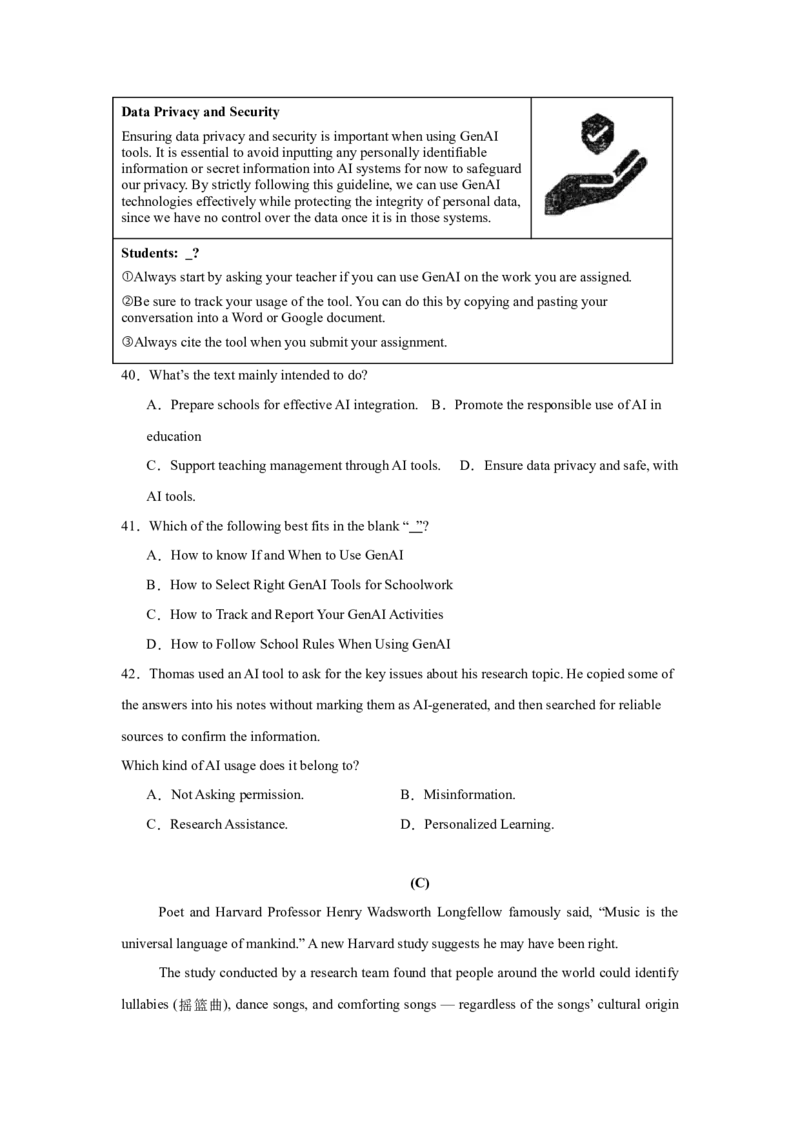
What is Generative AI?
Artificial Intelligence refers to systems designed to complete specific
tasks and has been around for many years. Your smartphone’s facial
recognition and virtual assistants like Alexa and Siri all use AI.
Generative AI (GenAI), however is a newer technology that generates
original content, including text, images, and music, by learning from
existing data. It enables the creation of innovative and customized
educational materials, enhancing creativity and learning.
What is AI’s Role in the Park Hill Classroom?
AI’s purpose in our learning is to enhance, not replace, the effort put
into your teaching and learning. Its use is intended to facilitate, not to
complete tasks on your behalf. AI will offer tailored support to meet
diverse learning needs, by breaking down complex concepts or
summarizing information, thereby enriching the educational
experience.
Data Privacy and Security
Ensuring data privacy and security is important when using GenAI
tools. It is essential to avoid inputting any personally identifiable
information or secret information into AI systems for now to safeguard
our privacy. By strictly following this guideline, we can use GenAI
technologies effectively while protecting the integrity of personal data,
since we have no control over the data once it is in those systems.
Students:  ?
Always start by asking your teacher if you can use GenAI on the work you are assigned.
①
Be sure to track your usage of the tool. You can do this by copying and pasting your
②
conversation into a Word or Google document.
Always cite the tool when you submit your assignment.
③
40.What’s the text mainly intended to do?
A.Prepare schools for effective AI integration.
B.Promote the responsible use of AI in
education
C.Support teaching management through AI tools.
D.Ensure data privacy and safe, with
AI tools.
41.Which of the following best fits in the blank “ ”?
A.How to know If and When to Use GenAI
B.How to Select Right GenAI Tools for Schoolwork
C.How to Track and Report Your GenAI Activities
D.How to Follow School Rules When Using GenAI
42.Thomas used an AI tool to ask for the key issues about his research topic. He copied some of
the answers into his notes without marking them as AI-generated, and then searched for reliable
sources to confirm the information.
Which kind of AI usage does it belong to?
A.Not Asking permission.
B.Misinformation.
C.Research Assistance.
D.Personalized Learning.
 (C)
Poet and Harvard Professor Henry Wadsworth Longfellow famously said, “Music is the
universal language of mankind.” A new Harvard study suggests he may have been right.
The study conducted by a research team found that people around the world could identify
lullabies (摇篮曲), dance songs, and comforting songs — regardless of the songs’ cultural origin
— after hearing just a 14-second clip (片段). The finding suggests that not only is music deeply
rooted in human nature, but that some types of songs break cultural boundaries.
The findings are based on a wide-reaching experiment in which 750 online participants in
60 countries listened to brief clips of songs collected from nearly 90 small societies around the
world, including hunter-gatherers and some special farmers. Participants then answered six
questions, rating each clip according to whether they believed the song was used for dancing,
calming a baby, treating illness, or expressing love. Two additional uses — mourning (哀悼) the
dead and telling a story — were included as controls.
The data showed that despite participants’ unfamiliarity with the cultures, the random
sampling of each song, and the short duration of the samples, people were able to reliably infer the
songs’ functions, and that their ratings were consistent across the world.
The findings ran counter to expert expectations. The team had also asked professionals,
including performers, composers, psychologists, and scientists about whether they believed people
would be able to identify the song types. Their answer was no. And not only that, but they
predicted that people’s responses will be inconsistent with one another. “That’s not what we
found,” the researchers said.
The researchers also wanted to know whether listeners were recognizing certain non-
musical characteristics of the songs. To test that, the team conducted a second study. This time,
they asked listeners about a number of contextual and musical features, ranging from the gender of
the singers to the rhythm of the song.
When data from the two studies were combined, the results showed that songs of the same
function shared similar characteristics — lullabies, for example, tended to be slower and simpler
than dance music — suggesting that something about musical characteristics crosses cultural
boundaries.
43.What did the participants do in the first study?
A.They distinguished functions of the songs.
B.They identified the cultural origins of the songs.
C.They recognized the non-musical characteristics of the songs.
D.They sorted the songs according to the gender of the singers.
44.What does the underlined part “ran counter to” in paragraph 5 probably mean?
A.Were equal to.
B.Were similar to.
C.Were superior to.
D.Were opposite to.
45.Why did the researchers carry out the second study?
A.To test the musical knowledge of a wider audience.
B.To collect more diverse songs from various cultures.
C.To confirm the surprising results from the first one.
D.To explore the underlying reasons behind the findings.
46.What can we learn from the two studies?
A.Listeners recognize music by its rhythm. B.Something about music might be universal.
C.Dance music is usually slower and simpler.
D.Cultural similarities lead to similar
musical features.
Section C
Directions: Read the following passages. Fill in each blank with a proper sentence given in
the box. Each sentence can be used only once. Note that there are two more sentences than
you need.
“Be present.” This is the slogan of mindfulness meditation and a supposed key to self-
awareness and acceptance.
Mindfulness may have psychological benefits. Earlier this year, a synthesis of randomized
controlled trials revealed that mindfulness-based interventions had small to moderate benefits for a
number of health outcomes, including stress, anxiety and depression.
    47     . That is, as we develop skills in complex tasks, we can perform them with
increasing facility until attention seems to be unnecessary. Everyday examples range from riding a
bike to chopping cucumbers-to brushing your teeth.
Forming this state of “automaticity” are mental processes that can be executed without
paying attention to them.     48    . We don’t perform all tasks automatically, but many can be
performed this way once they are well practised.
To be clear, paying attention is important when learning a new skill. But research has also
revealed that paying too much attention to what you’re doing can have damaging effects,
particularly when you perform well-practised skills. In fact, this is one reason why some experts
appear to “choke under pressure”:     49    .
In a classic study, cognitive scientist Sian Beilock and her colleagues had skilled golfers
attempt to sink putts ( 推球入洞) under different experimental conditions. In one scheme, the
golfers were simply instructed to pay attention to the swing of their club and say “stop” when they
finished their swing. In another condition, they were directed to listen for a target sound while
ignoring other noises and say the word “tone” when they heard the target sound. Surprisingly, the
skilled golfers performed considerably worse when they focused on their swing than when they
paid attention to irrelevant sounds.
Nevertheless, the important message from this research is that focusing too carefully on the
execution of well-practiced motor sequences can cause mistakes.     50    . But there are
situations where we should let automaticity take over. The next time you ride a bike or join in a
sport, don’t overthink it.
A.In any type of mindfulness exercise, the goal is to perform routine activities with a heightened
sense of attention.
B .Although mindfulness has its advantages, psychological research has also revealed that in
some circumstances it’s important to be mindless.
C.They think too much about the mechanics of the task at hand.
D.Automaticity can be disrupted by explicit attention when the devotion of conscious attention
to the pattern alters the content or timing of that pattern itself.
E.Of course, we should not resign to go through life on autopilot, missing opportunities to make
deeper connections with ourselves, one another and our environment.
F.These processes run off without conscious awareness — a chain reaction of mental events.
IV. Summary Writing   (10 分)
Directions: Read the following passage. Summarize the main idea and the main point(s) of the
passage in no more than 60 words. Use your own words as far as possible.
How Thankfulness Help Us
When you feel thankful for things you've received, that's gratitude. You never feel it from
nowhere; you are clear who or what is responsible. “Gratitude is how you relate to others,”says
Willibald Ruch, a psychology professor at the University of Zurich. He and other researchers
believe this understanding of our reliance on others is becoming more difficult today.”With
commercial and social media, everything makes the younger generation feel that they are the
center of the universe,” says Tamiko Zablith, founder of the consulting firm Minding Manners. “If
it's all about them, why thank others?”
If true, this would be a disturbing health trend, because thanking others in heartfelt ways
carries long-lasting effects. Canadian researchers found that people who wrote thank-you letters or
performed good deeds for a six-week period decreased their pain, upped their energy,
accomplished more every day, and improved their mental health. And you can experience these
benefits at any age. Swedish researchers have found that people ages 77 to 90 who choose to be
thankful are happier and stronger.”When they can't change something, they choose gratitude and
focus on what's good, like still being living by themselves,” says study author Helena Honder, at
the University of Gothenburg in Sweden.
Gratitude is infectious, as well: Those who are helped are more likely to pay kindness
forward. One study found that when someone is thanked, it more than doubles his or her chances
of being helpful again, likely because he or she enjoys feeling socially valued. Zablith likes the
reaction she gets when she thanks a stranger who holds the door open for her at Starbucks. “The
look on his face is shock,”Zablith says. “He'll be nicer to the cashier, the next person he sees at
work.”
Let's remember: gratitude isn't just a feeling—it's a powerful choice to recognize and
appreciate others. With gratitude, we not only uplift ourselves but also contribute to a kinder, more
connected world.
_______________________________________________________________________________
_______________________________________________________________________________
_______________________________________________________________________________
_______________________________________________________________________________
_______________________________________________________________________________
_______________________________________________________________________________
_______________________________________________________________________________
___________________
V. Translation  (第1-2 句,每句3 分;第3 句,4 分;第4 句5 分;共15 分)
Directions: Translate the following sentences into English, using the words given in the brackets.
52.图书馆里有海量的读物供我们选择。(vast)


53.你上次忘记重要的事,是什么时候了?(slip)


54.你口口声声说不再意气用事,可还是做不到情绪稳定,伤人伤己。(abandon)


55.百年老建筑摇身一变,成为集展览、阅读、休闲于一体的多功能文化空间,吸引了越
来越多的居民前来参观。(transform)


VI. Guided Writing  (25 分)
假设你是明启中学学生李志,看到了你所在社区的如下广告,并有意尝试该工作,给社区
负责人写封信申请该工作。
Children’s holiday club leader wanted!
We’re looking for a creative and confident leader for our children’s holiday club. Why would
you be suitable for the role? What do you enjoy about working with children? Are you available
at weekends?
If you’re capable of inventing and running fun activities for 4 to 11-year-olds, we’d love to hear
from you.
_______________________________________________________________________________
_______________________________________________________________________________
_______________________________________________________________________________
_______________________________________________________________________________
_______________________________________________________________________________
_______________________________________________________________________________
_______________________________________________________________________________
_______________________________________________________________________________
________________________________________________________________________