2024 年中考英语一轮复习模拟卷(河南卷)
注意事项:
1. 本试卷共10页,六个大题,满分120分,考试时间100分钟。
2. 本试卷上不要答题,请按答题卡上注意事项的要求直接把答案填写在答题卡上,答在试卷上的答案无
效。
一、听力理解(20小题,每小题1分,共20分)
第一节 听下面5段对话。每段对话后有一个小题,从题中所给的A、B、C三个选项中选出最佳答案。每
段对话读两遍。
1.Where are the speakers now?
A.In a restaurant. B.In a shop. C.In a hospital.
2.What is the boy doing now?
A.Waiting for his friend. B.Studying in the library. C.Looking for his notebook.
3.Which button is used to turn on the CD player?
A.The first button. B.The second button. C.The third button.
4.Who may travel with the boy this holiday?
A.Tom. B.Mike. C.His mom.
5.Where does the woman want to go?
A.A fruit shop. B.A drug store. C.A Post office.
第二节 听下面几段对话或独白。每段对话或独白后有几个小题,从题中所给的A、B、C三个选项中选出
最佳答案。每段对话或独白读两遍。
听下面一段对话,回答第6至第7两个小题。
6.Who is Molly?
A.Bill’s sister. B.Bill’s mother. C.Bill’s dog.
7.How will Bill go to school?
A.By car. B.By bus. C.By bike.
听下面一段对话,回答第8至第9两个小题。
8.How many people will be travelling?
A.Four. B.Three. C.Two.
9.When will the man leave for Seattle?
A.This Wednesday. B.Next Monday. C.Next Wednesday.
听下面一段独白,回答第10至第12三个小题。
10.How long will the students spend on the bus?
A.One hour. B.Two hours. C.Three hours.
11.What will the students do after coming back?
A.Write a diary. B.Share the photos. C.Discuss their experiences.
12.What is the speaker mainly talking about?A.Hobby. B.Travel. C.Education.
听下面一段对话,回答第13至第15三个小题。
13.Where does the conversation take place?
A.On a plane. B.In a post office. C.At a ticket office.
14.How long does the flight take?
A.About 3 hours. B.About 4 hours. C.About 5 hours.
15.What can we learn from the dialogue?
A.The man will travel with his family.
B.The man will take the ticket for business class.
C.The man’s telephone number is 8250-2248.
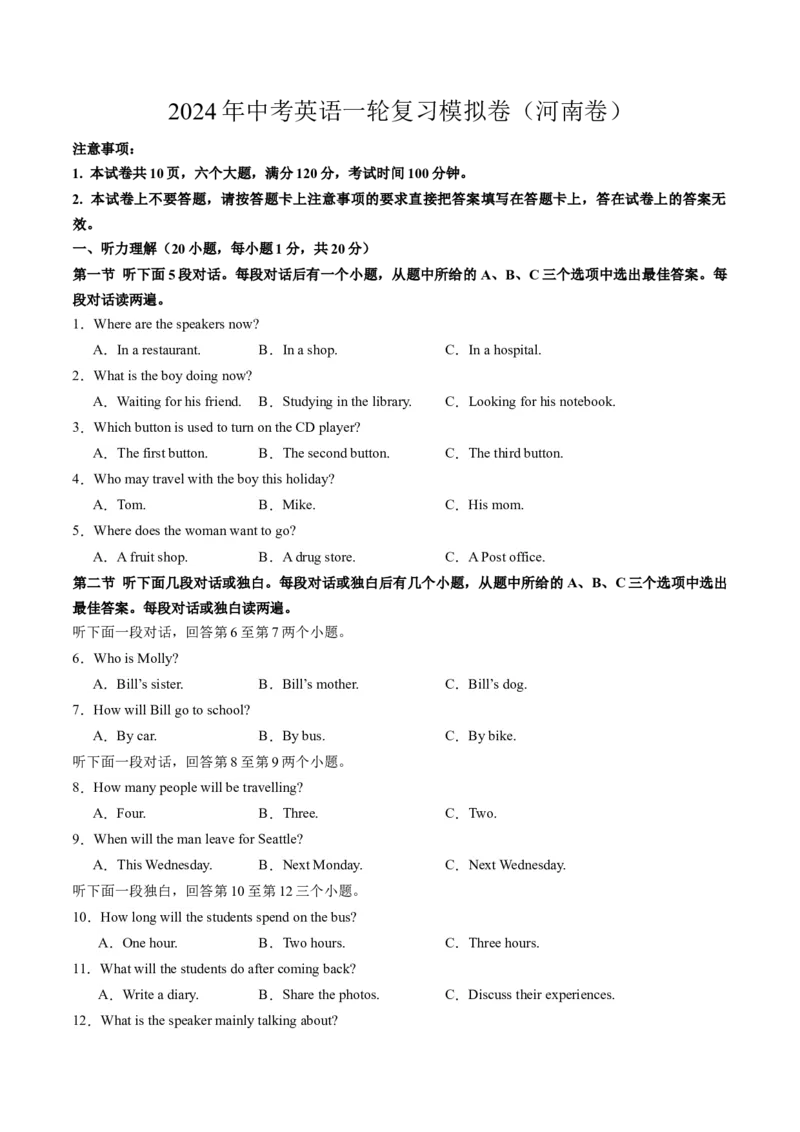
第三节 听下面一篇短文。按照你所听内容的先后顺序将下列图片排序。短文读两遍。
16._________ 17._________ 18._________ 19._________ 20._________
二、阅读理解(20小题,每小题2分,共40分)
阅读下面四篇语言材料,然后按文后要求做题。
A
Useful Apps for You
Many of you may have experienced surfing the Internet for searching the helpful apps in order to finish the
schoolwork. Apps are typical digital tools for your study, which can give you different and personalized content (个
性化的内容) to meet your learning or needs. Do you also want to find an app that can help you learn something
efficiently (高效地)? It is my great honor to recommend (推荐) you some great apps to you!
This free app is a great tool for those who are interested in
public speaking. It has collected more than seven hundred talks
from the world’s most famous thinkers, leaders and artists. There
is a short introduction for each talk so that you can get the main
idea in advance. You can watch talks by subject and download
some to watch on offline.BrainPOP mixes learning and technology in a fun and
simple way. It is free and teaches you something new in English
every day. From the solar system to DNA, each topic starts with
an interesting cartoon. After you have watched it, you can take a
test to see how much you have learned.
This app allows you to learn almost anything for free. It
covers subjects such as math, physics, biology, and even
computer science.
The real magic of Khan Academy is that you can learn at
your own speed. You can review subjects that you are not good
at, or start learning a subject, like a geometry (几何). The app is
in English if you need its translation, you can visit
http://open.163.com/khan.
根据材料选择最佳答案。
21.Who does the writer want to recommend these apps to?
A.Teachers. B.Students. C.Businessmen. D.Doctors.
22.What can we know from the passage?
A.The above three apps can be used for free.
B.BrainPOP users can learn at their own speed.
C.Khan Academy users can download talks from them.
D.TED users can take s test to see how much they have learned.
23.Which app will you choose if you are interested in math?
A.BrainPOP. B.TED. C.Khan Academy. D.Both B and C.
24.Who would TED try to attract?
A.TED would try to attract those who teach English online.
B.TED would try to attract those who learn math and physics.
C.TED would try to attract those who show interest in public speaking
D.TED would try to attract those who plan to search for their roots through a DNA test.
25.What can we probably read the passage?
A.In a sports magazine. B.In a learning magazine.
C.In a travel guide. D.In a business book.
B
There was once a small village at the foot of a mountain. One day, an old man came to the village. He called
out, “Hot and delicious dumplings. One for 10 cents, two for 20 cents, and three for free!”
When one villager asked him if it was a joke, the old man answered, “It’s true.” The villager ordered threedumplings. After he finished the third one, the old man smiled and let him leave. Soon, other villagers copied the
first villager’s action. They all got the free dumplings.
When the old man “sold” all his dumplings, he left. Then, villagers started talking. Most of them said the old
man was silly.
In the following days, the old man kept coming. Each time the old man came, the villagers ate as many free
dumplings as they could. One day, a young man came. He asked for one dumpling.
The old man asked, “Why only one?” The young man answered, “You work so hard for no money. I feel bad
and want to help you.”
“Aha! I found you,” said the old man. “I’m in charge of (掌管) the mountain. You have the character to be my
student.” After that, he took the young man away to help him in charge of the mountain.
The villagers were surprised. Then someone pointed out that the old man’s dumpling pot was full of mud (泥)
and mountain rocks. What’s more, they saw that half of their mountain was missing. It looked like somebody had
cut it in half. From then on, the villagers called it Banping Mountain to remind themselves not to be greedy (贪婪
的).
根据材料内容选择最佳答案,并将其标号填入题前括号内。
26.Other villagers followed the first villager’s action to ________.
A.get the free dumplings B.help the old man
C.cheat the old man D.make friends with the old man
27.Why did the old man sell the free dumplings?
A.To look for one of his students.
B.To make a joke with the villagers.
C.To give some help to the villagers.
D.To find a man to help him in charge of the mountain.
28.What’s the correct order according to the text?
a. The old man took the young man away.
b. A young man asked for only one dumpling.
c. The villagers thought the old man was stupid.
d. The villagers saw that half of their mountain was missing.
e. An old man came to the mountain village to sell dumplings.
A.e-c-b-a-d B.c-b-d-e-a C.d-b-e-a-c D.a-c-b-d-e
29.Which word can best describe the old man?
A.Silly. B.Rich. C.Wise. D.Kind.
30.What can we learn from the text?
A.We shouldn’t be greedy.
B.Be honest to anyone.
C.Be kind to everyone we meet.
D.We will be punished if we buy things without paying.C
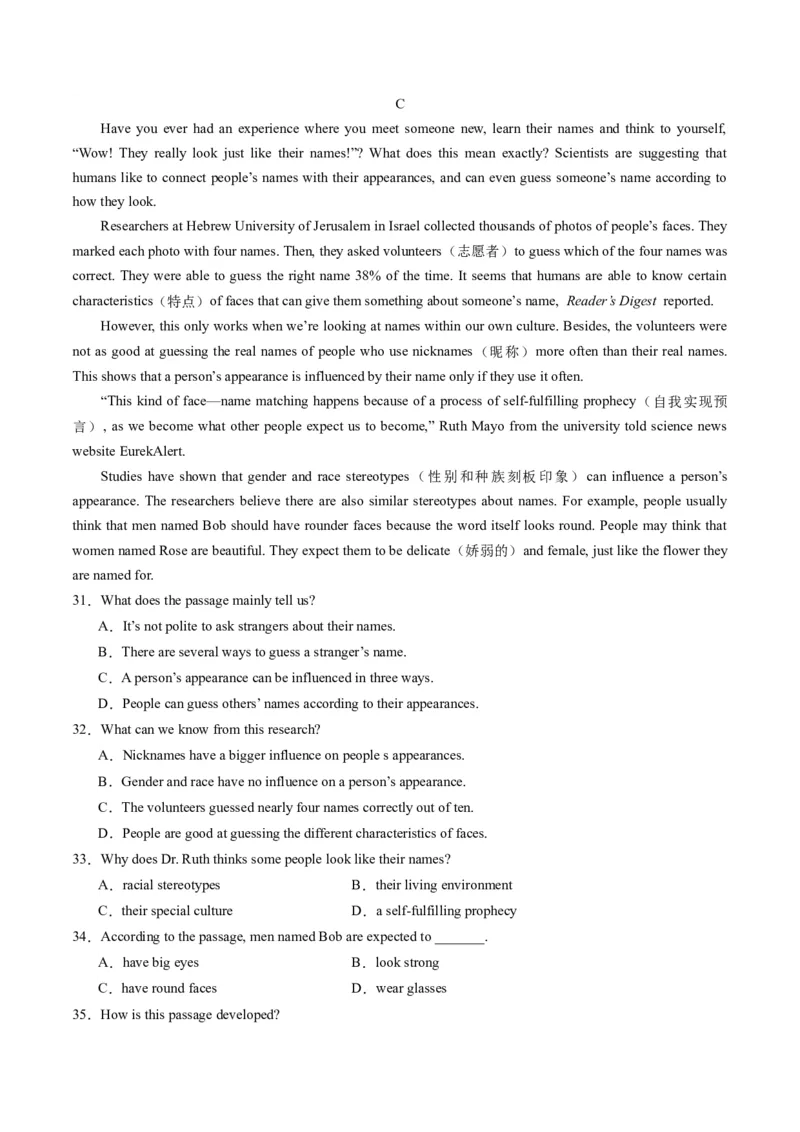
Have you ever had an experience where you meet someone new, learn their names and think to yourself,
“Wow! They really look just like their names!”? What does this mean exactly? Scientists are suggesting that
humans like to connect people’s names with their appearances, and can even guess someone’s name according to
how they look.
Researchers at Hebrew University of Jerusalem in Israel collected thousands of photos of people’s faces. They
marked each photo with four names. Then, they asked volunteers(志愿者)to guess which of the four names was
correct. They were able to guess the right name 38% of the time. It seems that humans are able to know certain
characteristics(特点)of faces that can give them something about someone’s name, Reader’s Digest reported.
However, this only works when we’re looking at names within our own culture. Besides, the volunteers were
not as good at guessing the real names of people who use nicknames(昵称)more often than their real names.
This shows that a person’s appearance is influenced by their name only if they use it often.
“This kind of face—name matching happens because of a process of self-fulfilling prophecy(自我实现预
言), as we become what other people expect us to become,” Ruth Mayo from the university told science news
website EurekAlert.
Studies have shown that gender and race stereotypes(性别和种族刻板印象)can influence a person’s
appearance. The researchers believe there are also similar stereotypes about names. For example, people usually
think that men named Bob should have rounder faces because the word itself looks round. People may think that
women named Rose are beautiful. They expect them to be delicate(娇弱的)and female, just like the flower they
are named for.
31.What does the passage mainly tell us?
A.It’s not polite to ask strangers about their names.
B.There are several ways to guess a stranger’s name.
C.A person’s appearance can be influenced in three ways.
D.People can guess others’ names according to their appearances.
32.What can we know from this research?
A.Nicknames have a bigger influence on people s appearances.
B.Gender and race have no influence on a person’s appearance.
C.The volunteers guessed nearly four names correctly out of ten.
D.People are good at guessing the different characteristics of faces.
33.Why does Dr. Ruth thinks some people look like their names?
A.racial stereotypes B.their living environment
C.their special culture D.a self-fulfilling prophecy
34.According to the passage, men named Bob are expected to _______.
A.have big eyes B.look strong
C.have round faces D.wear glasses
35.How is this passage developed?A.By doing a test. B.By giving examples.
C.By asking questions. D.By comparing different ways.
D
The Art of Paper
Chen Zijiang is a paper-cutting expert whom I interviewed for my article on Chinese Art. Paper-cutting is
something that he learned to do from an early age.
"It is a Chinese folk art with a long history," Mr. Chen told me, "Paper cuts of animals have been found in
tombs(坟墓). 36 " He added that by the Southern Song Dynasty, paper-cutting had become an important
part of everyday life.
37 They are paper cuts for decoration, for religious purposes(宗教目的) and for design patterns.
Paper cuts for decoration are often seen on windows and gates. 38 They are also used on presents. A
present for parents whose child has recently been born might show a paper cut of children, for example. Paper cuts
which show the Chinese character for double happiness are often used to celebrate weddings.
Paper cuts for religious purposes are often found in temples. 39
The third kind of paper cuts are those used to make patterns on clothing. They are also sometimes used to
decorate jewellery boxes. 40
A.They are usually put up during holidays to bring good luck.
B.They are also used as offerings to the dead.
C.Dragons are very popular patterns for these designs.
D.They can date back to the time of the Northern and Southern Dynasty.
E.Mr. Chen went on to explain that there are three types of paper cuts which people still make.
三、完形填空(15小题,每小题1分,共15分)
先通读短文,掌握其大意,然后从A、B、C、D四个选项中选出一个可以填入相应空白处的最佳答案。
The little girl went to school each day feeling frightened. She had been used to it, but it still hurt her when her
classmates 41 her.
When she was younger, she used to 42 when the laughing began. But as she grew older, she no longer
hid in shame. Still, it hurt. She had no 43 . The laughing turned her into a girl who kept to herself. But
friends were what she wanted most.
“Your mother is so 44 ,” the kids would say, “Your mother’s 45 is like a monster’s one,” they
said. “Cathy has a monster for a mother!”
Sometimes, Cathy wanted to 46 that her mother was not her mother. She wanted to tell the others that
the woman was not her mother at all. When this happened, she was filled with guilt(内疚) and 47 , for her
mother was the 48 and most generous of all the mothers in the world. She did so many great things and
helped lots of people.
Cathy’s mother did in fact have a scary face. It has long purple ugly scars (伤疤) on it. One day, when Cathy
came home 49 , her grandmother took her aside. “Why are you crying?” asked her grandmother. Cathy
explained how difficult it was to stand the laughing from her classmates. She told her how 50 she felt
each day at school with no friends around her.Her grandmother said, “It’s time to tell you the story of 51 your mother came to have such a face.
One day, you were sleeping in your bed and your mother was across the street talking with a neighbor. 52
, she noticed smoke coming from your house. Everyone rushed to the door, but it was too dangerous to go inside.
Your mother ran into the fire without thinking twice, not thinking of 53 , only of you, her dear child.
She brought you out safely, 54 her own body was burned from top to bottom, especially her face. That’s
the story of the ugly scars.” Cathy was 55 again embarrassed of her mother.
From that day on, she walked with her head high, knowing that she, above all the other children, had a mother
who loved her very much.
41.A.looked for B.heard from C.laughed at D.worried about
42.A.hide B.cry C.argue D.fight
43.A.family B.friends C.teachers D.classmates
44.A.bad B.worried C.poor D.ugly
45.A.face B.body C.nose D.eye
46.A.lie B.change C.leave D.discuss
47.A.love B.shame C.anger D.fear
48.A.prettiest B.happiest C.richest D.kindest
49.A.talking B.crying C.shouting D.laughing
50.A.surprised B.angry C.lonely D.bored
51.A.how B.when C.what D.where
52.A.Specially B.Bravely C.Suddenly D.Slowly
53.A.herself B.yourself C.himself D.themselves
54.A.because B.so C.and D.but
55.A.always B.never C.sometimes D.often
四、语篇填空(15小题,每小题1分,共15分)
第一节
阅读短文,从方框中选择适当的词并用其正确形式填空,使短文通顺、意思完整。每空限填一词,每词限
用一次。
since write power usual for reply mean correct lucky they
In Chinese culture, the color red stands for many good things, for example, happiness. But writing names and
letters with red pens is 56 avoided.
In ancient times, red was the symbol of 57 . Not everyone could write with red pens-only emperors.
They would reply to officials’ memorials (奏折) with red pens. These 58 were known as pizhu.
Writing with red pens was also related to death. In ancient China, the criminals who were sentenced to death
signed 59 names with red pens. The records of criminals’ names were all 60 in red words.
Therefore, it was thought to be 61 to write names with red pens.
62 red words carry bad meanings, people don’t write letters with red pens. If you write to friends or
family members with red pens, it 63 you want to break up with them.Nowadays, red pens are used 64 proof-reading (校对). Teachers mark students’ homework with red
pens. So do editors who need to 65 mistakes in newspapers and magazines. But writing names or letters
with red pens is still a bad idea to many people.
第二节
阅读短文,根据语篇要求填空,使短文通顺、意思完整。每空限填一词。
In some foreign countries, some people don’t like the number 13. They don’t think 13 is 66 lucky
number, for example, they don’t like to live on the thirteenth floor.
One day, my friend Jack asked friends to dinner. When all of his friends arrived, he asked them 67
sit at the table. He began to count the people in his mind while they were having the delicious food. Suddenly, he
cried out, “Oh, 68 are thirteen people here!”
Everyone’s face turned white except Mr. Brown. He said slowly 69 a smile on his face, “Don’t
worry, my friends. We have fourteen people here. My wife Mrs. Brown 70 have a baby in a few weeks.
She is in the family now.”
All of them became happy again, “Congratulations!” they said. They all had a good time that evening.
五、补全对话(5小题,每小题2分,共10分)
根据下面的对话情景,在每个空白处填上一个适当的句子,使对话的意思连贯、完整。
A: Hey, Bill. What a long day!
B: Hi, Sam. 71 ?
A: Yes. I do. I’m going to play soccer on Saturday afternoon.
B: Sounds fun. Where do you play?
A: At the soccer field near my home. 72 ?
B: Sure, I’d love to.
A: Great. I’ll call my teammates and tell them you are coming.
B: Thanks. But I’m a little worried. 73 .
A: That’s OK. Don’t worry about it.
B: 74 ?
A: Well, you should warm up before we play the game, and bring a bottle of water. If you want to learn some skills,
my teammate Scott will tell you something about that.
B: 75 .
A: You’re welcome. It’s just for fun, so no one takes it too seriously.
B: OK. See you on Saturday afternoon.
六、书面表达(20分)
奋斗的道路不会一帆风顺,初中三年我们在生活和学习上都经历过困难。Teenager magazine正在举办
“How to get over difficulty”为题的英文征文比赛。请根据提示结合自身实际情况,写一篇短文投稿。
(1)遇到的困难,
(2)解决的办法,
(3)收获与感想。
1. 请围绕所给要点写作,可适当发挥;2. 语句通顺、意思连贯,80—100 词左右;
3. 文中不得使用真实的个人及学校信息。
How to get over difficulty
______________________________________________________________________________
______________________________________________________________________________
______________________________________________________________________________
______________________________________________________________________________
______________________________________________________________________________
______________________________________________________________________________
______________________________________________________________________________
______________________________________________________________________________
______________________________________________________________________________
______________________________________________________________________________
________________________________________________