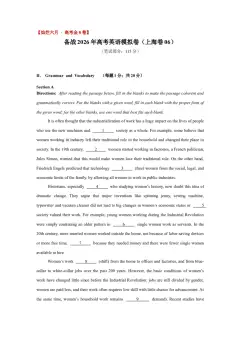
备战2024年高考英语模拟卷06(上海卷)
(考试时间:120分钟 试卷满分:140分)
注意事项:
1.答卷前,考生务必将自己的姓名、考生号等填写在答题卡和试卷指定位置上。
2.回答选择题时,选出每小题答案后,用铅笔把答题卡对应题目的答案标号涂黑。如需改动,用
橡皮擦干净后,再选涂其他答案标号。回答非选择题时,将答案写在答题卡上。写在本试卷上无效。
3.考试结束后,将本试卷和答题卡一并交回。
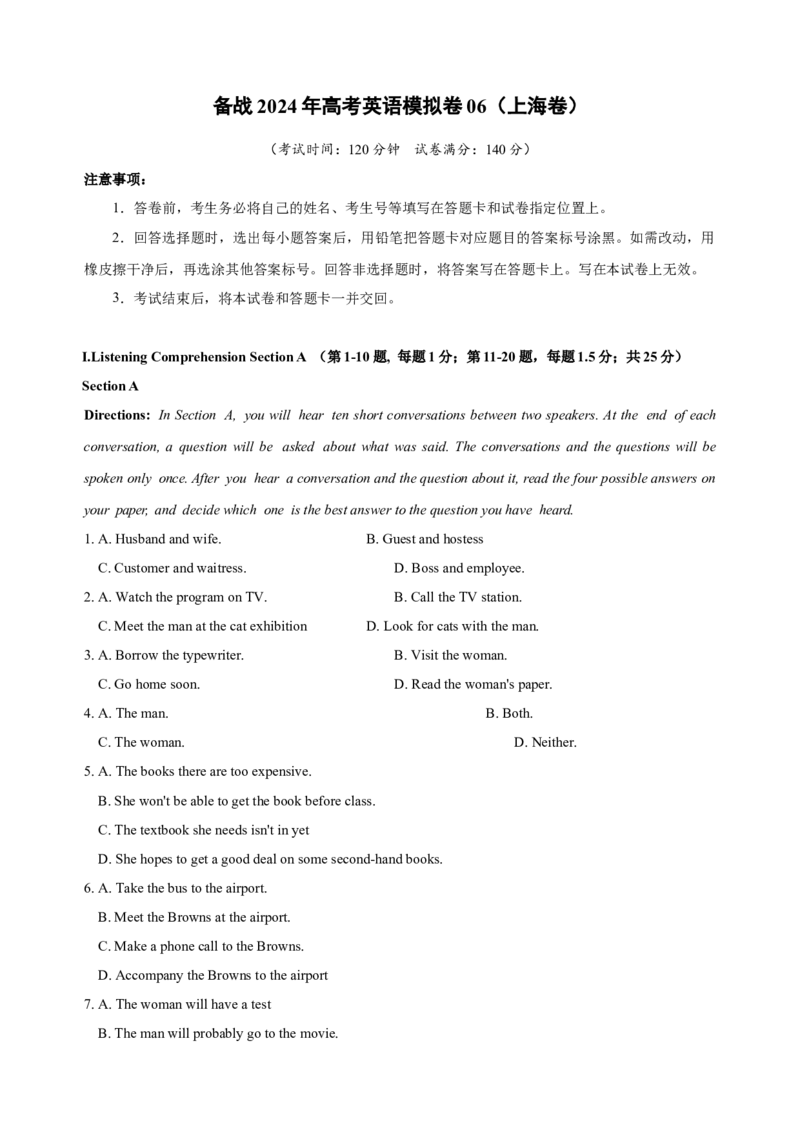
I.Listening Comprehension Section A (第1-10题, 每题1分;第11-20题,每题1.5分;共25分)
Section A
Directions: In Section A, you will hear ten short conversations between two speakers. At the end of each
conversation, a question will be asked about what was said. The conversations and the questions will be
spoken only once. After you hear a conversation and the question about it, read the four possible answers on
your paper, and decide which one is the best answer to the question you have heard.
1. A. Husband and wife. B. Guest and hostess
C. Customer and waitress. D. Boss and employee.
2. A. Watch the program on TV. B. Call the TV station.
C. Meet the man at the cat exhibition D. Look for cats with the man.
3. A. Borrow the typewriter. B. Visit the woman.
C. Go home soon. D. Read the woman's paper.
4. A. The man. B. Both.
C. The woman. D. Neither.
5. A. The books there are too expensive.
B. She won't be able to get the book before class.
C. The textbook she needs isn't in yet
D. She hopes to get a good deal on some second-hand books.
6. A. Take the bus to the airport.
B. Meet the Browns at the airport.
C. Make a phone call to the Browns.
D. Accompany the Browns to the airport
7. A. The woman will have a test
B. The man will probably go to the movie.C. The man will have to sit for an exam.
D. The woman wishes she could go to class with the man.
8. A. The results haven't come yet.
B. The results were checked again last night.
C. The woman needs another test tomorrow.
D. The doctor hasn't come back from the lab.
9. A. Most neighbors are as noisy as the woman.
B. Talking to the neighbors politely might be the best way
C. He'd like to know why the woman is angry
D. The woman is too polite for her neighbors.
10. A. He needs to buy another umbrella.
B. It will rain much later in the week.
C. It will probably rain tomorrow.
D. The weather forecasters almost never agree.
Section B
Directions: In Section B. you will hear two short passages several and one longer conversation, and you will
be asked several questions on each of them. The passages and the conversation will be read twice, but the
questions will be spoken only once. When you hear a question, read the four possible answers on your paper
and decide which one is the best answer to the question you have heard.
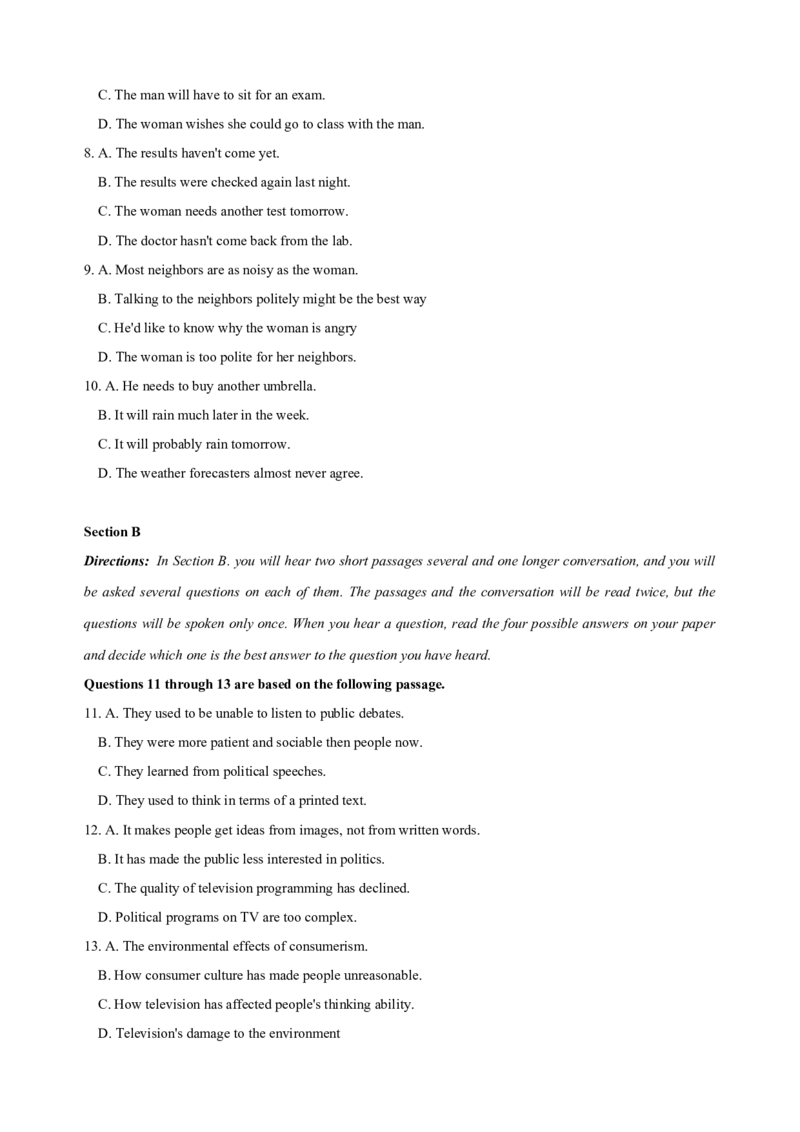
Questions 11 through 13 are based on the following passage.
11. A. They used to be unable to listen to public debates.
B. They were more patient and sociable then people now.
C. They learned from political speeches.
D. They used to think in terms of a printed text.
12. A. It makes people get ideas from images, not from written words.
B. It has made the public less interested in politics.
C. The quality of television programming has declined.
D. Political programs on TV are too complex.
13. A. The environmental effects of consumerism.
B. How consumer culture has made people unreasonable.
C. How television has affected people's thinking ability.
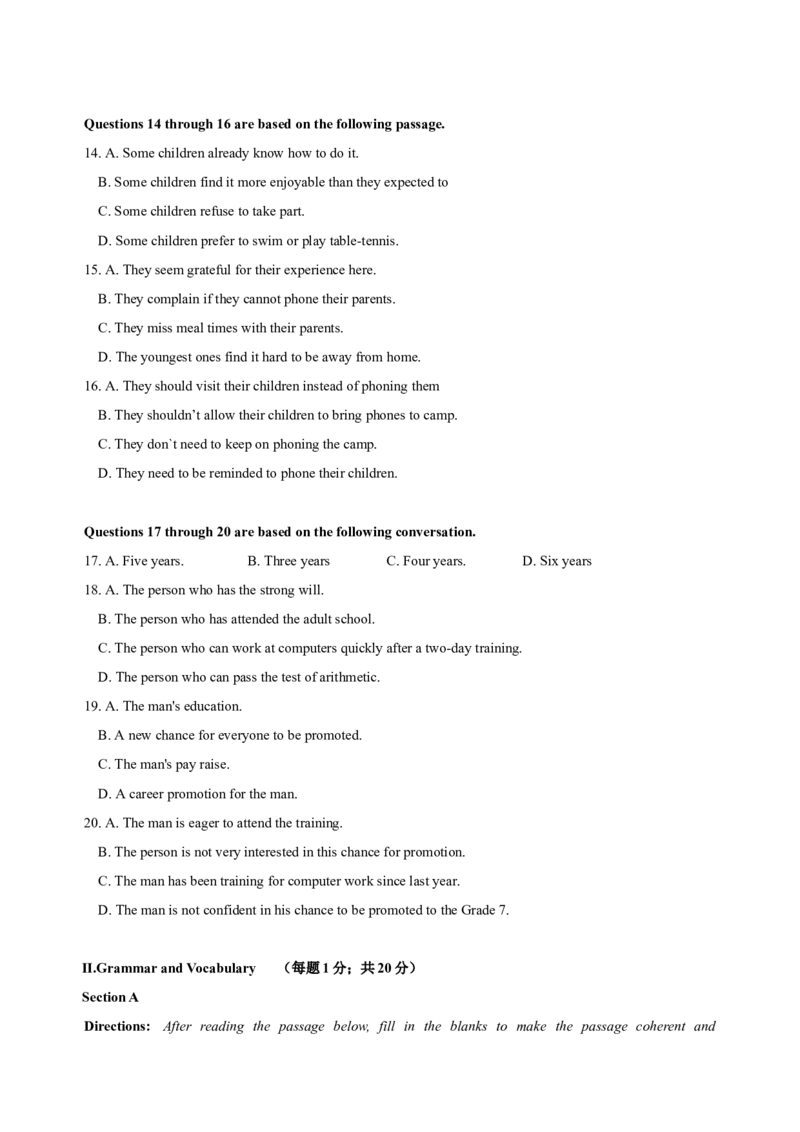
D. Television's damage to the environmentQuestions 14 through 16 are based on the following passage.
14. A. Some children already know how to do it.
B. Some children find it more enjoyable than they expected to
C. Some children refuse to take part.
D. Some children prefer to swim or play table-tennis.
15. A. They seem grateful for their experience here.
B. They complain if they cannot phone their parents.
C. They miss meal times with their parents.
D. The youngest ones find it hard to be away from home.
16. A. They should visit their children instead of phoning them
B. They shouldn’t allow their children to bring phones to camp.
C. They don`t need to keep on phoning the camp.
D. They need to be reminded to phone their children.
Questions 17 through 20 are based on the following conversation.
17. A. Five years. B. Three years C. Four years. D. Six years
18. A. The person who has the strong will.
B. The person who has attended the adult school.
C. The person who can work at computers quickly after a two-day training.
D. The person who can pass the test of arithmetic.
19. A. The man's education.
B. A new chance for everyone to be promoted.
C. The man's pay raise.
D. A career promotion for the man.
20. A. The man is eager to attend the training.
B. The person is not very interested in this chance for promotion.
C. The man has been training for computer work since last year.
D. The man is not confident in his chance to be promoted to the Grade 7.
II.Grammar and Vocabulary (每题1分;共20分)
Section A
Directions: After reading the passage below, fill in the blanks to make the passage coherent andgrammatically correct. For the blanks with a given word, fill in each blank with the proper form of the given
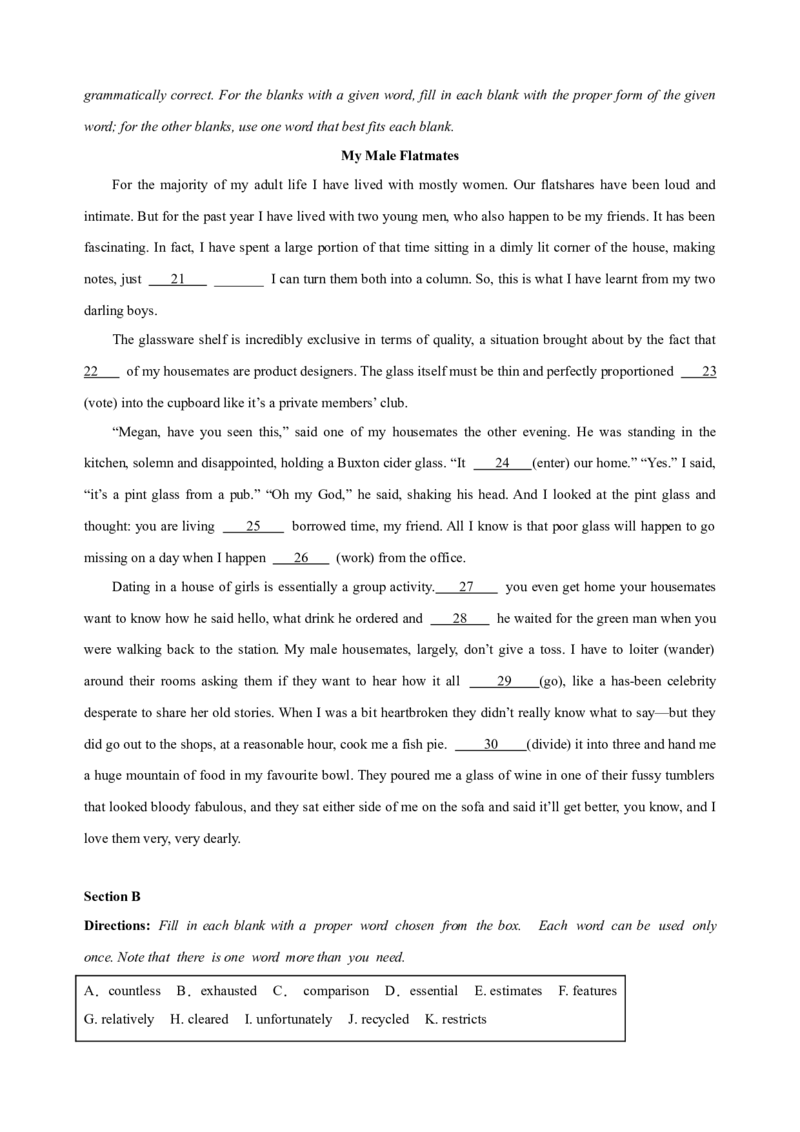
word; for the other blanks, use one word that best fits each blank.
My Male Flatmates
For the majority of my adult life I have lived with mostly women. Our flatshares have been loud and
intimate. But for the past year I have lived with two young men, who also happen to be my friends. It has been
fascinating. In fact, I have spent a large portion of that time sitting in a dimly lit corner of the house, making
notes, just 21 _______ I can turn them both into a column. So, this is what I have learnt from my two
darling boys.
The glassware shelf is incredibly exclusive in terms of quality, a situation brought about by the fact that
22 of my housemates are product designers. The glass itself must be thin and perfectly proportioned 23
(vote) into the cupboard like it’s a private members’ club.
“Megan, have you seen this,” said one of my housemates the other evening. He was standing in the
kitchen, solemn and disappointed, holding a Buxton cider glass. “It 24 (enter) our home.” “Yes.” I said,
“it’s a pint glass from a pub.” “Oh my God,” he said, shaking his head. And I looked at the pint glass and
thought: you are living 25 borrowed time, my friend. All I know is that poor glass will happen to go
missing on a day when I happen 26 (work) from the office.
Dating in a house of girls is essentially a group activity. 27 you even get home your housemates
want to know how he said hello, what drink he ordered and 28 he waited for the green man when you
were walking back to the station. My male housemates, largely, don’t give a toss. I have to loiter (wander)
around their rooms asking them if they want to hear how it all 29 (go), like a has-been celebrity
desperate to share her old stories. When I was a bit heartbroken they didn’t really know what to say—but they
did go out to the shops, at a reasonable hour, cook me a fish pie. 30 (divide) it into three and hand me
a huge mountain of food in my favourite bowl. They poured me a glass of wine in one of their fussy tumblers
that looked bloody fabulous, and they sat either side of me on the sofa and said it’ll get better, you know, and I
love them very, very dearly.
Section B
Directions: Fill in each blank with a proper word chosen from the box. Each word can be used only
once. Note that there is one word more than you need.
A.countless B.exhausted C. comparison D.essential E. estimates F. features
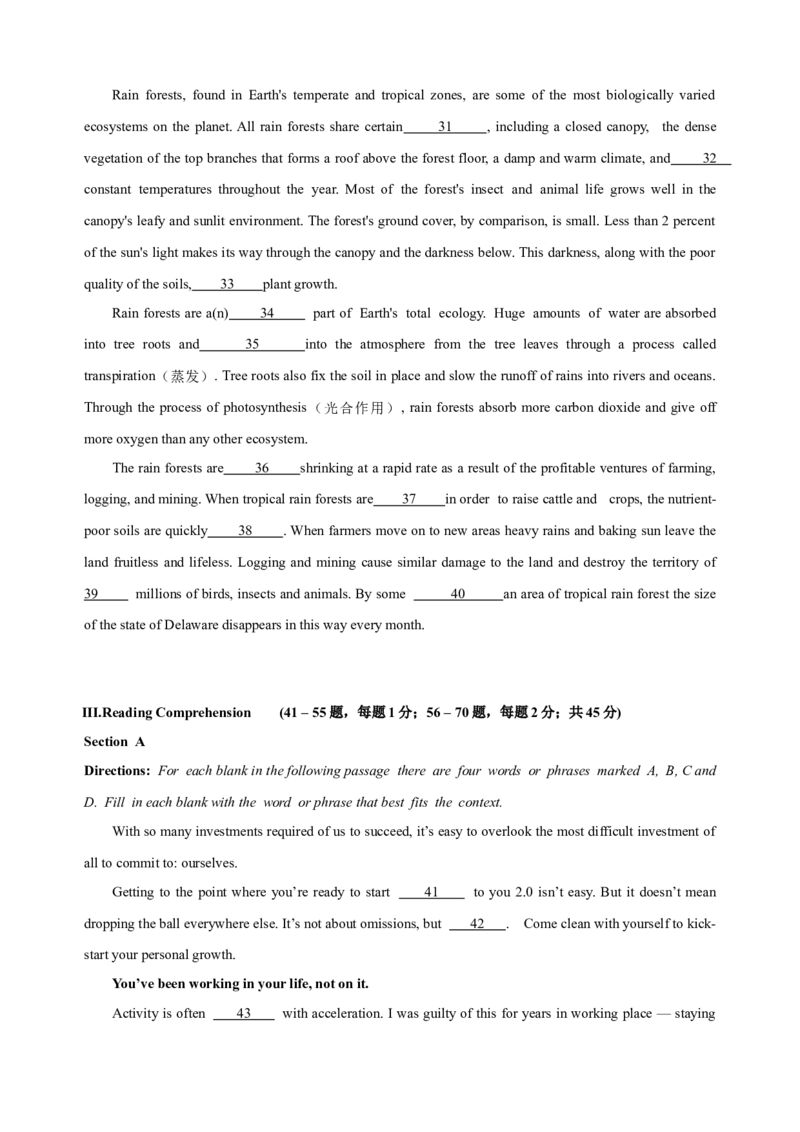
G. relatively H. cleared I. unfortunately J. recycled K. restrictsRain forests, found in Earth's temperate and tropical zones, are some of the most biologically varied
ecosystems on the planet. All rain forests share certain 31 , including a closed canopy, the dense
vegetation of the top branches that forms a roof above the forest floor, a damp and warm climate, and 32
constant temperatures throughout the year. Most of the forest's insect and animal life grows well in the
canopy's leafy and sunlit environment. The forest's ground cover, by comparison, is small. Less than 2 percent
of the sun's light makes its way through the canopy and the darkness below. This darkness, along with the poor
quality of the soils, 33 plant growth.
Rain forests are a(n) 34 part of Earth's total ecology. Huge amounts of water are absorbed
into tree roots and 35 into the atmosphere from the tree leaves through a process called
transpiration(蒸发). Tree roots also fix the soil in place and slow the runoff of rains into rivers and oceans.
Through the process of photosynthesis(光合作用), rain forests absorb more carbon dioxide and give off
more oxygen than any other ecosystem.
The rain forests are 36 shrinking at a rapid rate as a result of the profitable ventures of farming,
logging, and mining. When tropical rain forests are 37 in order to raise cattle and crops, the nutrient-
poor soils are quickly 38 . When farmers move on to new areas heavy rains and baking sun leave the
land fruitless and lifeless. Logging and mining cause similar damage to the land and destroy the territory of
39 millions of birds, insects and animals. By some 40 an area of tropical rain forest the size
of the state of Delaware disappears in this way every month.
III.Reading Comprehension (41 – 55题,每题1分;56 – 70题,每题2分;共45分)
Section A
Directions: For each blank in the following passage there are four words or phrases marked A, B, C and
D. Fill in each blank with the word or phrase that best fits the context.
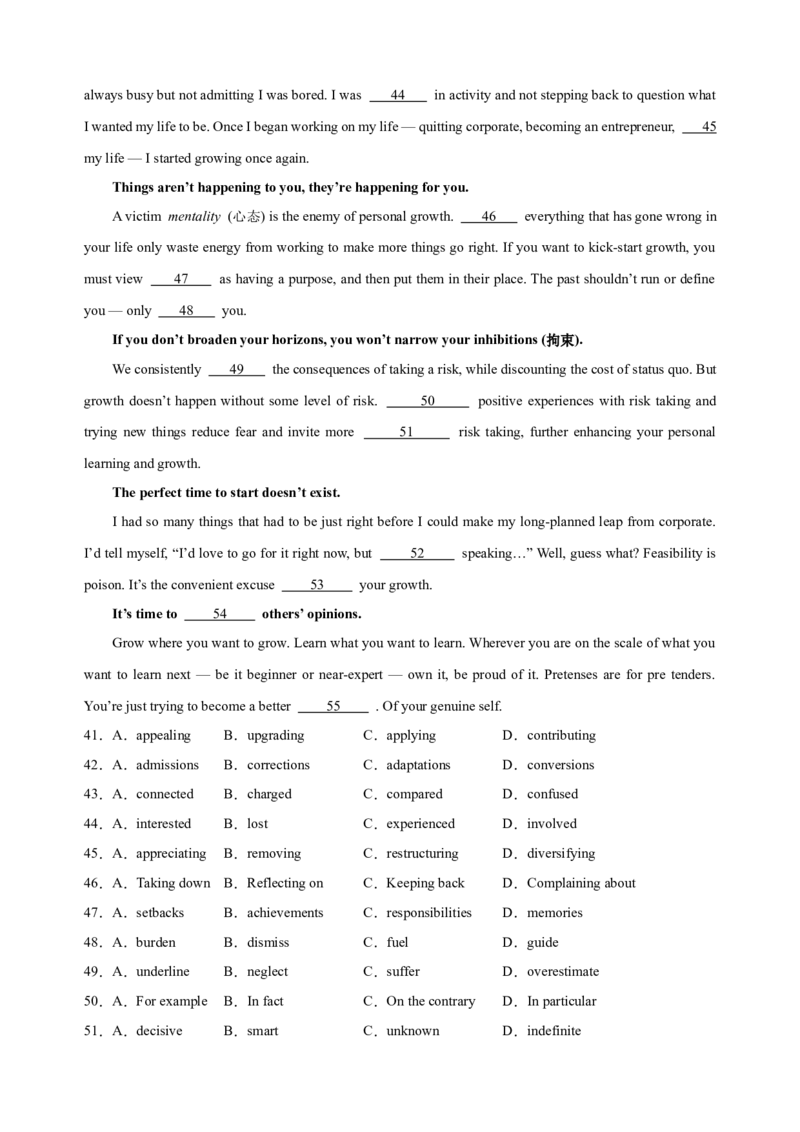
With so many investments required of us to succeed, it’s easy to overlook the most difficult investment of
all to commit to: ourselves.
Getting to the point where you’re ready to start 41 to you 2.0 isn’t easy. But it doesn’t mean
dropping the ball everywhere else. It’s not about omissions, but 42 . Come clean with yourself to kick-
start your personal growth.
You’ve been working in your life, not on it.
Activity is often 43 with acceleration. I was guilty of this for years in working place — stayingalways busy but not admitting I was bored. I was 44 in activity and not stepping back to question what
I wanted my life to be. Once I began working on my life — quitting corporate, becoming an entrepreneur, 45
my life — I started growing once again.
Things aren’t happening to you, they’re happening for you.
A victim mentality (心态) is the enemy of personal growth. 46 everything that has gone wrong in
your life only waste energy from working to make more things go right. If you want to kick-start growth, you
must view 47 as having a purpose, and then put them in their place. The past shouldn’t run or define
you — only 48 you.
If you don’t broaden your horizons, you won’t narrow your inhibitions (拘束).
We consistently 49 the consequences of taking a risk, while discounting the cost of status quo. But
growth doesn’t happen without some level of risk. 50 positive experiences with risk taking and
trying new things reduce fear and invite more 51 risk taking, further enhancing your personal
learning and growth.
The perfect time to start doesn’t exist.
I had so many things that had to be just right before I could make my long-planned leap from corporate.
I’d tell myself, “I’d love to go for it right now, but 52 speaking…” Well, guess what? Feasibility is
poison. It’s the convenient excuse 53 your growth.
It’s time to 54 others’ opinions.
Grow where you want to grow. Learn what you want to learn. Wherever you are on the scale of what you
want to learn next — be it beginner or near-expert — own it, be proud of it. Pretenses are for pre tenders.
You’re just trying to become a better 55 . Of your genuine self.
41.A.appealing B.upgrading C.applying D.contributing
42.A.admissions B.corrections C.adaptations D.conversions
43.A.connected B.charged C.compared D.confused
44.A.interested B.lost C.experienced D.involved
45.A.appreciating B.removing C.restructuring D.diversifying
46.A.Taking down B.Reflecting on C.Keeping back D.Complaining about
47.A.setbacks B.achievements C.responsibilities D.memories
48.A.burden B.dismiss C.fuel D.guide
49.A.underline B.neglect C.suffer D.overestimate
50.A.For example B.In fact C.On the contrary D.In particular
51.A.decisive B.smart C.unknown D.indefinite52.A.practically B.technically C.frankly D.generally
53.A.putting up B.cutting off C.holding back D.melting away
54.A.unfold B.evaluate C.consult D.unplug
55.A.part B.expert C.version D.pretender
Section B
Directions: Read the following three passages. Each passage is followed by several questions or unfinished
statements. For each of them there are four choices marked A, B, C and D. Choose the one that fits best
according to the information given in the passage you have just read.
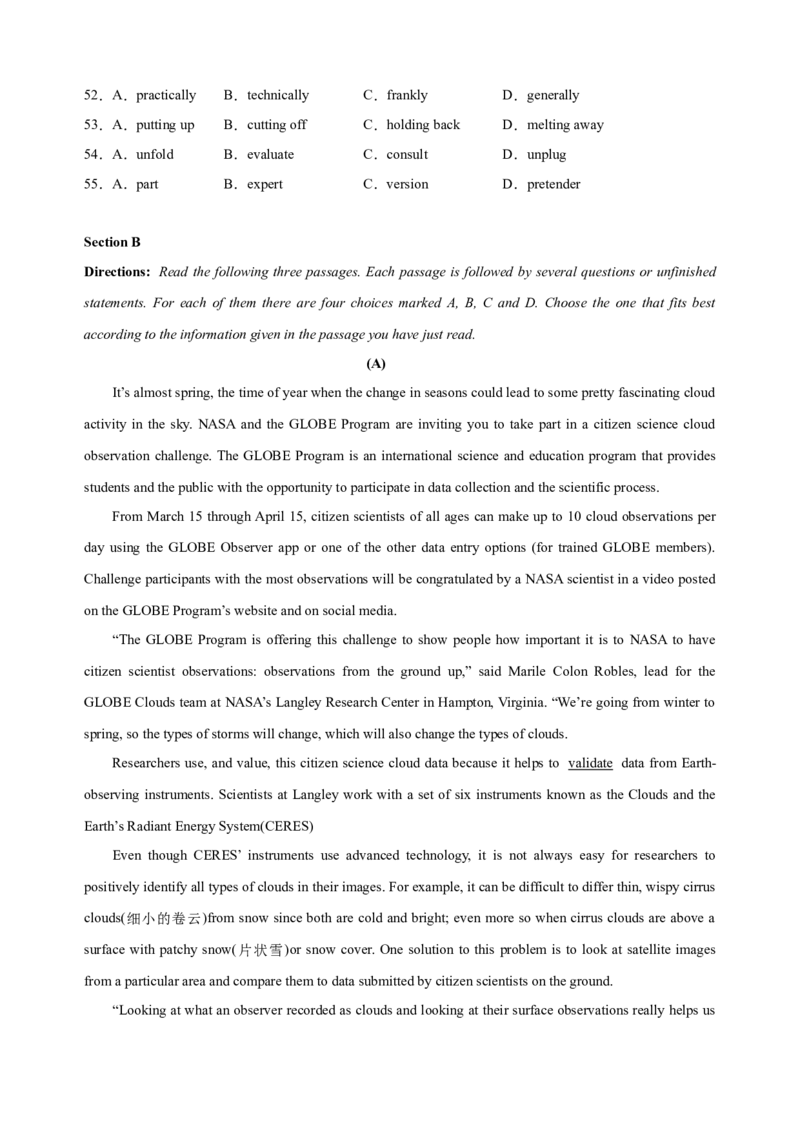
(A)
It’s almost spring, the time of year when the change in seasons could lead to some pretty fascinating cloud
activity in the sky. NASA and the GLOBE Program are inviting you to take part in a citizen science cloud
observation challenge. The GLOBE Program is an international science and education program that provides
students and the public with the opportunity to participate in data collection and the scientific process.
From March 15 through April 15, citizen scientists of all ages can make up to 10 cloud observations per
day using the GLOBE Observer app or one of the other data entry options (for trained GLOBE members).
Challenge participants with the most observations will be congratulated by a NASA scientist in a video posted
on the GLOBE Program’s website and on social media.
“The GLOBE Program is offering this challenge to show people how important it is to NASA to have
citizen scientist observations: observations from the ground up,” said Marile Colon Robles, lead for the
GLOBE Clouds team at NASA’s Langley Research Center in Hampton, Virginia. “We’re going from winter to
spring, so the types of storms will change, which will also change the types of clouds.
Researchers use, and value, this citizen science cloud data because it helps to validate data from Earth-
observing instruments. Scientists at Langley work with a set of six instruments known as the Clouds and the
Earth’s Radiant Energy System(CERES)
Even though CERES’ instruments use advanced technology, it is not always easy for researchers to
positively identify all types of clouds in their images. For example, it can be difficult to differ thin, wispy cirrus
clouds(细小的卷云)from snow since both are cold and bright; even more so when cirrus clouds are above a
surface with patchy snow(片状雪)or snow cover. One solution to this problem is to look at satellite images
from a particular area and compare them to data submitted by citizen scientists on the ground.
“Looking at what an observer recorded as clouds and looking at their surface observations really helps usbetter understand the images that were matched from the satellite,” said Colon Robles.
You don’t have to be a cloud-gazing professional to participate. For those who want to be part of the
challenge but don’t have a lot of experience identifying clouds, Colon Robles offers the following advice: “Just
go outside.” The more clouds you observe, she said, the more comfortable you’ll be collecting data.
56.Why do researchers launch the cloud observation challenge?
A.The GLOBE Program is badly short of hands.
B.The technology CERES uses is not that advanced
C.Scientists can compare data from different instruments.
D.Cirrus clouds are difficult to identify when with snow cover
57.The underlined word “validate” is closest in meaning to _________.
A.create B.cancel
C.count D.confirm
58.Which of the following is TRUE?
A.Citizen observers can only submit their data by means of an app
B.Observers submitting the most observations can get a special prize
C.Observations from the ground are not as valuable as satellite images
D.The data collected by citizen scientists will be posted on social media
59.Which is the best title for the passage?
A.NASA Employs New members
B.Cloud Activities Bring a New Challenge
C.Citizens Gain Experience through Observation
D.Professionals Teach You to Observe Clouds
(B)
Registration now open for the 2019 Student Research Showcase
Researchers often find it difficult to talk about their projects with friends and relatives who are not in the
same research field. Those who are able to effectively communicate their work to a broader audience are at an
advantage in terms of communicating the value of what they do to the public, to superiors at school or on the
job, and to organizations that could provide funding to support a project. Sigma Xi’s Student Research
Showcase is a unique opportunity for high school, undergraduate, and graduate students to develop their
communication skills through multimedia.Held annually, this online science communication competition allows
students to showcase their research on a website they build. The competition is open to all research areas.Presentation websites contain three main parts: an abstract, a technical slideshow, and a video to introduce
the project and its relevance to the research community and society. The video part challenges participants to
present their research to a general audience. During the review period,more than sixty Sigma Xi members
volunteer as judges to evaluate students' submissions(递交的作品) and engage in digital conversations with
presenters through their websites.
Participants find discussion with judges and the public helpful in better understanding their research. “I’m
really excited about trying to bridge the gap between the scientific community and a broader audience,” said
Luka Negoita, the 2015 graduate division winner, when asked about his motivation to participate in the
showcase. Participants compete for awards of up to $500 in high school, undergraduate, and graduate divisions.
The winner of the People’s Choice Award is selected based on a public vote and receives a $250 award.
Key deadlines for the 2017 Student Research
Showcase:
▪️P roject description approval and registration deadline: February 22, 2019
▪️P roject submission deadline: March 22, 2019
▪️E valuation period: April 3—10, 2019
Sigma Xi members are encouraged to volunteer as judges.
For more information on the Student ResearchShowcase, visit https://www.sigmaxi.org/mee
tings-events/student-research- showcase.
60.Student Research Showcase is intended to ________ .
A.spot the students who will devote themselves to research
B.find out the research area that is popular with students
C.help students to use multimedia more skillfully
D.give students a chance to present their research
61.Students must communicate their research to the public in the part of ________ on their websites.A.the abstract B.the technical slideshow
C.the video D.the discussion
62.Which of the following statements is true of Student Research Showcase?
A.Participants have to submit their projects by February 22 at the latest.
B.The public will decide which project wins People’s Choice Award.
C.Sigma Xi will employ world-famous scientists to be the judges.
D.No communication is allowed between judges and participants.
(C)
The only way to travel is on foot. The past ages of man have all been carefully labeled by anthropologists.
Descriptions like “Palaeolithic (旧石器时代) Man”, “Neolithic (新石器时代) Man”, etc., neatly sum up whole
periods. When the time comes for anthropologists to turn their attention to the twentieth century, they will
surely chose the label “Legless Man”. Histories of the time will go something like this: in the twentieth century,
people forgot how to use their legs. Men and women moved about in cars, buses and trains from a very early
age. There were lifts and escalators in all large buildings to prevent people from walking. This situation was
forced upon earth dwellers of that time because of miles of travelling each day. But the surprising thing is that
they didn’t use their legs even when they went on holiday. They built cable railways, ski-lifts and roads to the
top of every huge mountain. All the beauty spots on earth were spoiled by the presence of large car parks.
The future history books might also record that we were deprived of the use of our eyes. In our hurry to
get from one place to another, we failed to see anything on the way. Air travel gives you a bird’s-eye view of
the world—or even less if the wing of the aircraft happens to get in your way. When you travel by car or train a
blurred image of the countryside constantly flashes by the windows. Car drivers, in particular, are forever
obsessed with the urge to go on and on: they never want to stop. Is it the lure of the great motorways, or what?
And as for sea travel, it hardly deserves mention. It is perfectly summed up in the words of the old song: “I
joined the navy to see the world, and what did I see? I saw the sea.” The typical twentieth-century traveler is
the man who always says “I’ve been there.” You mention the remotest place-names in the world like EI
Dorado, Kabul, Irkutsk and someone is bound to say “I’ve been there”—meaning, “I drove through it at 100
miles an hour on the way to somewhere else.”
When you travel at high speeds, the present means nothing: you live mainly in the future because you
spend most of your time looking forward to arriving at some other place. But actual arrival, when it is achieved,
is meaningless. You want to move on again. By traveling like this, you suspend all experience; the presentceases to be a reality: you might just as well be dead. The traveler on foot, on the other hand, lives constantly in
the present. For him traveling and arriving are one and the same thing: he arrives somewhere with every step he
makes. He experiences the present moment with his eyes, his cars and the whole of his body. At the end of his
journey he feels a delicious physical weariness. He knows that sound. Satisfying sleep will be his: the just
reward of all true travellers.
63.Anthropologists label nowaday’s men “legless” because ________.
A.people prefer not to use their legs
B.people own cars,buses and trains
C.lifts and escalators prevent people from walking
D.there are a lot of transportation devices
64.Travelling at high speed means________.
A.people’s focus on living in the future B.a pleasure in travelling in car or by ship
C.satisfying drivers’ great thrill for speed D.a basic necessity of life to cover a distance
65.Why does the author say “We are deprived of the use of our eyes”?
A.People’s sights decline because of modern equipment.
B.In traveling at high speed,eyes become useless.
C.People can’t enjoy any view on their way of travel.
D.People often take a nap during the trip.
66.What suggestion the author may give to the readers?
A.Travel more,or your leg may become weaker.
B.Modern transportation will make the world a small place.
C.Use your eyes before you choose the means of travelling.
D.The best way to travel is on foot for you to sense its beauty.
Section C
Directions: Read the following passages. Fill in each blank with a proper sentence given in the box. Each
sentence can be used only once. Note that there are two more sentences than you need.
Rise of the Robots
The word “robot” was coined in 1920 by the Czech playwright Karel Capek. 67 For most of
their history, however, robots have been dumb, inelegant mechanical devices sitting out of sight in factories.
Things are starting to change, however. 68 They brought cheap cameras and sensors, fast
wireless communications and powerful, smaller computer chips to robots. More recent advances in machinelearning have added software to make robots better informed about their surroundings and equipped them to
make wiser decisions. Robots are leaving carefully managed industrial settings for everyday life and, in the
coming years, will increasingly work in supermarkets, clinics, social care and much more.
69 Many industries are facing a shortage of labour—the demand for workers has recovered
much faster than expected from the pandemic and some people have left the workforce, particularly in America.
Warehousing has grown rapidly thanks to the e- commerce boom. Robots are now crucial, picking items off
shelves and helping people pack an exponentially rising numbers of boxes. In a pandemic-ravaged world, short
of workers but with lots of elderly folk to look after, having more robots to boost productivity would be a good
thing.
Inevitably, some people will be on the losing end of change even as the robots make society as a whole
better off. One lesson from the freewheeling (随心所欲的) globalisation of the 1990s and 2000s is that the
growth in trade that was overwhelmingly beneficial triggered a political opposition, because the losers felt left
behind. 70 As jobs change, workers should be helped to acquire new skills, including how to work
with and manage the robots. that will increasingly be their colleagues.
The potential gains from the robot revolution are huge. In Capek’s play, the robots rise up against their
human masters and cause mass unemployment and worse. The beginnings of the world’s real robots have not
matched Capek’s satire. There is no reason to think that their future needs to either.
A.And many people fear that robots will destroy jobs.
B.That is why firms and governments had better recognize the value of retraining and lifelong learning.
C.They could not be coming at a better time.
D.In his play, Capek imagined artificial, fully functional servants.
E.They are beginning to wheel slowly along some pavements, delivering goods or food right to people’s
doors.
F.Robots have benefited from rapid innovations in smartphones.
IV. Summary Writing (10分)
Directions: Read the following passage. Summarize the main idea and the main point(s) of the passage in no
more than 60 words. Use your own words as far as possible.
Building a Greener Future
Which is more important when designing a building: beauty or function?
At the start of the twentieth century, Louis Sullivan, one of the creators of modern architecture, said that
‘form follows function’. However, many people disagree with this and feel that beauty is a more importantfactor in architectural design. In the modern world, it seems that most architects combine both ideas: aiming to
create buildings which are both functional and beautiful.
The reason for creating a building in the first place is clearly very important. For example, when building
an airport terminal, you need to think of the needs of passengers as well as planes. Passengers want to get to
their plane as quickly as they can, and planes need to be parked in the most efficient way possible.
Beauty, however, is also clearly important when constructing a building. Living or working in an ugly
place creates a depressing and uninspiring environment. In contrast, an attractive building can make people feel
happier and increase their motivation to work. There is also a wider responsibility to society which architects
have to consider. Beautiful, well-constructed buildings are a symbol of a civilized society.
In theory, there seems to be no reason why architecture cannot be both functional and beautiful. Yet in
practice, this can cause problems. The Modern International style of the 1920s and 1930s, an example of which
is the Guggenheim Museum in New York, was supposed to combine beauty with function. Many consider the
museum’s white spiral ramp beautiful, but there have been complaints that it is impractical, as it is difficult to
stand back to view the art. Also, the ramp is so narrow that it can become overcrowded. It seems that even this
celebrated design has problems with functionality.
If architects focus only on function, buildings may be cold, ugly and uninteresting. On the other hand, if
they focus only on making it look beautiful, the building may be completely impractical. Therefore, combining
these two ideas is necessary to create the perfect piece of architecture.
71. ______________________________________________________________________________________
_________________________________________________________________________________________
_________________________________________________________________________________________
_________________________________________________________________________________________
__________________________________________
V. Translation (第1-2句,每句3分;第3句,4分;第4句5分;共15分)
Directions: Translate the following sentences into English, using the words given in the brackets.
72.看着屏幕上的美味佳肴,他口水直流。(water)
73.因为一条假新闻, 这家超市货架上的所有商品已被一抢而空,真是匪夷所思。(It)
74.自从他的小说在网络上走红之后,他便经历了一场“破天的富贵”,成为了文坛的新星。(since)
75.这位忧心忡忡的母亲直到成功为她一周没吃过蔬菜的儿子在送餐应用上抢到了2公斤卷心菜,才
感到如释重负。(Not until …)VI. Guided Writing (25分)
Directions: Write an English composition in 120-150 words according to the instructions given below in
Chinese.
如今,随着网购和物流业的发展包装的浪费现象十分严重。请你具体说明包装的浪费现象,并提出建
议。你的文章必须包括:
1). 生活中此类浪费现象的具体表现;
2). 你对减少该现象的具体建议。
_________________________________________________________________________________________
_________________________________________________________________________________________
_________________________________________________________________________________________
_________________________________________________________________________________________
_________________________________________________________________________________________
_________________________________________________________________________________________
_________________________________________________________________________________________
_________________________________________________________________________________________
_______________________________________