文档文本内容
更多干货关注
粉笔教师教育
粉笔教师
理论精讲-教学实施与评价2
2 0 2 5 年全国教师资格
讲师:李婉君
温故知新
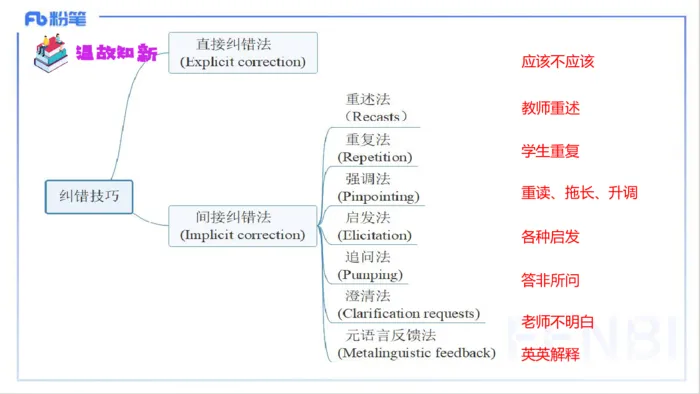
教师重述
学生重复
重读、拖长、升调
各种启发
答非所问
老师不明白
英英解释
应该不应该
温故知新
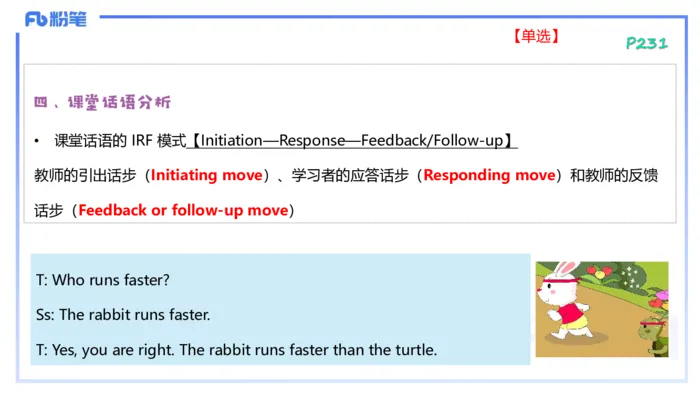
四、课堂话语分析
•
课堂话语的 IRF 模式【Initiation—Response—Feedback/Follow-up】
教师的引出话步(Initiating move)、学习者的应答话步(Responding move)和教师的反馈
话步(Feedback or follow-up move)
T: Who runs faster?
Ss: The rabbit runs faster.
T: Yes, you are right. The rabbit runs faster than the turtle.
【单选】
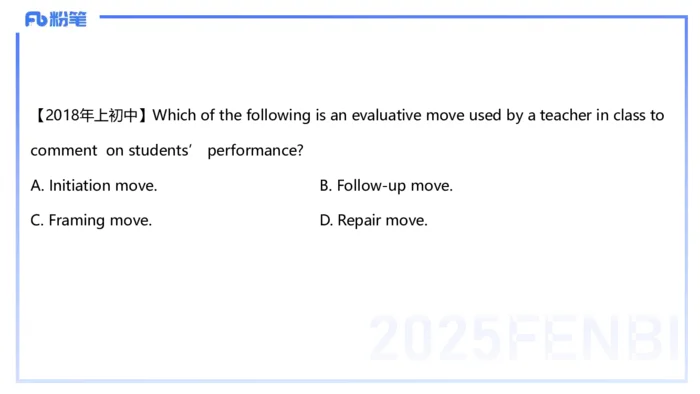
【2018年上初中】Which of the following is an evaluative move used by a teacher in class to
comment  on students’ performance?
A. Initiation move.
B. Follow-up move.
C. Framing move.
D. Repair move.
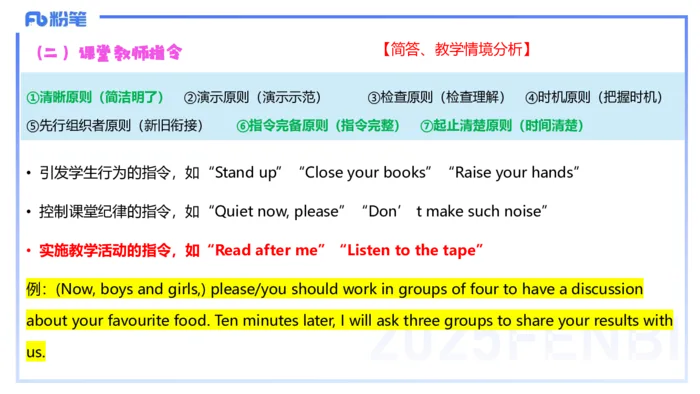
(二)课堂教师指令
• 引发学生行为的指令,如“Stand up”“Close your books”“Raise your hands”
• 控制课堂纪律的指令,如“Quiet now, please”“Don’ t make such noise”
• 实施教学活动的指令,如“Read after me”“Listen to the tape”
例:(Now, boys and girls,) please/you should work in groups of four to have a discussion
about your favourite food. Ten minutes later, I will ask three groups to share your results with
us.
①清晰原则(简洁明了)
②演示原则(演示示范)
③检查原则(检查理解)
④时机原则(把握时机)
⑤先行组织者原则(新旧衔接)
⑥指令完备原则(指令完整)
⑦起止清楚原则(时间清楚)
【简答、教学情境分析】
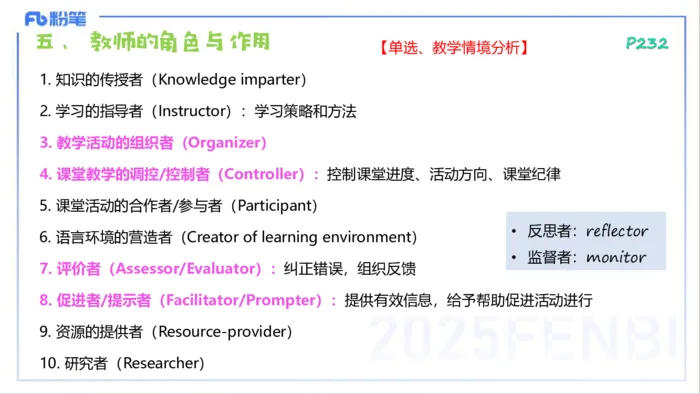
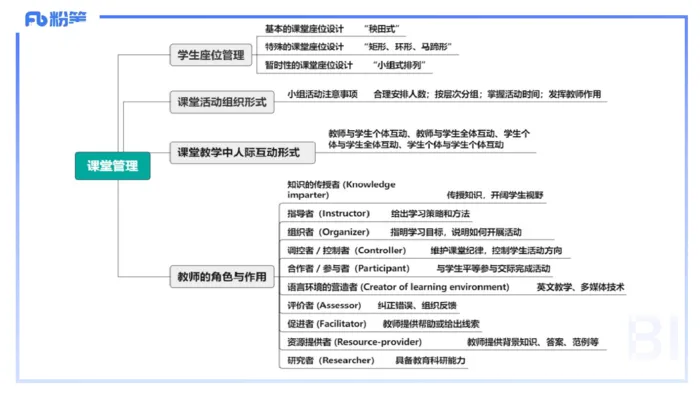
1. 知识的传授者(Knowledge imparter)
2. 学习的指导者(Instructor):学习策略和方法
3. 教学活动的组织者(Organizer)
4. 课堂教学的调控/控制者(Controller):控制课堂进度、活动方向、课堂纪律
5. 课堂活动的合作者/参与者(Participant)
6. 语言环境的营造者(Creator of learning environment)
7. 评价者(Assessor/Evaluator):纠正错误,组织反馈
8. 促进者/提示者(Facilitator/Prompter):提供有效信息,给予帮助促进活动进行
9. 资源的提供者(Resource-provider)
10. 研究者(Researcher)
五、 教师的角色与作用
【单选、教学情境分析】
• 反思者:reflector
• 监督者:monitor
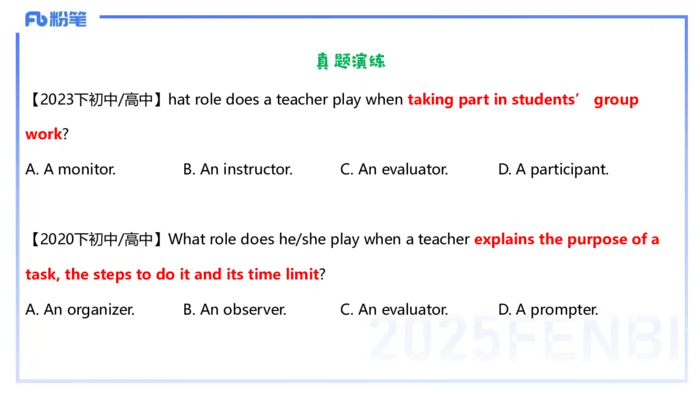
真题演练
【2023下初中/高中】hat role does a teacher play when taking part in students’ group
work?
A. A monitor.
B. An instructor.
C. An evaluator.
D. A participant.
【2020下初中/高中】What role does he/she play when a teacher explains the purpose of a
task, the steps to do it and its time limit?
A. An organizer.
B. An observer.
C. An evaluator.
D. A prompter.
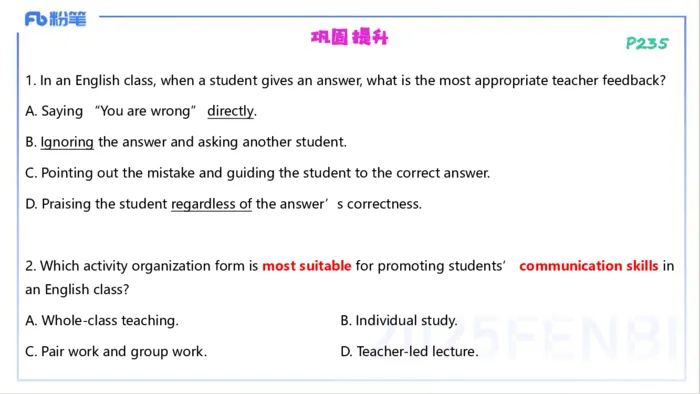
1. In an English class, when a student gives an answer, what is the most appropriate teacher feedback?
A. Saying “You are wrong” directly.
B. Ignoring the answer and asking another student.
C. Pointing out the mistake and guiding the student to the correct answer.
D. Praising the student regardless of the answer’s correctness.
2. Which activity organization form is most suitable for promoting students’ communication skills in
an English class?
A. Whole-class teaching.
B. Individual study.
C. Pair work and group work.
D. Teacher-led lecture.
巩固提升
3. In an English class where students are conducting a group discussion, what is the main role of the
teacher?
A. Dominating the discussion and telling students what to say.
B. Standing aside and not interfering at all.
C. Monitoring the discussion and providing guidance when necessary.
D. Correcting every grammar mistake students make during the discussion.
巩固提升
4. Which of the following questions can cultivate students’ divergent thinking ability?
A. Are you a shop assistant?
B. What do you think of the relations between education and work?
C. According to Paragraph 2, which of the following is true?
D. Are there any flowers in the picture?
5. When a student has made a sentence “I borrowed a paper from Miss Li”, the teacher says “Do
you mean a piece of paper? ” Here the teacher is playing the role of a(n) ________.
A. controller
B. prompter
C. assessor
D. organizer
巩固提升
第二章
教学评价
A
B
按评价功能不同:
诊断性评价
形成性评价
终结性评价
按评价标准不同:
常模参照评价
标准参照评价
个体参照评价
教学评价的类型
【单选、简答、教学情境分析】
概念:为了让教师在教学活动前了解学生的情况,更好地组织课堂而采取的评价方式,是一种“事
前评价”。
内容:学生在前一阶段学习所储备的知识数量和质量;学生的性格特征、学习风格、能力倾向及对
本学科的态度;学生对学校学习生活的态度、身体状况及家庭教育情况等。
【单选】
了解即可
诊断性评价(Diagnostic assessment)
作用:
•
确定学生的学习准备程度。
•
根据诊断性评价的结果对学生进行合理的安置。
•
诊断个别学生在发展上的特殊障碍,并以此作为采取补救措施的依据。
诊断性评价(Diagnostic assessment)
【简答、情境分析】
方法:
•
借助已有材料:如学生以前的成绩记录等。
•
调查与测验:如摸底测验、智力测验、态度和情感调查等。
•
观察与访谈:如做实验、做游戏和讨论问题等。
了解即可
注意事项:
•
任务的设置要明确具体且具有可操作性。
•
课堂教学过程中时间比例分配要合理。
•
要切实掌握学生的学习准备程度而非流于形式。
诊断性评价(Diagnostic assessment)
概念:基于对学生学习全过程的持续观察、记录、反思而做出的发展性评价,是一种“事中评价”。
特点:
① 对学生学习的变化和发展的评价。
② 让学生学会评价。
③ 评价要与教学紧密结合。(服务教学、反馈教学)
形成性评价(Formative assessment)
【单选】
作用:
•
调整学习活动
•
强化学生的学习
•
检验学生阶段性学习的效果
•
为教师提供反馈信息
形成性评价(Formative assessment)
【简答、情境分析】
方法:
•
量化评价法:调查表、评价量表(evaluation scale)
•
质性评价法:优秀作品(portfolio)、概念图
(mind map)、录音或录像、创建与使用成长记录、
教师观察(observation)、访谈 / 座谈、读书笔记、
项目和演示(Projects and presentation)
重点掌握
形成性评价(Formative assessment)
【简答、情景分析】
实施原则:
•
科学性原则
•
导向性原则
•
多元化原则
•
激励性原则
•
情感性原则
•
可行性原则
注意问题:
•
评价要课堂内外相结合
•
重视评价主体的多元化
•
评价要客观全面,并贯穿教学始终
形成性评价(Formative assessment)
【简答、情境分析】
概念:
终结性评价是指在活动后为判断其效果而进行的评价,一般在学期或学年结束时进行,如期
末考试、结业考试等,是一种“事后评价”。
特点:①着眼于学生对某门课程整体内容的掌握。②概括性水平一般较高。
方法:口试(Oral Test) 、笔试(Written Test)
了解即可
了解即可
终结性评价(Summative assessment)
【单选】
作用:
•
为各种选拔、评优提供参考依据
•
为教师确定后续教学起点提供依据
•
对学生的学习提供反馈并起到推动作用
注意问题:
•
评价要全面且形式多样
•
要注重教学结果
•
要注重与形成性评价相结合
终结性评价(Summative assessment)
01
0
3
【2017年上】When students are asked to go to the local museum, libraries, etc. to find out
information about endangered animals and work out a plan for an exhibition, they are
doing a(n) ________.
A. survey
B. experiment
C. project
D. presentation
【2023下高中-31题】
31.成长档案袋是形成性评价的一种手段,简述其对学生发展的两个主要作用(8分)。并列举档案袋
中应有的四项内容(12分)。
【参考答案】
(1)成长档案袋对学生发展的作用有:
①记录成长历程:学生可以将自己的作品、成绩等信息收入档案袋中,形成自己专属的成长档案,更好地回顾自
己的发展过程,发现自身优点和不足,记录成长足迹。
②评估进步过程:成长档案袋可以提供评估工具,如学分绩点、专业排名等,帮助学生进行自我评估,及时发现
自己的优势和不足,调整学习计划。
③促进个性化发展:成长档案袋可以根据学生的个人特点进行定制,帮助学生发掘自己的潜力,实现个性化发展。
同时,学生也可以通过成长档案袋展示自己的特长和兴趣爱好,增强自信心和成就感。
(答案仅供参考,任选2点作答即可)
【参考答案】
(2)成长档案袋中应收入的四项内容包括:
①学期寄语:学生自己在学期初设计本学期的计划或努力达成的目标,为新学期做好自我规划,并在本学期为之
努力。
②学习成果:学生日常的优秀成果及每学期学生素质报告单的收集和整理,如艺术类作品(手抄报,书法等)、
成绩单、奖励奖状、获奖作文等。
③社会活动:担任学校、班级学生干部,或在经学校认可的社团组织任职情况,参加社会公益活动记录等。
④综合分析:老师根据学生的表现进行综合评价,深入了解每一个学生,促进学生的全面发展。
【2019年上高中】32. 下面是某英语教师在日常教学中使用的“学生口语能力评价表”。该教师运用
此表记录了某位学生(李华)一学期口语能力的发展情况
(注:☺= 一般;☺☺= 良 好;☺☺☺= 优秀)
学生口语能力评价表
(1)该教师所采用的评价属于什么类型?(6 分)
(2)该评价表具有哪三个主要作用?(12 分)
【参考答案】
(1)该教师所采用的评价属于形成性评价。形成性评价是在教学活动中,为了更好地达到教学目标、
取得最佳教学效果而不断进行的评价,它能用来及时了解某阶段 教学的结果和学生学习的进展情况以
及存在的问题。
(2)评价表的主要作用:
①具有直观性和可对比性。该表通过“笑脸”数目的变化体现学生的表现,可以 使评价结果一目了然。
②展现学生在每个单元的口语表现,使评价具有科学性。该表可以体现出在每一 单元中,学生的口语
在哪些方面表现不错,哪些方面有待努力,这样教师可以在接下 来的教学中采取适当的策略,学生也
可以加强相关方面的学习。
③记录学生的学习进展情况,使评价过程具有连续性和动态性。该表纵向表现了学生在每个项目上的
进步情况,这能够使教师对学生的学习进展有总体性的认识,同 时使学生对自身学习情况有更加客观
的认识,激发学习动力。
01
教学评价
02
常模参照评价(Norm-referenced Assessment)
03
标准参照评价(Criterion-referenced Assessment)
个体参照评价(Individual-referenced Assessment)
• 相对位置(或名次)
•
特定标准
•
和自己比
【单选】
1. _______ assessment is used to measure how the performance of a particular student or
group of students compares with that of another.
A. Criterion-referenced
B. Norm-referenced
C. Formative
D. Summative
2. David took a test and his score was at the top 10 percent in his class. This is an
interpretation of the result of a ________ test.【2021上高中】
A. diagnostic
B. formative
C. norm-referenced
D. criterion-referenced
A
B
作用
评价标准
语言测试
C
类型
【单选】
一、语言测试的作用:
(一)检查学习进度
(二)衡量语言水平
(三)诊断语言程度
(四)预测外语学习
了解即可
1. 据测试目的划分
•
成绩测试(Achievement Test):如期末考试
阶段测试
•
水平测试(Proficiency Test):如TOEFL, CET
现有水平测试
•
潜能测试(Aptitude Test):如SAT, GRE
预测能力
•
诊断测试(Diagnostic Test):如单元测试、项目测试诊断问题
•
结业测试(Exit test):注重过程和形式

走走形式
•
分级测试(Placement test):
分班测试
二、语言测试的类型
【单选】
类型:
2. 据测试的评分方式划分
•
主观性测试(Subjective Test):简答题、材料分析题、作文等
•
客观性测试(Objective Test):选择题、判断正误题、连线搭配题、填空题
3. 根据测试的参照标准划分
•
常模参照性测试(Norm-referenced Test)
•
标准参照性测试(Criterion-referenced Test)
2. 语言测试
了解即可
评价标准:
1. 信度(Reliability) :同一对象、方法、内容(不同时间);结果一致、稳定
2. 效度(Validity)
•
表面效度(Face Validity):卷面标准
•
结构效度(Construct Validity):是否能测试语言能力
•
内容效度(Content Validity):代表性和覆盖面
•
经验效度(Empirical Validity):与相近时间测试或预测能力相比的系数
3. 区分度(Discrimination):对学生不同水平能够区分的程度
4. 难度(Difficulty)
2. 语言测试
了解即可
【2024上初中/高中】At the end of a term, teachers would give students a test to see how well
they have learned the language and skills taught in class. Such a test is called a(n) ______.
A. proficiency test
B. diagnostic test
C. achievement test
D. placement test.
【2019下初中/高中】What test is likely to be given to new students at the beginning of a
semester to  screen them?
A. Achievement test.
B. Placement test.
C. Proficiency test.
D. Aptitude test.
1. A teacher uses daily class participation, homework completion, and in-class quizzes to
evaluate students’ English learning. What type of evaluation is this?
A. Summative evaluation.
B. Formative evaluation.
C. Criterion-referenced evaluation.
D. Norm-referenced evaluation.
2. A school conducts a final exam at the end of the semester to grade students’ overall
learning. This exam is a typical example of ________.
A. formative assessment
B. diagnostic assessment
C. summative assessment
D. criterion-referenced assessment
巩固提升
3. What type of language test is used to identify students’ learning difficulties and provide
guidance for remedial teaching?
A. Proficiency test.
B. Achievement test.
C. Diagnostic test.
D. Placement test.
4. A/An ________ language test, such as IELTS, is developed on the basis of a fixed standard.
A. norm-referenced
B. peer-referenced
C. individual-referenced
D. criterion-referenced
巩固提升
第三章
教学反思
定义:教师分析自己的教学过程是否有效、合理,是否有助于学生学习的活动。
形式:口头和书面
内容:
1.对教学目标的反思
2.对教学设计的反思
3.对教学实施的反思
教学反思
了解即可
基本方法:
1. 教学日志(Teaching journal)
教学日志是教师记录自己进行的教学活动以及这些活动实施的效果、影响课堂教学的关键细节
等情况,并在此基础上进行深入理解和反思,促进自身专业发展。
•
【注意事项】亲历性、叙事性、启示性、典型性、即时性
教学反思
2017下 · 高中 · 简答
基本方法:
2. 叙事研究(Narrative research):讲故事
3. 实际讨论(Discussion):提出问题,共同讨论
4. 教学行动研究(Action research):行动方案
5. 学生反馈 (Students’ feedback)
教学反思
了解即可