The second period(第二课时)
Part A Let’s learn & Let’s chant
教学内容
▶
Let’s learn ·听、说、认读单词“tall, strong, short, thin, friendly, quiet”
·在情景中熟练运用句型“He’s/ She’s…”介绍人物的性格和外貌特征
·运用句型“Who is he/ she?”询问他人的姓名并回答
Let’s chant ·通过有节奏的说唱强化单词的音义联系,并增加课堂的趣味性
·理解歌谣中对人物外貌和性格特征的描述,并创编新的歌谣描述自己的朋友
教学重点
▶
1. 能够掌握描述人物特点的词汇。
2. 能够用以上词汇简单描述他人的性格和外貌特征。
教学难点
▶
1. 能够在情景中熟练运用句型“He’s…”介绍人物的性格和外貌特征。
2. 能够掌握单词“friendly, quiet”的发音。
教学准备
▶
1.预习《状元大课堂》《创优作业100分》《状元作业本》中本课时的相关内容。
2. PPT课件、课文录音、视频、单词卡片等。
教学过程
▶
Step 1: Warm-up & Revision & Lead-in
1. Greetings.
Teaching purpose①
2. Revision.①
以上节课中学习的询问
(1) Point to a boy and ask his name in rhyme. Ask students to
他人姓名的重点句型开始课
answer in rhyme, too. 程,起到“温故”的作用。
T:(Clap hands.)What’s his name? What’s his name? 同时,以带有游戏趣味的韵
句进行交流,能够极大地激
Ss: His name is… His name is…
发学生的学习兴趣,让课堂
T: What’s her name? What’s her name?(Clap hands and point to a
氛围更加热烈,更有益于学
girl.)
生的英语学习。
Ss: Her name is… Her name is…
(2) Play a game—“I say, you do”. (课件出示:一段有节奏的背景
音乐)
3T: Boys and girls, now I say, you do. Make yourself tall.
Ss: Tall, tall, tall. (Students stand up and say while they do it.)
T: Make yourself short. / Make your arms long. / Make your eyes Teaching purpose②
big. /… 通过对上一节课内容的
Ss: Short, short, short! / Long, long, long! / Big, big, big! /… 角色扮演,复习旧知识,为
3. Watch and act.② 导入新课做好准备。
Play the video of “Let’s talk”. (课件出示:教材P24 Let’s talk板块
的视频) Let students watch it and act out the dialogue in pairs.
4. Lead-in.
T: John has a good friend. I have a good friend, too. Do you want to
know what his/ her name is?
Step 2: Presentation
1. Learn the sentences.
T: I have a good friend in our class. He is a boy. He’s tall and
strong. He’s in Group 4. Guess! What’s his name?
Describe the appearance of a student in the class simply. If other
students can’t guess who he is, lead them to ask, “What’s his name?”
T: You can also ask me, “Who is he?”
Write down the sentences “What’s his name?” “Who is he?” on the
blackboard.
2. Let’s learn.③ Teaching purpose③
(1)Learn the words “tall, strong, short, thin”. 教师播放录音,学生听
录音跟读,训练其认真倾听
Ask a student to come to the front of the classroom and introduce
且在倾听过程中获取重要信
him as a good friend.
息的能力。让学生跟读,以
Then invite another student who is completely different from the
掌握单词的正确读音。
boy before. Ask other students to observe their differences in figure.
Lead in the words “tall, strong, short, thin”.
Show the word cards in turn. Teach these words. Ask students to
read after the teacher.
Let students point to the classmates and use the sentence structure
“He’s/ She’s…” to describe others.
(2)Learn the phrases “tall and strong, short and thin”.
Point to the tall and strong boy on the podium. Lead students to say
the sentences “He’s tall.” and “He’s strong.”
Then the teacher says “He’s tall and strong.” Ask students to read
the sentence after the teacher.
Practice the sentence “He’s short and thin.” in the same way.
4(3) Learn the word “quiet”.
The teacher makes a gesture with the index finger to keep students
quiet and says the sentence “Be quiet!” Then show the word card “quiet”
and read it, qu/kw/-i/aɪ/-e/ə/-t/t/, quiet . Then paste the card
onto the blackboard. Help students understand the meaning of the word
“quiet”. Lead students to use the word “quiet” to make sentences in the
real situations.
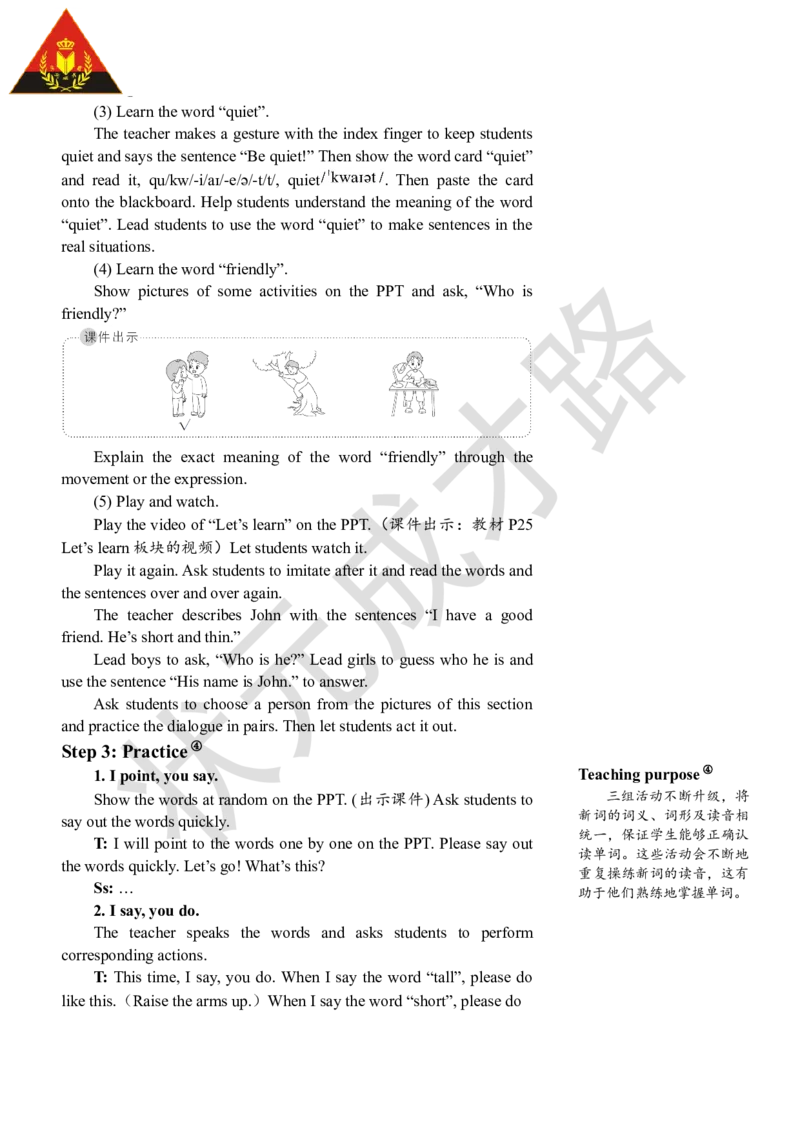
(4) Learn the word “friendly”.
Show pictures of some activities on the PPT and ask, “Who is
friendly?”
Explain the exact meaning of the word “friendly” through the
movement or the expression.
(5) Play and watch.
Play the video of “Let’s learn” on the PPT.(课件出示:教材 P25
Let’s learn板块的视频)Let students watch it.
Play it again. Ask students to imitate after it and read the words and
the sentences over and over again.
The teacher describes John with the sentences “I have a good
friend. He’s short and thin.”
Lead boys to ask, “Who is he?” Lead girls to guess who he is and
use the sentence “His name is John.” to answer.
Ask students to choose a person from the pictures of this section
and practice the dialogue in pairs. Then let students act it out.
Step 3: Practice④
1. I point, you say. Teaching purpose④
Show the words at random on the PPT. (出示课件) Ask students to 三组活动不断升级,将
新词的词义、词形及读音相
say out the words quickly.
统一,保证学生能够正确认
T: I will point to the words one by one on the PPT. Please say out
读单词。这些活动会不断地
the words quickly. Let’s go! What’s this?
重复操练新词的读音,这有
Ss: …
助于他们熟练地掌握单词。
2. I say, you do.
The teacher speaks the words and asks students to perform
corresponding actions.
T: This time, I say, you do. When I say the word “tall”, please do
like this.(Raise the arms up.)When I say the word “short”, please do
5like this.(Put the arms down.)When I say the word “strong”, please do
like this(. Raise the fists up.)And this is for “thin”. (Put the hands on the
both sides of cheeks.) Are you ready? Let’s play.
3. I do, you say.
T: Now let’s exchange. I do, you say.
4. Let’s chant.⑤ Teaching purpose⑤
通过观察人物的特征,
Show the pictures of Lily and Tim in the chant on the PPT. (课件出
选择正确的词汇来形容他们
示:教材 P25 Let’s chant 板块中的人物图片) Help students describe
帮助学生正确理解并使用新
Lily and Tim with the words they have learned and the sentence
学的词汇。
structure “He/She is…”
Play the chant separately.(出示课件)Let students read the chant
after the recording.
Step 4: Consolidation & Extension
Teaching purpose⑥
1. Make a competition.
话题继续延伸,将创编
Let students chant in different ways to make a competition. Remind
歌谣活动与实际相结合,鼓
students to do some actions while they’re chanting.
励学生发挥自己的想象力和
2. Create a new chant.⑥ 主观能动性,培养他们的英
Encourage students to replace the adjectives in the chant according to 语思维。
the true situations of friends. Create a new chant and perform it in class.
板书设计
▶
作业设计
▶
1. Copy the words learned in this lesson five times in four lines and three grids.
2. Draw your parents and describe them in English.
3. Do the exercises(. 见“状元成才路”系列丛书《创优作业100分》或《状元作业本》对应课时
作业)
教学反思
▶
1. 在韵句中,复习上一课的句型,极大地激发了学生的学习兴趣。
2. “我指你说”“我说你做”等一连串的活动贯穿授新和操练过程,尽可能地让学生的多种
感官参与到此学习过程中来,大大提高了学习效率。
3. 学习单词的目的就是能把单词灵活地运用到句子中去,使表达更加完整,同时把单词运用
到句子中也能巩固所学的单词,两者之间相辅相成,相互促进。
4. 板书设计清晰明了,重点突出,起到了很好的辅助作用。
6▶Teaching Contents
Let’s learn
·Listen, speak and read the words “tall, strong, short, thin, friendly, quiet”.
·Use the sentence structure “He’s/She’s…” to introduce the characters’ personalities and
appearances in situations.
·Use the sentence structure “Who is he/ she?” to ask someone’s name and answer.
Let’s chant
·Strengthen the phonetic connection of words and increase the interest of the lesson through rhythmic
chant.
·Understand the description of the characters’ appearances and personalities in the chant and
create a new chant about friends.
▶Teaching Priorities
·Master the words that describe characters’ characteristics.
·Be able to simply describe the appearances and personalities of others with the above words.
▶Teaching Difficulties
·Be able to use the sentence structure “He’s/ She’s…” skillfully in real situations.
·Be able to master the pronunciations of the words “friendly, quiet”.
▶Teaching Procedures
Teaching Teacher’ s Activities Students’ Activities Teaching Purposes
Stages
Warm-up 1. Greetings. 1. Greetings. This activity can refresh
& 2. Revision. 2. Answer in rhyme and do the the knowledge learned
Revision Ask in rhyme and do the actions. actions as the teacher’s before and stimulate
& Play the game. instruction. students’ interest in
Lead-in learning.
3. Watch and act. 3. Watch and act out the Through role-play, review
Play the video of “Let’s talk”. dialogue in pairs. old knowledge and lead in
4. Lead-in. 4. Listen to the teacher. new knowledge.
7Teaching
Teacher’ s Activities Students’ Activities Teaching Purposes
Stages
Presentation 1. Learn the sentences.
Listen to the teacher’s
Create a situation. Teach the Introduce the new
description and guess who he is.
sentences “What’s his sentences.
Learn the sentences.
name?” “Who is he?”
2. Let’s learn. (1) Learn the new words. Help students master the
(1) Teach the words “tall, Make sentences to describe correct pronunciation of
strong, short, thin”. classmates. the words by comparing,
(2) Teach the phrases and lead (2) Learn the phrases and observing and listening.
students to say the practice the sentences.
sentences to express the (3) Understand the meaning of
appearance of the character. “quiet” and learn how to use
(3) Teach the word “quiet”. it.
(4) Show pictures of different (4) Understand the meaning of
activities on the PPT to “friendly” and learn how to
help students understand use it.
the meaning of “friendly”. (5) Read the words and the
(5) Play the video of “Let’s sentences repeatedly.
learn” on the PPT. Practice the dialogue and
act it out.
Practice 1. I point, you say. 1. Quickly say out the words on Get students to grasp the
Show the words at random on the PPT. words from shape,
the PPT. 2. Do the corresponding actions. meaning and
2. I say, you do. 3. Say the corresponding words. pronunciation through
Speak the adjectives. 4. Use the words and the three groups of
3. I do, you say. sentence structures they have activities. Help students
Do the actions. learned to describe the understand and use the
4. Let’s chant. characteristics. Listen to the new vocabulary
Show the pictures of Lily and chant, follow it and chant correctly.
Tim in the chant on the PPT. together.
Play the chant.
Consolidation 1. Make a competition. 1. Chant in different ways. Extend the topic.
& Let students chant in 2. Create a new chant. Combine the creative
Extension different ways to make a Act it out in class. activity with the real
competition. situation. Encourage
2. Create a new chant. students to use their
imagination and
initiative. Cultivate their
English thinking.
1. Copy the words learned in this lesson five times in four lines and three girds.
Homework 2. Draw your parents and describe them in English.
3. Do the exercises.
8