文档文本内容
The second period(第二课时)
Part A Let’s learn & Do a survey and report
▶ 教学内容与目标
课时教学内容 课时教学目标
Let’s learn 通过图片、课件、拼读等方法,结合教材中主线人物进行的活动,学会
听、说、读、写短语“cleaned my room, washed my clothes, stayed at
home,watched TV”。
能够熟练运用上述短语描述人物在过去时间做的事情。
能够理解动词过去式的规则变化是在动词原形末尾加-ed。
Do a survey and 运用A部分所学的词汇与句型描述自己和同学的周末活动。
report
能够根据表格提示完成调查,并根据调查结果作总结汇报。
▶ 教学重点
能够听、说、读、写短语“cleaned my room, washed my clothes, stayed at
home,watched TV”。
▶ 教学难点
能够熟练运用所学词汇和句型描述人物在过去时间做的事情。
▶ 教学准备
1. 预习《状元大课堂》《创优作业100分》《状元作业本》中本课时的相关内容。
2. PPT课件、课文音频、视频等。
▶ 教学过程
Step 1:Warm-up & Revision & Lead-in①
1. Greetings.
T: Hello, boys and girls. Welcome back to our English class. In this class, I hope
you can be brave, active and open-minded.2. Let’s sing the song—Last weekend.(出示课件)
3. Lead-in—A guessing game.
T: Now let’s play a game. I do the actions, and you say the phrases. Guess what I
did last weekend.
Review the key phrases“watched TV, cleaned my room, played the guitar,
listened to music learned before”.
After guessing each phrase, students read the phrases and do the actions together.
◆ Teaching purpose①
歌曲热身能帮助活跃课堂气氛,通过做动作猜短语的活动复习旧知,为接下
来的学习做好铺垫, 也带领学生迅速进入本课主题。
Step 2:Presentation
1. Learn the phrase “stayed at home”.②
Present the picture of “home”.
T: Last weekend, I didn’t go outside. I was at…
Ss: Home.
T: Yes. I stayed at home and had a good sleep.
Present “stayed” and extend the new phrase “had a good sleep”.
Use the pictures to help students understand the words. Then lead students to
read the words.
2. Learn the phrase “cleaned my room”.
Present the picture of “clean the room”.T: Look! What did I do last weekend?
Ss: Cleaned the room.
T: Great job! I cleaned my room last weekend.
Use the picture and body language to help students understand the phrase.
Lead students to read the phrase.
◆ Teaching purpose②
教师通过创设情景进行新知呈现,让学生在具体的生活语境中学习生词,并
借助直观的图片信息和肢体语言理解词义。
3. Learn the phrase “washed my clothes”.③
Present the two pictures of Mike in “let’s learn”.
T: Look! This is Mike. Did he go outside last weekend?
Ss: No, he didn’t. He stayed at home.
T: What did he do at home?
Ss: He cleaned the room and washed the clothes.
Use the pictures and body language to help students understand the phrases.
Lead students to read the phrase “washed the clothes”. Remind them to pay
attention to the pronunciation of the word “washed”.T: What else did he wash?
Ss: He washed the dishes.
Present the new word “else” and extend the phrase “washed the dishes”.
Lead students to read the words.
◆ Teaching purpose③
教师借助Mike的周末活动自然地过渡到课本内容,逐步深入新授单词和短
语的呈现,通过学习washed,引出生词else,并拓展短语washed the dishes,让学
生进一步学习动词过去式的表达。
4. Learn the phrase “watched TV”.④
T: Now we’ve known something about Mike’s weekend. What about Chen Jie’s?
Watch the video of “Let’s learn”. (课件出示:Let’s learn板块Chen Jie的活动视频)
Answer these two questions:
①How was Chen Jie’s weekend?
②What did she do last weekend?
Finish the task and then check the answers. (出示课件)
◆ Teaching purpose④
对话视频的形式使学生更加直观地感知对话文本,设置问题,帮助学生更深
入地理解文本信息。在观看视频和回答问题的过程中,提高学生的语言学习和表
达能力。
Step 3: Practice
1. Practice the phrases.⑤
(1) Ask a student to be the little teacher. Lead students to read the phrases of
“Let’s learn”.
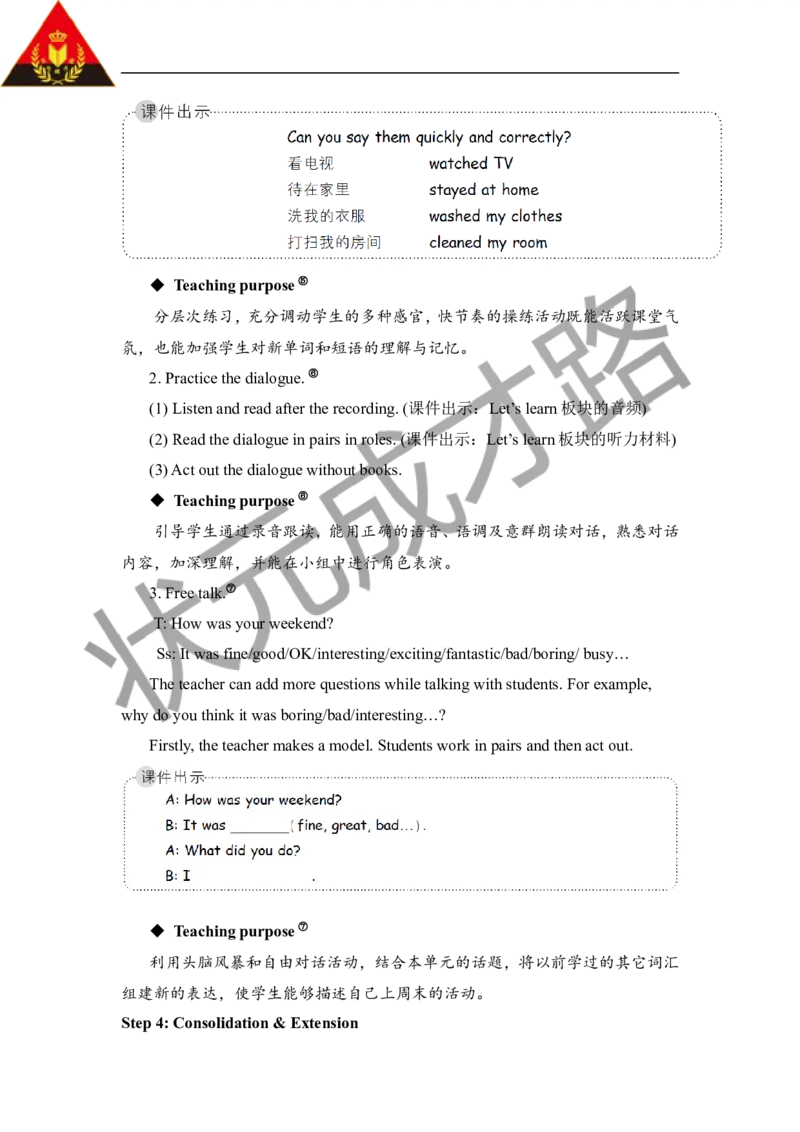
(2) Can you say them quickly and correctly?
(3) Game: What’s missing?◆ Teaching purpose⑤
分层次练习,充分调动学生的多种感官,快节奏的操练活动既能活跃课堂气
氛,也能加强学生对新单词和短语的理解与记忆。
2. Practice the dialogue. ⑥
(1) Listen and read after the recording. (课件出示:Let’s learn板块的音频)
(2) Read the dialogue in pairs in roles. (课件出示:Let’s learn板块的听力材料)
(3) Act out the dialogue without books.
◆ Teaching purpose⑥
引导学生通过录音跟读,能用正确的语音、语调及意群朗读对话,熟悉对话
内容,加深理解,并能在小组中进行角色表演。
3. Free talk.⑦
T: How was your weekend?
Ss: It was fine/good/OK/interesting/exciting/fantastic/bad/boring/ busy…
The teacher can add more questions while talking with students. For example,
why do you think it was boring/bad/interesting…?
Firstly, the teacher makes a model. Students work in pairs and then act out.
◆ Teaching purpose⑦
利用头脑风暴和自由对话活动,结合本单元的话题,将以前学过的其它词汇
组建新的表达,使学生能够描述自己上周末的活动。
Step 4: Consolidation & Extension1. Do a survey and report.⑧
(1) Divide students into several groups. Let students work in groups. One student
plays an interviewer and asks “How was your weekend? What did you do?”, other
students answer the questions. Let another student take brief notes on the table.
(2) Show time: Students make their reports. Report like this:
2. Summary.
Learn how to use the past tense. (出示课件)
◆ Teaching purpose⑧
通过引导学生完成调查与汇报,巩固本课学习重点。让基础弱或基础一般的
学生能熟练表达自己上周末的情况和进行的活动,让基础好的学生能针对小组同
伴的回答进行较复杂的汇报,使不同语言层次的学生在课堂上都能有不同水平的
发挥。
▶ 板书设计
▶ 作业设计
1. Practice the dialogue. Read it correctly, fluently and emotionally.2. Remember the key phrases and sentence structures.
3. Do the exercises.(见“状元成才路”系列丛书《创优作业100分》或《状元
作业本》对应课时作业)
▶ 教学反思
1. 导入环节的歌曲和TPR游戏能活跃课堂的气氛,充分调动学生参与课堂的
积极性,同时有效帮助学生复习和记忆单词,营造轻松愉快的学习氛围。
2. 创设真实的语言环境,在情境中逐步导入新授短语,通过多种方式呈现,借
助直观图片和视频等资源帮助学生理解词义,逐层由词至句引导学生输出表达。
3. 在课堂的对话交流中,以学生为本,注重与学生的沟通,创造条件让学生多
开口,多表达自己内心的想法。通过适当地追加问题,引导学生做进一步的语言
拓展和表达。
4. 采用头脑风暴的形式,集中全班智慧,拓展相关形容词,丰富课本学习内容
5. 注重对学生思维品质的培养,引导学生多观察、多思考,课下多借助网络资
源或文本资料,培养学生的自主学习能力。
▶ Teaching Contents & Teaching Aims
Let’s learn
Learn to listen, speak, read and write the phrases “cleaned my room, washed my
clothes, stayed at home, watched TV” through pictures, body language and other
methods.
Use the above phrases skillfully to describe the things people did in the past time.
Understand the basic word-formation rules of the past tense.
Do a survey and report
Use the vocabulary and the sentence structures learned in “Part A” to describe the
activities you and your classmates did last weekend.
Be able to complete the survey and make a report based on the survey results.▶ Teaching Priorities
Learn to listen, speak, read and write the phrases“cleaned my room, washed my
clothes, stayed at home, watched TV”.
▶ Teaching Difficulties
Be able to use the words and the above phrases skillfully to describe the things
people did in the past time.
▶ Teaching Procedures
Teaching Stages Teacher’s Activities Students’ Activities Teaching Purposes
Warm-up 1. Greetings. 1. Greetings. Help students review the
key words and the
& 2. Let’s sing the song— 2. Sing the song.
phrases they’ve learned
Revision Last weekend. 3. Guess and say. before. Lead in the
lesson and help students
& 3. Lead-in—A guessing
prepare for the following
game.
Lead-in learning.
Presentation 1. Teach the phrase Talk with the teacher. Create a real scene to
lead in the new phrase
“stayed at home”. Observe the pictures and
and help students
learn to describe them with
understand the new
the new words.
words.
2. Teach the phrase Observe the picture. Create a scene to help
students learn the new
“cleaned my room”. Listen to what the teacher
phrase. Help them learn
said and answer the
the new words and
question. Learn and read the
sentence structures
new words.
gradually.
3. Teach the phrase Observe the pictures and Help students learn more
“washed my clothes” and answer the questions step about the ways of
the word “else”. Extend by step. expressing the activities
the phrase “washed the people did in the past
Read the words after the
dishes”. time.
teacher.
4. Teach the phrase Watch the video. The video can help
students understand the
“watched TV”. Answer the questions.
dialogue more vividly.
Ask questions. Check the answers. Questions can help
students understand and
Check the answers.
think about the context in
a deeper level.Practice 1. Practice the phrases. (1) Read the phrases. The multi-level exercises
can effectively mobilize
(1) Lead students to read (2) Say them quickly and
students’ various senses.
the phrases. correctly.
They can not only
(2) Lead students to say (3) Speak out the missing enliven the class, but
them quickly and words. also strengthen students’
correctly. memory of the new
words and the sentence
(3) Play the game: What’s
structures learned.
missing?
2. Practice the dialogue. (1) Listen and read. Lead students to get the
main idea of the
(1) Play the recording. (2) Read in roles.
dialogue. Make sure
(2) Lead students to read in (3) Act out. every student can read
roles. the dialogue correctly,
fluently and emotionally.
(3) Lead students to act it
out.
3. Free talk. Talk about last weekend Lead students to use the
freely. words they’ve
Ask questions and make
a model. learned to express
themselves.
Consolidation 1. Do a survey and report. (1) Work in groups. By leading students to
conduct the survey and
& (1) Divide students into (2) Do a survey and report
report, the key points of
groups. in the class.
Extension this lesson are well
(2) Lead students to work in consolidated and the
groups. difficult points are well
broken through.
2. Summary. Learn to understand and use Lead students to learn to
the past tense. observe and summarize
Summarize the simple
the word-formation.
past tense. Acquire the word-
Help students acquire the
formation.
basic grammar
knowledge of the simple
past tense.
Homework 1. Practice the dialogue. Read it correctly, fluently and emotionally.
2. Remember the key phrases and sentence structures.
3. Do the exercises.