文档文本内容
The second period(第二课时)
Page 34 & Page 35
教学内容与目标
▶
课时教学内容 课时教学目标
Page 34 能够完成本页活动,复习与巩固第二、三单元的核心语言
能够阅读、理解邮件,并能够回答读后问题
能够根据所提供的信息,写出两个句子,完成个性化写作,补全Sarah的邮件
Page 35 能够完成本页活动,复习与巩固第一、二、三单元的主要语言以及第一至三单元的语音知
识
能够朗读诗歌,注意语音、语调、节奏,并能理解诗歌含义
能够根据前三个单元的语音知识,在诗歌中找出相应的单词,填写到表格相应的例词栏
里
教学重点
▶
掌握季节、活动、月份等相关单词、短语和句型,能够在真实的情境中运用所学知识,描述各
个季节的气候特点及在该季节里的主要活动。
教学难点
▶
仿照《夏天的风》“Bed in Summer”这首歌,进行诗歌创作。
教学准备
▶
1.预习《状元大课堂》《创优作业100分》《状元作业本》中本课时的相关内容。
2.PPT课件、课文录音等。
教学过程
▶
Step 1: Warm-up & Lead-in①
1.Greetings. Teaching purpose①
2.Sing a song—What’s your favourite season? 营造轻松、自然的英语
3.Free talk. 课堂氛围,唤起学生关于月
(课件依次出示:春、夏、秋、冬图片) 份知识的记忆。在交谈中巩
固第二、三单元的单词、短
T: What season is it?
语和句型,为后面的学习做
Ss: It’s spring/summer/autumn/winter.
铺垫。
T: What’s the weather like in spring/summer/autumn/winter?
Ss: It’s warm/hot/cool/cold.
T: What do you do in spring/summer/autumn/winter?
Ss: We fly kites in spring./We go swimming in summer./We pick
apples in autumn./We make a snowman in winter.
T: Which months are in spring/summer/autumn/winter?
3Ss: March, April and May are in spring./June, July and August
are in summer./September, October and November are in
autumn./December, January and February are in winter.
Step 2: Presentation Teaching purpose②
1.Read and answer.② 通过图片等形式,引导
(1)Talk about Australia. 学生回答,让学生了解北半
球和南半球的季节是相反的
T: What’s the weather like today?
同时了解澳大利亚,为理解
Ss: It’s…
文本做好铺垫。通过阅读,
T: What season is it now?
让学生理解并体会文本大意
Ss: Spring.
最后通过完成练习和朗读,
(课件出示:澳大利亚地图) 进一步加深对文本的理解。
T: This is Australia. What season is it now in Sydney?
Ss: It’s autumn. (If students can’t answer, the teacher explains.)
T: Yes. Look, these pictures are about Australia.
(课件出示:悉尼歌剧院、树袋熊、绵羊等图片)
The teacher and students talk about Australia freely.
(2)Finish the task. (课件出示:教材P34课文邮件)
T: Sarah will visit Sydney in April. She asks Stella, a friend there,
about the weather. Here is Stella’s reply. Now, read and answer:
①Is it spring in Sydney in April?
②What’s the weather like in April in Sydney?
(3)Check the answers. (课件出示:Read and answer练习的答案)
(4)Read the text together.
Students read the text together after the recording. Teaching purpose③
2.Write an email for Sarah.③ 创设情境,通过回复邮
(课件出示:教材P34 Sarah的回邮件任务) 件来锻炼学生的口语和书面
表达能力。提供对话模板,
T: Now, can you answer the email for Sarah? You can start from
为学生语言输出提供支架。
two aspects:
在这一过程中,复习第二单
①What’s the weather like in spring?
元主要知识点。
②What do you usually do then?
(1)Pair work.
Students ask and answer in groups of two. Make a model:
A: What’s the weather like in spring?
B: It’s warm and sunny.
A: What do you usually do then?
B: I usually fly kites with my friends.
(2)Write sentences.
Ask students to write down their sentences on the book.
(3)Show time.
Ask several students to show his/her email to the class.
3.Learn a poem: Bed in Summer.④
4(1)Briefly introduce the poet: Robert Louis Stevenson. (课件出示:
诗人的相关资料)
(2)Learn the poem.
T: Sarah often reads to Sam. This is a poem that Sarah will read
today.
①The teacher plays the recording. Students listen carefully. Teaching purpose④
②Students read the poem after the recording firstly. Then students 介绍作者,让学生了解
read by themselves and underline what they don’t understand. 诗的背景知识。学生自己阅
读诗歌,初步了解诗的意思,
T: Now, read the poem by yourselves. If you don’t understand the
同时将不理解的地方画线,
words or sentences, you can underline.
集中向老师提问。教师解决
(3)Explain the difficult points.
学生在理解中的障碍,帮助
①candlelight
学生理解句子意思。在这一
Show a picture to explain “candlelight”. (课件出示:燃烧的蜡烛图 过程中,锻炼学生的自主学
片) 习能力和思考能力。
②have to
“have to” means “must”. It means “不得不;必须” in Chinese.
③grown-up people
Show a picture to explain “grown-up people”. It means “adult”.
(课件出示:几个成年人图片)
(4)Students read the poem together with great emotion.
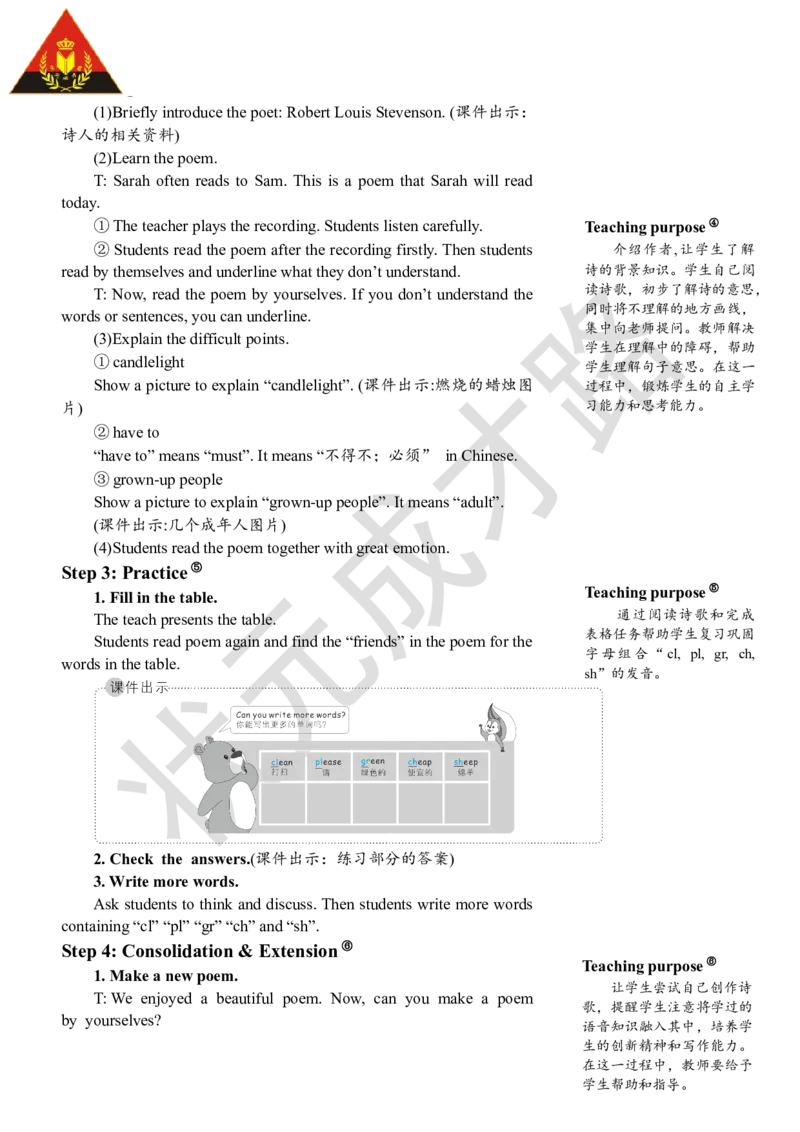
Step 3: Practice⑤
Teaching purpose⑤
1. Fill in the table.
通过阅读诗歌和完成
The teach presents the table.
表格任务帮助学生复习巩固
Students read poem again and find the “friends” in the poem for the
字母组合“cl, pl, gr, ch,
words in the table.
sh”的发音。
2. Check the answers.(课件出示:练习部分的答案)
3. Write more words.
Ask students to think and discuss. Then students write more words
containing “cl” “pl” “gr” “ch” and “sh”.
Step 4: Consolidation & Extension⑥
Teaching purpose⑥
1. Make a new poem.
让学生尝试自己创作诗
T: We enjoyed a beautiful poem. Now, can you make a poem
歌,提醒学生注意将学过的
by yourselves?
语音知识融入其中,培养学
生的创新精神和写作能力。
5
在这一过程中,教师要给予
学生帮助和指导。The teacher gives an example on the PPT:
2.Show time.
Let students share their poems in class. Choose the best poem and
the best “poet”.
板书设计
▶
作业设计
▶
1. Read the new poem to parents or friends.
2. Do the exercises(. 见“状元成才路”系列丛书《创优作业100分》或《状元作业本》对应课时
作业)
教学反思
▶
1.通过创设贴近生活的情境,帮助学生在真实自然的情境中使用所学语言知识。
2.本节课还涉及到南北半球的地理知识以及澳大利亚这个南半球国家,在教学中可以简单进
行渗透,让学生有一定的了解。
3.学生第一次自己写小诗,既是挑战,也是一种尝试。大部分同学敢于尝试,而且有许多很好
的诗歌作品。教师在平时教学中,应多给学生创造机会,让学生动脑、动手。
▶Teaching Contents & Teaching Aims
Page 34-35
• Be able to finish the tasks on Page 34-35.
• Review and consolidate the key language points from Unit 1 to Unit 3.
• Be able to read and understand the poem.
• Review and consolidate the phonetic knowledge from Unit 1 to Unit 3.
▶Teaching Priorities
• Master the key words, the phrases and the sentences of seasons, activities and months. And be
able to use them correctly in real situations.
▶Teaching Difficulties
6• Imitate the poem“Bed in Summer” and write a new one.
▶Teaching Procedures
Teaching
Teacher’ s Activities Students’ Activities Teaching Purposes
Stages
Warm-up 1. Greetings. 1. Greetings. Create a relaxing English
& 2. Sing a song. 2. Sing the song. learning atmosphere. Get
Lead-in 3. Free talk. 3. Talk about the students prepared for the later
Show the pictures of topics of Unit 2 and learning through talking about
seasons. Unit 3 with the the topics of Unit 2 and Unit
teacher. 3.
Presentation 1. Read and (1)Talk about Australia. Help students know about
answer. (2)Finish the task. Australia. Make them
(1) Talk about (3)Check the answers. understand the text by reading.
Australia. (4)Read the text.
(2) Ask students
to finish the task.
(3) Check the
answers.
(4) Ask students
to read the text.
2. Write an (1) Ask and answer in Lead students to practise their
email for Sarah. groups of two. oral English and English writing
(1) Make a model for (2) Write down the ability. Help them review the
students. sentences. key language points of Unit 2.
(2) Ask students to (3)Show emails.
write down sentences.
(3) Ask students to
show their emails.
3. Learn a poem: Know something about Let students know the
Bed in Summer . the poet. Learn the poem. background of the poem.
(1)Briefly introduce Find out and understand Help them understand the
the poet. the difficult points. Read sentences. Improve their
(2)Play the the poem together. autonomous learning abilities
recording. and thinking abilities.
(3)Explain the
difficult points.
(4) Ask students to
read the poem
together.
1. Find out the words Use the poem to help students
Practice 1. Fill in the table.
containing “cl, pl, gr, ch, review and consolidate the
7Teaching
Teacher’ s Activities Students’ Activities Teaching Purposes
Stages
sh” in the poem.
2. Check the 2. Check the answers pronunciations of letter
answers. with the teacher. combinations “cl” “pl” “gr”
3. Write more words. 3. Think and discuss. “ch” and “sh”.
Then write more words.
Consolidation 1. Make a new 1. Make a new poem Develop students’ creative and
& poem. by themselves. writing abilities. Cultivate
Extension 2. Show time. 2. Show the poems in students’ comprehensive
class. language using abilities.
Homework 1. Read the new poem to parents or friends.
2. Do the exercises.
8