The second period(第二课时)
Part A Let’s learn & Listen, answer and write
▶ 教学内容与目标
课时教学内容 课时教学目标
Let’s learn 能够听、说、读、写短语“rode a horse, rode a bike,
went camping, hurt my foot, went fishing”。
能够恰当运用本部分核心句型“—Where did you
go last…? —I went to…” “—What did you do there? —
I…”谈论周末或假日活动。
Listen, answer and 能够在听录音后获取信息,对Carl、Meimei和Mr
write Guo三人昨天的活动进行问答,并用完整的句子进行
书面描述。
▶ 教学重点
1. 能够听、说、读、写动词短语“rode a horse, rode a bike, went camping, hurt
my foot, went fishing”。
2. 能够运用句型“—Where did you go last…? —I went to…” “—What did
you do there? —I…”询问他人在周末、假期里做的事情并作出相应回答。
▶ 教学难点
1. 注意不规则动词过去式的变化形式。
2. 能够在创编的真实情景中练习重点句型。
▶ 教学准备
1. 预习《状元大课堂》《创优作业100分》《状元作业本》中本课时的相关内容。
2. PPT课件、课文音频、视频、教学卡片等。
▶ 教学过程
Step 1: Warm-up & Revision & Lead-in①
1. Greetings.2. Play a game: Whack-a-mole.
Whack the mole by reading the word or the phrase in its hand as quickly as
possible. (出示课件)
3. Play a chain game.
Look at the pictures of Unit 2. Make a model:
Show the picture “watch TV”. (课件出示:Unit 2陈杰看电视的图片)
T: Watch.
S1: Watched.
S2: Watched TV.
S3: I watched TV.
S4: I watched TV last Saturday.
◆ Teaching purpose①
通过课前的两个游戏,快速地把学生的注意力集中到课堂中去。以有趣的游
戏活动,巧妙复习与本节课有关的词汇和句型,为新课做好铺垫。
4. Lead-in.②
(1)Free talk.
T: Hello, boys and girls. What day is it today?
Ss: It’s…
T: How about yesterday?
Ss: It was…
T: What did you do yesterday?
Ss: I read a book/saw a film/slept/had a cold…
T: Was it interesting?
Ss: Yes, it was./No, it wasn’t.
T: Did you play QQ last weekend?
The teacher shows the picture of QQ. (课件出示:QQ登录界面)
Ss: Yes, I did./No, I didn’t.
T: What did you do in your QQ? (Tips: Chat with your friends. Write something.
Share pictures about the places you went.) Do you know we can do the same things in
blog?
The teacher shows the picture of blog. (课件出示:微博登录界面)OK, today we’re going to learn something about blog.
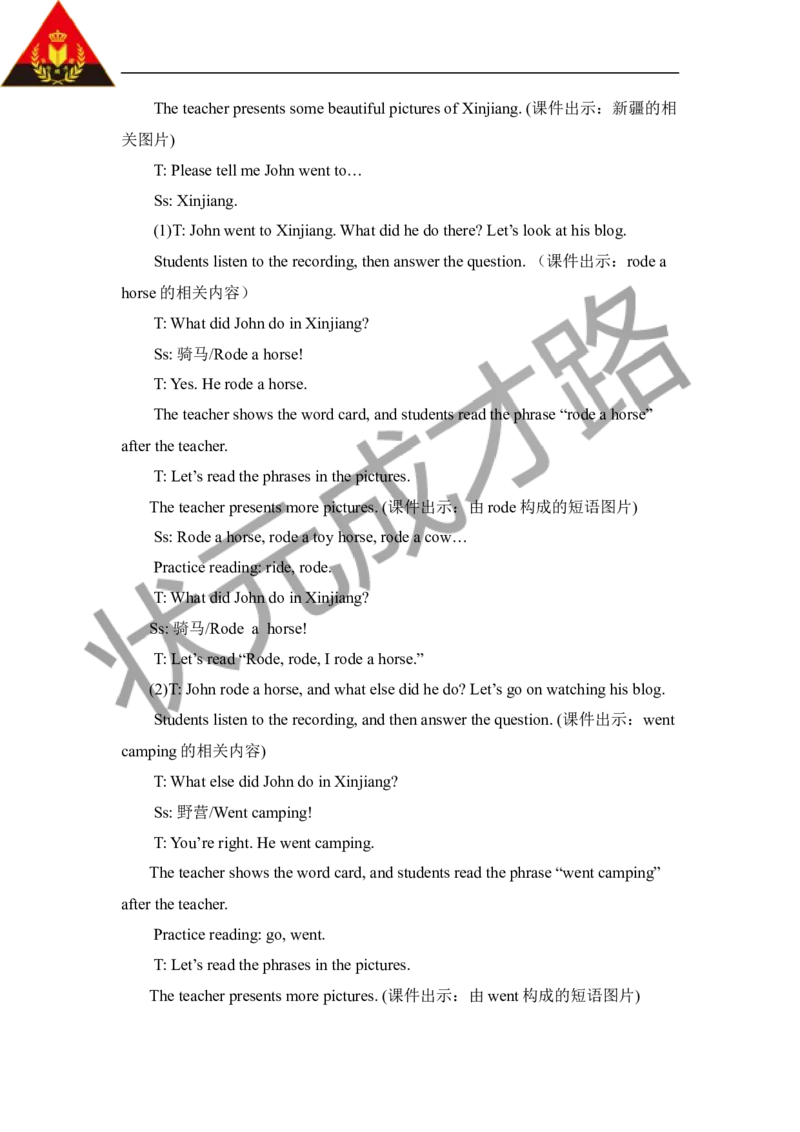
(2)The teacher’s blog.
T: Do you want to know what I did last week? Let’s see.
The teacher shares a blog about the activities last weekend.
T: What did I do last Saturday/Sunday/weekend?
Ss: You washed the clothes…
T: We can write and put some pictures in blog. We can share everything in blog.
Today let’s look at John’s blogs.
◆ Teaching purpose②
课前交流过去的活动,拉近师生间的距离,使学生较迅速地进入语言学习的
情境中来。将教师上周末的活动放在博客里展示,一是复习动词的过去式,二是
导入本节课的题眼:博客。同时,让学生初步了解博客,为下面展示John的博客做
铺垫。
Step 2: Presentation③
1. Show John’s blog about the Labour Day holiday. (课件出示:Let’s learn板块
左边图片)
T: First let’s look at this blog. Please pay attention to the date. It was Tuesday,
May 1st. So it was the Labour Day holiday. On the Labour Day holiday, we often go
to some places, such as Beijing, Qingdao… OK, I have a question. On the Labour
Day holiday, where did John go? Let’s look at some beautiful pictures and answer this
question.The teacher presents some beautiful pictures of Xinjiang. (课件出示:新疆的相
关图片)
T: Please tell me John went to…
Ss: Xinjiang.
(1)T: John went to Xinjiang. What did he do there? Let’s look at his blog.
Students listen to the recording, then answer the question. (课件出示:rode a
horse的相关内容)
T: What did John do in Xinjiang?
Ss: 骑马/Rode a horse!
T: Yes. He rode a horse.
The teacher shows the word card, and students read the phrase “rode a horse”
after the teacher.
T: Let’s read the phrases in the pictures.
The teacher presents more pictures. (课件出示:由rode构成的短语图片)
Ss: Rode a horse, rode a toy horse, rode a cow…
Practice reading: ride, rode.
T: What did John do in Xinjiang?
Ss: 骑马/Rode a horse!
T: Let’s read “Rode, rode, I rode a horse.”
(2)T: John rode a horse, and what else did he do? Let’s go on watching his blog.
Students listen to the recording, and then answer the question. (课件出示:went
camping的相关内容)
T: What else did John do in Xinjiang?
Ss: 野营/Went camping!
T: You’re right. He went camping.
The teacher shows the word card, and students read the phrase “went camping”
after the teacher.
Practice reading: go, went.
T: Let’s read the phrases in the pictures.
The teacher presents more pictures. (课件出示:由went构成的短语图片)Ss: Went swimming, went camping, went hiking, went running, went shopping…
T: What did John do in Xinjiang?
Ss: He went camping.
T: Let’s read “Went, went, I went camping.”
(3)T: John went camping, and what else did he do? Let’s go on watching his
blog.
Students listen to the recording, and then answer the question. (课件出示:went
fishing的相关内容)
T: What else did John do in Xinjiang?
Ss: 钓鱼/Went fishing!
T: Yes. He went fishing.
The teacher shows the word card, and students read the phrase “went fishing”
after the teacher.
T: What did John do in Xinjiang?
Ss: He went fishing.
T: Let’s read “Went, went, I went fishing.”
(4)Show John’s blog about the Labour Day holiday again on the PPT. (出示课
件)
T: What did John do in Xinjiang?
Ss: He rode a horse, went camping and went fishing.
2. Show John’s blog about last Saturday. (课件出示:Let’s learn板块右边图片)
(1)T: Look at his another blog. Please look at the date. It was Saturday, May
12th. So it was last Saturday. Where did John go last Saturday? Let’s look at his blog.
Students listen to the recording, and then answer the question. (课件出示:a
forest park的相关内容)
T: John went to…
Ss: A forest park.
(2)T: John went to a forest park last Saturday. What did he do there? Let’s go on
watching his blog.
Students listen to the recording, and then answer the question. (课件出示:rodea bike的相关内容)
T: What did John do last Saturday?
Ss: Rode a bike.
T: Yes. He rode a bike.
The teacher shows the word card, and students read the phrase “rode a bike”
after the teacher.
(3)T: I rode a bike with my friends. Did you ride a bike with your friends or your
father? Let’s say “I rode a bike with my father/my mother…”
(4)T: We know, when we ride a bike, we must wear a helmet. John wore a
helmet. But what happened? Let’s look at his blog.
Students listen to the recording, and then answer the question. (课件出示:hurt
my foot的相关内容)
T: What happened?
Ss: He fell off the bike. He hurt his foot.
The teacher shows the word card, and students read the phrase “hurt my foot”
after the teacher.
T: Let’s read “hurt my foot, hurt my head…”
The teacher presents more pictures. (课件出示:由hurt构成的短语图片)
(5)Show John’s blog about last Saturday again on the PPT. (出示课件)
T: Let’s look at his blog. What did John do?
Ss: He rode a bike. He hurt his foot.
◆ Teaching purpose③
引导学生听录音,并以图配文的形式展现教学内容,充分调动学生的听觉和
视觉,让学生可以更好地学习、理解词汇。
Step 3: Practice④
1. Act and guess.
One student does the actions, the others guess which phrase he/she is performing.
2. Read and conclude.
The teacher shows the phrases in this part. Students read them and conclude the
past forms of the verbs with the help of the teacher.3. Listen and repeat.
Students read the passages after the teacher. (出示课件)
◆ Teaching purpose④
表演与猜短语的过程可以让学生放松下来。在活跃的氛围里练习本板块的短
语,锻炼学生的动耳、动眼、动口、动脑和动手能力,让学生学得有趣。设计环节,
将语篇整合,让学生对所学内容有整体印象。
Step 4: Consolidation & Extension⑤
1. Listen, answer and write.
T: John has some friends. Who are they?
Ss: They are Carl, Meimei and Mr Guo. (课件出示:Listen, answer and write板
块的图片)
T: Let’s listen: What did they do yesterday?
(1)Listen to the recording twice and finish the exercises. (课件出示:本板块的
音频及练习)
(2)Check the answers. Show the listening materials to help students understand
further. (课件出示:本板块的听力材料及答案)
(3)Read the answers together.
2. Group work.
Four students work in a group. Do a survey: Ask your friends the questions in the
chart.
Name Where did you go? What did you do?
Nini park rode a bike
Make a model: Nini went to the park, and she rode a bike…
3. Show time.
Students try to report their surveys.
◆ Teaching purpose⑤听力练习以及小组活动的写与说,都是真正落实语言的输出和运用,从而达
到学以致用的目的。
▶ 板书设计
▶ 作业设计
1. Share a blog, QQ or WeChat.
2. Do the exercises.( 见“状元成才路”系列丛书《创优作业100分》或《状元
作业本》对应课时作业)
▶ 教学反思
1. 整个教学环节紧凑、流畅,较好地完成了教学目标。
2. 趣味性的活动设计激发学生的学习兴趣,调动学生的学习热情,营造积极
的学习氛围,很好地吸引了学生的注意力。
3. 遵循拼读规律教学单词,注意学生学习方法和学习策略的培养,有效设计
开放性练习帮助培养学生的发散性思维。
4. 基于单元整体设计创设教学情景,注意话题的延续性和整体性。
5. 联系实际的教学,能让学生身临其境,感受到知识就在身边,也能更好地
在实际中运用所学的知识。
▶ Teaching Contents & Teaching AimsLet’s learn
Be able to listen, speak, read and write the phrases “rode a horse, rode a bike,
went camping, hurt my foot, went fishing”.
Be able to talk about the activities in the past by using the key structures “—
Where did you go last…? —I went to…” “—What did you do there? —I…”
Listen, answer and write
Be able to get the right information from listening and use complete
sentences to ask and answer the activities in this part.
▶ Teaching Priorities
Be able to listen, speak, read and write the verb phrases.
Be able to use the key structures to ask people what they did during their
weekends or holidays and answer accordingly.
▶ Teaching Difficulties
Notice the past tense of irregular verbs.
Be able to practice the key structures in real situations.
▶ Teaching Procedures
Teaching Teacher’s Students’ Activities Teaching Purposes
Activities
Stages
Warm-up 1. Greetings. 1. Greetings. Stimulate students’
interest in learning.
& 2. Play a game: 2. Read the words and
the phrases. Lead them to
Revision Whack-a-mole.
review the
3. Play the chain
& 3. Play a chain vocabulary and the
game.
game. sentences they have
Lead-in
4. Observe the learned before. Lead
4. Lead-in.
teacher’s blog. Talk in the new lesson.
with the teacher.
Presentation 1. Show John’s Learn the new phrases Help students learn
blog about the “rode a horse, went and understand
Labour Day camping, went vocabulary better by
holiday. fishing” by answering fully mobilizing
the question “What their listening and
did John do in vision.
Xinjiang?”2. Show John’s Learn the new phrases
blog about last “rode a bike, hurt my
Saturday. foot” by answering
the question “What
happened?”
Practice 1. Act and guess. One student does the Enliven the class.
actions, the others Let students use
guess which phrase their ears, eyes,
he/she is performing. mouths, brains and
hands to make it fun
2. Read and Read the phrases and
to learn. Integrating
conclude. conclude the past
the phrases into a
forms of the verbs.
passage can help
3. Listen and Read the passages students have a
repeat. after the teacher. whole impression of
the learning content.
Consolidation 1. Listen, answer Do the listening task Listening task and
and write. in this part. group work can
&
develop students’
2. Group work. Work in groups of
Extension ability to use the
four. Do a survey: Ask
phrases and the
your friends the
sentences they’ve
questions in the chart.
learned.
3. Show time. Report the surveys.
Homework 1. Share a blog, QQ or WeChat.
2. Do the exercises.