高一春·目标985班
Unit 10
Reading
Part One
VOCABULARY
No. words & phrases
pronunciation
parts of speech & definition
1
describe
/dɪˈskraɪb/
v. 描述,形容
2
content
/ˈkɒntent/
/kәnˈtent/
n. 内容,目录
adj. 满足的
3
contain
/kәnˈteɪn/
v. 包含,容纳
4
simplify
/ˈsɪmplɪfaɪ/
v. 简化
5
regular
/ˈreɡjәlәr/
adj. 普通的;经常的;有规律的
6
particularly
/pәˈtɪkjәlәli/
adv. 尤其,特别
7
criticize
/ˈkrɪtɪsaɪz/
v. 指责,批评
8
accurate
/ˈækjәrәt/
adj. 精确的
9
prestigious
/preˈstɪdʒәs/
adj. 有威望的
10 generally
/ˈdʒenrәli/
adv. 普遍地;大体上
11 entertaining
/ˌentәˈteɪnɪŋ/
adj. 娱乐的
12 refer to
将……描述为;提及
LANGUAGE DEVELOPMENT
学而思网校
(B) The word “tabloid” originates
from the 19th century. Used to
describe medicine in easy-to-
take tablet form, the term was
later used to describe a new
type
of
newspaper.
While
traditional newspapers — known
as “broadsheets” — are large
and
cumbersome
( 笨重的),
tabloids come in a smaller size.
The compact size of tabloids
makes
them
easy
to
carry
around and read.
describe
/dɪˈskraɪb/ v. 描述,形容
• describe sb./sth.
The next section describes our findings in detail.
下一节将详细描述我们的发现。
学而思网校
LANGUAGE DEVELOPMENT
学而思网校
(B) The word “tabloid” originates
from the 19th century. Used to
describe medicine in easy-to-
take tablet form, the term was
later used to describe a new
type
of
newspaper.
While
traditional newspapers — known
as “broadsheets” — are large
and
cumbersome
( 笨重的),
tabloids come in a smaller size.
The compact size of tabloids
makes
them
easy
to
carry
around and read.
describe
/dɪˈskraɪb/ v. 描述,形容
• describe sb./sth.
The next section describes our findings in detail.
下一节将详细描述我们的发现。
• describe sb./sth. to sb.
Can you describe him to me?
你能向我描述一下他吗?
•
describe sb./sth. for sb.
They described for us exactly what happened.
他们向我们详细描述了所发生的事情。
Exercises
学而思网校
请使用以下句式翻译句子。
While traditional newspapers—known as “broadsheets”—are large and
cumbersome, tabloids come in a smaller size.
尽管传统的报纸—— 也就是“ 大幅报纸”—— 大而笨重,小报则更为小巧。
• 尽管小睡可以帮助减轻我们的压力,专家建议小睡时间不要超过二十分钟。
(nap ; relieve)
______________________________________________________________
______________________________________________________________
P27
Exercises
学而思网校
请使用以下句式翻译句子。
While traditional newspapers—known as “broadsheets”—are large and
cumbersome, tabloids come in a smaller size.
尽管传统的报纸—— 也就是“ 大幅报纸”—— 大而笨重,小报则更为小巧。
• 尽管小睡可以帮助减轻我们的压力,专家建议小睡时间不要超过二十分钟。
(nap ; relieve)
While naps can help us relieve stress, experts suggest that the nap should be
no more than 20 minutes.
P27
LANGUAGE DEVELOPMENT
学而思网校
(C)
Meanwhile,
the
content
of
tabloids themselves could also be
described
as
easy-to-take.
With
most newspapers containing high-
brow (高深的) journalism, tabloids
are
known
for
their
simplified
versions of news stories, as well as
celebrity gossip and sensationalism.
content
/ˈkɒntent/ n. 内容,目录
She picked up the glass and drank the contents.
她拿起杯子把里面的东西喝了。
学而思网校
LANGUAGE DEVELOPMENT
学而思网校
(C)
Meanwhile,
the
content
of
tabloids themselves could also be
described
as
easy-to-take.
With
most newspapers containing high-
brow (高深的) journalism, tabloids
are
known
for
their
simplified
versions of news stories, as well as
celebrity gossip and sensationalism.
content
/ˈkɒntent/ n. 内容,目录
She picked up the glass and drank the contents.
她拿起杯子把里面的东西喝了。
补充:
/kәnˈtent/ adj. 满足的
• be content with sth.
He is content with third place.
他满足于第三名。
LANGUAGE DEVELOPMENT
学而思网校
(C)
Meanwhile,
the
content
of
tabloids themselves could also be
described
as
easy-to-take.
With
most newspapers containing high-
brow (高深的) journalism, tabloids
are
known
for
their
simplified
versions of news stories, as well as
celebrity gossip and sensationalism.
contain
/kәnˈteɪn/ v. 包含,容纳
This drink doesn't contain any alcohol.
这种饮料不含酒精。
The documents contain sensitive information.
这些文件包含敏感信息。
LANGUAGE DEVELOPMENT
学而思网校
(C)
Meanwhile,
the
content
of
tabloids themselves could also be
described
as
easy-to-take.
With
most newspapers containing high-
brow (高深的) journalism, tabloids
are
known
for
their
simplified
versions of news stories, as well as
celebrity gossip and sensationalism.
simplify
/ˈsɪmplɪfaɪ/ v. 简化
The application forms have now been simplified.
申请表格现已简化。
Exercises
学而思网校
请使用以下句式翻译句子。
Tabloids are known for their simplified versions of news stories, as well as
celebrity gossip, and sensationalism.
小报以对新闻的简洁报道,及对名人传闻的热衷和哗众取宠的风格而闻名。
• 我最喜欢的演员是奥黛丽ꞏ 赫本,她以其在一些经典电影中的角色而闻名,比
如《窈窕淑女》。(Audrey Hepburn; My Fair Lady)
_____________________________________________________________
_____________________________________________________________
P27
学而思网校
Exercises
学而思网校
请使用以下句式翻译句子。
Tabloids are known for their simplified versions of news stories, as well as
celebrity gossip, and sensationalism.
小报以对新闻的简洁报道,及对名人传闻的热衷和哗众取宠的风格而闻名。
• 我最喜欢的演员是奥黛丽ꞏ 赫本,她以其在一些经典电影中的角色而闻名,比
如《窈窕淑女》。(Audrey Hepburn; My Fair Lady)
My favorite actress is Audrey Hepburn, who is best known for her roles in
classic films such as My Fair Lady.
P27
LANGUAGE DEVELOPMENT
学而思网校
(D) In Britain, some of the
most popular tabloids include
The Sun and the Daily Mirror.
These newspapers are also
sometimes
referred
to
as
“red
tops”,
as
their
mastheads (刊头) feature the
newspapers’ names in white
lettering
over
a
red
background.
refer to
将……描述为;提及
Study the example and refer to the explanation
below.
研究这个例子并参考下面的解释。
LANGUAGE DEVELOPMENT
学而思网校
(E) Many of the stories in British
tabloids are light-hearted (轻松
的), featuring regular people.
Political news is often featured
too, but in a more simplified
form than broadsheets. Stories
about celebrities — particularly
celebrity scandals (丑闻) — are
also
a
trademark
of
these
newspapers.
regular
/ˈreɡjәlәr/ adj. 普通的;经常的;有规律的
a regular customer
常客
We also hold a regular monthly meeting.
我们还定期举行月度会议。
Do you want regular or diet cola?
你要普通的还是低热量的可乐?
LANGUAGE DEVELOPMENT
学而思网校
particularly
/pәˈtɪkjәlәli/ adv. 尤其,特别
I particularly like the color of the walls.
我特别喜欢墙壁的颜色。
(E) Many of the stories in British
tabloids are light-hearted (轻松
的), featuring regular people.
Political news is often featured
too, but in a more simplified
form than broadsheets. Stories
about celebrities — particularly
celebrity scandals (丑闻) — are
also
a
trademark
of
these
newspapers.
学而思网校
LANGUAGE DEVELOPMENT
学而思网校
(F)
But what British tabloids are
most famous for is their clever and
witty headlines, which are often
based on puns*. For example, a
story about a man who was asked
for his teeth to be tested to prove
his real age read “Tell us the tooth”.
Meanwhile, another headline for a
story
which
criticized
the
European Union read “Who do EU
think you are?”.
criticize
/ˈkrɪtɪsaɪz/ v. 职责,批评
• criticize sb./sth. for sth.
She has been sharply criticized for her
comments.
她的评论受到了严厉的批评。
• be strongly/ widely/ sharply criticized
The decision was strongly criticized by
environmental groups.
这一决定遭到了环保组织的强烈批评。
LANGUAGE DEVELOPMENT
学而思网校
(G) Tabloids may not be known for
featuring the most accurate or
prestigious content, but they are
the
most-read
newspapers
in
Britain. Perhaps in the same way
that movies such as the Marvel or
Transformers series are generally
more popular than independent
movies,
most
Britons
prefer
entertaining news over serious
content.
accurate
/ˈækjәrәt/ adj. 精确的
Accurate measurements are essential.
准确的测量是必不可少的。
LANGUAGE DEVELOPMENT
学而思网校
(G) Tabloids may not be known for
featuring the most accurate or
prestigious content, but they are
the
most-read
newspapers
in
Britain. Perhaps in the same way
that movies such as the Marvel or
Transformers series are generally
more popular than independent
movies,
most
Britons
prefer
entertaining news over serious
content.
prestigious
/preˈstɪdʒәs/ adj. 有威望的
My parents wanted me to go to a more
prestigious university.
我父母想让我去一所更有名望的大学。
学而思网校
LANGUAGE DEVELOPMENT
学而思网校
(G) Tabloids may not be known for
featuring the most accurate or
prestigious content, but they are
the
most-read
newspapers
in
Britain. Perhaps in the same way
that movies such as the Marvel or
Transformers series are generally
more popular than independent
movies,
most
Britons
prefer
entertaining news over serious
content.
generally
/ˈdʒenrәli/ adv. 普遍地;大体上
The initiative was generally considered a
success.
这项倡议被普遍认为是成功的。
LANGUAGE DEVELOPMENT
学而思网校
(G) Tabloids may not be known for
featuring the most accurate or
prestigious content, but they are
the
most-read
newspapers
in
Britain. Perhaps in the same way
that movies such as the Marvel or
Transformers series are generally
more popular than independent
movies,
most
Britons
prefer
entertaining news over serious
content.
entertaining
/ˌentәˈteɪnɪŋ/ adj. 娱乐的
I found the talk both informative and entertaining.
我觉得这次谈话既有知识性又有娱乐性。
Grammar
Part Two
形容词副词
Ⅱ.表语形容词与定语形容词
Ⅲ.形容词作定语的位置规律
Ⅰ.形容词和副词的基本用法
Ⅳ.副词在句中的位置规律
V.-ed与-ing形容词的区别
学而思网校
1.形容词:修饰名词或不定代词,表示人或事物的性质、状态和特征,主要作定语、
表语、补语。
一、形容词和副词的基本用法
1.形容词:修饰名词或不定代词,表示人或事物的性质、状态和特征,主要作定语、
表语、补语。
定语:This is a new book.
表语:These oranges taste ________.
A. good
B. well
C. to be good
D. to be well
补语:John was so sleepy that he could hardly keep his eyes ________.
A. open
B. to be opened
C. to open
D. opening
一、形容词和副词的基本用法
1.形容词:修饰名词或不定代词,表示人或事物的性质、状态和特征,主要作定语、
表语、补语。
定语:This is a new book.
表语:These oranges taste ___A___.
A. good
B. well
C. to be good
D. to be well
补语:John was so sleepy that he could hardly keep his eyes ___A____.
A. open
B. to be opened
C. to open
D. opening
一、形容词和副词的基本用法
2. 副词:修饰动词、形容词、其它副词或全句,说明时间、地点、程度、方式等内容,
主要作__________ 。
一、形容词和副词的基本用法
学而思网校
2. 副词:修饰动词、形容词、其它副词或全句,说明时间、地点、程度、方式等内容,
主要作状语。
一、形容词和副词的基本用法
2. 副词:修饰动词、形容词、其它副词或全句,说明时间、地点、程度、方式等内容,
主要作状语。
He runs fast.
This job is pretty dangerous.
Luckily, he didn’t get hurt in the accident.
一、形容词和副词的基本用法
Exercises
学而思网校
请划出下列句子中的副词并指出它所修饰的内容。
It’s raining heavily.
_____________________
It’s a rather interesting story.
_____________________
He speaks English very well.
_____________________
This is just what she said.
_____________________
P28
Exercises
学而思网校
请划出下列句子中的副词并指出它所修饰的内容。
It’s raining heavily.
修饰谓语动词
It’s a rather interesting story.
修饰形容词interesting
He speaks English very well.
修饰副词well
This is just what she said.
修饰what he said
P28
学而思网校
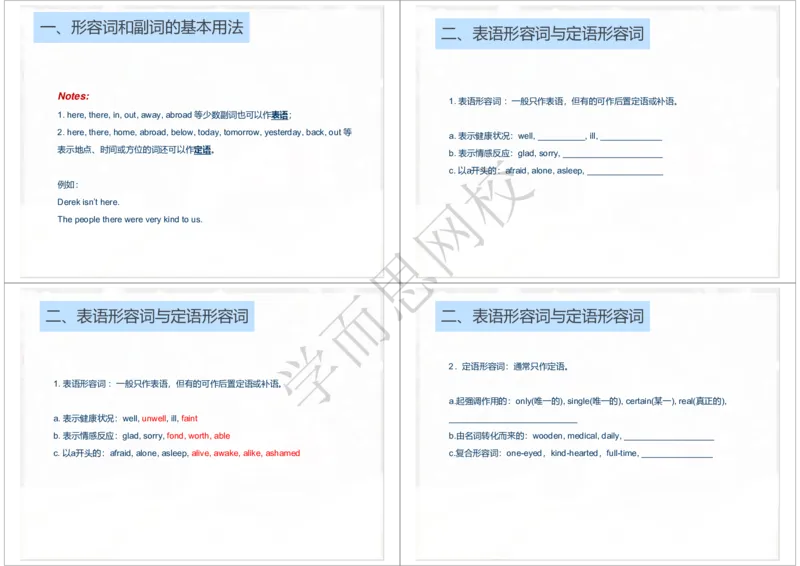
Notes:
1. here, there, in, out, away, abroad 等少数副词也可以作表语;
2. here, there, home, abroad, below, today, tomorrow, yesterday, back, out 等
表示地点、时间或方位的词还可以作定语。
例如:
Derek isn’t here.
The people there were very kind to us.
一、形容词和副词的基本用法
1. 表语形容词:一般只作表语,但有的可作后置定语或补语。
a. 表示健康状况:well, __________, ill, _____________
b. 表示情感反应:glad, sorry, _____________________
c. 以a开头的:afraid, alone, asleep, ________________
二、表语形容词与定语形容词
1. 表语形容词:一般只作表语,但有的可作后置定语或补语。
a. 表示健康状况:well, unwell, ill, faint
b. 表示情感反应:glad, sorry, fond, worth, able
c. 以a开头的:afraid, alone, asleep, alive, awake, alike, ashamed
二、表语形容词与定语形容词
2.定语形容词:通常只作定语。
a.起强调作用的:only(唯一的), single(唯一的), certain(某一), real(真正的),
___________________________
b.由名词转化而来的:wooden, medical, daily, ___________________
c.复合形容词:one-eyed,kind-hearted,full-time, _______________
二、表语形容词与定语形容词
学而思网校
2.定语形容词:通常只作定语。
a.起强调作用的:only(唯一的), single(唯一的), certain(某一), real(真正的),
true(真正的), very(正是), live(活的), exact(准确的), present(在场的)
b.由名词转化而来的:wooden, medical, daily, woolen, weekly, electric
c.复合形容词:one-eyed,kind-hearted,full-time, good-looking, well-meaning,
English-speaking
二、表语形容词与定语形容词
2.定语形容词:通常只作定语。
a.起强调作用的:only(唯一的), single(唯一的), certain(某一), real(真正的),
true(真正的), very(正是), live(活的), exact(准确的), present(在场的)
b.由名词转化而来的:wooden, medical, daily, woolen, weekly, electric
c.复合形容词:one-eyed,kind-hearted,full-time, good-looking, well-meaning,
English-speaking
This is a medical school. √
This school is medical.    ×
二、表语形容词与定语形容词
1. ________ to take this adventure course will certainly learn a lot of
useful skills.
A. Brave enough students
B. Enough brave students
C. Students brave enough
D. Students enough brave
三、形容词作定语的位置规律
1. ___C____ to take this adventure course will certainly learn a lot of
useful skills.
A. Brave enough students
B. Enough brave students
C. Students brave enough
D. Students enough brave
三、形容词作定语的位置规律
学而思网校
1. ___C____ to take this adventure course will certainly learn a lot of
useful skills.
A. Brave enough students
B. Enough brave students
C. Students brave enough
D. Students enough brave
总结:形容词短语作定语时要__________。
三、形容词作定语的位置规律
1. ___C____ to take this adventure course will certainly learn a lot of
useful skills.
A. Brave enough students
B. Enough brave students
C. Students brave enough
D. Students enough brave
总结:形容词短语作定语时要后置。
三、形容词作定语的位置规律
2. All the people ________ at the party were his supporters.
A. present           B. thankful          C. interested         D. important
三、形容词作定语的位置规律
2. All the people ___A____ at the party were his supporters.
A. present           B. thankful          C. interested         D. important
三、形容词作定语的位置规律
学而思网校
2. All the people ___A____ at the party were his supporters.
A. present           B. thankful          C. interested         D. important
总结:表语形容词作定语要__________。
三、形容词作定语的位置规律
2. All the people ___A____ at the party were his supporters.
A. present           B. thankful          C. interested         D. important
总结:表语形容词作定语要后置。
例如:You'd better not wake up the baby asleep.
三、形容词作定语的位置规律
3. Is there ___________ in the paper?
A. something important
B. anything important
C. important something
D. important anything
三、形容词作定语的位置规律
3. Is there _____B_____ in the paper?
A. something important
B. anything important
C. important something
D. important anything
三、形容词作定语的位置规律
学而思网校
3. Is there _____B_____ in the paper?
A. something important
B. anything important
C. important something
D. important anything
总结:形容词修饰不定代词something, anything, nothing等时,要位于_____。
三、形容词作定语的位置规律
3. Is there _____B_____ in the paper?
A. something important
B. anything important
C. important something
D. important anything
总结:形容词修饰不定代词something, anything, nothing等时,要位于后面。
三、形容词作定语的位置规律
1. — Mum, I think I’m ________ to get back to school.
— Not really, my dear. You’d better stay at home for another day or two.
A. so well         B. so ill          C. well enough         D. ill enough
四、副词在句中的位置规律
1. — Mum, I think I’m ___C____ to get back to school.
— Not really, my dear. You’d better stay at home for another day or two.
A. so well         B. so ill          C. well enough         D. ill enough
四、副词在句中的位置规律
学而思网校
1. — Mum, I think I’m ___C____ to get back to school.
— Not really, my dear. You’d better stay at home for another day or two.
A. so well         B. so ill          C. well enough         D. ill enough
总结:enough 修饰形容词或副词时,通常置于被修饰词的_________。
四、副词在句中的位置规律
1. — Mum, I think I’m ___C____ to get back to school.
— Not really, my dear. You’d better stay at home for another day or two.
A. so well         B. so ill          C. well enough         D. ill enough
总结:enough 修饰形容词或副词时,通常置于被修饰词的后面。
四、副词在句中的位置规律
2. 请选择放置频度副词always, often, never 的位置。
She (A) gets (B) up (C) early.                    ______
She (A) is (B) late (C) for (D) school.         ______
四、副词在句中的位置规律
2. 请选择放置频度副词always, often, never 的位置。
She (A) gets (B) up (C) early.                    ___A__
She (A) is (B) late (C) for (D) school.         ___B__
四、副词在句中的位置规律
学而思网校
2. 请选择放置频度副词always, often, never 的位置。
She (A) gets (B) up (C) early.                    ___A__
She (A) is (B) late (C) for (D) school.         ___B__
总结:频度副词always, usually, often, never等一般放在_____________前,
或者_________________________ 之后。
四、副词在句中的位置规律
2. 请选择放置频度副词always, often, never 的位置。
She (A) gets (B) up (C) early.                    ___A__
She (A) is (B) late (C) for (D) school.         ___B__
总结:频度副词always, usually, often, never等一般放在行为动词前,或者
情态动词、助动词或be 动词之后。
四、副词在句中的位置规律
3. ________ I went to the railway station to see my friend off.
A. After eating quickly my dinner         B. After my quickly eating dinner
C. After eating my dinner quickly         D. After eating my quickly dinner
四、副词在句中的位置规律
3. ___C____ I went to the railway station to see my friend off.
A. After eating quickly my dinner         B. After my quickly eating dinner
C. After eating my dinner quickly         D. After eating my quickly dinner
四、副词在句中的位置规律
学而思网校
3. ___C____ I went to the railway station to see my friend off.
A. After eating quickly my dinner         B. After my quickly eating dinner
C. After eating my dinner quickly         D. After eating my quickly dinner
总结:表示地点的副词常放在________;
表示确定时间的副词放在___________;
表示方式的副词通常放在“ 动词(+ 宾语)” 之后,也可放在其它位置;
同时有表示时间、地点和方式的副词时,其顺序一般为________________。
四、副词在句中的位置规律
3. ___C____ I went to the railway station to see my friend off.
A. After eating quickly my dinner         B. After my quickly eating dinner
C. After eating my dinner quickly         D. After eating my quickly dinner
总结:表示地点的副词常放在句末;
表示确定时间的副词放在句首或句末;
表示方式的副词通常放在“ 动词(+ 宾语)” 之后,也可放在其它位置;
同时有表示时间、地点和方式的副词时,其顺序一般为:方式+地点+时间。
四、副词在句中的位置规律
1. Laws that punish parents for their little children’s actions against the laws
get parents ________.
A. worried               B. to worried           C. worrying           D. worry
2. It is believed that if a book is ______, it will surely ______ the reader.
A. interested; interest                             B. interesting; be interested
C. interested; be interesting                   D. interesting; interest
五、–ed形容词和-ing形容词的区别
1. Laws that punish parents for their little children’s actions against the laws
get parents ___A____.
A. worried               B. to worried           C. worrying           D. worry
2. It is believed that if a book is ___D__, it will surely ______ the reader.
A. interested; interest                             B. interesting; be interested
C. interested; be interesting                   D. interesting; interest
五、–ed形容词和-ing形容词的区别
学而思网校
总结:
-ed 形容词通常说明_______,意为___________________;
-ing 形容词通常说明_______,意为___________________。
He told me the news in an excited voice.
The film is interesting.
五、–ed形容词和-ing形容词的区别
总结:
-ed 形容词通常说明人,意为(某人)感到……;
-ing 形容词通常说明事物,意为(某事物)令人……或令人……的(事物) 。
He told me the news in an excited voice.
The film is interesting.
五、–ed形容词和-ing形容词的区别
常见“ 成对儿” 的形容词
五、–ed形容词和-ing形容词的区别
interested-interesting
excited-exciting
disappointed-disappointing
frightened-frightening
surprised-surprising
pleased-pleasing
moved-moving
bored-boring
Note:
glad, happy, sorry, angry, thankful, proud 等形容词的主语只能是人,而pleasant,
easy, difficult, important等则通常以事物或it作主语,说明事物。
例如:
I feel sorry for you.
It’s difficult to explain in words.
五、–ed形容词和-ing形容词的区别
学而思网校