高一春·目标清北班
Unit 12
Contents
Part 1. Listening
Part 3. Grammar
Part 4. CEE Integrated
Part 2. Speaking
Listening
Part One
Pre-listening
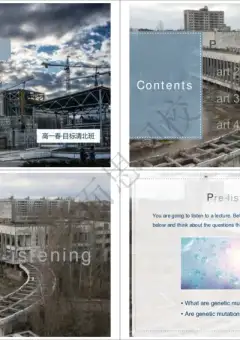
Before you listen, look at the pictures and decide which of
the following are associated with ancient Greece.
学而思网校
Match words (1-6) to their definitions (a-f).
Vocabulary Builder
1. attempt
2. craft
3. inferior
4. dense
5. block
6. keen
a. a tall building that contains flats or offices
b. an act of trying to do sth., especially sth. difficult
c. not good or not as good as sb./sth. else
d. containing a lot of people, things, plants, etc.
e. to make sth. using special skills with hands
f. wanting to do sth. or wanting sth. to happen
While listening
学而思网校
Since early times, mankind has attempted to make keen observations of
what is seen around us, accompanied by explanations. The ancient Chinese,
Egyptians, and Persians all conducted experiments and crafted detailed
descriptions of natural elements. The Greeks were no exception. A large
number of Greek philosophers and scientists contributed to their understanding
of matter and what formed the world around them.
While listening
学而思网校
Listen to the first part of the lecture. Decide whether the following
statements are TRUE (T) or FALSE (F).
1. T The ancient Chinese, Persians, and Egyptians have all conducted
experiments of natural elements.
2. F The Greek was the only civilization that has crafted detailed
descriptions of natural elements.
3. T Both Greek philosophers and scientists have contributed to their
understanding of matter.
While listening
学而思网校
The ancient Greeks initially believed that the world consisted of four elements:
earth, water, air, and fire. Much debate occurred in Greece around these four
elements. It was argued that there was only one primordial element from which
everything else came. Different
philosophers
made arguments
for different
elements. Heraclitus claimed that everything in nature came from fire, Thales, from
water, and Anaximenes, from air. The philosopher Empedocles was the first to
publicly state that there were actually four separate elements that formed up all
matter, instead of just one.
学而思网校
While listening
学而思网校
Listen to the second part of the lecture. Choose the correct answer to the questions
below.
1. The ancient Greeks initially believed the world consisted of:
A. earth, water, gold, and fire
B. water, fire, gold, and air
C. sun, water, gold, and air
D. water, air, earth, and fire
2. The Greek philosopher Thales claimed that everything in nature came from:
A.  fire                     B. earth                   C. water
D. air
While listening
学而思网校
Plato appears to be the first Greek to use the word “element” when describing
these four supposed building blocks of life. The Greek word for element basically
means “smallest division or unit”. Meanwhile, Aristotle argued that the earthly
elements were inferior and corruptible. He believed that the stars and the
observable universe couldn’t possibly be made of the same elements as the ones
that make up Earth, and suggested that a fifth element existed. This celestial
element, believed to be superior to all others, was known as aether. Aristotle
associated qualities like wet, dry, hot, and cold with each of the elements. Later,
Proclus connected different properties such as immobile, blunt, sharp, dense, and
mobile with each of the earthly elements.
While listening
学而思网校
Listen to the third part of the lecture. Decide whether the following statements are
TRUE (T) or FALSE (F).
1. F Aristotle is the first Greek to use the word "element“ to describe these four
building blocks of life.
2. T The Greek word for element essentially means "smallest division or unit".
3. T Aristotle believed that the earthly elements were inferior, whereas the celestial
element was superior to all others.
While listening
学而思网校
Concepts of the world around us have changed much over the years, with
scientists having now named over 100 different atoms that make up everything in
the universe. However, the scientific curiosity of the ancient Greeks will always
remain a symbol of this ancient people’s poetic imagination.
学而思网校
While listening
学而思网校
Listen to the fourth part of the lecture. What is most likely the author's attitude
towards ancient Greek's concepts of the world.
A. disapproving
B. complimentary
C. curious
D. skeptical
LANGUAGE DEVELOPMENT
学而思网校
mankind n. /mænˈkaɪnd/
all humans, thought about as one large
group; the human race
The future of mankind is at stake.
人类的未来危在旦夕。
Since early times, mankind has
attempted
to
make
keen
observations of what is seen around
us, accompanied by explanations.
The ancient Chinese, Egyptians, and
Persians all conducted experiments
and crafted detailed descriptions of
natural elements. The Greeks were
no exception. A large number of
Greek philosophers and scientists
contributed to their understanding of
matter and what formed the world
around them.
LANGUAGE DEVELOPMENT
学而思网校
attempt v./n. /әˈtempt/
an act of trying to do sth., especially sth.
difficult, often with no success
They made no attempt to escape.
他们没有企图逃跑。
• attempt to do something
I will attempt to answer all your questions.
我将尽力回答你所有的问题。
• attempt something
All The Times I've seen him attempt humor
have come across as forced and artificial.
Since early times, mankind has
attempted
to
make
keen
observations of what is seen around
us, accompanied by explanations.
The ancient Chinese, Egyptians, and
Persians all conducted experiments
and crafted detailed descriptions of
natural elements. The Greeks were
no exception. A large number of
Greek philosophers and scientists
contributed to their understanding of
matter and what formed the world
around them.
LANGUAGE DEVELOPMENT
学而思网校
keen v./adj. /kiːn/
wanting to do sth. or wanting sth. to happen
very much
keen to do sth.
John was very keen to help.
Since early times, mankind has
attempted
to
make
keen
observations of what is seen around
us, accompanied by explanations.
The ancient Chinese, Egyptians, and
Persians all conducted experiments
and crafted detailed descriptions of
natural elements. The Greeks were
no exception. A large number of
Greek philosophers and scientists
contributed to their understanding of
matter and what formed the world
around them.
学而思网校
LANGUAGE DEVELOPMENT
学而思网校
craft v./n. /krɑːft/
an activity involving a special skill at making
things with your hands
Sheep shearing is a highly skilled craft.
剪羊毛是一项非常熟练的手艺。
Since early times, mankind has
attempted
to
make
keen
observations of what is seen around
us, accompanied by explanations.
The ancient Chinese, Egyptians, and
Persians all conducted experiments
and crafted detailed descriptions of
natural elements. The Greeks were
no exception. A large number of
Greek philosophers and scientists
contributed to their understanding of
matter and what formed the world
around them.
LANGUAGE DEVELOPMENT
学而思网校
philosopher n. /fәˈlɒsәfә(r)/
a person who studies or writes about
philosophy
We studied the writings of the Greek
philosopher Aristotle.
我们学习了希腊哲学家亚里士多德的著
作。
Since early times, mankind has
attempted
to
make
keen
observations of what is seen around
us, accompanied by explanations.
The ancient Chinese, Egyptians, and
Persians all conducted experiments
and crafted detailed descriptions of
natural elements. The Greeks were
no exception. A large number of
Greek philosophers and scientists
contributed to their understanding of
matter and what formed the world
around them.
LANGUAGE DEVELOPMENT
学而思网校
primordial adj. /praɪˈmɔːdiәl/
existing at or from the beginning of
the world
primordial impulses
The ancient Greeks initially believed that
the world consisted of four elements: earth,
water, air, and fire. Much debate occurred in
Greece around these four elements. It was
argued that there was only one primordial
element from which everything else came.
Different philosophers made arguments for
different elements. Heraclitus claimed that
everything in nature came from fire, Thales,
from water, and Anaximenes, from air. The
philosopher Empedocles was the first to
publicly state that there were actually four
separate elements that formed up all matter,
instead of just one.
LANGUAGE DEVELOPMENT
学而思网校
block v./n. /blɒk/
a tall building that contains flats or
offices
The houses are made of concrete
blocks with tin roofs.
这些房子是用带有铁皮屋顶的混凝
土砖建造的。
Plato appears to be the first Greek to use the word
“element” when describing these four supposed
building blocks of life. The Greek word for element
basically
means
“smallest
division
or
unit”.
Meanwhile,
Aristotle
argued
that
the
earthly
elements
were
inferior
and
corruptible.
He
believed that the stars and the observable universe
couldn’t possibly be made of the same elements as
the ones that make up Earth, and suggested that a
fifth
element
existed.
This
celestial
element,
believed to be superior to all others, was known as
aether. Aristotle associated qualities like wet, dry,
hot, and cold with each of the elements. Later,
Proclus connected different properties such as
immobile, blunt, sharp, dense, and mobile with
each of the earthly elements.
学而思网校
LANGUAGE DEVELOPMENT
学而思网校
inferior n./adj. /ɪnˈfɪәriә(r)/
not good or not as good as sb./sth.
else
inferior to sb./sth.
He preferred the company of those
who were intellectually inferior to
himself.
他喜欢与那些智力不如他的人为伍。
Plato appears to be the first Greek to use the word
“element” when describing these four supposed
building blocks of life. The Greek word for element
basically
means
“smallest
division
or
unit”.
Meanwhile,
Aristotle
argued
that
the
earthly
elements
were
inferior
and
corruptible.
He
believed that the stars and the observable universe
couldn’t possibly be made of the same elements as
the ones that make up Earth, and suggested that a
fifth
element
existed.
This
celestial
element,
believed to be superior to all others, was known as
aether. Aristotle associated qualities like wet, dry,
hot, and cold with each of the elements. Later,
Proclus connected different properties such as
immobile, blunt, sharp, dense, and mobile with
each of the earthly elements.
LANGUAGE DEVELOPMENT
学而思网校
corruptible adj. /kәˈrʌptәbl/
susceptible to corruption; capable of
being corrupted
If they find an official very rich, they
will definitely think he is corruptible
and thus increase their resentment.
如果他们发现一个官员非常富有,他
们肯定会认为他是腐败的,从而增加
他们的怨恨。
Plato appears to be the first Greek to use the word
“element” when describing these four supposed
building blocks of life. The Greek word for element
basically
means
“smallest
division
or
unit”.
Meanwhile,
Aristotle
argued
that
the
earthly
elements
were
inferior
and
corruptible.
He
believed that the stars and the observable universe
couldn’t possibly be made of the same elements as
the ones that make up Earth, and suggested that a
fifth
element
existed.
This
celestial
element,
believed to be superior to all others, was known as
aether. Aristotle associated qualities like wet, dry,
hot, and cold with each of the elements. Later,
Proclus connected different properties such as
immobile, blunt, sharp, dense, and mobile with
each of the earthly elements.
LANGUAGE DEVELOPMENT
学而思网校
celestial adj. /sәˈlestiәl/
of the sky or of heaven
• celestial bodies (= the sun, moon,
stars, etc.)
Plato appears to be the first Greek to use the word
“element” when describing these four supposed
building blocks of life. The Greek word for element
basically
means
“smallest
division
or
unit”.
Meanwhile,
Aristotle
argued
that
the
earthly
elements
were
inferior
and
corruptible.
He
believed that the stars and the observable universe
couldn’t possibly be made of the same elements as
the ones that make up Earth, and suggested that a
fifth
element
existed.
This
celestial
element,
believed to be superior to all others, was known as
aether. Aristotle associated qualities like wet, dry,
hot, and cold with each of the elements. Later,
Proclus connected different properties such as
immobile, blunt, sharp, dense, and mobile with
each of the earthly elements.
LANGUAGE DEVELOPMENT
学而思网校
properties n. /'prɒpәtɪz/
the ways in which it behaves in
particular conditions
This building is government property.
这幢大楼是政府的财产。
Plato appears to be the first Greek to use the word
“element” when describing these four supposed
building blocks of life. The Greek word for element
basically
means
“smallest
division
or
unit”.
Meanwhile,
Aristotle
argued
that
the
earthly
elements
were
inferior
and
corruptible.
He
believed that the stars and the observable universe
couldn’t possibly be made of the same elements as
the ones that make up Earth, and suggested that a
fifth
element
existed.
This
celestial
element,
believed to be superior to all others, was known as
aether. Aristotle associated qualities like wet, dry,
hot, and cold with each of the elements. Later,
Proclus connected different properties such as
immobile, blunt, sharp, dense, and mobile with
each of the earthly elements.
学而思网校
LANGUAGE DEVELOPMENT
学而思网校
immobile adj. /ɪˈmәʊbaɪl/
not moving
She stood immobile by the window.
她一动不动地站在窗边。
Plato appears to be the first Greek to use the word
“element” when describing these four supposed
building blocks of life. The Greek word for element
basically
means
“smallest
division
or
unit”.
Meanwhile,
Aristotle
argued
that
the
earthly
elements
were
inferior
and
corruptible.
He
believed that the stars and the observable universe
couldn’t possibly be made of the same elements as
the ones that make up Earth, and suggested that a
fifth
element
existed.
This
celestial
element,
believed to be superior to all others, was known as
aether. Aristotle associated qualities like wet, dry,
hot, and cold with each of the elements. Later,
Proclus connected different properties such as
immobile, blunt, sharp, dense, and mobile with
each of the earthly elements.
LANGUAGE DEVELOPMENT
学而思网校
blunt v./adj. /blʌnt/
without a sharp edge or point
The police said he had been hit with
a blunt instrument.
警方说他是被一件钝器击中的。
Plato appears to be the first Greek to use the word
“element” when describing these four supposed
building blocks of life. The Greek word for element
basically
means
“smallest
division
or
unit”.
Meanwhile,
Aristotle
argued
that
the
earthly
elements
were
inferior
and
corruptible.
He
believed that the stars and the observable universe
couldn’t possibly be made of the same elements as
the ones that make up Earth, and suggested that a
fifth
element
existed.
This
celestial
element,
believed to be superior to all others, was known as
aether. Aristotle associated qualities like wet, dry,
hot, and cold with each of the elements. Later,
Proclus connected different properties such as
immobile, blunt, sharp, dense, and mobile with
each of the earthly elements.
LANGUAGE DEVELOPMENT
学而思网校
dense adj. /dens/
containing a lot of people, things,
plants, etc. with little space between
them
The fog was getting very dense.
雾越来越浓了。
Plato appears to be the first Greek to use the word
“element” when describing these four supposed
building blocks of life. The Greek word for element
basically
means
“smallest
division
or
unit”.
Meanwhile,
Aristotle
argued
that
the
earthly
elements
were
inferior
and
corruptible.
He
believed that the stars and the observable universe
couldn’t possibly be made of the same elements as
the ones that make up Earth, and suggested that a
fifth
element
existed.
This
celestial
element,
believed to be superior to all others, was known as
aether. Aristotle associated qualities like wet, dry,
hot, and cold with each of the elements. Later,
Proclus connected different properties such as
immobile, blunt, sharp, dense, and mobile with
each of the earthly elements.
LANGUAGE DEVELOPMENT
学而思网校
atom n. /ˈætәm/
the smallest part of a chemical element
that can take part in a chemical reaction
The scientist Ernest Rutherford was the
first person to split the atom.
科学家欧内斯特ꞏ卢瑟福是第一个分裂原
子的人。
Concepts of the world around us
have changed much over the
years, with scientists having now
named over 100 different atoms
that make up everything in the
universe. However, the scientific
curiosity of the ancient Greeks
will always remain a symbol of
this
ancient
people’s
poetic
imagination.
学而思网校
LANGUAGE DEVELOPMENT
学而思网校
poetic n./adj. /pәʊˈetɪk/
like
or
suggesting
poetry,
especially
because it shows imagination and deep
feeling
There is a poetic quality to her playing.
她的演奏有一种诗意。
Concepts of the world around us
have changed much over the
years, with scientists having now
named over 100 different atoms
that make up everything in the
universe. However, the scientific
curiosity of the ancient Greeks
will always remain a symbol of
this
ancient
people’s
poetic
imagination.
VOCABULARY
No.
Vocabulary
Part of
Speech
Phonetic Symbol
English Explanation
1
mankind
n.
/mænˈkaɪnd/
all humans, thought about as one large group;
the human race
2
attempt
v./n.
/әˈtempt/
an act of trying to do sth., especially sth. difficult,
often with no success
3
keen
v./adj.
/kiːn/
wanting to do sth. or wanting sth. to happen
very much
4
philosopher
n.
/fәˈlɒsәfә(r)/
a person who studies or writes about
philosophy
5
primordial
adj.
/praɪˈmɔːdiәl/
existing at or from the beginning of the world
6
craft
v./n.
/krɑːft/
an activity involving a special skill at making
things with your hands
7
block
v./n.
/blɒk/
a tall building that contains flats or offices
8
inferior
n./adj.
/ɪnˈfɪәriә(r)/
not good or not as good as sb./sth. else
9
corruptible
adj.
/kәˈrʌptәbl/
susceptible to corruption; capable of being
corrupted
10
celestial
adj.
/sәˈlestiәl/
of the sky or of heaven
VOCABULARY
No.
Vocabulary
Part of
Speech
Phonetic Symbol
English Explanation
11
properties
n.
/'prɒpәtɪz/
the ways in which it behaves in particular conditions
12
immobile
adj.
/ɪˈmәʊbaɪl/
not moving
13
blunt
v./adj.
/blʌnt/
without a sharp edge or point
14
dense
adj.
/dens/
containing a lot of people, things, plants, etc. with
little space between them
15
atom
n.
/ˈætәm/
the smallest part of a chemical element that can
take part in a chemical reaction
16
poetic
n./adj.
/pәʊˈetɪk/
like or suggesting poetry, especially because it
shows imagination and deep feeling
Exercises
学而思网校
1. He had retained a keen interest in the progress of the work.
2. We can distinguish one kind of substance from another by its properties .
3. She took the dog for a walk around the office block .
4. All the furniture is crafted from natural materials.
5. Modern music is often considered inferior to that of the past.
6. The prisoners attempted an escape, but failed.
attempt                      keen                            craft
inferior                       block                        properties
学而思网校
Speaking
Part Two
学而思网校
/m/, /n/ and /ŋ/ The pronunciation of /m/, /n/ and /ŋ/ are often confused.
All sounds are produced with the air coming through your nose. With /m/
that is achieved by closing your lips, whereas with /n/ the lips are open and
your tongue touching the top of your mouth behind your teeth blocks the air.
For /n/, you block the air in your mouth with the front of your tongue and for
/ŋ/, you block the air with the back of your tongue.
Pronunciation: /m/, /n/ and /ŋ/
学而思网校
Use the list to practice pronouncing /m/, /n/ and /ŋ/.
thin -- thing
sin -- sing
sun -- sung
win -- wing
kin -- king
ran -- rang
ton -- tongue
cam -- can
sum -- son
term -- turn
game -- gain
seem -- seen
team -- teen
skim -- skin
dorm -- dawn
Pronunciation: /tʃ/ and /dʒ/
Grammar
Part Three
学而思网校
A. In formal contexts, we can use an amount of or a great deal of with
uncountable nouns :
• A large amount of the food was inedible.
• A great deal of the exhibition was devoted to her recent work.
A number of, an amount of, etc.
B. We can use a number of or a great many with plural nouns:
•
The book contains a large number of pictures, many in colors.
•
She had a great many friends in New Zealand.
A number of, an amount of, etc.
C. We can use the phrase many a with a singular noun to talk about a repeated
event or a large number of people and things:
•
Many a pupil at the school will be pleased that Latin is no longer compulsory.
•
Many a ship has been wrecked on those rocks.
A number of, an amount of, etc.
D. Sometimes, we use a lot of, lots of, plenty of, quantities of, a quantity of,
masses of, etc. with uncountable noun and plural countable nouns:
•
We took plenty of food and drink on our walk through the hills.
A number of, an amount of, etc.
学而思网校
Exercises
P55
1. They spent ______ money on the new hospital.
A. a great deal
B. a good deal of
C. a great many
D. a large number of
2. He possesses ______ books.
A. plenty of
B. very much
C. a great deal of
D. an amount of
Exercises
P56
3. ______ new products have been successfully made in the factory.
A. A great deal of
B. A number of
C. The number of
D. A great amount of
4. Many a student ______ on line and played computer games since the new
term began.
A. has chatted
B. chatted
C. have chatted
D. chat
Exercises
P56
5. - Why does the Lake smell terrible?
- Because large quantities of water______.
A. have polluted
B. is being polluted
C. has been polluted
D. have been polluted
CEE
Integrated
Part Four
学而思网校
z
学而思网校
1.  Who is the woman?
A. The boy's teacher.            B. The boy's mother.           C. The boy's grandmother.
2. What did the woman love doing when she was young?
A. Doing art projects.            B. Playing with a cat.           C. Taking photographs.
3. What is the boy like?
A. He is outgoing.                 B. He likes to paint.              C. He has many good friends.
4. What does the woman mean about her husband?
A. The boy looks just like him.
B. He held the boy before she did.
C. He would be pleased with the boy if he were alive today.
P56
Listening - long conversation
z
学而思网校
M: What were you like when you were my age?
W: That was a long time ago. I was a lot like you, actually. I loved art, and I took dance lessons.
M: I like art, too.
W: I know you do. I have hung a lot of your paintings up in the living room. I was also very shy, and I didn't
make friends very easily. Do you want to see some photos of me when I was little?
M: Yeah.
W: Here I am on Easter Sunday. Look at my silly hat! And here I am with the family dog, Buttons. He was
so sweet. Oh, look, this is me with your mother when she was little. She looks just like you!
M: I think she looks like you.
W: She does look like me. I'm her mother, after all.
M: When did you meet me?
W: When you were born! I was at the hospital when your mother had you, and I was the third person to hold
you. Your grandfather was the fourth. He would be very proud of you if he were still with us today. You're a
wonderful little boy.
P56
Listening - long conversation
z
学而思网校
1.  Who is the woman?
A. The boy's teacher.            B. The boy's mother.           C. The boy's grandmother.
2. What did the woman love doing when she was young?
A. Doing art projects.
B. Playing with a cat.           C. Taking photographs.
3. What is the boy like?
A. He is outgoing.                 B. He likes to paint.
C. He has many good friends.
4. What does the woman mean about her husband?
A. The boy looks just like him.
B. He held the boy before she did.
C. He would be pleased with the boy if he were alive today.
P56
Listening - long conversation
学而思网校