2025 年高考第一次模拟考试(上海专用)02
英语
(考试时间:120 分钟  试卷满分:140 分)
注意事项:
1.答卷前,考生务必将自己的姓名、考生号等填写在答题卡和试卷指定位置上。
2.回答选择题时,选出每小题答案后,用铅笔把答题卡对应题目的答案标号涂黑。如需改动,用橡皮
擦干净后,再选涂其他答案标号。回答非选择题时,将答案写在答题卡上。写在本试卷上无效。
3.考试结束后,将本试卷和答题卡一并交回。
I.Listening Comprehension (第1-10 题, 每题1 分;第11-20 题,每题1.5 分;共25 分)
Section A
Directions: In Section A, you will hear ten short conversations between two speakers. At the end of each
conversation, a question will be asked about what was said. The conversations and the questions will be spoken only
once. After you hear a conversation and the question about it, read the four possible answers on your paper, and
decide which one is the best answer to the question you have heard.
1.
A.Husband and wife.
B.Boss and assistant.
C.Nurse and patient.
D.Manager and customer.
2.
A.At a post office
B.At a flower shop.
C.At a department store.
D.At a bus station.
3.
A.He is unemployed at present.
B.He owns a company now.
C.He still works in the agency.
D.He is unable to support his family.
4.
A.At 10:00.
B.At 10:20.
C.At 11:00.
D.At 11:20.
5.
A.Satisfied.
B.Relieved.
C.Surprised.
D.Embarrassed.
6.
A.The woman didn’t post any postcard from Egypt.
B.The man has never collected any postcards.
C.The woman will go to Egypt for her holiday.
D.The man begins to take up collecting postcards.
7.
A.She can’t afford that much for a trip.
B.She is fortunate to have made a lot of money.
C.She doesn’t think 5,000 dollars is enough for the trip.
D.She considers 5,000 dollars only a small sum of money.
8.
A.He wants to buy the new car.
B.He thinks his signature is necessary.
C.He has already signed a contract.
D.He doesn’t always say what he means.
9.
A.The man had poor imagination because of the car accident.
B.The man must have advised the woman to wear the seat belt.
C.The woman was likely to have got seriously injured in the car accident.
D.The woman wasn’t wearing the seat belt when the accident happened.
10.
A.Violence sports are the source of social instability.
B.Violence sports are to blame for crime and school bullying.
C.Violence sports serve as an escape for negative emotions.
D.Violence sports won’t attract many people’s interest in the long run.
Section B
Directions: In Section B, you will hear two short passages and one longer conversation, and you will be asked
several questions on each of the short passages and the longer conversation. The short passages and the longer
conversation will be read twice, but the questions will be spoken only once. When you hear a question, read the four
possible answers on your paper and decide which one is the best answer to the question you have heard.
Questions 11 through 13 are based on the following passage
11.A.To explain a new requirement for graduation.
B.To interest students in a community service project.
C.To discuss the problems of elementary school students.
D.To involve elementary school teachers in a special program.
12.A.Providing jobs for graduating students.
B.Helping education majors prepare for final exams.
C.Offering tutorials to elementary school students.
D.Funding for a community service project.
13.A.He teaches part-time in a local elementary school.
B.He observes elementary school students in the classroom.
C.He helps students who need consult prepare their resume.
D.He gives support to students who participate in a special program.
Questions 14 through 16 are based on the following passage.
14.A.They want to eat in a fashionable way like young people.
B.They prefer to eat food that is tastier and more widely accepted.
C.They become aware of the harm processed foods do to health.
D.They try to change their way of processing foods little by little.
15.A.They contain not too many chemical additives.
B.They are cultivated in the soil rich in organic matters.
C.They produce as many calories as processed foods.
D.They are usually grown in commercial farming areas.
16.A.They are allowed to move about and eat freely.
B.They are tasty though kept in the crowded building.
C.They can hardly grow in a healthy way without good food.
D.They produce eggs which usually contain important vitamins..
Questions 17 through 20 are bused on the following conversation.
17.A.It was on a cross street.
B.They had no time to see it.
C.It had no parking space.
D.They weren’t in favour of it.
18.A.It is too small in size.
B.It blocks the air-conditioner.
C.It admits heat from the late afternoon sun.
D.It stops the sun beating down on the curtains.
19.A.Parking and desk space.
B.Parking and air-conditioning.
C.Privacy and cleanliness.
D.A cheerful kitchen and a separate dining area.
20.A.The one on 68th Street.
B.The one on 72nd Street.
C.The one on 88th Street.
D.The one on 80th Street.
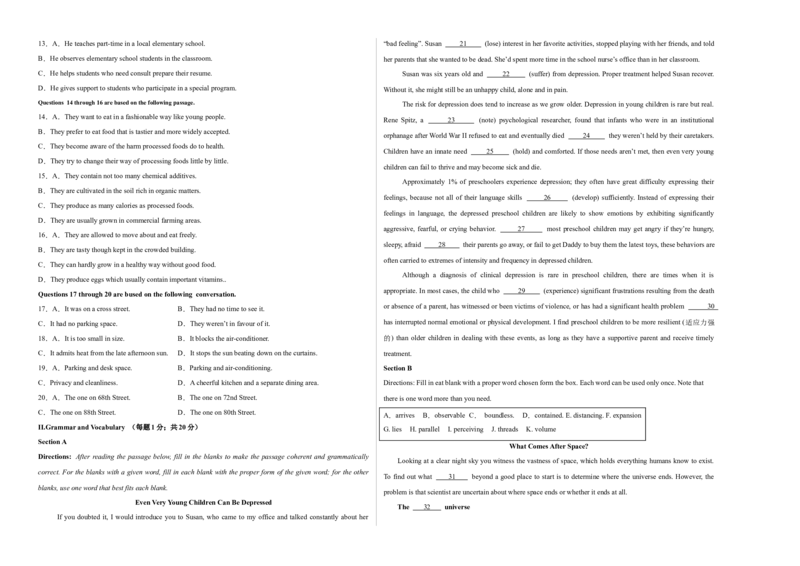
II.Grammar and Vocabulary (每题1 分;共20 分)
Section A
Directions: After reading the passage below, fill in the blanks to make the passage coherent and grammatically
correct. For the blanks with a given word, fill in each blank with the proper form of the given word; for the other
blanks, use one word that best fits each blank.
Even Very Young Children Can Be Depressed
If you doubted it, I would introduce you to Susan, who came to my office and talked constantly about her
“bad feeling”. Susan     21     (lose) interest in her favorite activities, stopped playing with her friends, and told
her parents that she wanted to be dead. She’d spent more time in the school nurse’s office than in her classroom.
Susan was six years old and     22     (suffer) from depression. Proper treatment helped Susan recover.
Without it, she might still be an unhappy child, alone and in pain.
The risk for depression does tend to increase as we grow older. Depression in young children is rare but real.
Rene Spitz, a     23     (note) psychological researcher, found that infants who were in an institutional
orphanage after World War II refused to eat and eventually died     24     they weren’t held by their caretakers.
Children have an innate need     25     (hold) and comforted. If those needs aren’t met, then even very young
children can fail to thrive and may become sick and die.
Approximately 1% of preschoolers experience depression; they often have great difficulty expressing their
feelings, because not all of their language skills     26     (develop) sufficiently. Instead of expressing their
feelings in language, the depressed preschool children are likely to show emotions by exhibiting significantly
aggressive, fearful, or crying behavior.     27     most preschool children may get angry if they’re hungry,
sleepy, afraid     28     their parents go away, or fail to get Daddy to buy them the latest toys, these behaviors are
often carried to extremes of intensity and frequency in depressed children.
Although a diagnosis of clinical depression is rare in preschool children, there are times when it is
appropriate. In most cases, the child who     29     (experience) significant frustrations resulting from the death
or absence of a parent, has witnessed or been victims of violence, or has had a significant health problem      30
has interrupted normal emotional or physical development. I find preschool children to be more resilient (适应力强
的) than older children in dealing with these events, as long as they have a supportive parent and receive timely
treatment.
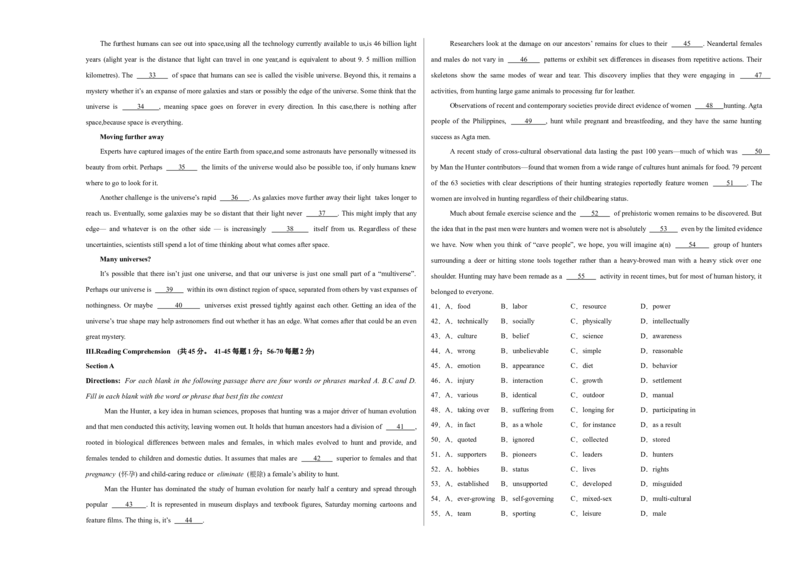
Section B
Directions: Fill in eat blank with a proper word chosen form the box. Each word can be used only once. Note that
there is one word more than you need.
A.arrives    B.observable  C. boundless.    D.contained. E. distancing. F. expansion
G. lies    H. parallel    I. perceiving    J. threads    K. volume
What Comes After Space?
Looking at a clear night sky you witness the vastness of space, which holds everything humans know to exist.
To find out what    31    beyond a good place to start is to determine where the universe ends. However, the
problem is that scientist are uncertain about where space ends or whether it ends at all.
The    32    universe
The furthest humans can see out into space,using all the technology currently available to us,is 46 billion light
years (alight year is the distance that light can travel in one year,and is equivalent to about 9. 5 million million
kilometres). The    33    of space that humans can see is called the visible universe. Beyond this, it remains a
mystery whether it’s an expanse of more galaxies and stars or possibly the edge of the universe. Some think that the
universe is    34   , meaning space goes on forever in every direction. In this case,there is nothing after
space,because space is everything.
Moving further away
Experts have captured images of the entire Earth from space,and some astronauts have personally witnessed its
beauty from orbit. Perhaps    35    the limits of the universe would also be possible too, if only humans knew
where to go to look for it.
Another challenge is the universe’s rapid    36   . As galaxies move further away their light  takes longer to
reach us. Eventually, some galaxies may be so distant that their light never    37   . This might imply that any
edge— and whatever is on the other side — is increasingly    38    itself from us. Regardless of these
uncertainties, scientists still spend a lot of time thinking about what comes after space.
Many universes?
It’s possible that there isn’t just one universe, and that our universe is just one small part of a “multiverse”.
Perhaps our universe is    39    within its own distinct region of space, separated from others by vast expanses of
nothingness. Or maybe     40     universes exist pressed tightly against each other. Getting an idea of the
universe’s true shape may help astronomers find out whether it has an edge. What comes after that could be an even
great mystery.
III.Reading Comprehension  (共45 分。 41-45 每题1 分;56-70 每题2 分)
Section A
Directions: For each blank in the following passage there are four words or phrases marked A. B.C and D.
Fill in each blank with the word or phrase that best fits the context
Man the Hunter, a key idea in human sciences, proposes that hunting was a major driver of human evolution
and that men conducted this activity, leaving women out. It holds that human ancestors had a division of    41   ,
rooted in biological differences between males and females, in which males evolved to hunt and provide, and
females tended to children and domestic duties. It assumes that males are    42    superior to females and that
pregnancy (怀孕) and child-caring reduce or eliminate (根除) a female’s ability to hunt.
Man the Hunter has dominated the study of human evolution for nearly half a century and spread through
popular    43   . It is represented in museum displays and textbook figures, Saturday morning cartoons and
feature films. The thing is, it’s    44   .
Researchers look at the damage on our ancestors’ remains for clues to their    45   . Neandertal females
and males do not vary in    46    patterns or exhibit sex differences in diseases from repetitive actions. Their
skeletons show the same modes of wear and tear. This discovery implies that they were engaging in    47
activities, from hunting large game animals to processing fur for leather.
Observations of recent and contemporary societies provide direct evidence of women    48   hunting. Agta
people of the Philippines,    49   , hunt while pregnant and breastfeeding, and they have the same hunting
success as Agta men.
A recent study of cross-cultural observational data lasting the past 100 years—much of which was    50
by Man the Hunter contributors—found that women from a wide range of cultures hunt animals for food. 79 percent
of the 63 societies with clear descriptions of their hunting strategies reportedly feature women    51   . The
women are involved in hunting regardless of their childbearing status.
Much about female exercise science and the    52    of prehistoric women remains to be discovered. But
the idea that in the past men were hunters and women were not is absolutely    53    even by the limited evidence
we have. Now when you think of “cave people”, we hope, you will imagine a(n)    54    group of hunters
surrounding a deer or hitting stone tools together rather than a heavy-browed man with a heavy stick over one
shoulder. Hunting may have been remade as a    55    activity in recent times, but for most of human history, it
belonged to everyone.
41.A.food
B.labor
C.resource
D.power
42.A.technically
B.socially
C.physically
D.intellectually
43.A.culture
B.belief
C.science
D.awareness
44.A.wrong
B.unbelievable
C.simple
D.reasonable
45.A.emotion
B.appearance
C.diet
D.behavior
46.A.injury
B.interaction
C.growth
D.settlement
47.A.various
B.identical
C.outdoor
D.manual
48.A.taking over
B.suffering from
C.longing for
D.participating in
49.A.in fact
B.as a whole
C.for instance
D.as a result
50.A.quoted
B.ignored
C.collected
D.stored
51.A.supporters
B.pioneers
C.leaders
D.hunters
52.A.hobbies
B.status
C.lives
D.rights
53.A.established
B.unsupported
C.developed
D.misguided
54.A.ever-growing
B.self-governing
C.mixed-sex
D.multi-cultural
55.A.team
B.sporting
C.leisure
D.male
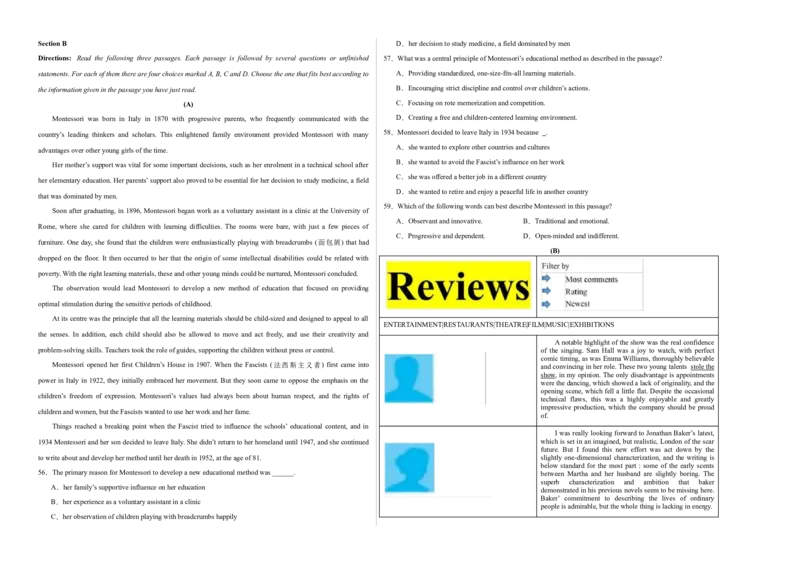
Section B
Directions: Read the following three passages. Each passage is followed by several questions or unfinished
statements. For each of them there are four choices marked A, B, C and D. Choose the one that fits best according to
the information given in the passage you have just read.
(A)
Montessori was born in Italy in 1870 with progressive parents, who frequently communicated with the
country’s leading thinkers and scholars. This enlightened family environment provided Montessori with many
advantages over other young girls of the time.
Her mother’s support was vital for some important decisions, such as her enrolment in a technical school after
her elementary education. Her parents’ support also proved to be essential for her decision to study medicine, a field
that was dominated by men.
Soon after graduating, in 1896, Montessori began work as a voluntary assistant in a clinic at the University of
Rome, where she cared for children with learning difficulties. The rooms were bare, with just a few pieces of
furniture. One day, she found that the children were enthusiastically playing with breadcrumbs (面包屑) that had
dropped on the floor. It then occurred to her that the origin of some intellectual disabilities could be related with
poverty. With the right learning materials, these and other young minds could be nurtured, Montessori concluded.
The observation would lead Montessori to develop a new method of education that focused on providing
optimal stimulation during the sensitive periods of childhood.
At its centre was the principle that all the learning materials should be child-sized and designed to appeal to all
the senses. In addition, each child should also be allowed to move and act freely, and use their creativity and
problem-solving skills. Teachers took the role of guides, supporting the children without press or control.
Montessori opened her first Children’s House in 1907. When the Fascists ( 法西斯主义者) first came into
power in Italy in 1922, they initially embraced her movement. But they soon came to oppose the emphasis on the
children’s freedom of expression. Montessori’s values had always been about human respect, and the rights of
children and women, but the Fascists wanted to use her work and her fame.
Things reached a breaking point when the Fascist tried to influence the schools’ educational content, and in
1934 Montessori and her son decided to leave Italy. She didn’t return to her homeland until 1947, and she continued
to write about and develop her method until her death in 1952, at the age of 81.
56.The primary reason for Montessori to develop a new educational method was ______.
A.her family’s supportive influence on her education
B.her experience as a voluntary assistant in a clinic
C.her observation of children playing with breadcrumbs happily
D.her decision to study medicine, a field dominated by men
57.What was a central principle of Montessori’s educational method as described in the passage?
A.Providing standardized, one-size-fits-all learning materials.
B.Encouraging strict discipline and control over children’s actions.
C.Focusing on rote memorization and competition.
D.Creating a free and children-centered learning environment.
58.Montessori decided to leave Italy in 1934 because  .
A.she wanted to explore other countries and cultures
B.she wanted to avoid the Fascist’s influence on her work
C.she was offered a better job in a different country
D.she wanted to retire and enjoy a peaceful life in another country
59.Which of the following words can best describe Montessori in this passage?
A.Observant and innovative.
B.Traditional and emotional.
C.Progressive and dependent.
D.Open-minded and indifferent.
(B)
ENTERTAINMENT|RESTAURANTS|THEATRE|FILM|MUSIC|EXHIBITIONS
A notable highlight of the show was the real confidence
of the singing. Sam Hall was a joy to watch, with perfect
comic timing, as was Emma Williams, thoroughly believable
and convincing in her role. These two young talents stole the
show, in my opinion. The only disadvantage is appointments
were the dancing, which showed a lack of originality, and the
opening scene, which fell a little flat. Despite the occasional
technical flaws, this was a highly enjoyable and greatly
impressive production, which the company should be proud
of.
I was really looking forward to Jonathan Baker’s latest,
which is set in an imagined, but realistic, London of the scar
future. But I found this new effort was act down by the
slightly one-dimensional characterization, and the writing is
below standard for the most part : some of the early scents
between Martha and her husband are slightly boring. The
superb characterization and ambition that baker
demonstrated in his previous novels seem to be missing here.
Baker’ commitment to describing the lives of ordinary
people is admirable, but the whole thing is lacking in energy.
This is episode number three in the nearly twenty-year-
old series, delivering a very attractive and interesting story
and loads of comedy. There is some strong writing and voice
acting, but the new episode chooses to go for a linear (线性
的) narrative, with some puzzle included along the way,
which is less involving than the theme of exploration and
conversation which previous episode have depended on.
Besides, the puzzle are not particularly engaging, and many
of them have been seen before in other adventure games. The
visuals are extremely impressive, of course, as we have come
to expect, this time featuring venues in Catalonia. But
overall, a slight disappointment.
60.The underlined phrase “ stole the show ” most probably means______.
A.disappointed the producer
B.ruined the whole performance
C.attracted the most attention
D.exhibited excessive confidence
61.Which of the following statements about Jonathan Baker is TRUE ?
A.He excels in one-dimensional characterization.
B.His novels center around ordinary people’s lives.
C.His novels show consistent super characterization and ambition.
D.He is passionate about presenting realistic images of future London.
62.The puzzle in episode number three______.
A.are integrated in the narrative
B.arc appealing to the audience
C.deal with the theme of exploration
D.are absent in other adventure games
(C)
Plugs across America
The United States has around 150,000 fuel stations to re till fossil-fuel-burning vehicles. Despite the rapid
growth of all-electric vehicle in America — 400,000 of them were sold in 2021, up from barely la, 000 in 2012 —
the country has only 6,000 fast electric charging stations, the kind that can rapidly charge a battery-powered car.
A glance at America’s charging map reveals a lot of charging deserts. This makes sense, as EVs (electric
vehicle) still represent less than 3% of new car sales. Large cities have a growing number of fast charges, but not
nearly enough to accommodate so many EVs. Away from cities, these charters are along interstate highways closely
enough to allow electric cars safe passage. Otherwise, they are nearly nonexistent in rural America. And EV stations
have a problem that gas stations don’t: “Even the fastest Tesla supercharger is still going to take 15 minutes to put a
couple hundred miles on the vehicle,” says Jeremy Michalek, a professor at Carnegie Mellon University.
Michalek says American charging facilities fall far behind what’ needed for the whole country to transition to
electric driving. On the bright side, there is time to catch up, because not all Americans will embrace at once. Most
early adopters were those with access to a charge at home in their garage or parking space. Those owners can wake
up with a full battery and only need to rely on public charters when they leave town on an extended trip. But as the
country gets to higher levels of EV adoption, the current facilities won’t be enough. That is why Michalek says the
US needs to prioritize increasing the number of charges at rest stops along well-traveled highways, especially as
more people use electric cars for summer-time road trips.
“As we act to higher levels of EV adoption, if we don’t have enough chargers for peak demand, the wait times
are going to be unlike what we see with gas stations,” he says.
Charging dead bones will be larger as more Americans consider an EV. Renters who do not have the option to
install a home charges will be hesitant to go fully electric until they can feel confident a public plug will be there
when they need it. And as more households drive only electric vehicles, it will be crucial that people can get to all
the places they want to go.
In the best case, Michalek envisions public-private cooperation to build a national charging network. The US
government has promised to install plugs throughout rural areas, while companies constructing charging stations
across America will have a strong motivation to fill in the country’s biggest cities. After all, companies like Electrify
America, EV go, and Charge Point charge customers of energy they use.
63.It can be learned from the 2nd paragraph that ______.
A.there is a shortage of charging stations in the rural areas of America
B.it takes about 15 minutes for an average charge to charge a battery-powered car
C.more electric vehicles are sold than fossil-fuel burning cars in large cities in America
D.there are enough charges in America considering the limited sales of new electric vehicles
64.Which of the following statements would Michalek most probably agree with ?
A.Companies setting up charging stations are hesitant to go electric.
B.Those who already have a home charge don’t have to find a public plug.
C.Top priority needs to be given to adding more charging stations across the country.
D.There is enough time to establish a charging network, because not many EVs are uscd.
65.What can be inferred about the renters ?
A.Some renters don’t have the intention to go electric.
B.Some renters might not be authorized to install a home charge.
C.As more renters are unwilling to use public plugs, the charging dead bones are growing.
D.Some renters might not have enough confidence in the public plugs for the safety reasons.
66.Who does Michalek expect to work together to establish the charging network nationwide?
A.The government and some companies.
B.The local government and every household.
C.The charging facility providers and every family.
D.The federal government and the local rural government.
Section C
Directions: Complete the following passage by using the sentences in the box Each sentence can only be used once.
Note that there are two sentences more than you need.
Is Listening to a Book Better than Reading It?
Picture yourself sitting at home in a quiet reading space, ignoring the world around you, absorbed in a tale. You
read the introduction, instantly became interested and now you’re in the middle of an absolute page-turner. But,
there’s a hot debate — physical books vs. e-books vs. audiobooks. Does the device you’re using to read affect your
reaction to the book?
     67      There’s attention span, reasoning, reading fluency, memory and language comprehension.
Reading is known to strengthen communicative ability, vocabulary and increase emotional intelligence and social
awareness. So, whichever way you’re reading, there are definitely benefits.
But, let’s look at the pros to reading with your eyes — that’s physical books and e-books.      68      This
is because when you can actually see the words, your attention is held more closely. Add to this the fact that with
physical books you can go back and find any part you missed, especially if your mind wanders, which will likely
happen at some point or other.
On the other hand, there’s the audiobook. Headphones in, you’re switched off from life and the story really
comes alive, almost like watching a film — in your head. From a scientific perspective, listening to an audiobook is
likely to help you develop a fellow feeling as you hear the emotion of the narrator.      69      Hearing the story
engages different parts of the brain, increasing the intensity and imagery, making you enjoy it more. Yet, going back
to attention period, with an audiobook it’s true that it’s much harder to go back and listen again.
     70      Perhaps, next time you find yourself browsing bookshop shelves, also consider the format. It
may just change your whole literary experience.
A.They help us become continuous readers.
B.They can help to remember information better.
C.Generally, reading uses several areas of the brain.
D.We can more easily understand the changes in tones.
E.All in all, it seems that there are advantages to both physical books and audiobooks.
F.According to a research from Oxford University, audio books affect our reading reaction most.
IV.Summary Writing   (共10 分)
Directions: Read the following passage. Summarize the main idea and the main point( s)of the passage in no more
than 60 words. Use your own words as far as possible.
Humans Evolved to Be Lonely
Loneliness hurts and, over time, it can put the body into a state that increases our risk of everything from heart
attack to diabetes and cancer. So, evolutionarily speaking, why do we experience it? Stephanie Cacioppo, a
neuroscientist, says that countless studies have helped researchers formulate a holistic ( 全面的) purpose for
loneliness.
Being social had its downsides even back then — competition for food, for example, or contribution to the
spread of pathogens (病原体). But scientists think we evolved to feel loneliness because it was more important to
work with one another to accomplish tasks and protect everyone. “The pain of loneliness drove us to renew the
social structure so we could survive and promote key features like trust, cooperation and collective action,” explains
Cacioppo.
She says that, for years, researchers thought of loneliness as a “disease with no compensatory features”.But
now, they’re realizing that it’s more of a biological hunger signal that reminds us when it’s time to reconnect with
those around us to promote our short-term survival. If the outcomes of loncliness were entirely negative, it would no
longer be a part of our DNA.“Hunger and thirst protect our physical body while loneliness protects our social
body,” says Cacioppo.
Interestingly, while loneliness sends a signal to the brain that it’s time for connection, at the same time it’s also
looking for danger. This “contradictory signal,” according to Cacioppo, reminds us to be careful of whether the
people we are connecting with are enemies or friends. She calls this need to be watchful even as we’re socializing a
“self-protection mechanism.” That means in situations where you feel lonely even when surrounded by others,
you’re subconsciously thinking that this crowd might not be a good evolutionary fit for your survival.
_____________________________________________________________________________________________
_____________________________________________________________________________________________
_____________________________________________________________________________________________
_____________________________________________________________________________________________
____________________________________________________________________
V.Translation (共15 分。第1 小题和第2 小题,每题3 分;第3 题4 分;第4 题5 分。)
Directions:Translate the following sentences into English, using the words given in the brackets
72.要做行业“天花板”,光有决心是不够的。(more than) (汉译英)
73.经历了一波三折之后,他如愿以偿地踏上了深造之旅。 (as) (汉译英)
74.在田野里奔跑,看夕阳西下,我们是多么享受简单而纯粹的童年啊!(how) (汉译英)
75.加大数字社会建设的投资力度,加速大数据产业发展是必然趋势,符合建设现代化强国的战略。
(consistent)(汉译英)
VI.Guided Writing  (共25 分)
76.Directions: Write an English composition in 120-150 words according to the instructions given below in
Chinese.
假设你是浦润中学高三学生李青。你的学校即将举办“回眸五十年”纪念活动,你在学生会参与相关的准
备工作,并负责向来宾介绍学校的变化,等等。请就此给你的英国好友Alan 写封邮件交流你的想法。你的
邮件必须包括:
1.介绍纪念活动的主要内容;
2.描述你所见闻的学校变化;
3.简述你对学校发展的期许。
(注:文中不得出现真实的姓名及学校名称。)
_____________________________________________________________________________________________
_____________________________________________________________________________________________
_____________________________________________________________________________________________
_____________________________________________________________________________________________
_____________________________________________________________________________________________
_______________________________________________________________________________________