第1页/共15页
学科网(北京)股份有限公司
机密☆启用前
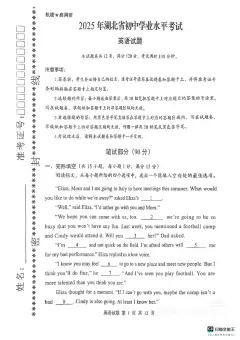
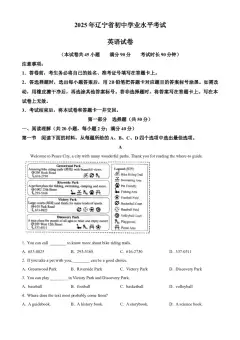
2025 年湖北省初中学业水平考试
英语试题
本试题卷共12 页,满分120 分,考试用时130 分钟。
注意事项:
1. 答卷前,考生务必将自己的姓名、准考证号填写在试题卷和答题卡上,并将准考证号条形
码粘贴在答题卡上指定位置。
2. 选择题的作答:每小题选出答案后,用2B 铅笔把答题卡上对应题目的答案标号涂黑。写
在试题卷、草稿纸和答题卡上的非答题区域均无效。
3. 非选择题的作答:用黑色签字笔直接答在答题卡上对应的答题区域内,写在试题卷、草稿
纸和答题卡上的非答题区域均无效,作图一律用2B 铅笔或黑色签字笔。
4. 考试结束后,请将本试题卷和答题卡一并交回。
笔试部分(90 分)
一、完形填空(共15 小题,每小题1 分,满分15 分)
阅读短文,从每小题所给的四个选项中,选出一个能填入空白处的最佳选项。
“Eliza, Mom and I are going to Italy to have meetings this summer. What would you like to do while we’re
away?” asked Eliza’s ___1___.
“Well,” said Eliza, “I’d rather go with you and Mom.”
“We hope you can come with us, too. ___2___ we’re going to be so busy that you won’t have any fun. Last
week, you mentioned a football camp and Cindy would attend it. Will you ___3___ her?” Dad asked.
“I’m ___4___ and not quick on the field. I’m afraid others will ___5___ me for my bad performance.” Eliza
replied in a low voice.
“I know you may feel ___6___ to go to a new place and meet new people. But I think you’ll do fine,” he
___7___. “And I’ve seen you play football. You are more talented than you think you are.”
Eliza thought for a moment. “If I can’t go with you, maybe the camp isn’t a bad ___8___. Cindy is also going.
At least I know her.”
When Eliza met Cindy at camp, they hugged and talked ___9___.
On the first day, the coach asked the girls to pick teams. To Eliza’s ___10___, her teammates chose her as


第2页/共15页
学科网(北京)股份有限公司
their leader! That afternoon, they learnt basic skills like running with the ball and ___11___ it to each other. She
tried hard, even though her legs felt shaky (发抖的) during the training.
On the second day, the team ___12___ more difficult skills. Eliza got surprised again by being the first to
finish every task. In the following days, whenever her teammates got tired, she cheered ___13___ up. With Eliza’s
help, everyone ___14___ quickly.
At the end of the camp, a shy girl named Annie came up to Eliza. “I just wanted to say thank you,” Annie said
softly. “Your ___15___ made me feel much better and helped us all get better, too.”
Eliza couldn’t help laughing. “Oh, Annie,” she said, “I was probably even more nervous than you were!”
1. A. mom
B. dad
C. friend
D. coach
2. A. Or
B. So
C. But
D. And
3. A. miss
B. find
C. visit
D. join
4. A. shy
B. friendly
C. honest
D. busy
5. A. listen to
B. depend on
C. look after
D. laugh at
6. A. worried
B. tired
C. safe
D. lucky
7. A. joked
B. encouraged
C. ordered
D. agreed
8. A. choice
B. dream
C. excuse
D. reason
9. A. slowly
B. happily
C. carefully
D. simply
10. A. interest
B. regret
C. shame
D. surprise
11. A. handing
B. lending
C. passing
D. showing
12. A. shared
B. reported
C. practiced
D. compared
13. A. him
B. them
C. her
D. us
14. A. returned
B. answered
C. improved
D. prepared
15. A. story
B. plan
C. promise
D. support
二、阅读理解(共20 小题,每小题2 分,满分40 分)
第一节(共15 小题,每小题2 分,满分30 分)
阅读以下三篇短文,从每小题所给的四个选项中,选出一个与短文内容相符的最佳选项。
A
Great trips for each season in Hubei!


第3页/共15页
学科网(北京)股份有限公司
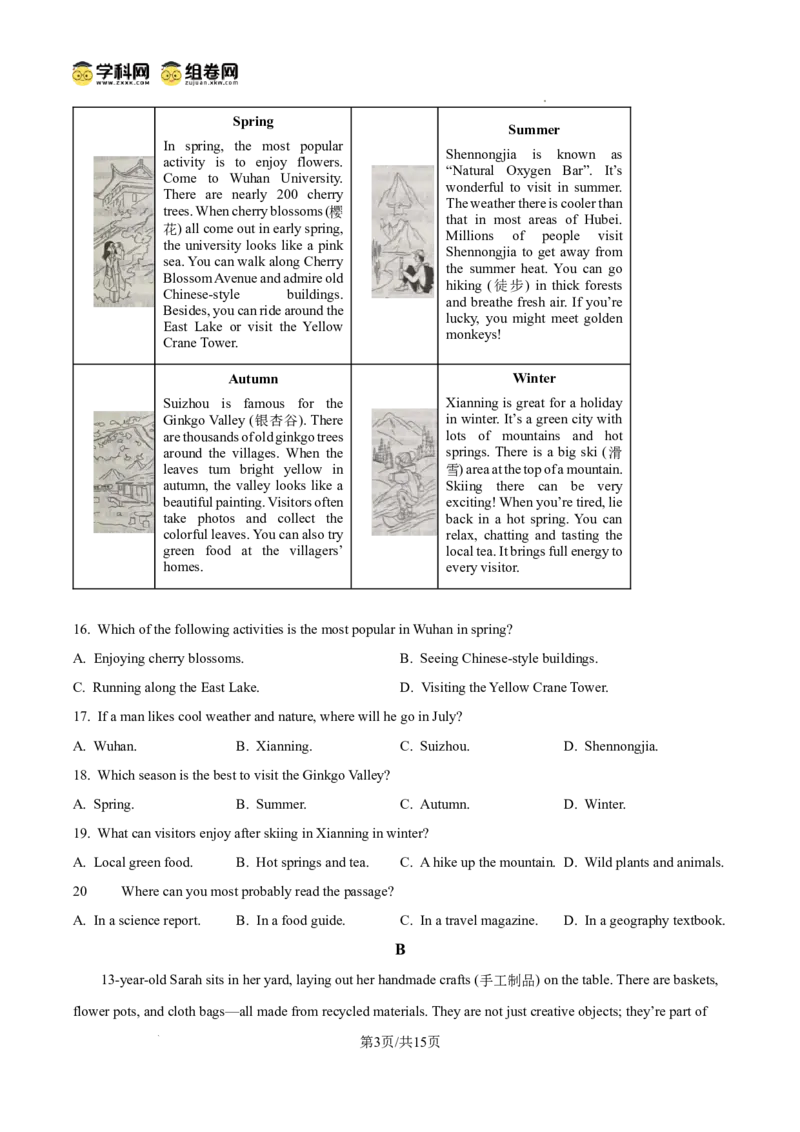
Spring
In spring, the most popular
activity is to enjoy flowers.
Come to Wuhan University.
There are nearly 200 cherry
trees. When cherry blossoms (樱
花) all come out in early spring,
the university looks like a pink
sea. You can walk along Cherry
Blossom Avenue and admire old
Chinese-style

buildings.
Besides, you can ride around the
East Lake or visit the Yellow
Crane Tower.
Summer
Shennongjia is known as
“Natural Oxygen Bar”. It’s
wonderful to visit in summer.
The weather there is cooler than
that in most areas of Hubei.
Millions of people visit
Shennongjia to get away from
the summer heat. You can go
hiking (徒步) in thick forests
and breathe fresh air. If you’re
lucky, you might meet golden
monkeys!
Autumn
Suizhou is famous for the
Ginkgo Valley (银杏谷). There
are thousands of old ginkgo trees
around the villages. When the
leaves tum bright yellow in
autumn, the valley looks like a
beautiful painting. Visitors often
take photos and collect the
colorful leaves. You can also try
green food at the villagers’
homes.
Winter
Xianning is great for a holiday
in winter. It’s a green city with
lots of mountains and hot
springs. There is a big ski (滑
雪) area at the top of a mountain.
Skiing there can be very
exciting! When you’re tired, lie
back in a hot spring. You can
relax, chatting and tasting the
local tea. It brings full energy to
every visitor.
16. Which of the following activities is the most popular in Wuhan in spring?
A. Enjoying cherry blossoms.
B. Seeing Chinese-style buildings.
C. Running along the East Lake.
D. Visiting the Yellow Crane Tower.
17. If a man likes cool weather and nature, where will he go in July?
A. Wuhan.
B. Xianning.
C. Suizhou.
D. Shennongjia.
18. Which season is the best to visit the Ginkgo Valley?
A. Spring.
B. Summer.
C. Autumn.
D. Winter.
19. What can visitors enjoy after skiing in Xianning in winter?
A. Local green food.
B. Hot springs and tea.
C. A hike up the mountain. D. Wild plants and animals.
20
 Where can you most probably read the passage?
A. In a science report.
B. In a food guide.
C. In a travel magazine.
D. In a geography textbook.
B
13-year-old Sarah sits in her yard, laying out her handmade crafts (手工制品) on the table. There are baskets,
flower pots, and cloth bags—all made from recycled materials. They are not just creative objects; they’re part of


第4页/共15页
学科网(北京)股份有限公司
Sarah’s project to make a greener community.
Two years ago, Sarah would pass by a park near her house every day after school. Plastic bottles, empty cans,
and broken toys littered the roadside. Seeing this, Sarah felt sad.
One afternoon, Sarah noticed some kids selling orange juice at the park. People stopped to buy it. That was
when Sarah got an idea.
“Mom, what if we sell handmade crafts?” she asked excitedly that evening. “Then we can buy trees for our
neighborhood with the money!”
With her mom’s help, Sarah started making crafts with great interest, using old boxes, plastic bottles and
empty cans. Every day after school, she sat in her yard, waiting for customers. At first, no one came. Sarah felt
down, but she didn’t give up.
Later, people began to stop by. A kind woman bought a cloth bag, saying it was perfect for shopping. Kids
liked the flower pots, and one boy even asked Sarah to make him a special basket for his toys. By the end of the
first month, Sarah had made $150! She bought 30 small trees. Together with her parents, they planted the trees
around the park and along the sidewalks.
Now, the neighborhood looks nicer, and the birds have more places to rest. Sarah even teaches her friends how
to make eco-friendly (环保的) crafts after school. They organize sales every month to raise money for new projects
like bird feeders.
This year, Sarah shared her story at a local community event. “Making a greener community is important,” she
said proudly. “If everyone helps a little, we can make our life better.” She believes that no effort is too small
when it comes to caring for the environment.
21. What did Sarah sell to make money?
A. Small trees.
B. Orange juice.
C. Plastic bottles.
D. Handmade crafts.
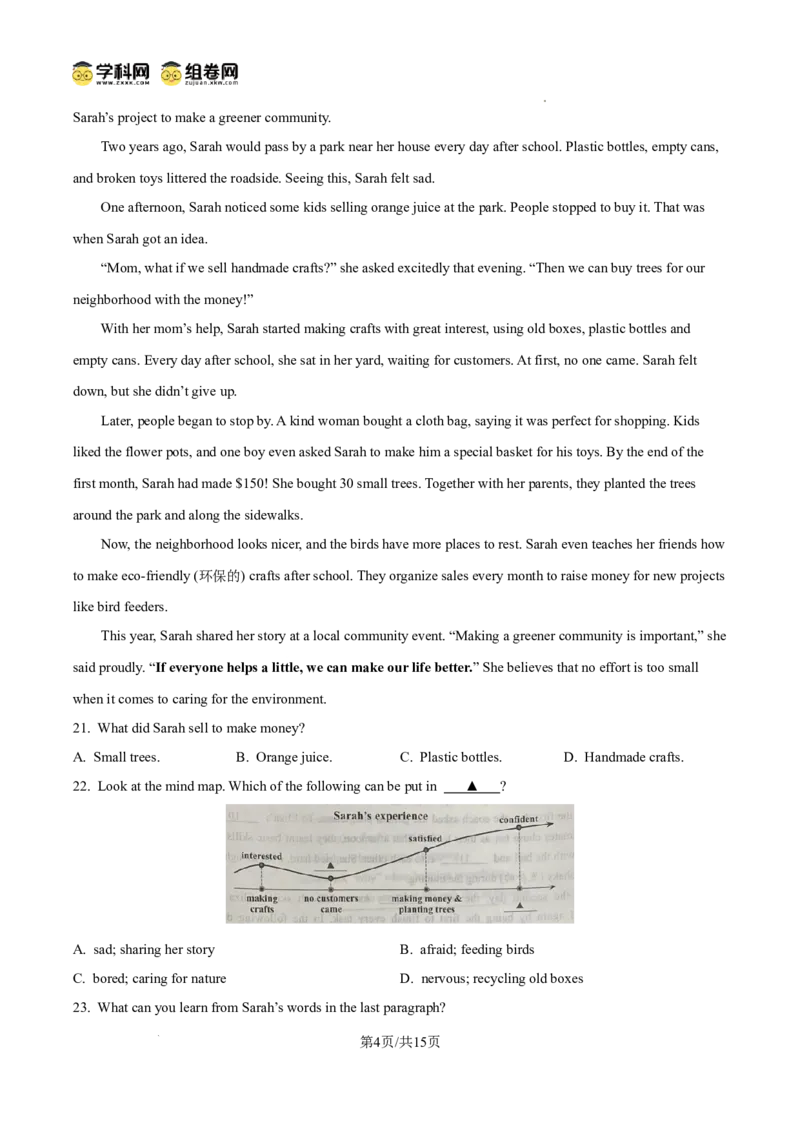
22. Look at the mind map. Which of the following can be put in    ▲   ?
A. sad; sharing her story
B. afraid; feeding birds
C. bored; caring for nature
D. nervous; recycling old boxes
23. What can you learn from Sarah’s words in the last paragraph?


第5页/共15页
学科网(北京)股份有限公司
A. Doing is better than saying.
B. Great hopes make great man.
C. The first step is the only difficulty.
D. Small actions can make a difference.
24. Which of the following can best describe Sarah?
A. Kind and honest.
B. Creative and helpful.
C. Strict and friendly.
D. Quiet and hard-working.
25. What is the best title for the passage?
A. A Girl’s Dream Job
B. A Community Park
C. A Girl’s Green Project
D. An Eco-friendly Habit
C
Long ago, in ancient China, there was a story about the invention of silk. People believed that silk was first
invented by Leizu, the wife of the Yellow Emperor. Leizu learned how to make cocoons (蚕茧) into soft and strong
cloth. This magical cloth became known as “silk”, and it was so valuable that it was called “China’s Gold”.
Following kings’ orders, the Chinese kept the secret of making silk for centuries.
But then, something amazing happened! During the Han Dynasty, the brave officer Zhang Qian traveled west
as far as Central Asia and brought silk there. As years passed by, silk became so important that the trade road from
Europe to China got its name—the Silk Road.
The Silk Road became a busy highway for traders who carried things across deserts and mountains. From
China, people sold silk and tea. In return, they received treasures such as spices (香料), gold and silver from the
West. At the very beginning, it was mainly about trade; then people began to share ideas, technologies and cultures.
For example, Chinese inventions like papermaking were spread to the West, while new ideas about math and
science came to China.
Most importantly, the Silk Road helped different cultures learn from each other. Art, music and even language
were shared along this ancient road. In places like the Dunhuang Grottoes (敦煌石窟) in China, you can see how
art pieces combined (融合) Eastern and Western styles into something distinctive. It can not be seen anywhere
else.
The story of the Silk Road tells us how people from faraway lands could become friends through trade and
shared ideas. Today, we remember the Silk Road as one of the greatest examples of cooperation and exchange in
history. It shows us how important it is to learn about and respect each other’s traditions, and that different cultures
can work together to create amazing things.


第6页/共15页
学科网(北京)股份有限公司
26. Who invented silk in ancient China?
A. Leizu.
B. The kings.
C. Zhang Qian.
D. The Yellow Emperor.
27. What was spread from China to the West according to paragraph 3?
A. Silk and gold.
B. Tea and papermaking.
C. Spices and silver.
D. New ideas of science.
28. What is the right order of the following facts from the passage?
① Zhang Qian traveled west with silk.
②Art and language were shared along the Silk Road.
③ Traders from China and the West exchanged things.
④The Chinese were ordered to keep the secret of making silk.
A. ①→④→③→②
B. ①→③→④→②
C. ④→①→③→②
D. ④→③→②→①
29. What does the underlined word “distinctive” mean in paragraph 4?
A
 Special.
B. Public.
C. Popular.
D. Strong.
30. What does the story of the Silk Road mainly tell us?
A. The change of world trade.
B. The introduction of silk cloth.
C. The influence of technology in history.
D. The importance of cross-cultural communication.
第二节(共5 小题,每小题2 分,满分10 分)
阅读短文,从所列选项中,选出最佳选项填入对应空白处,使短文通顺、连贯。(选项中有一项多余)
Learning can be exciting when you follow your curiosity (好奇心)! Scientists say curious students enjoy
studying more. They can find ways to make school subjects more enjoyable. Here are four easy ways to start with.
· Ask questions.
____31____ If you study physics, wonder why light travels faster than sound. When learning Chinese, ask
why Tang poems remain so popular in modern China. Questions make learning more active and help you
understand better.
· Connect lessons to real life.
Find how school subjects are part of your life. ____32____ English is useful when you travel abroad.
Geography can explain weather changes and the environment around us. When you find knowledge is practical,
you’ll want to learn more.
· ____33____
Make word cards to play memory games. Put together a puzzle map (拼图) to learn about the shapes of
countries. Use apps or online tools to practice spelling and grammar. Learning by doing feels like play, not work.
· Learn outside school.


第7页/共15页
学科网(北京)股份有限公司
Join a community center to learn to play a new sport. ____34____ Going to a park or a zoo allows you to
watch plants and animals carefully while learning about them. Different ways of learning keep your brain excited.
Start with one way today. You’ll find learning useful. ____35____ Remember, every subject becomes
interesting when you’re curious about it.
A. Develop good habits.
B. Turn learning into games.
C. You will also find it enjoyable.
D. Math helps when you are shopping.
E. Always ask “why” when learning something.
F. Visit museums to see what life was like in the past.
三、短文填空(共10 小题,每小题1 分,满分10 分)
阅读短文,从方框中选出恰当的单词并用其适当形式填空,使短文通顺、意义完整。每空仅填一词,每词
仅用一次。
by  camera  clearly  delicious  find  future  great  offer
rush  way
Have you ever used your fingerprint to open a door? Have you ever taken a self-driving taxi on the road?
Technologies have brought ____36____ changes to our life. Actually, changes can also be ____37____ in your
school.
“Now, we don’t have to ____38____ to the canteen (食堂) as soon as the bell rings,” says Hu Liang, a
student from Jiangxi. His school introduced a smart canteen system (系统) this year. Students choose meals online
first. When it’s time for their orders, they pick up meals ____39____ using facial recognition (人脸识别)
technology. The smart canteen ____40____ students enjoyable experiences. At the same time, it helps the school
plan meals and reduce kitchen waste. Besides providing ____41____ food, the smart school also tries to help
students develop good living habits.
Recently, a middle school in Chongqing has used four ____42____ on the playground to follow students and
record how fast they run. They can ____43____ see the top ten students on the screen. That adds fun to running
and makes students compete in an interesting ____44____.
What other exciting technologies could be part of our life in the ____45____? Let’s look forward to even
more changes!
四、读写结合(共两节,满分25 分)
第一节 任务型阅读(共5 小题,满分10 分)


第8页/共15页
学科网(北京)股份有限公司
阅读短文,用英文填空或回答问题。(注意每小题的词数要求)
Would you rather live where it snows in winter or enjoy warm sunshine all year round? Some people prefer
sunny weather. They think cold winters can be hard- short days make them sleepy and sad. The cold makes them
stay inside, exercise less, and get sick easily. However, people in cold places find fun ways to enjoy winter!
In Harbin, China, the Snow and Ice Festival starts in January and lasts until March. Artists cut ice from the
Songhua River and build tall sculptures (雕塑) that are lit with colorful lights. By late December, visitors come to
see this icy world filled with ice artworks and shining buildings. The beauty surprises them although it’s very cold!
In Quebec, Canada, there’s an amazing Ice Hotel that is made of 2,300 ice blocks and 15,000 tons of snow!
People love staying in its icy rooms for a special winter experience.
Even kids in Sweden can enjoy making snow lanterns called Snolykta. They first make large snowballs, and
then put candles inside to create warm lights. These simple lanterns light up the dark winter nights.
These creative traditions show how people turn cold winter challenges into beauty and joy! With imagination,
they make winter fun for everyone. Although it’s cold, there are so many fun ways to enjoy this special season.
46. Why do some people think cold winters can be hard? List two reasons.
___________________________46___________________________ (列举2 项,不超过15 词)
47-49. Fill in the blanks according to the passage.
Places
Activities
Harbin, China
Artists: ____47____ (不超过6 词)
Visitors: see the icy world
Quebec, ____48____ (仅填1 词)
People: stay in the Ice Hotel
Sweden
Kids: ____49____ (不超过5 词)
50. What can you learn from the last sentence of the passage?
___________________________50___________________________ (结合自身实际,不超过20 词)
第二节 书面表达(共1 题,满分15 分)
51. 假如你是王华,你校英语报Happy Times 正在征集关于本学期社会实践(field trip)方案的意见。
请写一封邮件将你的意见发送到指定邮箱。邮件内容包括:
1. 从下面两个方案中挑选一个并说明理由;
2. 为该方案增补两项你喜欢的活动。
Plan A
Exploring the Farm
Plan B
Visiting the Science Park


第9页/共15页
学科网(北京)股份有限公司
Reasons: · enjoy nature.
Activities: · learn from
farmers
· pick tomatoes
·...
·...
Reasons: · love science.
Activities: · watch robots
dancing
· learn about space
·...
·...
注意:
1. 根据上图所给提示,适当发挥;
2. 文中不得出现真实姓名和校名;
3. 词数80 左右,开头和结尾已给出,不计入总词数。
EMAIL
To:happytimes@school.com
From:wanghua@student.com
Dear Sir/Madam,
I’d like to
_____________________________________________________________________________
_____________________________________________________________________________
_____________________________________________________________________________
_____________________________________________________________________________
_____________________________________________________________________________
_____________________________________________________________________________
_____________________________________________________________________________
_____________________________________________________________________________
_________________________________________________________________
Best wishes!
Yours,
Wang Hua
Send
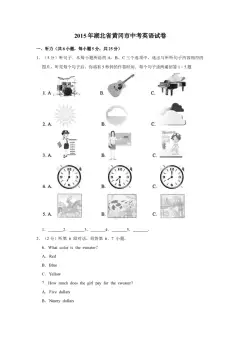
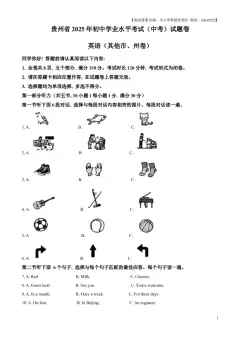
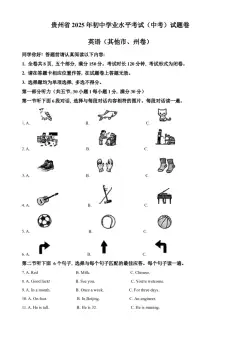
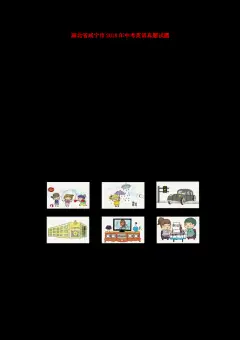
第一节 听短对话,选择图片。(共5 小题,每小题1.5 分,满分7.5 分)
下面你将听到5 段短对话。根据你所听到的内容,从所给的A、B、C、D、E、F 六个选项中,
选出与你所听内容相符的图片。每段对话听一遍。
A
    B
    C


第10页/共15页
学科网(北京)股份有限公司
D
    E
    F
1._________
2._________
3._________
4._________
5._________
第二节 听短对话,选择答案。(共5 小题,每小题1.5 分,满分7.5 分)
下面你将听到5 段短对话。根据你所听到的内容,从每小题所给的A、B、C 三个选项中选出
回答问题的最佳选项。每段对话听两遍。
6. What’s the pronunciation of the word?
A. /bi:f/    B. /bi:tʃ/    C. /baɪk/
7. What’s the probable relationship between the speakers?
A. Teacher and student.     B. Doctor and patient.    C. Salesman and customer.
8. Where is the library?
A. In the sports center.    B. Next to the white building.    C. Across from the white building.
9. When will the short play be put on?
A. On April 22nd.    B. On April 23rd.    C. On April 24th.
10. What does the boy want to tell his mom?
A. He likes noodles.    B. He likes tofu soup.    C. He likes fish soup with tofu.
第三节 听长对话,选择答案。(共7 小题,每小题1.5 分,满分10.5 分)
下面你将听到3 段长对话,根据你所听到的内容,从每小题所给的A、B、C 三个选项中选出
回答问题的最佳选项。每段对话听两遍。
听第一段长对话,回答第11 至12 小题。
11. What is the matter with the boy?
A. He is tired.    B. He has a headache.    C. He has a cold.
12. What’s the girl’s advice?
A. Do exercise.    B. Go to bed early.    C. Listen to music.
听第二段长对话,回答第13 至14 小题。
13. How did the boy’s grandma get information in the past?
A. On TV.    B. By phone.    C. By computer.
14. What does the boy’s grandma miss most about the past?
A. Schools.    B. Activities.    C. Neighbors.
听第三段长对话,回答第15 至17 小题。


第11页/共15页
学科网(北京)股份有限公司
15. What does Ella often do on weekends?
A. Go shopping with her parents.    B. Have city walks with her friends.
C. Make phone calls to her classmates.
16. Why are Ella’s parents learning Chinese?
A. To help Ella.    B. To visit China.    C. To work in China.
17. What is the conversation mainly about?
A. Ella’s life in China.     B. Ella’s parents’ plan.    C. Ella’s job in China.
第四节 听短文,填写表格。(共3 小题,每小题1.5 分,满分4.5 分)
下面你将听到一段短文,根据你所听到
内容,填写表格中所缺单词,每空仅填一词。短文听两遍。
Live Weather Report
Place
Beijing
Month
October
Weather
cool and   18
Temperature
around 15℃
Activity
playing in the park; walking    19   ; having picnics
Advice
   20    a coat or a sweater; drink more water


第12页/共15页
学科网(北京)股份有限公司
机密☆启用前
2025 年湖北省初中学业水平考试
英语试题
本试题卷共12 页,满分120 分,考试用时130 分钟。
注意事项:
1. 答卷前,考生务必将自己的姓名、准考证号填写在试题卷和答题卡上,并将准考证号条形
码粘贴在答题卡上指定位置。
2. 选择题的作答:每小题选出答案后,用2B 铅笔把答题卡上对应题目的答案标号涂黑。写
在试题卷、草稿纸和答题卡上的非答题区域均无效。
3. 非选择题的作答:用黑色签字笔直接答在答题卡上对应的答题区域内,写在试题卷、草稿
纸和答题卡上的非答题区域均无效,作图一律用2B 铅笔或黑色签字笔。
4. 考试结束后,请将本试题卷和答题卡一并交回。
笔试部分(90 分)
一、完形填空(共15 小题,每小题1 分,满分15 分)
【1~15 题答案】
【答案】1. B    2. C    3. D    4. A    5. D    6. A    7. B    8. A    9. B    10. D    11. C    12. C    13. B    14. C    15.
D
二、阅读理解(共20 小题,每小题2 分,满分40 分)
第一节(共15 小题,每小题2 分,满分30 分)
阅读以下三篇短文,从每小题所给的四个选项中,选出一个与短文内容相符的最佳选项。
A
【16~20 题答案】
【答案】16. A    17. D    18. C    19. B    20. C
B
【21~25 题答案】
【答案】21. D    22. A    23. D    24. B    25. C
C
【26~30 题答案】


第13页/共15页
学科网(北京)股份有限公司
【答案】26. A    27. B    28. C    29. A    30. D
第二节(共5 小题,每小题2 分,满分10 分)
【31~35 题答案】
【答案】31. E    32. D    33. B    34. F    35. C
三、短文填空(共10 小题,每小题1 分,满分10 分)
【36~45 题答案】
【答案】36. great
37. found    38. rush    39. by
40. offers    41. delicious
42. cameras
43. clearly
44. way    45. future
四、读写结合(共两节,满分25 分)
第一节 任务型阅读(共5 小题,满分10 分)
【46~50 题答案】
【答案】46. Because short days make them sleepy and sad.
47. cut ice and build tall sculptures    48. Canada
49. enjoy making snow lanterns
50. We can do many interesting things during cold winter.
第二节 书面表达(共1 题,满分15 分)
【51 题答案】
【答案】例文:
Dear Sir/Madam,
I’d like to recommend Plan B (Visiting the Science Park) for our field trip. The reason is that many students,
including me, are interested in science and technology. It’s a great chance to explore programming and experiments,
which are both educational and fun.
For additional activities, I suggest: Trying a virtual reality (VR) experience to learn about future technologies.
Attending a workshop to build simple robots.
These activities will make the trip more wonderful
 Looking forward to your reply!
Best wishes!
Yours,


第14页/共15页
学科网(北京)股份有限公司
Wang Hua
第一节 听短对话,选择图片。(共5 小题,每小题1.5 分,满分7.5 分)
下面你将听到5 段短对话。根据你所听到的内容,从所给的A、B、C、D、E、F 六个选项中,
选出与你所听内容相符的图片。每段对话听一遍。
A
    B
    C
D
    E
    F
1._________
2._________
3
________
_
4._________
5._________
第二节 听短对话,选择答案。(共5 小题,每小题1.5 分,满分7.5 分)
下面你将听到5 段短对话。根据你所听到的内容,从每小题所给的A、B、C 三个选项中选出
回答问题的最佳选项。每段对话听两遍。
6. What’s the pronunciation of the word?
A. /bi:f/    B. /bi:tʃ/    C. /baɪk/
7. What’s the probable relationship between the speakers?
A. Teacher and student.     B. Doctor and patient.    C. Salesman and customer.
8. Where is the library?
A. In the sports center.    B. Next to the white building.    C. Across from the white building.
9. When will the short play be put on?
A. On April 22nd.    B. On April 23rd.    C. On April 24th.
10. What does the boy want to tell his mom?
A. He likes noodles.    B. He likes tofu soup.    C. He likes fish soup with tofu.
第三节 听长对话,选择答案。(共7 小题,每小题1.5 分,满分10.5 分)
下面你将听到3 段长对话,根据你所听到的内容,从每小题所给的A、B、C 三个选项中选出
回答问题的最佳选项。每段对话听两遍。
听第一段长对话,回答第11 至12 小题。
11. What is the matter with the boy?


第15页/共15页
学科网(北京)股份有限公司
A. He is tired.    B. He has a headache.    C. He has a cold.
12. What’s the girl’s advice?
A. Do exercise.    B. Go to bed early.    C. Listen to music.
听第二段长对话,回答第13 至14 小题。
13. How did the boy’s grandma get information in the past?
A. On TV.    B. By phone.    C. By computer.
14. What does the boy’s grandma miss most about the past?
A. Schools.    B. Activities.    C. Neighbors.
听第三段长对话,回答第15 至17 小题。
15. What does Ella often do on weekends?
A. Go shopping with her parents.    B. Have city walks with her friends.
C. Make phone calls to her classmates.
16. Why are Ella’s parents learning Chinese?
A. To help Ella.    B. To visit China.    C. To work in China.
17. What is the conversation mainly about?
A. Ella’s life in China.     B. Ella’s parents’ plan.    C. Ella’s job in China.
第四节 听短文,填写表格。(共3 小题,每小题1.5 分,满分4.5 分)
下面你将听到一段短文,根据你所听到的内容,填写表格中所缺单词,每空仅填一词。短文听两遍。
Live Weather Report
Place
Beijing
Month
October
Weather
cool and   18
Temperature
around 15℃
Activity
playing in the park; walking    19   ; having picnics
Advice
   20    a coat or a sweater; drink more water