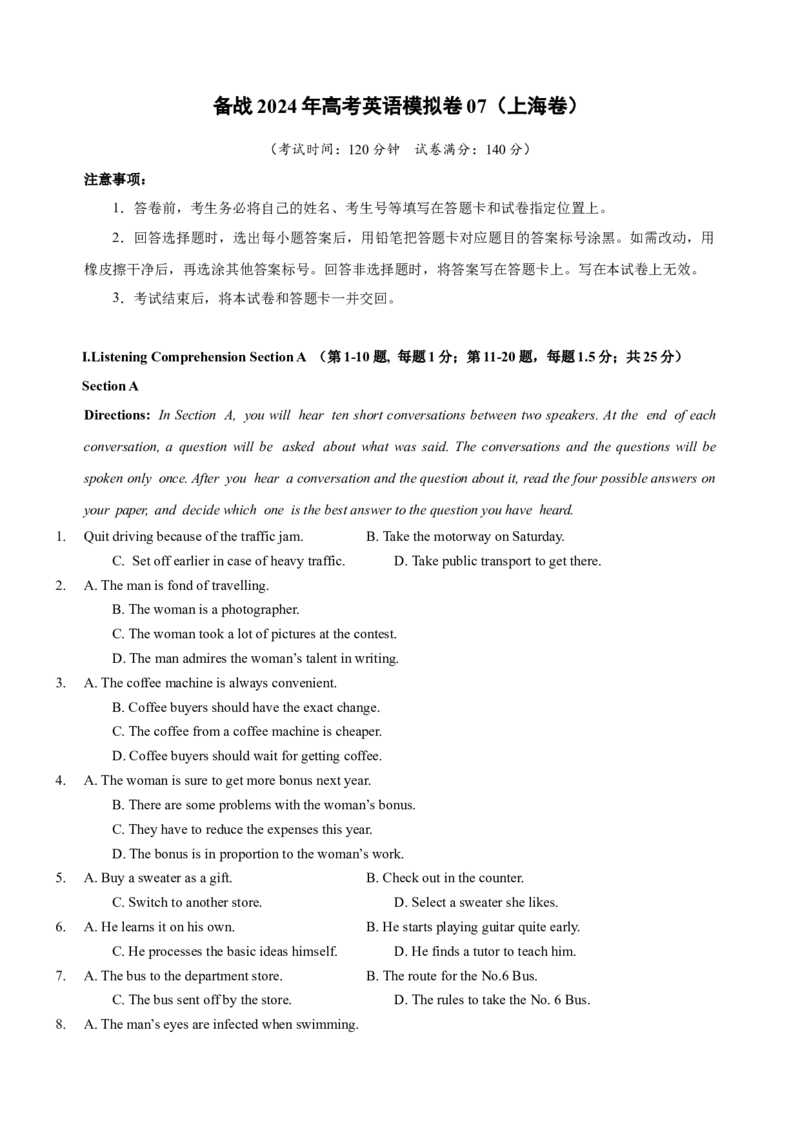
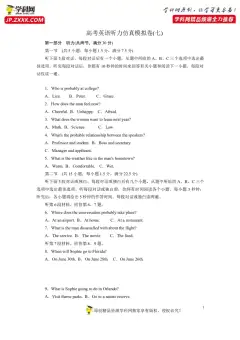
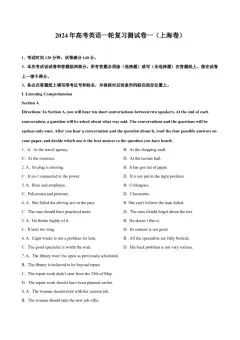
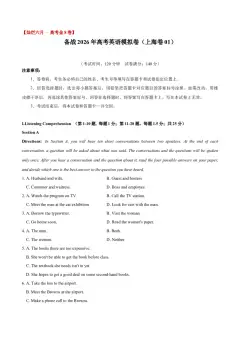
备战2024年高考英语模拟卷07(上海卷)
(考试时间:120分钟 试卷满分:140分)
注意事项:
1.答卷前,考生务必将自己的姓名、考生号等填写在答题卡和试卷指定位置上。
2.回答选择题时,选出每小题答案后,用铅笔把答题卡对应题目的答案标号涂黑。如需改动,用
橡皮擦干净后,再选涂其他答案标号。回答非选择题时,将答案写在答题卡上。写在本试卷上无效。
3.考试结束后,将本试卷和答题卡一并交回。
I.Listening Comprehension Section A (第1-10题, 每题1分;第11-20题,每题1.5分;共25分)
Section A
Directions: In Section A, you will hear ten short conversations between two speakers. At the end of each
conversation, a question will be asked about what was said. The conversations and the questions will be
spoken only once. After you hear a conversation and the question about it, read the four possible answers on
your paper, and decide which one is the best answer to the question you have heard.
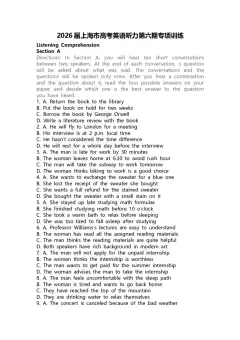
1. Quit driving because of the traffic jam. B. Take the motorway on Saturday.
C. Set off earlier in case of heavy traffic. D. Take public transport to get there.
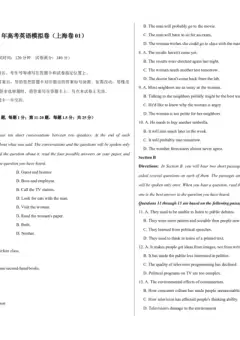
2. A. The man is fond of travelling.
B. The woman is a photographer.
C. The woman took a lot of pictures at the contest.
D. The man admires the woman’s talent in writing.
3. A. The coffee machine is always convenient.
B. Coffee buyers should have the exact change.
C. The coffee from a coffee machine is cheaper.
D. Coffee buyers should wait for getting coffee.
4. A. The woman is sure to get more bonus next year.
B. There are some problems with the woman’s bonus.
C. They have to reduce the expenses this year.
D. The bonus is in proportion to the woman’s work.
5. A. Buy a sweater as a gift. B. Check out in the counter.
C. Switch to another store. D. Select a sweater she likes.
6. A. He learns it on his own. B. He starts playing guitar quite early.
C. He processes the basic ideas himself. D. He finds a tutor to teach him.
7. A. The bus to the department store. B. The route for the No.6 Bus.
C. The bus sent off by the store. D. The rules to take the No. 6 Bus.
8. A. The man’s eyes are infected when swimming.B. The man can’t swim before his eyes are cured.
C. The woman persuades the man into quitting swimming.
D. The woman gives the man suggestions to protect his eyes.
9. A. Because his boss is very strict.
B. Because he has some work problems.
C. Because his boss assigned him many projects.
D. Because he had a hard time in sleeping.
10. A. They are very convenient.
B.They cost people much money.
C. They take up people much time.
D. They have both advantages and disadvantages.
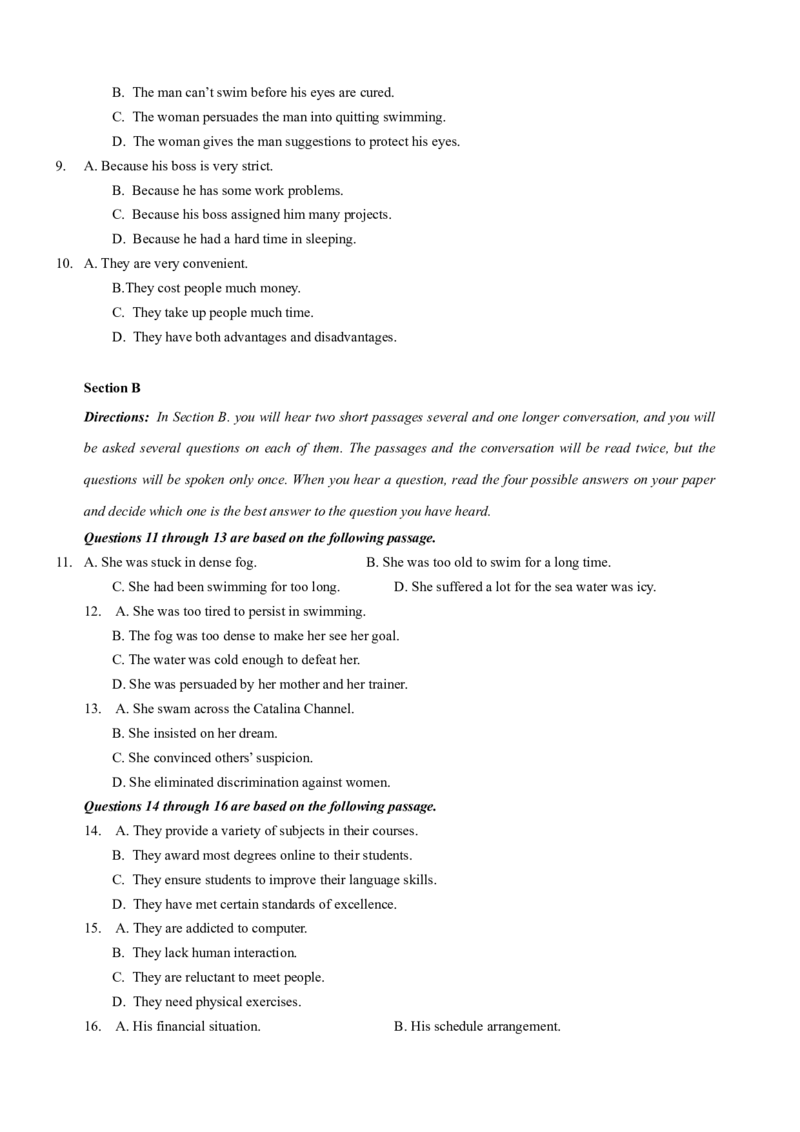
Section B
Directions: In Section B. you will hear two short passages several and one longer conversation, and you will
be asked several questions on each of them. The passages and the conversation will be read twice, but the
questions will be spoken only once. When you hear a question, read the four possible answers on your paper
and decide which one is the best answer to the question you have heard.
Questions 11 through 13 are based on the following passage.
11. A. She was stuck in dense fog. B. She was too old to swim for a long time.
C. She had been swimming for too long. D. She suffered a lot for the sea water was icy.
12. A. She was too tired to persist in swimming.
B. The fog was too dense to make her see her goal.
C. The water was cold enough to defeat her.
D. She was persuaded by her mother and her trainer.
13. A. She swam across the Catalina Channel.
B. She insisted on her dream.
C. She convinced others’ suspicion.
D. She eliminated discrimination against women.
Questions 14 through 16 are based on the following passage.
14. A. They provide a variety of subjects in their courses.
B. They award most degrees online to their students.
C. They ensure students to improve their language skills.
D. They have met certain standards of excellence.
15. A. They are addicted to computer.
B. They lack human interaction.
C. They are reluctant to meet people.
D. They need physical exercises.
16. A. His financial situation. B. His schedule arrangement.C. His interpersonal competence. D. His social activities.
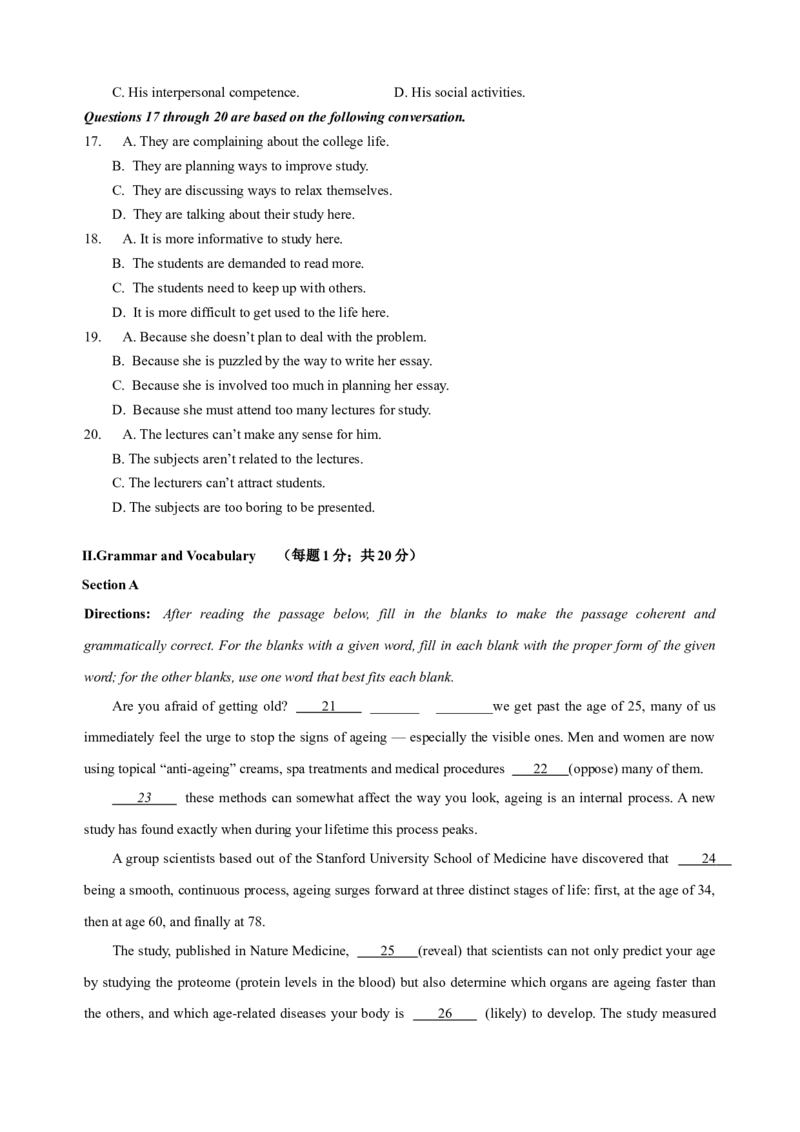
Questions 17 through 20 are based on the following conversation.
17. A. They are complaining about the college life.
B. They are planning ways to improve study.
C. They are discussing ways to relax themselves.
D. They are talking about their study here.
18. A. It is more informative to study here.
B. The students are demanded to read more.
C. The students need to keep up with others.
D. It is more difficult to get used to the life here.
19. A. Because she doesn’t plan to deal with the problem.
B. Because she is puzzled by the way to write her essay.
C. Because she is involved too much in planning her essay.
D. Because she must attend too many lectures for study.
20. A. The lectures can’t make any sense for him.
B. The subjects aren’t related to the lectures.
C. The lecturers can’t attract students.
D. The subjects are too boring to be presented.
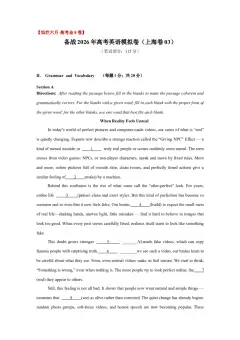
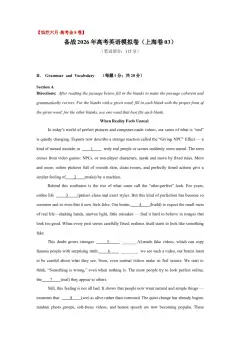
II.Grammar and Vocabulary (每题1分;共20分)
Section A
Directions: After reading the passage below, fill in the blanks to make the passage coherent and
grammatically correct. For the blanks with a given word, fill in each blank with the proper form of the given
word; for the other blanks, use one word that best fits each blank.
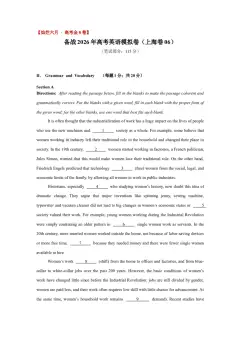
Are you afraid of getting old? 21 _______ ________we get past the age of 25, many of us
immediately feel the urge to stop the signs of ageing — especially the visible ones. Men and women are now
using topical “anti-ageing” creams, spa treatments and medical procedures 22 (oppose) many of them.
23 these methods can somewhat affect the way you look, ageing is an internal process. A new
study has found exactly when during your lifetime this process peaks.
A group scientists based out of the Stanford University School of Medicine have discovered that 24
being a smooth, continuous process, ageing surges forward at three distinct stages of life: first, at the age of 34,
then at age 60, and finally at 78.
The study, published in Nature Medicine, 25 (reveal) that scientists can not only predict your age
by studying the proteome (protein levels in the blood) but also determine which organs are ageing faster than
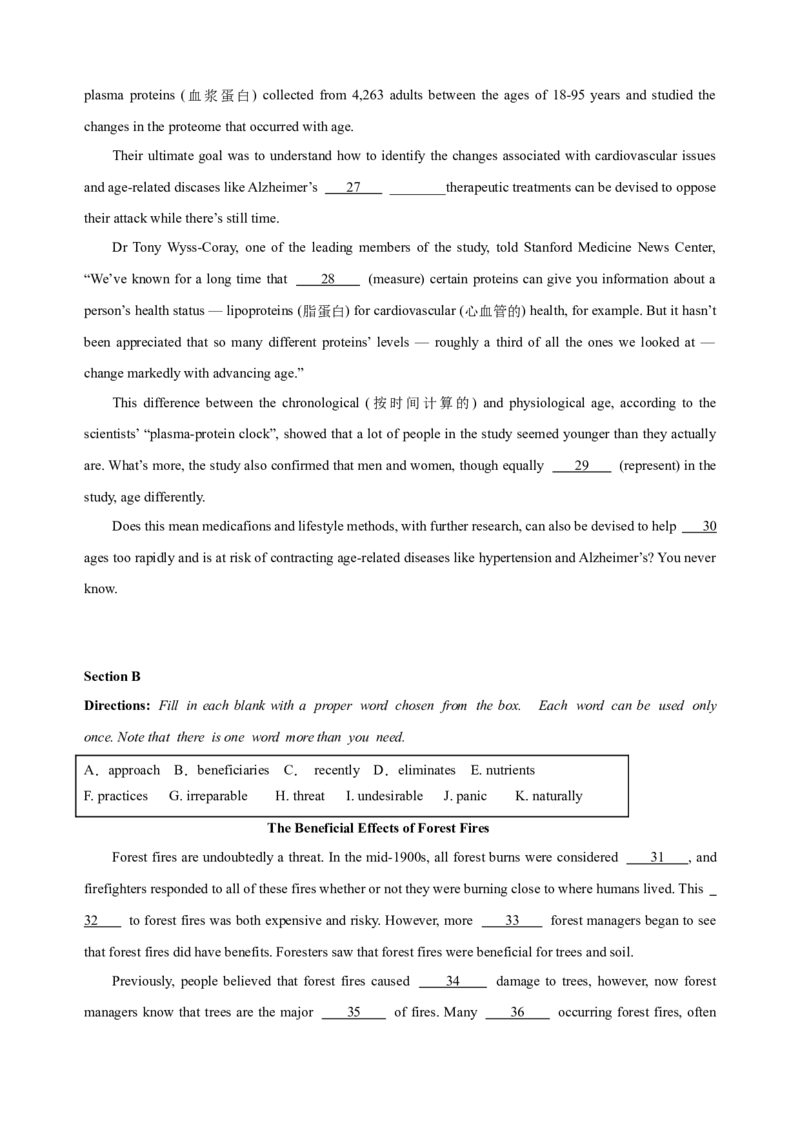
the others, and which age-related diseases your body is 26 (likely) to develop. The study measuredplasma proteins (血浆蛋白) collected from 4,263 adults between the ages of 18-95 years and studied the
changes in the proteome that occurred with age.
Their ultimate goal was to understand how to identify the changes associated with cardiovascular issues
and age-related discases like Alzheimer’s 27 ________therapeutic treatments can be devised to oppose
their attack while there’s still time.
Dr Tony Wyss-Coray, one of the leading members of the study, told Stanford Medicine News Center,
“We’ve known for a long time that 28 (measure) certain proteins can give you information about a
person’s health status — lipoproteins (脂蛋白) for cardiovascular (心血管的) health, for example. But it hasn’t
been appreciated that so many different proteins’ levels — roughly a third of all the ones we looked at —
change markedly with advancing age.”
This difference between the chronological (按时间计算的) and physiological age, according to the
scientists’ “plasma-protein clock”, showed that a lot of people in the study seemed younger than they actually
are. What’s more, the study also confirmed that men and women, though equally 29 (represent) in the
study, age differently.
Does this mean medicafions and lifestyle methods, with further research, can also be devised to help 30
ages too rapidly and is at risk of contracting age-related diseases like hypertension and Alzheimer’s? You never
know.
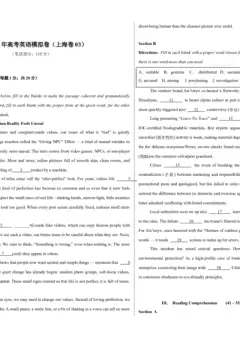
Section B
Directions: Fill in each blank with a proper word chosen from the box. Each word can be used only
once. Note that there is one word more than you need.
A.approach B.beneficiaries C. recently D.eliminates E. nutrients
F. practices G. irreparable H. threat I. undesirable J. panic K. naturally
The Beneficial Effects of Forest Fires
Forest fires are undoubtedly a threat. In the mid-1900s, all forest burns were considered 31 , and
firefighters responded to all of these fires whether or not they were burning close to where humans lived. This
32 to forest fires was both expensive and risky. However, more 33 forest managers began to see
that forest fires did have benefits. Foresters saw that forest fires were beneficial for trees and soil.
Previously, people believed that forest fires caused 34 damage to trees, however, now forest
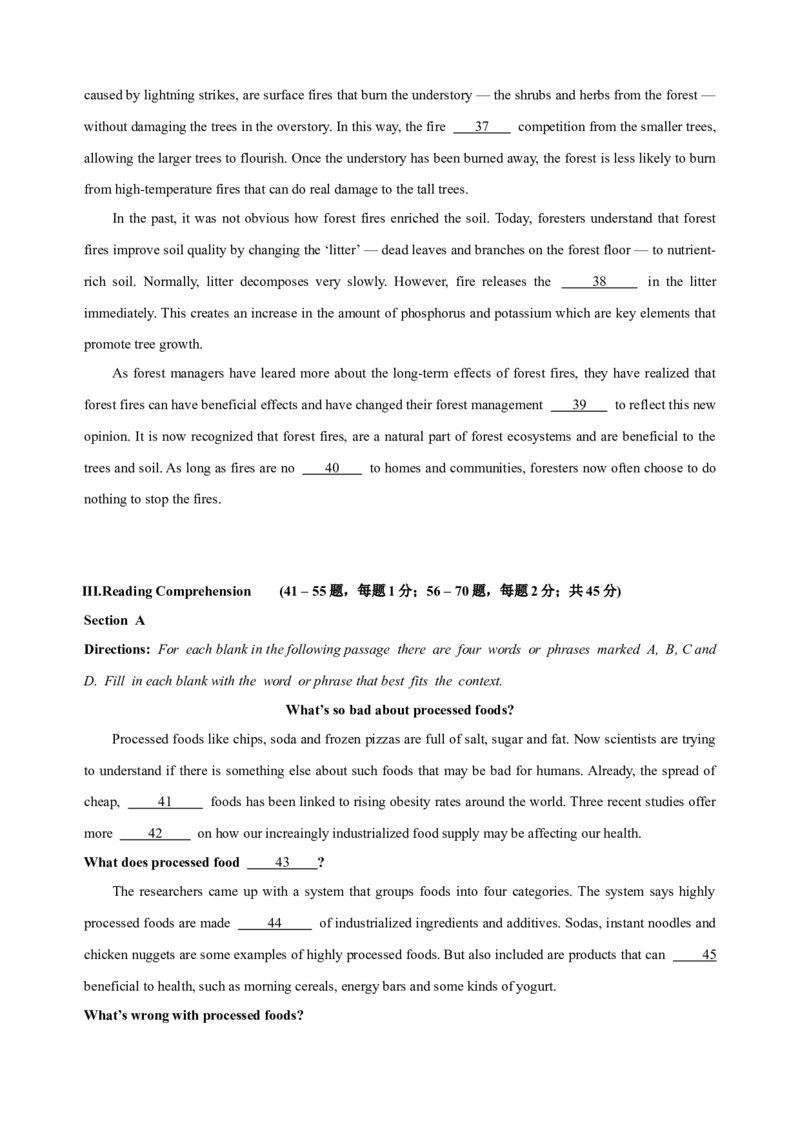
managers know that trees are the major 35 of fires. Many 36 occurring forest fires, oftencaused by lightning strikes, are surface fires that burn the understory — the shrubs and herbs from the forest —
without damaging the trees in the overstory. In this way, the fire 37 competition from the smaller trees,
allowing the larger trees to flourish. Once the understory has been burned away, the forest is less likely to burn
from high-temperature fires that can do real damage to the tall trees.
In the past, it was not obvious how forest fires enriched the soil. Today, foresters understand that forest
fires improve soil quality by changing the ‘litter’ — dead leaves and branches on the forest floor — to nutrient-
rich soil. Normally, litter decomposes very slowly. However, fire releases the 38 in the litter
immediately. This creates an increase in the amount of phosphorus and potassium which are key elements that
promote tree growth.
As forest managers have leared more about the long-term effects of forest fires, they have realized that
forest fires can have beneficial effects and have changed their forest management 39 to reflect this new
opinion. It is now recognized that forest fires, are a natural part of forest ecosystems and are beneficial to the
trees and soil. As long as fires are no 40 to homes and communities, foresters now often choose to do
nothing to stop the fires.
III.Reading Comprehension (41 – 55题,每题1分;56 – 70题,每题2分;共45分)
Section A
Directions: For each blank in the following passage there are four words or phrases marked A, B, C and
D. Fill in each blank with the word or phrase that best fits the context.
What’s so bad about processed foods?
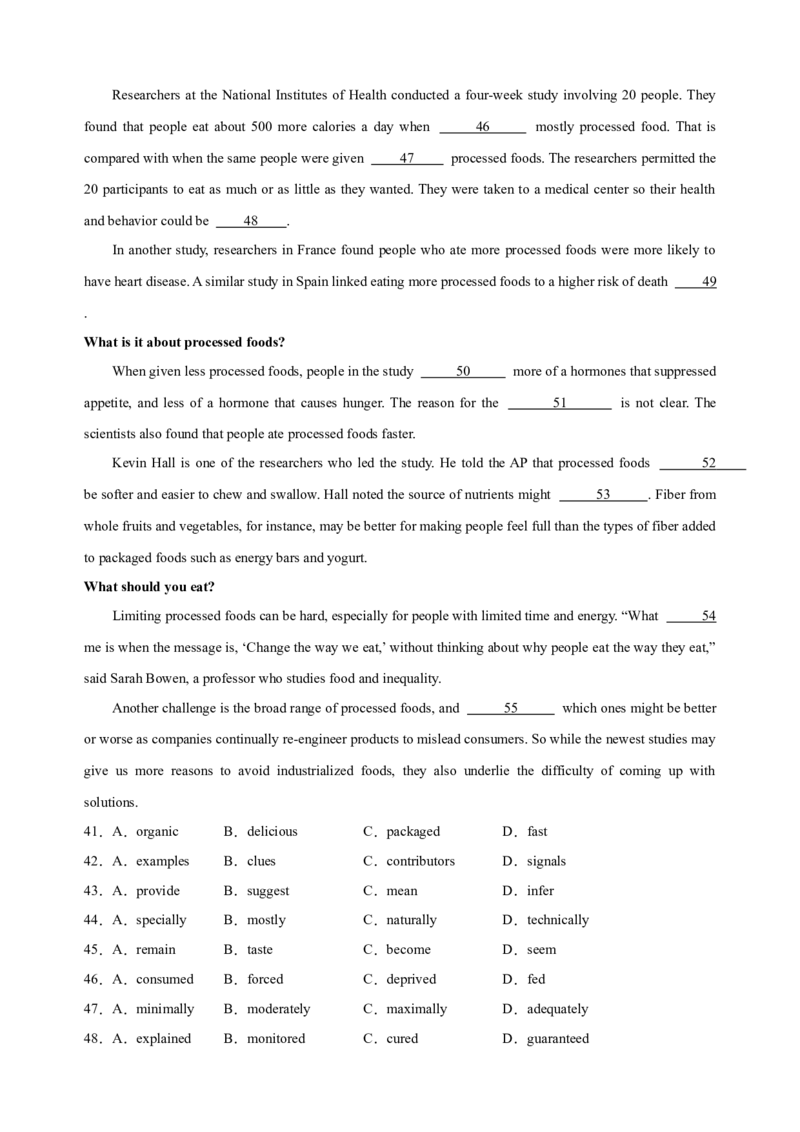
Processed foods like chips, soda and frozen pizzas are full of salt, sugar and fat. Now scientists are trying
to understand if there is something else about such foods that may be bad for humans. Already, the spread of
cheap, 41 foods has been linked to rising obesity rates around the world. Three recent studies offer
more 42 on how our increaingly industrialized food supply may be affecting our health.
What does processed food 43 ?
The researchers came up with a system that groups foods into four categories. The system says highly
processed foods are made 44 of industrialized ingredients and additives. Sodas, instant noodles and
chicken nuggets are some examples of highly processed foods. But also included are products that can 45
beneficial to health, such as morning cereals, energy bars and some kinds of yogurt.
What’s wrong with processed foods?Researchers at the National Institutes of Health conducted a four-week study involving 20 people. They
found that people eat about 500 more calories a day when 46 mostly processed food. That is
compared with when the same people were given 47 processed foods. The researchers permitted the
20 participants to eat as much or as little as they wanted. They were taken to a medical center so their health
and behavior could be 48 .
In another study, researchers in France found people who ate more processed foods were more likely to
have heart disease. A similar study in Spain linked eating more processed foods to a higher risk of death 49
.
What is it about processed foods?
When given less processed foods, people in the study 50 more of a hormones that suppressed
appetite, and less of a hormone that causes hunger. The reason for the 51 is not clear. The
scientists also found that people ate processed foods faster.
Kevin Hall is one of the researchers who led the study. He told the AP that processed foods 52
be softer and easier to chew and swallow. Hall noted the source of nutrients might 53 . Fiber from
whole fruits and vegetables, for instance, may be better for making people feel full than the types of fiber added
to packaged foods such as energy bars and yogurt.
What should you eat?
Limiting processed foods can be hard, especially for people with limited time and energy. “What 54
me is when the message is, ‘Change the way we eat,’ without thinking about why people eat the way they eat,”
said Sarah Bowen, a professor who studies food and inequality.
Another challenge is the broad range of processed foods, and 55 which ones might be better
or worse as companies continually re-engineer products to mislead consumers. So while the newest studies may
give us more reasons to avoid industrialized foods, they also underlie the difficulty of coming up with
solutions.
41.A.organic B.delicious C.packaged D.fast
42.A.examples B.clues C.contributors D.signals
43.A.provide B.suggest C.mean D.infer
44.A.specially B.mostly C.naturally D.technically
45.A.remain B.taste C.become D.seem
46.A.consumed B.forced C.deprived D.fed
47.A.minimally B.moderately C.maximally D.adequately
48.A.explained B.monitored C.cured D.guaranteed49.A.in general B.in particular C.in nature D.in advance
50.A.preferred B.produced C.compared D.processed
51.A.hunger B.procedure C.reaction D.psychology
52.A.attempt to B.intend to C.tend to D.mean to
53.A.strike a balance B.run a risk C.pose a threat D.make a
difference
54.A.frustrates B.entertains C.puzzles D.inspires
55.A.predicting B.imagining C.assuming D.distinguishing
Section B
Directions: Read the following three passages. Each passage is followed by several questions or unfinished
statements. For each of them there are four choices marked A, B, C and D. Choose the one that fits best
according to the information given in the passage you have just read.
(A)
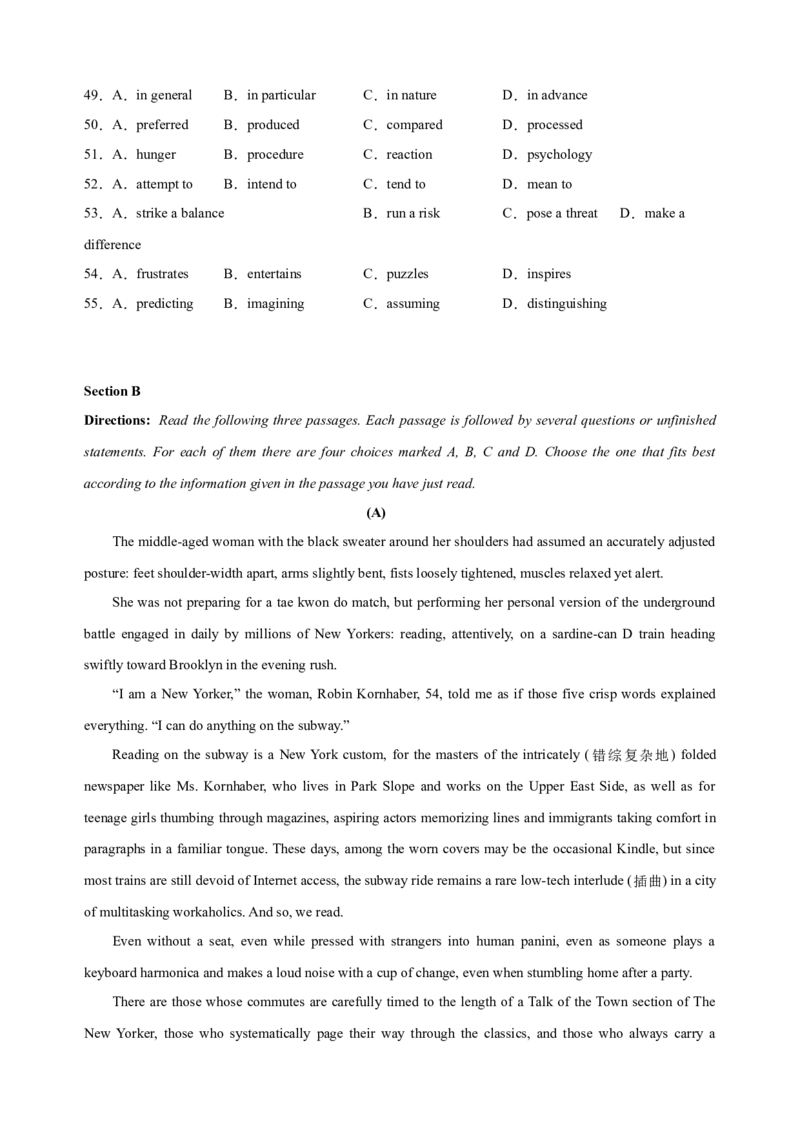
The middle-aged woman with the black sweater around her shoulders had assumed an accurately adjusted
posture: feet shoulder-width apart, arms slightly bent, fists loosely tightened, muscles relaxed yet alert.
She was not preparing for a tae kwon do match, but performing her personal version of the underground
battle engaged in daily by millions of New Yorkers: reading, attentively, on a sardine-can D train heading
swiftly toward Brooklyn in the evening rush.
“I am a New Yorker,” the woman, Robin Kornhaber, 54, told me as if those five crisp words explained
everything. “I can do anything on the subway.”
Reading on the subway is a New York custom, for the masters of the intricately (错综复杂地) folded
newspaper like Ms. Kornhaber, who lives in Park Slope and works on the Upper East Side, as well as for
teenage girls thumbing through magazines, aspiring actors memorizing lines and immigrants taking comfort in
paragraphs in a familiar tongue. These days, among the worn covers may be the occasional Kindle, but since
most trains are still devoid of Internet access, the subway ride remains a rare low-tech interlude (插曲) in a city
of multitasking workaholics. And so, we read.
Even without a seat, even while pressed with strangers into human panini, even as someone plays a
keyboard harmonica and makes a loud noise with a cup of change, even when stumbling home after a party.
There are those whose commutes are carefully timed to the length of a Talk of the Town section of The
New Yorker, those who systematically page their way through the classics, and those who always carry asecond novel in case they unexpectedly make it to the end of the first on a slow F train. There is a lawyer from
Brooklyn who for the past two months has catalogued what she and other commuters are reading on a blog,
“The Subway Book Club,” and a student at the New School who spent the summer passing out 600 donated
books to subway riders to spread her passion for reading.
And then there are those reading the readers, imagining their story lines. That man in a suit studying
“Rosetta Stone Level 3 Italian” on the No.2 train must be preparing to meet his fiancée’s family in Tuscany.
The woman reading a young-adult novel at 81st Street is probably a teacher preparing for class.
56.Which of the following is the best title of the passage?
A.New York Rush B.Reading Underground
C.Underground Battle D.Subway Escape
57.The first three paragraphs tell us that ________.
A.Robin Kornhaber is a little bit nervous on the train
B.Robin Kornhaber is physically prepared for train ride
C.Robin Kornhaber is a typical New York train rider and reader
D.Robin Kornhaber stands for New Yorkers who rely heavily on subway
58.Which of the following is NOT true?
A.It is a culture for New Yorkers to read underground.
B.Some people will make guesses at those reading on the train.
C.People have no Internet access on most underground trains in New York.
D.People must make a careful schedule if they are to read underground.
59.The following may stand for the ill environment for readers on the train EXCEPT ________.
A.sardine-can D train B.human panini
C.tae kwon do match D.keyboard harmonica
(B)
Of Special Interest to Freshman
STARS (Science, Technology, and Research
Freshman Seminars are small classes just for
Scholars) provides undergraduates of every year with
freshmen, with some of York’s most distinguished
an opportunity to combine research, course-based
faculty members. Some seminars provide an
study, and development of mentorship skills. The
introduction to a particular field of study; others take
program offers research opportunities and support to
an interdisciplinary (跨学科的) approach to a variety
students historically underrepresented in the fields of
of topics. All seminars provided a friendly natural science and quantitative reasoning, such as
environment for developing relationships with faculty racial and ethnic minorities, women, and the
members and peers. physically challenged. More than 100 students each
year participate in STARS, during the academic yearor over the summer months.
Perspectives on Science and Engineering is a
Directed Studies is a selective freshman
lecture and discussion course for about 75 selected
interdisciplinary program focusing on Western
freshmen who have exceptionally strong backgrounds
civilization that includes three yearlong courses —
in science or mathematics. The yearlong course
literature, philosophy, and historical and political
explores a broad range of topics, exposes students to
thought — in which students read the foundational
questions at the frontiers of science, and connects the
works of the Western tradition.
first-year students to York’s Scientific community.
Academic Advising is a collective effort by the
residential colleges, academic departments and
various offices connected to York University Dean’s
Science and Engineering Undergraduate
office. Students’ primary academic advisors are their
ResearchYork is one of the world’s foremost research
residential college deans, to whom they may always
universities. Independent engineering research and
turn for academic and personal advice. The deans live
design projects and scientific research are an essential
in residential colleges and supervise the advising
part of undergraduate science education at York.
networks in the college. Students also have a
Science students can begin conducting original
freshman advisor who is a York faculty member or
research as early as the freshman year. Ninety-five
administrator affiliated with their advisees’ residential
percent of undergraduate science majors engaged in
college. Each academic department has a director of
research with faculty mentors.
undergraduate studies (DUS) who can discuss with
students the department’s course offerings and
requirements for majors.
60.An African female freshman seeking opportunities of research is most likely to choose _____.
A.Freshman Seminars B.Directed Studies
C.STARS D.Perspectives on Science and Engineering
61.In which program may the science majors be guided to read Shakespeare’s works?
A.Academic Advising. B.Directed Studies.
C.STARS. D.Freshman Seminars.
62.Which freshman may have priority to attend Perspectives on Science and Engineering?
A.The one who has already got a novel published.
B.A medalist of the International Mathematical Olympiad.
C.The one who has designed an original engineering project.
D.An applicant for York’s Scientific Community.
(C)
While more and more scientists are working on nonfiction science books for the general reader, I think we
also need a change.
The typical expert-voiced monologues that scientists write are a wonderful component of the engagement
effort, but the form is limited. Such books are largely ready people already willing to pick up a science book, or
who are open to the authoritative academic’s voice telling them how to think. There are plenty of people whocan engage with science but who find those kinds of books a sometimes unwelcome reminder of the classroom.
Following from my belief that science is for everyone, I suggest that publishers need to work with
scientists to expand the kinds of books on offer, assured that there is an audience for them. Progress is possible.
Many years ago, I realized it is hard to find books on the nonfiction science shelf that let readers see themselves
as part of the conversation about science. So I thought about an entire book of conversations about science
taking place between ordinary people. While “overhearing” those conversations, readers learn some science
ideas. It’s a resurrection of the dialogue form, known to the ancient Greeks, and to Galileo, as a device for
exchanging ideas, but with contemporary settings: cafes, restaurants, trains and so on.
I decided it would be engaging for the reader to actually see who’s having those conversations, and where,
instead of describing them in words. This led me to realize that I was thinking about a powerful form of visual
storytelling: Graphic novels for adults have matured and exploded in popularity in recent years. Spiegelman’s
“Maus: A Survivor’s Tale” and Bechdel’s “Fun Home” are just two well-known examples.
But the storytelling tools of the graphic book have been little used to convey nonfiction science ideas to a
general adult audience. The vast majority of contemporary graphic books with a science focus are presented
instead as “explainer/adventure comics” for younger audiences. This is an important genre, but graphic books
about science should not be limited to that.
And while there are several excellent graphic books for adults that include science, they typically focus
instead on the lives of famous scientists, with discussion of the science itself as a secondary goal. Some
excellent recent examples that balance the two aspects well include Ottaviani arid Myrick’s “Feyrunan” and
Doxiadis and Papadimitriou’s “Logicomix”. The scarcity of science-focused non-biographical (非自传体的)
graphic books for adults is especially true in my field of physics. So I decided that here was an opportunity to
broaden the kinds of nonfiction science book available to engage the public.
63.It can be inferred from Para.2 that the expert-voiced monologues don’t appeal to _________.
A.those who are interested in scientific ideas
B.those who have no talents for scientific research
C.those who would like to know how scientists think
D.those who think science classes in school are uninteresting
64.The word “resurrection” (in paragraph 3) most probably means _________.
A.announcement B.comeback C.explanation D.representation
65.According to the writer, which might be the best form of nonfiction science books for general readers?
A.A collection of scientists’ life stories. B.A book written by a Nobel Prize winner.C.An adventure novel focusing on science.D.A comic book conveying scientific ideas.
66.What is passage mainly about?
A.A well-known writer who writes to promote science among the public.
B.A possible way to get nonfiction science books to appeal to the public.
C.A new approach to have the public get interested in new scientific ideas.
D.An easy access for the public to have a general idea of what science is.
Section C
Directions: Read the following passages. Fill in each blank with a proper sentence given in the box. Each
sentence can be used only once. Note that there are two more sentences than you need.
A.Do not arrive too early, or you will be influenced by other people's anxiety can be contagious, and you may
suffer from undue panic.
B.Try not to be tempted to look at those around you, or at the clock.
C.When you get home, read the examination paper through and look up all the words you didn't understand.
D.Sleep, exercise and relaxation are all just as important.
E.Map out a quick plan of points you wish to make and how much time you should spend on each question.
F.Too much rest will slow down the workings of your brain.
Do not underestimate the power of revision in the days and hours before an examination. The closer you
are to the exam, the more chance you have of storing and retaining crucial information. But do not overdo it.
67 An effective daily routine can help you through an exam period, so in the days leading up to your first
exam, get into the habit of being up and ready to work by game. It can be a shock to the system after months of
working to your own timetable to be mentally alert at that time if you have not prepared for it.
On the day of the exam, have a good breakfast, pack two of everything you need (pens, pencils, erasers,
etc.), then make your way to the examination hall in good time. 68
Once in your seat, simply pause for a few seconds and collect your thoughts. Close your eyes and take in a
few slow, deep breaths to help you relax. When you turn over the test paper, spend a short period reading
through all the instructions and questions, paying particular attention to key verbs such as "discuss", "compare"
and "evaluate". 69 It is wise always to allow for 10 minutes at the end of the exam to give yourself
time to go back over your answers. Once you have selected the questions you wish to tackle, begin by
attempting the one you think is your strongest. It will give you more confidence when you see a well-answered
question down on paper. Also remember to write clearly, and do not be afraid to express the unexpected: after
all, examiners can get very bored marking stereotypical answers.70 If you do need something else to focus on to help collect your thoughts, choose a fixture in
the room, such as the ceiling - or anything else that will not allow you to be distracted.
Finally, once you have finished, never hang around outside afterwards to attend the discussion by other
students. Go and have a well-earned rest—then prepare for your next exam.
IV. Summary Writing (10分)
Directions: Read the following passage. Summarize the main idea and the main point(s) of the passage in no
more than 60 words. Use your own words as far as possible.
Offshore production
The world’s consumption of fashion is huge. The European Union imported textiles (clothing and carpets)
to the value of €83.7 billion in 2010. Prices have fallen, too, with hand-finished shirts costing less than five
euros. To make clothes at these low prices, companies have to keep costs down. They use offshore production
to do this. Large companies make their products in developing countries where workers are paid much less than
in developed countries.
A point that should be considered in that case is that developing countries encourage developed countries
to invest in them to provide jobs. Supporters of overseas production point out that increased investment has
positive effects in the long term. Nobel prize-winning economist Paul Krugman points out that the growth in
manufacturing has an impact on the rest of the economy, because it reduces the number of people needing to
work in agriculture and increases competition for labour. This leads to higher wages, which lead to other
improvements, such as the ability to send children to school. On the other hand, the disadvantage of this foreign
investment is the fact that it can have a negative impact on the economy of developed countries, because people
lose their jobs when production is outsourced to other countries.
It seems that if multinationals are going to benefit from low production costs by using overseas suppliers,
they should do more to improve the social situation-for example, by building schools for the children in those
communities. It is also clear that multinationals should invest in communities in the developed countries where
they sell their products. Furthermore, given multinationals do benefit from lower costs of production in
developing countries and their workers, they need to feel obliged to protect the workers in overseas
manufacturing plants.
71._______________________________________________________________________________________
__________________________________________________________________________________________________________________________________________________________________________________
_________________________________________________________________________________________
_________________________________________________________________________________________
__
V. Translation (第1-2句,每句3分;第3句,4分;第4句5分;共15分)
Directions: Translate the following sentences into English, using the words given in the brackets.
72.你怎么能把自己犯的错误怪罪到别人身上?(blame)
73.同学们轮流打扫教室,不觉得累。(turns)
74.这座主题公园位于上海,以其独特的文化内容和完美的游客体验为特色。(feature)
75.和你的预期相反,隐形营销,作为一种常见的做法,经常被公司采纳来推广一个还未做过广告的
产品,因为它既便宜又有效。(contrary, adopt)
VI. Guided Writing (25分)
Directions: Write an English composition in 120-150 words according to the instructions given below in
Chinese.
俗话说:与其诅咒黑暗,不如点亮光明。(It’s better to light a candle than to curse the darkness),结合
你自己或者身边人的一个事例,谈谈你对这句话的理解。
_________________________________________________________________________________________
_________________________________________________________________________________________
_________________________________________________________________________________________
_________________________________________________________________________________________
_________________________________________________________________________________________
_________________________________________________________________________________________
__________________________________________________________________________________