2025~2026 学年度武汉市部分学校高三
年级九月调研考试
1. What did the man do yesterday?
A. He visited a website.
B. He bought a robot.
C. He attended a fair.
2. What is the library trying to improve?
A. The book variety.
B. The reading space.
C. The opening hours.
3. What is the man going to do this afternoon?
A. Lend a paintbrush.
B. Have a class.
C. Return an artwork.
4. What happened to the man?
A. He lost an item.
B. He missed the bus.
C. He broke a phone.
5. What are the speakers mainly talking about?
A. An election.
B. A speech.
C. An association.
听下面一段对话,回答以下小题。
6. What is the advantage of the smartwatch over the phone?
A. Tracking steps.
B. Tracking heart rate.
C. Tracking sleep.
7. What does the woman think of the smartwatch?
A. It’s helpful.
B. It’s bothering.
C. It’s unnecessary.
听下面一段对话,回答以下小题。
8. What is Susan’s short film probably about?
A. Acting competitions.
B. A girl’s growth.
C. Time travel.
9. Who will be in charge of editing the short film?
A. Susan.
B. Lucy.
C. James.
10. What does Susan advise Simon to do?
A. Write the lines.
B. Read the play.
C. Set a scene.
听下面一段对话,回答以下小题。
11. How did the new student build his game app?
A. By joining a club.
B. By copying other apps.
C. By learning on his own.
12. What is the club working on?
A. Launching a new app.
B. Designing a digital study tool.
C. Teaching programming skills.
13. What will the man do tomorrow?
A. Visit the club.
B. Update a system.
C. Call Mr. Williams.
听下面一段对话,回答以下小题。
14. What is the woman doing?
A. Performing a show.
B. Making an interview.
C. Delivering weather reports.
15. What is the main cause of the high-temperature weather?
A. Abnormal circulation.
B. Strong sunlight.
C. Sinking air.
16. How long will the high-temperature weather probably last?
A. Two weeks.
B. One week.
C. Three days.
17. What does the last question focus on?
A. Requests.
B. Warnings.
C. Suggestions.
听下面一段独白,回答以下小题。
18. What field does Lin Xianfeng work in?
A. Medical science.
B. Mathematical physics.
C. Information technology.
19. How did Lin Xianfeng deal with failures?
A. He faced them bravely.
B. He changed his direction.
C. He waited for opportunities.
20. Which word can best describe Lin Xianfeng?
A. Tolerant.
B. Committed.
C. Considerate.
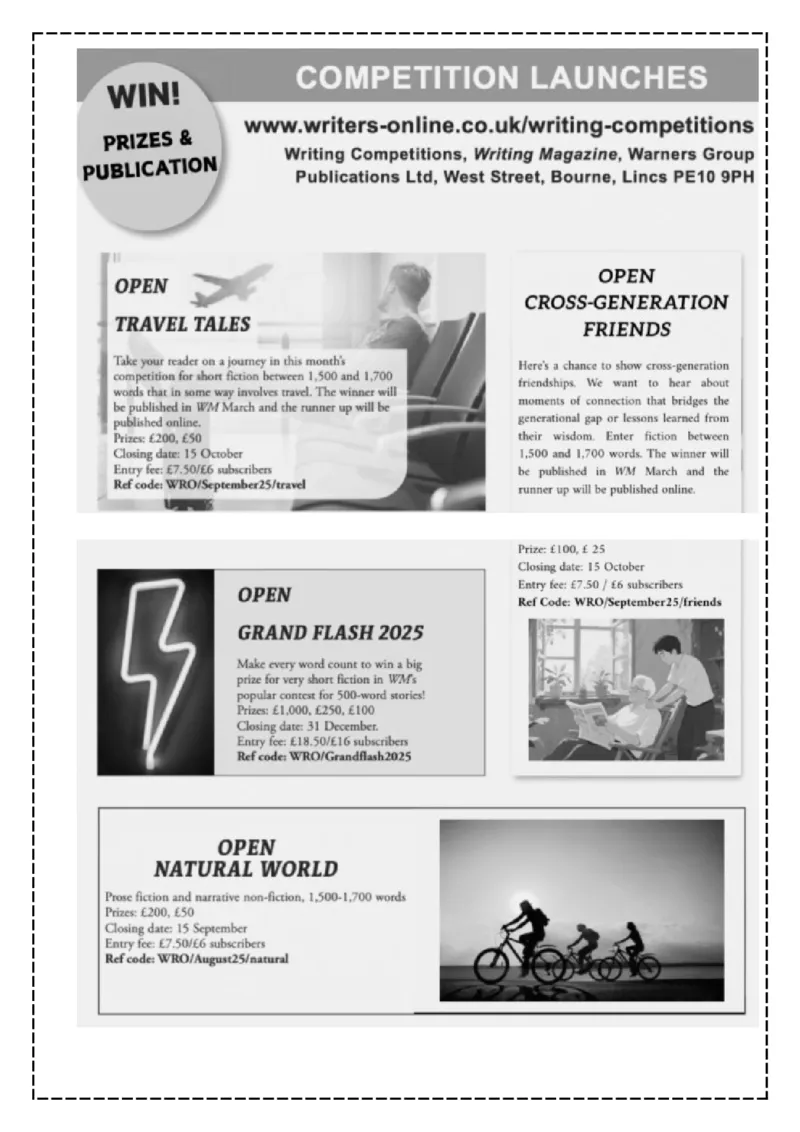
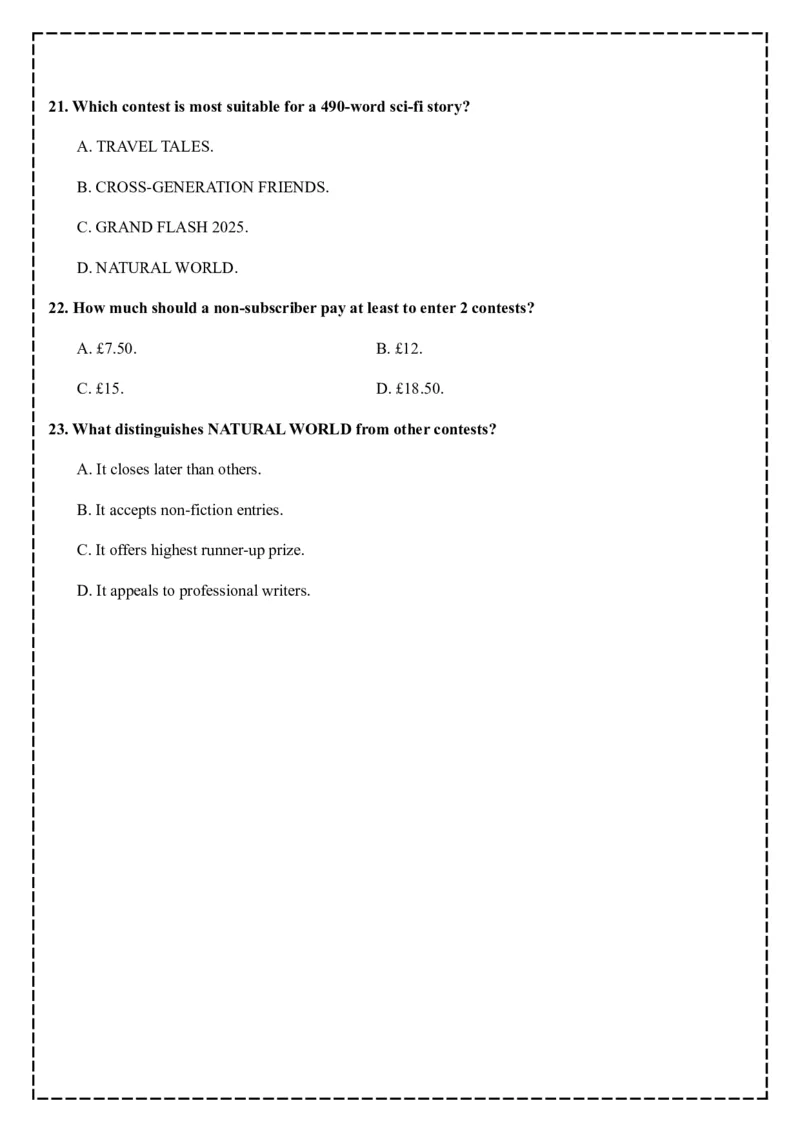
21. Which contest is most suitable for a 490-word sci-fi story?
A. TRAVEL TALES.
B. CROSS-GENERATION FRIENDS.
C. GRAND FLASH 2025.
D. NATURAL WORLD.
22. How much should a non-subscriber pay at least to enter 2 contests?
A. £7.50.
B. £12.
C. £15.
D. £18.50.
23. What distinguishes NATURAL WORLD from other contests?
A. It closes later than others.
B. It accepts non-fiction entries.
C. It offers highest runner-up prize.
D. It appeals to professional writers.
At first sight, Easthope doesn’t seem much like a Cassandra. She smiles a lot. Her manner is kind and
motherly; pushed to name her profession, you might guess at nurse or teacher. But look closer.
Easthope is an emergency planner whose job is to support the survivors of major disasters, in which
capacity she acted following the 2004 Indian Ocean tsunami and the fire at Grenfell Tower. For two decades,
the public knew nothing about this vital work, which went on behind the scenes, though she was hugely
admired in what we might call professional disaster circles: a voice of calm and a fountain of wisdom. But in
2023, she published a best-selling book about her career, When the Dust Settles, and that changed. People
became very interested in what she did.
“At literary festivals, most authors get questions about their writing process,” Easthope says. “But I
wouldn’t get those. What people wanted from me was to know how I lived with the knowledge that I have.
Wasn’t I afraid? How did I handle? I would tell them that I didn’t live afraid, and I would give them basic
advice. But this wasn’t enough.” In the end, she felt she had no choice but to write a second book, one in
which she would try to distill (浓缩) all that she has learned for the benefit of each individual.
While her publisher describes Come What May as a roadmap for resilience ( 韧性), the word is one
Easthope dislikes. Ready, she suggests, is a better one. Easthope also reminds people that small things, like
losing hair during illness or consuming too much food after someone dies, still matter. She encourages people
to remember, not to forget, what happened during disasters, because such events leave a long-lasting effect.
24. What might a Cassandra be like according to paragraph 1?
A. Severe and forbidding.
B. Competent and cautious.
C. Friendly and energetic.
D. Cheerful and approachable.
25. What led to increased public awareness of Easthope’s work in 2023?
A. The publication of a best seller.
B. The growth of professional disaster circles.
C. Her involvement in2004 tsunami relief.
D. Her sudden rise to fame through media.
26. Why are readers’ questions cited in paragraph 3?
A. To reveal Easthope’s personal fears.
B. To explain Easthope’s writing process.
C. To show Easthope’s writing motivation.
D. To present public doubts about Easthope’s work.
27. What does Easthope agree on handling disasters?
A. Resilience matters most.
B. Forgetting aids recovery.
C. Positive thinking takes the lead.
D. Minor sufferings deserve attention.
With a surface hot enough to melt lead in its atmosphere, Venus has been described as “Earth’s evil
twin” — similar in size, yet worlds apart. The question of whether Venus was ever habitable has long been a
hot topic among scientists. Some astronomers believe the planet was once much more hospitable, but a recent
research by Tereza Constantinou, a PhD student from the University of Cambridge, has now dealt a blow to
the idea that it ever hosted life as we know it.
Constantinou noted that early in the formation of Venus, the planet was covered in a vast sea of magma
(岩浆). If this cooled quickly, water would form oceans or be trapped as it crystallised (结晶), meaning the
planet’s interior (内部) would be water-rich. As a result, water would be released when volcanoes erupt. “If
you look at any photos of volcanism on Earth, you can see these large clouds coming out. Most of that is
water,” said Constantinou. But if the magma cooled slowly, water would have ended up as steam in the
atmosphere. In this situation, water would not be trapped inside the interior of the planet.
Constantinou and his colleagues studied changes in the Venusian atmosphere to cast light on the water
content of its interior. When they analysed the amount of substances being refilled, they found very little water
was being added. In other words, volcanic eruptions are “dry”. “The shortage of water in volcanic release
reflects an equally dry Venusian interior,” said Constantinou. The team announced that their findings did not
support the theory that Venus had surface oceans of water in its past, or a habitable climate.
Their conclusion could soon be tested. Later this decade, NASA is set to launch a mission to carry out
fly-bys of Venus. Constantinou said resolving the question could help astronomers rule out Venus as a
habitable planet now that the dry interior of Venus suggests it never has the oceans of liquid water traditionally
thought necessary for life to begin.
28. What is the finding of the recent research?
A. Venus is Earth’s identical twin.
B. Venus sets the whole world apart.
C. Venus was unlikely to sustain life.
D. Venus was more habitable than thought.
29. What is paragraph 2 mainly talking about concerning the research?
A. Its methods.
B. Its procedures.
C. Its potential impact.
D. Its theoretical foundation.
30. How did Constantinou and his colleagues draw their conclusion?
A. By analysing the changes of water content.
B. By studying the properties of substances.
C. By investigating the components of water.
D. By examining the differences of volcanoes.
31. What can the finding be used to do according to Constantinou?
A. Carry out more fly-bys.
B. Identify upcoming threats.
C. Conduct Venus observations.
D. Narrow down astronomers’ search.
Quick: what’s your best friend’s phone number? Don’t feel bad if you couldn’t answer off the top of your
head. You have no reason to commit phone numbers to memory: it’s just there in your phone. Or perhaps you
once had a phone book to store them. In either case, an object does the remembering for you.
“Prosthetic memory” (人工记忆) is nothing new. Writing itself has been a means of storing information.
Yet the information revolution has generated more data than ever before. We are flooded with information.
We’re creating more of it, and keeping more of it, The storage capacity of the human brain has since been
eclipsed. No wonder, then, that we’re increasingly dependent on memory prostheses, from libraries to
smartphones.
Not everyone thinks this trend in external memory is good. Historically, memory prostheses were
expensive. As technologies such as printing and photography become more affordable, sharing experiences
with others is easier than ever. So every breakfast, every sunset, every encounter with a cat finds its way on to
social media. And here comes the worry. When we devote ourselves to capturing and sharing the world in this
way, something immensely valuable is lost; when recording so much of our lives, we’re forgetting to actually
live them. We put something between ourselves and the world-a camera-instead of just being in the moment,
and so disconnect ourselves from experience.
But is our social media-driven transformation wholly bad? If we’re still creating and sharing memories
like this, perhaps this is because we’ve not had sufficient time to learn how to do these things without thinking
about what we’re doing. It is easy to ignore that the mass social media era is less than a decade old. That’s just
a short blink (眨眼)in human history, yet it has totally changed how we live. I suspect we’re not far off from
being directly faced with experience yet with the ability to share experience in ways less bounded by
geography and time. After all, technology can do what our fragile meat-computers can’t: protect all the
moments of a life that would otherwise be lost.
32. What can be inferred from paragraph 1?
A. We rely more on tools to memorize.
B. We are burdened with phone numbers.
C. Technology weakens our brains.
D. Technology distances us from our friends.
33. What does the underlined word “eclipsed” in paragraph 2 mean?
A. Improved.
B. Outperformed.
C. Restricted.
D. Undervalued.
34. What negative effect does online sharing bring about?
A. An overflow of posts.
B. High cost of digital devices.
C. Addiction to the virtual world.
D. Disregard for authentic experience.
35. What does the author advise us to do in the last paragraph?
A. Have faith in human brains.
B. Take time to adapt to digital age.
C. Quicken the pace of development.
D. Make efforts to enhance memory.
I vividly remember the process of moving in for the first time: stuffing clothes, comfort items, and pieces
of my childhood into various bags and boxes. It was a whirlwind (旋风)of excitement. ____36____ What
would it be like living at college? Would I get along with my roommate? How would I make friends with
complete strangers?
___

 _37_

 ___

  I had always felt like I struggled more than others to find “my people.” In high school, I had
a few close friends, but it always seemed like everyone else had these big, inseparable friend groups that did
everything together. I wanted that, and the sense of belonging, too.
Like many, I was attracted by the first people I met in college.____

 38
  ____

  We lived next to each other,
ate together, and stayed up late together. They were my early friend group, and they brought laughter, growth,
and memories — both positive and negative. Those highs and lows taught me an important lesson: Not every
friendship is meant to last, and that’s okay.
Your friendships don’t just impact your social life — they affect your motivation, your academics, and,
among other things, your sense of self. I have found it valuable to surround myself with people who share my
values to keep me grounded.___

 _39

 ____

  College is one of the few places in life where you’re surrounded by
people from vastly different backgrounds and experiences. Keeping an open mind is just as important as
finding common ground.
College can be, and probably will be, chaotic. People come and go. You’ll probably cry over friendships
that didn’t work out.____

 40_

 ___

  That’s all part of the process. Over time, you will find your people.
A. They’re part of your story.
B. But it was also filled with uncertainty.
C. I wouldn’t trade my friendship for anything.
D. They mostly so happened to be the people on my floor.
E. That said, don’t limit yourself to just those who are like you.
F. You may smile at memories with people no longer close with.
G. Of all the unknowns, the last question consumed me the most.
Hillary Krieger was sitting in her parents’ house with her friend, David. The man ____41____

  squirted
(喷溅) orange juice all over himself. “I shouted, ‘Oh, the orange just orbiculated,’” she later ____42____ .
David was thrown into ____43____, “It did what?”
Curious herself, Hillary quickly grabbed a dictionary and ____44____ to the “O” section — only to
freeze. The word was nowhere to be found.____45____, she marched into her father’s study. Wearing an
awkward smile, he admitted he’d ____46____ the word back in college, never imagining it would ____47____
— yet he’d used it naturally around the family for years and everyone had ____48____ it was real.
At first, Hillary felt frustrated, wondering how many other make-up words had ____49____ her
vocabulary without her noticing. But that frustration faded fast. Soon, she began to see “orbiculate” not as a
mistake, but as a ____50____— a small window into her father’s inventive soul. “It speaks to his
____51____,” she believes. “Even when something is annoying-like orange juice in your eye — he found a
way to laugh at it, turning a ____52____ moment into something fun.”
Two decades later, Hillary’s father passed away. Sorrow settled over her, but so did ____53____:
“Orbiculate” deserved a place in the dictionary. Her goal wasn’t just to get a word ____54____; it was to keep
her father’s joy alive. This, she thought, was the best way to ____55____ him.
41. A. carefully
B. intentionally
C. accidentally
D. constantly
42. A. recalls
B. comments
C. complains
D. insists
43. A. panic
B. confusion
C. desperation
D. embarrassment
44. A. contributed
B. responded
C. applied
D. turned
45. A. On time
B. At random
C. In disbelief
D. With admiration
46. A. chosen
B. invented
C. misused
D. encountered
47. A. stick
B. improve
C. transform
D. disappear
48. A. denied
B. pretended
C. suspected
D. assumed
49. A. slipped into
B. escaped from
C. broken down
D. gone against
50. A. secret
B. lesson
C. gift
D. challenge
51. A. adaptability
B. productivity
C. creativity
D. responsibility
52. A. messy
B. cheerful
C. critical
D. memorable
53. A. relief
B. patience
C. sympathy
D. determination
54. A. revised
B. defined
C. translated
D. corrected
55. A. assist
B. honor
C. contact
D. accompany
As temperatures rise across China, a new trend is taking hold. Outdoor sports, ____56____ draw citizens
out of gyms and into the wilderness, test people’s physical limits and reconnect them with nature.
One standout in this trend, the Spartan Race, has exploded in __
  __57__

 __
  (popular) in many Chinese
cities. So far, the race, along with its ____58____(mud) routes, high walls, and various obstacles, has gained
significant attraction online as well. Last month, the Spartan China series ____59____(land) in Changchun
while on October 16-17, the Spartan Kids World Championship will be held ____60____ the second time at
Yunding Snow Park in Hebei Province.
Each event challenges participants to complete distances ____61____(range) from 5 to 50 kilometers,
with some ____62____(intense) demanding obstacles depending on the race category. In practice, the race
involves climbing, hanging, and carrying sandbags,_  ___63____

  total return to nature from gyms.
Liu Mingyi, chief expert at the China Youth Sports and Physical Education Center, said that the rise of
outdoor running competitions is far from accidental. “In the past, people stayed indoors, lifting weights in
gyms. Now, there’s a growing desire ____64____(break) free from concrete buildings.” Liu commented.
“These mud-stained events offer not just wildness,____65____ a kind of close dialogue with nature.”
你校正在开展“学校图书馆是否应该购买电子书刊”的讨论。请你写一篇发言稿,在英语课堂
作课前分享。内容包括:
1.表达看法;
2.说明理由。
注意:
1.写作词数应为80 左右;
2.请按如下格式在答题卡的相应位置作答。
           Good morning, everyone!
It was a typical busy noon at the downtown fast-food spot. The smell of sizzling patties and crispy fries
lingered (弥漫) in the air, and the place was packed with folks rushing to grab a quick meal. I’d just gotten off
a long morning at work, and my stomach was empty as I finally reached the front of the line and got my
order-a burger, fries, and a cold drink.
As I set the tray (托盘) down on a small table by the window, I glanced over and saw two firefighters in
the corner. Their uniforms were heavy with faint spots, like they’d just stepped away from a smoky scene, and
their boots still held a hint of damp from the morning dew. They stood in the back of the line, shoulders relaxed
but eyes tired.
I was just about to pick up my burger-the cheese melted perfectly-when a loud, sharp siren (警报) cut
through the noise of the restaurant. The two firefighters froze for half a second, and then moved. No hesitation,
no exchange of words — just muscle memory. One grabbed his helmet off the nearby counter, the other
adjusted his radio on his shoulder, and they turned toward the door, their steps quickening. I watched them go,
and my fork paused mid-air.
My empty stomach served as a quiet reminder of how long I’d waited for this meal. I’d stood in that line
for 15 minutes, my feet aching from the morning’s work. Giving them my lunch meant I would have to wait
again-maybe another line, maybe my break slipping away faster. I bit my lip, staring at the tray. Then I thought
of their uniforms, the spots, the way they’d act upon hearing the siren like it was a call they couldn’t ignore.
They didn’t get to pause for a meal when emergencies hit. They’d probably go hours without eating, running
from one call to the next.
My hesitation melted away.
I went back to the counter, only to find the manager was waiting for me.