ARTICLE · 1314214
2023年高州教招面试——初中 英语(考高中)

第一部分面试考情
面试采取试讲的方式进行。每位考生的备考时间为15分钟,试讲时间为10分钟,最后1分钟举牌提醒。
第二部分试讲真题及解析
考试内容:人教版,高中英语,必修二《A day in the clouds》
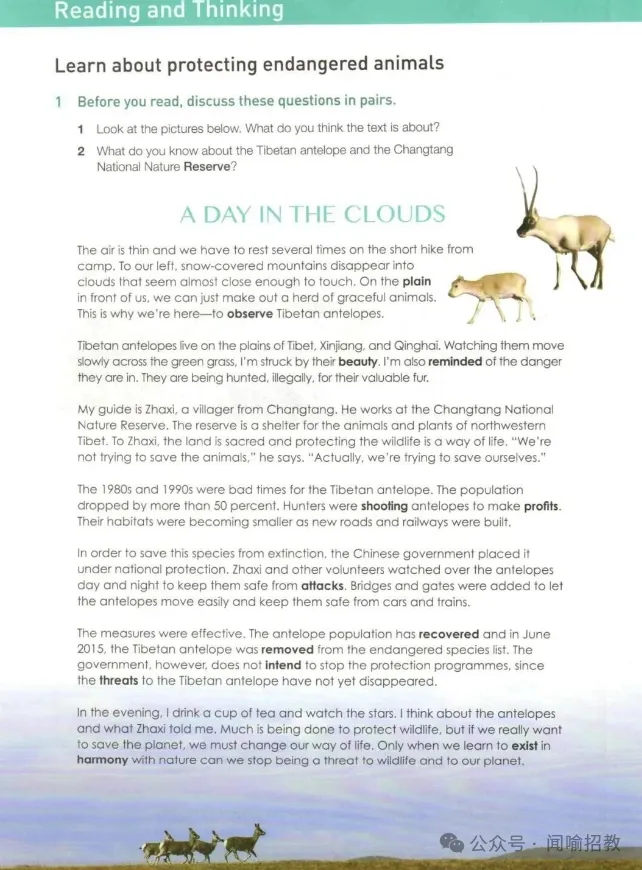
【Leading-in】
Good morning, class. Let's begin with a question. Look at the pictures on the screen. What do you see? Yes, we see antelopes with long, curved horns. They are Tibetan antelopes. What do you know about them? Some of you may know they live in Tibet, Xinjiang, and Qinghai. Today we are going to read a text called "A Day in the Clouds." It tells the story of the writer's visit to Tibet to observe these beautiful animals. We will learn about the dangers they faced and how people worked together to protect them. Let's get started.
【Pre-reading】
Before we read, let's discuss these questions in pairs. First, what do you think the text is about based on the pictures? Second, what do you know about the Tibetan antelope and the Changtang National Nature Reserve? Take one minute to share your ideas with your partner.
Time's up. Who would like to share? Lily, you think the text is about protecting Tibetan antelopes. Tom, you know they are endangered because of hunting. Now let's read and find out more.
【While-reading】
Now, please read the text silently. You have four minutes. As you read, think about why the writer visited Tibet and what happened to the Tibetan antelopes.
Time's up. Let's go through the text together.
The first paragraph describes the writer's arrival. The air is thin and they have to rest several times on the short hike. Snow-covered mountains disappear into clouds. On the plain, they can just make out a herd of graceful animals. This is why they are there—to observe Tibetan antelopes.
The second paragraph tells us that Tibetan antelopes live on the plains of Tibet, Xinjiang, and Qinghai. Watching them move slowly across the green grass, the writer is struck by their beauty. But the writer is also reminded of the danger they are in. They are being hunted illegally for their valuable fur.
The third paragraph introduces Zhaxi, a villager from Changtang who works at the Changtang National Nature Reserve. To Zhaxi, the land is sacred and protecting the wildlife is a way of life. He says, "We're not trying to save the animals. Actually, we're trying to save ourselves."
The fourth paragraph describes the bad times. In the 1980s and 1990s, the population dropped by more than 50 percent. Hunters were shooting antelopes to make profits. Their habitats were becoming smaller as new roads and railways were built.
The fifth paragraph tells us what people did to help. The Chinese government placed the species under national protection. Zhaxi and other volunteers watched over the antelopes day and night. Bridges and gates were added to let them move safely.
The sixth paragraph says the measures were effective. The population has recovered, and in June 2015, the Tibetan antelope was removed from the endangered species list. The government, however, does not intend to stop the protection programmes because the threats have not yet disappeared.
The last paragraph shares the writer's reflection. In the evening, the writer drinks tea and watches the stars, thinking about what Zhaxi said. Much is being done to protect wildlife, but if we really want to save the planet, we must change our way of life. Only when we learn to exist in harmony with nature can we stop being a threat to wildlife and to our planet.
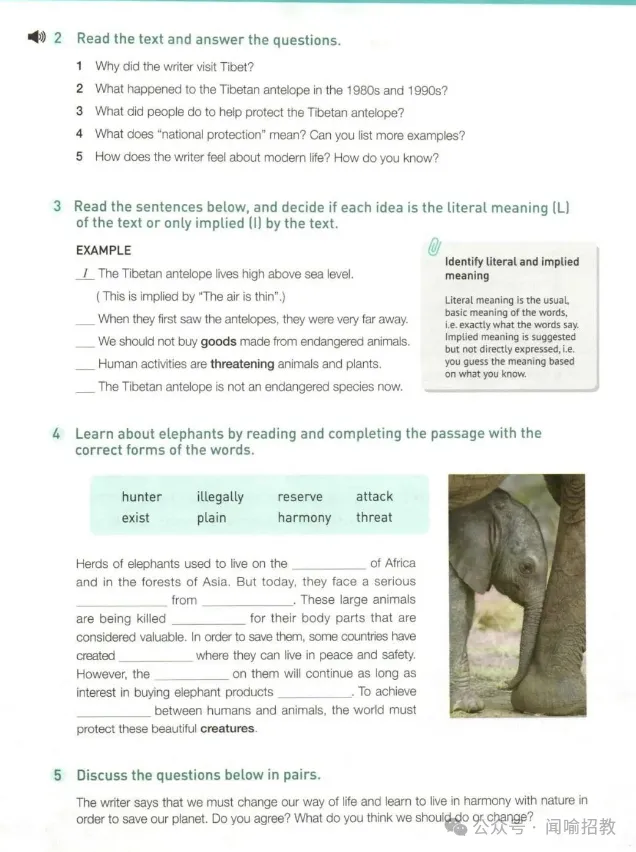
Now, let's answer the questions. Why did the writer visit Tibet? To observe Tibetan antelopes. What happened to them in the 1980s and 1990s? Their population dropped by more than 50 percent due to illegal hunting. What did people do to help? The government placed them under national protection, and volunteers watched over them. What does "national protection" mean? It means the government makes laws and takes actions to protect the species. How does the writer feel about modern life? The writer thinks we need to change our way of life to live in harmony with nature.
【Post-reading】
Now, let's do the exercise on literal and implied meaning. Read the sentences and decide if each idea is the literal meaning or only implied by the text.
"The Tibetan antelope lives high above sea level." This is implied by "The air is thin."
"When they first saw the antelopes, they were very far away." This is implied by "we can just make out a herd of graceful animals."
"We should not buy goods made from endangered animals." This is implied by the text's message about protecting wildlife.
"Human activities are threatening animals and plants." This is literal—the text directly states that habitats are becoming smaller and hunters are shooting antelopes.
"The Tibetan antelope is not an endangered species now." This is literal—the text says it was removed from the endangered species list in 2015.
Now, let's complete the passage about elephants with the correct words. The words are: hunter, illegally, reserve, attack, exist, plain, harmony, threat.
"Herds of elephants used to live on the plains of Africa and in the forests of Asia. But today, they face a serious threat from hunters. These large animals are being killed illegally for their body parts that are considered valuable. In order to save them, some countries have created reserves where they can live in peace and safety. However, the attacks on them will continue as long as interest in buying elephant products exists. To achieve harmony between humans and animals, the world must protect these beautiful creatures."
Now, let's have a group discussion. In groups of four, discuss these questions: The writer says we must change our way of life and learn to live in harmony with nature in order to save our planet. Do you agree? What do you think we should do or change? You have three minutes.
Time's up. Let's hear from some groups. Group 2, please share. You agree because human activities cause pollution and habitat loss. We should use less plastic and recycle more. That's a good point. Group 4, you think we should stop buying products made from endangered animals. Yes, that's very important. Group 1, you think we should plant more trees and protect natural habitats. Absolutely. Group 3, you think we should educate more people about protecting wildlife. That's crucial for long-term change.
【Conclusion】
Today we read "A Day in the Clouds," a text about the Tibetan antelope and the efforts to protect them. We learned about the dangers they faced: illegal hunting and habitat loss. We learned about the solutions: government protection, volunteer work, and building safe passages. Most importantly, we learned Zhaxi's powerful message: protecting wildlife is protecting ourselves. We also discussed how we can live in harmony with nature. Remember, every small action can make a difference. You all did a fantastic job today.
【Homework】
Now for homework, please complete two tasks. First, write a short summary of the text in your own words, using at least five of the bolded words: observe, beauty, shooting, profits, attacks, recovered, removed, intend, threats, exist, harmony. Second, write a paragraph about one endangered animal you know. Describe why it is in danger and what can be done to protect it. You can do some research if you like. Share your summary and paragraph with the class next time. That is all for today. Thank you for your wonderful participation. See you next time.


更多教招资料