小学英语优秀教学设计(一)
Unit8 A camping trip
What do you have ? I have… What does he/she have ? He/She has…
Unit 6 Do you like bananas?(SectionA 1a- 1c)
Teaching objects:
A. Knowledge objects:
a. Be able to grasp some new words about food.
b. Can distinguish countable nouns and uncountable nouns.
c. Be able to express themselves with the new structure :
---Do you like …? ---Yes, I do./ No, I don’t.
B. Ability aims:
a.Can develop listening, speaking, reading and writing skills though the practice of
the target language.
b.Gain communicative ability by using the target language.
C.Emotional objects:
a.Get the students to realize the importance of healthy diet.
b. Get the students to develop the students’ cooperative spirit.
Teaching key/different points:
Teaching key points:
1. To learn the new words and phrases.
2. Help the students to master the structures of “what are you going to do” and “be
going to do”.
3. To arouse the students’ interest of listening and speaking.
4. To form a good habit of making schedule for their daily life.
Teaching difficult points:
1. To master the structures of “what are you going to do” and “be going to do”.
2. To improve the students’ listening and speaking ability.
3.Use the words and the target language learned in this class to describe situations in
the daily life.
1Teaching methods: Task-based Method任务型教学, Communicative Approach交际法, Audio-
lingual Approach听说法
Teaching aids: word cards
Teaching procedures:
Warming-up:
Q&A. Teacher pick up one object, which are learned before, such as ruler, baseball and
eraser.
T: What’s this? S: It’s a/an…(ruler/baseball/eraser)
Pre-listening:
1. Hold a card of food, for example apple. T ask :What’s this? S: It’s an apple.
T:apple,Do you want to eat apple? Look, there is a fridge in the picture. Now, open the
fridge and look what’s in the fridge? Is there an apple?
Open the fridge, present pictures of different food. Then ask:
T: What’s this? S: It’s a/an…
T: What are they? S: They are…
Countable nouns: bananas/oranges/tomatoes/pears/strawberries. (They can use a/an, and
we can add “s”)
Uncountable nouns: ice-cream/ milk/bread/salad.(They can’t use a/an and we can’t add
“s”)
2. Teach students to read, and ask students “Who wants to be a little teacher?”
Guessing game. Six students show the back of the paper, and other students guess the
name of the food. Then read the word together. Next, finish 1a.
3. Talk about what’s your favorite food. T says “I like apples. But i don’t like
bananas.”
I like… I don’t like…
While-listening:
Listen to the tape twice and find out the right numbers.
Post-listening:
A: Talk about likes and dislikes.
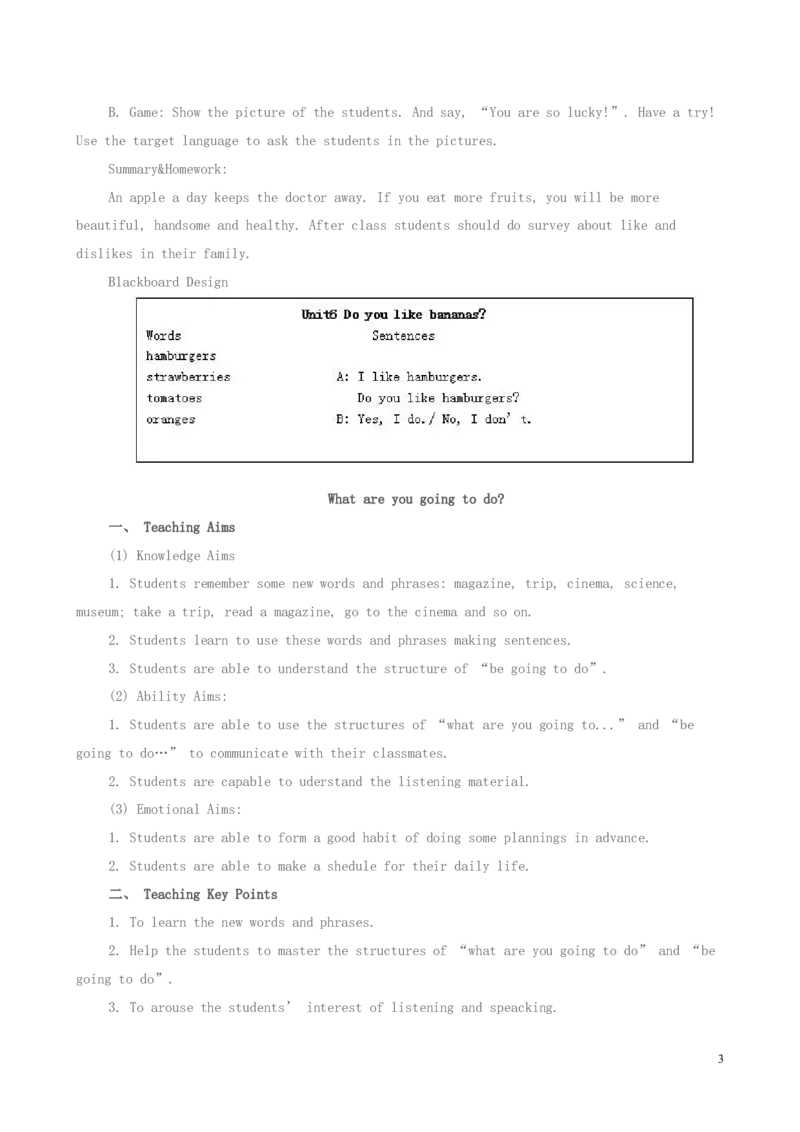
1. ——I like hamburgers. Do you like hamburgers?
——Yes, I do./ No, I don’t.
2.——-I don’t like milk. Do you like milk?
——Yes, I do. / No, I don’t.
2B. Game: Show the picture of the students. And say, “You are so lucky!”. Have a try!
Use the target language to ask the students in the pictures.
Summary&Homework:
An apple a day keeps the doctor away. If you eat more fruits, you will be more
beautiful, handsome and healthy. After class students should do survey about like and
dislikes in their family.
Blackboard Design
What are you going to do?
一、 Teaching Aims
(1) Knowledge Aims
1. Students remember some new words and phrases: magazine, trip, cinema, science,
museum; take a trip, read a magazine, go to the cinema and so on.
2. Students learn to use these words and phrases making sentences.
3. Students are able to understand the structure of “be going to do”.
(2) Ability Aims:
1. Students are able to use the structures of “what are you going to...” and “be
going to do…” to communicate with their classmates.
2. Students are capable to uderstand the listening material.
(3) Emotional Aims:
1. Students are able to form a good habit of doing some plannings in advance.
2. Students are able to make a shedule for their daily life.
二、 Teaching Key Points
1. To learn the new words and phrases.
2. Help the students to master the structures of “what are you going to do” and “be
going to do”.
3. To arouse the students’ interest of listening and speacking.
34. To form a good habit of making shedule for their daily life.
三、 Teaching Important Points
1. To master the structures of “what are you going to do” and “be going to do”.
2. To improve the students’ listenning and speaking ability.
四、 Teaching Procedures
(1) Step 1: lead-in
1. Greetings
2. The teacher shows a song, which contians the structure of “be going to do or what
are you going to do” to students, and then asks them to have a try to sing it.
(2) Step 2:pair work
1. To learn the new words, phrases and the sructures of “what are you going to do”
and “be going to do”.
2. The teacher sends every student a card, which contains the phrases of this part.
Then the students are work in pairs and using the phrase they held to communicate with
their partners. In a short, the students are asked to make sentences with the structures of
“what are you going to do ” and “be going to do” .
Eg: Student A hold the card with the phrase of “go to the cinema”, student B hold the
card with “this evening”, then they can make a dialogue like this:
Ss A: What are you going to do this evening?
Ss B: I’m going to the cinema.
3. According to their performance, the teacher makes a conclusion and then asks the
whole class to speak out these sentences loudly.
(3) Step 3: listening
1. The teacher plays the tape to the students and asks them to do the Let’s Try part.
2. Then checks their answers.
3. And then plays the music, which shows in the Lead-in part and then the teacher
teaches students to sing the song.
(4) Step 4: group work
1. The students are divided into several groups, and each group contains 4 to 5
students. One student role playing as a tour guide, the other students’ role as the
tourists. The tourists ask the tour guide some questions about the schedule of this weekend
by using the sentence structures of “What are you going to do…” and “I’m/ you are/
they are/ she is/ he is going to do…” . Then change the roles and play it again.
42. Have some volunteers to do the role play in the front of the classroom.
3. Ask the students to write down their group’s dialogues.
4. Then the teacher evaluates their representations.
五、 Assignment
The students should to write a schedule for this weekend.
六、 Teacher’s reflection
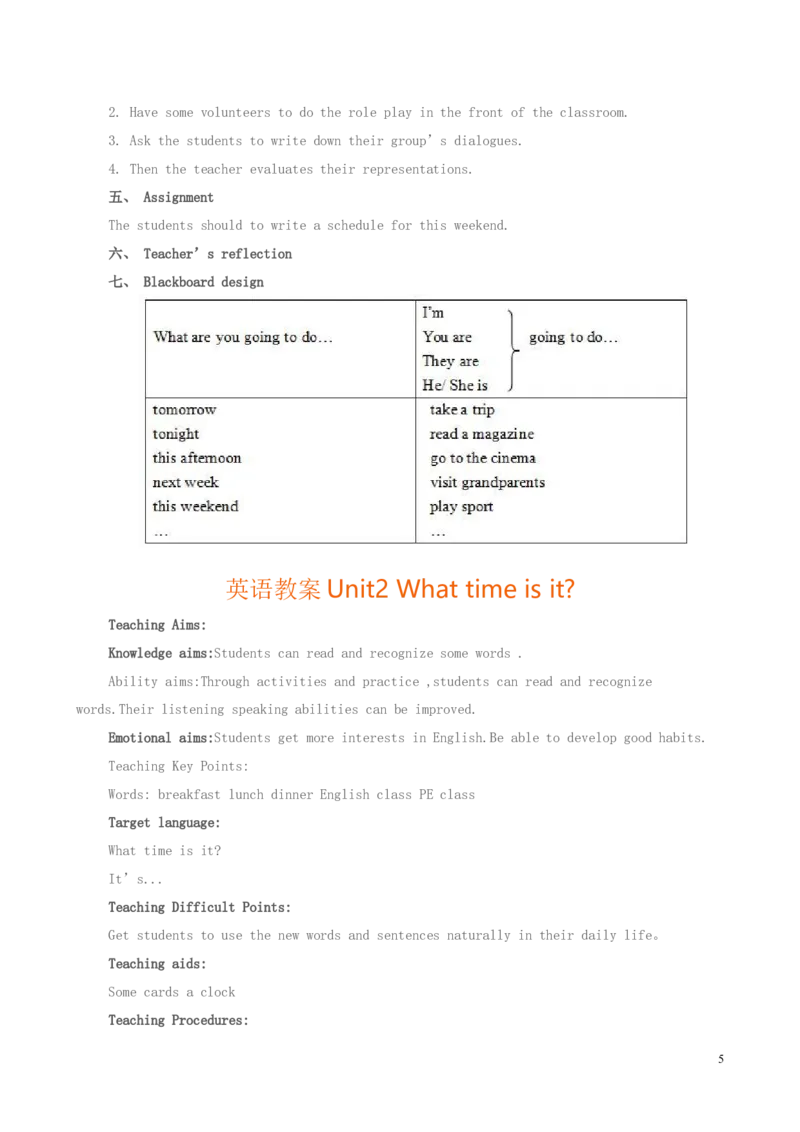
七、 Blackboard design
英语教案 Unit2 What time is it?
Teaching Aims:
Knowledge aims:Students can read and recognize some words .
Ability aims:Through activities and practice ,students can read and recognize
words.Their listening speaking abilities can be improved.
Emotional aims:Students get more interests in English.Be able to develop good habits.
Teaching Key Points:
Words: breakfast lunch dinner English class PE class
Target language:
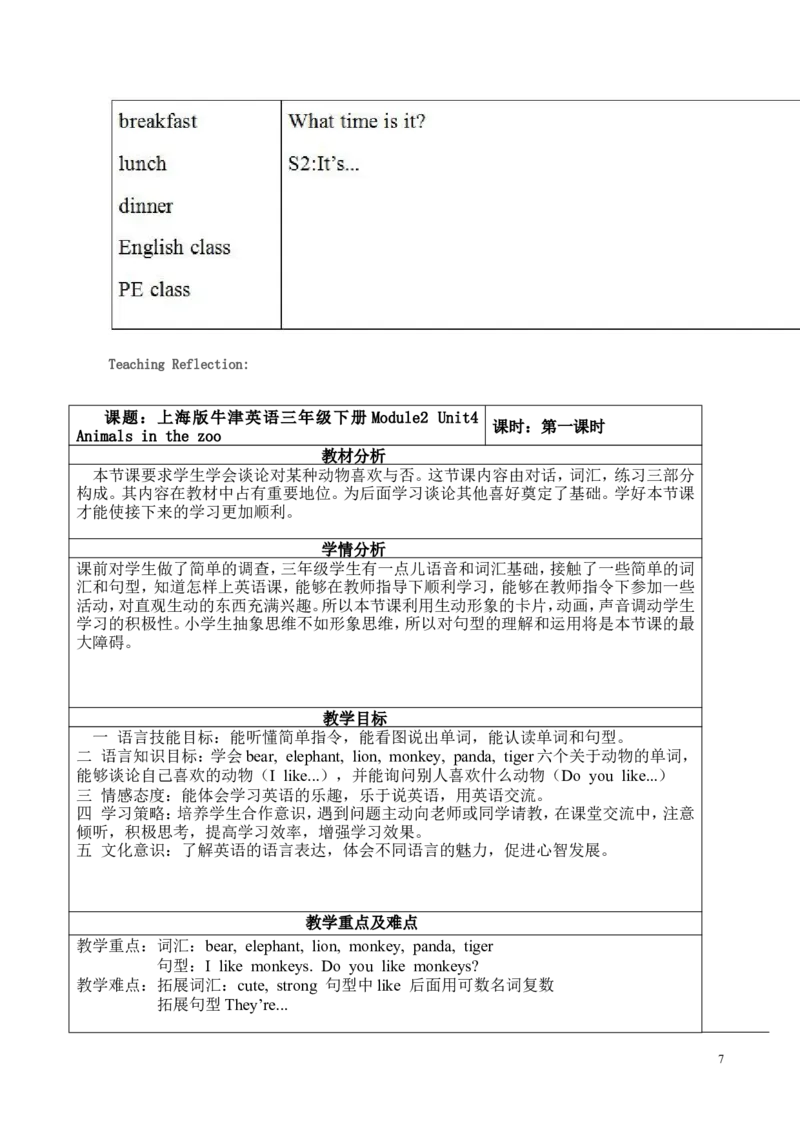
What time is it?
It’s...
Teaching Difficult Points:
Get students to use the new words and sentences naturally in their daily life。
Teaching aids:
Some cards a clock
Teaching Procedures:
5Step1:Warming up and lead in
1. Daily greeting and sing a song
2. If I didn’t bring the watch I ask my students “What time is it ?”Who can tell me
And then lead in the topic.
Step2:Presentation and practice
1. Activity one
Show students some pictures and ask them what does he /she do in the picture. And then
Teach them“How to read these words and How to spell them’’.
Activity two
1,Listen to the tap and ask one student to answer my question “what are two boys
talking about?”and then the teacher say the time and the student need to say a thing.if
the teacher say a thing ,the student need to say the time.
2,Let students make a conversation
S1:What time is it?
S2:It’s...
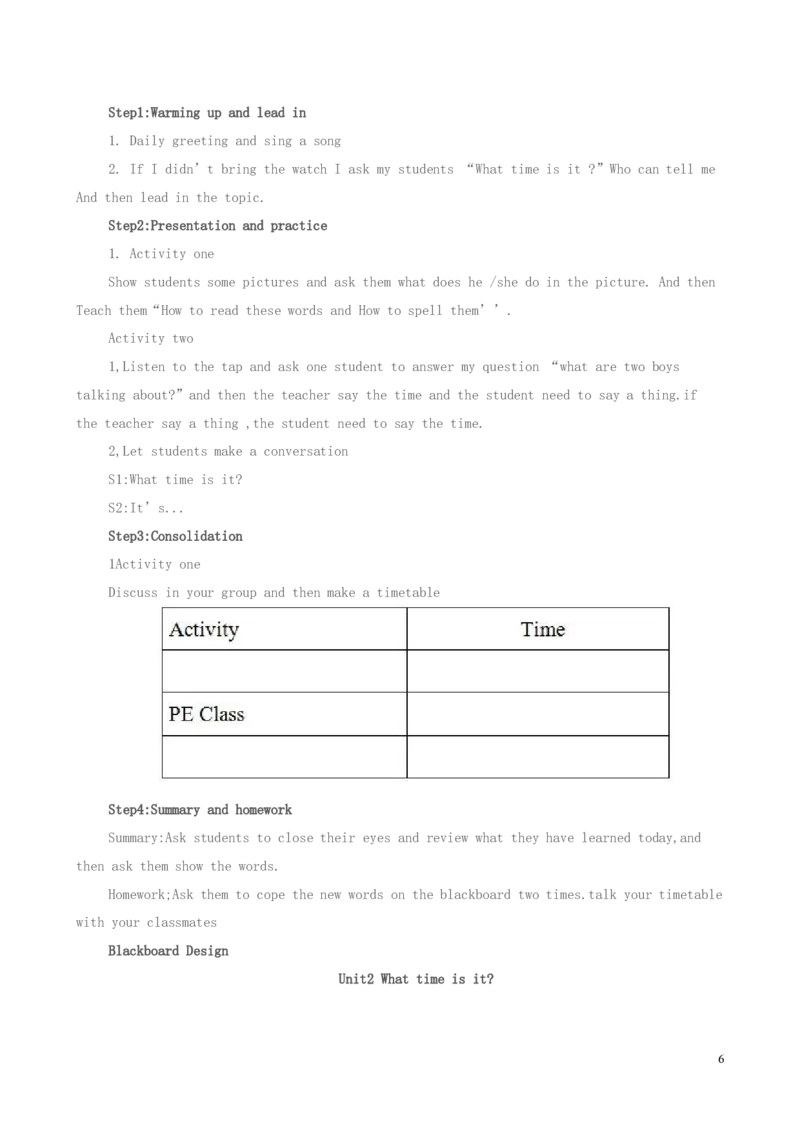
Step3:Consolidation
1Activity one
Discuss in your group and then make a timetable
Step4:Summary and homework
Summary:Ask students to close their eyes and review what they have learned today,and
then ask them show the words.
Homework;Ask them to cope the new words on the blackboard two times.talk your timetable
with your classmates
Blackboard Design
Unit2 What time is it?
6Teaching Reflection:
课题:上海版牛津英语三年级下册 Module2 Unit4
课时:第一课时
Animals in the zoo
教材分析
本节课要求学生学会谈论对某种动物喜欢与否。这节课内容由对话,词汇,练习三部分
构成。其内容在教材中占有重要地位。为后面学习谈论其他喜好奠定了基础。学好本节课
才能使接下来的学习更加顺利。
学情分析
课前对学生做了简单的调查,三年级学生有一点儿语音和词汇基础,接触了一些简单的词
汇和句型,知道怎样上英语课,能够在教师指导下顺利学习,能够在教师指令下参加一些
活动,对直观生动的东西充满兴趣。所以本节课利用生动形象的卡片,动画,声音调动学生
学习的积极性。小学生抽象思维不如形象思维,所以对句型的理解和运用将是本节课的最
大障碍。
教学目标
一 语言技能目标:能听懂简单指令,能看图说出单词,能认读单词和句型。
二 语言知识目标:学会bear, elephant, lion, monkey, panda, tiger六个关于动物的单词,
能够谈论自己喜欢的动物(I like...),并能询问别人喜欢什么动物(Do you like...)
三 情感态度:能体会学习英语的乐趣,乐于说英语,用英语交流。
四 学习策略:培养学生合作意识,遇到问题主动向老师或同学请教,在课堂交流中,注意
倾听,积极思考,提高学习效率,增强学习效果。
五 文化意识:了解英语的语言表达,体会不同语言的魅力,促进心智发展。
教学重点及难点
教学重点:词汇:bear, elephant, lion, monkey, panda, tiger
句型:I like monkeys. Do you like monkeys?
教学难点:拓展词汇:cute, strong 句型中like 后面用可数名词复数
拓展句型They’re...
7教学基本策略及设计思路
本课题是根据本年段学生学习语言的认知规律和《课标》提出的学习目标来设计的,注
重直观,形象,激发学生好奇心和兴趣,以学生熟悉的生活情境和经验为基础,通过看看猜
猜,听听猜猜,说说唱唱等活动让学生在“做中学,用中学”的过程中学习语言,运用语
言。
资源的开发及说明
本节课采用多媒体课件辅助教学,利用图片,声音,动画来刺激学生感官,让学生在愉
悦中学习,体验学习的乐趣,增强的学习效果。
教学过程
教学环节 教师活动 预设学生活动 设计意图
播放视频歌曲,In the
用与本节课有关
zoo引出课题 跟唱
Step1 动物的英语歌曲热身
讲授新知:
1.依次出示六种动物图 直观形象 ,图片吸
片,播放单词读音 引学生注意,以词带
看图跟读
2.在学习六个动物单词 句,解决难点
图文并茂,模仿读音,形象
中,渗透拓展词汇:
记忆
cute, strong,拓展句
型:They’re...
调动兴趣,活跃思维,
3.出示课件,看看猜猜, 看动物身体一部分,猜动
灵活记单词
Step2 4.出示课件,听听猜猜 物,用英语说出
5.出示课件,读读连线 发挥想象,集中注意
听动物叫声,猜动物
6.出示课件,出示图片, 力,再记单词
将动物单词与动物连线
动物单复数对比说法引 练习认读单词
知道英语名词单复数的说
出本课重点句型:I 解决重点,难点,排除
法。学会谈论是否喜爱某种
like monkeys. Do 障碍。为对话学习做
动物
you like monkeys? 准备。
初识对话
学说 看听 再读对话,体会英语
1. 播放视频对话
表达
听音,看书,跟读
Step3 2. 再播放录音
两人一组,读对话,不会的问老 培养自主学习能力和
3. 让学生分组读对话,教
师或同学,尽快学会。 合作意识。
师巡视
4. 听学生表演对话 两个人汇报表演对话 检验学生掌握对话情
况
与同学进行问答,谈论喜欢和 学会表达自己不喜欢
1.巩固练习:勾一勾,说一 不喜欢的动物
某种动物,从而将知
说 抄写背会六个必会动物单词,
Step4 识拓展延伸。
2.布置家庭作业 抄写重点句型。与同学谈论对
作业巩固本课知识并
动物的喜好。找一找关于其他
作延伸。
的动物和别人交流一下。
学生学习活动评价设计
8学生设计一个自我评价表。
内容包括:
1.我能用英语说出动物园常见的动物名称。( )
2.我能准确认出这些动物单词。( )
2. 我能正确书写这些动物单词。( )
3. 我能用句型I like...来介绍自己喜欢的动物。( )
4. 我能用Do you like...?来询问别人是否喜欢,并能用Yes, I do/No, I don’t 来回答。(
)
以对子形式,互相检验五项要求是否达标,向老师作书面汇报。
板书设计
Unit4 Animals in the zoo
bear elephant lion monkey panda tiger
--I like monkeys. Do you like monkeys?
--Yes, I do./No, I don’t.
小学英语第五册(外研版)
Module 8 School
Unit 1 What time does school start?
蓬莱市南王中心小学 包晓晴
一、教材分析
Module 8 Book 5 的主题是“School”,“ Unit 1 What time does school start?”的语言功能是描述学校生活;
学习任务为“What time does school start? What time do you get up?”
二、学情分析
本课的教学对象是五年级学生,他们已经掌握了一定的英语词汇,具有一定的英语学习的积极性与
主动性,具备了一定的英语语言运用能力,求知欲增强。因此,在新知识传授的同时,教师要尽可能多的为学生创
造良好的语言环境,给学生充足的语言“习得”机会,让学生在学习中积极参与、大胆发言,从而形成积极的情感
态度和自主学习的能力。
三、教学目标
(一)知识目标
1、能听懂、会说并认读下列单词:exercise, before, playground, skip, coffee, tea.
2、能听懂、会说并认读下列句子:What time does school start? My school starts at 9 o’clock. What time do you
get up? I get up at half past seven.
(二)能力目标
9能口头运用“What time does school start?”这类语句询问发生的时间,并能口头运用“My school starts at 9
o’clock.”这类语句回答。
(三)情感目标
为学生创设轻松、愉悦、和谐的英语课堂学习氛围,使学生在学习中敢于开口说英语,并了解西方小学学校
日常生活习惯,从而对英语学习产生更为浓厚的兴趣。
四、教学要点分析
(一)教学重点
1.单词:exercise, before, playground, skip, coffee, tea 的认读。
2.运用“What time … ?”来询问事情发生的时间。
(二)教学难点
能够在真实的语境中正确运用“What time … ?”询问事情发生的时间。
五、教学准备
多媒体课件、录音机、磁带、单词卡片、跳绳。
六、教学过程
Step 1 Warming-up
1. Chant:《I like coffee, I like tea.》(第二册中M3 U2 4)
教师一手拿coffee 一手拿tea的英语单词卡片示意学生一起拍手说Chant,并教授单词:coffee, tea。(教授单
词时尽量提供一些学过的词汇,鼓励学生自己读出来,培养学生的拼读能力。)
Step 2 Presentation
1. Leading-in.
(1)课件出示学校的图片介绍说:This is our school. Do you read a book in your classroom?
(2)课件出示学校学生跳绳和做操的照片
T: What are they doing? They are skipping. Do you skip in the playground?
They are doing morning exercises.
(3)课件出示学校作息时间表引出句型:What time does our school start? 及回答:My school starts at eight
o’clock.
T:We know the school life in China, how about the children in England? Today,let’s go and visit their school
with Amy.
【设计意图】出示自己学校的照片,学生感觉熟悉,同时渗透playground,skipping,exercise的单词的教
学,为下边的教学活动做好相关铺垫。通过介绍自己的学校引出Amy的学校生活是什么样的?与我们的学校有
什么不同?
2. Text.
(1)Listen to the tape.
T: Our school starts at 8:00. What time does Amy’s school start? Do you know? Let’s listen to the tape and
answer the question:
What time does Amy’s school start?
【设计意图】由学校生活自然要谈到几点上课的问题,学生对此问题的提出不会感到唐突。由教师对Our
school starts at 8:00.的讲解,孩子们也一定急于知道英国学生的上课时间,从而初步感知课文内容,了解课文大
意。
(2)Listen to the tape again.
T: I get up at 5:30. What time do you get up?
T: You get up at … And you go to school by schoolbus or walk to school and so on. How about Amy? Let’s
listen again and answer the following questions:
① What time does Amy go to school?
② How does Amy go to school?
A. She walks to school. B. She goes to school by schoolbus.
【设计意图】由于中西方孩子上学时间的不同,学生起床时间的早晚必然不同。通过对问题的回答,让
学生对中西方学校生活的差异有更深的了解。
(3)Look and say.
课件出示get up/watch TV/go to bed/have English/read a book/go to school的图片让学生进行交流。
A: What time do you get up?
B: I get up at .
询问小伙伴的起床时间、上学时间等。
【设计意图】通过对小伙伴们作息时间的询问,使学生对本课重点句型有了进一步的理解。
(4)Listen, repeat and answer.
T: What do you do before 8:00? Teach: before
10S: …
T: I know you clean the classroom and read some books before 8:00. What about Amy? Listen, repeat and answer.
① What does Amy do before 9 o’clock?
② Does Amy do exercises every morning?
Teach: exercise morning exercises/eye exercises/exercise book
playground blackboard/classroom/football/bedroom/postcard(使学生理解合成词的含义,有助于单词的记忆。)
T: Does Amy do exercises every morning? What does Amy do in the playground?
S: …
T: Yes. Let’s take our skipping rope( 教师手拿跳绳)and skip with Amy and Lingling. Let’s chant together. “I like
coffee, I like tea…” You can skip with your good friend after class.
【设计意图】学生模仿、跟读课文,加深对课文的理解,同时在词汇教学中培养学生的归纳整理能力,初
步感知英语合成词的构词规律。
Step 3 Practice
Fill in the blanks with the following words.
exercises, starts, before, playground, gets up, walks, likes skipping
Amy’s school at 9 o’clock. She at 7:30. She to school. They don’t do every morning.
They play in the 9 o’clock.
Amy with Lingling.
【设计意图】让学生在理解课文的基础上完成以上题目,训练学生写的能力的同时,锻炼了学生的应用能力。
Step 4 Consolidation
与小组同学谈谈你们理想中的学校生活。
A: What time does the school start?
B: It starts at .
A: What time do we get up?
B: We get up at .
…
【设计意图】通过小组同学谈论理想的一天作息时间,既调动了学生的学习积极性,又使所学知识得到了有
效地运用。
Step 5 Summary
教师针对板书,引导学生以Amy 在校的学习生活为线索进行归纳小结。
Step 6 Assignments
1. Listen to the tape for three times.
2. 采访一下你的好朋友的一天时间安排。
3. 找出中英小朋友学校生活的差异。
In China, we start school at . We go to school at .And we . But in England, they start school at .
They .
(后两个为选做作业)
【设计意图】语言源于生活,又应用于生活。因而在作业的布置上,我给学生充分的施展空间,让他们自主选
择,选自己想做的,说自己想说的,使他们能更好的将所学知识合理应用,培养他们的综合语言运用能力。分层次
作业,可以满足不同学生的需求,使每一位学生都有事做,都能体会到成功的快乐。
七、板书设计
Module 8 School
Unit 1What time does school start?
coffee What time does school start? What time do you get up? exercise
tea Her school starts at 9 o’clock. I get up at half past seven. skip
before playground
牛津小学英语5BUnit8 A camping trip
11一、教材依据
牛津小学英语5B Unit8 B and D
二、设计思路
本课时主要围绕What do you have ? I have…What does he/she have ? He/She has…句型展开的一节活动
式英语教学课,通过听做、说唱、玩演、读写等活动的设计,让学生一边玩一边学。教师充分设置各种教学场
景,营造浓厚的口语氛围,突出“以学生为主体”的教学思想,让抽象的内容变得直观形象。最后延伸环节
中“爱的奉献”的设计不仅提高了学生的口语能力,更让每一个学生对这世界都充满了爱心,并体验到了
助人为乐的喜悦。
三、教学目标
1、认知目标:
①、能听懂、会说、会读:a telescope, a tin-opener, a pot a stove ,a blanket, a towel
②、能听懂、会说、会读并在实际中加以运用:What do you have ? I have… What does he/she have ?
He/She has…
2、思想情感目标:通过本节课语言操练,学会用英语询问别人有什么,并能介绍自己有什么,养成助人
为乐的好习惯。
四、教学重点
1、句型与词结合在具体情景中运用。
五、教学难点
结合句型与词在具体情景中进行综合语言运用及其书写。
六、教学准备
1、多媒体课件(课前收集国家部分贫困地区的资料及单词实物投影等)
2、录音机、磁带、课文挂图、单词卡、句型条。
3、歌曲:《爱的奉献》、《兔子舞》。
4、一个募捐箱、一个“爱心大使”证、一个话筒。
5、实物:启子、毯子、手巾、望远镜、玩具锅和炉子、罐头
七、Teaching steps
Step1 组织教学
1、Warm up :Listen and do
[设计意图]:活跃气氛并集中注意力,让学生以轻松愉快的心情学英语。
122、Greetings
[设计意图]:师生之间互相问候,使学生心情放松。
Step2 Presentation
1、Learn“a pot”and“What do you have ? I have…”
① Listen to a song
T:First,let’s listen to a song《What do you have》,then you must tell me : What do you have ?
[设计意图]:为下一步教学作铺垫。(放课文中H部分的歌曲,让学生从中听出I have a pot,以便引到I
have和a pot的教学)
T:Tell me,please. What do you have ?
[点评]:教师指着录音机边问边说示意学生回答歌曲里的内容
S:I have a pot.
1
② What do you have ? I have a pot.
Practise: Pot Pot Pot.
I have a pot.
What do you have ?
I have a pot.
[设计意图]:以学生喜闻乐见的“数来宝”形式练习两句话,学生说起来朗朗上口,更容易较快掌握。
2、Learn“a stove”
T:Boys and girls. I’m hungry, let’s cook some food, ok ? Ss:OK.
T:I need a stove to cook some food.But where’s my stove ? Where’s my stove ? Oh, it’s here.
[点评]:引出此单词的教学,事先将模型炉子放在一隐蔽处)
① Practise:
[点评]:教师声音大,学生声音小;教师声音小,学生声音大。
② Play a game:Pot.stove.quickly.
T:Let’s play a game, ok ? Ss:OK.
T:Let’s cook some food.I put the pot on the stove but you must say“pot.stove.quickly”
[点评]:学生边拍巴掌边说pot .stove. quickly)
T: How delicious ! Do you want to eat ?
[点评];学生练的差不多时,师拿出小锅里事先准备好的食物
13Ss:Yes.
T:If you want to eat you must say:What do you have ? I have a pot /stove
[点评]:同桌练说,说的流利者即赠送锅里的食物尝一尝)
3、Learn“a tin-opener”
T:)I’m sorry,but I have some tins of fish. Do you want to eat ?
[点评]:教师将锅里的食物分完即说。
Ss:Yes.
T:But I can’t open it. Who can help me ?(引出tin-opener)
① Practise:
[设计意图]:师出示左手学生说tin,出示右手学生说opener,拍手说tin-opener,要求站起来抢答,活跃
课堂气氛
② Play a game
[设计意图]:教师找两个学生上来开罐头,下面学生不停地说tin-opener,open it !即活跃了学生课堂气氛,
又巩固了新单词
4、Learn“a tove a blanket a telescope What does he/she have ? He/she has…”
① Have a rest:Dance
T:I’m very tired. Let’s listen to music and dance
[设计意图]:师生共同跳兔子舞,活跃课堂气氛,为下一步教学做铺垫。
Ss:Yeah ! Let’s go !
T: Are you hot ? Here’s a towel for you.
[点评]:待学生跳得出汗时,教师拿出毛巾问,引出a towel的教学
T: What do you have ?
[点评]:教师对有毛巾的几个学生发问
S:I have a towel.
1
[设计意图]:让学生在不知不觉中接受新知识)
T:He/she has a towel.
[点评]:并让学生跟说,同桌练习
② Guess:What does she have ?
T:Look,she’s my daughter,beautiful ? Ss:Yes
14[设计意图]:教师出示一张照片,设疑,激发学生兴趣。
T:She has a big towel. Guess ! What ?(引出a blanket的教学)
③ Play a game:‘blanket boy/girl;What do you have ?’
游戏规则:请两位同学上台前,用毯子将他们的头盖住,用刚学过得实物给他们摸,下面同学边拍巴掌
边问Blanket boy/girl;What do you have ?在不知不觉中引出a telescope的教学,教师不停地发问What does
he/she have ?学生回答He/She has a telescope.
④ Practise:What does he/she have ? He/she has…
[设计意图]:用今天所学的单词分小组自由练习,培养学生合作精神
⑤拓展练习;说说你和你的朋友有些什么?比一比谁说的多。注意综合语言的运用.S:ZhangYu is my
bestfriend.He has a big schoolbag and a big footbal.I have a big football,too. We like playing foootball.So we
have the same hobbies.
Step3 Consolidation
1、Listen to the tape
2、快速反应(听教师指图读单词,读对击掌跟说,读错光击掌不说)
3、组长统计组员有什么,并进行汇报。
4、Write (the new words and sentences)
Step4 拓展延伸“爱的奉献”
规则与要求:大荧屏投影出我们国家部分贫困地区的学生由于家庭贫困而辍学的场面,并出示一些募
捐的场面。号召学生用自己刚学过的单词实物或其他物品进行募捐,但必须用上刚才所学句型。
由于是真情实景,深深的感染了学生,我清楚地记得有一对平时不爱说话的双胞胎兄弟表现非常好。
Example:Hello.My name is XuChang.He is my twin brother.I have a pencil.He has a pen.This is a small gift,I
hope you like it.I hope we will study together . Here you are.
[设计意图]:在实际中运用语言,培养学生助人为了的精神,在学生募捐时并放《爱的奉献》歌曲。
Step5 Homework
1、Listen to the tape and write the new words and the new sentences.
2、课后调查你周围有没有比较贫困的学生,伸出你的友爱之手,帮帮他们。
15