初中英语简案+逐字稿
阅读教学简案 ................................................................................................................... 2
阅读教学逐字稿 ............................................................................................................... 4
My Community 简案 ................................................................................................... 9
My Community 逐字稿 ............................................................................................. 10
语法教学简案 ................................................................................................................. 14
语法教学逐字稿 ............................................................................................................. 16
语音课简案 ..................................................................................................................... 20
语音教学逐字稿 ............................................................................................................. 22例 1 阅读教学试讲题本
1.题目:Venice
2.内容:
Venice is famous throughout the world. People also call it the “floating city”
and the “City of Water” because there are over 117 islands and over 400 bridges
in this city. One of the best ways to see the city is by gondola–the traditional boat.
3.基本要求:
(1)请进行阅读教学;
(2)设计成理解文段细节的阅读教学;
(3)朗读文段;
(4)全英试讲,10分钟。
阅读教学简案
1. Aims
Understand the main idea and detailed information of the material. (key points)
Improve their reading skills and cultivate learning strategies. (difficult point)
Cultivate the awareness of understanding world culture.
2. Methods:
TBLT, situational teaching method, communicative approaches
3. Teaching ProceduresStep 1 Lead-in
Sing a song: “What a wonderful world” to warm up.
Show pictures about famous foreign cities. Q: Do you know these cities? What
other cities do you know?
Step 2 Pre-reading
Show a video about Venice. Q: What can you see? According to the video, can
you predict the main idea of the passage?
Step 3 While-reading
1st reading: find out the main idea and check the prediction.
Main idea: Brief introduction about Venice.
2nd reading: Students will read again, and do the T/F questions.
(1) People also call Venice the “floating city” and the “City of Water”. (T)
(2) There are over 400 islands and over 117 bridges in this city. (F)
(3) The best ways to see the city is by car. (F)
3nd reading: Read the passage after the teacher.
Step 4 Post-reading
Discussion: do you want to go to Venice and why.
Step 5 Summary & Homework
Summary: Students will make a conclusion about the class together.
Homework: Search the Internet to find your favorite place and introduce to your
friends.4. Blackboard Design
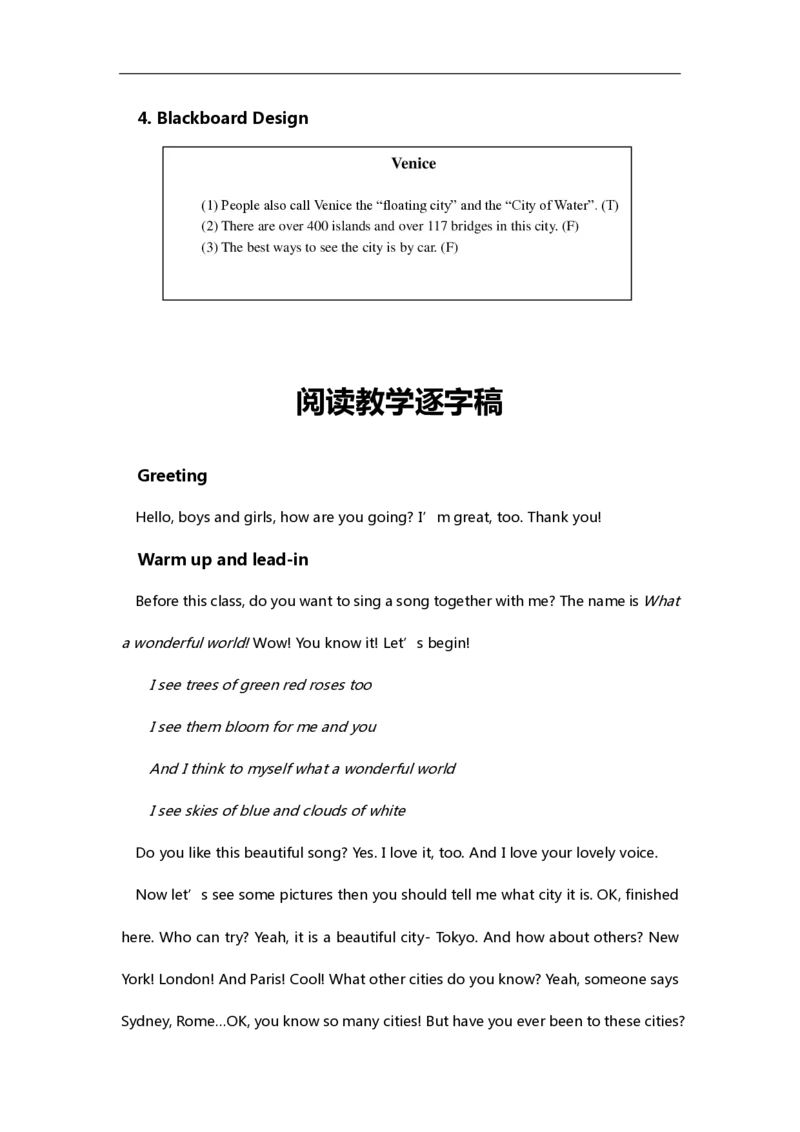
Venice
(1)People also call Venice the “floating city” and the “City of Water”. (T)
(2)There are over 400 islands and over 117 bridges in this city. (F)
(3)The best ways to see the city is by car. (F)
阅读教学逐字稿
Greeting
Hello, boys and girls, how are you going? I’m great, too. Thank you!
Warm up and lead-in
Before this class, do you want to sing a song together with me? The name is What
a wonderful world! Wow! You know it! Let’s begin!
I see trees of green red roses too
I see them bloom for me and you
And I think to myself what a wonderful world
I see skies of blue and clouds of white
Do you like this beautiful song? Yes. I love it, too. And I love your lovely voice.
Now let’s see some pictures then you should tell me what city it is. OK, finished
here. Who can try? Yeah, it is a beautiful city- Tokyo. And how about others? New
York! London! And Paris! Cool! What other cities do you know? Yeah, someone says
Sydney, Rome…OK, you know so many cities! But have you ever been to these cities?No? It doesn’t matter. Today we will go to a foreign city together to find out its
beauty.
Pre-reading
Before our reading, let’s watch a video, and after watching it, you should tell me
what you see. OK, finish here. So what is it about? Yeah, Peter says that he can see
many boats on the water. And the buildings are also built on the water, too. Is it
interesting? Yeah. So can you guess which city is it? And according to this video, can
you guess what the passage is about. Have a prediction! OK, someone says maybe
it is about an introduction of a city - Venice, and others say it is about the future city!
OK, so which city is it? And whose prediction is right? Now, open your book and
begin today’s reading, after that, you will find your answer.
While-reading
Now, I will give you 5 mins to read the passage as fast as possible and tell me
what the main idea is. OK, time is up. Any volunteer? Yes, it’s about the brief
introduction of Venice. It talks about the reasons of its names and the vehicle there.
So, is your prediction right? Yeah, some of you make a right prediction!
Congratulations!
OK, this time you need to read it again and find out more detailed information
about it. Then you should finish the following T/F exercises. I will give you ten
minutes this time.
(1) People also call Venice the “floating city” and the “City of Water”.
(2) There are over 400 islands and over 117 bridges in this city.(3) The best ways to see the city is by car.
Finished? Let’s check the answer together. Who wants to have a try? The first
one-People also call Venice the “floating city” and the “City of Water”, is it true?
Yes, it is true! Where can you find the answer? It’s in the second sentences, right?
Yeah, you all read it very carefully. OK, the next one-There are over 400 islands and
over 117 bridges in this city, is it true? Oh, no, it’s false! Why? Because their
numbers are reversed. It should be-There are over 117 islands and over 400 bridges
in this city. Yeah, you all did a good job. OK, now it comes to the last one-The best
ways to see the city is by car. Yeah, I hear that someone say it’s obviously wrong.
Why? Because we all know it’s the “floating city” and the “City of Water”. So
how can we go out by car? Yes, the right way should be boat. Where can we find the
answer? Right! In the last sentence. OK, guys, you all read it very carefully and
master all the details of this passage. I am very proud of you!
OK, the last time, I hope you all read this passage loudly together following the
me. Ready? Go!
Venice is famous throughout the world. People also call it the “floating city”
and the “City of Water” because there are over 117 islands and over 400 bridges
in this city. One of the best ways to see the city is by gondola–the traditional boat.
Wow, I like your pronunciation. Good job!
Post-reading
Now we have known the beauty of Venice, so can you tell me: do you want to go
there? And why? I will give you ten minutes. Then you should discuss in group offour. After that, I will invite some of you to share your opinions. Ready? Begin! OK,
finish here. Any groups want to have a try? OK, I see that. Group 1 please. Yes, you
say you want to go there one day. Because you think going out by boat is really
cool. OK, I hope one day you will have the chance to experience there. Other
groups please? OK, group 2, come here! Yes, group 2 also says that you want go
there, too. Because you think it’s a historical city, and now it’s full of water, so
maybe one day this city will disappear. So you want to have a look before its
disappearance. OK, good idea. I think it’s possible for you to visit there before its
disappearance. Or maybe one day, people will do something to save this city, and
there won’t be so much water. Cool, guys you all did a good job about this topic.
And I hope everyone can go to the city you like best one day. But before that, you
need to study hard to achieve your dream, right?
Summary and homework
How time flies, it’s time to summarize what we have got today. Please look at
our blackboard. Today, we learned a passage about Venice and we know much
detailed information about it.
So today’s homework is that you should find the information about your
favorite city, and introduce it to your friends. Next class we will share it together. OK?
class is over, see you!例 2 词汇教学试讲题本
1.题目:词汇教学试讲
2.内容:
My name is Linda. I live in Yushancun. It's a quiet community. There are many
old people living here. Many families with young children live here, too. There are a
lot of tall buildings and small gardens in our community. My home is in an
apartment building. There are many shops and restaurants close to my home.
There is a supermarket near Xinhua Bookstore. The parking lot and the train station
are not far from here. And there is a community service center in our area. We can
call it for help.
3.基本要求:
(1)朗读所给语篇;
(2)配合教学内容适当板书;
(3)对划线部分单词进行讲解;
(4)用英文试讲;
(5)试讲时间:10分钟。My Community 简案
1. Aims
Master the new words and useful expression patterns to describe the community;
(key point)
Improve students’ reading and speaking skills; (difficult point)
Keep interest in learning English and learn to corporate with others.
2. Methods
TBLT, communicative methods and situational teaching methods.
3. Teaching Procedures
Step 1 Warm-up & Lead-in
Song: Seasons in the Sun
Q: Which community do you live in? →(写)
Step 2 Presentation
Look at the pictures and learn the new words→(写); learn the main idea of the
passage through teacher’s reading→(写).
Step 3 Practice
Role play of Linda and the little reporter.
Step 4 Production
Discussion: what is my community like?
Step 5 Summary and homework
New words and how to describe the community4. Blackboard Design
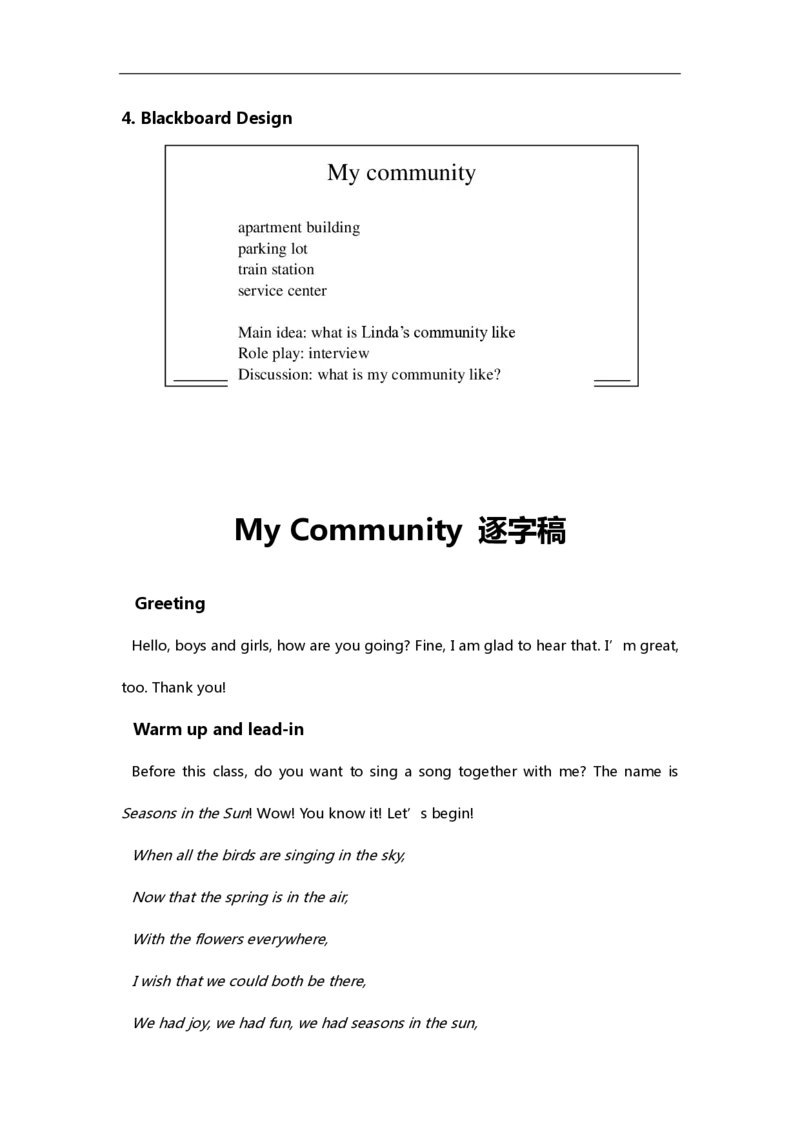
My community
apartment building
parking lot
train station
service center
Main idea: what is Linda’s community like
Role play: interview
Discussion: what is my community like?
My Community 逐字稿
Greeting
Hello, boys and girls, how are you going? Fine, I am glad to hear that. I’m great,
too. Thank you!
Warm up and lead-in
Before this class, do you want to sing a song together with me? The name is
Seasons in the Sun! Wow! You know it! Let’s begin!
When all the birds are singing in the sky,
Now that the spring is in the air,
With the flowers everywhere,
I wish that we could both be there,
We had joy, we had fun, we had seasons in the sun,But the hills that we climbed were just seasons out of time.
Do you like this beautiful song? Yes. I love it, too. And I love your lovely voice.
Before learning, I have a question for you. Which community do you live in? Okay,
Jason, please. Very good, Sit down please. Jason said that, he lives in Zhongshan
community with his parents, and it’s a beautiful place for living. Anyone else?
Alice, please. Oh, I know it, and it is near our school, right. Sit down, please. Alice
said that, she lives in Jianming community and it takes only five minutes’ walk to
school from here.
Then, how about our friend Linda. Which community does she live in? Today we
will learn our new class named “My community”. Open your book and turn to
page 38. Let’s learn it together.
Presentation
Now, please look at our screen, there are some pictures. Let’s learn some new
words. Look at the first picture, this is a building called apartment building, and
there are many families live in it, right. Please read after me, apartment building (↑),
apartment building (↓) Look at the second picture, this is called parking lot, and we
can park the car here, right? Please read after me, parking lot (↑), parking lot (↓)
Look at the third picture, this is called train station, and we take the train here, just
like we take the bus at the bus stop. Please read after me, train station (↑), train
station (↓). Look at the last picture, this is called service center, and if we need any
help in our community we can come here. Please read after me, service center (↑),
service center (↓).Let’s strike when the iron is hot. Please make sentences with the new words
with your desk mates for 3 minutes, and I will ask one of you to show your
sentences. Let’s start now. Time is up. Who can have a try? Okay, Patrick. Excellent,
sit down please. Patrick’s sentence is: I live in an apartment building with my
grandparents. Who else? Lucy, please. Good girl, sit down please. Lucy’s sentence
is: We take the train to Beijing at the train station.
Okay, since we have learned the new words in the passage, I believe you guys
can understand the meaning of it. I will read the passage for you. And you should
find the main idea of the passage.
My name is Linda. I live in Yushancun…My home is in an apartment building.
There are many shops and restaurants close to my home. There is a supermarket
near Xinhua Bookstore. The parking lot and the train station are not far from here.
And there is a community service center in our area. We can call it for help.
Okay, who can tell me the main idea of the passage? You are so active. Lily,
please. Great, sit down please. Lily said, the main idea is what is Linda’s
community like, Right?
Practice
Now, Let’s do a role play in your English group. One for Linda and one for a
little reporter. The reporter should make an interview of what is Linda’s
community like, and You have 5 minutes for your interview. Let’s start now. Okay,
stop here. Which group want to have a try? Okay, you two, please. That’s great, go
back to your seats.Production
Time for discussion! Make a discussion in group of four for 10 minutes. The topic
is what is my community like. And I will invite one group to show their answer in
front of the class. Let’s begin. Time is up. Any volunteers? Okay, Group 1. Excellent,
very clear expression. go back to your seats.
Summary and homework
How time flies, it’s time to summarize what we have got today. Please look at
our blackboard. Today, we learned some new words and how to describe our
community. So, today’s homework is that you should describe your community to
your parents using the new words that we have learned today. Okay, class is over,
see you!例 3 语法课题本
1.题目:语法教学试讲
2.内容:
Not only you but I am also looking for her.
When she was found, she either angry or cry.
3.基本要求:
(1)朗读所给内容;
(2)配合教学内容适当板书;
(3)针对划线部分所给的内容,设计相应的语法操练的教学活动;
(4)用英文试讲;
(5)试讲时间:10分钟。
语法教学简案
1. Aims
Master the rules of “not only … but also” and “either … or”. (key points)
Cultivate their integrated language skills. (difficult points)
Arouse their interest in learning English.
2. Methods:
TBLT, situational teaching method, communicative approaches
3. Teaching ProceduresStep 1 Lead-in
Warm up: sing a song
Picture Q: Please guess what game they are playing.
Groups: Yellow vs Blue
Step 2 Presentation
Show the sentences.
Teach the meaning of “not only … but also” and “either… or”
Teach the usage. Rule: Proximity
Step 3 Practice
Make sentences
Fill in the blanks
Step 4 Production
Discussion. What’s game do you know? Which one do you like best?
Step 5 Summary & Homework
Summary: Students will make a conclusion about the class together.
Homework: (1) Finish the exercise book. (2) Search for more structures with
Proximity on the Internet.
4. Blackboard Design语法教学逐字稿
Greeting
Hello, boys and girls, how are you going? I’m great, too. Thank you!
Warm up and lead-in
Before this class, do you want to sing a song together with me? The name is Auld
Lang Syne! Wow! You know it! Let’s begin!
Should auld acquaintance be forgot
And never brought to mind
Should auld acquaintance be forgot
And auld lang syne
For auld lang syne my dear
For auld lang syne
We'll take a cup o' kindness yet
For auld lang syne
Do you like this beautiful song? Yes. I love it, too. And I love your lovely voice.Before the class. I’d like to show you a picture. Please look at the screen. Then I
have some questions for you. Listen carefully: Can you guess what game they are
playing? Tina, please. Great! They are playing hide and seek. Can you describe this
picture for us? Yes. Tina said Lucy hides behind the tree. And Jim finds her. Any
volunteers? Lilian! Excellent! Linda finds her, too. You have sharp eyes. Do you know
how to describe this picture in one sentence? I see most of you say no. Today we
will learn a new grammar about it: Proximity.
First of all. You will be divided into two groups. Including group Yellow and group
Bile. Then you will have a group competition. Let’s see who can answer my
questions correctly and quickly.
Presentation
Now, please look at the blackboard, let’s read it together. Then you need to work
in pairs to guess what’s the meaning of these two structures. Give you 5 mins.
Let’s go. I see most of you stop discussing. Any one wants to share your answers?
Jack, please. Wonderful. “Not only … but also…” has the same meaning with
“Both … and…”. You have a good understanding of this structure. For example:
Not only Lucy but I am swimming. We also can say “Both Lucy and I are swimming.”
Do you understand? Great!
Another one. Who wants to try? John. You think it also has the same meaning with
“both … and...”. Do you agree with him? This structure seems a little bit harder. Let
me tell you. For example: There are two skirts. I either bought blue one or red one.
This sentence means I only can take one of them back. Are you clear? Nice.Although these two structures have different meanings. But both of them have
the same usage: Proximity. That means the verb of the sentence should change its
form according to the nearest subject. For example: as the first sentence, we also
can say “Not only I but you are also looking for her.” Am I clear? Great!
Practice
Then let’s have some practice. Since we have learned two new structure. Let’s
use them to make some sentences. We can play a game called “boom game”.
There is a ball in my hand. Then I will sing a song for you. When I say stop, the one
who gets the ball need to use one of these two structures to make a sentence. Are
you clear? Let’s start. Should auld acquaintance be forgot. And never brought to
mind. Stop. Who gets the ball? Rose. Cool. She said “Not only you but also I am
right.” You got one point. Once more. Should auld acquaintance be forgot. And
auld lang syne. Who is the lucky guy? Rebecca. She said “Either he or I is playing
football.” Do you agree with her? No? Who can help her? Judy. It should be
“Either he or I am playing football.” Brilliant! You master it. Rebecca don’t lose
your heart. I believe you will do better next time.
Practice makes perfect. Let’s do more exercises. Please fill in some blanks. Look
at the screen. There are so many banks. You should finish them as quickly as you
can. Let’s see who can do it faster. Time’s up. The first blank. Any volunteers? Jim.
Right. It should fill in “either ... or”. Give you one point. Next one? You please.
Bravo. We should fill in “am”. Because it is the structure of “not only… but also”
and the nearest subject is “I”. One point for you, too. I believe all of you masterthese two structures.
Production
OK, now, we have done so many exercises. Then it’s time to have fun. Let’s
have a discussion. You should think about the topic as following: What games do
you know? Which one do you like best? You can think of it for a while. Then please
discuss it using the structures that we learned today with your partners. Let’s
begin. Stop here. Which team wants to try? Group Yellow, please. You know so
many games. And you have a logical thinking. I am so proud of you. Two points for
you.
Summary and homework
How time flies, it’s time to summarize what we have got today. Please look at
our blackboard. Today, we learned two structures and learned how to use them. So,
today’s homework is that you should finish the exercise book and search more
structures with Proximity on the Internet. So much for today. Goodbye, everyone.例 4 语音课题本
1.题目:语音教学
2.内容:
A:You are the new, aren't you?
B:Yes, you are Tony, aren’t you?
A:It is really crowed here, isn’t it?
B:Yes, it is.
3.基本要求:
(1)朗读所给内容;
(2)请进行板书;
(3)讲解aren’t you和 isn’t it 的音调;
(4)教学时间10分钟,英文试讲。
语音课简案
1. Aims
Master the rules of rising and falling tones. (key point)
Improve their integrated skills. (difficult points)
Be more confident to express themselves.
2. Methods:
TBLT, situational teaching method, communicative approaches3. Teaching Procedures
Step 1 Lead-in
Tongue twister to warm up
Show a video about the first day of school. Q: What are they doing?
Step 2 Presentation
1. Listening: Q: What’s the main idea of the conversation?
2. Show the key sentences
3. Discuss the rules in groups Q: Can you find out the similarities?
4. Conclude the rules of intonation.
There are two parts in a tag question. The first part is often in a falling tone and
for second part, there are two cases. If we are not sure about the question, we often
use a rising tone. If we are sure about that, we often use a falling tone.
Step 3 Practice
Pair work: Practice the conversation with your partner.
Read a new intonation.
Step 4 Production
Dubbing. (Watch a movie and dub it.)
Step 5 Summary & Homework
Summary: Students will make a conclusion about the class together.
Homework:
(1) Finish the exercise book.
(2) Search for more information about other rules of intonation on the Internet.4. Blackboard Design
语音教学逐字稿
Greeting
Hello guys! How’s it going? It’s always a pleasure to see you.
Warm up and lead-in
Before we learn something new, let’s say a tongue twister together? Ready? Go!
Can you can a can as a canner can can a can? Wow, some of you can say it very well.
Let's speed up! Can you can a can as a canner can can a can? Can you follow me? All
of you did a very good job! You can practice it after class.
At the beginning of the class, I’d like show you a video, Take a look! I have some
questions for you, listen carefully. What can you see in the video? Yes, there are
many students in the school. What else? Jack, please. Yes, in this video, it’s about
the first day of school. What are they doing? Cindy, please. Excellent! They aregreeting each other. Today we are going to learn a new lesson about greeting. The
title is Intonation.
Presentation
Now, please open your book. You can see a short conversation. I will play the
tape for you. Listen carefully and think about this question: What’s the main idea
of the conversation? Now, let’s begin. OK, stop here. Who wants to share your
answer with us? Jordan, you please. Yes, A and B are greeting each other. Well done!
Thank you, sit down please. Agree? Nice, you all get the correct answer. I'm so
proud of you.
All right guys, it’s time to learn something new. Here are some sentences from the
conversation. Take a look! Please read them by yourselves first. Try your best to find
out the rule of reading. OK, now I’ll read it for you. Please pay attention to my
reading and find out the similarities, OK? Here we go. A:You are the new, aren't you?
Yes, you are Tony, aren’t you? It is really crowed here, isn’t it? Yes, it is. Time’s up.
Who’d like to try? Mary, please. Yes, the first two sentences use a falling-rising
tone. And the last sentence uses a falling tone. Great, why is that? Don’t know?
Don’t worry! Let me explain for you. From the comparison, we can find the
intonation rule: rising and falling tones. In order to make our reading easy to
understand, we should pay attention to the tones. There are two parts in a tag
question. The first part is often in a falling tone and for the second part, there are
two cases. If we are not sure about the question, we often use a rising tone. If we
are sure about that, we often use a falling tone. Look at these sentences. We shouldread them as: You are the new, aren’t you? Yes, you are Tony, aren’t you? It is
really crowed here, isn’t it? Do you understand? Good job!
Practice
Practice makes perfect, so let's do some exercises. Open your book and read all
the sentences after the tape. Try to imitate the native speakers. Please pay attention
to the intonation. Here we go. Excellent. Do you have any questions? All right, I
think you have mastered it.
Now I have some new sentences for you. Please look at the screen. Can you read
these sentences for us? You can use the knowledge we have learned just now. Who
wants to have a try? Jack, please. Yes, great. I love your voice!
Production
OK, guys! This time, let's play a dubbing game. We will watch a movie clip twice.
For the first time, you can watch it and listen to it carefully. But for the second time,
it will be silent. I'll give you the script, you need to read it emotionally. Work with
your partner, choose your own character, and then we will have a dubbing
competition. Pay attention to the intonation. OK, let's watch it together! OK, time is
up. Any volunteers? Very good, you two, please. Wow, you gave a wonderful
performance.
Summary and homework
How time flies, it’s time to summarize what we have got today. Please look at
our blackboard. Today, we’ve learned the rules of the intonation and how to use
them. Learning English is not just inside the class, it’s for life, for fun.OK, boys and girls, class is almost over. And there is one last thing. What is it? Right,
our homework! After you go home, please finish the exercise book. And then
search for more information about other rules of intonation on the internet. We will
share it in the next class. So much for today, goodbye everyone!