小学英语简案+逐字稿
语音课 Let’s chant 简案 ........................................................................................... 2
语音课 Let’s chant 逐字稿 ........................................................................................ 4
听说课I can…/ I can't简案 .......................................................................................... 9
听说课I can…/ I can't 逐字稿................................................................................... 10
词汇课 Where is Lucky? 简案 .................................................................................. 16
Where is Lucky?逐字稿 ............................................................................................ 17
语法课Grammar教案 ................................................................................................. 21
语法课Grammar逐字稿 ............................................................................................ 23例 1 语音课
1.题目:Let’s chant
2.内容:
A cat and a rat,
A cap and a hat,
The cat likes the hat,
The rat likes the cap.
3.基本要求:
(1)示范朗读材料;
(2)利用肢体语言或简笔画进行教学设计;
(3)利用多种游戏教学设计教学活动;
(4)引导学生积极参与课堂。
语音课 Let’s chant 简案
1. Teaching Aims:
(1) Master the pronunciation rules of letter “a”. (key points)
(2) Read and hear these words correctly in their further communication. (difficult
points)
(3) Foster their awareness of cooperation.
2. Teaching MethodsSituational teaching method, communicative teaching method, task-based
teaching method, group work method, cooperation study method, independent
study method
3. Teaching procedures
Step 1: Warm-up and Lead-in
(1) Song: Apple song→Feeling?
(2)Shows a video of “Tom and Jerry”. Q: What can you see in the video?→a
rat and a cat→the chant
(3) Divide into 2 groups → banana and strawberry→ competition→winner
Step 2: Presentation
(1) Read the chant for students and conclude the main idea.
(2) Show the words: rat [ræt] cat [kæt] hat [hæt] cap[kæp]
(3) Discuss to find the pronunciation rules of the letter “a”.
(4) Conclude the rules.
Step 3: Practice
(1)Word game→ Read my mouth→ rules →demonstration→play
(2) Read the new chant in groups (Pam had a map)→read the chant in
rhythm→Show
Step 4: Production
Dubbing game→ Show→ compare
Step 5: Summary and homework
Summary: Make a summaryHomework: Ask parents about what their favorite animals.
4. Blackboard design
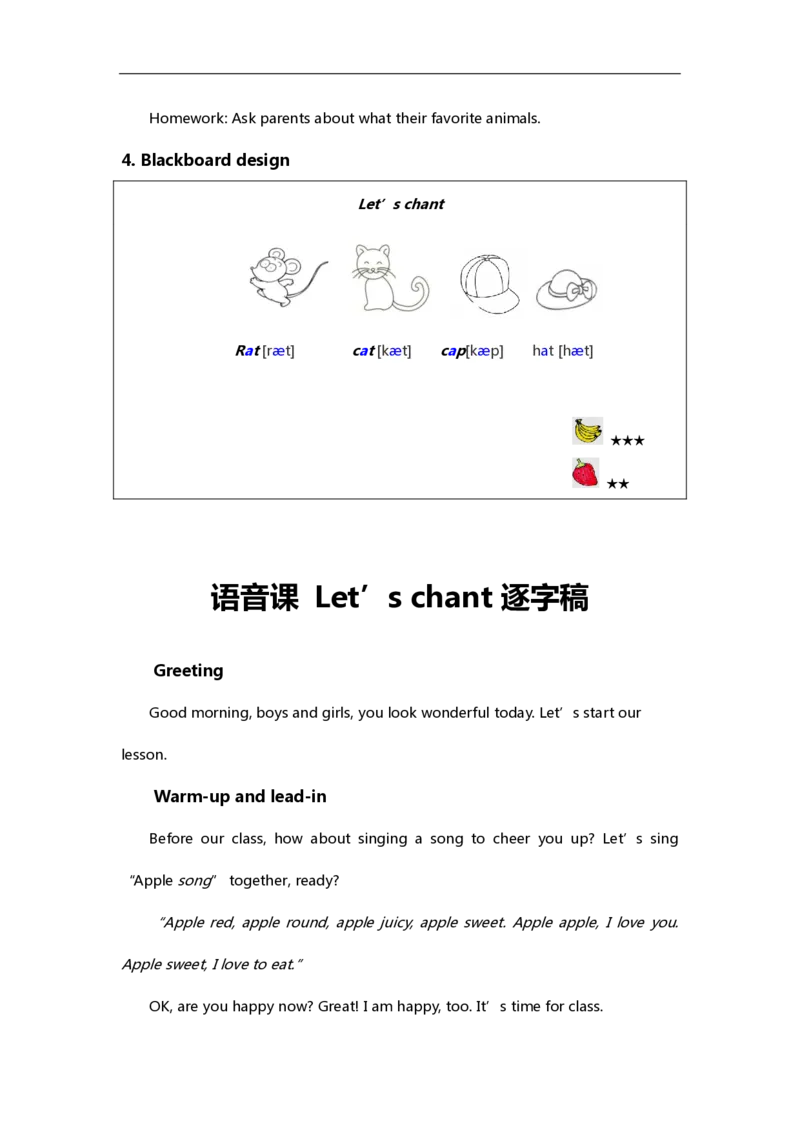
Let’s chant
Rat [ræt] cat [kæt] cap[kæp] hat [hæt]
★★★
★★
语音课 Let’s chant 逐字稿
Greeting
Good morning, boys and girls, you look wonderful today. Let’s start our
lesson.
Warm-up and lead-in
Before our class, how about singing a song to cheer you up? Let’s sing
“Apple song” together, ready?
“Apple red, apple round, apple juicy, apple sweet. Apple apple, I love you.
Apple sweet, I love to eat.”
OK, are you happy now? Great! I am happy, too. It’s time for class.Presentation
At the beginning of the class, please look at the screen. I have a video for you,
look carefully and think: What can you see in the pictures? Yes, you can see a cat
and a rat. What’s his name? Great, Tom and Jerry. Do you like it? Wow! I like it too.
Did you hear the chant about it? Oh, you look so active. Today, we are going to
learn a new lesson about it. The title is “let’s chant”.
First of all, you are divided into 2 groups: group banana and group strawberry.
You’ll have a group competition. Let’s see which group performs better and be
the winner at the end of this class.
Guys, now we have a short chant. I will read the chant for you.
A cat and a rat,
A cap and a hat,
The cat likes the hat,
The rat likes the cap.
Please listen carefully and think about this question: What’s the passage
mainly about? Please listen carefully and try to give me the answer. Let’s begin. OK
time’s up. Please share your ideas. Jordan, you please. Thank you, sit down please.
It’s about a story about rat and cat. Good job! You all get the correct answer.
All right guys, it’s time to learn something new. Listen to the tape again and
pay attention to the underlined words, cat, rat, hat, cap. Let’s begin! Time’s up.
Can you find any similarities of these words? Jack, you please. All of the words have
the letter a. How do you pronounce it? OK, discuss it in your groups and tell me theanswer. Go ahead. Stop here. Jason, you please. Yes, letter “a” pronounces /æ/,
good job. Exactly, we often read it /æ/ in a stressed closed syllable, such as apple,
ant, bag and so on. look at my mouth, /æ/ /æ/ /æ/. Let’s read the words together.
Now, listen to the tape again, and read the chant sentence by sentence to get
more familiar with the passage. Wow, you all did a very good job. You all get one
point.
Practice
OK, practice makes perfect. Let’s play a game called “read my mouth”. We
will do it like this—I am going to read a word, but I’ll be silent. You can only see
my mouth and guess what word I am saying, understand? Are you ready? Let’s try
it! Look carefully: cat. Good! Group Moon, you all have sharp eyes. This one, hat,
Great! I think you have mastered it very well.
Now, let’s practice the chant. Please work in pairs and read the chant in
rhythm with your desk mates. Please pay attention to your pronunciation and
intonation. Who can be the volunteer to show us your performance? Yes, Lisa and
Lucy, you two please. Wonderful! I’m so proud of you. One point for your group.
OK, class, it’s time for fun! I have a new chant for you. Let’s play a “hot
potato” game Look, I have a ball in my hand, it’s too “hot”, and you need to
pass it one by one. I’ll play some music and when I “stop”, the one with that ball
should stand up and read the new chant for us, understand? Now let’s have a try.
My dad is fat.
He has a little rat.When the rat sees a cat,
It makes him mad.
OK, “stop!”. Kobe, you are lucky, please read the chant for us. Very good.
Let’s try again...OK, “stop!” Helen, please. Wonderful! I think you have mastered
it.
Production
And then, I have another challenging task named dubbing game. We will watch
a video about "Frozen". For the first time, listen to it carefully, and the second time
it will be silent. You need to choose your own character, and try to make the scene
as interesting as you can, all right? Are you ready? Let’s go! Sarah, you please. I see
your hands is rising very high. Excellent, you all give wonderful performance, I am
very proud of your progress and smart ideas. I will give your group one point.
Summary and homework
How time flies! Who can tell me what we have learned today? OK, I heard most
of you say we have learned the sound of letter “a”. Great! And I also heard that
we have learned how to talk about cute animals. Which group is winner? Yes, group
banana is the winner. Congratulations! Group strawberry, don’t lose your heart.
You will be better next time.
OK, boys and girls, I hope you can learn English in and out of the class, so here
is the homework. The first one is to finish the exercise book first and the second
one is to find more words with letter “a” on the book. We will share them in the
next class. So much for today, goodbye everyone!例 2 听说课
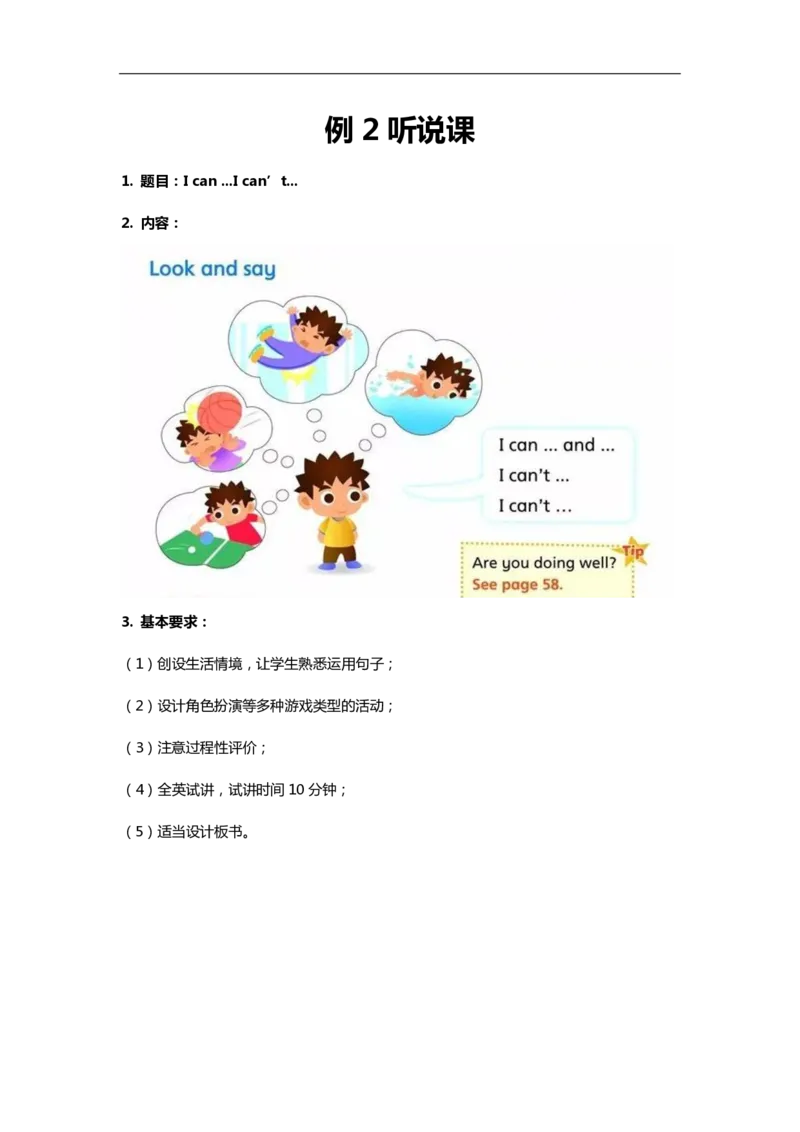
1. 题目:I can ...I can’t...
2. 内容:
3. 基本要求:
(1)创设生活情境,让学生熟悉运用句子;
(2)设计角色扮演等多种游戏类型的活动;
(3)注意过程性评价;
(4)全英试讲,试讲时间10分钟;
(5)适当设计板书。听说课 I can…/ I can't 简案
1. Teaching aims
(1) Master the main idea and some detailed information of the listening material.
(key point)
(2) Improve the listening and speaking skills and cultivate learning strategies.
(difficult point)
(3) Raise the interest in learning English and build confidence.
2. Teaching methods
Situational method, TBLT, communicative approach.
3. Teaching procedure
Step1. Warm-up and lead-in
(1) After greeting, sing <You are my sunshine> together.
(2) Show a video of the Olympic Games.
Step2. Pre-listening
(1) Review the words by showing pictures.
(2) Predict the passage.
Step3. While listening
(1) 1st listening: main idea.
(2) 2nd listening: fill in the blanks and introduce the sentence structure.
(3) Read after the tape.
Step4. Post listening(1) Show some pictures and practice the sentences.
(2) Role play. Suppose you are going to attend a sports meeting at your school.
Make up a conversation with your partner about what you can and can't do.
Step5. Summary & Homework
Finish the exercise book and ask parents about their abilities.
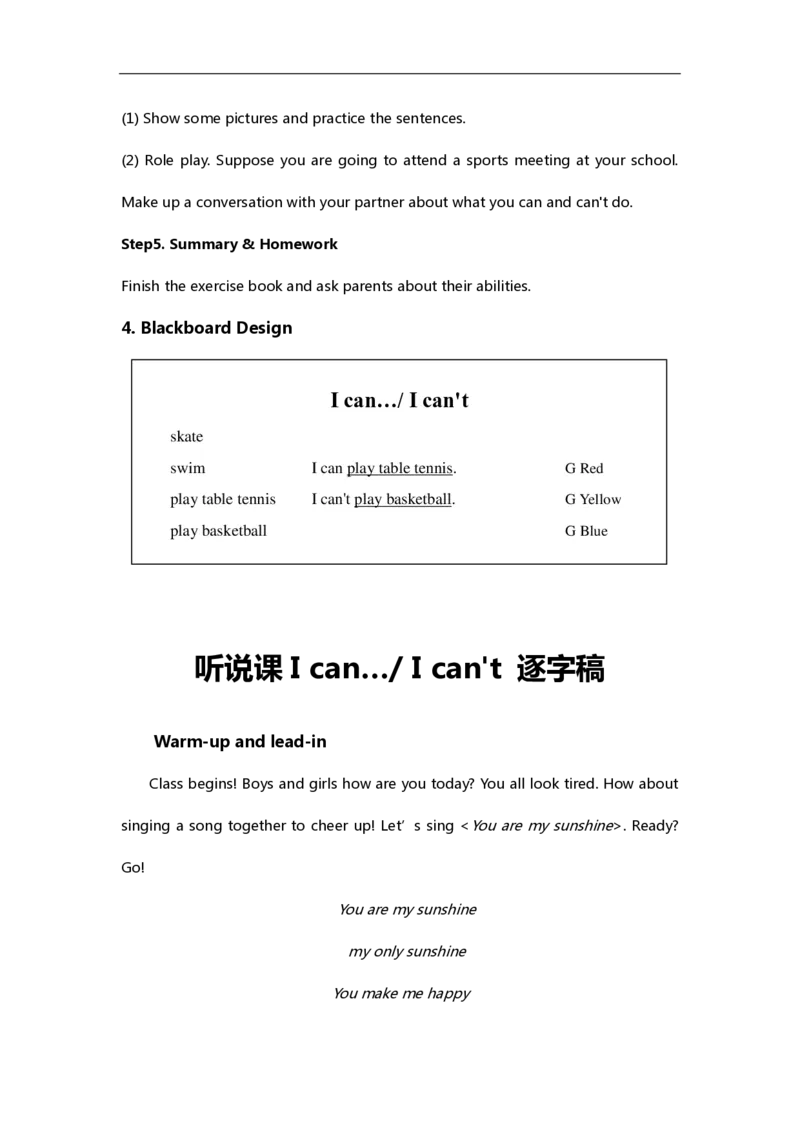
4. Blackboard Design
I can…/ I can't
skate
swim I can play table tennis. G Red
play table tennis I can't play basketball. G Yellow
play basketball G Blue
听说课 I can…/ I can't 逐字稿
Warm-up and lead-in
Class begins! Boys and girls how are you today? You all look tired. How about
singing a song together to cheer up! Let’s sing <You are my sunshine>. Ready?
Go!
You are my sunshine
my only sunshine
You make me happyWhen skies are grey
I love your voice! Good job! Feeling better now? Let’s begin our class.
At the beginning of the class, I'd like to show you a video. Please look at the
screen. I have a question for you. Listen carefully: What can you see in the video?
Lily, please. It's the Olympic Games. There are many players doing sports, right?
Excellent! Sit down, please. I have another question. What sports can you do? Oh,
football, basketball. That's really good. You know a lot about sports. But you don't
know how to answer that in a complete sentence, right? Today we are going to
learn about that. It's our new lesson. I can…/ I can't.
Before we learn something new, I’ll divide you into 3 groups as usual, you are
group red, you are group yellow, you are group blue. Each time you get a correct
answer, I’ll give you 1 point. Let’s have a group competition and see which group
gets more points at the end of our class. Are you excited? Me too!
Pre-listening
First, let's review the words and phrases we've learned last time. Please look at
the first picture on the screen. What's this? Anyone? Tina, you are the bravest. Skate.
Correct. Next one, Jack, can you try it? Oh, swim. Very good, sit down, please. Let's
move on. This one, do you know? Tony. Right! Play table tennis. And the last one,
let's say it together. Play basketball. Good job, everyone! I'm so proud of you. I'll
give each of you 1 point.
Now, open up your book. Here are some pictures. Can you predict what the
passage will talk about according to these pictures? 2 minutes. You can discuss itwith your desk mate. Alan, do you know the answer? Oh, maybe it's about the boy's
hobby. That's reasonable. Any other ideas? Jerry? You think it's about the boy's
dream. Good thinking. You two also got 1 point for your team. Who's right? Let's
listen to the tape and find the answer together.
While-listening
Boys and girls. For the first time of listening, try to find out the main idea of it.
Clear? Let's get started. Ok, the tape is over. Who can answer my question? Linda,
have a try. The passage tells us what sports can and can't the boy do. Everyone, do
you agree with her? Yes, well done, Linda. I'll give you one point.
Now, let's listen to the passage again. This time, you need to find out some
details of it and fill in these blanks on the blackboard. Got it? Here we go. Have you
finished? Let's check the answer. Judy, can you share your answer with us? The first
one. I can play table tennis. And the second one. I can't play basketball. Do you
have any different opinions? No? So, all of you got the right answer. Nicely done,
Judy. You got one point. Everyone, please look at the blackboard. This is the
sentence structure. We can use these sentences to talk about what sports we can
and can't play. I’ll give you an example. I can play badminton. I can't swim. Do you
understand?
After reading the story, let's practice speaking now. Please listen to the tape
and read after it. Please read it loudly together. Go! Ding dong, that's all for reading.
I like your beautiful voice! You have clear pronunciation, and correct intonation.
Fantastic!Post-reading
Since you all have mastered this passage. Let's do some challenging tasks
together. Boys and girls, please look at the screen. I brought you some pictures of
our friend Peppa Pig. Now, can you tell me what she can and can't using the
sentences we learn today? I'll give you 5 minutes to practice. Now you can start.
Time's up! Who'd like to answer? Oh, Tom, you raise your hand so high. She can
swim. Wonderful! Lucy, you also want to answer. Come on. Em, she can't play
football. You're such a good observer. You all got 1 point for your teams.
OK, guys, let's do another task. It's your favorite game, role play. Listen to me
carefully. Suppose you are going to attend a sports meeting at your school. Make
up a conversation with your partner about what you can and can't do. You can
practice it within your group. Later, I'll invite some of you to give a performance.
Are you clear? 10 minutes for you, go! OK, it’s your showtime! Timmy and your
partner, please! Come here. Excellent! Other groups, do you want to challenge
them? Group Blue. Well done. All of you did a very good job! I’ll give all of you 1
point!
Summary and homework
How time flies! Class is almost over. Let’s review what we learned today. Who
wants to summarize it for us? Tom please. Yes, we learned a sentence pattern about
capability. You have a good memory. Sit down, please. Let’s look at the blackboard.
It seems that Group Yellow is the winner. Congratulations! You will get a little gift
after class. Other groups, don’t be upset. I believe you will do better next time!Just practice more after class, OK?
Boys and girls. Now it’s our homework time! When you go home, please
finish the exercise book first and ask your parents about their abilities using these
sentences. Are you clear?
So much for today, goodbye everyone! See you next time!例 3 词汇课
1.题目:Where is Lucky?
2.内容:
3.基本要求:
(1)根据内容设置课堂活动;
(2)主要讲介词的用法;
(3)用英文试讲;
(4)试讲时间:10分钟。词汇课 Where is Lucky? 简案
1. Teaching Aims
Master the new expressions: behind and next to. (key point)
Use the expressions in real life fluently. (difficult point)
Keep interest in learning English.
2. Teaching Methods
TBLT, Question & Answer teaching method and communicative teaching method
3.Teaching procedures
Step 1 Warming-up& Leading-in
Lead the students to sing the song of “Five Little Ducks” together.
Step 2 Presentation
(1) Teach new words “behind, next to”.
(2) Teach the sentences “-Where is Lucky? -She is behind/next to ...”
Step 3 Practice
Activity 1: Fruit down - to practice the new words.
Activity 2: Little detective - to practice the dialogue.
Step 4 Production
Do a survey: Where is your best friend?
Step 5 Summary & Homework
Finish the exercise in the textbook. Be a little teacher to teach your parents,
4. Blackboard designWhere is Lucky?
behind next to
—— Where is Lucky?
—— She is behind/next to...
Where is Lucky?逐字稿
Greeting
Good morning, boys and girls, how are you today? I’m fine too. Thank you!
Warm up and lead-in
At the beginning of the class, let’s sing a song together. The name is Five Little
Ducks! Wow! You know it! Let’s begin!
Five little ducks
Went out one day
Over the hills and far away
Mother duck said
"Quack, quack, quack, quack."
But only four little ducks came back.Wow, I like your voice. Good performance. Boys and girls, look here. What is this?
Yes, it is Peppa pig. Let’s say hello to her. Hello! Peppa pig. Now, let’s enjoy a
short clip about it. OK, boys and girls, what can you see in the video? Good answer.
Peppa pig and her friends are playing “hide and seek”. Guys, today we will learn a
new class: Where is Lucky? (板书标题)
Presentation
OK, boys and girls! Firstly, I will draw some pictures for you. Please look
carefully. What can you see in this picture? Mary, please. Yes, a beautiful girl. Can
you tell me where she is? Yes, she is behind the pencil box. (板书behind) Please
read after me. Behind, Behind. Good job. When I stand here, please say this word
loudly. And when I stand here, please say the word in a low voice. (操作两轮) Guys,
look at the other picture. Where is the beautiful girl?Yes, she is next to the pencil
box. (板书next to) Read after me. Girls first. Boys, please. Bravo!
Now, boys and girls, I will play a short video for you. And please answer my
question. Where is the mouse? Let’s start. OK. Who wants to answer my question?
Mike, you are so active. Yes, it is behind the door. When we want to know
something about position, we can say: It is behind/next to....... Clear? Great!
Practice
OK, let’s strike when the iron is hot. Let’s play a game called “Fruit down”.
We will do it like this: Four students stand in the front of the class. Everyone holds a
card with the pictures of behind and next to. I will show the word card and the otherstudents say the word out loudly. Meanwhile, the student with the right fruit need
squat down. Understand? Let’s try it! Wonderful!
Boys and girls, let’s practice the sentence. Let’s play Little Detective. One
student is asked to stand on the platform and close his eyes, playing the role of
little detective. Then I will choose one student from the others as the spy and say
the sentences like “-Where is Lucky? -She is behind/next to...” As the detective
open his eyes, the others should repeat my words, but the spy must make a mouth
shape instead of making a sound. If the detective finds out the spy, the spy should
sing a song. On the contrary, the detective should give a performance to the class.
Production
Now, let’s do a survey. You need to think about the following questions.
Where is your best friend? You should work in groups of six. Think about the
questions for a
while, and then talk with your group members. I will give you 8 minutes. Remember
to use the new knowledge we have learned and make a short report. I will check
your answers later. Here we go! OK. Who can give us a report? Excellent! You all
have made a wonderful performance.
Summary and homework
Time goes by quickly! Who wants to be a little teacher to make a summary for
us? OK. Lily, please. Lily said we had learned some useful expressions. Great! And
we also have learned how to talk about position. Remember that we should not
only learn English inside the class, but also learn it for life, for fun.OK, boys and girls, class is almost over. And there is an important task. What is
it? Right, our homework! After you get home, please finish the exercise book first
and teach your parents the new expressions. We will share them in the next class.
So much for today. Goodbye, everyone!例 4 语法课
1.题目:Grammar time
2.内容:
What do you/they like doing? I/they like playing basketball/swimming.
What does he/she like doing? He/she likes drawing/reading stories.
3.基本要求:
(1)多种形式进行操练;
(2)注意与学生的互动;
(3)有相应的板书设计;
(4)用英文试讲;
(5)试讲时间:10分钟。
语法课 Grammar 教案
1. Aims
Master the sentences patterns “what do you/they like doing?” “I/they like
doing…” “What does he/she like doing?” “He/she likes doing…”
Keep the interest in learning English
2. Methods
TBL, communicative methods and situational teaching methods
3. Teaching ProceduresStep1: Lead-in
Sing a song related to the lesson “Rabbit dance”
Have a free talk to ask and answer hobbies
Lead-in today’s topic- “ What do you like doing?”
Step 2: presentation
Show some pictures on the screen. Then ask and answer “Who are they?”
“What do/does...like doing”. Write down the sentences on the blackboard.
I like reading stories.
They like playing basketball.
He likes swimming.
She likes drawing.
Students find the similarities and differences. Then, summarize together.
Step 3: Practice
1. Fill in the blanks
2. Make sentences
Step4: Production
Do a survey in groups of 4 in 5 minutes. Then, share the survey in front of the
class. Give some positive evaluations.
Step5: Summary & Homework
Students can master the grammar point- the third person singular.
Ask your parents “What do you like doing?”
4. Blackboard:What do you like doing?
I like reading stories.
like(I/you/they)
They like playing basketball.
He likes swimming.
likes(he/she/it)
She likes drawing.
语法课 Grammar 逐字稿
Greeting
Hello, boys and girls how are you? I’m so glad to hear that all of you are happy.
Warm-up and lead-in
Before this class, let’s sing a song called “Rabbit dance”, okay? If you can sing,
sing along with me! Everybody, stand up! Ready! Go!
Left, left, right, right, go, turn around, go, go, go!
Jumping, grooving, dancing, everybody.
Rolling, moving, singing, night and day.
Let’s fun, fun together.
Let’s play the penguin’s games.
Do you like this song? Yes, I like it, too. All of you did a good job! Sit down, please.
I like singing very much. What do you like doing, boys and girls? Lily, please. You
like dancing. Great! What about you, Jack? You like playing games. Good! From the
things we talked above, we know that different people have different hobbies. So,
today we will learn our new lesson—“What do you like doing?”Presentation
Now, boys and girls, look at screen. Who is she? Yes, it’s me! What am I doing?
I’m reading stories. Because I like reading stories very much! What about next
picture? Who are they? Yes, they are Yao Ming and Kobe. As we all know, they like
playing basketball. Let’s continue to look at the third picture. Do you know him?
Bingo, he is Sun yang. He likes swimming very much. Let’s look at the last picture.
Do you familiar with her? Yes, she is our Art teacher. She is drawing, right? She
likes drawing very much.
From the pictures above, we know that different people have different hobbies.
Boy and girls, observe these sentences carefully. Can you find some similarities
between these two sentences? Yes, there is a “like” in the sentence. What about
next two sentences? Good, there is a “likes” in it. Excellent! So, boys and girls.
When we meet “I, you, they” we should use “like” to describe our favorite
hobby. When we meet “he/she/it”, we should use “likes” to describe our
favorite hobby. Am I clear?
Practice
As we all know, practice makes perfect. Now, let’s do some practice to remember
the grammar point. First of all, let’s do the “fill in the blank” on the screen. 3
minutes will be given. Okay? Let’s go! Time’s up! Who would like to finish the
task? Bob, please. “Mr. Li likes singing and dancing every day.” “They like playing
computer games very much.” Thank you, Bob! Boys and girls, do you agree with
Bob? Well done! Wonderful!Secondly, let’s make some sentences according to the pictures on the screen by
using the structure “like/likes doing sth.” with you partner in five minutes. You
can write them down on your notebook. Am I clear? Okay, let’s begin. Time’s up!
Who would like to read your sentences for us? Coco, please. Amazing! I love your
voice and pronunciation! You did a good job! Give me five! Any others? Linda,
please. Great! Your sentences are good! I think all of you have mastered the
knowledge we learned well now.
Production
Let’s do a survey! I will divide you in groups of four. Ask and answer with your
group members by using the sentences “what do you like doing?” “I like doing…”
5 minutes will be given. Then, I will invite some of you to share the survey in front of
the class. Am I clear? Ok, let’s start! Open your mouth and speak loudly. Be
confidence! Stop here, everybody! Who would like to share? David, please. You did
a good job! Let’s give him a big hand!
Summary and homework
How time flies, it’s time to summarize what we have got today. Please look at
our blackboard. Who would like to be a little teacher to summarize? Zoe, please.
Yes, today, we learned the sentence pattern “what do you/they like doing?”
“I/they like doing…” “What does he/she like doing?” “He/she likes doing…”.
So today’s homework is that you should ask your parents “what do you like
doing?” OK? class is over, see you!