义务教育教科书
英语
八年级
上册
主编 舒白梅
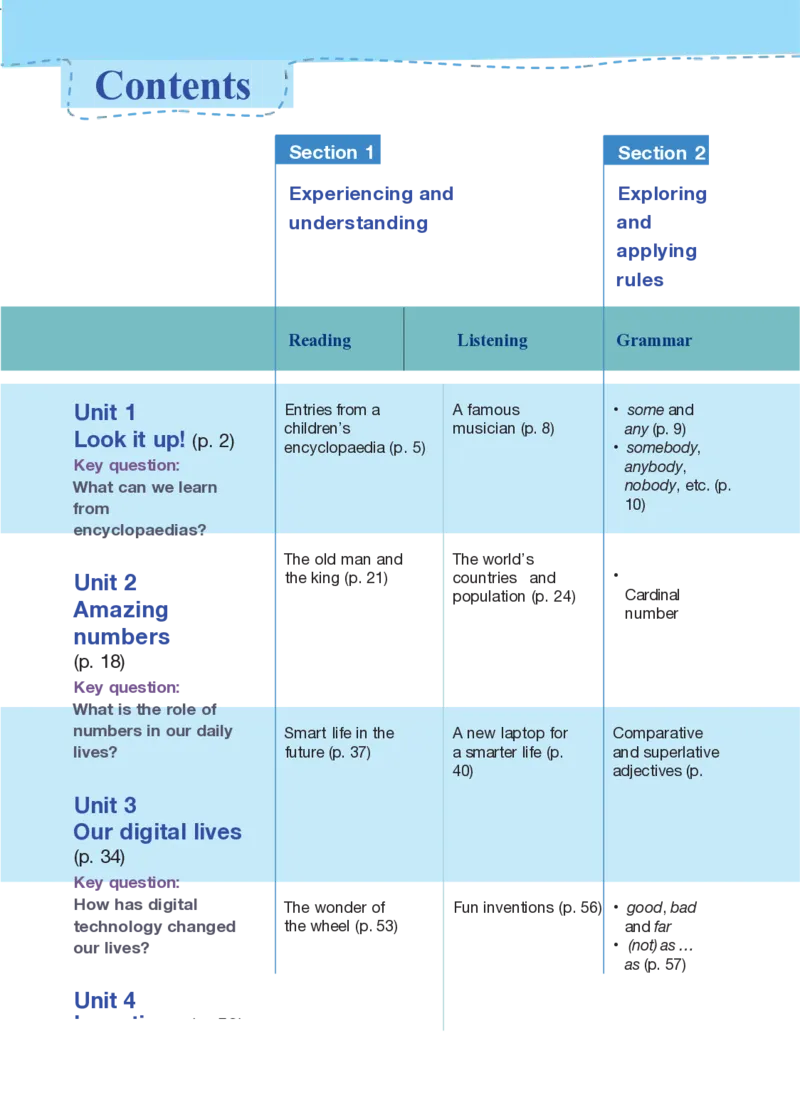
上海教育出版社Contents
Section 1 Section 2
Experiencing and Exploring
understanding and
language applying
rules
Reading Listening Grammar
Unit 1 Entriesfroma A famous • someand
children’s musician (p.8) any(p.9)
Look it up! (p. 2)
encyclopaedia (p. 5) • somebody,
Key question: anybody,
What can we learn nobody, etc. (p.
from 10)
encyclopaedias?
The old man and The world’s
Unit 2 theking (p.21) countries and •
population (p. 24) Cardinal
Amazing
number
numbers s
(p. 18)
Key question:
What is the role of
numbers in our daily Smart lifeinthe Anew laptopfor Comparative
lives? future(p. 37) a smarter life (p. andsuperlative
40) adjectives(p.
41)
Unit 3
Our digital lives
(p. 34)
Key question:
How has digital The wonder of Funinventions (p. 56) • good,bad
technology changed thewheel (p.53) andfar
our lives? • (not)as…
as(p. 57)
Unit 4
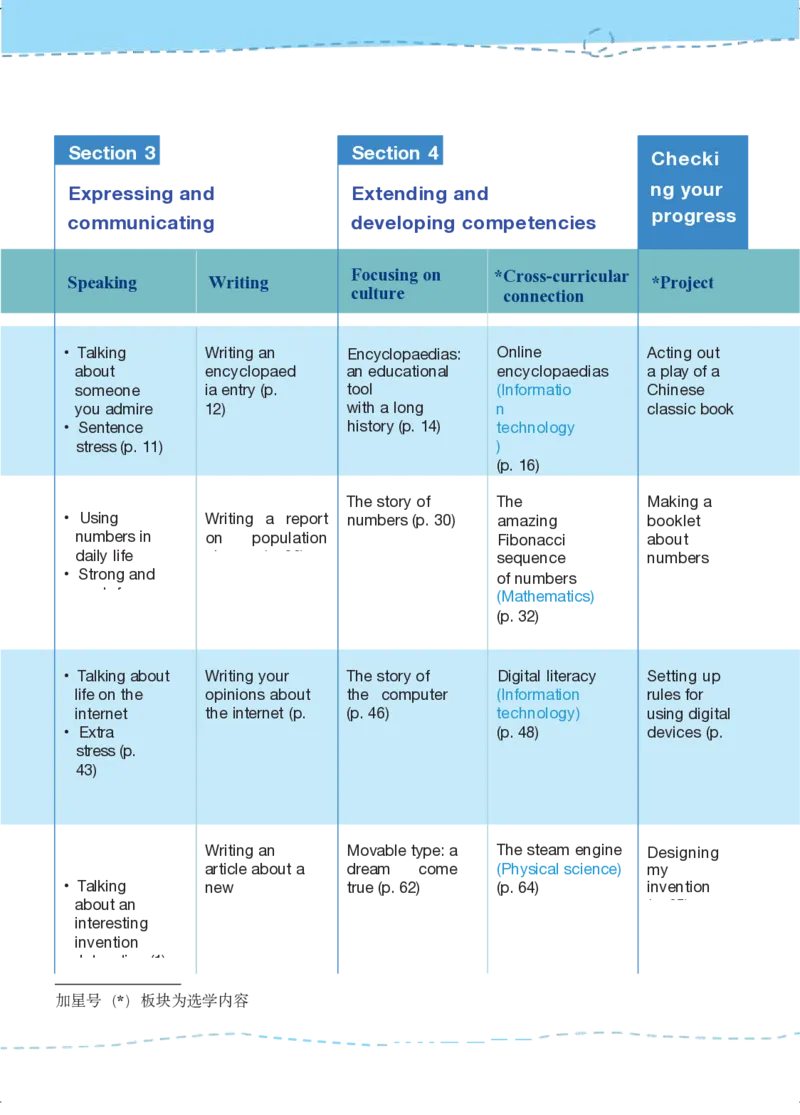
Inventions (p. 50)Section 3 Section 4
Checki
Expressing and Extending and ng your
progress
communicating developing competencies
ideas
Focusingon *Cross-curricular
Speaking Writing *Project
culture connection
• Talking Writing an Encyclopaedias: Online Acting out
about encyclopaed aneducational encyclopaedias a playofa
someone ia entry (p. tool (Informatio Chinese
you admire 12) with a long n classicbook
• Sentence history(p. 14) technology (p. 17)
stress(p. 11) )
(p. 16)
The story of The Makinga
• Using Writing a report numbers(p. 30) amazing booklet
numbersin on population Fibonacci about
daily life change (p. 28) sequence numbers
• Strongand ofnumbers (p. 33)
weakforms (Mathematics)
(p. 32)
• Talkingabout Writing your The story of Digital literacy Setting up
lifeon the opinions about the computer (Information rulesfor
internet the internet (p. (p.46) technology) usingdigital
• Extra 44) (p.48) devices (p.
stress(p. 49)
43)
Writing an Movable type:a The steam engine Designing
articleabout a dream come (Physical science) my
• Talking new true(p.62) (p.64) invention
aboutan invention(p. 60) (p.65)
interesting
invention
• Intonation (1):
加星号(*)板块为选学内容
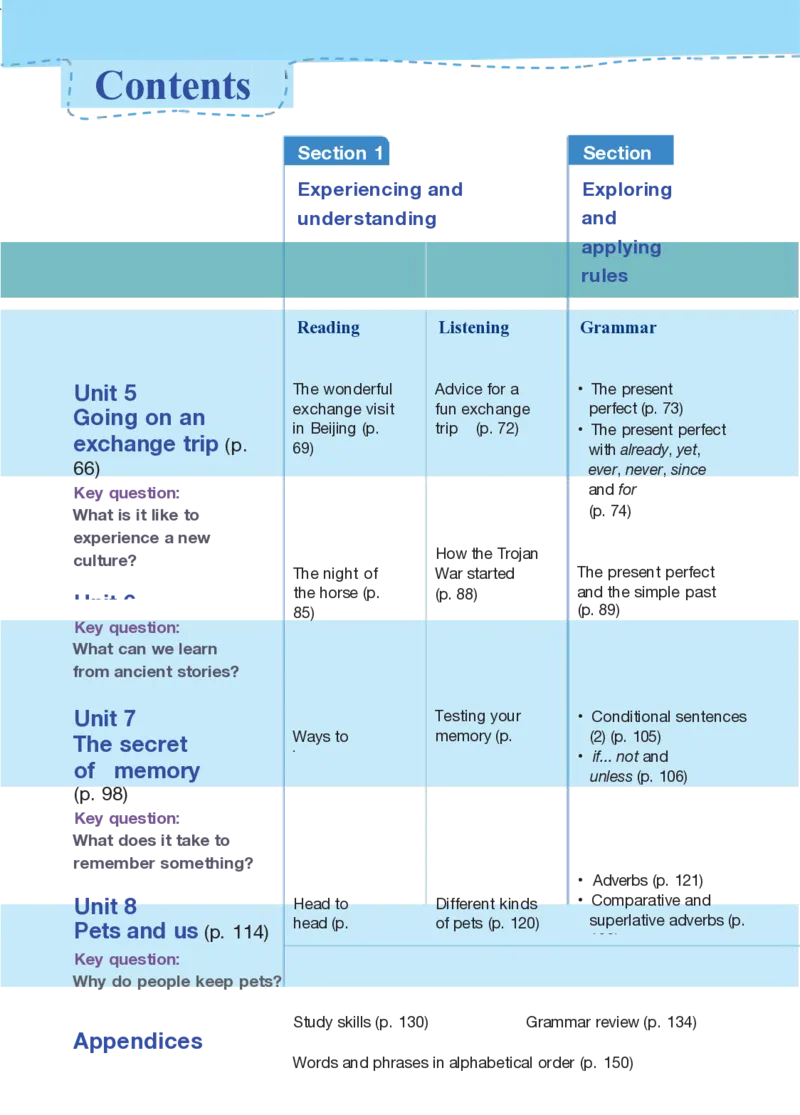
- - - - — — 一 一Contents
Section 1 Section
2
Experiencing and Exploring
understanding and
language applying
rules
Reading Listening Grammar
Unit 5 The wonderful Advice for a • The present
exchange visit funexchange perfect(p. 73)
Going on an
in Beijing (p. trip (p. 72) • The present perfect
exchange trip (p. 69) withalready,yet,
66) ever,never,since
Key question: andfor
What is it like to (p. 74)
experience a new
HowtheTrojan
culture?
The night of Warstarted The present perfect
the horse (p. (p.88) andthe simple past
Unit 6
85) (p.89)
WKeiysqduoesmtiocn:ounts (p.
What can we learn
82)
from ancient stories?
Unit 7 Testingyour • Conditional sentences
Waysto memory(p. (2) (p. 105)
The secret
improve your 104) • if...notand
of memory
unless(p. 106)
(p. 98)
Key question:
What does it take to
remember something?
• Adverbs (p. 121)
Unit 8 Headto Different kinds • Comparativeand
head(p. ofpets (p. 120) superlativeadverbs(p.
Pets and us (p. 114)
117) 122)
Key question:
Why do people keep pets?
Studyskills(p. 130) Grammar review(p. 134)
Appendices
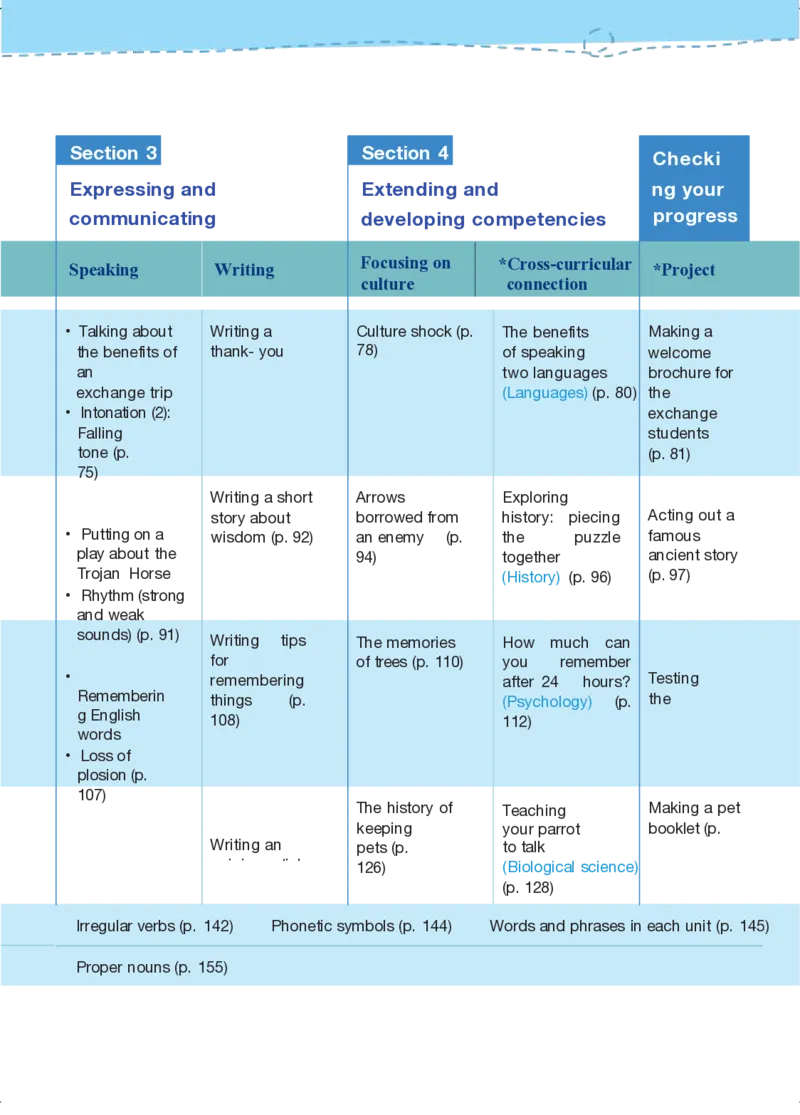
Wordsandphrases inalphabetical order (p. 150)Section 3 Section 4
Checki
Expressing and Extending and ng your
communicating developing competencies progress
ideas
Focusingon *Cross-curricular
Speaking Writing *Project
culture connection
• Talkingabout Writinga Cultureshock(p. The benefits Making a
the benefits of thank- you 78) of speaking welcome
an email (p. 76) two languages brochurefor
exchange trip (Languages) (p. 80) the
• Intonation (2): exchange
Falling students
tone (p. (p.81)
75)
Writing a short Arrows Exploring
story about borrowedfrom history: piecing Acting out a
• Puttingona wisdom (p. 92) an enemy (p. the puzzle famous
playabout the 94) together ancientstory
Trojan Horse (History) (p. 96) (p.97)
• Rhythm(strong
and weak
sounds) (p. 91)
Writing tips The memories How much can
for of trees (p. 110) you remember
• remembering after 24 hours? Testing
Rememberin things (p. (Psychology) (p. the
gEnglish 108) 112) memory
words
• Lossof
plosion(p.
107)
The history of Teaching Making a pet
and keeping your parrot booklet(p.
superlative Writing an pets(p. totalk 129)
opinion article 126) (Biological science)
(p. 128)
Irregularverbs(p. 142) Phoneticsymbols(p. 144) Wordsand phrases in each unit (p. 145)
Proper nouns(p. 155)
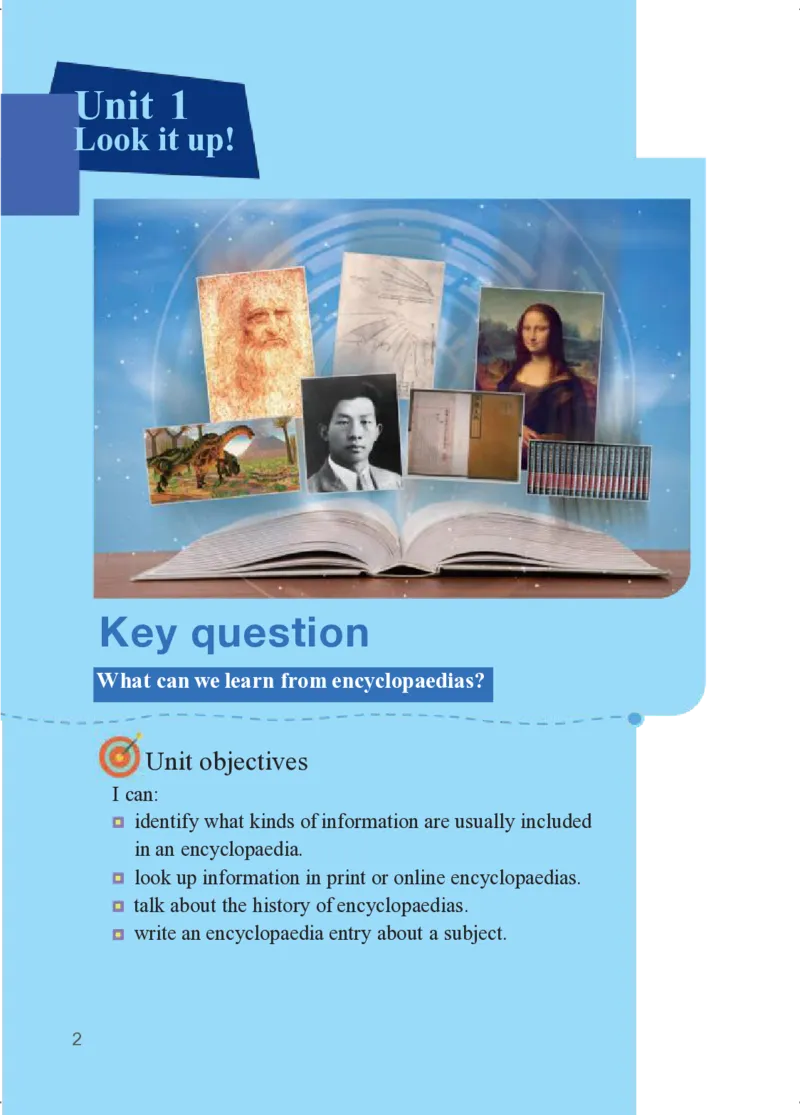
Glossary(p. 157)Unit 1
Look it up!
Key question
What canwe learn from encyclopaedias?
Unit objectives
I can:
identify what kinds ofinformation are usually included
in an encyclopaedia.
look up information in print or online encyclopaedias.
talk about the history ofencyclopaedias.
write an encyclopaedia entry about a subject.
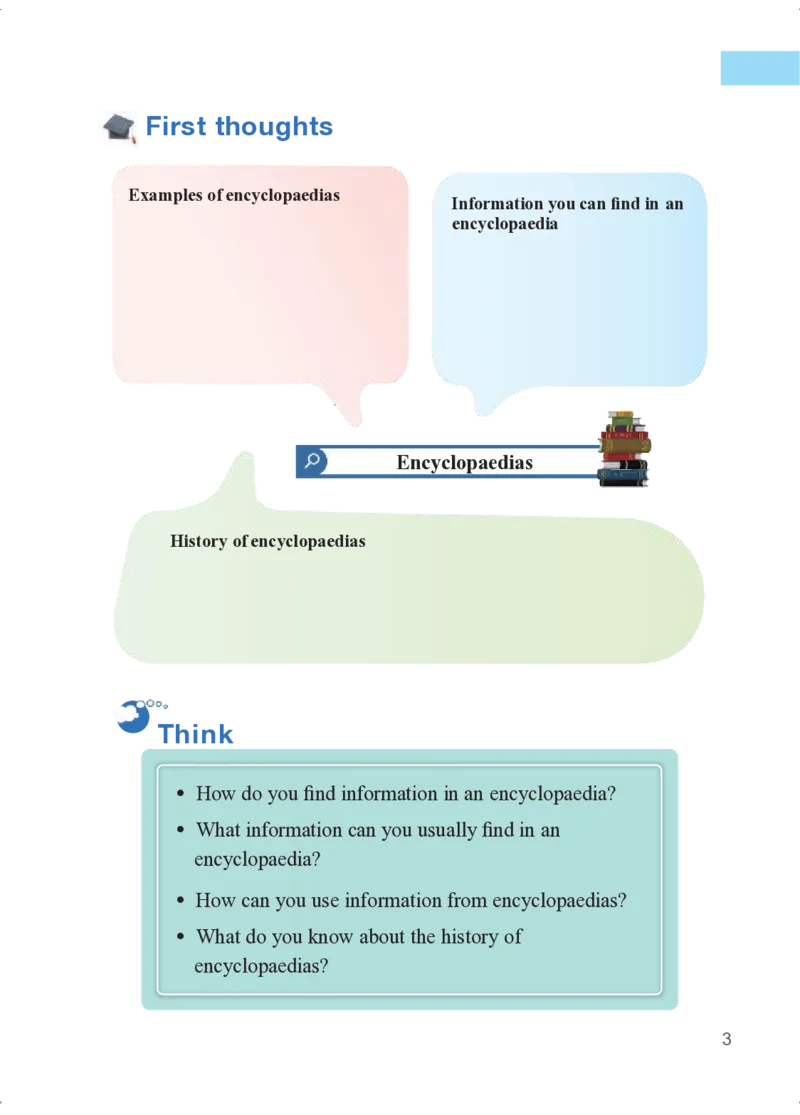
2First thoughts
Examples ofencyclopaedias
Informationyoucanfindin an
encyclopaedia
HST Y
Encyclopaedias
丽 —
History ofencyclopaedias
●
Think
• How do you find information in an encyclopaedia?
• What information can you usually find in an
encyclopaedia?
• How can you use information from encyclopaedias?
• What do you know about the history of
encyclopaedias?
31
Section Experiencing and understanding language
Readin
Think
g Before you read How do you find information in an
encyclopaedia?
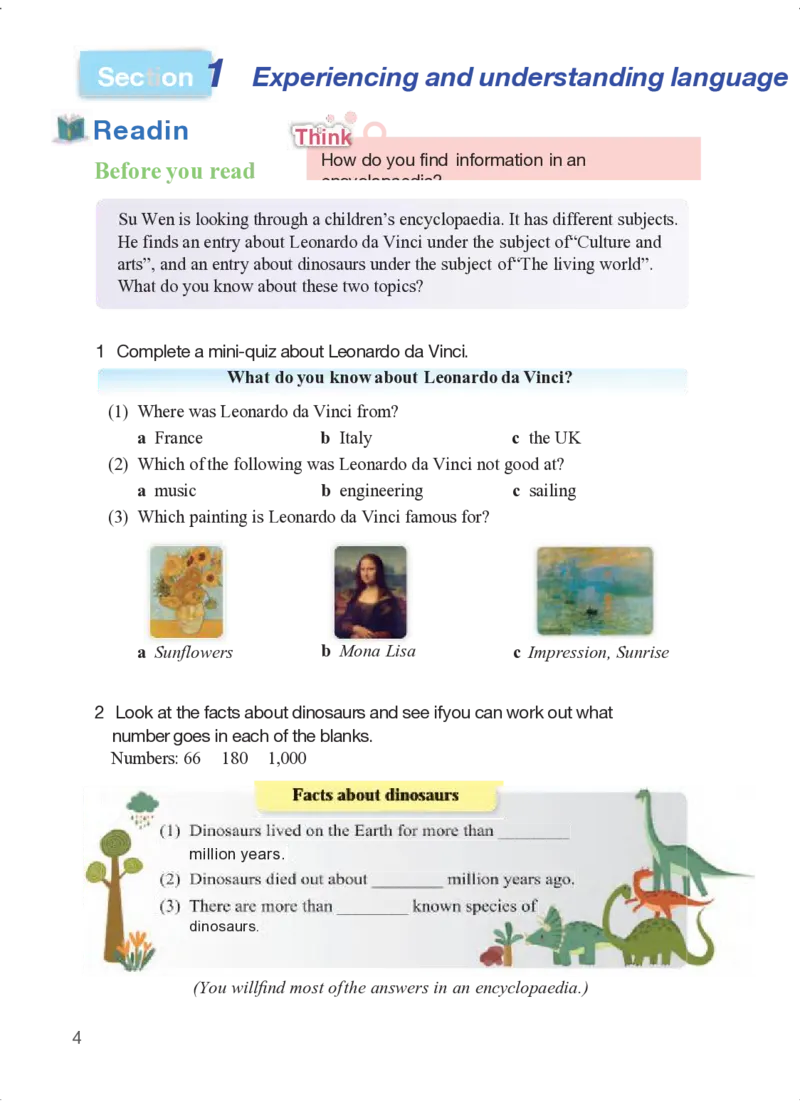
SuWenislookingthroughachildren’sencyclopaedia.Ithas different subjects.
He finds an entry about Leonardoda Vinciunder the subject of“Culture and
arts”, and an entry about dinosaurs under the subject of“The living world”.
Whatdoyouknowabout thesetwo topics?
1 Completeamini-quizaboutLeonardoda Vinci.
What doyou knowabout LeonardodaVinci?
(1) Where wasLeonardodaVincifrom?
a France b Italy c theUK
(2) Which ofthefollowing wasLeonardoda Vincinot goodat?
a music b engineering c sailing
(3) Which painting isLeonardodaVincifamousfor?
a Sunflowers b Mona Lisa c Impression, Sunrise
2 Lookatthefactsaboutdinosaursandseeifyoucanworkoutwhat
numbergoesineachoftheblanks.
Numbers:66 180 1,000
about dinosaurs
(1) lived the for than
mmiilllliioonnyears.
(2) died about million
(3) than known species of
ddiinnoossaauurrss.
(You willfind most ofthe answers in an encyclopaedia.)
4Section 1
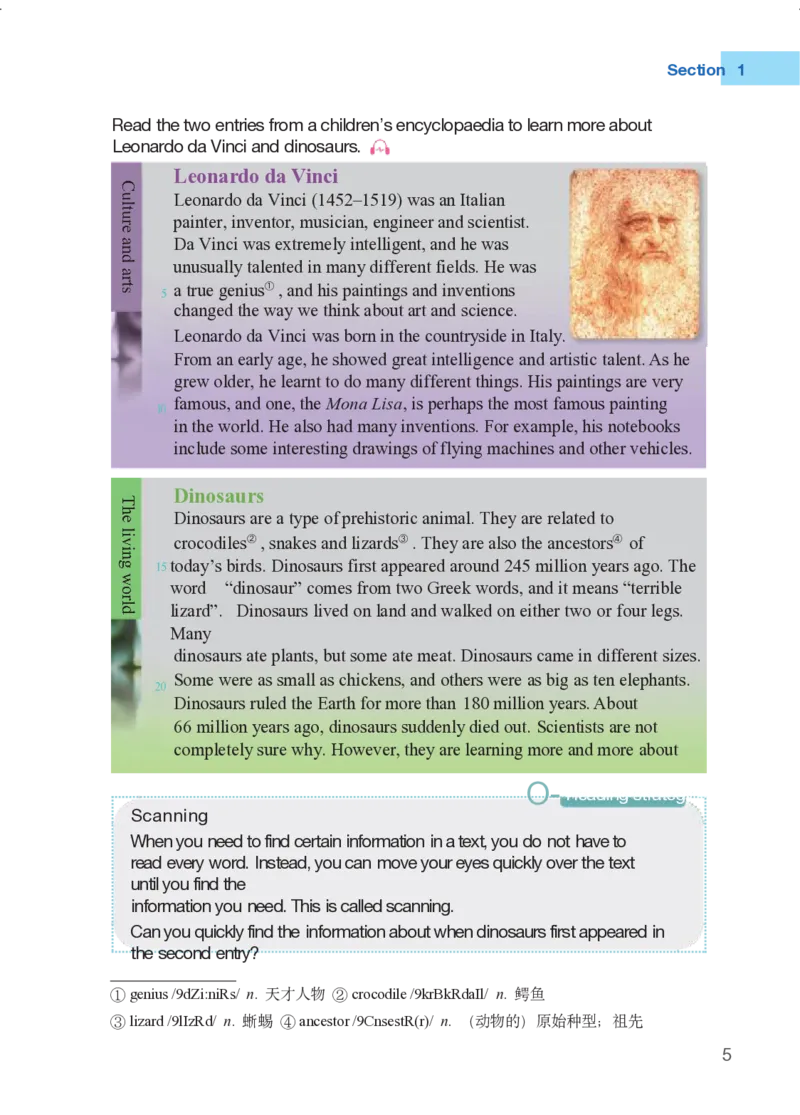
Readthetwoentriesfromachildren’sencyclopaediatolearnmoreabout
LeonardodaVincianddinosaurs.
Leonardo da Vinci
LeonardodaVinci (1452–1519)wasanItalian
painter,inventor, musician,engineerandscientist.
DaVinciwas extremelyintelligent,andhewas
unusually talentedin manydifferentfields. Hewas
atruegenius①,andhis paintings andinventions
5
changedtheway we thinkaboutartand science.
LeonardodaVinci wasbornin thecountrysideinItaly.
Fromanearly age, heshowed great intelligence and artistic talent.As he
grewolder, helearnt to domanydifferentthings.Hispaintingsare very
famous,and one,theMonaLisa,isperhaps themost famouspainting
10
intheworld. Healso hadmanyinventions. For example,his notebooks
includesome interesting drawingsofflying machines and other vehicles.
Dinosaurs
Dinosaurs are a type ofprehistoric animal. They are relatedto
crocodiles②,snakes andlizards③.They arealsothe ancestors④ of
15today’sbirds. Dinosaurs first appeared around 245 million years ago. The
word “dinosaur” comes from two Greek words, and it means “terrible
lizard”. Dinosaurs lived on land and walked on either two or four legs.
Many
dinosaursate plants, but someatemeat.Dinosaurscamein different sizes.
Some wereassmall aschickens,and otherswere asbig asten elephants.
20
Dinosaurs ruledtheEarth formorethan 180millionyears.About
66millionyears ago, dinosaurssuddenlydied out. Scientists arenot
completelysure why.However,theyarelearningmoreandmore about
dinosaursbystudyingtheirfossils.
O-
Readingstrategy
Scanning
Whenyou needtofindcertaininformation inatext,youdo not haveto
readeveryword. Instead,youcan moveyoureyesquicklyoverthetext
untilyoufindthe
informationyou need.Thisiscalledscanning.
Canyouquicklyfindthe informationaboutwhendinosaursfirstappearedin
thesecondentry?
①genius/9dZi:niRs/ n. 天才人物 ②crocodile/9krBkRdaIl/ n. 鳄鱼
③lizard/9lIzRd/ n. 蜥蜴 ④ancestor/9CnsestR(r)/ n. (动物的)原始种型;祖先
5Unit 1 Look it up!
Reading comprehension
1 Completethenotesbelowwiththeinformationfrom theencyclopaedia
entriesonpage5.
Leonardo daVinci
Yearofbirth:
Yearofdeath:
Countryofbirth:
Profession(s):
Mostfamousartwork:
Dinosaurs
Timeperiod:
Size:
Diets:
Animalsrelatedtodinosaurs:
Thingsscientistsarenotsureabout:
2 Thetwoencyclopaediaentriesarefromdifferentsubjectsofthesame
encyclopaedia.Underwhichsubjectsshouldweputthefollowingentries?
ClaudeMonet insects thegiantpanda
festivals LudwigvanBeethoven types ofplants
Cultureand arts:_____________________________________________________
The living world: ____________________________________________________
Yourideas
3 Discussthequestionsbelow.
(1) Whendoyouneed to findinformationinan encyclopaedia?
(2) What is thedifferencebetweena dictionaryandan encyclopaedia?
6Section 1
Vocabulary practice
1 Thewordsinitalicsexplainthemeaningsoffourwordsandonephrase
from theencyclopaediaentriesonpage5.Findthemandcompletethe
sentences.
(1) Some animals are highly __________(line3).They are sosmartthat they can
betrainedto understand some humanlanguage.
(2) My brother is avery __________(line4)pianoplayer. Hehasanaturalability
toplay very wellfrom ayoung age.
(3) Kate’s __________(line 8)abilityisamazing:she isverygoodatdrawing.
(4) Peoplesaythat __________(line 12)withoutdriverswillbequitenormal in
thefuture. It will bevery common toseea bus orcarwithout a driver!
(5) Thedodo,a large birdthat couldn’t fly, __________ (line21) hundreds of
years ago,so there aren,t any living dodos onEarth.
2 Hereismoreinformationfromtheencyclopaedia.Completethepassage
with thewordsandphrasesbelow.Changetheformifnecessary.
atypeof completely dieout perhaps prehistoric
Inthe 1990s, researchersin Chinadiscoveredsomethingsurprising about
dinosaurs: some ofthese (1)__________ animals hadfeathers.This discovery
helped explaintheconnection betweenbirds and dinosaurs.Accordingto
scientists,all thenon-birddinosaurs (2)__________,but dinosaurssurvived as
birds. Infact, birds developed from (3)__________two-legged, meat-eating
dinosaurscalled theropods① .(4)__________ you’veseen excitingmoviesabout
dinosaurslikeT-Rex② .Well,thosehugedinosaurscomefromthe same family
asbirds.Today’sducksandchickensaren’tscary,butthey are actuallyrelated to
T-Rex!Inone way,the dinosaursneverdisappeared(5)__________—theyjust
becamesmaller.
3 Writeaboutatalentedperson. Usetheexpressionsbelow.
bebornin ... betalentedin ... changetheway ...
froman early age learnto do show ...talent
Word
building
Noun suffixes: -ist,-ian
We canadd-istor -iantothe end ofsome wordsto makenouns, referring
toaperson.
science→scientist music→musician
Canyougivemoreexamples?
①theropod/'PIRrRpBd/ n. 兽脚类恐龙 ②T-Rex/0ti: 'reks/ n. 霸王龙
7Unit 1 Look it up!
Think
Listening
What informationcanyou usually
Afamous musician find in an encyclopaedia?
1 Lookatthewordsandphrasesbelow. Whatdoyouknowaboutthemusician
①
NieEr ?Shareyourideaswithyourclassmates.
nationalanthem②
talented
musician
marchtogether
originalname
nickname③
2 Listentotheaudioofanencyclopaediaentryandcompletethenotes.
NieEr,afamousmusician
• Originalname:(1)_____________
Birthplace:(2)_____________
Yearofbirth:(3)______________
• Whydidhechangehisname?
Becausehe(4)_____________,and hecould(5)_____________, so
peoplecalledhim“Erduo”.Helikedthisnicknameandchangedhisname.
• WhatwaslifelikeforNieErandothersduringthe1930s?
The1930swere(6)______________;therewasgreatsufferingand
peoplewere(7)______________.
• Howmanysongsdidhewriteduringhisshortlife?
(8)_________________________________________
3 Listenagainandanswerthequestion.
WhywasNie Ercalled “thePeople’sMusician”?
Your ideas
4 WhatelsedoyouknowaboutNieFindmoreinformationabout and
Er?withyourclassmates. him share
①NieEr 聂耳 ②nationalanthem/0nCSnRl 'CnPRm/ 国歌 ③nickname/'nIkneIm/n.
绰号
82
Section Exploring and applying rules
Grammar
A some and any
Weusesomeandanyasdeterminerstotalkaboutamounts.We alsouse them as
indefinitepronounsto refer to peopleorthings.
Su WenisinterviewingDrXing,adinosaurexpert,forhisproject.Readthe
interviewandpayattentiontothewordsinbold.
Su Wen: Hi, Dr Xing, can I ask you some questions about
dinosaurs?
Dr Xing: Of course!
SuWen: Why did dinosaurs die out?
Dr Xing: Many scientists think that dinosaurs died out because a
huge
①
asteroid hit the Earth. However, some scientists don’t
accept this theory.
SuWen: What do scientists disagree about?
Dr Xing: Some scientists think the world became too cold for
dinosaurs.
Some believe there was not
enough food for dinosaurs.
SuWen: Do you have any theories yourself?
Dr Xing: I have my own theory, but there
Let’s sum up the
rules!
• Weusesnomeeedantodafinnydbmefoorreepflousraslilcso…untablenounsanduncountablenouns.
• We usually usesome inpositive statements,andanyinnegativestatements
Look!
• Weusesomeinquestionswhenweexpecttheanswertobe“yes”. It is also
apolitewaytoask.
Wouldyoulikesometea?MayIhavesomenoodles?
• Wecanuseanytotalkaboutsomeoneor somethingwhenwe do notreferto
aspecificperson orthing.
Youcantakeanybookyou’dliketoread.
Whichpendoyouwant?Anywilldo.
①asteroid/'CstRrOId/ n. 小行星
9Unit 1 Look it up!
1 CompletetheconversationbetweenSu Wenandthelibrarianwithsomeorany.
Librarian: Hello, how can I help you?
SuWen: Hi, Miss. Do you have (1)__________ books about dinosaurs?
Librarian: Yes, we do. We have (2)__________ next to the encyclopaedias. What
type of dinosaurs are you interested in?
SuWen: I don’t have (3)__________ idea. Ijust want to look up
(4)__________ facts.
Librarian: No problem. Let me show you (5)__________ popular
dinosaur books for teenagers.
B somebody, anybody, nobody, etc.
Readthedialoguebelowandpayattentiontothewordsinbold.
Dad: How is your project going? Did you find anything useful in
the library? Su Wen: The librarian showed me a few books, but I found
nothing useful.
Dad: Maybe you can ask somebody else—perhaps your
biology teacher can help.
Su Wen: That’s a good idea! I think he can tell me something about
the first dinosaurs.
Let’s sum up the
rules!
• Indefinitepronounsending in-thingare used torefertoobjects, ideas or
situations.Indefinitepronouns endingin -oneand -body areusedto referto
people.
• Nothing,nobodyand nooneare used ina positive statement,butthey have a
Grammar in use
2 Lookatthepictureoftheschoollibrarybelowandthenaskandanswer
questionsinpairs.
S1: Isthereanythinginthebookcase?
S2: Yes.Therearelotsofbooksinthe
bookcase.
S1: Arethereanyplantsinthelibrary?
S2: Yes,therearesomeplantsinthe
library.
...
103
Section Expressing and communicating ideas
Speaking Think
Howcanyou use information
Talking about someone you admire from encyclopaedias?
Findinformationaboutapersonyouadmireinanencyclopaediaandtellyourpartner.
Tip You can ind
Differentjobs the following
artist,designer,inventor, information
about the person you
mathematician,musician,painter,
admire in an
physicist,scientist, writer,etc.
encyclopaedia:
• Lifeandworks
• Main achievements
S1: Whichpersoninhistorydoyouadmire? • Inluence
S2: IadmirePabloPicasso.Hewasoneofthe
greatestpainters ofthe20thcentury.
S1: Whatdidhedo?
S2: Hecreatedmanynewstylesofpainting,
andhisworksinfluencedthedevelopment
ofmodernart.
S1: Canyougivesomeexamples?
...
Improvingyour pronunciation
Sentencestress
Whenwe speak, weusually stresskey words(e.g. nouns, verbs,adjectives,
adverbsandnumbers)ina sentence.
Readthedialoguebelowandstresstheunderlinedwords.Thenlisten
andrepeat. May: Happy birthday,Ben!This is foryou.
Ben: An encyclopaedia?Thank you, May!
May: You’rewelcome.I’m sureyou’lllearn a lot from it.
Ben: Yes,I’msure Iwill. It’s alwaysuseful to have an encyclopaedia
aroundthehouse.
11Unit 1 Look it up!
Writing
Writing an encyclopaedia entry
☆
Online Encyclopaedia for Teens
We are calling for articles about famous people around the world.
Write an encyclopaedia entry and send it to us.
1 Wang Yaodrewamindmapbeforeshewroteanencyclopaediaentryabout
ascientistsheadmires.Lookatthemindmapandlabelthepartsoftheentry.
Basic information
yearofbirth and death
Tip
...
Encyclopaedia
Yuan Longping entries should
contain facts
instead of opinions.
Ma ac ievemen s
① Awards and it es
hyb r i resear h
Meda lof theR p b lic
...
...
Yuan Longping
(1)________
YuanLongping(1930–2021)was aChinese
agriculturalscientist. He wasbornin Beijing.
Yuanspenthiswholelifedevelopingdifferent
kinds ofhybrid rice. These new types of
(2)________
plants canproduce muchmore rice than
traditionalones.Yuan’sworkhashelpedfeed
people in China and many other parts ofthe
world. Farmers in alot ofcountries now grow his hybridrice.
(3)________ Yuanwonmany awardsfor his research.He receivedtheMedalof
the Republic, one ofChina’s highest honours, in 2019. People call
him the “Father ofHybrid Rice”.
①hybridrice /0haIbrId 'raIs/ 杂交水稻
12Section 3
2 Whodoyouadmire?Findinformationaboutthispersonandwritean
encyclopaediaentry.
Step 1 Plan Drawyourownmindmap.
Step 2 Write Writean encyclopaediaentry aboutthepersonyou admire. Find
aphoto oftheperson youare writing aboutandaddit to the article.
photo
Step 3 Check and revise Tick(√) theboxes to check yourwriting,
and thenrevise it.
I included important informationaboutthis person.
I used facts instead of opinions in the encyclopaedia
entry. I usedthewordsandexpressions I learnt in
this unit.
I used correct spelling,grammar and punctuation.
13Se ti n 4 Extending and developing competencies
o
c
Focusing on Think
Whatdoyouknowaboutthe
culture
Encyclopaedias provideall kindsof historyofencyclopaedias?
information. When were the first
encyclopaedias made?
Let’sexplorethe historyofencyclopaediasto learn more.
1 Readthearticleaboutencyclopaediasandfindouthowtheydevelopedin
differentpartsoftheworld.
Encyclopaedias: an educational tool with a long history
Theword“encyclopaedia”comes fromaGreek wordthatmeans “general
education”.We useencyclopaedias tofindinformationaboutdifferent
subjects.Nowadays,most peopleuse encyclopaediasonline, butsomestill
prefer touse paperencyclopaedias. Theyoften comein severalvolumes①.
5 China hasa long history ofcreatingencyclopaedias. One ofthe first
encyclopaedias was the Huanglan② (i.e. the ImperialAnthology). Itwas
created around 220CE.Anotherimportantencyclopaediawasthe Yongle
Dadian③ (i.e.the YongleEncyclopaedia).The
YongleDadianwascompletedin 1408andhad
10 over 11,000volumes.Itisprobablythelargest
encyclopaediain history.BoththeHuanglan
and YongleDadianincludedimportantpieces
ofwriting. These entries covered subjects like
history,artand science.
15 Encyclopaediasin other partsoftheworld alsogobacka longway inhistory.
The earliestknownencyclopaedias in Europe werewrittenbytheGreeks
in the4th century BCE.Theyweresimilar to early Chinese encyclopaedias
becausethey includedworksbydifferentscholars④.Centurieslater,
the editors ofthe first modern
20 encyclopaedias, like theEncyclopaedia
Britannica, organized theentries in
alphabeticalorder.Peoplecouldusethe
first letterofaword to finda subject
quicklyand easily.
25 Encyclopaediashave playedan important rolethroughhistory in recording
andproviding information.They arestill auseful tool,andthey helpus learn
abouttheworldthat welivein.
①volume/'vBlju:m/ n. 一卷;一册 ②Huanglan 《皇览》
③YongleDadian 《永乐大典》 ④scholar/'skBlR(r)/ n. 学者
14Section 4
The Encyclopaedia Britannica is a world-famous
encyclopaedia. It is the oldest English-language
Notes
encyclopaedia.The irst
edition was published in 1768, and since then there have
been 15 editions.
2 Answerthequestionsbelowwiththeinformationfrom thearticleonpage 14.
(1) Howwere early Greekencyclopaediassimilartoearly Chinese encyclopaedias?
(2) What changesdid theeditorsofthefirst modern encyclopaedias make? What
do you think ofthis change?
3 Completethesentenceswiththewordsbelow.Change theformifnecessary.
editor order organize record
(1) Before youstart writing,youneed to __________yourideas.
(2) Writers __________importantinformationaboutscience,artandother subjects
intheHuanglanand YongleDadian.
(3) __________needto checkall facts very carefully.
(4) Thewords in adictionaryare usually inalphabetical __________.
Yourideas
4 FindoutmoreinformationabouttheYongle Dadianandshareyour
findingswithyourclassmates.
Exploring
more
Wherecan youseeprecious ancient books in China?TheNationalMuseum
ofClassic Booksis one suchplace. Findmore informationabout it online.
15Unit 1 Look it up!
*
Cross-curricular connection Information technology
In thetime of the internet, more and more people useonlineencyclopaediasto
look up information, which isfastandconvenient.
1 Theentrybelowisfromoneoftheworld’slargestonlineencyclopaedias.Lookatthe
entryandanswerthequestionsbelow.
Online encyclopaedias
Menu:Helpsyouquicklyfind TopQuestions:Alistofcommonquestions
informationonthewebsite. aboutthetopic.
Browse Search Dictionary Quizzes One
GoodFact
Home>VisualArts>Painting>
LeonardodaVinci Painters Picture:Digital
Introduction&Top L Ita e lia o n n a a rti r st d ,e o ng d in a eer V ,a i n n d c sc i ientist picturesthat you
Questions >Lifeandworks
openin anew
>Artandaccomplishment Print Cite Share Feedback ...
window.
ByLudwigHeinrichHeydenreich•Lastupdated:Aug23,2022•Edit
FastFacts
history
2-Min
Listentoarticle
Summary
Timeline
TopQuestions
Achievements
>TopQuestions WhatisLeonardodaVincibestknownfor?
Facts&Related
ContentQuizzes
HowmanyLeonardodaVincipaintingsarethere?
Quotes WhatwasLeonardodaVinci’spersonalitylike? LeonardodaVinci:self-
portrait
Media Seeallmedia
Video Summary Born:April15,1452•Italy
s Readabriefsummaryofthistopic Died:May2,1519(aged67)•
Image France
LeonardodaVinci,(Italian:“Leonardo NotableWorks:“Battle
s ofAnghiari”•“Last
fromVinci”)(bornApril 15, 1452, Supper”•“Leda”•“Mona
More Lisa”...(Showmore)
Anchiano,nearVinci,Republicof
Movement/Style:Early
MoreArticlesOnThis
Florence [Italy]—diedMay2, 1519 Renaissance•Renaissance
TopicAdditional SubjectsOfStudy:painting•
Reading Cloux [nowClos-Lucé],France), proportion•anatomy•
mechanics•architecture
Contributors Italianpainter,draftsman,sculptor,
ArticleHistory
architect,andengineerwhoseskilland
Tableof intelligence,perhapsmorethanthat
ofanyotherfigure,epitomizedthe
contents:Helps
Renaissancehumanistideal. ... Quickfacts:
youquickly find Summary of
informationon
importantfacts and
thepage.
keywords.
(1) Whyare the partsin theblueboxesuseful? What kind ofinformation dothey
giveus?
(2) How is itdifferent fromaprint encyclopaedia?Which doyouprefer?
2 Doyouknowanyotheronlineencyclopaedias?Canyoudescribe
themtoyourclassmates?
16Checking your
progress
*
Project
Acting out a play of a Chinese classic book
EncyclopaediasliketheYongle DadianareonetypeofChineseclassicbooks,
butthere aremanyotherclassiccollectionsofknowledge.Inthisproject,you
willworkingroupstoexploreaclassicworkandactoutaplayaboutit.
Step 1 Pickone oftheworksbelow, orchoose another classicbook you like.
Findmore informationaboutit.
Shijing① (The Book ofPoetry)
TiangongKaiwu②
Bencao Gangmu③
TheArt ofWar④
...
Step 2 Organizetheinformationyoucollected.
Booktitle: Writer(s):
Topic: Timewritten:
Materialwrittenon: Importance:
Step 3 Adapttheinformationinto aplay script.Assign differentroles in
yourgroup. Roles in yourplaymayinclude:
• thenarrator:introduces thebook(e.g.its title,writer(s),topic)
• thestoryteller:reads poems/ excerptsfromthebook
• actor(s):play(s)therole(s)ofcharactersfromthebookortheauthor(e.g.
explaininghowhe/ shewrotethebook)
Step 4 Performyour playfortheclass andvote forthe best performance.
Wits corner
Theworldencyclopaedia, theuniversallibrary,exists,andit is
the world itself.
—Alberto Manguel
①Shijing《诗经》 ②TiangongKaiwu《天工开物》 ③Bencao Gangmu《本草纲目》
④TheArtofWar 《孙子兵法》
17Unit 2
Amazing numbers
壹 贰 叁
1 2 3
肆 伍 陆
4 5 6
柒 捌 玖
7 8 9
拾 零 佰
10 0 100
Key question
What is the role of numbers in our daily lives?
Unitobjectives
Ican:
understandtheimportanceofnumbersindailylife.
recordandpresentinformationwithnumbersinEnglish.
usecardinal andordinal numberscorrectly.
understandhownumbersdevelopedandhowtheydiffer
betweencultures.
18First thoughts
Typesofnumbers
Understanding
numbers
Numbersusedin dailylife
Numbersindifferentcultures
●
Think
• Whyarenumbersamazing?
• Howdoweusenumberstorecordandpresent
information?
• Howdoweusenumbersindailylife?
• Howdidnumbersdevelop?
191
Section Experiencing and understanding language
Readin
Think
g Whyare numbersamazing?
Before you read
Numbersareeverywhere.Lookatthepicturesanddiscusswhereyoucansee
numbersinyourdailylife.
flightschedule
clock face
Readthestoryandfindouthowawiseoldmanusednumberstooutwit①theking.
The old man and the king
A longtime ago,therewas a king in India.The king’sfavourite game
was chess.
One day,awise old man cametothe palace andthe king challenged
himto a game.“You can have any prize ifyouwinthe game,”the
king promisedthe old man.
5
The old manthoughtfora momentand said slowly,“If I win the
game,I’d like one grain of
riceforthe first square of
thechessboard,twoforthe
second,four forthe third
10
...I’d likeyou to double
theamount for each of the
rest ofthe squares.”
The kingwas very
①outwit /0aWt9wIt/ v. (智力上)胜过
20Section 1
Wherecanyousee numbers?
Ican see numbers everywhere,
such asona clock face, a
calendar ...
chartsandgraphs
pricetag
calendar
surprised.“Is that all?” he asked.“Wouldn’t you like gold or silver
15
instead?”
“No,just rice,”the old man replied without hesitation.
“How manygrains of rice willthis be?”the kingwondered,“There
are 64squares onthe chessboard,sotherewill be one,two,four,eight,
sixteen, … Perhaps a bag of rice isenough.”Afterthinking about it
20
for a moment,the king agreed.
The king andthe old man playedthe gamefor a longtime. Finally,
the old manwon,sothe king ordered his mento collect a bag of rice.
The king’s men put one grain onthefirstsquare,two onthe second,
andso on.After afewsquares,the king realizedthe problem—even
25
with allthe rice inthecountry,hewouldstill not have enough rice to
put onthe chessboard!
O-
Readingstrategy
Identifying the elements of a story
The keyelementsofastory includethecharacters,setting, plot,conflict
andtheme.They helpyou understandthestory better.
Canyou identifytheseelements intheabovestory?
21Unit 2 Amazing numbers
Reading comprehension
1 Completethetablewiththeinformationfrom thestoryonpages20–21.
Time
(1)____________________________________
Setting
Place
(2)____________________________________
Characters
(3)____________________________________
Theking(4) ____________________________
Beginning ______________________________________
Thekingandtheoldman(5) ______________
Plot Middle
_____________________________________.
(6)____________________________________
End ______________________________________
______________________________________
2 Readthestoryagainandfindevidencetosupportthestatementsbelow.
(1) Thekinglovedtoplaychess.
________________________________________________________________
(2) Thekingthoughttheoldmanaskedfortoolittle.
(3) Thekingdidnothaveenoughricefortheoldman.
________________________________________________________________
Yourideas
3 Discussthequestionsbelow.
(1) Howmanygrainsofriceshouldthekingputonthelastsquare?
(2) Whatdoyouthink happenednext? Continuethestoryandrole-playitinyour
group.
22Section 1
Vocabulary practice
1 Thewordsinitalicsarefromthestoryonpages20–21. Match the sentence halves.
(1) Whenyouwonder about a youareverysureyouwill doit.
something, b he/shewantstoseeifhe/shecanwin.
(2) Ifyoupromise todo c ifyoucomesecondintherace.
something, d youthink aboutitwithcuriosityandwant
(3) Youmaywinaprize toknowmoreaboutit.
(4) Youwillwinthesilver medal e ifyoudowell intherace.
(5) Ifyourfriendchallenges you
toachessgame,
2 Completethestorywiththewordsbelow.Change theformifnecessary.
hesitation prize promise reply wonder
poor youngmancame first na ru ng race andwon som gold a a
.
_ _ _ _ Helooked thes llpieceofgoldin his andan
(2)____________ whattodowithit. Theyoungmandecidedtoask awiseold
manforadvice. “Ihavealittlegoldnow,butIwantmuchmore,” hesaid. “Can
youhelpme?”
heold manlook athim . “I anteachyouhowtomakemoremoneyifyou
_ t workha r d, he said
.
Theyoungmanagreedwithout(4)____________. Thentheoldmanpointed
outofthewindow. “Look outside. Whatcanyousee?” heasked. “Icansee
nothingbut anempty field,” theyoungman (5)____________.
“Useyour money to buythis field,” said theold man, “and grow somecotton.
Ina year,youcan sellthe cotton and make aprofit.”
Theyoungmanfollowedhisadviceandworkedhardallyearround, andin
time, hebecameveryrich.
3 Summarizethestoryonpages20–21. Usethewordsandphrasesbelow.
promise surprise wonder
challenge... to doubletheamount
realizetheproblem withouthesitation
23Unit 2 Amazing numbers
Listening
Think
Howdowe use numbers to
The world’s countries
recordand present
and population
information?
1 Discussthequestionsbelowinpairs.
(1) Whatisthepopulationoftheworldnow?
(2) Canyounamethethreelargestcitiesintheworldbypopulation?
2 EllieandAnnaretalkingaboutcountriesandpopulationaroundtheworld.
Listento theconversationandchoosethecorrectanswers.
(1) What’stheworld’spopulation
accordingtotheconversation?
a about8billion Tip We can express
numbers in different
b about10 billion
ways:
c about13 billion
• 27%: twenty-seven per
(2) Howmanypeoplewilltherebe
cent • : onefifth
intheworldin2100?
a morethan9billion
• :twothirds
b morethan10 billion
c morethan12 billion
(3) Whatpercentoftheworld’spopulationcurrentlyliveinAsia?
a abitover30% b lessthan50% c about60%
(4) Whichofthefollowingcitiesisdiscussedintheconversation?
a Shanghai b Shenzhen c Beijing
3 Listenagainandanswerthequestionbelow.
WhatdoesAnnmeanwhenshesays“thenumberkeepschanging”?
Your ideas
4 Imaginethatyouareworkingonaprojectaboutthepopulationofdifferent
countries aroundtheworld. Whatmethodsareyougoingtousetofindthe
information?How willyourecordandpresenttheinformationyoucollect?
242
Section Exploring and applying rules
Grammar
A Cardinal numbers
Weusecardinal numbers tocountthings.
11 eleven 15 fifteen 20 twenty 82 eighty-two
12 twelve 18 eighteen 50 fifty 98 ninety-eight
100 onehundred 375 threehundredandseventy-five
1,000 onethousand 100,000 onehundredthousand
4,189 fourthousandonehundredandeighty-nine
1,000,000 onemillion 1,000,000,000 onebillion
2,000,000 twomillion 3,000,000,000 threebillion
Let’s sum up the
rules!
• Whenwereadoutnumbers, wedonotadd-s tothewordshundred,
thousand, million andbillion.
• Weputand betweenhundred andten.
B Ordinal numbers
Weuseordinal numbers toshowtheorderofthings.
1st first 4th fourth 9th ninth 13th thirteenth
2nd second 5th fifth 11th eleventh 20th twentieth
3rd third 8th eighth 12th twelfth 21st twenty-first
Let’s sum up the
rules!
Weformmostordinal numbers byadding-th tothecardinal numbers,
exceptfirst, second andthird. Fornumbersof21 andabove, theordinal
25Unit 2 Amazing numbers
1 Lookattheinformationaboutthethreelongestriversinthe world. Take
turnsaskingandansweringquestionsabouttherivers.
TheNileRiver TheAmazonRiver TheYangtzeRiver
Africa SouthAmerica Asia
6,480 km 6,300 km
6,671 km
S1: Whichisthefirst-longestriverintheworld?Whereisit?Howlongisit?
S2: TheNileRiveristhefirst-longestriver.It’sinAfrica.It’sabout6,671kmlong.
Grammar in use
2 LookatthelistofthehighestmountainsinAsia,NorthAmericaandAfrica.
Describethemountainswithcardinalandordinalnumbers.
Rank Name Height Continent
1 Mt. Qomolangma 8,848.86 m Asia
2 Mt. Qogir 8,611 m Asia
3 Mt. Kanchenjunga 8,586 m Asia
Rank Name Height Continent
1 Mt. Denali 6,190 m NorthAmerica
2 Mt. Logan 5,959m NorthAmerica
3 PicodeOrizaba 5,610 m NorthAmerica
Rank Name Height Continent
1 Mt. Kilimanjaro 5,895 m Africa
2 Mt. Kenya 5,199m Africa
3 Mt. Stanley 5,109m Africa
Thetallestmountainin...is...Itis...metreshigh.
...isthesecond-highestmountainin...
263
Section Expressing and communicating ideas
Speaking Think
Howdowe use numbers indaily life?
Using numbers in daily
life
Numbersplayanimportantroleinourdailylives.Discusshowpeopleusenumberswith
yourclassmates.
S1: Howdopeopleusenumbersin
dailylife?
Peopleusenumbersto:
S2: Peopleusenumberstodoalotof
• design buildings
things.Takeplanningajourneyfor
• develop new medicine
example.Weneedtodecidethe • grow crops
dates.Andthenweneedtocheck • make a monthly budget
thetrainorflightschedule.Also,
• plan ajourney
weneedtomakeabudget.
...
S1: That’strue.Peoplealsouse
numbersto...
Improvingyour pronunciation
Strongandweakforms
Somewords(e.g. do, the, of, and, can,for, to) havebothastrongformand
aweak form. Inmostsentences, weusetheweak formsofthesewords.
Sometimesweusethestrongformsforemphasis.
a an for of to
Strong form /eI/ /Cn/ /fO:(r)/ /Bv/ /tu:/
Weak form /R/ /Rn/ /fR/ /Rv/ /tR,tu/
the and can have he do
Strong form /Qi:/ /Cnd/ /kCn/ /hCv/ /hi:/ /du:/
Weak form /Qi, QR/ /Rn(d),n/ /kRn/ /hRv, Rv/ /hi/ /dR, du/
Listenandrepeat.Payattentiontothewordsinblue.
May: Doyouknowthenumberofstudentsinyourclass?
Ben: Yes, Ido. Thereare35 studentsinmyclass—18boysand17
girls. I canrememberalltheirbirthdays!
27Unit 2 Amazing numbers
Writing
Writing a report on population change
Populations change in all areas over time. Do some research
and write a report on population change in a city or
province based on your findings.
1 Wang Yaoiswritingareportabouttheworldpopulation.Lookattheline
graphshe foundandhelphercompletethereport. Usethewordsand
phrasesbelowtohelpyou.
Worldpopulation: 1750–2050
10
9
8
7
6
5
4
3
2
1
0
1750 1800 1850 1900 1950 2000 2050
Year
Growingnumbers:rise(sharply,quickly,slowly),grow,goup, double
Fallingnumbers:fall(sharply,quickly,slowly),drop,go down
Nochange:staythesame, remain thesame
World population
The graph shows that the population in the world
(1)__________________ before the year 1800. During the second half
of the 1800s, the
population began (2)______________________. In 1850, there were
about
(3)_____________________ people in the world. About one hundred
years later, the world population reached (4)______________________.
Between
1950 and 2000, the population more than
28Section 3
2 Howhasthepopulationinaparticularcityorprovincechangedoverthe
years?Findinformationaboutitandwriteareport.
Step 1 Plan Chooseacityorprovinceyouareinterestedin.Find
informationaboutitspopulationchangeoveraperiodoftimeandmakealine
graph.
Step 2 Write Writea reportabouthowthepopulation changed overtime.
Rememberto usethewords andphrasesinExercise 1.
Step 3 Check and revise Tick (√) theboxes to check your writing,
and thenreviseit.
I useda linegraphto recordand present information, usingcorrect
numbers.
I provided a detailed descriptionof howthe population of a city/
province
changed over time.
I usedthewordsandexpressions I learnt inthis unit.
29Secti n Extending and developing competencies
o
Focu4sing on Think
Howdidnumbersdevelop?
culture
Numbersareeverywhere today. Howdid people
in ancient times record numbers? Let’sexplore the developmentof
counting methods.
1 Readanarticlefromasciencemagazineandfindoutmoreaboutnumbers.
The story of numbers
Inancienttimes,peopledevelopeddifferentcounting
methods.Oneoftheearliestwascalled“tallysticks①”.
Each“stick”(orpebble②,orothercountingtool)stands
forathingwewanttocount,suchasananimalorabagof
5 rice.Foreachanimalwewanttocount,wedrawonestick.
”
Thisiscalleda“one-to-onecorrespondence③ .Tally
sticksareeasytounderstand,butitcantakealongtimeto
write downlargenumbers.Towrite“1,000”,youhaveto
drawa thousandtallysticks!
10 Later, peoplecreated fasterways ofwriting numbers.One suchsystem
developed in ancientIndia. Instead ofusing tally sticks,peoplebegan using
differentabstract④ symbols to representdifferent numbers.Researchersdo
notknow exactlyhow thishappened,but some believe that thesticks slowly
turnedinto symbolsover thecenturies. These Indiannumeralsbecame
15 popular,andpeople in theArab worldstarted usingthemtoo.Thankstothe
Arabs, thisway ofwriting numbersspread to Europe andacross the world.
Nowadays,theyare knownas Arabic numerals⑤.
Theancient Romanswrote numbersinadifferentway.They
usedletters fromtheiralphabet. For example, thenumber
20 12is “XII” (10+1+1).TheRoman numerals usedtobethe
mostcommon way ofwritingnumbers inEurope.Today we
still see them in manyplaces,for example,on clock faces,
onbuildingsor in books.But Roman numeralsarenotas common asArabic
numerals, maybebecausethey are too difficult to use!
①tallystick/'tClistIk/ 计数棍 ②pebble/'pebl/ n. 鹅卵石;砾石
③correspondence/0kBrR'spBndRns/ n. 对应 ④abstract/'CbstrCkt/ adj. 抽象的
⑤numeral/'nju:mRrRl/ n. 数字
30Section 4
People from different cultures use different numerals.
Below are three ways of writing the numbers one to five.
Chinese numerals: 一、二、三、四、五 Notes
Roman numerals: I, II, III, IV,V
Arabic numerals: 1, 2, 3, 4, 5
2 Completethesummarybelowwiththeinformationfromthearticleonpage30.
Inancienttimes, people developeda counting systemcalled
(1)____________________.Later, people replacedthis systemwith
abstract (2)____________________.These weremore convenient
becausetheywerequicker to write. Thenumbers weusetoday arecalled
(3)____________________.They wereinventedin (4)____________________.
Thanksto the(5)____________________,thissystem spread to otherparts ofthe
world.Sometimeswe alsosee numberswrittenwith (6)____________________
onclockfacesand buildings.These are called Romannumerals.
3 Completethesentenceswiththewordsbelow.Change theformifnecessary.
exactly represent symbol system
(1) TheRoman symbolIV_________thenumber4inArabicnumerals.
(2) This palacewas a(n) __________oftheking’swealthandpower.
(3) TheRoman alphabet is notthe onlywriting _________in theworld—thereare
manyothers.
(4) We don’t know__________howmanyanimal speciesthereareon Earth.
Yourideas
4 Whatinfluencesdidthedevelopmentofcountingmethodshaveonpeople’sdailylives?
Exploring more
Peopleusedcounting rodsin ancient China. Whatdoyouknow aboutthisway
ofcounting?Do some researchandshare yourfindings with yourclassmates.
31Unit 2 Amazing numbers
*
Cross-curricular connection Mathematics
Ifyou carefully observe the naturalworldaroundyou, you may find interesting
mathematical patterns!
1 ReadthearticleonFibonaccinumbersandfindoutmoreaboutMathsinnature.
①
The amazing Fibonacci sequence of numbers
Fibonacci was a famous Italian mathematician born in the 12th
century. He created many maths problems. The most famous one
was about rabbits.
Imagine that a pair of rabbits can have two babies every month. After two
months, the new rabbits can have babies too. What will happen ifyou
have a pair of newborn rabbits on your farm? How will the number of
rabbits grow over time? Let’s look at the answers this way:
This is the beginning Month Numberofpairs
of the Fibonacci
1 1
sequence. Look at
the numbers.
2 1
Can you see any
pattern? That’s right—
3 2
each
number is the sum of
4 3
the two previous ones.
As we can see, the
5 5
numbers in the
6 8
Fibonacci sequence
grow very quickly.
7 ?
What numbers come
after 8 in the
sequence?
Fibonacci numbers are very special because they show up
everywhere. They appear in artworks and famous buildings, and also
in living things. In fact,
②
nature likes to follow the Fibonacci sequence. Flower petals often come
③
in Fibonacci numbers. The same thing happens with the spirals of pine
④
cones and sunflower seeds. We do not know yet why these numbers
are so common, but Fibonacci’s discovery can help us understand
the natural world.
2 Findapineconeandcountthespirals.Howdoesthenumberofspirals
illustratethe Fibonaccisequence?Thinkaboutthingsaroundyouinnature.
Haveyouevernoticedanyinterestingpatterns?①Fibonaccisequence /0fIbR'nA:tSi 'si:kwRns/ 斐波那契数列 ②petal/'petl/ n. 花瓣
③spiral /'spaIrRl/ n. 螺旋形 ④pinecone/'paInkRWn/ n. 松果
32Checking your
progress
*
Project
Making a booklet about numbers
Ourworldisfullofamazingnumbers.Howmuchdoyouknowaboutthem?Inthis
project,youwillexploredifferenttypesofnumbersingroupsandmakea
classbookletaboutyourfindings.
Step 1 Brainstorm some number-related topics in yourgroup. Use the following
spidergram to helpyou.Writedown yourownideasinthespidergram.
Numbersin
differentcultures
Numbersin
Peopleand
numbers
Numbers
Numbers
connectedto
Numbers
connectedto
Step 2 Decideonatopic and then research it.
Step 3 Writeashort passage onyourtopic. Illustrate yourpassage with
pictures, graphs,etc.
Step 4 Asa class,put all yourpassages together to make a booklet
aboutnumbers.
Wits corner
Numberrulestheuniverse.
—Pythagoras
33Unit 3
Our digital lives
Key question
How has digital technology changed our lives?
Unit objectives
I can:
talk about the history ofcomputers.
understand how digital technology changes our lives.
improve my digital literacy.
analyse the positive and negative effects ofthe internet
on daily life.
34First thoughts
The internet and our digital lives
Lifebeforethe Thingspeople do The positive effects of
internet withtheinternet theinterneton daily
life
Thenegative effects
ofthe internet on
dailylife
●
Think
• How will the internet change our lives in the future?
• How do you choose a digital device?
• What are the positive and negative effects ofthe internet?
• How has digital technology changed the world?
351
Section Experiencing and understanding language
Think
How will the internet
Reading
Before you read
change our lives inthe
future?
Nowadays,people use smartphones, smartwatchesand smarthome devices. In
the future, even more things will be connected to the internet. The network of
interconnected smart devices is called the Internet ofThings (IoT①).
Lookatthepicturebelowanddiscusswhatasmarthomeislike.
doorlock airconditioning Wi-Fi
flood sensor② lights multimedia
robotcleaner activity sensor thermometer③
What isa smart home like? Inasmart home, a lot of
devices areconnectedtothe
internet.You can control these
devices
even whenyouare not
Canyougivesome at home.
examples?
...
①IoT/0aIRW 'ti:/ 物联网 ②sensor/'sensR(r)/ n. 传感器
③thermometer /PR'mBmItR(r)/ n. 温度计
36Section 1
Readthetranscriptofapodcastinterviewtolearnabouthowtheinternetwill
furtherchangeourlives.
Smart lifein thefuture
Host: Our guesttoday is Dr Li, a technology expert. Dr Li has studiedhow the
internetwill furtherchangeourlives inthe future.
DrLi: That’s right. Theinternet hasbroughtbig changes toeverydaylife.For
example,e-learning andmobile paymenthave changedthe waywestudy
5 andshop. Inthe future, evenmore thingswill beconnected to the internet,
solifewillcontinueto change.
Host: Canyougiveus someexamples?
DrLi: Takehealthforexample.We’llprobablywear small devices all thetime,
andthey’ll checkourhealthand warn us abouthealthproblems.Withthis
10 information,doctors canprovide bettertreatment.
Host: Interesting! Will the internethelp improvethe environment?
DrLi: Yes!Asmorethings become connectedtotheinternet, our citieswill
become smartcities. Smart citieswill bemoreeco-friendlythancities
today.One ofthe mostimportant changeswill comein energyuse.
15 Different devices willcommunicateandshare datawith each other.
This will helpthem saveenergy.For example,smartrubbishbins will
automatically① tell thesmartcity network when theyarefull.Thisdata
willallowthe rubbish collectioncompanyto planbetter collectionroutes②.
Host: Willsmartcities improveourlives in otherways?
DrLi: 20 Ithink thebiggest changewill bein transport.Our roadswillbemuch
saferinthefuture,andtrafficwillflowmore smoothly.Therewillbe fewer
accidents becausecars will drive themselves,andtheywill share datawith
thesmartcity network. With thisdata, trafficlightscan changethe timing
according to the numberofcars on theroad.
Host: 25 That’s amazing.And willthisreallybe possible?
DrLi: Yes,itwill.We’vealready starteddoing some ofthese things!
国-
Readingstrategy
Finding examples that support opinions
Writersoften useexamplestosupporttheiropinionsandthis helpsthereader
understandtheopinions better. Forexample,inline 14, Dr Li’sopinionis“oneof
the
most importantchangeswillcomeinenergy use”.Theexample he usesto
supportthis opinion is“smart rubbish binswillautomaticallytellthesmartcity
network... plan bettercollection routes”.
Canyoufind moreexamples?
①automatically/0O:tR9mCtIkli/ adv. 自动地 ②route/ru:t/ n. 路线
37Unit 3 Our digital lives
Reading comprehension
1 Completethetablebelowwiththeinformationfrom the transcriptofthe
podcastinterviewonpage37.
The internet will … Examples
We will(1)______________________________
changethewaywelook
afterourhealth.
______________________________________.
Smartrubbishbinswill(2)__________________
changethewayweuse
energy.
.
Carswill (3)_____________________________
changethewaythetransport
systemworks.
.
2 Readthetranscriptofthepodcastinterviewagainandanswerthequestionsbelow.
(1) Does Dr Litake apositive, negative orneutral① attitude towardsthe
changesbroughtbytheinternet?
(2) Canyoufindexamplesfromtheinterviewto supportDr Li’s opinion?
________________________________________________________________
________________________________________________________________
Yourideas
3 Discussthequestionsbelow.
(1) Whatwilllifeina smart citybe like?
(2) Do youthinktheinternet hasnegativeeffectsonour daily lives?What are
they? Howcan we dealwith them?
①neutral/'nju:trRl/ adj. 中立的;无倾向性的
38Section 1
Vocabulary practice
1 Findthewordsinthetranscriptofthepodcastinterviewonpage37and
matchthemwiththeirmeanings.
(1) expert(line 1) a totellsomeonethatsomethingbadmayhappen
(2) warn (line9) b medical caregiventopatients
(3) treatment(line 10) c thevehiclesmoving on aroad at a certain time
(4) traffic (line21) d movingwithoutdifficulties
(5) smoothly(line 21) e apersonwithspecialknowledgeand skill
2 Completethepassagewiththewordsandthephrase below. Change
theformifnecessary.
data take ...forexample warn
smoothly treatment
Smart technologyis changing thewaywe live. Nowadays,moredevicesare
connectedto theinternet. (1)____________smartwatches ____________.
Athletescan usethem to measuretheirspeed and heartrate,andthen send all
the(2)____________to their trainer.
Smartdeviceswillchangeourcitiesinthefuture and traffic will flowmore
(3)____________thanksto smartcity technology.Our homeswillbe full of
smart devicestoo. For example, whenwe runout ofeggsormilk, our fridge
will automaticallyorder more.
One day, we may even take “smart pills”
tohelpcheck ourhealth,and thiswill help
doctorsprovidetheright (4)____________.
However,some experts (5)____________ that
smarttechnologycan easilygowrong and
thiscouldlead to seriousproblems.
3 Writeabouthowyouthinktheinternetwillchangeourlivesin thefuture.
Usethewordsandexpressionsbelow.
check provide warn
bringchangesto changethewaywe ... changeswillcomein ...
connectedto take ...for example
39Unit 3 Our digital lives
Listening Thin
k How do you choose a digital
A new laptop for a smarter life
device?
1 LiNawantstobuyalaptoponline.Helpherfindoutwhatsheneeds to
consider.Discusswithyourclassmatesandmakealist.
Size: Howlargeisthescreen?
Tip Units we
Memory: Howmuchmemorydoesthe use to describe a
computerhave? laptop:
• size: inch
...
• weight: kg
• memory: GB
• price: yuan (¥)
2 LiNaasksherfriendLiu Weiforadvice.Listentotheconversationand
answerthequestionsbelow.
(1) What doesLi Na mainlyuse thelaptopfor?
(2) Whatkind oflaptop doesLiu WeithinkLiNaneeds?
(3) Whichlaptop will Li Namost probablychoose?
3 Listenagainandcompletethetable.
Model Size Weight Memory Price
LightningX
Spec 15
A101
Yourideas
4 Discussthequestionsbelow.
(1) Whatdigital devices doyouhaveathome?
(2) Howdoyou usethem to helpwith yourstudyand daily life?
402
Section ---Exploring and applying rules
Grammar
Comparative and superlative adjectives
When we compare two people orthings, we can use the comparativeform of
theadjective.When wecomparemore thantwo people orthings, wecanusethe
superlative form ofthe adjective.
ReadthedialoguebetweenSuMeiandSu Wen.Payattentiontothewordsinbold.
SuMei: Oh,what’sthis?
SuWen: It’sacomputerfromthe 1940s.Youknowwhat?The first
computerswerebigger thancars.Nowadays, computersaremuch
smallerandbetter.
SuMei: Isee. Besides size, what else is different?
SuWen: Computers todayare muchfasterthanbefore.
SuMei: Thatmust betrue. Some computersare evensmarter than human
beings.
SuWen: No, Idon’t think so. Ithinkhumanbeingsare the smartest.After
all,weinventedcomputers.
Adjective Comparativeadjective Superlativeadjective
big bigger biggest
smart smarter smartest
interesting moreinteresting mostinteresting
Let’s sum up the rules!
• Toformcomparativeadjectives,weoftenadd -ertoan adjectivewith one
ortwo syllables anduse morewith adjectives ofthree ormore syllables.
• Weoftenusethanaftercomparativeadjectives.
• Toformsuperlativeadjectives,weoftenadd -estto an adjectivewith one
ortwo syllables and use mostwith adjectives ofthree ormore syllables.
• Weusuallyusethebeforesuperlativeadjectives.
41Unit 3 Our digital lives
1 Completetheconversationwiththecomparativeorthesuperlative
formoftheadjectivesinbrackets.
SuWen: Did youwatch thatscienceshowonTV lastnight?It was about chess
computers.
SuMei: No,Ididn’t.Wasit interesting?
SuWen: Yes! Scientists designed(1)______________________(early) chess
computersin the 1950s.Atthetime,thecomputerscouldnotbeat
humanplayers. Even ordinarypeople were(2)______________________
(good)thanthese firstchesscomputers.Butin 1997,a computernamed
eepBluewona chess match a nst e worl c ampion.T s was
_ (f ous hessg m against a mputer
inhistory.
SuMei: Wow,that’sabigvictoryforartificialintelligence (AI)!
SuWen: Indeed! Backthen,DeepBluewas(4)_____________________________
(powerful)chess computerin theworld.Butnow,anordinary computer
can beat(5)______________________(good) humanplayers.
SuMei: Well, thatmaybetrue,buthumans
inventedAI.Also, computerscannot
think like wedo.Thatmeanshumans
are still (6)______________________
(smart) thancomputers!
Grammar in use
2 Interviewyourteachersandclassmatesabouttheirattitudestowardsdigital
technology. Writequestionswithcomparativeandsuperlativeadjectives
beforeyoustart.
• Whichdoyouthinkismoreconvenienttoread,e-booksorprintbooks?
• Does...makeyourlifeeasierorharder?
• Isitsafertomakenewfriendsonlineoroffline?
...
3 SummarizetheinformationyoucollectedinExercise2andshareyour
findingswiththeclass. Youmaybeginyoursummarywiththefollowing
sentences.
Mostofmyclassmates/teachersthinkthatitismoreconvenientto...
Somesayitissafer/easierto...
423
Section ---Expressing and communicating ideas
Speaking Think
Whatarethe positive and
Talking about life on the internet
negativeeffectsofthe internet?
Howmuchtimedoteenagersspendontheinterneteveryday? Workingroupsand
conductasurveyofyourclassmates. Usethequestionstohelpyou.Then
completethetableandreportyourfindingstotheclass.
• Doyouuse socialmedia?Howoftendoyou check itper day?
• Doyouusually send yourfriendsmessages, or doyoutalkmore inperson?
• Howmuchtimedoyouspend learning online?
...
Timespent on ... S1 S2 S3 S4 ...
checkingsocialmedia
sendingmessagestofriends
learningonline
reading newsonline
...
Weinterviewed...students....studentssaidthey...Theyspendmosttimeon...
Improvingyour pronunciation
Extrastress
Whenwe speak, westressthemostimportantwordinthe sentence.You,
thespeaker,mustdecide whatthemostimportantwordis.
Listenandrepeat.Giveextrastresstothewords underlinedtwice.
Amy: What do you think ofcomputers, Frank?Are they smarter than
humanbeings?
Frank: No,Idon’t think so.
Amy: Whynot? Computers can do a lot ofthings!
Frank: Maybe,but humanbeingscreated computers.
Amy: That’strue!
43Unit 3 Our digital lives
Writing
Writing your opinions about the internet
C
☆
Teen Life Magazine
Nowadays teenagers spend a lot oftime on the internet. What are the
positive and negative effects of the internet on their lives? Write a
paragraph to
express your opinions.
1 Lookatthelistsbelowandaddyourownideas.Supportyouropinionswithexamples.
Positiveeffects Examples
• Theinternethelpsusdevelop Ilovereadingsciencefiction
ourinterests. novels,andIpostmybookreviews
• Itallowsusto stay in touch
online.EverytimeIwriteareview,
withfriends.
Igethundredsofcomments.
• Itallowsusto learn online.
Negativeeffects Examples
Someteenagersspendtoo
•
muchtimeon socialmedia.
•
44Sectio 3
n
2 Writeyouropinionsonthetopic.
Step 1 Plan Look atyourlistsofideasonpage44and choose one or
twoimportantpoints.
Step 2 Write Writedown youropinionsand supportthemwith examples.
Step 3 Check and revise Tick(√) theboxes to check yourwriting,
andthenrevise it.
I expressed my positive / negative opinionsaboutthe internetclearly in
mywriting.
I supported my opinions with specificexamples, such as
____________.
I usedthewordsandexpressions I learnt inthis unit.
454
Section ---Extending and developing competencies
Focusing on
Think
How has digital
cultCuormeputer technology develops quickly has
technology changed the
and changed our world greatly. Let’shistor
world?
explore the of computers. y
1 Readthetexttofindouthowcomputershavedevelopedovertheyears.
C
☆
The story ofthe computer
Acomputeris any machinethat can beprogrammed with a setofinstructions.
1837 1936
1940s
InBritain, thefirst machine BritishscientistAlanTuring
Scientists
witha program wasdesigned readAda’s ideasand created
built early
byCharlesBabbage and his theTuringmachine,thebasic
computersin
studentAdaLovelace.Charles design ofa computer system. Englandand
wanted amachine to addup TheTuringmachinecould Germany.
bignumbers, butAda realized do all kinds ofcalculations,
Theywere
that a computerprogram could anditcouldalsorun different
the size ofa
doalotmore. Shewas the first programs. This isthe basis
room!
computerprogrammer. for all moderncomputers.
1981 1971
AUS company TedHoffwas themain inventor
designedthefirstPC ofthe microprocessor, or
(personalcomputer) “microchip”. This was a major
for thegeneralpublic. Expertsdidn’t breakthrough in the history ofcomputers
believe that anybody wanted a Thanks to themicrochip,computersand
computerathome. Butin twoyears otherelectronicdevicesgot faster and
they sold thousands ofthem. smallerveryquickly.
1990s–present Thefuture
Smartphones—phoneswithcomputer Computer technologycontinuesto
software—arrived!Today’s smartphones develop. Somecomputerswillbe
canconnecttotheinternet andrun all tiny—perhaps wewill even have
kinds ofdifferent apps—in other words, computersinourclothes. Scientists
they are small computers. The arrival believe that quantum computers①
ofsmartphones has started a new era in will bethenextbig breakthrough.
digital technology. Expressions such as They willbe manytimesfaster than
“Wi-Fi”, “download” and “app” have today’scomputers,andmuchmore
become part ofour daily lives. powerful.
①quantumcomputer/0kwBntRmkRm'pju:tR(r)/ 量子计算机
46Section 4
In May 2021, Chinese researchers built a powerful
quantum computer called Zuchongzhi. Quantum
Notes
computers are a new type of computer. They make
calculations with the help of
①
quantum mechanics .
2 Answerthequestionsbelowwiththeinformationfrom the textonpage46.
(1) Whatdid CharlesBabbageandAdaLovelacedo in 1837?
(2) Whowas AlanTuringandwhatdid hedo?
(3) Whowas TedHoff? What happenedafter hisinvention?
(4) Whatwill bethenextbig breakthroughin computertechnology?
3 Findthewordsandthephraseinthetextandmatch them with theirmeanings.
(1) major a programsonacomputer,phone, etc.
(2) thegeneral public b a particularperiodinhistory
(3) era c peoplein society
(4) software d toget data, files, software, etc. fromthe internet
(5) download e greaterormore important
Yourideas
4 Howhavesmartphoneschangedourdailylives?Howwilltheycontinueto
changeourdailylives?Shareyourideaswiththeclass.
Exploring
WhoinventedtheWorldWideWeb?Howhasitchangedtheworld?Go
online andlearn more aboutthedigitalrevolution.
①quantummechanics/0kwBntRmmR'kCnIks/ 量子力学
47-
Unit 3 Our digital lives
*
Cross-curricular connection Information technology
Literacy istheabilityto readandwrite. Nowadays,we also talk about“digital
literacy”. Intoday’sworld,this isavery important skill.
Readthearticleaboutdigitalliteracyandtick(√)thecorrectstatementsaboutit.
Digital literacy
Whatis digital literacy?Hereare afew important parts ofdigital literacy.
Findingandusingdigital content
It is easierto findinformationonline thanin print books. However,weneed tobe
careful when we look things up on the internet. Firstly, there is a lot ofsubjective
informationonline, so we cannottrusteverythingweread. Secondly,there is so
muchcontentontheweb, andthismakes it difficultto evaluate① information,
anditiseasyto formbiased② opinions.
Creatingdigitalcontent
Today,wealsocreatenewcontentonline.Writingposts and comments is an
importantway to communicateonline. The thingswe publishontheinternet
containmore thanjusttext. We can alsouseemojis③,picturesandvideos to
expressourselves. Thismakes ouronline messages moreinterestingtoread.
Communicatingand sharingcontent
When wewrite emails,postsand comments,wecan communicatewith a large
number ofpeople.The internet is a very powerful tool, but we need to usethis tool
inagoodway.Weshouldalwaysbekindtoothers online, especiallypeoplewe
donotknow. Ifwe communicate in therightway,wecanhaveapositive effect on
people’s lives. Ontheotherhand, we canhurtotherswithmean comments online.
Digitalliteracy means theability:
口
tofindand use reliableonline information.
口
to read e-books.
口
to createonline content,such as writing posts and
口
blogs. to chat online with family andfriends.
口
to share ideas andcommunicate withothers
口
online. to behave wellonline.
①evaluate/I'vCljueIt/ v. 评价;评估 ②biased/'baIRst/ adj. 有偏见的;片面的
③emoji/I'mRWdZi/ n. 表情符号
48Checking your
progress
*
Project
Setting up rules for using digital devices
Digitaldeviceshavebecomeanimportantpartofdailylife.However,weneedto
make sureweusetheminasensibleway.In thisproject,youaregoingto
makealistofrulesforusingdigitaldevicesathome.
Step 1 Howdothe membersofyour familyuse digital devices at home?
Completethetablebelow.
Family Digital Thingstheyuse Timespent Positive /Negative
member devices them for perday effects
Step 2 Workin groups. Compare howyou and your family membersuse digital
devices.Then makea listofrulesfor using digital devices athome.
• Howmuchtimemayeachfamilymemberspend ontheir digital devices
per day?
• Whatshould/maytheyusetheir digital devices for?
• Shouldtherebea“device-free”timeeveryday?Why/whynot?
• Whoisresponsibleforcheckingthat everyone followstherules?
• What happensifsomeonebreakstherules?
Step 3 Discussthe rules with your parents. Thenrevise them based on
theirsuggestions.
Step 4 Introducetherulesathome.Keep ajournal for aweek and note
downhowwelltherules work.
Familyrules Whoisresponsible?
Ifsomeonedoesn’tfollowtherules,wewill... Date:
Checkedby:
Step 5 Discussyourresultsin groups. Howwell did the rules work? Did they
makeany difference? Share yourfindingswiththeclass.
Wits corner
Weareallnowconnectedbytheinternet,like neurons① in
agiantbrain.
—StephenHawking
①neuron/9njWRrBn/ n. 神经元
49Unit 4
Inventions
Key question
What makes an invention great?
Unit objectives
I can:
identify important inventions in history.
talk about some interesting inventions in our daily lives.
describe my ideas for a new invention.
understand the features ofgreat inventions.
50First thoughts
Features of
Greatinventions
in history great inventions
Great inventions
Newways oflivingbecause ofinventions
●
Think
• How have different inventions changed the way we live?
• What kind offun inventions have you seen?
• How do people come up with ideas for new inventions?
• What are some great inventions in history?
511
Section Experiencing and understanding language
Think
Reading
How have different inventions changed the way we live?
Beforeyou read
Completethetimelineofdifferentformsoftransportwiththewordsandphrases
onpage53.Discussinpairswhichinventionisthemostimportantandwhy.
steam
locomotive
2
3500BCE 1783 1801
Readthearticleaboutthewheelandfindouthowthisinventionchanged
transport aroundthe world.
The wonder ofthe wheel
Whenthefirst humans decidedto leavetheir homes over 100,000years
ago in search of new placesto live and better sources offood,they did it
onfoot. Humanscontinuedwalkingacrossthe globe for the next 94,000
years,until about 6,000years agowhen a number of importantchanges
took place. For instance,inthe CentralAsiancountry of Kazakhstan,
5
peoplestartedto ride horses.Althoughthis meantthat peoplecouldtravel
further and faster,transporting large amounts ofgoodswas still a difficult
job.That all changed,however,afew hundredyears laterwiththe invention
ofthe wheel.
10 Whofirst inventedthewheel?Wewill never knowfor sure,but the
inventors probablyfirst usedwheelsto make pottery① . Later,they
realizedthatthey could also usethemtotransport people andthings.They
soon
attachedwheelsto horse-pulledvehicles. Farmersweresuddenly able
totransporttheir goodsto marketsfaraway.This invention increased
15
national and internationaltrade.
Thewheel changedthewayvillages,towns andeven countries did business
witheach other,but itwasn’t perfect.The roadswere oldwalking paths.
①pottery/9pBtRri/ n. 陶器
52Section 1
car hot-airballoon plane safety bicycle wheel
crewed
spacecraft
3
andthefirstmodern
5
1885 1961
Whichdoyouthink isthe most important invention?
Why?
Ithink... isthe most important invention because ...
These old paths quickly becameextremely difficultto use inwetweather.
As a result,thefirst roads made ofstoneappearedafter the arrival of the
wheel.The Romansthen invented new road-buildingtechniques.The new
20
roadswerevery good,andwestill use some of them today.
Thewheel not only changedtheway humans move,but it also allowed
usto build alltypes of amazing machines.Windmills①, clocks and
othermachines all usewheels,andthe Industrial Revolution depended
onthe
25 wheel. Even in our digitalizedworld,we still usewheels in devices such
as 3D printers.Without doubt,thewheel is one ofthe most important
inventions ofall time.
Reading
Annotating a text
strategy
Successful readersoftentake notesto remindthemselvesofimportant
informationinatext. Herearesometipsforannotatingatext:
• Write keywords nexttoeach paragraph.
• Markdifferenttypesofinformation. Forexample,circletransitional
wordsandunderline keyinformation.
①windmill/'wIndmIl/ n. 风车
53Unit 4 Inventions
Reading comprehension
1 Matchtheheadingsto theparagraphs with theinformationfrom the
articleonpages52–53.
Paragraph 1 _______ a Wheelsare everywhere
Paragraph 2 _______ b New roadsandfaster
Paragraph 3 _______ travel c Travellingwas
Paragraph 4 _______ hardwork
d A world-changing invention
2 Readthearticleagainandanswerthequestionsbelow.
(1) How did peopletravel beforethe inventionofthe wheel?
(2) What changesdid theinventionofthewheel bringabout?
(3) Why is thewheelan importantinvention?
Yourideas
3 Discussthequestionsbelow.
(1) Whydoyouthink peopleinvented newways oftravelling?
(2) Look aroundyou.Canyousee anywheels?Where arethey?
54Section 1
Vocabulary practice
1 Findthewordsandthephraseinthearticleonpages52–53andmatch
them withtheirmeanings.
(1) attach (line 13) a afeelingofnotbeingsureabout something
(2) pull (line 13) b awaymade byalotofpeoplewalking on it
(3) path(line 17) c toneedsomething in order for something elsetohappen
(4) depend on(line24) d tojoin onethingtoanother
(5) doubt (line26) e to movesomethingin a certain direction
2 Completetheconversationwiththewordsand thephrasefromExercise 1.
Change theformifnecessary.
Interviewer: HelloDrLi!You wrotea bookaboutthehistory ofthewheel.How
didthewheelchangepeople’slives?
DrLi: Before the wheel,people (1)____________ animals to carry heavy
things,ortheycarried things themselves.
Interviewer: Did people continueto useanimalsto movethingsafterthe
invention ofthe wheel?
DrLi: Yes.That’showhorse-pulledvehiclescameabout.Theyputthings
in thevehicles, (2)____________ thehorses and offtheywent! It
wasso mucheasierfor ahorse to (3)____________ somethingthan
carryit onitsback.
Interviewer: Howweretheroads back then?
DrLi: Terrible!The roadswerereallyjust (4)____________frompeople
walking thesameway foryears.
Interviewer: Thankyoufor theinformation!
DrLi: You’re welcome. Thereis no(5)____________thatthewheelisthe
greatest invention ofall time!
3 Writeaboutaninventionwiththewordandexpressionsbelow.
increase
afterthearrival of... changedwith theinvention of... dependon
one ofthe most important inventions ofall time
55Unit 4 Inventions
Think
Listening
What kind offun inventions haveyouseen?
Fun inventions
1 Lookatthepicturesbelowanddiscussthequestionsinpairs.
(1) Whatisit invented for?
(2) Do youthinkit isa useful invention?Why orwhynot?
a b c
2 Listentotheradioadvertisements.Matchtheinventionswithadjectives that
describetheirkeyfeatures.
(1) Full-bodyUmbrella a funny
(2) CleanerCatBrushes b efficient
(3) LED Slippers① c convenient
(4) Two-wayGlasses d easytouse
(5) Noodle Fan e safe
3 Listenagainandchoosethecorrectanswers.
(1) What doesthespeaker mean by“itmightlooka little funny”?
a TheFull-body Umbrellawon’t keepyoudry.
b TheFull-body Umbrellalooks really strange.
c Thespeakerpersonally likes theinventionvery much.
(2) When the speakersays“these slipperswilllightup yourway”,he is
.
a making aprediction
b makinga statement
c making fun ofthe invention
Yourideas
4 Whichoftheseinventionsdoyouthinkisthemostuseful? Why?
①slipper/'slIpR(r)/ n. 室内便鞋;拖鞋
562
Section Exploring and applying rules
Grammar
A good, bad and far
Somecomparativeand superlativeadjectivesare irregular.
Readthepassageandpayattentiontothewordsin
bold.
Manyinventions make people’s livesbetter.Forexample,the
invention ofthewheel allowed people to travel farther distances.
However,there are badinventions too.Amagazine oncepickedthe
toptenworst inventionsin humanhistory, suchascigarettesand
plastic bags.Manypeople thinkthese inventions maketheworld a
worseplace to live in.
Adjective Comparative adjectives Superlative adjectives
good better best
bad worse worst
far farther/ further farthest/furthest
B (not) as … as
Weuse (not)as…astosaythatthings orpeople are (not) equal in someway.
Readthesentencesbelowandpayattentiontothewordsinbold.
Early computers wereasbig as aroom.
With electric lights, people can do as many things in the
evenings astheycanin the daytime.
Acandle does notproduce asmuchlightas alightbulb.
Let’s sum up the
• Weuse (not)as … aswiththebaseformofadjectives to compare things
andpeople.
• Weuse (not)as … aswith many+thepluralform ofa countable noun or
much+ an uncountable nounto compareamounts.
57Unit 4 Inventions
1 Somehistorianshavemadealistofgreatinventionsinthepast 1,000
years.Lookatthelistandcompletetheconversationbelowwiththecorrect
formofthe wordsin brackets.
Year Invention Year Invention
1041–1048 movabletype 1885 car
1440–1450 printingpress 1895 radio
1796 vaccine① 1903 airplane
1876 telephone 1925 television
1879 lightbulb 1940s computer
SuWen: Ithink movabletypeis the(1)______________________(good)
invention in thepast 1,000years.Thankstothis,peoplecouldhave
books to read.
SuMei: Well,itisanimportantinvention.However,Ithinkthe lightbulb is an
even (2)______________________(good)invention. Itwashard to read
andwriteat nightbefore wehad lightbulbs. Whichmodern inventiondo
youthinkis themost important?
SuWen: Definitely thecomputer.Ithas beenalmost(3)______________________
(important,as ...as)themovabletype.
SuMei: Thethings onthelistare all great inventions.After all, life wouldbe
much(4)______________________(bad) withoutthem!
Grammar in use
2 Lookatthelistofthegreatinventionsinthepast 1,000yearsinExercise 1.
Thenaskandanswerthequestionsinpairs.
(1) Which invention doyouthinkis moreimportant, the printingpressorthelight
bulb?Why?
(2) Which invention doyouthinkis themostimportant?Why?
(3) Whatother inventionsdoyouthinkareas usefulas those on the list?
①vaccine/9vCksi:n/ n. 疫苗
583
Section ---Expressing and communicating ideas
Speakin Think
g Howdo peoplecome upwith ideasfor new inventions?
Talking about an interesting invention
Find aninterestinginvention and thendiscuss it in
pairs. • What istheinventionandwhoinvented it?
• Whydidhe/ sheinvent it?
• Whatdoesit look like?
• Howdoes itwork?
S1: Whatisthatinventioninthepicture?
S2: Itisapedal-powered① washingmachine.
S1: Whoinventedit?
S2: A 14-year-oldgirlfromIndiainventedit.
S1: Howdoesitwork?
S2: Whenyouridethebicycle,itmovestheclothesaround
thewashingmachine.
...
Improvingyour pronunciation
Intonation (1): Risingtone
WhenweaskaYes/Noquestion,ourtonerises( 4)attheendofthe
question.
Doyouunderstand? 4 Canyourepeatit? 4 Isitcorrect? 4
Listenandrepeat.Trytomakesureyourtonerisesattheendofeach
question.
Wendy: I’mgoingtotalk about an importantinvention.You can ask five
Yes/Noquestions.Canyouguesswhatit is? 4
Tony: Dowehaveitinthe classroom? 4
Wendy: Yes.
Tony: DoIhaveitin my schoolbag? 4
Wendy: Yes.
Tony: Is it apen?
Wendy: Yes.You’reright.
①pedal-powered/0pedl 'paWRd/ adj. 踏板驱动的
59Unit 4 Inventions
Writing
Writing an article about a new invention
C ☆
Teen Life Magazine
The School Science Festival will start next week. We are looking for
students’ ideas for new inventions to put on the school website.
Please write an article about your idea for a new invention and send it
to us.
1 Wang Yaodrewamindmapbeforeshewroteaboutherideaforanew
invention—a flyingcar.Lookatthemindmapandreadherarticletofindout
howsheorganizedherideas.
Mainfeatures What it is
My invention
What it looks like
—A flying car
Benefits of my What it can do
invention
A flying car
My invention is aflying car. It isfast, convenient and green.
Theflying car hasfour wheels andtwo wings. It can run on land
andfly in the air.
It has atop speed of300 km/h. You cantravelfarther distances in
lesstime. The car can be controlled by voice. Ifyou shout“Fly!”,the
car willturn into a plane in 30 seconds. Then you canfly inthe air.
You will be as free as a bird. Instead of petrol,the car uses solar
power, so it will not pollutethe air.
Asthere are more cars onthe road,there are moretrafficjams.
My invention will help people avoidtrafficjams. Itwill make driving
a more exciting experiencetoo People canfly anywherethey like
.
and enjoythe view atthe sametime.
60Sectio 3
n
2 Nowdescribeyourowninvention.
Step 1 Plan Drawa mindmapforyourowninvention.
Step 2 Write Write aboutyourinvention.Youcanalso draw apicture ofit.
Step 3 Check and revise Tick (√) theboxes to checkyour
writing,and thenreviseit.
I wrote about the mainfeatures of my invention,such as____________,
andwhat it looks like.
I described what it can do and how it is used.
I usedthewordsandexpressions I learnt inthis unit.
614
Section ---Extending and developing competencies
Focusing on Think
Whataresomegreatinventionsinhistory?
culture
ancient China have had a huge impactonthewholeworld. Let’s learn
Thefamous four great
about one of them.
1 ReadthestoryaboutJane’sencounterwithagreatinventorfromancientChina.
Movabletype: a dreamcometrue
It was nearly teno’clock atnight.Jane wasin bed. Shewasreadingabook aboutthe
history ofprinting when she fell asleep.
Suddenly, Janefound herselfinsideabigroom. Shecould
seeanopenfireandabig deskwith lots ofstrangetools.
5 Therewasa manbythedesk,and hewasworkingwith
clay.He wasso busythathe didn’tnoticeher.
“Excuse me, what are you doing?” asked Jane.
“I’m going to print a book, so I’m making type,” the man replied.
“Type? What is it? Could youtell memore about it?” asked Jane.
10 “Sure.First,I cutcharacters intopiecesofclay.Then Ibakethem with fire tomake
themhard. These onesare readynow—look, eachcharacter is a singlepiece oftype.I
need to make thousands ofthese before Ican print thebook,” saidthe man.
“Could you show me how to print with them?” asked Jane.
“First, spread out a mixture ofpine gum①, wax and paper ash② on a metal plate. Next,
15 put each pieceoftypeontheplateandfixthemwitha frame③.After that,heat itup
so that themixturewill melt. Then pressdownontheclaycharacterswith aboardto
makesure thesurfaceiseven.Finally,brushthe characterswith ink④—now, it’s
readyto print,” heexplained.
“Oh,youmust beBi Sheng⑤,”Jane said.“Ilearnt aboutyouin thebook!You invented
20 movabletype.Youknow what,theGerman craftsman⑥ Gutenbergimprovedyour
invention and introduced metal movable type to Europe about 400 years later.”
Bi Shengsmiled.AtthatmomentJanewokeup.Itwasonlya dream ...! She looked at
thebookinherhandsand smiled.
①pinegum/9paInGVm/ 松脂 ②ash/CS/ n. 灰;灰烬 ③frame/freIm/ n.(图画、门、玻
璃等的)框架 ④ink /INk/ n. 油墨;墨水 ⑤BiSheng 毕昇
⑥craftsman/9krA:ftsmRn/ n. 工匠
62Section 4
Bi Sheng was a craftsman and engineer in the Song dynasty.
Sometime between 1039 and 1048, he invented Notes
movable-type printing technique. It is one of the four
great inventions of
ancient China.
2 Describethestepsofprintingabookwithmovabletypewith theinformation
from thestoryonpage62.
Step 1: Cutcharacters intopiecesofclay. Step5: (4)_________________
Step2: (1)_________________ Step 6: (5)_________________
Step3: (2)_________________ Step 7: (6)_________________
Step4: (3)_________________
3 Completethesentenceswiththewordsbelow.Change theformifnecessary.
heat metal notice press type
(1) Bi Sheng wasfocusing onhiswork,sohedidn’t______________the girl
standingthere.
(2) WhenJanesawBi Sheng,hewasmaking_____________ from clay.
(3) We can______________ theclaydownto make itflat.
(4) It’squicker to ______________upthefoodinthemicrowave.
(5) Gold, iron andsilver are all different types of______________.
Yourideas
4 Discussthequestionsbelow.
(1) Why is the invention ofprinting important in history?
(2) Whatdoyouknowabout othergreat inventionsofancient China?
Exploring
Xuanpaperis another important invention ofancient China. Whatdoyou
knowaboutit? Find more online.
63-
Unit 4 Inventions
*
Cross-curricular connection Physical science
Inventions often go through several stages of development before they
become popular.
1 Readthearticleaboutthedevelopmentofthesteamengine.
The steam engine
ThomasNewcomen andtheinventionofthefirst
steam engine
ThisistheNewcomen’sengine,whichwasinvented
piston
in 1712byThomasNewcomen.Withitsuseofa
cylinder
piston①,cylinder② and boiler③,itwasthevery
firststeamengine. Newcomeninventedit tohelp
peoplemineformetalsandcoal at greater depths.
Watt’s improvementofNewcomen’s design boiler
Peopleoften considerJamesWatt theinventorofthesteam engine.Fewpeople
knowthathesimplyimprovedonThomasNewcomen’soriginaldesign.Watt’s
improvementto Newcomen’s designincreasedthepower oftheengine.
This newsteam enginecould beusedinmanymoreways.Itcouldpowertrains
andships,anditcould alsobeused in factories.
The steamengine andtheIndustrial Revolution
Wattaddedwheelsandcogs④ tohis steam
engine,and thismadeit usefulin train
locomotivesand
steamboats.His invention in turnplayedahugerole
in whatis nowknownas theIndustrialRevolution.
Interesting facts:
• JamesWatt inventedtheterm“horsepower”. He recordedtheweight
a group of ponies could lift.This becamea single unit. He then
compared this to the
weight his steamengine could lift.This made his machine’s power
sound even more impressive!
2 Drawatimelinetodescribetheinventionandimprovementprocess
ofthesteam engine.
①piston/'pIstRn/ n. 活塞 ②cylinder/'sIlIndR(r)/ n. (发动机的)气缸
③boiler/'bOIlR(r)/ n. 锅炉;汽锅 ④cog/kBG/ n. 齿轮
64Checking your
progress
*
Project
Designing my invention
Imaginethatyouareaninventor.Thinkaboutwhatyouaregoingtoinventto
makeourlivesbetter.
Step 1 Ingroups,brainstorm problemsyouwantto solve.Usethe questions
andtheexample belowto helpyou.
• Whatistheproblem?
• Who needshelp withthisproblem?
• What are thepossible waysofsolvingthis problem?
• Alotofpeoplecycletoschoolandwork.Bicyclehelmetsarenotvery
convenienttocarryaround.
• Itisdifficultforoldpeopletoclimbstairs.
...
Step 2 Discuss what kind ofinventions can solve the problems.
Step 3 Design yourinvention in groups.Use the examplebelow to help you.
Folding helmet
byJames, SaraandAlex
INTRODUCTION
We are goingto make anew kind ofbicycle helmet.Itwillbe a foldinghelmet.
PURPOSE
Alot ofpeople don’t wearhelmetsbecause it is difficulttocarrythem around. Our
foldinghelmetwill fit into abag easily!With our invention,morepeoplewillwear
helmets.It willkeep morepeople safe.
DESIGN
Thehelmetis goingto be madeofhard plastic.Itwillshine inthe dark. Itwill fit
everybody.
Step 4 Presentyourinvention to theclass.Then vote for thebest invention
inyourclass.
Wits corner
Ihave nospecial talents.Iamonly passionately curious.
—Albert Einstein
65Unit 5
Going on an exchange trip
Key question
What isitliketoexperienceanewculture?
Unit objectives
I can:
describe things that students can do on an exchange trip.
talk about the experiences ofother cultures.
express my opinions about the benefits ofexchange trips.
understand and cope with culture shock.
66First thoughts
The countryyouwould
liketogotoandwhy
Preparations for thetrip
Goingon an
Plansforthetrip exchangetrip
Thingsyou
expect tolearn
Think
• What can students learn from an exchange trip?
• What does an exchange trip involve?
• What are the benefits ofan exchange trip?
• What is culture shock?
671
Section Experiencing and understanding language
Readin
Think
What can students learnfroman exchange
g Before you read
trip?
AgroupofBritishstudentsarecomingtoyourschool. Whatcanyoudotointroduce
Chineseculturetothem?Lookatthepicturebelowandmakeato-dolistfor
them.Thenexplainyourreasons.
Beijing opera Chinesepainting teaculture
calligraphy① Confucius
...
To-do list:
I will introduce Chinese calligraphy to these exchange students
because itturnsChinese characters intoanartform.
Calligraphy has a long history in Chinaand is stillwidely
practised.
①calligraphy/kR'lIGrRfi/ n. 书法
68Section 1
ReadanonlinereportaboutsomeBritishstudents’exchangevisitinBeijing.
The wonderful exchange visit in Beijing
A group of British students fromWoodpark School in London are
visiting Yangguang Junior High School.
“I was very nervous at first,”says Sarah.“However, my host family are
really friendly. I’m really grateful that they let me stay in their home.
I love Chinese
5 food and enjoy every meal I have with my host family. I’ve learnt
to use chopsticks, and I can speak a little Chinese!”
The students spend the weekdays studying with Chinese students. At the
weekend, they go on tours with their host families around Beijing and visit
places of interest, such as the Great Wall, the Summer Palace and the National
10 Museum.
“I’ve watched videos about the Great Wall before, but seeing it in person is
definitely an unforgettable experience!”says Lisa.“The wall snakes its way
through the mountains of north China for thousands of kilometres. The
Great Wall is no doubt one of the most amazing achievements in
human history!”
15 The students also spend time learning about Chinese culture. They
get to try different things for themselves.
“It’s been a fantastic experience so far,”says Eric.“I’ve learnt a bit of tai
chi, and I really enjoy it. The teachers have introduced us to Chinese
painting as well. The way of painting is very interesting. It’s quite
different from what I’ve learnt
①
20 in my art classes back home. We dip the brush in black ink, and paint on a
special kind of paper, called Xuan paper. I haven’t had much success
yet, but I’ll keep trying.”
“I’ve made many new friends,”says Sarah.“I plan to keep in touch with
them when I return home. We’ll see one another soon because they’ll
come over to
25 the UK for the second part of the exchange next month. I can’t wait!”
O-
Readingstrategy
Understanding quotes
Writers use quotes to support their ideas. Quotes are the exact words that
people said or wrote. Quotes should come from believable sources, such as
②
expertsoreyewitnesses . Asyou read, payattentiontothequotes inthetext
andthinkaboutthewriter’s
intention.
①dip/dIp/ v, 蘸;浸 ②eyewitness/'aIwItnRs/ n, 目击者Unit 5 Going on an exchange trip
Reading comprehension
1 Completethetablebelowwiththeinformationfrom theonlinereportonpage69.
Our exchange
Activities Impressions
visit inBeijing
Living stayedwith Sarahwas really (2)________
(1)_____________________ thatshe could staythere.
Tours visited (3)_______________, ForLisa, seeingthe
suchasthe GreatWall, GreatWallinpersonwas
(4)_____________________ (5)___________________
_____________________ ___________________.
Learning learntabout or Eric ,itwas
(6)_____________________ ) _ ________.
Socialactivities
(8)_____________________
2 Readtheonlinereportagainandanswerthequestionsbelow.
(1) Did the Britishstudents enjoythetriptoChina?Find evidence in the online
report tosupport your idea.
(2) In theonline report, thewriter usesalot ofquotes fromthe exchange students
todescribe theirexperiences andfeelings. Whydoesthewriterdo so?
Yourideas
3 ImaginethatastudentfromtheUKwillstayinyourhomeduringhis/her
exchange trip. Whatpreparationswillyoumake? Whatweekendactivities
willyouarrange?
70Section 1
Vocabulary practice
1 Thewordsinitalicsexplainthemeaningsofsomewordsfrom theonline
reportonpage69.Findthemandcompletethesentences.
(1) Every yearourschool doesa(n)________(title)with a school in London. Both
schools willsend somestudents tovisit each other.
(2) Stevenalways feels ________(line3)before an exam. He’s soworriedthathe
can’tsleep well.
(3) Sarah hasgot apair of________(line 6) from a Chinese friend. Sheis still
learning to eat with a pair ofthese thin sticks.
(4) Today,wewentonaguided________(line 8)ofthe city.Wevisitedseveral
touristsites.
(5) Lisahasn’t calledme________(line21). Shesaidshewould call me today,
butsofar, I haven’theard fromher.
2 CompletethediaryentrywiththewordsfromExercise 1.Change theformif
necessary.
Friday, 8 July
Tomorrow I’m going on a(n) (1)____________tripto London!
I’m a bit (2)____________ aboutthetrip because I have never been
abroad before. However,the British students arethe same age as me,
so Ithink we’ll get along well. There are lots of exciting activities on my
schedule. This weekend, we’lltake a(n) (3)____________ ofthe city. Next
week, we’re goingtotake part in a cultural exchange evening. My group
is goingto show British students howto use (4)____________! I’m sure
it’ll be a lot offun!
OK, I haveto stop writing now. I haven’tfinished packing my bags
(5)____________, and I needto get up earlytomorrow.
3 Imaginethatyouhavejustcomebackfromanexchangetrip.Describethe
trip usingthewordsandexpressionsbelow.
definitely fantastic unforgettable
differentfrom keepintouch nodoubt
seeing ...inperson spendtimelearning ...
Word building
Nounsuffix:-ness
Wecan add-nessto theendofsome adjectivestomakenouns. The suffix -ness
means a quality or state ofbeing.
nervous→nervousness friendly →friendliness
Canyougivemoreexamples?
71Unit 5 Going on an exchange trip
Think
Listening
What does an exchange
trip involve?
Advice for a fun exchange trip
SomestudentsfromYangguangJuniorHigh SchoolwillgotoWoodparkSchool
with theirteacher MrLiu for the second part oftheexchange.
1 Completeamini-quizaboutLondonandfindouthowmuchyouknowaboutthecity.
A mini-quiz about London
(1) Londonhasahistory ofmorethan______years. a 1,000 b 2,000
(2) The______ runs throughLondon. a RiverThames b RiverSeine
(3) Londonhasmore than______museums. a 50 b 170
2 ListentotheconversationbetweenMrLiuandthestudents.Complete
thenotesbelow.
My exchange trip
• Arrive atthe airport before (1)__________ a.m.
• Stay with our hostfamilies for (2)____________.
• (3)_____________ have plannedfun activities.
• (4)_____________ atWoodpark School on weekdays.
• (5)____________________________________.
(6)____________________________________.
•
3 Listenagainandanswerthequestions.
(1) Whatarethestudentscurioustoknow?
(2) Whatarethestudentsgoingtodoaftertheycomeback?
Yourideas
4 ImaginethatyouaregoingonanexchangetriptoLondon.Howshouldyou
prepareforthetrip? Whatdoyouwanttododuringyourvisit?
722
Section Exploring and applying rules
Grammar
A The present perfect
We usethepresent perfectto talk aboutpasteventswith aconnection to the
present.
ErichasbeeninBeijingforaweek.Hehaswrittenanemailto tellhismotherabouthis
exchangeexperience.Readtheemailandpayattentiontothewords
inbold.
TO: Mum
subJ·ect: My exchange trip in Beijing
Dear Mum,
I have been in Beijing for a week now. I’m staying with my host
family and they are friendly. l havejust learnt how to play Go. My
host brother Wei
taught me the rules. He has also shown me the medals he won.
I have done lots offun things so far! I have learnt some useful
Chinese
phrases at a local school with my British classmates. I haven’t
practised them yet but I will soon! Our teacher has told us we will do
some Chinese painting and tai chi next week. I haven’t tried tai chi
before, so I am excited!
By the way, Wei hasn’t been to the UK. I’d like to invite him to
London during summer holiday. What do you think?
Love,
Let’s sum up the
EricWe form thepresent perfectwith have / hasru+lethse!past participleofthe
mainverb.
Look!
• I/You/We/Theyhave=I’ve/You’ve/We’ve/They’ve
• He/ She/Ithas= He’s / She’s/ It’s
• have not =haven’t hasnot=hasn’t
• Thepast participleofaregular verb is usually the same as its past tense
form.Youcan findthepastparticiples ofsome irregularverbsonpages
142–143.
73Unit 5 Going on an exchange trip
B The present perfect with already, yet, ever,
never, since and for
Wecan usealready,yet,ever,never,since andfor withthepresentperfect.
Readthepassagebelowandpayattentiontothewordsinbold.
Sarah hasbeen in Beijingfor aweek. She hasstayedwith her hostfamilysince
14October. She has alreadytrieda lotoflocalfood in Beijing,but shehasn’t
visitedmany placesofinterest. Forexample, she hasnotseen the GreatWall
yet,and shehasnot beentothe SummerPalaceeither. Shehopesto gothere
nextweek.
Let’s sum up the
rules!
• Weusesince with apoint intime.Weuseforwithaperiodoftime.
• Wecan usethe adverbsalready,everandneverafterhave/hasandbefore
themainverb.
• Weoften useyetat theendofaquestionoranegative sentence.
1 Completethepassagewiththecorrectformoftheverbsinbracketsand
sinceorfor.DorisandChris are goodfriends. They(1)______________ (know)
each other
(2)______________a longtime. Theyfirstmeteachotherin the Tennis Club.
Dorisisnowin London onanexchangetrip. She (3)______________ (be) away
(4)______________last Sunday. Chris wentonholidaytheweekbefore.Therefore,
Doris(5)______________(notsee) Chris(6)______________two weeks.
Grammar in use
2 Thinkaboutyourtravellingexperiences.Askandanswerquestionswithyourclassmates.
• HaveyoueverbeentoAustralia/Canada/Japan/India...?
• HaveyouvisitedtheGreatWall/...?
• Howlonghaveyoustayed/beenin...?
• Haveyouevereaten...?
...
74Secti n Expressing and communicating ideas
o
Spea3kin
Think
g Whatarethe benefits of
Talking about the
an exchange trip?
benefits of an
exchange trip
Whatcanstudentslearnfromanexchangetrip?Howwillithelptheminthefuture?
fi
Discussthequestionsinpairs
.
• Howdoexchangetripsbenefit
Usefulexpressions
Tstudents?
• Whatcanstudents learn from • becomemoreindependent
exchange trips,and whatinteresting • improvecommunication skills
thingscan theyexperience? • learn aboutdifferent ways oflife
• practiseanotherlanguage
• understanddifferentcultures
Whatarethe benefits of
exchange trips?
In myopinion, exchangetrips can help students from
different countries understandeachother better.When
theystaywith a host familyand meet local people,
theygetto learnabout
differentways oflife.
Improvingyour pronunciation
Intonation(2): Fallingtone
When we aska Wh-question,we let thetoneofourvoice fall atthe end of
the question. When we answer the question, we usually let the tone fall at
the end ofthe sentence too.
S: Whatshouldweremembertododuringourexchangetrip?
T: Youshouldbepoliteandrespectthelocalculture.
Wealsouseafallingtoneatthe end ofan imperative sentence.
Arriveattheairportontime,please.
Pleasebringacamerawithyou.
75Unit 5 Going on an exchange trip
Writing
Writing a thank-you email
has returned to London. He decides to write a thank-you
email to his host family.
1 Eric’steacherhassuggestedanoutlineandsomeusefulexpressionsfora
thank-youemail.Addmoreusefulexpressionsifyoucan.
Content Useful expressions
Greetings and beginningofthe Ihopeyouarewell.Howareyou?
email I’mwriting to thankyou for …
Yourappreciation andgratitude① Itwas so kind ofyou to ...
• Thingsyouare grateful for I amgrateful that...
• Thingsyouenjoyedmostaboutthe Ithas been afantasticexperienceto
trip learn …
• Thingsyoulearntduringyour stay I felt like part ofthe family.
inBeijing(e.g.Chinese history, I still remember the daywhen …
Chineseculture)
Yourlifeand feelingsafterthetrip Ihavetold my friendsabout…
• Thingsyouhavedone sinceyou The thingI miss most is …
returnedtoLondon Ido hope that…
• ThingsyoumissaboutBeijing
Endingand signingoff Keepintouch!
• Best wishesto thehostfamily Yours,
Bestwishes,
①gratitude/'GrætItju:d/ n. 感激之情
76Sectio 3
n
2 NowhelpEriccompletehisthank-youemail.
Step 1 Plan Make anoutline ofthethank-you email.
Step 2 Write Writetheemail.
TO: Mr Li; Mrs
LisubJ·ect: Thank
you
DearMr and Mrs Li,
I hope to hear from you
soon. Yours,
Step 3 Check and revise Tick (√) the boxesto checkyour writing,
and thenrevise it.
I used appropriate expressions,such as___________________________,
for greetings and signing off.
I used appropriate vocabulary, such as ___________________________,
to describe Eric’s experiencesand feelings about the trip.
I usedthewordsandexpressions I learnt inthis unit.
774
Section Extending and developing competencies
Focusing on culture
Think
Whatiscultureshock?
Whenyou experience a new culture,you mayfeel
confused, uncertainorevenanxious. Let’s
explore why we have such feelings and how they
change over time.
1 Readthearticletofindoutwhatcultureshockisandhowtodealwithit.
Culture shock
Ifyoutravel toa foreign country,youmayfeel confused, strange or
anxious.This feelingis called “culture shock”.People experience culture
shockfor differentreasons. They maynot knowthelanguageorlocal
culture. Theymayalsomiss theirfamiliesandfriends athome.
5 Culture shock usually follows fourphases, alsoknownas “the model of
cultural adjustment①”.
1. TheHoneymoonPhase
Itisexcitingtoarrive ina foreign country. Everything isnew and
unfamiliar,and itis funto explorethenewplace and learn aboutthe local
10 culture.
2. TheNegotiation② Phase
Aftera while,youbeginto feel unhappyabout lifeinthenew country.
Everythingfeelsdifficult,andyougetangry or sadvery easily.Youfind
itdifficultto communicate with peoplearoundyou.Youmaygetreally
15 homesickandlonely.
3. TheAdjustment Phase
Duringthis phase, youslowly starttodealwiththedifficulties.Youknow
what to expect in most situations and the host country no longer feels all
thatnew.Youstarttoacceptthelocalculture,andyou also learnhow to
20 deal with thethingsyoudonotlike.
4. TheAdaptationPhase
Youfinallybegintofeelathomeinthenew culture, andthe cultural
differencesare nota big problemanymore.
It can behard to adjust whenyoureturn to yourhomecountry afteryou
25 have been away fora long time. Somepeopleexperienceanew culture
shockwhen theycome backhome. Thisis calledreverse③ cultureshock.
①adjustment/R9dZVstmRnt/n, 调节 ②negotiation/nI0GRWSi9eISn/ n, 协商
③reverse/rI9vF:s/ adj, 相反的;反向的
78Section 4
The model of culture shock was first proposed by
Kalervo Notes
①
Oberg, a Canadian anthropologist , in 1954. He
travelled the world and wrote about his experiences in
different cultures.
2 Belowisalinegraphdescribingthechangesoffeelingwhenone
experiencescultureshock.Canyouexplainitwiththeinformationfromthe
articleonpage78?
Cultureshock curve
6
Honeymoon
Adaptation
4
2
0
Adjustment
-2
-4
Negotiation
-6
1 2 3 4 5 6 7 8 9 10 11 12
Monthsina foreign country
3 Completethesentenceswiththewordsandphrasesbelow. Change
theformifnecessary.
accept cultureshock dealwith expect lonely
(1) Kate felt______________when shestartedhighschool,but she soonmade
lots offriends.
(2) Patrickexperienced ______________when hestudied inArgentina.Hefelt
reallyhomesick.
(3) Ittakes sometimefor people to______________anewidea.
(4) You willhave to findaway to______________thosedifficultfeelings.
(5) We can’t ______________otherstosolvetheproblemsforus.
Yourideas
4 ImaginethatyoureadapostbyWangMei,whoisonanexchangetripinNew
Zealand.Shedoesn’tfeelgoodandmissesherfamily. Writeamessagetocheerherup.
Exploring
more
Doyouthink children aroundtheworld dothesamethings? Findmore
informationonline andcomparechildren’slivesin different countries.
①anthropologist/0CnPrR9pBlRdZIst/ n, 人类学家Unit 5 Going on an exchange trip
Cross-curricular connectioLannguage
*
s
Moreand more people nowtravelandstudy indifferent parts ofthe
world. As a result, theyspeak more thanone language.
1 Readthearticleandlearnaboutthebenefitsofspeakingtwolanguages.
The benefits of speaking
two languages
Why is it good to speak more thanjust one language?A growing
number ofstudies show that learning asecond language hashuge
benefits.
Accordingto a group ofscientistsin Canada, using two languages
isgoodfor thebrain. Thescientists studiedpeoplewho grewup
speaking two languages.They discoveredthat thesepeoplewere
better atunderstanding newinformationand adaptingto change.
Justas weexercise ourbodiesto make themstronger,wemay also
exercise ourmindsto make them workbetter.Peoplewhospeak
more thanonelanguage dothisbrain exercise every day.Theyjump
from onelanguage toanother, depending onwhothey aretalkingto.
Therefore,they generallymake better decisionsandare ableto solve
problemsmore easily.
Theyare alsobetter atunderstanding
differentcultures.Whenpeoplegrowup
speakingtwo languages, theylearnto
seethings fromdifferentpoints ofview.
Becauseofthis, theyfindit easierto get
along with all kinds ofpeople whenever
2 Imaginethatyourschoolprincipalplanstointroduceanadditionalforeign
language (e.g.Russian,German,French)intothecurriculum.Doyouthinkit
isagoodidea?
Expressyouropinionandexplainwhy.
80Checking your
progress
*
Project
Making a welcome brochure for the exchange students
ImaginethatagroupofexchangestudentsfromAustraliaaregoingtovisit
yourschool fortwoweeks.Helpyourteachermakeawelcomebrochurefor
them.
Step 1 Discussingroups andplan activities forthe exchange students.Use
thequestionstohelpyou.
• Weekdayplan: What wouldyouliketheexchangestudentstolearn
aboutyourschoolor Chineseculture? Whatactivitiesareyou goingto
organize?
• Weekendplan: What wouldyoulikethemtolearnaboutyourcity?
Whatactivities are yougoingto organize?
...
Step 2 Makea welcome brochure forthe exchange students.
Thebrochuremayinclude:
• somewelcoming words
Tip
• aschedule ofactivities fortheir stay
Remember to
• transport information, famousplaces of use pictures and
interest,localfood, etc. different colours
• a list ofdos and don’ts to make the
brochure
...
Step 3 Present yourwelcome brochure to your class
andvoteforthebest one.
Welcome
to
Yangguan
g
Junior High
School!
Wits corner
Amind cannot be independent ofculture.
—LevVygotsky
81Unit 6
Wisdomcounts
Key question
What canwelearnfromancientstories?
Unit objectives
I can:
understand why wisdom counts.
describe characters in ancient stories.
explain what lessons we can learn from ancient stories.
tell an ancient story about wisdom.
82First thoughts
AncientstoriesI know Maincharactersinthese
ancientstories
。。 。 。x ,
Ancientstories
Commonfeaturesof ThingsI canlearnfrom
ancientstories ancientstories
●
Think
• What do you know about the Trojan War?
• How did the Trojan War start?
• How can we turn an ancient story into an interesting play?
• What common features do ancient stories have?
831
Section Experiencing and understanding language
Readin
Think
Whatdoyou knowabouttheTrojan
g Beforeyouread
War?
1 CompletethequizabouttheTrojan Wartofindouthowmuchyouknowaboutit.
(1) WhendohistoriansthinktheTrojanWartookplace?
a around the 12th century BCE b aroundthe 3rd centuryBCE
c aroundthe 12thcenturyCE
(2) Who werethetwo sidesoftheTrojanWar?
a theEgyptians andtheGreeks b theTrojans andthe Greeks
c the Egyptians and the Trojans
2 HaveyouseenanyfilmsorreadanystoriesabouttheTrojan War? Whatdoyouknow
aboutit?Shareyourideaswithyourclassmates.
ReadthestoryabouttheTrojanHorseandfindouthowtheTrojan War
The soldier came down the stairs—two at a time. “Captain, they’ve
gone,” he cried. “The Greek soldiers have disappeared—all of them. I
can’t see …” But the captain was no longer listening. He was going up
the stairs—three at a time.
5 Seconds later, the captain stood on the high wall of the city of Troy. He
looked down at the empty Greek camp and, beyond it, at the empty
sea. “They’ve gone and we’ve won,” he said. “The Greek army has tried
for ten years to capture① our city. Now, they’ve sailed away and taken
everything with them.”
10 “Not everything, sir,” the soldier said. “They’ve left their horse.” Outside
the main gate of the city stood a huge wooden horse.
“Ah, yes,” the captain said, “that wooden horse. It’s so big that they
couldn’t take it with them. Well, it’s ours now. Get some help and pull it
into the city. That won’t be difficult. It’s on wheels.”
15 “But why is it on wheels?” asked the soldier. “I think that maybe the
Greekswant usto …”
①capture /'kCptSR(r)/ v. 攻取;攻占
84Section 1
Q
uiz about
The Trojan War
(3) HowlongdidtheTrojanWar last?
a about3years b about5years c about 10years
(4) WhichfamousauthorwroteabouttheTrojanWar?
a Homer b Socrates c Plato
(5) Whereare theremainsofTroy located?
a present-day Greece b present-day Italy c present-day Turkey
The captain stopped him and said, “You’re a soldier. It’s not your job to
think. Your job is to obey① orders, and I’m giving you one now. Move
that horse!” So the Trojans pulled the wooden horse into the city.
20 That night, all the Trojans celebrated their victory in the main square.
They sang and danced around the horse, and made jokes about the
stupid② Greeks. Then they made sure all the gates of the city were
locked, and went to bed.
By midnight, the main square was empty, except for the huge horse.
25 Some Greek soldiers were hiding inside. They waited for another hour,
to be sure. Then, very carefully, they opened the secret door on the
horse’s side and climbed out. No guards were around so they quietly
made their way to the main gate and let in the Greek soldiers waiting
outside.These soldiers secretly came back while the Trojans were
30 celebrating. Now the Greek army entered the city.
The Greeks spent ten years trying to take over the city of Troy. In the
end, they succeeded in capturing it in just one night with a clever
trick—and without any fighting.
Reading
Visualizing strategy
Visualizing means making pictures inyour mindofwhatyouare reading. For
example, youcantrytothinkofa pictureasyou readthe first paragraph of
the story. Descriptive words and figurative language can help you visualize
things.
①obey /R'beI/ v. 服从;顺从 ②stupid /'stju:pId/ adj. 笨的;傻的
85Unit 6 Wisdom counts
Reading comprehension
1 Rearrangetheeventsaccordingtothestoryonpages84–85.
a The Trojanscelebrated theirvictory in the main square.
b TheGreek soldiersclimbedout ofthewooden horse and opened themain gate.
c The Greeks captured the city ofTroy.
d The captain orderedthesoldiersto pull thehorseinto the city.
e TheTrojans foundthat theGreekshadgone andleft ahuge woodenhorse.
Thecorrectorderis:口 →口 →口 →口 →口
2 Readthestoryagainandanswerthequestionsbelow.
(1) Whoarethecharactersinthe story?
________________________________________________________________
(2) HowdidtheTrojansoldierfeelwhenhe came down the stairs?Why?
(3) WhydidtheGreekarmy sail away?
________________________________________________________________
(4) What wasthe soldierprobablygoing to saywhen thecaptain stoppedhim?
(5) Why did theGreeksoldiersinside thehorsewaitfor anotherhour?
________________________________________________________________
Yourideas
3 Thephrase“TrojanHorse”meansaclevertrickorplanthatpretendstobe
harmlessbutaimstocauseharmfromtheinside.Doyouknowanyother
similartricks?
86Section 1
Vocabulary practice
1 Thewordsinitalicsexplainthemeaningsofsomewordsfrom thestory
onpages84–85.Findthemandcompletethesentences.Changethe
formifnecessary.
(1) When thewar started, hedecided tojointhearmy.He wanted to become a
________(line 1)toprotecthiscountry.
(2) Itwas very lateandthebuilding was________(line6). Therewas nobody
around.
(3) TheGreeks wonthewar thanks totheTrojanHorse.Aftertheir________
(line20), theGreekscouldfinally sail home.
(4) Wearrivedatthehotellateatnight.Wegotthereafter_______ (line 24).
(5) Noonethoughtshewould________ (line32),but she has finally achievedall
the things she wantedafter five years ofhard work.
2 Completethepassagewiththewordsandthephrase below. Change theformif
necessary.
empty fight soldier succeed in victory
We havejust read about how the brave Greek (1)____________jumped out of
theTrojan Horse into the (2)____________ streetsofTroy.The Greekswonthe
warthanksto theirclever trick.Butdid this Greek(3)____________over the
Trojansreallyhappen? Infact, wedon’t evenknowifthe Greeks andTrojans
(4)____________ eachotherintheTrojanWar.ManyhistoriansthoughtthatTroy
wasjust a myth①, but some archaeologists finally (5)____________ finding the
remainsoftheancient city in 1870.The ruins ofTroyare located inpresent-day
Turkey,andbecameasiteofUNESCOWorldHeritagein 1998.
3 Summarizethestoryonpages84–85. Usetheexpressionsbelow.
capture ...with aclevertrick celebratetheirvictory climb out
hideinside pullinto sailaway secretlycomeback
Word
building
Adjectiveandverbsuffix: -en
Wecan add-entotheendof somenounstomake adjectives.Wecan also
add-ento theendofsome adjectives to makeverbs.
wood (n.)→wooden(adj.) weak(adj.) →weaken (v.)
Canyougivemoreexamples?
①myth/mIθ/ n. 神话故事
87Unit 6 Wisdom counts
Listening Think
HowdidtheTrojanWar
How the Trojan War started start?
1 HowmuchdoyouknowabouttheTrojan War?Discussthequestionsbelow.
(1) WhydidtheTrojanWar start?
(2) Can younamesome charactersfromthe famous storiesofthe TrojanWar?
2 ListentothestoryaboutthecauseoftheTrojan Warandputthepicturesin
thecorrectorder(1-6).
a b c
1
d e f
3 Listenagainandanswerthequestionsbelow.
(1) WhowasParis?
(2) What happenedatthedinner?
(3) Why wastheKing ofSpartaveryangry?
(4) What did theKing ofSpartadointhe end?
Yourideas
4 Discussthequestionbelow.
Whatdoyouthink ofthecharactersin the story?
882
Section Exploring and applying rules
Grammar
The present perfect and the simple past
We canuse boththepresent perfect andthesimple pastto talkaboutapast
experience.
Readthedialoguebetweenthecaptainandthesoldierfromthestoryofthe
TrojanHorse.Payattentiontothetensesoftheverbsinbold.
Soldier: Captain! Captain! The Greeks have gone.They left last
night.
Captain: Great! We have finally won! I have waited so long
for this moment.
Soldier: Look! Our men have found something unusual. The
Greeks left a huge wooden horse near the city. Can you
see it outside the main gate? The Greeks did not take it
with them.
Captain: Let’s keep it then. Go and pull it into the city.
Let’s sum up the
rules!
We usethepresent perfect totalk aboutpast eventswithaconnectiontothe
1 Decidewhetherthesentencesarecorrect( )ornot( ).Iftheyarewrong,
underlinethemistakesandcorrectthem.
(1) TheTrojanWarhaslastedforabouttenyears. ( )
(2) Whobrokeintotheshoplastnight? ( )
(3) TherehavebeenmanyfamouspoetsintheTangdynasty. ( )
(4) Ihavehadahistorylessonyesterday. ( )
(5) TheKingofSpartahasstartedthewar. ( )
(6) Ellie learnt alot aboutGreekhistory since shejoinedtheHistory Club. ( )
89Unit 6 Wisdom counts
2 Completethediaryentrybelowwiththecorrectformoftheverbsinbrackets.
Thursday, 10 November
Dear Diary,
A new bookshop (1)_________________ (open) the day before
yesterday near my school. I (2)_________________ (go) there with my
cousinthis afternoon.
I (3)_________________ (buy) atravel book about Greece. I (4)_____
_____________ (never be)to Greece, but my cousin (5)___________
________ (visit) the country lastyear. I (6)_________________ (see)
some of her photos. Greece is such a beautiful country.
My cousin (7)_________________ (buy) a book about ancient Greece
atthe bookshop. I (8)_________________ (read) afew pages ofthe
book with her. Ithink it’s very interesting.
Grammar in use
3 DiscussanancientChinesestoryaboutwisdominpairs. Usethequestionsbelowto
helpyou. Youmayaddyourownquestions.
Tian Ji in ahorserace
(1) When did thestorytakeplace?
(2) What happenedinthestory? The Battle ofChibi
(3) Whathaveyoulearntfromthe story?
Emptyfortstrategy
...
SurroundWeitosaveZhao
S1: Whatisthestory?
S2: Itisafamousstorycalled...
S1: Whendidthestorytakeplace?
S2: Thestorytookplacein...period.
S1: Whathappenedinthestory?
...
903
Section Expressing and communicating ideas
.
Speaking
Think
How can weturn an
Putting on a play about
ancient story intoan
the Trojan Horse interesting play?
SomestudentsturnedthestoryabouttheTrojanHorseintoaplay.Lookatthefirsttwo
scenesandcreatetwomorescenes.Thenperformthemingroups.
Scene 1
Narrator: Thecaptain ofTroyis standing onthehighwall ofthe city.He is
lookingdownatthe empty sea.
Captain: We’ve finallywon!TheGreekshavegone.They’vesailed away.
(Asoldierenters.)
Soldier: Captain,Captain,look overthere.We’ve found a hugewooden
horse.
Captain: Ah,yes.The Greeksdidn’t wantto takeitwiththem.Get somehelp
andpullitintothecity.That won’tbedifficult.It’s onwheels.
Soldier: Yes,sir!
(Thesoldierleaves.)
Scene 2
Narrator:All theTrojans celebrate inthe main square,bythewoodenhorse.
Captain: WeTrojanscan’tbebeaten!Let’senjoythenight!
Soldiers: TheGreeksareso stupid! Ha! Ha!
Scene 3
Narrator: Theparty isover.TheTrojanslockallthegatesofthe city
andgoto sleep.Greeksoldiers inthe woodenhorse talk.
...
Improvingyour pronunciation
Rhythm(strongandweaksounds)
Instressed syllables, thepronunciationofthevowels isclear and long. The
pronunciationofthe vowels inunstressed syllables is unclear and short. This
addsrhythm towords andsentenceswhen we speak.
Listenandrepeat.Payattentiontotherhythmofeachsentence.
Maketheunderlinedvowelsstrongandthedottedvowelsweak.
(1) There’sa hugewood nhorse utsideth city.
4 4
(2) Atnight,allth Trojanscel brat d nth main square.
4 4 4
(3) F rtenyears,th Greeksc uldnotcaptureth city by fight ng.
4 4 4Unit 6 Wisdom counts
Writing
Writing a short story about wisdom
The school short story competition is calling all talented
writers! Please write a story and send it to us. Winning
stories will be
included in this year’s storybook.
1 Afterthewar,oneoftheGreeksoldiersin the TrojanHorse wroteastory
abouthisexperience.Readthestoryandseehowheorganizedhisideas.
Part 1:Settingthe
It was another hot and dry summer. After
scene ten years offighting, we were still trying
time,place,weather, to capture the city ofTroy. We were
character(s) tired of war, and we missed home. What
(appearance,clothes, could we do?
feelings,etc.)
One of us finally had a clever idea.That
day, we built a huge wooden horse,
and some
brave soldiers and I hid inside it.Then our
Part 2:
friends put the horse outside the main
Developingthe
gate in the middle of the night. The next
story
morning, all the other Greek soldiers
Whathappenedat
went on board their ships and pretended
thebeginning,inthe
to sail away. Soon, we
middle,and atthe
could hear theTrojans shouting outside:
end?
“The Greeks have gone! We have won
(Puttheevents in the war!”
Then they pulled the horse into the city.
We waited quietly for the right moment.
That night, theTrojans drank and
Part 3: Ending
danced to celebrate their victory.Then
thestory they all went to sleep. At midnight, we
Whatdid the climbed out of the
character(s)do atthe horse and opened the gate. Our
endofthe story, and soldiers enteredTroy.
howdidthey feel?
TheTrojan captain cried when we
92Sectio 3
n
2 Writeafamousstoryaboutwisdom.
Step 1 Plan PlanyourstorybasedonthethreepartsinExercise 1.
Step 2 Write Writethe story.Makesure to include detailed descriptions
ofthe character’sactions, feelingsand comments.
Step 3 Check and revise Tick( ) theboxesto checkyourwriting, and
thenrevise it.
a I includedthethree parts,suchas_______________, in my story.
口
I provided detailed descriptions of the character’sactions,feelings
and
comments.
934
Section Extending and developing competencies
Focusing on culture
Think
Whatcommonfeatures
①
Zhuge Liang wasa great strategist known
doancientstorieshave?
for his wisdom. Do you know any stories
about him?
1 ReadastoryfromRomanceoftheThree Kingdomsandfindoutthe
wisdombehindit.
Arrows② borrowedfromanenemy
This is a story about two wise men—Zhuge Liang and Zhou Yu③. It is one
of the most famous stories from Romance of the Three Kingdoms.
Zhou Yu was jealous④ of Zhuge Liang and wanted him to fail. Therefore,
he asked Zhuge Liang to make 100,000 arrows within ten days. “No
5 problem,” Zhuge Liang said. “I’ll bring you 100,000 arrows in three
days.”
Zhou Yu couldn’t believe his ears—it was an impossible task. “Zhuge
Liang won’t be able to do this!” he thought.
Zhuge Liang did nothing on the first two days. In the early morning of
10 the third day, he asked his soldiers to fill 20 large boats with straw⑤ men.
The soldiers then sailed the boats towards the camps of Cao Cao⑥’s army
on the other side of the river. The soldiers shouted and beat their drums⑦
loudly.
When Cao Cao’s soldiers heard the sounds, they thought they were under
15 attack. However, they could not see through the thick fog on the river.
Cao Cao ordered his soldiers to shoot arrows towards the sounds of the
drums and the shouting. Zhuge Liang’s boats were soon full of arrows.
Zhuge Liang’s soldiers
then turned the boats
20 around and shouted,
“Thank you for your
arrows, Cao Cao.”
Zhuge Liang took all
these arrows to Zhou
25 Yu. There were more than 100,000 of them.
①ZhugeLiang 诸葛亮 ②arrow/'CrRW/ n. 箭 ③ZhouYu 周瑜
④jealous /'dZelRs/ adj. 妒忌的 ⑤straw/strO:/ n. 稻草 ⑥Cao Cao 曹操
⑦drum/drVm/ n. 鼓
94Section 4
Romance ofthe Three Kingdoms is a classical novel written
①
by Luo Guanzhong . The novel starts at the end of the Han
Notes
dynasty, and it tells the story of the wars between the
kingdoms of Cao Wei, Shu Han and Sun Wu.
2 OneofCaoCao’ssoldierstoldthestorytohisfamily.Completehisstory
belowwith theinformationfromthestoryonpage94.
Inthe earlymorning thatday, mostofus weresleeping in our camps.
Suddenlyweheardsomeloudnoisesfromtheriver.Wequickly gotup
andwenttolook. ...
3 Findthewordsinthestoryandmatchthemwiththeirmeanings.
(1) enemy (title) a thickcloudsatgroundlevel
(2) fail(line 3) b forthatreason
(3) therefore (line3) c apersonor army someone is fighting against
(4) attack(line 15) d tonot succeed in achieving something
(5) fog(line 15) e anactoftryingtohurt orkillsomebody
Your ideas
4 Discussthequestionsbelow.
(1) Doyouknowany otherstoriesfrom Romance oftheThreeKingdoms? Select
oneand retellit toyour classmates.
(2) Whichcharacterfrom Romance oftheThree Kingdomsdoyoulike best? Why?
Exploring
more
Tolearn moreaboutfamousstoriesfromthe ancientworld,you can read
storiesfrom China’s FourGreatClassicalNovels:WaterMargin,Romance
ofthe Three Kingdoms, Journeyto the West, and The Dreamofthe Red
①LuoGuanzhong 罗贯中
95Unit 6 Wisdom counts
Cross-curricular connectiHoisntory
*
Howcanwe knowwhetheranancient story istrue or not?With the help of
different typesof sources, historiansdo detective worktodiscover the truth.
1 Readthearticleandfindouthowhistoriansstudydifferenttypesofevidence.
Exploring history: piecing the puzzle
together
Studying evidence from the past
When historians study ancient times, they work
with archaeologists to uncover clues from the past.
Archaeological evidence helps historians imagine
what life was like in earlier eras. By comparing this
evidence with old stories, they figure out which parts
Sites likeSanxingdui
might be true. Tools,
① can provide
coins, clothes, and other artefacts found at ancient
information about
sites offer insights into how people lived back then.
cultures before
Studying written sources
written history began.
The biggest part of a historian’s work is studying documents
from the past. Documents can tell us what people did, said and
thought at the time. Examples include:
• Official government documents
• Personal documents, such as diaries, letters, notebooks and photos
Old documents do not always provide correct information, so historians
need to compare different documents to find out what really happened.
Using new technology
Carbon-dating Carbon-dating is a way of confirming the age of
things like paper, wood, etc. Historians can use it to check whether a
document is real or not.
DNA evidence In 2012, historians and archaeologists worked
together to find the grave of Richard III of England.They used DNA from
the king’s relatives to
confirm the discovery. DNA can help historians learn more about the
family trees of historical figures.
2 Doyouknowanyothermethodsthathistoriansusetolearnabouthistory?
Shareyourfindingswithyourclassmates.
①artefact/'A:tIfCkt/n.手工艺品(尤指有历史或文化价值的)96Checking your
progress
*
Project
Acting out a famous ancient story
Inthisproject,youwillworkingroupstointroduceanancientstoryabout
wisdomand actoutoneofthescenesfromit.
Step 1 In groups,brainstormdifferent ancient stories and choose one.Do some
researchand then makean outline ofthe story together.
Title
When /where
Characters
Beginning
Whathappened Middle
End
Step 2 Write abriefintroductionto the story
together. Step 3 Chooseonescene.Thenwrite a
script.
Tip
• When writing a script, remember to include stage directions,
physical actions and dialogue.
• You may add details to characters’words, actions and feelings
by using descriptive words and figurative language.
Step 4 Share yourstory with the class. Briefly introduce the story andthen
actoutthesceneyoupicked.
Wits corner
Witandwisdomarebornwith aman.
—John Selden
97Unit 7
The secret of memory
Key question
What does it take to remember something?
Unit objectives
I can:
understand different ways to improve memory.
talk about different types ofmemory.
explain different memory techniques.
use scientific findings about memory to help with my
study and daily life.
98First thoughts
Different types ofmemory
Waystoimproveyour
memory
Methodsto testyour The secret ofmemory
memory
Waystorememberthingswell
●
Think
• How can you improve your memory?
• How can you test your memory?
• What are some effective ways to remember things?
• What have scientists learnt about memory?
991
Section Experiencing and understanding language
Reading
Think
Howcanyou improveyour memory?
Before you read
1 Memoryisimportantinourlife.Haveyoueverfounditdifficulttomemorize
things?Ifso,howcanyouhelpyourselfrememberthingsbetter?Discussin
pairs.
Ifind itdifficultto rememberthingswhen
I’m sleepyandtired,or not focused.
Ithinkwecan memorizethings better ifwe ...
2 Lookatthelistofmemorytipsbelowanddiscusswhethertheyareusefultoyou.
Memorytips
Ways to improveyour memory
• Getenough sleep. • Eathealthyfood.
• Exerciseregularly. • Playbraingames.
Waystorememberthingswell
• Createarhyme① orsong andrepeat
itseveraltimes.
• Putthingsinto groups.
• Makeflashcards ortakenotes.
• Usetablesorchartsto organize
information.
• Make itvisual—createinteresting
imagesin yourmind to helpyou
remember.
①rhyme/raIm/ n. 押韵的短诗
100Section 1
Readthearticlefromapsychologymagazineandfindoutwaysto
iR
improveyourmemory.
Ways to improve your memory
Your memory plays an important role inyour life.It helpsyou remember
whoyou are,whereyou live,whatyou have learnt andwhat
you planto do inthe future.
So,how canyou improveyour memory?
5 First, it is helpfulto livea mentallyactive life. Make a
point oftrying newthings.Forexample,youwill exercise
your brain ifyou learnto play a new instrument or learn aforeign
language.You can also improveyour memorywith brain games,such
as crosswords,word games and maths puzzles.Techniques like memory
10 linking alsoworkyour brain and improveyour memory.In memory
linking,you make mental connectionsto helpyou rememberthings. For
example,you can make up astoryto link items in a listsothatyou will
rememberthem.Youwill beexercisingyour brain aswell as improving
your memory!
15 Second,ifyou livea healthy life,your memorywillwork
better. Healthyeating habits areespecially important,and
a healthy diet helps maintain a good memory. Research
showsthateating greenvegetables,nuts,berries①, and
oilyfishcan improveyourabilityto remember things.
What’s
20 more,regular physicalexercise and gettingenough sleep also help
improveyour memory.
Last but not least,it is importantto get plenty of rest. Unlessyoutake
timeto relax,your brainwillfind it hardto rememberthings. Besides,if
you gettoostressed orworried,your memorywill become lesssharp.
25 Everyone has moments offorgetfulnessand memorytendstodeclinewith
age.Therefore,it isquite normalfor peopletoexperience memory loss as
theyget older. However,youcan maintainandeven improveyour memory
ifyouexerciseyour brain,livea healthy lifeand maketimeto relax!
国-
Reading
Identifying transition of ideas through transitional words
Inexpositorywriting,writersoften usetransitionalwordsto markthetransition
ofideas.Words likefirst,second,lastbutnotleast,etc.are usedto listseparate
ideasofequal
importance.
①berry/9beri/ n. 浆果;莓
101Unit 7 The secret of memory
Reading comprehension
1 Completethenotesbelowwiththeinformationfrom thearticleonpage 101.
Waysto improveyour memory
First,(1)_____________________:
a Trynewthings;
b (2)____________________________;
c (3)___________________________________.
Second,(4)___________________:
a Keep(5)_________________;
b (6)___________________________________;
c (7)___________________________________.
Third, (8)____________________.
Fourth, (9)_____________________________________.
2 Readthearticleagainandanswerthequestionsbelow.
(1) What can youdoto exerciseyourbrain?
___________________________________________________________
(2) What willhappen to yourmemoryifyougettoo stressedor worried?
(3) Which sentencein thearticle summarizesthemain idea?
Yourideas
3 Discussthequestionsbelow.
(1) What can youdoto improve yourmemory?
(2) The writer says,“Everyone hasmoments offorgetfulnessandmemorytendsto
declinewith age.”Do youthinkit istrue? Why orwhynot?Find examplesto
supportyourview.
102Section 1
Vocabulary practice
1 Thewordsinitalicsexplainthemeaningsofsomewordsfrom thearticleon
page 101.Findthemandcompletethesentences.Changetheformif
necessary.
(1) My grandmother is 93,but shestilltries to stay__________ (relatedto the
mind)(line5)active: she really likes doing crosswords!
(2) It’simportant to __________(tokeep)(line 16)ahealthywork-lifebalance.
(3) Going for awalkin thepark is myway to __________ (torest) (line 22).
(4) It__________(islikely)(line24)to be harderto rememberthings whenweare
hungryortired.
(5) Itis __________(not strange or unusual)(line25) toforget thingssometimes.
2 Completetheconversationwiththewords below.
maintain mentally relax stressed tend
Nathan: Wheredid Iput my keys?I keep forgetting things these days!
Ellie: Nowonder youforgetthings, youlook reallytired.
Nathan: Yes,I(1)___________togettiredintheafternoon,soIusuallyhaveacoffee.
Ellie: Butifyoudrink coffeethis late in the afternoon,youwon’t be able to
sleepatnight.Andyoumayfeel tiredand (2)___________thenextday.
That’snotgoodforyourmemory.
Nathan: Really? Canyou giveme some advice?
Ellie: Sure.Yourlifestyleaffects howyourbrainworks. For example,you
need toget enoughsleep tostay(3)___________healthy.Yourdiet is
alsoimportant. Ifyoueat healthyfood,getenough sleep and exercise
regularly,it will beeasierto reme rthings .Ifyou ake timeto
(4 ) ,youwill feel less ried ,and your rainwill staysharp.
Nathan: Thatsoundseasy,butyouknowhowharditisto(5)__________goodhabits!
3 Writedowntipsabouthowtoimprovememory. Usethewordsandexpressionsbelow.
maintain regular tend
liveamentallyactivelife playanimportantrolein ...
Itishelpfulto ... Researchshowsthat ...
Word
Verbsuffix:-ise/-ize
Wecan add-ise/ -ize to theend ofsomenouns to makeverbs. These verbs
describe processes by which people or things are changed into a new state.
memory →memorize hospital → hospitalize
Canyougivemoreexamples?
103Unit 7 The secret of memory
Listening Think
Howcanyoutestyour memory?
Testing your memory
1 Readthewordsbelowfor30seconds.Thencloseyourbookandwrite
downasmanywordsasyoucanremember.
fork mountain February onion river
ant monkey window computer soldier
2 Listentothreememorytestsandanswerthequestion
below. Whatdothethree memorytests test?
3 Listenagainandcompletethememorytests.
Test 1:
Test 2: Test 3:
Whatis the firstset ofnumbers? Whatarethewords in listA?
Whatis the second set ofnumbers? Whatarethewords in list B?
Yourideas
4 Shareyouranswersingroupsandcompletethetable. Whichtestwasthe
easiest,andwhichwasthemostdifficult?Howwouldyouexplaintheresults?
StudentA StudentB Student C StudentD
Test 1
Test2
Test 3
1042
Section ---Exploring and applying rules
Grammar
A Conditional sentences (2)
We have already learnt to use conditional sentencesto talk about probable results.
Wecanalsouseconditionalsentencestotalkaboutresultsthatwillcertainlyhappen.
Readthepassagebelowandpayattentiontothewordsinbold.
Lookatthe colourmixingguidebelow andsee howwellyou canrememberit!
Ifyoumix blue andyellow, you get green. + =
Ifyou mix red and white, you getpink. +
= Ifyou mix blue and red, yougetpurple. +
= Ifyou mix green and red, you getbrown. +
= Ifyoumixred andyellow,youget orange. +
=
The if-clausetalksabout a possible action.
Ifyouputsaltintowater,itdisappears.
The mainclausetalks about the
result that will certainly happen.
Let’s sum up the
When we usea conditional sentencetotalk aboutsomething that will
certainlyhappen, both verbs shouldbe in thesimplepresent.
Look!
We canalsoput theif-clauseafterthemain clause.
Saltdisappearsifyouputitintowater.
1 Readtheseif-clausesandmatchthemwiththeresults.
(1) Ifyoutakeafish out ofwater, a itgrows.
(2) Ifyouswitchoffthe lamp, b it dies.
(3) Ifyouput woodinto water, c theroom becomesdark.
(4) Ifyouwateraplant, d itbreaks.
(5) Ifyoudropa glass, e itfloats.
105Unit 7 The secret of memory
B if... not and unless
The wordunless can mean if…not.
Readthesentencesbelowandpayattentiontothewordsinbold.
• Ifyoudonot getenoughsleep, youwillnot rememberthings well.
• Unlessyouget enoughsleep,youwill notrememberthingswell.
Look!
Wecan alsoput theunless-clauseafterthemain clause.
Youwillnotrememberthingswellunlessyougetenoughsleep.
2 Su Wenisthinkingabouthisweekendplans.Rewritethesentencesusingunless.
(1) Ifit doesn’t rain, I’ll (3) I’llfinish reading
gofor a picnic with RomanceoftheThree
my friendson Kingdoms ifI’m nottoo
Saturday. tiredonSaturday
evening.
(2) I’m going to
(4) I’ll help Su Mei
make a birthday
card for my mother practise English if
if I don’t have any my mother’s
better ideas. birthday party
doesn’tendtoo late.
(1) _______________________________________________________________
(2) _______________________________________________________________
(3) _______________________________________________________________
(4) _______________________________________________________________
Grammar in use
3 Interviewyourclassmatesaboutpossiblesituationsinlife. Youmay
addmorequestionsto thelist.
• Whatwillhappenifyoudon’tgetenoughsleep?
• Whatwillyoudoifyoucan’trememberyourpassword?
• Whathappensifyouputsomeiceintoacupofhotwater?
• Whatdodogsdoifastrangercomesclose?3
Section ---Expressing and communicating ideas
Speaking Think
Whataresome effective
Remembering English words ways to rememberthings?
TherearemanyfunandeffectivewaystohelpyourememberEnglishwords.Discussyour
ideaswithyourclassmates.
improve
WaystorememberEnglishwords active
• keepanotebook
• learnwordsin context brain
forgetful memory
• makeaword web
• useflash cards stressed
• useimages
decline
S1: HowdoyourememberEnglishwords?
S2: Well,onewaytorememberEnglishwordsistomakeawordweb.Forexample,if
youwanttorememberwordsrelatedwith“memory”,youcanwrite“memory”in
thecentre.Thendrawlinesoutwardfromthecentreandconnectotherwords
withit,suchas“forgetful”,“improve”,“decline”and“brain”.
S1: Isee!Canwemakethewebbigger?
S2: Definitely.Youcancontinueaddingwordstotheweb.Forexample,youcanwrite
“active”and“stressed”aroundtheword“brain”.
...
Improvingyour pronunciation
Loss ofplosion
Whentwo plosive consonants(e.g./t/,/d/,/p/,/b/,/k/or/G/)arenextto
eachother, wedonot pronouncethefirstone,andthereisusually a short
pause betweenthem. Wecall this thelossofplosion. Thefollowingare
some examples:
foo(t)ball/'fWtbO:l/ use(d)to/'ju:sttu/ si(t)down/'sItdaWn/
Listenandrepeat.
(1) Gla(d)tomeet you.
(2) This isa goo(d)bookabout memorytips.
(3) Thatwasthe bes(t)day ofmy life!
(4) Ifel(t) badabout whathappened.
(5) Mos(t)peoplehave moments offorgetfulness.
107Unit 7 The secret of memory
Writing
Writing tips for remembering things
☆
TeenPost
Many of us find it hard to remember what we have learnt in class.
What can we do to make sure we remember these things later?
Please send us your brilliant ideas!
1 Doyouknowanygoodwaystohelpusrememberwhatwehavelearnt?
Discussingroupsandcompletethemindmap.
Use mind
maps
Waystoremember
Retell it
Create
whatwehavelearnt
to
rhymes
someon
e
①
Activate our
five
senses
2 Belowisonetipforyourreference.
Using mind maps is one of the best ways to
remember things. [WHAT] A mind map is a visual Tip Remember
summary of that besides
what we have learnt. It shows us the connections introducing what
between things or ideas. By looking at the mind the tip is, you also
map, we can see all the key points together in need to explain
one place. As a result, it helps us remember why it is
them better. [WHY]To make a mind map, we helpful and how
can set a central topic, and then we use tree-like to do it.
branches to build around the central topic.
Remember to use key words and phrases in the
mind map. This is a good way to help us review
①activate/9CktIveIt/ v. 激活
108Sectio 3
n
3 Nowwriteyourowntip.
Step 1 Plan Lookatyourideasinthemindmap in Exercise 1 and
choose atiptowriteabout.
Step 2 Write Writeyourtipdown.
Step 3 Check and revise Tick (√) the boxesto checkyour writing,
and then revise it.
Iexplainedwhatthetip is,why it is useful, and howto
do it. I used transitionalwords toorganize my writing.
I usedthewordsandexpressions I learnt in
this unit. I used correct spelling, grammarand
punctuation.
1094
Section ---Extending and developing competencies
Thin
Focusing on
k What havescientists learntabout memory?
culture
Human beings havetheabilityto rememberthe past. Inoneway, nature is
also able to remember pastevents,andthis helpsscientists learn about the
history ofthe
Earthand humankind.
1 Readthearticleabouttreeringstolearnwhattheycantellus.
The memories of trees
Do trees have memories? This may seem like a strange question, but trees
can actuallytell us thingsabout thepast.Whenatreeiscut down, you can
see something special inside: rings. These rings are the memories oftrees.
Treerings containlotsofsecretsfromthe forest.
5 Every yearthe treegrows, thereis a newring. Scientistscancount the
rings totell theage ofthetree. They alsostudy treerings to learn about the
climateandthe environment.Treerings are a recordofthe climate. Some
ringsarequitewide.Thisisagood sign asitmeans the tree grewwell and
washealthy.This happens whenthetree getsenoughsunandrain.When it
10 doesn’trainenough,thetreewon’tgrowasmuch,andthe rings are narrow.
Thanksto this,scientists canlook atthe tree ringpatternsto learn about
climatechangein a particularplace.
Scientistsalsolookat treerings
tostudynaturaldisasters.For first year growth
15 example,sometimesthereis a rainy season
blackareaonatreering. This dry season ·
usuallymeanstherewasaforest ① · ·
scar from
fire.Ifscientistscounttherings
forest fire
fromtheblack area,theycananswer ·
20 difficultquestions,suchas “When did the
fire happen?” and “Howcommon are forest fires?”
Treerings canalso helpus understandhumanhistory.Forexample,scientists
can use tree ring patterns to learn the age ofold buildings. Nowadays, they
can even lookatthe chemistryofeachtree ringtofigure out exactlywhen
25 the tree wascutdown. Thanksto thisnew method,a teamofarchaeologists
discoveredthataVikingvillageinCanadawasbuiltintheyear 1021CE.
It’samazing that trees can tellus so much,eventhough they cannot talk!
①scar/skA:(r)/ n. 伤疤
110Section 4
Scientists have long studied tree rings.This branch of
①
science is called dendrochronology . Experts in this
Notes
field use tree rings to learn more about our world.They
compare tree rings from different trees in the same
area to collect data about the past.
2 Whyaretreeringsuseful?Howdoscientistsmakeuseofthem?Complete
themindmapbelowwiththeinformationfromthearticleonpage 110.
Scientistscounttheringstotell
telltheageofthetree
theageofatree.
(1) (2)
Treerings
(3) (4)
(5) (6)
3 Findthewordsandphrasesinthearticleandmatchthemwith theirmeanings.
(1) contain (line4) a used torefertoaspecificpersonorthing
(2) particular (line 12) b todiscoverthe answer
(3) natural disaster (line 14) c tohave/holdsomethinginside
(4) chemistry (line24) d thechemicals that something is madeupof
(5) figure out (line24) e usedtorefer toanearthquake, flood, forest
fire, etc.
Yourideas
4 Whatelsedoyouknowabouttreerings?Sharewithyourclassmates.
Exploring more
Tolearn abouthowscientistsstudytreerings,you cantry to explore the
followingquestions:
Howdotheyfindtreesto study?
Whattools dotheyuse?
Whathave theydiscovered aboutthepast?
Why istheir workimportant?
①dendrochronology/0dendrRWkrR'nBlRdZi/ n. 树木年代学
111Unit 7 The secret of memory
*
Cross-curricular connection Psychology
Scientists have done experimentsto discover how memory worksand why it fails.
Let’sexplore howwecan remember better.
1 Readthearticlefromasciencemagazineaboutsomefindingsonmemory.
How much can you remember after 24 hours?
HermannEbbinghaus wasthefirst personto studylearningandmemoryby
carryingout anexperiment onhimself.Beloware his findings:
...forgettinghappensquickest in ...itis easiertorelearnthings
thefirstninehours. forgotten,thannewthings.
...learningmeaningless
...thethingswe study thingsisdifficult.Things
Ebbinghaus’s
longerandmorecarefully thatmakesense andhave
workshowed
willremainin our meaningare remembered
that:
memorylonger. abouttentimes longer
thanthingsthatdon’t.
...thingsclosetothebeginning ...it is easierto rememberthings ifwe
andendofa list or series are study them in many learning sessions
remembered most easily. over longer periods oftime.
Ebbinghausdiscoveredapatterninremembering.
The Forgetting Curve
Hefoundthatinthefirsthourheforgotthingsvery
100%
quickly.Althoughthissloweddown,afterabout
80%
ninehours,peopleforgotabout60percentofwhat
60%
theytriedtolearn.Finally,hefoundthat24hours
40%
afterstudying,peoplehadforgottenaroundtwo-
thirdsofanythingtheytriedtolearnandremember. 20%
Thisisthewell-known“forgettingcurve①”.It
0 1 2 3 4 5 6 30
startswithasharpdrop,followedbyagentlecurve.
Days
Ebbinghaus’s work encouragedscientists to explore memoryfurtherand itbecame
afieldofstudy. Healsohelped create propermethodsforexperimenting in
psychology.Thesearestillusedtothis day.
2 Discuss thequestionsbelow.
(1) What can youlearnfromHermannEbbinghaus’sfindings?
(2) Which findingdoyouthinkisthemosthelpful?
①curve/k3:v/ n. 曲线
112Checking your
progress
*
Project
Testing the memory techniques
Therearemanytechniquesthatcanhelpimproveourmemory.Inthisproject,
youwillchoosetwodifferentmemorytechniquesanddoanexperiment.
Memorytechnique 1:________________________
Memorytechnique 2: ________________________
Things toprepare:
• Amemory test
e.g. anumber orwordrecalltest
• Atimer
Experiment:
Step 1 Find ninesubjectsforyour experiment.Youmay selectthose ofa similar
age orthose ofthesamesex to avoidthe effects ofage and gender.
Step 2 Have each subjecttake amemory test. This first testwill tell how good
theirmemory is before theyuse the memorytechnique, and theresults of
thistest are called thepre-test score.
Step 3 Dividethesubjectsinto three groups:
Group 1:threesubjectsusingmemorytechnique 1
Group2: three subjectsusingmemory technique2
Group3: three subjectsusingnomemory technique
Step 4 The nextday,have all subjects take the same memorytest again.
Record theirscores. The resultsofthesecondtest are called thepost-test score.
Step 5 Then comparethepre-test score and post-test score.Which group
showed thebiggest improvement?Which memorytechnique is themost
effective?Share your findingswith yourclassmates.
Wits corner
The true art ofmemory is the art ofattention.
—Samuel Johnson
113Unit 8
Pets and us
Key question
Whydopeoplekeeppets?
Unit objectives
I can:
provide reasons for or against keeping pets.
express my opinion on what animal makes the perfect pet.
describe the history ofkeeping pets.
understand the relationship between humans and pets.
114First thoughts
Commonpets Myfavouritepet(s)
People and their pets
Ways oftaking Advantages and
care ofpets disadvantages of
havingapet
Think
• What are the advantages and disadvantages ofhaving a
pet?
• What kinds ofpets do people usually keep?
• What trouble can pets cause and what animal makes the
perfect pet?
• How did people start to keep pets?
1151
Section Experiencing and understanding language
Think
Whatare theadvantages
Reading
Before you read
and disadvantagesof
having a pet?
1 Usethewordsbelowtomakesomephrasesaboutdogs.Thenwrite the
phrasesunderthecorrectheadingsintheboxes.Someofyourphrasesmay
fitundermorethanone heading.
attack cute feed fur noisy quiet tail walk
bark faithful friendly hair play run train wash
Thingsthatdogs do
Characteristics ofdogs
Physical appearance ofdogs
Thingspeople dowith /for theirdogs
2 Whyaredogspopularpets? Whydopeoplelikedogs,andwhatdothey
usuallydowiththem?Discussinpairs. Usethewordsandphrasesin
Exercise 1tohelpyou.
Why do youthink dogs are so popular?
Whydo people like them?
Well,somedogs can be really cute.
That’strue. Iguess peoplealso like dogs
becausetheyarefaithful.
116Section 1
Readtheopinioncolumnfromanonlineteenmagazineanddecidewhose
opinionyouagree with.
C
☆
HEAD TO HEAD
Is ita good ideato keep dogsaspets?LiLiandWangMeng
givetheir opinions on this matter.
“Keeping pet dogs is a good idea,” says Li Li.
“Having a dog is a good idea. There 15 becomemoreresponsiblepeople.It
5 are lots ofreasons for this. can alsoteach youngpeoplehowto
First, dogs are reallycute and make carefor others.
greatplaymates.It’snicetohold Finally,adogwillloveyou faithfully
theminourarms andplay games andisalwayspleasedto see you.
withthem.It’salso wonderfulto see 20 These characteristicsmeanthat
10 themgrowup. owning a dogwill bring youlots of
Second,we can learnresponsibility happiness.
fromkeepingdogs.Wehavetofeed Inshort,Ithink it’s a good idea to
them,train them andplaywith them. have a dog.”
Accordingto my mum, thishelpsus
“Keeping pet dogs is not a good idea,” says Wang Meng.
25
“It’s not agood idea to have a dog. but to keep their dogs inside most of
Petdogsleavetheirhairon the floor, 40 thetime. However,thisisnot good
onbedsandon sofas,and they need fordogssincetheyneed fresh air and
tobe washedoften. largeopenspaceswherethey canrun
Dogsarenoisy.Nearly all dogs free.
30
barkatstrangers. Some dogsbark Finally,owninga dog canbe
moreloudlythanothers. Afewdogs 45 expensive.Anowner needs tobuy
barkall night. This cankeep your foodandtoysforhis orher dog, and
neighboursawakeatnight! Not all ifthe doggets ill, itneeds to be taken
dogs are friendly.Asmall numberof to thevet①.
35
petdogseven attackpeople. Because ofall these reasons, I would
What’smore,it’scommonforpeople 50 advise younot to get a dog as apet.”
toliveinflats. Theyhaveno choice
国-
Reading
Identifying arguments in an opinion article
Whenwriters presenttheiropinions,they usually providearguments.Anargument
isa
setofreasonssupportinganopinion, showingthatsomething is rightorwrong,
ortrueoruntrue. Inthearticleabove,whataretheargumentsforandagainst
①vet/vet/ n. 兽医
117Unit 8 Pets and us
Reading comprehension
1 Decidewhetherthefollowingstatementsarefacts(F)oropinions(O)
according to thearticleonpage 117.
(1) Accordingto mymum, keepingdogs helpsus becomemore
responsible people. F/ O
(2) Adogwillloveyoufaithfullyandisalwayspleasedto seeyou. F/O
(3) Nearlyall dogsbark at strangers. F/O
(4) Keeping pet dogsis not a good idea. F/O
2 LiLiand WangMenggavemanyreasonstosupporttheiropinions.Read
thearticleagainandcompletethenotesbelow.
Li Li’s opinion: Keeping pet dogs is a good idea.
Li Li’s reasons:
• Dogs are (1) .
• Keeping dogscan help uslearn(2) .
• Dogs (3) .
WangMeng’s opinion: Keepingpetdogs is not agoodidea.
WangMeng’s reasons:
(1)
•
(2)
•
(3)
•
(4)
•
(5)
•
Your ideas
3 Isitagoodideatokeeppets? Whyorwhynot?Discussinpairs. Use
examplestosupportyouropinions.
118Section 1
Vocabulary practice
1 Thewordsinitalicsexplainthemeaningsofsomewordsandphrasesfrom
thearticleonpage 117.Findthemandcompletethesentences.
(1) My littlecat isgetting bigger everyday.Ilovewatchinghim_______(line 10).
(2) Itis myjob to look aftermy hamster①,but it’snot a problem.I like
being_______(line 15)for apet.
(3) Whenmy hamster is notsleeping,he is usuallyrunning onhisexercisewheel.
Thenoiseoften keeps me_______(line34)atnight.
(4) You _______(lines38–39)take thisexam.Everyoneinthe schoolmusttake it.
(5) Sinceyouliveinasmall apartment, Iwouldn’t_______ (line 50) youto get a
dog.Isuggestthat youget a fish instead.
2 Completetheconversationwiththewordsandphrasesbelow.Changetheformifnecessary.
advise awake carefor in short responsible
LiLi: Mum! Please can I get a dog?
Mum: Well,I (1)__________younot to get a dogunless you have time to look
after it.
LiLi: What aboutacat, then? They can look afterthemselves.
Mum: Cats are annoying—they stay (2)__________ all night andmake a lot of
noise.
LiLi: But Mum,Ireallywantapet! CanI get a goldfish, at least? They’re easy
to (3)__________.Andthey don’t makeany noiseandtheyare beautiful.
(4)__________,a goldfish isthe perfectpetfor me!
Mum: I’mnotsure.
LiLi: Ohplease Mum! IpromiseI willbe (5)__________ and look afterit!
Mum: OKthen.I suppose it’s easierthan getting a dog or a cat!
3 SummarizeLi Wang reasonsfortheiropinionswithword an
Li’sor Meng’s thes d
expressions
below.
attack expensive happiness responsible train
carefor growup It’s(not)agood idea to ...
It’scommonforpeopleto ... It’snice/ wonderful to ...
Word building
Nounsuffix: -ity
We can add-ity to theendofsome adjectives to makenouns.
real→reality responsible→responsibility possible→possibility
Canyougivemoreexamples?
①hamster/'hæmstR(r)/ n. 仓鼠
119Unit 8 Pets and
us
Listening Think
What kindsofpets
Different kinds of do people usually
pets keep?
1 Youaregoingtolistentoaconversationamongthreefriendsabouttheir
favouritepets.Discussthequestionsinpairs.
(1) What animalsdopeopleusually keepaspets?
(2) Why doyouthinkpeople keepthemaspets?
2 ListentotheconversationbetweenLiChen,ZhouJingandTangLi. Thencomplete the
notesbelow.
Tang Li
Li Chen
Zhou Jing Favouritepet:
Favourite pet:(1)________
Favouritepet: (5)________
Reason:(2)_____________
(3)________ Reason:
Reason:
(6)_____________
(4)_____________ _____________________
_____________________
3 Listenagainandfindoutwhoexpressedthefollowingopinions.Tick(√)
thecorrect boxes.
Opinion Tang Li Li Chen ZhouJing
(1) Catsjust lie around.They do not
doanything.
(2) Dogs needa lot ofattention.
(3) Hamstersdon’tneedmuch space
andarefun toplaywith.
(4) Youcannotreallydo anything
withafish, exceptwatch it.
(5) Itisnicetowatch fish swim
around.
Yourideas
4 Whatisyourfavouritepet? Whydoyoulikethem?Discussinpairs.
1202
Section ---Exploring and applying rules
Grammar
A Adverbs
We canuse adverbsto talk abouthowsomethinghappensor is done.
Readthedialogue.Payattentiontothewordsinbold.
A dog will love you faithfully.
A cat can play happily on its
own.
Let’s sum up the rules!
We usually put theadverb afterthemainverbortheobject.
Look!
• Manyadverbs are formed by adding -lyto adjectives.
quick—quickly happy—happily simple—simply full—fully
• Someadverbshavethe same form as adjectives.
Thepuppyisfast.Thepuppyrunsfast.
Mycatisanearlyriser.Mycatalwaysgetsupearly.
• Goodis anadjective;wellis an adverb.
Mydogisagoodsleeper.Sheespeciallysleepswellonmybed!
1 MrLi,apetshopowner,isspeakingtohisstaff.Completethesentenceswith
theadverbformofthewordsbelow.
bad cheerful correct good patient quick
Our customersare leavingus becauseyoutreatthem
(1) !Here aresomethings that you allneed
todo.Youneedtosmile(2) whencustomers
entertheshop. Whentheyask aquestion, youhave
tolisten(3) .Make sureyouhelp every
customer(4) .Whentheypay,addupallthe
amounts(5) .Finally,everyoneneedstodress
(6) atwork. Noshorts, please!
121Unit 8 Pets and us
B Comparative and superlative adverbs
Readthepassageandpayattentiontothewordsinbold.
ZhengYuehasthreecats: Swift,Fluffyand Silver.Theyallloverunning. Swiftruns
fasterthanFluffyand Silver.Thatmeans Swiftruns (the)fastest.Today,Zheng
Yuegaveher catsabath. ShewashedFluffymorecarefullythanshewashed Swift.
However, shewashed Silver (the)mostcarefullybecause Silverisherfavourite!
Let’s sum up the
• Toformcomparativeandsuperlativeadverbsendingin-ly, we add more
and mostbefore them.
• Foradverbsthatdonotendin-lyandhave the same form as the adjectives,
weoften add -erand-estto them.
Look!
Theforms ofsome comparative andsuperlativeadverbs are irregular.
well—better—best badly—worse—worst little—less—least
much—more—most far—farther/further—farthest/furthest
2 LiLiinterviewedsomepetcliniccustomers.Lookattheratingsandhelpher
completeherreportwiththecorrectformofcomparativeandsuperlative
adverbs.
TEP Ken’s Heart
Quickservice
Carefulvets
Friendly and patient staff ★★★ ★
Ofall theclinics,TEP helpscustomers (1)_______________(fast). Thevetsthere
alsocheckpets(2)_______________(carefully) thanthe vetsat otherclinicsdo. The
petownersdon’tlikeKen’satallbecausethestaffatKen’scare(3)_______________
(little) aboutpets.Onthewhole, thepetowners seemto prefer Heart.The staff
there listen(4)_______________(patiently)to customersthanthoseatTEPorKen’s
do.Overall, Heart ranks (5)________(high)amongthepet clinicsin town.
Grammar in use
3 Discussdifferentpetsingroups. Useadverbstocomparethem.
MypetcatiscalledMimi.Sheeatsmoreslowlythanmybrother’scatMiaomiao.
1223
Section ---Expressing and communicating ideas
Speaking
Think
What trouble can pets cause and
Solving problems
whatanimal makesthe perfect
caused by pets pet?
Petsmaysometimescauseproblems.Role-playthesituationsbelowinpairs.
Youmayuseyourownsituations.
• Adogscaredyouryoungersisterwhenshewalkedpastit.Youaregoingto
talktothedog owner.
• Youhaveapetdog.Itisusuallyquiet,butrecentlyit startedbarking at
night. One ofyourneighbours is unhappy and comesto youto complain
about it.
S1: Excuseme.Iwanttocomplainaboutyourdog.
S2: What’stheproblem?
S1: Yourdogscaredmyyoungersistertheotherday.
S2: Oh,I’mverysorryaboutthat!Mydogisusually
friendly.Canyoutellmewhathappened?
S1: Myyoungersisterwalkedpastyourdog.Itsuddenly
barkedveryloudlyather.
S2: I’msorry.IhopeyoursisterisOKnow.Ipromisethis
won’thappenagain.
Improvingyour pronunciation
Word linking
Inspoken English,the consonantattheend ofa word often linksup with
the vowelat the start ofthenext word.
puton→ puton notatall→ notatall
goodidea→ goodidea foranhour→foranhour
Listenandrepeat.Linkthewordswhereindicated,andpayattentionto
thelossofplosion.
(1) I’mafraidI can’(t) cometo seeyou.
(2) I’m going toattenda talk abou(t) teaching.
(3) CanIhavesomemoney for are(d) dress?
(4) When Iswitch thelight off,turn offtheTV.
123Unit 8 Pets and us
Writing
Writing an opinion article about the perfect pet
Writing Club
We are holding a writing competition about pets. Write an article
about what animal makes the perfect pet and send it to us.
1 Whydoes Wang Yaothinkcatsaretheperfectpets?Readherarticleand
findouttheanswer.
Cats:theperfectpet
Ithinkthat cats arethe perfect pets.
Firstly, cats are clean. Theirtongues① and paws② are great cleaning
tools. They spend a lot oftime cleaningthemselves every day. In
addition, cats use a litter boxto relievethemselves and covertheir own
waste.
Secondly, cats are quiet. They are much quieterthan dogs. Ifyou keep
a pet cat, it is unlikelythatyour neighbours will complainthat it makes
a loud noise.
Thirdly, cats are easyto look after. They are happy
staying indoors, eating, sleeping, and playing with
smalltoys. Cat owners do not needto walktheir
cats.
Forthese reasons, I believethat a cat isthe
perfect petfor anyone.
2 Writeanarticleaboutwhatanimalmakestheperfectpet.
Step 1 Plan Think aboutwhatanimalmakestheperfectpetandwhy.
Usethetipsbelow tohelp youplanyourarticle.
Tip Remember to include the following sections in your article:
• Introduction: State your opinion.
• Body: Give facts or examples to support your opinion.
• Conclusion: State your opinion again.
①tongue/tVN/ n. 舌;舌头 ②paw/pO:/ n.(动物的)爪
124Section 3
Step 2 Write Nowwriteyourarticle. YoumayrefertoWangYao’sarticle
andtheexpressionsbelow.
Accordingto ... Secondly, ... Forthesereasons, ...
Inmyopinion, ... What’smore, ... I(donot)believethat ...
Firstly, ... Finally, ... I(donot)think that ...
: the perfect pet
Step 3 Check and revise Tick (√) the boxesto checkyour writing,
and then revise it.
. I stated my opinion in the first and the last paragraphs.
. I gave at least three reasons to support my opinion and provided
examples,such as
.
. I used the words and expressions I learnt in this unit.
1254
Section ---Extending and developing competencies
Focusing on culture Thin
k Howdid peoplestartto keep
Petswere keptfor manydifferent reasons in
pets?
the past. Let’sexplorethe historyofkeeping petsaroundthe world.
1 Readthearticleaboutthehistoryofkeepingpetsandfindoutwhatkindsofpets
网 e
peoplekeptinhistory.
oa
The history ofkeeping
pets
Pets likecats anddogs have lived with peoplefor thousands ofyears. But doyou
knowwhatanimals people have keptaspetsover theyears?Let’sreadand find out!
2000BCE–500CE Some ancientEgyptians had unusualpetslike crocodilesand
elephants,but cats anddogs werethemost popular.People evenbelievedthatcatshad
5 magicalpowers and couldbring goodluck.
500–1500 IntheMiddleAges,petswere oftenasymbol ofwealth andpower. Itwas
commonfor Europeankings andqueens to have pets. Sometimes,theseanimals even
hadtheirownservants! Itbecame popularfor noble① ladiesto have lapdogs②,and
noblemenhadhunting dogs. However,common peopledid not generallykeeppetsfor
10 fun.At about the same time in Japan,people caught fireflies③ andkeptthem aspets.
1700–1900 Peoplekeptall kinds ofpetsin theirhomes,suchas birds, frogs and
even snakes,but catsgenerallystayed outsidethe house.Thisbeganto change
towardstheendofthe 19thcentury.Intheearly20th century, catsbecame very
commonhousepets.
15 1920s DuringWorldWarI,anAmericansoldiernamed Lee Duncan found a dog
in France.He namedhim RinTin Tin andbeganteachinghimtricks.Afterthewar,
Duncan took thedogbacktoAmerica andenteredhimindog shows. One day,the
cleverdogcaughttheeyeofafilm-maker.RinTin Tinwent on to star innearly 30
films and became one ofthe most famous dogs in history! Duncan was full ofpride
20 forhis cleverdog andwrote apoem abouthim afterhe died.
Today Cats and dogs are among themost popular pets, andhamsters, guinea pigs④,
turtles⑤ andgoldfish are alsocommon. Over theyears, therelationshipbetween
peopleand petshas grown closer.Acrosstheworld, petsare nowadaystreatedlike
familymembers.
①noble/'nRWbl/ adj. 贵族的 ②lapdog/'læpdBG/ n.(可携带的)宠物狗
③firefly/'faIRflaI/ n. 萤火虫 ④guineapig/'GInipIG/ n. 天竺鼠;豚鼠
⑤turtle/'tF:tl/ n, 龟
126Section 4
Before modern times, people used dogs for hunting and
farm work. Dogs generally did not have an easy life, and
that is why we have sayings such as“to lead a dog’s Notes
life”or“as sick as a
dog”. Nowadays, dogs are treated more like family
members, and people often say that they are“man’s
best friend”.
2 Makeatimelineshowingthehistoryofkeepingpetsinyournotebook.Copythe
timelinebelowandusetheinformationfromthearticleonpage 126to
summarizethekeyeventsineachperiod.
2000BCE–
500–1500 1700–1900 1920s Today
500CE
3 Completethesentenceswiththewordsandthephrase below.Change
theformifnecessary.
(1) Animals with_____________powersarecommoninfairytalesacrossthe
catch theeye of magical pride servant wealth
world.
(2) My cat takes great_____________inhisshiny,black fur and always cleans it
carefully.
(3) The economicreforms havebrought_____________to Chinesefarmers.
(4) My friend often takesherdogtothepark.One day,her dog_____________ a
photographer and he took some photos ofit.
(5) The king orderedhis _____________to lightacandleintheroom.
Your ideas
4 Whichofthepetsinthearticledoyouthinkisthemostunusual? Why?
Shareyourideaswith theclass.
Exploring
We alllove ourpets,but dowe reallyunderstandwhytheybehavein certain
ways?Go onlineand findmore informationaboutpets andtheir behaviour.
127-
Unit 8 Pets and us
*
Cross-curricular connection Biological science
Parrotsarevery intelligent birds,andtheycan even learn howto talk. Let’s
find out howtotraina parrotto say words.
1 Readthearticleabouthowtoteachparrotstotalkandcorrectthestatements.
Teaching your parrot to talk
Parrotsare popular pets.Theyare social andintelligent birds.Theyhavethe ability
tomimic① humanspeechand wecan teach them to talk!
Trainingyourparrot
• Putyourparrot’scageina calm and quietplace.
• Hold atreat in frontofthebirdand beginwith a simpleword like “hello”. Look
atyour birdand say“hello”in abright and positivevoice. Repeat the sameword
multipletimes.
• When yourparrot startsmaking asoundlike“hello”, give it lots ofpraise and a
treat. Say theword back toitinanexcited and loudvoice.
• When yourparrot cansay “hello”,move ontoteachingitthenext new word!
Thingstobearinmind
• Choose theright time totrain yourparrot. Ifthebirdlooks tiredornot interested,
leaveit alone.
• Keep yourtrainingsessions short. Whenyourparrotstartslooking away from
youorcleaningitsfeathers②, it is time to stop.
• Only giveyour parrota treatwhenitmakesa sound similartothewordyou are
tryingtoteach.
• Be patient.Give yourparrot enoughtimetolearntosay aword clearly.
Teachingyour parrottakes time. Don’t bedisappointed ifyourparrot doesn’tspeak
atfirst.One day,it maysurpriseyouwith a bright andbreezy③ “Hello!”
(1) Give yourparrot atreat beforeyoustarttoteacha simpleword.
(2) Parrots onlyspeak afteralong training session, sobepatient.
(3) Say the wordonce andwait patientlyfor yourparrot torepeat.
(4) Teach asmanywordsas youcanifyourparrot looks interested.
2 Findoutwhysomebirdsareabletomimichumanspeechandshareyour
findingswithyourclassmates.
①mimic/9mImIk/ v. 模仿 ②feather/'feQR(r)/ n. 羽毛 ③breezy/9bri:zi/ adj. 轻松愉快
的
128Checking your
progress
*
Project
Making a pet booklet
Whatanimalwouldyouliketokeepasapet? Inthisproject,youaregoing
tomakea classpetbooklet.
Step 1 Discussandchoose an animalthat would make an interestingpet.
Step 2 Researchkey informationabout the animal and make notes. Use
thefollowing questions tohelp you.
• Whydopeople liketokeepthispet?
• Howshould peopletake care ofit?
• What is your experience ofkeeping this type ofpet?
Step 3 Eachgroup writes apage forthe animal. Organizethe information
intosectionsandchoose themostimportant orinterestingfacts for
each
section.Thenfind picturesor createyourown. Youmayrefer tothe
examplebelow.
Keeping goldfish as pets
(1) Whygoldfishmakegreatpets:
• Goldfishareverybeautiful to look at.
• Theyare alsovery peacefuland quiet pets,so theyhelp us feel relaxed.
• Theyareeasytocarefor, anddo notneed as much space as otherpets.
(2) Howtocare for goldfish:
• Feedthegoldfish 1–2times a day.
• Givethegoldfishenough space. Donot keep
theminasmall goldfishbowl—use a fish
tankinstead.
• Cleanthefish tankregularly.
(3) Our experience ofkeeping goldfish:
• Onemember ofour grouphasseven goldfish at
home. She thinksit is relaxingto watchthemswim.
Step 4 Collectthe pagesfrom the different groups and make a classpetbooklet.
Writeacontentspageand design a cover.
Wits corner
We canjudge the heart ofa man by his treatment ofanimals.
—Immanuel Kant
129Appendices
Study skills
1 Using abbreviations and symbols
Sometimeswemakewordsshortersothatwecanwritethemmorequickly.Wecalltheseshorter
formsabbreviations.Forexample,wewrite“UN”insteadof“theUnitedNations”.
1 Canyoumatchthewordandthephraseswiththeirabbreviations?Writethelettersintheblanks.
a AI b PRC c CE d BCE e asap f w/o
(1) thePeople’sRepublicofChina______ (4) CommonEra______
(2) assoonaspossible______ (5) ArtificialIntelligence______
(3) beforetheCommonEra______ (6) without______
Wealsousesymbolstosavetimewhenwetakenotes.Forexample,wecanuse“&”insteadof“and”.
2 Canyoumatchthesymbolswiththeirmeanings?Writethelettersintheblanks.
a greaterthan d correct g rise;increase
b leadto e the sameas h number/ No.
c fall; decrease f lessthan i incorrect
(1) =___________ (4) >___________ (7) #___________
(2) ↓___________ (5) √___________ (8) ↑___________
(3) ⇨___________ (6) X___________ (9) <___________
3 Readthepassageandtakenotes.Trytouseabbreviationsandsymbolsinyournotes.
QianXuesenwasbornin Shanghaiin 1911.In 1935
hewenttotheUnited Statesandbeganstudyingatthe
1911_________________
MassachusettsInstituteofTechnology.However,he
decidedtocontinuehisstudiesattheCaliforniaInstitute 1935_________________
ofTechnologythenextyear.Qianreceivedhisdoctoral 1936_________________
degreein 1939.HereturnedtoChinain 1955.
1939_________________
1955_________________
Yourideas
4 Readanarticlefromnewspapersormagazinesandtrytotakenotesusingabbreviationsandsymbols.
1302 Taking notes while reading
Takingnoteswhilereadingcanhelpusfocusonwhatwearereading,understandbetterand
remembermore.
1 Completethepassagewiththewordsbelow.
information ideas purposes project notes
Thekindof(1)____________wetakeandthewayinwhichwetakethemdependonour
(2)____________forreading.Forexample,whenwepreparefora(3)____________oranessay,we
usuallyneedtonotedownkey(4)____________ andinterestingfacts,aswellasourownthoughts
and(5)____________.
2 Herearesometipstohelpyoutakegoodnoteswhilereading.Trytoputtheminthethreecolumns:
“Choosewhattonotedown”,“Organizetheinformationasyouwrite”,and“Summarizethekeypoints”.
a Leavespacebetweenmainpointssothatyoucanaddmoreinformationlater.
b Writeasummaryofthekeyinformationinyourownwords.
c Identifythemainideasandthemostimportantdetails.
d DoNOTtrytowritedowneverything.
e Dividethepageintocolumns.
f Uselistsoroutlines.
Choosewhattonotedown Organizetheinformationas Summarizethekeypoints
youwrite
Tip Ifyou keep the following questions in mind, you can take even better
notes. Before reading
Whydo Iwanttoreadthetext?
While reading
Do I understandwhat I’mreading?
• Takenotesaboutthepartsyou understandclearly.
• Writedownquestionsaboutthepartsyoudo not
understand.After reading
Isthereanythingthat’sunclear?
• Gothroughyournotesand reviseany partsthatare unclear.
Yourideas
3 Rereadthispageandtakenotesofthemostimportantthingsyouhavelearnt.
1313 Taking notes while listening
Takingnoteswhilelisteningisanimportantskill.Ithelpsyouconcentrate,increasesyour
understandingandhelpsyourememberwhatyouhaveheard.
1 Doyoutakenotesinclass?Inwhatothersituationsdoyoulistenandtakenotes?
2 Howtotakegoodnoteswhilelistening?Matchthestepswiththequestions.
(1) Knowyourpurpose. a Whatkind ofinformationisimportant?
(2) Payspecialattention. b DoesthissentencecontaintheinformationIneed?
(3) Writedownkeyinformation. c Domynotesmakesense?
(4) Rewriteintime. d IsthiswhatIneedmost?
3 Whataresomedosanddon’tswhenwelistenandtakenotes?Putatick(√)nexttothethingsweshould
do,andputacross(x)nexttothethingsweshouldnotdo.
Whattime istheArt Museumopen? Onweekdays,theArt Museum is open
from nine o’clock in the morning to
four thirty in the afternoon. On
Saturdays, it’s open from nine
o’clocktothreeo’clock.
On Sundays, it’s open for three
hours only, from nine in the
morningto 12 noon.
I I I I I I I I I I I I I I I I I I I I I
Weekdays: 9:00 a.m.–4:30 p.m.
Sat.: 9:00 a.m.–3:00 p.m.
Sun.: 9:00 a.m.–12:00 noon
(1) Spelloutallwordsandphrases. 口 (5) Usesymbolsandabbreviations. 口
(2) Usecompletesentences. 口 (6) Writedownthekeyinformation. 口
(3) Writeslowlyandbeautifully. (7) Giveupifthespeakertalksveryquickly.
(4) Writeasquicklyasyoucan. 口 (8) Trytowritedowneverythingyouhear. 口
Yourideas
4 Takenotesduringalecturetopractiseyournote-takingskills.Thencompareyour
noteswithyourclassmates’andseewhatyoucanlearnfromeachother.
1324 Using your notes to retell a story
Noteshelpusrememberthekeypointsofanarticleorastory.Theycanbeveryusefulwhenwe
wanttoretellthemainpoints.
1 Thinkaboutthenotesyouusuallytakewhenyouread,listenordiscuss.Howcanyouuse
yournotes?Tick(√)thosethatapplytoyou.
ThenotesItakecanhelpme …
(1) retellastory inmyownwords. 口 (5) summarize atext. 口
(2) developcriticalthinkingskills. 口 (6) createstudy guides. 口
(3) reviewwordsandphrases. 口 (7) recallkeypoints. 口
(4) practisewritinginEnglish. 口 (8) testmyself. 口
2 Ifyouwanttouseyournotestohelpyouretellastory,whichofthefollowingshouldyou
dowhilereadingthestory?Tick(√)therightthings.
(1) Dividethestoryupintobeginning,middleandend. 口
(2) Drawapictureofyourfavouritecharacter. 口
(3) Takenotesaboutthemaincharacters. 口
(4) Takenotesaboutthe setting. 口
3 LiLanmadethefollowingnoteswhenshewasreadingthestory“Thenightofthehorse”on
page85.Tryretellingthestorywiththehelpofhernotes.
aTrojansoldier,theTrojan
Characters Setting thecityofTroy
captain,someGreeksoldiers
Beginning TheTrojansrealizethattheGreekarmyhasleft.
• TheTrojansdiscoverthattheGreekshaveahugewoodenhorse
outsidethemaingate.
• TheTrojancaptainordershismentopullthehorseintothecity.
Middle
• Atnight,theTrojanscelebratetheirvictory.
• Aftermidnight,agroupofGreeksoldiersclimboutofthehorseand
openthemaingate.
End TheGreekarmyentersandcapturesthecity.
Yourideas
4 Rereadastoryinyourtextbookandtakenotes.Thenusethenotestohelpyouretellthestory.
133Grammar review
Unit 1
A some and any
Weusesomeandanyasdeterminerstotalkaboutamounts.Theyareusedbeforepluralcountable
nounsanduncountablenouns.
Positive Ihavesomequestionsaboutdinosaurs.
Negative Shedoesnothaveanyquestionsaboutdinosaurs.
Question Doesshehaveanyquestionsaboutdinosaurs?
Note:Wealsousesomeinquestionswhenweexpecttheanswertobepositive,andwhenwewant
toshow ourpoliteness.
Wouldyoulikesomejuice?
Wealsousesomeandanyasindefinitepronounstorefertopeopleorthings.
Somesaydinosaursdiedoutbecausetherewasnotenoughfood.
Ineedsomepaints.Doyouhaveany?
B somebody, anybody, nobody, etc.
Indefinitepronounsendingin-thingareusedtorefertoobjects,ideasorsituations.Indefinite
pronounsendingin-oneand-bodyareusedtorefertopeople.Wealwaysusesingularverbswith
indefinitepronouns.
Ihavegotsomethingforyou. Weusesomeone,something,and
TheremustbesomeoneIknow. nobody, nothing, etc. in positive
Nobodygoestothelibraryatthistimeofday. sentences.
Ihaven’tgotanythingforyou.
Thereisn’tanyoneinthereadingroom. Weuseanyone,anything,etc. in
Didyouseeanybodyinthelibrary? negativesentencesandquestions.
IsthereanyoneIknow?
Completethesentenceswithsome,any,somebody,anybody,nobody,etc.
(1) Didyounotice_________enteringthelibrary?
(2) Ineedsomepaperandpens.Doyouhave_________?
(3) Thebookwasfuntoread,butitdidn’tcontain_________newinformation.
(4) Ididn’tgo_________last Sunday.Istayedathomeandfinishedreadingthat sciencebook.
(5) Whataboutbuyingyourson_________booksforhisbirthday?
(6) MumandDadaregoingtotakeus_________specialafterourfinalexams.
(7) Scientistshavejustdiscoveredthisdinosaurspecies,soyouwillfind_________aboutitin
theencyclopaedia.
(8) Therearemanydifferentencyclopaedias._________areabouttopicslikemusic,artorhistory.
134Unit 2 Cardinal and ordinal numbers
Weusecardinalnumberstocountthingsandordinalnumbersto showtheorderofthings.
CardinalNumber OrdinalNumber
1 one 17 seventeen 1st first 17th seventeenth
2 two 18 eighteen 2nd second 18th eighteenth
3 three 19 nineteen 3rd third 19th nineteenth
4 four 20 twenty 4th fourth 20th twentieth
5 five 21 twenty-one 5th fifth 21st twenty-first
6 six 22 twenty-two 6th sixth 22nd twenty-second
7 seven 30 thirty 7th seventh 30th thirtieth
8 eight 40 forty 8th eighth 40th fortieth
9 nine 50 fifty 9th ninth 50th fiftieth
10 ten 60 sixty 10th tenth 60th sixtieth
11 eleven 70 seventy 11th eleventh 70th seventieth
12 twelve 80 eighty 12th twelfth 80th eightieth
13 thirteen 90 ninety 13th thirteenth 90th ninetieth
14 fourteen 100 onehundred 14th fourteenth 100th (one)hundredth
15 fifteen 101 onehundredand one 15th fifteenth 101st (one)hundredandfirst
16 sixteen 201 twohundredand one 16th sixteenth 201st twohundredandfirst
Hereisareportaboutsomestudents’height.Completethereportwithcardinalorordinal
numbers.Spell outthenumbers.
Name Height
Dannyis(1)____________________________centimetrestall.
May 165cm
Heisthetallest ofall.
Alan 171cm
Mayisthe(2)___________________________tallest.
Danny 172cm Alanisthe(3)____________________________tallest.
Annisthe(4)____________________________tallest.
Ann 162cm
Janeis(5)____________________________centimetrestall.
Jane 155cm
Peter’sheightis(6)__________________________centimetres.
Peter 158cm Aliceranksthe(7)___________________________inheight.
Alice 156cm Steveis(8)____________________________centimetrestall.
Steve 161cm
135Unit 3 Comparative and superlative adjectives
Weusecomparativeadjectivestocomparetwopeopleorthings.Whenweforma sentence,weuse
thecomparativeadjectivewiththewordthan.
Weusesuperlativeadjectivestocomparethreeormorepeopleorthings.Thewordtheisusually
usedbeforethesuperlativeadjectives.
Adjective Comparativeadjective Superlativeadjective
tall taller tallest
nice nicer nicest
sad sadder saddest
easy easier easiest
exciting moreexciting mostexciting
• Weuse-erand-estforone-syllableadjectivesandsometwo-syllableadjectives:
tall→ taller→ tallest clever→ cleverer→ cleverest
• Weusemoreandmostforlongeradjectives(threesyllablesormore)andforsometwo-syllable
adjectives:
exciting→moreexciting→mostexciting careful→morecareful→mostcareful
• Fortwo-syllableadjectivesendingin-y,wereplace-ywith-ierand-iest:
easy→easier→easiest lucky→ luckier→luckiest
• Forsomeshortadjectives,weneedtodoublethelastconsonant:
big→bigger→biggest sad→sadder→ saddest
Completethepassagewiththecomparativeorsuperlativeformoftheadjectivesinbrackets.
Theearlycomputerswere(1)__________________(big)thanbuses.Today’scomputersare
much(2)__________________(small)and(3)__________________(fast).Peoplearewondering
whethercomputersarebecoming(4)__________________(intelligent)thanhumanbeings.The
answeris“No”:yourbrainisprobably(5)__________________(complex)thingintheworld,and
itcandomanythingsthatcomputerscan’t.Even(6)__________________(powerful)computers
intheworldcannotbecreative.However,whenitcomestocertaintasks,computersarealready
abletodoabetterjobthanhumanbeings.Forexample,theycananalysehospitalX-raysina
much(7)__________________(short)timethanhumanscan.Butwillcomputersonedaybe
(8)__________________(capable)thanhumandoctorsatalltasks?Wejusthavetowaitandsee.
136Unit 4
A good, bad and far
Somecomparativeandsuperlativeadjectivesareirregular.
Adjectives Comparativeadjectives Superlativeadjectives
good,well better best
bad,ill worse worst
far farther/further farthest/furthest
1 Completethepassagewiththecomparativeorsuperlativeformoftheadjectivesinbrackets.
Manysuccessfulinventionswereconsideredsillywhentheyfirstappeared.Forexample,alotof
peoplethoughtthefirstsmartphoneswerejustexpensivetoys.Today,smartphoneshavemadeour
lives(1)__________________(good)insomanyways:theyallowfor(2)__________________(fast)
communicationandmakemanytasksmuch(3)__________________(easy).Inshort,thesmartphone
maybeoneof(4)__________________(useful)inventionsever.
Theoppositecanalsohappen.Plasticlookedlikeagreatinventionatfirst,butnowadays,many
peoplethinkplasticisoneof(5)__________________(bad)inventionsinhistory.Plasticpollution
isbecomingaseriousproblem,anditisaffectingourenvironment.Forexample,plasticcancause
(6)__________________(terrible)harmtonaturethanothermaterialsbecauseitdoesn’tbreak
downnaturally.Thatmeansitcantravel(7)__________________(far)distancesandremaininthe
environment(8)_________________(long)thanothertypesofrubbish.
B (not)as...as
Weuse (not)as...astosaythatthingsorpeopleare(not)equalinsomeway.
AIwillbeasimportantastheinternet,butcomputerswillneverbeassmartashumans.
2 Lookatthepicturesandcompletethesentenceswith(not)as...asandthewordsinbrackets.
(1) TheHotwaveandtheMicro-King__________________(expensive)the Speedcook.
(2) The Speedcook__________________(wide)the Superoven.
(3) TheHotwave__________________(high)theMicro-King.
(4) TheMicro-King__________________ HOTWAVE SPEEDCOOK
(deep)the Speedcook. ¥ 50 ¥
37cm(H ) 55cm(W) 36cm ( ) 61cm(W)
(5) TheHotwaveandtheMicro-King ×42cm(D) ×55cm(D)
__________________(wide)the
SpeedcookandtheSuperoven. SUPEROVEN MIC RO -KING
0c 4 ¥ 8 m 8 c 00 ( ) ) 61cm(W) 7 c 39 ¥ m c 5 m 2 (H ( 0 ) ) 55cm(W)
137Unit 5 The present perfect
Weusethepresentperfecttotalkaboutpasteventswithaconnectiontothepresent.
Positive Negative Questions
I/You/We/Theyhavemadea I/You/We/Theyhavenot HaveI/you/we/theymadea
lotofnewfriends. (haven’t)madealotofnew lotofnewfriends?
He/She/Ithasworkedhard. friends. Hashe/she/itworkedhard?
He/She/Ithasnot(hasn’t)
workedhard.
Weoftenusethepresentperfectwithjustandalreadytotalkaboutrecentactionsorevents.When
wetalkaboutthingsthathavenotbeencompletedatthetimeofspeaking,weuseyet.
Wealsouseforandsincetotalkaboutactionsthatstartedinthepastandcontinueinthepresent.
Weuseeverinquestionsandnevertotalkaboutthingswehaven’tdone.
Wehavejustfinishedourexchangetrip.
Ihavealreadywrittenmyreport.
Erichasn’treturnedyet.
Wehavebeenawayfromhomesincelastmonth.
IhavestayedinBritainfortwomonths.
HaveyouevervisitedBritain?
Hehasneverbeenthere.
SuMeiandherclassmatesLiHuaandWangJunarepreparingafarewellpartyforSarah,
anexchangestudentintheirschool.Completethepassagewiththecorrectformoftheverbs
inbrackets.
Sarah(1)______________________(be)inChinafortwoweeksandshe(2)______________________
(go)backhomenextweek.Afewdaysago,SuMei,LiHuaandWangJun(3)______________________
(decide)tothrowafarewellpartyforSarah. SuMei(4)______________________already
______________________(send)alltheinvitations.LiHua(5)______________________(buy)the
foodanddrinksfortheparty.WangJun(6)______________________just______________________
(choose)therightmusicfortheparty,buthe(7)______________________(notcheck)thesound
systemyet. SuMeiandLiHua(8)______________________(notfinish)decoratingtheclassroomyet.
They(9)______________________still______________________(blow)uptheballoons.
138Unit 6 The present perfect and the simple past
Weusethepresentperfecttotalkaboutapastexperiencewhichhasaconnectiontothepresentand
thesimplepasttotalkaboutacompletedactioninthepast.
IhavestudiedHistoryfortwoyears.(=IstartedstudyingHistorytwoyearsagoandIamstill
studyingthesubject.)
IstudiedHistoryfortwoyears.(=IoncespenttwoyearsstudyingHistory,butInolongerstudy
it.)
• Weoftenusethepresentperfectwithfor+ a MymotherhaslookedaftermesinceIwasborn.
lengthoftimeandsince+apointoftime. Mymotherhasworkedinthefactoryfortwenty
years.
• Weusethesimplepastwithpasttime Mymothertoldmetheancientstorylastnight.
expressions.
• Whenwerefertounfinishedtimeperiods Hehasvisitedthelibraryfourtimesthismonth.
suchastodayandthisweek,thepresent (Hemayvisitthelibraryagain.)
perfectisusedtoshowthattheaction/event Ihavehadfourclassesthismorning.(It’sstillin
mighthappenagain. themorning.)
• Whenweusethesimplepastwithunfinished Hevisitedthelibraryfourtimesthismonth.(He
timeperiods,weshowthattheaction/event maynotvisitthelibraryagainthismonth.)
maynothappenagain. Ihadfourclassesthismorning.(Morningis
over.)
• Wealsousethepresentperfectwithout MybrotherhasreadthebookJourneytothe
timeexpressionstotalkaboutthingsthat West.(Itisunclearorunimportantwhenthe
happenedatanunspecifiedpointinthepast. boyfinishedreadingthebook.)
Completethepassagewiththecorrectformoftheverbsinbrackets.
(1)__________youever__________(hear)ofthefamousstoryaboutChang’e,theChinesemoon
goddess?
Onceuponatime,therewasabeautifulwomannamedChang’eandherhusbandHouYi.
Oneday,tensuns(2)__________(appear)inthesky.ItgotveryhotonEarth,andmanypeopledied.
Tosavethepeople,HouYi(3)__________(shoot)downnineofthesuns.Asareward,theQueen
MotheroftheWest(4)__________(give)himabottleoftheelixirofimmortality① .
Oneday,someonetriedtostealthebottle,soChang’e(5)__________(drink)itinstead.Theelixir
madeherflyhigherandhigher.Intheend,she(6)__________(fly)allthewaytothemoon. Some
peoplesaythatChang’estilllivestheretoday.
Thislegend(7)__________(be)verypopularsincetheHandynasty.Foroverathousandyears,
people(8)__________(celebrate)theMid-AutumnFestivalbyofferingfruitandmooncakestothe
moon.
①elixirofimmortality/I0lIksIR(r)Rv0ImO:'tClRti/ 长生不老药
139Unit 7
A Conditional sentences (2)
Wehavealreadylearnttouseconditionalsentencestotalkaboutprobableresults.Wecanalsouse
conditionalsentencestotalkaboutresultsthatwillcertainlyhappen.
Ifyoudon’tgetenoughsleep,youwon’trememberthingswell.
Ifyoupressthebutton,theinstructionsappearonthescreen.
(=Theinstructionsappearonthescreenifyoupressthebutton.)
B if... not and unless
Wesometimesuseunlessinsteadofif...notinconditional sentences.
Unlessyougetenoughsleep,youwon’trememberthingswell.
Ifyoudon’tpressthebutton,theinstructionsdon’tappearonthescreen.
(=Unlessyoupressthebuttontheinstructionsdon’tappearonthescreen.)
Combinethetwosimplesentencesintoacomplexsentence,usingif… notorunless.
(1) Youwon’tsucceed.Youworkhard.
Unlessyouworkhard,youwon’tsucceed./Ifyoudon’tworkhard,youwon’tsucceed.
(2) Idon’tgetenough sleep.Istartforgettingthings.
(3) Ireviewthevocabularyseveraltimes.Iwon’t rememberallthewordsinthisunit.
(4) Iwalkintothekitchen.Mycatdoesn’t startmiaowing.
(5) Youcheckthemap.Youwillgetlost.
(6) Youwritedownthephonenumber.Youwillforgetit.
____________________________________________________________________________
140Unit 8
A Adverbs
Weuseadverbstogiveinformationaboutanaction.Adverbsareoftenformedbyadding-lyto
adjectives:
Adjectives Adverb form Example
mostadjectives +- ly quick→quickly
adjectivesendingin -y y+- ily easy→easily
adjectivesendingina consonant+
e+-y simple→simply
-le
adjectivesendingin -ll +-y full→fully
Therearesomeadverbswhichdonotfollowthenormalrule,forexample:
good→ well fast→ fast early→ early hard→ hard late→late
B Comparative and superlative adverbs
Wecanuseadverbstocomparehowthingshappenorare done.Weformcomparativeand
superlativeadverbslikethis:
Adverb Comparative Superlative
quickly morequickly (the)mostquickly
slowly moreslowly (the)mostslowly
Therearesomeadverbswhichdonotfollowthenormalrule,forexample:
well→better→ (the)best badly→ worse→ (the)worst
fast→ faster→ (the)fastest early→ earlier→ (the)
earliesthard→ harder→ (the)hardest little→ less→
(the)least far→ farther/further→ (the)farthest/furthest
(Weusefar→ farther→ farthesttotalkaboutactualdistancebutfar→ further→ furthest
whenwetalkabouthowmuchprogresssomeonemakesorhowmucheffect somethinghas.)
Completethetwopassageswiththecorrectformofcomparativeorsuperlativeadjectivesoradverbs.
Somescientistsbelievethatinsectsmaybe(1)___________(successfully)adaptedanimals in
theworld.Theyhaveadapted(2)___________(successfully)todifferentenvironmentsthanany
otherkindofanimal.Theycanliveunderthesoilandinthewater,buttheyare(3)___________
(commonly)foundinthe air.
TheAfricanelephantis(4)___________(large)landanimalintheworld.Theyareoftenfound
ontheplainsandgrasslandsandintheforests.Theyhaveverylargeearsandtheirfrontlegsare
usuallyslightly(5)___________(short)thanthebacklegs.AnaverageAfricanelephant canrun
atthetopspeedof40kilometresperhour. Thisismuch(6)___________ (fast)thanmostAsian
elephants.Theyaremostlygentlebutinrecentyearstheyhavecomeintoconflictwithhumans
(7)___________(frequently).However,mostattackscanbeavoidedbytreatingtheelephantwith
careandrespect.
141Irregular verbs
Simple Past Simple Past
Baseform Baseform
past participle past participle
be (am,is, drive drove driven
was,were been
are)
eat ate eaten
bear bore born/borne
fall fell fallen
beat beat beaten
feed fed fed
become became become
feel felt felt
begin began begun
fight fought fought
blow blew blown
find found found
break broke broken
fly flew flown
bring brought brought
forget forgot forgotten
build built built
get got got/gotten
burnt/ burnt/
burn give gave given
burned burned
go went gone
buy bought bought
grow grew grown
can could
—
have had had
catch caught caught
hear heard heard
choose chose chosen
hurt hurt hurt
come came come
keep kept kept
cut cut cut
know knew known
deal dealt dealt
lead led led
dig dug dug
learnt/ learnt/
learn
do did done learned learned
draw drew drawn leave left left
dreamt/ dreamt/ let let let
dream
dreamed dreamed
lie
lay lain
drink drank drunk
(位于;躺)
142Simple Past Simple Past
Baseform Baseform
past participle past participle
light lit/lighted lit/lighted sit sat sat
make made made sleep slept slept
may might smelt/ smelt/
— smell
smelled smelled
mean meant meant
speak spoke spoken
meet met met
spelt/ spelt/
must hadto/must spell
— spelled spelled
put put put
spend spent spent
read/ri:d/ read/red/ read/red/
spread spread spread
ride rode ridden
stand stood stood
rise rose risen sweep swept swept
run ran run
swim swam swum
say said said
take took taken
see saw seen teach taught taught
sell sold sold tell told told
send sent sent think thought thought
set set set understand understood understood
shall should — wake woke woken
shine shone shone
wear wore worn
shoot shot shot will would
—
show showed shown win won won
sing sang sung write wrote written
143Phonetic symbols
说明:
本书词汇表主要以英式英语的发音为标准。表音符号如下:
Consonants Vowelsanddiphthongs
辅音 元音和双元音
p pen /pen/ i: meet /mi:t/
b bad /bæd/ i happy /'hæpi/
t tea /ti:/ I sit /sIt/
d did /dId/ e ten /ten/
k cat /kæt/ æ fat /fæt/
G get /Get/ A: father /'fA:ðR(r)/
tS watch /wBtS/ B hobby /'hBbi/
dZ joy /dZOI/ O: four /fO:(r)/
f fall /fO:l/ W put /pWt/
v brave /breIv/ u actually /'æktSuRli/
P thin /PIn/ u: too /tu:/
ð this /ðIs/ V cup /kVp/
s see /si:/ F: work /wF:k/
z zoo /zu:/ R about /R'baWt/
S shoe /Su:/ eI say /seI/
Z usually /'ju:ZuRli/ RW go /GRW/
h hat /hæt/ aI my /maI/
m man /mæn/ OI boy /bOI/
n now /naW/ aW how /haW/
N sing /sIN/ IR near /nIR(r)/
l leg /leG/ eR hair /heR(r)/
r red /red/ WR sure /SWR(r)/
j yes /jes/
w /wet/
wet
144Words and phrases in each unit
说明:
标* 的单词只要求理解。
generaleducation 通识教育 p. 14
Unit 1
dinosaur /'daInRsO:(r)/ n. 恐龙 p.4 gobackalongway 历史悠久 p. 14
intelligent /In'telIdZRnt/ adj. 有才智的; be similarto 与...................相似 p. 14
聪明的 p.5 alphabeticalorder 字母顺序 p. 14
talented /'tClRntId/ adj. 有才能的; playanimportantrole 起到重要作用 p. 14
天才的 p.5
Unit 2
artistic /A:'tIstIk/ adj. 有艺术天赋的;
flight /flaIt/ n. (尤指乘飞机的)
(尤指)有美术才能的 p.5 航程 p.20
perhaps /pR'hCps/ adv. 可能;大概; schedule /'Sedju:l/ n. 日程安排 p.20
也许 p.5 everywhere /'evriweR(r)/ adv. 到处;
notebook /'nRWtbWk/ n. 笔记本 p. 5 各个地方 p.21
vehicle /'vi:Rkl/ n. 交通工具;车辆 p.5 challenge /'tSClIndZ/ v. 向(某人)
prehistoric /0pri:hI'stBrIk/ adj. 挑战 p.20
史前的 p. 5 prize /praIz/ n. 奖赏;奖励 p.20
completely /kRm'pli:tli/ adv. 完全地; promise /'prBmIs/ v. 承诺;保证 p.20
彻底地 p. 5 chessboard /'tSesbO:d/ n. 国际象棋
original /R'rIdZRnl/ adj. 原来的; 棋盘 p.20
起初的 p. 8 silver /'sIlvR(r)/ n. 银 p.21
birth /bF:P/ n. 出生 p. 8 reply /rI'plaI/ v. 回复;答复 p.21
suffering /'sVfRrIN/ n. 苦难;疼痛 p. 8 hesitation /0hezI'teISn/ n. 犹豫 p.21
artist /'A:tIst/ n. 艺术家;(尤指) wonder /'wVndR(r)/ v. 想知道;琢磨 p.21
画家 p. 11 agree /R'Gri:/ v. 同意;赞成 p.21
death /deP/ n. 死;死亡 p. 12 percent /pR 'sent/ n. 百分之............ p.24
whole /hRWl/ adj. 全部的;所有的 p. 12
currently /'kVrRntli/ adv. 目前;当前 p.24
piece /pi:s/ n. 一首,一篇(作品) p. 14
check /tSek/ v. 检查;核查 p.27
editor /'edItR(r)/ n. (书籍的)编辑 p. 14
budget /'bVdZIt/ n. 预算 p.27
organize /'O:GRnaIz/ v. 安排;组织 p. 14
province /'prBvIns/ n. 省份 p.28
order /'O:dR(r)/ n. 顺序 p. 14
sharply /'SA:pli/ adv. 急剧地;突然
record /rI'kO:d/ v. 记录 p. 14
大幅度地 p.28
count /kaWnt/ v. 计算(或清点)总数 p.30
dieout 灭绝 p. 4
system /'sIstRm/ n. 系统 p.30
atypeof 一种 p. 5
symbol /'sImbl/ n. 符号;记号 p.30
berelatedto 与.........属于同一种类 p.5
145represent /0reprI'zent/ v. 代表 p.30 interview /'IntRvju:/ v. 采访 p.43
exactly /IG'zCktli/ adv. 准确地; positive /'pBzRtIv/ adj. 正面的;
确切地 p.30 积极的 p.44
negative /'neGRtIv/ adj. 消极的 p.44
flightschedule 航班时刻表 p.20 effect /I'fekt/ n. 影响 p.44
pricetag 价格标签 p.21 opinion /R'pInjRn/ n. 意见;看法 p.44
foramoment 片刻;一会儿 p.20 novel /'nBvl/ n. (长篇)小说 p.44
withouthesitation 毫不犹豫 p.21 comment /'kBment/ n. 评论 p.44
goup 上升 p.28 basis /'beIsIs/ n. 基础 p.46
godown 下降 p. 28 microprocessor /0maIkrRW'prRWsesR(r)/
writedown 写下;记下 p.30 n. 微处理器 p.46
insteadof 代替;作为...........的替换 p.30
microchip /'maIkrRWtSIp/ n. 微芯片;
芯片 p.46
Unit 3
major /'meIdZR(r)/ adj. 主要的;
*network /'netwF:k/ n. 网络 p.36
重要的 p.46
flood /flVd/ n. 洪水;水灾 p.36
breakthrough /'breIkPru:/ n. 突破;
multimedia /0mVlti'mi:diR/ n. 多媒体 p.36
重大进展 p.46
expert /'ekspF:t/ n. 专家 p.37 electronic /I0lek'trBnIk/ adj. 电子的 p.46
mobile /'mRWbaIl/ adj. 可移动的 p.37 software /'sBftweR(r)/ n. 软件 p.46
payment /'peImRnt/ n. 付款;支付 p.37 app /Cp/ n. (application 的缩写)
warn /wO:n/ v. 提醒注意;警告 p.37 应用程序;应用软件 p.46
treatment /'tri:tmRnt/ n. 治疗;疗法 p.37 era /'IRrR/ n. 时代;纪元 p.46
data /'deItR/ n. 数据 p.37 download /0daWn'lRWd/ v. 下载 p.46
company /'kVmpRni/ n. 公司 p.37 tiny /'taIni/ adj. 微小的 p.46
traffic /'trCfIk/ n. 路上行驶的车辆;
交通 p.37 connectto 连接 p. 36
*flow /flRW/ v. (人或事物)涌流; bringbigchangesto 给……带来重大
流动 p. 37 变化 p. 37
smoothly /'smu:Qli/ adv. 平稳地; mobilepayment 移动支付 p.37
连续而流畅地 p.37 take ....... forexample 以……为例 p.37
laptop /'lCptBp/ n. 笔记本电脑 p.40 rubbishbin 垃圾箱 p.37
screen /skri:n/ n. 屏幕 p.40 socialmedia 社交媒体 p.43
weight /weIt/ n. 重量 p.40 inperson 亲自;亲身 p.43
digital /'dIdZItl/ adj. 数码的 p.40 thegeneralpublic 公众;大众 p.46
social /'sRWSl/ adj. 社交的 p.43
Unit 4
message /'mesIdZ/ n. (书面或口头的)
balloon /bR'lu:n/ n. 气球 p.53
信息 p.43
146wheel /wi:l/ n. 轮;车轮 p.52 takeplace 发生;进行 p.52
central /'sentrRl/ adj. 在中心的 p.52 forinstance 例如;比如 p.52
although /O:l'QRW/ conj. 虽然;尽管; largeamountsof 大量 p.52
即使 p. 52 internationaltrade 国际贸易 p.52
attach /R'tCtS/ v. 把.....固定; dependon 依靠;依赖 p. 53
把..................附(在……上) p.52 3Dprinter 3D打印机 p.53
pull /pWl/ v. 拉;拽;扯;拖 p.52 withoutdoubt 毫无疑问 p. 53
international /0IntR'nCSnRl/ adj. 国际的 ofalltime 自古以来;有史以来 p.53
p.52 makefunof 取笑;拿...........开玩笑 p. 56
path /pa:P/ n. 小路;小径 p.52 trafficjam 堵车;交通阻塞 p.60
technique /tek'ni:k/ n. 技巧;技艺 p.53
depend /dI'pend/ v. 需要;依靠 p.53 Unit 5
doubt /daWt/ n. 疑惑;疑问 p.53 exchange /Iks'tSeIndZ/ n. 交流 p.68
personally /'pF:sRnRli/ adv. 就个人 nervous /'nF:vRs/ adj. 焦虑的;
意见 p. 56 担忧的 p.69
*prediction /prI'dIkSn/ n. 预言;预测p.56 *grateful /'GreItfl/ adj. 感激的 p.69
chopstick /'tSBpstIk/ n. 筷子 p.69
statement /'steItmRnt/ n. 说明 p.56
tour /tWR(r)/ n. 旅行;旅游 p.69
benefit /'benIfIt/ n. 益处;优势 p.60
taichi /0taI 'tSi:/ n. 太极(拳) p.69
wing /wIN/ n. (飞行器的)翅膀;
yet /jet/ adv. 尚(未);还;仍 p.69
机翼 p.60
independent /0IndI'pendRnt/ adj.
distance /'dIstRns/ n. 距离 p.60
自主的 p.75
petrol /'petrRl/ n. 汽油 p. 60
content /'kBntent/ n. 内容 p.76
avoid /R'vOId/ v. 避免;防止 p.60
feeling /'fi:lIN/ n. 感觉;感情 p. 76
anywhere /'eniweR(r)/ adv. 在(或去)
shock /SBk/ n. 震惊;令人震惊的事 p.78
任何地方 p.60
foreign /'fBrRn/ adj. 外国的 p.78
notice /'nRWtIs/ v. 看(或听)到;
*confused /kRn'fju:zd/ adj. 糊涂的;
注意到 p.62
迷惑的 p.78
type /taIp/ n. (印刷用的)活字 p.62
anxious /'CNkSRs/ adj. 焦虑的;
*mixture /'mIkstSR(r)/ n. 混合物 p.62
忧虑的 p.78
heat /hi:t/ v. 加热;变热 p.62
*phase /feIz/ n. 阶段;时期 p.78
press /pres/ v. (被)压 p.62
honeymoon /'hVnimu:n/ n. 蜜月 p.78
metal /'metl/ n. 金属 p.62
unfamiliar /0VnfR'mIliR(r)/ adj. 陌生的;
steamlocomotive 蒸汽机车 p.52 不熟悉的 p.78
crewedspacecraft 载人航天器 p. 53 homesick /'hRWmsIk/ adj. 想家的 p.78
onfoot 步行 p. 52 lonely /'lRWnli/ adj. 孤独的 p.78
anumberof 几个;若干 p. 52 deal /di:l/ v. 对付;应付 p.78
147expect /Ik'spekt/ v. 期待;盼望 p.78 fill /fIl/ v. (使)充满;(使)装满 p.94
situation /0sItSu'eISn/ n. 情况 p.78 towards /tR'wO:dz/ prep. 向;朝;
accept /Rk'sept/ v. 接受 p. 78 对着 p.94
adaptation /0CdCp'teISn/ n. 适应 p.78 attack /R'tCk/ n. 袭击;攻击 p.94
fog /fBG/ n. 雾 p. 94
Beijingopera 京剧 p. 68
makejokesabout 开............的玩笑 p. 85
hostfamily 寄宿家庭 p.69
succeedin 在................方面成功 p. 85
snakeitsway 蜿蜒 p. 69
betiredof 厌烦 p. 92
cultureshock 文化冲击 p. 78
goonboard 上船 p. 92
dealwith 解决;处理 p.78
bejealousof 嫉妒 p.94
feelathome 感到舒适自在 p.78
befullof 装满;充满 p. 94
Unit 6
author /'O:PR(r)/ n. 作者;作家 p. 85 Unit 7
regularly /'reGjRlRli/ adv. 有规律地 p. 100
remains /rI'meInz/ n. 遗迹;遗址 p.85
repeat /rI'pi:t/ v. 重复 p. 100
locate /lRW'keIt/ v. 把........安置在
note /nRWt/ n. 笔记;记录 p. 100
(或建造于) p.85
*visual /'vIZuRl/ adj. 视觉的 p. 100
soldier /'sRWldZR(r)/ n. 士兵 p.84
mentally /'mentRli/ adv. 精神上 p. 101
*captain /'kCptIn/ n. 首领;领导者 p.84
*link /lINk/ v. 联系;相联系 p. 101
empty /'empti/ adj. 空的 p. 84
list /lIst/ n. 清单 p. 101
victory /'vIktRri/ n. 胜利;成功 p. 85
especially /I'speSRli/ adv. 尤其 p. 101
joke /dZRWk/ n. 笑话;玩笑 p. 85
diet /'daIRt/ n. 日常饮食 p. 101
midnight /'mIdnaIt/ n. 午夜 p.85
maintain /meIn'teIn/ v. 维持;保持 p. 101
except /Ik'sept/ prep. 除...........之外 p. 85
nut /nVt/ n. 坚果 p. 101
hide /haId/ v. 藏;隐蔽 p. 85
relax /rI'lCks/ v. 放松;休息 p. 101
secretly /'si:krRtli/ adv. 秘密地 p. 85
stressed /strest/ adj. 心力交瘁的;
enter /'entR(r)/ v. 进来;进入 p. 85
焦虑不安的 p. 101
succeed /sRk'si:d/ v. 达到目的;成功p. 85
tend /tend/ v. 往往会;常常就 p. 101
*trick /trIk/ n. 诡计 p. 85fight
normal /'nO:ml/ adj. 正常的 p. 101
/faIt/ v. 打仗;战斗 p. 85
loss /lBs/ n. 丧失;损失 p. 101
beat /bi:t/ v. 打败(某人) p.91
fork /fO:k/ n. 餐叉 p. 104
v. 敲打 p.94
onion /'VnjRn/ n. 洋葱 p. 104
*pretend /prI'tend/ v. 假装;佯装 p.92
ant /Cnt/ n. 蚂蚁 p. 104
enemy /'enRmi/ n. 敌人 p. 94
context /'kBntekst/ n. 上下文;语境 p. 107
fail /feIl/ v. 失败;未能(做到) p.94
image /'ImIdZ/ n. 图像 p. 107
therefore /'QeRfO:(r)/ adv. 因此;所以p.94
sense /sens/ n. 感觉官能(即视、听、
within /wI'QIn/ prep. 在(某段时间)
嗅、味、触五觉) p. 108
之内 p. 94
148summary /'sVmRri/ n. 总结;概括 p. 108 *complain /kRm'pleIn/ v. 抱怨;投诉p. 123
contain /kRn'teIn/ v. 包含;含有 p. 110 litter /'lItR/ n. 垃圾 p. 124
particular /pR'tIkjRlR(r)/ adj. 专指的; unlikely /Vn'laIkli/ adj. 不大可能
特指的 p. 110 发生的 p. 124
chemistry /'kemIstri/ n. 化学性质; relieve /rI'li:v/ v. 方便;解手 p. 124
化学 p. 110 indoors /0In'dO:z/ adv. 在室内 p. 124
magical /'mCdZIkl/ adj. 有魔力的 p. 126
flashcard 识字卡片 p. 100 wealth /welP/ n. 钱财;财富 p. 126
makeapointofdoing something
queen /kwi:n/ n. 女王;王后 p. 126
(因重要或必要)保证做 p. 101
servant /'sF:vRnt/ n. 仆人;佣人 p. 126
lastbutnotleast 最后但同样重要的 p. 101 pride /praId/ n. 自豪;骄傲 p. 126
naturaldisaster 自然灾害 p. 110
among /R'mVN/ prep. 在.............中 p. 126
figureout 弄懂;弄清楚 p. 110
relationship /rI'leISnSIp/ n. 关系 p. 126
Unit 8
growup 长大;成熟 p. 117
attack /R'tCk/ v. 袭击;攻击 p. 116
carefor 照顾;照料 p. 117
*faithful /'feIPfl/ adj. 忠实的;
inshort 总之;简言之 p. 117
忠诚的 p. 116
havenochoicebuttodo 别无选择;
hold /hRWld/ v. 抱着;拿着 p. 117
只能.............................. p. 117
responsible /rI'spBnsRbl/ adj. 可信任
runfree 四处自由走动 p. 117
的;可信赖的 p. 117
liearound 懒散度日;游手好闲 p. 120
awake /R'weIk/ adj. 醒着 p. 117
complainabout 抱怨 p. 123
flat /flCt/ n. 公寓 p. 117
inaddition 除..............以外(还) p. 124
choice /tSOIs/ n. 选择 p. 117
catchtheeyeofsomebody 引起某人
advise /Rd'vaIz/ v. 劝告;建议 p. 117
的注意 p. 126
cause /kO:z/ v. 引起;造成;导致 p. 123
149Words and phrases in alphabetical order
berelatedto 与.........属于同一种类 p.5
A
anumberof 几个;若干 p. 52 be similarto 与...................相似 p. 14
atypeof 一种 p. 5 betiredof 厌烦 p. 92
accept /Rk'sept/ v. 接受 p. 78 beat /bi:t/ v. 打败(某人) p.91
adaptation /0CdCp'teISn/ n. 适应 p.78 v. 敲打 p.94
advise /Rd'vaIz/ v. 劝告;建议 p. 117 Beijingopera 京剧 p. 68
benefit /'benIfIt/ n. 益处;优势 p.60
agree /R'Gri:/ v. 同意;赞成 p.21
birth /bF:P/ n. 出生 p. 8
alphabeticalorder 字母顺序 p. 14
breakthrough /'breIkPru:/ n. 突破;
although /O:l'QRW/ conj. 虽然;尽管;
即使 p. 52 重大进展 p.46
among /R'mVN/ prep. 在.............中 p. 126 bringbigchangesto 给……带来重大
变化 p. 37
ant /Cnt/ n. 蚂蚁 p. 104
budget /'bVdZIt/ n. 预算 p.27
anxious /'CNkSRs/ adj. 焦虑的;
忧虑的 p.78
C
anywhere /'eniweR(r)/ adv. 在(或去)
*captain /'kCptIn/ n. 首领;领导者 p.84
任何地方 p.60
carefor 照顾;照料 p. 117
app /Cp/ n. (application 的缩写)
catchtheeyeofsomebody 引起某人
应用程序;应用软件 p.46
的注意 p. 126
artist /'A:tIst/ n. 艺术家;(尤指)
cause /kO:z/ v. 引起;造成;导致 p. 123
画家 p. 11 central /'sentrRl/ adj. 在中心的 p.52
artistic /A:'tIstIk/ adj. 有艺术天赋的; challenge /'tSClIndZ/ v. 向(某人)
(尤指)有美术才能的 p.5 挑战 p.20
attach /R'tCtS/ v. 把.....固定; check /tSek/ v. 检查;核查 p.27
把..................附(在……上) p.52 chemistry /'kemIstri/ n. 化学性质;
attack /R'tCk/ n. 袭击;攻击 p.94 化学 p. 110
v. 袭击;攻击 p. 116 chessboard /'tSesbO:d/ n. 国际象棋
author /'O:PR(r)/ n. 作者;作家 p. 85 棋盘 p.20
avoid /R'vOId/ v. 避免;防止 p.60 choice /tSOIs/ n. 选择 p. 117
awake /R'weIk/ adj. 醒着 p. 117 chopstick /'tSBpstIk/ n. 筷子 p.69
comment /'kBment/ n. 评论 p.44
B
company /'kVmpRni/ n. 公司 p.37
balloon /bR'lu:n/ n. 气球 p.53
*complain /kRm'pleIn/ v. 抱怨;投诉p. 123
basis /'beIsIs/ n. 基础 p.46
complainabout 抱怨 p. 123
befullof 装满;充满 p. 94
bejealousof 嫉妒 p.94
150completely /kRm'pli:tli/ adv. 完全地; everywhere /'evriweR(r)/ adv. 到处;
彻底地 p. 5 各个地方 p.21
*confused /kRn'fju:zd/ adj. 糊涂的; exactly /IG'zCktli/ adv. 准确地;
迷惑的 p.78 确切地 p.30
connectto 连接 p. 36
except /Ik'sept/ prep. 除............之外 p. 85
contain /kRn'teIn/ v. 包含;含有 p. 110 exchange /Iks'tSeIndZ/ n. 交流 p.68
expect /Ik'spekt/ v. 期待;盼望 p.78
content /'kBntent/ n. 内容 p.76
expert /'ekspF:t/ n. 专家 p.37
context /'kBntekst/ n. 上下文;语境 p. 107
count /kaWnt/ v. 计算(或清点)总数 p.30
F
crewedspacecraft 载人航天器 p. 53
fail /feIl/ v. 失败;未能(做到) p.94
cultureshock 文化冲击 p. 78
*faithful /'feIPfl/ adj. 忠实的;
currently /'kVrRntli/ adv. 目前;当前 p.24
忠诚的 p. 116
D feelathome 感到舒适自在 p.78
data /'deItR/ n. 数据 p.37 feeling /'fi:lIN/ n. 感觉;感情 p. 76
deal /di:l/ v. 对付;应付 p.78 fight /faIt/ v. 打仗;战斗 p. 85
dealwith 解决;处理 p.78 figureout 弄懂;弄清楚 p. 110
death /deP/ n. 死;死亡 p. 12 fill /fIl/ v. (使)充满;(使)装满 p.94
depend /dI'pend/ v. 需要;依靠 p.53 flashcard 识字卡片 p. 100
dependon 依靠;依赖 p. 53 flat /flCt/ n. 公寓 p. 117
dieout 灭绝 p. 4 flight /flaIt/ n. (尤指乘飞机的)
diet /'daIRt/ n. 日常饮食 p. 101
航程 p.20
digital /'dIdZItl/ adj. 数码的 p.40 flightschedule 航班时刻表 p.20
dinosaur /'daInRsO:(r)/ n. 恐龙 p.4 flood /flVd/ n. 洪水;水灾 p.36
distance /'dIstRns/ n. 距离 p.60
*flow /flRW/ v. (人或事物)涌流;
doubt /daWt/ n. 疑惑;疑问 p.53
流动 p. 37
download /0daWn'lRWd/ v. 下载 p.46 fog /fBG/ n. 雾 p. 94
foramoment 片刻;一会儿 p.20
E
forinstance 例如;比如 p.52
editor /'edItR(r)/ n. (书籍的)编辑 p. 14
foreign /'fBrRn/ adj. 外国的 p.78
effect /I'fekt/ n. 影响 p.44
fork /fO:k/ n. 餐叉 p. 104
electronic /I0lek'trBnIk/ adj. 电子的 p.46
empty /'empti/ adj. 空的 p. 84
G
enemy /'enRmi/ n. 敌人 p. 94 generaleducation 通识教育 p. 14
enter /'entR(r)/ v. 进来;进入 p. 85 gobackalongway 历史悠久 p. 14
era /'IRrR/ n. 时代;纪元 p.46 godown 下降 p.28
especially /I'speSRli/ adv. 尤其 p. 101 goonboard 上船 p. 92
151goup 上升 p.28 lastbutnotleast 最后但同样重要的 p. 101
*grateful /'GreItfl/ adj. 感激的 p.69 liearound 懒散度日;游手好闲 p. 120
growup 长大;成熟 p. 117 *link /lINk/ v. 联系;相联系 p. 101
guard /GA:d/ n. 卫兵;看守 p.85 list /lIst/ n. 清单 p. 101
litter /'lItR/ n. 垃圾 p. 124
H locate /lRW'keIt/ v. 把........安置在
havenochoicebuttodo 别无选择; (或建造于) p.85
只能.............................. p. 117 lonely /'lRWnli/ adj. 孤独的 p.78
heat /hi:t/ v. 加热;变热 p.62 loss /lBs/ n. 丧失;损失 p. 101
hesitation /0hezI'teISn/ n. 犹豫 p.21
M
hide /haId/ v. 藏;隐蔽 p. 85
maintain /meIn'teIn/ v. 维持;保持 p. 101
hold /hRWld/ v. 抱着;拿着 p. 117
magical /'mCdZIkl/ adj. 有魔力的 p. 126
homesick /'hRWmsIk/ adj. 想家的 p.78
major /'meIdZR(r)/ adj. 主要的;
honeymoon /'hVnimu:n/ n. 蜜月 p.78
重要的 p.46
hostfamily 寄宿家庭 p.69
makeapointofdoing something
(因重要或必要)保证做 p. 101
I
makefunof 取笑;拿...........开玩笑 p. 56
image /'ImIdZ/ n. 图像 p. 107
makejokesabout 开............的玩笑 p. 85
inaddition 除..............以外(还) p. 124
mentally /'mentRli/ adv. 精神上 p. 101
inperson 亲自;亲身 p.43
message /'mesIdZ/ n. (书面或口头的)
inshort 总之;简言之 p. 117
信息 p.43
independent /0IndI'pendRnt/ adj.
metal /'metl/ n. 金属 p.62
自主的 p.75
microchip /'maIkrRWtSIp/ n. 微芯片;
indoors /0In'dO:z/ adv. 在室内 p. 124
insteadof 代替;作为...........的替换 p.30 芯片 p.46
microprocessor /0maIkrRW'prRWsesR(r)/
intelligent /In'telIdZRnt/ adj. 有才智的;
聪明的 p.5 n. 微处理器 p.46midnight
international /0IntR'nCSnRl/ adj. 国际的 /'mIdnaIt/ n. 午夜 p. 85
*mixture /'mIkstSR(r)/ n. 混合物 p.62
p. 52
internationaltrade 国际贸易 p.52 mobile /'mRWbaIl/ adj. 可移动的 p.37
mobilepayment 移动支付 p.37
interview /'IntRvju:/ v. 采访 p.43
multimedia /0mVlti'mi:diR/ n. 多媒体 p.36
J
joke /dZRWk/ n. 笑话;玩笑 p. 85 N
naturaldisaster 自然灾害 p. 110
L negative /'neGRtIv/ adj. 消极的 p.44
laptop /'lCptBp/ n. 笔记本电脑 p.40 nervous /'nF:vRs/ adj. 焦虑的;
largeamountsof 大量 p.52 担忧的 p.69
152*network /'netwF:k/ n. 网络 p.36 press /pres/ v. (被)压 p.62
normal /'nO:ml/ adj. 正常的 p. 101 *pretend /prI'tend/ v. 假装;佯装 p.92
note /nRWt/ n. 笔记;记录 p. 100 pricetag 价格标签 p.21
notebook /'nRWtbWk/ n. 笔记本 p. 5 pride /praId/ n. 自豪;骄傲 p. 126
notice /'nRWtIs/ v. 看(或听)到; prize /praIz/ n. 奖赏;奖励 p.20
注意到 p.62 promise /'prBmIs/ v. 承诺;保证 p.20
novel /'nBvl/ n. (长篇)小说 p.44 province /'prBvIns/ n. 省份 p.28
nut /nVt/ n. 坚果 p. 101 pull /pWl/ v. 拉;拽;扯;拖 p.52
O Q
ofalltime 自古以来;有史以来 p.53 queen /kwi:n/ n. 女王;王后 p. 126
onfoot 步行 p. 52
onion /'VnjRn/ n. 洋葱 p. 104 R
record /rI'kO:d/ v. 记录 p. 14
opinion /R'pInjRn/ n. 意见;看法 p.44
regularly /'reGjRlRli/ adv. 有规律地 p. 100
order /'O:dR(r)/ n. 顺序 p. 14
relationship /rI'leISnSIp/ n. 关系 p. 126
organize /'O:GRnaIz/ v. 安排;组织 p. 14
original /R'rIdZRnl/ adj. 原来的; relax /rI'lCks/ v. 放松;休息 p. 101
relieve /rI'li:v/ v. 方便;解手 p. 124
起初的 p. 8
remains /rI'meInz/ n. 遗迹;遗址 p.85
repeat /rI'pi:t/ v. 重复 p. 100
P
reply /rI'plaI/ v. 回复;答复 p.21
particular /pR'tIkjRlR(r)/ adj. 专指的;
特指的 p. 110 represent /0reprI'zent/ v. 代表 p.30
path /pa:P/ n. 小路;小径 p.52 responsible /rI'spBnsRbl/ adj. 可信任
payment /'peImRnt/ n. 付款;支付 p.37 的;可信赖的 p. 117
percent /pR 'sent/ n. 百分之............ p.24
rubbishbin 垃圾箱 p.37
perhaps /pR'hCps/ adv. 可能;大概;
runfree 四处自由走动 p. 117
也许 p.5
personally /'pF:sRnRli/ adv. 就个人
S
意见 p. 56
schedule /'Sedju:l/ n. 日程安排 p.20
petrol /'petrRl/ n. 汽油 p. 60
screen /skri:n/ n. 屏幕 p.40
*phase /feIz/ n. 阶段;时期 p.78
secretly /'si:krRtli/ adv. 秘密地 p. 85
piece /pi:s/ n. 一首,一篇(作品) p. 14
sense /sens/ n. 感觉官能(即视、听、
playanimportantrole 起到重要作用 p. 14
嗅、味、触五觉) p. 108
*prediction /prI'dIkSn/ n. 预言;预测p.56
servant /'sF:vRnt/ n. 仆人;佣人 p. 126
positive /'pBzRtIv/ adj. 正面的;
sharply /'SA:pli/ adv. 急剧地;突然
积极的 p.44
大幅度地 p.28
prehistoric /0pri:hI'stBrIk/ adj.
shock /SBk/ n. 震惊;令人震惊的事 p.78
史前的 p. 5
silver /'sIlvR(r)/ n. 银 p.21
153situation /0sItSu'eISn/ n. 情况 p.78 traffic /'trCfIk/ n. 路上行驶的车辆;
smoothly /'smu:Qli/ adv. 平稳地; 交通 p.37
连续而流畅地 p.37 trafficjam 堵车;交通阻塞 p.60
snakeitsway 蜿蜒 p. 69 treatment /'tri:tmRnt/ n. 治疗;疗法 p.37
social /'sRWSl/ adj. 社交的 p.43
*trick /trIk/ n. 诡计 p. 85type
socialmedia 社交媒体 p.43 /taIp/ n. (印刷用的)活字 p.62
software /'sBftweR(r)/ n. 软件 p.46
soldier /'sRWldZR(r)/ n. 士兵 p.84 U
statement /'steItmRnt/ n. 说明 p.56 unfamiliar /0VnfR'mIliR(r)/ adj. 陌生的;
steamlocomotive 蒸汽机车 p.52
不熟悉的 p.78
stressed /strest/ adj. 心力交瘁的;
unlikely /Vn'laIkli/ adj. 不大可能
焦虑不安的 p. 101
发生的 p. 124
succeed /sRk'si:d/ v. 达到目的;成功p. 85
succeedin 在................方面成功 p. 85
V
suffering /'sVfRrIN/ n. 苦难;疼痛 p. 8
vehicle /'vi:Rkl/ n. 交通工具;车辆 p.5
summary /'sVmRri/ n. 总结;概括 p. 108
victory /'vIktRri/ n. 胜利;成功 p. 85
symbol /'sImbl/ n. 符号;记号 p.30
*visual /'vIZuRl/ adj. 视觉的 p. 100
system /'sIstRm/ n. 系统 p.30
W
T
warn /wO:n/ v. 提醒注意;警告 p.37
taichi /0taI 'tSi:/ n. 太极(拳) p.69
wealth /welP/ n. 钱财;财富 p. 126
take ....... forexample 以……为例 p.37
weight /weIt/ n. 重量 p.40
takeplace 发生;进行 p.52
wheel /wi:l/ n. 轮;车轮 p.52
talented /'tClRntId/ adj. 有才能的;
whole /hRWl/ adj. 全部的;所有的 p. 12
天才的 p.5
wing /wIN/ n. (飞行器的)翅膀;
technique /tek'ni:k/ n. 技巧;技艺 p.53
tend /tend/ v. 往往会;常常就 p. 101 机翼 p.60
thegeneralpublic 公众;大众 p.46 within /wI'QIn/ prep. 在(某段时间)
therefore /'QeRfO:(r)/ adv. 因此;所以p.94 之内 p. 94
3Dprinter 3D打印机 p.53 withoutdoubt 毫无疑问 p. 53
tiny /'taIni/ adj. 微小的 p.46 withouthesitation 毫不犹豫 p.21
tour /tWR(r)/ n. 旅行;旅游 p.69 wonder /'wVndR(r)/ v. 想知道;琢磨 p.21
towards /tR'wO:dz/ prep. 向;朝; writedown 写下;记下 p.30
对着 p.94
Y
yet /jet/ adv. 尚(未);还;仍 p.69
154●
Proper nouns
Names of people
AdaLovelace /0eIdR 'lVvleIs/ LeeDuncan /0li: 'dVNkRn/ 李·邓肯 p. 126
阿达·洛夫莱斯 p.46 LeonardodaVinci /li:R0nA:dRWdR
AlanTuring /0ClRn'tjWRrIN/ 'vIntSi/ 列奥纳多·达·芬奇 p.4
艾伦·图灵 p.46 LevVygotsky /0levvI'GBtski/ 列夫·
AlbertEinstein /0ClbRt 'aInstaIn/ 维果茨基 p.81
阿尔伯特·爱因斯坦 p.65 LiLi 李莉 p. 117
LudwigvanBeethoven /0lWdvIGvCn
AlbertoManguel /Cl0bF:tRW 'mCnGuRl/
'beIt(h)RWvRn/ 路德维希·范·
阿尔维托·曼古埃尔 p. 17
贝多芬 p. 6
Alex /'ClIks/ 亚历克斯(男名) p.65
LuoGuanzhong 罗贯中 p.95
Bi Sheng 毕昇 p. 62
NieEr 聂耳 p. 8
CaoCao 曹操 p. 94
PabloPicasso /0pCblRWpI'kCsRW/
Chang’e 嫦娥 p. 139
巴勃罗·毕加索 p. 11
CharlesBabbage /0tSA:lz 'bCbIdZ/
Paris /'pCrIs/ 帕里斯(男名) p. 88
查尔斯·巴贝奇 p.46
Plato /'pleItRW/ 柏拉图 p. 84
Chris /krIs/ 克里斯(男名) p.74
ClaudeMonet /0klO:d 'mBneI/ Pythagoras /paI'PCGRrRs/ 毕达哥拉斯 p.33
克洛德·莫奈 p.6 RichardIII /0rItSRd QR 'PF:d/ 理查三世p.96
Confucius /kRn'fju:SRs/ 孔子 p.68 SamuelJohnson /0sCmjuRl 'dZBnsn/
Doris /'dBrIs/ 多丽丝(女名) p.74 塞缪尔·约翰逊 p. 113
Eric /'erIk/ 埃里克(男名) p.69 Sara /'seRrR/ 萨拉(女名) p.65
Gutenberg /'Gu:t(R)nbF:G/ 古登堡 p.62 Socrates /'sBkrRti:z/ 苏格拉底 p. 84
HermannEbbinghaus /0hF:mRn StephenHawking /0sti:vn 'hO:kIN/
史蒂芬·霍金 p.49
'ebINhaWs/ 赫尔曼·艾宾豪斯 p. 112
TangLi 唐丽 p. 120
Homer /'hRWmR(r)/ 荷马 p.84
HouYi 后羿 p. 139 TedHoff /0ted'hO:f/ 特德·霍夫 p.46
ImmanuelKant /I0mænjuRl 'kCnt/ ThomasNewcomen /0tBmRs
伊曼纽尔·康德 p. 129 'nju:0kVmRn/ 托马斯·纽科门 p. 64
James /dZeImz/ 詹姆斯(男名) p.65 TimBerners-Lee /0tIm 0bF:nRz 'li:/
蒂姆·伯纳斯·李 p.47
JamesWatt /0dZeImz 'wBt/
Tony /'tRWni/ 托尼(男名) p.59
詹姆斯·瓦特 p.64
WangMeng 王蒙 p. 117
John Selden /0dZBn 'seldRn/ 约翰·
Wendy /'wendi/ 温迪(女名) p.59
塞尔登 p.97
ZhouYu 周瑜 p.94
KalervoOberg /0kClR(r)vRW 'RWbF:G/
ZhugeLiang 诸葛亮 p.94
卡莱尔沃·奥伯格 p.79Names of places
Kazakhstan /0kCzRk'stA:n/ 哈萨克斯坦p.53 SouthAmerica /0saWPR'merIkR/
Mt.Denali /maWntdR'nA:li/ 德纳里山 p.26 南美洲 p.26
Mt.Kanchenjunga /maWnt Sparta /'spA:tR/ 斯巴达(古希腊城邦)
0kA:ntSRn'dZVNGR/ 干城章嘉峰 p.26 p. 88
Mt.Kenya /maWnt 'kenjR/ 肯尼亚山 p.26 theNationalMuseumofClassicBooks
/QR 'nCSnRlmju'zi:RmRv'klCsIkbWks/
Mt.Kilimanjaro /maWnt
0kIlRmRn'dZA:rRW/ 乞力马扎罗山 p.26 国家典籍博物馆 p. 15
Mt.Logan /maWnt 'lRWGRn/ 洛根山 p.26 theNileRiver /QRnaIl 'rIvR(r)/
Mt.Qogir /maWnt 'kBGIr/ 乔戈里峰 p.26 尼罗河 p.26
theRiverThames /QR 'rIvR(r)temz/
Mt.Qomolangma /maWnt
0tSRWmR'lWNmR/珠穆朗玛峰 p.26 泰晤士河 p.72
theYangtzeRiver /QR 'jCNtsi 'rIvR(r)/
Mt.Stanley /maWnt 'stænli/ 斯坦利山 p.26
PicodeOrizaba /0pi:kRWdeI0BrI'zA:bR/ 长江 p.26
Troy /trOI/ 特洛伊(小亚细亚西
奥里萨巴火山 p.26
北部的古城) p.84
Sanxingdui 三星堆(遗址) p. 96
Others
Arab /'CrRb/ 阿拉伯人 p. 30 Shijing 《诗经》 p. 17
BencaoGangmu 《本草纲目》 p. 17 Sunflowers /'sVnflaWRz/ 《向日葵》 p.4
DeepBlue /0di:p 'blu:/ 深蓝(国际 TheArtofWar 《孙子兵法》 p. 17
象棋电脑) p.42 The Dreamofthe Red Chamber
Egyptian /i'dZIpSn/ 埃及人 p. 84 /QRdri:mRvQRred 'tSeImbR(r)/
《红楼梦》 p.95
EncyclopaediaBritannica
theMiddleAges /QR 0mIdl'eIdZIz/
/In0saIklR0pi:diRbrI'tCnIkR/
中世纪 p. 126
《大英百科全书》 p. 14
theTrojanWar /QR 'trRWdZRnwO:(r)/
European /0jWRrR'pi:Rn/ 欧洲人;
特洛伊战争 p.84
欧洲的 p. 126
TiangongKaiwu 《天工开物》 p. 17
Huanglan 《皇览》 p. 14
UNESCOWorldHeritage /ju:'neskRW
Impression,Sunrise /Im'preSn 'sVnraIz/
wF:ld 'herItIdZ/ 联合国教科文组织
《日出·印象》 p.4
世界遗产 p.87
Indian /'IndiRn/ 印度人;印度的 p.30
Viking /'vaIkIN/ 维京人 p. 110
JourneytotheWest /'dZF:nitRQRwest/
WaterMargin /'wO:tR 'mA:dZIn/
《西游记》 p.95
《水浒传》 p.95
RinTinTin /0rIntIn 'tIn/ 神犬丁丁 p. 126
WorldWarI /0wF:ld 0wO:'wVn/
Roman /'rRWmRn/ 罗马人 p.30
第一次世界大战 p. 126
RomanceoftheThreeKingdoms
YongleDadian 《永乐大典》 p. 14
/'rRWmCnsRvQRPri: 'kINdRmz/
Zuchongzhi 祖冲之号(量子计算机)p.47
《三国演义》 p.94●
Glossary
adverb 副词 p. 121 plosiveconsonant 爆破音 p. 107
annotate 给..........作注解(或评注) p. 53 quote 引语 p.69
cardinalnumber 基数词 p.25 rhythm 节奏 p. 91
comparativeadjective 形容词比较级 p.41 scanning 扫读 p.5
comparativeadverb 副词比较级 p. 122 strongform 重读 p. 27
determiner 限定词 p.9 superlativeadjective 形容词最高级 p.41
expositorywriting 说明文写作 p. 101 superlativeadverb 副词最高级 p. 122
indefinitepronoun 不定代词 p.9 thepresentperfect 现在完成时 p.73
intonation 语调 p.59 transitionalword 连接词 p.53
lossofplosion 失去爆破 p. 107 weakform 弱读 p.27
ordinalnumber 序数词 p.25 wordlinking 连读 p. 123
157