1
Unit8 语法篇

__________________________________________________________________________________
__________________________________________________________________________________
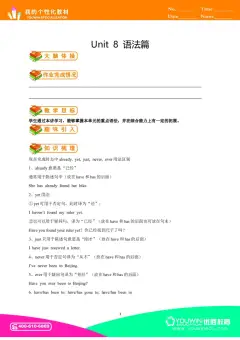
1.熟练掌握频度副词的意思和用法
频度副词
频度副词表示某一动作发生的频率或某一状态出现的频率,是副词的一种。常用的频度副词
有:always, usually, often, sometimes, seldom, never。
一、表示频度方面的区别
always     usually     often     sometimes    seldom      never
1. always 是频度最大的词,意为"总是;永远"。
I shall always remember my first day at school.  我将永远记住我上学的第一天。
2. usually 意为"通常",即很少例外,频度仅次于always。
What do you usually have for breakfast?  你通常早餐吃什么?
3. often 意为"经常",在频度上不如usually 那么频繁。
Li Ping often does his homework in the afternoon.  李平经常在下午做作业。
4. sometimes 意为"有时候",频度比often 小,表示动作偶尔发生,间断较大。
sometimes go to the library. 我有时去图书馆。
Sometimes I read a book in the evening.  我有时在晚上看书。
5. seldom 意为“很少”,表示动作很少发生。
I've seldom felt so happy.  我很少感觉如此幸福。
6. never 意为“从不”,表示动作从来不发生。
I never go to school late.  我上学从不迟到。
2
二、频度副词的用法
1. 频度副词在句中习惯上位于be 动词、助动词之后,行为动词之前。
She is often late for school. 她上学经常迟到。
He usually goes to bed at about 12. 他通常(午夜)十二点钟睡觉。
When do you usually get up in the morning?  早上你通常什么时候起床?
2. sometimes 是个特殊的频度副词,既可以放在be 动词、助动词之后,行为动词之前,也可
以放在句首,还可以放在句尾。
I sometimes think that it is a great mistake.  我有时想这是一个大错
Sometimes I help my mother in the house.  有时候我帮助妈妈做家务。
3. often 可以放在句中,也可放在句尾,习惯上不放在句首。
We have been there quite often.  我们经常到那儿去。
4. always 与进行时态连用时,并非表示动作正在进行,而是表明说话者带有赞赏、厌烦或批
评等感情色彩,意为“总是做某事”。
She is always helpful to others.   她总是乐于助人。(表示赞赏)
He is always playing computer games.   他老是玩电子游戏。(表示批评)
5.对频度副词提问一般使用疑问词组how often (多久一次)。
She is seldom late for school. (对划线部分提问) → How often is she late for school?

1. (浙江温州中考)---Do you often go shopping, Tina?
---No,


  . I don't like shopping at all.
A. always
B. usually
C. never
D. often
2.(2014 年江西南昌中考)My sister


  goes to bed early because she needs a lot of sleep
every day.
A. always
B. sometimes
C. hardly
D. never
3.(2014 年四川成都中考)Li Ke


  runs in the morning, for he wants to be healthy.
A. never
B. often
C. hardly
4. My mother always

  TV.
A. likes watching
B. like to watch
C. likes to watch
D. like watching
5.(2012 浙江宁波中考)---Zhang Lili, "the most beautiful teacher", has moved us deeply.
---Yes, and she is


  popular with her students.
A. sometimes
B. never
C. always
D. hardly
6.---Have you ever been to Disneyland?
---No,


  . I hope I can go there next year.
A. always
B. sometimes
C. never
D. often
解析及答案:
3
1. 可用“找关键词法”解题。由答语中No 及后句中的“not...at all(一点儿也不,根本不)”这些
关键词语可知,此处应用never(从不),故选C。
2. 由从句句意“因为她每天需要大量的睡眠”可推知我妹妹总是早上床睡觉,故选A。
3. 推理判断法。由“因为他想保持健康”可知often 符合逻辑,故选B。
4. 句意:我的母亲总是喜欢看电视。句子的主语是第三人称单数形式,排除选项B 和D;like
doing sth.表示经常或习惯性的行为,like to do sth. 表示偶尔或具体的行为,而句中的always 决定
了此处是表示习惯性的行为,排除选项C。故选A。
5. 答语承接上句句意,下句意为“是的,并且她总是受到她的学生们的欢迎”,故选C。
6. 由答语中的No 可知空格处应用表示否定意义的never,故选C。
基础演练
一、单项选择
 1. John is a good student. He

    late(迟到) for school.
A.
 never is
B.
 is never
C.
 are never
D.
 never are
 2. He is very lazy(懒惰的). He

    gets up early.
A.
 never
B.
 often
C.
 usually
D.
 always
 3. We

    English in the morning.
A.
 usually read
B.
 read usually
C.
 usually reads
D.
 reads usually
 4. Does he

    football matches?
A.
 often see
B.
 often watch
C.
 read often
D.
 watch often
 5. Maths is

    too difficult for me. I can't learn it well.
A.
 never
B.
 always
C.
 usually
D.
 seldom
答案:1-5 BAABB
二、用方框中所给的副词补全对话
Daming:Where are you going, Lingling?
Lingling:I'm going to the library.
Daming:Do you  1

   go to the library at weekends?
Lingling:NO, not often. Only
   2

   .But I hear Mo Yan has got Nobel Prize in literature. Chinese
writers    3

   get the prize. He's the first one. He's really great!
Daming:That's right. I

 4

  want to read his works after I hear the news. Let's go together.
Lingling:OK. Let's go. The library
  5

  open all day to people.
答案:1. often
2. sometimes
3.never
4.always
5. usually
巩固提高
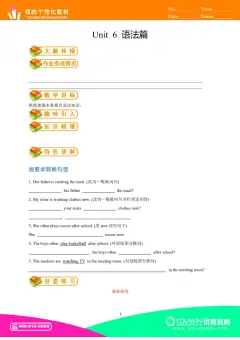
三、按要求转换句型
1. She often gets letters from my sister. (改为同义句)
always, usually, often, sometimes, never
4
She often


    my sister.
2. The boy always has a birthday party. (改为一般疑问句)


    the boy always

    a birthday party?
3. He makes a birthday card. (将never 加入到句中)


4. Does his grandpa always watch TV? (作出肯定回答)


   , he

   .
5. My birthday party is on Saturday. (对划线部分提问)


    your birthday party?
答案:
1. hears from
2. Does, have
3. He never makes a birthday card.
4. Yes, does
5. When is
四、翻译(根据中文提示完成句子)
1. 在美国的生日聚会上你们通常做什么?
What

    you

    at an American birthday party?
2. 我总是喜欢肉和鱼。(词数不限)
I

    meat and fish.
3. 托尼从不吃巧克力。(词数不限)
Tony

    chocolate.
4. 有时候我们制作生日贺卡。


    we

    birthday cards.
5. 在生日宴会上,我们经常吃面条,我们总是很高兴。(词数不限)
At the birthday dinner, we

    noodles. And we

    very happy.
答案:
1. do; usually do
2. always like
3. never eats
4. Sometimes; make
5. often eat; are always
一、单项选择
1. My favourite clothes

    T-shirts.
A.
 is
B.
 be
C.
 are
D.
 am
5
2. My brother usually watches football matches

    TV

    Sunday
morning.
A.
 at; on
B.
 on; on
C.
 in; in
D.
 on; in
3. Hamburgers are not healthy food, so I

    eat them.
A.
 always
B.
 usually
C.
 often
D.
 never
4. --- Do you often

    your brother?
--- Yes, I get a letter from him every week.
A.
 hear from
B.
 talk with
C.
 come from
D.
 write to
5. My friend, Jenny, usually

    blue shirts.
A.
 put on
B.
 wear
C.
 puts on
D.
 wears
6. Do you often

    magazines at weekends?
A.
 watch
B.
 look
C.
 see
D.
 read
7. Her sister spends much time

    her study.
A.
 in
B.
 on
C.
 at
D.
 with
8. His grandpa likes the film and often

    to the cinema.
A.
 go
B.
 goes
C.
 is going
D.
 to go
9. --- Would you like to come and play with us?
---

   , but I must look after my little brother.
A.
 I'd like
B.
 I'd love to
C.
 I'd like to do
D.
 I'd like so
10. --- Do you

    have parties?
--- Yes. Every Saturday evening.
A.
 always
B.
 never
C.
 often
D.
 ever
答案:1-5 CBDAD
6-10 DBBBC
二、完形填空
    Mr. Smith gave his wife ten pounds for her birthday. So the day after her birthday Mrs Smith went
shopping. She waited for a bus,got  1  and sat down beside an old lady. After a while she noticed that
the lady’s handbag was  2  .Inside it she saw a wad of notes (一叠钞票).They were just like what her
husband  3  her,so she quickly looked into her own bag. They were not there! Mrs Smith was sure that
the old lady had stolen them. She thought she would have  4  the police. But later she changed her idea.
She decided to take the money  5  the lady’s handbag and not to say anything about it. She  6  round
the bus to make sure nobody was watching,and then she carefully put her hand into the lady’s  7  ,
took the notes and put them into her own bag.
    When she got home that evening,she  8  her husband the beautiful hat she had bought.
    “How did you pay for it?”he asked.
    “With the money you  9  me for my birthday,of course,”she answered.
    “Oh! What’s that,then?”he asked  0  he pointed to a wad of notes—ten pounds on the table.
1. A. on
B. in
C. into
D. off
2. A. close
B. closed
C. open
D. opened
3. A. gave
B. had given
C. gives
D. has given
6
4. A. called
B. call
C. to call
D. calling
5. A. out
B. back
C. from
D. back from
6. A. looked
B. saw
C. turned
D. went
7. A. basket
B.bag
C. coat
D. pocket
8. A. gave
B. showed
C. gave to
D. showed to
9. A. gave
B. showed
C. gave to
D. showed to
10. A. when
B. while
C. as
D. after
答案:1-5 ACBCD
6-10 ABBAC
 _________________________________________________________________________________
 _________________________________________________________________________________
一、阅读理解
A
    My name is Emma. I'm an English girl. I'm in Beijing with my parents now. My parents work here.
Today is Friday, June 1. It's my birthday. It's Children's Day, too. It's hot. My father and mother don't go to
work this afternoon. They go shopping for my birthday party. In the afternoon I go to the Children's
Palace(少年宫) with my cousins and my friends. We sing, dance and play games together(一起). I have a
birthday party in the evening. I get many presents from my father, my mother, my cousins and my friends.
How happy I am!
1. Emma comes from

   .
A.
 China
B.
 America
C.
 England
D.
 France
2. --- What is the weather like today?
--- It is

   .
A.
 cold
B.
 cool
C.
 warm
D.
 hot
3. What do Emma's parents do in the afternoon?
A.
 They go to work.
B.
 They go to the park.
C.
 They go shopping.
D.
 They go swimming.
4. Emma goes to

    in the afternoon.
A.
 the park
B.
 the zoo
C.
 the Children's Palace
D.
 the Children's Cinema
5. Emma doesn't

    today.
A.
 sing or play games
B.
 do her homework
C.
 get any presents
D.
 dance or play games
B
7
    It is the last day of May(5 月) today. It is my grandpa's birthday. Father, mother and I go to see him.
    He lives with my uncle in a village(村庄). Early in the morning we buy a birthday cake and some
fruit, and then we go to his house by bus.
    My grandpa and uncle are very happy to see us. We give the presents to grandpa and say, "Happy
birthday to you!" He is very happy. Then we sit down to talk. My uncle goes to prepare(准备) lunch. At 4
o'clock we say goodbye to them and go back home.
6. My grandpa's birthday is

   .
A.
 yesterday
B.
 May
C.
 May 31st
D.
 May 1st
7. My grandpa lives

   .
A.
 with my father
B.
 with my uncle
C.
 with my mother
D.
 alone
8. What do we buy for grandpa?
A.
 Some books.
B.
 A birthday cake.
C.
 Presents.
D.
 A birthday cake and some fruit.
9. We

    with grandpa in his house.
A.
 talk and enjoy a nice lunch
B.
 prepare lunch with my uncle
C.
 talk and play
D.
 enjoy the birthday cake
10. Which sentence(句子) is wrong?
A.
 My uncle prepares lunch.
B.
 We take a bus to see my grandpa.
C.
 My grandpa is very happy to see us.
D.
 We get back home late(晚地) today.
C(重庆市巴蜀中学2014 年期末试题)
    Tom likes fish very much. He often buys some fish in the shop and takes it home. But when(当…的时
候) his wife sees the fish, she says to herself, "Good ! I can ask my friends to have lunch, and we can eat
the fish. They like fish very much, too."
      So when Tom comes home in the evening, the fish is not there and his wife always says, "Oh, your cat
eats it " And she gives Tom some bread for his supper. Tom is very angry. He takes the cat and his wife to
the shop near his house and weighs the cat. Then he turns to(转向) his wife and says, "My fish weighs one
kilo(公斤). This cat weighs one, too. My fish is here, you see, but then where is my cat?"
11. Where does Tom often buy fish?
A. in the shop
B. at home
C. in a school
D. from his wife
12.______eat the fish.
A. Tom
B. Tom and his wife
C. The cat
D. Tom's wife and her friends
13. What does Tom have for supper?
A. Some bread
B. The fish
8
C. Some rice and the fish                                D. Some fruit and chicken
14. What does the underlined word(划线单词) ”weighs” mean(意思是) in Chinese?
A.批评
B. 称重
     C. 宰杀
D. 驱逐
15. Which of the following is right?
A. Tom doesn’t like fish.
B. Tom’s wife eats the fish with Tom at home.
C. Tom doesn’t have lunch at home.
D. Tom can’t find the cat.
D
Mr. Green once worked in a big company. He was quite busy so that he couldn’t do any reading. So
he gave up his job and opened a bookshop in the center of the town. It wasn’t big but all the books were
nice and most people liked to buy some there. When the shop was closed, he could read at home. He knew
a lot and many learned people were glad to make friends with him.
It was Sunday and it was cold outside. Mr. Green was very busy. At nine in the evening all the
buyers left but a woman was still there. She was dressed up and seemed to be waiting for somebody there.
Standing by the shelves, she looked over the books one after another, and made them in a terrible mess. Mr
Green came up to her and asked, “Excuse me, madam. What can I do for you?”.
“Your books are not interesting at all,” said the woman, “I want a delicious one.”
“That’s easy,” Mr. Green smiled. He brought out a cookbook and said, “Here you are, madam.”
16.Why did Mr. Green change his job?
A. He didn’t like reading.
B. He was too busy to read books.
C. He liked the life in the center of the town.
D. He wanted to write a cookbook himself.
17.Most people liked to buy books in the shop because _______.
A. the bookshop was in the center of the town
B. all the books were nice cookbooks
C. it was very large
D. the books there were nice for people
18.Which is WRONG ?
A. Mr. Green liked to lend his books to the learned persons.
B. When Mr. Green came back home from the bookshop, he often did some reading.
C. Many learned people liked to make friends with Mr. Green.
D. At nine on that Sunday evening all the buyers left the bookshop except a woman.
19.From the story we know that “learned people” means _______.
A. people who are free
B. people who are studying hard
9
C. people who have much knowledge
D. people who have much money
20.What 's the most suitable ending of the story?
A. Mr. Green would make friends with the woman.
B. Mr. Green would teach the woman how to cook delicious food.
C. The woman left the bookshop without buying any books.
D. The woman bought many books in order to be a learned person.
答案:一、阅读理解
1-5 CDCCB
6-10 CBDAD
11-15 ADABC
16-20BDACC
课程顾问签字:                        教学主管签字: